



Abstract
Abstract
The international trade of Pakistan is highly concentrated on a few goods and markets. This study investigates macroeconomic behaviour of trade flow and explores potential trade markets for Pakistan using an augmented gravity model on a large panel of 47 cross-sections from 1980 to 2013. The result of standard gravity variables shows consistent findings with statistically significant t-statistics, whereas augmented variables reveal that relative price has a positive impact with lower price elasticity. The result of binary variables shows that Pakistan’s trade is more with countries having the same language, whereas lower trade is observed with bordering countries. The result of South Asian Free Trade Agreement (SAFTA) revealed ineffectiveness of regional integration on the creation of trade for Pakistan, whereas, bilateral free trade agreements (BFTAs) have created considerable trade. The finding of trade potential revealed exhausted potential with major trading partners and there is a need for greater trade diversification from exhausted to potential countries. It has higher untapped potential with Nepal, Iraq, India, Philippines and Jordan, respectively, in Asia, whereas European countries have the highest potential. The results concluded that Pakistan can diversify its trade from exhausted to potential countries through individual BFTAs and multilateral free trade agreements. South Asian countries should address their disputes and revisit SAFTA aiming to improve regional trade and growth.
Introduction
Trade diversification can be an engine for invention, innovation and economic growth by providing greater and/or new access to potential markets across the globe. Globalization induced increased international competition that resulted in the distortion of trade balance and economic growth in lower-specialized developing and least developed countries (see Abbas, 2014). The main problems with developing economies are high concentration and dependence of trade on few commodities and limited trading partners.
Pakistan is a small open economy because of its significantly low contribution to world merchandise trade and capital flow. It is a labour-intensive economy due to higher dependence on some lower value-added labour-intensive industries, that is, food and textile. Five major trading partners, dominated by the USA (15%), the UK (6%), Germany (5%), Hong Kong (1.2%) and the UAE (7.1%), account for 35.8 per cent of total merchandise exports (Government of Pakistan, 2015–2016). European Union (EU 28) is a major destination, accounting approximately 30 per cent of total merchandise trade. Dependence of trade on few goods and markets has resulted in higher venerability in export earnings. Moreover, the share of Pakistan in world merchandise trade is also considerably lower than other South Asian countries namely India and Bangladesh. Pakistan needs to enhance its domestic production and diversify trade across the globe for greater market share and economic growth.
Contemporary trade theories urge greater trade and market diversification for the achievement of sustainable growth and development. Intra-regional trade plays an important role in the process of trade diversification. South Asian countries have signed a regional free trade agreement for greater market access for trade diversification and expansion, known as South Asian Free Trade Agreement (SAFTA), which failed to create trade among member nations due to prevailing political tension and conflicts (see Abbas & Waheed, 2015; Gul & Yasin, 2011). Failure of SAFTA forced Pakistan and other members for other regional and bilateral trade agreements. Pakistan has signed bilateral free trade agreements (BFTAs) with Sri Lanka in 2005, Indonesia in 2006, China in 2006, Malaysia in 2007, Mauritius in 2007 and Afghanistan in 2010, for greater trade diversification and expansion. The effect of these BFTAs on international trade flow of Pakistan is not yet empirically investigated. This study modelled bilateral trade flow of Pakistan by incorporating BFTA and SAFTA in an augmented gravity model and explored the potential trade market using actual and predicted values of trade flow. If actual trade flow is less than predicted trade flow, it indicates untapped trade potential. The study provides a comprehensive framework for Pakistan to diversify and expand its international trade.
The rest of this study is organized as follows: the following section introduces gravity model of international trade, whereas a review of some selected empirical literature is presented later. The methodological framework and data sources are discussed after the literature review section. The estimated results are discussed in a separate section. The final section concludes the study with policy implications.
Gravity Model
The gravity model of international trade, introduced by Tinbergen (1962) and Pöyhönen (1963), describes the trade relationship between heterogeneous economies at various geographic distances. The model shows that the trade flow between countries and/or regions is directly proportional to economic sizes and negatively explained by the geographical distance.

where Tij is bilateral trade flow, Yi is domestic productivity measured by real GDP, Yj is income of a trading partner and Dij is bilateral distance. The log-linear form of the standard gravity model (1) is presented as follows:

where β0 is intercept and β1 and β2 are slope coefficients of GDP of trading country (Yi) and its partners (Yj) and β3 is coefficient of distance (Dij). The stochastic error encapsulates the effect of all other shocks and variables that can influence international trade flow.
Equation (2) is the standard gravity model which lacks valid theoretical foundations, as it only indicates a turnover relationship. Linnemann (1966) attempted to fill this gap by providing a theoretical foundation using the quasi-Walsarian model, whereas Anderson (1979) explained microeconomic foundations by driving the gravity model using the constant elasticity of substitution utility function. For a successful theoretical foundation, the model’s arguments should be consistent with the theory of trade based on imperfect competition and Heckscher–Ohlin’s model. The credit for a successful theoretical foundation, according to Frankel (1997), goes to Helpman and Kurgman (1985). Helpman (1987) derived the proportionate relationship between trade flow and country size, whereas Deardorff (1995) derived the gravity model using the Heckscher–Ohlin theory and included distance in the model. The standard trade theories based on the Heckscher–Ohlin and imperfect competition models only provide justification for inclusion of income and distance, that is, core variables; however, later empirical studies augmented the standard model by including additional variables.
Literature Review
The gravity model has been intensively used in empirical research to explore the behaviour of trade and capital flow across the countries and/or regional boundaries due to strong empirical justification and required theoretical foundations. Baier and Bergstrand (2001) investigated the impact of relative income, tariff liberalization, income convergence and transportation cost on bilateral trade flow among OECD countries by employing an augmented gravity model. The findings revealed that 67 per cent of trade among OECD countries are explained by GDP growth, 25 per cent by tariffs reduction and 8 per cent by reduced transportation cost. Zarzoso and Lehman (2003) examined trade flow between the EU and Mercosur countries using an augmented gravity model on unbalancing panel data from 1988 to 1996. The findings revealed a significant positive effect of exporters’ and importers’ GDP on the volume of bilateral trade flow. The population of exporter countries showed a significant negative effect, whereas the importer’s population has revealed significant positive effect. The number of other control variables, that is, income differential, exchange rates and infrastructure, also revealed a significant positive impact.
Batra (2006) used the augmented gravity model to explore the determinants of Indian trade flow and potential by incorporating various quantitative and qualitative variables, that is, real exchange rate (RER), common border, common language, common colonial history, landlocked and island. The result revealed that the bilateral trade of India is positively explained by its domestic output growth as well as partner country’s economic size, whereas geographical distance revealed a significant negative impact. The result of a common border and region revealed a significantly lower trade flow. Rahman (2010) investigated trade, creating the effect of various regional trade agreements (RTAs), especially SAFTA, on the bilateral trade flow of Bangladesh, by using an augmented gravity model on annual panel data. The augmented standard gravity equation incorporates exchange rate, BFTAs and other sets of dummy variables. In recent studies, Roy and Chatterjee (2013) used an augmented gravity model to address the effect of global financial crisis on trade among Asian economies, namely China, Malaysia, Singapore, Indonesia, Philippines, South Korea and India, from 1995 to 2009, whereas Mishra, Gadhia, Kubendran, and Sahoo (2015) examined India’s trade relations with other BRICS countries using an augmented gravity model on panel data from 1990 to 2010. Waheed and Abbas (2015) explored potential export markets for Bahrain with its 25 major trading partners using an augmented gravity model on panel data.
In Pakistan, there are some notable studies on the behaviour of bilateral trade flow and one notable study on the application of the model to explain remittance inflow by Abbas (2016). Among early contributions, Achakzai (2006) augmented the gravity model for the determination of trade potential of Pakistan with its 137 trading partners, consisting of 10 countries in the Economic Cooperation Organization (ECO), 15 countries in the EU, 7 countries in South Asian Association for Regional Cooperation (SAARC), 3 countries in North American Free Trade Agreement (NAFTA) and 102 other trading partners. Akther and Ghani (2010) examined trade creation from the regional integration of SAARC nations, SAFTA, using an augmented version of the gravity model via cross-sectional and time series data from 2003 to 2008. The panel’s least square estimation technique is used to investigate the impact of explanatory variables. Gul and Yasin (2011) investigated trade potential of Pakistan with its trading partners using the gravity model panel data of 42 cross-sectional units from 1981 to 2005. The study concludes with the existence of high trade potential with countries in Association of South East Asian Nations (ASEAN), EU, Middle East, Latin America and North America, while low potential is observed with countries in SAARC and ECO.
In more recent studies, Abbas and Waheed (2015) modelled Pakistan’s export flow with its 40 trading partners using an augmented gravity model and also explored potential export markets. The study employs panel random effect model (REM) on balance panel from 1990 to 2011. Their model also incorporated a binary variable for SAFTA and found a negative and statistically significant impact. The review of literature did not find any reliable study that explores the effect of various BFTAs signed for greater economic integration through trade. This study investigates trade flow of Pakistan with its global trading partners, using an augmented gravity model on a large sample of 47 cross-sections from 1980 to 2013, aiming to explore macroeconomic determinants of trade flow and determine potential trade markets. BFTAs of Pakistan are first time incorporated in the augmented gravity model to explore trade creation from these agreements.
Methodology
Modelling Strategy
The standard gravity model urges that bilateral trade flow between countries or regions is explained by income levels of countries involved and the geographic distance between them. The standard gravity equation (Equation [2]) is augmented by incorporating additional qualitative and quantitative variables, that is, real exchange rate (RER), and binary variables for bordering countries, common language, SAFTA and BFTA. The augmented gravity model used in the study is presented in Equation (3).
LnTijt

where the dependent variable Tij presents the total trade (export + import) flow of Pakistan with its global trading partners; the explanatory variable Yi represents the real domestic product of the trading country; Yj is the real income of trading partners; Dij presents bilateral distance in km between capital cities; and RERij indicates the RER of Pakistan with respect to trading partners. The binary variable BDRij indicates a common border and CLij represents a common language (English as the official and/or national language). The binary variable SAFTA indicates South Asian free trade agreement, BFTA indicates bilateral free trade agreements, whereas μit presents white noise error term.
The real gross domestic products of Pakistan (Yi) and trading partners (Yj) are in million US dollars, which indicates domestic productive capacity and partner countries’ market size, respectively. The coefficients β1 and β2 are expected to be positively associated with bilateral trade flow. The bilateral distance (Dij) is an important variable as it encapsulates all trade-distorting factors associated with geographical distances. The greater distances are associated with greater transportation costs and hence coefficient β3 is expected to be negatively associated with bilateral trade. The bilateral RER of Pakistan with its trading partner is not directly available and is generated using nominal exchange rate and relative prices under purchasing power parity conditions. Equation (4) presents the index used to calculate RER.

where RER ij is the bilateral exchange rate, Pj is price-level trading partner and Pi is domestic price level measured by the respective GDP deflators (GDPD). The increase in RER reflects deprecation of domestic currency and is positively associated with exports and negatively associated with imports. The impact of RER is yet to be determined.
Besides these quantitative variables, many qualitative variables can also affect the volume of bilateral trade flow, that is, countries tend to trade more with bordering countries and countries with the same language. In order to explore the effect of a common border on bilateral trade, a dummy variable is incorporated by valuing 1 for bordering countries. Similarly, the binary variable for a common language is generated, valuing 1 for countries with English as either the official or the national language. In order to encapsulate the effect of SAFTA on bilateral trade flow of Pakistan, a dummy variable is created, valuing 1 for member countries; similarly, the binary variable for BFTA is created to explore their relative impact on bilateral trade flow of Pakistan.
The coefficients obtained from the regression model are used to investigate trade potential of Pakistan with its global trading partners using actual and predicted value of trade flow. The index used to estimate trade potential is presented in the following equation:

where TPijt is trade potential
Estimation Strategy and Data
The panel data combine both time series and cross-sectional observations, thus providing more informative data, that is, more variability, less collinearity, more degree of freedom and more efficiency. The panel data are related to individuals, firms, states and countries over time, therefore have endogeneity and heterogeneity problems. There are various panel regression models based on the treatment of this unobserved individual heterogeneity in each cross-sectional unit, that is, panel ordinary least square (OLS) estimation, panel random effect model (REM) and panel fixed effect model (FEM). Panel OLS disregards the space and time dimension assuming no individual heterogeneity in the model. Panel FEM captures individual-specific heterogeneity through the intercept term using dummy variables and therefore sometimes is called the least square dummy variable estimation technique. It correlates individual-specific variation with regressors and is not applicable if the model contains any time-invariant series. However, panel REM assumes that the individual cross-sectional units are randomly drawn from a large population with constant mean. Individual heterogeneity is a deviation from the constant mean value and captures it by a component in the composite error term, therefore also called the error component model. If the individual error component of one or more regressors is correlated, then the REM estimators will become inefficient and biased (Greene, 2002).
The geographic distance in the present study is time invariant, hence panel FEM is inapplicable for the present study. Now, if we relate unobserved heterogeneity with the error component by using REM, it would lead to autocorrelation, resulting in bias estimates. This study, therefore, used the panel generalized least square (GLS) estimation technique to explore the impact of selected variables on bilateral trade. The GLS with cross-sectional weightages can address heterogeneity and endogeneity issues and provide better estimates.
The balanced panel work file is constructed for 47 major global trading partners 1
The selected 47 cross-sectional units are Argentina, Australia, Austria, Bahrain, Bangladesh, Belgium, Brazil, Bulgaria, Canada, China-Hong Kong, China-Mainland, Denmark, Egypt, Finland, France, Germany, Greece, India, Indonesia, Iran, Iraq, Italy, Japan, Jordan, Kenya, Korea, Malaysia, Mauritius, Mexico, Morocco, Nepal, Netherlands, New Zealand, Norway, Philippines, Portugal, Saudi Arabia, Singapore, Spain, Sri Lanka, Sweden, Switzerland, Thailand, Turkey, United Arab Emirates, the UK and the USA.
Analysis
Determinants of Trade Flow
The analysis of the macroeconomic determinants of the bilateral flow of Pakistan is conducted by constructing three models. The distance and some binary variables used are time inconsistent; therefore, panel FEM is not applicable. The first model tested the standard gravity model and the remaining two models estimated the augmented gravity model using panel GLS and panel REM. The estimated results are presented in the Table 1.
The result of the standard gravity model, as shown in Equation (2), shows that the trade flow of Pakistan is positively determined by its domestic product, Yi, and the productivity of the trading partner, Yj, whereas negatively determined by the bilateral distance, Dij. The findings thus validated the applicability of the gravity model. The result of the expanded gravity model revealed that a 1 per cent increase in domestic production Yi is associated with an increase in the trade flow by 0.94 per cent, whereas an increase in the productivity of trading partners is associated with an increase in the volume of bilateral trade by 0.72 per cent. The distance Dij shows that a 1 per cent increase in bilateral distance reduces the volume of bilateral trade flow by 1.22 per cent.
Determents of Bilateral Trade Flow

Potential Trade Markets
Potential Trade Markets for Pakistan
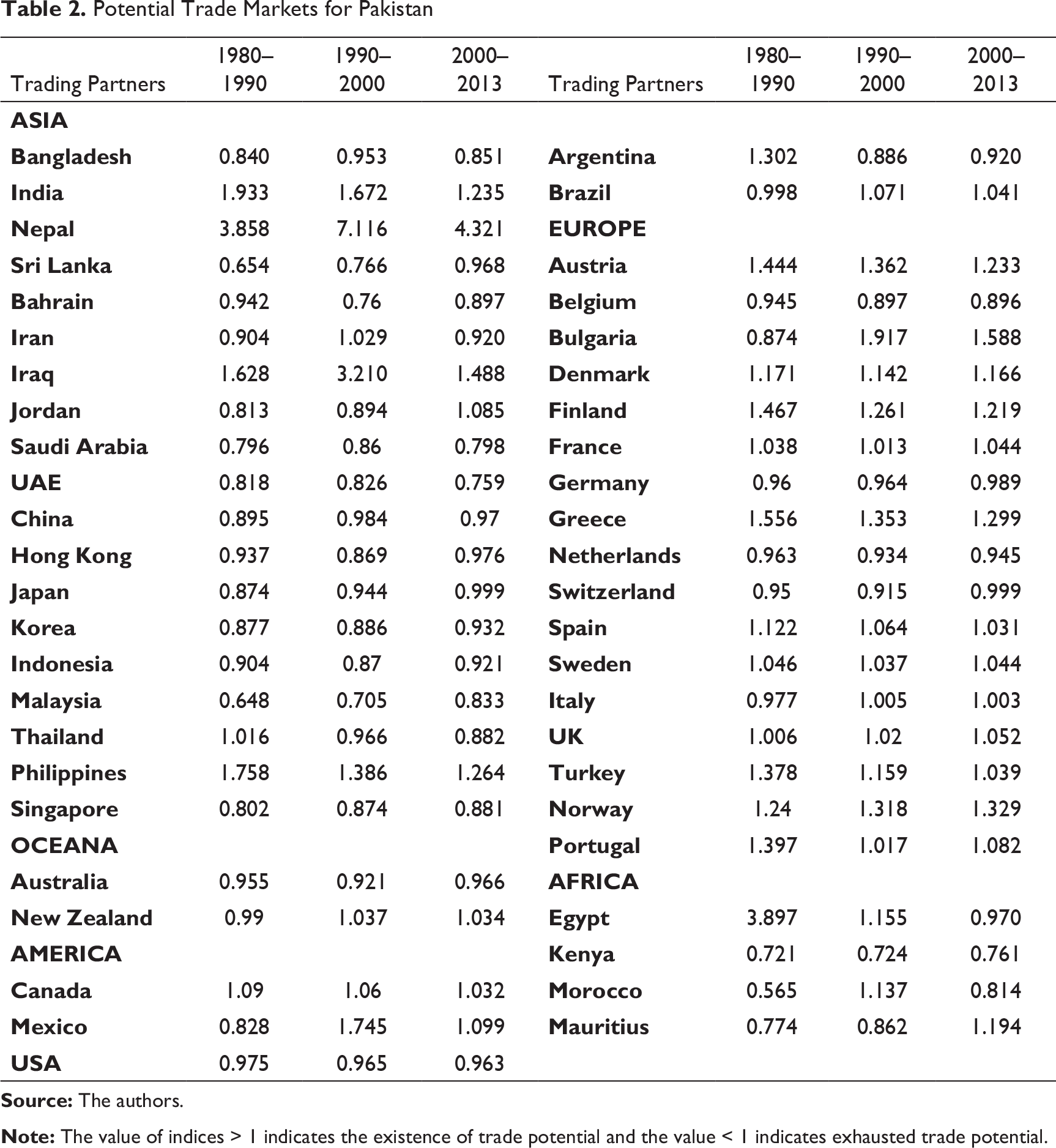
The selected simple size is divided into three periods, that is, 1980–1990, 1990–2000 and 2000–2013, for the comparative analysis of trade performance and potential. Results in Table 2 show that the Pakistan has high trade potential with selected South Asian countries such as Nepal, Sri Lanka, and India, respectively; whereas, among other selected Asian countries only Iraq, Jordon, Hong Kong, and the Philippines have respectively high potential. Besides these, Pakistan has trade potential with both Australia and New Zealand, in Oceana. The result of selected Africa countries reveals exhausted trade potential except Mauritius. Europe and North America have emerged as the most potential regions for international trade with Pakistan. In North America, the USA, Canada and Mexico revealed a high potential. In Europe, Greece, Bulgaria, Norway, Finland, Austria, Denmark, France, Switzerland, Spain, Sweden, UK, Turkey and Portugal, respectively, show a high trade potential. The trade potential of Pakistan with countries having BFTAs shows exhausted potential.
Conclusion and Implications
Globalization and trade liberalization have enhanced international competitiveness and considerably distorted trade balance and economic growth in lower-specialization developing economies. Trade diversification can be an engine for invention, innovation and growth if successfully implemented. International trade of Pakistan is highly concentrated in some industries and trading partners which can deteriorate trade balance and impede growth rate.
This study investigates the determinants of bilateral trade flow and explores potential trade markets for Pakistan among the selected 47 trading partners from 1980 to 2013. The dependent variable is bilateral trade flow, which is explained by domestic GDP, GDP of trading partners, geographic distance, relative prices, common language, common border, BFTAs and SAFTA. The estimated result shows that bilateral trade flow of Pakistan is positively determined by domestic GDP and GDP of trading partners, whereas negatively by geographical distance. The result of augmented variables revealed that RER has a positive but insignificant impact on trade, indicating the price inelastic nature of Pakistan’s external trade. The result of the binary variable shows greater trade with countries having the same language, whereas considerably lower trade is observed with bordering countries. The result of SAFTA shows a significant negative impact, which implies its ineffectiveness in the creation of trade for Pakistan, whereas BFTA has created considerable trade. South Asian countries should revisit regional free trade agreements for greater connectivity and trade, and Pakistan can use BFTA as an instrument for greater trade diversification and expansion.
The result of trade potential has revealed that Pakistan has exhausted its potential with major trading partners and urges diversification towards potential economies. This study found high trade potential with countries in Asia and Europe. Pakistan can diversify its trade with Nepal, Iraq, India, Philippines and Jordon in Asia; New Zealand in Oceana; Canada and Mexico in America; Mauritius in Africa; and Bulgaria, Norway, Greece, Austria, Finland, Denmark, France, Switzerland, Spain, Sweden, the UK, Turkey and Portugal in Europe. In order to effectively diversify its trade, Pakistan needs to develop its existing industries and new industries targeting diversified markets. Future research can move in any direction but the exploration of behaviour of imports can provide a better picture.
Footnotes
Acknowledgement
The authors are grateful to the anonymous referees of the journal for their useful comments and suggestions. Usual disclaimers apply.
Declaration of Conflicting Interests
The authors declared no potential conflicts of interest with respect to the research, authorship and/or publication of this article.
Funding
The authors received no financial support for the research, authorship and/or publication of this article.