




Abstract
Although considerable research efforts have focused on bereavement outcomes following loss, there are few studies which address the role of memorialization, particularly as it relates to formal service provision. Currently the funeral, cemetery, and crematorium industries are observing a steady decline in traditional and formal memorialization practices. This study aims to identify current memorialization practices and emerging trends, highlight key priorities for improving service outcomes for the bereaved, and understand the implications of changing consumer preferences for service provision. The study’s qualitative research design incorporates two phases, a scoping literature review followed by in-depth interviews with eight service providers from the funeral, cemetery, and crematorium industries. A key finding is that the trend toward contemporary and informal memorialization practices blurs the lines between the role of consumers and service providers. There is a clear opportunity for service providers to engage in community education as a means of building supportive relationships with and improving service outcomes for the bereaved.
Introduction
Over the last 30 years, empirical studies of the experiences of loss, grief, and bereavement have proliferated (Woodthorpe, 2011). Despite this, there has been relatively little research about the influence of memorials and memorialization on these experiences (Holloway, Bailey, & Hukelova, 2017). Bereavement is largely shaped by sociocultural factors (Anderson, 2010; Corless et al., 2014), with several cross-cultural studies indicating that responses to death are not universal (Eisenbruch, 1984a, 1984b; Klass, 1999, 2000). Similarly, societies form beliefs, values, and practices surrounding memorialization that are subject to change over time (Anderson, 2010; Appel & Papaikonomou, 2013). There is mounting evidence to suggest the rise of new and diverse memorialization practices, expressing shifting sociocultural responses to the experience of bereavement and provoking further enquiry among industry practitioners and researchers (Schafer, 2016).
In a society with increasingly diverse belief systems, the bereaved search for meaningful ways to grieve, contributing to the contemporary notion of consumer choice now present within the death care industry (Anderson, 2010; Vale-Taylor, 2009). While the funeral, cemeteries, and crematoria industries bundle services to include ceremony, body disposal, and memorialization, consumption of these services is often circumstantial, rather than driven by genuine consumer choice (van der Laan & Moerman, 2017). Exemplified by rising cremation rates and memorialization practices taking place in public spaces, consumer preferences are changing (IBIS World, 2018; van der Laan & Moerman, 2017). Several trends contribute to these changes, including the declining role of formal religion, lack of burial space in metropolitan areas, increased cost of burials, concern for the environmental impact of burials, and the costs of body transportation in a globalized world (IBIS World, 2018).
Objectives
Formal service providers from the funeral, cemetery, and crematorium industries have collectively observed a marked shift away from traditional forms of memorialization.
The Australasian Cemeteries and Crematoria Association, concerned about the wider societal implication of these trends, commissioned this study, with three objectives:
Establish current memorialization practices and emerging trends Highlight key priorities to improve service outcomes for the bereaved Understand the implications of changing consumer preferences on service provision
Methodology
This qualitative research design incorporated two phases, a scoping literature review, followed by in-depth interviews with eight key service providers from the funeral, cemetery, and crematorium industries across Australia.
Phase 1: Scoping Literature Review
A scoping literature review is particularly useful where an area of research is complex and has not previously been reviewed comprehensively, as is the case with memorialization (Arksey & O’Malley, 2005; Mays, Roberts, & Popay, 2001; Wilson, Lavis, & Guta, 2012).
Scoping reviews enable easy identification of gaps within extant literature and highlight opportunities for original contribution to knowledge (Armstrong, Hall, Doyle, & Waters, 2011; Landa et al., 2011; Peterson, Pearce, Ferguson, & Langford, 2017). A scoping review provides a narrative integration of evidence (Peterson et al., 2017), useful to practitioners, policy-makers, and researchers, eliminating duplication of effort and guiding future research (Armstrong et al., 2011). A scoping review also offers the opportunity to integrate practitioner perspectives through consultation with key stakeholders, particularly relevant given the industry-specific nature of this study (Arksey & O’Malley, 2005; Levac, Colquhoun, & Brien, 2010).
Search strategy
In undertaking the scoping review, a thorough search of academic literature, industry reports, and main stream media was conducted, focusing on studies linking grief and bereavement with memorialization practices. Databases utilized in the search for published academic literature included: CINAHL Plus, MEDLINE, EMBASE, Scopus, PsychINFO, Science Direct, Scopus, Web of Science, Sociological Abstracts, Anthropology Online, Anthropology Plus.
Search terms
The list of search terms included: grief, bereavement, loss, funerals, cemeteries, crematoria, anticipatory grief, prolonged grief, memorialisation, memorials, ceremonies, memorial plaques, headstones, mourning. Because of the scarcity of studies linking grief and bereavement with memorialisation practices, hand searches were conducted using various combinations of search terms. For example, “memorialisation” and “grief” or “memorialisation” and “bereavement” or “memorial” and “cemetery.”
Inclusion criteria
The search was limited to studies published in English, from the year 2000 onwards, to ensure timely and relevant evidence. Four searches were conducted, two focusing on academic research, yielding 51 relevant articles, and two on industry and main stream media resources, yielding 43 relevant articles. These 94 references were analyzed thematically, paying particular attention to memorialization trends. The search process, while rigorous, was also iterative, allowing for the inclusion of unexpected sources of relevant information that may have otherwise been omitted (Wilson et al., 2012). Seminal articles were traced using the reference lists from more recently published works to ensure threads pertaining to memorialization remained intact. As a result, articles published prior to 2000 were included where pertinent. The fifth and final search identified 116 additional sources, a total of 210 references for inclusion.
Phase 2: Industry Interviews
Sampling strategy
Invitations to participate in this research were extended exclusively by e-mail to industry members of the Australasian Cemeteries and Crematoria Association, constituting a purposive sampling strategy. Eight industry members expressed their interest and their details were passed on to the research team, who contacted members via phone and e-mail to provide further information about the study and consent forms.
Data collection and analysis
Eight semistructured in-depth telephone interviews were conducted between August 27 and September 3, 2018, with interviews ranging in length between 35 and 80 minutes, with an average duration of 60 minutes. Interviews were audio-recorded with the written and verbal consent of the participants for the purpose of transcription. The interview protocol was based on the research objectives and preliminary findings from Phase 1. The interview recordings were transcribed, coded, and analyzed thematically by the research team. The resultant themes were then compared and contrasted with those that previously emerged in the scoping literature review.
Participant profile
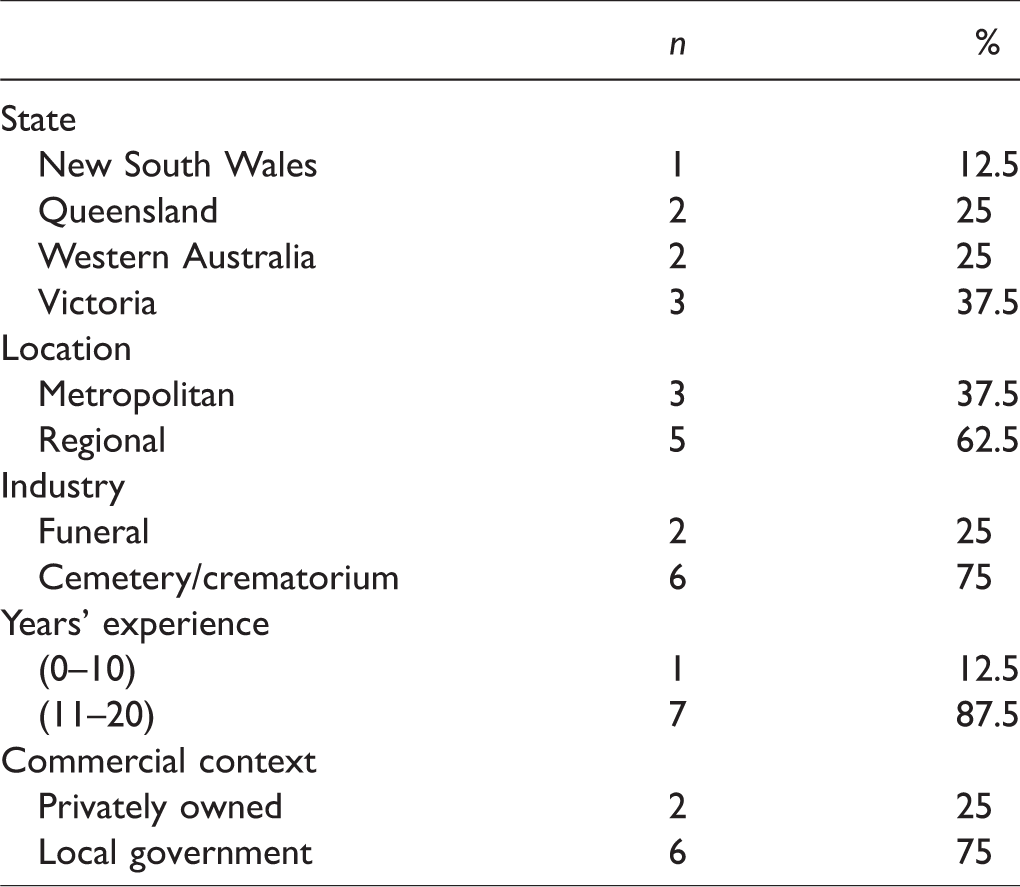
An overview of participant characteristics is provided in Table 1. The interview participants were from metropolitan and regional areas in four states within Australia: New South Wales, Queensland, Western Australia, and Victoria. The majority of participants (six out of eight) represent the perspectives of the cemeteries and crematoria industries, while the remainder (two out of eight) represent those of the funeral industry. The commercial context in which interview participants operate should be noted, with the minority (two out of eight) from a privately owned business and the remaining majority (six out of eight) operating under the jurisdiction of local government and trusts.
Interview Participant Profile (n = 8).
Findings
Phase 1: Scoping Literature Review
This scoping literature review established specific memorialization practices linked to digital memorialization, special relationships, and the nature of loss in existing research. In the following outline, recommendations from prior research are summarized outlining priorities for the industry to improve service delivery and outcomes for the bereaved.
Digital memorialization
Due to technological advancement and the widespread use of social media platforms, the idea that bereaved individuals have digital needs has become apparent (Roberts, 2012) with the sharing of memorialized photos of the deceased increasingly common (Gibbs, Meese, Arnold, Nansen, & Carter, 2015; Nansen, Kohn, Arnold, Van Ryn, & Gibbs, 2017). Moreover, the death of a loved one is also a common trigger for an increased interest in online family history research as a means of creating a legacy (Neilson & Muise, 2016). With many families separated by geographical distance, online memorials offer an accessible alternative to a fixed, physical memorial as an outlet for emotional expression (Mitchell, Stephenson, Cadell, & Macdonald, 2012; Veale, 2004; Walter, Hourizi, Moncur, & Pitsillides, 2012). Even where traditional physical memorials such as gravesites are accessible, 76% of bereaved people reported more frequent visits to the online memorial space (Roberts, 2004).
The dynamic nature of online memorials is the main source of appeal and key point of difference (Hess, 2007; Roberts, 2004). Additional benefits include unrestricted accessibility, without interruption from or imposition upon others, providing mourners with a sense of anonymity, privacy, dignity, and neutrality (Hallam & Hockey, 2001; Mitchell et al., 2012; Williams & Merten, 2009). Online memorials strengthen existing relationships and aid in the creation of new communities, with over 90% of users reporting their participation had been beneficial in their bereavement (Roberts, 2004). Memorial websites provide a socially acceptable way to create links with others who have experienced a similar loss, marking continuing bonds and ongoing communication with the deceased (Roberts, 2004; Walter et al., 2012; Williams & Merten, 2009). An ongoing “dialogue” with the deceased is common, documenting one side of a conversation as if the other, deceased, person was listening (Kasket, 2009; Walter et al., 2012).
Special relationships
While bereaved parents do engage with traditional forms of memorialization, personalized practices are of greater significance and include activities such as build-a-bear, scrap books, commemorative jewelry, car stickers, Christmas ornaments, balloon releases, tattoos, volunteering, and random acts of kindness undertaken in memory of the deceased child (Cacciatore & Flint, 2012). Those who have lost a child may also rely on the internet to express their grief, capitalizing on its usefulness in connecting isolated individuals with shared experience (Mitchell et al., 2012). For some, a formal burial within a cemetery evokes a sense of anxiety, with bereaved parents perceiving their child as being “out there” all alone, resulting in the compulsion to visit every day (Schwab, 1990).
Given the lack of public acknowledgement of the grief in losing a close animal companion, bereaved pet owners often create their own private memorialization practices (Zinner, 2016). There are varying forms seen around the world, demonstrating a widely accepted sociocultural construction of animal companions as family (Zinner, 2016).
Although legislation in Australia prohibits the combined burial of humans and animals in cemeteries, many pet owners opt to cremate their deceased animal companion with the intention eventually to be buried with these cremains (Chur-Hansen, 2011).
Nature of loss
Those bereaved by a death that is sudden or violent in nature may seek more meaningful ways to preserve the memory of the deceased beyond the bounds of a cemetery (Clark & Franzmann, 2006). There is a tendency toward fashioning spontaneous public memorials at the scene of a violent crime or accident, often aided by promotion from mass-media and social media communications (Gibson, 2011). The main motivations for private memorial building in public places are grief, the power of presence, and importance of place (Clark & Franzmann, 2006). Current research focuses on memorialization surrounding motor vehicle accidents, suicide, and homicide.
Memorials at the roadside are increasingly common as a metaphysical attachment to the place of death, rather than the final resting place of the deceased (Breen & O’Connor, 2009; Gibson, 2011). This practice challenges the notion of space as public or private or secular or sacred and facilitates an open-ended grieving process for the bereaved (Clark & Franzmann, 2006). Similarly, the notion of public secular space as private sacred space also applies to those bereaved by suicide, with survivors often retracing the final steps of the deceased as a private pilgrimage (Simone, 2010). For survivors of suicide, online memorialization sites such as Facebook are an important supplement to the physical grave (Chapple & Ziebland, 2011; Krysinska & Andriessen, 2015), offering a new way to come to terms with loss and resulting in a positive impact on survivors’ mental health (Bell, Bailey, & Kennedy, 2015). For those bereaved by homicide, loss is magnified and grief adjustment more challenging (Bottomley, Burke, & Neimeyer, 2017). Memorialization practices that focus on the life of the deceased prior to the violent ending may facilitate healing and adjustment to grief (Anderson, 2010).
Service improvement
Bereaved consumers are largely led and constrained by the products and services on offer (Nansen et al., 2017). Thus, it is necessary for funeral providers to balance the needs of the bereaved with their commercial interests (Nansen et al., 2017). Despite active professional associations, and legislation in place to protect consumers, research calls for increased transparency within the funeral industry to improve consumer awareness and minimize predatory pricing practices (van der Laan & Moerman, 2017). Although consumers can, in most cases, organize all aspects of a funeral without a funeral provider, there is little awareness in the community at large of alternative courses of action (van der Laan & Moerman, 2017). This may be, in part, due to the institutionalization of death, with 86% of Australians dying in an aged-care facility or hospital (Grattan Institute, 2014), where the bereaved are advised to contact a funeral director shortly after the death (van der Laan & Moerman, 2017). Similarly, within aged-care facilities across Australia and the United Kingdom, service provider policies state that funeral and disposal decisions must be disclosed prior to admission (Froggatt, Vaughan, Bernard, & Wild, 2009; Lyon, 2007).
Phase 2: Industry Interviews
Following the Phase 1 scoping literature review, in-depth interviews with industry showed that factors affecting current memorialization practices include a shared definition, identifying the role of service providers and the importance of place. The service providers interviewed offered their perspectives on key priorities for improving service delivery and bereavement outcomes. Challenges include a lack of industry integration and family dynamics, while opportunities are identified within developing trends and increasing community integration.
Shared definition
In establishing a shared definition of “what memorialization is,” service provider sentiments ranged from the notion of “remembering” to the concept of “continuation.” Memorialization practices are essentially understood as a means of making tangible the intangible. It’s a continuation of that person … when someone dies you’ve lost the ability to care for that person like you did, you could physically touch them, it’s the transference of that care from someone to something. (P1)
Role of service providers
Service providers predominantly view their role in memorialization as one of facilitation, focusing on their functional benefit to society by lawfully disposing of human remains and maintaining historical records. It’s important as an identifier for the future generations, future historians … to identify that this person was in fact alive at some stage and meant something to someone, or just contributed to the world. (P1) I get people that ring me and say Dad’s just died, what do I do? Some people just don’t know, some people aren’t aware of the process. But I think people are a bit more tuned in nowadays, especially the younger generation with the internet they can just quickly type in what do I do if someone dies … you Google it, it’s got all the answers. (P7) The family can perform an informal service of their own which seems to becoming more popular … I think that a lot of families are still unaware … they seem to think they need to go through a funeral director for the arrangements. (P4) And a lot of them are uneducated to know that they can split ashes. They can put half in their favorite place and half within the cemetery with a memorial, which is going to hopefully help them through the bereavement process. (P4) All they want to do is what their loved one wanted, so we see them a little bit more relaxed … they’re not having to make a decision in their grief state. They’ve had somebody make that decision for them, and it’s like this sense of relief. (P8) If there’s 200 options, you don’t say to the family here’s 200 ways you can be memorialized, you’ll often try to match the family to the type of memorialization that you think is right for them. (P6)
Importance of place
Service providers perceive their role in maintaining a place or purpose-built space for the bereaved to gather as an important component of facilitating the memorialization process. There’s still a need for a sense of place, somewhere to go, to congregate, to meet, to talk … for a lot of people that’s sufficient, to just be in a place. (P5) You often see families coming all together here on birthdays and special days for them, they all spend time and have food and just be together. (P5) We get people who run, ride, walk their dogs, every morning, every night through our park, they use it as open space. I think that more and more we’ll see councils and urban planning identifying cemeteries as open space environments. (P8)
Lack of industry integration
Service providers maintain their greatest challenges are multifaceted, arising from a combination of legislation, industry structure, and increasing competition. For cemeteries and crematoria in particular, there is a lack of opportunity to build client relationships. It’s really hard to talk to them about memorialization options because we haven’t built a relationship, their relationship is with the funeral director. (P8) If the funeral directors stated to families ‘go and visit the cemetery, they’ll look after the next stage for you’, that would be a huge benefit and memorialization would benefit families in the continuation of their grief journey. It would also just show that there’s more people in their community that can help. (P1) If a family has had a good experience through the funeral process, they seem to manage a little bit better when they come to us … the ones that have had a bad funeral experience, come with a very negative attitude about what’s next. (P5) Funeral companies now are big corporations … so, it’s difficult to get involved in the community without them thinking that you’re trying to get some sort of financial benefit out of it. (P4)
Family dynamics
Service providers described family dynamics on a continuum between dysfunctional and exuding a sense of belonging, with bereavement outcomes reflecting this variation. For families that go through the bereavement and grief and then the memorialization, it can be just so wonderful and perfect and so beneficial, but sometimes there is a flipside to that. (P2) Perhaps one person might not think that the other is a suitable person of authority, or somebody is kept away, kept out of being allowed to be part of the memorialization or the funeral arrangements, and that’s very difficult and hurtful for everybody concerned. (P2) We had a person who prepaid their burial, prepaid their location, and after they died the brother came in and changed it, and had him cremated and took the refund … he was the executor, so the deceased have no right. (P8)
Developing trends
Service providers observe the impact of increasing globalization leading to memorialization practices separated from disposal, both physically and temporally. We have a lot of people who have family members that pass away overseas, so they want to memorialize here … it wasn’t actually her mum’s remains, but sand and rocks from her burial site in Dubai. (P5) And when you go through all those different steps that they do need to do, I find most of them realize it’s not something that they’re prepared to do themselves, and that’s when they’ll employ the use of a funeral director to do those things for them. They don’t see themselves as being able to pick dad or mum up, dress mum, put mum in a coffin, take her home to the house, those sorts of things I think are very confronting for the families. It’s something that, I know there is a movement towards it and I believe that it will gain momentum. (P4) I’ve had people come back again and again and say how great that was. It’s a lot of pressure for the main one involved because there’s a lot of work to do, but they definitely benefit out of it. I think they feel like it’s been a more appropriate funeral for the person that’s died, they feel that they’ve done exactly what they wanted. I’m sure the long-term benefits will be better, they feel they’re more involved. (P7) We’re seeing more funerals at golf clubs, yacht clubs, family’s homes … you’ve got to come up with new options … we’ve negotiated with some reception centers in the past … some say “no our staff don’t want to have a coffin on site, sorry.” (P6) Ancestry.com means that genealogy has become a big deal. So, people are tracking all that information, and part of what you can record is where they’re buried and where they’re memorialized. (P6)
Community integration
The opportunity to educate communities as a means of increasing awareness around death, grief, and bereavement evoked polarizing views among service providers. While some were willing to assume responsibility for educating communities, others saw themselves as ill-equipped. I think more education would benefit everybody … .if people don’t know what their options are, then they don’t know what they should do … it’s up to us to educate our communities on how different options might suit their situation. (P3) It’s so far out of our jurisdiction as how our function is defined currently … when we’re talking to families and we really get a sense that the families are struggling so much, and there’s a sense of urgency that they really are in need of help, we do have on hand booklets and contacts. (P2) We are moving to a business model rather than a community service model … and what does that mean if you want to be in the business of cemeteries? How does that translate into dollars and staff and land? (P5) I’d hate to become too business minded … as long as we cover costs, and make a little bit of money out of it to cover future costs of maintaining gardens, that’s our aim rather than achieving targets. I think it depends on the staff … if you have people who might be revenue driven but still community minded … if they can get a balance in there it can work out okay … but if you’re just all about the dollar I think it would detract from how people cope. (P7) We’ve got a university here that has a body donation program … the family haven’t had a funeral, they haven’t had their loved one returned to them at all and they really need somewhere to memorialize. (P5)
Discussion
A scoping review of the literature and in-depth interviews with industry have helped identify memorialization practices and highlight priorities for improving services.
Current Memorialization Practices
It is clear that the innate human need to memorialize remains unchanged, but the way in which the bereaved choose to memorialize the deceased is undergoing rapid transformation. This aligns with the view that memorialization is subject to change over time as a material response to handling death and dying within a sociocultural context (Janson, 2015). It is apparent that consumers are opting for a personalized amalgamation of traditional and contemporary social practices surrounding memorialization to fulfill their individual needs (Walter, 1994).
Practitioners understand memorialization practices as a means of making tangible the intangible and recognize their main role as facilitators of memorialization for the bereaved. Consumer perspectives within mainstream media similarly suggest the bereaved wish to be guided in such a way. Somewhere in the public health system there needs to be a facilitator, like prenatal classes, to inform us of all that is possible. And to do it at the other end of life and be guided by what [the family and the deceased] want to do. (Power, 2017)
Key Priorities for Improvement
Increased community involvement and a demand for consumer choice have inadvertently led to tension between cemeteries, crematoria, and funeral providers. Competing for consumers’ time and money was referred to, both implicitly and explicitly, by industry practitioners as a major challenge. A lack of industry integration coupled with a shift from community service models to commercial models of operation has further exacerbated the issue.
The relational dynamic of families was perceived by industry practitioners as a barrier to effectively engaging the bereaved in memorialization. Family dynamics shape families’ perceived value of funerals (Schafer, 2016) and memorials. The splitting of ashes may be an effective option for those in disagreement.
Consumers are moving away from formal service provision and expressing an interest in “DIY” alternatives. This trend is attributed to cost, the wishes of the deceased, and the notion that professional means impersonal. Despite this, families are often deterred by the complexity of this undertaking and “hand things over” to a funeral director. For the industry to convert these “insurmountable” tasks into easy-to-follow instructions may be of great benefit to service providers and the wider community. Bereaved people clearly appreciate the instrumental, informational, and emotional supports provided by funeral providers (Aoun, Lowe, Christian, & Rumbold, 2018).
While service providers felt it was their role to educate communities about their products and services, the topics of grief and bereavement were not embraced with the same level of certainty. Service providers should be encouraged to recognize their experiences with death, grief, and bereavement as intangible assets that are highly valuable and reimagine ways in which they may be able to share their pragmatic wisdom with the wider community.
Fostering a sense of community may rely upon the service providers’ abilities to engage the local community, in a timely and consistent manner, to build trust in their ability as “professionals” to offer guidance. We note in this regard that funeral providers were rated among the most helpful sources for bereavement support after families and friends (Aoun, Breen, White, Rumbold, & Kellehear, 2018).
The changing utilization of private and public spaces is a flow-on effect of evolving consumer preferences for integrating the deceased into everyday life. The need to host memorial services within a religious context is diminishing and being replaced by spaces imbued with personal meaning for the deceased and the bereaved.
Implications for Service Provision
Consumer preferences within the death care industry are constantly evolving (Beard & Burger, 2017; Kopp & Kemp, 2007). Consumer behavior involves searching for, purchasing, using, and evaluating products or services (Schiffman, O’Cass, Paladino, D’Alessandro, & Bednall, 2011). The main tenets of consumer behavior, namely, needs, motivations, decision-making, and relationship marketing, are present as invisible yet powerful undercurrents throughout these research findings. Thus, to effectively improve service outcomes for the bereaved through memorialization, service providers must understand the needs, motivations, and variables that influence decision-making. Moreover, relationship marketing strategies offer a means of creating partnerships, promoting education, and improving facilitation across the funeral, cemetery, and crematorium industries. Suggested marketing activities are tactical exemplars for service providers in promoting open communication, increasing long-term consumer engagement, and achieving community integration.
Need-based memorialization
Needs are recognized when a consumer is faced with a problem (Schiffman et al., 2011). Grief studies indicate that bereaved consumers may engage the same memorialization ritual or practice to fulfill divergent needs or, conversely, seek fulfillment of the same need through different memorialization practices (Vale-Taylor, 2009). In accessing memorialization products or services, the consumer role can only be filled by the deceased as “self” or the bereaved as “other.” Four need-based memorialization contexts can be identified (a) Gift-Giving, (b) Coping Strategy, (c) Relieving Burden, and (d) Fulfillling Responsibility (Figure 1). These contexts consider consumers’ practical and emotional needs and, while not mutually exclusive, may offer service providers a basis for target market segmentation.
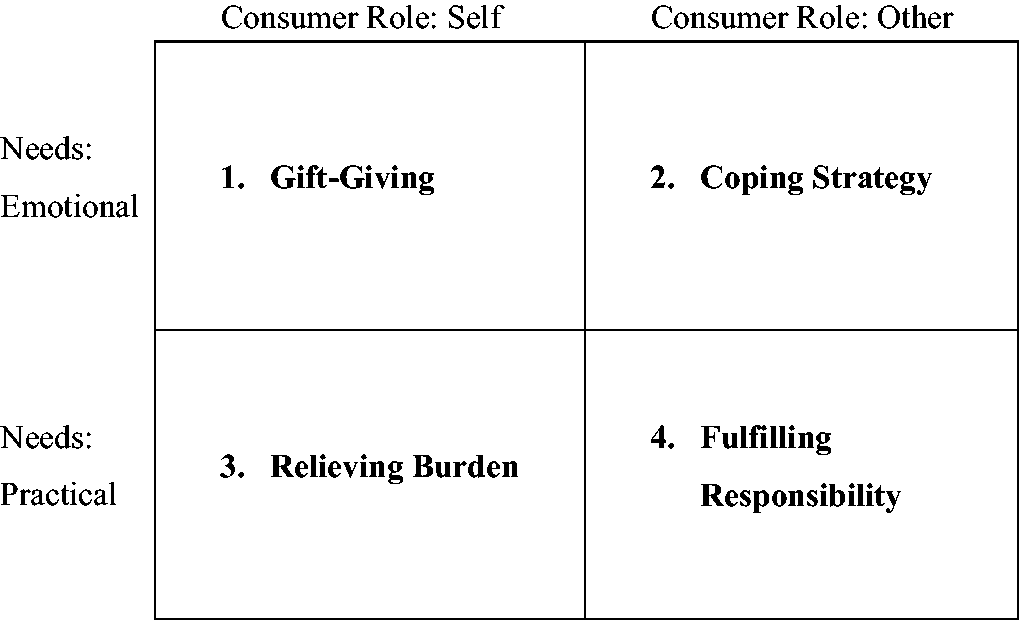
Need-based memorialization contexts.
Motivation for memorialization
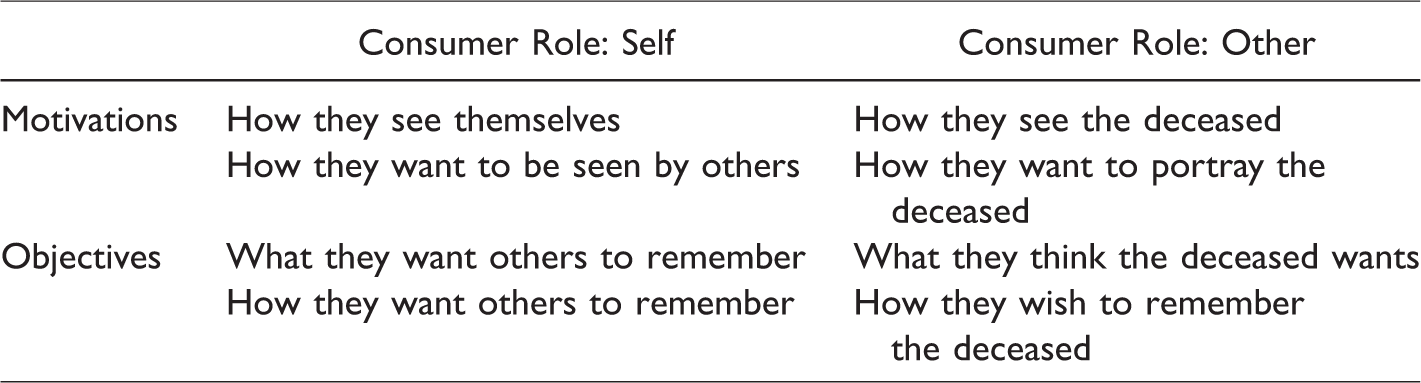
Profiling the main consumer roles of “self” and “other,” two underlying motivations are established, further underpinned by two driving objectives (Table 2). Understanding these consumer profiles may encourage service providers to evaluate their offerings to ensure their range is sufficient in meeting consumers’ objectives. For example, the deceased (a father) may prepurchase an entire family allotment as a form of gift-giving (in order to be seen by others as a great provider), while the bereaved (his son) may only choose to install a memorial plaque after his father’s burial, to fulfill what he perceives as a responsibility.
Consumers’ Motivations and Objectives for Memorialization.
Variables influencing decision-making
Five primary variables and 16 secondary variables have been identified as influencing decision-making about memorialization across the funeral, cemeteries, and crematoria industries: (1) Access (location, place of death, death literacy, digital literacy), (2) Tradition, ritual, ceremony (cultural heritage, belief system), (3) Grief response (cause of death, relationship to deceased), (4) Body disposal (legislation, environmental values, religious values), and (5) Consumer Preference (gender, age, family dynamics, socioeconomic status, relationship with service provider) (Table 3). Adopting a commercial perspective, the only variable over which the service provider has any influence is their preexisting relationship with the bereaved consumer as “self” or “other.” From an organizational perspective, service providers may benefit from developing meaningful relationships within their communities.
Variables Influencing Consumer Decision-Making in Memorialization.

Relationship marketing strategies
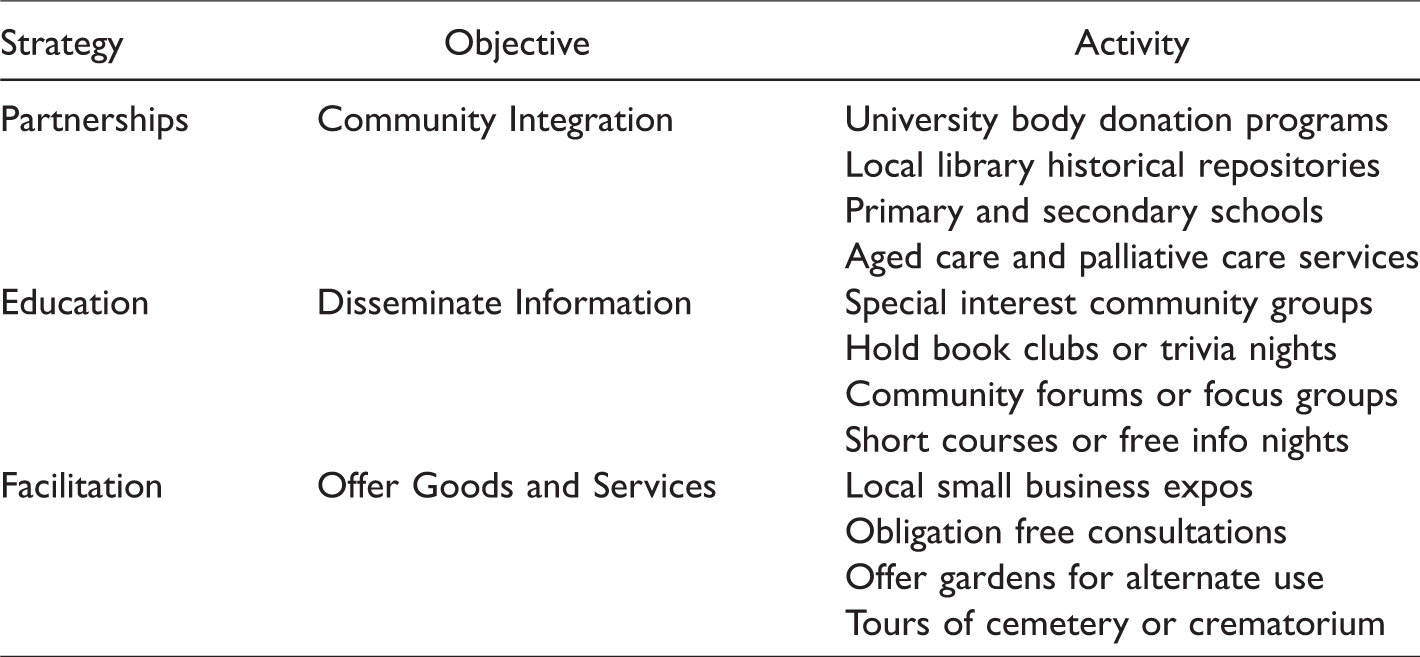
Successful implementation of relationship marketing activities (Table 4) offers service providers increased consumer engagement and long-term loyalty (Hunt, Arnett, & Madhavaram, 2006). The objective is to increase service provider contributions to their wider communities through implementing tactics that focus on key relationship building.
Suggested Relationship Marketing Activities.
Conclusion
A key finding of this study is the trend toward contemporary and informal memorialization practices that blurs the roles of the community and formal industry service providers, integrating the deceased into the everyday lives of the bereaved. This is evident through the use of digital memorialization and online genealogy research, the memorialization of pets, private memorials in public spaces, rising interest in DIY alternatives, and increasing globalization of memorialization practices across countries. There is a need to review the industry structure as cooperation is lacking among funeral, cemeteries, and crematoria service providers, with the bereaved unknowingly foregoing potentially helpful services as a result. In addition, dysfunctional family dynamics are among the most challenging operational constraints upon improving service outcomes for bereaved clients. Moreover, there is a clear opportunity for service providers to engage in community education as a means of building ongoing relationships with individuals and families. This could ultimately lead to a mutually beneficial and unprecedented level of community integration, sustaining commercial viability for the service provider and providing consistent support for the bereaved. Within this changing commercial and social landscape, service providers have the opportunity to better understand the needs and motivations of the bereaved and utilize these insights as a foundation for building long-lasting relationships through memorials. While in this study, the views of bereaved consumers are represented through the reports of industry service providers, future research should examine consumer perspectives of memorialization practices. For academic and industry researchers, the underexplored avenue of contemporary memorialization practices presents a fruitful opportunity to advance theory and practice across multiple disciplines.
Footnotes
Acknowledgments
The authors acknowledge valuable input from service providers who volunteered their time and expertise to participate in the interviews.
Declaration of Conflicting Interests
The author(s) declared no potential conflicts of interest with respect to the research, authorship, and/or publication of this article.
Funding
The author(s) disclosed receipt of the following financial support for the research, authorship, and/or publication of this article: The authors acknowledge the financial support of the Australasian Cemeteries and Crematoria Association.