



Abstract
Some end-of-life aspects have become a significant political and social issue such as elderly care and euthanasia. But hardly anything is known about how the general public in Germany thinks about death and dying more generally. Therefore, we conducted a representative online survey (N = 997) regarding 21 end-of-life aspects. Differences between subgroups were analyzed by conducting analyses of variance and Tukey honestly significance difference post hoc tests and by performing t tests. The findings revealed that the general public is open to engaging with topics of death, dying, and grief and that death education might even be promoted for children. Most participants appraised dealing with the finitude of life as part of a good life, but few have contemplated death and dying themselves so far. Attitudes and perceptions were related to age, subjective health, religious denomination, and gender. The survey provides useful implications for community palliative care, death education, and communication with dying people.
Background
Although the end of life has gained increasing attention in German politics and media, only little is known about what the general public thinks about various end-of-life issues. Public attitudes have been documented in particular regarding controversial issues such as euthanasia and assisted suicide (Hendry et al., 2013), organ donation (Newton, 2011), and end-of-life treatment in general (Ashby & Wakefield, 1993; Kwon et al., 2009). For Germany, however, these issues have mainly been studied in health professionals (Zenz, Tryba, & Zenz, 2015) or medical students (Anneser, Jox, Thurn, & Borasio, 2016).
Especially, the topic of euthanasia seems to highlight conflicting norms within the general public: The conflict of ending a person’s life with medical methods versus allowing people to suffer when it can be avoided (Emanuel, Onwuteaka-Philipsen, Urwin, & Cohen, 2016; Marsala, 2019). Furthermore, trust seems to be an important issue when explaining the differences in attitudes toward euthanasia, especially when drawing international comparisons (Köneke, 2014).
Some studies have also focused on religious beliefs, such as life after death (Klenow & Bolin, 1990), and specific aspects related to palliative care such as the perception of a good death (Meier et al., 2016; Rietjens, van der Heide, Onwuteaka-Philipsen, van der Maas, & van der Wal, 2006) or the preferred place to die (Calanzani et al., 2014; Pollock, 2015; Wilson et al., 2013). Analyses of trends of American attitudes toward euthanasia have shown that there is a correlation between religious beliefs and attitudes toward euthanasia and physician-assisted suicide: the more religious the individual, the more likely they are to be against euthanasia (Aghababaei, 2013; Burdette, Hill, & Moulton, 2005).
However, only few studies have dealt with more general attitudes and perceptions regarding death, dying, and grief. While some more comprehensive research on public attitudes is available for the United Kingdom (Cox et al., 2013), Ireland (Di Mola & Crisci, 2001), and Italy (Klug, 1997; Toscani et al., 1991), most research on Germany is decades old (Klug, 1997) and recent studies have been rather lacking (Stößel, 2013).
Furthermore, experiences with dying and grief may affect attitudes and perceptions of end-of-life interventions and treatment choices. But so far, mainly, the experience of professional health-care workers (Anderson, Williams, Bost, & Barnard, 2008; Brent, Speece, Gates, & Kaul, 1991) or private care experiences have been studied (Sohar, Großschädl, Meier, & Stronegger, 2015), more general experiences such as contemplating death and dying or having personal experience with death at some point in life (i.e., the death of a close friend or family member). Those aspects might be more important for peoples’ everyday life than their attitudes toward euthanasia or the preferred place of death. They may also impact care decisions and attitudes toward palliative care (McIlfatrick et al., 2014). In addition, studying broader attitudes and perceptions of death, dying, and grief is important because public opinion influences political health-care decisions (Cook, Jelen, & Wilcox, 1992; Hacker, 1997; Mossialos, 1997). Furthermore, existing guidelines state that hospice and palliative care shall increasingly be integrated into community care (King, Thomas, Martin, Bell, & Farrell, 2005; Nauck & Dlubis-Mertens, 2011). Therefore, it is necessary to complement existing studies, which have dealt with perceptions and attitudes of the older adults (Catt et al., 2005a, 2005b; Wu, Kei, Onn, Hwang, & Chan, 2006) with research on people from other age groups in Germany.
We tried to bridge this gap by conducting a survey among various members of the German general public, asking questions on different topics related to death such as whether people are rather burdened by the thought of their own death or the death of relatives, whether they think dying generally implies suffering, and whether children should also be confronted with the topic of death, dying, and grief, that is, death education programs. We also assessed the impact of aspects such as gender, age, and personal experiences with thoughts about (one’s own) mortality on attitudes and perceptions regarding the end of life, as they have been shown to impact attitudes toward and perceptions of the end of life in prior studies (Bassett, 2017; Frommelt, 2003; Maxfield et al., 2007; Skulason, Hauksdottir, Ahcic, & Helgason, 2014).
Methods
Participants
Participants were recruited via the opinion pollster Lightspeed GMI, a company that maintains various online respondent panels with the sample selected to be nationally representative. All panelists have actively agreed to become panel members, register with the panel through a unique e-mail address and complete an in-depth recruitment questionnaire and demographic registration profile. These profiles are used to randomly sample panel members for a survey in order to ensure a representative sample. All respondents participated voluntarily and provided informed consent. For Germany, the panel size is about 204,000 panelists (Lightspeed GMI, 2016).
Participants of the GMI online panel were sent an invitation to participate in a short survey on attitudes toward death, dying, and grief. The targeted number of completed questionnaires was about 1,000. The survey was closed after 1,003 participants had completed the survey. Of these participants, six had to be excluded as they did not state their gender. For the remaining 997 participants, there were no missing data. The sample was representative of the German general public for gender and age, with participants with a higher level of education being slightly overrepresented.
Questionnaire
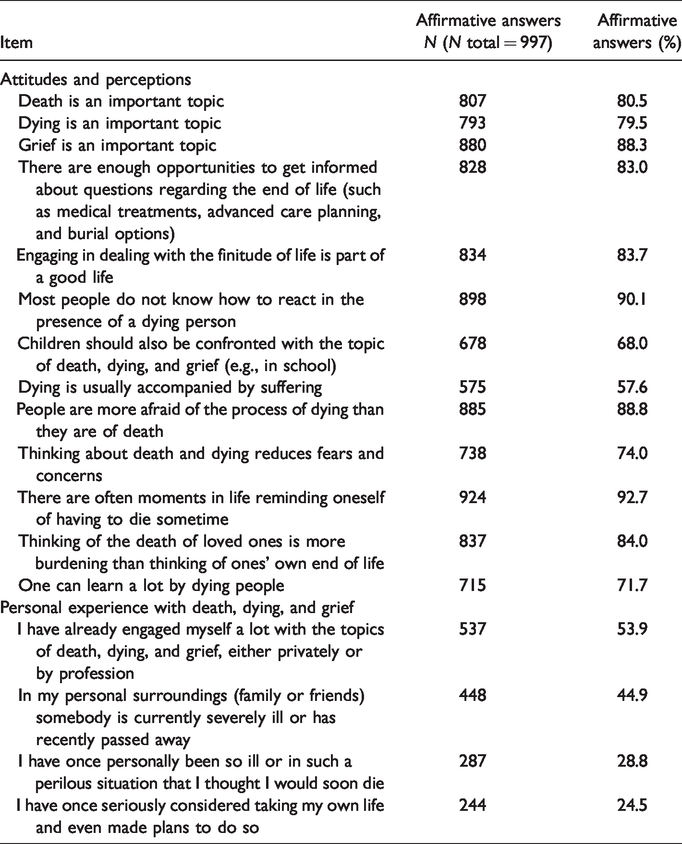
The survey consisted of 17 dichotomous questions (see Table 1). Thirteen of them concerned attitudes and perceptions of death and dying such as whether dying is usually accompanied by suffering, whether the process of dying is more frightening than the actual death, or whether talking about death and dying reduces fears. The remaining four questions dealt with personal experiences and salience of the topic; for example, having been confronted with the situation of having to think about dying soon. Each question could be answered with either ‘yes’ or ‘no.’
Items and Share of Affirmative Answers.
Following these questions of main interests, participants answered several questions regarding possible determinates and moderators to account for potential attitudinal differences between subgroups. These were demographic data such as gender, age, income group, religious denomination, and which region of Germany they live in as well as subjective health (bad, rather bad, satisfactory, good, and very good).
Analysis
The data were analyzed with IBM SPSS 22. The raw data are available from the corresponding author. Differences between subgroups based on variables such as gender, age, and personal engaging with death and dying were analyzed by conducting contingency table analyses with Pearson χ2 test of independence and (for subgroups with more than two manifestations like age) post hoc tests based on column comparisons (z tests) with Bonferroni correction at a significance level of 1%. For religious denomination, all non-Christian denominations (e.g., Buddhism, Islam, Hinduism) were grouped into one category (other) because only a number of participants (N = 23) belonged to a non-Christian denomination.
Ethical Considerations
The study was approved by the ethical committee of the University Hospital of Cologne, Germany (16–431) and by an expert on suicide research. Before answering the survey, potential participants were informed about the topic in order to make an informed decision about taking part in the survey. In addition, participants received a disclaimer at the end of the survey with information on and contact details for a crisis hotline. No minors were involved. The mentioned procedure mimicked the procedure of a similar study that was done in Ireland (Weafer, 2014).
Results
Attitudes and Perceptions
Almost all participants (93%) stated that they are often reminded of the finitude of life. Three of the four (74%) participants think that talking about death and dying reduces fears. Similarly, 72% think that one can learn a lot from dying people. Two of the three (68%) think that children should also be confronted with the topic of death and dying (e.g., in school). Grief was perceived as an important topic by even more participants (88%) than dying and death (80% and 81%, respectively). Relatively, few participants (58%) stated that they assume dying is accompanied by suffering (see Table 1).
Personal Experience
About half of the participants (54%) stated that they have already dealt with end-of-life issues. Many (45%) have also recently witnessed a loved one passing away or suffering from a severe illness. More than one of the four (29%) participants has personally experienced a situation like severe illness or a perilous situation where they assumed they would soon die. Furthermore, one of the four (25%) has once been suicidal.
Differences Between Subgroups
The sample was divided into subgroups to analyze whether the subgroups differ in their perceptions and attitudes. The shares of affirmative answers are documented in Tables 2 and 3.
Differences Between Subgroups: Sociodemographic Factors.
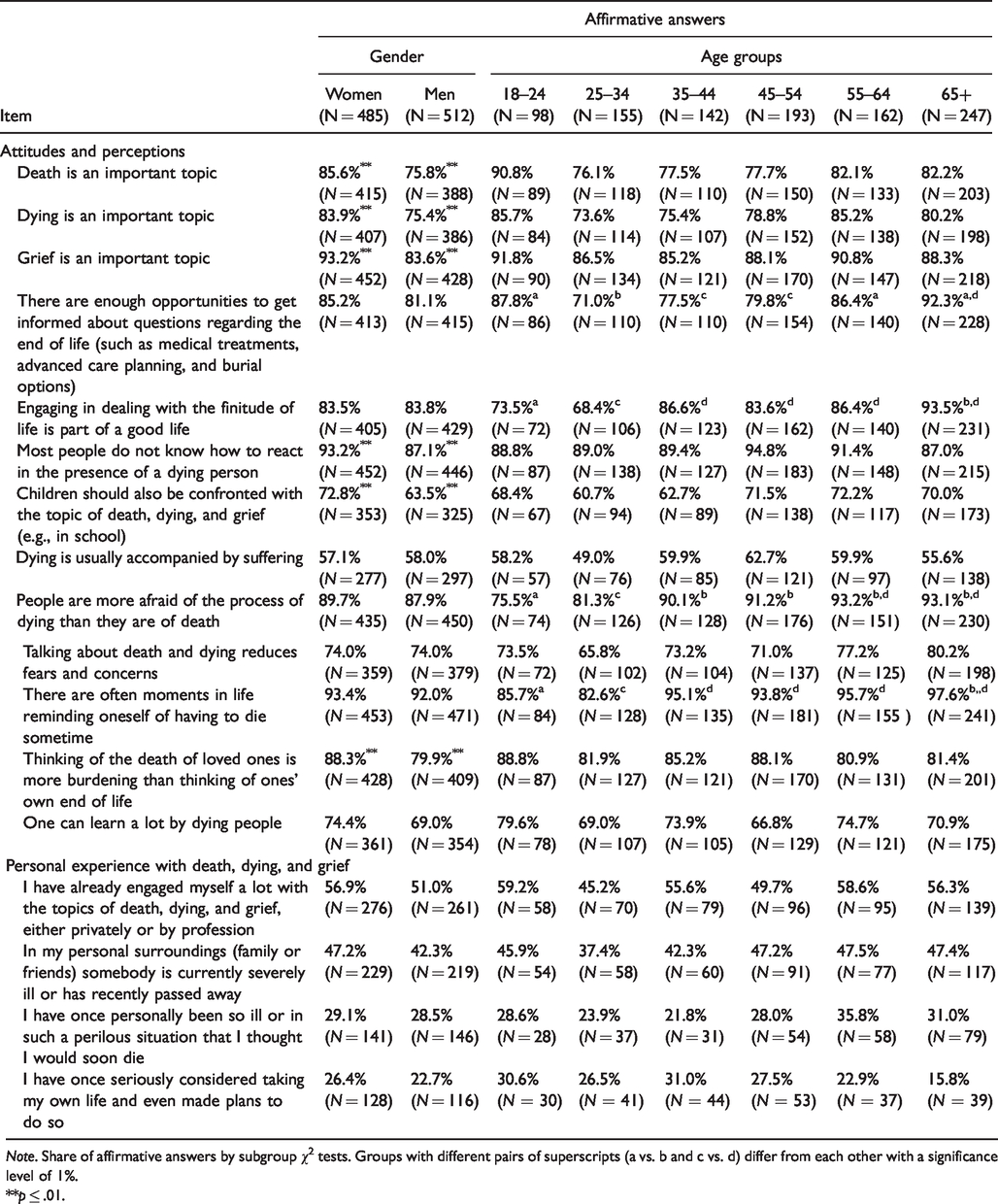
Note. Share of affirmative answers by subgroup χ2 tests. Groups with different pairs of superscripts (a vs. b and c vs. d) differ from each other with a significance level of 1%.
**p ≤ .01.
Differences Between Subgroups: Mortality Salience and Engagement With Death and Dying.
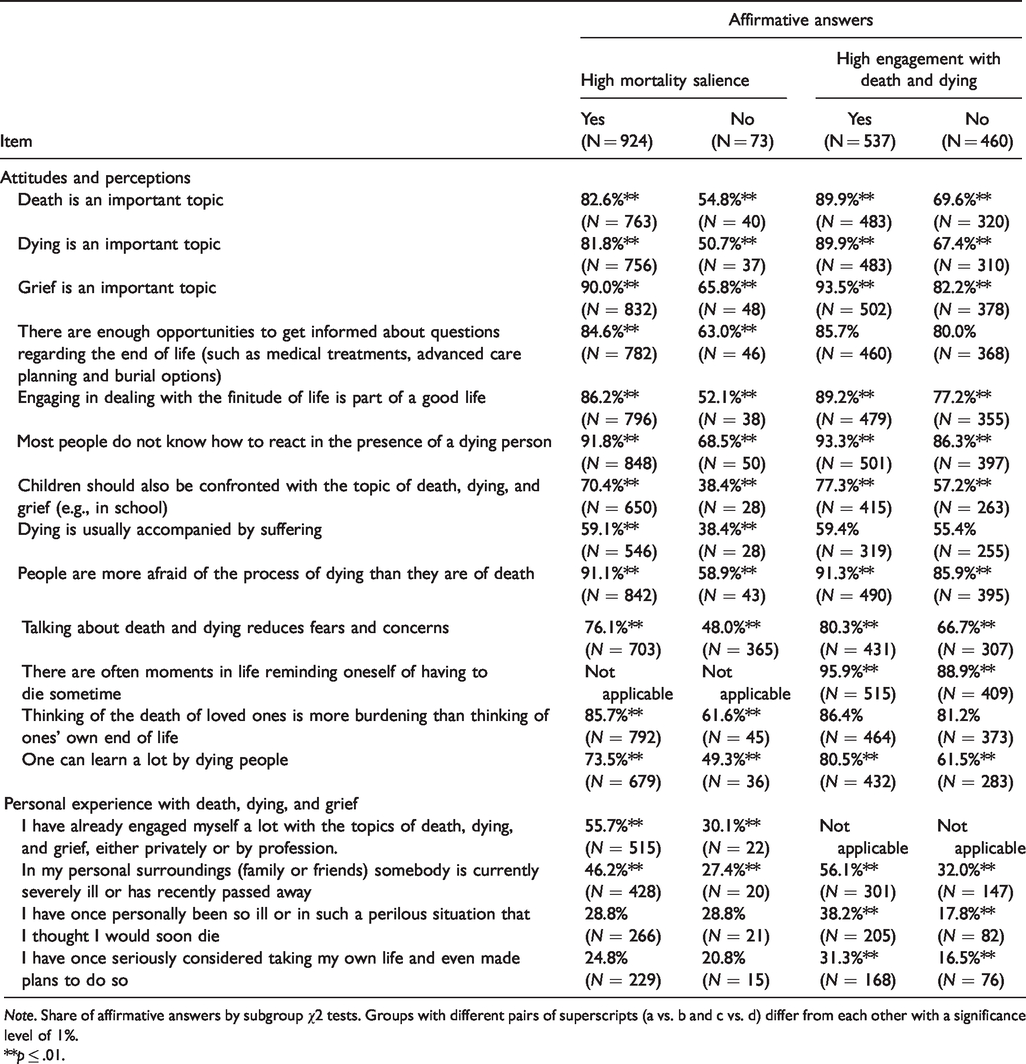
Note. Share of affirmative answers by subgroup χ2 tests. Groups with different pairs of superscripts (a vs. b and c vs. d) differ from each other with a significance level of 1%.
**p ≤ .01.
Gender
The analysis revealed that women perceive death as more of an important topic than men do χ2(1, N = 997) = 15.22, p <.01. The same was true for dying, χ2(1, N = 997) = 11.13, p ≤.01, and grief, χ2(1, N = 997) = 22.17, p ≤.01. Similarly, more women than men thought that children should also be confronted with the topic, χ2(1, N = 997) = 9.92, p ≤.01, and that most people do not know how to react in the presence of a dying person, χ2(1, N = 997) = 10.32 p≤.01. Furthermore, more women than men thought that the death of a loved one is more serious than one’s own death, χ2(1, N = 997) = 12.96, p ≤.01.
Age
Participants of different age groups differed in how far they feel to have enough opportunities to receive information about issues regarding the end of life (e.g., medical treatment, advanced care planning, and burial options), χ2(5, N = 997) = 38.56, p < . 01.
Post hoc z Tests
Post hoc z tests showed that the oldest age-group (65+) rather perceived enough information available than the middle age-group (25–54 years). Furthermore, age groups differed in considering contemplating death and dying are part of a good life, χ2(5, N = 997) = 53.27, p < . 01, and in feeling often reminded of the finitude of life, χ2(5, N = 997) = 42.70, p < . 01. Age groups also differed in thinking most people are rather afraid of the death of a loved one than one’s own death, χ2(5, N = 997) = 35.26, p < . 01. This was due to the younger participants (18–34 years) less often affirming these items.
Mortality Salience
Although most participants feel that they are often reminded that their life will eventually end, one rather small group in particular stands out with regard to mortality salience. This group did not give significantly different answers to most questions than other participants did, with the exception that participants in this group have personally been close to death or have been suicidal at one point in their life. For example, participants with high mortality salience in everyday life generally think that dying is usually accompanied by suffering—59.1% versus 38.4%, χ2(1, N = 997) = 11.91, p < . 01, and that most people are more afraid of dying than of death—91.1% versus 58.9%, χ2(1, N = 997) = 70.44, p < . 01.
Personal Engagement With Death and Dying
Similarly, whether participants have already engaged themselves a lot with death and dying or not showed significant effects, but the effects were less pronounced than whether participants often feel reminded of death. Notably, having already dealt a lot with the topic of death was independent of whether participants perceive enough information about end-of-life aspects to be available, χ2(1, N = 997) = 5.64, ns. Furthermore, this variable did not influence whether or not participants thought dying is usually accompanied by suffering, χ2(1, N = 997) = 1.60, ns, or that the death of a loved one is more serious than ones’ own death, χ2(1, N = 997) = 5.20, ns.
Religious Denomination
For religious denomination, differences were found as follows: Death was perceived an important topic to address by slightly more Christians (85%) than non-Christians (65%) and by participants without any denomination (75%), χ2(2, N = 997) = 20.60, p < . 001. Dying was perceived an important topic to address by 85% of Christians, 65% of non-Christians, and 74% of participants without any denomination, χ2(2, N = 997) = 19.93, p < . 001. The topic of addressing bereavement was perceived important by 91% of Christians, 70% of non-Christians, and 86% of participants without any denomination, χ2(2, N = 997) = 14.08, p < . 001. As for the item ‘Most people do not know how to behave in the presence of the dying,’ Christians answered this in the affirmative with 91% compared with non-Christians with 74% and participants without any denomination with 89%, χ2(2, N = 997) = 9.28, p < . 01. ‘Talking about death and dying reduces fears and anxieties’ was answered in the affirmative by 76% of Christians, 52% of non-Christians, and 73% of participants with no denomination, χ2(2, N = 997) = 6.87, p < . 05. ‘The thoughts of the death of close relatives burden most people more than thoughts of their own end-of-life’ was answered in the affirmative by 87% Christians, 70% of non-Christians, and 82% of participants without any denomination, χ2(2, N = 997) = 8.50, p < . 02. The item ‘You can learn a lot from dying people for your own life’ was answered in the affirmative by 76% of Christians, 61% of non-Christians, and 67% of participants without any denomination, χ2 (2, N = 997) = 12.55, p < . 01. And finally, participants from non-Christian denominations were not as likely to feel often reminded on the finitude of life (70%) as Christian participants (94%) or participants without any denomination—92%, χ2 (2, N = 997) = 19.34, p < . 001.
Income and Region
No differences were found for subgroups based on income or regions in Germany.
Subjective Health
Participants with different self-perceived health differed in how far they have already dealt a lot with the topic of death and dying, χ2 (4, N = 997) = 15.38, p < .01, whether they have thought they would soon die, χ2(4, N = 997) = 88.81, p < .01, and whether they have been suicidal once, χ2(4, N = 997) = 40.60, p < .01. Post hoc z tests revealed that participants with subjective bad or rather bad health affirmed those questions relatively more often than participants with at least satisfactory self-perceived health.
Discussion
This study shows a very pronounced salience of the finitude of life. Nine of the 10 participants often feel reminded that life will eventually end. Similarly, the large majority perceive death, dying, and grief to be important topics. There have been findings that are also of specific importance for palliative care: about three of the five participants think that dying is usually accompanied by suffering, and even more assume that dying is more frightening for most people than the actual death. Most participants stated that talking about death and dying reduces fears, and one can learn a lot from dying people, and many supported the idea that children should be provided with death education as well. However, only about half have personally engaged themselves in thinking or talking about death and dying.
In line with the author’s own previous research dealing with forecasting communication wishes of patients (Buecken et al., 2012; Galushko, Romotzky, & Voltz, 2012), the end-of-life attitudes and perceptions dealt with in this study seem to be very complex and not very predictable by common variables. Looking for possible differences between age groups, women and men, or religious denominations, most attitudes and perceptions were more similar among the participants than they were different. With regard to religiosity and attitudes toward euthanasia, Marsala (2019) has shown that individuals who belong to more conservative religious groups and display higher levels of religiosity are less likely to approve of euthanasia. Marsala further concludes that religious variations change over time, suggesting a cohort effect. People show declines in religiosity on the individual level (practices such as prayer or church attendance become less important) as well as in institutional religious identity (such as belonging to a specific denomination; Ammerman, 2007; Chaves, 2011; Schwadel, 2011).
It is noteworthy that attitudes and perceptions of death and dying do not seem to develop continuously during the course of one’s life because very young participants (18–24 years of age) were more similar to the older age groups (55+) than to the middle aged. Especially, participants between 25 and 34 years of age, which is generally a busy life phase in which many make important career choices and start a family, were less occupied with death and dying. Furthermore, women differed in some aspects from men, especially regarding items referring to children and the fear of a loved one’s death. The differences might be explained by traditional gender roles, with women more often taking on the role of family caregiver in the case of illness or death, or differences in expressing distressing emotions (Bassett, 2017). While it would go beyond the scope of this study to analyze the reasons behind the differences that have been found, it would, however, be useful for end-of-life research to carry out such an analysis in a future study.
Limitations
A limitation of the study is that the sample was not representative of the population in Germany in all aspects (e.g., education and among others). However, it yields useful information for palliative care and death education.
Practical Implications
Outcomes of palliative care are not easy to measure (Brainbridge & Seow, 2016; Ostgathe & Voltz, 2010).Therefore, it is important to know the preferences of patients and their relatives to provide palliative care that is in accordance with them. Physicians regularly say it would be helpful to know the preferences of patients, but only few patients have stated their preferences in advance (Borasio, Weltermann, Voltz, Reichmann, & Zierz, 2004; Voltz, Akabayashi, Reese, Ohi, & Sass, 1998). As preferences on end-of-life care are not constructed ad hoc but rather develop during life based on one’s values and experiences with death and dying (Di Mola & Crisci, 2001), this article contributes to the field of end-of-life research by providing insights that are useful for palliative care and treatment preferences. Furthermore, the reported findings are important for the future development of hospice and palliative care, especially for community-based care (Kellehear & Young, 2007; Sallnow, Richardson, Murray, & Kellehear, 2016) and the early integration of palliative care (Gaertner et al., 2012), particularly because the attitudes of the general public have been found to differ from those of medical professionals (Addington-Hall & Karlsen, 2005; Rietjens, van der Heide, Onwuteaka-Philipsen, van der Maas, & van der Wal, 2005).
Scientific Implications
This study is also interesting for suicide research because some aspects accounted for in the survey are similar to those asked in the ‘Acquired Capability for Suicide Scale–Fearlessness about Death’ (Spangenberg et al., 2016). In addition, this study provides useful information for psychological research dealing with the so-called terror management theory (TMT; Greenberg, Solomon, & Pyszczynski, 1997). TMT studies have repeatedly shown that the salience of one’s own death and dying affects religious and cultural attitudes (Major, Whelton, Schimel, & Sharpe, 2016), as do health-care behavior (e.g., annual medical check-ups and preventive care; Grover & Miller, 2014; Routledge, Arndt, & Goldenberg, 2004). However, in this line of research mortality, salience is usually experimentally induced. TMT research has only marginally accounted for the genuine level of mortality salience among the general public (Hayes, Schimel, Arndt, & Faucher, 2010). Notably, the mortality salience indicated in this study among the German general population is higher than thoughts about death and dying reported for the Italian population (Di Mola & Crisci, 2001). However, this could be due to the different wording of questions.
Future Studies
End-of-life research could benefit from similar studies in other countries in order to compare the attitudes and perceptions of the general public between countries and cultures. To assess the possible changes in attitudes and perceptions within the German population, we plan to conduct the survey again within the next few years.
Conclusion
Previous research has mainly focused on medical or religious end-of-life issues. The survey presented here has gone beyond the scope of previous research, giving insights into broader perceptions of death, dying, and the finitude of life among the general public. Thereby, this study provides useful information that can be used in death education and for the interpersonal communication with dying people and their relatives as well as for community palliative care.
Footnotes
Acknowledgments
The authors would like to thank Lightspeed GMI for collecting the data.
Declaration of Conflicting of Interests
The author(s) declared no potential conflicts of interest with respect to the research, authorship, and/or publication of this article.
Funding
The author(s) disclosed receipt of the following financial support for the research, authorship, and/or publication of this article: The author(s) received no financial support for the research, authorship, and/or publication of this article.