



Abstract
Commercial extraction of nitrogen (N) from the atmosphere began soon after World War II and has provided N fertilizer that has transformed agriculture to meet, through greater crop areas and yields although with some regional shortfalls, the increasing food demand of a world population that has increased from 2 billion then to 7.6 billion in 2018. N fertilizer now provides more N input to agriculture (113 Mt N/year) than biological N fixation by legumes (33–46 Mt N/year) on which earlier agriculture relied entirely. Persistent claims over the last decade for return to organic methods, which include rejection of fertilizer N, are based on studies that erroneously claim adequate productivity to feed the world. Previous analyses, by contrast, have estimated that organic agriculture (OA) could at best support a world population of three to four billion. The problem is two-fold. First, organic crops grown in sequences with legumes or treated with N manures mostly yield less than crops grown with N fertilizer. Second, substantial areas of legumes are required to provide adequate N for required yields of non-legume crops. Recent analyses have overestimated the yield of organic crops by omitting the effect of weeds, pests and diseases, and by ignoring the land required for legumes. The result is a large overestimation of the relative productivity of OA. The effect of area is critical because, since there is little opportunity to increase cropping area beyond the current 1400 Mha, land for legumes means less land for, and consequently lower total production from, non-legume food crops. To replace 100 Mt N fertilizer/year with legumes at a net fixation of 100 kg N/ha/year would leave just 30% of cropland available for non-legumes producing a similar proportion of current yield. Even with major gains in yield, organic systems cannot feed our populous world and less so as the population increases to an expected 9.8 billion by 2050.
Keywords
Introduction
A major transformation of world agriculture commenced after World War II, around 1950, when the Haber process was commercialized to produce nitrogen (N) fertilizer from atmospheric N2 (Smil, 2001). The world population was around two billion and the productivity of then continually expanding areas of crop was increasingly limited by N supply. To that time, the only significant source of N in agriculture, also from atmospheric N2, was biological nitrogen fixation (BNF) by legumes, briefly complemented in some countries in the 20th century, by dwindling supplies of Chilean nitrate.
The then closing organic era had always been characterized by low productivity caused by shortage of N for crop growth. While the positive benefits of legumes had been recognized since Roman times (Columela, ca. 40), they were not a dominant feature of crop rotations until late 19th century. Previously cropping was much more dependent on manure from draught and domestic livestock grazing on wide areas. Stable manure was carefully stored for subsequent application to cropland and grazing livestock were herded at night to areas, including those intended for cropping, for refuging of manure (Loomis, 1978).
Population and food supply
The major driving force for the expansion of agricultural production over the past 70 years has been increasing human population and consequent demand for food. Population has more than tripled to 7.6 billion in 2018, that is, it has increased faster than yield gain of staple foods (Figure 1), leaving an estimated 0.8 billion people underfed (FAO et al., 2018), partly due to regional imbalances between food production and demand. In Asia, food production has increased more quickly than population but in sub-Saharan Africa the reverse places increasing dependence on food donations from developed countries. An analysis of projected rates of population increase and possibilities to increase food supply of five cereals in 12 sub-Saharan countries (van Ittersum et al., 2016) reveals the possibility that few (3–4) will be able to meet the challenge of food sufficiency by 2050 even if yields on available land can approach the potential, that is, the yield as determined by external conditions of temperature, solar radiation and rainfall. Another analysis (You et al., 2011) establishes, however, the potential for expansion of small- and large-scale irrigation that could increase food production by 50% in a continent where just 6% of cropland is irrigated compared with 15% in Latin America and 37% in Asia.
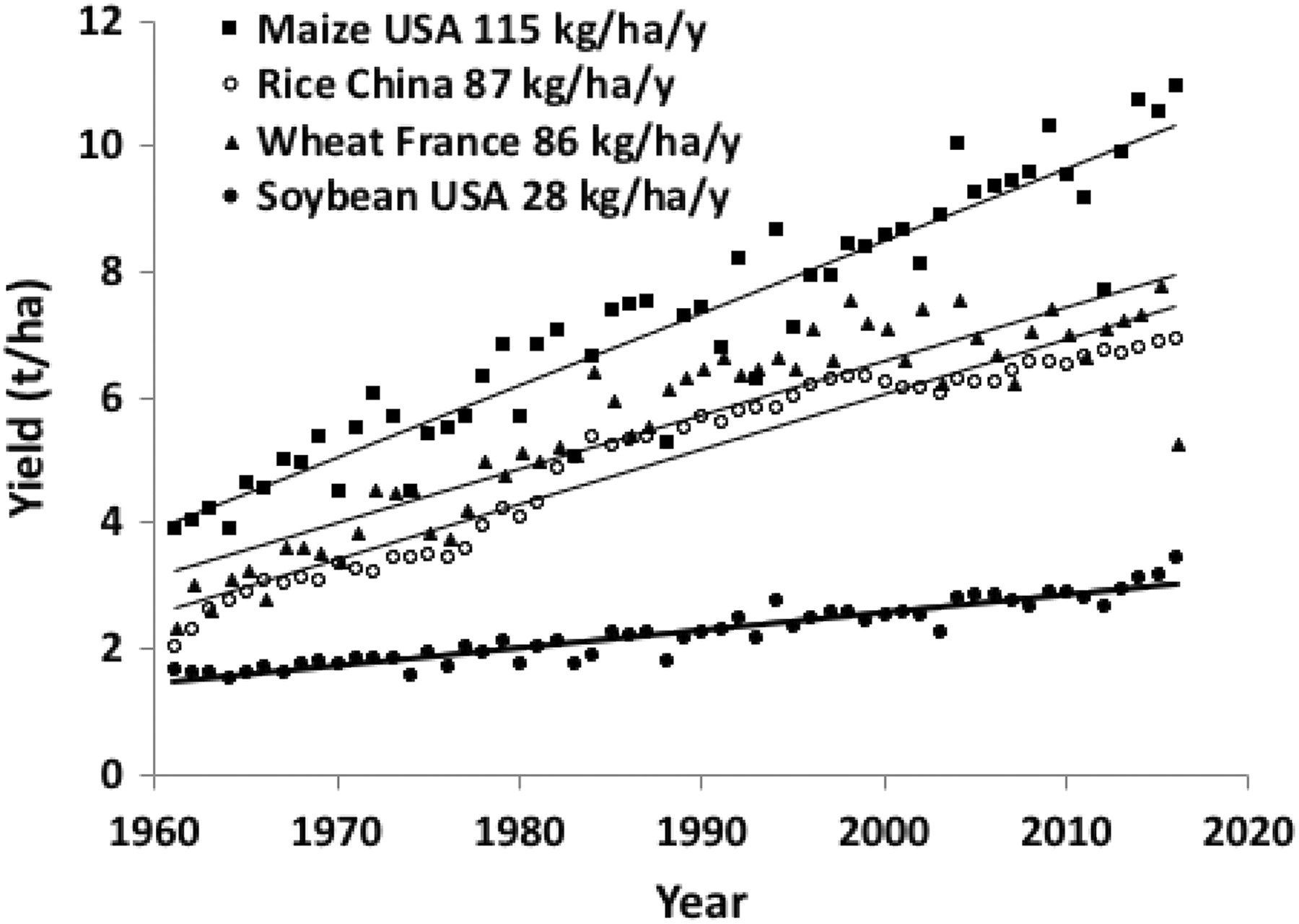
Yield trends in US maize and soybean, Chinese rice and French wheat, 1960–2016 (FAOSTAT, 2017).
This increase in food production has been made possible by the use of N fertilizer supported by many other advances in agricultural practice including new crops and improved crop cultivars resistant to drought, pests and diseases; inorganic fertilizers; agrochemicals for crop protection, mechanization, and scientific and technological advancement. The ability to supply crops with N at rates above those possible with organic methods that rely entirely on BNF resulted in greater yields and greater food crop area since the proportion of land previously devoted to legumes could be reduced. BNF still provides a large part of the N of world agricultural systems (33–46 Mt N/year) (Herridge et al., 2008) but N fertilizer provides more (113 Mt N/year) (FAO, 2015).
The world now relies on crop yields that have almost tripled since the end of the organic era (Figure 1) along with global trade to match regional demand with supply. A recent paper (Fischer and Connor, 2018) analysed current global demand and consumption of all staple foods aggregated by food energy content for six regions (see original paper for composition). It revealed that just two (Russia plus and New World) were net exporters to the remaining four (sub-Saharan Africa, West Asia and North Africa, populous Asia and Green Europe). Green Europe, which will be a particular focus of this article, imported cereals at a net 50 Mt of wheat equivalent in 2012, mostly from developing countries with lower yield than presented in Figure 1.
Problems facing agriculture
Modern agriculture receives much criticism, especially in well-fed developed countries, for adverse effects on the environment and also for socio-economic impacts resulting from the increasing scale of farming operations (Clark and Tilman, 2017; Rasmussen et al., 2018). A main concern is loss of natural systems (biodiversity) from expansion of agriculture onto new land. Another is abandonment of land deteriorated by soil erosion or salting, often with detrimental effect on adjacent non-agricultural land. A third is pollution of ground water with agrochemicals applied in excess amounts, with consequences for food quality and consumer health. These are legitimate issues to which research and development must attend along with continuing concern for adequate productivity to feed the world (Fischer and Connor, 2018).
Now, in 2018, the world population is still increasing, although at a decreasing rate, so agriculture faces an enormous and continuing challenge to increase productivity. In just 30 years from now, marking 100 years from the start of the era of modern agriculture, it will be necessary to increase food production by a further 70% to properly feed the expected population of 9.8 billion (UN, 2017). This is a challenge that requires urgent attention now, and evidence of success by 2030, if there is to be confidence that the chosen methods can meet the challenge.
Logic dictates the need for intensification of production because the scope to expand agricultural land is very small and also at odds with concerns for preservation of natural areas for their other services and values. Even so, the promotion of low-yield organic and related agroecological agriculture is gaining strength as a viable alternative paradigm for world food production (Altieri, 2002; FAO, 2018; IAASTD, 2009; iPES-Food, 2016) especially in food-importing Europe, where concern for the environment is sidelining consideration of productivity and capacity to feed the expanding world population.
Organic agriculture in 2017
Organic agriculture (OA) produces arable crops (cereals, oilseeds, dry pulses, green fodders and vegetables), permanent crops (citrus, olive, coffee, cocoa, temperate fruits and grapes) and livestock products (meat, milk and milk-based) from permanent grazing land. The land in question includes certified OA land and land under transformation to OA, a process that may take several years. OA land is farmed according to rules administered by various OA-regulating associations that, in the case of crops, disallow the use of most inorganic compounds for crop nutrition, synthetic compounds for pest, disease and weed control, and more recently, genetically modified cultivars. The rules also encourage rotations and intercrops to build soil fertility, improve crop nutrition, and to control or reduce production problems associated with pests, diseases and weeds. These latter aspects of OA are practiced much more widely outside OA, but those systems, here referred to as conventional agriculture (CA), vary enormously in range and amount of ‘OA-prohibited’ inputs. They include, for example, many farms in developed countries that rely dominantly on BNF for N supply and others in developing countries where agrochemicals are not used because they are either not available or are too expensive.
The area in OA has increased substantially in the last decade from 26.8 Mha to 57.8 Mha. The most recent data summarized by region in Table 1 (Willer and Lernoud, 2018) reveal that Oceania has the largest proportion (47%), followed by Europe (23%) and Latin America (12%). Asia, North America and Africa have least with 8%, 5% and 3%, respectively. OA now occupies 1.2% of world agricultural land up from 0.6% during the last decade but the relative importance to total agricultural activity varies greatly between regions. Two regions, Oceania and Europe have significant areas, with 6.5% and 2.7%, respectively, while the remaining regions are relatively small (0.2–0.9%). There have been relatively similar increases in all three categories, arable (4.9–10.6 Mha), permanent crops (1.9–4.5 Mha) and permanent grazing (20.0–42.5 Mha), with the result that the greatest proportion of OA land (74%) is now in permanent grazing land.
Areas of land under organic management and arable and permanent crops in six regions of the world together with value of consumption of organic products in 2016 (Willer and Lernoud, 2018).
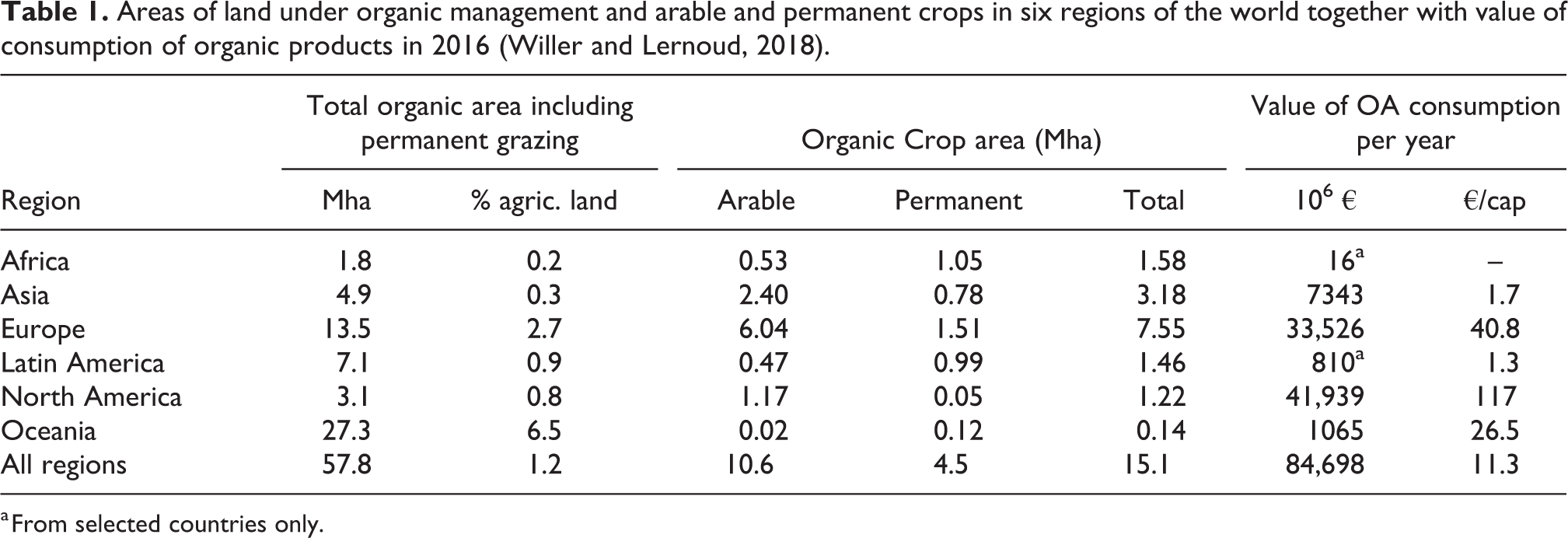
a From selected countries only.
The data in Table 1 also reveal the variation in the form of OA activity across regions. Oceania is dominated (99%) by livestock production from extensive grazing enterprises, mostly in Australia. Latin America (60%) and both North America and Europe (50%) also have significant permanent grazing areas in OA. By contrast, OA land in Africa is two-thirds permanent crops while in Asia it is two-thirds arable crops.
Table 1 also includes information of sales of organic food products by region from which important features emerge. North America is the biggest market that, together with Europe, consumes 90% of global production. Despite its relatively small area of OA activity, North America is also the major importer of organic foods. Europe is the other major consumer and importer. The markets are small in the remaining regions that tend to be exporters of OA products.
There are also major differences in OA production and consumption between European countries that is not shown in Table 1. Nine European countries have 10% or more of agricultural area devoted to OA, ranging from Liechtenstein (38%) to Finland (10%). There are also a number of northern European countries with per capita annual expenditure on OA products greater than that of North America (117 €/cap), namely, Switzerland (274€/cap), Denmark (227€/cap), Sweden (197€/cap), Luxembourg (188€/cap), Austria (177€/cap) and Liechtenstein (171€/cap). Market share of organic consumption is also greatest in these countries, namely, Denmark (9.7%), Luxembourg (8.7%), Switzerland (8.4%), Austria (7.9%) and Sweden (7.9%).
The driving forces for increasing consumption of OA products are concerns to reduce impact of agriculture on the environment but mostly to avoid perceived hazards to health. Surveys define that consumers associate organic foods with absence of toxic residues or derived compounds from herbicides and pesticides in crops and hormones in livestock products. In addition, avoidance of products from genetically modified crops is a major concern in the United States but such products are forbidden by legislation in the European Union. The majority of consumers are city dwellers with high disposable incomes. European governments encourage OA by additional subsidies within the Common Agricultural Policy (CAP) for its production. The combination of subsidies and higher prices for OA products is a major force in the expansion of production there and in exporting countries.
Two European countries, Liechtenstein and Denmark, have adopted policies for conversion of agriculture to OA in the short term.
Productivity of OA
The issue for discussion here is the underlying low productivity of OA that is generally ignored, and often denied, in the current promotion of OA as a viable alternative paradigm for world agriculture. It results mostly from the need for land to be allocated to legumes to supply N for organic crops, either in situ in rotations or ex situ as animal manure and/or vegetable mulch. Put simply, the challenge to a proposed transformation of world agriculture to organic methods without loss of yield reduces to the replacement by BNF of the 113 Mt N/year currently supplied by N fertilizer, or at least the major part that increased efficiency of use could establish. Support for transformation requires ‘proof of adequate productivity’ that has not yet been established, leaving the possible population that could be supported by application of the best organic methods to all arable land at the long-established three to four billion (Buringh and van Heemst, 1979; Smil, 2000).
A recent paper ‘Strategies for feeding the world more sustainably with organic agriculture’ (Muller et al., 2017) provides a misleading analysis of the possibility of such transformation because it wrongly estimates the productivity of OA relative to CA by an inappropriate method (Connor, 2018). The authors apply OA/CA yield ratios of individual, mostly experimental, crops (mean 0.75 ± 0.40; p < 0.05) (Seufert et al., 2012) to estimate productivity of the transformed OA system without attention to the additional OA land required for legumes (Connor, 2008, 2013). The result is a large overestimate of the productivity of OA because the impact of the additional area required to provide the organic N fertility (rotational legume crops/pastures and/or imported biomass and animal manure) on which the system depends is large relative to yield reduction attributable to individual crops. Such an error at the start of an extensive analysis of a proposed transformation of world agriculture to organic methods renders the results and conclusions greatly over-optimistic.
The proposed transformation of Muller et al. (2017) specifies replacement of 98 Mt N fertilizer that the authors have in their CA version by an equivalent amount of N from organic sources. To achieve this, they propose transformation of world cropland (1400 Mha) to OA rotations containing 20% legume crops. Even if some of those legume crops were used as green manures, that is, they are not harvested for grain, a mix of such crops across a worldwide range of environments might fix 100 kg N/ha/year (Anglade et al., 2015; Peoples et al., 2009; Unkovich et al., 2008), that is, 28 Mt N/year on 280 Mha. That amount is well short of the 115 Mt N/year in manure the authors claim for crop and pasture management in the OA system, even without including inevitable losses, especially in the preparation and storage of animal manure. So, the question arises as to the origin of the large amount of extra manure N used to support the high productivity of their transformed agriculture?
The answer is found in the erroneous method of applying OA/CA ratios of individual crops because it introduces a corresponding N content of food for humans and fodder for manure producing livestock without explanation of its source. In this way, the model breaches the Law of Conservation of Mass and fails a proper analysis of the productivity of world agriculture transformed to OA by a large margin. The model needs a different method to calculate the productivity of OA, appropriate to the capabilities of legume BNF. As more land is allocated to legumes, the area for food crops is reduced and total production decreases.
The paper raises the important question of what proportion of land in legume would be required to sustain transformation of agriculture to a sufficiently productive OA? A useful start can be found in the recent analysis of N flows and crop yields of a nine-crop organic rotation in France (Anglade et al., 2015). There, five non-legume crops, two of which each also received 50 kg N/ha/year in imported manure, were supported by BNF from four legume crops that occupied 44% of area. But more generally persuading is the long-established practice (Loomis, 1978), last widely seen in the mid-1900s (Connor et al., 2011; Rovira, 1992) before the advent of synthetic N fertilizer. Then, farms commonly maintained up to 50% of arable areas in leguminous pasture for three or more years, or in annual green manure crops, to accumulate soil N to support productivity of subsequent non-legumes. That, and rotations and intercrops with legumes, remain the only options to introduce and manage soil N to support productivity of non-legume crops in OA. The land for those leguminous pastures and crops, wherever and however harvested (biomass, animal manure), is the major component of the extra land required for transformation of CA to OA and hence for the resultant smaller overall productivity of OA on equal land areas. Better to start thinking about a possible 50% allocation of land to N fixation in productive organic cropping systems leading to a relative productivity of OA/CA on the same land area of 0.75/2 = 0.38 (0.75 is the mean OA/CA yield ratio of Seufert et al. (2012)) and working to improve production and storage of N for crops and best financial benefit from associated animal production.
But there are at least two more considerations for a current comparison of OA/CA productivity and both are detrimental to the relative productivity of OA as established by previous practice. First, because crop yields are now much higher (200–300%) (Figure 1) than in the mid-1900s, larger legume areas will be required to secure adequate BNF to match current CA yield. In the French organic rotation referred to above, cereal yields were small (3–4 t/ha) relative to current national average (7 t/ha) and closer to those reported in 1960 at the end of the organic era (Figure 1). Second, because fewer tools are available in OA, pest and disease control is less effective than in CA. Neither effect is included in the basic comparison (OA/CA = 0.75) of individual experimental crops with the result that the yield ratio, calculated before the consideration for extra land, can be further reduced in commercial practice. Comparative yield data are difficult to find, but the mean (2016 and 2017) cereal OA/CA yield ratio for commercial farms in England was 0.48 ranging from 0.40 for winter wheat to 0.57 for spring barley (Lang, 2017).
Conclusions
Less than 100 years ago, the world fed itself with agriculture based entirely on organic methods. Crops relied on BNF by legumes, yields were a third of what is achieved today, but the population was then only two billion. Now in 2018 with a population of 7.8 billion, the potential of BNF is insufficient to support food demand. Replacement of 100 Mt N in fertilizer by BNF at a feasible net 100 kg N/ha/year would require 1000 Mha of legume (71% arable land), at 125 kg N/ha/year it would require 800 Mha (57%). The reduction in food crop area would be in proportion and the challenge to maintain it would increase as population increases to 9.6 billion by 2050. It is unrealistic to think about rangeland livestock as a source of large quantities of N with accounting for losses, enormous labour requirement and gradual diminution of rangeland productivity. Existing analyses establish the possible population that could be supported by application of the best organic methods to all arable land to be three to four billion (Buringh and van Heemst, 1979; Smil, 2000).
OA is increasing in extent driven by consumer perceptions, premium prices and in European countries by direct subsidies. Concern for the environment and search for chemical-free food are major reasons. The area of OA is increasing, now 57 Mha in total with 11 Mha in arable plus permanent crops (0.8% of that area). The extent is, however, small and most recent increase has been in grazing low-productive Australian rangeland for meat export to the United States and Europe. Experience so far does not provide practitioners with a suitable experience to judge the effect of more extensive transformation. Under current circumstances, the availability of manure from intensive animal enterprises and the cost of disposal make it appear a free good in developed countries. But that will not persist because as transformation proceeds manure will be increasingly valuable, and unlike medieval Europe, will be insufficient to sustain substantial transformation.
Supporters of OA as an optional agricultural production paradigm have been misled by recent papers (Badgley et al., 2007; Muller et al., 2017; Seufert et al., 2012) that have largely overestimated the productivity of OA from ratios of yield of individual crops grown by organic and conventional methods, omitting attention to the substantial land area that must be allocated to legumes to supply the required organic fertility. As yield increases to meet required world demand, N demand increases in unison (Lassaletta et al., 2014). Although increasing in extent, OA remains a small part of agricultural activity (1.2%) and of that a large proportion is in wide-area grazing systems that are self-sustaining for N.
There should be as much legume and recycling of N as possible in modern agriculture but the time has now come to stop the demonization of CA and glorification of OA (Tal, 2018). Organic systems cannot feed our populous world now and less so as population increases to an expected 9.8 billion by 2050. The challenge is to design agricultural systems that are environmentally friendly for a heavily populated world in which problems will be solved by science and application of technology (Fischer and Connor, 2018; Meemken and Qaim, (2018). That will be challenging but there is already substantially more use of rotations, legumes and residue recycling outside than inside of OA, and there are many CA farmers contributing to the evolution of food security and environmental sustainability (Connor and Mínguez, 2012). And finally, it is necessary because the greater the proportion of land that becomes dedicated to low-input, low-output cropping systems, the greater will be the pressure on the remainder to keep increasing yield.
Footnotes
Declaration of conflicting interests
The author(s) declared no potential conflicts of interest with respect to the research, authorship and/or publication of this article.
Funding
The author(s) received no financial support for the research, authorship and/or publication of this article.
