



Abstract
Despite increased agricultural trade liberalization, high productive inefficiency in agriculture has kept Africa as a net importer of agriculture products. Empirical studies have focused on the trade liberalization–productivity growth nexus and overlooked the efficiency linkage. Also the role of regional trade agreements (RTAs) and institutions in reducing inefficiency in agriculture have been sidelined. We use a stochastic frontier approach and single-stage maximum likelihood estimation of a true fixed-effects panel data model for our analysis. Using maize and rice data, we provide evidence that through technology transfer, agricultural trade statistically improves technical efficiency. Moreover, results suggest that RTAs provide favourable technical efficiency effects, which varies across products and membership. Furthermore, we document that while regulatory quality reduces technical inefficiency, control of corruption increases it. Our findings call for increased role of RTAs in promoting agricultural trade liberalization. This should be complemented by further strengthening of institutions involved in the agriculture value chain.
Keywords
Introduction
Tackling inefficiencies in the agriculture sector is crucial in promoting efficiency and total factor productivity (TFP) growth (Food and Agriculture Organisation (FAO), 2017). The world, as guided by the Sustainable Development Goal 2, seeks to end hunger, enhance food security, improve nutrition and promote sustainable agriculture (United Nations Development Programme (UNDP), 2017). This requires doubling of agricultural productivity through correcting and preventing trade restrictions, distortions and inefficiencies in world agricultural markets (UNDP, 2017). The World Trade Organisation (WTO) (1994) Agreement on Agriculture (AoA) provides a formal commitment to agricultural trade liberalization. The central drive of AoA is to eliminate inherent production and distribution inefficiencies in the agriculture sector (Blandford, 2015). Regardless of increased trade liberalization, Sub-Saharan Africa remains a net importer of strategic agricultural products (FAO, 2017).
Africa’s challenge is that of feeding a population growing at a rate higher than productivity growth (FAO et al., 2012). The Global Harvest Initiative (GHI) (2018) reports that annual global productivity growth of 1.75%, against the current 1.66%, is required to meet the demand of nearly 10 billion people in 2050. The growth in demand is concentrated in poor countries. GHI (2018) reported that in 2017, the rate of agricultural productivity growth in Sub-Saharan Africa was 1.24%, a fall from 1.5% and 1.31% in 2015 and 2016, respectively. In the wake of the anomaly of increased trade in agriculture and low productivity growth, the need to examine the role of agricultural trade liberalization in eliminating inefficiency in agriculture takes centre stage.
While the trade liberalization-TFP growth nexus has received extensive scrutiny, there is scant of such on the trade liberalization–efficiency connection. A number of studies (Cameron et al., 2005; Griffith et al., 2004; Hassine et al., 2010; Shu and Steinwender, 2019) concur that international trade speeds up the rate of technological transfer and innovation, thereby stimulating TFP growth. On the contrary, Shaik and Miljkovic (2011) and Hart et al. (2015) maintain that there are no logical theories connecting trade policy to technical inefficiency. Nonetheless, Shaik and Miljkovic (2011) and Miljkovic et al. (2013) provide an explanation in which trade liberalization may work against technical efficiency. They argue that subsequent increase in exporter’s income provides an incentive to relax technological efforts, which may reduce efficiency. Existing studies have been shy to provide an empirical examination of whether, how and to what extent do international trade traditional transmission mechanisms affect technical efficiency.
This is despite the fact that advancements in TFP measurement, in particular the Malmquist-Data Envelopment Analysis (DEA) and the Stochastic Frontier Analysis (SFA), have allowed it to be decomposed into two components, technical efficiency and technical change, with the latter being the dominant. Further improvements by Green (2005a) and Wang and Ho (2010) have made it possible to examine exogenous determinants of technical inefficiency. Regardless of this, studies including Hassine et al. (2010), Skully and Rakotoarisoa (2013) and Hong et al. (2016) continue to focus agricultural trade liberalization effects directly on TFP growth. These studies overlook an important pass through the effect on technical inefficiency, thereby short-changing the trade liberalization–productivity linkage. We contribute to the literature by zeroing on the impact of agricultural trade liberalization on technical efficiency.
Regional trade agreement, institutional quality and technical efficiency
Another missing element in existing studies is the role of regional trade agreements (RTAs). African governments have established agriculture policy wings in several RTAs. The leading RTAs are East Economic Community (EAC), Economic Community of West African States (ECOWAS), Common Market for East and Southern Africa (COMESA) and the Southern African Development Community (SADC). These regional groupings have since established programmes and policies that are meant to boost agriculture productivity. SADC introduced the Regional Agriculture Policy in 2004, EAC established the Agriculture and Rural Development Policy in 2006, and ECOWAS launched their Regional Agriculture Policy under Comprehensive Africa Agriculture Development Programme (CAADP).
FAO (2017) acknowledges that agriculture provisions in the RTAs cement agricultural negotiations in the multilateral trading system. Although empirical literature on trade creation and trade diverting effects of RTAs at aggregate economy level remains inconclusive (Ngepah and Udeagha, 2018), the potential gains in agriculture are enormous. Notwithstanding, there have been scant evidence on the effect of RTAs on the agricultural sector at large. The few existing studies including Sun and Reed (2010), Cipollina and Salvatici (2010), Ghazalian (2013a, 2013b, 2017) and Huchet-Bourdon et al. (2016) focus on RTAs impact on trade flows for developed countries. However, increased trade flows may come at the expense of self-sufficiency. This calls for examination biased towards agriculture production. We strongly submit that any serious examination in this direction should not neglect the role of RTAs in promoting productive efficiency.
In addition to agricultural trade liberalization, production efficiency has been documented to be a function of institutional quality. In fact, empirical work (Islam and Montenegro, 2002; Rigobon and Rodrik, 2004; Rodrick et al., 2002) provide evidence that trade openness positively correlates with institutional quality. According to Organisation for Economic Co-operation and Development (OECD) (2015) and Yildirim and Gokalp (2016), quality institutions affects performances by enhancing trust, building cooperation and reducing transaction costs, thereby improving efficiency. Doyle and Martinez-Zarzosof (2011) and Blandford (2015) allude to deficit of institutional framework as a major reason for subdued agricultural efficiency. For instance, corruption is regarded as a bribe tax which distorts production (OECD, 2015). In African agriculture sectors, corruption is most likely to prevail, given the systems used in inputs distribution. Market forces play a secondary role in inputs distribution, with government agents playing a leading role. It follows that strengthening institutional quality would provide greater efficiency returns.
Notwithstanding the potential returns in agriculture production from strengthening institutional quality, there is a dearth of evidence on its impact in the agriculture sector. By and large, most studies including Dollar and Kraay (2004), Doyle and Martinez-Zarzosof (2011) and Yildirim and Gokalp (2016) examined the impact of institutional quality on the aggregate economy. For African countries, focusing on agriculture, which anchors their growth, is more rational. Given the impetus to enhance efficiency by removing distortions in Africa’s agriculture sector, analysing the role of institutional quality is imperative.
The rest of the article proceeds as follows: the second section presents materials and methods covering theoretical framework, functional forms and econometric estimation; the third section presents and discusses empirical results; and the fourth section gives concluding remarks and recommendations based on the findings.
Materials and methods
We use the single-stage maximum likelihood estimation (MLE) of Green’s (2005a) true fixed-effects model based on a panel quasi-translog stochastic production frontier. Data consist of 120 observations for maize from 10 countries over the period of 2005–2016. For rice, we have 132 observations from 11 countries over the same period. The choice for maize and rice is motivated by their economic and nutritional importance. In Africa, maize is staple for approximately 50% of the population (FAO, 2017). Urbanization and favourable change of taste and preferences for rice have seen it becoming increasingly strategic for food security (Chauhan et al., 2017). Both maize (over 40% calories) and rice (20% calories) have high starch and protein (Ricepedia, 2019), which are essential for food security. The countries are drawn from FAO’s Monitoring and Analysing Food and Agriculture Programmes (MAFAP 1 ) countries. Only Nigeria is excluded due to data challenges. The data are mainly sourced from FAO and the World Bank Governance Indicators (WBGI). Data description and sources are shown in Table 1.
Data description and sources.
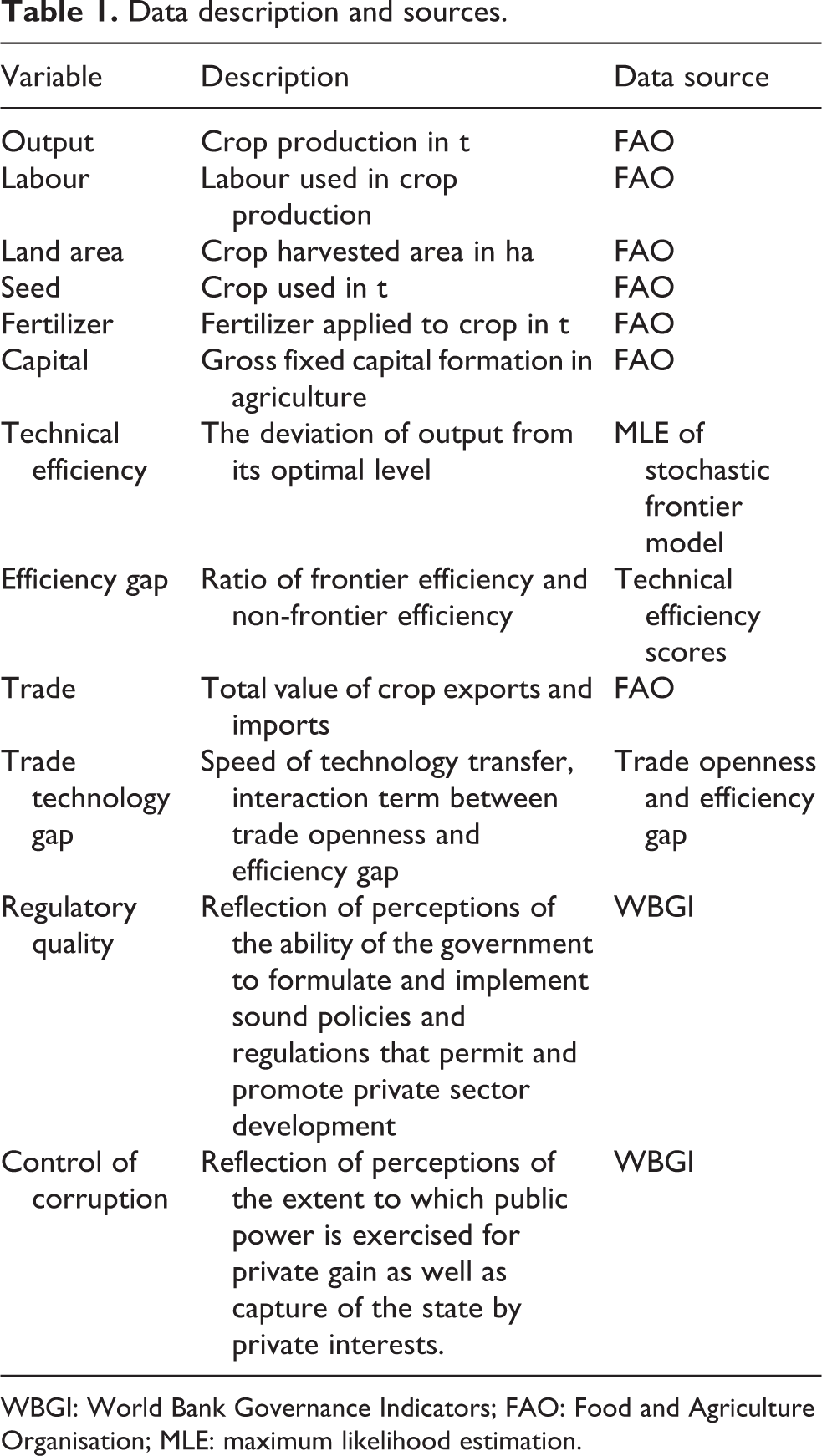
WBGI: World Bank Governance Indicators; FAO: Food and Agriculture Organisation; MLE: maximum likelihood estimation.
Theoretical framework
Our model follows the specification of a time-varying technical inefficiency model by Battese and Coelli (1995) and Green (2005a). Early specifications by Schmidt and Sickles (1984) considered technical inefficiency to be time invariant. This implies that an inefficient producer never learns. However, Kumbhakar (1990) and Battese and Coelli (1992) provided more realistic specifications in which technical efficiency is time varying. The possibility of learning becomes more realistic in the presence of market competition, government regulations and international policy frameworks (Kumbhakar et al., 2015). In the face of agricultural trade liberalization and domestic agriculture support programmes, technical inefficiency is most likely to be time varying. Building on the specifications above, Battese and Coelli (1995) provided a specification in which the time-varying technical inefficiency is expressed as a function of exogenous regressors:

where
We develop the Battese and Coelli (1995) specification by following Bandyopadhyay and Das (2013). They registered discomfort in earlier specifications by Kumbhakar (1990) and Lee and Schmidt (1993) in which temporal variation of technical efficiency is captured by an exogenously specified function of time. The approach has an advantage of accounting for time-varying efficiency through the ‘all catch’ variable time. However, Bandyopadhyay and Das (2013) voiced that it neglects the dynamics of efficiency, given the dependence of today’s efficiency on yesterday’s. More practically, mistakes are corrected through learning by doing (Desli et al., 2003). To consider the dynamics of technical efficiency, we introduce the first lag of technical inefficiency as a key explanatory variable:

where
International trade, technology transfer and technical inefficiency
The role of international trade in promoting technical efficiency has been and continues to be an area of both theoretical and empirical contestations. Wide literature (Cameron et al., 2005; Griffith et al., 2004; Hassine, et al., 2010; Hart et al., 2015; Hong et al., 2016) endorses international trade as a conduit for competition, technology transfer and innovation, which promote technical efficiency. However, pessimistic literature (including Shaik and Miljkovic, 2011; Miljkovic et al., 2013) postulates that following trade liberalization, increased exporter’s income may provide an incentive to relax technological efforts. This may dampen technical efficiency growth.
In view of this understanding, we include crop trade value to capture direct effects of international trade on technical inefficiency. In addition, to explain the role of trade in speeding up the rate of technology transfer, a trade-technical efficiency gap term is introduced as is in Cameron et al. (2005). The efficiency gap is proxied by the distance to the frontier, calculated as a ratio of frontier-to-no-frontier efficiency,
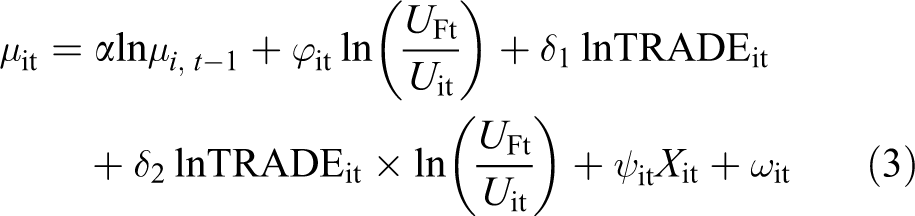
where
The role of regional trade agreements
Unlike previous studies on trade and technical inefficiency, we go an extra mile by recognizing the importance of RTAs in liberalizing trade and promoting efficiency. We take wisdom from theoretical and empirical literature supporting that RTAs promote trade and production efficiency. The Gravity models of international trade of Viner (1950) identifies the principal implications of RTAs through the trade creation and diversion effects. The trade creation effect displaces less efficient domestic production. Evidence show that RTAs enhance intra-regional trade in general (Ngepah and Udeagha, 2018) and intra-regional agriculture in particular (Ghazalian et al., 2011; Ghazalian, 2013a). Resultant competition compels member states to upgrade their production systems and use inputs more efficiently (Josling, 2011). In this context, we include the four RTAs dummies into (3) which gives
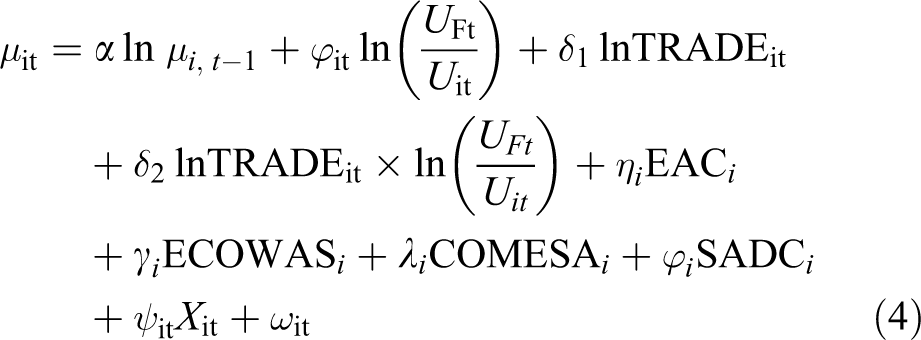
where
Institutional quality and technical efficiency
The inclusion of institutional quality marks another key contribution of the study. The gist of agricultural trade liberalization, as indicated in the AoA is to remove inefficiencies in the agriculture sector. Rodrik et al. (2002), Islam and Montenegro (2002) and Rigobon and Rodrik, 2004) provide evidence that trade openness indeed positively correlates with institutional quality. OECD (2015), Blanchard (2015) and Yildirim and Gokalp (2016) agree that the strengthening of institutions frameworks reduces inefficiencies in production. However, some studies (Kato and Sato, 2015; Meon and Weill, 2009) find that depending on the strength of institutions and sequence of policies, anti-corruption interventions may have negative production effects. Given this insight, we include institutional quality variables regulatory quality and control of corruption. This gives:
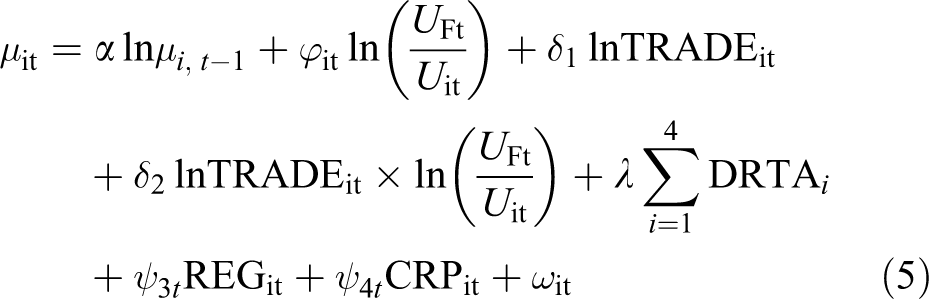
where
Functional forms
Stochastic frontier approach
The technical inefficiency in (5) is computed using a stochastic production frontier instead of the conventional deterministic frontier. The latter, shown in (6), assumes that all the deviation from frontier output is attributed to technical inefficiency (Kumbhakar and Lovell, 2000).

Nevertheless, random shocks to the production technology beyond the control of producer do exist. Building on early theoretical works by Debreu (1951) and Farrell (1957), Aigner et al. (1977), Meeusen and Van Broeck (1977) and Battese and Cora (1977), in independent and simultaneous papers, introduced a stochastic error term to produce a stochastic production frontier expressed as:

where

True fixed-effects panel stochastic frontier model
In order to estimate (5), we use the true fixed-effects model by Green (2005a). Earlier time-varying models (Kumbhakar and Wang, 2005; Lee and Schmidt 1993) did not separate individual heterogeneity from inefficiency (Green, 2005a). Consequently, all time-invariant heterogeneity is confounded into inefficiency. Thus, the technical inefficiency term could be picking up heterogeneity in addition to or instead of inefficiency (Kumbhakar et al., 2015). To address this, Green (2005a) improved on the time-invariant specification by Schmidt and Sickles (1984) to develop the true fixed-effects model:

where

Unlike (9), (10) has an additional term

where D is a country dummy and
The quasi-translog production function
Empirical estimations of stochastic frontier models are usually based on the Cobb–Douglas and transcendental-logarithmic (translog) production functions. The former has a strength that econometric estimation problems, including multicollinearity, serial correlation and heteroskedasticity, cannot only be easily, but adequately handled (Bhanumurthy, 2004). The Cobb–Douglas function with technical change can be expressed as:

where
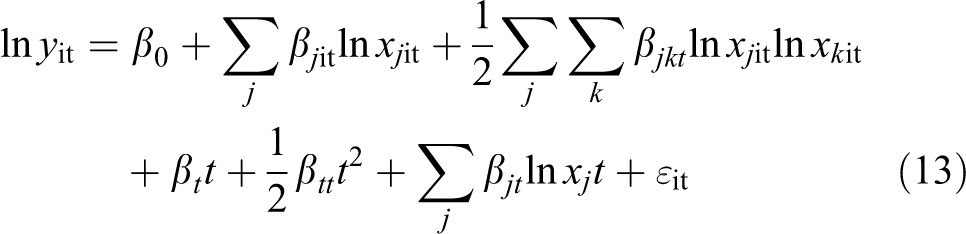
where
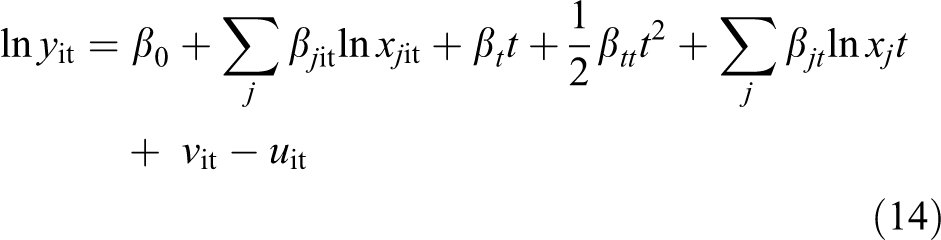
In this study, we include harvested land area (a), labour (l), crop seed (s), fertilizer (f) and capital as our inputs. Expanding (14) gives:
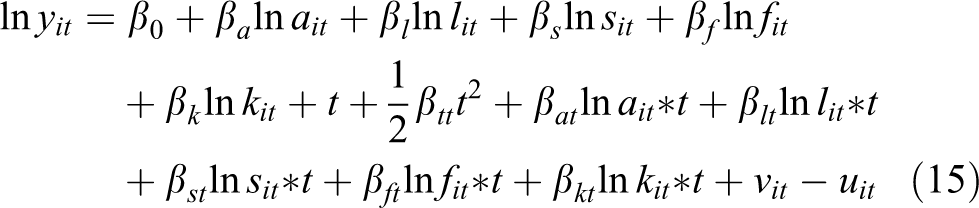
The quasi-translog production function strikes a balance between the Cobb-Douglas and the Translog functions and therefore provides a more approximate representative of the evolution of inputs (Mccarthy, 2019). Moreover, by imposing separability between all inputs, it lessens the multi-collinearity problem. Based on these arguments we use it for estimation.
Estimation
Single-stage maximum likelihood estimator
Early works employed a two-step procedure to examine the determinants of technical inefficiency. Firstly, the observation specific inefficiency index is predicted. Secondly, the index is regressed on a vector of exogenous variables

where
Substituting the technical inefficiency model (5) and the quasi-translog production function (15) into (16) gives the true fixed-effects panel stochastic frontier model:

Equation (17) is the final model ready for MLE.
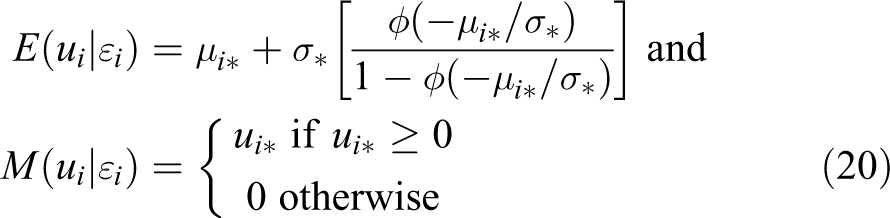
The essence of the MLE is that the parameters of the model are estimated by maximizing the log-likelihood function which is derived from the distributional assumptions. The likelihood function by Kumbhakar and Lovell (2000) for the ith observation is expressed as:

where

Summing up
Empirical results
Technical efficiency scores
The true fixed-effects technical inefficiency scores for maize and rice are presented in Figures 1 and 2, respectively. The overall technical efficiency for maze and rice is 80.4% and 76.5%, respectively. This implies that there is scope to increase maize and rice production by approximately 20% and 23% using the same resources. Inferior rice efficiency may be due to difference in maize and rice scale of production. OECD-FAO (2016) reveals that Sub-Saharan Africa produces less than 3% of global rice, of which almost all is produced on small scale farms of 0.5–3 ha (International Rice Research Institute (IRRI, 2019)). The access and use of technology for small-scale farmers is limited, whereas maize producers enjoy economies of scale. The trend in efficiency improvement is encouraging. Maize efficiency increased from 68.1% in 2005 to a maximum of 87.9% in 2012 before stabilizing above 84% from 2014. Rice efficiency in 2005 was 72.8%, dropped to 61.4% in 2007 before increasing significantly to a maximum of 85.3% in 2016.

Maize technical efficiency scores. Source: Authors’ compilation from STATA Estinates.

Rice technical efficiency scores. Source: Authors’ compilation from STATA 14 Estimates
Individual efficiency scores also reflect variations across countries and crops. Ghana (89.5%) and Mali (90.2%) are the most efficient maize and rice producers, respectively. Malawi (69.7%) and Mozambique (48%) are the least efficient maize and rice producers. Ethiopia, Malawi and Mozambique recorded below average maize efficiency. Also, Ghana, Kenya and Mozambique rice efficiency lies below average.
True fixed-effects MLE results
The results are shown in Table 2. Parameter estimates for technical efficiency gap are all negative and highly statistically significant for both maize and rice. This confirms to conventional logic and empirical findings that non-frontier producers are more likely to increase their efficiency levels relative to frontier producers. Considering rice efficiency between 2013 and 2014 elaborates this. In 2013, Benin with efficiency of approximately 1 (0.999998) is the frontier producer while Mozambique with efficiency of 0.248 is the least efficient producer. In 2014, Mozambique’s efficiency increased by 42.47% to 0.353, while Benin’s efficiency dropped by 11.31% to 0.887. It follows that the further a country lies below frontier, the greater is the potential for technology transfer and the higher the chances of technical efficiency improvement.
True fixed effects MLE results.a
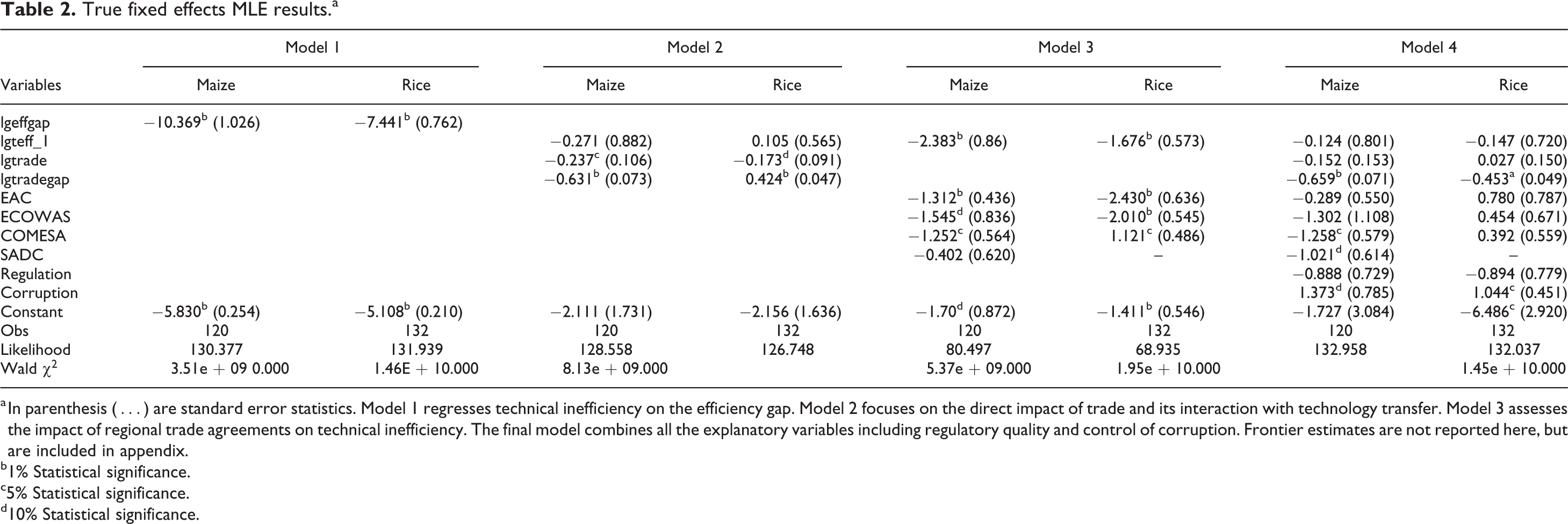
a In parenthesis (…) are standard error statistics. Model 1 regresses technical inefficiency on the efficiency gap. Model 2 focuses on the direct impact of trade and its interaction with technology transfer. Model 3 assesses the impact of regional trade agreements on technical inefficiency. The final model combines all the explanatory variables including regulatory quality and control of corruption. Frontier estimates are not reported here, but are included in appendix.
b1% Statistical significance.
c5% Statistical significance.
d10% Statistical significance.
Discussion
Maize and rice coefficients of trade and its interaction term with technology transfer are all negative as expected. The trade coefficients of −0.212 and −0.173 for maize and rice are significant at 5% and 10%, respectively. It follows that a 1% increase in trade reduces technical inefficiency by 0.212% and 0.173%, respectively. With efficiency gap interaction, both coefficients become significant at 1%, with the impact increasing to 0.63% and 0.42%, respectively. Our findings confirm that trade speeds up technology transfer from frontier to non-frontier producers and the combined force reduces technical inefficiency. This concurs with findings by Chortareas et al. (2003) and Hart et al. (2015). The results point to interesting findings pertaining to the nature and composition of regional trade agreements. For maize production, ECOWAS, with a 10% statistically significant coefficient of −1.545 is the most influential in reducing maize technical inefficiency, followed by EAC (−1.312) and COMESA (−1.252) which are significant at with 10% and 1%, respectively. It follows that for the three RTAs, technical efficiency is approximately 1.5 and 1.3 times greater than in non-members. SADC (maize) has the least and only insignificant impact on technical inefficient of −0.402. Turning to rice production, EAC has the biggest (−2.430) and highly statistically significant (1%) impact on rice technical inefficiency. This suggests that members of EAC reduces technical inefficiency by approximately 2.5 times than non-EAC countries. ECOWAS, has the second biggest (−2.01) and significant (1%) influence in reducing rice technical inefficiency. For COMESA (1.121 and 5%), results suggest that member countries are 1.2 times less efficient than non-members. SADC was dropped for rice in models 3 and 4 because of collinearity. This may be due to multi-RTAs. Two SADC countries, Malawi and Tanzania also belong to COMESA and EAC respectively. The variations in the impact of RTAs on technical efficiency may be explained by two issues. Firstly, impact depends on their nature, depth and politics. Ngepah and Udeagha (2018) relate variations to effectiveness or lack of it, in implementation by signatory countries. Secondly, the results may reflect negative effects of multiple membership to trade agreements. Six countries (Burundi, Kenya, Malawi, Rwanda, Tanzania and Uganda) belongs to two RTAs. Of these, four countries (Burundi, Kenta, Rwanda and Uganda) belong to both EAC and COMESA. Thus measures in one RTA may be duplicated and/or overridden by those in sister RTAs. This is in line with the findings by Afesorgbor and Van Bergeijk (2011) and Sunge and Mapfumo (2014) who documented that the differences in the rules of origin from different agreements creates red tape, thereby undermining the effectiveness of the RTAs. Institutional quality estimates indicate favourable impact of regulatory quality. The coefficients for maize and rice are −0.888 and −0.894, respectively. It follows that a unit improvement in regulatory quality leads to approximately 89% decrease in technical inefficiency for both crops. However, the estimates are statistically insignificant. Nevertheless, this suggests that maize and rice producers responded positively to policies and regulations formulated and implemented by their respective governments. The policies and regulations promote private investment initiatives like R&D, competition and market access. With these fundamental aspects in place, farmers become more efficient producers. Our findings echo previous studies (Doyle and Martinez-Zarzosof, 2011; Yildirim and Gokalp, 2016), which find favourable impacts of good regulatory frameworks on different aspects of the economy. Control of corruption estimates is in contrast with theory. Maize and rice estimates are 1.373 and 1.044, respectively. The coefficients are statistically significant at 10% and 5%. We deduce that a unit increase in anti-corruption, increases maize and rice technical inefficiency by 137.7% and 104.4% units, respectively. This finding is rare but might not be surprising. Some studies (Kato and Sato, 2015; Meon and Weill, 2009) show that when countries’ institutions are weak and function poorly, corruption becomes a means to navigate inefficient provision of services and rigid laws. Kato and Sato (2015) calls this a ‘greasing the wheel effect’ of corruption. Given the fragile institutions Africa has, there is a big chance that the control of corruption may impede production, hence the negative effects. In African agriculture, distribution of farm inputs and equipment usually involve political agents. Hence if anti-corruption measures are not implemented properly, they may work against production. More recently, Adefeso (2018) found evidence of ineffective control of corruption in African countries.
Lastly, the results suggest that weak institutional quality tends to dampen the impact of trade openness and RTAs. In models 2 and 3, trade and RTAs (save for SADC) are shown to have favourable and statistically significant impact on technical efficiency. However, they become subdued and insignificant in model 4. For rice, all RTA coefficients became positive and none is significant, suggesting that the provisions under the RTAs are harmful to efficiency after controlling for institutional quality. The loss of significance and fall in impact may suggest that benefits from RTAs are pulled down by weak institutions. Florensa et al. (2015) provide evidence that strong institutions have increased the benefits from trade in Latin American Integration Association (LAIA) over the period 1962–2009. More recently, Álvarez et al. (2018) document that institutional conditions are relevant factors for trade. De-Groot et al. (2003) find good regulatory framework promote trade by 12–18%, while lower corruption accounts for 17–27% additional trade. It follows that when institutions are weak, as is in Africa, negative externalities are likely. As a result, unnecessarily higher transaction costs are incurred leading to less trade and inefficient production.
Conclusions
This article investigates the role of agricultural trade liberalization and institutional quality on technical efficiency in the agriculture sector in Africa using panel data spanning from 2005 to 2016. We make two contributions in this study. First, over and above considering the pass through effects of trade–technology channel, we consider the role played by African RTAs. Second, we assess how efforts to eliminate distortions in agriculture, through strengthening institutional quality, affects technical efficiency. We use the single-stage MLE of the quasi-translog stochastic frontier approach to estimate time-varying technical efficiency scores on maize and rice production. We then assess the trade and institutional quality determinants on technical efficiency using Green’s (2005a) true fixed-effects model. We provide evidence that through technology transfer, agriculture trade statistically improves technical efficiency. Also, results suggest that RTAs provide favourable technical efficiency effects which varies across products and membership. Furthermore, we document that while regulatory quality reduces technical inefficiency, control of corruption increases it. Our findings call for increased role of RTAs in promoting agriculture trade liberalization. This should be complemented by further strengthening of institutions involved in the agriculture value chain.
Supplemental material
Supplemental Material, Appendix_1_RTAs_COUNTRY_LIS - Agricultural trade liberalization, regional trade agreements and agricultural technical efficiency in Africa
Supplemental Material, Appendix_1_RTAs_COUNTRY_LIS for Agricultural trade liberalization, regional trade agreements and agricultural technical efficiency in Africa by Regret Sunge and Nicholas Ngepah in Outlook on Agriculture
Supplemental material
Supplemental Material, Appendix_2_MAIZE_TRANSLOG-DATA - Agricultural trade liberalization, regional trade agreements and agricultural technical efficiency in Africa
Supplemental Material, Appendix_2_MAIZE_TRANSLOG-DATA for Agricultural trade liberalization, regional trade agreements and agricultural technical efficiency in Africa by Regret Sunge and Nicholas Ngepah in Outlook on Agriculture
Supplemental material
Supplemental Material, Appendix_3_RICE_TRANSLOG-DATA - Agricultural trade liberalization, regional trade agreements and agricultural technical efficiency in Africa
Supplemental Material, Appendix_3_RICE_TRANSLOG-DATA for Agricultural trade liberalization, regional trade agreements and agricultural technical efficiency in Africa by Regret Sunge and Nicholas Ngepah in Outlook on Agriculture
Supplemental material
Supplemental Material, Appendix_4_INSTRUCTION_DOFILE - Agricultural trade liberalization, regional trade agreements and agricultural technical efficiency in Africa
Supplemental Material, Appendix_4_INSTRUCTION_DOFILE for Agricultural trade liberalization, regional trade agreements and agricultural technical efficiency in Africa by Regret Sunge and Nicholas Ngepah in Outlook on Agriculture
Supplemental material
Supplemental Material, Appendix_5_MAIZE-RESULTS - Agricultural trade liberalization, regional trade agreements and agricultural technical efficiency in Africa
Supplemental Material, Appendix_5_MAIZE-RESULTS for Agricultural trade liberalization, regional trade agreements and agricultural technical efficiency in Africa by Regret Sunge and Nicholas Ngepah in Outlook on Agriculture
Supplemental material
Supplemental Material, Appendix_6_RICE-RESULTS - Agricultural trade liberalization, regional trade agreements and agricultural technical efficiency in Africa
Supplemental Material, Appendix_6_RICE-RESULTS for Agricultural trade liberalization, regional trade agreements and agricultural technical efficiency in Africa by Regret Sunge and Nicholas Ngepah in Outlook on Agriculture
Supplemental material
Supplemental Material, Appendix_7_RESULTS - Agricultural trade liberalization, regional trade agreements and agricultural technical efficiency in Africa
Supplemental Material, Appendix_7_RESULTS for Agricultural trade liberalization, regional trade agreements and agricultural technical efficiency in Africa by Regret Sunge and Nicholas Ngepah in Outlook on Agriculture
Footnotes
Declaration of conflicting interests
The author(s) declared no potential conflicts of interest with respect to the research, authorship, and/or publication of this article.
Funding
The author(s) received no financial support for the research, authorship, and/or publication of this article.

Supplemental material
Supplemental material for this article is available online.
Notes
References
Supplementary Material
Please find the following supplemental material available below.
For Open Access articles published under a Creative Commons License, all supplemental material carries the same license as the article it is associated with.
For non-Open Access articles published, all supplemental material carries a non-exclusive license, and permission requests for re-use of supplemental material or any part of supplemental material shall be sent directly to the copyright owner as specified in the copyright notice associated with the article.
