



Abstract
This study examined the effect of a motor intervention based on the attention, balance, and coordination (ABC) learning approach on motor proficiency and executive functions in children with learning disabilities (LD). Forty-five male elementary school students with LD aged 7-9 years were recruited and randomly assigned into one of three groups: two experimental groups and one control group. Experimental Group A received only the motor intervention. Experimental Group B simultaneously received both motor intervention and regular educational services. The control group received only regular educational services. The motor intervention involved sequential station exercises based on ABC; this training took place in 24 sessions, scheduled three times a week for eight weeks. We obtained children’s scores on the Bruininks-Oseretsky Tests of Motor Proficiency, N-Back Test, Tower of London, and Continuous Performance Tests at pretest, posttest, and follow-up testing. Our results showed that both experimental groups significantly improved their motor skills and most measures of executive functions, relative to no significant improvement for the control group. The improvements on some measures of executive functions in Experimental Group B were just slightly better than in Experimental Group A. This study supported Blythe’s ABC learning approach emphasizing ABC, and it extended earlier findings of benefits of this approach to populations of children with LD.
Introduction
Each child’s ability to learn depends on his or her neural and organ development, such that learning certain abilities requires a level of readiness from the child. Insufficient learning readiness can lead to academic failure (Lerner, 2002). According to our most modern diagnostic manual (Diagnostic and Statistical Manual of Mental Disorders, Fifth Edition; American Psychiatric Association [APA], 2013), children with learning disabilities (LD) have a persistent difficulty learning key academic skills (i.e., reading, writing, and mathematics) with an onset of these difficulties during the early years of formal education. Students with LD may have problems in one or more academic fields. Therefore, these children are a heterogeneous group that displays various learning and behavior characteristics (Anderson, 2002; APA, 2013; Lerner, 2002). These children have a normal intelligence quotient (IQ), but their academic skill performance is well below average for their age (APA, 2013). Therefore, chronological age and intelligence are not the only criteria for successful learning; among other critical variables, developmental readiness is important for formal education (Blythe, 2017). Blythe (2009) stressed the importance of a relationship between attention, balance, and coordination (ABC) in a child’s readiness to learn and asserted that this ABC of Learning represents a foundation for later learning. Blythe believes that these three elements are the primary ABC approach upon which all later learning depends (Mountstephen, 2011). The capacity for sustained and self-directed attention increases simultaneously with maturation of perceptual-motor functions (Blythe, 2000). On the other hand, balance forms the basis of the ability to pay attention and coordinate movements effectively (Mountstephen, 2011). A child who must use vision as a compensatory system for poor balance faces many problems, giving full attention to such fine visual-motor tasks as writing (Mountstephen, 2011). In addition, writing is a motor task that requires eye–hand coordination as supported by the postural system. Reading is a visual-motor skill dependent on coordination and proper functioning of systems such as vestibular, proprioceptive, and visual. So, to improve learning quality, several systems must be in sync (Krog, 2010). Blythe (2009), through an emphasis on the importance of the relationship between ABC, predicted that children who cannot maintain good body control may show reading, writing, or behavioral problems. Thus, instead of only training their academic skills, there should be training directed toward their poorly organized movement patterns (Mountstephen, 2011).
Lower motor skills among children with LD, compared with their typically developing peers, have been identified by various researchers (Bruininks & Bruininks, 1977; Getchell, Pabreja, Neeld, & Carrio, 2007; Nonis & Tan, 2014; Westendorp, Hartman, et al., 2014; Woodard & Surburg, 2001). One longitudinal study on gross motor development in children with LD aged 7-11 years showed that these children had a lower performance than typically developing children on locomotor and ball skills at all ages studied, with the exception that locomotor skills at age seven were not lower for this group. Also, 11-year-old children with LD, compared with their peers, showed a lag in (a) locomotor and (b) ball skills of at least four and three years, respectively (Westendorp, Hartman, et al., 2014). Vuijk, Hartman, Mombarg, Scherder, and Visscher (2011) compared children with LD to available normative scores of same-aged children and found that 52.6% of children with LD performed below the 15th percentile on manual dexterity, 40.9% performed poorly on ball skills, and 33.7% on balance skills. Moreover, another research team demonstrated that the greatest motor-related skill deficiencies of children with LD were on tasks requiring body balance, visual-motor control, and bilateral coordination (Bruininks & Bruininks, 1977).
On the other hand, earlier theorists, such as Piaget, argued that skills and relationships learned during physical activity carry over to the learning of other relationships and concepts. Physical activity provides learning experiences that aid proper cognitive development (Sibley & Etnier, 2003). Recent studies express that children’s motor performance may be related to higher order cognitive functions, including executive functioning (EF; Schurink, Hartman, Scherder, Houwen, & Visscher, 2012). EF includes higher order cognitive processes that are responsible for goal-directed behavior. These functions are processed by the prefrontal cortex and its subcortical connections and include different metacognitive skills such as response inhibition, cognitive flexibility, attention, working memory, planning, and problem-solving (Schuchardt, Maehler, & Hasselhorn, 2008; Westendorp, Hartman, Houwen, Smith, & Visscher, 2011). Executive functions are important to the learning process, and, thus, EF changes can affect the child’s learning (Lima, Azoni, & Ciasca, 2011). Studies have shown that children with LD usually have weaker EF performance in areas such as working memory, attention, and planning and problem-solving, compared with nondisabled peers (Lima et al., 2011; Mammarella, Lucangeli, & Cornoldi, 2010; Schuchardt et al., 2008). Deficits in working memory seem to be related to academic performance, including literacy and mathematics in children with LD (Mrazik, Bender, & Makovichuk, 2010). Inability to maintain task attention is also a main problem of those with LD. Attention is essential for cognitive performance, memory, and learning behavior so that even slight deficiencies in attention can impair learning (Sterr, 2004). In addition, planning and problem-solving are critical parts of goal-oriented behavior, and they embody the ability to formulate actions in advance and approach a task in an organized, strategic, and efficient manner (Anderson, 2002). Problem-solving seems to be a fundamental ability for mathematical skills (Westendorp, Houwen, et al., 2014). Therefore, improving EF can facilitate academic learning (Best, Miller, & Jones, 2009).
Few studies have investigated the effects of motor intervention programs on improving both motor performance and EF in children with LD. Rintala and Palsio (1994) examined the effects of 20-session physical education programs on children with LD. Their results indicated significant improvement in eye–hand coordination, bimanual coordination, and static balance. They found that motor skills improved in the psychomotor training group as much as 54%, in the body image training group as much as 26%, and in the regular physical education group as much as 41%. Moreover, study findings in the follow-up period of a 6-month home-based exercise treatment for children with reading difficulties indicated that the exercise group significantly improved both motor skills and cognitive skills, such as attention and working memory (Reynolds & Nicolson, 2007). Ericsson (2008) examined the effect of extended physical education and motor training on children’s attention over a period of three years. The results showed intervention-related attention improvement in School Year 2 that did not persist to School Year 3. In another similar study performed to investigate the effect of physical exercise (coordination exercises vs. nonspecific physical education lessons) on cognition (Budde, Voelcker-Rehage, Pietraßyk-Kendziorra, Ribeiro, & Tidow, 2008), coordinative exercises had more effect on the performance of concentration and attention tasks. Westendorp, Houwen, et al. (2014) also investigated the effects of a 16-week ball skill intervention on ball skills, problem-solving, and cognitive flexibility in children aged 7-11 years with learning disorders. Their results showed that ball skills were improved, but there was no intervention effect on cognitive parameters. However, a positive relationship was found between improved ball skills and the change in problem-solving within the intervention group. In addition, Schurink et al. (2012) indicated a positive relationship between Tower of London (TOL) scores with manual dexterity and balancing objects on one hand in children with developmental disorders. Evidence for the relationship between motor performance and EF was found in neurobiological research based on temporal or spatial similarities between the development of motor skills and EF in typically developing populations (Schurink et al., 2012). Most of the methodology in studies on children with LD in this area have been causal-comparative and correlational with motor interventions rare. On the other hand, with regard to the motor and cognitive domain problems of children with LD, the gap between these children’s skill levels and those of their nondisabled peers may become larger with age. Thus, providing intervention programs that meet these children’s basic needs is an important means of reducing and improving their learning problems. The present study examined whether a motor intervention program, based on the three elements of ABC, could enhance both motor abilities and executive functions (i.e., sustained attention, working memory, and problem-solving) of children with LD.
Method
Participants
We recruited 45 7-year-old male elementary school male students with LD from four Iranian Education and Rehabilitation Centers for Special Learning Disabilities, under the supervision of the Special Needs Education Department located in Mashhad. All the children were enrolled in public elementary schools (first to third grade), and, because of their learning difficulties in reading, writing, or mathematics, they had been referred to the rehabilitation centers for required special educational services. Within their educational grade, children were randomly and equally assigned into one of three groups—two experimental groups and a control group. Each group consisted of 15 students equally divided in first to third grade (first grade, n = 5; second grade, n = 5; third grade, n = 5). The children’s LD were confirmed by child psychologists and special education experts at the centers as based on their school files, containing for each student such characteristics as age, sex, and intelligence (IQ score); short medical history; and academic status. Children were included only if they were medically healthy, meaning not suffering from any physical illness or injury and had no disorder except LD at the time of testing. We obtained informed consent from parents of all participants. All procedures were approved by the Biological Research Ethics Committee of Ferdowsi University of Mashhad.
Materials
Bruininks-Oseretsky Test of Motor Proficiency (BOTMP)
We administered the BOTMP to assess the children’s motor performances. This test consists of eight subtests and 46 items measuring motor proficiency. Four subtests evaluate gross motor performance (running speed and agility, balance, bilateral coordination, strength); three evaluate fine motor performance (response speed, visual-motor control, and upper-limb speed and dexterity); and one evaluates both gross and fine motor performance (upper-limb coordination). This test has been validated to assess motor proficiency of children who are 4.5 to 14.5 years old, and test–retest reliability has been reported as .78 (Bruininks, 1981; Hattie & Edwards, 1987).
Continuous Performance Test (CPT)
This test was used to assess sustained attention. The CPT was first described in 1956, and test–retest reliability measures for it ranged between .74 and .90 (Rosvold, Mirsky, Sarason, Bransome, & Beck, 1956). There are a variety of CPTs to measure sustained attention, vigilance, response inhibition, and signal detection (Riccio, Reynolds, Lowe, & Moore, 2002). We employed a computer-administered CPT consisting of 150 numerical stimuli (1–9) that randomly appeared on the computer screen, one stimulus at a time, for approximately 150 milliseconds each. The interval between stimuli was 500 milliseconds. Participants were required to press the space bar when a target stimulant (e.g., number 4) appeared on the screen. Test–retest reliability coefficients for various measures of this version of CPT ranged between .59 and .93 in a study on Iranian primary school students, and criterion validity coefficients of the CPT were also measured and validated for use with children (Hadianfard, Najarian, Shokrkon, & Mehrabizade Hnarmand, 2001).
The N-Back Test
This working memory test was introduced by Wayne Kirchner in 1958. In it, a subject is presented with a sequence of stimuli and required to indicate when the current stimulus matches a prior stimulus that occurred n steps earlier in the sequence (Kirchner, 1958). We used the visual 1-back test in this study. “1 − N” means the respondent must remember the position of the item, one turn back. Participants were asked to monitor the identity of a series of one-digit numbers from 1-9, presented in a random sequence. They had to push one of two possible buttons (yes = green key or no = red key) to indicate whether the currently presented stimulus was the same as the one presented 1-trial previously. N-back has validity as a working memory task, and the reliability coefficient of this test were reported to range between .54 and .84 (Kane, Conway, Miura, & Colflesh, 2007).
TOL
To examine problem-solving and planning ability, we performed a computer version of the TOL. This test consists of a board with three different lengths of pegs and three colored balls (red, blue, and yellow) with holes through them, permitting them to be placed on the pegs. The respondent’s goal was to rearrange the position of the balls from a fixed start position to a depicted goal position. The children were given 12 problems to solve as accurately and as quickly as possible, with a maximum of three trials allowed. Thus, scores for each item ranged from 1-3 points, based on the number of trials required to solve the problem. The child’s final score was expressed as the sum of scores for each item, with a maximum total score of 36. The TOL has been validated for use with children (Anderson, Anderson, & Lajoie, 1996), and the reliability coefficient of this test was reported to be .79 (Lezak, Howieson, Loring, & Fischer, 2004).
Procedure
In this study, an experimental pre-post-follow-up design was used. The scores on the motor proficiency and EF tasks of participants in the three groups at pretest were used as baseline data; and, to investigate intervention effects, we compared participants’ scores on the posttest and on a follow-up test three months after intervention.
Pilot study
We performed a pilot study in advance of the experiment in which we exposed all children for two weeks to training sessions at a frequency of three times per week to examine whether the exercises were appropriate for the children and their abilities and performance level. We collected information about how much time it takes to give appropriate instructions and to perform the exercises, and we used what we learned for the final intervention sessions.
Intervention
The motor intervention program employed in both experimental groups was based on the ABC approach to learning discussed in the introduction to this research (Blythe, 2000, 2017; Mountstephen, 2011). This program involves sequential station exercises based on ABC by using bilateral, unilateral, and cross-lateral activities. This motor program allows learners to engage in perceptual-motor behavior in the form of play and through activities that are meaningful, purposeful, and carefully sequenced in a three-station format. The activities are short and simple to set up, and they use a variety of common and specially designed equipment to keep children interested and challenged. They incorporate academic skill in the form of cards with different colors showing letters, shapes, pictures, numbers, and sight words. These cards are placed, for example, on cones or mats in the stations. As students engage in the activities, they verbalize what is shown on the cards, thus practicing the integrated use of their mind and muscles together to meet each challenge (Johnstone & Ramon, 2011). Importantly, children are challenged according to their own skill level. The motor activities were sequenced from simple to complex. The first two weeks involved simultaneous bilateral activities from both sides of the body; the second two weeks addressed unilateral activity with one side of the body; and the third two weeks covered cross-lateral activities or movements crossing the body’s midline. The final two weeks closed the program with activities that combine all types of tasks (Johnstone & Ramon, 2011). We used three physical education teachers in this program. At each station, a teacher monitored and guided children to perform these exercises, based on their skill level. Several references were used to provide this motor intervention program (Cheatum & Hammond, 2000; Fletcher, Lyon, Fuchs, & Barnes, 2006; Johnstone & Ramon, 2011; Rini, 1976) consisting of 24 sessions, three times a week for eight weeks. Each session lasted for approximately 55 minutes and consisted of the warm-up (five minutes), attention exercises (15 minutes), balance exercises (15 minutes), coordination exercises (15 minutes), and a cooldown period (five minutes). During the referral to the center, children in Experimental Group A participated only in the motor intervention program and did not receive regular educational services at the centers. Children in Experimental Group B, in addition to participating in the motor intervention program, simultaneously received regular educational services at the centers directed toward their LD. The control group received only the regular educational services at the centers and no organized motor programs.
Data Analysis
We gathered, calculated, and presented descriptive statistics, including group means and standard deviations. We conducted repeated measures analyses of variance (ANOVA) and multivariate analyses of variance (MANOVA) to examine the effect of the motor intervention on dependent variables. Univariate ANOVA was used to investigate the obtained differences, and Bonferroni post hoc tests were applied for effects that reached a 5% level of significance to carry out pairwise comparisons. We checked typical assumptions of MANOVA and ANOVA, such as normality and homogeneity of variance by boxplot and Q-Q plot (residuals vs. fitted values). The analyses were performed using SPSS 25 software, and we set the significance level at p < .05.
Results
Groups Characteristics, Motor Skills, and EF Tasks Scores
Characteristics of Participants by Group in Experimental Groups and Control Group, Expressed as Means (Standard Deviations) for Anthropometric Variables and WISC-III IQ Scores.
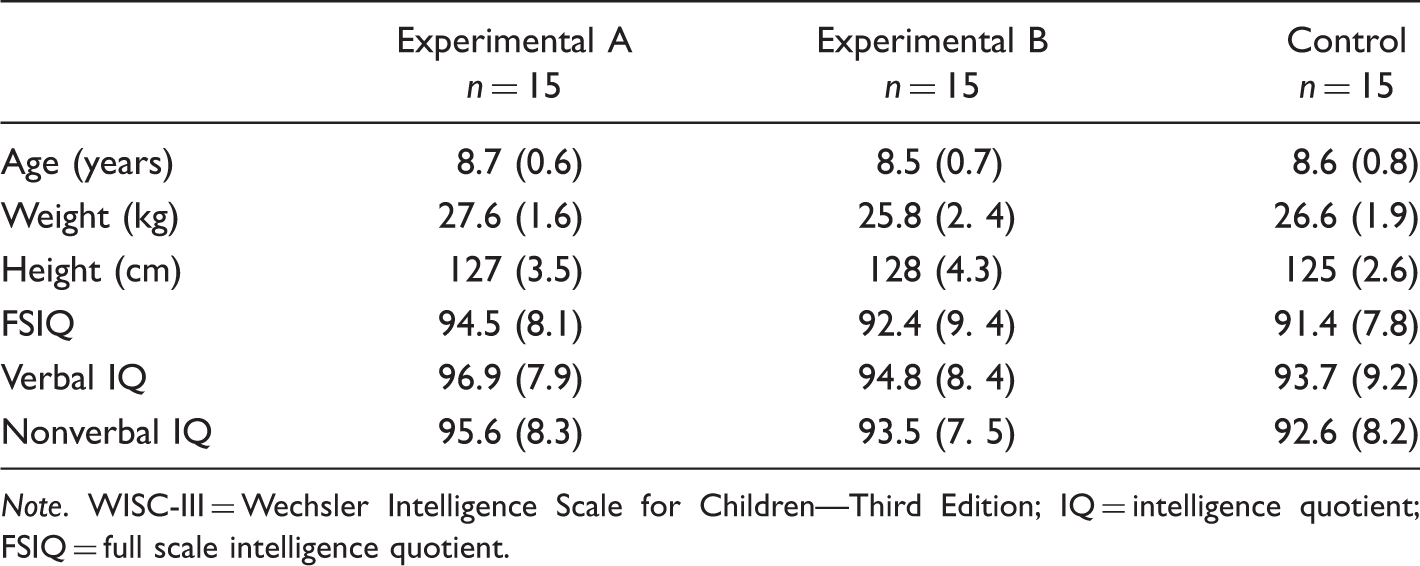
Note. WISC-III = Wechsler Intelligence Scale for Children—Third Edition; IQ = intelligence quotient; FSIQ = full scale intelligence quotient.
Means (Standard Deviations) of Participants’ Motor Skills and Executive Functions Test Scores by Groups and Over Time.
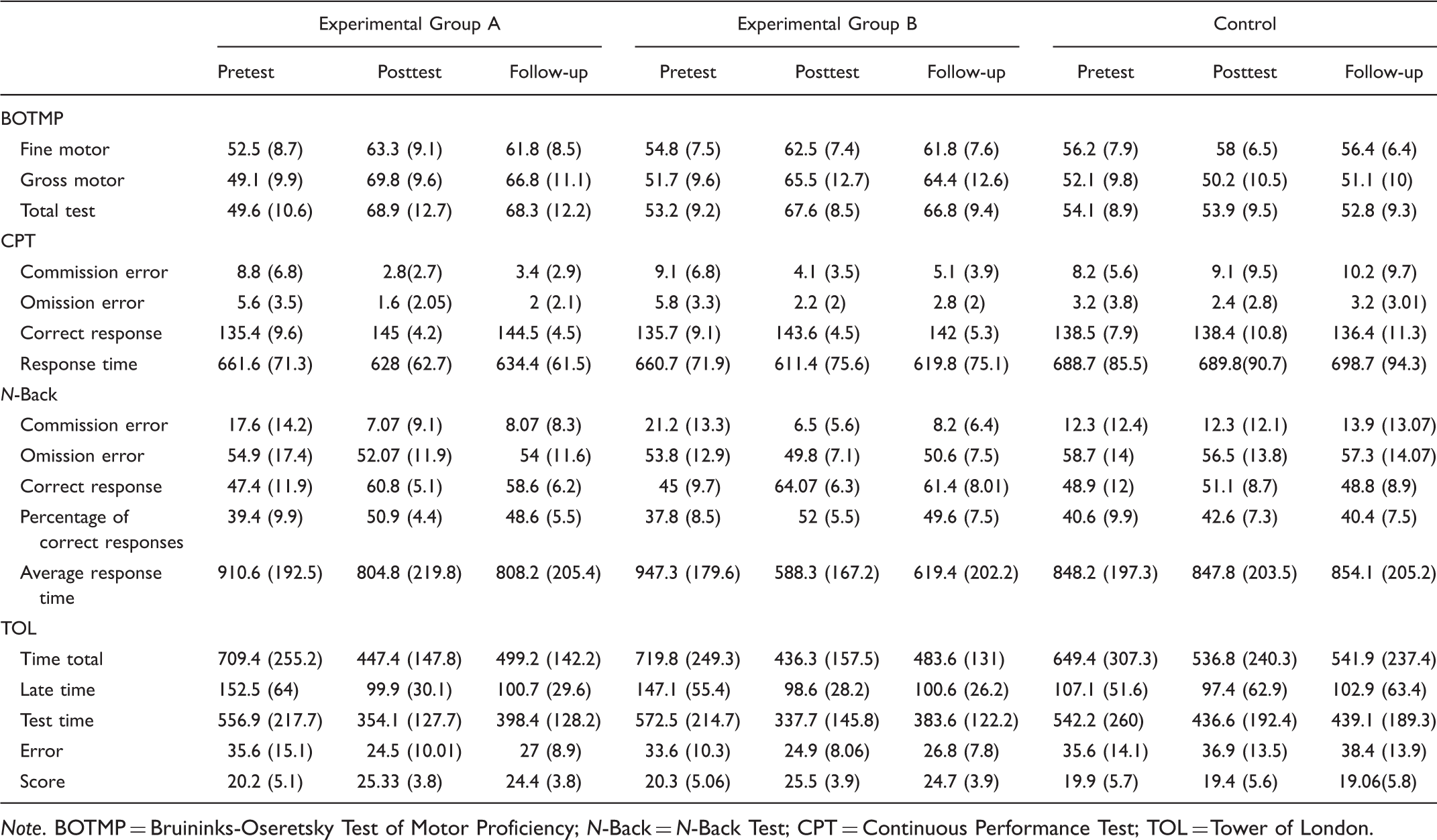
Note. BOTMP = Bruininks-Oseretsky Test of Motor Proficiency; N-Back = N-Back Test; CPT = Continuous Performance Test; TOL = Tower of London.
Effect of the Intervention on Motor Proficiency
MANOVAs for BOTMP and EF Tasks Performance.

Note. MANOVAs = multivariate analyses of variance; BOTMP = Bruininks-Oseretsky Test of Motor Proficiency; EF = executive functioning; CPT = Continuous Performance Test; TOL = Tower of London.
ANOVAs for BOTMP and EF Tasks Performance.
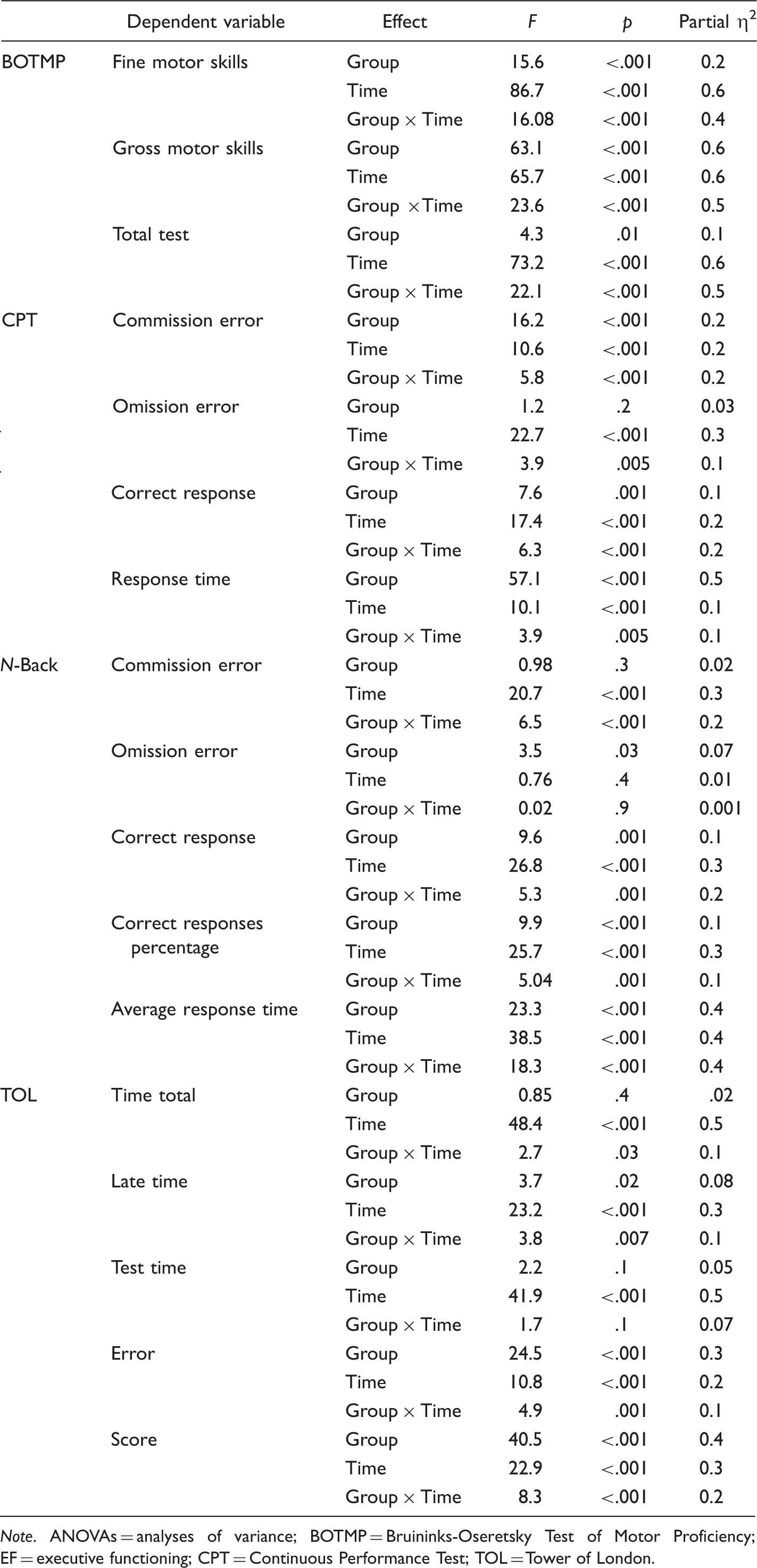
Note. ANOVAs = analyses of variance; BOTMP = Bruininks-Oseretsky Test of Motor Proficiency; EF = executive functioning; CPT = Continuous Performance Test; TOL = Tower of London.
Results of repeated measures ANOVA for the total score of motor proficiency testing revealed that the main effects of group (p < .05) and time (p < .001) and the interaction between group and time (p < .001) were significant. The Bonferroni test showed that Experimental Groups A and B had significantly higher performances at posttest than did the control group (p < .05), but there was no significant difference between Experimental Groups A and B in this regard. Also, there was a significant difference between pretest with posttest and follow-up testing (p < .05), but there was no significant difference between posttest and follow-up test scores for these groups. Moreover, in both Experimental Groups A and B, there was a significant difference between pretest and both posttest and follow-up test motor proficiency (p < .05), but there was no significant difference between posttest and follow-up testing. Also, there was no significant difference in motor proficiency between any test times in the control group.
Effect of the Intervention on Executive Functions
Sustained attention
The results of MANOVA for CPT performance, presented in Table 3, reveal that the main effects of group and time and the interaction between group and time were significant (p < .05). Thus, there was a significant difference between the groups, between testing times, and in the interaction between groups and times. The results of univariate ANOVAs, presented in Table 4, show a significant difference among the groups for commission error (p < .001), correct response (p < .01), and response time (p < .001), but there was no significant difference for omission error. In addition, there was a significant difference among the testing times and a significant interaction between group and time for all measures of CPT. The results of the Bonferroni post hoc test indicated that Experimental Groups A and B had significantly better performance at posttest than did the control group on commission error, correct response, and response time (p < .05). However, there was no significant difference between the Experimental Groups A and B on any of the measures. In addition, there was a significant difference among the testing times for all measures of CPT: commission error (p < .001), omission error (p < .001), correct response (p < .001), and response time (p < .001). The Bonferroni post hoc test indicated a significant difference between pretest and both posttest and follow-up test for all measures (p < .05), but there was no significant difference between posttest and follow-up test. Moreover, the interaction between group and time was significant for commission error (p < .001), omission error (p < .01), correct response (p < .001), and response time (p < .01). The results of the Bonferroni test showed that in both Experimental Groups A and B, there was a significant difference between pretest with both posttest and follow-up test for all the measures (p < .05), but there was no significant difference between posttest and follow-up test. Also, in the control group, there was no significant difference between testing times for any measures.
Working memory
The results of MANOVA for the N-back Test performance, presented in Table 3, reveal that the main effects of group and testing time and the interaction between them are significant (p < .05). Thus, there was a significant difference between the groups and the testing times and between the times in the groups.
The results of univariate ANOVAs, presented in Table 4, show a significant difference between the groups for omission error (p < .05), correct response (p < .001), percentage of correct responses (p < .001), and average response time (p < .001), but there was no significant difference for commission error. In addition, there was a significant difference among the testing times and a significant interaction between group and time for commission error, correct response, percentage of correct responses, and average response time, but there was no significant difference for omission error. The results of the Bonferroni post hoc test indicated that Experimental Groups A and B had significantly better performance at posttest than did the control group on correct response and percentage of correct responses (p < .05), but there was no significant difference between Experimental Groups A and B. Also, Experimental Group B had significantly better performance than the control group on omission error and average response time (p < .05), but there was no significant difference between the Experimental Groups A and B and no difference between Group A and the control group. Moreover, average response time in Group B was significantly better than in Group A (p < .05). Also, there was a significant difference between testing times for commission error (p < .001), correct response (p < .001), percentage of correct responses (p < .001), and average response time (p < .001), but there was no significant difference for omission error. The Bonferroni post hoc test indicated significant differences between pretest and both posttest and follow-up testing for commission error, correct response, percentage of correct responses, and average response time (p < .05), but there was no significant difference between posttest and follow-up test on these measures. Moreover, the interaction between group and time was significant for commission error (p < .001), correct response (p < .01), percentage of correct responses (p < .01), and average response time (p < .001), but there was no significant difference for omission error. The results of the Bonferroni test showed that in both Experimental Groups A and B, there was a significant difference between pretest and both posttest and follow-up testing for all the measures (p < .05), but there was no significant difference between posttest and follow-up testing. Also, in the control group, there was no significant difference between times for any measures.
Problem-solving and planning ability
The results of MANOVA for TOL performances, presented in Table 3, reveal significant main effects of group and time and for the interaction between group and time (p < .05). Thus, there was a significant difference between the groups and testing times as well as between testing times in the groups.
The results of univariate ANOVAs, presented in Table 4, show a significant difference between groups for late time (p < .05), error (p < .001), and score (p < .001), but there was no significant difference for test time and total time. In addition, there was a significant difference among the testing times for all measures of TOL and a significant interaction between group and time for late time, total time, error, and score, but there was no significant difference for test time. The results of the Bonferroni post hoc test indicated that the Experimental Groups A and B had significantly better posttest performances than did the control group on error and score (p < .05), but there was no significant difference between the experimental groups. Also, the Experimental Group A had significantly better late time performance at posttest than the control group (p < .05), but there was no significant difference between the experimental groups or between Group B and the control group. Also, the results showed a significant difference between testing times for late time (p < .001), test time (p < .001), total time (p < .001), error (p < .001), and score (p < .001). The Bonferroni post hoc test indicated there was a significant difference between pretest and both posttest and follow-up testing for all these measures (p < .05), but there was no significant difference between posttest and follow-up testing. Moreover, the interaction between group and time was significant for late time (p < .01), total time (p < .05), error (p < .01), and score (p < .001), but there was no significant difference for test time. The results of the Bonferroni test showed a significant difference between pretest and both post and follow-up test for total time in the control group and both Experimental Groups A and B (p < .05), but there was no significant difference between posttest and follow-up testing. In addition, in both experimental groups, there was a significant difference between pretest and both posttest and follow-up testing for late time, error, and score (p < .05), but there was no significant difference between posttest and follow-up test. Also, there was no significant difference between times for these measures in the control group.
Discussion
This study examined the effects of a training program based on ABC on motor proficiency and executive functions among children with LD. We found that children who received the 24 55-minute intervention sessions in experimental groups for a period of eight weeks demonstrated improvement in their motor proficiency and on most measures of executive functions, relative to children in the control group who did not show these improvements. Both fine and gross motor skills significantly improved from pretesting to posttesting after the intervention, compared with the control group, and these changes were maintained for follow-up testing three months later. However, there was no significant difference between the experimental groups. These findings are consistent with Westendorp, Houwen, et al. (2014) who showed that the ball skills of children with learning disorders were improved by participating in a ball skill intervention program and with Rintala and Palsio (1994) who found that motor skills improved in (a) a psychomotor training group, (b) a regular physical education group, and (c) a body image training group by 54%, 41%, and 26%, respectively. Our finding of improvements after this intervention for children with LD may be due to prior observations that children with LD usually have problems in motor planning, sequencing, and flexible motor responses underlying general motor proficiency problems (Reed, 2003). These children’s greatest motor deficiencies have been found to be on tasks requiring attention, body equilibrium, controlled fine visual-motor movements, and bilateral coordination of movements involving different parts of the body (Bruininks & Bruininks, 1977; Getchell et al., 2007; Vuijk et al., 2011; Rintala & Palsio, 1994). All of these tasks involve complex motor patterns that require the integration of visual and kinesthetic senses with motor responses (Bruininks & Bruininks, 1977). In addition, the preschool and the early primary school years are recognized as a critical period for developing motor skills, especially gross motor skills (Gabbard, 2008). Therefore, participation by students with LD in the motor intervention specified in this study promoted fine and gross motor skills and improved predictable motor deficiencies relative to participants in the control group who received no such intervention.
Regarding the intervention’s effect on EF in children with LD, this study found that sustained attention skills improved among participants in both Experimental Groups A and B relative to the control group on CPT measures of commission error and response time and an increased number of correct responses. However, there was no significant difference between the experimental groups for these measures. These findings suggest that both the speed of information processing and response inhibition improved from experimental group participation. In addition, all measures of CPT were significantly improved from the pretest to both posttest and follow-up testing, indicating that the motor intervention program had a lasting effect in improving the attention of children with LD. These findings are consistent with Reynolds and Nicolson’s (2007). However, Ericsson (2008) showed intervention-related attention improvement in School Year 2 that did not persist to School Year 3. The results of another similar study showed that coordinative exercises versus nonspecific physical education lessons had more effect on the performance of concentration and attention tasks (Budde et al., 2008).
Our results regarding working memory showed that Experimental Groups A and B had a higher number and percentage of correct responses than the control group at posttest. Also, the omission error and average response time in Group B were further reduced than the control group. In addition, the average response time in Group B was better than in Group A. These results indicate more improvement on measures of work memory (omission error and average response time) in Experimental Group B than Group A. Findings also showed that all measures of working memory in the experimental groups, with the exception of omission error, were significantly improved from pretest to posttest, and these changes persisted to follow-up testing after three months. These outcomes are consistent with those of Reynolds and Nicolson (2007) who showed children with reading difficulties after participating in a 6-month exercise-based treatment with significant gains in motor skills and working memory 18 months later.
Regarding problem-solving and planning ability, Experimental Groups A and B had better performance in reducing errors and increasing scores than the control group. However, there was no significant difference between the experimental groups for these measures. Late time in Group A was further reduced than in Group B, but test time and total time did not change significantly in the experimental groups compared with the control group. Although the total time from the pretest to the posttest test in all groups was reduced, it did not lead to a significant difference between groups. These results showed relatively similar improvements of children in the two experimental groups on the TOL test, relative to the control group. In addition, the findings indicated all measures of problem-solving were significantly improved from the pretest to posttest, and these changes remained constant after three months on follow-up testing. These results support the effectiveness of the intervention program in improving the problem-solving and planning. Westendorp, Houwen, et al. (2014) found no effect on cognitive parameters but did find correlations between the change in ball skill performance and the change in problem-solving for the intervention group. In addition, Schurink et al. (2012) showed a positive relationship between manual dexterity and balance on one hand and TOL scores on the other among children with developmental disorders.
Improvements in EF in the present study might be due to the cognitive skill demands of our motor intervention practice sessions. For children with relatively low motor proficiency, engagement in more cognitively demanding tasks is difficult and requires a basic level of motor skills to permit children to pay attention to cognitive elements of the task (Westendorp et al., 2011; Westendorp, Houwen, et al., 2014). Therefore, improving children’s motor skills in the intervention groups may have facilitated their executive functions relative to children in the control group. On the other hand, this motor program’s emphasis on ABC exercises using the bilateral, unilateral, and cross-lateral activities might have helped develop neural pathways in the brain (Johnstone & Ramon, 2011). The bilateral movement activities can help develop motor control and coordination. If a child does not master bilateral movements, his or her learning and cognitive development can be negatively affected due to the lack of neural stimulation that promotes brain organization. Cross-lateral movement activities include the movement of the opposite hand and foot simultaneously, also activating complex integrated movement between the two sides of the brain.
Our findings regarding improved executive functions confirm an important interaction between motor and cognitive processes. From a neuropsychological perspective, motor and cognitive functions seem to follow similar developmental timetables with an accelerated development between 5-10 years of age (Anderson, 2002), and both functions share several basic processes such as sequencing, monitoring, and planning (Westendorp et al., 2011). Moreover, motor and cognitive functions are coupled through brain structures involved in these processes, including the cerebellum and the prefrontal cortex (Anderson, 2002; Diamond, 2000). Thus, a motor intervention based on ABC, as in the current study, requires frontal-dependent cognitive processing that can help to enhance prefrontal neural functioning (Budde et al., 2008), while an emphasis on cerebellum-related skills associated with balance and coordinated movement may activate cerebellar neural functioning to allow these interventions to foster improvements in both motor and cognitive functions, including attention, working memory, and problem-solving (Lopes, Santos, Pereira, & Lopes, 2013; Westendorp, Houwen, et al., 2014). The present study showed that a motor intervention based on the ABC approach to learning improved fine and gross motor skills and most measures of executive functions for children with LD in both Experimental Groups A and B. Improvements on EF tasks in Experimental Group B (characterized by both the motor intervention protocol and regular education instruction) was just slightly better than for Experimental Group A (characterized by only the motor intervention protocol). These findings indicate that creating opportunities for movement and physical education are an important adjunct to teaching academic skills, especially during early learning years.
Among the limitations of the present study is that, in this cross-sectional research, we began with a convenience sample of children with LD, limiting the generalization of these findings. In addition, we do not know whether the positive effects of this intervention will be sustained after our 3-month follow-up period. Therefore, future longitudinal research with larger, more representative participant samples is required before further generalizing our conclusions regarding the beneficial effects of this intervention for children with LD. Also, because we assessed only three EF tasks, future researchers should examine these intervention effects on the whole spectrum of EF. Finally, future studies should examine whether this intervention program may affect other cognitive performances, such as academic achievement, in these children.
The present study has practical implications for teachers and educators working with children with LD, especially including the highlighted importance of a specific interaction between motor and cognitive performance and the benefits of specific motor and cognitive interventions for this population. Physical education teachers who help these children practice fine and gross motor skills in their gym lessons can facilitate both motor and cognitive functions and the neural pathways that underlie them, perhaps especially assisting EF development. An exclusive focus on academic goals may be monotonous and overly discouraging, while the program used in this study using therapeutic play and motor skill development has exciting promise. This study supported Blythe’s approach based on an ABC learning approach that stresses ABC as fundamental to the child’s readiness to learn, especially in the early learning years (Blythe, 2000, 2017; Mountstephen, 2011).
Footnotes
Acknowledgments
The authors wish to thank all teachers and children who cooperated in this study.