



Abstract
This study examined the relationship between physical literacy (i.e., motor competence, physical activity, and health-related fitness) and academic performance (i.e., executive function, class attendance, and standardized test scores) among adolescents. Second, we investigated whether these relationships differ between boys and girls using a structural invariable test. Using a prospective research design, we recruited 330 adolescents (154 boys and 176 girls; Mage = 12.52 years, SD = 0.86) in Texas and conducted correlational analyses, finding that physical literacy variables were significantly related to executive function (while the rs range was from −.16 to −.30, the high scores on the instrument we used, the Behavior Rating Inventory of Executive Function, indicate higher risks for executive dysfunction; p < .01) and positively associated with school attendance (rs range from .19 to .34; p < .05). Structural equation models supported the significant direct and indirect effects of motor competence on executive function and school attendance for boys and girls through physical fitness (all three components) and school-based moderate-to-vigorous physical activity, respectively. The structural invarince test indicated noninvariant models (based on path coefficients) between girls and boys (p < .01). Embracing psychomotor associations with physical literacy may be a promising way to elicit behavioral change in physical fitness and create a behavioral channel to academic success for adolescents.
Introduction
Health professionals have suggested that school-based physical education (PE) should assume a strong role in developing physically literate students with sufficient movement skills to allow efficient and effective motor reactions and responses for a wide range of physical activities (Edwards, Bryant, Keegan, Morgan, & Jones, 2017; SHAPE America, 2014). Recently, the concept of physical literacy has become a key educational goal of PE, and scholars have begun investigating its importance to students’ academic learning and health behaviors (Edwards et al., 2017; Hyndman & Pill, 2017; SHAPE America, 2014). Based on the SHAPE America (2014) National Standards and Grade-Level Outcomes, the major goal of school PE is to develop physically literate individuals by focusing on three learning domains: psychomotor, cognitive, and affective. Consistent with the definition from a recent systematic review (Edwards et al., 2017), in this article, we define and assess physical literacy through the psychomotor domain including motor competence, school-based moderate-to-vigorous physical activity (MVPA), and health-related fitness (HRF).
Motor competence has been recognized as an important indicator of both physical activity and HRF during childhood (see reviews by Cattuzzo et al., 2016; Logan, Kipling Webster, Getchell, Pfeiffer, & Robinson, 2015). Stodden et al. (2008) proposed a developmental dynamic relationship between obesity and three behavioral factors within their conceptual model of physical literacy (motor competence, physical activity, and HRF). In this model, motor competence in childhood may serve as a positive mechanism for adequate HRF and physical activity in adulthood (Stodden et al., 2008). Stodden, Langendorfer, and Roberton (2009) further indicated that motor competence explained significant variance in aspects of HRF, including measures of muscular strength and cardiorespiratory fitness in adults. Two recent studies provided primary evidence that highly skilled children may persist in physical activities and maintain higher levels of HRF (Gu, 2016; Gu, Chen, & Zhang, 2018). In a recent systematic review, Logan et al. (2015) examined the magnitude of the relationship between motor competence and physical activity within several conceptual models, including the Stodden et al.’s (2008) model. These researchers found only two studies on adolescents (aged 13–18 years) and reported low-to-moderate associations (r = .14–.35) between motor competence and physical activity. Stodden et al.’s (2008) conceptual model has not been thoroughly tested with valid developmental measures of motor competence, and data related to physical literacy (i.e., psychomotor domain) among adolescents have been limited (Hastie, 2017; Logan et al., 2015).
As school administrators have increased their focus on academic performance, newer research has attempted to connect HRF and school-based physical activity with positive cognitive functioning (Donnelly et al., 2016; Lubans et al., 2016; Tomporowski, Davis, Miller, & Naglieri, 2008) and academic performance (Caird et al., 2013; Ericsson & Karlsson, 2012; Lambourne et al., 2013). These studies have shown, specifically in the school setting, that active and fit children have consistently outperformed their inactive, unfit counterparts academically, in both the short and the long term. More active children have shown higher academic achievement, better classroom behavior, greater ability to focus, and less absenteeism compared with their unfit or less fit peers (Donnelly et al., 2016). Two recent studies suggested that not only physical activity but also aerobic fitness and motor competence are likely to increase attachment to school, cognitive functioning, and academic achievement among elementary school students (Ericsson & Karlsson, 2012; Lambourne et al., 2013). According to the Centers for Disease Control and Prevention (2010), academic performance can be classified into three primary areas: cognitive function (e.g., executive function), academic behaviors (e.g., attendance), and academic achievement (e.g., standardized test scores). Research has also suggested that adolescents with low motor competence may not be able to participate in diverse activities in adulthood because they lack competence, have limited skill options and fitness performance, and present lower intrinsic motivation to participate (Logan et al., 2015; Robinson et al., 2015; Stodden et al., 2009). Although researchers have gradually recognized the importance of physical literacy assessment (i.e., motor competence, physical activity, and HRF) as an index of academic potential (Edwards et al., 2017), the directional relationships among the physical literacy variables, including motor competence, physical activity, and HRF lack sufficient theoretical investigation (Tomporowski et al., 2008).
Stodden et al. (2008) acknowledged the importance of psychomotor development and provided scientists a theoretical model for understanding the potential mechanism of physical literacy’s impact on childhood obesity (i.e., the psychomotor domain). The heart of Stodden et al.’s (2008) conceptual model is a hypothesized trajectory of childhood obesity that assumes a directional relationship between motor competence and physical activity or between motor competence and HRF across childhood. The associations among these psychomotor variables (motor competence, physical activity, and HRF) strengthen over the course of development, thus providing a theoretical foundation for this study. Although a negative association between childhood obesity and academic achievement has been identified among children and youth (Caird et al., 2013), the existing literature has not sufficiently examined the primary role of physical literacy on adolescents’ academic performance. With respect to gender dynamics, Thomas and French (1985) found that the motor competence disparities between boys and girls widened over the course of development. The extent of childhood or adolescent gender differences in physical literacy is unclear, although it is well documented that girls show a significant decrease in their physical activity and HRF during adolescence (Gu, Thomas, & Chen, 2017; Ortega, Ruiz, Castillo, & Sjostrom, 2008). Some have suggested gender-specific associations in school students between being overweight and showing impairment in certain aspects of developmental functioning, including motor skills, cognitive abilities, and fitness development (Bonvin et al., 2012; Goodway, Robinson, & Crowe, 2010; Krombholz, 2013).
Guided by Stodden et al.’s (2008) conceptual model, our study aimed to extend current knowledge by investigating the relationships between physical literacy (i.e., motor competence, school-based MVPA, and HRF) and aspects of academic functioning (i.e., executive functioning, class attendance, and standardized test scores) among adolescents across a single academic year. Through structural invariance tests, we evaluated gender differences among the study variables and tested the direct and indirect effects of motor competence on academic functioning (i.e., executive functioning, class attendance, and reading and math) through all components of HRF (i.e., body composition, cardiorespiratory fitness, and muscular fitness) and school-based MVPA in adolescent boys and girls.
Method
Participants
Research participants in this study were 330 middle school students (154 boys, 176 girls; Mage = 12.52 years, SD = 0.86) enrolled in three public schools (MM, HP, and CO) from a large school district in Texas. Participants were predominantly Caucasian (65.6%), and 23.8% were from low-income families. The three schools had similar enrollment sizes and student-to-teacher ratios (13–15.6:1). The final sample consisted of 102 students from the MM school (White = 62.2%), 106 students from the HP school (White = 69.8%), and 122 students from the CO school (White = 64.5%). We obtained permission to conduct this study from the University Institutional Review Board, the school district, the school principal, and the PE teachers, and we obtained informed written consent from all parents and legal guardians and assent from all child participants prior to the data collection. All students enrolled in school PE classes in the three schools were invited to participate in this study.
We used a prospective research design across one academic school year. At the beginning of the fall semester and five months later, in the spring semester, we measured aspects of students’ physical literacy and academic performance. Sociodemographic information including age, gender, and ethnicity was obtained from the school district. Specific measurement tools in these areas and their methods of assessment are described later.
Measurement
Physical literacy variables
Motor competence
We measured motor competence with PE Metrics™ including skills in soccer, volleyball, and ultimate Frisbee (SHAPE America, 2010). PE Metrics™ is aligned with SHAPE America’s five standards and grade-level outcomes and has been recommended as a valid assessment tool for measuring physical literacy (Hastie, 2017). Each motor skill assessment was scored by one well-trained research assistant. The scoring rubric is a process-oriented performance evaluation with four levels, and Level 3 is denoted as the proficiency level (SHAPE America, 2010). The total points from the three skill tests were used as an overall index of motor competence (overall MC). PE Metrics™ provides a valid and reliable standards-based assessment tool for measuring students’ motor competence (Zhu et al., 2011; Intraclass correlation = .71 for volleyball, .80 for Soccer, and .84 for ultimate Frisbee in this study).
Health-related fitness
Students’ HRF was assessed by means of the FITNESSGRAM® battery developed by the Cooper Institute for Aerobics Research (2010; see also Welk & Meredith, 2013). The testing protocols of this study include Progressive Aerobic Cardiovascular Endurance Run, curl-ups, push-ups, and height and weight. HRF was represented in this study using three components: body composition, cardiorespiratory fitness, and muscular fitness. Specifically, body composition was assessed with body mass index (BMI), which was computed by measured height and weight without consideration of body fat percentage. Cardiorespiratory fitness was assessed with the number of laps in Progressive Aerobic Cardiovascular Endurance Run. Muscular fitness was assessed using the sum of the 4.5-in. curl-ups and the 90° pushups tests. The FITNESSGRAM® manual (Welk & Meredith, 2013) indicates that these tests are reliable and valid representations of each HRF component.
School-based MVPA
To objectively measure students’ school-based MVPA, this study utilized Actical activity monitors (Koninklijke Philips Electronics N.V., Amsterdam, The Netherlands) to assess the students’ MVPA over five school days. Specifically, students wore accelerometers for five consecutive school days delimited to the time frame between 8:00 a.m. and 3:00 p.m. (∼7 hours) as the data collection period. Research assistants attached an Actical accelerometer to each student’s nondominant wrist, noting the time of attachment, the identification number of the student, and the identification number of the accelerometer. Accelerometers were set up with 60-second epochs and with students’ age, gender, height, and weight uploaded. Average time (minutes/day) spent in school-based MVPA was calculated using Actical software, and the MVPA cut-off points were based on activity energy expenditure (moderate intensity as 0.04 ≤ AEE < 0.10 kcal/kg/min and vigorous intensity as AEE ≥ 0.10 kcal/kg/min; Romanzini, Petroski, & Reichert, 2011).
Academic performance variables
Executive function
We used the Behavior Rating Inventory of Executive Function—Self-Report form (BRIEF-SR®, Guy, Gioia, & Isquith, 2004) to assess each student’s impairment of executive function, as we considered this to be one of the important indicators of cognitive functioning generally (Best, Miller, & Jones, 2009). Higher scores from the BRIEF measure indicate lower executive function and higher risks for executive dysfunction. In general, executive function is defined as collective cognitive capabilities responsible for purposeful, goal-directed, and problem-solving behaviors; it serves as a direct indicator of academic achievement (Donnelly et al., 2016; Gioia & Isquith, 2011). The BRIEF-SR® is composed of 80 items that measure two broad indexes of executive function: (a) Behavioral Regulation Index, which measures how the adolescent regulates his or her behavior and (b) Metacognition Index, which measures how the adolescent solves problems with planning and organizational skills. The Global Executive Composite is interpreted as an overall summary score of executive functioning and is the sum of scores from the Behavioral Regulation Index and Metacognition Index (Guy et al., 2004). The BRIEF-SR® has adequate reliability and validity for its use with adolescents (Cronbach α = .94 in this study).
Academic behaviors
School attendance is an indicator of academic behavior (Centers for Disease Control and Prevention, 2010), and these data were provided by the school attendance specialists from school records for both fall and spring semesters (one academic year). We used the total attendance (days attended) across one academic school year in this study.
Academic achievement testing
Students’ academic achievement was represented by their math and reading scores on Texas State required standardized tests. The State of Texas Assessments of Academic Readiness (STAAR) was conducted in early April. Each student’s STAAR math and reading scores were collected from the school district and converted to standardized z scores for subsequent data analyses.
Statistical analyses
After screening the raw data to assure accuracy and normality, we took three steps to analyze the data in this study. First, we used Pearson product–moment correlations to address bivariate correlations among the study variables, including (a) aspects of physical literacy such as motor competence (volleyball, soccer, and ultimate Frisbee skills), school-based MVPA, and HRF (cardiorespiratory fitness, muscular fitness and BMI) and (b) aspects of academic performance such as executive function, school attendance, and STAAR reading and math scores. We conducted one-way multivariate analysis of covariance (MANCOVA) to test gender differences among the study variables, after controlling for sociodemographic variables, including socioeconomic status, ethnicity, and age. Data were screened for violations of statistical assumptions (Box’s M test for MANCOVA). We reported partial eta square (
Finally, we used structural equation modeling (SEM) analyses to evaluate the potential indirect effects of school-based MVPA and HRF (mediators) on the relationships between motor competence (independent variable) and academic performance (dependent variables; executive function, class attendance, STAAR math and reading scores), respectively. We also conducted the structural invariance test for gender invariance in those relationships. We employed goodness-of-fit (GoF) statistics (Hu & Bentler, 1999; Markus, 2012) to assess the model fit, including chi-square GoF test, normed fit index (NFI), incremental fit index (IFI), comparative fit index (CFI), and root mean squared error of approximation (RMSEA).
Results
Correlations Among the Study Variables (N = 330).

Note. MVPA = moderate-to-vigorous physical activity; BMI = body mass index; SD = standard deviation.
*p < .05. **p < .01.
Multivariate Analysis of Covariance for Gender.
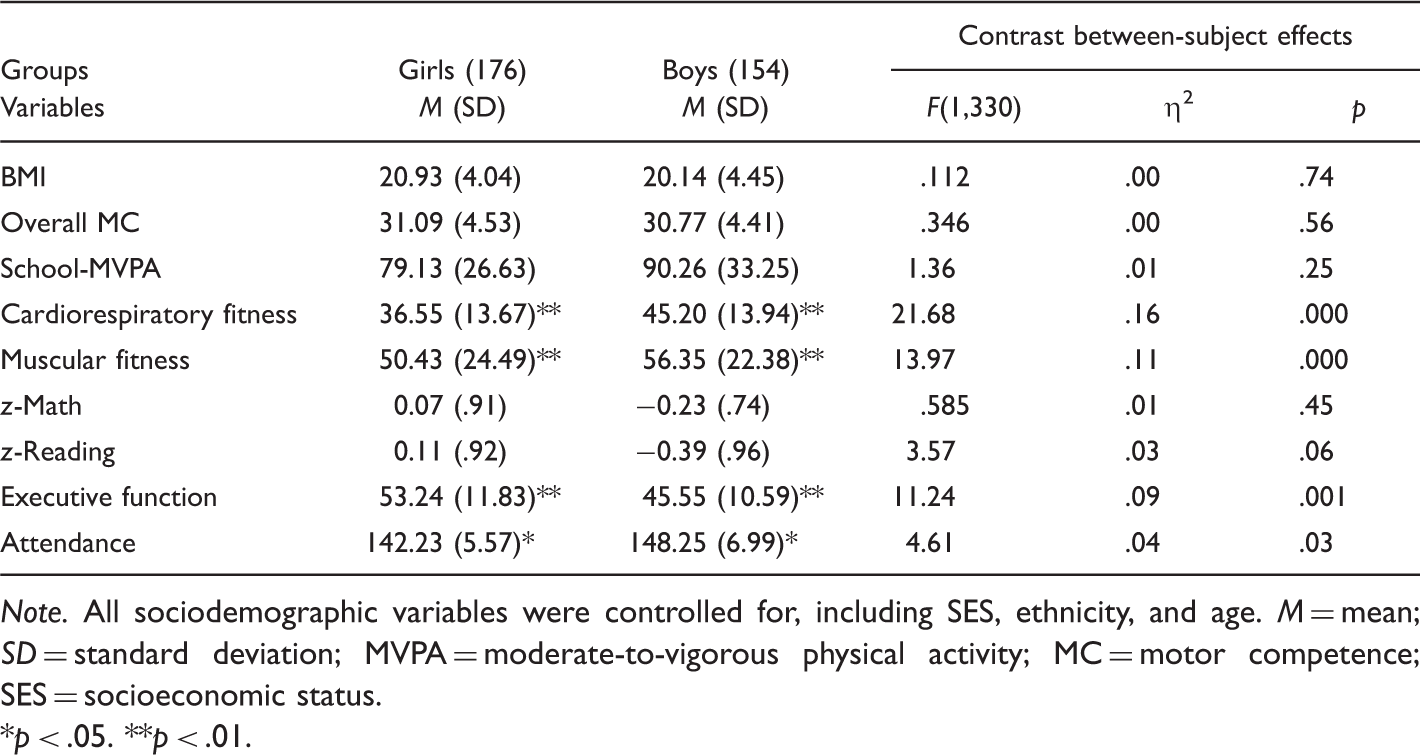
Note. All sociodemographic variables were controlled for, including SES, ethnicity, and age. M = mean; SD = standard deviation; MVPA = moderate-to-vigorous physical activity; MC = motor competence; SES = socioeconomic status.
*p < .05. **p < .01.
In the model with executive function as the dependent variable (see Figure 1), the GoF indices suggested a well-fitting model (χ2/df = 134.28/78 < 3; NFI = .83; IFI = .92; CFI = .91; RMSEA = .038; 90% CI [.023, .042]). The structural invariance analysis suggested a significant difference in the path coefficients between the two models by gender, supporting structural noninvariance between boys and girls (Δχ2 = 45.4, Δdf = 17; p < .01). For the girls’ model, motor competence significantly and positively predicted all HRF components (β = .53, p < .01; R2 = 28%) and school-based MVPA (β = .35, p < .01; R2 = 13%). Executive function (high scores on the BRIEF indicate lower executive function and higher risks for executive dysfunction) was significantly and negatively predicted by HRF (β = −.32, p < .01; R2 = 11%) but not school-based MVPA (β = −.17, p = .062). This suggests that the relationship between motor competence and executive function was fully mediated by HRF in girls but not school-based MVAP among girls. For the boys’ model, motor competence significantly and positively predicted all HRF components (β = .47, p < .01; R2 = 22%) and school-based MVPA (β = .43, p < .01; R2 = 19%). Both HRF (β = −.20, p < .01) and school-based MVPA (β = −.16, p < .01) were significant predictors of executive function, contributing to 12% of the variance in the model. These relationships suggest that the indirect effect of motor competence on executive function may go through both pathways of HRF and school-based MVPA among boys.
The final structure model for executive function with standardized path coefficients. MVPA = moderate-to-vigorous physical activity; BMI = body mass index. *p < .05. **p < .01.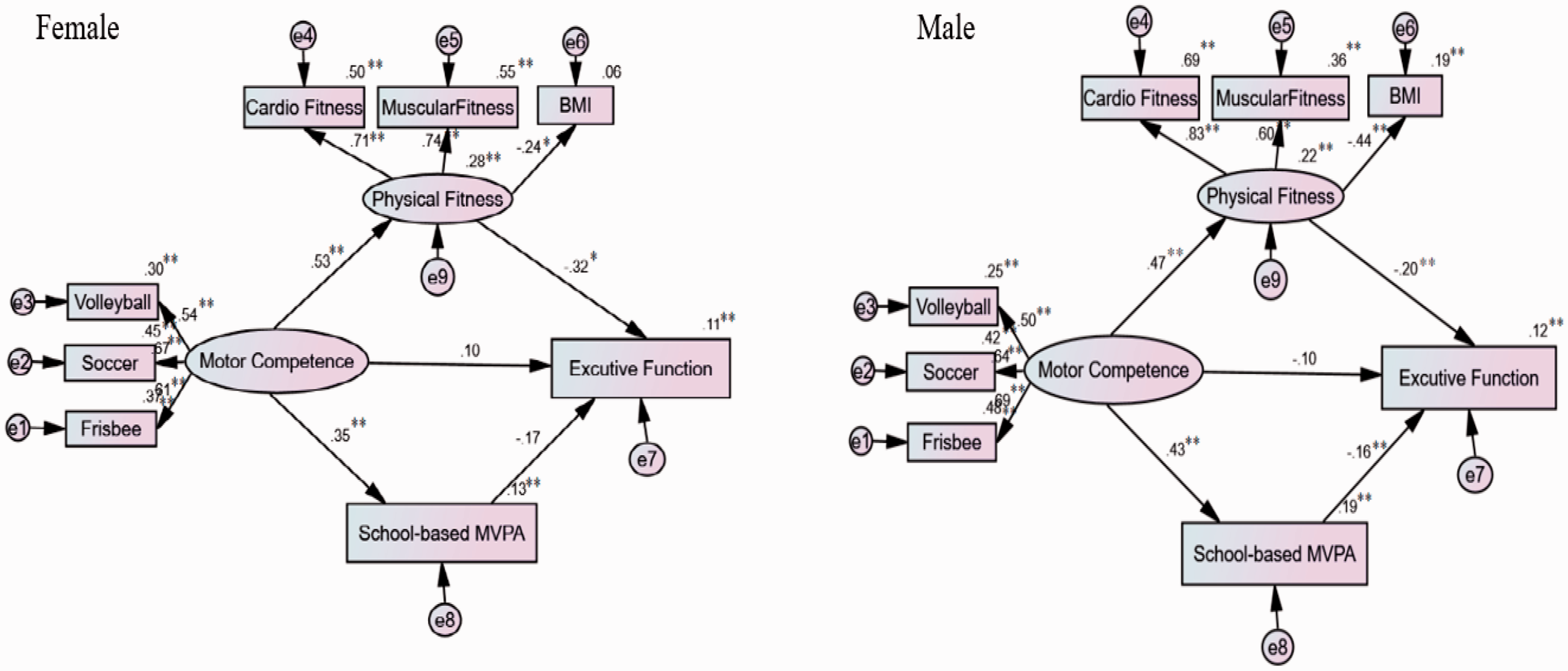
In the model with school attendance as the dependent variable (see Figure 2), the GoF indices suggested a well-fitting model (χ2/df = 143.49/78 < 3; NFI = .81; IFI = .91; CFI = .90; RMSEA = .036; 90% CI [.026, .045]). The structural invariance analysis indicated a significant difference in the path coefficients between the two models by gender, supporting structural noninvariance between boys and girls (Δχ2 = 50.74, Δdf = 17; p < .01). For the girls’ model, motor competence significantly and positively predicted all components of HRF (β = .47, p < .01; R2 = 22%) and school-based MVPA (β = .37, p < .01; R2 = 14%). School attendance was only significantly predicted by school-based MVPA (β = .36, p < .01; R2 = 20%). There were no significant path coefficients from motor competence (β = .07, p = .66) or HRF (β = .13, p = .35) to school attendance. This suggests that the relationship between motor competence and school attendance was fully mediated by school-based MVPA in girls. For the boys’ model, motor competence significantly and positively predicted all HRF components (β = .45, p < .01; R2 = 21%) and school-based MVPA (β = .45, p < .01; R2 = 11%). Both motor competence (β = .22, p < .05) and school-based MVPA (β = .23, p < .01) were significant predictors of school attendance, contributing to 21% of the variance in the model. These relationships suggest indirect effects of motor competence on school attendance through school-based MVPA, indicating a partial-mediation model among boys.
The final structure model for attendance with standardized path coefficients. MVPA = moderate-to-vigorous physical activity; BMI = body mass index. *p < .05. **p < .01.
We performed the SEM model for reading, but not for math, since the correlations between math and motor competence, school-based MVPA, and HRF were not significant (MacKinnon, Fairchild, & Fritz, 2007). In the SEM model with reading as the dependent variable, the GoF indices suggested a well-fitting model (χ2/df = 127.79/78 < 3; NFI = .83; IFI = .93; CFI = .92; RMSEA = .031; 90% CI [.021, .041]). The structural invariance analysis suggested the difference between the two SEM models was significant, which supports structural noninvariance between boys and girls (Δχ2 = 48.99, Δdf = 17; p < .01). In the girls’ model, there were significant coefficients from motor competence to HRF (β = .50, p < .01; R2 = 25%) and school-based MVPA (β = .37, p < .01; R2 = 13%), while the path coefficients from HRF and school-based MVPA to reading were not significant in the girls' model (p > .05); thus, the mediation model was not supported (no figure presents these data). In the boys’ model, there were significant coefficients from motor competence to HRF (β = .47, p < .01; R2 = 22%) and school-based MVPA (β = .44, p < .01; R2 = 19%). A very small but significant path coefficient was observed from motor competence to reading (β = .18, p < .05) with 7% of the variance in the boys' model. Thus, the mediation model was not supported (no figure presents these data).
Discussion
School PE provides a unique avenue for nearly 56 million youth in the United States to assist them in becoming physically literate by developing sufficient motor competence, meeting the recommended 60-minute daily MVPA, and maintaining appropriate levels of HRF (SHAPE America, 2014). Based on the 2014 SHAPE America Grade-Level Outcomes, the psychomotor domain provides the foundation for developing physically literate adolescents and thus is important for PE. This study explored the relationships between physical literacy, mainly in the psychomotor learning domain (i.e., motor competence, school-based MVPA, and HRF) and academic performance in adolescents. Three general implications of physical literacy can be highlighted from our study: (a) Consistent with national PE guidelines, a physical literacy profile among adolescents should be further explored and elaborated in research literature; (b) Skill-based interventions are particularly needed for adolescent girls in order to remediate their lower HRF compared with boys, as suggested in Stodden et al.’s (2008) conceptual model; and (c) a better understanding of the underlying mechanisms (i.e., physical literacy) influencing students’ academic performance and the impact of gender is warranted in order to design successful school-based interventions.
Learning and behavioral patterns established during adolescence form the foundation for future learning and behavioral patterns in adulthood (Stodden et al., 2008, 2009). Developing physical literacy is critical to long-term health and cognitive development (Gu et al., 2018). To our knowledge, this is one of the first studies to explore adolescents’ physical literacy (motor competence, physical activity, and HRF) according to SHAPE America’s definition and relating it to their academic performance. Stodden et al. (2008) suggested that developing motor competence is paramount to understanding why students choose to be either active or inactive, and motor competence may help to maintain appropriate levels of HRF. Consistent with Stodden et al.’s (2008) assumption, students who were skillful in each of the motor skills assessed in this study spent more time in MVPA during school hours and had better HRF over their less skillful counterparts. An important finding of the current study is the directional relationship established in our SEM models for both gender, which shed light on school intervention programs aimed at promoting adolescents’ academic performance, such as executive function and attendance.
Consistent with previous research findings that HRF components (i.e., BMI, cardiorespiratory fitness; Donnelly et al., 2016) were significant correlates of academic performance in adolescents, we found a significant but small correlation between BMI and academic scores and between cardiorespiratory and muscular fitness and executive function in our sample of adolescents. Our findings showed that students who engaged in more MVPA had better attendance rates and were more likely to demonstrate better executive function than those who did not engage in enough MVPA during school hours. Although these were correlational data and do not provide a clear causal relationship between these variables, it is reasonable to suspect that maximizing school-based opportunities for youth to develop competencies in physical literacy such as motor competence and school-based MVPA might be associated with improved school attendance. Gender differences in adolescents have been recognized as an important source of individual variability in health behaviors and academic learning (Lubans et al., 2016; Ortega et al., 2008). Our findings support previous studies (Edwards et al., 2017; Morita et al., 2016) in showing gender differences such that boys obtained higher scores than girls, not only in HRF (cardiorespiratory and muscular fitness), but also in attendance and executive function, after controlling sociodemographic variables. No significant gender differences were found in motor competence and school-based MVPA in this sample, which is promising in terms of the direct and indirect roles of both variables on academic performance resulted from SEM models in both girls and boys.
This study was unique in its comparison of assocations between physical literacy variables and academic functioning variables between boys and girls through structural invariance tests. Based on the results of the invariance test, the direct and indirect effects of motor competence on academic performance (i.e., executuive function and school attendance) through HRF components or school-based MVPA differ in boys and girls. All HRF components, but not school-based MVPA, served as mediators in the relationship between motor competence and executive function among girls; however, all HRF components and school-based MVPA emerged as mediators in this association among boys. On the other hand, school-based MVPA played a significant role in the assocaiton between motor competence and school attendance for both boys (21% variance) and girls (20% variance). Motor competence is a strong correlate of physical activity or HRF in adolescents and may indirectly influence their school attendance and executive function; thus, motor skill acquisition and enhancement among adolescents, especially girls, should be emphasized. Although the SEM model for reading was well fit, the indirect effect of motor competence on reading through HRF or school-based MVPA was not supported in either gender in this study. Similarly, Donnelly and Lambourne (2011) assumed that the impacts of HRF and physical activity on academic achievement may be mediated by cognitive function and body fat. Further investigation is warranted to test potential mediators between physical literacy and academic reading or math performance. These findings suggest that the instructional environment (i.e., a mastery learning environment; Goodway et al., 2010; Gu et al., 2017) should accommodate for differences across gender and developmental level in building motor competence. Students in our study shared similar PE curricula guided by SHAPE America National Standards, and both genders had equal time/opportunity to practice and learn the motor skills during their PE classes. Although gender differences for HRF are well documented in PE (Chen & Gu, 2018; Ortega et al., 2008), more investigations are needed to examine how PE teachers might influence these differences through variations in skill-based instructions.
Recent research indicated that only half of the American students achieve recommended levels of motor competence and the health fitness zone standards of FITNESSGRAM® for their grade level (Bai et al., 2015; Castelli & Valley, 2007; Hastie, 2017). Furthermore, researchers have previously reported that students’ MVPA within PE was much lower than the recommended 50% of class time, ranging from 38– 49% of lesson time in middle school PE (Smith, Lounsbery, & McKenzie, 2014). Although defining and assessing physical literacy is urgent from both educational and public health perspectives, there are no documented reports or evidence that provide global definitions of physical literacy among adolescents (Chen & Gu, 2018; Hastie, 2017). At the level of individual components of physical literacy, in our study, 53.0% of boys and 55.9% of girls failed to meet recommended levels of motor competence, consistent with limited prior research on motor competence (Gu et al., 2017). According to the initial PE Metrics™ data report, less than half of adolescents met recommended competence levels for volleyball (23.3%), soccer (42.55%), and ultimate Frisbee (41.3%). Since practice time is a critical indicator of skill acquisition (Bernstein, Phillips, & Silverman, 2011), students may not be provided with sufficient practice in allotted PE to develop each motor skill.
We acknowledge that current findings should be interpreted with some caution. First, we used a prospective research design, so no causal relationship between physical literacy variables and academic performance variables should be claimed. Future research should use a longitudinal or experimental research design to examine how changes in motor competence, HRF, and school-based MVPA may impact adolescents’ academic performance across gender. Second, we measured students’ school day MVPA but not their total daily MVPA. Finally, objectively assessing students’ motor skills was a strength of this study; however, future studies may consider assessing more skills in order to capture a complete picture of adolescents’ motor competence. In conclusion, we uniquely assessed the physical literacy concept according to the SHAPE America’s definition by using PE Metrics™ (a process-oriented measure) to objectively assess motor competence. PE Metircs™ is aligned with the U.S. national PE guidelines (SHAPE America, 2014) and can be used to determine whether students achieved their grade-level outcomes (Hastie, 2017; SHAPE America, 2014; Zhu et al., 2011). This study provides an initial description of physical literacy levels in the U.S. adolescent population, with associated implications for physical educators, school administrators, and health professionals. Embracing psychomotor associations with physical literacy may be a promising way to elicit behavioral change in physical fitness and create a behavioral channel to academic success for adolescents.