




Abstract
The impact of auditory environmental stimulation on the academic and cognitive functioning of typically developing children, youth, and adults has been the focus of a number of investigations (Batho, 2008; Boman, 2004; Buchner, Rothermund, Wentura, & Mehl, 2004; Cohen, Evans, Krantz, & Stokols, 1980; Elliott, 2002; Furnham & Strbac, 2002; Hygge, Boman, & Enmarker, 2003; Martin, Wogalter, & Forlano, 1988; Ransdell & Gilroy, 2001). In general, findings suggest that background speech impairs performance on memory, reading comprehension, writing, and mathematics tasks for typically developing children, adolescents, and college students, as does background noise that varies over time (e.g., traffic noise, classroom noise), though findings are not always consistent.
Research findings on the impact of environmental auditory stimuli on the academic and cognitive performance of children with ADHD are also generally inconsistent (Abikoff, Courtney, Szeibel, & Koplewicz, 1996; O’Connell, Bellgrove, Dockree, & Robertson, 2006; Sneddon, 2004; Söderlund, Sikström, & Smart, 2007; Uno et al., 2006; Zentall & Shaw, 1980). However, all types of background noise could be problematic for students with inattention because they are more vulnerable to distraction (Connors, Connolly, & Toplak, 2012), and noise is thought to impair cognitive processing and remove attention from the task (Elliott, 2002). A few studies, however, have shown a beneficial impact on performance by some background noises for children with ADHD, including white noise, vocal music, and novel sounds (e.g., Abikoff et al., 1996; O’Connell et al., 2006; Söderlund et al., 2007; Uno et al., 2006; van Mourik, Oosterlaan, Heslenfeld, Konig, & Sergeant, 2007). As van Mourik et al. (2007) indicated, it is possible that sounds that are normally considered “distracting” may not be so for children with ADHD, as some background noise may have beneficial effects by increasing the arousal of children with ADHD to an optimal level. These results are consistent with the Moderate Brain Arousal (MBA) model in which stimuli that evoke MBA in the dopamine system lead to improved performance for children with ADHD, whereas too little or too much stimuli lead to reduced performance (Sikström & Söderlund, 2007).
The primary objective of this study was to examine the effects of different background noises on academic performance and perceived task difficulty in adolescents with ADHD. Youth with ADHD often exhibit marked academic difficulties (Frazier, Youngstrom, Glutting, & Watkins, 2007) and are at higher risk than their peers for school dropout (Kent et al., 2011), in addition to showing weaknesses in processing speed, working memory, and inhibitory control (Carte, Nigg, & Hinshaw, 1996; Shanahan et al., 2006). Given that youth with high levels of inattention often report more problems with distraction and concentration than their typically developing peers (Connors et al., 2012), it is possible that noise may be even more bothersome to students with ADHD. In fact, it is often assumed that students with learning and/or attention problems benefit from accommodations that limit background noise (e.g., writing tests in a separate room); however, as outlined above, not all data from past research support this assumption.
This current exploratory study is noteworthy as it focuses on the impact of noise on adolescents with ADHD. Prior research has tended to focus on children with and without ADHD (e.g., Abikoff et al., 1996; Batho, 2008; Elliott, 2002; Zentall & Shaw, 1980). Given that distraction from background noise could be related to developmental level (e.g., Elliott, 2002), it is important to examine the impact of noise on adolescents with ADHD, to add to what is already known about the impact of noise on children and adults. In addition, examining academic performance of youth who also have clinical levels of inattention is important as poor attentional control has been hypothesized to be related to greater distraction from noise (Elliott, 2002). To our knowledge, there have not been any prior studies that have examined the impact of different types of noise on the academic performance of youth with ADHD and only one study (i.e., Berger & Cassuto, 2014) that examined the impact of noise on cognitive performance for that group of individuals. Further research in this area is essential as the results have important educational implications, especially related to optimal school environments for improved academic outcomes for youth with ADHD.
Factors Influencing Background Noise Effects in Students With and Without ADHD
Research suggests that distraction from background noise is likely related to individual characteristics, including age, developmental level, and attention abilities (Bell, Buchner, & Mund, 2008; Elliott, 2002); specifically, younger individuals and those with inattention are more vulnerable to distraction than older individuals and those with good attentional control. Other factors that have been hypothesized to influence the effects of noise on academic performance and behavior include the characteristics of the auditory stimulation and the characteristics of the task (Klatte, Bergström, & Lachmann, 2013). For example, research suggests that noise has to be continuous and at a high energy level at all frequencies (i.e., white or pink noise) to be beneficial, as intermittent noise is most disruptive to performance (Szalma & Hancock, 2011).
Research results provide some support for the MBA model for children and youth with ADHD. For example, white noise and music, which seem to provide MBA, enhance performance (e.g., Abikoff et al., 1996; Pelham et al., 2011; Söderlund et al., 2007), whereas irrelevant speech likely provides too much arousal (e.g., Elliott, 2002) and no noise likely provides too little arousal (e.g., Söderlund, Sikström, Loftesnes, & Sonuga-Barke, 2010; Uno et al., 2006) resulting in poorer performance on tasks in speech and silent conditions.
Task characteristics also likely influence the impact of background noise on performance. Academic tasks such as reading comprehension (e.g., Oswald, Tremblay, & Jones, 2000) and written text generation (e.g., Ransdell & Gilroy, 2001) are likely to be the most strongly affected by noise because of their linguistic content (Klatte et al., 2013). Task complexity, and the resulting demand on working memory, has also been hypothesized to influence the amount of impact that background noise has on task performance (Szalma & Hancock, 2011). For instance, music and noise may be similar in their distracting effects on complex cognitive tasks, but music may be beneficial on simpler tasks (Furnham & Strbac, 2002). As reading comprehension and text generation require higher level processes (e.g., integrating ideas into a text to form a coherent mental model, planning, language generation, and reviewing), these tasks are likely to be more strongly affected by noise than simpler tasks such as copying a text or reading single words. In fact, the presence of noise may be an environmental characteristic that increases the cognitive load of the task resulting in the youth in the noise conditions perceiving the task as more difficult than those working without concurrent noise (Choi, van Merriënboer, & Paas, 2014).
Study Objectives and Hypotheses
The current study investigated the effects of two types of environmental noise on academic performance and cognitive load (indexed with perceived task difficulty) in adolescents with ADHD. Participants completed academic tasks that require high cognitive demand, namely, reading comprehension and written expression. Reading comprehension of the passage was measured with an oral retell of the passage (quality of text comprehension) and time to silently read the passage. Writing performance was measured by the proportion of correct writing sequences (PCWS; correct writing sequences divided by the total number of possible writing sequences, measuring writing accuracy) and total words written (TWW; writing fluency). Perceived difficulty of the task, or cognitive load, was also measured as perceptions of task difficulty may affect learning ability and performance (e.g., Paas, Renkl, & Sweller, 2004).
The specific research question examined by this study was: What are the effects of different noise conditions (no noise, classroom babble, and white noise) on academic performance and cognitive load in adolescents with ADHD? Based on the MBA model, it was expected that there would be a significant impact of background condition, such that the participants with ADHD would perform best in the white noise condition on all outcomes, compared with their performance in the no noise or classroom babble condition. Based on research on general noise effects, it was also expected that participants would exhibit the poorest performance in the classroom babble condition compared with the no noise condition.
Method
Participants
A sample of 52 adolescents (65% male) were included in the present study, which was part of a larger study examining oral and written comprehension in youth with and without ADHD. Participants who were between the ages of 14 and 16 were recruited from newspaper and community advertisements, contacts with organizations like the Learning Disabilities Association of Ontario (LDAO) and Children and Adults with Attention Deficit Disorder (CHADD), and local school boards. Parents who contacted the lab completed an intake interview and the Conners 3–Parent Rating Scales, Long Form (Conners 3-P; Conners, 2008) over the phone to screen potential participants for the study. Participants were included in the study if they obtained a T-score of at least 70 on one or more of the central ADHD indices (i.e., DSM-IV-TR Hyperactive-Impulsive, DSM-IV-TR Inattentive, and DSM-IV-TR Global) from the Conners 3-P. In addition, all but three participants were reported by parents to have a previous clinical diagnosis of ADHD. The three participants who had not been formally diagnosed with ADHD exhibited clinically significant symptoms of ADHD according to parent report as well as self-and/or parent-reported impairment at home and/or school and thus were included in the present sample.
Youth were excluded from participation in the study if they had a prior diagnosis of a genetic or neurological disorder (e.g., Tourette’s syndrome, autism spectrum disorder, psychotic disorder) according to parental report. Participants were also only included in the present study if their estimated IQ was at a standard score of 70 or greater, or if they had a standard score of 70 or more on at least one of the subscales (i.e., verbal or nonverbal reasoning) measuring IQ, as research has suggested that excluding children with ADHD who have standard scores in the borderline range (IQ 70-79) unnecessarily truncates the sample (Antshel, Phillips, Gordon, Barkley, & Faraone, 2006). Adolescents with ADHD and a learning disability (LD) and/or other diagnoses (e.g., oppositional defiant disorder, conduct disorder, anxiety, or mood disorders) were not excluded from the study if they met all other criteria. Parents of participants were asked if their child has sufficient understanding of the English language and if they have any hearing difficulties. In total, 69% of the adolescents with ADHD were taking medication for the disorder, though they were asked to withhold taking their medication on the day of the testing, as medication has been shown to improve academic and cognitive performance for children with ADHD in the presence of auditory distractors (Pelham et al., 2011). Participants were randomly assigned to a noise condition, including no noise (n = 16), white noise (n = 16), and classroom babble (n = 20).
Materials
Reading task
For the reading comprehension task, participants each read a short information text about immigration from the Qualitative Reading Inventory–Third Edition (QRI-3; Leslie & Caldwell, 2001) in their assigned background noise condition. Previous knowledge of the topic of the text was assessed before reading, using four questions each scored from 0 to 2 for a total possible score of 8. The academic accuracy outcome variable on the reading task was the number of elements (main ideas and details) correctly recalled in an oral retell of the passage. Oral retell responses were double-scored for 15 of the participants with and without ADHD with high interrater reliability based on the intraclass correlation coefficient (ICC = .93). Time to silently read the QRI passage was also recorded for each participant (presented in seconds).
Writing task
Participants also completed a text generation (writing) task. They wrote a persuasive essay in response to a given probe (e.g., “Should cell phones be allowed in school?”). They were given 2 min to plan their response and 5 min to complete the essay, and completion time was noted if participants finished before the time limit. The academic accuracy variable on the writing task was the PCWS (which was calculated by dividing the number of correct writing sequences by the number of total possible word sequences), and the academic fluency variable was the TWW. PCWS is a measure of correct writing mechanics, taking into account spelling, punctuation, and grammar, independent of how much was written. Such measures of written expression performance have been found to be both valid and reliable for examining writing ability in adolescents (Espin et al., 2000). All writing samples were double-scored by two different raters, with Rater 1 double-scoring the writing samples for the first 34 participants and Rater 2 double-scoring the writing samples for the remaining participants. The interrater reliability for the TWW with both raters was extremely high (ICC = .99). The interrater reliability for the PCWS was also high for both Rater 1 (ICC = .93) and Rater 2 (ICC = .90). TWW and PCWS were also significantly correlated with other measures of writing in the current study, including writing fluency (r = .47 and r = .50, respectively) and a standardized measure of writing ability that was part of the larger study battery (Woodcock–Johnson, Third Edition and Writing Samples subtest; r = .44 and r = .48, respectively), indicating that they are valid measures of written expression performance.
Difficulty rating
After completion of both academic tasks, participants were asked to rate the perceived level of difficulty in response to a probe (“Please rate how difficult this task was for you by circling one of the numbers below. A rating of 1 indicates that you felt the task was extremely easy whereas a rating of 9 indicates that you felt the task was extremely difficult.”). This task difficulty assessment has been used in prior research as an indicator of cognitive load when completing tasks (e.g., DeLeeuw & Mayer, 2008).
Background noise
The background noise was continuously played over a speaker placed behind and to the right of participants during completion of the reading and writing experimental tasks. Participants were randomly assigned to one background noise condition only (i.e., silence, classroom babble, or white noise), and they read a passage and completed a writing task in their assigned noise condition. Both the background noises were presented at a level of about 70 decibels, as Sikström and Söderlund (2008) indicated that noise levels need to be within 70 to 80 decibels to show a beneficial effect; levels of noise that are too low show weaker effects, whereas higher levels are universally detrimental for performance. Decibel levels were measured with a portable decibel meter to ensure similar conditions across participants.
Cognitive measures
A range of cognitive measures were included in the present study to provide information about the comparability of the three different noise conditions in relevant cognitive domains. Intellectual ability (estimated IQ) was assessed using the Wechsler Abbreviated Scale of Intelligence (WASI). To assess working memory abilities, the listening recall subtest from the Working Memory Test Battery for Children (WMTB-C; Pickering & Gathercole, 2001) was administered to all participants. To measure processing speed, participants were given a rapid digit naming task from the Comprehensive Test of Phonological Processing (CTOPP). A rapid naming task was used to index processing speed in the current study as research has demonstrated that there is a high correlation between measures of rapid naming and other measures of processing speed, such as coding and Stroop tasks (e.g., Shanahan et al., 2006). Performance on all cognitive measures was converted to age-based standardized scores, which were used in the analyses.
Other academic screening measures
The listening comprehension subtest of the Oral and Written Language Scales (OWLS) was administered to measure receptive language. The Test of Word Reading Efficiency (TOWRE) was used to assess reading fluency. The Woodcock–Johnson Tests of Achievement (WJ-III ACH) was used to assess general writing ability and reading comprehension. Performance on these academic measures was converted to age-based standardized scores, which were used in the analyses. A measure of transcription fluency was also administered based on the task developed by Peverly et al. (2007), which required youth to produce each letter of the alphabet in sequence in lowercase letters and then in uppercase as many times as possible within 1 min, with raw scores (total number of letters written within the time limit) being used in the analyses.
Parent and self-reported ADHD symptoms and externalizing behavior
All participants also completed the Conners 3–Self-Report Rating Scale, Long Form (Conners 3-SR) to examine their self-reported inattention and hyperactivity-impulsivity symptoms. Parents completed the Conners 3-P. Raw scores were converted to T-scores based on gender (male or female) and age.
Procedure
Youth with ADHD were individually tested by trained graduate students. The data for this present study were collected in the context of data collection for other studies, and near the end of a single 5- to 6-hr session. Youth were randomly assigned to one of three noise conditions (no noise, white noise, and linguistic classroom babble). Each participant completed academic tasks, measuring reading comprehension and writing, in the presence of their assigned noise, and then rated the perceived difficulty of each task. For the reading comprehension task, which was completed first for all participants, noise was only presented when the participants read the text and not during the comprehension outcome measure, whereas noise was presented during the entire writing task (i.e., planning and composing). Ethical approval from the University of Toronto’s ethics board was obtained before beginning recruitment and data collection.
Data Analysis Plan
Preliminary analyses were conducted to examine whether the participants in each experimental condition were similar on the demographic, screening, cognitive, and academic measures. Then, the effects of background noise condition on performance for the ADHD participants on each outcome variable were examined using orthogonal planned contrasts based on both the MBA model and research on the impact of linguistic noise on performance. Planned contrasts were used as they provide greater power to detect differences among the groups (Field, 2013) and control for Type I error (Tabachnick & Fidell, 2007). The first orthogonal planned contrast specifically examined whether academic performance was best in the white noise condition compared with the average performance in the no noise and babble conditions, as predicted by the MBA model. The second contrast examined whether performance in the no noise condition was significantly better than performance in the babble condition on each of the outcome measures. Past research would predict that participants would demonstrate worse performance in the babble condition compared with the no noise condition. As both sets of contrasts specify a directional relationship between groups in the different conditions, one-tailed significance tests were employed. Alpha was set at .05 for those domains containing one dependent variable (i.e., reading accuracy, time spent reading) and adjusted to .025 (.05/2) for outcomes with two dependent variables: writing (TWW, PCWS) and perceived difficulty ratings (reading, writing). The magnitude of differences in performance between the conditions was assessed using Cohen’s d, which was calculated using the t-value for the contrast and the sample size in each condition. It is important to consider the magnitude of the effect as well as the significance of the effects given that statistical significance is in part related to sample size (Vacha-Haase & Thompson, 2004). One of the outcome variables (PCWS) was transformed for analysis using an arcsine transformation to account for a negatively skewed distribution, which is often seen with proportional data. In addition, individual analyses sometimes did not include the entire sample due to missing data on some of the dependent measures.
Results
Preliminary Analyses
Results of the preliminary analyses comparing the youth with ADHD in each background noise condition are summarized in Table 1. A significant difference was found only for medication status. Examination of the data revealed that participants with ADHD in the no noise condition were more likely to be taking medication than participants in the white noise or classroom babble conditions; however, as none of the participants took their medication on the day of testing, medication status did not need to be controlled for in the analyses. There were no significant differences on any of the other demographic, cognitive, or academic variables (e.g., reading comprehension, transcription fluency, reading fluency) including the percentage of youth in each group with an individual education plan. Groups also did not differ in severity of parent-reported inattention symptoms, hyperactivity-impulsivity symptoms, or conduct or oppositional behavior. One-way ANOVAs were also conducted to examine whether the participants with ADHD in each experimental condition were similar on the supplementary experimental measures, including previous knowledge of the reading comprehension passage and time spent planning and writing the essay. There were no significant differences between the groups in each condition on those three measures; thus, they were not included in the analyses as control variables.
Demographic, Cognitive, and Academic Features of the ADHD Participants in Each Background Noise Condition.
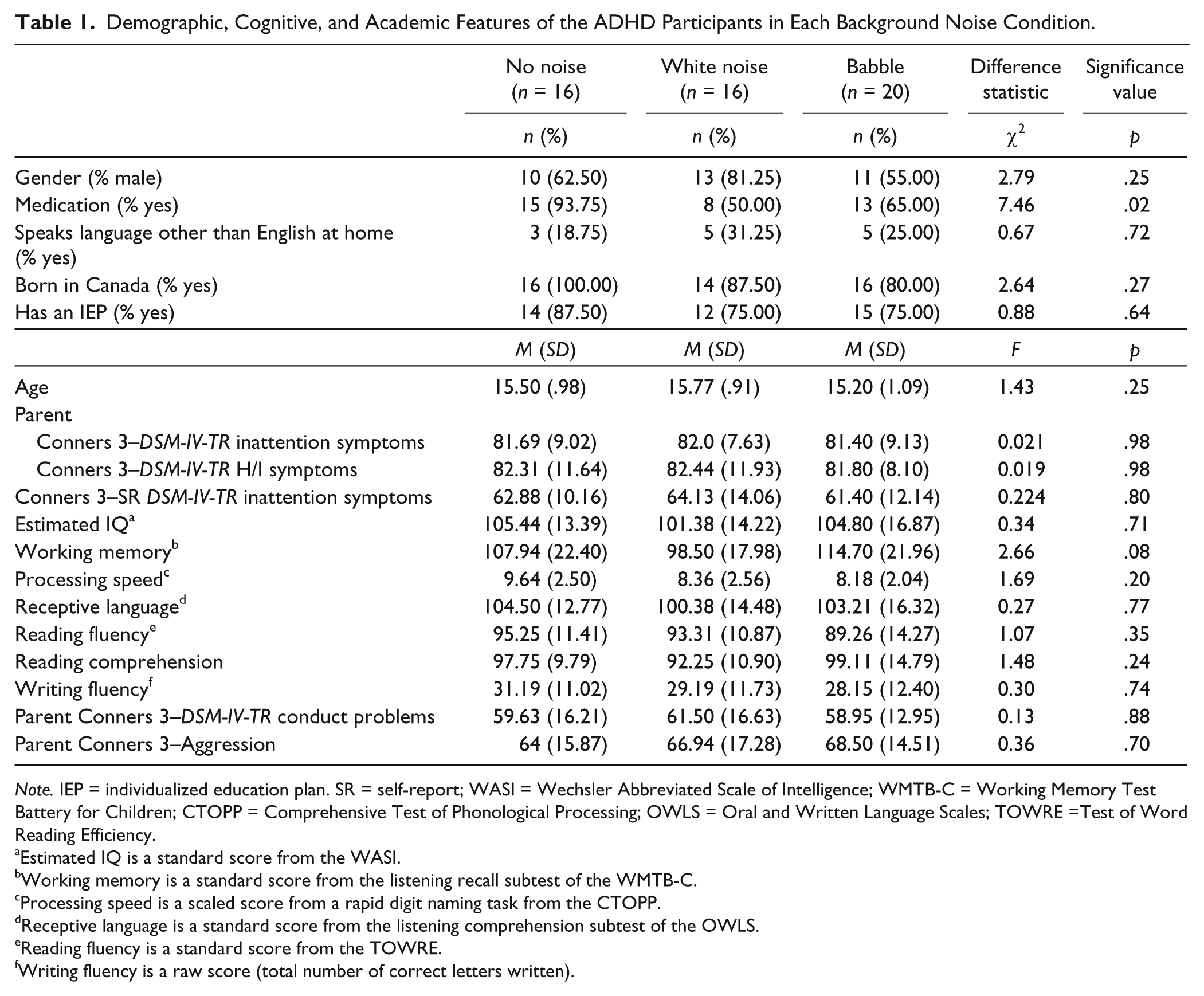
Note. IEP = individualized education plan. SR = self-report; WASI = Wechsler Abbreviated Scale of Intelligence; WMTB-C = Working Memory Test Battery for Children; CTOPP = Comprehensive Test of Phonological Processing; OWLS = Oral and Written Language Scales; TOWRE =Test of Word Reading Efficiency.
Estimated IQ is a standard score from the WASI.
Working memory is a standard score from the listening recall subtest of the WMTB-C.
Processing speed is a scaled score from a rapid digit naming task from the CTOPP.
Receptive language is a standard score from the listening comprehension subtest of the OWLS.
Reading fluency is a standard score from the TOWRE.
Writing fluency is a raw score (total number of correct letters written).
Effects of Noise on Academic Task Performance
Descriptive statistics for the groups in each of the background noise conditions on the experimental measures are presented in Table 2. Although we provide the F value from the omnibus ANOVAs in Table 2, we focus on the orthogonal planned contrasts as they provide specific tests of our hypotheses and “yield both estimates of the magnitude of the effects investigated and the associated significance levels” (Rosenthal, Rosnow, & Rubin, 2000, p. 1).
Group Differences on Academic Outcomes and Perceived Task Difficulty Ratings.

Reading comprehension accuracy
Youth with ADHD in the no noise condition had the highest mean score on the oral retell task (see Table 2). Students in the no noise condition were able to recall about eight ideas from the text in total, whereas the white noise group and babble group could only recall five and six ideas, respectively. The results of the first planned contrast comparing the white noise group to the average of the no noise and babble conditions was not significant, t(46) = −1.16, p = .13, nor was the planned contrast comparing the no noise group with the babble group, t(46) = −1.04, p = .15. Effect sizes, however, were in the small to medium range (d = .34 and d = .37, respectively) indicating moderate differences in favor of the no noise condition.
Time spent reading
Youth in the white noise condition took the least time to complete the reading task (see Table 2). The planned contrast comparing the white noise group with the average of the no noise and babble conditions was not statistically significant, t(46) = −1.16, p = .13, but the effect size was in the moderate range, d = .40, indicating that there was a moderate advantage in completion time for the white noise condition. The planned contrast comparing the no noise group with the babble group was also not statistically significant, t(46) = −0.230, p = .4, and the effect size was small, d = .06.
Writing accuracy
The planned contrast comparing the white noise group with the average of the no noise and babble conditions was not significant, t(49) = −0.384, p = .35, d = .09, nor was the planned contrast comparing the no noise group with the babble group, t(49) = −0.901, p = .19, d = .35. The effect sizes reflect small differences between the groups in the first contrast and moderate differences between the no noise and babble groups. This latter finding reflects the greater accuracy of the youth in the no noise condition relative to the babble condition.
Writing fluency
Youth in the white noise condition had the highest mean scores on TWW (see Table 2). The planned contrast comparing the white noise group with the average of the no noise and babble conditions was not significant, t(49) = 1.72, p = .047, though there was a medium effect size, d = .53, indicating that students wrote more words in the white noise condition relative to the average of the remaining two conditions. The planned contrast comparing the no noise group with the babble group was not significant, t(49) = −0.284, p = .39, d = .09.
Self-reported task difficulty
Perceived task difficulty was highest in the babble condition and lowest in the no noise condition for the reading task (see Table 2). Whereas there was no significant difference between the white noise group and the average of the other two groups, t(47) = 0.112, p = .46, d = .004, participants in babble condition rated the task as being significantly more difficult than the participants in the silent condition, t(47) = 2.11, p = .02, with a large effect size, d = .74. Similar results were found with the writing task. Whereas there was no significant difference between the white noise group and the average of the other two groups, t(48) = 0.074, p = .47, d = .02, participants in the babble condition rated the task as being more difficult than the participants in the no noise condition, t(48) = 2.21, p = .02, with a large effect size, d = .79.
Discussion
The present study tested the effects of two noise conditions hypothesized to either facilitate or hinder the ability of youth with ADHD to comprehend and compose written text (Söderlund et al., 2007), skills of importance to academic success in high school, and beyond. In general, the results were not consistent with the MBA model. Positive effects of white noise relative to the mean performance across the babble and no noise conditions were only evident on writing fluency (TWW) and the time it took for students to complete the reading comprehension tasks. In all other outcomes, youth who were in the no noise condition tended to exhibit the strongest performance. Below we discuss the findings in more detail and their implications for research and practice.
Consistent with the MBA model, youth with ADHD in the white noise condition wrote more words and took less time to read the text relative to the average performance of youth in the other two conditions (no noise, babble). Although neither of the planned contrasts for writing fluency was statistically significant, an examination of the effect sizes for both TWW and total reading time suggests a moderate difference between the white noise condition relative to the combined babble and no noise conditions. It is possible that white noise improved task fluency in youth with ADHD by increasing focus so that the youth were able to complete tasks with fewer breaks in concentration and redirections back to task. Participants’ performance in the no noise and classroom babble conditions on writing fluency and time spent reading were not significantly different (nor practically different in magnitude according to the effect sizes) suggesting that both too little (e.g., no noise) and too much (e.g., babble) background stimulation can similarly attenuate academic response time/fluency performance.
Although there appears to be a benefit of white noise for time spent reading and writing fluency, the pattern of findings on the academic accuracy measures (i.e., oral retell, PCWS) was not consistent with the MBA model. White noise did not enhance performance accuracy on the reading and writing accuracy tasks. For reading comprehension accuracy, as measured by the number of ideas recalled by the youth, the results imply that a no noise condition may be the most advantageous for comprehension based on the fact that youth with ADHD recalled fewer ideas in the babble and white noise conditions relative to the number of ideas recalled in the no noise condition. Further research is needed to replicate this finding with a larger sample. For the writing task, although the participants in the white noise condition produced more words on average within the same time period relative to the mean of the two remaining groups, they did not show a significant advantage or increase in writing accuracy relative to the average of the two remaining groups. These results for writing fluency were inconsistent with those of Ransdell, Levy, and Kellogg (2002) who reported that background speech decreased compositional fluency, but not the quality, of an essay compared with a silent condition for university students. Future research with larger sample sizes across different age groups (e.g., high school vs. university/college) is needed to determine whether the possible advantage of white noise on reading time/writing fluency is offset by a potentially negative effect on higher level academic processes.
In general, the findings do not provide strong support for hypotheses based on the MBA model, which states that an optimal level of noise would provide the ideal environment for students with ADHD when they are completing academic and cognitive tasks, whereas too little or too much auditory stimulation would result in a decrement in performance. This pattern of results was only found for the measure of writing fluency and time to read the text passage. In contrast, adolescents’ performance across the conditions on measures of accuracy (e.g., oral retell, PCWS) was not consistent with the MBA model as there were no significant improvements in the white noise condition compared with performance in the other two conditions for those measures. In addition, those measures had low effect sizes (according to Cohen’s d). Although our level of white noise may have not been optimal to provide beneficial effects, it is also possible that noise effects are not as straightforward as might be predicted by the MBA model; that is, they may depend on individual difference factors (e.g., working memory; Sörqvist, 2010) as well as task demands and specific noise characteristics (Beaman, 2005).
It may be fruitful to draw on alternative theoretical models such as the “maximal adaptability theory” (Hancock & Warm, 1989, cited in Szalma & Hancock, 2011) that highlights the role of three key factors in examining responses to stressors such as noise: the input in the environment (e.g., classroom) that may contribute to over- or under-arousal, the ability of the individual to become accustomed to the stressor (e.g., noise), and the output or response of the individual. Interestingly, in this model, an individual’s own awareness or reaction to the stressor is likely to occur before effects are evident on task performance (Hancock & Szalma, 2006). Consistent with this prediction, we found that youth with ADHD who were in the classroom babble condition reported significantly higher task difficulty ratings compared with those in the no noise condition despite performing similarly on the academic accuracy outcome variables. This pattern of results suggests that youth with ADHD did experience negative effects of the stressor (babble) at the subjective level, but, perhaps as a result of compensatory strategies, the effects of babble on actual task performance were not strongly evident. From a practical perspective, it is possible that higher task difficulty under the babble condition may result in decrements in task persistence over time (Hoza, Pelham, Waschbusch, Kipp, & Owens, 2001).This would be a useful hypothesis to test in future research.
The results of this study and results from past research (e.g., Beaman, 2005) also suggest that background noise affects the speed of a response differently than the accuracy of a response. Previous research, primarily with adults, indicates that background noise, especially noise with semantic content such as speech, has a stronger negative impact on measures of response accuracy than on measures of response speed for cognitive and communication tasks (Szalma & Hancock, 2011). The results of the current study, however, suggest that the converse may be true for youth with ADHD (i.e., that some noise may have a stronger beneficial impact on measures of response speed than response accuracy). As there are no previous studies on the academic performance of youth with ADHD in varying noise backgrounds, more research is needed to draw conclusions about the types of noise that may be most helpful (e.g., white noise, music) or detrimental (e.g., speech) for academic performance speed and accuracy.
Limitations
The main strength of the present study is the investigation of noise effects (predicted to be either facilitative or adverse depending on the noise) for adolescents with ADHD on complex academic measures, which has not been examined in past research. However, there are several limitations of the current study. A between-subjects design was used, with a small number of youth with ADHD in each experimental condition, resulting in a decrease in power and cautious interpretation of the effects. Nevertheless, effect sizes indicate support for future testing of environmental noise on academic performance with larger sample sizes. In addition, it is important to note that only one level of noise was used in the study. It is possible that this level of white noise was not optimal (either too loud or too quiet) for promoting an optimal state of arousal for academic performance. It would be helpful for future studies to use a within-subjects design, not only for increasing sample size but also to examine the effects of different levels of white noise as well as possible order effects in the enhancement of academic performance. For example, in the study by Abikoff et al. (1996), academic performance was enhanced by music for only the children with ADHD who received music as their first condition. Abikoff et al. suggested that the beneficial impact of music seen initially with academic performance could not counter boredom for the entire duration of the task. Thus, it is possible that the beneficial effect of white noise on academic fluency in the current study may have diminished had participants received it as their second or third background condition.
In addition, as the decibel level of the “quiet” condition was not measured in the current study, we do not have knowledge of the natural noise intensity of that condition. As noted by Szalma and Hancock (2011), even low-intensity noises or quiet conditions may have a negative impact on performance depending on their decibel level. They recommend that the noise intensity of the quiet condition also be measured and reported in research studies examining noise effects, which was not done in the current study. Although we tried to make the no noise condition as “quiet” as possible by completing the study in a self-contained lab, it is conceivable that some level of noise was present that may have impacted performance.
Implications for Clinical Practice and Future Research
Some researchers advocate a quiet work environment for all students, regardless of their levels of attention. For example, Boman and Enmarker (2004) stated that providing students “with good conditions for learning requires lowering noise levels” (p. 208). Based on the results of the current study, the benefits of a quiet environment may depend upon the nature of the academic task. From the perspective of perceived task difficulty, the results suggest that youth with ADHD may find completing tasks while listening to classroom babble to be more difficult than those completed during silence. Until further work is done in this area, it may be best to work with students on an individual basis to determine the extent to which youth find noise (white noise, babble) to be helpful or detrimental to performance and task persistence. Understanding how background noises impact academic performance on an individual basis is important in developing recommendations for optimal environments for both the classroom and home study space. Accommodations related to the physical environment of the classroom, including changes in background noise, are easily implemented and require little effort and time for the teacher (Carbone, 2001).
Related to task difficulty, more research is needed to understand how background noise impacts performance on different academic tasks for youth with and without ADHD. It may be that the background noise conditions needed for optimal performance on different academic tasks vary. For instance, using a questionnaire to examine the study environments of children in Grades 5 through 9 with varying levels of attention, Patton, Stinard, and Routh (1983) found that students often changed from quiet settings for reading tasks to nonquiet settings for writing and math tasks. Furthermore, they speculated that, although music and other environmental distractors may have a perceivable and adverse impact on academic performance overall, they may also have benefits, such as increasing the amount of time a student devotes to an academic task (Patton et al., 1983). The current study suggests that some steady noise (i.e., white noise) may also have a beneficial impact on reading time and writing fluency, reducing the amount of time required to complete, and maintain attention on, a given task.
Conclusions and Directions for Future Research
In conclusion, there was mixed support for the MBA model. Research that utilizes alternate models such as the maximum adaptability model (Hancock & Warm, 1989, cited in Szalma & Hancock, 2011) is needed to determine how different types of noise interact with student characteristics as well as task characteristics. Considering that students learn new information in classroom environments where linguistic and other noise is frequently present, it is important to understand under what conditions they learn best, particularly for those students with ADHD who are easily distracted and at significant risk for academic underachievement.
Footnotes
Declaration of Conflicting Interests
The author(s) declared no potential conflicts of interest with respect to the research, authorship, and/or publication of this article.
Funding
The author(s) disclosed receipt of the following financial support for the research, authorship, and/or publication of this article: This research was supported by grants from the Canadian Institutes of Health Research (Grant CGD87921, held by L. Batho) and the Social Sciences and Humanities Research Council of Canada (Grant 410092328, held by R. Martinussen and J. Wiener).