




Abstract
Rhythmic expertise is a multidimensional skill set with clusters of distinct rhythmic abilities. For example, the ability to clap in time with feedback relates extensively to distinct beat- and pattern-based rhythmic skills in school-age children. In this study we aimed to determine whether clapping in time would relate to both beat- and pattern- based rhythmic tasks among adolescents and young adults. We assessed our participants on seven tasks: two beat-based tasks (Metronome and Tempo adaptation), two pattern-based tasks (Reproducing rhythmic patterns and Remembering rhythmic patterns), a self-paced drumming task, a task of drumming to a music beat, and a clapping in time task. We found that clapping in time correlated with all other rhythmic tasks, even though some were not mutually related to one another. These results provide insight into the taxonomy of rhythmic skills and support the practice of clapping in time with feedback as a means of developing broad spectrum rhythmic abilities.
Introduction
When thinking about rhythmic activities, various tasks may come to mind, such as tapping to a beat or an entire rhythmic sequence or clapping hands and tapping feet to a familiar piece of music. While one may think that proficiency in one rhythm task is transferable to all rhythmic tasks, recent studies have shown that an individual’s performance varies across different rhythmic activities; that is, the same person may perform well in one rhythmic task yet struggle in another (Bonacina et al., 2019; Dalla Bella et al., 2017; Tierney & Kraus, 2015).
The discovery of dissociations among rhythmic abilities is important from both theoretical and clinical perspectives because rhythmic abilities can be used to predict language and literacy development even before a child learns to read (David et al., 2007; Flaugnacco et al., 2014; Huss et al., 2011; Woodruff Carr et al., 2014). Theoretically, knowing that the same person may perform well at rhythmic task A but poorly at rhythmic task B may help us identify and address specific language weaknesses that tend to be associated with task B. At the same time, knowing that performance on rhythmic task X is related to performance on both rhythmic tasks A and B may mean that task X can capture multifaceted dimensions of rhythm and so may provide a global reference point of someone’s general cognitive and linguistic functioning. Among school-age children, for example, performance drumming to a beat predicts rapid naming (RAN), but not variability in phonological awareness (PA), whereas performance tapping to rhythmic patterns predicts PA, but not RAN. Clinically, the alignment of particular reading and rhythm tasks suggests using tailored rhythmic interventions for RAN and PA difficulties (Bonacina et al., 2020).
Bonacina et al. (2020) recently documented, in school-age children, that (a) there is independence between drumming to a beat and tapping to rhythmic patterns, consistent with findings among adolescents (Tierney & Kraus, 2015), and (b) there are strong relationships between clapping in time with feedback and three other rhythmic tasks. This independence between performance on drumming to a beat and tapping to rhythmic patterns is also supported by the observation that these two skills are correlated with different cognitive, linguistic, and perceptual skills (Tierney et al., 2017), and that they have different auditory neural sources (Tierney et al., 2017). In particular, in a group of young adults, people with stronger rhythmic pattern skills performed better on tests of short-term memory and reading, whereas people with stronger skills at drumming to a beat were better on backward masking (Tierney et al., 2017), a measure of auditory-temporal processing (Pollack, 1975). People with better rhythmic pattern skills also showed greater across-trial consistency for cortical, but not subcortical, auditory responses whereas people with better beat synchronization skills had more consistent subcortical, but not cortical, auditory responses (Tierney et al., 2017). The second finding–that clapping in time with feedback relates pervasively to tasks of rhythm aptitude–is new and motivates further investigation.
In this paper, we aimed to examine whether this relationship between clapping in time with feedback and multiple rhythm tasks persists among an older population, namely adolescents and young adults, or whether it is developmentally transient. Our specific hypothesis was that clapping in time with feedback would engage both beat and pattern-based rhythm abilities in this older participant group. Therefore, we predicted that clapping in time with feedback would relate to all other tasks used to assess rhythm skills among adolescents and young adults. Competing hypotheses were that no such relationship is present in adolescents and young adults or that clapping in time would relate only to one class of rhythm ability.
Method
Participants
We recruited 68 participants, aged 14.7–19.6 years (Mage = 17.9, SD = 0.85 years; 36 females) from four public high schools in the Chicago area. Participants were originally recruited at the start of grade 9 as part of a larger longitudinal study on music training in adolescence. Of these participants, 87% (n = 60) were also part of a previous study by Tierney and Kraus (2015). We justified the number of participants by practical reasons: the extensive rhythmic battery reported here was not administered until four years into the original longitudinal study, and so only 68 participants completed these tasks. Also of note, the rhythm battery was not administered in a single session, meaning that some participants did not complete all tests, explaining why the number of datapoints differs across tests.
All participants passed an age-appropriate hearing screening (pure tone thresholds < 20 dB for octaves between 250 to 8000 Hz). None had any history of a neurologic condition or diagnosis of a language disorder. For participants under 18 years of age, we obtained assent and their parents or legal guardians’ informed consent. We obtained direct informed written consent from all participants over 18 years of age. This study was approved by Northwestern University’s Institutional Review Board. Participants were provided monetary compensation for their research participation.
Rhythm Testing
The rhythmic battery administered to these participants included seven tasks. The first six tasks use the same system for stimulus presentation, collection, and analysis of drumming data as in Tierney and Kraus (2015). The clapping in time with feedback task was performed using Interactive Metronome technology. Methodological details of the first six tasks may be found in Tierney and Kraus (2015) and Bonacina et al. (2019). Briefly, participants were presented with their target sounds via circumaural headphones, and they drummed with their dominant hand on a conga drum outfitted with a trigger for detecting their hits. The auditory targets and the trigger pulses were recorded into two channels of an audio file that was then analyzed with custom written Matlab programs. The seven specific tasks of this rhythmic battery are presented below.
Self-Paced Drumming
This task measured participants’ motor dexterity, intrinsic motor variability, and preferred tempo. In it, participants were asked to drum at a comfortable tempo, as evenly as possible, for 30 seconds over two trials. The instruction given to the participants for this task was: “In this next part, you will be trying to keep a steady beat. When you hear a tone, begin hitting the drum at a regular rate, and continue drumming at this rate until you hear a second tone. You can pick any rate you want but do your best to keep the rate steady.” We measured variability as the standard deviation of inter-tap intervals divided by the participant’s mean tempo (average inter-tap interval in milliseconds produced by the subject) between drum hits. Sixty-six participants were assessed on this task.
Metronome
This task measured participant’s ability to maintain a steady beat while drumming along to an isochronous stimulus. Participants were asked to listen and drum to an isochronous pacing beat (a 150 milliseconds duration conga drum sound, acquired at free-sound.org). Six trials of 40 beats were presented. Two trials were presented for each of three different inter-onset intervals (IOIs): 333 ms (3 Hz); 500 ms (2 Hz); 667 ms (1.5 Hz). The instruction given to the participant for this task was: “In this next part you will be drumming along to a beat. You will hear a sound presented at a regular beat. Your job is to hit this drum along with that beat, such that your drum hits occur at the exact same time as the sound you are hearing. Continue drumming until you hear a tone; this indicates the end of each trial. You will do two trials at each of three different speeds, for a total of six trials” We measured synchronization variability as the standard deviation of intervals between drum hits divided by the mean IOI for that condition averaged across all IOIs. Sixty-eight participants were assessed on this task.
Tempo Adaptation
This test measured participant's error-correcting skills to adapt to a change in tempo. Fifty-five trials were presented. Each trial consisted of a conga drum sound (same as described above for Metronome task) repeated isochronously between 6–10 times with a 500 ms IOI, followed by five more presentations. In five of the trials, these last five sounds continued to be presented with a 500 ms IOI (i.e., there was no shift in tempo). In 25 trials the last five sounds were presented with a shorter IOI (faster tempo), with five trials each using IOIs of 450, 460, 470, 480, and 490 ms. In the remaining 25 trials the last five sounds were presented with a longer IOI (slower tempo), with five trials each using IOIs of 510, 520, 530, 540, and 550 ms. The instruction given to the participants for this task was: “In this next part you will be drumming along with a beat. You will hear a sound presented at a regular beat. Your job is to hit this drum along with that beat, such that your drum hits occur at the exact same time as the sound you are hearing. Continue drumming until the sound stops. It may occasionally sound as if one of the sounds is slightly off the beat; just do your best to stay with the sounds you hear.” The participants’ ability to switch to the new tempo was assessed by calculating the absolute value of the difference between the target IOI and the produced IOI for the last two taps of each trial. These two values were then averaged across the five trials at each tempo to form an adaptation score for that tempo. Performance across all fifty shifted trials was then averaged to compute an overall tempo adaptation score, referred to as error composite. Sixty-six participants were assessed on this task.
Reproducing Rhythmic Patterns
This task measured participants’ ability to rapidly perceive and drum along to a temporal sequence. Four trials were presented. In each trial, a 3.2-second four-measure sequence taken from Povel and Essens (1985) was repeated ten times, for a total of forty measures. Each four-measure sequence consisted of the conga sound presented nine times. Every sequence used the same set of IOIs: five 200 ms, two 400 ms, one 600 ms, and one 800 ms. The sequences differed in the order in which IOIs were presented, which gave rise to different temporal patterns. Two of the trials contained sequences taken from the set of strongly metrical sequences by Povel and Essens, while two of the trials were weakly metrical sequences which contained more rests in strongly metrical positions (greater syncopation). The instruction given to the participants for this task was: “In this next part you will be drumming along with a complex rhythm. You will hear several repetitions of a complex rhythm. Listen to the rhythm and then, once you have a good idea of what the rhythm is, begin drumming along to it. When the rhythm stops, you can take a break and stop drumming until the next rhythm starts. Drum with one hand only. You will complete four trials.” Both the stimulus and drumming data were converted to a sequence of hits and rests. First, it was determined whether each 200 ms time interval in the stimulus contained a drum hit or silence. The drumming data was then similarly converted to a sequence of hits and rests: if a drum hit took place between 100 ms before and 100 ms after the onset of a given 200 ms stimulus interval a hit was added to the drum sequence, otherwise a rest was assumed. The test was then scored by comparing the sequence of drum hits and rests to the sequence of stimulus hits and rests. For example, if the stimulus sequence was [0 1 1 0] and the drumming sequence was [1 1 1 0], where a zero indicates a rest and a one indicates a hit, the participant’s score on this small section of the test would be 75%. Performance was calculated across the second through tenth repetitions of each rhythm and averaged across all four trials. Sixty-seven participants were assessed on this task.
Remembering and Drumming to Rhythmic Patterns
This task measured participants’ ability to recall and reproduce metrical sequences. Participants were asked to listen to three repetitions of a rhythmic four-measure sequence without drumming, and then drum out the sequence during a pause, producing the sequence exactly when it would have occurred had it been repeated a fourth time. The instruction given to the participant for this task was: “In this next part you will be attempting to remember a complex rhythm. You will hear three repetitions of a complex rhythm, followed by a pause where the fourth repetition would be. During that pause, drum out the rhythm at the exact time it would have occurred had the rhythm kept repeating.” Thirty trials were presented; half of them contained sequences taken from the set of strongly metrical sequences listed in Povel and Essens (1985), while the other half were weakly metrical sequences. The drum sequence produced during the pause was compared with the target drum sequence, using the same general procedure described in Reproducing rhythmic patterns, to calculate the percentage correct of drum hits and pauses. Sixty-eight participants were assessed on this task.
Drumming to the Beat of Music
This task measured the participant’s ability to perceive and drum the beat of complex pieces of music. Participants were asked to listen to a musical excerpt and were instructed to drum to the perceived beat. Twelve instrumental musical excerpts from a range of genres were used and drum times were collected. This task is an adaptation of the beat-alignment task from Iversen and Patel (2008), and all the pieces were taken from it.1 The instruction given for this task was: “In this next part you will be drumming along to real music. You will hear short excerpts from different pieces of music. Your job is to hit the drum along to the beat of the music, as if you were tapping your toes to a beat. Do not play the rhythms present in the music, just keep a steady beat. Pick whatever rate feels natural to you, but try to synch your drumming up to the music, and try not to change rates in the middle of an excerpt. There will be twelve trials.” Synchronization accuracy was measured as the absolute value in milliseconds of the difference between the average inter-drum interval produced by the participants and the actual beat tempo of each musical excerpt. Participants may choose different tactus levels with which to synchronize. For example, if an excerpt is in 4/4 time, the participant might tap four times in every measure, or twice, on beats 1 and 3. Tapping performance was compared with the tactus level in the excerpt closest to the tapping tempo. Fifty-eight participants were assessed on this task.
Clapping in Time With Feedback
This task measured participant's ability to clap in time with an isochronous pacing beat using visual feedback aimed at facilitating the clapping at the correct rate and phase. Participants were asked to clap their hands together by moving their arms in a fluid circular motion against a hand trigger in time with a pacing tone delivered over headphones. The participant was required to stand while performing the task. A visual indicator was shown on a computer screen, reflecting the asynchrony between their last clap and the target beat (ms ahead of or behind the beat). See Figure 1 for a schematic of the feedback which appeared on the computer screen. The ms offset indicator appeared in a colored box spatially corresponding to their offset in relation to the target. Each box represented a 30 ms window. If the participant clapped ±15 ms in relation to the target, the offset in ms appeared in the central green box, whereas if the participant clapped 47 ms earlier, the ms appeared in the red box to the left of the target.

Feedback Schematic for Clapping in Time Task.
Synchronization was performed at an IOI of 1111 ms for 3 minutes without any practice period. The instruction given for this task was: “Let’s play a clapping game! I’m going to give you this button to wear on your hand, and you’re going to listen to some sounds over the headphones. Your job is to clap along to the sounds you hear like this. You will also how well you are doing on the laptop screen. There will be some boxes in a row in the middle of the screen. The center box will be green, and there are yellow and red boxes on the other sides. Each time you clap you will see a number appear in one of the boxes. Where the number appears is going to tell you how close you are to clapping at the same time as the sounds. If the number is in the green box, you are doing a great job clapping along with the sound! If the number appears in one of these boxes (point to the red and yellow boxes on the LEFT side of the screen) it means that you clapped before the sound. If the number appears in one of these boxes (point to the red and yellow boxes on the RIGHT side of the screen) it means that you clapped after the sound. “For the analysis we focused only on the first minute of performance to be consistent with Bonacina et al. (2018, 2019). Synchronization variability is calculated as standard deviation of the asynchronies (ms) which are automatically computed and reported by the IM software. Fifty-nine participants were assessed on this task.
Statistical Analysis
To obtain a data distribution that approximated normal, we log-transformed the variability measure from the self-paced drumming, the synchronization accuracy measure from the drumming to the beat of music task, the synchronization variability measure from the clapping in time task, and we performed logit transformation for the percentage correct measure from the reproducing rhythmic patterns data and the remembering and drumming to rhythmic patterns task. The resulting data distributions for each rhythmic task are represented in Figure 2 (for some measures, the data distributions remained non-normal even after the above-reported data transformations). Table 1 shows the participant number, Mean and Standard Deviation for each rhythmic task considered.

Distribution of Performances on Each Rhythmic Task after Relevant Transformation (see Method: Statistical Analysis).
Participant Performance for Each Rhythmic Task (N, transformed Ms and SDs).
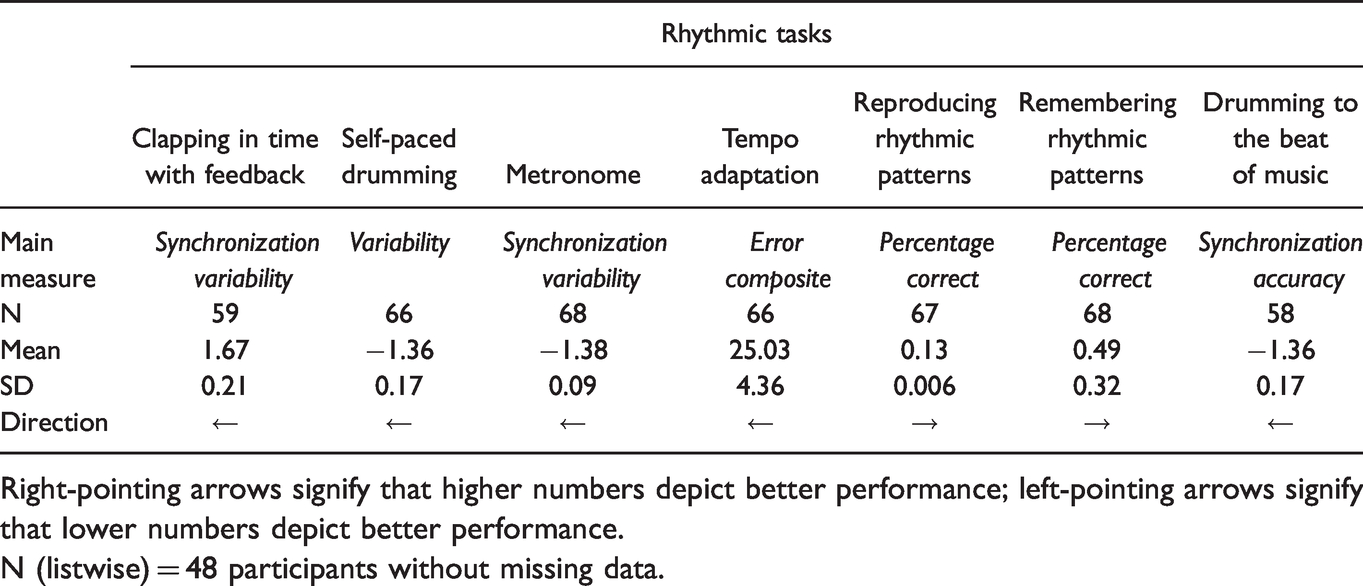
Right-pointing arrows signify that higher numbers depict better performance; left-pointing arrows signify that lower numbers depict better performance.
N (listwise) = 48 participants without missing data.
To confirm the presence of clusters of rhythmic skills within this dataset, we performed a factor analysis on the fifty-five participants who completed all six of the drumming tasks (i.e. all rhythmic tasks except Clapping in time with feedback). To investigate the relationships between the various rhythmic tasks, performances on the seven measures of rhythmic skills were correlated using Spearman’s rho (see Table 3). Finally, clapping in time variability was correlated with the factor scores obtained from the factor analysis.
Results
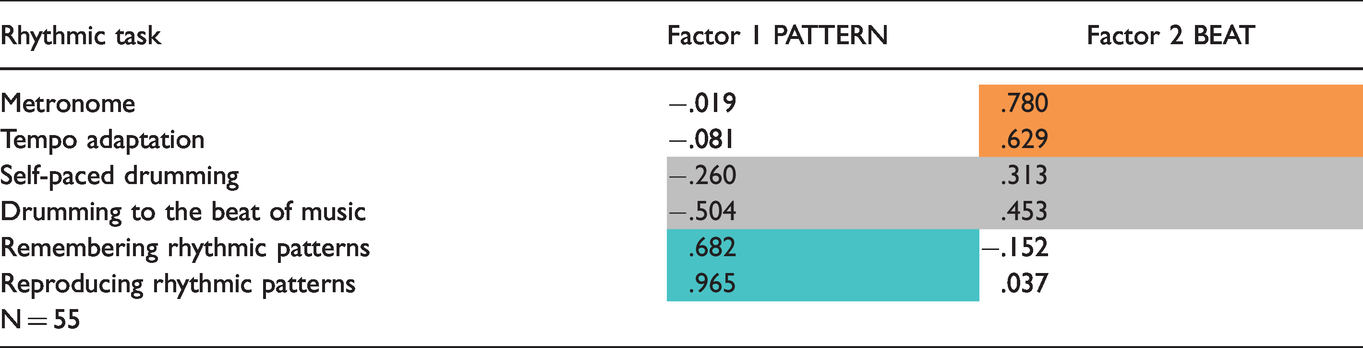
The factor analysis revealed a two factor solution in which one factor – a pattern-based factor – reflected strong loadings from the metronome (.780) and tempo adaptation (.629) tasks and more moderate contributions from remaining tasks. The metronome and tempo adaption tasks loaded minimally onto the second factor (−.081 and −.019, respectively), while this second factor – a beat-based factor – strongly reflected drumming to rhythmic patterns (.965) and remembering rhythmic patterns (.682), both of which loaded minimally onto the first factor (.037 and −.152, respectively). Self-paced drumming and drumming to the beat of music loaded moderately onto both factors with balanced contributions.
These two factors appeared to reflect beat- and patterns- based skills. The pattern factor accounted for 27.9% of variance after rotation, whereas the beat factor accounted for 21.9% of variance after rotation. The Kaiser-Meyer-Olkin Measure of Sampling Adequacy (KMO) was .625, indicating that 55 participants provided an adequate sample (Kaiser & Rice, 1974), and Bartlett’s test of sphericity returned a significant result (χ2 = 85.087). Table 2 shows the factor loadings after varimax rotation.
Bivariate correlations across all seven tasks are reported in Table 3, with Figure 3 showing scatterplots comparing performance across all seven rhythmic tasks. All significant relationships were in the expected directions: we labeled as positive all relationships between tasks where a good performance on both tasks was quantified by either high or low scores, and we labeled as negative relationships all tasks where a good performance on one task was quantified by a low score and on the other by a high score.
Summary of Factor Loadings After Varimax Rotation.
Spearman's Rho Paired Correlation Coefficients and p-values (2-tailed) for Performances on All Seven Rhythm Tasks.

Asterisk indicates level of significance (* <.05; ** <.01).
Comparing Performances on Score Factor 1, Score Factor 2 and Synchronization Variability From Clapping in Time With Feedback.

Asterisk indicates level of significance (* <.05; ** <.01).
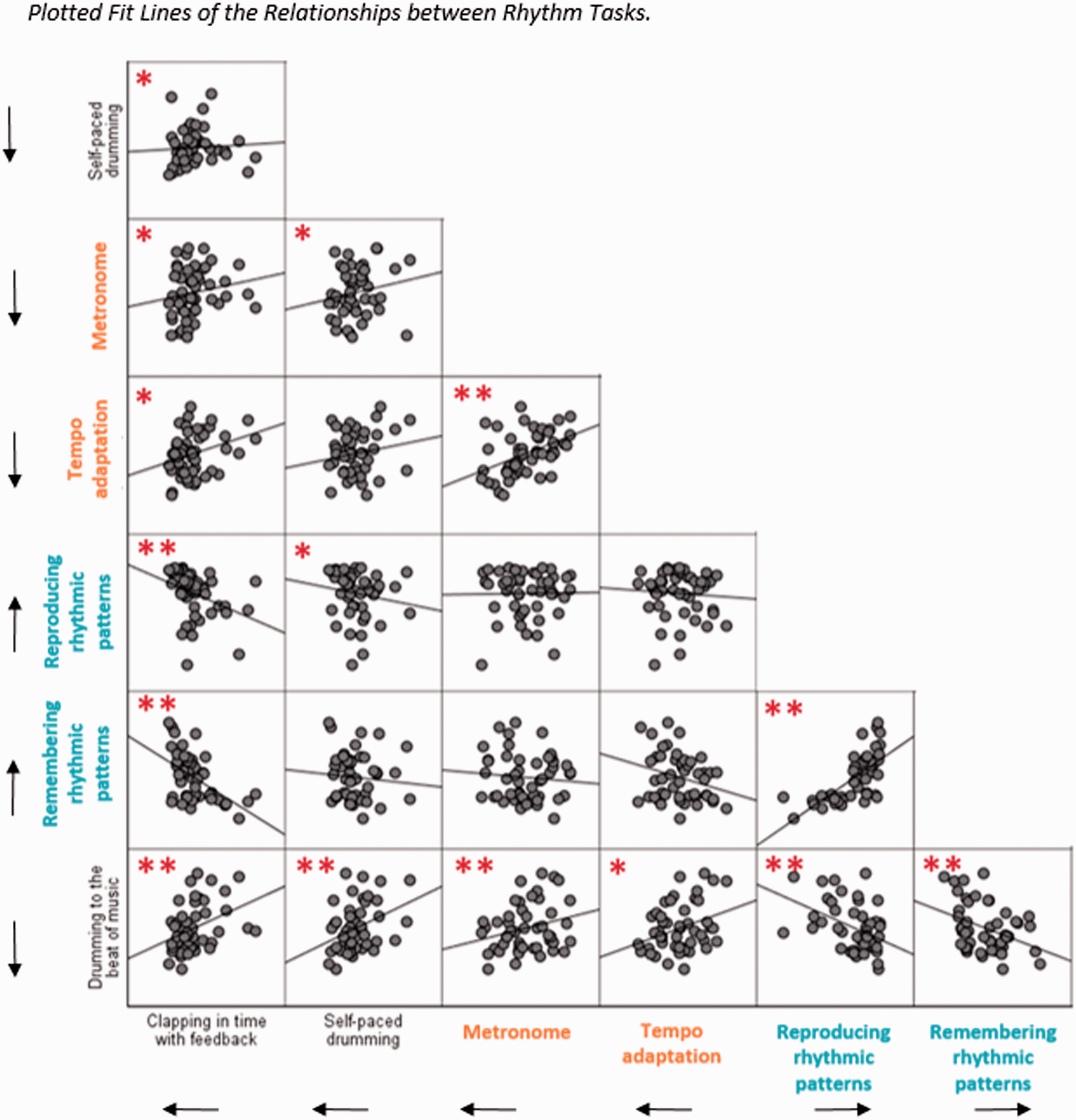
Plotted Fit Lines of the Relationships Between Rhythm Tasks.
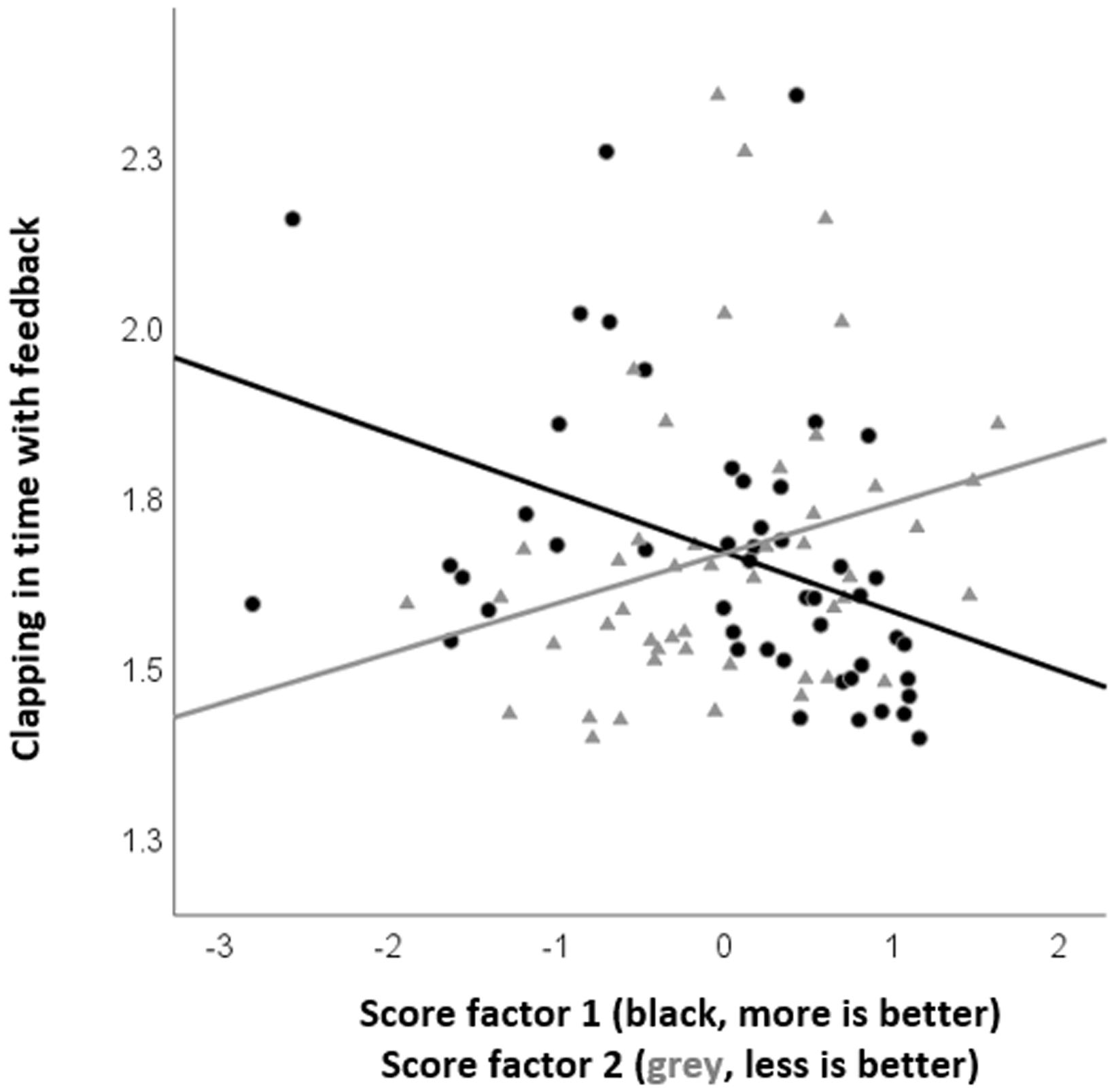
Plotted Fit Lines of the Relationships Between Factor Score 1 “Pattern” (in Black) and Factor Score 2 “Beat” (in Grey) (Overlapped on x-Axis) and Clapping in Time Variability (on y-Axis).
Positive relationships were found between:
Clapping in time and (a) Tempo adaptation (rho = .261, p = .049*), (b) Metronome (rho = .263, p = .044*), (c) Self-paced drumming (rho = .334, p = .011**), and (d) Drumming to the beat of music (rho = .390, p = .005**). Drumming to the beat of music and (a) Self-paced drumming (rho = .395, p = .005**), (b) Metronome (rho= .338, p = .010**), (c) Tempo adaptation (rho = .264, p = .047*). Self-paced drumming and Metronome (rho = .304, p = .013*). Metronome and Tempo adaptation (rho = .489, p < .005**) Reproducing rhythmic patterns and Remembering rhythmic patterns (rho = .695, p <.005**)
Negative relationships were found between:
Clapping in time and (a) Remembering rhythmic patterns (rho = −.483**, p <.005) and (b) Reproducing rhythmic patterns tasks (rho = −.491**, p < .005). Drumming to the beat of music and (a) Remembering rhythmic patterns (rho = −.379**, p = .003) and (b) Reproducing rhythmic patterns tasks (rho = −.356**, p = .006). Self-paced drumming and Reproducing rhythmic patterns (rho = −.371*, p = 010).
The bivariate correlations between the clapping in time variability and the two factor scores were significant, with a stronger relationship between clapping in time and the factor including the pattern-based tasks than the one including the beat-based tasks (see Table 4 and Figure 4).
Discussion
This study showed evidence of an interconnection between various rhythmic tasks and a clapping in time task among adolescents and young adults. Prior research has proved that human participants may reveal separate abilities across various rhythmic tasks (Bonacina et al., 2019; Dalla Bella et al., 2017; Tierney & Kraus, 2015). Interestingly, here we show that clapping in time with feedback relates with other rhythmic tasks that assess distinct rhythmic skills. The observation that clapping in time related to both rhythmic clusters of beat-based and pattern-based tasks may be explained by the nature of the clapping in time task. This task requires both coordinating motor movements in time with an auditory pacing beat (the basis of a beat synchronization task), and planning and adjusting motor actions to align movements to the target beat (skills that are essential for contending with articulated rhythmic patterns). Moreover, this task can be thought of as a beat synchronization task at a very slow pace, again supporting the idea that it embodied features of both the beat-based tasks and pattern-based rhythmic tasks over a longer time interval.
While examining these relationships, we observed two other related findings. First, motor dexterity and intrinsic motor variability assessed by the self -paced drumming task related with only rhythmic tasks that required proactive productions and dealt with steady and predictable rhythms. The two tasks that self-paced drumming failed to relate to, tempo adaptation and remembering rhythmic patterns, do not have this characteristic. The tempo adaptation task consists of subtle unpredictable variations in tempo that require the participant to suppress innate motor variability, while the remembering rhythmic pattern task calls upon working memory to reproduce the rhythmic sequence, again requiring the participant to suppress spontaneous motor action. Second, these findings replicated previous findings in school-age children showing that drumming to a beat of music relates to both beat-based and pattern-based tasks. This is understandable, considering the nature of the drumming to the beat of music task. Music embraces both regular and irregular beats and is built on a sequence of rhythmic patterns. Therefore, when drumming along to a music beat, we implicitly rely on both the skills necessary to identify the patterns of a melody and the skills needed to recognize, follow, and drum out the beat. Bonacina et al. (2019) hypothesized a model in which rhythm starts off early in life as a global skill and becomes more specialized through development. Thus, we expected the drumming to the beat of a music task to be distinct from both a beat- and a pattern- based task by adolescence. However, our findings negated this expectation.
The fact that both drumming to the beat of music and clapping in time with feedback related with all other tasks in our rhythmic battery is consistent with the idea that those two tasks entail a broad activation of processes that are only partially engaged by the other rhythmic tasks. Moreover, given the similarities of these two tasks with activities involved in music training and Interactive Metronome training, the broad spectrum of processes activated by these two tasks may underlie widely beneficial effects that have been documented for each of the latter two activities (Chen & Pei, 2018; Etra, 2006; Kraus & Chandrasekaran, 2010; Kuhlman & Schweinhart, 1999; Lesiuk et al., 2018; Ritter et al., 2013; Shaffer et al., 2001; Taub et al., 2007; Trombetti et al., 2011).
Our finding that some rhythmic skills are dissociated while others are extensively interrelated among adolescents and young adults mirrors the patterns previously documented in very young children (Bonacina et al., 2019). This finding offers new and reinforces current insights into the taxonomy of rhythm skills. Together with previous findings our results inform the study of links between rhythm and language and support the development of tailored remediation strategies.
Limitations and Future Research Recommendations
A limitation of this study was its reliance on correlational data that necessarily preclude determining causality in these relationships. However, the consistency of results in studies of very young and older children and adults bolsters the strength and certainty of these relationships and now motivates further longitudinal research. Additionally, although, statistically, we were adequately powered (KMO = .625), it would be ideal to replicate this finding in a much larger sample. Future research might expand the participant data base and focus further attention on patients with focal lesions that disrupt specific rhythmic abilities.
Conclusion
In conclusion, we find that there are distinct subskills of rhythm in adolescents and young adults. These individual skills can be encapsulated in one rhythm task, such as drumming to the beat of music or clapping in time with feedback. Certain rhythmic subskills related to literacy skills. Given the relationship between reading and rhythm skills, a task, such as clapping in time, that assesses all (or many) rhythm skills together may provide an overall reference point of one’s general literacy processing. These individual tasks, however, may provide a targeted assessment of a particular function or process to identify specific rhythm and reading difficulties.
Footnotes
Acknowledgments
We would like to thank the members of the Auditory Neuroscience Laboratory, past and present, for their contributions to this work, and the children and families who participated in this study. The authors thank Interactive Metronome who donated equipment used in this study. Interactive Metronome had no role in the study design, execution, or interpretation.
Declaration of Conflicting Interests
The author(s) declared no potential conflicts of interest with respect to the research, authorship, and/or publication of this article.
Funding
The author(s) disclosed receipt of the following financial support for the research, authorship and/or publication of this article: This work is supported by NSF BCS 14304000, National Association of Music Merchants, Knowles Hearing Center.

Note
1. Titles of the 12 pieces from which each extract was taken, along with the genre.
1. A Chorus Line – Boston Pops (Pop Orchestral)
2. Hard to Handle – The Black Crowes (Rock)
3. King Porter Stomp – Glenn Miller (Jazz)
4. New York New York – Boston Pops (Pop Orchestral)
5. One O’clock Jump – Benny Goodman (Jazz)
6. One Way or Another – Blondie (Rock)
7. Panama – Van Halen (Rock)
8. Richard Rodgers Waltz – The Boston Pops (Pop Orchestral)
9. Superman – The Boston Pops (Pop Orchestral)
10. Tuxedo Junction – Glenn Miller (Jazz)
11. Stompin’ at the Savoy – Benny Goodman (Jazz)
12. Hurts So Good – J. Mellencamp (Rock)