



Abstract
In the present study, we examined the relationship between mindfulness and rumination among student-athletes. Ninety-seven young adult student-athletes (38.1% female, 61.9% male; Mage = 22.52, SD = 3.53) completed both the Mindfulness Inventory for Sport and the Ruminative Thought Style Questionnaire. Among these participants, we observed a significant positive correlation between rumination and the awareness sub-dimension of mindfulness. We also observed significant negative correlations between rumination and two scores from the Mindfulness Inventory for Sport: non-judgment and overall mindfulness. Awareness, non-judgment, and mindfulness were all significant predictors of rumination in a linear regression analysis. While these are correlational data that do not permit causal inferences, these findings raise the possibility, in this population, that awareness triggers ruminative thoughts and overall mindfulness might represent a coping tool for rumination. Further research is needed to test this possibility.
Keywords
Introduction
Rumination refers to a class of conscious thoughts that revolve around a common instrumental theme and that recur in the absence of immediate environmental demands requiring the thoughts (Martin & Tesser, 1996). Rumination has been commonly associated with depression (De Jong-Meyer et al., 2009; Papageorgiou & Wells, 2003), anxiety (Harrington & Blankenship, 2002), worry (De Jong-Meyer et al., 2009), symptoms of post-traumatic stress disorder (Borders et al., 2012) and obsessive-compulsive symptoms (Wahl et al., 2011).
According to Goal Progress Theory (Martin & Tesser, 1996), rumination is a class of negative or positive thoughts related to the past, the present, or the future. It can also be related to a finished or unfinished task. It can be exemplified by thought content that revolves around an ordinary theme. Rumination emerges when target-driven progress occurs slower or faster than the individual expects. According to the aforementioned theory, most thoughts are goal-driven, and recurrent thoughts are related to unachieved goals. When individuals have a goal, they take steps towards achieving it. If these steps are successful, the individual gravitates towards another goal. If the steps are unsuccessful, individuals attempt to reach their goals in other ways. These alternative ways persist until the individual reaches their goal or gives up. If the goal is achieved or abandoned instantly, ruminative thinking does not emerge. In theory, two approaches (one permanent, one temporary) were mentioned for preventing rumination. The permanent way to prevent rumination is to reach the goal, and the temporary way is to re-channel one's thoughts away from rumination. This theory might predict that an athlete who aims to become an Olympic champion might experience ruminative thoughts unless they reach their goal or turn towards another goal (e.g., becoming the European champion). Thus, athletes who have accomplished their goals (setting the records they targeted) are less likely to ruminate, compared to those who have failed to do so. This theory suggests that it is necessary for athletes to reach their goals or redirect their thoughts if they are to block out the ruminative thoughts they experience. On the other hand, focusing on their experiences in the present moment in a conscious and non-judgmental mindset (Kabat-Zinn, 2003) has been conceptualized as mindfulness, and this may be another way for athletes to prevent rumination.
In past literature, it has been common for researchers to find a negative correlation between rumination and athletic performance (Roy et al., 2015; Scott et al., 2002). It is thought that athletes whose thoughts are stuck in a past game will perform more poorly in the current game because high rumination will distract the athlete’s focus from current performance (Roy et al., 2015). Mindfulness practices, however, have been shown to enhance athletic performance. For instance, in a recent meta-analysis study, reviewers concluded that mindfulness interventions were effective in enhancing performance outcomes in shooting and throwing (Bühlmayer et al., 2017). In addition, in a study with national-level swimmers, Mardon et al. (2016) found that four out of six swimmers who underwent mindfulness training improved performance, and five increased their perceived performance. Josefsson et al. (2017) found that mindfulness seemed to have a negative impact on rumination among elite athletes. Birrer et al. (2012) also theorized that the mechanism for the relationship between mindfulness and better performance may have been that mindfulness reduces rumination.
According to the mindfulness concept, recurrent thoughts result from mind wandering. Easing off this wandering by becoming still and preparing oneself for mental, physical, and emotional experiences are aspects of mindfulness. Mindfulness interventions assume that by noticing that recurrent thoughts may be restrictive and may prevent one from reaching goals, the individual is able to balance the wandering mind (Baltzell & Summers, 2017). Thus, mindfulness may help reduce ruminative thoughts by balancing a type of wandering mind in which the “wandering” can be repetitive thinking. Additionally, other components of mindfulness include non-judgment, acceptance and letting go (Kabat-Zinn, 2013), and these components may also contribute to reduced rumination. In addition to balancing the mind, Baltzell and Summers (2017) listed concentration, clear vision, and mental preservation among other functions of mindfulness that might help increase athletic performance. Through mindfulness, athletes learn when to encourage the wandering mind and when to focus on athletic tasks; this ability then enhances concentration. Top performing athletes also achieve the consistent ability to focus on real-time, here and now experiences and performance-specific thoughts that elicit their optimal performance; and mindfulness techniques may assist this process. Mindfulness also teaches individuals specific thought content for this focus, including what they might believe in, or simply observe. In this way, mindfulness preserves the athlete's focus and may set the mind and body tone for a type of relaxed readiness to perform. Coming back to rumination, different solutions may be needed for athletes who suffer from different degrees or types of ruminative thoughts. It is clear that more findings are needed to understand the relationship between rumination and mindfulness in student-athletes. Thus, the present study hypothesized a negative correlation between mindfulness and rumination among student-athletes.
Method
Design
The protocol for the present study was approved by the University Assessment and Evaluation Ethics Sub-Committee. This study was cross-sectional and carried out with certified student-athletes who were studying in the Faculty of Sports Sciences at Gazi University during the 2019–20 academic year. Data collection was online, through Google Forms. Participants completed a Demographic Information Form created by the researchers, the Mindfulness Inventory for Sport
Participants
Student athletes studying in the Faculty of Sports Sciences at Gazi University were recruited for the study. We conducted a power analysis to estimate the sample size required for adequate statistical power. In order to detect an effect size of Cohen’s d = 0.3 with 85% power (alpha = .05, two-tailed), an analysis with G*Power (Faul et al., 2009) suggested that we would need 93 participants for a linear bivariate regression. Due to a probability of some participant attrition and/or missing data, we increased this required sample size and accepted the first 97 student-athletes who volunteered. These participants had a mean age of 22.52 years (SD = 3.53).
Instruments
Demographic Information Form
This form was created by the investigators. It included questions regarding the participants' gender, age, sports branch, and best records to date in their sport branch. Respondents completed this form online.
Mindfulness Inventory for Sport (MIS)
The Mindfulness Inventory for Sport was developed by Thienot et al. (2014) and adapted to Turkish by Tingaz (2020a). This 15-item inventory consists of three sub-dimensions of mindfulness involving “Awareness,” “Non-Judgment,” (reverse-scored), and “Refocusing.” The item format was a 6-point Likert scale (1 = Almost never, 2 = Occasionally, 3 = Sometimes, 4 = Frequently, 5 = Usually, 6 = Almost always). This instrument has shown good reliability with a test-retest correlation coefficient of .89 and a split-half correlation coefficient of .80 (Tingaz, 2020a). The Cronbach's Alpha Internal Consistency Coefficient was calculated as .82 for the overall inventory, α = .81 for the “Awareness” sub-dimension, α = .70 for “Non-Judgment” and α = .77 for “Refocusing” (Tingaz, 2020a). The scale was negatively correlated with irrational performance beliefs and positively correlated with cognitive flexibility (Tingaz, 2020b) and impulsivity (Tingaz et al., 2020).
Ruminative Thought Styles Questionnaire
The Ruminative Thought Styles Questionnaire was developed by Brinker and Dozois (2009), and it was adapted for Turkish respondents by Karatepe et al. (2013). For this unidimensional instrument, 20 items are presented on a 7-point Likert scale. The test-retest correlation coefficient of the inventory was calculated as .84 while its Cronbach's alpha internal consistency coefficient was calculated as .93 (Karatepe et al., 2013).
Data Analysis
We used SPSS 25.0 (IBM Corp., Armonk, NY, USA) for data analysis. We tested assumptions of normality in the data distributions with Q-Q Plot Graphs, Histogram, and skewness-kurtosis coefficients. Since the data were found to be normally distributed, we performed Pearson correlational analyses to examine the relationships between rumination and mindfulness and between rumination and the sub-components of mindfulness. We used a simple linear regression analysis to determine the power of mindfulness and its components for predicting rumination. We observed no multicollinearity.
Results
Table 1 shows the characteristics of our sample of 97 student-athletes. As noted above, they had a mean age of 22.52 years (SD = 3.53), and 61.9% were male (while 38.1% were female). As for type of sport, 43.3% of the athletes participated in team sports while 56.7% participated in individual sports. Examining each athlete’s self-reported best athletic record, 14.4% achieved no record, 17.5% achieved a provincial record, 7.2% achieved a regional record, 32% achieved a national Turkish record, 21.6% achieved a European record and 7.2% achieved a world record.
Demographic Information of the Participants.
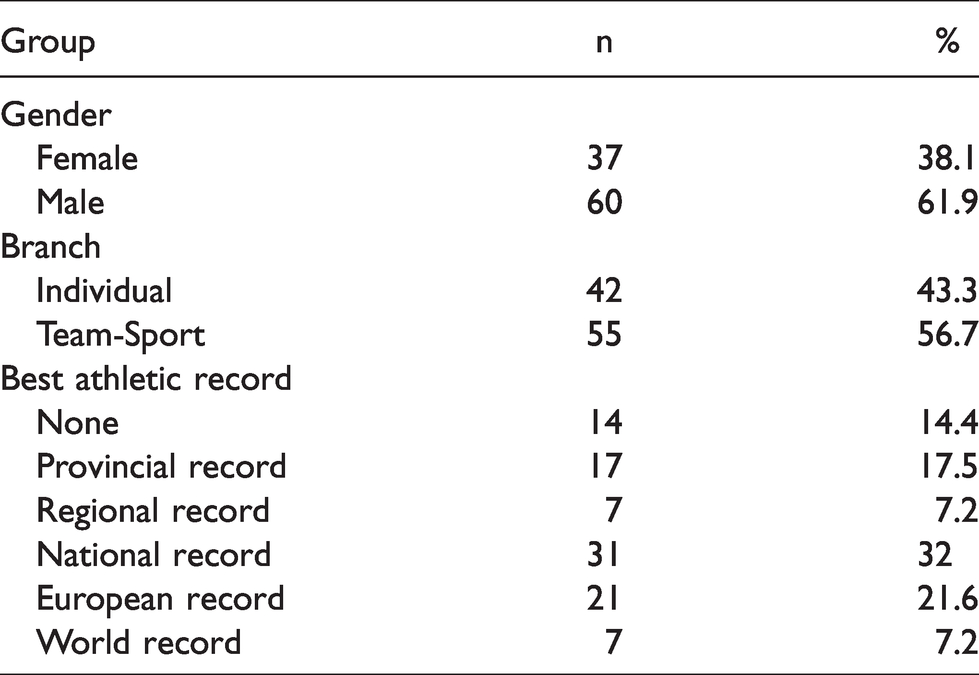
Table 2 shows the Pearson correlation coefficients between variables of interest in this study for all 97 participants. There was a significant positive relationship between mindfulness awareness and rumination (r = .290, p = .004), and there were significant negative relationships between rumination and the non-judgment component of mindfulness (r = −.654, p = .000) and between rumination and overall mindfulness (r = −.362, p = .000). As the non-judgment subscale is reverse scored and items in the non-judgment sub-dimension of the Mindfulness Inventory for Sport are negative, for these analyses, they were scored as six instead of one. We evaluated the correlation classifications according to recommendations from Schober et al. (2018): .00−.10: insignificant, .10−.39: weak, .40−.69: moderate, .70−.89: strong, .90−1: very strong. Thus, the positive relationship between awareness and rumination and the negative relationship between rumination and mindfulness were both statistically significant but weak in magnitude. The statistically significant negative relationship between rumination and non-judgment was considered moderate in strength.
Correlations Between Rumination, Overall Mindfulness and Sub-Dimensions of Mindfulness.
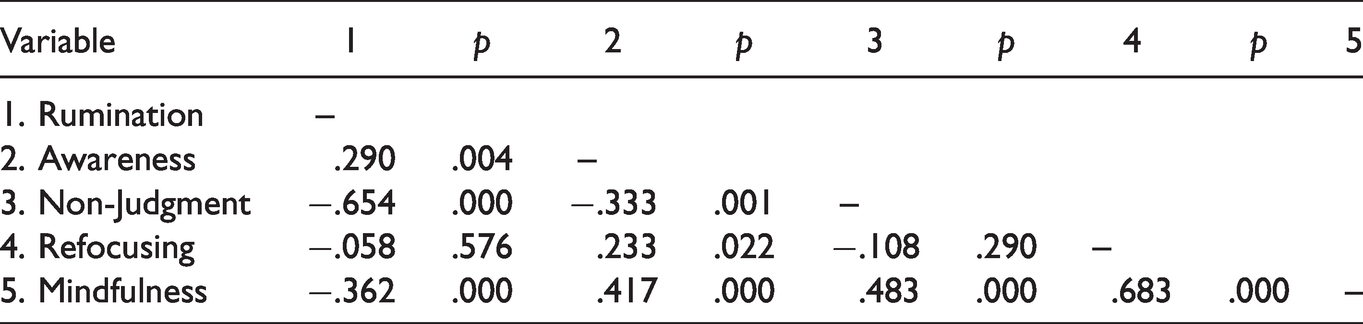
Table 3 shows the results of a linear regression analysis. Models 1 (R = .29, R2 = .08, F = 8.74, p = .00), 2 (R = .65, R2 = .42, F = 70.83, p = .00) and 3 (R = .36, R2 = .13, F = 14.29, p = .00) were significant. The Awareness sub-dimension from the mindfulness questionnaire explained 8% of the total variance in rumination, while the non-judgment sub-dimension accounted for 42% of the variance in rumination. Overall mindfulness accounted for 13% of rumination.
Regression Analysis on Mindfulness as a Predictor of Rumination.
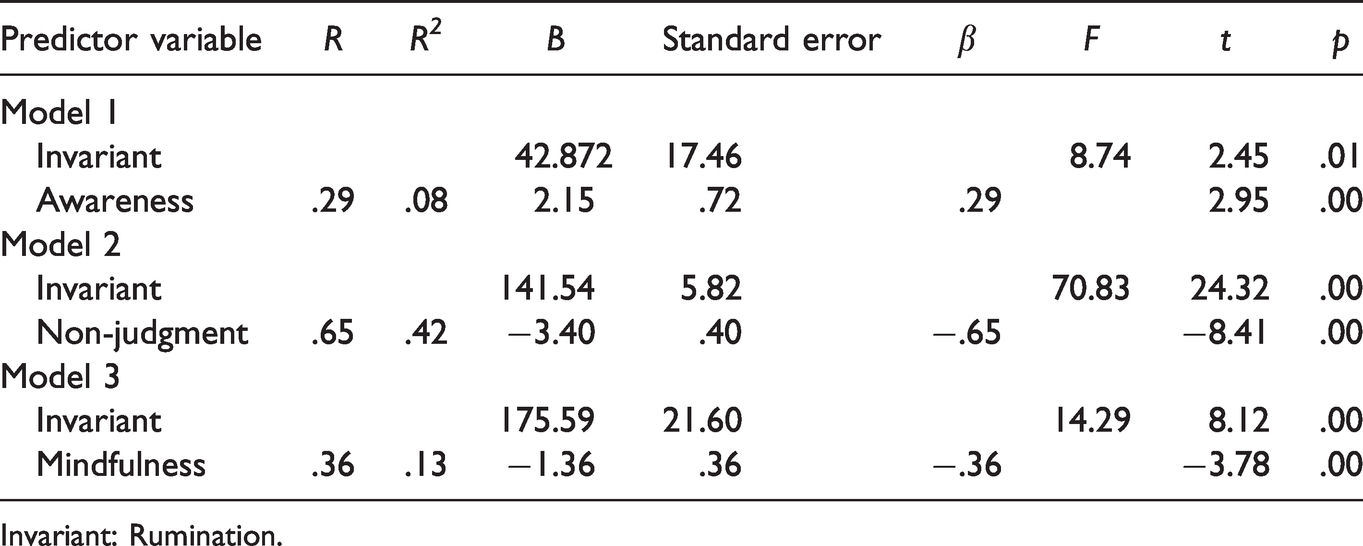
Invariant: Rumination.
Discussion
In the present study, we examined the relationship between mindfulness and rumination in self-reported inventories completed by student-athletes. On self-report questionnaires used to measure both constructs, we found a weak positive relationship between mindfulness awareness and rumination, a weak negative relationship between overall mindfulness and rumination, and a moderate negative relationship between mindfulness non-judgment and rumination.
In parallel with this finding, many prior studies have shown a negative relationship between mindfulness and rumination (Borders et al., 2010; Flett et al., 2016; Josefsson et al., 2017; Marks et al., 2010; Raes & Williams, 2010). In addition, Sutton (2016) observed that the acceptance subscale of the self-awareness questionnaire was negatively related with rumination. Because non-judgment was reverse scored, this really means that less non-judgment correlated with more rumination. In other words, non-judgment may be the critically important mindfulness component for reducing rumination. In its association with rumination, mindfulness represents a balance between subdomains of Awareness and Non-judgment, since mindfulness essentially averages the opposite effects of these components. In other words, heightened Awareness is associated with heightened rumination, while heightened Non-judgment is associated with diminished rumination. Based on our findings, however, we might presume that while heightened awareness may be associated at least weakly with ruminative thoughts, mindfulness generally is associated with less rumination. Perhaps most importantly, non-judgment was moderately associated with rumination. At this point, it can also be said that awareness and mindfulness do not carry the same meaning. High awareness on its own may trigger unpleasant feelings in addition to pleasant ones. For this reason, awareness should be regarded as a component of mindfulness that operates differently alone than a more complete mindfulness construct. Mindfulness teaches a non-judgmental attitude towards what is perceived, and this added component of mindfulness is important to minimizing rumination. Another finding in the present study supports this hypothesis. Awareness alone explained 8% of the total variance in rumination while non-judgment explained 42% of the total variance in rumination, and mindfulness overall controlled 13% of rumination variance. Based on this, it can be said that non-judgment and mindfulness are stronger in predicting rumination, compared to awareness on its own. Similarly, Josefsson et al.'s (2017) study with competitive elite athletes found that dispositional mindfulness accounted for 16% of rumination. In a systematic review and meta-analysis study (Perestelo-Perez et al., 2017) mindfulness-based cognitive therapy significantly reduced rumination, compared to usual care. In another study examining the impact of mindfulness training on depression-related rumination, the mindfulness-based stress reduction program reduced rumination and symptoms of depression (Deyo et al., 2009).
Athletes suffering from rumination may engage in deep, repetitive, and unhelpful thoughts. For example, an athlete who has lost an important competition may have repetitive thoughts such as “I wish I was better,” “Why did this happen to me?” or “What would have happened if I competed differently?” These thoughts serve as examples of rumination that can be named as time-bending or mind-wandering. As stated by Killingsworth and Gilbert (2010), “A wandering mind is an unhappy mind.” An athlete may ruminate more intensely if they try not to have these ruminative thoughts, regarded as avoidance behavior, and mindfulness may be a more effective approach for reducing rumination, especially for athletes who are aware of their ruminative thoughts and who experience past competitions in a non-judgmental and accepting manner, showing a more fully mindful attitude towards their ruminative thoughts. One of the answers to the question “What is not Mindfulness?” was provided by Germer (2009) who described this as attempting to empty the mind or escape the pain. Birrer et al. (2012) listed rumination among the potential action mechanisms of mindfulness that have potential to enhance athletic performance. These researchers also suggested that low levels of rumination affected many psychological skills, personal development, and life, self-respect, healing, coping, regulation of stimulation, attention, and motor control skills. The athletic performance of athletes who experience intense levels of rumination may also be affected.
Limitations and Directions for Further Study
There are several limitations to be considered in the present study. As a cross-sectional design that was based on self-report scales from student-athletes, causal conclusions cannot be drawn through this regression analysis. Future research is needed to draw a definitive causal connection between mindfulness and rumination, and these constructs might be studied further among different athlete groups. Sequential data in pre-post mindfulness treatment designs that analyze both rumination and mindfulness components among athletes are next needed.
Conclusion
In conclusion, this study showed a significant positive relationship between mindfulness awareness and rumination among young adult student-athletes. There were significant negative relationships between rumination and the non-judgment component of mindfulness and between rumination and overall mindfulness. These findings suggest that awareness may be a contributor to rumination unless it is accompanied by non-judgment and a refocusing of negative ruminative thoughts. All of these dimensions - awareness, non-judgment, and overall mindfulness - were of direct relevance to rumination in student-athletes.
Footnotes
Declaration of Conflicting Interests
The author(s) declared no potential conflicts of interest with respect to the research, authorship, and/or publication of this article.
Funding
The author(s) received no financial support for the research, authorship, and/or publication of this article.
Ethical Approval
The present study was approved by Gazi University Assessment and Evaluation Ethics Sub-Committee (Approval no: 2020-330).
Informed Consent
Informed consent was given to all participants in order to get their allowance for this study.
