




Abstract
Two studies examined whether negative emotion-focused coping accounts for associations between attachment insecurity and post-traumatic stress symptoms (PTS). Victims of physical or sexual assault (N Study1 = 71; N Study2 = 250) completed measures of attachment, negative emotion-focused coping, and PTS. Associations between attachment-avoidance and PTS were mediated by suppressive emotion-focused coping, and associations between attachment-anxiety and PTS were mediated by ruminative emotion-focused coping. Results replicated across two independent samples, but also supported a generalized view of the mediating processes involved.
Keywords
According to attachment theory, environmental stressors trigger the activation of behavioral systems directed at obtaining security from close others (Bowlby, 1969/1982). Individuals differ in the effectiveness with which these systems function, owing to variation in the perceived reliability of relationship partners. Dimensions of insecure attachment constitute important predictors of post-traumatic stress symptoms (PTS; Barazzone, Santos, McGowan, & Donaghay-Spire, 2018). The present research aimed to specify psychological mechanisms that partly explain this association.
Benoit, Bouthillier, Moss, Rousseau, and Brunet (2010) suggested the potential mediating role of negative emotion-focused coping strategies: ineffective manners of regulating emotional responses to stressors (Lazarus & Folkman, 1984). In a sample of 36 trauma survivors, Benoit et al. (2010) observed negative emotion-focused coping (e.g., worry, self-blame) to mediate the relationship between attachment insecurity and PTS. However, the researchers employed a categorical attachment classification system, whereas dimensional measures yield more precise assessments of adult attachment patterns (e.g., Fraley, Hudson, Heffernan, & Segal, 2015). Further, owing to their use of a categorical measure in a small sample, Benoit et al. (2010) could not differentiate avoidant and anxious attachment. Doing so may be important, because each dimension is associated with characteristic emotional response tendencies (e.g., Mikulincer & Shaver, 2007).
The attachment-avoidance dimension reflects individuals’ sense of distance from close others, accompanied by distrust, defensive self-reliance, and denial of attachment needs. When stressed, relatively avoidant individuals are less likely to seek comfort from others and prone instead to effortfully suppress emotions related to the stressor. Bond et al. (2011) assess a similar deactivating tendency, termed psychological inflexibility: “the rigid dominance of psychological reactions over chosen values and contingencies in guiding action…occurring when people fuse with evaluative and self-descriptive thoughts and attempt to avoid experiencing unwanted internal events” (p. 678). This construct is associated with elevated PTS risk (Marx & Sloan, 2005). The attachment-anxiety dimension reflects individuals’ perception that close others are unreliable or insufficiently responsive, accompanied by overdependency and exaggerated concern with abandonment. When stressed, relatively anxious individuals overemphasize their difficulties; doing so may signal the possibility of gaining partners’ attention and support, but has the negative consequence of hyperactivating emotions related to the stressor. Cann et al. (2011) assess a similar perseverative tendency, termed intrusive rumination: “unsolicited invasions of one’s cognitive world-thoughts about an experience that one does not choose to bring” (p. 138). This construct, too, is associated with elevated PTS risk (Blackburn & Owens, 2016).
The present studies thus tested for: (1) an indirect association whereby attachment-avoidance predicts PTS through its association with psychological inflexibility and (2) an indirect association whereby attachment-anxiety predicts PTS through its association with intrusive rumination. Participants were victims of physical or sexual assault, forms of trauma selected, given their interpersonal nature. Interpersonal traumas are more likely than non-interpersonal traumas to implicate attachment-related processes in the elicitation of PTS (Huang, Chen, Su, & Kung, 2017). Physical and sexual assault are among 16 trauma categories from the Life Events Checklist for DSM-5, a PTS screener (LEC-5; Weathers, Blake, et al., 2013), and exhibit relatively strong temporal stability (Gray, Litz, Hsu, & Lombardo, 2004).
Study 1
Method
Participants
Participants (N = 403) were Amazon Mechanical Turk (MTurk) workers in the U.S. who had previously completed at least 50 MTurk human intelligence tasks (HITs) with an approval rating of at least 90%. The study was described as a survey “regarding multiple areas of psychological interest (i.e., relationships, past life events, coping).” Study 1 examined a subset of respondents who had suffered physical or sexual assault, as determined by responses to Criterion A from the PTSD Checklist for DSM-5 (Weathers, Litz, et al., 2013). Participants were asked to “briefly identify the worst event” they had experienced. Three research assistants independently rated whether responses constituted physical/sexual assault, based upon definitions from the LEC-5: “physical assault (for example, being attacked, hit, slapped, kicked, beaten up)” or “sexual assault (rape, attempted rape, made to perform any type of sexual act through force or threat of harm; other unwanted or uncomfortable sexual experience).” Coders were unanimous in their categorization of 97% of cases; disagreements were resolved following group discussion. This procedure identified 71 physical/sexual assault victims (22 males, 49 females; M age = 36.00, SD age = 10.67; rangeage = 19–64). The sample was 63% Caucasian, 17% African American, 10% Hispanic/Latino, 7% Asian, and 3% other. 1
Measures
Attachment insecurity
Attachment insecurity was assessed with the Experiences in Close Relationships Scale–Revised (Fraley, Waller, & Brennan, 2000), consisting of an avoidance subscale (e.g., I prefer not to be too close to romantic partners) and anxious subscale (e.g., I worry that romantic partners won’t care about me as much as I care about them). Thirty-six items, presented in randomized order, were rated on 7-point rating scales (1 = strongly disagree, 7 = strongly agree; αs > .92), such that higher values indicated greater attachment insecurity.
Psychological inflexibility
Psychological inflexibility was measured with the Acceptance and Action Questionnaire II (Bond et al., 2011). To ensure pertinence to participants’ self-identified “worst event,” items were modified to emphasize respondents’ assault experience (e.g., I am afraid of my feelings was changed to I am afraid of my feelings regarding my worst event). Seven items were rated on 7-point scales (1 = never true, 7 = always true; α = .94), such that higher values indicated greater psychological inflexibility.
Intrusive rumination
Intrusive rumination was measured with the intrusive thoughts subscale from the Event Related Rumination Inventory (ERRI-intrusive; Cann et al., 2011). Items were modified to emphasize respondents’ current thoughts (e.g., Thoughts about the event came to mind and I could not stop thinking about them was changed to Thoughts about my worst event come to mind and I cannot stop thinking about them). Participants responded to 10 items on 4-point scales (0 = not at all, 3 = often), indicating how much they had recently experienced intrusive ruminations regarding their worst event (α = .94). Higher values thus indicated greater intrusive rumination.
PTS
PTS was measured on the PTSD Checklist for DSM-5 (PCL-5; Weathers, Litz, et al., 2013). Participants responded to 20 items on 5-point scales (0 = not at all, 4 = extremely), indicating the extent to which their worst event had recently caused them to experience PTS (e.g., In the past month, how much were you bothered by…Having strong physical reactions when something reminded you of the stressful experience [for example, heart pounding, trouble breathing, sweating]? α = .96). Higher values thus indicated greater PTS. 2
Descriptive statistics for these variables are displayed in Table 1.
Descriptive statistics and bivariate correlations (Studies 1 and 2).
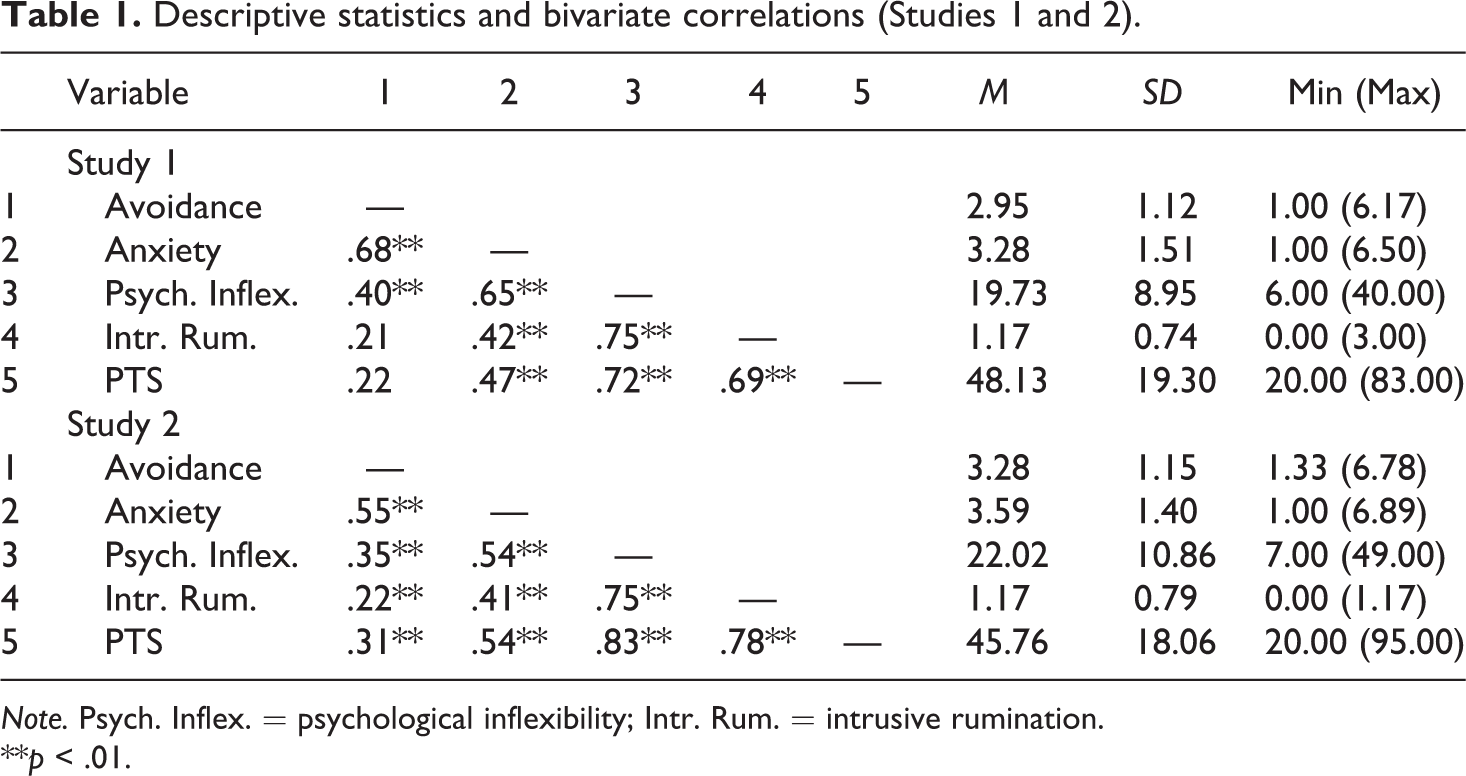
Note. Psych. Inflex. = psychological inflexibility; Intr. Rum. = intrusive rumination.
**p < .01.
Results and discussion
Indirect associations were assessed with PROCESS (Hayes, 2013; see Table 2). In the first mediation analysis, participants reporting greater attachment-avoidance had higher levels of psychological inflexibility (a = 3.19), and participants reporting greater psychological inflexibility reported greater PTS (b = 1.63). The indirect relationship was statistically different from zero (ab = 5.20, with a 5,000-sample bias-corrected bootstrap 95% confidence interval [CI] from 2.09 to 8.14). Additionally, there was no direct association between attachment-avoidance and PTS (c′ = −1.44, p = .36).
Simple mediation analyses (Study 1).
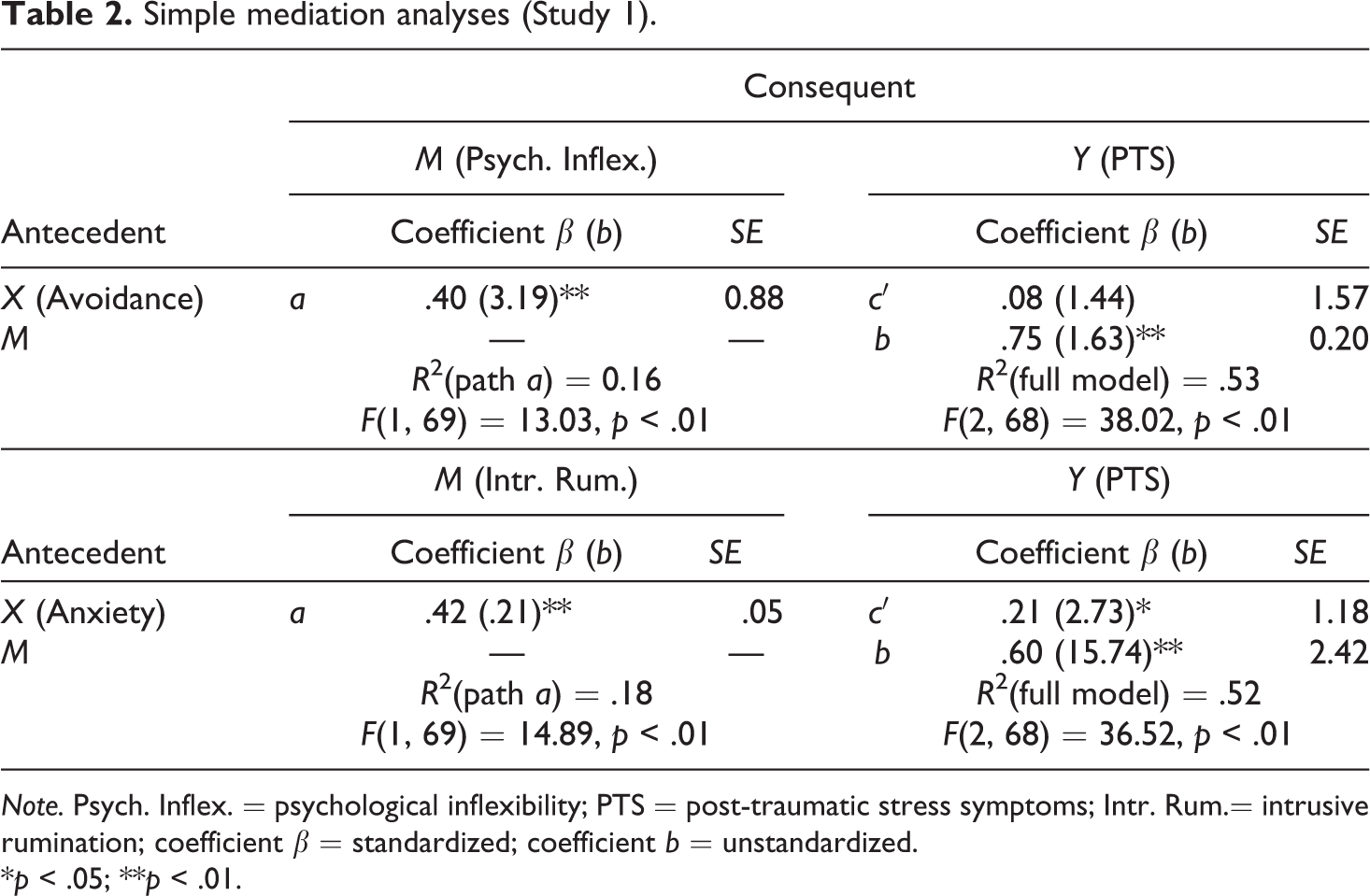
Note. Psych. Inflex. = psychological inflexibility; PTS = post-traumatic stress symptoms; Intr. Rum.= intrusive rumination; coefficient β = standardized; coefficient b = unstandardized.
*p < .05; **p < .01.
In the second mediation analysis, participants reporting greater attachment-anxiety had higher levels of intrusive rumination (a = .21), and participants reporting greater intrusive rumination reported greater PTS (b = 15.74). The indirect relationship was statistically different from zero (ab = 3.23, with a 5,000-sample bias-corrected bootstrap 95% CI from 1.56 to 5.31). Additionally, there was a direct association between attachment-anxiety and PTS (c′ = 2.73 p = .02).
Ancillary analyses examined indirect associations when reversing the hypothesized attachment dimension and emotion-focused coping measure. There was no indirect association between attachment-avoidance and PTS through intrusive rumination (ab = 2.45, 95% CI: −.26 to 5.91). However, there was a significant indirect association between attachment-anxiety and PTS through psychological inflexibility (ab = 6.01, 95% CI: 3.86–8.39).
Results supported the primary hypotheses, though ancillary analyses showed one of the proposed mediators (psychological inflexibility) to explain indirect associations between both attachment dimensions and PTS. This suggests a more generalized mediational process than initially hypothesized. Study 2 examined the replicability of these findings in a larger, independent sample.
Study 2
Method
U.S. MTurk workers (minimum 100 HITs with 93% approval rate) completed an initial screening question requesting they categorize their “worst event” as falling in one of the 16 LEC-5 categories. Respondents were only permitted to participate if they categorized their worst event under the physical or sexual assault category. Of the 1,303 respondents, 604 identified as physical or sexual assault victims. Of these, 151 were excluded because an IP address log suggested they had repeatedly tried to guess their way through the screener. A second screener prevented Study 1 participants from participating in Study 2. Respondents were required to input their verified MTurk worker identification number and were only permitted to participate if that did not match any from the Study 1 sample. This screened out 203 participants, yielding a sample of 250 assault victims (101 males, 145 females, 1 other, 3 did not report; M age = 34.93, SD age = 10.80, rangeage = 19–71). The sample was 72% Caucasian, 10% African American, 8% Asian, 6% Hispanic/Latino, 2% Other, and <1% Native American/Pacific Islander (four did not report). Materials were the same as in Study 1 (αs > .93).
Results
Participants reporting greater attachment-avoidance had higher levels of psychological inflexibility (a = 3.30), and participants reporting greater psychological inflexibility reported greater PTS (b = 1.37; see Table 3). The indirect association was statistically different from zero (ab = 4.52, with a 5,000-sample bias-corrected bootstrap 95% CI from 2.89 to 6.09). Additionally, there was no evidence of a direct relationship between attachment-avoidance and PTS (c′ = .39, p = .51).
Simple mediation analyses (Study 2).
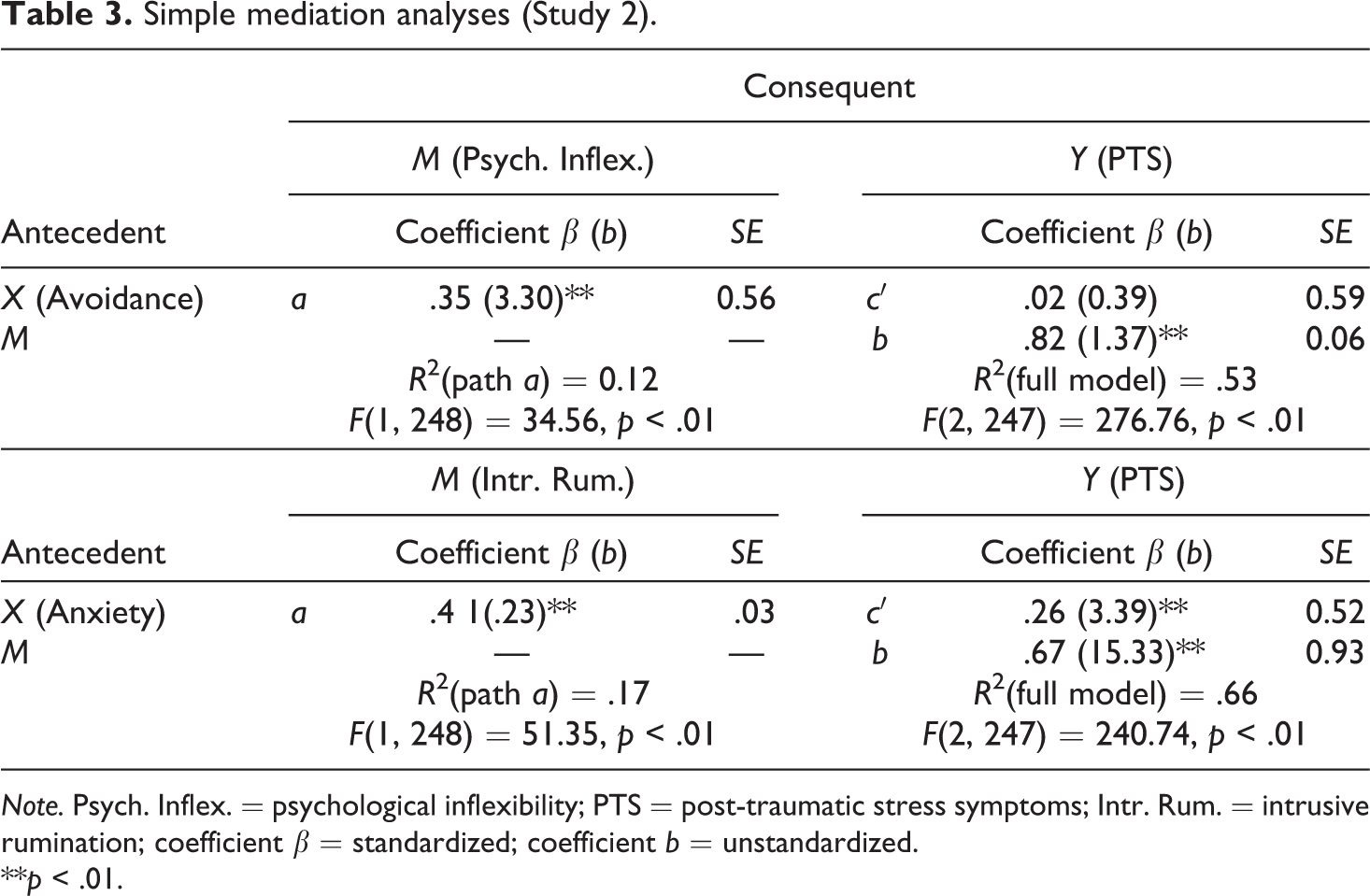
Note. Psych. Inflex. = psychological inflexibility; PTS = post-traumatic stress symptoms; Intr. Rum. = intrusive rumination; coefficient β = standardized; coefficient b = unstandardized.
**p < .01.
Participants reporting greater attachment-anxiety had higher levels of intrusive rumination (a = .23), and participants reporting greater intrusive rumination reported greater PTS (b = 15.33). The indirect association was statistically different from zero (ab = 3.55, with a 5,000-sample bias-corrected bootstrap 95% CI from 2.51 to 4.66). Additionally, there was evidence of a direct relationship between attachment-anxiety and PTS (c′ = 3.39, p < .01).
Ancillary analyses revealed an indirect association between attachment-avoidance and PTS through intrusive rumination (ab = 2.53, 95% CI: 0.93–4.12) and an indirect association between attachment-anxiety and PTS through psychological inflexibility (ab = 5.25, 95% CI: 4.12–6.39).
General discussion
In two studies, negative emotion-focused coping strategies mediated associations between attachment and post-traumatic stress. Attachment-avoidance related to PTS indirectly through psychological inflexibility, and attachment-anxiety related to PTS indirectly through intrusive rumination. These findings were consistent with theory and research linking each attachment dimension to characteristic forms of negative emotional-coping (e.g., Mikulincer & Shaver, 2007). However, ancillary results suggest a more generalized view of these mediating processes. Indirect associations also occurred when reversing the attachment dimensions and emotion-focused coping measures (most robustly in the larger sample of Study 2). This signals an important aim for future research: assessing the diverse constellation of constructs that mediate attachment-stress associations and distinguishing those common to both dimensions from those which may be unique to each. Attachment-avoidance and attachment-anxiety may, in some contexts, anticipate common affective responses that precipitate distress. It is noteworthy, however, that direct associations between attachment insecurity and PTS occurred for the attachment-anxiety but not attachment-avoidance. Perhaps suppressive processes were, indeed, operating distinctly in regard to attachment-avoidance, such that the avoidance-PTS associations manifested only through an indirect path. Despite this difference, the two dimensions were highly correlated (as is typical, e.g., Fraley et al., 2015). Trauma victims could thus be high on both dimensions, rendering them particularly disposed to coping processes that exacerbate vulnerability to PTS.
Important limitations should be noted. MTurk participants have lower self-esteem than community and student samples (Goodman, Cryder, & Cheema, 2013), which may have partly contributed to the attachment-stress processes observed. Further, given the correlational nature of this research, experiments are needed to determine whether the observed mediational pathways truly correspond to a sequence of psychological events. Finally, subtle modifications to the emotion-focused coping measures ensured participants reported psychological inflexibility and intrusive rumination regarding their assault experience. These alterations might limit generalizability to broader constructs of interest. Despite these limitations, an important population was studied, and results inform understanding of associations between attachment insecurity and post-traumatic stress.
Footnotes
Funding
The author(s) received no financial support for the research, authorship, and/or publication of this article.

Open research statement
As part of IARR’s encouragement of open research practices, the authors have provided the following information: This research was not pre-registered. The data used in the research are not available due to IRB participant confidentiality protocol. The materials used in the research are not directly available from the authors, however, are widely available online. Questions regarding the manuscript or materials that were used can be directed to