



Abstract
This article identifies a set of behavioral indicators associated with the carrying of concealed and unholstered handguns. Using qualitative data collected from interviews and focus groups with veteran law enforcement, we outline a variety of cues that, when used appropriately, can help authorities identify people who may be concealing handguns. This work provides a systematic means of assisting the police in identifying and safely interdicting persons who might pose a threat to police or the public. The cues described here contribute to a lexicon that may also serve law enforcement communication, training, and research.
Several layers of complexity surround law enforcement’s interaction with persons carrying firearms. Firearms, whether carried legally or illegally, carry the potential for offensive use against officers and the public. Terrorism, active shooters, media publicity of police officers killing unarmed civilians, ambush killings of police officers, and variation in the ability of citizens to legally carry firearms exacerbate these complexities. It is essential for police officers to be aware of those who may be carrying firearms in their vicinity and to take appropriate and legal action based on the situation.
Concerns about persons carrying concealed and unholstered weapons are well founded. According to FBI Uniform Crime Reports, 46 US law enforcement officers (LEOs) died in the line of duty in 2017; in the vast majority of these cases (42 of 46 cases), officers were killed with a firearm (United States Department of Justice, 2018). Of those 42 firearm-related deaths, 32 involved a handgun (United States Department of Justice, 2018), which is the easiest type of firearm to conceal given its shape and weight. Past research also suggests that most people carrying handguns illegally do not use holsters (Pinizzotto et al., 2006).
Therefore, research that might facilitate the ability of officers to identify persons carrying concealed and potentially illegal firearms can be of great benefit to officer safety, the ability of police to protect the public, as well as their ability to enforce the law. This article identifies and describes a set of behavioral indicators that veteran law enforcement associate with the carrying of concealed, unholstered, and potentially illegal handguns. These behavioral indicators are derived from multiple interview and focus group discussions with subject matter experts (SMEs). The research described in this document is part of a larger project funded by the United States Office of the Assistant Secretary of Defense called the Just Doesn’t Look Right (JDLR) Project, undertaken by authors at the United States Naval Research Laboratory.
This article is divided into the following sections: after this introduction is an outline of background literature and the scope of our investigation; the section that follows describes our investigation, its methods and findings; the findings section itself is organized into three different sub-sections; following this catalog of findings is a discussion of additional concerns, caveats, limitations, and future directions.
Background and scope
There is sparse academic research on behavioral indicators of gun carrying and most available materials are limited to practitioner-focused training materials (for example, New York State Division of Criminal Justice Services, 2011; Porter, 2010). However, some previous work has attempted to organize an understanding of how to identify those who may be committing or preparing to commit other types of criminal activity, which can potentially inform the study of gun carrying. Some of this research falls under the domain of criminal profiling and associated techniques, the use and effectiveness of which has been widely debated (see discussion in Becton, 1986; Cloud, 1985; Poythress et al., 1993; Young, 1991). Voices on the issue vary a great deal, and concerns about profiling work are further complicated by myriad legal considerations that surround the practice of search and seizure (Becton, 1986; Cloud, 1985; Young, 1991; Wilson, 1996), a full discussion of which is beyond the scope of this document. Note that behavioral profiling and personality profiling have considerably different scholarly histories and theoretical foundations; the current investigation is based in the former—behavioral profiling—which has more to do with actions and observations that take place in a particular moment, as opposed to characterizing the nature of an offender, which we do not build on here.
A scholarly history of profiling and crime detection as it relates to gun carrying
Focusing strictly on empirical research that has investigated the effectiveness of behavioral profiling techniques, several validation efforts have successfully demonstrated how an understanding of these techniques can facilitate the identification of potential criminal offenders, in terms of the number of correct predictions, and overall accuracy (Ault and Reese, 1980; Kocsis, 2006, 2009, 2010, 2013; Kocsis et al., 2008; Pinizzotto and Finkel, 1990). Research from Troscianko et al. (2004), for example, found that both trained and untrained observers can distinguish crime sequences in CCTV footage, and that certain behavioral cues aid these successful predictions. These demonstrations are difficult to ignore; at the same time, the results of past work are limited, and subject to several caveats (see Bennell et al., 2006, for a direct critique of Kocsis’s research). Comprehensive meta-analyses of this profiling literature have reached moderately favorable reviews and have called for more research to be done in this area (Snook et al., 2007; see also Bourque et al., 2009). It is clear that room for improvement exists in the development of scientific tools that can accurately parse out the profiling process in a manner that harmonizes subjectivity, allows for more precise measurement by researchers, and incorporates elements of practical judgment in the field.
In light of these concerns, many agree that future research and training in identification techniques make an important step toward tackling tough problems like crime prevention and mitigation (Bennell et al., 2006; Chifflet, 2015; Cook and Hinman, 1999). Given concerns for officer safety as well as safety of the public, various programs have attempted to identify and interdict with persons who may be carrying concealed or illegal firearms. One of the best-known examples is New York City’s controversial stop-and-frisk policy, which has received criticism due to legal concerns of race-based profiling; indeed, research has found that during this program black residents were stopped at disproportionately higher rates compared to white residents (Evans et al., 2014; Gelman et al., 2007). It is no doubt the use of some profiling methods, are fraught with a mix of legal and ethical considerations.
The techniques described in this article provide one means of mitigating these concerns by moving away from ad hominem profiling and instead directing focus to the use of specific and evidence-based behavioral cues. Behavioral cues are actions and micro-actions that can be indicative of concealed weapon carrying in any person, regardless of race, class, ethnicity, or other personal characteristics. Using an approach to crime detection that combines observable physical cues with officer training, the current article hopes to move forward this area of study. In this way, our goal is to provide a way forward that keeps officers and law-abiding citizens safe while maintaining respect for the civil liberties of all persons. Importantly, the work presented here extends beyond mere ‘profiling’ and into the realm of visual search skill training. Adding to the body of work on the identification of gun carrying, we present an approach that moves away from trait-based techniques (which have been the subject of much criticism in the past; Alison, 2005; Bateman and Salfati, 2007; Doan and Snook, 2008; Mokros and Alison, 2002), and instead moves toward the use of behavior-based, environmentally-embedded indicators that are detectable through trained visual search.
Firearms and their use
An initial understanding of firearms and carrying methods is required in order to identify those who may be concealing them. There are two general types of firearms: long arms (i.e., rifles, shot guns, and military style semiautomatic and automatic firearms) and handguns. Within these two types there is significant variation in weight and size. In this study, we focus on handguns—specifically the revolver and the semiautomatic pistol. A survey of federal and state inmates found that 8 in 10 offenders who carried a gun in the commission of a crime used a handgun (Harlow, 2001), and more recent surveys largely corroborate this general trend (see Kleck, 2017; Rossi, 2008). Available research from the Bureau of Alcohol, Tobacco, Firearms and Explosives (ATF) found that the 77% of guns used in a crime and subsequently traced were handguns (United States Department of the Treasury, 1999: 10). Handguns are likely chosen as a weapon in criminal activity because they are smaller and more concealable than other types of firearms.
In terms of carrying methods, research on gun carrying behavior by criminals who killed law enforcement officers indicates that these offenders generally did not use holsters (Pinizzotto et al., 2006). This same research found that of 37 total shooters, 48% carried the gun in the front belt/waist area, 20% carried it in the small of the back, 22% hid it in the groin area, and 11% carried it in a pocket (Pinizzotto et al., 2006). Note that legal guns also tend to be carried at the waist. Pinnizato et al.’s findings are supported by practitioners in this area, Porter (2010) asserts that most illegal firearms are carried unholstered and a significant percentage of these are in the front right of a person’s waistline, tucked into a belt.
There are a variety of different factors related to firearms which are likely to affect the behavior of someone who carries one. First, a handgun has weight and this will affect a carrier’s behavior. Handguns are made of a variety of different components constructed of different materials, and their particular construction will influence weight distribution of the gun, which can in turn affect a person’s behavior when carrying the weapon. 1 Second, guns are also potentially deadly objects that can harm the person carrying them if not handled appropriately. People carrying firearms are therefore expected to handle them with more caution and care than other objects they are carrying (Pinizzotto et al., 2006). Third, given that 75–90% of people are right-handed (Hardyck and Petrinovich, 1977), this will affect where a person carries a gun to maintain access to the weapon and how they orient their body to use it (Porter, 2010). The prevalence of right-handedness can result in a subject carrying a gun in a holster at their waist or, in the case of an unholstered gun, in a right pocket or in the waistband on the right side of the body (Porter, 2010). The behavior of a person carrying a holstered weapon may be less noticeable than someone carrying unholstered because the movement of the weapon will be constrained. On the whole, the method by which a firearm is carried is inextricably linked to the cues displayed by someone who carries one. Where (e.g. waist, small of back, ankle) and how firearm is carried (e.g. holstered or unholstered) represent two key factors that dictate which behavioral indicators will be displayed by a subject.
To summarize, there are several different moderators which will impact the behavior of a person that is carrying a concealed, unholstered, and potentially illegal firearm. These moderators range from the type of weapon, construction materials, how it is carried, where it is carried, and even how experienced the person is at using and carrying firearms. This large variety of moderators enhance the complexity of articulating specific behavioral indicators of carrying of concealed firearms. Additionally, if someone carrying an illegal gun is stopped and questioned by the police, the person may be likely to be stressed, and this may cause a number of identifiable behaviors (Jeffery, 2017; Pinizzotto et al., 2006). The results presented in this article attempt to account for these moderating factors, and are organized in relation to the basic understanding outlined above.
Understanding behavioral indicators as an aid to visual search
Utilizing behavioral indicators to identify a person who is carrying a firearm is not necessarily a straightforward process, or one that is easy to execute. It requires an understanding of not only an individual’s behavior, but also the environment, and how the two interact. As research from Woodhams et al. (2007) points out, establishing a baseline understanding of how frequently various actions and sub-actions occur within a context (i.e., for a particular person, or in a particular social environment) is a critical first step in the processes of drawing connections and ultimately utilizing crime detection skills like these. Note that one specific behavior alone may not be indicative of the carrying of a firearm; instead, the process of identification should be considered multi-faceted and cumulative. In this way, observable cues should be used in combination to understand an individual’s behavior over time and provide context or opportunity to interact with that individual. When used in combination with one another, and with other contextual knowledge, behavioral indicators may offer the opportunity to understand why an individual is acting in a particular way and, if needed, can facilitate an interdiction by the police. This approach helps to accommodate some but not all concerns raised by Turvey (2012)’s critique of past work and its failure to account for the variability in subject’s behavior. In proceeding with any behavioral indicators research, one must acknowledge that some unknowable level of idiosyncratic variability will inevitability emerge from person to person, and situation to situation.
There are many important caveats associated with the utilization of behavioral indicators, and law enforcement and other personnel who utilize this research should not hold this information as an infallible set of rules. Practitioners must remain mindful, in-control, and use their own discretion in appropriate ways based on their experience in the moment and follow all relevant organizational policies, rules, and all local, state, and federal laws applicable in their jurisdiction. While behaviors can serve as a useful cue in the potential identification of persons carrying handguns, a single behavior should not necessarily be considered an indicator of wrongdoing (see Cloud, 1985: 852, for discussion of difficulties in inferring criminal behavior from single innocuous actions). Behaviors displayed by a subject under observation are not criminal in themselves, but may be associated with a criminal act. Any given set of behavioral indicators must only be taken as a starting point for further investigation and potential interdiction.
The current study
Qualitative research methodology
We used an approach to qualitative research known as grounded theory to catalog and describe notes and transcript data collected during interview and focus group sessions. This common research methodology (Cho and Lee, 2014; Malterud, 2001; Strauss and Corbin, 1994) is a data-driven approach in which researchers derive, organize, and elaborate a thematic categorization scheme based on the careful examination of qualitative data (in this case, interview transcripts and notes). Working within this framework, we aimed to build a useful catalog of the current state of knowledge and techniques that SMEs offer on the identification of gun carrying. In using grounded theory and allowing categories to emerge from the qualitative data, researchers resist imposing a preconceived set of categories on the dataset; instead, the goal is to produce an objective assessment of experts’ training knowledge and techniques to the best degree possible. Following the guidelines of this approach, we processed the data and proceeded to inductively build a multi-level set of themes and sub-themes that seemed to emerge in SMEs descriptions of handgun-related behavioral indicators. These findings will be discussed at length in the sections to follow.
Participants and data collection
Data for this project were collected in a two-step process involving 16 subject matter experts (SMEs). In Phase I, we conducted interviews with police personnel with experience providing training and utilizing behavioral indicators to interdict illegal guns. Using a grounded theory approach, we organized this information into categories and drafted an initial report.
To recruit SMEs in Phase 1 of the project we used a process of snowball sampling in which each SME referred future individuals who possessed the required expertise and experience to participate. Organizational affiliations of SMEs include Glenville (NY) Police Department, Las Vegas (NV) Metropolitan Police Department, United States Secret Service, Schenectady (NY) Police Department, North Carolina State Highway Patrol, and the Metropolitan Nashville Police Department. Job titles or ranks among the SMEs include Police Chief, Sergeant, Technical Sergeant, Detective, Trooper, and Officer. Each SME who participated in our study had at least 10 years of experience in a role that required them to use behavioral indicators in order to identify potentially dangerous individuals in public spaces.
In Phase 2, with an initial document drafted, we presented this material to a group of 10 attendees at a meeting of the International Association of Law Enforcement Firearms Instructors (IALEFI), in which SMEs provided additional input on the topic and added to the findings associated with the study.
Results
The results of this analysis are presented below in three major sections. The first section outlines the temporal phases of an interaction between law enforcement and those carrying firearms. From SME discussions, it became clear that an understanding of temporal context (that is, how the timing of a behavior during an interaction is critical to its interpretation) provides an important backdrop for understanding specific behavioral cues and how each should be assessed. After setting the stage with this introduction to temporal context, we then present two sections of results that describe specific behavioral indicators. The first section of behavioral indicators focuses on cues related to the physical mass of a weapon. The second section of behavioral indicators is related to situational awareness of an individual carrying a firearm (including a person’s reaction to perceived threats). These two types of behavioral indicators emerged as distinct categories, and will be presented sequentially below.
Temporal context: Behavioral indicators throughout the stages of an encounter
People respond to their perceived environment, and changes in the perceived environment may result in changes in behavior. In particular, research in psychology has long described the phenomenon by which individuals change their behavior after becoming aware that someone is observing them. The ‘Hawthorne Effect’, as it is known, originated from a study of factory workers at the Hawthorne Works facility of the Western Electric Company in the 1920s and 30 s. Initial findings from Mayo (1933) suggested that factory workers increased their productivity when factory lights were turned up brightly due to the belief that supervisors were watching; since that time dozens of articles have revisited these investigations to new domains such as healthcare and classroom settings (for a systematic review and critical analysis of this work, see McCambridge et al., 2014). In the context at hand, this phenomenon becomes especially relevant as those who are carrying firearms (and who know they are doing so unlawfully) are likely to adjust their actions in response to the presence of threats, and especially in the presence of law enforcement (see Blechko et al., 2009, for a demonstration of observers’ ability to detect individuals who are carrying a firearm vs. an innocuous object based on their changing emotional and nonverbal cues). Harvesting insights from this body of research, the current section integrates the input of SMEs in order to formulate a five-step model that contextualizes how behavioral outputs can fluctuate over the course of an interaction.
Understanding this premise, SMEs emphasized the need to consider how a person’s behavior, when they are carrying a gun in different ways, may be affected by changes in the environment, and particularly by an encounter with law enforcement that unfolds over time. To facilitate our understanding of these behaviors, we have established five basic stages of interaction associated with any individual under some form of observation by member of law enforcement (LEO) (Figure 1). These five stages are: Unthreatened, Present, Watching, Initial Contact, and Interdiction.
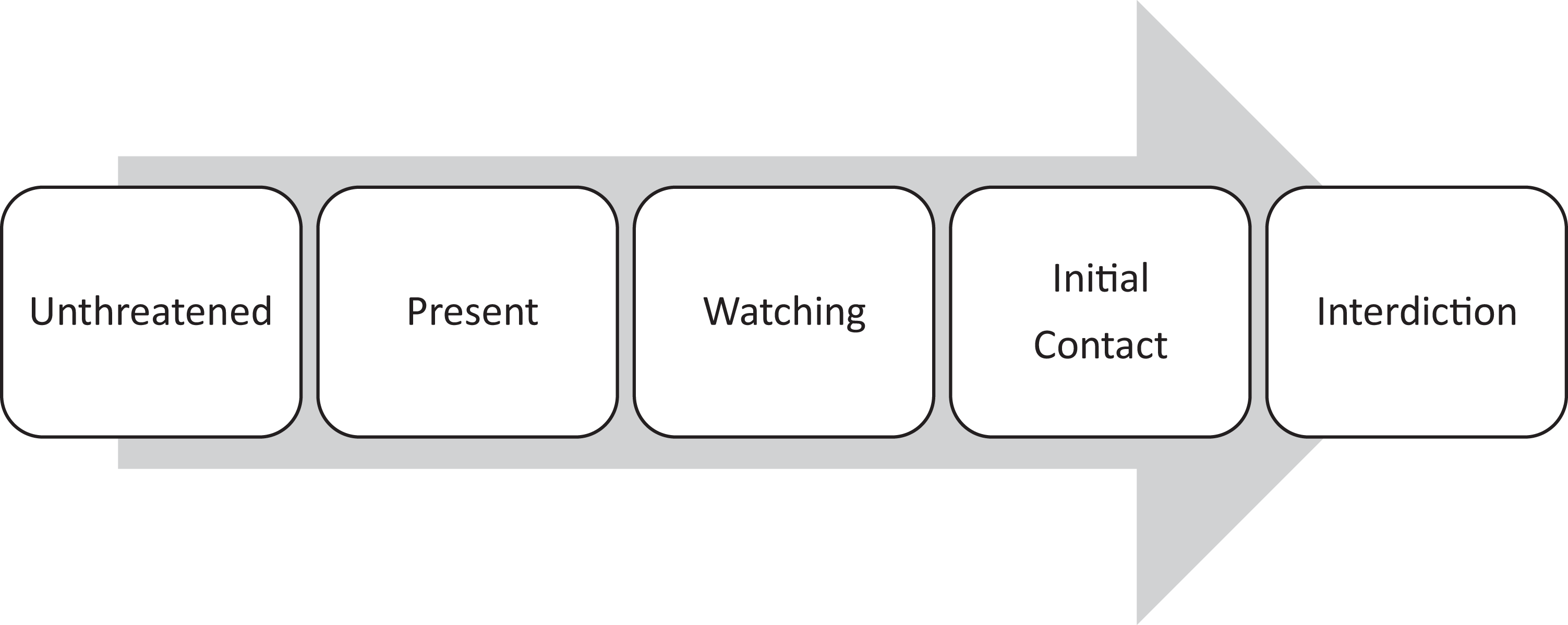
Behavioral stages associated with an encounter between a subject and an LEO.
For the purposes of this discussion, the term subject is used for simplicity and consistency. The first stage describes how the subject behaves when law enforcement is not present and subject does not feel under any direct threat. The second stage focuses on how the subject behaves when law enforcement is present, but when the subject does not believe that those law enforcement personnel are observing them in particular. The third stage involves a subject who believes they are under ‘surveillance’ by law enforcement personnel. The fourth stage involves how this subject will act when approached and during the initial stages of an interaction with law enforcement. The fifth stage refers to the interplay between law enforcement and the subject after the initial contact to the conclusion of the interaction. Note that an encounter between law enforcement and a person carrying a weapon is not necessarily linear; it may not simply progress from unthreatened unobserved, to present, watching, and then contact, but may jump from one stage to another, in no particular order.
In the next two sections, we will describe the different indicators associated with gun carrying. These behaviors need to be assessed within the context of the stages of interaction with a subject of interest and are likely to have different urgency and potential meaning based on the stage of interaction. For example, certain behaviors, such as those indicating a person is about to attack, are primarily of relevance during an approach or interdiction than while the subject is unknowingly under surveillance by law enforcement.
Behavioral indicators associated with the physical mass of a firearm
Based on physical and behavioral constraints, persons carrying handguns are expected to exhibit a number of behavioral cues associated with the physical mass of the object. There are a wide variety of handguns, made of a wide variety of materials, and this variation is likely to have a subtle influence on some behaviors (especially those related to physical mass). Regretfully, it is beyond the scope of this article to account for all variation possible in the shape and size of firearms, and practitioners should use discretion in applying these findings to their particular targets of interest.
Note that the terms and descriptions provided in this document are not necessarily new or created for the purposes of this article. Instead, many are enshrined in police practice. The purpose of this article is to identify and describe police practice based on our interview and focus group sessions, and therefore our use of these terms should not necessarily be considered as an original contribution of the authors.
Results below refer to handguns in general. These indicators are listed in Table 1 and then described in greater detail.
A list of behavioral indicators related to physical mass of a gun.

Security feel
The security feel is associated with people carrying items they believe have value and are concerned about losing. A subject may repeatedly touch the item of value (for example, a firearm) to confirm they still retain possession. It can involve touching the gun with the hand, or with the elbow or another part of the body, depending upon where the gun is located. It can also involve the subject tapping the area lightly with their fingers or the palm of the hand gently touching or patting the concealed weapon. Another purpose of the security feel is to make sure that the firearm is concealed by clothing, or in some other manner, when standing or walking. The security feel may not only be exhibited by persons carrying firearms. It may be displayed by someone carrying other high value items hidden on their person, such as money, jewelry, cameras, illegal drugs, or edged weapons (i.e., knives, straight razors, box cutters). This behavior is not limited to a particular location on a person’s body but depends upon where the item of value is hidden.
Shortened or disrupted stride
When a gun is tucked into a pants pocket or the front waistband, it may hinder leg movements on that side of the body or cause the subject to have a shorter stride on one side. Instead of having a shortened stride, a person carrying a concealed gun may have a disrupted stride, meaning that their gait may appear unnatural in some recognizable way. This disruption may not only involve forward movement, but may also a side to side motion which could be described as a ‘waddle’. The disrupted stride may also be visible as a brief interruption or change in the rhythm of a subject’s stride over a longer distance. This behavior may be caused by the individual attempting to either conceal the weapon, limit its movement so as not to drop it, or readjust the position of the firearm on their body.
Shortened arm swing
When a person is walking, their left and right arms generally swing in a consistent and symmetrical manner. When a subject is carrying a gun in or out of a holster at the waist, they may hold their arm or elbow against the weapon to control it and to keep it from falling out of the waistband. This behavior has been described as a ‘dormant’ or ‘dead’ arm (Porter, 2010). This shortened arm swing is likely to be more visible when a person is running. Observers may also see a person holding one hand directly over the firearm, in a pocket, or holding it tightly against the body when running. 2
Adjusting pants/belt
Most legal and illegal firearms are carried on the waistline, with legally carried firearms in a holster and illegal ones tucked into the belt (Pinizzotto et al., 2006; Porter, 2010). When a person sits, stands up, or gets out of a car, and has a gun on their belt, they may ‘adjust’ the belt and the gun on it to account for any shift. This adjustment takes the form of a person sliding the hands from the lower hip to the belt and pulling up the belt (much like an exaggerated ‘hitching’ of a person’s belt). This behavior is especially visible when a person is moving from a sitting to a standing position, when the subject may hold the weapon against their body as they stand up. Subjects who are carrying a gun tucked into the belt may also tighten the belt over a concern about losing the weapon.
Repositioning of gun
Because guns have considerable weight, they tend to shift during movement. Shifting of the firearm may also make it more difficult to quickly draw the handgun, a subject may reposition the gun to ensure access. Repositioning can involve performing a circular or lifting movement with the hand, palm of the hand, or forearm outside of the clothing to adjust the gun’s position. However, there is no single explanation of how each gun will position itself when carried loosely. Shifting may occur depending on how a handgun is balanced and the construction materials of the weapon. Repositioning may involve a number of other related behaviors: for example, if an individual is carrying a firearm loosely in the pocket, a person may reach directly into the pocket to reposition the firearm. If a firearm is carried at the waist in a holster or tucked into a belt unholstered, a subject t may also push up on the muzzle of the firearm with one or two fingers.
Clothing fiber stress
If a gun is concealed inside a coat pocket, particularly one constructed of thin fabric, the weight of the gun pulling down on the jacket may create a crease or fold. This visible line runs vertically from the shoulder or chest area directly to the pocket, precisely over the gun. If there is nothing weighting down the other side of the jacket, it becomes more distinct in comparison.
Printing
When concealing a handgun located on the hip or inside a waistband, a subject may wear their shirt over the gun but not tucked into the belt or waist of the clothing, as the untucked shirt both conceals the weapon and allows easy access to it by simply reaching under or lifting up the shirt. Depending on the size of the gun and how it is secured, it may create a ‘print’ or silhouette under the article of clothing, revealing its shape to an observer. The distinctiveness of the shape depends on how tightly the clothing covers the gun.
Picking
A subject may ‘pick’ at their clothing to ensure weapon is covered or concealed. Picking can involve pulling down on clothing at the spot where printing occurs or grabbing the shirt with two fingers and pulling it away from the weapon and the body. These actions limit printing or can ensure a weapon is covered.
Blading
Blading involves orienting the body based on the presence of a potential threat. Blading can involve two objectives: to shield or conceal the gun from visual detection and to facilitate drawing the weapon. A subject often carries a firearm in the area of the hips or pants or coat pockets and may position the weapon on the dominant side (their right side in the case of right handed individual). To conceal a weapon, a subject may turn 90 degrees away from the individual observing or approaching them, placing their body between the gun (or another object they wish to conceal) and the other person approaching. In the case of the second objective, when blading is done for the purpose of drawing and using a firearm, an individual may face their adversary and orient their stance so their dominant side is positioned about one half step back from the other side of the body. Whether blading for the purpose of concealment or preparation to draw the handgun, the dominant side may be the side furthest from a threat.
Behavioral indicators associated with situational awareness and reaction to threats
While people may carry a firearm for many different reasons, individuals carrying concealed or hidden weapons may believe their environments to be hostile. Two major perceived threats to illegal carriers are other criminals and law enforcement. Based on this belief, these carriers may exhibit an enhanced situational awareness, and associated cues, compared to the law-abiding public (Blechko et al., 2009; Canter and Ioannou, 2004).
Situational awareness is characterized as the perception of the elements in an environment within a volume of time and space and the comprehension of their meaning (Asken et al., 2010). In this article, the concept of situational awareness refers specifically to the extent to which an individual is aware of, evaluates, and reacts to his or her environment. The most distinguishing aspect of situational awareness is the individual’s observable act of attentiveness and focus on other people in the environment. This awareness may involve, for example, the continuous movement of a person’s eyes and head as they are scanning for a perceived threat or assessing the potential threat from another individual. The head of a situationally-aware person may appear to be on a swivel, with the subject looking from side to side and even over the shoulder. Although these characteristics range from subtle to obsessive, any carrier is likely to show signs of anxiety, suspicion, and caution about others (Blechko et al., 2009; Montepare et al., 1999). The combination of a person’s understanding of their environment, their reaction to potential threats, and their level of confidence in protecting themselves may result in a number of behavioral indicators that may be relevant to identifying persons carrying concealed, unholstered, and potentially illegal handguns (Table 2).
A list of behavioral indicators related to situational awareness and reaction to threats.

Scanning
Scanning involves a subject constantly looking around and making visual contact with every individual approaching or inside their immediate area. This appears as an individual visually searching the environment for any sign of danger, or in a state of hypervigilance.
Threat analysis
Threat analysis involves evaluating an adversary’s threat potential through direct focus and study of the individual. It is often preceded by scanning. This may include staring at a person walking through a crowd and looking at each person close to them in a prolonged manner. It involves not only an assessment of the individual, but also an assessment of the environment for avenues of escape or a position of advantage. A person analyzing a threat is deliberate and calculating in their attention to detail and may be developing a contingency plan if a threat occurs.
Adrenaline shake
The adrenaline shake is a physiological reaction of the body in response to stress and the associated increased heart rate and blood pressure that occurs in stressful situations. The secretion of stress hormones is part of the human ‘fight or flight’ response to fear or aggression (Jeffery, 2017). It can be a precursor to a violent act. Also, it is not necessarily motivated by fear; rather, in moments of stress, adrenaline is ‘dumped’ into the body, and the shaking is a reaction to the increased adrenaline levels, not to the threat. This shaking is not generally visible but may be apparent at short distances. It can be felt as small tremors if in contact with an individual.
Involuntary facial cues
Involuntary facial cues are a physiological reaction of the body to a stressful situation. These facial cues include sweating, a red face, bulging veins, blinking, licking of the lips, and fast eye movement. In some individuals, this might involve a distant unresponsive stare, colloquially called a ‘deer in the headlights’ look. Underlying processes in the autonomic nervous system and circulatory system (the ebb and flow of hormonal responses, for example) are associated with many of these surface-level behavioral symptoms (Haanstad, 2009). Research into the psychology of fear and stress discusses the implications these emotional reactions can have on subsequent or concurrent visible movements in the face (see Gray, 1987; De Meijer, 1989). While a detailed discussion is beyond the scope of this article, practitioners should be aware of the facial distortions and visible reactions described above, which are commonly associated with fear and stress.
Dissipatory actions
When put into a fight or flight situation, people may have a number of involuntary reactions to a rapid increase in the level of adrenaline in their body. In these situations, the body produces a variety of hormones and chemicals that are used to protect and assist the body in a traumatic and violent encounter and physical activity can help regulate and ‘burn off’ the chemicals and hormones associated with a spike in adrenalin levels (Kappel et al., 1991). These dissipatory actions involve movements of the full body or movement of a single body part. Full body movements might include pacing back and forth or rocking. A person who is rocking is usually stationary and will slowly rock back and forth or from side to side. Partial body dissipatory actions might involve repetitive behavior, such as running the hands through the hair, touching the face or facial hair, rubbing the head, itching, yawning, tapping the foot, or continuously rubbing the fingers together.
Arms in a semi-defensive position
When a subject is preparing themselves to react to a perceived threat, they may place their hands at waist level to shorten the reaction time to defend or strike; the body may also be slightly turned to allow for quicker reaction to threats. This may also be an ideal position from which to quickly draw a weapon.
Target glance
Seconds or milliseconds
Evasive maneuvers/avoidance
Evasive maneuvers and avoidance can be described as the deliberate movement of an individual away from a potential threat. This behavior is primarily defensive in nature. It is noticeable in the presence or approach of law enforcement by the immediate change in behavior to a ‘retreat mode’, with the person creating a greater distance between himself and a threat.
Adversarial distance
A person who is approached by or dealing with a perceived threat may move to a distance he feels confident in accurately shooting from or a location that may provide cover. While evasive maneuvers are defensive in nature, adversarial distance is offensive. It may involve a person who does not move from a position of advantage or cover when ordered to do so. An individual may also attempt to conceal himself or get behind cover to protect himself from gun fire.
Adjustment of clothing
Adjustment of clothing can be a deliberate action to conceal or retrieve a firearm. When a subject is threatened and reacting to a threat, they may remove or lift a layer or layers of clothing to retrieve the gun quickly or unnoticed. In this case, the goal behind this movement is to allow access to the firearm. This could include unzipping, unbuttoning, reaching under or lifting up an article of clothing with one or both hands.
Hands-in-pockets
A gun carried in a coat pocket without any form of closure on the clothing to secure it runs the risk of falling out. To compensate for this movement and limit constant repositioning, a subject may place one hand inside the pocket and on the gun over a continuous time period.
Dissociation
Dissociation involves the reaction of someone to a threat. Rather than a person attempting to physically evade a threat, he may try to become ‘invisible’ in place and may feign some kind of behavior so as not to be noticed and avoid eye contact with the threat. This behavior is similar to the way a child in school tries to avoid being called on by the teacher when they have not completed their homework or do not know the answer to a question. Dissociation could also involve a person looking at his phone, checking for something in the pockets, or any other behavior that would show he is acting normally and avoiding engagement with the threat.
Discussion
Countless officer-citizen interactions occur every day in the United States. Some citizens pose a threat while others do not. Due to the sheer number of interactions and the unknowable nature of how each will unfold, applying a systematic framework to certain aspects of visual search can help officers navigate the ambiguities of human behavior, and help them identify which individuals are more likely to be carrying a weapon and who may subsequently pose a threat to law enforcement or the public. The capacity to identify potential threats using behavioral cues will allow officers to more appropriately react to criminal activity, protect themselves, and provide a higher level of service to the public.
In addition, following many instances of interdiction, police officers may be asked to legally articulate their rationale for stopping an individual whom they believe was carrying a concealed and potentially illegal gun. The ability to articulate these behaviors in a systematic manner should provide more clarity around officer-civilian interactions that are often coated and constrained by ambiguities, cognitive recall, and rapid decision-making. From a legal standpoint, the knowledge base communicated here might also facilitate the adjudication and punishment of persons guilty of carrying illegal weapons.
Another contribution of this research is the establishment of a common lexicon for the communication of behaviors associated with potential threats. Related research found that while most police officers are able to identify the same threat-related behavior, they typically use different terms to identify and describe them (Meehan et al., 2015). By establishing a common set of terms and definitions, this work has the potential to enhance the efficiency and clarity of communication during a critical incident as well as articulation of an incident post-hoc.
It is noteworthy that law enforcement personnel also report using a variety of behavioral cues to detect crime in other situations, such as airport drug couriers (Oolman et al., 2019) and narcotics in open spaces (Meehan et al., 2018), and there are overlap in these behaviors (Meehan et al., 2015). Some of these techniques have been incorporated into online and instructor-led practitioner-based training delivered to military, law enforcement, and security trainees who provide a broad range of service ranging from gun interdiction units, to retail and church security, to peace operations (Meehan, 2018), and such trainings provide a basis for future validation and testing.
Limitations and future directions
The indicators presented here have not been subject to predictive validation. This research could be used as the basis for hypothesis testing in controlled lab conditions, identification of specific clusters of behavior that have higher reliability and validity, and determination of the extent these behaviors are exhibited based on the physical attributes of the carrier (e.g. weight, height, gender). Subsequently or concurrently with lab studies, a field-based validation would be necessary to determine the extent to which persons carrying concealed and potentially illegal firearms exhibit these kinds of behaviors in the real-world, how frequently these specific cues occur in comparison to when a firearm is not carried, and the assessment of extent to which it is possible for trained law enforcement to identify them.
The current study is also limited by a small sample size and by the descriptive nature of the data collected. While interviews and focus groups provide one useful path toward formulating an understanding of complex, new topics (Krueger and Casey, 2009), it is important not to interpret these findings beyond a descriptive account of SME’s reporting of their past experience. Our SMEs have spent the majority of their work experience in the US; outside of the United States, gun ownership and access to firearms varies considerably (Karp, 2018). More research is needed in order to corroborate these findings in different settings, establish the reliability of these findings, and relate their applicability to similar crime detection efforts. These findings are not generalizable to all gun-carrying scenarios, and that we have focused here carrying of a concealed or unholstered handgun.
There also exists an issue of false positives and false negatives; an observer may assess someone is carrying a firearm and be incorrect (a false positive or type I error) or assess someone is not carrying a firearm when they are in possession of one (a false negative or type II error). Independent of additional research, this is a legitimate concern and can be addressed through two mechanisms. First, assessments of behavior need to focus on clusters of multiple indicators (e.g. someone is displaying disrupted stride, is scanning, repeatedly touching a location a firearm is typically carried, and there is visual evidence of printing and clothing fiber stress). Second, an assessment that a firearm is being carried is a starting point for further observation or interdiction. Further observation might allow for identification of additional behavioral indicators, dismissal of an individual, or visual identification of the firearm.
In addition, it is important to note the emphasis of this research effort is on behavior and not appearance of individuals. We are concerned with the actions taken and decisions made by an individual, not by the way an individual looks (i.e., not the color of one’s skin, or the facial hair one chooses to wear). The frequency and intensity of behaviors must also be factored into any assessment. As mentioned previously, no single behavior or indicator can be taken as a sure sign of criminal activity, and law enforcement must use their best discretion when making decisions before and during an interdiction.
Conclusion
The purpose of this article is to identify and describe behavioral indicators of concealed, unholstered, and potentially illegal gun carrying, with the future goal of both validating and evaluating the utility of these indicators for law enforcement. A focus on behavior also protects the civil rights and liberties of the common citizen by directing the attention of law enforcement to those persons showing evidence of suspicious or criminal activity.
Some behaviors identified in this article may also be applicable to other types of behaviors in other types of environments (for example, terrorist activity, or gun carrying in controlled locations, such as airports). Adding to the body of work on this growing topic, we present an approach that moves away from trait-based strategies and instead moves toward the use of behavior-based, environmentally-embedded indicators that are detectable through trained visual search.
The ability to identify behavioral indicators associated with persons carrying concealed and unholstered handguns is an important tool for law enforcement, security, and those who work in similar roles. Its relevance spans both officer safety and crime reduction. A firearm is an object with the capability of offensive harm to both police and the public, and identifying persons carrying concealed handguns, legally or illegally, is important to ensuring public and officer safety.
Footnotes
Acknowledgements
In this document, describe behavioral indicators research conducted at the NRL and formally published under government Memorandum NRL/MR/5508–15-9597. This research was funded by the Rapid Reaction Technology Office (RRTO), of the Office of the Assistant Secretary of Defense contract awarded to Nathan Meehan and the Naval Research Laboratory (NRL). Statements of fact, opinion, and analysis in the paper are those of the authors and do not reflect the official policy or position of the RRTO or the United States Government.
Declaration of conflicting interests
The author(s) declared the following potential conflicts of interest with respect to the research, authorship, and/or publication: Research findings associated with this article are incorporated into training provided by Second Sight Training Systems.
Funding
The author(s) received no financial support for the research, authorship, and/or publication of this article.
