




Abstract
To date, no research has attempted to evaluate human rights in the Pacific region in comparative perspective. Employing commonly used cross-national measures of basic human rights, the author examines how well regimes in the region respect political and civil rights as well as the right to physical integrity. The results reveal that, as regards political and civil rights, the region appears to resemble parts of the developing world more than the developed world. In contrast, the region performs relatively well with regard to available measures of personal integrity rights. Moreover, the results reveal that levels of respect for certain key individual human rights in different states across the region are far from uniform. The author subsequently poses questions for future research based on these findings.
Introduction
Many people view the South Pacific as a relatively placid oasis of harmony. Marketing campaigns designed to bring tourists to the area often present the region in this positive light. For example: Set in the tropical South Pacific, Fiji is surely the essence of a tropical island paradise. . . . And then there’s our most precious asset – smiling, generous, relaxed Fijians who greet you and everyone they meet with our famous and welcoming ‘Bula’.
1
While the politics in the region may never have been as consensual as Ratu Mara argues, it has certainly become much more difficult for ‘the Pacific’ to live up to its name in recent years. In 1987, Fiji experienced two attempted military-led coups d’etat, and suffered through two more in 2000 and 2006, leading to a situation where ‘violence of the right to freedom of expression, association and assembly’ has intensified. 3 Other signs of difficulty exist in the region as well. In Tonga, despite a move toward democracy since 2008, only 17 of the 38 representatives in the parliament are elected by popular vote. The rest are appointed by the king or chosen from among a small group of nobles. 4 The transition to democracy in the kingdom is far from complete. 5 The 2010 Amnesty International report describes an increase in sorcery-related killings and violence against women and girls in Papua New Guinea that has not been effectively addressed by the government. 6 This is in addition to the open conflict that has occurred in recent years in the Solomon Islands.
How can we assess the overall human rights situation in the South Pacific? One way to approach this question is by using a comparative approach. This allows us to ask a number of questions about the relative human rights performance of regimes in the region: Are governments in the South Pacific more likely to respect the rights of their citizens than governments in Africa, Asia, Latin America, or the Middle East? How do levels of respect for human rights in the region compare to those in the developed world? And how do nations in the region compare to each other on different aspects of human rights performance?
This article investigates the degree to which certain key individual rights are respected in the region, and how well the South Pacific compares to other parts of the world. As more and more regular reports on human rights practices become available from such sources as Amnesty International and Human Rights Watch, the quality of information on the conditions of individuals across the planet is continuously improving.
The justification for using a comparative approach is that it is often very difficult to assess the situation in a given country without using some sort of measuring stick. To this end I employ measures of physical integrity, civil and political rights that have been widely used in social science over the last two decades. 7
The rest of this article proceeds as follows. First, I present a brief argument for why the South Pacific should be treated as a region for human rights purposes. Second, I discuss the concept of basic human rights and how they can be measured and compared cross-nationally. Third, I compare how well regimes in the region respect the physical integrity, civil and political rights of their citizens, and how well the region compares to other parts of the world. I conclude with a brief discussion of the findings, offering suggestions for future human rights research efforts in the region.
The challenge of studying the Pacific from a regional perspective
Before turning to how regimes in the South Pacific respect the basic human rights of their citizens, it is necessary to discuss whether it is appropriate to study the region as such for human rights purposes. The countries and territories that constitute the Pacific Islands Forum are a good basis for a human rights community. 8 In the past five years, members of the Forum have begun (although in a somewhat hesitant fashion) to cooperate on human rights issues as part of the Pacific Plan. 9
While they are also members of the Pacific Islands Forum, I do not include Australia and New Zealand in my analyses because they are considered to be developed countries. While they do contain significant indigenous and Pacific Islander populations, their overall patterns of economic and social development are clearly similar to those of other wealthy, industrialized nation-states such as Canada, the United States, Japan and the countries of Western Europe.
Despite the high degree of cultural diversity and rather high degree of geographic dispersion, the Pacific Island Countries (PICs) should be regarded as a distinct region in many respects. First, they share a geographic proximity to one another, at least in a relative sense. In addition, they are small (aside from Papua New Guinea) island states that are generally rather isolated. Moreover, the peoples of the three primary sub-regions, Polynesia, Melanesia and Micronesia, have a long history of interaction and share many cultural similarities. Finally, countries in the region share a history of colonialism and a relatively recent history of decolonization (aside from Tonga, which is a British protectorate but was never colonized). 10
In this article, I examine how well three different areas of basic human rights are respected in the PICs. First I discuss respect for physical integrity rights (often called personal integrity or security rights), which assert the right of the individual against repressive activities of the state such as state-sponsored torture, disappearances and mass killings. The second set of rights are civil liberties, which include the right to due process and a fair trial, freedom of expression, associational rights and the right to privacy. Finally, I examine political rights, which relate to the state’s respect for individual rights in a number of areas of political participation such as voting, running for office and electing those who represent one’s interests.
While my analysis focuses on three categories of individual rights (physical integrity, civil and political rights) this by no means suggests that these rights are the only ones that deserve the attention of human rights researchers. Rather, individual rights are the focus of this article because data are most readily available on this type of rights. I choose to focus on them because they are available for many countries across the world. Over time, data on a greater range of basic human rights (such as cultural and linguistic rights or work and subsistence rights) will progressively become more available. Unfortunately, it seems as true today as it was when McCormick and Mitchell first said it almost 15 years ago that ‘human rights research has been driven by as much by policy priorities and data availability as by theory’. 11
In the next section, I discuss how civil, political and personal integrity rights are measured for the purpose of my analysis of the PICs.
Measuring human rights
For more than two decades, human rights researchers have attempted to collect and analyse data regarding the performance of individual regimes. Several recent works have used these data to analyse how respect for physical integrity rights varies across regions and individual countries. 12 However, no such study has yet focused on the South Pacific separately. Again, this is largely due to the small population of the region and the fact that relatively few data have historically been available regarding human rights practices in the region.
Data are not uniformly available for the region, either. In particular, data are much more available for larger countries in the region. Very little quantitative data exist for non-independent territories. However, while taking note of the data limitations is important, the insights one can gain from a comparative study of the region outweigh the costs. As more data become available for more measures across a greater number of countries, the human rights picture in the region will become progressively clearer. This article represents one step in that direction.
In this comparative study of PICs, I examine respect for three types of rights –physical integrity rights, civil liberties and political rights. I now turn to how each of the three is defined and operationalized.
Physical integrity rights
The first basic human right I compare is the right to physical integrity. According to Poe and Tate, state terror involves ‘coercive activities on the part of the government designed to induce compliance in others. Examples of such activities include murder, torture, forced disappearance, and imprisonment of persons for their political views.’ 13 In other words, the level of respect for physical integrity rights is the degree to which a society is free from state terror.
The Political Terror Scale
Physical integrity rights can be measured using the Political Terror Scale, a five-point ordinal measure that is assembled annually by Mark Gibney and other researchers who assign scores based on the wording in Amnesty International country reports. 14 States are graded on a five-point scale depending upon how well they respect physical integrity rights for a given year.
The five scores a country can receive are listed below: Level 1: Countries . . . under a secure rule of law, people are not imprisoned for their views, and torture is rare or exceptional. . . . Political murders are extraordinarily rare. Level 2: There is a limited amount of imprisonment for nonviolent political activity. However, few are affected, torture and beatings are exceptional. . . . Political murder is rare. Level 3: There is extensive political imprisonment, or a recent history of such imprisonment. Execution or other political murders and brutality may be common. Unlimited detention, with or without trial, for political views is accepted. Level 4: The practices of level 3 are expanded to larger numbers. Murders, disappearances, and tortures are common parts of life. . . . In spite of its generality, on this level violence affects primarily those who interest themselves in politics or ideas. Level 5: The violence of level 4 has been extended to the whole population. . . . The Leaders of these societies place no limits on the means or thoroughness with which they pursue personal or ideological goals.
15
The CIRI Physical Integrity score
The Cingranelli and Richards (CIRI) data set includes a series of measures of human rights. CIRI’s Physical Integrity score is an additive index of four separate indicators: torture, extrajudicial killings, political imprisonment and disappearances. Countries can receive a score of ‘0’ (practised frequently), ‘1’ (practised occasionally), or ‘2’ (not practised) depending on the degree to which government officials (or private individuals at the instigation of government officials) engaged in each of these four negative human rights practices. Thus, scores on this additive index can range from a low of 0 (no government respect for any of these four rights) to 8 (full government respect for these four rights). 16
Civil liberties
I use only one measure for civil liberties. Freedom House is an NGO that provides ‘action, analysis, and advocacy for democracy’ around the world. 17 The organization evaluates countries on two categories of regime performance: civil liberties and political rights. 18 I discuss the construction of the civil liberties measure here, and the construction of the political rights indicator below.
The Freedom House Civil Liberties score indicates how well a regime performs with regard to four aspects of civil liberties: freedom of expression and belief, associational and organizational rights, rule of law and personal autonomy. The sum of a country’s score on each of these four performance categories is translated (some questions are weighted more heavily than others) into a score on a 1–7 scale, 1 being the worst and 7 the best. 19
Political rights
Freedom House
The final category is political rights. As is the case with civil liberties, Freedom House publishes a seven-point measure of regime respect for individual political rights. The score is calculated according to how well each country performs on three different aspects of political rights: the openness of the electoral process (including free and fair elections), political pluralism and participation (including the existence of competitive parties and other political groupings including minority groups to participate in the political process) and the functioning of government (i.e. the presence of an authoritative, functioning central government). As is the case with civil liberties, Freedom House has created a scale where 7 denotes the best score a country can receive for its political rights in a given year while a 1 is the worst score. 20
CIRI Political Empowerment Index
The CIRI Political Empowerment Index is an amalgam of seven indicators of respect for some aspect of political rights: foreign movement, domestic movement, freedom of speech, freedom of assembly and association, electoral self-determination and freedom of religion. For each of the seven indicators, a country can receive a score of ‘0’ (the right is severely restricted), ‘1’ (the right is somewhat restricted), or ‘2’ (the right is unrestricted). The index is additive, so a country can receive a score of anywhere between 0 (all rights are restricted) and 14 (all rights are unrestricted). 21
How well do countries in the Pacific region actually respect the types of basic human rights outlined above? The next section offers both inter- and intra-regional comparisons of regime performance on these measures.
Analysis
I now proceed to a comparative analysis of physical integrity rights, civil liberties and political rights in the PICs. It is important to note here that not only can countries and regions be compared to one another, but it is possible to examine how the level of respect for human rights in a particular country or region has changed over time.
Physical integrity rights
The South Pacific compared to other regions
In terms of physical integrity rights, regimes in the South Pacific perform relatively well in comparison with other regions of the developing world. From the years 2003 to 2009 (the only years for which data on this measure are available), the average CIRI Physical Integrity Rights score in the region was about 7 on an eight-point scale (see Figure 1).
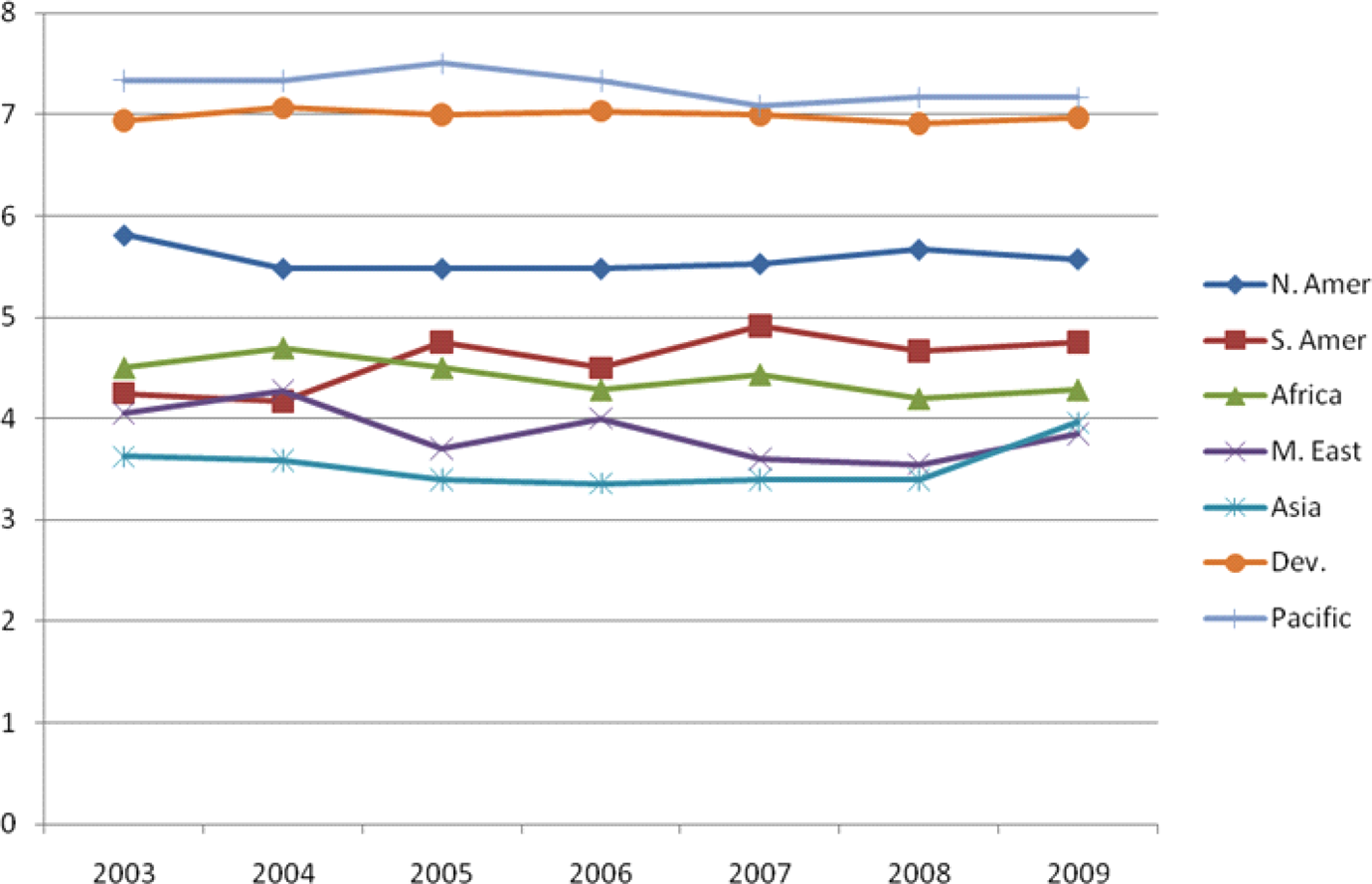
Global physical integrity rights (CIRI), 2003–2009.
Moreover, the South Pacific has not only performed far better than other parts of the developing world on average on this measure, but it appears to mirror the developed world rather closely. Thus, based on this measure alone, one might infer that with regard to practices such as torture, political imprisonment, etc., regimes in the region perform relatively well.
We see similar results when observing the region’s performance over the past two decades on the Political Terror Scale (see Figure 2).
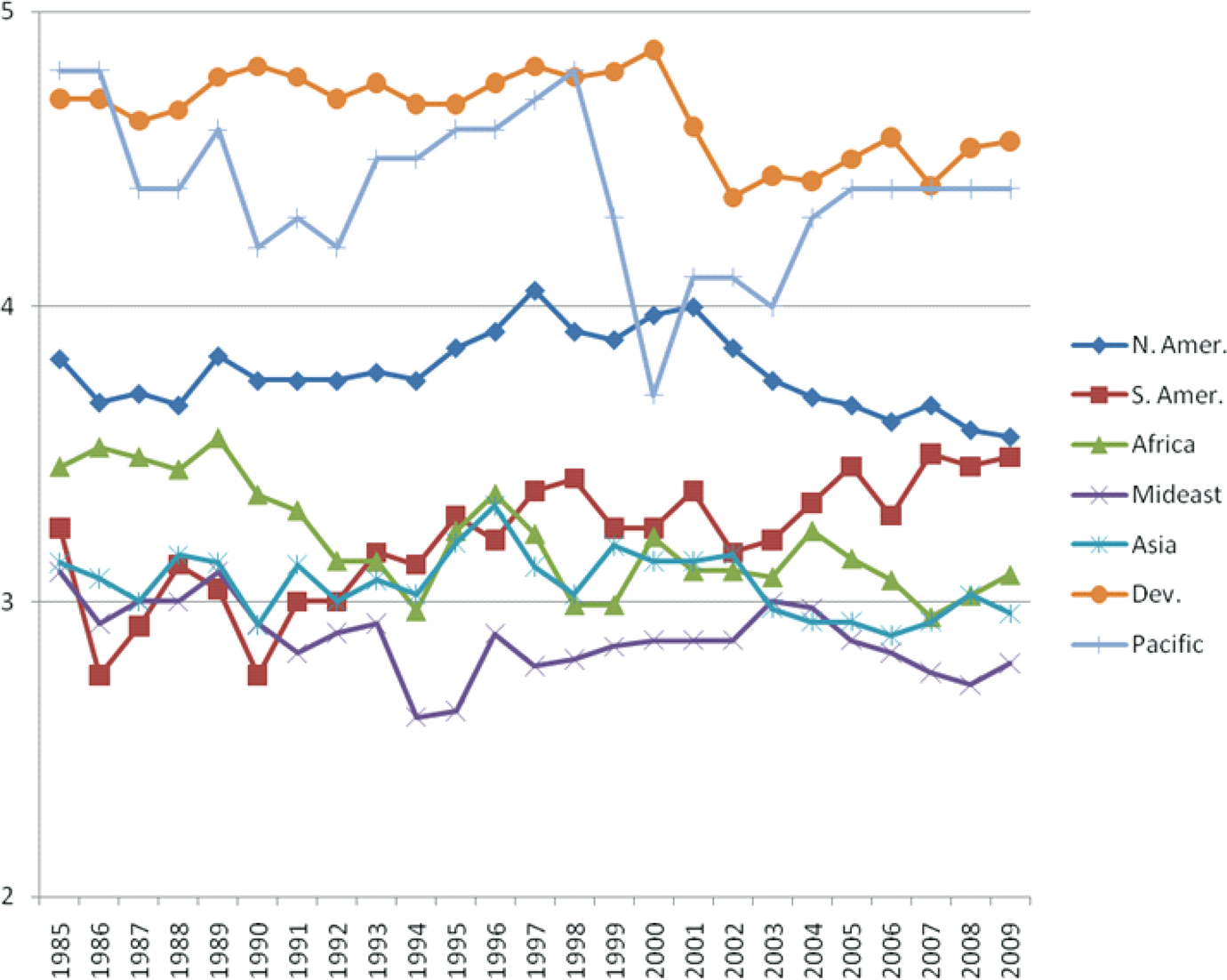
Global physical integrity rights (Political Terror Scale), 1985–2009.
In short, the average performance of the five countries for which Political Terror Scale scores exist during the 1985–2009 time period was only surpassed by the OECD group of countries, and was far better than the developing world average. The average Political Terror Scale score for the South Pacific hovered around 4.5 on a five-point scale during most years, although this figure dropped slightly from 1999 to 2003. The next-best performing developing regions in terms of physical integrity rights are North and South America, which in recent years have averaged between 3.5 and 4.0 on a five-point scale. The rest of the regions perform much worse on this measure, with both the Middle East and Africa averaging under 3.0 in the past few years on the Political Terror Scale –suggesting that arbitrary detention, political imprisonment and even political murder are the norm for many countries in these regions. Scores are only available for five countries in the region (Fiji, PNG, the Solomon Islands, Vanuatu and Samoa). 22
While the countries studied generally performed well on this measure (only Papua New Guinea has a consistently poor performance, as we will see below), it must be noted that data are only available for a relatively small number of countries due to the fact that Amnesty International does not report on many smaller countries. This brings up the question of whether these five countries’ personal integrity rights performance is representative of the region as a whole. A scan of the most recent United Nations Working Group Reports as part of the Universal Period Reviews for three smaller countries – Kiribati, Nauru and Palau – reveals no mention of torture, political imprisonment, political murder, or any similar behaviour on the part of any of these countries. 23 Respect for personal integrity rights thus appears to be well-respected in the Pacific, in small states as well as in larger ones.
Intra-regional comparison
While the PICs have generally performed better than their developing counterparts, this does not mean that all is well in the region as regards physical integrity rights (see Table 1). While 10 of the 12 PICs covered by the eight-point CIRI Physical Integrity measure averaged 7 or above, Papua New Guinea attained a score of only 5 for every year of the study. And Fiji’s score has dropped in the wake of the 2006 coup.
Physical integrity rights in PICs (CIRI), 2003–2009

Turning to the Political Terror Scale, Papua New Guinea again is the worst performer with regard to respect for physical integrity rights (see Table 2). Its score has ranged from 3 to 4 on the five-point scale in recent years, suggesting its performance on this measure has been far from ideal. For instance, Lawrence states that during 2003 ‘police committed arbitrary or unlawful killings, used excessive force when arresting and interrogating suspects, and engaged in excessively punitive and violent raids’. 24 In January 2011, the United Nations Office of the High Commissioner for Human Rights noted that ‘reports of police abuses, including of children, poor prison conditions and lengthy pre-trial detention’ exist in the country. 25
Physical integrity rights in PICs (Political Terror Scale), 1980–2009
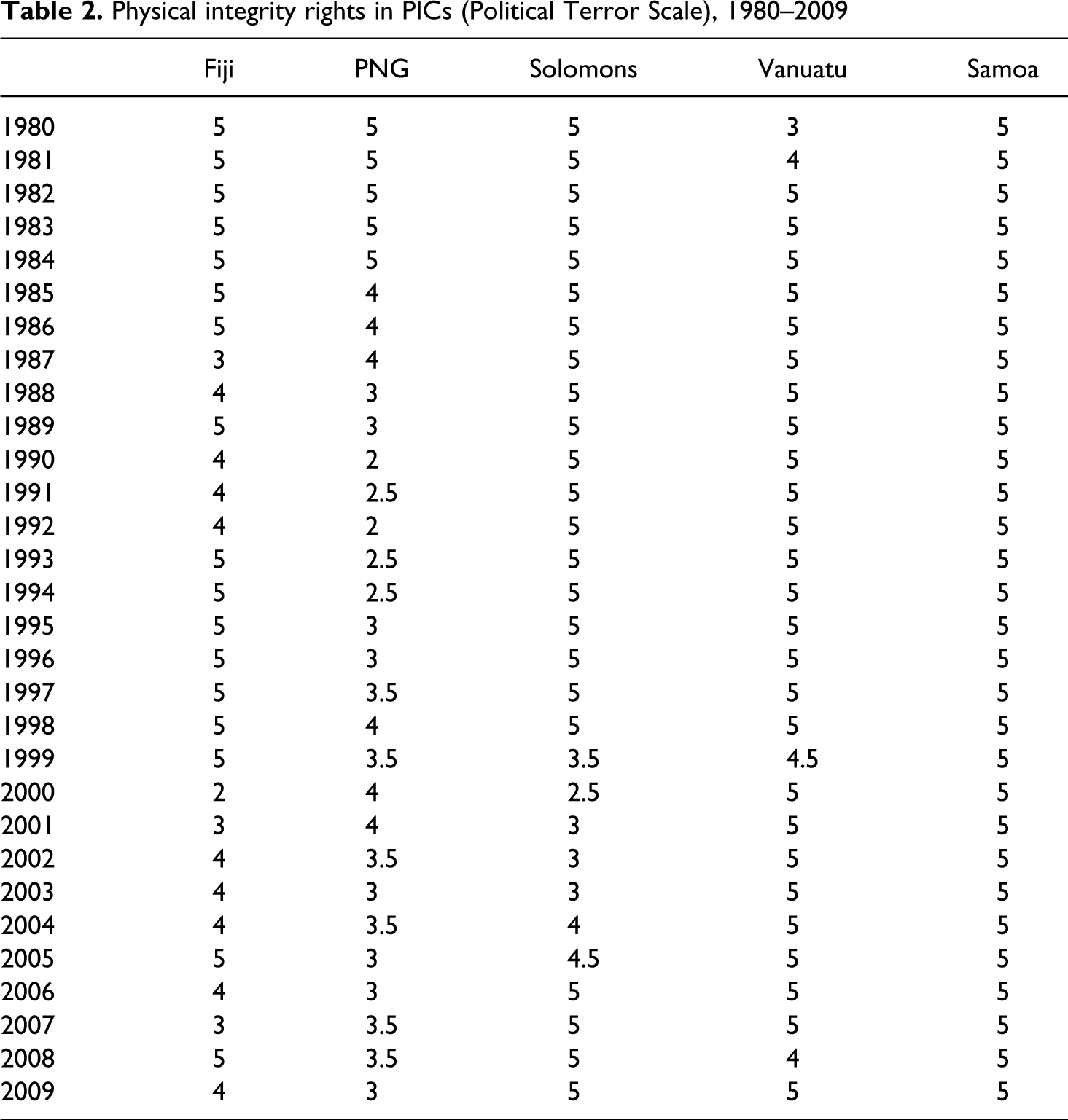
The Political Terror Scale also indicates that Fiji has experienced a moderate degree of physical integrity rights violations in recent years. Amnesty International reports that Fijian police repeatedly beat a recaptured prisoner who subsequently died due to injuries sustained in the attack, and that the Bainimarama regime subjugated several members of the media to threats and intimidation. 26 Physical integrity rights also dropped sharply during the inter-communal violence in the Solomon Islands a decade ago, but they have rebounded since the 2003 RAMSI intervention.
At the other extreme is Samoa, which received a ‘perfect’ score of 1 for each year observed. Vanuatu also has performed well during most of the period under study.
It is interesting to note that while physical integrity rights are well respected in many PIC countries, Melanesian states continue to experience relatively serious problems with regard to respect for the right to physical integrity. Nevertheless, much of the region appears to be better off than the rest of the developing world in terms of physical integrity rights.
Civil liberties
The South Pacific compared to other regions
It appears that in terms of civil liberties, the PICs perform on a par with the Americas, and far better than Africa, Asia and the Middle East (see Figure 3). Throughout most of the past 30 years, the Freedom House Civil Liberties scores for the PICs have averaged at or slightly above the 5.5 range. Since 5.0 is the cutoff for the designation of ‘free’, the region is performing reasonably well, although its average score is still more than a point lower than that of the OECD countries. It is interesting to note the very wide gap between civil liberties in the top tier of developing regions (the PICs, North and South America) and conditions in the other three regions. The current gap between these regions and the Middle East, for instance, has been around 2.5 points on an eight-point scale.
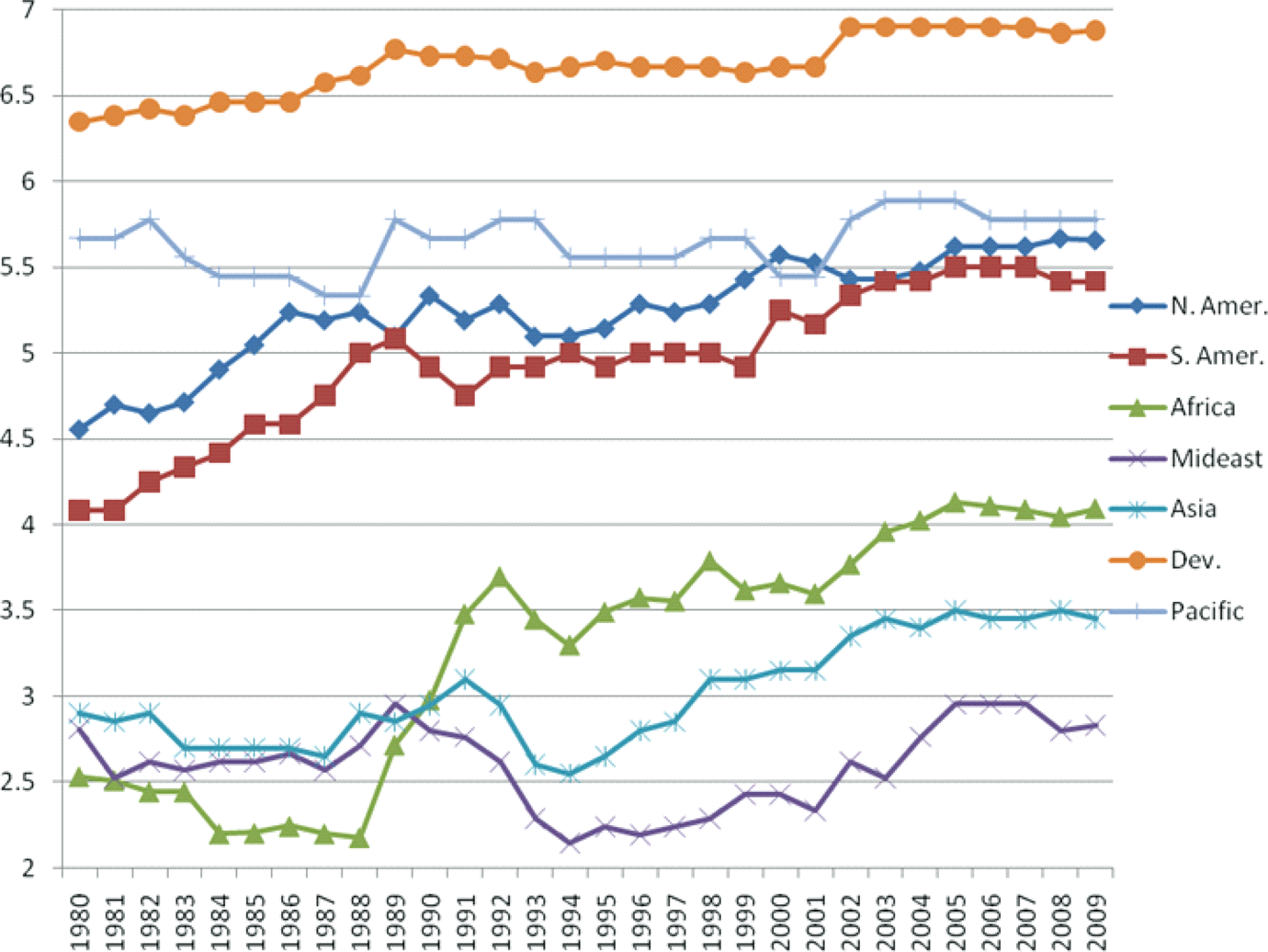
Global civil liberties (Freedom House), 1980–2009.
However, it must be noted that the Pacific has not shown much improvement on this measure since 1980. By contrast, every other region of the world aside from the Middle East has shown significant improvement over this time period. It is too early to tell whether the Americas will soon surpass the PICs on this measure or, alternatively, whether there is merely some sort of current ceiling value of around 6.0 for developing countries for this measure. Nonetheless, the fact that the PICs have levelled off on this measure definitely bears further explanation.
Intra-regional comparison
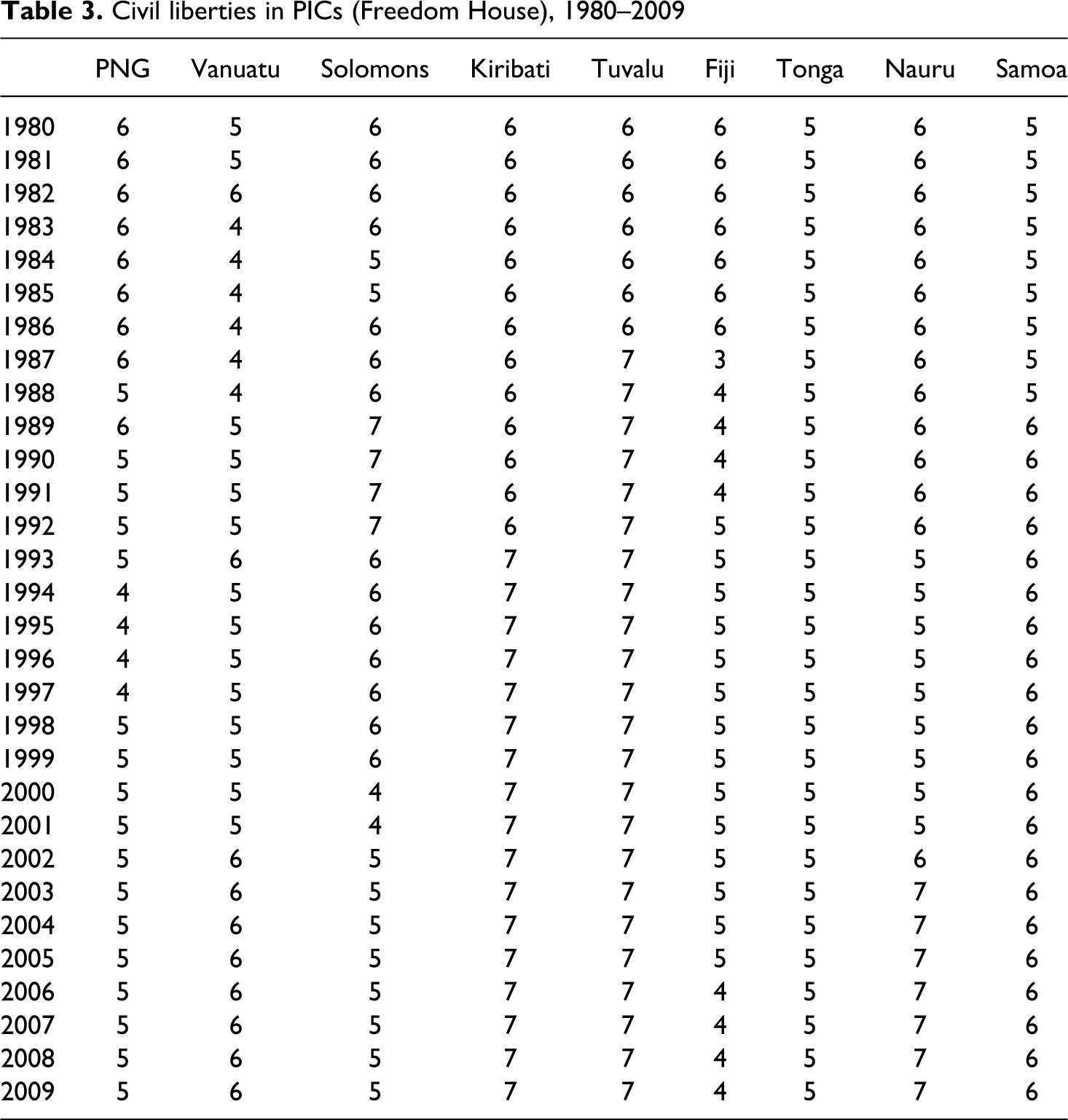
A breakdown of individual country scores on the Freedom House Civil Liberties measure shows that most countries have experienced some degree of variability on this measure (see Table 3). No country has maintained a ‘perfect’ score of 7 for the entire 30-year period, and only Kiribati and Tuvalu have maintained consistently high scores. Among the PICs, Fiji has the single worst record for civil liberties during this time period. Due to the fact that its score is below 5, it is currently the only Pacific state that Freedom House does not designate as ‘free’ in terms of civil liberties. Freedom House says of Fiji in 2009: ‘
Civil liberties in PICs (Freedom House), 1980–2009
In 2011, Freedom House comments: Freedoms of assembly and association have been restricted since the suspension of the 1997 constitution and the imposition of the PER in 2009. The interim government has used the PER to outlaw public protests and ban public demonstrations by the Methodist Church and the teachers’ union against the regime’s policies. Workers can form and join trade unions, though these rights have reportedly been constrained under Bainimarama.
28
Finally, Papua New Guinea has had problems with civil liberties as well, as a recent US State Department Human Rights Report attests: Law enforcement officials have been implicated in unlawful killings, use of excessive force in arresting and interrogating suspects, and conducting excessively punitive and violent raids.
30
Political rights
The South Pacific compared to other regions
Figure 4 reveals how each region performs on the Freedom House Political Rights measure. As is the case with civil liberties, the world seems to neatly break down into three categories. The South Pacific again finds itself in the middle category with North America (excluding the two developed countries, Canada and the USA) and South America, situated far behind the developed set of countries but well ahead of Africa, the Middle East and Asia. One disturbing trend is that while Freedom House Political Rights scores for the Americas have improved dramatically over the past three decades, the average score for the nine PIC countries is falling to the point where it is close to dropping below the threshold for ‘free’ into the ‘partly free’ category (i.e. below 5.0). On the other hand, the PICs are performing much better than Africa, Asia and the Middle East, the last of which has always had an average rating in the ‘not free’ category).
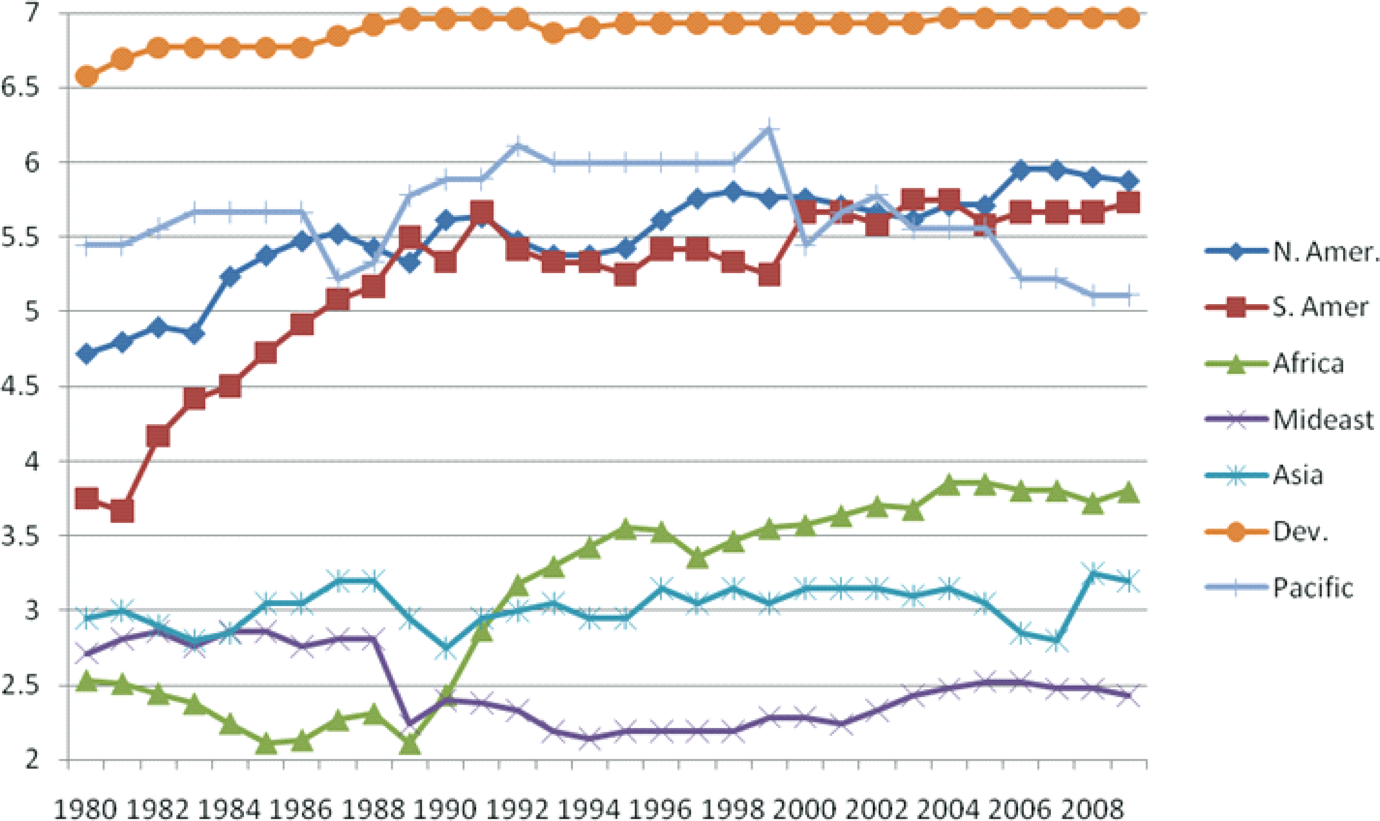
Global political rights (Freedom House), 1980–2009.
The strong performance of Latin America reflects the strong democratizing trend in that region that occurred during what political scientist Samuel Huntington calls the ‘Third Wave’ of democratization, as many authoritarian regimes were swept from power. 32 Nowhere was this phenomenon stronger than in South and Central America. While still trailing the PICs and the developing parts of the Western hemisphere, Africa also has seen a marked improvement over the past two and a half decades, enough to move the average into the ‘partly free’ category’, while Asia has improved slightly. Only the Middle East and the Pacific do not appear to have benefited from the global trend toward democratization. Why the South Pacific does not appear to have benefited from the ‘Third Wave’ according to a well-respected measure of political rights should be of interest to political scientists.
Moving to the CIRI Political Empowerment measure (for which data are available only for the 2003–2009 period), we observe a somewhat similar pattern emerge in terms of the global picture (see Figure 5). The exception is that with CIRI, the performance of the PICs and the Americas come close to matching that of the OECD countries (within about a point on a 14-point scale), whereas with the Freedom House measure the gap is rather substantial (more than a point on a seven-point scale). As is the case with the Freedom House measure, political rights in the South Pacific have declined according to the CIRI measure even as other regions (aside from the Middle East) appear to be holding steady. Thus, despite a fairly good performance in the area of political rights, the South Pacific is being outperformed by other developing regions in recent years.
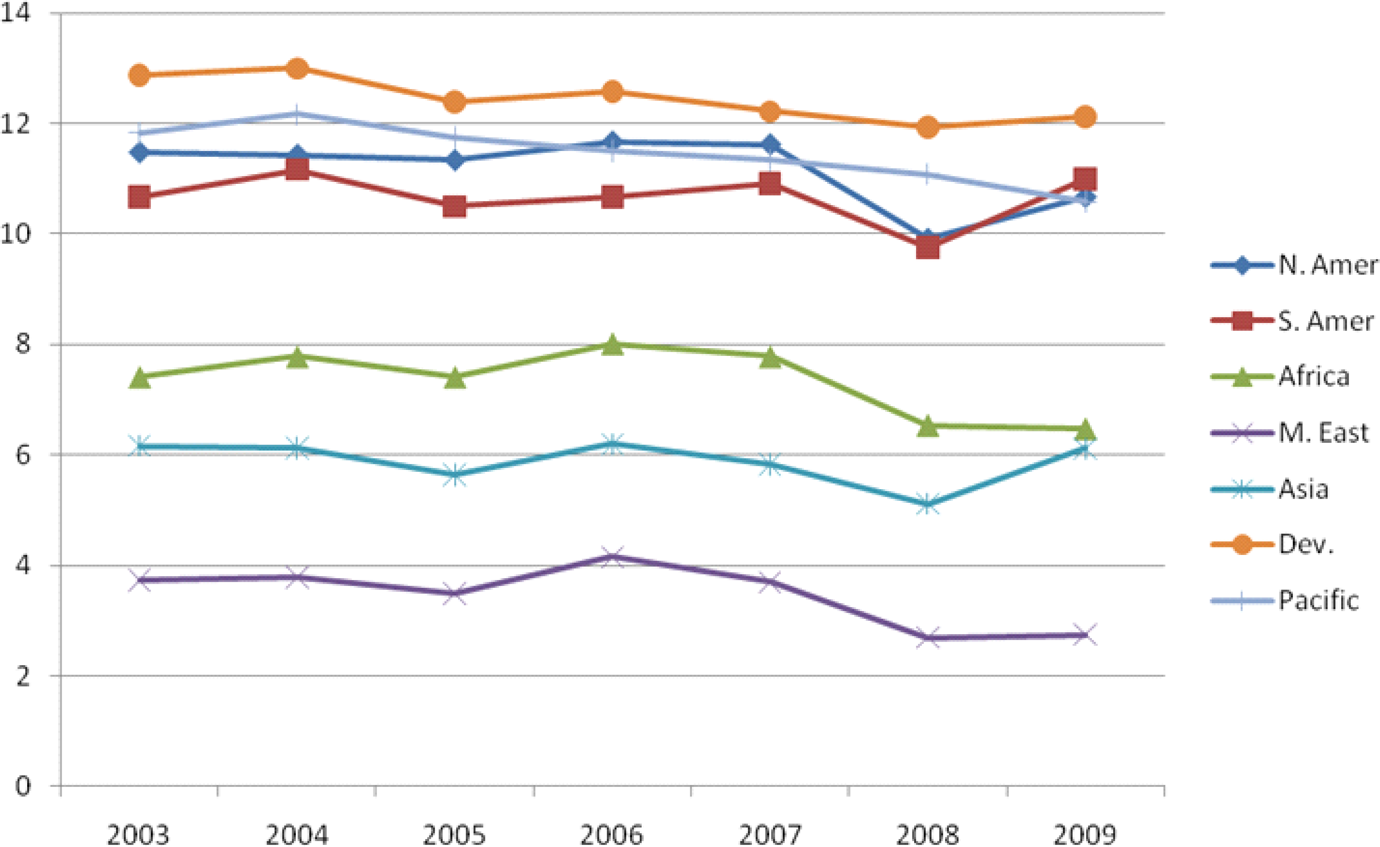
Global political empowerment (CIRI), 2003–2009.
Intra-regional comparison
Table 4 shows the performance of the nine PICs whose political performance is ranked by the Freedom House Political Rights measure. The data reveal that respect for political rights in individual countries in the South Pacific can be quite volatile over time. Fiji’s score, for instance, has varied between 2 and 6 on the seven-point scale since the first coup in 1987. During 2006–2009, Freedom House assigned Fiji with a Political Rights score of ‘2’, as it ‘is not an electoral democracy’. Commodore Bainimarama has repeatedly pledged to hold elections in 2014, although New Zealand and Australia in particular have put a good deal of diplomatic pressure on Fiji to force elections earlier. 33
Political rights scores in PICs (Freedom House), 1980–2009
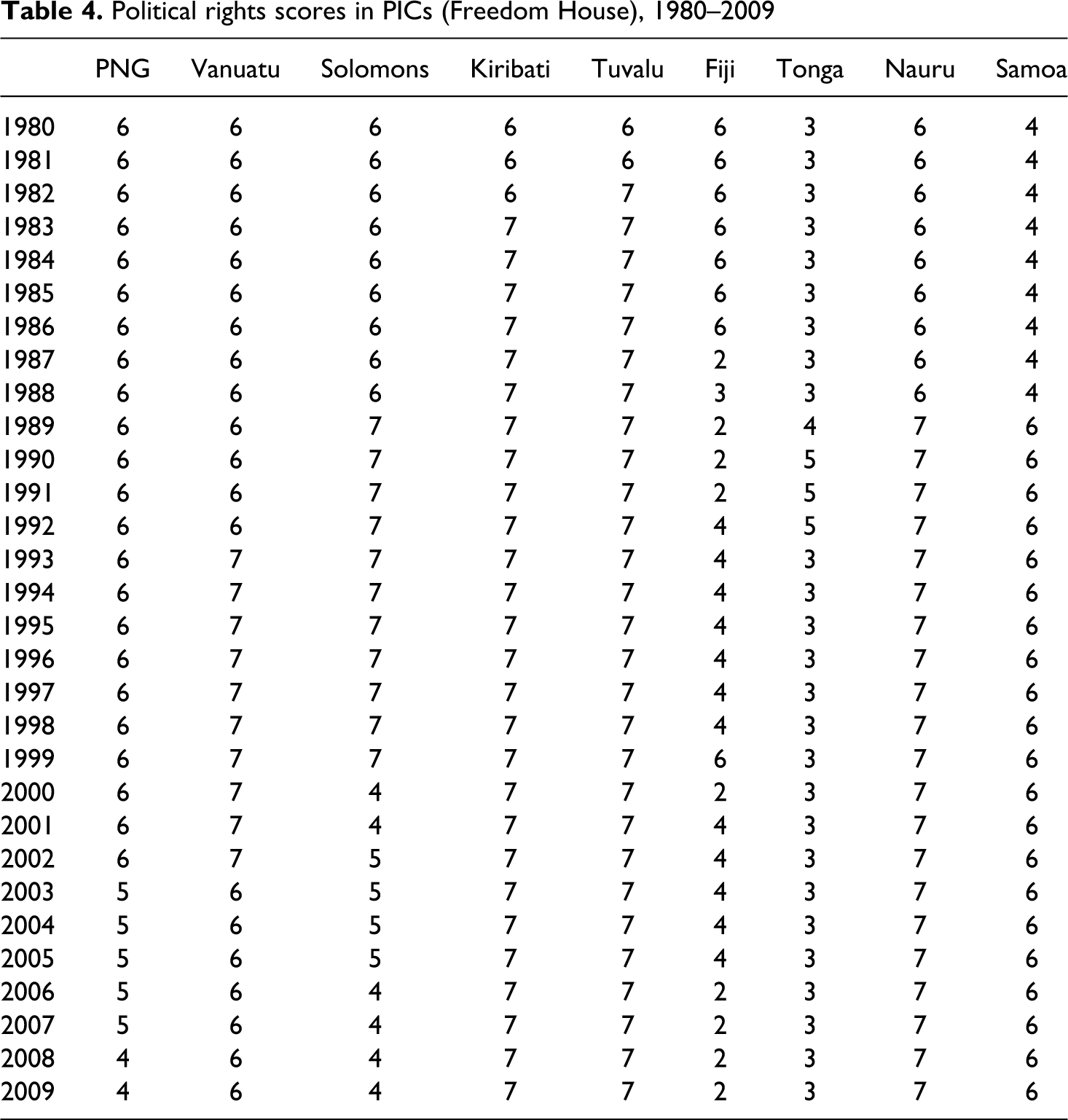
Likewise, the score for the Solomon Islands has taken precipitous drop since 2000 due to numerous problems such as claims of fraudulent elections and ‘rampant corruption at all levels of government’. Judicial independence is also a problem. 34
Tonga is another PIC that did not perform well on the Freedom House Political Rights measure for most of the 1980–2009 period. In fact, it is the only country in the region that has been consistently designated by Freedom House as closer to ‘not free’ than ‘free’ (as indicated by an average Freedom House score of lower than 4 on the seven-point scale). However, in just the past two years, the country has made a significant move toward democracy as the king has been pressured by the public for more citizen participation in the political process. While the changes are not yet consolidated (Freedom House has yet to upgrade Tonga’s Political Rights score), this movement is a very encouraging sign. A majority of members of the Tongan parliament are now elected, although the nobles still control a significant minority of seats. 35
In contrast, two countries covered by Freedom House, Kiribati and Tuvalu, achieved very high political rights scores during the time period of the study. Lawrence argues that few restrictions exist on political rights in Kiribati, aside from some restrictions on press freedoms. 36 In the case of Tuvalu, he states that the government generally respects the political rights of its citizens, although the government tolerates the restriction of women’s economic opportunities. 37
As is the case with the Freedom House measure, the two countries that perform the worst on the CIRI Political Empowerment score scores are Fiji and Tonga (see Table 5). In fact, the downfall of democracy in Fiji since 2006 accounts for most of the decline in the average score for the region during that time period. It is clear that Fiji should be treated as an outlier in terms of political empowerment, as its score is well below others in the region. Unlike the Freedom House Political Rights measure, the CIRI scores for Papua New Guinea and the Solomon Islands are respectably high. A possible reason might be that CIRI includes several factors in its measure that Freedom House does not, including components for worker rights and freedom of movement.
Political empowerment in PICs (CIRI), 2003–2009
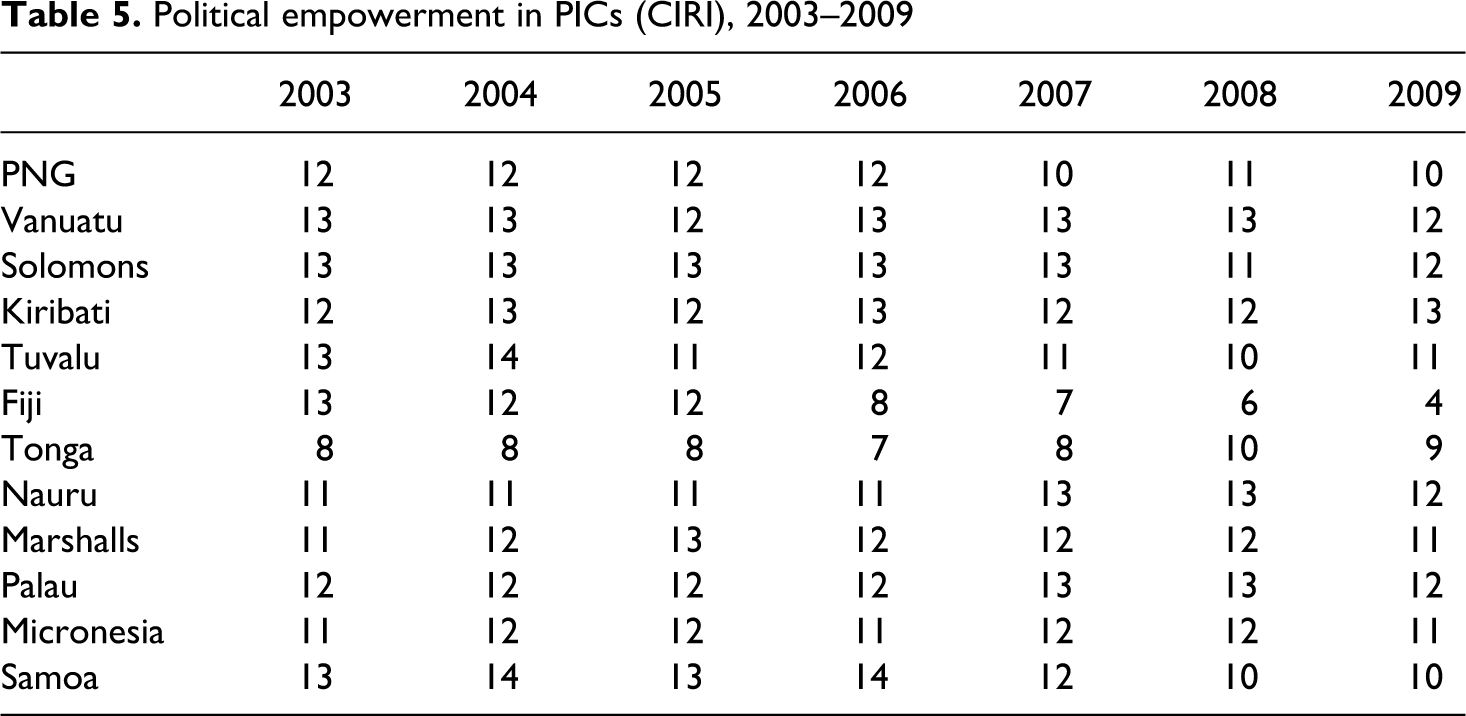
One might infer from the information available that, aside from Fiji and Tonga, political rights are fairly well respected on average in comparison to other parts of the developing world. However, a measurable gap between these Pacific nations and the developed world still exists. The Tongan move to wrest power away from the monarchy will help to shrink this gap, but the region still has a long way to go before all of its members enjoy levels of respect for political rights that are equal to those of the OECD countries.
Discussion
This brief survey of certain key basic individual human rights in the Pacific region reveals both positive and negative news regarding the region’s performance. Certainly, PICs cannot yet be classified as being similar to the developed world on most measures, but neither do they, on average, perform as poorly as the Middle East and Africa. While respect for personal integrity rights is relatively good in the region, a review of trends over the past three decades does not suggest that political rights and civil liberties are improving significantly over time.
Why do we see these results? In terms of personal integrity rights, most states in the region do not have the sort of centralized, bureaucratic machinery that is capable of high levels of political repression, violations of personal integrity rights are, not surprisingly, relatively low in the Pacific. 38 However, while serious violations by governments are generally rare in the PICs, the Political Terror Scale and CIRI (which both use Amnesty International data) focus narrowly on repression by the state and its agents. Thus, ‘domestic violence or societal (mob/clan), are not included in the Political Terror Scale and CIRI personal integrity rights measures. Neither are actions carried out by gangs, paramilitaries, or syndicates.’ 39 Thus, an overall assessment of respect for personal integrity rights in the region should take a look at non-state actors as well as the state as potential violators of the right to personal integrity. Sue Farran’s work provides evidence that in many cases, it is not the state that abrogates rights in PICs, but rather ‘customary practices, local chiefs, church, or community leaders’. 40 She adds that ‘outside of the major metropolitan areas, the state may have minimal influence outside the daily lives of Pacific Islanders. The perceived lack of cooperation (both legally, as well as in practice), may relate to the nature of how rights have been historically viewed in the region.’ 41
The PICs have generally not performed as well on measures of political rights and civil liberties. The Latin American countries of the Western hemisphere appear to have caught up to the Pacific in terms of the two Freedom House measures, in part due to the fact that they benefited from the ‘Third Wave’ of democratization.
42
The Pacific started well above most other regions of the world. In 2002, Peter Schraeder wrote: The fourteen Pacific Island Countries that comprise Oceania represent the world’s second most democratic region [behind Western Europe]. Anchored by democratic Australia and New Zealand, Oceania consistently maintained an impressive democratic standard from 1975 to 2000, a period in which seven of its fourteen countries achieved independence.
43
Perhaps Samoa’s situation is emblematic of the region’s democratic trends. Asofau So’o describes his country as one in which, from the time it became an independent state, democracy and traditional values have both been highly valued. A ‘legalized, democratic political system’ coexists alongside a matai system ‘centred around a system of chiefly titles’.
44
While it might be argued that the presence of customary practices has ultimately hindered democratic development in the country, So’o points out that the region has adopted many changes over the past two decades: Universal suffrage and political parties have both come about in the past twenty years or so, for instance. This has led the country to slowly move away from a consensus model of politics toward a majoritarian one . . . but respect for the role of custom in decision-making remains strong.
45
The region may thus be in the process of establishing an equilibrium between the idea that certain rights accrue to an individual through culture and the belief that rights develop through an evolving set of universal human rights norms. Toki and Baird argue that ‘equivalent’ ideas to western human rights norms come from custom. 47 One possibility, then, is the development of a regional mechanism that recognizes the value of both local and universal norms. Of course, such a mechanism cannot be put in place until leaders in the region develop a political consensus to support it.
Conclusion
This comparative examination of Pacific human rights is only a first step toward a greater appreciation of how the situation in the region differs from other parts of the world. It strongly suggests that we should not assume, despite its small size and the many similarities among its countries, that every PIC regime offers an identical set of human rights protections to its citizens. While cross-national measures such as the ones used here can obviously not account for some of the nuances that make individual political systems unique, this type of comparative exercise can hopefully shed more light on the specific human rights issues related to the region.
I conclude with two suggestions for future human rights research in the area.
First, this research is intended to lead the way for further comparative efforts to appreciate how regimes in the region respect the basic human rights of their citizens. While studies that boil rights down to a few numbers may be an interesting way to compare large numbers of countries, in-depth comparative case studies are necessary to outline the situation more clearly. Are the global Political Terror Scale, Freedom House and CIRI measures helping to identify underlying fundamental differences in the way governance operates in Pacific polities? Or do social scientists need to develop measures of respect for human rights and well-being that are tailor-made to the Pacific context?
Second, the types of rights analysed in this article are essentially limited to Lockean ‘first generation’ rights, and this study does not refer to how well other types of rights are respected. Certainly a comparative study of human rights in the Pacific should include economic or subsistence rights, the rights of women and group rights. Some fragmentary data are available for such analyses, but more needs to be gathered in order to understand patterns of respect for other types of rights more clearly.
A good starting place would be to collect better data on women’s rights. However, Clair Apodaca points out that the quality of social science data on women is problematic: The Committee on the Elimination of Discrimination Against Women has repeatedly noted its concern with this relative absence of disaggregated, precise, and reliable indicators on the situation or condition of women. The Committee remarked ‘that statistical information is absolutely necessary in order to understand the real situation of women in each of the States parties to the Convention’ (1989, 392). The primary culprits are first and foremost states themselves. But international institutions like the World Bank, the International Monetary Fund, and the World Trade Organization are also guilty of ignoring or excluding women in the collection of data.
48
While measures of economic rights are not readily available cross-nationally, measures of economic well-being are. Moving beyond the traditional measure of per capita income, current measures include the UN Human Development Index (which includes per capita GDP, life expectancy and education) and the broader Weighted Index of Social Progress (which also includes social peace, diversity, the role of women and environmental conditions). 49
Future research will hopefully provide more complete insights into the level of respect for human rights of the region’s peoples. But it is up to the people of the region and their leaders to decide how to develop national and regional institutions to help achieve better respect for human rights in the future.