



Abstract
Research on parliamentary representation has traditionally assumed that political parties take clear and differentiated policy positions, but recent studies suggest that parties sometimes have an electoral incentive to present voters with a distribution of positions to select from at the ballot box. This article explores whether parliamentary parties pursue such a strategy through candidate position taking using unique elite and mass survey data from Denmark. The results illustrate that parties are highly unified on issues that are salient to their electoral brand, but that they develop a distribution of positions that is related to voter preferences at the district level on less salient issues. These findings have important implications for the way that representation works in parliamentary democracies.
Keywords
An emerging literature on broad-appeal strategies in parliamentary democracies suggests that political parties sometimes have an electoral incentive to present voters with a distribution of positions on political issues instead of a single position (Bräuninger and Giger, 2016; Lo et al., 2016; Rovny, 2012; Somer-Topcu, 2015). Doing so helps a party to win votes if it can convince different groups of voters with diverse preferences that it is ideologically closer to the issue positions that they prefer. However, this emerging literature has developed without fully considering the role candidates and their constituents have in shaping the party distribution of issue positions. Furthermore, it is not yet fully understood how parliamentary parties balance the incentive to appeal broadly with the potentially conflicting incentive to protect the informational value of the party label. The purpose of the article is to address these gaps theoretically and empirically.
Theoretically, the article suggests that party leaders enforce discipline on issues that are salient to their party’s electoral brand because these are the types of issues where damage to the informational value of the party’s label is most electorally dangerous. On issues that are less salient to the party, on the other hand, party leaders do not sanction district-targeted position taking among their candidates. This behavior results in a distribution of candidate issue positions that allows a party to appeal broadly in an efficient way by targeting regional voter preferences while protecting the informational value of the party’s label on the issues that are most salient to the party’s electoral brand.
Empirically, these possibilities are tested with data from Denmark. The Danish case is useful because it contains a unique and non-anonymous candidate survey with an unusually high response rate, which I merge with district level data on voter preferences, using an original mass survey and multilevel regression and poststratification (MRP) methods. Consistent with the theoretical expectations, the analysis of these data shows that Danish candidates almost always take the same positions as their party leader on issues that are salient to their party, but that they often diverge from their party’s position on less salient issues when it is unpopular among the voters in their district. Furthermore, district-targeted position taking is more prevalent among mainstream than niche party candidates.
These findings are not only important because they help illuminate parliamentary party strategies in a new way, but also because they have important implications for the way that parliamentary representation works. On one hand, clear and distinguishable party positions have traditionally been considered normatively desirable features of representative democracy (Dahlberg, 2009; Ranney, 1954), and district-targeted position taking may obscure a party’s positions. On the other hand, individual candidates have several opportunities to influence policy in the direction that their constituents prefer if they get (re)elected to a parliament. Parliamentary parties typically have high levels of unity when they vote on legislative bills, but MPs can influence the content of these bills in ministries (Laver and Shepsle, 1996) and on legislative committees (Strøm, 1998). Furthermore, individual party members can influence their party’s policy positions within party factions such that the party votes differently when a bill comes up for a legislative vote (Budge et al., 2010). The positive relationship between candidate and district voter positions may thus be indicative of substantive representation at the district level in parliamentary contexts.
The article proceeds as follows: The next section describes comparative and American research on representation and uses the insights from this literature to generate a theoretical model of candidate position taking in parliamentary parties. The section that follows is empirical and composed of three subsections. The first subsection presents the Danish case. The second subsection presents the data and analyzes the relationship between issue salience, district voter preferences, party leader preferences, and candidate position taking in Denmark. The third subsection analyzes whether this relationship is confined to mainstream parties or whether it applies to niche parties as well. The final section concludes.
Parties, Candidates, and Voters in Parliamentary Democracies
A key assumption in the literature on parliamentary representation—particularly the prominent literature on congruence—has traditionally been that each political party acts as a unitary actor that takes a single clear-cut ideological position which it seeks to transform into policy in the government and/or legislature (Huber and Powell, 1994; McDonald and Budge, 2005; Powell, 2000). This is very different from research on representation in the United States which has long shown that individual representatives often diverge from their party when the district calls for it (Bartels, 1991; Mayhew, 1974; Miller and Stokes, 1963).
A key reason for this discrepancy in the parliamentary and American literature on representation is that parliamentary party leaders have more institutional opportunity to enforce party discipline among their candidates. 1 Prime ministers, for example, have the formal power to treat each vote on a legislative bill as a vote of confidence, which increases the costs of dissent among backbenchers in the governing coalition (Diermeier and Feddersen, 1998). This is not possible in the United States because of the fixed term of the executive and the stricter separation of powers more generally. Parliamentary party leaders in the executive can use this power (or the threat of dissolution) in addition to their agenda setting powers (Chandler et al., 2006; Cox et al., 2007; Huber, 1992) to ensure that there is unity when the governing coalition votes on bills.
Parliamentary party leaders also have at least three other formal powers they can use to influence position taking among their members that party leaders in the United States do not have. First, candidate selection rules in parliamentary democracies tend to be much more centralized than in the United States. Parliamentary party leaders, for example, often have the power to decide which district each candidate competes in (if at all), or the candidate’s placement on the party’s list in the district s(he) competes in (André et al., 2017; Ferrara, 2004). These formal powers allow parliamentary leaders to select candidates who take the positions that they prefer, and to de-select those who do not. In the United States, on the other hand, the selection of candidates is largely made by voters at the district level in party primaries.
Second, parliamentary party leaders control career advancement from the legislature to the executive in a way that party leaders in the United States cannot due to the separation of the two branches (Kam, 2009). Specifically, party leaders from a parliamentary government select MPs to the cabinet, (or, in opposition, to the shadow cabinet), and these positions are desirable for party members who are motivated by influence and/or office perks. It is thus important for both policy- and office-seeking candidates in parliamentary democracies to take the preferences of their leadership into consideration when they take public positions on political issues.
Finally, if parliamentary candidates take positions that their party leaders oppose after having been nominated, and despite having career incentives to adhere to party leader preferences, then parliamentary party leaders have a final tool available to enforce discipline, namely expulsion from the party (Malloy, 2003). Party leaders in the United States cannot expel their members because membership is not formalized in the same way, and while this formal power is rarely invoked in the parliamentary context, the threat of expulsion can be a powerful disciplining tool (Kam, 2009).
Why Would Candidates Diverge From Their Party?
Why, then, if party leaders have such a degree of control over parliamentary careers would parliamentary candidates ever diverge from their party’s position? This article suggests the answer is that parties sometimes have an electoral incentive to present voters with a distribution of issue positions as opposed to a single clear-cut position (Bräuninger and Giger, 2016; Lo et al., 2016; Rovny, 2012; Somer-Topcu, 2015). This becomes a winning electoral strategy for a party if it is able to convince different groups of voters with diverse preferences that it is ideologically closer to them than they would otherwise perceive it to be. Party leaders may thus avoid sanctioning candidate divergence from the party’s position in order to help generate a distribution of candidate positions that allows the party to appeal broadly to different segments of the mass electorate.
The idea that parliamentary parties appeal broadly through the distribution of candidate positions has not yet been systematically examined by researchers. Yet, it may be a very efficient broad-appeal strategy. If parties can cultivate a distribution of candidate positions that is positively related to voter preferences at the district level then this may lead voters to perceive that there is a particular option on the party’s list that is ideologically closer to them than the party as a whole (in open list systems where voters can vote for individual candidates), or that the party’s list is ideologically closer to them than the party as a whole (in both open and closed list systems).
One way in which parties can achieve such an outcome is through candidate responsiveness to aggregate district voter preferences (e.g. the preferences of the mean district voter). Such responsiveness may occur in open-list proportional representation (OLPR) and single member district (SMD) electoral systems where (re)election-seeking candidates have personal vote-seeking incentives to respond to district voter demands (Cain et al., 1987; Carey and Shugart, 1995; Heitshusen et al., 2005). Candidates may thus take popular district positions to get more personal votes, and party leaders may refrain from sanctioning this behavior or even encourage it by offering career advancement opportunities such as speakerships or ministries to MPs who are more popular among district voters (Kam, 2009). 2 Likewise, party leaders can encourage candidate responsiveness to district voter preferences in electoral systems that use closed or flexible party lists, which are difficult for voters to alter directly, by moving popular candidates further up on the party’s list (André et al., 2017).
Another way in which parties can develop a similar distribution of candidate positions is by systematically recruiting candidates who have pre-existing attitudes that correlate with those of their district voters. Party leaders can encourage such a recruitment strategy when they control the nomination process, but parties can also plausibly rely on candidates to self-select into districts that tend to share their issue positions. Candidates may thus sometimes take district positions due to their sincere issue preferences, and party leaders may refrain from sanctioning this behavior. These possibilities are also consistent with research from presidential democracies showing that legislators often engage in district-targeted legislative behaviors even when they cannot possibly win re-election due to term limits or other institutional barriers (Carey, 1996; Kerevel, 2015; Taylor, 1992).
When Do Candidates Diverge From Their Party?
It is not clear, however, that party leaders have an electoral incentive to avoid sanctioning district-targeted position taking among their candidates on all issues. Instead, I argue that party leaders are more likely to enforce party discipline among their members on the political issues that are more salient to their electoral brand for two key reasons.
First, the literature on issue ownership has long argued that political parties have an electoral incentive to highlight the issue dimensions where the party’s reputation is more electorally advantageous (Bélanger Meguid, 2008; Budge and Farlie, 1983; Petrocik, 1996). 3 A party thus has an electoral interest in voters using its label as an informational shortcut on issues that it highlights as important, which suggests that the party also has an interest in protecting the informational value of the party’s label on these types of issues. Accordingly, Rovny (2012) has shown that parties tend to emphasize clear positions on the issue dimensions where they are historically or ideologically invested while blurring their positions on issues that are more detrimental to them. I make a related argument, namely that parliamentary party leaders enforce discipline on salient issues because party disunity can make voters uncertain about what the party’s positions are (Cox and McCubbins, 1993) and reduce the party’s perceived issue competence (Greene and Haber, 2015). On less salient issues, on the other hand, party leaders do not sanction district-targeted position taking because it allows their party to appeal to different districts with diverse preferences on issues where the party’s reputation is less electorally advantageous in the national electorate.
Second, when parties develop their distribution of issue positions, they respond to the demands of both the general public and their partisan constituencies (Bräuninger and Giger, 2016), which can be difficult because partisan constituencies have issue positions that are distinct from those of the general public (Ezrow et al., 2011). Yet, partisan constituencies tend to agree more with, and care more about, the issues that are salient to their preferred party (Neundorf and Adams, 2016; Ray, 2003). Party leaders can thus appeal to their party’s constituency by cultivating unity on issues that are salient to their party while also appealing to the general public in an efficient way by avoiding to sanction district-targeted position taking on less salient issues.
For these reasons, I argue that party leaders are likely to sanction district-targeted position taking on salient issues, but to allow district-targeted position taking on less salient issues. On salient issues, this should result in candidates taking positions that are strongly related to the preferences of their party leader, but on less salient issues I expect candidates to take issue positions that are systematically related to voter preferences in their home districts in addition to those of their party. This theoretical model of candidate position taking in parliamentary democracies can be summarized in the following two hypotheses.
H1. The issue positions of parliamentary candidates are positively related to the positions of their party leaders holding district voter positions constant, but more so on salient issues.
H2. The issue positions of parliamentary candidates are positively related to the positions of their district voters holding party leader positions constant, but less so on salient issues.
Another interesting possibility is that candidate responsiveness is conditional on party type. 4 Specifically, it is possible that niche party candidates are less responsive to aggregate district voter preferences than mainstream party candidates. This is because niche parties have been shown to be sanctioned electorally when they abandon their core partisan constituencies and appeal to the mean voter in the national electorate (Adams et al., 2006). Consequently, they tend to appeal to their mean party voter instead in their election manifestos (Ezrow et al., 2011). These findings suggest that a broad-appeal strategy that involves letting candidates diverge from the party’s position when it is unpopular in the district at large may be an inefficient strategy for niche parties. Rather, niche parties may have an electoral incentive to target their core constituencies in the national electorate. If party leader strategy drives candidate behavior then the empirical implication of this is that niche party candidates tend to take positions that are less congruent with the preferences of their district voters than mainstream party candidates. 5 This empirical expectation can be summarized in the following hypothesis:
H3. The issue positions of parliamentary candidates are positively related to the positions of their district voters holding party leader positions constant, but more so in mainstream than niche parties.
Empirical Analysis
The three hypotheses are tested with data from the 2015 parliamentary election in Denmark. The Danish case is used because of the existence of a particularly useful candidate survey, which is detailed below. Before turning to the data and analysis, however, a few words are in order about the Danish case more generally.
There were 783 candidates from 10 parties running in the 2015 Danish parliamentary elections (as well as 16 independents who are omitted from all analyses below). Each candidate competed for 1 of 175 available parliamentary seats within 1 of 10 multimember districts with a magnitude ranging from 2 to 27 (four additional seats are reserved for candidates from Greenland and the Faroe Islands). The 10 parties competing in 2015 were The Unity List, the Socialist People’s Party, the Social Democrats, the Radicals, the Alternative, the Christian Democrats, the Liberals, the Conservatives, the Liberal Alliance, and the Danish People’s Party. The government at the time of the survey was a center-left minority government composed of the Social Democrats (the party of the prime minister) and the Radicals, supported by the Unity List and the Socialist People’s Party. The latter four parties were in the opposition. The Christian Democrats and the Alternative did not have any parliamentary seats. In the case of the Christian Democrats, this was because the party did not get above the 2 percent vote share threshold in the previous election in 2011, and in the case of the Alternative, this was because the 2015 election was the party’s first parliamentary election.
All of these parties used open list rules to select their candidates in 2015 except the Unity List, which used so-called flexible list rules. A flexible list is similar to a closed list except that voters can reorder it if an individual candidate gets enough votes to meet a high threshold. Preliminary analyses of the 2015 data did reveal that candidates from the unity list tend to be more unified on both salient and non-salient issues, but it is not possible to know whether this is because of electoral rules, or for other reasons that are specific to the party, such as its far-left ideology. The dataset used in this article thus does not allow for a systematic analysis of the relationship between candidate position taking and electoral rules in parliamentary democracies, but this is something I encourage future research to do for several important reasons that I outline in the conclusion. Before doing so, however, I test Hypotheses 1 and 2 in the next subsection using candidate data pooled across all party lists from the 2015 election. Hypothesis 3 is subsequently tested in a separate subsection through a comparison of candidate responsiveness to district voter preferences in niche and mainstream parties.
Candidate Positions, District Voter Positions, and Issue Salience
Hypotheses 1 and 2 are tested with Danish candidate survey data from a so-called voting advice application (VAA) that was implemented by the political news agency “Altinget.dk” and the television station “TV2” before the 2015 general election in Denmark. The VAA asked all candidates running in the election to take positions on 20 political issue statements. For each statement candidates were allowed five response options ranging from 1: “completely disagree,” 2: “partially disagree,” 3: “neither/or,” 4: “partially agree,” to 5: “completely agree.” 6 Later, the candidate responses were published online by Altinget in order to inform voters about the positions of the candidates in their district.
These candidate survey data are very useful to test the hypotheses on at least three different counts: First, unlike most publicly accessible elite surveys, the candidate responses to the VAA questions are not anonymous, which allows me to match each candidate to a district and also to identify their party leader’s position on each issue. Second, the candidate response rate within the 10 Danish parties competing in the election was 93 percent, which is exceptionally high for an elite survey (Bailer, 2014). The high response rate reduces concerns about bias caused by systematically missing elite survey data (Montgomery et al., 2008). Third, public surveys such as VAAs are particularly useful for examining candidate and party leader strategies because they measure “… the electorally revealed preferences, contaminated by electoral concerns” (Willumsen and Öhberg, 2017: 693). This means that the incentives that apply to public candidate position taking in general also apply to candidate position taking in the VAA. Or, put differently, if candidates perceive a general incentive to take the position of their party leader on salient issues, and to respond to district voter preferences on less salient issues, then this should be observable when candidates take positions in the VAA.
To test Hypotheses 1 and 2, I also need data on how popular the various possible issue positions in the candidate survey were among district voters. Consequently, I administered an Internet-based mass survey mass in the days leading up to the 2015 general election in Denmark in which I asked over 1300 Danish citizens 10 of the 20 questions from the 2015 VAA and gave them the same five response options as well. Furthermore, I asked the respondents to provide their postal code, which allows me to match them to a district. Finally, I inquired about their gender, education level, age, and party vote choice. The survey was implemented by Survey Sampling International (SSI), and their sampling procedure is described in detail in Supplementary Material online Appendix C.
I use these mass survey data in combination with census data and MRP methods to develop my measures of district level public opinion. MRP is a technique that was developed by Gelman and Little (1997) and Park et al. (2006), and it is designed precisely to handle situations where researchers want to make inferences about public opinion in subnational units using a normal-sized national survey. Consequently, it has been applied by several studies to measure state level ideology and public opinion in the United States context (Enns and Koch, 2013; Lax and Phillips, 2009; Pacheco, 2011).
The MRP method works through two stages: A first stage that uses a multilevel model of individual survey responses to estimate the relationship between demographic status and public opinion, and a second stage that weights the estimates for each demographic respondent type from the first stage against the percentages of each demographic type in each district using census data. For this particular project, I then take the weighted average of the estimated percentage of voters that gave each response option in each district for each question, such that I get a mean voter position for each district on each issue. The key advantage of the MRP method is thus that it uses data from all 1300 respondents to measure public opinion in each district rather than just the subset of respondents who resided in the district. The results from the two MRP stages are shown in Supplementary Material online Appendix D.
The district voter position on a political issue is thus operationalized as the mean of the district voter issue position distribution. To be sure, there are other aspects of this distribution that could influence candidate position taking as well, but this operationalization makes theoretical sense because it represents the central preference tendency in each district on each issue, which is a logical focal point for the broad-appeal strategy. Furthermore, it is consistent with the way that the existing congruence and responsiveness research aggregates voter preferences at the national level (Brooks and Manza, 2007; Huber and Powell, 1994; McDonald and Budge, 2005; Powell, 2000). 7
Next, the model also needs a measure of salience for each party on each issue. A common way in which political scientists measure this concept is through the use of Comparative Manifesto Project (CMP) data. However, manifesto data are not very useful for this analysis because there is no firm manifesto tradition in Denmark (Vliegenthart and Walgrave, 2011). This has led the CMP group to use different proxy documents such as speeches, drafts, and even documents from local elections to measure party positions and issue salience in the Danish context, which “in many years produce a completely distorted picture of the actual positions of Danish political parties” (Hansen, 2008). For example, the document that the CMP group uses to code issue positions and issue salience for the Social Democrats in Denmark in 2011 (the most recent Danish election with available CMP data) is actually a joint statement with the Socialist People’s Party, which itself issued an independent manifesto before the election.
The manifesto data are thus clearly not appropriate for this analysis, but the Danish case offers another interesting data source that provides a solution to the issue. Specifically, I take advantage of the fact that each party in Denmark issues a magazine several times each year (these party magazines are also occasionally used as manifesto data by the Comparative Manifesto Project). Concretely, I obtained the last magazine issued before the 2015 election for each party and analyzed it carefully in order to determine whether each issue from the elite survey was mentioned in the magazine. 8 I then coded issues that were mentioned by a candidate’s party as a “1” (salient) and issues that were not mentioned as a “0” (non-salient).
A key advantage of measuring issue salience in this way is that the party magazines tend to have similar lengths, and they follow similar formats. Specifically, the party magazines have an editorial on the second or third page where the party leader specifies the political themes that (s)he considers most important in the forthcoming (or ongoing) election campaign, followed by several sections that detail the party’s position on the issues that comprise the themes. The documents thus provide an excellent data source for issue salience because they highlight the issues that are most important to each party in a way that is comparable across parties. Furthermore, the coded variable correlates well with expert codings of issue salience and shows clear signs of face validity. 9
Finally, the model also needs to take party leader positions into account. The elite survey data offer a convenient opportunity to do so because the survey was not anonymous, which allows me to generate a variable that measures the position of the party leader on each issue. 10 Including this variable not only allows for an analysis of the relationship between district and candidate issue positions while holding the party leader position constant, but it also allows for an analysis of the relative strength of the relationship between candidate and party leader positions versus candidate and mean district voter positions.
I use these data to test Hypotheses 1 and 2 in a single model by regressing candidate positions on mean district voter positions, party leader positions, and issue salience with the unit of analysis being the candidate-issue, and with an ordered probit estimator given the ordered-categorical nature of the dependent variable. Furthermore, the right-hand side includes an interaction term for the mean district voter position and issue salience in order to appropriately test the hypothesis that the relationship between district voter and candidate positions is conditional on issue salience (Hypothesis 2). Likewise, the model includes an interaction term for the party leader position and issue salience to test for the possibility that the relationship between party leader positions and candidate positions depends on the salience of the issue (Hypothesis 1).
The data also have a complicated multilevel structure that could result in correlated errors if not accounted for properly. First, it is possible that all candidates from all parties in all districts tend to agree more or less with some issue statements for reasons that are unrelated to the mean district voter position, the party leader position and issue salience. Second, it is possible that candidates from the same party agree more or less with some issue statement across all districts for reasons unaccounted for by the fixed variables in the model. Third, it is possible that there is systematic error because candidates from all parties agree more or less with some issue statement in a particular district. Finally, it is possible that candidates from a particular party in a particular district agree more or less with a particular issue statement for reasons that the independent variables do not measure. I address these possibilities by letting the intercepts vary at four different levels: (1) the level of the individual issue, (2) the level of the issue-party, (3) the level of the issue-district, and (4) the level of the issue-party-district. 11 The statistical model can thus be summarized in the following error components equation where j candidates take positions on i issues in p parties and d districts

where:
Using the parameter estimates from this model specification (reported in Supplementary Material online Appendix E), Figure 1 shows the average (expected) candidate position for different party leader positions over the mean district voter position. Specifically, the figure consists of five panels—one for each possible party leader position. The top-left panel shows the expected candidate position on salient and non-salient issues over the average district voter position when the party leader position is a “1” (when the party leader “strongly disagrees” with an issue statement), the top-center panel shows the expected candidate position on salient and non-salient issues when the party leader position is a “2” (when the party leader “partially disagrees” with an issue statement), and so on.

Candidate Positions, Party Leader Positions, District Voter Positions, and Issue Salience.
The figure shows that party leader positions are more strongly related to candidate positions on issues that are salient to the candidate’s party (Hypothesis 1), and district voter positions are more strongly related to candidate positions on non-salient issues (Hypothesis 2). This is most clear on issues where the party leader position is extreme—that is, issue statements that the candidate’s party leader either agrees or disagrees with completely. On these issues, candidates tend to take the same position as their party leader when the issue is salient to their party regardless of the mean district voter position. If, on the other hand, the issue is not salient, and if party leader and district voter positions diverge, then candidates tend to take less extreme positions than their party leaders.
The figure also shows evidence that candidates take district-targeted positions on issues where the party leader position is not extreme—that is, issue statements that the party leader does not agree or disagree with completely—regardless of whether the issue is salient to their party. However, it is important to be somewhat careful when interpreting this finding because party leaders almost always (dis)agree completely with issue statements that are salient to their party (15 of 18 cases). In fact, party leaders never gave the “neither/or” response to an issue that was salient to their party. This curvilinear relationship between party positions and issue salience is consistent with findings by Rovny (2012) in a larger sample of West European countries. Nonetheless, an interesting possibility that follows from the empirical results is that candidates are more likely to take district positions on issues where their party leader’s position is less extreme.
Figure 1, however, does not reveal whether the district voter position slopes on salient and non-salient issues are statistically distinguishable from one another when the party leader position is extreme. In order to test this possibility in a non-linear model, it is necessary to calculate the second difference of the dependent variable over the range of the independent variable of interest (Berry et al., 2010). This can be done with the parameter estimates from equation 1 by estimating the marginal effect of a .1 increase in the mean district voter position on salient issues and subtracting it from the marginal effect of a .1 increase in the mean district voter position on non-salient issues over the range of the constituency position variable. Figure 2 shows that this second difference is statistically distinguishable from zero when the party leader position is set to “1” (on issue statements that the party leader “completely disagrees” within the left panel) and to “5” (on issue statements that the party leader “completely agrees” within the right panel).

Marginal Effects of the Mean District Voter Position on Non-Salient vs Salient Issue Statements.
Figures 1–2 thus collectively provide evidence in favor of Hypothesis 1 and Hypothesis 2 (with some modification to account for cases where the party leader position is less extreme), but in a fairly generalized way. Consequently, Figure 3 shows the predicted distribution of candidate positions in a specific Danish district on a particular issue. The black colored distribution represents the MRP based distribution of voter positions in the “Vestjyllands Storkreds” district on the following issue statement: “The parliament should introduce minimum sentencing guidelines for aggravated assault and rape.” The mean voter position in this particular district on this particular issue was roughly 4.25, indicating that the average voter from this district favored minimum sentencing guidelines.

Expected Candidate Positions in “Vestjyllands Storkreds” on Law and Order Issue.
What, then, does the empirical model suggest about the distribution of candidate positions when the party leader takes a position in the complete opposite direction (completely opposed to minimum sentencing guidelines) 12 ? The green colored distribution indicates that candidates faced with this scenario almost always take the position of their party leader if the issue is salient to their party—even though their district voters generally are opposed to this position. The blue colored distribution, on the other hand, shows that if the issue is not salient to the party, then nearly half of all candidates will take a position that is different from their party leader’s position and more popular among the voters in the district
Candidate Positions and Party Types
It is clear from the results so far that parliamentary candidates in Denmark are less responsive to the preferences of the mean voter in their district on issues that salient to their party’s electoral brand. It still remains to be seen, however, whether candidate responsiveness to district voter preferences is also conditional on whether the candidate comes from a niche or mainstream party (Hypothesis 3).
In order to test this possibility, the statistical model needs a niche party indicator. 13 Adams et al. (2006) define the niche party family as being composed of parties that present either an extreme ideology or a non-centrist ideology. There are four such parties in Denmark: The Unity List, which presents a far-left ideology; the Danish People’s party, which presents a far-right ideology on immigration and nationalism; The Alternative, which presents a green post-materialist ideology, and the Liberal Alliance, which presents a far-right ideology on taxation and the scope of government. Consequently, I generate a niche party dummy variable where candidates from these four parties are coded as a “1.” 14 Candidates from all other parties are coded as a “0.”
With these data, I compare position taking among niche and mainstream party candidates by regressing candidate-issue positions on party leader positions, mean district voter positions, party leader positions, and the niche party dummy variable using an ordered probit model. 15 Furthermore, mean district voter positions and party leader positions are interacted with the niche party dummy variable to account for the possibility that niche party candidate positions are more strongly related to those of their party leader, and that mainstream party candidate positions are more strongly related to those of their mean district voter. This statistical model is summarized in Equation 2 below where J candidates again take positions on I issues in P parties and D districts, and where the intercepts are again allowed to vary at the level of issues, party-issues, district-issues, and party-district-issues. Figure 4 summarizes the substantive results from this model specification

where:
The substantive results in Figure 4 reveal that issue positions among niche party candidates are indeed more weakly related to the preferences of the mean district voter and more strongly related to the position of the party leader. Furthermore, this moderating effect of party type can be seen for the full distribution of party leader positions. The panel on the bottom right, for example, shows that when the party leader completely agrees with an issue statement then mainstream party candidates from the same party are likely to diverge from this position if their mean district voter disagrees with the issue statement. Niche party candidates, on the other hand, tend to take the same position as their party leader on average regardless of their mean district voter’s position.
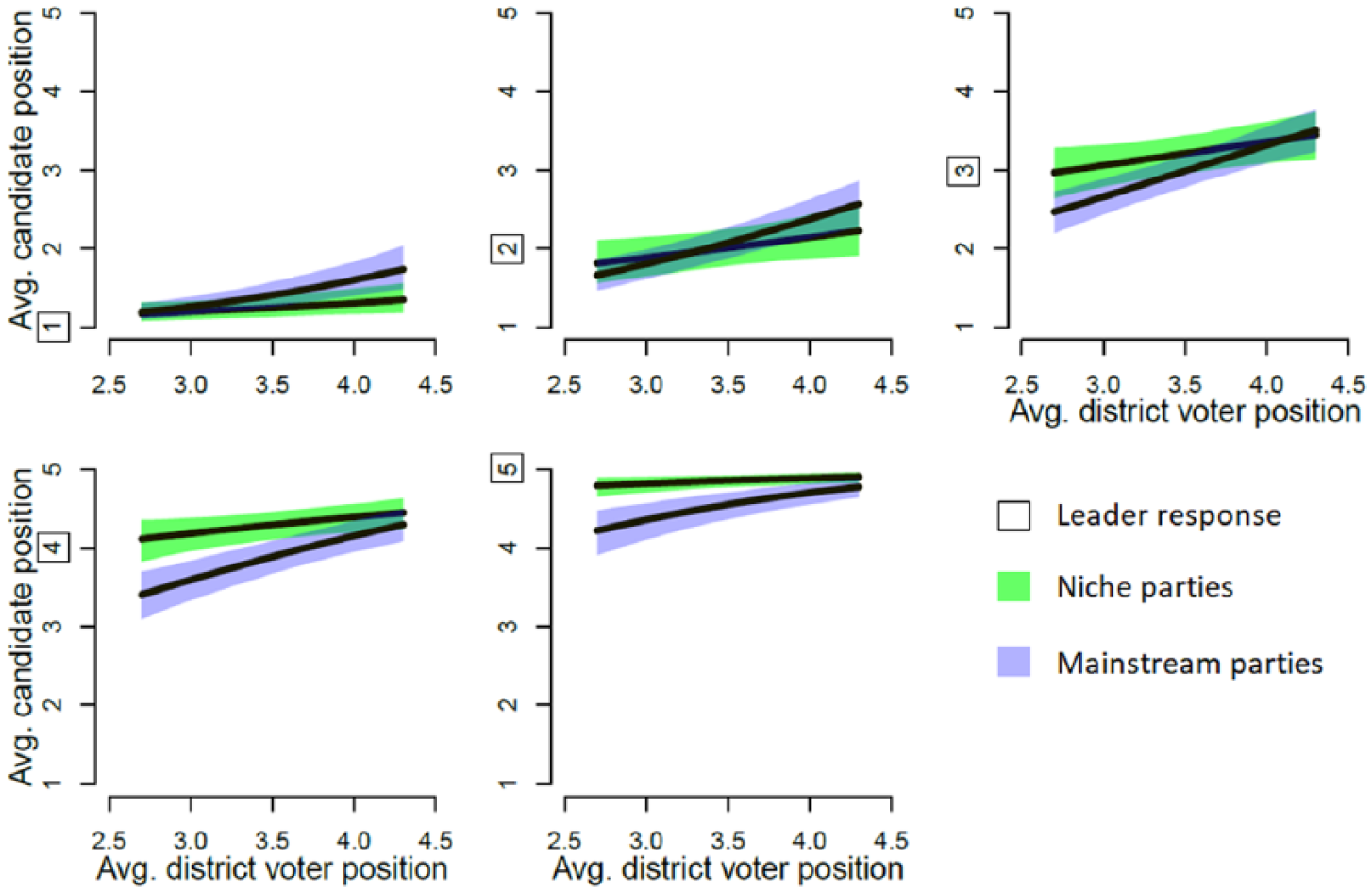
Candidate Position Taking in Niche and Mainstream Parties.
Figure 5 shows that the differences in the district voter position slopes for niche and mainstream party candidates are also statistically distinguishable from zero with p < .05 for issue statements where the party leader position is “1” and “5” (the differences in slopes are also significant for all other party leader positions with p < .1, which shown in Supplementary Material online Appendix E). 16 Collectively, the results in Figures 4–5 thus indicate that mainstream party candidates are systematically more responsive to the mean district voter than niche party candidates. These findings make theoretical sense because the party level electoral costs of perceived policy moderation are larger for niche parties than for mainstream parties (Adams et al., 2006). Consequently, these results provide further evidence that the shape of the candidate issue position distribution within parliamentary parties is determined, at least in part, by strategic incentives at the party level.

Marginal Effects of the Mean District Voter Position for Mainstream vs Niche Party Candidates.
Conclusion
This article has analyzed candidate position taking in parliamentary parties using Denmark as the empirical case. The main findings are that parliamentary candidates take positions that are strongly related to those of their party leader on issues that are salient to their party’s electoral brand, but that candidates are also influenced by the position of the mean district voter on less salient issues. Furthermore, the relationship between district voter positions and candidate positions is weaker for niche parties than for mainstream parties.
These findings contribute to recent research suggesting that parliamentary parties sometimes have an incentive to appeal broadly to different groups of voters with diverse policy preferences instead of taking clear and consistent policy positions (Bräuninger and Giger, 2016; Lo et al., 2016; Rovny, 2012; Somer-Topcu, 2015). So far, this literature has focused mostly on how parliamentary parties pursue this broad-appeal strategy in their manifestos, and it has not yet been determined how they resolve the tension between appealing broadly and protecting the informational value of the party’s label. The results presented here suggest that some parliamentary parties pursue both goals through their distribution of candidate issue positions. Specifically, mainstream parties in parliamentary democracies pursue the broad-appeal strategy by cultivating a distribution of candidate positions that is positively related to voter preferences at the district level, but they also protect the informational value of the party’s label by cultivating unity on the issues that are most salient to their electoral brand.
One important weakness in this article is that the empirical analysis does not conclusively disentangle whether the positive relationship between candidate and district voter positions on non-salient issues is caused by personal vote-seeking incentives, candidate self-selection, or active party leader behavior. The findings that the relationship is weaker on salient issues, and among niche party candidates, are indicative of strategies at the party leader level. However, in order to gain some more leverage on this important question, it will be useful to examine candidate position taking in institutional contexts where party lists are closed, and thus where the personal vote-seeking incentive to diverge from the party is low. However, doing so will require using alternative types of data (e.g. text analyses of candidate level campaign documents) because VAAs that inform voters about the issue positions of their individual candidates are not implemented in countries where voters cannot indicate a candidate preference on the party’s list.
Another possibility that will be interesting for future research to examine is how variation in issue salience among voters at the district level influences candidate position taking. On one hand, the party and candidate level benefits of appealing to district voters should be greater on issues that these voters care more about. On the other hand, party leaders have an incentive to protect the informational value of their party’s label on issues that are salient to their party regardless of whether the issue is also salient in a district. This suggests that the relationship between district voter positions and candidate positions may tend to be stronger on issues that are salient to these voters, but only when the issue is not simultaneously salient to the candidate’s party. However, this is an empirical question that I encourage future research to explore. Doing so will likely lead to a more nuanced understanding of party and candidate electoral strategies in parliamentary democracies—strategies that have important implications for the way that parliamentary representation works.
Supplemental Material
PSX765520_supplementary_material – Supplemental material for Issue Salience and Candidate Position Taking in Parliamentary Parties
Supplemental material, PSX765520_supplementary_material for Issue Salience and Candidate Position Taking in Parliamentary Parties by Mathias Tromborg in Political Studies
Footnotes
Funding
The author(s) received no financial support for the research, authorship, and/or publication of this article.
Supplementary Information
Additional supplementary information may be found with the online version of this article.
Figure 1b: The distribution of candidate positions in The Unity List (Enhedslisten) Figure 2b: The distribution of candidate positions in the Socialist People’s Party (Socialistisk Folkeparti) Figure 3b: The distribution of candidate positions in the Social Democratic Party (Socialdemokratiet) Figure 4b: The distribution of candidate positions in the Radical Party (Radikale Venstre) Figure 5b: The distribution of candidate positions in the Alternative (Alternativet) Figure 6b: The distribution of candidate positions in Christian Democratic Party (Kristendemokraterne) Figure 7b: The distribution of candidate positions in the Liberal Party (Venstre) Figure 8b: The distribution of candidate positions in the Conservative Party (Det Konservative Folkeparti) Figure 9b: The distribution of candidate positions in the Liberal Alliance (Liberal Alliance) Figure 10b: The distribution of candidate positions in the Danish People’s Party (Dansk Folkeparti) Table 1c: Demographic distribution of respondents in 2015 mass survey Table 1d: Random intercept variance for each variable in the multilevel regression stage: Pr(1) Table 2d: Random intercept variance for each variable in the multilevel regression stage: Pr(2) Table 3d: Random intercept variance for each variable in the multilevel regression stage: Pr(3) Table 4d: Random intercept variance for each variable in the multilevel regression stage: Pr(4) Table 5d: Random intercept variance for each variable in the multilevel regression stage: Pr(5) Table 6d: Mean district voter position Table 1e: Candidate positions, party leader positions, district voter positions, and issue salience Table 2e: Candidate position taking in niche and mainstream parties Figure 1e: Marginal effect of .1 increase in mean district voter position for mainstream vs. niche party candidates when party leader position = 2 Figure 2e: Marginal effect of .1 increase in mean district voter position for mainstream vs. niche party candidates when party leader position = 3 Figure 3e: Marginal effect of .1 increase in mean district voter position for mainstream vs. niche party candidates when party leader position = 4 Figure 1f: Candidate position taking on left-right and other issues Figure 2f: Candidate position taking in government and opposition parties Figure 3f: Candidate position taking on issues with unified and dispersed district voters Figure 4f: Candidate positions and issue salience within niche parties Figure 5f: Candidate positions and issue salience within mainstream parties
Notes
Author Biography
References
Supplementary Material
Please find the following supplemental material available below.
For Open Access articles published under a Creative Commons License, all supplemental material carries the same license as the article it is associated with.
For non-Open Access articles published, all supplemental material carries a non-exclusive license, and permission requests for re-use of supplemental material or any part of supplemental material shall be sent directly to the copyright owner as specified in the copyright notice associated with the article.
