




Abstract
Prior research has consistently identified education as an important correlate of political knowledge, which, many argue, reflects an underlying causal relationship. However, recent work has questioned this interpretation rather arguing that family background causes one to both obtain an education and to develop political knowledge. I argue that this causal-versus-proxy debate is too simplistic. Specifically, using a sample of identical twins, I test the interaction between education, political discussion in the home, and political knowledge. I find that education is positively associated with political knowledge independent of family background and genetics for those who discussed politics with family relatively little during upbringing. However, for those who discussed politics with family members more frequently, education has no association with political knowledge independent of pre-adult factors. Therefore, education compensates for a lack of exposure to political content in the home.
Introduction
Political knowledge is associated with a multitude of factors that are considered essential for democratic politics. Knowledge is argued to lead to greater support for individual rights (Bobo and Licari, 1989; Nie et al., 1996), greater political participation (Verba et al., 1995), and political efficacy (Carpini and Keeter, 1996), and knowledge is assumed to reflect a principle commitment to democratic rule (Nie et al., 1996). As Carpini and Keeter (1996: 7) put it: “no other single characteristic of an individual affords so reliable a predictor of good citizenship, broadly conceived.” Furthermore, political knowledge increases the likelihood that one votes for candidates who espouse policy positions consistent with one’s own (Fowler and Margolis, 2014; Singh and Roy, 2014). Therefore, not only is knowledge assumed to lead to more participation, but it also leads to quality participation aimed at effectively promoting the preferences of citizens. As democratic politics have become plagued by misinformation and fake news (Allcott and Gentzkow, 2017), understanding the factors that lead to political knowledge is of increasing importance.
Prior studies have consistently identified education as an important correlate of political knowledge (Carpini and Keeter, 1996; Nie et al., 1996; Rasmussen, 2016). Indeed, Carpini and Keeter (1996: 188) summarize their extensive study of the determinants of political knowledge as: “of all the individual demographic, structural, attitudinal, and behavioral variables we examined … education was the strongest single predictor of political knowledge.” However, the interpretation of this correlation is highly debated. Some argue that education is causally prior because of its aim to develop the cognitive capacity of students, and its influence on the social networks in which one engages both during and after school (Verba et al., 1995; Carpini and Keeter, 1996; Nie et al., 1996; Rasmussen, 2016). Therefore, raising the overall level of political knowledge in the population can be achieved by increasing the overall level of education.
Others, on the other hand, argue that the correlation is spurious. Proponents of this school of thought argue that pre-adult factors, such as genetics and family background, are believed to influence both one’s level of education and one’s political knowledge (Highton, 2009; Kam and Palmer, 2008; Luskin, 1990). A large literature has emerged, which attempts to differentiate between the genetic, family, and environmental determinants of political attitudes, and has found that a significant portion of the observed variance in political knowledge held by individuals is attributable to genetic factors alone (Alford et al., 2005; Arceneaux et al., 2012; Dawes et al., 2014; Hatemi and McDermott, 2012). However, it is not entirely clear to what extent these pre-adult factors confound the correlation between education and political knowledge as the literature has thus far been somewhat divided. For example, Rasmussen (2016) finds a strong effect of education after control for personality, intelligence, and parental factors. But Highton (2009) finds no effect of college education on political knowledge with longitudinal data, and Weinschenk and Dawes (2018)—using the same data analyzed in this article—find that the relationship between education and political knowledge is highly confounded by pre-adult factors.
Extant research has largely focused on this causal-versus-proxy debate (see Persson (2015b) for an overview). This present study aims to further this literature by aiming to uncover not if, but under which conditions, a causal effect is more likely. The particular condition on which I focus, family background, is one of the most enduring explanatory factors of political behavior and attitudes in the literature (Campbell, 1960). Individuals are more likely to vote if their parents vote (Jennings and Niemi, 1981), they are likely to support the same political party that their parents support (Hooghe and Boonen, 2015; Westholm and Niemi, 1992), and they are more likely to be politically knowledgeable if their parents have political knowledge (Jennings, 1996). In Jennings’ (1996) study of the factors related to an individual’s political knowledge, the level of knowledge held by one’s parents was the only consistently significant and substantial predictor—apart from one’s own level of education. Furthermore, the degree to which parents transmit political attitudes varies as parents themselves vary in their political knowledge and engagement (Hooghe and Boonen, 2015; Jennings and Niemi, 1981; Jennings et al., 2009; McIntosh et al., 2007).
In this article, I focus on the interaction between a particular aspect of parental socialization, political discussion in the home, 1 and education. Specifically, this study asks, does political discussion in the home condition the effect of education on political knowledge? Parental socialization as a conditioning factor has been examined in the civic education (Campbell, 2008) and political participation literatures (Lindgren et al., 2018), but to the best of my knowledge, it has not yet been linked to formal education and political knowledge. In this study, political knowledge is defined as factual knowledge of the political system and is measured as a summed index of five multiple-choice survey questions.
In order to answer this question, I implement a co-twin design in which I match identical twins to one another in order to estimate the effect of education with family fixed effects (FFE). This setup allows me to control for pre-adult factors, such as genetics and family background as they are assumed fixed within twin pairs. In this respect, the co-twin design allows one to overcome many of the identification issues discussed in the causal-versus-proxy debate, while allowing one to model differences between families in order to study the effect of education conditional on family background. I analyze data from the Minnesota Twin Political Survey (MTPS), 2 a cross-section of identical twin pairs collected in 2008/2009 (Nebraska-Lincoln, 2017). This article proceeds as follows: I first review the literature and outline the conditional hypothesis. Following, I introduce the data and research design. The subsequent analysis contributes to the field of political knowledge by testing the interaction between education, parental socialization, and political knowledge. In the final section of the article, I discuss the generalizability of the findings through comparison to a nationally representative sample. I find that for individuals from homes in which politics were discussed comparatively little that education has a positive association with political knowledge independent of pre-adult factors, but that no such association is found among those who discussed politics relatively frequently. Thus, while lacking a general effect independent of family background, education has the capacity to compensate for low political socialization in the home.
The Interaction Between Education and Parental Socialization
In a highly influential piece, Luskin (1987) argues that political knowledge comprises three underlying dimensions: opportunity, motivation, and ability. Education takes a prominent role in the discussion of the determinants of political knowledge because it is assumed to impact upon all three dimensions, either directly or indirectly. The direct impact of education arises as a result of its role in the cognitive development of students (Verba et al., 1995); schooling develops one’s cognitive capacity sufficiently such that one can seek and understand vast amounts of information in the political world (Sunshine Hillygus, 2005). College education has been claimed to be of particular relevance in developing these skills given the central focus on writing proficiency and civics (Carpini and Keeter, 1996; Highton, 2009), and through the encouragement students receive to engage in civic or service learning programs (Galston, 2001). The indirect effect of education results from the impact that education has on peer groups and social networks in which one is situated (Biggs, 2016; Campbell and Horowitz, 2016; Harris, 1995; Nie et al., 1996). Social networks and peer groups provide opportunity—engagement in organizations makes one more likely to come into contact with government agencies and regulations (Nie et al., 1996); motivation—such regulation may affect one’s activities; and ability—individuals can gain political information from other network participants, which lowers the cost of participation (McClurg, 2003).
Parental socialization similarly has the ability to impact upon the three underlying dimensions of political knowledge. Parents who discuss politics with their children provide them the opportunity to engage with the political world, socialization can imbue in children the importance of political engagement thereby providing motivation, and discussion allows children to develop their ability to engage with and understand political information. Social learning theory highlights the frequency of cues as instrumental in defining the extent of transmission (Bandura, 1969), and subsequently, political discussion in the home has been identified as a particularly salient mechanism through which family background can affect attitudes and behavior (Hooghe and Boonen, 2015; Jennings et al., 2009). McIntosh et al. (2007) find the frequency of parent–youth political discussion to be the strongest predictor of youth political knowledge among a battery of parental characteristics. In line with the Luskin’s (1987) conceptualization, the authors theorize that discussion allows children to develop a cognitive understanding of the political world: “The give-and-take of family political discussion … provides the opportunity for youth to construct their own political understanding” (McIntosh et al., 2007: 497).
The intersection of these two purported causal factors is of particular interest. Given that both education and parental socialization are assumed to impact upon political knowledge in similar manners, it is plausible that these two factors reinforce one another (Lindgren et al., 2018). Individuals who are exposed to political content in the home are provided with an understanding of political concepts before they ever set foot in the classroom (Van Deth et al., 2011). If subsequent development in schooling and exposure to political content in the curriculum allow these individuals to develop their political understanding at a greater rate than children who do not have the same stimulus in the home, education should exacerbate pre-existing differences. In this case, education may have an acceleration effect on political knowledge as it would serve to reinforce pre-existing differences (Neundorf et al., 2016):
H1: Political discussion should positively interact with education to strengthen education’s effect on political knowledge.
However, it may also be the case that education compensates for a lack of exposure to political content in the home if education and political discussion act as substitutes (Lindgren et al., 2018). As Jennings et al. (2009: 787) put it: “low levels of parent politicization should leave the child either bereft or relatively open to influence from other socializing agents.” Education can fill this void by providing exposure to political content and allowing individuals to close the gap to their high-discussion peers. This mechanism becomes particularly plausible if political knowledge is characterized by a ceiling effect (Neundorf et al., 2016). In such case, those who come from home environments with high levels of political discussion should have high baseline levels of knowledge compared to those from low-discussion homes, and therefore, less room to improve outside of the home (Neundorf et al., 2016). According to the compensation hypothesis, education should serve to reduce differences in political knowledge between high and low socialization homes:
H2: Political discussion should negatively interact with education to weaken education’s effect on political knowledge.
Data
The data for this study come from the MTPS of the Minnesota Twin Registry, which contains 337 full twin pairs (674 individuals) with complete responses for the relevant variables. I use only monozygotic (identical) twins as they share 100% of their genetic material thereby excluding dizygotic (fraternal twins) to ensure the greatest similarity within matched pairs. The individuals were all born between 1947 and 1956, and data were collected in 2008/2009 meaning that respondents were in their early 50s or 60s at the time of the survey. The data are collected long after individuals would have completed their education, but as political engagement for most does not begin until later in life, whether or not education allows individuals to maintain political knowledge into late adulthood is arguably of greatest relevance (Highton, 2009). Furthermore, as Jennings et al. (2009) show, political knowledge is unstable among individuals in the decade after high school graduation, before eventually settling in one’s 30s and middle age.
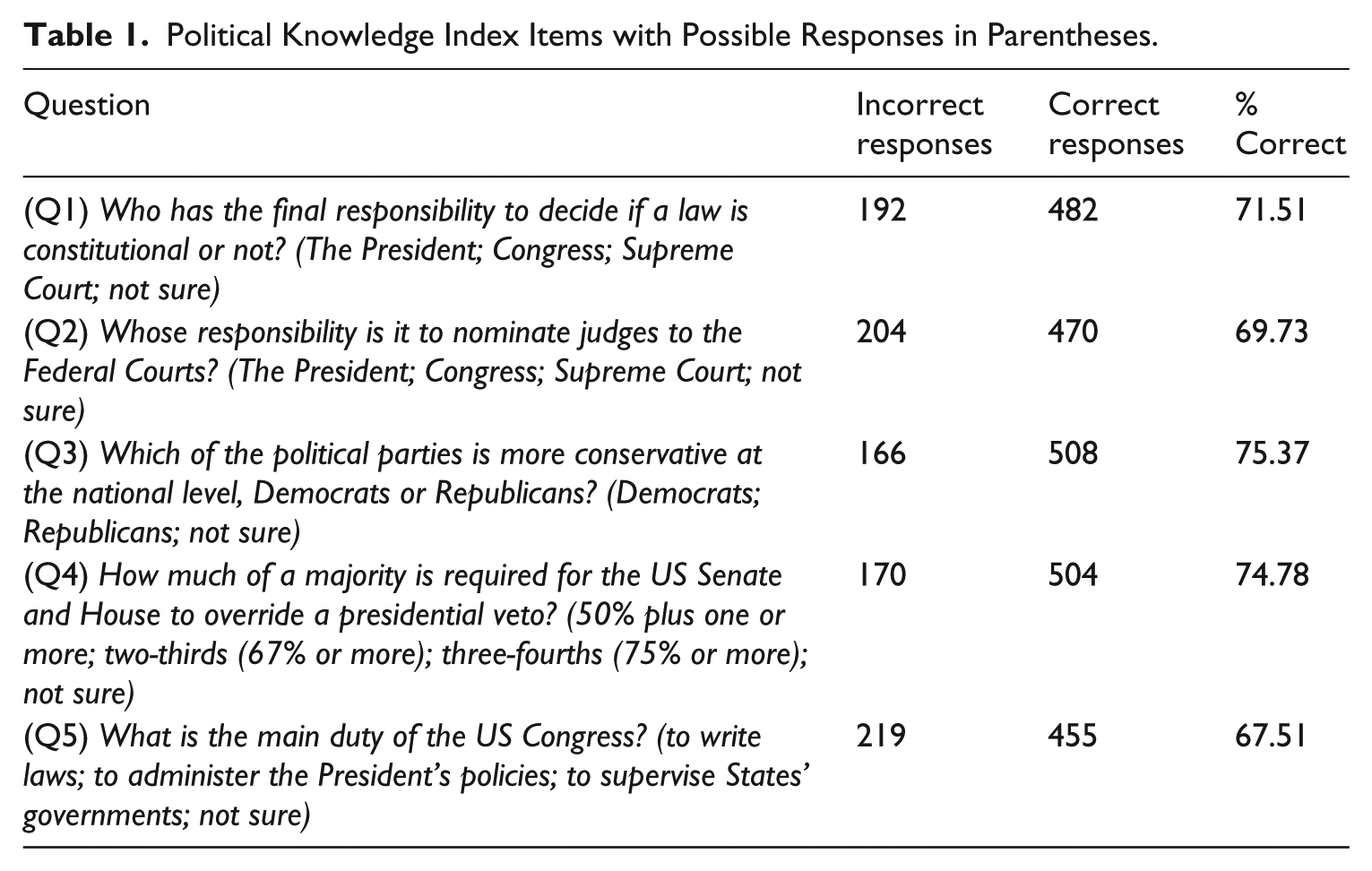
Political knowledge is measured with five multiple-choice items, shown in Table 1. Correct responses are coded as 1, incorrect or “not sure” responses are coded as 0, which I then combine into a single summed index. The resulting political knowledge index ranges from 0 to 5 and represents the number of correct responses to the battery of questions. Political knowledge in general is assumed to be multidimensional differentiated both in terms of topic (general or policy-specific) and temporal stability (static or variable) (Barabas et al., 2014; Söderström, 2018). The items used in this study are exclusively related to the general and static dimensions; four of the index items are outlined in the constitution, and the fifth, which of the political parties is more conservative at the national level, has been stable for decades (Barabas et al., 2014). Knowledge of enduring processes and institutions is starkly different from variable, surveillance issues that may change with election cycles or in accordance with current events. Importantly in the study of the effect of education, general–static factors are most typically taught in school. Therefore, prior research suggests that while the effect of education on political knowledge may be variable across the different dimensions (Barabas et al., 2014; Jennings, 1996), it is assumed to have the strongest effect on the general–static dimension.
Political Knowledge Index Items with Possible Responses in Parentheses.
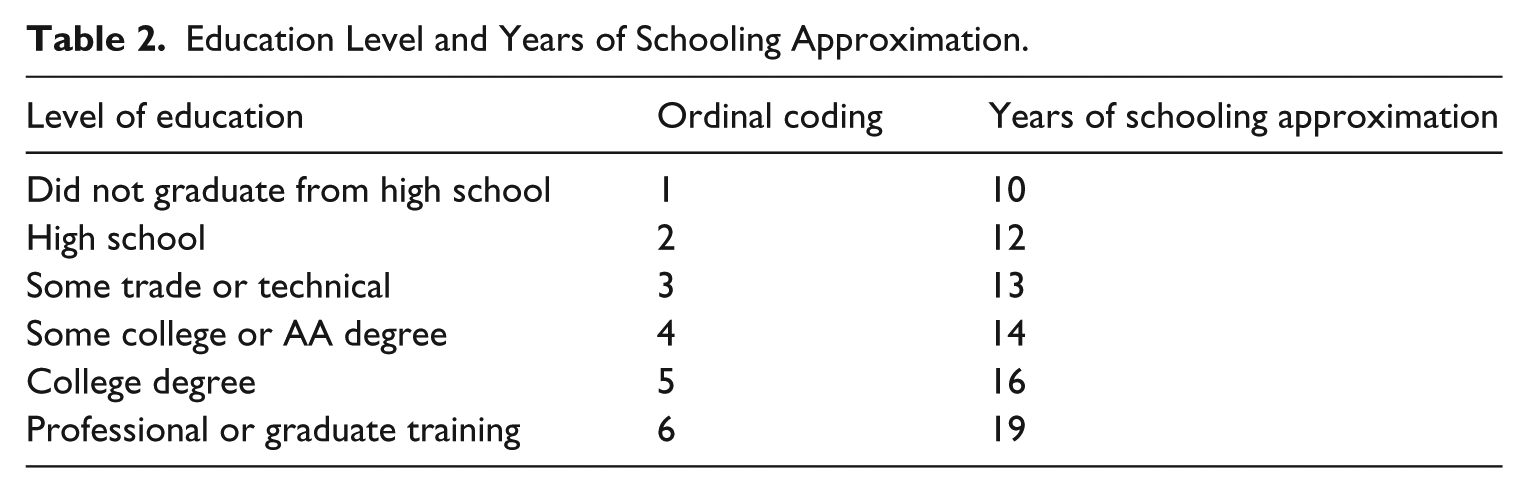
Education is measured on a 6-point ordinal scale, which I convert to a years of schooling approximation for regression estimates in following Dinesen et al. (2016). The lowest category pertains to those who did not complete high school, and a high school diploma designates the second step. The remaining four values of this variable relate to post-secondary education of some kind, from trade school to professional or graduate study. The variable values and the summary statistics indicate that the majority of variation in this variable is related to post-secondary schooling (descriptive statistics are shown in Table 3 of the “Within-Family Variance” section). This has some implications for the study of education because such variation creates difficulties in discerning potential nonlinear effects (a point to which I return in the discussion of robustness in the “Results” section). However, college education has been highlighted in prior research as being of particular importance to the development of political attitudes and political knowledge (Campbell and Horowitz, 2016; Carpini and Keeter, 1996; Highton, 2009), which makes a highly educated sample favorable to the education-as-causal theory (Table 2).
Education Level and Years of Schooling Approximation.
To test the hypothesis that family background conditions the effect of education, I use a measure of self-reported political discussion with family other than one’s twin during upbringing (a 4-point ordinal scale). 3 This variable is then averaged based on the scores of both twins to create a family-level operationalization of political discussion, in line with the theoretical argument. As such, political discussion during upbringing is constant by construction within twin pairs, which makes explicit the assumption that parents treat identical twin siblings similarly. Furthermore, taking the average of both twins should reduce measurement error and other forms of poor data quality that may arise from recollection (more discussion on this in the “Within-Family Variance” section).
While studies of the compensation hypothesis in the civic education literature often explicitly theorize that “stimulating discussions at home” (Persson, 2015a: 589) determine the compensatory potential of education, rarely is political discussion measured. 4 Typically, proxies, such as parental education, number of books in the home (Campbell, 2008; Persson, 2015a), or ethnicity of respondents (Campbell and Niemi, 2016) are used. While it is well-known that these family-level variables correlate with most forms of political engagement (Verba et al., 1995), the use of such measures relies on the assumption that they capture the effect of political socialization and not some other mechanism, for example, shared material interests. There is good reason to believe that discussion is a more appropriate measure of political socialization than the above-mentioned proxy variables. It does not matter if there are a large number of books in the home if they are not read; similarly, parents with comparatively low education or socioeconomic status may nevertheless be active politically through other avenues such as unions. Therefore, for a test of parental socialization, political discussion maintains high theoretical validity.
Estimation
Estimates are calculated by matching identical twins in an FFE regression model (Ashenfelter and Krueger, 1994; Campbell and Horowitz, 2016; Dinesen et al., 2016; Oskarsson et al., 2017; Schnittker and Behrman, 2012; Weinschenk and Dawes, 2018). In short, the difference in observed political knowledge is modeled as a function of the difference in years of education within twin pairs. In order to test the conditional hypothesis, I include an interaction term between political discussion and education as shown in equation (1). I do not include its lower order covariate in the FFE models due to the constant nature of political discussion within twin pairs. For simplicity of interpretation, I use a dichotomous variable defined as those above or below the mean value of political discussion, but the interpretation of the results does not differ when the full measure is used.

Equation (1) outlines the estimation strategy in which P represents political knowledge for twins 1 and 2 of family j, E is education for twins 1 and 2, D is political discussion in the home during upbringing (assumed constant within families and therefore not subscripted by twin), and u is the error term unique to each individual. As a benchmark, I run all models with standard ordinary least squares (OLS) estimation and controls for gender and age—that is, without FFE. I refer to these models as “OLS” in the results’ table.
Within-Family Variance
The FFE models rely exclusively on variance within twin pairs in estimating the effect of education independent of family background, which warrants further discussion and exploration of this variance. In Table 3, I report descriptive statistics of the variables of interest including the proportion of total variance that is explained within twin pairs. Compared to between-family variance, which is simply 1 minus the within-family variance, far less variability is observed constituting below 50% of the total variance in all cases. This should not be a surprising result; one should expect identical twins to be more similar to one another than they are to individuals from different families. That political discussion shows the highest variability within twin pairs is an interesting finding, one for which the interpretation is not entirely clear. It is possible that this represents meaningful variation if, for example, parents discussed politics more frequently with one child than the other. However, this seems unlikely. For instance, upon examination of a second, similar question: “And how often did you and your twin talk about politics and public affairs when you were growing up?” which should have zero variance within twin families in the (unrealistic) scenario of perfect measurement, I find that the proportion of within-family variance is nearly identical to the main discussion measure, 0.43. Given such high variability in responses for a measure that should theoretically have no within-family variance, it is more plausible that the high variability of political discussion is due to measurement error, most likely the result of recollection.
Descriptive Statistics.

SD: standard deviation.
Within twin pair variance calculated in Stata by performing a null xtreg model to obtain the intraclass correlation (ICC). The column value is then 1—the ICC for each variable.
Self-reports of political discussion are commonly used in political science (see McClurg, 2003; McIntosh et al., 2007) and one concern that has been raised is that individuals’ subjective assessment of the frequency of discussion may differ between interlocutors. Contrary to the discrepancy I highlight above, Huckfeldt and Sprague (1995) investigate the perceptions between discussion partners and find that individuals evaluate the nature of discussion similarly, and assess their partner’s perception of discussion quite well. This result has been a motivating factor in the use of self-reports in discussion research. The primary difference between Huckfeldt and Sprague’s (1995) sample and the MTPS is the that the latter are self-reports based on recollections of political discussion during upbringing rather than recent discussion.
A second possible source of discrepancy is that the measure of discussion may be subject to social desirability bias. It is well-known that survey measures of democratic behavior are subject to over-reporting; self-reports of voter turnout (Holbrook and Krosnick, 2010), rejecting gifts for votes (Gonzalez-Ocantos et al., 2012), and attention to media or current affairs (Prior, 2009) have all been shown to be biased, a phenomenon that is more prevalent among the higher educated (Karp and Brockington, 2005). It is reasonable to assume that a similar mechanism may be at work with regard to recollections of political discussion during upbringing. If individuals view political discussion as a socially desirable behavior, there is a significant risk that observed values are inflated. If this inflation is increasing in education, regression estimates would be positively biased thereby invalidating results. Using the average within twin pairs can therefore be seen as methodologically advantageous as it alleviates issues related to low-quality data, whether this is the result of measurement error, social desirability bias, or both. In order to further validate this claim, I implement two robustness checks in the “Analysis” section in which I use the minimum and maximum reported discussion measures within twin pairs rather than the average—all results show the same overall pattern (see Appendix A).
To examine in more detail the within-family variance, I plot histograms of the differences in education (on the original ordinal scale) and political knowledge (in index form) between identical twins. In both cases, it is more common that twins differ in their level of education and political knowledge than are the same. Fifty-three percent of twin pairs report different levels of education, whereas 63% score differently on the summed political knowledge index. Slightly greater discrepancies are found in the political knowledge index for which the mode is a difference of one point on the summed index, roughly 40% of respondents (Figure 1).
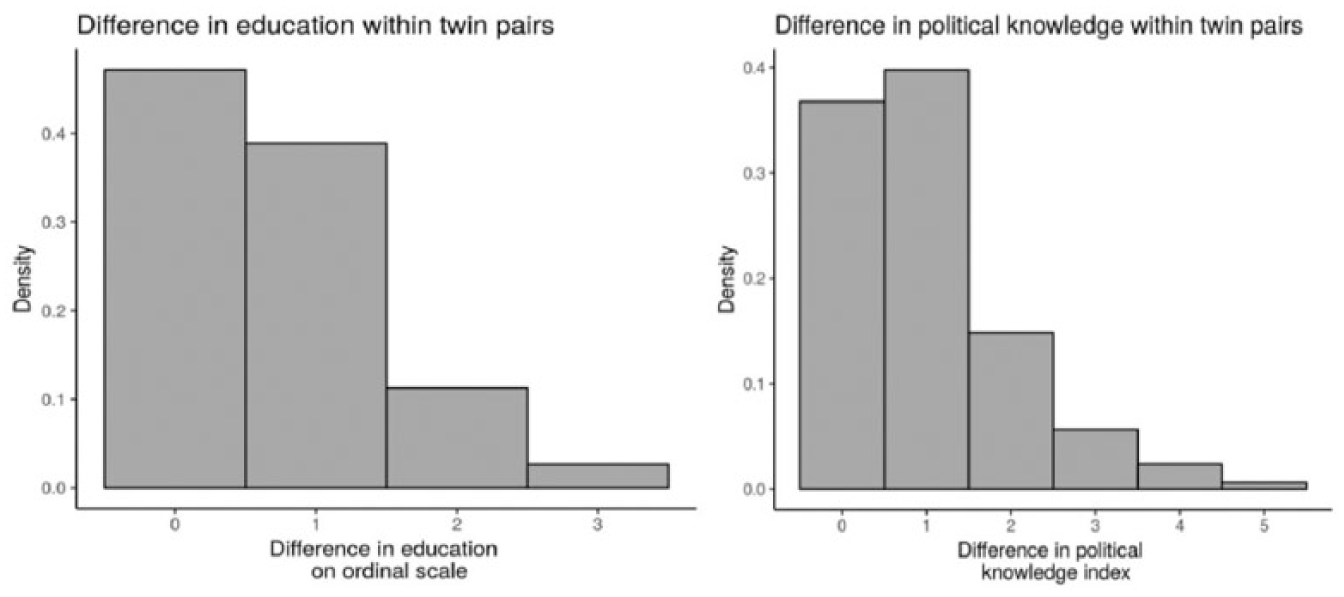
Histograms of the Differences in Education (Ordinal Scale) and Political Knowledge (Index) Within Identical Twin Pairs.
Differences in education are, on the other hand, smaller; the modal category is no difference between twins. Roughly, 40% of twin pairs are separated by one level of education, 11% report a difference of two, but only 3% a difference of three levels of schooling. No family reports a difference between twin siblings of four levels of education or greater. Only 8 of 674 individuals in total did not complete high school, and of those eight, two individuals are from the same twin pair. The differences in education within twin pairs are shown in Figure 2 in which I plot the lower-educated twin’s level of education along the x-axis, and the higher-educated twin’s level of education along the y-axis. A dashed 45 degree line is shown to denote equality, and points are jittered for presentation.
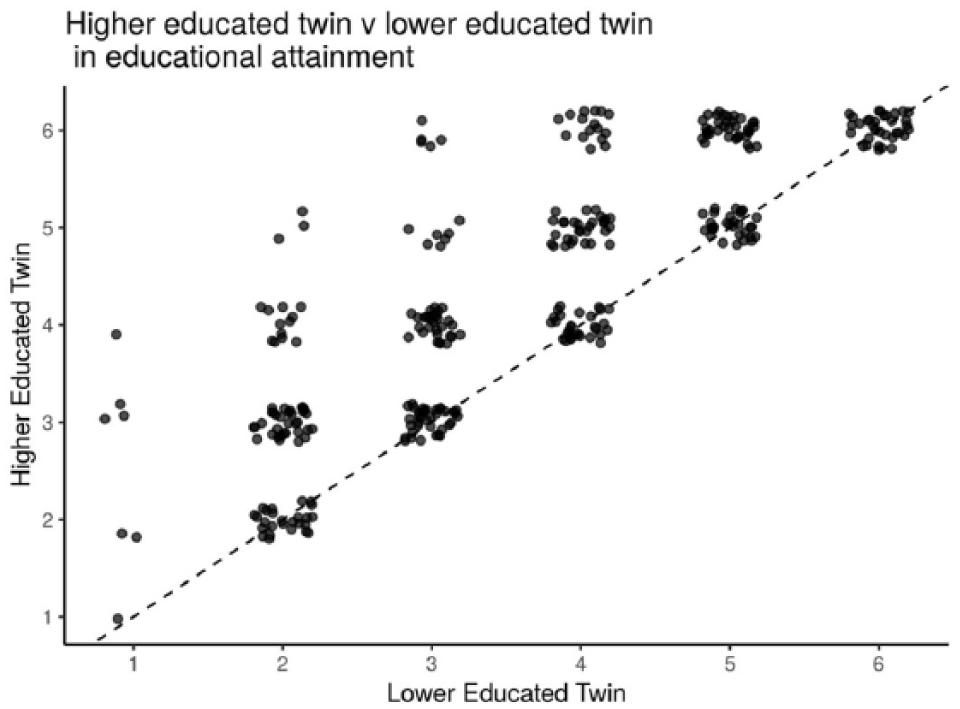
Scatterplot of the Differences in Education Within Twin Pairs.
Estimates of the Effect of Education on Political Knowledge
Before the estimation and presentation of regression results, it is useful to examine some simple cross-tabulations of the relationship between education, political knowledge, and political discussion in the home. To do so, I build on the distinction between the lower- and higher-educated twins from within each family, and cross-tabulate the corresponding levels of education and political knowledge. I maintain the original coding of education level in order to present raw results of the data without the corresponding assumptions that are induced with the conversion of the qualitative education variable to a quantitative measure of years of schooling.
As can be seen in the upper half of Table 4, the higher-educated sibling in identical twin pairs is expected to report 0.7 levels of education more than their lower-educated sibling. However, a corresponding difference in political knowledge is not observed—those with more education are expected to only marginally score higher on the political knowledge index, 0.08 points of the 6-point scale. The lower half of the table extends the political knowledge analysis by including a dichotomous measure of political discussion in the home. Here the results become more nuanced. Among low-discussion homes, the higher-educated twin is expected to score 0.25 points higher on the political knowledge index, but a slightly negative difference appears among the high-discussion homes.
Cross-tabulation of Education and Political Knowledge.

Standard errors in parentheses.
Regression estimates, shown in Table 5, provide a more rigorous test of the above cross-tabulation and can shed light on whether the observed differences above are large enough to constitute more than chance variation. In Model 1, I use standard OLS with controls for gender and age. Consistent with a large literature in political science, I find a positive relationship—the point estimate for years of schooling is 0.262 and highly statistically significant. In this sample, education varies from 10 to 19 years of schooling. As such, moving from the lowest to highest value of education corresponds to an expected increase in political knowledge of 2.4 points on the 6-point scale. In Model 2, I introduce the conditional model, again with standard OLS estimation and controls for age and gender. The lower-order estimate of years of schooling, or the estimated effect of education in homes with below average political discussion, is substantially larger than the coefficient from Model 1. Furthermore, the interaction term between schooling and discussion is negative and highly significant, which indicates that the correlation between education and political knowledge is weaker among those from high-discussion homes. However, the magnitude of the interaction term is not sufficient as to reduce the association between education and political knowledge to zero in these high-discussion homes. In other words, based on standard OLS estimation, we would conclude that education is positively associated with political knowledge for all, but that this association weakens somewhat as individuals are exposed to greater levels of political discussion in the home.
The Association Between Education and Political Knowledge.

FFE: family fixed effects; OLS: ordinary least squares.
Standard errors in parentheses (clustered by family in FFE models).
FFE models calculated with xtreg in Stata—xtreg calculations are made by differencing out the fixed effects, which make direct comparison of OLS versus FFE R2 estimates invalid.
p < 0.01, **p < 0.05, *p < 0.1.
In Model 3, I introduce FFE and estimate the general association between education and political knowledge. This model is, therefore, comparable to the OLS estimate from Model 1. Gender and age terms are not included in the FFE models because they are fixed within families; any variation that may arise due to gender and age in this sample is purely at the family level and is therefore captured in the FFE. The introduction of FFE diminishes the point estimate of education substantially to 0.056, which eliminates statistical significance, and effectively eliminates all practical significance. Based on this estimate, moving from the lowest value of education to the highest only corresponds to a 0.5-point increase in political knowledge on the 6-point scale. It is clear from these results that pre-adult factors have a strong confounding effect on OLS results. This result is consistent with Weinschenk and Dawes (2018), who find with this dataset that the relationship between education and political knowledge is highly confounded by pre-adult factors. The conversion of the ordinal education measure to a years of schooling approximation makes this confounding more apparent. While Weinschenk and Dawes (2018) find that education has very small impact on political knowledge independent of pre-adult factors, I find here that the confounding effect of pre-adult factors is large enough to eliminate any positive effect of education. 5
But the conclusion that education has no, or only little, impact on political knowledge after control for family background and genetics as claimed by Highton (2009) and Weinschenk and Dawes (2018) is premature. In Model 4, I introduce the interaction term between education and political discussion during one’s upbringing which depicts a more nuanced relationship. The lower-order years of schooling term—the estimated effect of schooling for those from low-discussion homes—is nearly three times as large as the point estimate from Model 3, and is statistically significant at the 95% confidence level. For those from low-discussion homes, a 1-year increase in schooling corresponds to a 0.16-point increase in political knowledge. Equivalently, moving from the lowest value of education to the highest yields and expected increase in political knowledge of 1.44 points, roughly 1 standard deviation. Furthermore, the interaction term is statistically significant at the 99% level. The point estimate of the interaction, –0.195, is large enough to completely negate the positive lower order effect of years of schooling. The expected effect of 1 year of schooling on political knowledge among those from high-discussion homes is −0.035. These results provide strong evidence in support of Hypothesis 2. While there is no general association between education and political knowledge independent of family background and genetics, there is a compensation effect. Among those from homes with little political discussion during upbringing, education has a positive effect on political knowledge in adulthood. But, for those individuals that frequently discussed politics in the home during upbringing, education has no effect.
Robustness and Nonlinearity Checks
I run two robustness checks in which I operationalize discussion as the minimum reported value within twin pairs and as the maximum value. These results are presented in Online Appendix B and are consistent with the main results given above. These tests are useful to substantiate the assumption that recollected political discussion provides a valid yet imprecise measure of political discussion during upbringing. Furthermore, as I operationalize this as a family-level variable, it is reassuring to find that different methods of aggregating political discussion within families do not alter the findings presented above.
As a further robustness check, I relax the assumption of a linear functional form for the relationship between education and political knowledge. As prior research has identified college education in particular as having an instrumental effect on political knowledge (Carpini and Keeter, 1996; Highton, 2009), it may be the case that college education impacts on political knowledge, but that other levels of education have no effect. In order to test this, I create a three-level education variable coded as High school or lower, Some college, and College or higher. 6 I then re-run Model 4 of Table 5 using these levels as dummy variables interacted with political discussion. This strategy allows each of the different combinations of the three levels of education and two levels of political discussion an independent estimated level of political knowledge.
I present a marginal effects plot of the results in Figure 3 (the regression results can be found in Online Appendix B). As can be seen, for those from homes with high levels of discussion, there is no expected increase in political knowledge as education increases. The point estimates, shown in gray, indicate that political knowledge remains largely constant as level of education rises. However, the corresponding points for those from low-discussion homes, in black, show a positive, linear effect of education. The large gap in political knowledge between high- and low-discussion homes at the lowest level of education is completely eliminated at the highest level of education. Interestingly, there is no distinct jump as a result of college education for either group, but this may be the result of the highly educated sample examined here.

Marginal Effects Plot—Education as Three-Category Ordinal Variable.
Representativeness of the MTPS Sample
The MTPS sample is restricted by age and geography, which raises the question as to how far results can be generalized. The political socialization literature has discussed the issue of whether or not the generation brought up during the 1960s, such as those individuals who make up this sample, represent a unique case for socialization given the highly politicized era in which individuals were raised (Jennings et al., 2009). Furthermore, twin samples themselves are generally not descriptively representative of the wider population, which is also the case with the MTPS (see Online Appendix B for a descriptive comparison to a nationally representative dataset). But previous studies have nevertheless argued that results from the co-twin design can be cautiously generalized to the wider population (Dinesen et al., 2016). To support this assumption, at a minimum, it must be shown that the correlation between education and political knowledge found in the MTPS sample is consistent with that found in a representative sample. This test is not sufficient to definitively conclude that results from the MTPS should be viewed in more general terms, but it does lend some support to the notion.
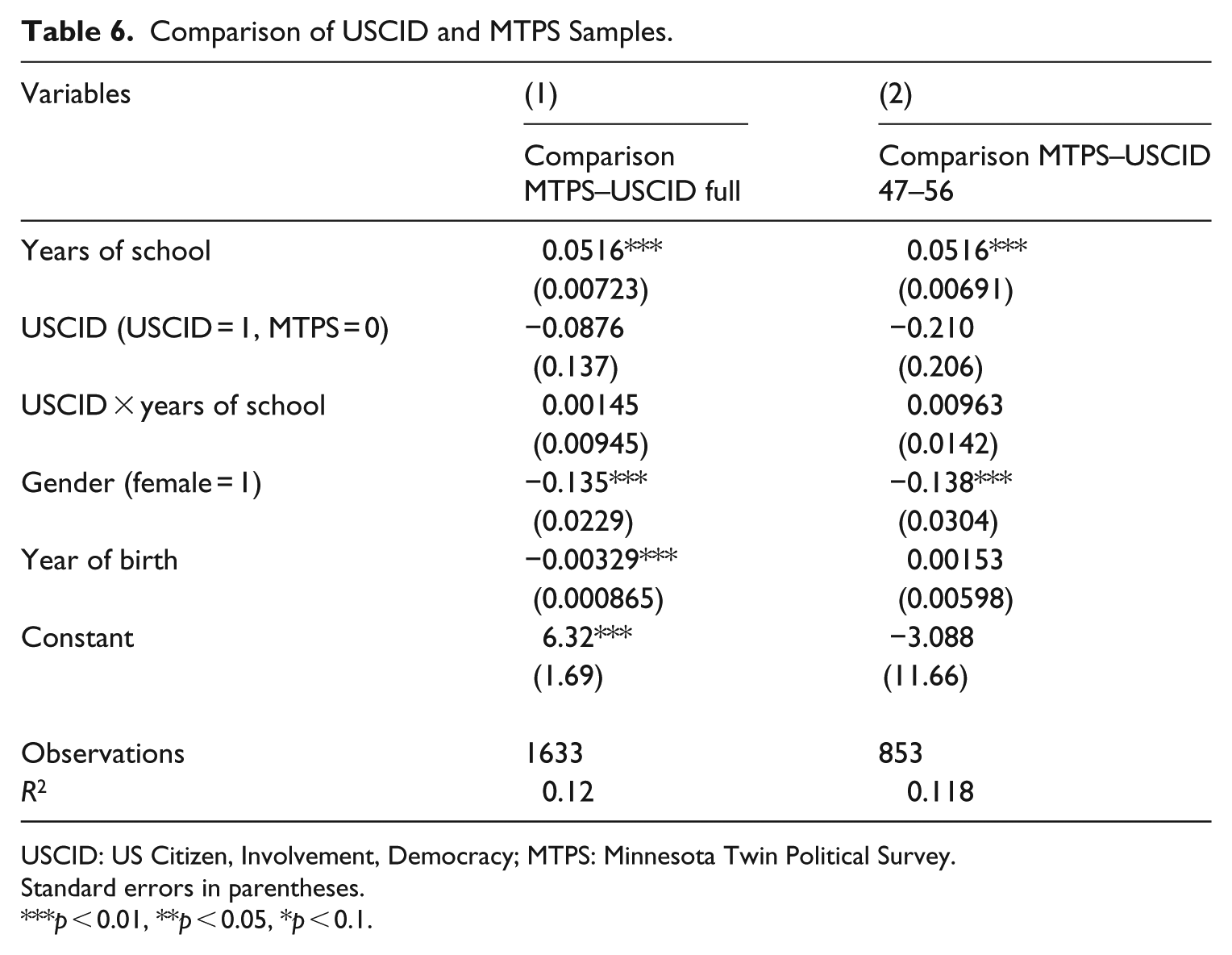
To this end, I compare the correlation between years of schooling and political knowledge in the MTPS sample with that of a nationally representative sample—the US Citizen, Involvement, Democracy dataset (USCID; Howard et al., 2016). Specifically, I append the datasets and create a dummy indicator (USCID = 1, MTPS = 0) which specifies the dataset to which an individual observation belongs. I then regress political knowledge on the interaction between years of schooling and the dataset identifier in a linear probability model. I include controls for gender, age, and the appropriate lower order variables. There is only one political knowledge item common to both surveys, responsibility for determining constitutionality, 7 which precludes the use of the full index.
The results of this test are shown in Table 6. The primary coefficient of interest is the interaction term USCID × Years of Schooling, which captures the difference in the estimated effect of years of schooling on political knowledge between the two datasets. As can be seen, there is no evidence of a difference (I also estimate the relationship in each sample separately and find the same results, see Online Appendix B). The USCID variable is coded such that 0 indicates the MTPS sample and 1 indicates the USCID sample. Therefore, the Years of School term represents the correlation between education and political knowledge in the MTPS sample, which is equal to 0.0516 in both models. That is, among MTPS respondents, 1 year of schooling increases the likelihood of correctly responding to the political knowledge item by 5.2%. The correlation between education and political knowledge in the USCID sample is equal to the Years of School term plus the USCID × Years of School term (0.0516 + 0.001 in Model 1, 0.0516 + 0.009 in Model 2). The large standard error for this coefficient indicates that there is no evidence to suggest that the estimated difference represents more than chance variation. Therefore, this test shows that the observed association between education and political knowledge found in the twin sample is by no means unique to this sample, thereby providing some support to the notion that MTPS results can be cautiously generalized to the wider population.
Comparison of USCID and MTPS Samples.
USCID: US Citizen, Involvement, Democracy; MTPS: Minnesota Twin Political Survey.
Standard errors in parentheses.
p < 0.01, **p < 0.05, *p < 0.1.
One might argue that Model 2 shows evidence of a difference but that estimates are imprecise due to the small sample size. The interaction term of 0.009 suggests that USCID respondents are approximately 1% more likely to have answered correctly given equal levels of education. With a baseline estimate of 5.1%, a 1% increase is perhaps not trivial. However, the MTPS coefficient is smaller than the USCID, which indicates that the twin sample underestimates rather than overestimates any relationship. Therefore, even with this optimistic interpretation, I still find support for a cautious generalization of the main findings of this article.
Conclusion
Much of the focus of education research in the empirical political behavior literature has centered on the causal-versus-proxy debate. Does education cause political knowledge? Or do pre-adult factors, such as family background and genetics determine both level of education and political knowledge? While there are some mixed findings from this work, several studies have found support for the proxy hypothesis. Weinschenk and Dawes (2018), for example, argue that the effect of education on political knowledge is highly confounded by pre-adult factors, such as genetics and family background, a result uncovered using the same data analyzed in the current study.
I argue, however, that this view is too narrow as it does not consider that a proxy interpretation may be more likely under certain circumstances. One such circumstance is the extent to which parents expose their children to political content. This article focuses on one specific family-level factor and how it interacts with education, the amount of political discussion in the home. I test the conditional hypothesis with a twin-matching design that holds constant the effect of pre-adult factors, such as genetics and family background, while allowing one to model the variability in discussion of political content observed across families. I find that education has a positive association with political knowledge independent of pre-adult factors for those who discussed politics relatively less frequently in the home, but no association independent of pre-adult factors for those who discussed politics frequently with family members.
These findings are striking given the prominence placed upon education in the political knowledge literature (Carpini and Keeter, 1996), and important given the relevance of an informed citizenry in democratic theory (Dahl, 1989). As citizens of democratic politics are increasingly exposed to political information from a variety of sources, in some cases with the specific intention to deceive (Allcott and Gentzkow, 2017), understanding what causes individuals to learn and retain factual information about the “rules of the game” is of great importance. Furthermore, the ability of policy makers to implement programs to encourage such knowledge hinges upon an understanding of the processes in which knowledge is formed. That the most prominent factor identified by past research for the development of factual knowledge is shown here to be relevant only under certain conditions calls for greater focus on family background in empirical education research.
From a theoretical perspective, it is of great interest that education does not have a general effect on political knowledge independent of family background. This leads to a sharp caveat with respect to prior theory: education may be a causal factor of political knowledge, but only for those who are not exposed to political content in the home. However, from a policy perspective, these results underline the immense importance of education. What should be of greatest interest to policy makers and those who wish to promote a strong democratic culture is to ensure that individuals have equal opportunity to exercise their democratic rights. However, this opportunity is restricted if systematic background factors yield an unequal distribution of knowledge, which is required to meaningfully participate in the democratic process. As I show here, education has the capacity to substantially reduce these inequalities. Therefore, the results from this study heighten the importance of education from a policy perspective, while simultaneously weakening the importance of education from a theoretical perspective.
The results of this study are of further interest because of the type of political knowledge measured. The factors that make up the index are all related to general, static forms of political knowledge, such as institutions and processes—precisely those that are focused upon in education. Prior work has found some variation in the effect of education on the different dimensions of political knowledge (Barabas et al., 2014; Jennings, 1996), but general-static knowledge, such as that studied here, is considered most likely to be affected by education. In spite of this, I find that education is only conditionally related to political knowledge independent of pre-adult factors. The study of other dimensions of political knowledge is beyond the scope of this article, but the logic of the most likely case allows for some tentative conclusions to be drawn as a result. Given the findings here, it is unlikely that other forms of political knowledge, those that are typically less correlated with education such as surveillance facts that arise from attention to media, should be affected by education if one is exposed to political discussion in the home.
Several aspects of the sample analyzed here lead to further questions. Specifically, the sample is small, constrained to a particular geographic region of the Midwest United States, and contains only individuals with identical twin siblings born between 1947 and 1956. Furthermore, this study leverages a small number of political knowledge items, and relies upon recollections of political discussion during upbringing, which are likely subject to measurement error. In spite of these restrictions, I argue that the results can be cautiously generalized to the wider population; a claim I support through a comparison of the MTPS to a nationally representative sample. Nevertheless, this claim must be considered tentative and future work can expand on the restrictions present in this study to test the robustness and generalizability of the findings.
Supplemental Material
PSX848901_Supplemental_material – Supplemental material for Education, Family Background, and Political Knowledge: A Test of the Compensation Hypothesis with Identical Twins
Supplemental material, PSX848901_Supplemental_material for Education, Family Background, and Political Knowledge: A Test of the Compensation Hypothesis with Identical Twins by Darrel Robinson in Political Studies
Footnotes
Appendix A
Acknowledgements
I would like to thank Sven Oskarsson, Katrin Uba, Johanna Söderström, Mikael Persson, Pär Zetterberg, Charles Pattie, and the anonymous referees, as well as seminar participants at Uppsala Center for Labor Studies and the Department of Government for their helpful comments and suggestions.
Funding
The author(s) received no financial support for the research, authorship, and/or publication of this article.
Supplemental Material
Supplemental material for this article is available online.
Notes

Author Biography
References
Supplementary Material
Please find the following supplemental material available below.
For Open Access articles published under a Creative Commons License, all supplemental material carries the same license as the article it is associated with.
For non-Open Access articles published, all supplemental material carries a non-exclusive license, and permission requests for re-use of supplemental material or any part of supplemental material shall be sent directly to the copyright owner as specified in the copyright notice associated with the article.
