




Abstract
Women are underrepresented within political institutions, which can (negatively) impact policy outcomes. We examine women’s descriptive representation as politically appointed staff within ministerial offices. Politically appointed staff are now institutionalised into the policy process, so who they are is important. To date, collecting systematic data on political staff has proved impossible. However, for the first time we demonstrate how to build a systematic data set of this previously unobservable population. We use Australian Ministerial Directories (telephone records) from 1979 to 2010 (a method that can notionally be replicated in advanced democratic jurisdictions), to examine political advising careers in a similar manner as elected political elites. We find that work in political offices is divided on gender lines: men undertake more policy work, begin and end their careers in higher status roles and experience greater career progression than women. We find evidence that this negatively impacts women’s representation and their later career paths into parliament.
Keywords
Women remain under represented in parliaments across the Western world (Inter-Parliamentary Union, 2018). Women’s presence – or lack thereof – in political offices has important implications for policy outcomes (Bratton, 2002; Diaz, 2005; Sawer, 2012; Swers, 2002; Wängnerud, 2000), representation in parliament (O’Brien and Piscopo, 2018) and the policy preferences of parties (Greene and O’Brien, 2016). The extent of women’s descriptive representation in political institutions raises important, but understudied, implications for political decision-making and policy outcomes. In this article, we examine women’s descriptive representation among politically appointed staff in Australian political offices. Political appointees are now considered an institutionalised ‘third’ pillar of executive governance (Maley, 2015), and policy actors in their own right. If staff play important roles in policy generation, development, consultation and implementation, who they are, their experiences and prejudices matter for policy outcomes. Given growing evidence of the links between partisan experience and candidate selection there are downstream implications for women’s representation within legislatures (Verge and Claveria, 2016).
This article contributes to the emerging research agenda on politically appointed staff backgrounds and their career pathways (Howlett et al., 2017; Maley, 2017; Van den Berg, 2018; Wilson, 2015; Yong and Hazell, 2014). To date, much of what we know about politically appointed staff has emerged from case study and survey research. However, we lack longitudinal understandings of how labour is divided within political offices. This information is essential to understanding how work and the division of labour in a partisan office affects and influences elected political elites and the decisions they make. Despite several calls for increased theorisation around political staff (Craft, 2015; Hustedt et al., 2017; Shaw and Eichbaum, 2015; Van den Berg, 2017), one of the barriers stalling theorisation is the difficulty of obtaining useful comparative data because of the differences in work roles and political institutions across regimes. Longitudinal data on politically appointed staff are difficult to obtain: staff work primarily ‘in the shadows’, with many governments reluctant to publicly disclose the numbers of paid partisan support workers employed and reporting and transparency regimes are inconsistent around the world (Shaw and Eichbaum, 2018).
For the first time, we collate the largest and most comprehensive data set of political staff in a single political system using historical telephone directories (1979–2010) from the Australian Federal Parliament. The directories reveal the entire personnel architecture of ministerial offices, from the typist to the chief of staff (CoS). Using quantitative sequence analysis and qualitative evidence, we examine whether there are systematic gendered divisions of labour within political offices.
The results of our empirical analysis demonstrate the gendered division of labour within ministerial offices between 1979 and 2010. This division manifested itself with respect to work roles and status undertaken by men and women, and also in differing career trajectories, despite significant gains across all areas of work. Finally, we demonstrate the utility of using systematic longitudinal data to examine the career paths of political advisers, in the absence of detailed biographical data.
Politically Appointed Staff: Roles and Responsibilities
Political scientists have long been interested in the career backgrounds of bureaucratic elites and how this shapes governance, particularly, in relation to politicisation (Lewis, 2010; Page and Wright, 1999; Theakston and Fry, 1989). This issue has come into sharper focus as ministers have demanded more political responsiveness from the bureaucracy. In turn, this has spurred research into the relationship between the characteristics of senior bureaucrats, their promotion, tenure and political responsiveness (Bach and Veit, 2018; Boyne et al., 2010; Christensen and Opstrup, 2017; Ennser-Jedenastik, 2016; Petrovsky et al., 2017). These scholars draw on research undertaken into the career paths of political elites, which have led to important theoretical developments that underwrite our understanding of ministerial selection (Dowding and Dumont, 2014).
A second area of interest, which is the focus of this article, is the growth of politically appointed staff and the kind of work they undertake. The sub-discipline lacks a definitive definition, but there is broad agreement that a political adviser is a ‘temporary public servant appointed to provide partisan advice to a member of the political executive and who is exempt from the political impartiality requirements that apply to the standing bureaucracy’ (Shaw and Eichbaum, 2018: 3).
In Australia, politically appointed staff – a broader category than political adviser – are governed by separate legislation, the Members of Parliament (Staff) Act (1984), and they are not members of the bureaucracy. The legislation does not stipulate specific roles, but makes clear they are appointed by members of parliament (MPs) or Senators (Australian Commonwealth Government, 1984). Historical evidence suggests that staff employed in political official offices prior to 1984 do not have the same status as public servants (Summerhayes, 2009). Ministers’ offices are located in parliament house, rather than their bureaucratic department, and support large staffs when compared internationally (Shaw and Eichbaum, 2018). As Maley (2018) has argued, politically appointed staff are a separate institution and operate in the partisan world of the ministerial office. This institutional arrangement is rare among Westminster jurisdictions. For this reason, we use the term politically appointed staff. This includes actors like policy advisers, but also the receptionists, who are appointed under the same legislation and work in the same partisan environment.
The proliferation of staff can be understood as a response to the growing complexity of government and an ‘unresponsive bureaucracy’. Australia, was one of the first jurisdictions to adopt the use of politically appointed staff in the 1960s (Maley, 2000a). The evolution of the role of politically appointed staff was broadly bi-partisan and sought to accommodate the ‘neutrality’ of the public service (Maley, 2018; Taflaga, 2017). Politically appointed staff are powerful actors in Australia, with around 450 political staff working at the national level (Maley, 2018).
Politically appointed staff are located at the intersection of political functions and policy work providing both administrative and emotional support (Eichbaum and Shaw, 2010; Maley, 2003; Pegan, 2017). The general label encompasses several work-roles including: partisans; experts; coordinators or minders (Connaughton, 2010, 2015). In recent years political advisers have been recognised as distinct policy actors in their own right (Craft, 2015, 2016; Gouglas, 2015; Gouglas et al., 2017; Maley, 2015; Van den Berg, 2017).
Maria Maley (2000a) identified five policy-making roles of political advisers: agenda setting; linking ideas, interests and opportunities; mobilising; bargaining; and ‘delivering’. In Westminster contexts, Craft (2016, 2017) found similar practices in Canada, as did Eichbaum and Shaw (2007, 2014) in New Zealand. In Western Europe, partisan staff also have important policy-making (Askim et al., 2017) or policy co-ordination roles (Gouglas, 2015; Gouglas et al., 2017; Hustedt and Salomonsen, 2017). Politically appointed staff have continuously accumulated responsibilities, relieving the workload of ministers, and sometimes, usurping or crowding out mandarins (Christiansen et al., 2016). Politically appointed staff contribute meaningfully to the policy process, while also complicating lines of accountability (Abbott and Cohen, 2014; Eichbaum and Shaw, 2008; Shaw and Eichbaum, 2014; Silva, 2017; Tiernan, 2007). Yet, politically appointed staff are a different type of actor from other elites: are their careers different?
Gender, Representation and Pathways Into Political Careers
Political resources are not evenly distributed across the community generally, nor across gender specifically. Theories of representative bureaucracy have highlighted the importance of descriptive representation of minority groups within governmental institutions (Keiser et al., 2002; Meier and Stewart, 1992; Selden, 2015). This extends to women as well: the roles and responsibilities women exercise have a significant positive impact on policy outcomes (Dolan, 2002; Wilkins, 2007). But descriptive representation is not always enough. For descriptive representation to mutate into active or substantive forms of influence, women require sufficient resources, status and discretion (Meier and Bohte, 2001; Rosenthal and Bell, 2003; Wilkins and Keiser, 2006). They also need to work in institutions appropriately organised to influence outcomes (Keiser et al., 2002). Where these factors exist, minority groups can have important substantive influences on policy or political outcomes (Nielsen, 2015). Understanding whether women are present, and with what level of status and resources in ministerial offices matters.
Furthermore, if public policy and executive decision-making is to reflect on feminist as well as masculinist political inputs (see Sykes, 2009) then women should to be in position where the gendered consequences of political activity can be realistically considered and translated into policy. Indeed, this is precisely the pathology that gender mainstreaming attempts to address. And if role and rank are correlated with influence in the minister’s office – and we believe they are – then women’s overrepresentation at lower ranks between and across roles will affect their ability to make a substantive difference to policy by virtue of their distance from minister. Likewise, and as Maley (2011: 1476) observes, hierarchies also exist within the ministerial adviser/political-appointee strata and those who reside higher up the ladder – where we will see that women are virtually absent – are proximate to decision-makers and able to exert greater influence over policy and political strategy.
In the case of political staff, there are additional implications. The professionalisation of politics (Best and Cotta, 2000; King, 1981) has seen increasing numbers of elected political elites begin their careers as politically appointed staff. Policy systems are highly networked (Maley, 2011; Shaw and Eichbaum, 2014), placing former staff at an advantage: they experience faster promotion, (Allen, 2013, 2014; Cowley, 2012; Goplerud, 2015) because they are able to exploit both their skills gained and their personal networks (Ohmura et al., 2017), which may themselves be gendered (Snagovsky and Kerby, 2018). In Australia, working in a political office has become a first career step for increasing numbers of Australian parliamentarians (Miragliotta and Errington, 2012; Pakulski and Tranter, 2015; Weller and Fraser, 1987). However, there may be important gendered differences at the earliest stages of political careers.
There are some indications that gender differences play out in political offices and differ across countries. Evidence from the UK (Yong and Hazell, 2014) suggests that women make up a much smaller proportion of political staff, but that Labour performs better than the Conservatives. By contrast, the Netherlands has almost balanced gender representation among staff (Van den Berg, 2018). As for the possibility of gaining skills advantageous to candidate selection, survey evidence from Denmark and Sweden suggests that women are less likely to discuss the political dimensions of policy work with ministers (Christiansen et al., 2016). Perhaps this is replicated in other parts of the world, as evidence from the UK (Goplerud, 2015) shows that less than 15% of candidates with staffing experience are women and in Germany, candidates with previous partisan experience are the smallest category of female candidates, despite the ‘party animal’ candidate making up the largest group running for office (Ohmura et al., 2017).
Given these mixed findings, it is important to understand how work is organised in political offices, what work women do, and how this has changed over time. Do women occupy roles in which they can exercise sufficient discretion and which can translate passive representation into active representation and influence? Given evidence from other jurisdictions outlined above, we expect women to experience a different career pattern to men. We expect women to begin their careers at a lower status relative to men, to dominate lower status roles in political offices and to end their careers in lower status roles than men. That is, we expect fewer women in technical policy roles or senior advising positions where political-tactical advice is important. For this reason, they may also experience shorter careers. Unlike other studies, our data set allows us to uncover the full extent of women’s descriptive representation by examining the division of labour in political offices. Furthermore, it provides the first systematic description of the early stages of women’s political careers and the impact upon female politicians’ later career pathways in politics.
Case Selection, Data and Method
Despite the large literature on political staff, there is limited data of politically appointed staff as a class of elite actors. Therefore, collecting data on the entire population for staff in any Western democratic political system is an important first goal. Previous biographical studies on bureaucratic elites have overwhelmingly focused on the most senior bureaucrats, often selecting on the dependent variable. We have collected data on politically appointed staff serving at all levels of status and responsibility, meaning we can eliminate selection bias (selecting on the dependent variable) from our analysis of career paths.
Australia’s early adoption and institutionalisation of politically appointed staff make it an important case for analysis. Scholars have argued that politically appointed staff have become important (and problematic) actors in Australian executive governance (Forward, 1977; Maley, 2000a; Rhodes and Tiernan, 2014; Tiernan, 2007; Walter, 1986). They also note that Australian elected elites are becoming younger (Weller and Fraser, 1987), and beginning their careers in the ‘advising industries’ (Farrell and McAllister, 1995; Miragliotta and Errington, 2012; Pakulski and Tranter, 2015). Australia, because of its specific history, represents an excellent case study to investigate political careers in a large population and over several decades.
Unlike other jurisdictions which have staff registers, Australian politically appointed staff numbers are not transparent. To overcome this significant information barrier, we use a novel method to build our data set, using the Ministerial Staff Directories from the Australian federal parliament. While several studies (Dunn, 1997; Maley, 2000b; Wilson, 2015) have collected individual-level data at specific snapshots, this is the first study to collect individual-level data systematically over three decades. We demonstrate it is possible to collect data about difficult to observe political elites in the absence of formal registers.
These telephone directories were produced each year and often updated more frequently. Using telephone directories outlines (almost) all staff working in an office, allowing us to overcome the limitations of other methods such as newspaper searches or snowball sampling. This method of collection and presentation is standardised, assuring a higher level of validity. Although scholars have criticised using telephone directories (Maley, 2000b; Tiernan, 2005) to determine overall staffing levels because they are informal documents, we are not seeking to use the directories for this purpose. Furthermore, we argue that their usefulness as a tool for determining career path changes is valid because the directories capture the full gamut of roles at the time. These were working documents, used daily by staff, which is why they were updated frequently to maintain their utility. While not fail-proof, the directories capture almost all actors, and importantly, their career changes.
We scanned, scraped and cleaned the Ministerial Staff Directories for the period from March 1979 to June 2010. 1 The Ministerial Staff Directory records the name, position/role and telephone number for each ministerial staffer, alongside the Cabinet Minister and ministry title. In total, we collected 11,420 records for 3536 unique individuals working as staff for the sitting government. Figure 1 presents the distribution of politically appointed staff across the time series. This shows the extent to which the number of staff have increased; the raw number doubles from 1985 to 1995.
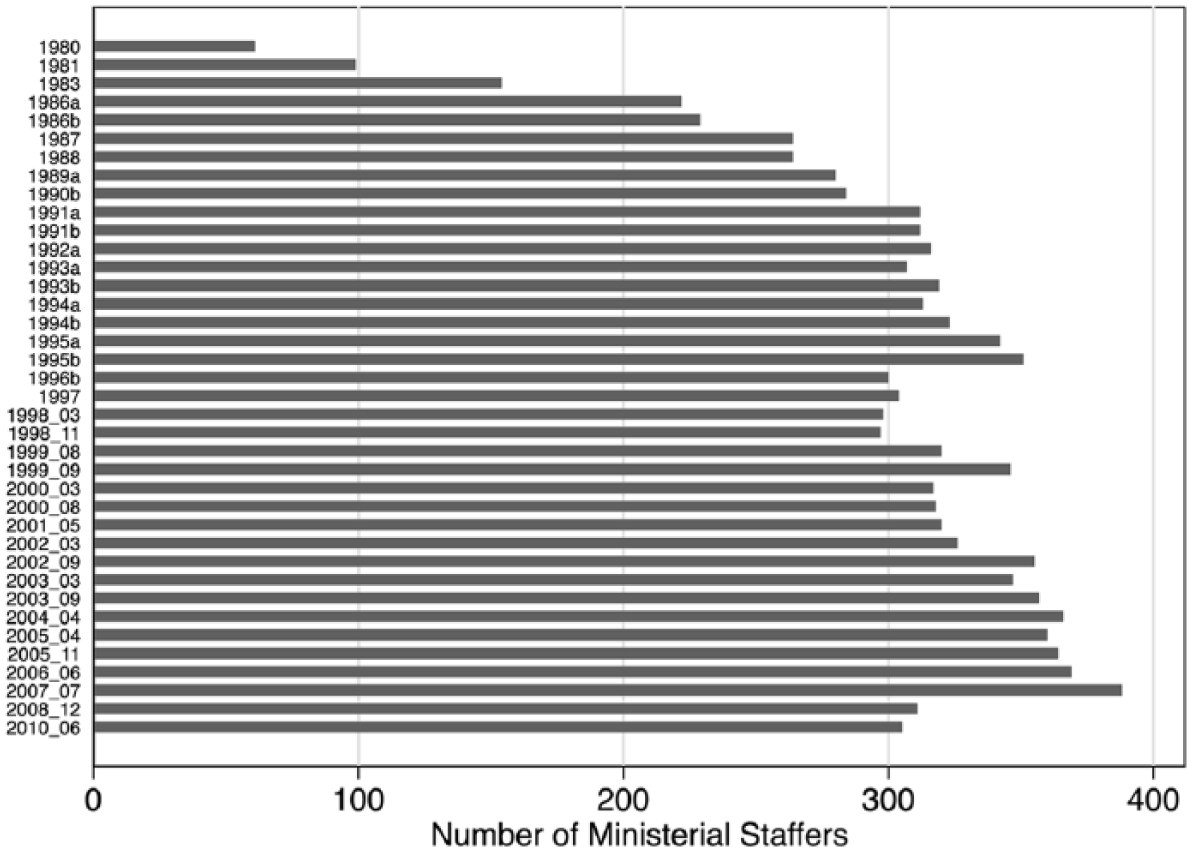
Number of Australian Politically Appointed Staff in Ministerial Offices (1980–2010).
In the directories, 82 different job titles (what we call ‘roles’) are recorded, rendering analysis challenging. Nevertheless, we were able to combine some roles into common categories, reducing the role labels to a more manageable 37 (Figure 2). 2 Adviser is the modal role, followed by Electorate Officer, Secretary and Senior Adviser. The less frequently observed roles are typically assigned to subsets of the more recognisable titles: for example, Senior Media Adviser.

Number of Politically Appointed Staff in Ministerial Offices by Roles.
Full names were recorded in the Ministerial Staff Directories, and for most years, so were gender prefixes and/or honorifics. We succeeded in identifying the sex of all staffers in our study based on their given names. Where this was ambiguous, we cross-referenced earlier/later entries where a more gender-identifiable given name was recorded (e.g. Patricia/Patrick with Pat) or via a gendered prefix (e.g. Ms, Mrs, Miss, Mr).
We found that female politically appointed staff outnumbered their male counterparts 58% to 42%. The distribution of men and women across time reflects this general trend, with the proportion of women typically outnumbering men, but often only slightly (Figure 3). However, when we examine work roles (Figure 4), we find that women occupied lower status, lower responsibility and lower renumerated roles (e.g. as typists, receptionists and secretaries) in higher proportions than men.

Proportion of Male and Female Politically Appointed Staff in Ministerial Offices by Ministerial Staff Directory.
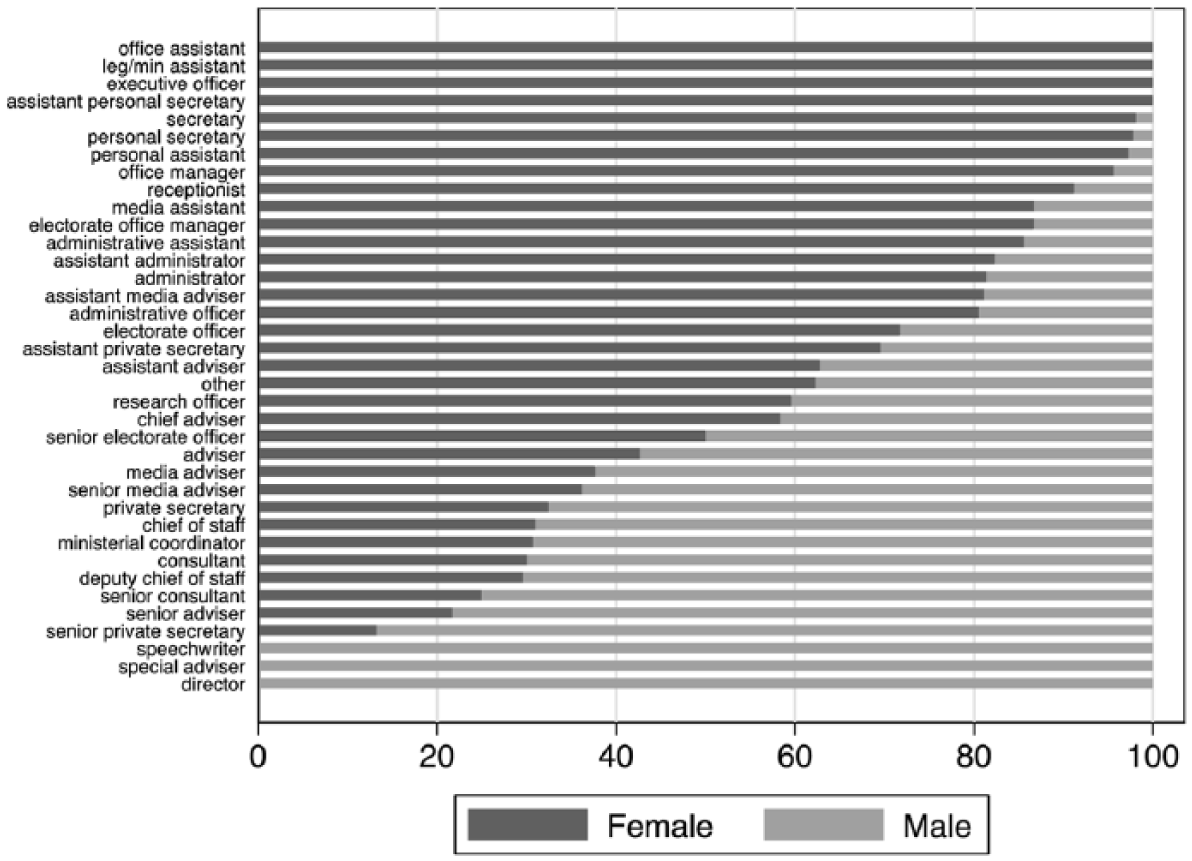
Proportion of Male and Female Politically Appointed Staff in Ministerial Offices by Role.
Last, we draw on histories, newspaper accounts and oral histories from the Museum of Australian Democracy (MoAD). MoAD’s collection features individuals, including politically appointed staff working in the provisional (1927–1988) Australian parliament building (Old Parliament House). Many of these individuals’ careers continued beyond 1988. In the main, a majority of interviews collected were for higher profile individuals. However, there are some interviews that reflect typical, that is modest, career progression. While we are cautious about generalising from these accounts, they are suggestive of the work and the gendered division of labour that existed at the time. Political histories of this time often refer to political advisers – typically men – whose experiences are better documented and understood (e.g. Rhodes and Tiernan, 2014; Weller, 1989). Therefore, we draw on the accounts of six women working as politically appointed staff between the 1930s and the 2000s (Cartwright, 2009; Cooper, 2011; Craig, 1996; Livanes, 2014; Moore, 2011; Summerhayes, 2009). The bulk of these interviews document work practices between the 1970s and the 2000s – the same period as our telephone directories.
Using Sequence Analysis
We use sequence analysis to explore the evolution of adviser careers in Australia. Sequence analysis involves the systematic computational study of the structure of a population over time. Sequence analysis entails the description and visualisation of sequences through descriptive statistics; the classification and comparison of sequences to identify commonalities and differences in the patterns of sequences; sequence mining (searching for sequence patterns identified a priori) and, finally, the explanation of trajectories by searching for causal relationships between variables and clusters of sequences (see Blanchard et al., 2014; Jäckle and Kerby, 2018 for specifics).
Sequence analysis was originally developed to examine (and decode) DNA and protein sequences within the biological sciences (Brzinsky-Fay and Kohler, 2010). Like many innovative methods developed for the natural sciences, social scientists have gradually adopted sequence analysis to study social and political phenomena: employment, policy adoption trends, and conflict (and peace) escalation. In this article, we employ sequence analysis to explore how the order and duration of roles within a single politically appointed career is distinct across sex.
Accordingly, the data needed to populate the sequence analysis include the following: a representative sample of politically appointed staff; the start and end dates of each role held over the course of their career and their sex. Additional, desirable data include background information as well as descriptives pertaining to their work roles (minister, political party of minister, etc.).
Determining Roles and Ranks
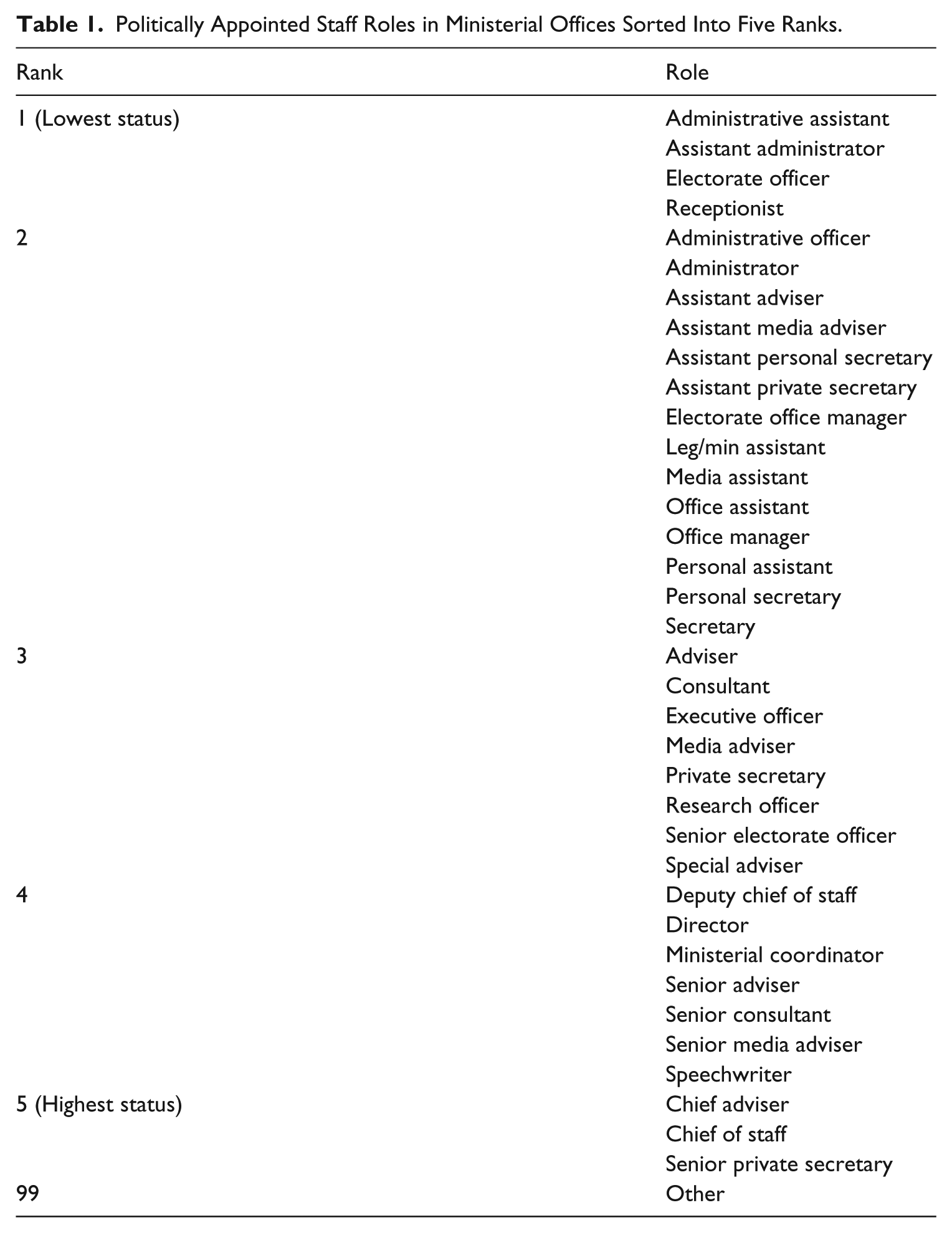
Our sequence data set consists of information about ministerial staffers’ career roles recoded as ranks from the point they begin working for a minister until their exit for any reason. We chose to convert the roles to ranks because 37 separate roles were computationally ungainly. The roles are broken down into a five-point ordinal ranking where ‘1’ is the lowest and ‘5’ is the highest rank. We also include a catch-all category (‘99’) for those roles for which we are uncertain (n = 36). The breakdown and distribution of roles and ranks are found in Figures 5 and 6.
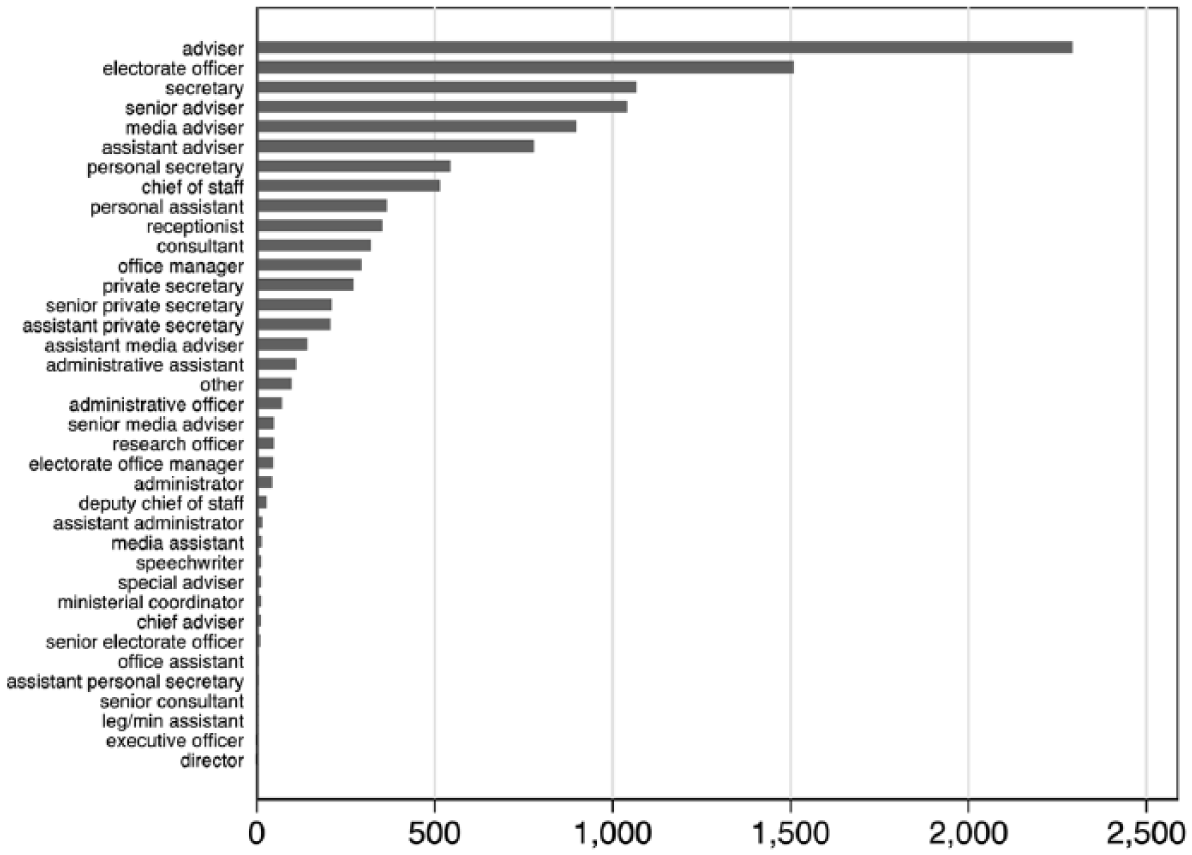
Politically Appointed Staff Roles by Frequency of Job Title in Ministerial Offices.
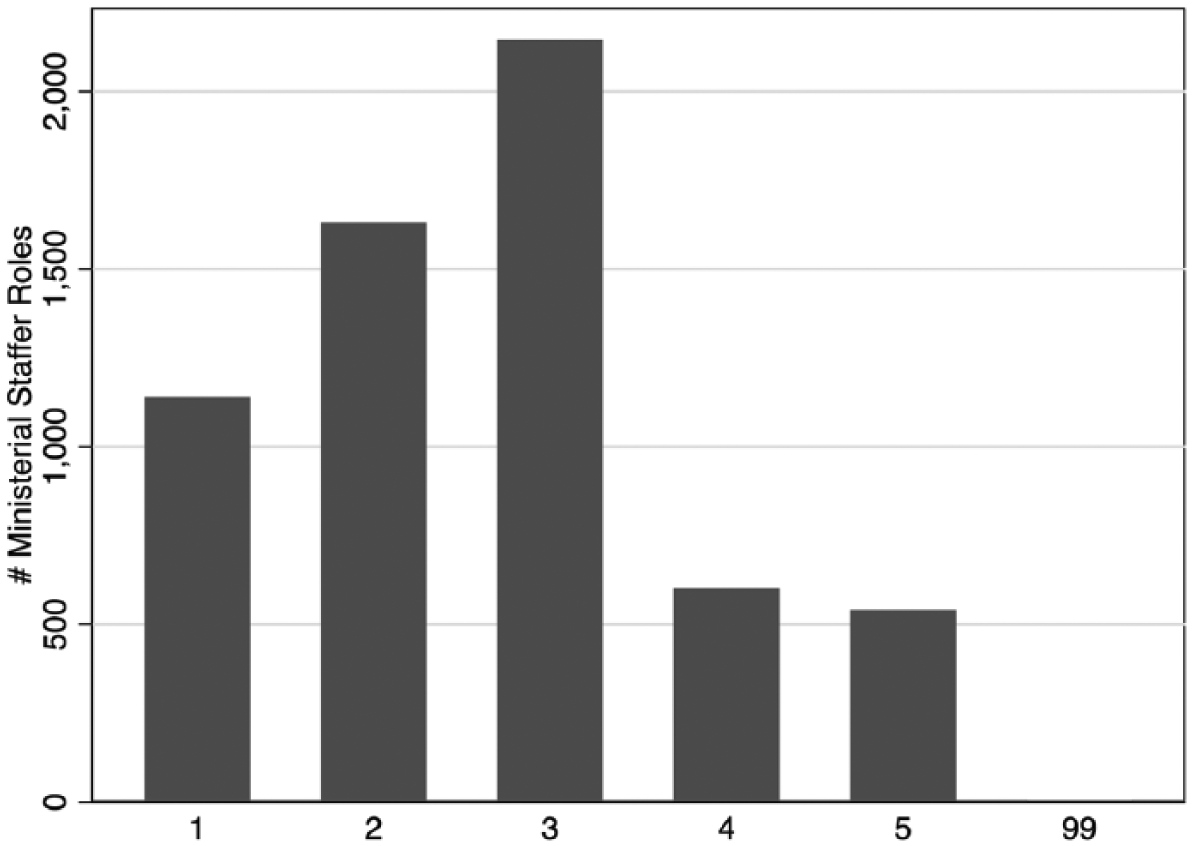
Politically Appointed Staff Roles in Ministerial Offices by Rank.
Role rankings were determined by examining all available employment agreements (2003–2016) (Department of Finance, Australian Commonwealth Government, 2017). The salary bands of job titles were used to determine seniority of staff. Those most senior (Rank 5) we assign principal advisers, principal private secretary and CoS. Senior (policy or political) advisers, senior media advisers/press secretaries are ranked 4. We further distinguish using a dummy variable (1 = leadership portfolio, 0 = ministerial portfolio) between Senior (policy and/or political) advisers and media advisers serving the Prime Minister, Deputy Prime Minister and Treasurer, because these staff are paid more than CoS of non-cabinet ministers. We assign (policy and/or political) advisers and media advisers to Rank 3. Rank 2 includes assistant advisers, executive assistants and office managers. Secretaries and electorate officers are assigned Rank 1. We argue that given role titles have changed little since 1979, we can be confident that the rankings determined from data from 2003 to 2016 are sufficiently indicative to project back to 1979 (Table 1). 3
Politically Appointed Staff Roles in Ministerial Offices Sorted Into Five Ranks.
We chronicled the careers of all politically appointed staff recorded in the Directories from 1980 to 2010, less those staff whose first record appears in 2010 as they have no career duration. 4 This leaves us with 3388 unique individuals. We organised, coded and analysed our data in the widely used ‘state sequence’ format. The data consist of 136 monthly activity state variables (i.e. the longest politically appointed career lasted 136 months) and we consider our six ‘rank’ categories (5 ranks plus ‘other’).
Evidence of the Gendered Division of Labour in Political Offices
Figure 7 presents the career sequence for the first 10 observations (politically appointed staff) in the data set. Note that politically appointed staff member ‘1’ served 18 months at Rank 3, and then exited the data set. Contrast this with staff member ‘7’ whose career is more varied: 28 months in Rank 1 followed by 6 months at Rank 3. Figure 8 presents a state distribution plot for all ministerial staffers showing their transversal frequencies, which also illustrates the pattern contained in the sequence data. Each monthly column in the figure provides the frequency for each of the ranks occupied by politically appointed staff at that time period.

Sequence Index Plot of Australian Politically Appointed Staff in Ministerial Offices, 1980–2010: 1–10.
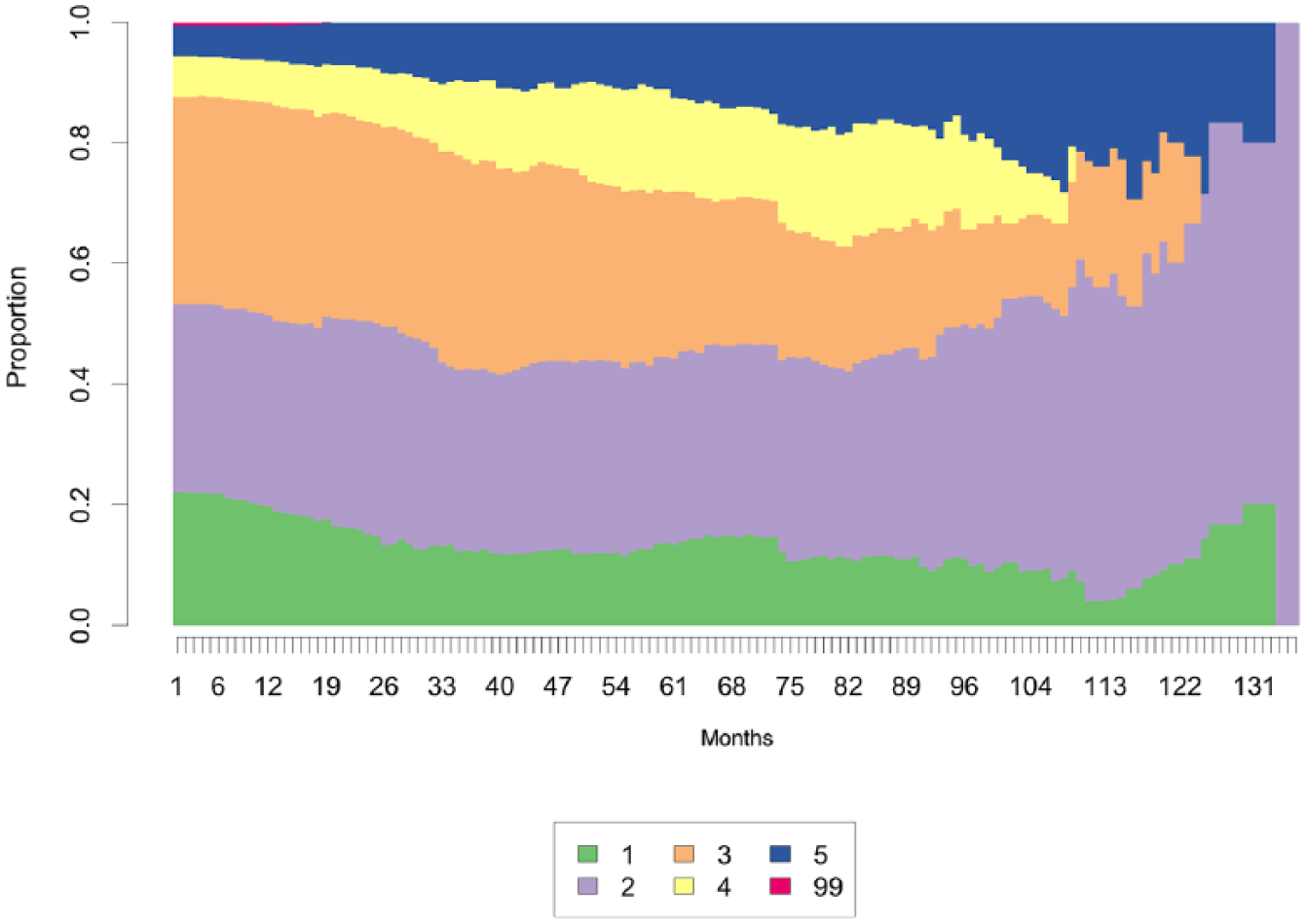
State Distribution Plot – All Politically Appointed Staff in Ministerial Offices.
Importantly, all staff in the data set appear at month 1, but as people exit staffing as a career, the overall number decreases. Typically, the last month represents only one person – that is, the longest serving staff member in the entire data set by calendar months. Hence, at month 1, 5% of politically appointed staff served at Rank 5, 7% at Rank 4, 35% at Rank 3, 31% at Rank 2 and 22% at Rank 1. Ranks 3 and 2 are the modal ranks over time. We can also see that as careers move forward in time the proportion of politically appointed staff that occupy positions at Rank 3 decreases, largely because of the increase in the proportion of staff that hold positions at Ranks 4 and 5. This suggests a mild career progression among politically appointed staff at the middle and upper ranks.
Sequence analysis is useful as a descriptive tool because it allows for sub-setting by categories and groups. When we re-examine the state distribution plots considering gender (Figure 9), two very different patterns of career progression emerge. For male staff, 14% begin their careers in a Rank 1 (lowest status) position. This proportion drops rapidly by the 5-year mark, with only 3% of men working in Rank 1 positions. A smaller percentage (12%) of male politically appointed staff begin their careers at Rank 2 and this percentage slowly decreases to 8% after 5 years. The modal rank for men at the start of their careers is Rank 3 (advisers): where 50% of men start their staffing careers, the percentage drops to 41% after 5 years and 25% after 10 years. The shrinkage in Ranks 3, 2 and 1 is offset by an increase over time in the proportion of male politically appointed staff who occupy the top two ranks (Ranks 4 and 5). At the start of their careers, 13% of male staffers hold Rank 4 positions and 9% hold Rank 5 positions. After 5 years these percentages increase dramatically to 32% and 19%, respectively. Although there is evidence that staff move between roles and ranks (Figure 9 shows that at least one man was likely demoted after about 108 months), overall, there appears to be evidence of an upwardly mobile career progression. As each month goes by, the proportion of men who hold lower ranking positions decreases and the proportion who hold higher ranking positions increases.
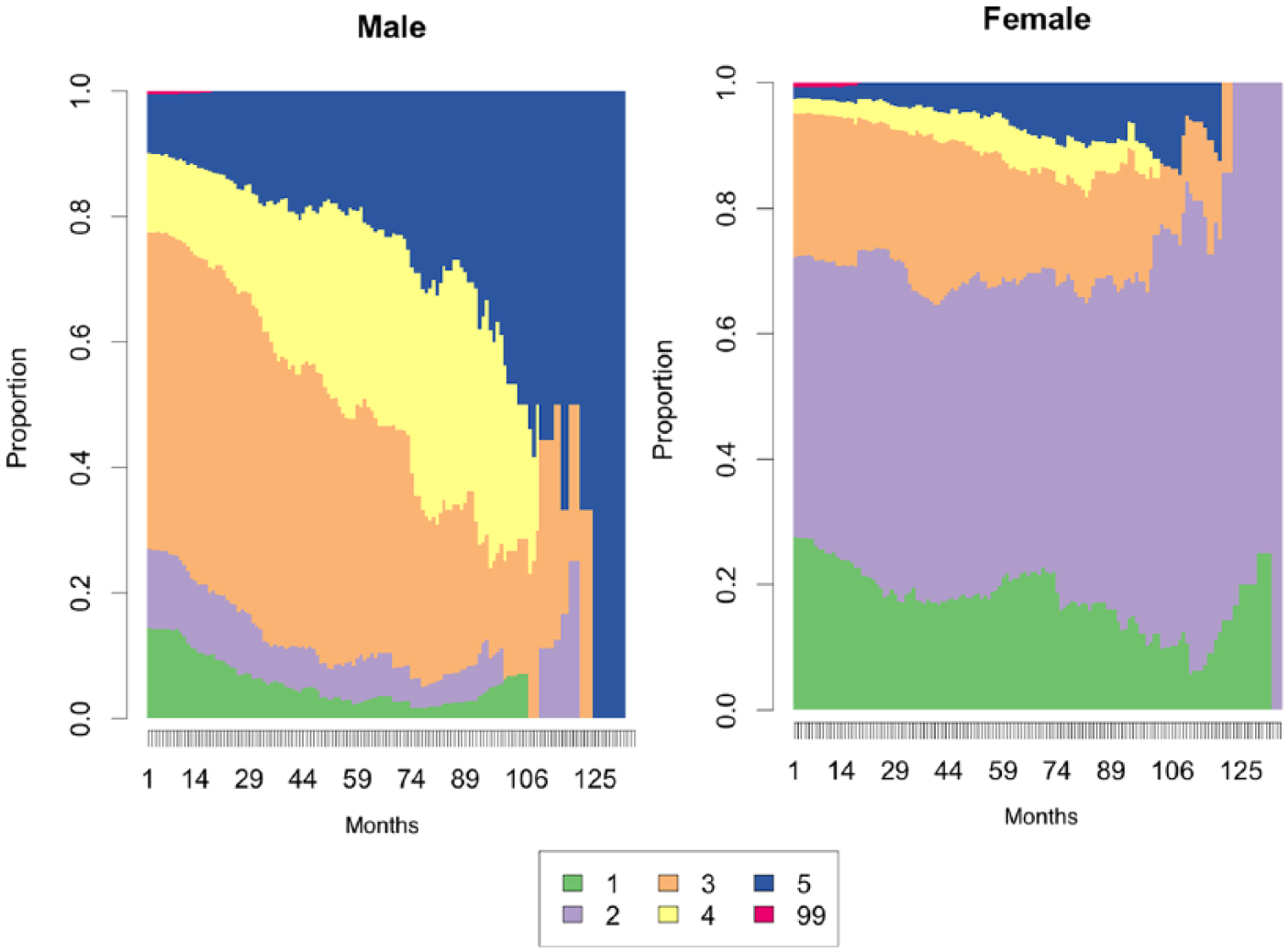
State Distribution Plot: Politically Appointed Staff in Ministerial Offices, by Sex.
Female staffing careers are different. The right-hand side in Figure 9 demonstrates that 28% of female politically appointed staff begin their careers at the lowest rank (compared to 14% of men), and the rate that the proportion decreases over time is noticeably slower. Indeed, by the time women have progressed 5 years into their careers the proportion in Rank 1 has only dropped from 28% to 22%. Only 4% of women begin their careers in either Ranks 5 or 4; this figure increases to 14% after 5 years of service. This contrasts with men of whom 22% begin their careers at the two highest ranks and increases to 51% at the 5-year mark.
When we compare male and female careers directly, systematic differences become apparent (Figure 9). Male politically appointed staff typically begin their careers at Rank 3, and it remains the model rank for the majority of the sequence duration. In contrast, the proportion of women at Rank 3 is not only smaller, it also decreases at a faster rate. This is because of an increase in the proportion of women who occupy assistant advising or senior support staff (Rank 2) positions is greater. This pattern differs dramatically for men, who are largely absent from Rank 2 positions and, over time, men increase their proportion of Senior adviser (Rank 4) and CoS (Rank 5) type roles. Men are more likely to reach top roles and they also remain longer in those roles than women. Contrary to our expectations, there is no statistically significant difference between men and women’s median career durations. 5 Women’s median length of service is equivalent to men, underscoring the systematic and gendered patterns in career progression. This is borne out when we compare the longest serving man and woman in the data set. David Whitrow began his ministerial staffing career in 1996 as a senior adviser (Rank 4) and moved to become a CoS in 2005, where we last observe him in the data set in 2007. By contrast, Denise Taunton became a personal secretary (Rank 2) in 1983, before becoming an assistant private secretary (Rank 2) in 1989 and finally an assistant adviser (Rank 2) from 1990 to 1995. While Taunton’s work likely became more policy oriented as she moved from secretarial work into assistant advising, she did not improve her status or move into a new salaried band.
Changing Pathways Into Political Careers for Women Over Time
Observed changes in the gendered division of labour since the 1970s can be explained by the changing nature of political advising, the types of work undertaken and increased participation of women in the labour force. When we examine patterns over time, we do observe changes in women’s ranks and roles. However, as Figure 10 demonstrates, women’s progress into higher status roles remained stubbornly slow from 1980 to 2010. The vast majority of women who worked in political offices prior to the introduction of computers were typists and stenographers, which is reflected in women’s dominance of Rank 1 or 2 roles. The drop in the overall proportion of women who occupy these roles in calendar time: 86% of politically appointed female staff in 1980 did so in Rank 1 and 2 roles, compared with 35% by 2010, is best explained by the decline in demand for political support/administrative roles. Men have not increased the proportion of low status work since 1980, rather, there are fewer political support/administrative roles in 2010. Indeed, a higher proportion of women still work at these lower levels than men. What is significant is that an equal proportion of men and women worked at Rank 3 (the adviser level) in 2010. Yet, it remains the case that a significantly higher proportion of men (28.5%) continue to work at the two highest ranks in 2010 when compared with women (11.5%). This points to slow and tempered evidence of change in the gendered division of labour in political offices over time.

Proportion of Roles by Directory in Ministerial Offices, by Sex.
This matches surviving accounts of women working in political offices prior to the 1990s. Women reported that work roles were gendered, with men occupying high status roles and women overwhelmingly in support roles. All of the women who appear in MoAD’s oral history collection, working as political staff during the 1970s to mid-1980s, were engaged in a typist/administration role, even those women who later went on to occupy senior roles. As Carol Summerhayes (2009), stenographer to the Leader of the Australian Labour Party (ALP) between 1967 and 1975 explained, ‘we did the sort of junior, the less important work. The men did the thinking, advising, strategic sort of work’. Caroline Cooper (2011), also a secretary working at the top level of government from 1976 to 1983, confirmed a similar division of labour operating at this time: ‘the men were the advisors and the girls were secretaries’.
This had important implications for women’s symbolic and substantive representation. Prior to the 1980s, only a handful of pioneering women occupied substantive policy or influential roles and their appointment was sometimes linked to controversy and scandal (Baird, 2003). During the 1980s, a small number of women occupied leadership roles. Women such as Netta Burns, Diana Shogren, Julienne McKay and Deborah Snow entered politically appointed roles with previous career experience in academia, the party machine or the media.
Women were present in political offices, but most commonly, did not have the capacity to exercise sustained influence over policy. As the MoAD oral histories suggest, many women took up the work serendipitously, and often without a specific interest in politics (see Cartwright, 2009; Livanes, 2014; Moore, 2011; Summerhayes, 2009). Even expressing opinions on policy was rare: Summerhayes (2009) recalled an incidence where the women in the office had ‘a bit of an outburst’ about abortion, but their participation was minimal: ‘I think we just said, you blokes ought to be listening to women for a change … —it didn’t last long’. Cheryl Cartwright (2009) (typist from 1978 to 1979) recalls her pride when a tactical suggestion she made was actually written into a speech. These experiences reflect accounts of ‘masculinist’ workplaces in the US congress (Dittmar, 2018).
However, the experience gained proved valuable for some women, leveraging their time in political offices to later move on to roles in the public service (Cooper, 2011; Summerhayes, 2009) or within party machines (Livanes, 2014). More still stayed working within political offices, becoming doyennes of senior politicians’ offices (Craig, 1996). Women who today might have gone to become senior advisers or MPs instead threw their energies into accruing vast administrative knowledge, mastering procedural details and acting as gatekeepers. These women only appear as sidenotes in biographies or newspaper columns and represent a difficult measurement problem for scholars.
Yet, two women working as secretaries in the 1970s, Kate Moore (2011) and Cheryl Cartwright (2009), eventually became CoSs. They identified serendipity, youth, changing opportunities and the recognition of their talents by powerful men as important factors in their career progression. Working around political actors (Moore worked for the ALP machine, Cartwright in the Prime Minister’s office) proved to be an important juncture in their political socialisation, sparking a desire to know more and to influence events. This contrasts with other women such as Carol Summerhayes (2009), who started her career earlier (1967–1975). Summerhayes reported becoming interested in politics, but stated her ambition at the time was to become secretary to the Prime Ministers’ Press Secretary, rather than take the job herself. By contrast, both Moore and Cartwright note that they actively pursued a career in political advising. This self-confidence is something they share in common with both the path-breaking women before them and the senior women that followed.
Due to limitations of space, we only examine three high-profile cases of women serving as politically appointed staff since the mid-1990s. We examine the careers of three female CoS: Nicole Feely (1995–1997), Amanda Lampe (2010–2011) and Peta Credlin (2010–2015) as qualitative evidence exists of their experiences. In contrast to Cartwright and Moore, the later cohort of female CoS pursued advising as a defined career choice. Both Feely and Credlin demonstrated strong career ambitions and an interest in politics at school (Cadzow, 1996, 2014). Moreover, these women began their careers as professionals: Feely was a lawyer, Lampe a journalist and Peta Credlin moved into political staffing early.
However, barriers remained. Only Cartwright and Credlin were CoS for more than 3 years. Cartwright served a well-respected, but ultimately, low-profile minister. Credlin, like her forerunner, Feely, was the subject of much controversy and gendered commentary, including references to their physical attractiveness and youth. Both were strong women who were, rightly or wrongly, criticised for their aggressive and masculine behaviours (Albrechtsen, 2015; Cadzow, 1996, 2014; Crowe, 2015) and their alleged excessive influence over the Prime Minister (Rhodes and Tiernan, 2014: 99; Savva, 2016). This overlapped with some of the discussions of women working in senior political roles in the 1960s and 1970s (Baird, 2003). By contrast, Lampe was dismissed as out of her depth (for an indicative example see Cleary, 2011) and left the office quickly. However, more research is required to unpack the complex set of institutional and social constraints that may be impacting women’s careers and how they changed over time.
Implications: A Stunted Pathway Into Parliament?
There is evidence to suggest that gendered division of labour in political offices is playing some part in representational outcomes. Of those politically appointed staff that went on to elected office, two main skillsets appear to be represented. The most common was the ‘policy skill set’, with those occupying adviser or senior adviser roles before entry into parliament appearing the most frequent. The second route seems to be ‘overt politics’, with electoral officer and CoS as the third and fourth most common final work roles before election. Yet, as Figure 11 demonstrates, patterns suggesting a career pathway, and particularly the ‘overt politics’ route, are a male phenomenon. This route appears to be declining over time. For the women, it is difficult to pick out explicit patterns given the small number. If anything, these findings reflect the complex paths that characterised early staffing careers for women discussed in the qualitative evidence above. Finally, we add a note of caution given our data only include government politically appointed staff. We currently lack data for the opposition.
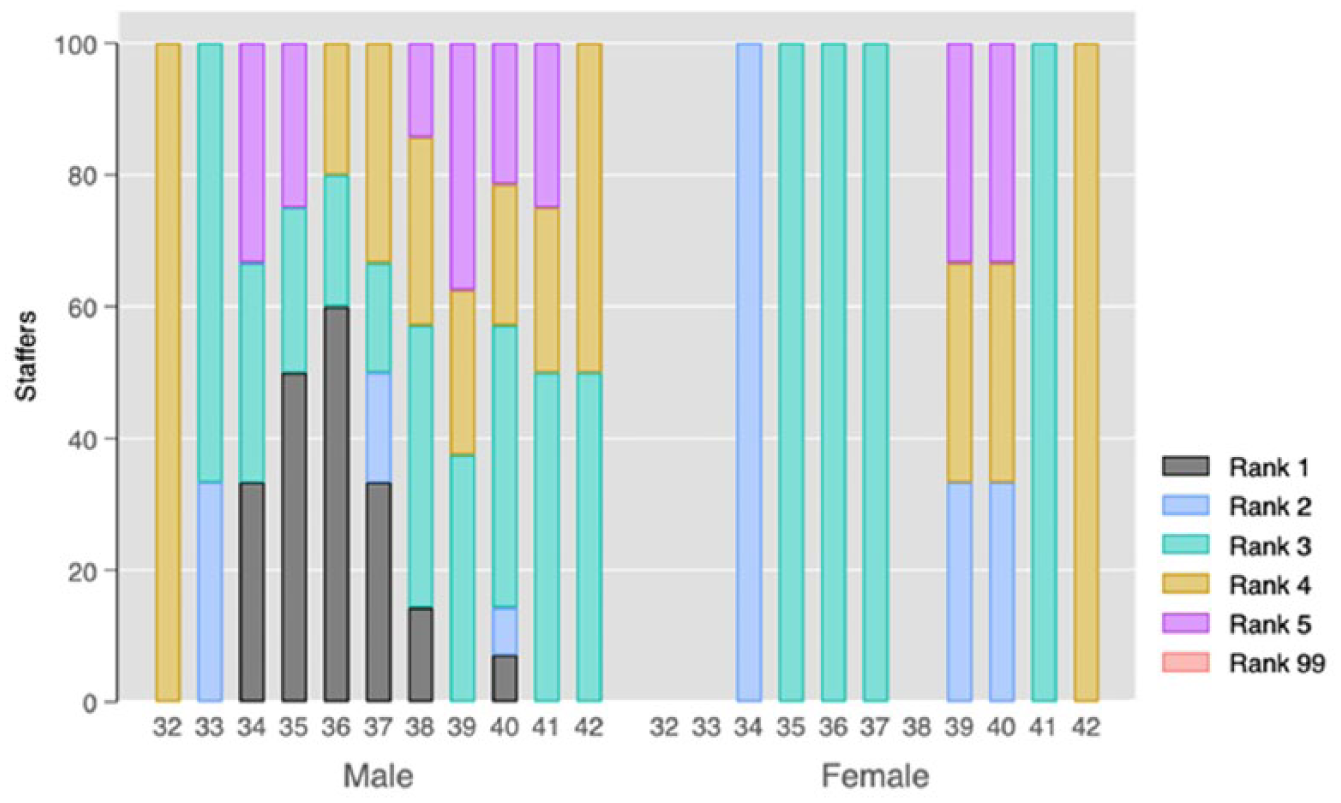
Politically Appointed Staff in Ministerial Offices Who Went on to Become Elected Representatives by Parliament.
Over time women have gained some access to roles in political offices with a strong capacity to exercise discretion over policy. However, women still appear to fare poorly when compared with men. As our analysis shows, part of this relates to proximity. Politically appointed staff gain their role, status and much of the power they exercise from their proximity to legislative and executive elites. While not all staff will go on to exercise influence, their proximity grants them the potential to be influential. Women have occupied work roles that are lower in the staffing strata and are typically less likely to be proximate when decisions on policy direction are taken. While the specificity of work roles may differ across jurisdictions, we can meaningfully compare politically appointed staffs’ relative proximity to ministers. This may be one way of progressing theorisation in this field.
In addition, women’s underrepresentation at even the earliest stages of women’s careers mirrors consistent underrepresentation in parliament and within party institutions (Ashe, 2017). A career in political advising is mediated by political parties because party actors select and promote staff. Perhaps the same factors that inhibit women’s progress within parties are at play within offices?
For women within parties, these factors are considerable. Female candidates face obstacles gaining party endorsement, from ideas about what makes a ‘good’ candidate (Murray, 2015) and are less likely to think of themselves as qualified (Fox and Lawless, 2005) or put themselves forward for office (Norris, 1993). The operation of party rules and institutional norms also translates into lower levels of women selected as candidates and subsequently represented in parliament (Caul, 1999; Kunovich and Paxton, 2005). As Verge and Claveria (2016) argue, women within party institutions remain ‘insiders on the outside’, struggling to fully capitalise upon the opportunities partisan offices present and unable to participate in gendered political networks (Snagovsky and Kerby, 2018). We find this extends to political offices: women remain underrepresented at higher levels and can face sexist public scrutiny when they occupy leadership roles. Furthermore, we find some evidence that women struggle to translate their ministerial advising experience into a career as an elected representative. Understanding why this is the case is an important area for future research.
Conclusion
The aim of this article is two-fold. First, to demonstrate how career data can be compiled using unconventional historical documents and show that these data can be analysed to make theoretically informed inferences about a group of political actors understudied by political scientists. Data on ‘visible’ political elites such as ministers, presidents and prime ministers are now readily accessible. This accessibility has eluded those interested in the activities and actions of non-elected elites, who remain largely out of sight. By drawing on historical documents like the Ministerial Directory in Australia we were able to create a near-population sample of ministerial staffers for the period 1979–2010. In doing so, we provide a first attempt at examining the careers of Australian ministerial staff in the same manner as the careers of other elected political elites.
The second aim was to demonstrate that the work of political staff differs substantially and systematically along gender lines. Our results demonstrate that male and female ministerial staffers occupied qualitatively different roles over time, and that women occupied a consistently higher proportion of lower status roles. Female staff were more likely to occupy gendered support style roles, such as typists or administrators across all years. Women as a proportion started and ended their careers at a lower rank and experienced less upward career progression than men. Women occupied job roles that were less regularly proximate to the minister, and granted them less discretion to influence policy outcomes. Although women have made some progress, reaching 50% representation in mid-ranked roles, they remain underrepresented at the top ranks. This aligns with women’s accounts of their own work practices, demonstrating that strong norms existed which overwhelmingly delegated support roles to women, and substantive policy roles to men. We demonstrated that there is evidence to suggest that women are less proximate to ministers when making decisions and are struggling to translate their experience working as politically appointed staff into elected political office.
Footnotes
Acknowledgements
The authors thank the editors and reviewers at Political Studies for their generous and useful comments. Keith Dowding, Katrine Beauregard, Feo Snagovsky, Pat Leslie, Marina McGale and Reuben Creighton all provided critical and insightful suggestions. They are especially indebted to the staff at the Australian Parliamentary Library who helped with data collection. Earlier versions benefitted from pointed questions and critiques at the 2017 ECPR General Conference (Oslo, Norway), and the 2018 Sharing is Caring: Comparative Ministerial Elites Across Time and Space workshop (Canberra, Australia).
Data Accessibility Statement
Data from this paper can be accessed via The Australian National University Dataverse.
Funding
The author(s) received no financial support for the research, authorship and/or publication of this article.
