




Abstract
The belief among citizens that their views are represented is essential to the legitimacy of American democracy, but few studies have explicitly examined which political actors Americans feel best represent them. Using data from the 2006 Cooperative Congressional Election Study, we ask new questions about whether respondents who share a partisan, racial, or gender identification with their members of Congress (MCs) feel those members best represent them. Although the framers designed the House so that individuals’ own MCs would be their closest and most responsive representatives, a majority of respondents turn to other actors for representation. Partisanship is a key reason for this attenuated connection, as respondents who do not share a partisan identification with their MCs are more likely than those who do to rely on their party’s congressional leaders or advocacy organizations for representation instead. Sharing a racial identification with one’s own MC can strengthen representational connections as respondents who share a racial identity with their MCs are significantly more likely than respondents who do not to indicate that their MC represents them “the most.” These results shed light on enduring questions about the significance of symbolic representation and its link to partisanship and descriptive representation.
Few concepts are as fundamental to American democracy—and few issues more essential to democratic legitimacy—than Americans’ beliefs that their views and interests are represented in political institutions. But while there are rich bodies of research examining issues such as Americans’ trust in government and whether their preferences are congruent with the behavior of their members of Congress (MCs) and policy outcomes, scholars have paid less attention to what happens when people do not feel that the MC sent to Washington by voters in their district actually represents them and their interests. Do they, for example, seek out other options when their own MC is a member of the opposing party? Likewise, although scholars have demonstrated that descriptive representation has positive effects on a range of political outcomes for members of historically marginalized groups such as women and people of color, we know little about who they seek out when they are represented by MCs who are not “like” them when it comes to salient identities and formations such as race, ethnicity, and gender.
Recognizing that Americans are simultaneously formally represented by multiple elected officials and informally represented by other political actors and entities such as advocacy organizations, we use original survey data to answer critical questions about their beliefs about who represents them in national politics and to show how, in a pluralist system, they decide which of many possible actors represent them the most (Saward 2010, 38). In so doing, our study provides a novel approach to thinking about the connection between symbolic representation—defined by Hanna Pitkin (1967) as representation that evokes “emotional, affective” beliefs that can lead people to feel represented by political actors that they identify with—and descriptive representation, or representation that mirrors “the people, the state of public consciousness, or the movement of social and economic forces in the nation” (p. 61). We do so by asking people who they feel represents them the most effectively and by examining how those attitudes are connected to the partisan, racial, and gender identifications of the respondents and their representatives. That is, we take up a provocative empirical question—“What makes men [sic] feel represented?”—that Pitkin left unanswered in her pathbreaking and conceptually focused examination of the circumstances under which people should believe in their representatives or should feel represented (Pitkin 1967, 9, 111). Our approach is, therefore, in conversation with work examining the relationship between symbolic and descriptive representation, on the one hand, and work about people’s beliefs in the legitimacy of their political institutions or the fairness of the decision-making process, on the other. At the same time, we depart from those studies by emphasizing people’s beliefs about their own individual House members and by providing them with the opportunity to indicate that they would prefer to seek out another political actor for representation instead (Abney and Hutcheson 1981; Atkeson 2003; Atkeson and Carrillo 2007; Banducci, Donovan, and Karp 2004; Barreto, Segura, and Woods 2004; Gay 2001, 2002; Hansen 1997; Hayes and Hibbing 2017; High-Pippert and Comer 1998; Howell and Fagan 1988; Jones 2014; Pantoja and Segura 2003; Reingold and Harrell 2010; Sanbonmatsu 2003; Sapiro and Conover 1997; Verba, Burns, and Schlozman 1997).
Three central themes emerge from our analyses. First, although the framers of the U.S. Constitution designed the House of Representatives so that individuals’ own MCs would be their closest and most responsive representatives, the majority of Americans do not necessarily believe that their MCs represent them better than other political actors. Second, this attenuated connection is conditioned by partisanship: People who share a partisan affiliation with their MC are significantly more likely than those who do not to look to them for representation, and they are also significantly less likely to report that other actors such as advocacy groups and congressional party leaders represent them. Third, people are more likely to “prefer” their MCs when they share a racial identification with them, suggesting that Americans from both dominant and marginalized groups recognize and value the symbolic nature of descriptive representation.
Assessing the Framers’ Representative Claim
Americans are formally represented by four federal elected officials: their MC, two senators, and the president. When the framers designed American political institutions, however, they made what Michael Saward (2010) calls a “representative claim” that the House of Representatives would be the “people’s House.” They codified that aspiration by creating small districts, holding elections every two years, and making House members the only directly elected federal officials (at the time). They hoped that these provisions would ensure that House members would be the most proximate to the American people. Proximity to one’s MC is not the same as being represented by them, however. Cindy Simon Rosenthal (1995), for example, suggests that it is important for constituents to believe in their representatives. Likewise, Andrew Rehfeld (2006) argues that representation can only occur when people recognize political actors as their legitimate representatives, and Iris Young (1997) explains that this recognition is more likely to occur when people share a social perspective with political actors, believe that political actors look after their interests, and share political actors’ opinions, principles, or values. People who share social perspectives with their MCs should, therefore, be more likely to feel both emotionally connected to them and to feel symbolically represented by them.” They should also, in turn, be more likely to trust them and to believe that their groups’ interests are being represented (Gay 2002; Young 1997). A growing body of research indicates, for example, that constituents who share a gender or racial identification with their MCs are more likely to trust and contact their representatives and to participate in politics than those who do not (Abney and Hutcheson 1981; Howell and Fagan 1988; Pantoja and Segura 2003; Tate 2003).
Building on these suggestive insights about the conditions under which people are likely to “feel” symbolically represented, we argue there are several reasons to believe that some Americans reject the framers’ notion that their House members represent them the best. For example, in a society in which race and gender shape people’s understandings of their political identities and interests (see, inter alia, Beltrán 2010; Celis et al. 2014; Cohen 1999; Cramer 2016; Crenshaw 1989; Dawson 1994; Mansbridge 1999; Sapiro 1981; Strolovitch 2007; Strolovitch, Wong, and Proctor 2017; Young 1994, 2000), constituents and political actors may be more likely to share a perspective when they also share social positions in terms of gender, race, ethnicity, and other salient identities. In an increasingly polarized environment, people may likewise believe that only a representative from “their” political party will share their interests and values (Mason 2018). People whose race, gender, or partisan identifications are not congruent with those of their MCs may consequently not “feel represented,” particularly in the contemporary political environment in which voters increasingly disapprove of the rival party, and the House is more competitive and polarized along partisan lines than it has been in nearly a century. 1 In such an environment, it may also be difficult for MCs to overcome partisan disagreements with their constituents through their nonpartisan “home styles” and constituent case work (Fenno 1978; Mayhew 1974; Young 1997). In theory, these discontented partisans could vote their MCs out of office and replace them with challengers who share their partisan affiliations, but large margins of victory and incumbent reelection rates that are consistently over 90 percent make it difficult to do so (Jacobson 2007). Consequently, people who do not belong to the same party as their MCs may instead seek out representation from their own party’s leaders, the president, or advocacy organizations.
Extant research also suggests that in a context in which the vast majority of women and people of color are not descriptively represented in the House, members of these groups may not believe their MCs represent them. In 2017, for example, there were only 88 (20.2%) women and 106 (24.4%) people of color serving in the House. Moreover, in 2017, only 35.7 percent of African Americans were represented by African American MCs, and only 24.9 percent of Latinos were represented by Latino MCs (National Association of Latino Elected and Appointed Officials Educational Fund n.d.; U.S. Census Bureau 2018; U.S. House of Representatives 2018). As of 2010, only 17.5 percent of congressional districts had populations in which African Americans, Latinos, or a combination of the two comprised a majority (U.S. Census Bureau 2010). 2 Thus, although some African Americans and Latinos have the opportunity to select MCs of color by voting in the majority-minority districts that were created under Section 2 of the Voting Rights Act (VRA), those who do not may not feel their MCs represent them. 3 The same may be true for Asian Americans, who rarely constitute a majority in congressional districts, and who have never successfully invoked Section 2 of the VRA (Chen and Lee 2012). Geographically based congressional districts also provide few opportunities to increase the descriptive representation of groups such as women, who are not typically concentrated in particular geographic areas (Canon 1999; Rehfeld 2005; Warren 2000). It is, therefore, difficult for women and people of color to replace white male MCs with descriptive representatives with whom they share identities and social perspectives, particularly because, as Zoltan Hajnal (2009) shows, the preferred House candidates of African American and Latino voters are more likely to lose than those preferred by their white counterparts. Altogether, these partisan and descriptive representative disjunctures help explain why Congress is routinely the least popular branch of government (Durr, Gilmour, and Wolbrecht 1997; Hibbing and Theiss-Morse 1995, 2002; Ramirez 2009, 2013) and why Americans may reject their MCs and seek out other representatives instead.
Who Else Could Represent Me? Alternatives to the Congressional Connection
In addition to being formally represented by federal elected officials, Americans can also be informally represented by a wide range of individuals and organizations inside and outside of government, including party leaders, congressional caucuses, and advocacy organizations. Thus, people who do not believe that the MCs that represent their district look after their interests or share their values or perspectives can seek out other individuals or organizations for surrogate or “collective” forms of representation (Mansbridge 2003; Pitkin 1967; Schildkraut 2016; Tate 2003; Weissberg 1978). Specifically, some may feel that the president or congressional party leaders better reflect their opinions. Others may believe that identity-based congressional caucuses—including the Congressional Black Caucus (CBC), the Congressional Hispanic Caucus (CHC), the Congressional Asian Pacific American Caucus (CAPAC), and the Congressional Caucus for Women’s Issues (CCWI)—articulate their concerns the most effectively because these four caucuses explicitly claim to act on behalf of women and people of color. The CCWI’s mission, for example, “is to bring women policymakers together across party lines to work on issues of importance to women and their families” (Women’s Congressional Policy Institute 2017). Similarly, the CBC works to “advance the global black community by developing leaders, informing policy, and educating the public” (CBC Foundation 2017), and the CHC “is dedicated to voicing and advancing, through the legislative process, issues affecting” Latinos (CHC 2018). In 2005, the CBC, CHC, and CAPAC also formed the Tri-Caucus to work together on issues related to inequality and discrimination (Tyson 2016). But while we know a fair bit about the ways in which these identity-based caucuses actively engage in outreach to members of marginalized groups and make an effort to help them “feel represented” (Canon 1999; Carroll 2002; Dodson 2006; Fenno 2003; Hero 1992; Minta and Sinclair-Chapman 2013; Swers 2002; Tyson 2016), scholars have not yet examined whether members of marginalized groups are receptive to these representative claims.
People may also exit their relationships with the government altogether, by looking beyond legislatures and parties entirely and turning instead to interest groups and advocacy organizations for representation (Mansbridge 2003; Montanaro 2012; Rehfeld 2005, 2006; Saward 2010; Strolovitch 2007; Warren 2000). Advocacy organizations help to fill in some of the gaps in electorally based representation by providingsurrogate and symbolic representation for groups of people who have shared interests but feel their formal territorially based political representation is inadequate (Frymer 1999; Rehfeld 2006; Strolovitch 2007; Warren 2000). As Scott Ainsworth (2002) explains, while elected MCs have a geographic basis for representation, interest groups “focus on functional divisions” that are often spread across the entire country (p. 69). For example, while an African American MC from Ohio might try to provide surrogate representation for African Americans nationwide, her primary responsibility is to the members in her district (Fenno 2003; Gay 2002; Mansbridge 2003; Pitkin 1967). Civil rights groups, in contrast, represent African Americans across the country. Carol Uhlaner (2002) has found, for example, that, many Latinos feel represented by advocacy organizations that “look out for” the concerns of people of their national origin group. Recognizing that race, gender, and partisan dynamics may mean that many people do not “feel” that any elected officials represent them, we examine how Americans think about representation and whether some of them look outside of government for representation instead.
Broadening Concepts of Representation
In taking up these questions, we engage longstanding and recently rejuvenated conversations about representation, particularly representation for marginalized groups. For example, a growing body of important studies has examined levels of congruence between the mass public’s collective preferences and macro-level policy outcomes (Achen 1978; Ansolabehere, Snyder, and Stewart 2001; Bartels 1991, 2008; Druckman and Jacobs 2006; Erikson, Wright, and McIver 1993; Ferejohn 1986; Fiorina 1981; Gilens 2012; Gilens and Page 2014; Miller and Stokes 1963; Stimson, MacKuen, and Erikson 1995; Weissberg 1978). Studies of representation for marginalized groups more specifically have also taught us a great deal about “the correspondence between minority policy preferences and actual policy outcomes” (Hajnal 2009, 38) and the conditions under which women and people of color are able to elect the representatives of their choice (Hajnal 2009). Research about underrepresented groups has also examined the circumstances under which women and people of color are elected, are able to legislate on behalf of those groups, gain access and power, or have different relationships with their constituents than their white and male counterparts. 4 Among the key findings of these studies is that descriptive representation is associated with a range of positive effects for women and people of color, including increased levels of political knowledge and engagement (Atkeson 2003; Atkeson and Carrillo 2007; Gay 2002; Hansen 1997; Jones 2014; Mansbridge 1999; Sapiro and Conover 1997; Verba, Burns, and Schlozman 1997), improved attitudes about government and its responsiveness (Abney and Hutcheson 1981; High-Pippert and Comer 1998; Howell and Fagan 1988; Sanbonmatsu 2003; Verba, Burns, and Schlozman 1997), and increased feelings of inclusion and political efficacy (Banducci, Donovan, and Karp 2004; Barreto, Segura, and Woods 2004; Mansbridge 1999; Pantoja and Segura 2003). 5 Many of these positive effects are further enhanced when women are able to vote for women who also share their partisan affiliations (Reingold and Harrell 2010).
Together, this work implies that among the benefits of descriptive representation is that it helps members of marginalized groups “feel represented.” Kira Sanbonmatsu (2003), for example, found that women are more supportive of descriptive representation than men, suggesting that they feel more accurately represented by female MCs than by male ones. Likewise, Katherine Tate (2003) shows that African Americans who are represented by African American MCs are significantly more likely than those represented by whites to approve of their MCs, to believe they are helpful and that they do a good job keeping in touch, to recall what they have done for the district, and to see them as problem solvers (p. 121). She concludes that “Blacks are simply delighted when their representative turns out to be black, because they feel black representatives are going to be more representative of their interests” (Tate 2003, 131). But while these studies imply that people whose MCs descriptively represent them “feel represented,” scholars have yet to explore directly whether this is the case. And because studies of representation typically rely on questions that ask respondents to rate their individual MCs or the government as a whole, they cannot tell us whether people have different representative relationships with different political actors.
To better understand which representatives Americans prefer and to examine directly which representatives’ claims they accept and reject—and heeding Hajnal’s (2009) call for more varied and nuanced indicators of minority representation beyond whether policy outcomes correspond with their preferences—we collected new data that explore the relationships between race, gender, and partisanship and two interrelated aspects of political representation: (1) the extent to which people turn to a series of political actors for representation, and (2) the political actors they think best represent them. Using these measures, we examine whether and to what extent “partisan congruence” (e.g., a Democratic MC representing a Democratic constituent or a Republican MC representing a Republican constituent), “racial congruence” (e.g., African Americans represented by African American MCs, Latinos represented by Latino MCs, Native Americans represented by Native American MCs, and whites represented by white MCs), and “gender congruence” (e.g., a female MC representing a female constituent or male MC representing a male constituent) influence the extent to which people look to their own MCs for representation or report that they look instead to other political actors. 6
Data and Hypotheses
We designed a series of original questions as part of the 2006 Cooperative Congressional Election Study (CCES) to examine which political actors people believe effectively represent them at the national level. These questions appeared only on the 2006 CCES, but our unique battery of items provides insight into voters’ preferences about representation in the context of unified party control of Congress and the White House, an unpopular president, and a polarized electorate—a political context with some important similarities to conditions in the fall of 2018 and those of other midterm election seasons. To examine representation in the context of characteristics of both the respondents and their specific MCs, we merged the survey data with publicly available information about the party, seniority, party leadership positions, committee chairs, campaign spending, race, and gender of the MCs from respondents’ districts.
Using these data, we test two hypotheses. The first is the partisan congruence hypothesis, which holds that constituents who are formally represented by an MC that shares their self-reported party identification will be more likely than partisan incongruents (constituents represented by an MC of the other major party) to report that they look to their own MCs for representation in Washington. Accordingly, we also expect that partisan congruents will be less likely than partisan incongruents to prefer the president, party leaders, congressional caucuses, and outside organizations to their MCs.
Our second hypothesis, the descriptive representation hypothesis, contends that racial and gender congruence will strengthen representational links between individuals and their own MCs, while a lack of descriptive congruence will lead respondents to prefer the representation that relevant caucuses or outside organizations provide. We expect to find that racial and gender congruents will be more likely than those who are not descriptively represented in these ways to look to their MCs for representation and to prefer them to other political actors.
Measuring Representation
As is the case with many concepts of interest to political scientists, there are many ways one might conceptualize and operationalize representation. The scholarship that we have reviewed, for example, has done so using measures such as political trust and alienation (Abney and Hutcheson 1981; Gay 2002; Howell and Fagan 1988; Pantoja and Segura 2003), increased accountability and knowledge (Atkeson 2003; Atkeson and Carrillo 2007; Gay 2002; Hansen 1997; Jones 2014; Sapiro and Conover 1997; Verba, Burns, and Schlozman 1997), winners and losers (Hajnal 2009), and congruence between policy preferences and outcomes (Achen 1978; Bartels 1991; Ferejohn 1986; Fiorina 1981; Miller and Stokes 1963; Stimson, MacKuen, and Erikson 1995). To conceptualize as plainly as we can the relatively straightforward but fundamental and unanswered question in which we are interested—which political actors do people feel represent them?—we asked respondents directly who they “look to” the most for representation. 7 As we show below, the data generated by our approach provide a first operationalization of the concept of “feeling represented,” and they begin to answer several key questions at the core of American democracy while suggesting others that ought to be explored.
Survey measures
We asked the following question to assess to which political actors respondents rely on for representation: “Which of the representatives listed above do you look to the MOST to represent you in Washington?” Respondents were presented with a list that included “the House member from your district,” President George W. Bush, Republican congressional leaders such as Dennis Hastert, Democratic congressional leaders such as Nancy Pelosi, the CBC, the CHC, the CAPAC, and the CCWI. Next, they were asked to indicate which of the listed representatives they looked to for representation in Washington the second most (see Online Appendix B for more information on question wording).
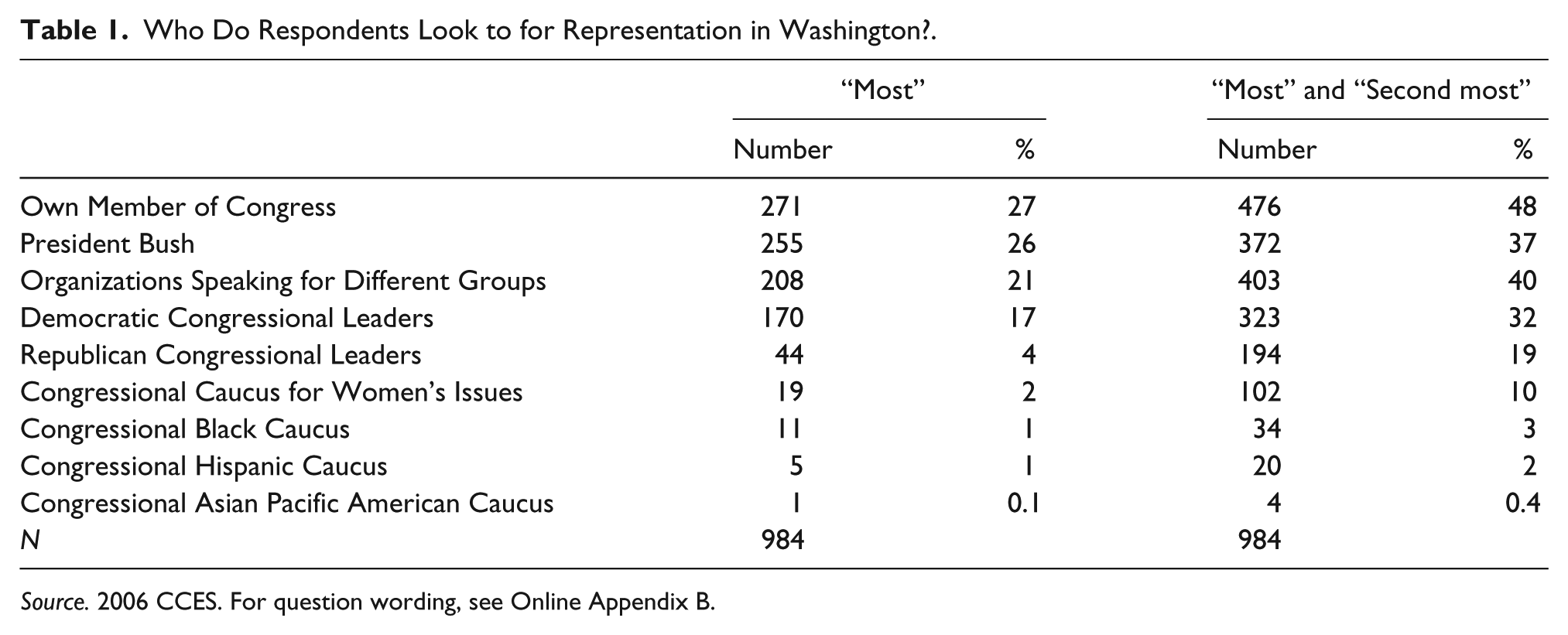
Table 1 presents the responses to these questions. The first two columns show that, when forced to select the one representative to whom they look “most,” a plurality (but far from a majority) chose their MC (27%), followed closely by those who chose President Bush (26%), and then those who selected organizations (21%). The next most frequent choice is Democratic congressional leaders, at 17 percent. None of the other options (Republican congressional leaders or any of the caucuses) exceeds 4 percent.
Who Do Respondents Look to for Representation in Washington?.
Source. 2006 CCES. For question wording, see Online Appendix B.
The second set of columns in Table 1 presents the aggregated responses to the questions about the representative to whom respondents look both “most” and “second most.” Although MCs remain the most popular choice (48%), it is remarkable that only about half of the respondents look to their MC most or second most. President Bush (37%) and organizations (40%) are the first or second choice for almost equal proportions of respondents. A greater share of respondents chose Democratic leaders (32%) than Republican leaders (19%). When we include a respondent’s second choice, 15 percent of respondents selected one of the congressional caucuses for representation. The CCWI and the CBC were the most popular choices among the caucuses (10% and 3%, respectively) when we combined first and second choices.
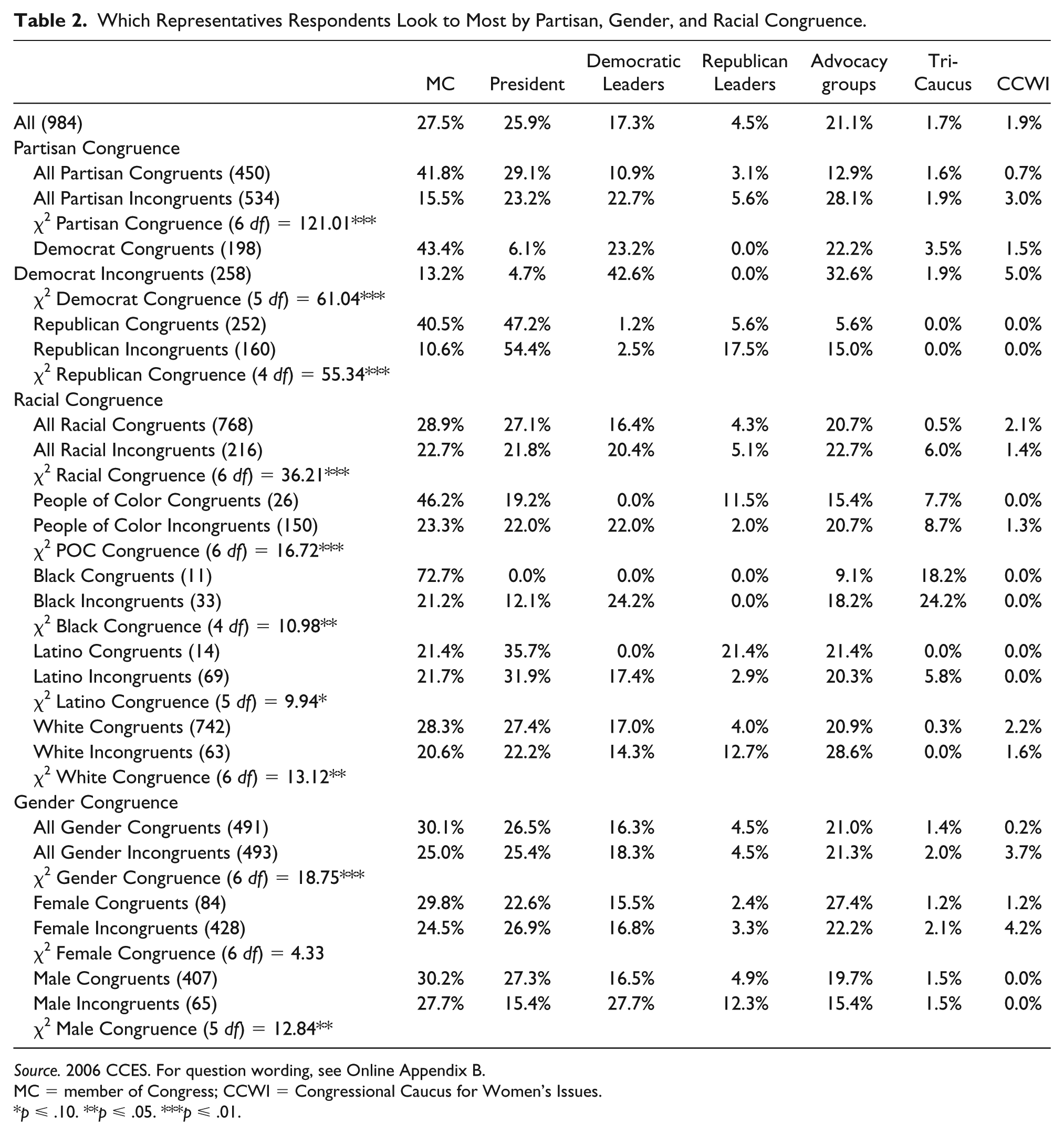
Next, to begin to assess whether partisan and descriptive congruence explain this variation, Table 2 presents responses to the question, “Which of the representatives listed above do you look to the MOST to represent you in Washington?” and it breaks out responses by partisan, racial, and gender congruence. (For this analysis, we combine the CBC, CHC, and CAPAC together into one category called “Tri-Caucus.” Although respondents were presented with these options separately, and while we recognize that these caucuses were formed to represent groups with different histories and experiences, we believe that they operationalize the same underlying concept of identity-based representation, as they demonstrated when they joined forces as the Tri-Caucus in 2005; see Tyson 2016).
Which Representatives Respondents Look to Most by Partisan, Gender, and Racial Congruence.
Source. 2006 CCES. For question wording, see Online Appendix B.
MC = member of Congress; CCWI = Congressional Caucus for Women’s Issues.
p ⩽ .10. **p ⩽ .05. ***p ⩽ .01.
These crosstabulations provide preliminary evidence of partisan, gender, and racial effects on the respondents’ choices about representation. Partisan congruence between respondents and their MCs forges the strongest representational connection, as 41.8 percent of all partisan congruents, including 43.4 percent of Democratic congruents and 40.5 percent of Republican congruents, indicated that they most often look to their MCs for representation in Washington. In contrast, only 15.5 percent of partisan incongruents, 13.2 percent of Democratic incongruents, and 10.6 percent of Republican incongruents selected their own MCs. 8 The differences between partisan congruents and incongruents, Democratic congruents and incongruents, and Republican congruents and incongruents are all statistically significant at the .01 level.
Table 2 also provides some hints about who Americans turn to when they do not share a partisan identity with their MCs. Forty-three percent of Democratic incongruents reported that they looked to Democratic leaders the most, and another one-third of them preferred advocacy groups. A majority of Republican incongruents (54.4%) reported that they relied on President Bush, and an additional 17.5 percent of them selected Republican leaders.
The crosstabulations also suggest that racial congruence has an effect on respondents’ connections to their representatives. They show that 28.9 percent of racial congruents selected their MC, compared with 22.7 percent of racial incongruents, and the differences between racial congruents and incongruents are significant at the .01 level. Further disaggregating those results also shows that African American congruents and white congruents were also significantly (p ⩽ .05) more likely to select their own MCs than were black incongruents and white incongruents. Descriptive congruence forged a particularly strong representational connection among African American congruents, as 72.7 percent of them indicated that their own MCs provided them with the most effective representation in Washington. For African Americans, the effects of racial congruence are likely compounded by partisan congruence, as 100 percent of African American congruents were also Democratic congruents. These preliminary results confirm the findings of previous research showing that most African Americans do not believe Republicans or conservatives effectively reach out to them or represent their interests (Frymer 1999; Lewis 2005; Philpot 2004). The results presented in Table 2 also provide clues about which political actors those who are not represented by an MC of the same race turn to if not their own MCs. Among all racial incongruents, advocacy organizations (22.7%) and President Bush (21.8%) were popular alternatives. A plurality of African Americans represented by someone of another race selected either Democratic leaders (24.2%) or one of the Tri-Caucuses (24.2%) over their MCs.
Table 2 also indicates that gender congruence is related to respondents’ feelings about their MCs, but also that it has a more limited effect than partisan congruence or racial congruence do. It shows that 30.1 percent of gender congruents, 29.8 percent of female congruents, and 30.2 percent of male congruents selected their own MCs, compared with 25.0 percent of gender incongruents, 24.5 percent of women represented by men, and 27.7 percent of men represented by women. The differences between gender congruents and gender incongruents are also statistically significant at the .05 level. However, while gender congruence was not significantly related to women’s choices about which political actors represent them the most, it was significant for men (p ⩽ .05). This relationship suggests that male respondents may place more value on being descriptively represented by a male MC than their female counterparts place on being represented by a woman.
Multivariate Analysis
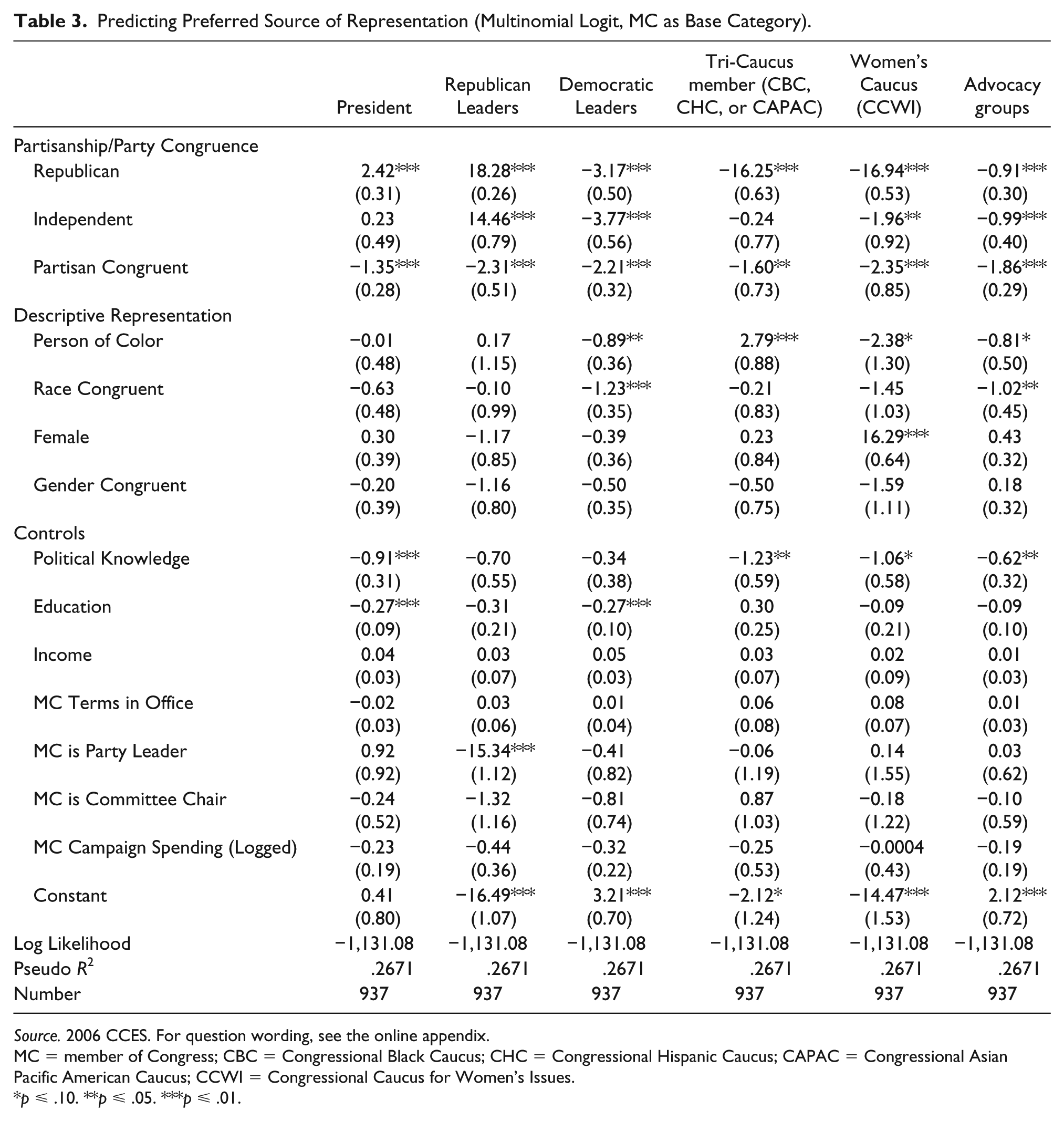
To test the partisan congruence and descriptive representation hypotheses, we use multinomial logit to analyze responses to the question, “Which of the representatives listed above do you look to the MOST to represent you in Washington” (see the online appendix for response options). Because MCs are, theoretically, the representatives most proximate to the American people, we use that option as the baseline category. The coefficients, therefore, indicate whether each independent variable affects whether respondents choose an alternative actor such as President Bush, organizations, party leaders in Congress, or the congressional caucuses over the MC from their district. (We once again combine the CBC, CHC, and CAPAC together into one category called “Tri-Caucus” in this analysis.)
We regress this dependent variable on independent variables measuring partisan affiliation, partisan congruence, and descriptive congruence. To account for partisan affiliation and partisan congruence, we include dummy variables for Republicans and Independents (with Democrats as the reference group) and a dummy variable measuring partisan congruence. To assess descriptive congruence, we include dummy variables for gender congruence and racial congruence, and we include dummy variables for females (with males as the reference group) and people of color (with whites as the reference group). Because of the small numbers of African American congruents (eleven), Latino congruents (fourteen), African American incongruents (thirty-three), and Latino incongruents (sixty-nine) in our sample, we were not able to further disaggregate racial congruence among people of color in the multivariate analyses as we did in the bivariate analyses. We also include measures of respondents’ education levels, political knowledge (operationalized as whether or not the respondent knows their MC’s partisan affiliation), and incomes to control for our expectations that wealthier, more highly educated, and more knowledgeable respondents should be more likely to know their MCs’ partisan affiliation, gender, and race, and to be aware of their other options for representation when they feel dissatisfied with their MCs. 9 Similarly, because we expect that respondents will be more likely to say that their representatives represent them the most when they perform their jobs effectively, we include four control variables that Tate (2003) shows influence MCs’ competence: seniority (measured as terms in office), status as a party leader, status as committee chair, and campaign spending. 10 We expect respondents will be more likely to say their MCs represent them the most when they have served longer in office or in leadership roles because senior MCs and leaders typically have more opportunities to secure victories for the constituents and/or to shape the agenda. We also expect that respondents will be more likely to feel represented when their MCs spend more on their campaigns, because increased campaign spending increases the chances that constituents will be aware of any actions their MCs took on their behalf.
Using the results of this model, we then calculated probabilities predicting the likelihood that respondents selected each political actor as the one who represented them the best, comparing these probabilities for partisan congruents and incongruents, racial congruents and incongruents, and gender congruents and incongruents. We calculated those predicted probabilities (with 95% confidence intervals) by setting the relevant congruence variables to 1 for congruents and 0 for incongruents and holding all the other categorical variables at their medians and all of the continuous variables at their means. 11 Finally, we calculated the difference between these predicted probabilities (and estimated 95% confidence intervals for them) to determine whether or not there were statistically significant differences between congruents and incongruents in terms of which representatives they preferred.
Partisan Congruence and Representation
Our results provide strong support for the partisan congruence hypothesis. Specifically, the predicted probabilities derived from the multinomial logit model presented in Table 3 indicate that, after controlling for other factors, Democrats represented by Democratic MCs (see Figure 1) are most likely to look to their own MCs, selecting them 50 percent of the time. Republicans represented by Republican MCs (see Figure 3) were most likely to indicate that President Bush represented them the most, selecting him 47 percent of the time. However, Republican congruents also had a strong connection to their MCs, indicating that they represented them the best 41 percent of the time. The differences between these probabilities (which are significant at the .05 level) are presented in Figures 2 and 4, and together, they show that partisan congruence increases the chances that respondents reported their own MC represents them the best by 38 percent of Democratic congruents and 28 percent for Republican congruents. 12
Predicting Preferred Source of Representation (Multinomial Logit, MC as Base Category).
Source. 2006 CCES. For question wording, see the online appendix.
MC = member of Congress; CBC = Congressional Black Caucus; CHC = Congressional Hispanic Caucus; CAPAC = Congressional Asian Pacific American Caucus; CCWI = Congressional Caucus for Women’s Issues.
p ⩽ .10. **p ⩽ .05. ***p ⩽ .01.
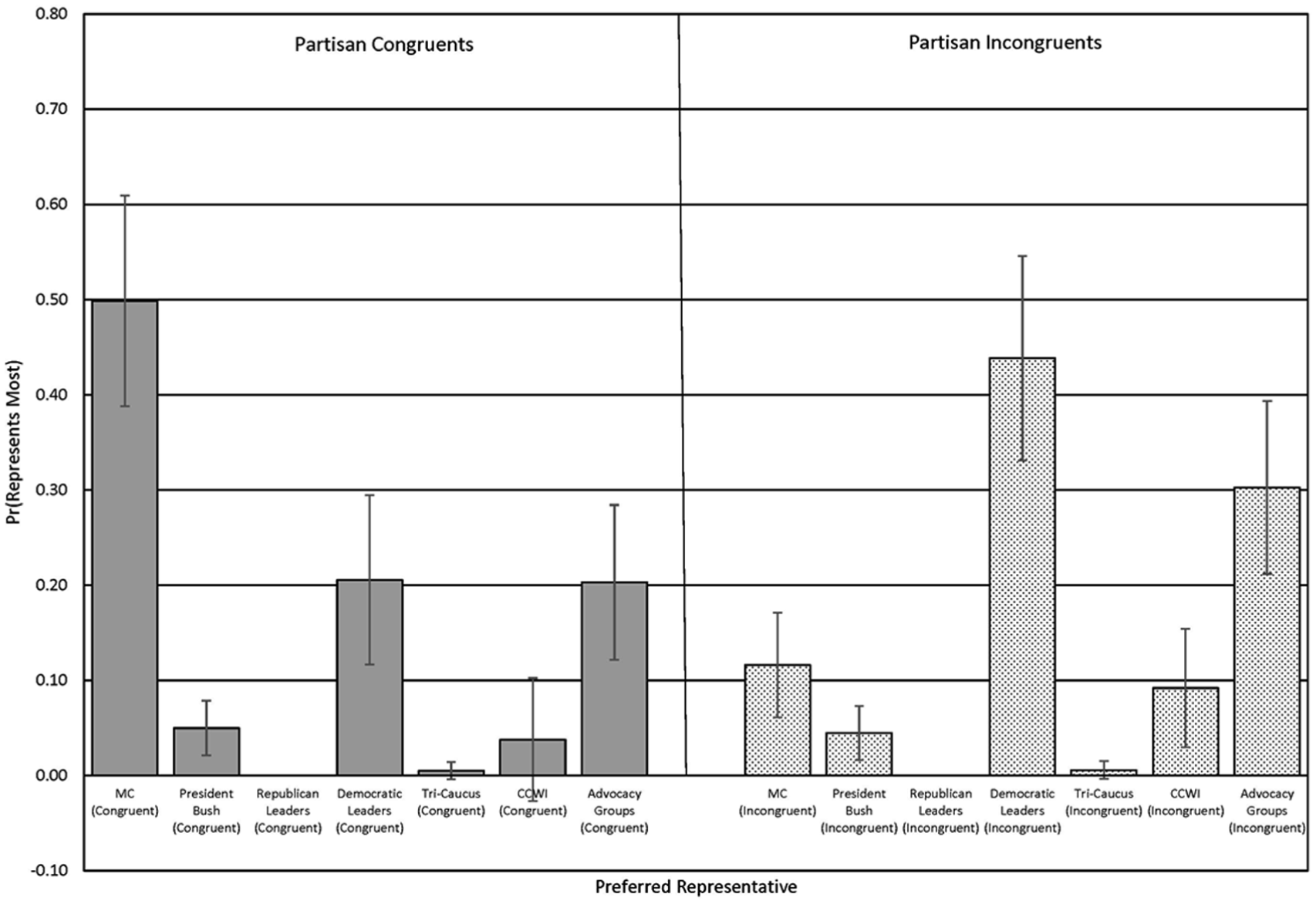
Democrats’ preferred representatives by partisan congruence.
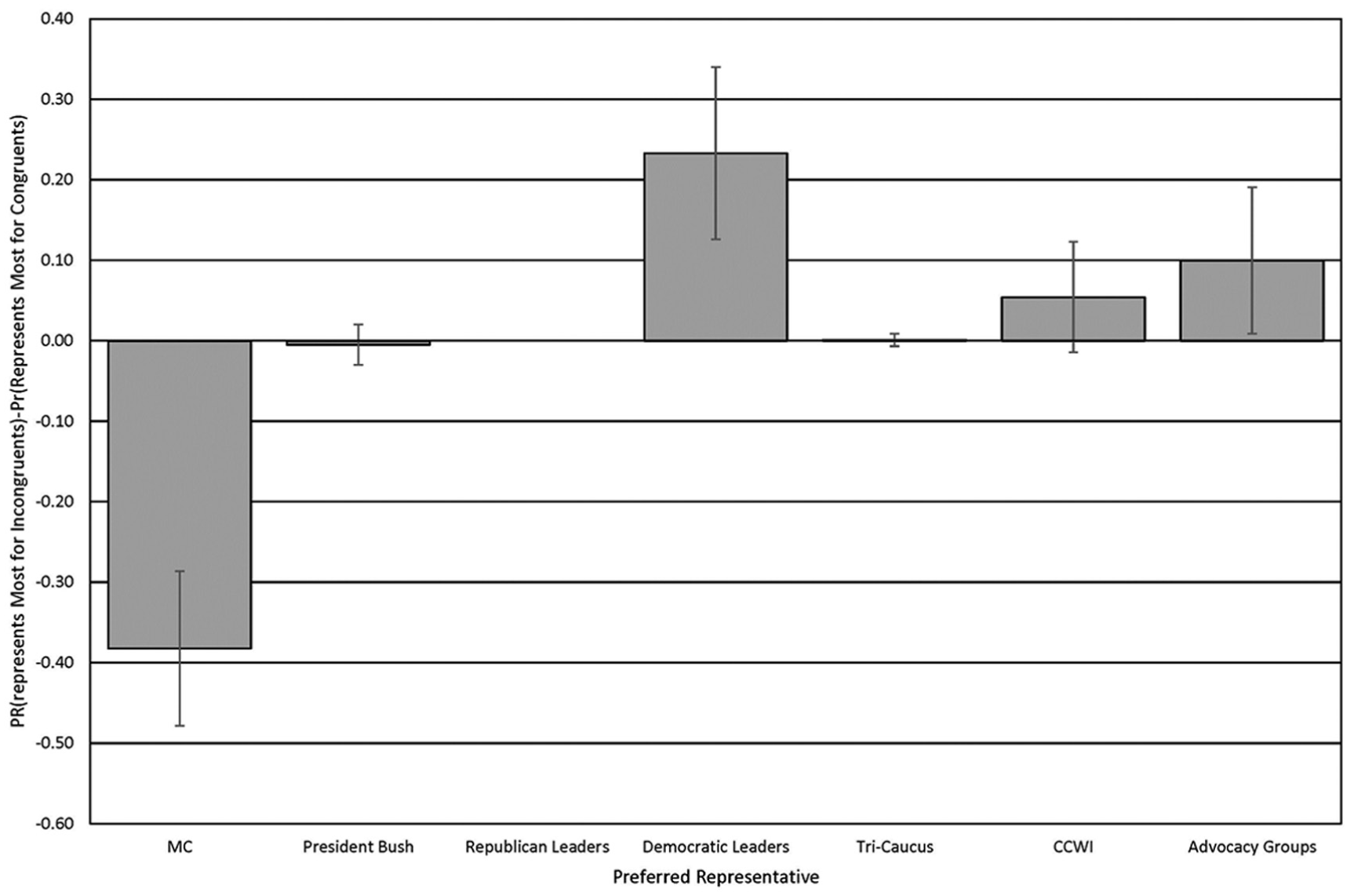
Predicted differences in the probability that democratic congruents and incongruents will select each representative.

Republicans’ preferred representatives by partisan congruence.
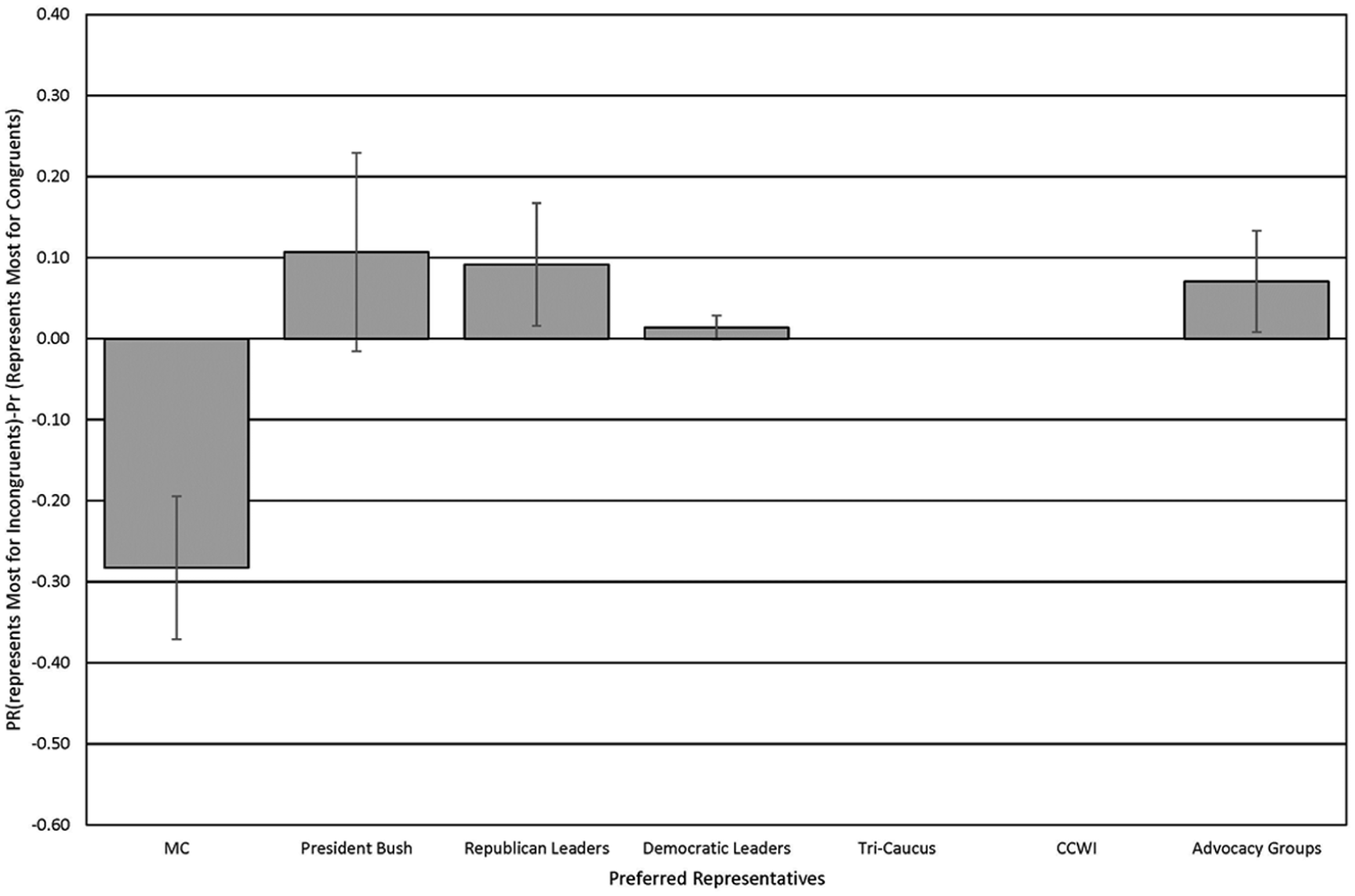
Predicted differences in the probability that republican congruents and incongruents will select each represenative.
The results also provide insight into who respondents feel represents them the most when they do not share a partisan identification with their MCs. Perhaps unsurprisingly, Democrats represented by Republican MCs preferred Democratic party leaders and advocacy organizations to their own MCs (see Figure 1). Figure 2 indicates that Democratic incongruents were 23 percent more likely than Democratic congruents to indicate that Democratic leaders represented them the best, and they were 10 percent more likely than Democratic congruents to select advocacy organizations as the actor that represented them the most. Both of these differences were significant at the .05 level. Figure 3 shows that after controlling for other factors, Republicans represented by Democratic MCs strongly preferred President Bush—the national head of their party—to their own MCs. Figure 4 indicates that they were also significantly (p ⩽ .05) more likely than Republican congruents to indicate that Republican congressional leaders and advocacy groups represented them the most, and those differences were significant at the .05 level.
Racial Congruence and Representation
Our bivariate results (Table 2) demonstrate that partisan congruence and racial congruence are highly correlated among African Americans. In spite of this relationship, however, the results of the multivariate analyses make clear that racial congruence has its own unique effects on respondents’ ideas about who represents them the most even after we take partisan congruence into account. To start, racial congruents (e.g., African Americans represented by African American MCs, Latinos represented by Latino MCs, and whites represented by white MCs) turn to their own MCs more than their incongruent counterparts do. After controlling for all other factors, Figure 5 indicates that the probability that racial congruents reported that their own MCs represent them best was 12 percent, compared with a 4 percent chance for racial incongruents. Thus, as Figure 6 shows, racial incongruents were 8 percent less likely than racial incongruents to select their own MCs, and that difference is significant at the .05 level. 13 Figure 6 also reveals that racial congruence was not significantly associated with whether respondents selected the president, congressional leaders, congressional caucuses, or advocacy groups as the actors who represented them the best. 14 Our sample included too few respondents of color to further disaggregate racial congruence among people of color. We were, however, able to conduct a separate analysis of racial congruence to test its effects among white respondents. Figures 7 and 8 show that we found that 12 percent of white congruents – but only 4 percent of white incongruents – reported that their own MC represented them the most, an 8 percentage point difference that is significant at the .05 level.
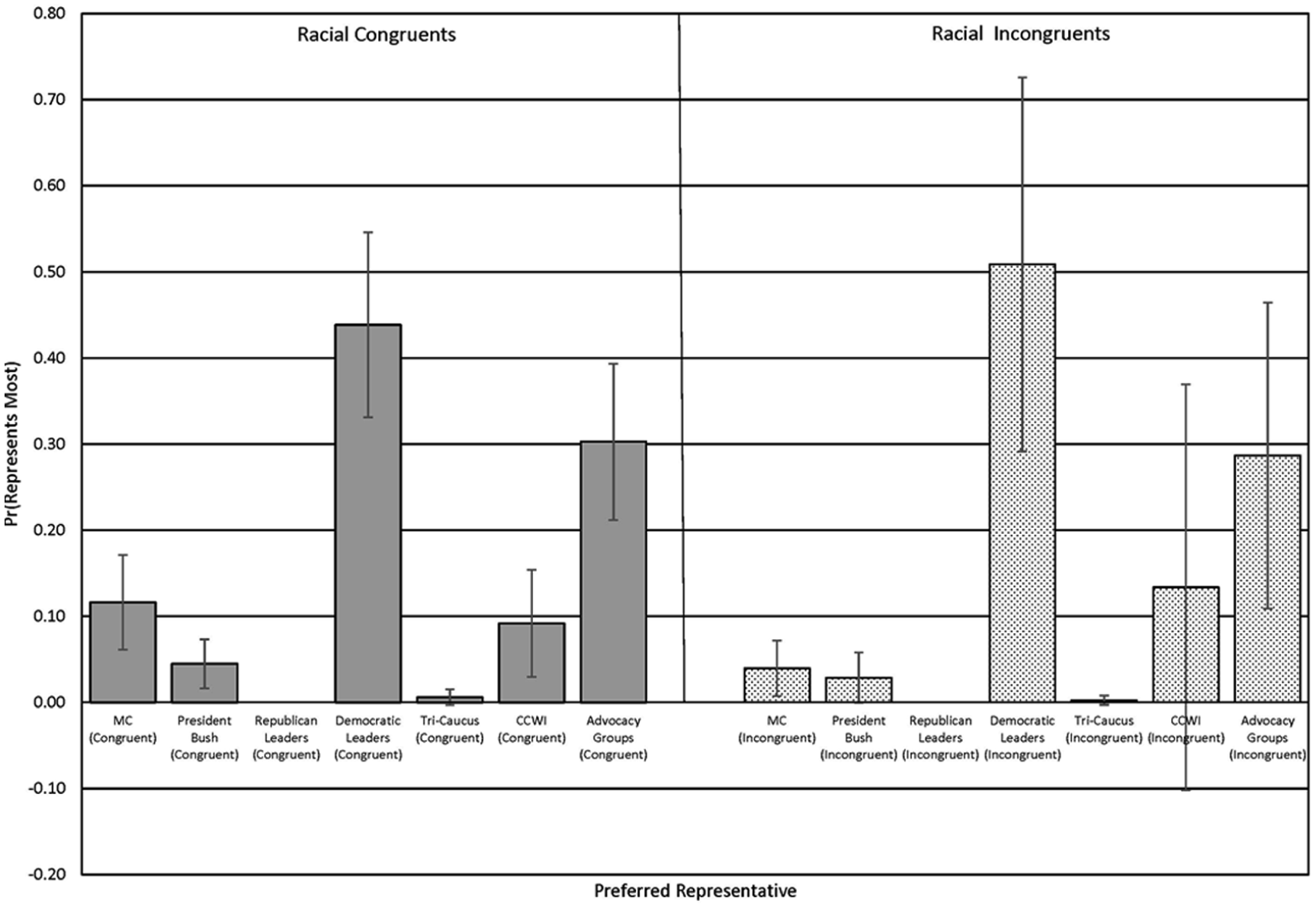
Respondents’ preferred representatives by racial congruence.
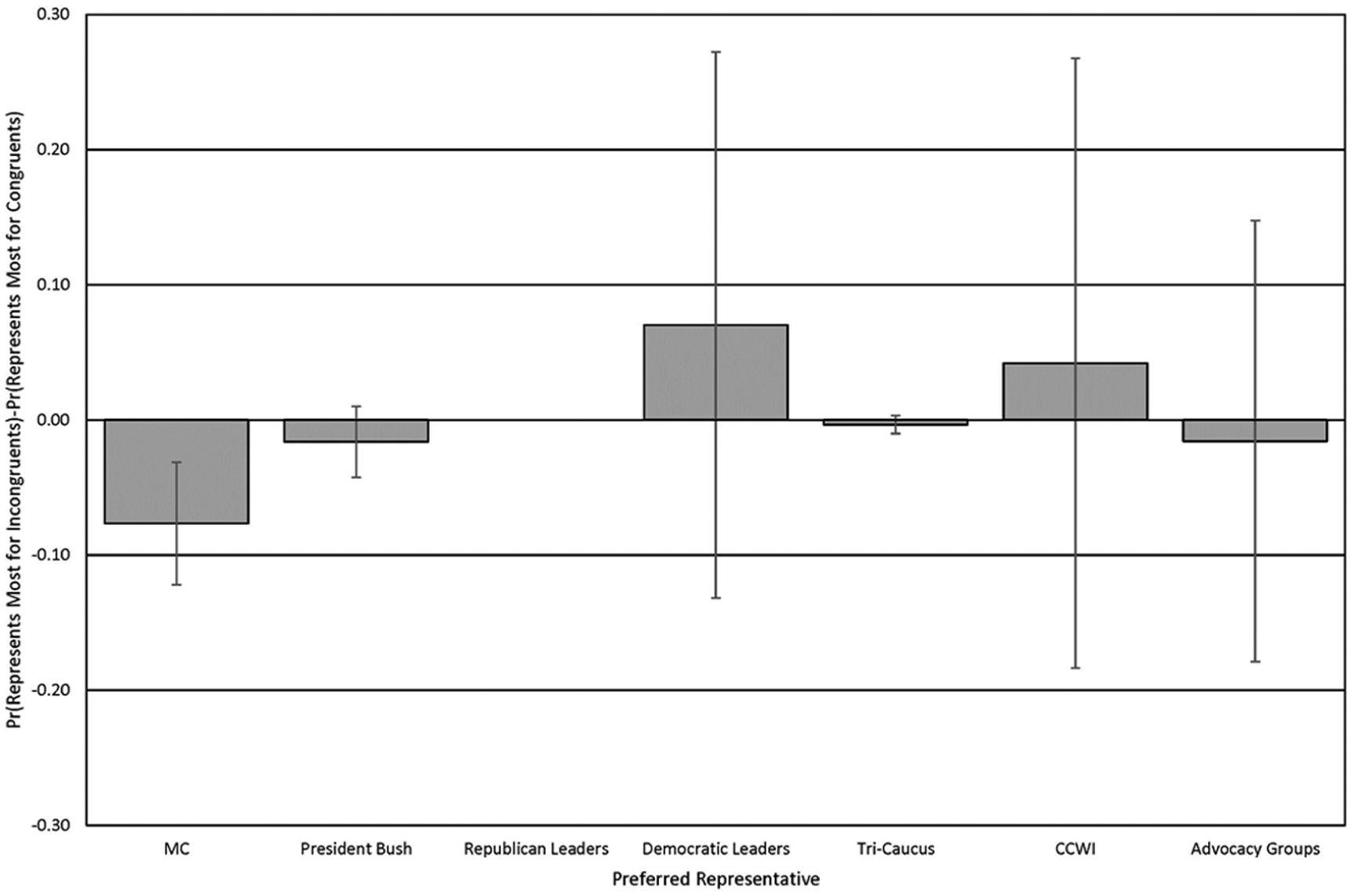
Predicted differences in the probability that racial congruents and incongruents will select each representative.
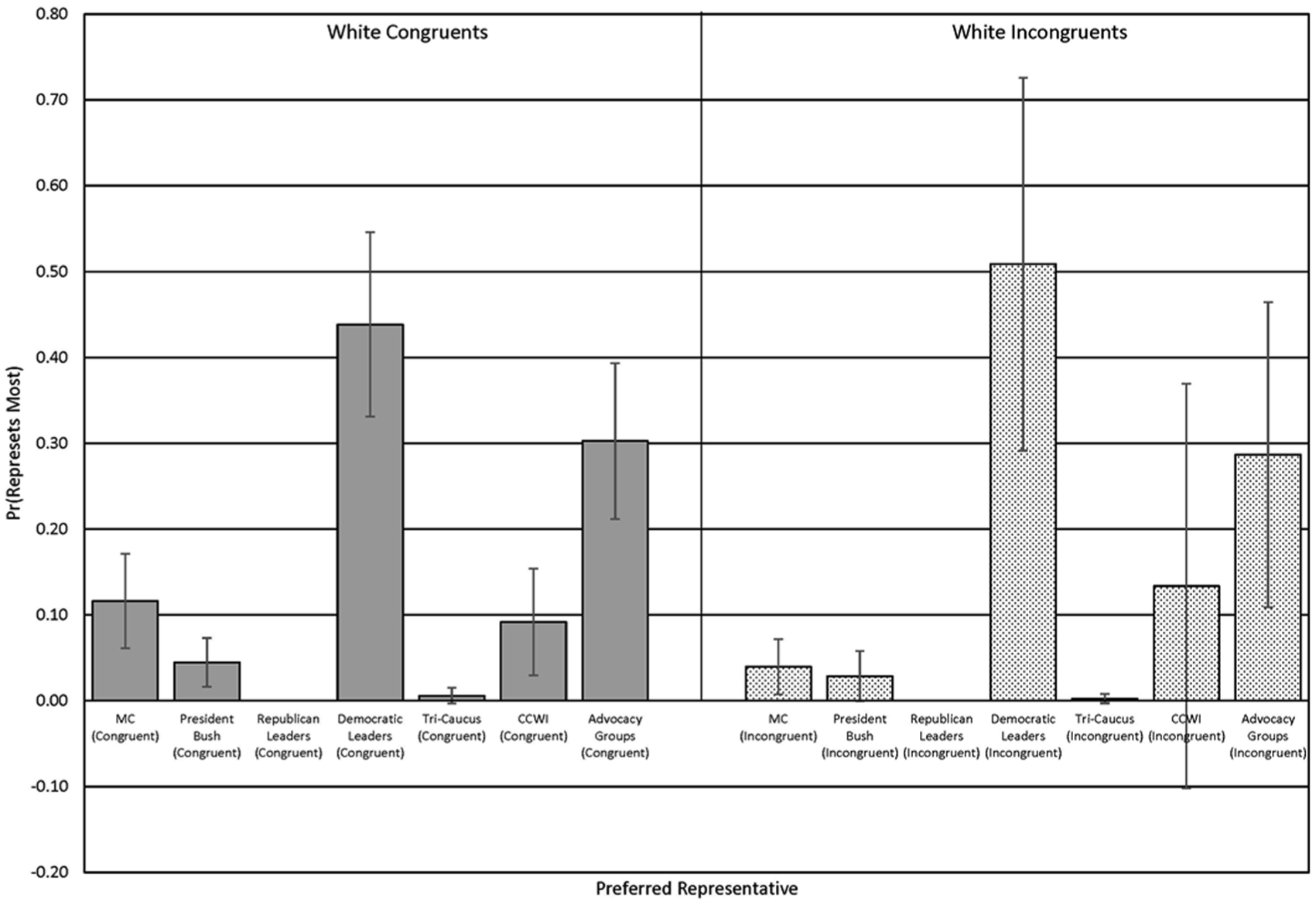
White respondents’ preferred representatives by racial congruence.
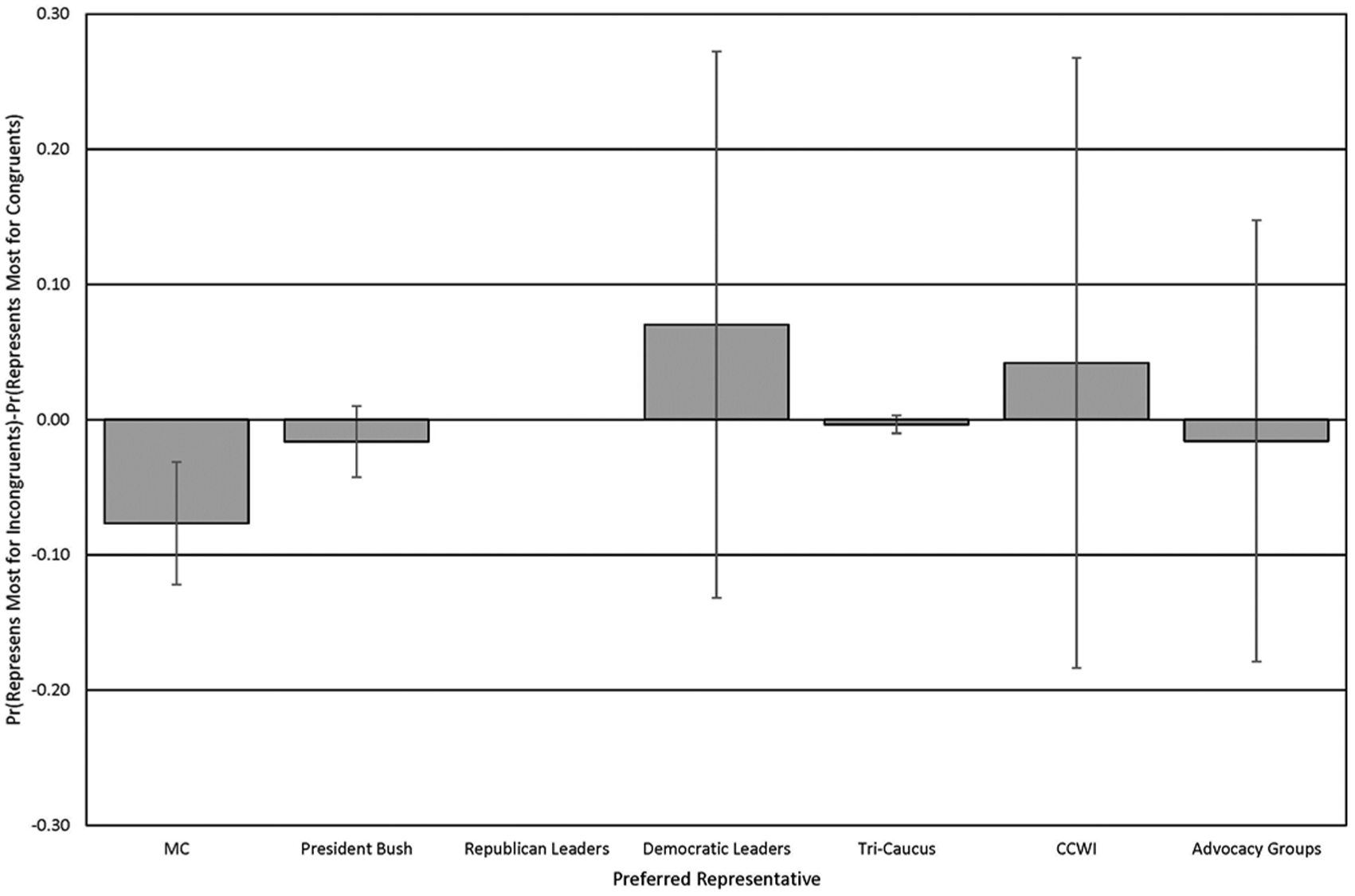
Predicted differences in the probability that white congruents and incongruents will select each representative.
Gender Congruence and Representation
The bivariate results suggested that gender congruence would have some effect on respondents’ feelings on who represents them the most (particularly among men). However, the results in Table 3 indicate that, once we account for other factors, gender congruence does not significantly effect whether respondents indicate that other political actors represent them better than their own MCs do. Indeed, the differences in the predicted probabilities displayed in Figure 9 show that gender congruence does not have a significant effect on how often respondents indicate their MCs represent them the most. 15 Figure 10 also indicates that gender congruence does not have a significant effect on how often women or men select President Bush, party leaders in Congress, or the congressional caucuses. 16
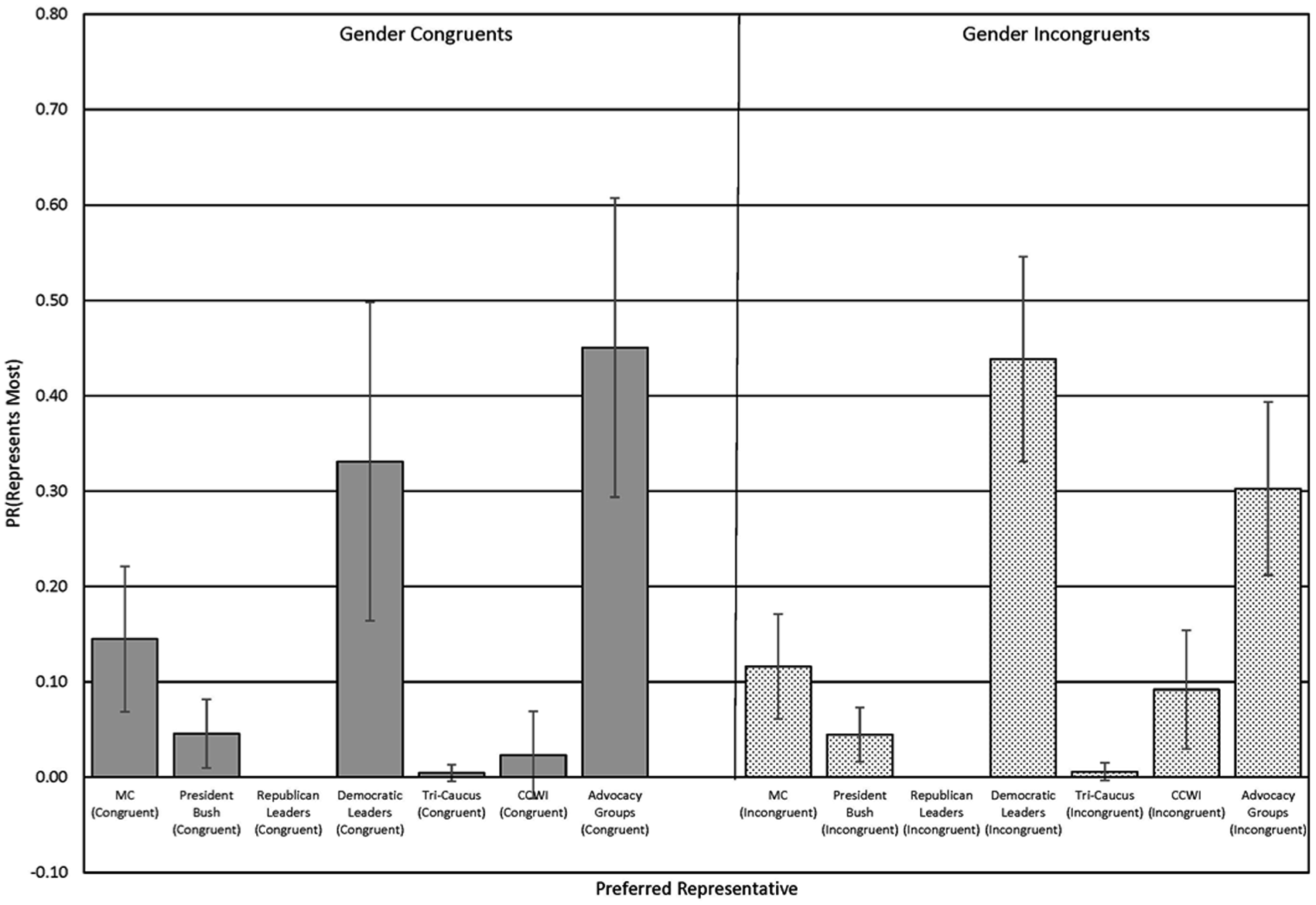
Respondents’ preferred representatives by gender congruence.
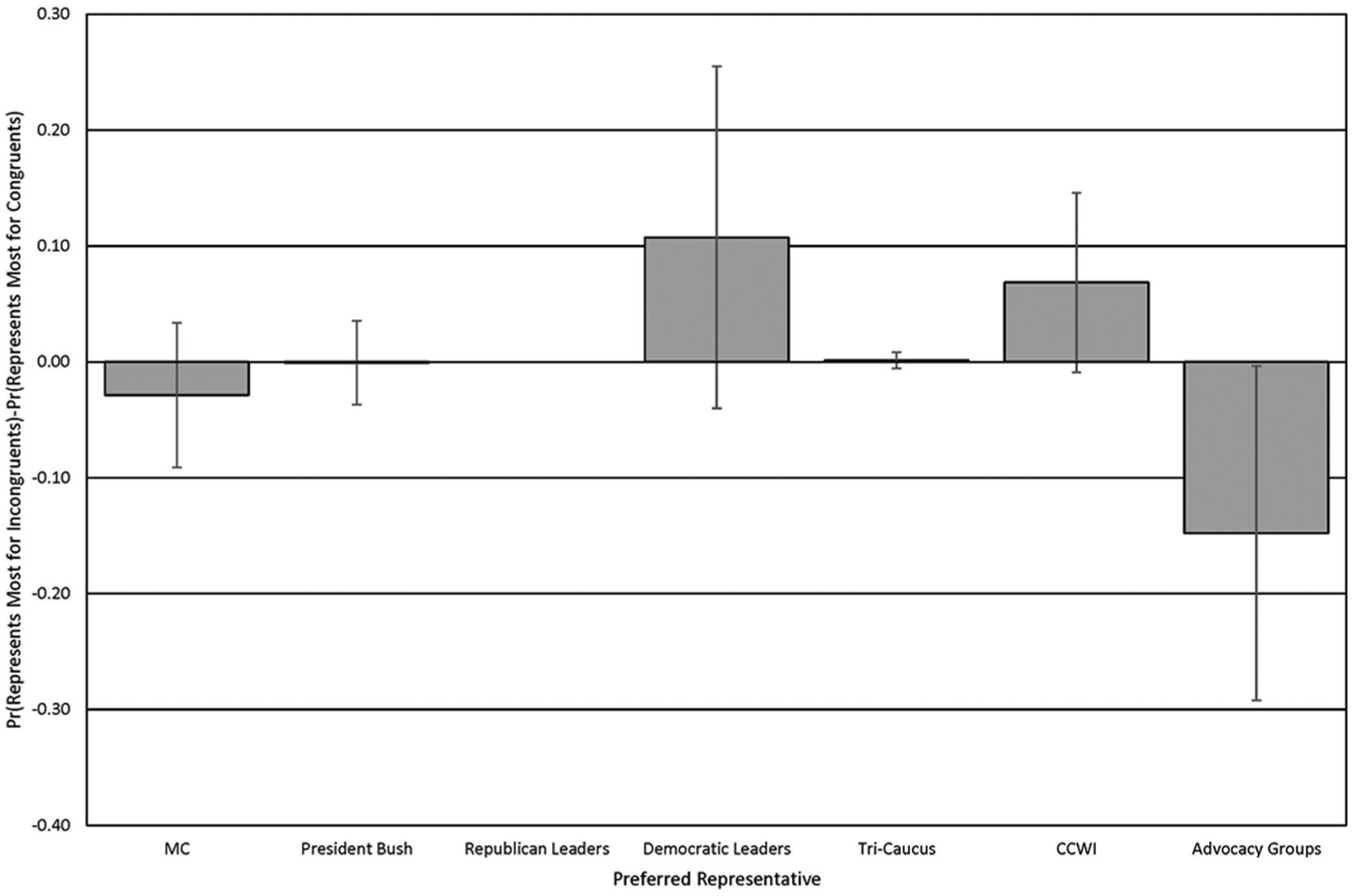
Predicted differences in the probability that gender congruents and incongruents will select each representative for female respondents.
Discussion: Polarization, Congruence, and Representative Democracy
Our analyses shed light on several important but understudied dimensions of representation. First and most centrally, we show clearly that the connection between constituents and their own elected House members is far more tenuous than the framers intended it to be. Although a plurality of Americans looks first to their own MC for representation, a majority looks elsewhere—inside or outside Congress—often because the representative links between Americans and MCs are heavily conditioned by the presence or absence of shared partisanship. For example, partisan congruents from both parties are significantly more likely than partisan incongruents to report that their own MC represents them the most. Partisan incongruents are also more likely to look instead to other representatives, such as advocacy groups. While our cross-sectional data do not permit us to examine what happens in other contexts, these findings suggest that in the current polarized era, it is difficult for MCs to use constituent services or to rely on their “home styles” to compensate for partisan or policy differences. Those challenges have likely increased as polarization inside Congress and the electorate has become more intense (Mason 2018; Voteview 2018).
This research also adds several new dimensions to the growing literature on the importance of—and the relationships among—symbolic representation, descriptive representation, and informal and compensatory sources of representation. First, our analyses demonstrate that organizations do, indeed, serve an important representative function even though voters do not elect them. For example, partisan incongruents from both parties were significantly more likely than their congruent counterparts to turn to advocacy organizations, suggesting that these organizations provide an important form of surrogate representation for those who do not feel represented by their MCs.
Second, our results suggest that descriptive representation can have symbolic effects that enhance Americans’ beliefs that they are being represented, and they confirm the findings of work by scholars such as Claudine Gay (2001; 2002) and Deborah Schildkraut (2017) that this is true not only among members of marginalized groups. For example, 72.7 percent of African American respondents represented by an African American MC indicated that their own MCs represented them the most, but that number dropped to 21.2 percent for African American incongruents. Like Schildkraut (2017), we found that whites, too, value descriptive representation, because we find and they are more likely to say their MC represents them the most when their MC is also white. Our multivariate analyses also showed that, after controlling for other factors, racially-congruent respondents were significantly more likely than their racially-incongruent counterparts to select their own MCs as the political actors who represented them the best.
Third, we show that caucuses are another important source of representation for members of marginalized groups. Although our findings suggest that people turn only rarely to congressional caucuses for representation and that racial and gender congruence have no effect on whether or not people seek them out, the results in Table 3 indicate that people of color were significantly more likely than whites to choose one of the Tri-Caucus groups over their MCs, and women were also significantly more likely than men to prefer the CCWI to their own MCs.
Finally, our findings suggest that because many of the salient groupings that help to define political constituencies and representative claims are contingent, dynamic, and intersecting, simply increasing the “single-axis” descriptive representation of any one group does not automatically mean that individuals who “share” the race or gender identification of their MCs will “feel represented” (Brown 2014; Cohen 1999; Crenshaw 1989; Dovi 2002; Minta and Brown 2014; Schildkraut 2013, 2016; Strolovitch 2007; Young 2000) or that they will accept their descriptive representatives’ claims (Rehfeld 2006; Saward 2010). These insights suggest that people’s intersectional identities affect the extent to which they feel their MCs represent them. Because our sample included only 184 respondents of color, however, we could not conduct robust statistical analyses to test the possiblity that, for example, sharing both a race and gender with one’s MC—what we might call intersectional congruence—affected their attitudes about which political actors represented them the best. Based on our findings, however, we expect that intersectional congruence would further increase the chances that respondents feel that their MCs represent them the most effectively. Future surveys that oversample people of color might test that hypothesis, and might also examine the effects of descriptive representation along other lines such as lesbian, gay, bisexual, transgender, and queer (LGBTQ) identification, citizenship status, and religious affiliation. Building on Schildkraut’s (2013, 2016, 2017) work, future studies using data that include questions about linked fate (which were not available in the 2006 CCES) might also examine the relationship between respondents’ perceptions of linked fate with groups based on race, gender, sexual orientation, gender identity, citizenship status, or religious affiliation and their ideas about represention.
Conclusion
What does “representation” mean to Americans, and who do they think actually represents them in Washington? Do they accept the framers’ claim that their House members are their “best” representives, or do they reject that claim and turn to other representatives instead? By asking new questions about how people view a range of political actors and entities, our results provide new insights into important but understudied aspects of symbolic representation and into what it means to “feel represented.” Specifically, by examining the degree to which people look to their own MCs and by exploring which political actors they feel represent them the best, we show that most Americans look beyond their House members for representation and rely on other actors to speak for them in national politics. In an era in which people routinely express dissatisfaction with their government, we show that entities such as advocacy organizations provide an important surrogate voice for many Americans because they transcend congressional district boundaries and help compensate for their underrepresentation in Congress.
By also examining the effects of race, gender, and partisanship on people’s propensity to look beyond their own MCs, our results also begin to illuminate the particular factors that lead people to seek out these alternative representatives. In so doing, we shed new light on longstanding debates about the symbolic value of descriptive representation by showing that Americans are more likely to rely on their MCs when they share a racial identification with them. However, our results also show that many Americans turn to advocacy groups and party leaders before their own MCs even when they share such identifications, indicating that MCs need to do more than simply share an identity with their constituents for Americans to “feel represented.”
Although our results are situated in the context of one particularly polarized congressional election season, they provide insights about crucial representational connections forged by both institutional design and by partisan and descriptive dynamics. It is almost tautological to note that the legitimacy of our representative democracy hinges on the belief among Americans that their views and interests are represented. Perhaps it is because this central tenet seems self-evident that it has been so rarely examined explicitly. This study represents a first and important step toward doing so, showing that partisan congruence and race-based descriptive representation increase Americans’ feelings that they are being represented by their own MC and providing new insight into who Americans turn to when they feel that their MC does not represent them in Washington.
Supplemental Material
Online_Appendix – Supplemental material for Who Represents Me? Race, Gender, Partisan Congruence, and Representational Alternatives in a Polarized America
Supplemental material, Online_Appendix for Who Represents Me? Race, Gender, Partisan Congruence, and Representational Alternatives in a Polarized America by Ashley English, Kathryn Pearson and Dara Z. Strolovitch in Political Research Quarterly
Footnotes
Declaration of Conflicting Interests
The author(s) declared no potential conflicts of interest with respect to the research, authorship, and/or publication of this article.
Funding
The author(s) received no financial support for the research, authorship, and/or publication of this article.
Notes

References
Supplementary Material
Please find the following supplemental material available below.
For Open Access articles published under a Creative Commons License, all supplemental material carries the same license as the article it is associated with.
For non-Open Access articles published, all supplemental material carries a non-exclusive license, and permission requests for re-use of supplemental material or any part of supplemental material shall be sent directly to the copyright owner as specified in the copyright notice associated with the article.
