



Abstract
This study adopts a systemic approach, focusing on real-world online discussions in legislative-, media-, and activist-based forums, to explore a set of factors that affects reasoned disagreement in digital environments. While conventional analysis investigates the effects of disagreement on civic and political participation, this study unpacks forms of disagreement that retain a principled link with reason-giving. Our findings demonstrate that context matters for shaping online communication, but that other variables have even stronger correlations. Specifically, moderating disagreement—conceptualized as a way of disagreeing that nevertheless signals a background of agreement in the conversation—strongly increases the likelihood of justificatory behavior, and it does so in more categories than bold disagreement. In conclusion, we argue that forms of disagreement and their respective consequences deserve more empirical and normative attention, not only to advance debates on deliberation but also to critically understand the communicative complexities in a new media landscape.
Keywords
In the complex network of digital connectivity, citizens have unprecedented opportunities to engage in discussions beyond those located in formal political institutions and civic arenas, whether they seek to support or undermine democratic policy. To a large extent, the growing fragmentation and polarization of ideological political groups is supported by these diverse digital settings (Bakshy et al., 2015; Maia and Rezende, 2016; Nikolov et al., 2015; Pariser, 2011; Sunstein, 2017), and social media platforms enable hate speech and attacks on human rights to spread (Chambers, 2017; Curato et al., 2019; Mansbridge and Fishkin, 2017). This study systematically analyzes the relationships between disagreement and reason-giving in online discussions about a controversial issue—specifically, a bill proposing that the age of criminal responsibility in Brazil be lowered—in arenas that serve distinct functions in the political system (legislative public hearings, news websites, and an activist social media page (Facebook), and traces the implications of these practices for public reasoning.
Given this adversarial scenario for deliberative democracy and different settings within this new media landscape, this article argues that it is more important than ever to understand citizens’ expressions of disagreement beyond those identified in controlled experiments. By focusing on various contexts of relatively spontaneous online communication, our research does not generalize from the capacities of everyday communication to efficacious deliberation as a means to produce recommendations for political decision-making and policy. Instead, we understand that deliberation is a rare, demanding, and difficult practice, and that incentives for discursive engagement and strategies are usually required to compensate for less-than-ideal conditions (Habermas, 1996, 2009; Neblo, 2015; Steiner et al., 2017).
This article advances three related claims. First, we posit that citizens’ informal political discussions constitute an important component of the deliberative system, and that investigating disagreement requires attending to different scales of the broader public sphere (Chambers, 2017; Dryzek, 2016; Ercan et al., 2017; Maia, 2017a, 2017b; Mansbridge et al., 2012; Parkinson, 2018). Whereas a large body of research has investigated elements that shape online discussion in specific spaces, research on variations across digital settings is nascent (Esau et al., 2017; Halpern and Gibbs, 2013; Maia and Rezende, 2016; Strandberg and Grönlund, 2014, 2018; Stromer-Galley et al., 2015). Our research, by focusing on a news media space, a legislative forum, and an activist Facebook page, taps into settings that serve to distinct functions in deliberative systems (Maia, 2012; Mansbridge et al., 2012). This is an important question to investigate because one cannot generalize prematurely the significance of exposure to opposing information and in advocating public reflection and discursive engagement. This role may very well depend on the context, and here the distinction between types of digital settings is salient.
Second, the analytic framework offered in this article sheds light on reasoned disagreement. The literatures on political communication and deliberation have theorized and studied extensively expressions of agreement and disagreement (Huckfeldt et al., 2004; Mutz, 2002, 2006; Wojcieszak and Mutz, 2009; Wojcieszak and Price, 2010). We have witnessed a serious ongoing effort to disentangle the effects of dis/agreement on information seeking, attitude changes, and various types of civic practice and political participation (Esterling et al., 2015; Hong and Rojas, 2016; Klofstad et al., 2012; Mutz, 2006). Current studies have focused on the frequency and intensity of disagreement (Lee et al., 2015; Mutz, 2002; Strickler, 2018; Wojcieszak and Price, 2010) or the contrast between perceived and actually expressed differences during discussions (Stromer-Galley et al., 2015; Wojcieszak and Price, 2012). Given this interest in disagreement, surprisingly little work has analyzed systematically the relationship between expressions of disagreement and reason-giving. Since justification is a core normative requirement for deliberation, this gap is a missed opportunity to understand the relationship between disagreement and provision of reasons. This study operationalizes variables such as online discussion context, one’s stance on the majority opinion in the debate, and the message target.
Third, and finally, this study argues that moderating ways of expressing disagreement matter for reasoned argumentation. Our analysis corroborates the view that context is a relevant factor for shaping online communication, but other variables may have important effects on the expressions of disagreement. We build on the concept of “bold” and “soft” disagreements as forms of articulating difference that signal a background of agreement in the conversation (Laden, 2012). A clear distinction emerges between such forms across digital settings, and soft disagreement varies depending on a large number of factors. Though it does not guarantee discursive engagement, only soft disagreement is statistically associated with reason-giving in spontaneous communication. In conclusion, we argue that the differential consequences between these forms of expressing disagreement deserve more empirical and normative attention.
Disagreement and Reason-Giving in the Unstructured Public Sphere
Theories of deliberative democracy place disagreement at their core, and divergent views are necessary to pinpoint the problem that deliberation is expected to solve (Esterling et al., 2015; Gastil, 2018; Gutmann and Thompson, 1996; Habermas, 1996, 2009; Landemore and Page, 2015; Thompson, 2008). However, how individuals react when they encounter challenging information and opposing views or claims is far less certain. While encountering disagreeable information likely generates contestation, this does not mean that people are willing or motivated to move toward argumentation as a means to resolve conflicts about their views and recommendations, including those values and beliefs underlying their preferences and judgments. Citizens may prefer to use other means such as fighting, trading insults, or avoiding stressful argumentation (Bakshy et al., 2015; Maia and Rezende, 2016; Nikolov et al., 2015; Pariser, 2011; Sunstein, 2017).
Theories of deliberative democracy and political communication contain many assumptions regarding disagreement and willingness to engage in reasoned discussion. Disagreement may be more productive when individuals reflect more carefully about other considerations, gain knowledge, and engage in constructive dialogue (Gutmann and Thompson, 1996; Habermas, 1987, 1996; Thompson, 2008). Conversely, disagreement can be counterproductive when individuals ignore opposing views, feel uncomfortable with conflict, retreat from conversation, or resent or insult those who challenge their preferences (Bächtiger and Gerber, 2014; Esterling et al., 2015; Gastil, 2018; Mutz, 2006). Therefore, we need to observe the nature of disagreement and when it occurs in order to understand under what conditions this practice is more likely to be reasoned.
To address this gap, we adopt two premises in this study. First, according to normative deliberative theory, we expect discussion participants to offer justifications for their views when they do engage in reasoned disagreement (Gutmann and Thompson, 1996; Habermas, 1987, 1996). Exposure to opposing views and claims may lead participants to deep disagreements about moral and ethical issues as well as legal and pragmatic questions (Gutmann and Thompson, 1996; Habermas, 1996, 2009). We consider, however, that disagreement can be expressed in different “forms,” regardless of the content of such divergence, and even robust and deeply substantial disagreements can be expressed in a moderate or diplomatic fashion. This study seeks to explore some of the mechanisms, identified in the existing literature, that underlie and shape the different forms of disagreement.
Second, we assume that, in order to understand disagreements in an online environment, we must broaden our approach beyond the current studies that focus on a singular forum and instead develop more consistently multidimensional analyses (Chambers, 2017; Dryzek, 2016; Ercan et al., 2017; Mansbridge et al., 2012; Parkinson, 2018). Whereas there has been long-standing evidence that online discussion is shaped by contextual variables, much remains to be established under what conditions reasoned disagreement is more likely to occur, for instance, regarding the functional purpose of digital spaces, homogeneity/heterogeneity of communicative spaces, and non-personal/interpersonal online interactions.
It is, of course, not at all clear—nor is it uncontroversial—how “forms” of expressing disagreement are to be best characterized. Some scholars have attempted to distinguish between “civil disagreement,” behavior that reflects awareness of social norms of politeness and civic interactions, and “uncivil disagreement,” more aggressive and inhibited conflict that may eventually include hostility (Black and Wiederhold, 2014; Masullo Chen and Lu, 2017; Stromer-Galley et al., 2015). Surely, disagreement can take these forms, but this kind of distinction poses difficulties for explaining disagreement’s role in deliberation in ways that can move beyond culture. We are also sympathetic to Warren’s (2006, 2008) claims that “diplomatic,” rather than overt expressions of agonism, helps maintaining the dialogic cooperation necessary to the deliberation progress. This argument, as it stands, however, runs the risk of excluding or neglecting deep disagreements in political conflicts. Warren’s argument, despite being relevant in practical terms, offers us little normative guidance for going forward with honest contestation.
In this study, we focus on “soft disagreement” as a form of expressing disagreement that nevertheless signals a background of agreement in the conversation. Moderating disagreement in this sense comes closer to what Laden (2012: 214) has called an “invitation” to reasoning, that is, a reciprocal interaction “by which we attune ourselves and work out the space of reasons we inhabit.” We assume that communicative marks such as “I see your point, but,” “I’m not sure about that,” and “that’s not entirely right” (Stromer-Galley and Muhlberger, 2009) signal that the speaker considers what others say and therefore might be open to other assertions and evaluative standpoints. Thus, the speaker modulates his or her own deliberative engagement by appearing to admit other lines of inquiry or remain open to further interactions.
In contrast, bold disagreement involves sharp contestation and straightforward expressions of divergence. By saying, for instance, “you are wrong” or “I disagree,” the speaker declares that the other is mistaken or that a certain consideration does not count (or is even irrational) in a way that signals the absence of shared grounds in the conversation. Here, the speaker presents himself or herself as less open to be moved on the basis of a shared set of reasons (Laden, 2012). In this situation, we believe that bold disagreements do not signal an invitation for reasoning together. Therefore, we expect that bold disagreements, in contrast to soft ones, may entail less motivation for reason-giving.
To summarize, based on the logic of communicative action and argumentation theories (Habermas, 1987, 1996; Laden, 2012), we assume that offering justifications increases the chance of moderating disagreement that signals a background of agreement in the conversation while bold disagreements indicate an absence of a shared ground for reasoning together. Thus, we pose our central hypothesis:
H1. Comments with justification are more likely to spur soft disagreement than bold disagreement.
Two caveats are needed before we proceed. First, this is an exploratory study. Since disagreement can be affected by various mechanisms that operate in different ways, we decided to confine our study to the complex interactions in the digital media landscape. Thus, although this study aims to produce some generalizations, these do not apply to broader populations and non-digital communication. The second caveat is that this study focuses on the “form” of expressing disagreement, not the content of such divergence. We do not ignore the problem that moderating one’s disagreement may be rhetorically useful (Chambers, 2009, 2017; Kock, 2012; Neblo, 2015), and that this rhetorical strategy may accommodate uneven power relations (Curato et al., 2019; Maia, 2012, 2014; Young, 2002). Still, we believe that keeping the terrain open for reasonable argumentation can reveal hidden injustices and illegitimate power and thus facilitate more valid conflict resolutions.
Online Discussion Context
Taking into consideration the diversity of approaches that have thematized and investigated disagreement, it is worthwhile to step back and survey which elements may affect citizens’ disputes in different contexts of online discussion. While attempts to extrapolate from the online environment as a whole have confused the current debate about exposure to disagreeable information, we assume that focusing on three digital settings—legislative public hearings, news media, and an activist Facebook page, all components in a larger process of providing information to the general public—will shed new light on this controversy. Importantly, such strategy enables us to tap into what Mansbridge et al. (2012: 6) call “deliberative ecologies,” that is, “different contexts facilitate some forms of deliberation and avenues for information while others facilitate different forms and avenues.” A relevant function of legislative public hearings is to promote skilled assessment of arguments about a certain controversial issue, clarify policy choices, and provide advice for policy-making via face-to-face meetings. News media communication is supposed, ideally, to draw public attention to current issues and help citizens to understand policy consequences. Activists typically organize persuasive information and run campaigns to educate citizens about particular topics, and they typically operate as advocacy agents, who explicitly seek to lead reflection or decision-making toward a certain direction. Thus, the political institutions and organizations selected in this study offer distinct venues for citizens’ information and online discussions.
Exposure to Political Difference in Online Environments
At the level of mass politics, a key concern has been the extent to which people encounter dissimilar views in their political networks or everyday conversations (Huckfeldt et al., 2004; Mutz, 2002, 2006; Wojcieszak and Mutz, 2009; Wojcieszak and Price, 2010). Following the theory of selective exposure (Klapper, 1960), a foundational concept in the field of political communication, a number of studies has investigated the common tendency for people to seek information that confirms prior beliefs and disregard contrary or opposing information (Bakshy et al., 2015; Bennett and Iyengar, 2008; Pariser, 2011). Sunstein’s (2007, 2017) writings about the capacity of online group discussion to reinforce individuals’ prior beliefs and ideological fragmentation have gained renewed traction following public attention to social media filters and algorithms (Bakshy et al., 2015; Nikolov et al., 2015; Pariser, 2011). This body of literature argues that, in online environments, people generally encounter information and sources that conform to prior beliefs and predispositions. Particularly in homogeneous settings that explicitly advocate a specific cause, online participants encounter mostly like-minded people. These literatures thus suggest that argumentation in these settings provokes “echo chambers” that contain little disagreement.
However, this perspective has been critically contested by a number of scholars who argue that the effects of ideological segregation are “overestimated” (Barberá et al., 2015) or even a “myth” (Nelson and Webster, 2017). Studies that focus on a larger pattern of ties between numerous political media outlets and the public’s political information, rather than bivariate associations, indicate that people use both general interest and partisan media outlets in a complementary way and do not restrict themselves to political enclaves (Knobloch-Westerwick and Kleinman, 2012; Weeks et al., 2016). Investigating how users navigate from news sites to Facebook, recent research corroborates that audiences seek media information aligned with their views and interests but do not avoid oppositional news sites (Nelson and Webster, 2017; Weeks et al., 2016). The use of attitude-consistent political sources is in fact positively correlated with the use of sources that challenge those attitudes, even among individuals strongly committed to their political ideology (Garrett, 2009; Garrett et al., 2013). In looking at social media at the network level, other studies have not identified a significant relationship between one’s exposure to political disagreement and subsequently avoiding controversy (Lee et al., 2015; Kim, 2011).
As it stands, the existing literature suggests that homogeneous online settings provide one-sided information (Sunstein, 2007, 2017) and therefore attract mostly like-minded users, making disagreement rare (Bakshy et al., 2015; Nikolov et al., 2015; Pariser, 2011). By contrast, studies indicating that people use both general interest and partisan media outlets (Weeks et al., 2016) suggest that digital environments characterized by broad, plural information attract a heterogeneous audience and consequently stimulate more disagreement. Thus, we hypothesize the following:
H2. Homogeneous partisan settings are less likely to spur disagreement among online discussants compared to heterogeneous settings.
Interactional Communicative Factors Associated with Disagreement
Previous studies have found that political behavior in general and disagreement in particular are affected by whether or not an individual aligns with the majority opinion (Allen and Levine, 1968; Asch, 1956; Limon and Boster, 2001; Moscovici and Lage, 1976; Pavitt, 2014; Pavitt and Aloia, 2009). When forums offer arguments that contradict the ideologically dominant position or widespread preferences, this information is likely to provoke heated reactions and disagreement from members of the majority group (Gastil et al., 2008; Smith, 2011; Wojcieszak, 2010). Moreover, empirical studies based on the spiral of silence theory demonstrate that members of the minority group tend to avoid expressing divergent views when there is a majoritarian climate of opinion in that particular context (Fox and Holt, 2018; Gearhart and Zhang, 2014).
It is noteworthy that previous studies have further shown that groups with minorities arguing consistently provoke divergent thought processes within the group and exert significant influence toward more creative solutions than homogeneous groups (Limon and Boster, 2001; Pavitt and Aloia, 2009; Schulz-Hardt et al., 2000). Asch (1956) found that the presence of just one person diverging from the majority choice can reduce conformity as much as 80%. Even groups with minority dissent are seen to positively affect the intensity of discussion as well as the provision of new information when compared to groups with full dissent (Schulz-Hardt et al., 2006), and the argument quality of sub-group minority members influences the majority sub-group (Limon and Boster, 2001). In this study, we considered “pro-reduction” as the majority-ideological camp since public opinion surveys indicated that over 90% of the population supported the age-lowering policy. Thus, we hypothesize the following:
H3. Comments in favor of the majority side of the debate are more likely to express disagreement when compared to those on the minority side.
Based on the literature about online discussions (Strandberg and Grönlund, 2014, 2018; Stromer-Galley, 2007), we assume that disagreement about exposed information such as parliamentary debates, news articles, and posts on Facebook differs from disagreement addressed to other users’ comments in online interactions (i.e. interpersonal disagreement). Empirical research has shown that online forums that provide background information about the topic of deliberation improve the quality of users’ discussions. As Mendonça and Amaral (2016) concluded by comparing comments in four online forums (legislatorial-consultant, news website, YouTube, and Facebook), legislative discussants were most likely to justify their views. Esau et al. (2017) found similar patterns that news websites performed better in sustaining deliberation than did Facebook, particularly when it comes to reason-giving. These scholars explain that legislative settings and news websites are better designed than Facebook to initiate political online discussions (see also Rowe, 2015) and the availability of information contributes to more reasoned comments (Esau et al., 2017; Strandberg and Grönlund, 2014, 2018).
The little work examining the relations between disagreement and rational reasoning in online settings limits our capacity to make consistent predictions (Halpern and Gibbs, 2013; Rowe, 2015; Wojcieszak, 2010). That said, we suspect that comments about the exposed information in each digital setting are more likely to spur disagreement in comparison with those addressed to the comments of other forum users. The logic here is straightforward: it might be expected that interpersonal contestation can cause negative reaction, and therefore it may seem less troublesome to publish rebuttals to informational content made available in online sites than to other participants’ views. Therefore, we posit the following:
H4. Comments addressed to other participants are less likely to contain disagreement when compared to those addressed to informational content.
Research Design and Methods
We designed this study to better understand what elements affect disagreement in different contexts of online discussions (see Supplemental Appendix). In contrast to studies based on a single institution or forum, we investigate online discussions about one specific issue in three online arenas, each of which serves a distinct function within the political system.
Previous studies rely on different conceptions of disagreement and use different methodological strategies to measure it in political conversation. Most research applies surveys (Esterling et al., 2015; Lee et al., 2015; Mutz, 2002; Strickler, 2018; Wojcieszak and Mutz, 2009; Wojcieszak and Price, 2010). However, this method cannot tell us if, how, and to what extent disagreement is actually expressed during discussion (Hong and Rojas, 2016; Wojcieszak and Price, 2012). Recent studies have shown that there are considerable differences between perceived disagreement inferred from respondents’ self-reports and objective disagreement mapped in discussion practices (Stromer-Galley et al., 2015; Wojcieszak and Price, 2012). Moreover, research based on self-reports is limited in its ability to measure media engagement accurately, especially because participants’ abilities to recall media consumption have become more problematic due to the proliferation of consumer media choice (Nelson and Webster, 2017; Taneja and Webster, 2016). Our study measures disagreement based on actual online discussions in a legislative platform, a news website, and a social media platform (Facebook).
Case Study: The Topic of Lowering the Age of Criminal Responsibility
The growing violence in Brazil is a hot-button issue for much of the population, and the age of criminal responsibility has been consistently challenged since the Child and Adolescent Statute (ECA) was passed in 1990. 1 Because it is linked to public safety concerns, debate on this topic usually emerges when an adolescent commits a serious infraction like homicide and the incident receives widespread media attention. The period of data collection for this study (April–June 2013) was marked by intense public debate following the criminal case of an adolescent who killed a college student in a middle-class neighborhood of São Paulo to steal his cell phone. Since security cameras filmed the crime and captured the student being shot in the head even after he turned over his cell phone to the assailant, this case generated extensive media coverage and repercussion in social media networks. Given the huge social commotion provoked by this case, the Senate, 2 months later, organized three public hearings to discuss a proposal to reduce the age of criminal responsibility. At that time, there were four bills of law for lowering the age of criminal responsibility and eight proposals for amendments open for debate in the Brazilian Congress. In this 3-month period, a series of mobilization and awareness campaigns to contest age-lowering policy were conducted by civic entities. These initiatives included the creation of a Facebook page titled “18 reasons to say no to the reduction proposal” by 153 civic entities promoting adolescent rights—one of the three arenas selected for the present study. Since ordinary citizens generally consider themselves affected by this issue and have a voice about this policy proposal, this case is a suitable one for investigating disagreement in digital settings.
Moreover, this is a critical case that illustrates situations of majority-based debates. According to survey data, 2 over 90% of the population supported the age-lowering proposal at that time. A preliminary analysis of reason-giving within legislative public hearings, news stories, and the activist-based Facebook page, however, revealed that the majority of speakers in these forums (representatives, experts, social movement organizations, intellectuals, and celebrities) were mostly against the proposal and thus did not align with the preference of the vast majority of the population (Maia et al., 2015). Therefore, if our hypothesized outcome does occur in relatively spontaneous online discussions when ordinary citizens are exposed to disagreeable information in a near unanimous public opinion situation, and the underlying mechanism of reasoned disagreement is confirmed, then our analysis could provide support for this mechanism in other situations.
Sample, Method, and Measurement Techniques
Data for this study come from three online forums. The number of participants was identified in news website (n = 473), public hearing online forum (n = 370), and Facebook page (n = 455). We conducted content analysis. 3 Detailed descriptions of the data collection procedure, sample, coding, frequency and other methodological issues are presented in the Supplemental Appendix. To assess disagreement in different settings systematically, we mapped the claims (arguments) in transcripts of the public hearings (n = 177), news stories (n = 267), and all posts of the Facebook page (n = 38) in the corresponding period (see Supplemental Appendix). Then, we analyzed online forum users’ comments in the legislative digital forum (n = 414), on news websites (n = 502), and on the Facebook page (n = 838). In total, we analyzed 482 claims and 1754 online comments.
Independent Variables
Platform
The legislative public hearings were televised and an interactive digital platform was provided for citizens’ comment and virtual participation. On the news website, citizens were exposed to reports on juvenile misbehavior and controversies about the age of criminal responsibility. On the newspaper’s website, readers could view the online discussion, but they were requested to create an account in order to post comments. On the Facebook page, users were exposed to an advocacy campaign.
Majority/Minority Position in the Debate
Classifying positions in an issue-specific debate is a challenging but integral task in capturing the rich structure of opinion expression and collective reasoning. The “pro-reduction” was coded as the majoritarian ideological camp since over 90% of the population supported the age-lowering policy. We also controlled for the majority of preferences in each forum (i.e. the majority opinion on a given platform) by identifying the positions expressed in comments. In our study, position was classified in three categories: pro-reduction, con, and mixed.
Message Target
In our selected online settings, users’ comments could be addressed either to the information they were being exposed to (i.e. the actual legislative debates, news articles, or Facebook posts) or to other forum users’ comments (in the online interaction dynamics). We coded the following: user responds or reacts explicitly to the content in the main arena; user responds to previous online user; and user makes a comment without a clear addressee.
Justification
To capture the level of justification underscoring claims, we used an adapted version of the Discourse Quality Index (DQI) (Steiner, 2012; Steiner et al., 2004). Since our study is based on citizens’ informal discussions, online comments are typically shorter than speech acts in deliberately designed forums (Strandberg and Grönlund, 2014, 2018). Therefore, only three codes were used: opinion without justification, simple justification (one reason), and complex justification (more than one reason).
Dependent Variable
Disagreement
We distinguished between soft disagreement referring to rebuttals marked by cues such as “well,” “but,” and “I agree, but,” and bold disagreement referring to straightforward rebuttals underlined by terms such as “I disagree” and “You’re wrong” (Stromer-Galley et al., 2015; Stromer-Galley and Muhlberger, 2009). The following categories were coded: absence of disagreement, soft disagreement, and bold disagreement.
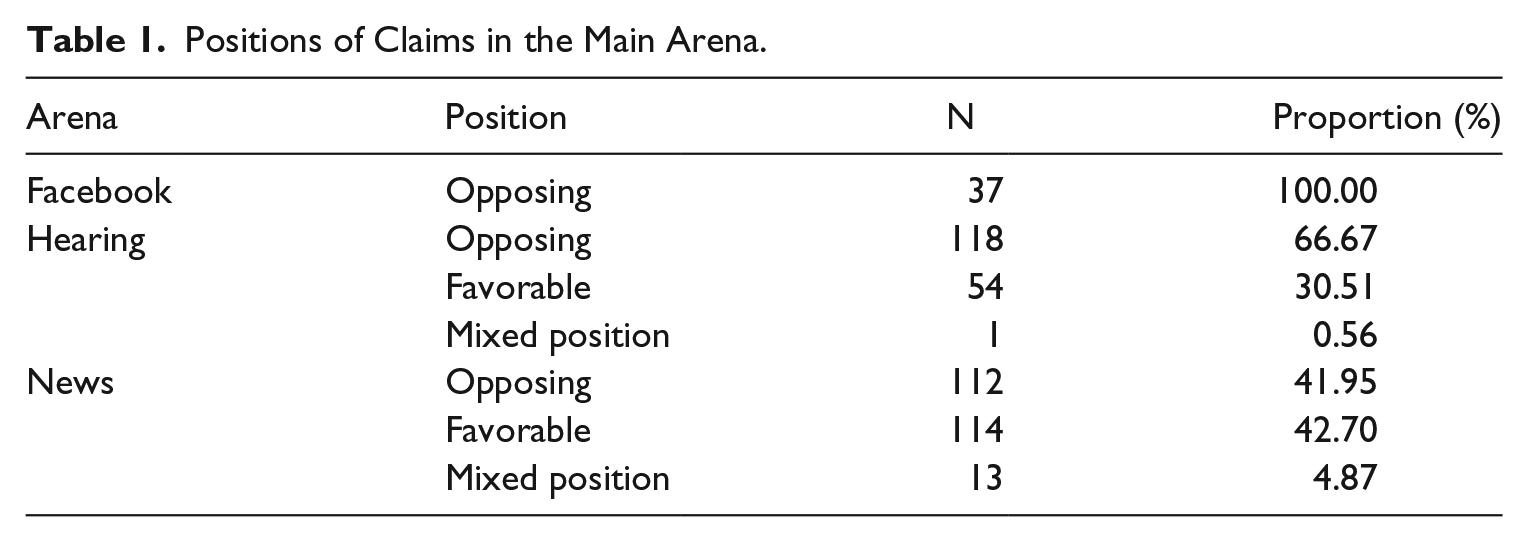
To provide an initial insight into the direction of discussion inside/outside each forum, we investigated the proportion of pro- and con-arguments in the three main arenas, namely, the Facebook page, public hearings, and news articles (Table 1) as well as in the comments posted in each respective digital platform (Table 2). On analyzing the posting behavior, we did not identify the presence of “superparticipants,” that is, users with an over large number of postings in the selected period (Graham and Wright, 2014).
Positions of Claims in the Main Arena.
Positions of Comments in Online Platforms.

Table 1 shows that two arenas in our study presented plural argumentation. The public hearings, as an “empowered space” (Dryzek, 2016) designed to gather information to clarify policy choices, produced an overwhelming majority of arguments and policy positions against lowering the age of criminal responsibility (66.67% con vs 30.51% pro). By contrast, the news media, which ideally functions to draw public attention to issues of common concern, conveyed a balanced share of pro- and con-arguments (41.95% con vs 42.70% pro). Journalists, possibly interested in presenting news reporting as fair, drew on a plurality of competing sources. As was expected, the activist Facebook page, as a site created and maintained by social movement organizations and advocacy entities, expressed homogeneous and partisan argumentation (100% con). Interestingly, Table 2 reveals that the majority of comments on these three online platforms supported the pro-reduction proposal. This indicates that wider digital publics shared the majoritarian view of the population, regardless of being engaged in legislative-, media-, or activist-based online spaces. These results also suggest a disconnect between elites’ reasoning and the broader public’s preferences. Hence, the digital environment was fertile terrain for disagreement.
A multinomial logistic regression model—performed with the R package nnet (Venables and Ripley, 2002)—was used to estimate the average chance of each type of disagreement in online comments in relation to comments without disagreement (absence). This analysis focuses on the collected sample of 1754 online comments from the three aforementioned digital settings. We tested the effect of four variables (platform, position, target of interaction, and justification) on the chance of bold and soft disagreement.
Results
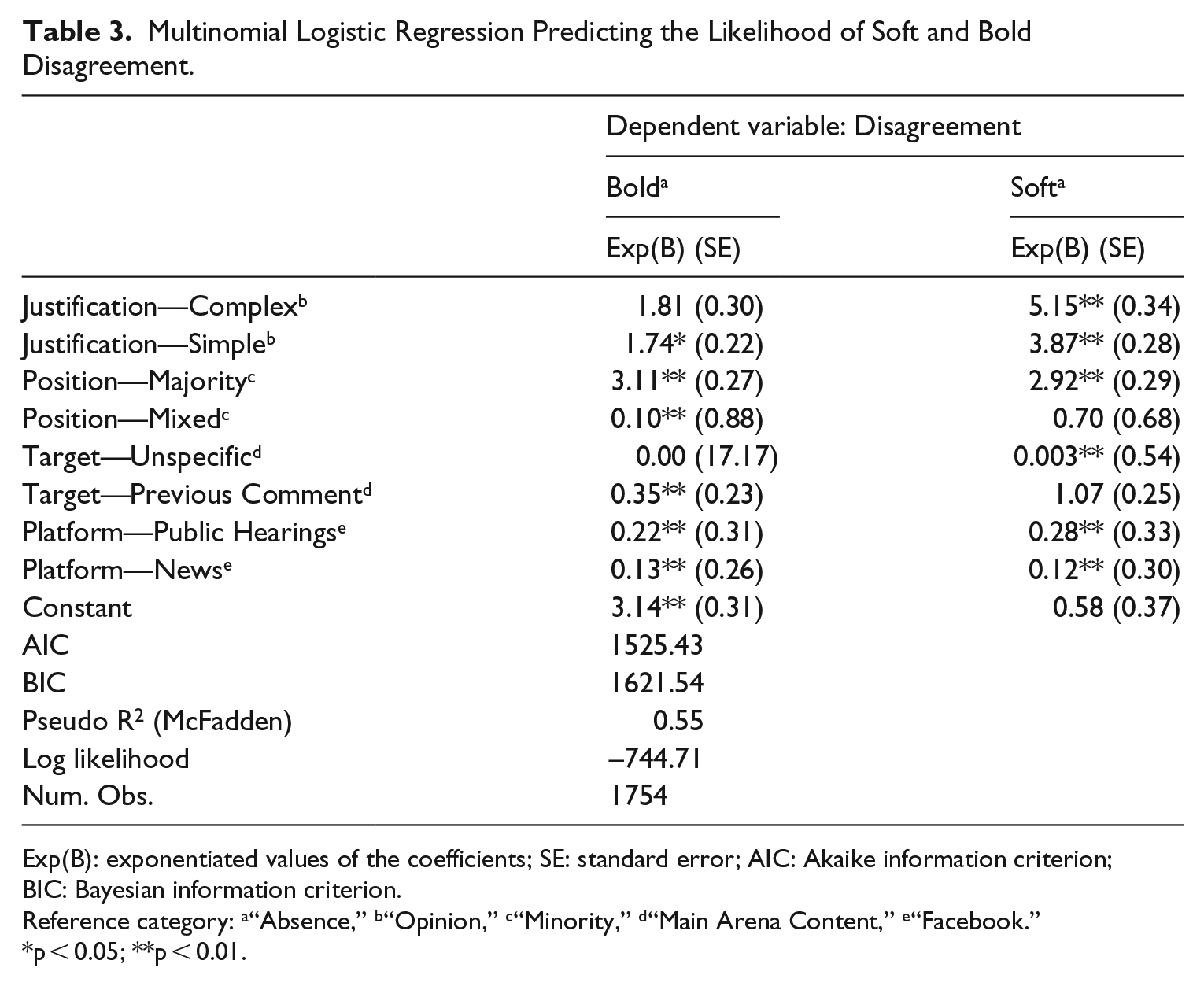
We hypothesized that comments with justification are more likely to contain soft disagreement than bold disagreement. Table 3 shows the results of multinomial logistic regression predicting the odds ratio of disagreement types in comparison to comments without disagreement. We found a clear and statistically significant difference between “soft” and “bold” disagreements, reinforcing our claim that it is relevant to explore different mechanisms behind reasoned disagreement. Our model shows that comments with a simple justification increase the chance of soft disagreement by approximately four times (3.87) when compared to comments expressing opinion (reference category), and increase by around two times (1.74) the chances of bold disagreement. Comments with a complex justification increase the chance of soft disagreement by approximately five times (5.15). However, the effect of comments containing complex justification on bold disagreement is indistinguishable from those comments exhibiting mere opinions. Confirming hypothesis H1, this result supports the view that participants, by justifying their preferences and probing their ideas, are more likely to moderate their expressions of divergence.
Multinomial Logistic Regression Predicting the Likelihood of Soft and Bold Disagreement.
Exp(B): exponentiated values of the coefficients; SE: standard error; AIC: Akaike information criterion; BIC: Bayesian information criterion.
Reference category: a“Absence,” b“Opinion,” c“Minority,” d“Main Arena Content,” e“Facebook.”
p < 0.05; **p < 0.01.
Concerning our second hypothesis, did the homogeneous setting (Facebook) present less disagreement among online commenters compared to heterogeneous settings (news and public hearings)? The answer is no. Indeed, Facebook was the platform with the greatest chance of disagreement in comments. Posting comments in the legislative forum and the news forum alike decreases the chances of both types of disagreement compared to those comments in Facebook. These results challenge the expectation that partisan settings will form “echo chambers.” The interpretation of this finding requires caution since our research design focused on just one partisan setting, and the absence of observation across different homogeneous online platforms precludes testing more broadly for this effect.
In line with a systemic approach to deliberation, however, our results provide evidence for the majority-group hypothesis (H3). We expected that members of the dominant ideological side of the debate would be more likely to exhibit disagreement because dissenting citizens would activate widespread preferences and values. This argument was nicely confirmed by our data. Being in the majority camp (pro-reduction) increases by approximately three times (2.92) the chance of expressing soft disagreement as well as bold disagreement (3.11) when compared to those aligned in the minority camp (against reduction). Comments containing mixed positions decrease the chance of bold disagreement (0.10) in comparison to those in the minority group. Thus, hypothesis H3 was confirmed.
Regarding the message target, we found that comments without a clear addressee are less likely to soften disagreement (0.003) compared to comments addressing content in main arena. Noticeably, forum users are less likely to exhibit bold disagreement (0.35) when contesting other participants’ remarks than when rebutting informational content exposed in the three main arenas. This corroborates our fourth hypothesis, confirming our expectation that impersonal/personal relations affect how disagreement is expressed in posted comments.
Justification proves to be a key predictor of disagreement. To further develop this analysis, we use a multinomial logistic regression to examine what factors explain justification itself. To this end, we tested the effects of three variables (platform, position, target of interaction) on chances of simple and complex justification.
The first and second rows of Table 4 show the chance of debate position affecting reason-giving. We found that being aligned in the majoritarian ideological camp of the debate (pro-reduction) effectively reduces the chance of providing complex justification (0.40) as well as simple justification (0.51) compared to comments affiliated in the minority camp (reference category). The result confirms the view that participating in a large majority group leads to the perception that preferences can be expressed without further explanations and justifications, whereas awareness of being in the minority side requires interrogating, disputing, and arguing. Comments exhibiting a mixed position present no statistically significant difference in relation to those aligned in the minority camp on the chance of offering simple and complex justifications.
Multinomial Logistic Regression Predicting the Likelihood of Simple and Complex Justification.

Exp(B): exponentiated values of the coefficients; SE: standard error; AIC: Akaike information criterion; BIC: Bayesian information criterion.
Reference category: a“Opinion,” b“Minority,” c“Main Arena Content,” d“Facebook.”
p < 0.05; **p < 0.01.
The third and fourth rows show the estimated effect of target on justification. Forum users are less likely (0.68) to provide simple reasons when addressing other users’ comments than when addressing the informational available in the main arena. We found no statistically significant association for the effect of messages with unspecific target on both types of justification. Finally, the fifth and sixth rows show the estimated effect of the context of online discussion on justification. The results were mixed. Comments posted in the public hearing platform have almost four times (3.73) more chances of containing simple justification than those in Facebook, corroborating the view that online platforms specially designed to host political discussions enhances users’ reason-giving (Esau et al., 2017; Mendonça and Amaral, 2016; Strandberg and Grönlund, 2014, 2018). When it comes to complex justification, however, participants plugged into the public hearing forum are less likely to post comments with this type of justification (0.54) compared to Facebook participants. This could be due to the synchronous nature of discussion in the public hearing platform that generated short comments each with single arguments (Strandberg and Berg, 2015). Asynchronous discussions typically afford more time for reflection and thus produce more qualified reasoning (Strandberg and Grönlund, 2014). By comparing comments on news websites and Facebook, our analysis indicates that comments posted on the news website have less chances of exhibiting both complex (0.38) and simple (0.75) justifications compared to comments on Facebook.
Discussion of Results
Adopting the concept of “deliberative ecologies” (Mansbridge et al., 2012), this study aimed at investigating three sites that expose citizens to legislative debates, news media stories, and advocacy campaigns. Our analysis of debate internal to these forums as compared to those external to these forums revealed a clear clash of preferences. Debates occurring internally in the legislative public hearings, news stories, and the activist-based Facebook page mostly contested the bill in question, and thus challenged the preference of the vast majority of the population. Ordinary citizens connected to each respective digital platform, however, mostly favored the bill. They followed the majoritarian public opinion against the elites’ public discourse (Chambers, 2017; Curato et al., 2019; Mansbridge and Fishkin, 2017). “Wild online discussions” occurring in the unstructured public sphere were marked by widespread political disagreement.
Disagreement, Digital Forums, and Beyond
Many critics tend to speak about conflicts and disagreements in the new digital landscape without a detailed examination of the processes. Overall, our study offers a complex picture of informal political discussion that corresponds with broader and well-established conclusions about online forum contexts and majority-based debates. To take a step forward, our analysis develops a more nuanced approach rather than advancing a generic view of disagreement. These findings have implications for research on deliberative democracy, disagreement, and political communication.
First, our findings corroborate the view that the context and information provided within digital forums for online discussion are important elements shaping commenters’ disagreement and reason-giving practices (Maia and Rezende, 2016; Strandberg and Berg, 2015; Strandberg and Grönlund, 2014, 2018). Since Facebook was the platform with the greatest chance of disagreement compared to the legislative and news media forums, our expectation derived from the selective exposure theory—that is, that homogeneous settings would not attract commenters “from the other side” and therefore would become “echo chambers”—was disconfirmed by our data. Another line of research about the role of activists’ challenges to hegemonic discourses offers a relevant perspective for explaining this finding, as will be discussed later. Because we are looking only at one homogeneous online setting, we do not overinterpret this result.
The relation between disagreement and the nature of online forums becomes even more interesting when we examine these results (Table 3) in relation to the model providing estimates for chances of justification (Table 4). Corresponding to the tendency reported by previous studies that information provision tends to enhance commenters’ reasoning (Esau et al., 2017; Rowe, 2015; Strandberg and Berg, 2015; Strandberg and Grönlund, 2014, 2018), it comes as no surprise that public hearing forum users were much more likely to offer justifications for their claims when compared to Facebook users. In our case, public hearings offered citizens the opportunity to watch experts, politicians, and leaders from advocacy entities debate the issue at hand and to submit questions to the panelists, and therefore issue more justified comments, even in synchronous online communication. The Facebook Page users, nevertheless, were more likely to post reasoned comments than news website users, contradicting previous studies (Esau et al., 2017; Mendonça and Amaral, 2016). A possible explanation for this discrepancy is that the Facebook page in our case, being organized by more than 150 advocacy and activist entities, offered qualified yet accessible information on some complicated issues, improving reason-giving among commenters. Alternatively, the explicitly adversarial argumentation in this activist Facebook page can be judged as stimulating engagement in a heated debate in contrast to a more balanced journalistic language.
Second, disagreement seems also consistently related to debate majority/minority position, at least in disputes involving supermajorities. From a systemic approach, it is telling that the activist Facebook page, which contested the hegemonic preference of Brazilian citizens and recommended alternative solutions for the age reduction proposal, generated more rebuttals than the other, more general interest sites, that is, public hearings and media-based forums (Garrett et al., 2013; Knobloch-Westerwick and Kleinman, 2012; Lee et al., 2015; Nelson and Webster, 2017; Weeks et al., 2016). In addition, our findings also support studies indicating that majority alignment increases the chances one will express disagreement when faced with opposing views (see Table 3) and, simultaneously, decreases the chances of offering reasons for one’s claims (see Table 4) (Gastil et al., 2008; Smith, 2011; Wojcieszak, 2010). This suggests that those sharing the majoritarian public opinion preference, while actively engaging in confrontation and contestation, typically fail to critically examine their (and others’) values, beliefs, and preferences, and therefore do not build reasoned disagreement, regardless of the online discussion context. Thus, widespread convergence in public opinion may reinforce one’s position—and perhaps also one’s prejudices.
Third, the effect of message target is more ambiguous (Table 3). The finding that users are less likely to manifest bold disagreement toward other commenters than to forum information (i.e. hearing debates, news articles, and Facebook posts) underscores the argument that sharp interpersonal contestation can be unpleasant and, therefore, participants tend to retreat from personal confrontation (Bächtiger and Gerber, 2014; Halpern and Gibbs, 2013; Maia and Rezende, 2016; Rowe, 2015). Moreover, the fact that users are more likely to soften their divergence when engaging with forum information than when posting decontextualized rebuttals suggests that they might be more invested in the topic and more motivated to articulate their point. In this direction, we found that users tend to do a better job justifying their views when addressing information available in the main arena than when addressing other users’ remarks (Table 4). As a consequence, these users may moderate disagreement to support their positions (Halpern and Gibbs, 2013). Our research does not enable us to conclude how disagreement types and message target interact in more precise ways. Future work could measure reasoned disagreement by observing reciprocity in comment threads (Adams, 2015; Gastil, 2018; Stromer-Galley et al., 2015) or discerning users’ possible motivations for disagreeing in distinct online spaces—motivations including curiosity, aversion, and the desire to incite conflict for its own sake (Esterling et al., 2015).
Types of Disagreement
Online forum context and one’s stance on the majority opinion in the debate seem to consistently affect expressions of disagreement. In addition, our analysis indicates that justification is a crucial predictor of disagreement. Providing simple justifications dramatically increases the likelihood of soft disagreement, rather than bold disagreement, and providing complex justifications increases even more the likelihood of soft disagreement. This finding supports our proposition that a speaker seeking to explain claims in a more intelligible and coherent way beyond merely uttering preferences or opinions (Habermas, 1987, 1996; Laden, 2012) may also be motivated to moderate his or her divergence. Soft expression of disagreement is associated with both levels of justification (simple and complex reason-giving), regardless of the communication context and the alignment with majority/minority camp of the debate.
Returning to the central point of this article, then, the crucial question is, “Why does soft disagreement have a positive association with reason-giving, but the same is not true for bold disagreement?” We argued earlier that the former sounds more like an invitation to continuing discussion (Laden, 2012). We should reiterate that both ways of expressing disagreement are contestatory, and deep, substantial disagreements can be uttered in a soft or a bold style. Following this line of interpretation, it is plausible to say that moderating expressions of disagreement is positively related to justification because the speaker may expect that there is some shared ground for reasoning about an issue that is not so clear-cut. A speaker may conclude that there is purpose in defining the problem differently, making suggestions about which considerations are salient, advancing alternative solutions, and so forth. Justification is thus more likely to be paralleled with soft expressions of disagreement (Gutmann and Thompson, 1996; Habermas, 1987, 1996; Laden, 2012; Landemore and Page, 2015). By contrast, harsh affirmations of preferences, beliefs, or recommendations that signal the interlocutors inhabit divorced spaces of reasons do not motivate moderating divergence.
One interesting feature of the analysis offered here is that “softening” disagreement does not exclude the possibility that participants may use language rhetorically, and obviously the subjects may not mean what they say (Chambers, 2009, 2017; Kock, 2012; Maia, 2014; Neblo, 2015). Forum discussants may be neither genuinely interested in their interlocutors’ responses nor willing to be moved by what others say (Curato et al., 2019; Laden, 2012; Smith, 2011; Young, 2002). Expressing disagreement in a moderate fashion runs the risk of obscuring not only relevant aspects of the problem under discussion but also alternative considerations. Moreover, soft criticism may be fostered by social attitudes that combine politeness and inequality between interlocutors, as to accommodate power relations (Maia, 2014; Young, 2002). Despite all these risks, we can say, following the theoretical standpoint of deliberation, that when the ground for continuing the conversation is kept open, interactional dynamics can produce unexpected results. For instance, Elster (1998) claimed, quite a long time ago, that strategic and hypocritical communication may generate deliberative outcomes. Likewise, Risse (2000) has contended that speakers may begin exchanges with rhetorical logic used for persuading communication partners or an audience, but there is also a chance that skepticism, insincerity, and mistrust may change, resulting in a shift toward deliberative behavior during the exchange. Therefore, forms of expressing disagreement may be consequential for keeping the terrain of discussion more or less open to reasoned argumentation, which can move people to see things differently, whether regarding inequalities, asymmetric power distributions, and undemocratic-illiberal forms of participation, and thereby to distinguish between better and worse policy choices.
Conclusion
By focusing on real-world online discussions, this study has examined a complex set of factors that shape disagreement in legislative-, media-, and activist-based digital platforms in informal public sphere. A considerable accomplishment of empirical research in the field of deliberation and political communication has been to demonstrate the factors that affect digital communication in particular forums. The analytic framework offered in this study expands the analysis of citizens’ informal discussions across the digital media landscape. The results have both analytic and theoretical implications. By investigating the claims available internally in three arenas, this study helps pinpoint what current analysis has neglected: a better understanding of patterns of disagreement in the self-regulating public sphere, including views and judgments from broader publics that may not fit discussion within forums (Chambers, 2012, 2017; Curato et al., 2019; Dryzek and Hendriks, 2012; Mansbridge and Fishkin, 2017).
While previous research has investigated the effect of avoiding or welcoming disagreement on political and civic attitudes, our study sought to understand the association between disagreement types and reason-giving. In line with the current literature, our analysis indicates that the digital context combines with participants’ characteristics to produce considerable variety in the outcome of online discussions. By testing various factors, our analysis elucidates the likelihood of different ways of expressing disagreement and offering reasons. Not all disagreements motivate participants to support their views with reasons. Only moderated expressions of disagreement go hand-in-hand with justification. To the extent that deliberative democracy aims to achieve reasoned argumentation, these findings call upon researchers to pay more attention to normative implications of forms of expressing disagreement and their practical consequences in digital environments and beyond these settings.
This article comes with some limitations. Since our study does not use a large data set, future research could expand the quantitative analysis. Other works might compare discussions about a range of distinct issues as well as include other countries and sorts of forums to investigate whether the same effects emerge. Further analysis considering the complex nature of language or how long reasoned disagreement is sustained in different online environments would certainly advance the scholarship. Despite its limitations, this study advances our current scholarship, systematically analyzing citizens’ disagreement and justification in this interconnected media environment, accounting for multiple venues for public information and discussion. Distinguishing between forms of expressing disagreement while retaining a principled link with reason-giving opens up new venues for future research that may lead us closer toward understanding productive ways of disagreeing with allies and opponents, and even with enemies. This is a worthy goal to pursue in these troubled times for deliberative democracy.
Supplemental Material
sj-docx-1-PSX-10.1177_0032321719894708 – Supplemental material for What Kind of Disagreement Favors Reason-Giving? Analyzing Online Political Discussions across the Broader Public Sphere
Supplemental material, sj-docx-1-PSX-10.1177_0032321719894708 for What Kind of Disagreement Favors Reason-Giving? Analyzing Online Political Discussions across the Broader Public Sphere by Rousiley CM Maia, Gabriella Hauber, Thais Choucair and Neylson JB Crepalde in Political Studies
Footnotes
Acknowledgements
The authors thank the editors of Political Studies and the three anonymous referees for their suggestions for improving this study. They also thank Luciano Mattar for statistical assistance and Simone Chambers and John Gastil for their support for advancing this article.
Declaration of conflicting interests
The author(s) declared no potential conflicts of interest with respect to the research, authorship, and/or publication of this article.
Funding
The author(s) disclosed receipt of the following financial support for the research, authorship, and/or publication of this article: The authors are grateful to the following funding agencies for supporting this research: Conselho Nacional de Desenvolvimento Científico e Tecnológico - Brazil: CNPq 308609/2015-8; CNPq 306492/2018-0; . Coordenação de Aperfeiçoamento de Pessoal de Nível Superior - Brazil: CAPES, 001; CAPES, INCT 88887.136417/2017-00.

Supplementary Information
Additional supplementary information may be found with the online version of this article.
Contents Table 1A. Research Sample. Table 2A. Design Feature of Digital Platforms. Table 3A. Krippendorff’s Alpha Reliability Estimate. Table 4A. Descriptive Statistics of Variables: Disagreement, Justification, Debate Position, Message Target.
Notes
Author Biographies
References
Supplementary Material
Please find the following supplemental material available below.
For Open Access articles published under a Creative Commons License, all supplemental material carries the same license as the article it is associated with.
For non-Open Access articles published, all supplemental material carries a non-exclusive license, and permission requests for re-use of supplemental material or any part of supplemental material shall be sent directly to the copyright owner as specified in the copyright notice associated with the article.
