



Abstract
Citizens’ adherence to deliberative civic values fulfils a vital function in deliberative democratic systems. We propose a way to measure the prevalence and variations of such values as a first step to better understanding how this works. Based on survey data, we demonstrate that, in Sweden, adherence to the values of reasoning and listening is stronger than adherence to the strategic rhetorical, non-deliberative values. This may have important implications for our understanding of how deliberation and democracy work in this particular context. There are also, however, important individual-level variations of adherence to deliberative civic values related to age, education, gender and Swedish background. Taken together, this opens up for a new research agenda where comparative analyses of deliberative civic values and how it relates to political behaviour are particularly encouraged.
Introduction
Deliberative democratic theory has gone through a ‘systemic turn’ where increased attention is given to the interplay of various institutions, locations and actors and how they are ‘connected in such a way as to form a complex whole’ (Mansbridge et al., 2012: 4). This has led scholars to call for the ‘mapping’ and ‘measuring’ of deliberative systems to work out the details of how democratic deliberative systems work (Bächtiger and Parkinson, 2019). We contribute to this discussion by turning attention to the function of deliberative civic values, which parallels research on the broader concept of democratic civic culture (Almond and Verba, 2015).
Democracy scholars have demonstrated how democratic civic culture, which denotes the widespread acknowledgement of values such as individual liberty, political tolerance and political trust (Gibson et al., 1992: 332), is related to thriving democracy (Almond and Verba, 2015). Likewise, important deliberative studies stress situational and contextual explanations to citizens’ deliberative conduct (Neblo et al., 2010), which indicates the potential of surrounding civic values to influence citizens’ political understanding. However, previous studies on deliberative culture have mainly been concerned with the universality of deliberation and cultural interpretations of deliberative practices focused on small-scale events (He, 2014; Sass and Dryzek, 2014), and only scant attention has been given to civic values as a contextual condition. In accordance with other civic values, it is likely that people adhere to deliberative civic values to different degrees, and therefore it is important to develop tools to understand those variations.
In this article, we aim to develop and calibrate an instrument that can be used to measure the presence of deliberative civic values. Based on deliberative conversational rules, we develop deliberative civic values indexes and examine the extent to which citizens recognize the significance of these values in political interactions. To contrast our findings, we also include a set of questions intended to capture the prevalence of non-deliberative values where political discussions are thought of as a ‘rhetorical battleground’, where politics is more about strategic then communicative action (Risse, 2000).
We apply our instrument on data from a survey with a representative sample of 1207 respondents living in Sweden (the survey was distributed to 5000 persons, and the response rate was 29.4%). The results demonstrate that deliberative values form two distinct dimensions of reasoning and listening. The reasoning aspect of deliberation appears more uniform and highly accepted by the respondents, while the listening aspect of deliberation is more demanding, varies more among the citizens and is more likely to be found among people with higher education. The results also demonstrate that non-deliberative values, which we argue should be understood as strategic rhetorical values, are associated with a third underlying dimension.
We show that deliberative conversational values are fairly widespread in Sweden. Respondents embrace deliberative civic values to a significant degree, while at the same time they support strategic rhetorical values to a much lesser degree. This indicates favourable conditions for a relatively vital deliberative culture in Sweden, which may have important implications for democracy as well as for the design of deliberative innovations (Grönlund et al., 2014). We also find that recognition of deliberative values varies depending on the respondents’ socio-economic, cultural and psychological background, similar to how these are shown to relate to citizens’ deliberative skills and capacities (e.g. Gerber et al., 2018).
We proceed by first outlining the main arguments for why it is important to study deliberative civic values. Next we introduce the deliberative civic values index together with the items used to empirically assess each value. Finally, the results are presented where we first draw attention to underlying dimensions of deliberative values and then discuss possible explanations for variations in citizens’ adherence to deliberative civic values.
Why Study Deliberative Civic Values?
Pivotal work in social research has demonstrated that a vital civic culture is related to democracy and participation (e.g. Almond and Verba, 2015; Inglehart, 2000). While these findings are important contributions to the study of political behaviour, value research has at the same time been accompanied by sustained methodological and theoretical debates and critique. It has, for example, been debated if values can be reliably measured and distinguished from preferences, if values imply the same behaviour across contexts, if values by definition are resistant to changes in social environment or to individuals’ experiences and if political culture can explain social change or only describe stability (e.g. Docherty et al., 2001; Granato et al., 1996; Jackman and Miller, 1996; Pateman, 1971; Miles, 2015; Welzel and Inglehart, 2009). Some researchers have argued that values probably explain very little since they mirror institutions rather than explain the existence of political and social institutions, and that it is difficult and unfruitful to try to disentangle institutions from values when explaining political behaviour (Jackman and Miller, 1996; Pateman, 1971).
In this article, we make only descriptive and exploratory claims and need not take a final stand in these debates. We agree, however, with Andrew Miles (2015: 680) that some recent findings suggest that ‘values merit renewed theoretical and empirical attention’, and we believe that a fruitful starting point is Carol Pateman’s (1971: 302) statement that institutions (structure) and values (culture) are ‘mutually interdependent and reinforcing’ and as Arend Lijphart (1998: 107) argues referring to Almond and Verba, that these variables ‘tend to interact very closely with each other’.
While value research has been given a lot of attention in general social science, the role that deliberative civic values might have for deliberative practices is, however, still unexplored. This is a major shortcoming in the effort to understand how democracy works in different contexts, since deliberative processes can allegedly fulfil important functions in a democratic system, especially by promoting democratic legitimacy (Bächtiger and Parkinson, 2019; Fishkin, 2018; Gutmann and Thompson, 1996; Neblo, 2015: 3–7). Theorists disagree on the aims of deliberation (Bächtiger et al., 2018: chapt. 1) and, consequently, its potential functions. But Parkinson and Mansbridge (2012: 10–13) have tried to sum up three important ‘relatively non-controversial’ functions of deliberative systems in a democracy. The epistemic function is to produce decisions and outcomes that are appropriately informed by facts and logics after consideration of relevant reasons; the ethical function is to promote mutual respect among citizens, and the democratic function is to promote equality by including multiple and plural voices. It is likely that these functions are facilitated to different degrees within various cultural contexts. Therefore it is important – as a first step – to better understand how deliberative civic values vary and what factors might influence those variations.
The question of whether and how deliberative values might relate to civic culture is a contentious one. There is a long-standing debate in deliberative theory on whether deliberation is a universal human capacity (Sen, 2003), a temporal practice that emerges at a certain threshold of development (Habermas, 1984), a particularistic practice limited to certain Western cultures (Sanders, 1997; Young, 1996) or a political style belonging to specific speech cultures (Gambetta, 1998). In two recent studies on culture – Sass and Dryzek (2014) and (He, 2014) – deliberation is deemed a universal capacity and as such prevalent in diverse cultural contexts, but at the same time the actual deliberative practices vary from case to case. This means that there is not one way to deliberate but that deliberation takes as many forms as there are diverse cultures. For example, Sass and Dryzek (2014) demonstrate how the widespread listening to cassette sermons in Egypt stirred citizens’ minds, which in turn made them reflect and led to passionate public debates. The authors claim that once deliberative practices take root and spread, there is an emerging deliberative culture. He (2014) adds that deliberative culture is not related to specific political systems, and deliberation can go hand in hand with authoritarianism. He traces deliberative practices back to China’s indigenous roots and the Confucian moral code. Although these established deliberative practices in China differ in type and language from the Western understanding of deliberation, they share the same foundational values and principles. The two examples demonstrate that deliberative practices differ across cultural contexts, but they also emphasize that there is some universality of deliberation. The underlying conversational values seem to stay the same regardless of the setting, and this gives us reason to investigate such values further.
An adjacent research field examines citizens’ willingness to participate in deliberation and suggests that political context has an impact on citizens’ deliberative skills and practices. Although some studies stress how citizens are uninterested in having their voices heard (Hibbing and Theiss-Morse, 2002) and tend to dislike politics and therefore stay away from deliberation (Mutz, 2006), more optimistic deliberative proponents argue that citizens’ willingness and capability to deliberate is context dependent (Neblo et al., 2010). Along the latter lines of argument, Neblo et al. (2010) demonstrate how citizens’ willingness to deliberate is dependent on the surrounding political system. As the argument goes, by creating conditions that are conducive to deliberation, citizens will be more interested in participating and will thereby learn the deliberative skills and become positively attuned to deliberation.
The differences in these prior studies demonstrate that we still have very little knowledge about the role of context for deliberation as well as the extent to which citizens find deliberation important and valuable in political conversations. We argue that the spread of deliberative civic values in a society functions as an integrating force because it implies a shared understanding of the underlying meaning of politics (Dahlgren, 2006). In the same way as citizens embedded in high-trust contexts expect others to behave trustworthily (Öberg et al., 2011a), citizens in a context with high deliberative civic values may expect others to listen to arguments and therefore be more willing themselves to deliberate. We suggest that this may prompt a self-reinforcing mechanism that shapes communities in which deliberativeness is presumed in political interactions. In other communities, this kind of behaviour is expected only very conditionally or not at all. In this way, a community’s deliberativeness can be constrained or empowered depending on the extent to which deliberative civic values in general guide political behaviour and are mutually expected by citizens in political interactions. Political institutions and public spheres are of course pivotal to provide practical opportunities to realize civic values. While it is far beyond the aim of this article to research this relationship, we propose that a self-reinforcing mechanism would include civic values’ impact on the design of institutions as well as the impact of (experience from) institutions on civic values. Paralleling theories on trust and social capital, the degree to which deliberative values permeate political behaviour might be understood as a form of deliberative capital which, together with other elements (Milewicz and Goodin, 2016), also defines a community’s deliberative capacity (Dryzek, 2009; Pedrini, 2014).
Therefore, rather than examining whether citizens are willing to engage in deliberative practices, we assess the extent to which citizens find deliberative practices desirable. In the next section, we discuss the components that should be included in such a measure and how relevant questions should be posed.
A Deliberative Civic Values Index
We claim it is the conversational demand of deliberation, what Dryzek (2009) refers to as the criteria of deliberativeness, that best encapsulates the meaning of deliberation from the citizen perspective. While the criteria of inclusiveness and consequentiality ensure the legitimacy of deliberative proceedings on a system level, these aspects are not expected to have a regulatory effect on citizens’ political thinking and conduct in the same way as conversational norms.
Conversational norms structure and regulate deliberative exchanges, and the quality of interaction is contingent on citizens’ adherence to – and internalization of – conversational norms (Rosenberg, 2014). Although the specifics of the deliberative conversational ideal are still the subject of debate (Bächtiger et al., 2010: 32–63), there is general agreement on the significance of collective reasoning, performed in a respectful, reciprocal and non-coercive manner, characterized by reason-giving exchanges, reflection on existing positions and openness to alternative arguments (Bohman, 1996; Chambers, 1996; Dryzek, 2017; Gutmann and Thompson, 1996; Owen and Smith, 2015). To the extent that citizens recognize these as desirable traits in discussions about politics, it can be termed a deliberative civic culture. Essentially, the conversational ideal encapsulates three basic values: reasoning, listening and reflecting.
Reasoning refers to the discursive process of making claims and providing explanations and justifications (Levine et al., 2005). Through deliberation, citizens encounter novel information and facts about the topic of debate. By engaging with novel information, they improve their understanding of the issue and get new insights into competing opinions and perspectives (Dryzek, 2009; Steenbergen et al., 2003). Consequently, deliberation stimulates learning (Luskin et al., 2002) and the updating of previously held attitudes and beliefs to be more in tune with the surrounding milieu, thereby supporting the development of informed reasons and judgements (Bächtiger and Parkinson, 2019; Dryzek, 2000).
To be able to make informed judgements, citizens must be ready to explain and justify their claims when asked to by other participants, and to carefully weigh and consider information (cf. Black et al., 2010; Steenbergen et al., 2003). Furthermore, informed judgements are best obtained when citizens are sincere in their interactions and guided by a search for the ‘truth’ while avoiding dishonesty and the use of threats and lies (Bächtiger et al., 2010; Markovits, 2006).
In sum, reasoning is a conversational rule that we suggest involves two aspects: ‘talking together’ and truth-seeking, which the survey questions below are intended to assess.
Question 1 assesses the extent to which citizens acknowledge the importance of talking together, that is, every participant should be willing to state their opinion and be ready to clarify, explain and justify claims to listeners in order to try to reach a shared understanding of the topic of debate.
1. One should always try to explain what one means in a way that others can understand. 1
As a complement to the first question, Question 2 measures the extent to which citizens value reasoning as a truth-seeking exercise in political discussions. This is widely accepted as a component of deliberation but is not easy to capture in behavioural studies (e.g. Steenbergen et al., 2003). Although this item could be accused of opening up for social desirability biases, we claim that, in politics, this is not necessarily the case since strategic thinking and tactical manoeuvres can be seen as clever political moves in order to ‘get things done’, and therefore considered integral to the nature of politics.
2. In discussions one should be sincere and honestly share opinions and thoughts. 2
Listening is a critical component in democratic theory in general, but it is only within the deliberative democratic framework that it is given full recognition on its own terms (Morrell, 2018). Fair and equal listening to all voices, regardless of who is talking, is what gives legitimacy to deliberative procedure, and if a perspective has not been listened to, it has not been given a fair trial, hence undermining the equal treatment of actors (Dobson, 2012). Equal treatment demands attentive listening regardless of who the speaker is, because ‘the best way to silence people is to refuse to listen to them’ (Dryzek, 2000), and ‘not listening is an effective kind of power’ (Bickford, 1996).
Deliberative listening is supposed to be genuinely inter-subjective and therefore needs to be distinguished from more relaxed forms of listening – for instance, simply respecting others’ right to speak by being silent but still not paying attention to what is said. For listening to qualify as a deliberative style of listening, it is important that citizens apply the same attentive, equal listening norm to all participants. Question 3 assesses the extent to which individuals consider it important to listen to those who have different opinions than their own, and Question 4 assesses the importance of listening also to persons who are different from us.
3. Even if one strongly dislikes an opinion it is important to listen to those who hold that opinion. 3
4. In politics, one must try to understand everyone’s opinions even when they express themselves strangely, unclearly or clumsily. 4
There is a long-standing debate in deliberative theory on the role of emotional and passionate speeches. Emotions are at times adopted in a manipulative fashion used by insincere speakers leading the discussion astray in a non-deliberative direction, but emotions also play an inevitable role in our reasoning and as such cannot be subtracted from politics (Morrell, 2010). Nowadays, most scholars adopt a more permissive view of what should be deemed acceptable claims, which means that as long as speakers do not make threats or tell lies they should be listened to. Question 5 measures citizens’ acceptance of other speakers even when they appeal to affect or make emotional claims in politics.
5. One should always try to listen to others, even when they show strong emotions in discussions, for example, shouting or crying. 5
Reflecting concerns the expectation that, engaging in deliberative exchanges, citizens should be ready to develop, update, modify or reinforce their own arguments and beliefs (e.g. Levine et al., 2005). This requires citizens to be open-minded and reflexive in political interactions (e.g. Bächtiger and Parkinson, 2019). Reflecting builds on citizens’ capacities to engage in reasoning and genuine listening as it refers to the process of integrating and updating new information and insights gained in discussions with others. Hence, serious deliberators should be prepared to question and rethink values, believes and preferences in the light of reasons that are encountered (Niemeyer and Dryzek, 2007). Notice that even perfect reflection does not necessarily imply transformation of preferences. Deliberators may (or may not) stand by their opinions based on updated and better-informed reasons (Niemeyer and Dryzek, 2007; Ryfe, 2005).
Question 6 assesses the readiness to rethink initial views and ideas in continuous deliberation. 6
6. One should always be ready to change one’s opinion after having participated in a political discussion. 7
To get a better understanding of deliberative values standing in the political system, we also need to understand how contrasting, non-deliberative ideals are constituted and how they relate to the other values. Rhetoric has often been described as the opposite of reason-giving and hence an obvious contrast to deliberative ideals. However, recent arguments for a more Aristotelian understanding of political deliberation, where passion and emotions are considered essential for efficient presentation of reasons (Yack, 2006), has spurred a growing interest in the idea of deliberative rhetoric (Chambers, 2009: 325). In line with how we understand deliberative values, impartiality and impersonal reasoning is not a requirement for deliberation (Hendriks, 2011; cf. Yack, 2006) and rhetoric that appeals to passion is not the problem (Dryzek, 2000; Jennstål and Öberg, 2019). Hence, rhetoric need not be the enemy of deliberation; it is certain kinds of rhetoric that is non-deliberative (Chambers, 2009). Simone Chambers (2009: 328) uses the concept plebiscitary rhetoric for non-deliberative rhetoric where (referring to Plato) the essence of rhetoric is ‘its interest in power over truth and its strategic stance toward communication’. This kind of rhetoric is monological rather than dialogical. The rhetoricians may be ‘master logicians’, but are not interested to answer questions sincerely or respond to criticism honestly: it is a type of rhetoric ‘interested in winning the day’ (Chambers, 2009: 327). We name this kind of rhetoric strategic rhetoric. It may or may not have important and legitimate roles in other democratic ideals, but it is non-deliberative. While deliberative core values are associated with communicative (argumentative) action, strategic rhetorical values are based on strategic action (cf. Habermas, 1984; Risse, 2000, 2004). From this point of view, political discussions are not about genuine listening or reflection, but about arguing convincingly for one’s opinions and winning debates. Citizens that understand politics as an activity that should be based on strategic rhetorical values do not think that actors involved in political discussions necessarily need to be prepared to change their own beliefs. Rather, they should be prepared to ‘come up with ever more sophisticated justifications’ of the position they argue for (Risse, 2000: 9). Obviously, this means that evidence may be more or less biased and even manipulated. Hence, in strategic rhetorical battles the overall motivation to participate in political debates is to win the argument (Questions 7 and 8). When the aim is to win, manipulative and/or coercive strategies are deemed acceptable rhetorical means to strengthen the own cause (Questions 9 and 10) and to argue convincingly often involve a didactic, opinionated style to be efficient (Question 11). Thus, equal treatment and reflection are not deemed normatively desirable values:
7. One should try to convince others about one’s views and opinions. 8
8. Politics should be about trying to win discussions. 9
9. If people have illogical opinions, one does not need to consider them. 10
10. It is particularly important to listen to people who hold important positions in society. 11
11. In political discussions, one should argue for one’s own opinion, even if one is uncertain whether one is right. 12
Dimensionalities of Deliberative and Rhetorical Civic Values
The following demonstration of the relevance of the measures draws on data from a survey administered by Statistics Sweden (SCB) and mailed out to 5000 randomly selected respondents in Sweden in November–December 2016. As the survey was rather extensive, covering eight pages and containing measurements of demographic, political, individual, psychological and attitudinal variables, the response rate of almost 30% (1468) was satisfying. The respondents represent the Swedish population fairly well except for a slight underrepresentation of people without permanent housing and those with immigrant background. After excluding the respondents with missing values in examined variables, we had a dataset with 1207 respondents.
To test our theoretical ideas about the composition of and adherence to deliberative civic values, we first analysed how the answers to six questions aiming to tap deliberative values correlate to each other. Recall that respondents were asked to evaluate their agreement with the statements listed above on a scale from 0 (totally disagree) to 10 (totally agree). The distribution of the responses is presented in Figure 1. Statistically significant and relatively strong correlations as well as the principal component analysis are shown in Table 1. The results demonstrate that these six items form one underlying dimension including reason-giving, listening and reflecting.
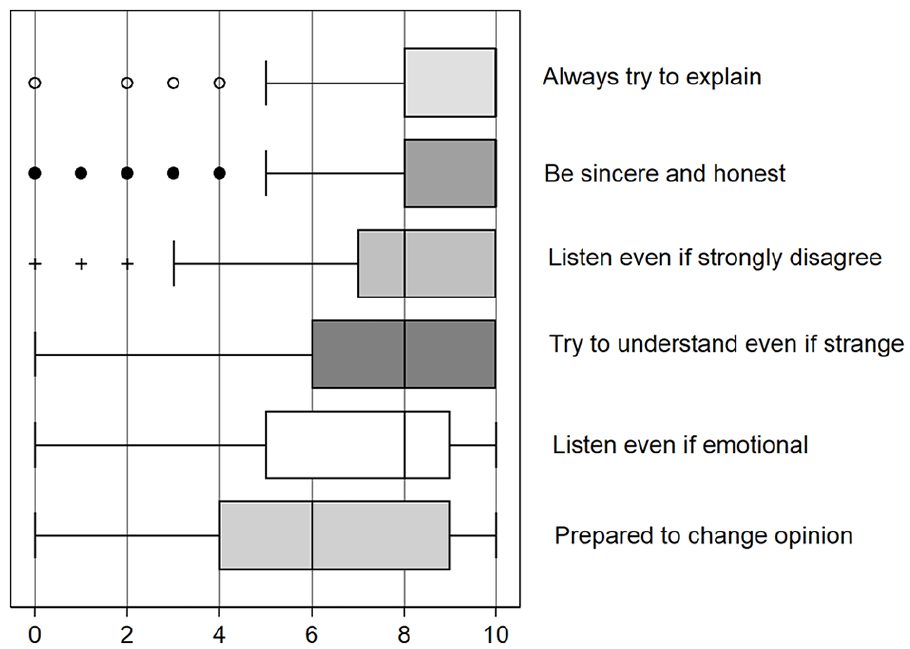
Distribution of the Separate Items of Deliberative Civic Values.
Dimensions of Deliberative Values (Factor Loadings and Correlation).
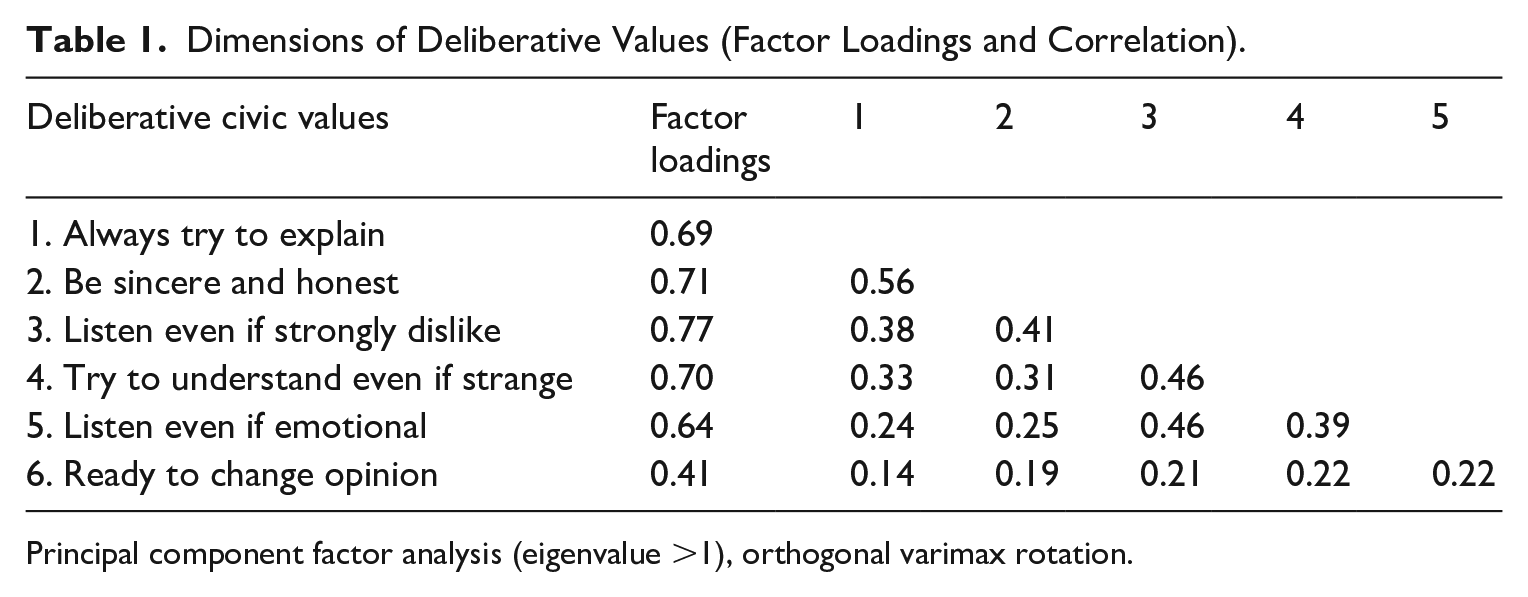
Principal component factor analysis (eigenvalue >1), orthogonal varimax rotation.
This first analysis indicates that our battery in fact taps similar values, even though the item that supposedly should measure reflecting (6. Ready to change opinion) is much less correlated to other items. This is not surprising, as reflecting, although being theoretically closely connected to the other deliberative values, still should be conceptually distinguished from reasoning and listening. But the fact that the empirical analyses suggest one common factor demonstrates that there is some latent deliberative civic value that all six items refer to. If we were to form a common additive index, this would have a generally accepted level of Cronbach’s alpha – 0.70. Yet, we acknowledge that due to the low variation and skewness of some the components, the index itself suffers from ‘ceiling effect’ and is clearly skewed, having an average of 7.58 (standard deviation (SD) 1.59). 13 This result might also be affected by a ‘social desirability effect’ (Gerber et al., 2018: 2). Unfortunately, we don’t have any instruments to evaluate how much this tampers with our data. It should, however, be emphasized that our survey questions are very demanding (e.g. listen and try to understand when others are emotional or inconsistent) and there also are variations that can be reasonably understood (see below). Furthermore, these findings are also consistent with other studies that have shown that ‘standards of classic deliberation are far from being utopian standards that only very few citizen deliberators can achieve’ (Gerber et al., 2018: 15).
The items proposed to measure strategic rhetorical values form one common strongly correlated factor although the common index would have only a weak Cronbach’s alpha (0.55), average value of 3.69 and SD of 1.96. Thus, comparing the deliberative value index and the strategic rhetorical values, it is clear that in Sweden there is high embracement of deliberative values and a relatively low adoption of strategic rhetorical values.
Considering that all items are actually part of conversational values, we have also examined all items simultaneously, and in this case the results of exploratory factor analyses (Table 2) display three underlying dimensions: reason-giving, listening and strategic rhetorical values. 14
Dimensions of Deliberative and Rhetorical Values.
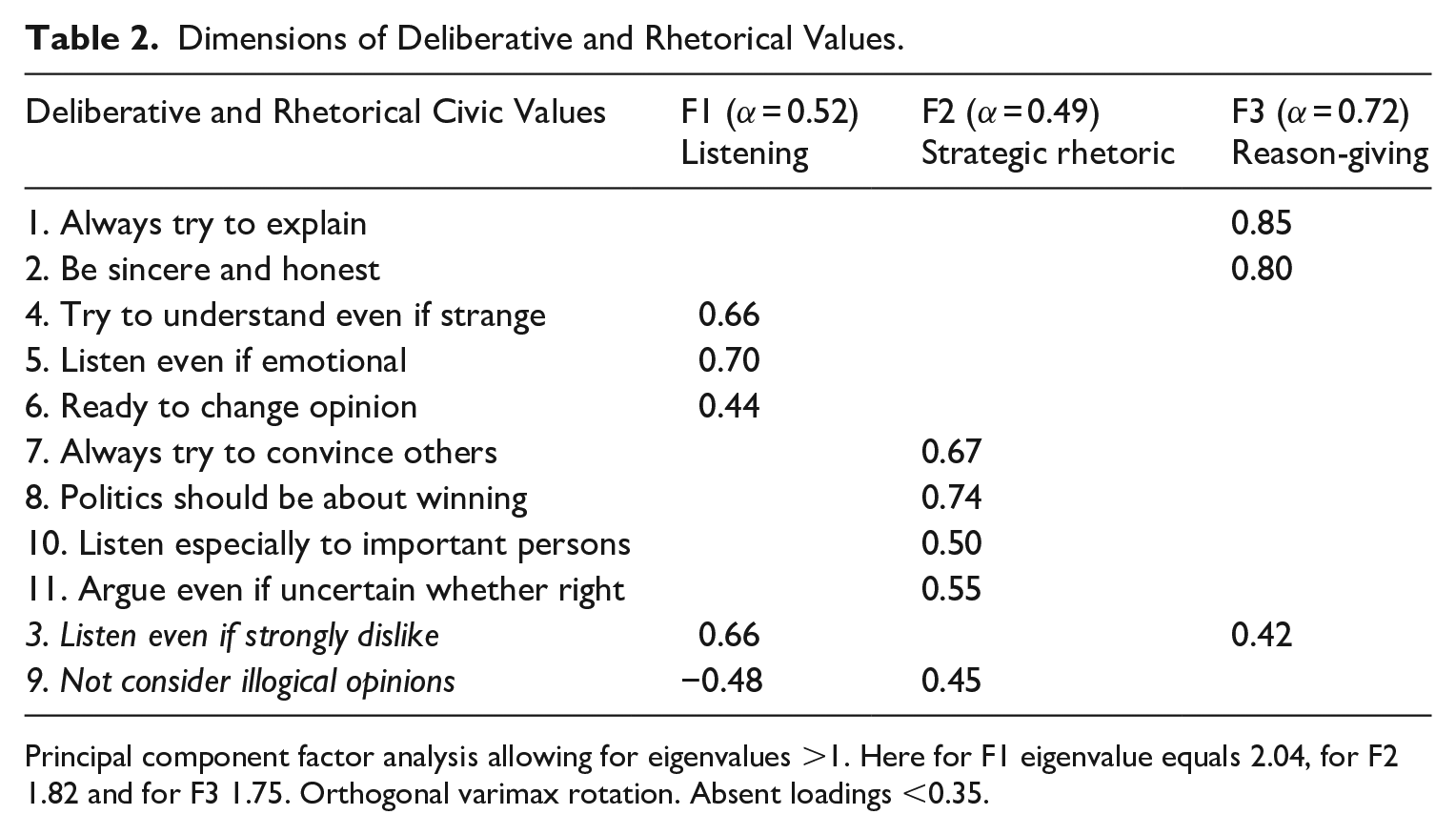
Principal component factor analysis allowing for eigenvalues >1. Here for F1 eigenvalue equals 2.04, for F2 1.82 and for F3 1.75. Orthogonal varimax rotation. Absent loadings <0.35.
The questions aimed to measure reason-giving make up a fairly cohesive factor, as expected. The listening dimension is also easily interpretable. However, the question that was aimed to measure reflecting values (about being ready to change opinion) does not make up a dimension of its own in this analysis either, but is (weakly) associated with the listening dimension. This might indicate that the item needs to be reformulated to capture the analytical distinction between listening and reflecting. It might also indicate that the distinction is difficult to capture empirically. Most importantly, since many deliberative theorists include reflecting in the listening dimension (see e.g. Bächtiger and Parkinson, 2019) and it is pivotal for actual deliberative listening, we find strong theoretical reasons to include it in our listening index instead of removing it. 15 We have, however, included a separate column for reflecting in Table 3 to make it possible to interpret this item separable. Item 3 (‘Even if you strongly dislike some idea, it is important to listen’) is, as expected, related to the other listening values, but it also appears to be weakly associated with reason-giving. We exclude it therefore from the ‘listening’ index.
Simple OLS Regression of Deliberative and Strategic Rhetorical Values Indexes.
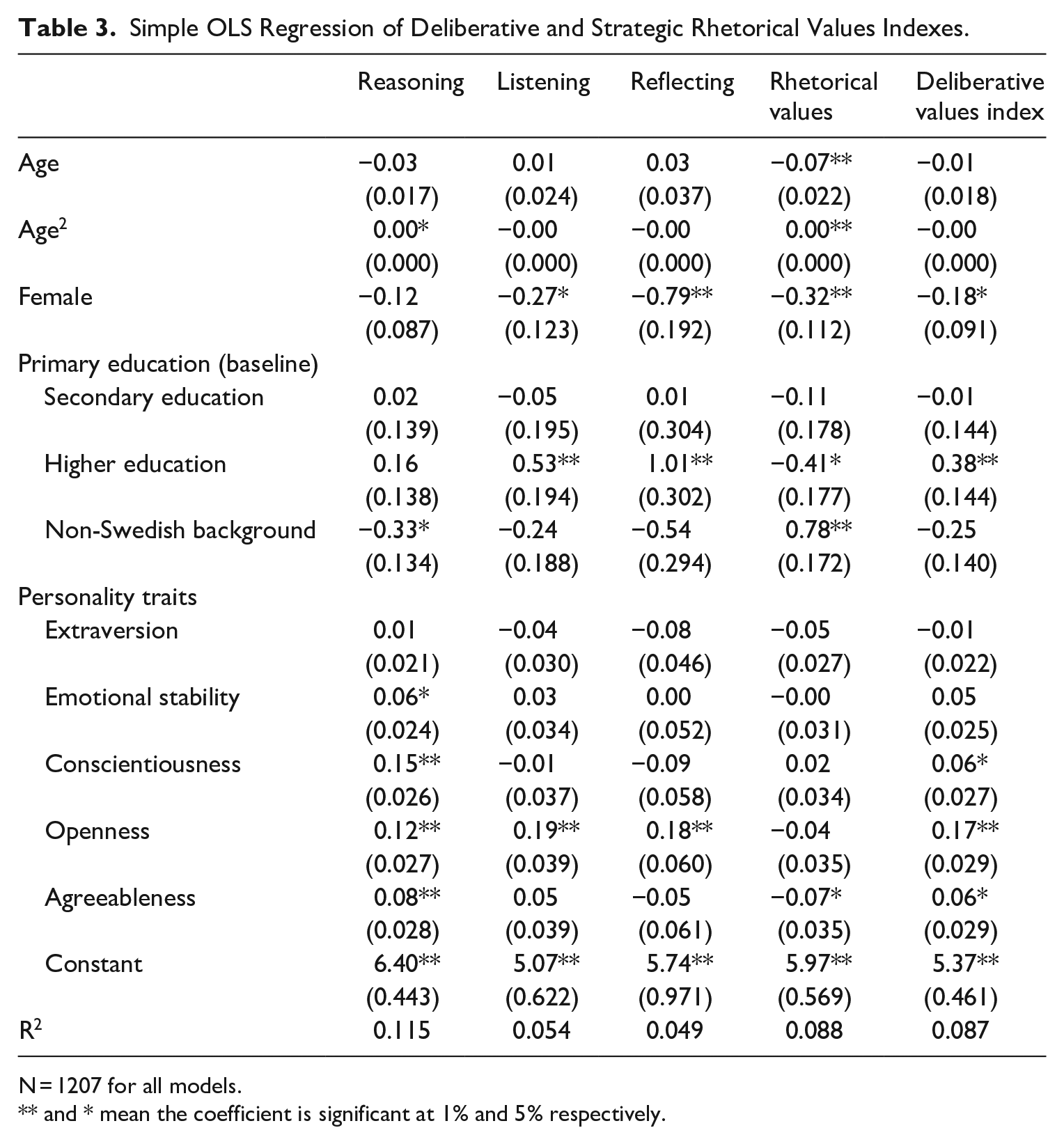
N = 1207 for all models.
and * mean the coefficient is significant at 1% and 5% respectively.
The five items supposedly measuring strategic rhetorical values are still associated with one underlying dimension. However, one item (9. If people have illogical opinions, one does not need to consider them) is also negatively associated with the listening dimension. Similar to item 3, we will not include it in the index.
To conclude, the items seem to be related to each other as expected, and they appear to tap expected aspects of some latent deliberative civic values. There are three separate underlying dimensions – reasoning, listening and strategic rhetorical values, where reasoning and listening are somewhat correlated (correlation coefficient 0.37, p < 0.00), but none of these deliberative values are related to rhetorical values (correlation 0.004 and 0.16, respectively). This means that a person may embrace listening values without necessarily being positive towards reason-giving. In addition, a person may hold deliberative values and still think that politics is about winning, or not embrace any of these values at all. The general distribution of all conversational values (shown in Appendix 1, Figure A1) demonstrates that the values of reasoning are clearly dominant among Swedish citizens, while listening is adhered to less, and the same applies when we look at the general index of deliberative values. But importantly, all indicators of deliberative civic values have a higher average than strategic rhetorical values.
To sum up so far, we have now found empirical evidence for the existence of deliberative civic values – reasoning and listening, but can also note that despite a relatively high average degree of reasoning (8.82, SD 1.56) and listening (6.67, SD 2.10), there are some significant variations. Also, strategic rhetorical values are embraced to a much lower degree, with a mean value of 3.69 on the same scale.
In the absence of cross-national data, we can only speculate whether Sweden is a deviant case or whether similar scores will be found in most other countries too. In our interpretation of previous research, there are several reasons to expect that people living in Sweden are relatively accustomed to deliberative culture and institutional practices (Denters et al., 2007). Sweden was for a long period of time characterized as a country with extensive membership in voluntary associations involved in a democratic corporatist system (Rothstein and Trägårdh, 2007), in which political conflicts were ‘institutionalized’ (Rothstein, 1987) in collaborative units with deliberative elements (Öberg, 2015). Consequently, state–civil society relations in Sweden have been described as relatively less confrontational and more collaborative (Rothstein and Trägårdh, 2007). Relations between the parties on the labour market have been marked by tough but reason-based negotiation in what is known as ‘the Swedish model’, which have had important implications for politics and policy (Korpi, 2018). In an interesting study of how values and institutions interact, political scientist Jenny Jansson (in press) has shown how the Trade Union Confederation used its educational system in the early 1900s to create an identity among members of the trade union as being persons willing to engage in sincere and responsible negotiations with employers at the workplaces (in contrast to e.g. syndicalists that despise such talks). Over the past decades, significant parts of the corporatist system have been dismantled but many of its features are still important in Swedish politics (Öberg et al., 2011b). At the same time, Swedish citizens have witnessed an upsurge in the organization of various forms of deliberative events at the local level (Montin and Granberg, 2014: 134ff). Hence, high deliberative value scores are not surprising given how Swedish politics and society have been characterized in previous research.
Exploring the Variations in Deliberative Values Indexes
In this section we look more closely at certain variations of the proposed indexes of deliberative civic values and how these are related to a number of individual variables such as immigration, education, personality traits and gender. Due to the specifics of the data (no longitudinal or quasi-experimental data), we cannot and do not claim any causal argument. Besides commenting on the indexes that were constructed based on the factor analyses, we will also comment on relationships with individual items in the text (Table A2 in Appendix 1).
As demonstrated above, we found that, on average, the respondents scored high on deliberation and low on strategic rhetorical values. Other studies have shown that persons with a western European background are on average more accustomed to deliberation, and may even be more skilled deliberators, than persons from ‘the European periphery’ (Gerber et al., 2018: 21). We assume that these differences mirror the interactive relationship between institutions, opportunities to deliberate, values and behaviour as described above. Consequently, we expect persons who have a background in countries other than Sweden – or the presumably very similar Nordic countries – to generally embrace deliberative values less than persons born in Sweden.
A number of other socio-demographic variables have been demonstrated to influence citizens’ willingness to participate in deliberative events as well as their style of communication, and we expect that these might also correlate with individuals’ adherence to deliberative civic values. Older, highly educated citizens are overrepresented in deliberative settings just as they are in more traditional partisan politics (Neblo et al., 2010). Possibly, this could indicate that older, highly educated persons would also be more likely to embrace deliberative values. On the other hand, deliberation can be seen as an alternative to traditional partisan politics and as such more appealing to younger, low-educated groups as they are often underrepresented in traditional politics (Neblo et al., 2010). We leave it an open question as to how age and education are related to deliberative values.
It has been argued and widely assumed that White, middle-aged and well-educated men are generally privileged in deliberation as they are socialized into firmly stating their opinions compared to women, who are expected to listen and validate other speakers rather than making persuasive statements themselves (Sanders, 1997; Young, 2000; see, however, (Fishkin, 2018; Gerber et al., 2018). Socialization is expected not only to have implications for differences in gender practices but also to result in differences in beliefs and attitudes. We expect to find differences between gender, where men adhere to the reasoning dimension to a larger extent than listening, and vice versa for women. However, considering the strong emphasis on gender equality in the Swedish schools, our findings might not show such clear gender differences.
Recent research demonstrates the importance of personality traits in explaining political participation (Gerber et al., 2011) and political attitudes (Gerber et al., 2010) and there are reasons to believe that personality is also related to values (Miles 2015). In McCrae and Costas’ (1999: 145) personality framework, values belong to the same mid-level unit as attitudes, habits and skills and understood as the product of the interaction of essential dispositional traits (the Big Five) and environmental factors. In Gerber et al.’s (2010: 112) study on personality and political attitudes they claim: ‘political issues and ideological labels are “stimuli” to which the Big Five traits shape responses’. In the same way, personality traits can be expected to shape individual responses to deliberative values but this is so far a relatively unexplored avenue.
However, a recent study in a Swedish context demonstrates that the personality traits of extraversion, openness and emotional stability are positively related to citizens’ willingness to participate in deliberation (Jennstål, 2018). As values, attitudes and habits belong to the same mid-level unit of personality it seems reasonable to expect that those citizens who express willingness to participate in deliberation – and thus have a positive attitude to deliberative practices and/or developed a habit of participating – are also more likely to embrace deliberative values. For this reason together with the fact that this study is set in the same Swedish context as the study by Jennstål, we expect similar findings in the case of deliberative values.
In sum, we expect persons with a background outside the Nordic countries and younger persons to embrace deliberative values less than others in this sample. Furthermore, we expect the personality traits of extraversion, openness and emotional stability to be positively related to deliberative values, while our expectations on gender are more open since gender might be differently related to diverse aspects of deliberation.
The results in Table 3 demonstrate that, as expected, the effects of socio-economic variables as well as personality have rather weak association to the indexes of deliberative civic values (cf. Gerber et al., 2018). The explained variance of the models used to analyse the variation of deliberative values and its features is also rather low (5%–11%), mainly due to the low variability of the dependent variables. The low degrees of explained variance might also be related to the lack of good predictors at our disposal, and future studies are encouraged to improve it. Yet, the present analysis demonstrates some interesting patterns. Persons who are born outside the Nordic countries, or have at least one parent born in another country, tend to have higher degrees of adherence to strategic rhetorical values and lower degrees of adherence to reasoning and the general deliberative value index. They embrace in particular the idea that politics is about winning and that one should argue for one’s position even if uncertain whether one is right or not. On the other hand, being born outside Nordic countries or having a parent outside this region also relates to lower endorsement of reflecting (that one should be prepared to change one’s opinion) and try to explain so that everybody else understands. The small number of respondents with this background in our sample (11%) makes it difficult to examine any combined relationship with level of education.
While age does not seem to have any strong and substantial linear relationship with the proposed indexes, there is a notable curvilinear effect of age only on strategic rhetorical values. Namely, respondents older than 65 are significantly more likely to hold higher strategic rhetorical values than respondents between 18 and 34 or 35 and –64. Education has a clear expected association to deliberative values (notice similar results based on other kinds of data in Gerber et al., 2018). In general, highly educated people endorse listening more (see also Figure 2), and strategic rhetorical values less, than people with low education. Higher education has a positive effect on the value that one should always be prepared to change one’s opinion and try to understand people who express themselves strangely. At the same time, highly educated persons don’t think that politics should be about winning and, interestingly, they think that one should also consider people with illogical opinions.
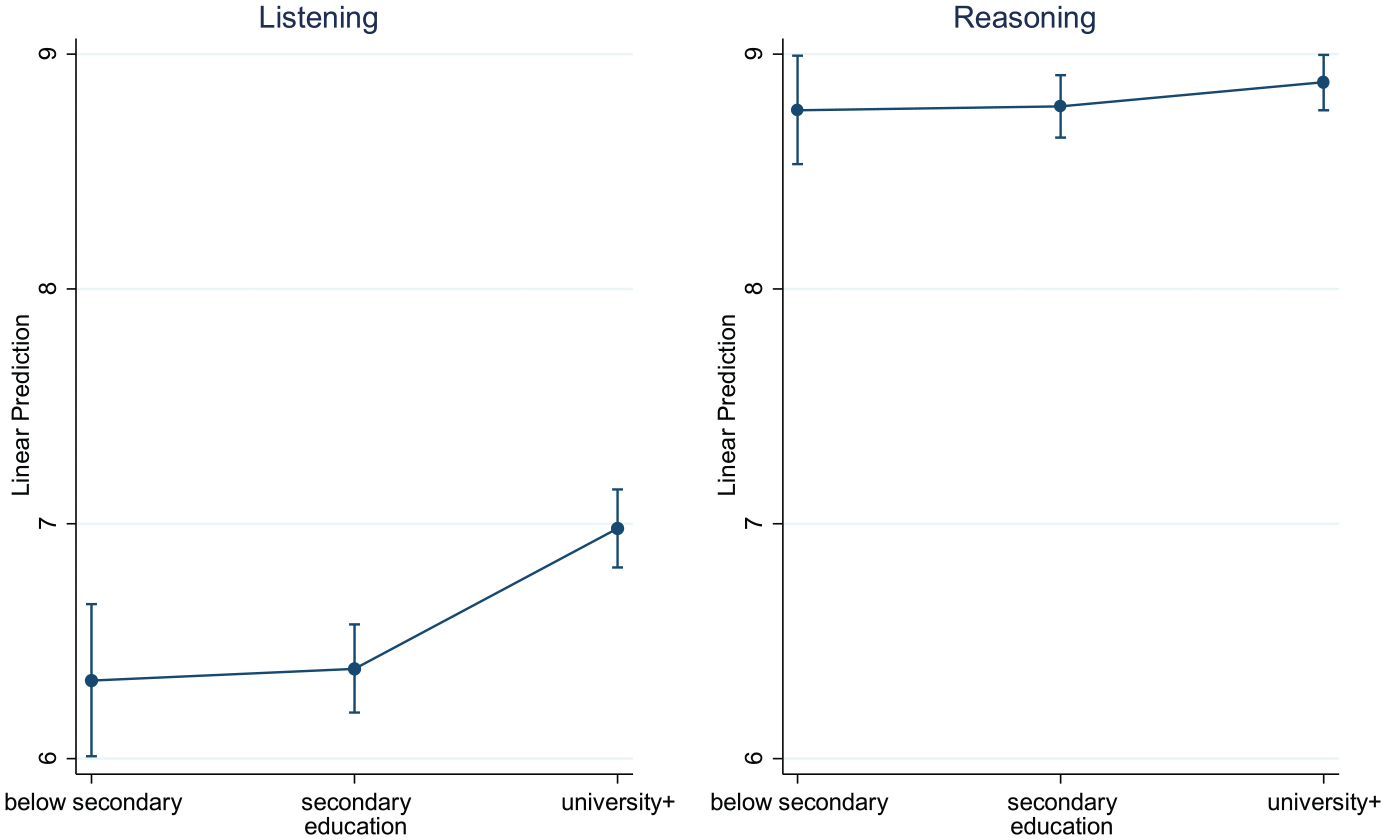
Education and Deliberative Values (Other Variables at Their Mean).
The puzzling results appear in relation to gender, as female respondents are less likely to embrace listening values, the general index of deliberative values as well as the strategic rhetorical values. The effect in the case of deliberative value index is driven by the component ‘ready to change opinion’, as female respondents are particularly unlikely to agree with the statement that one has to be ready to change opinion as a result of political discussions.
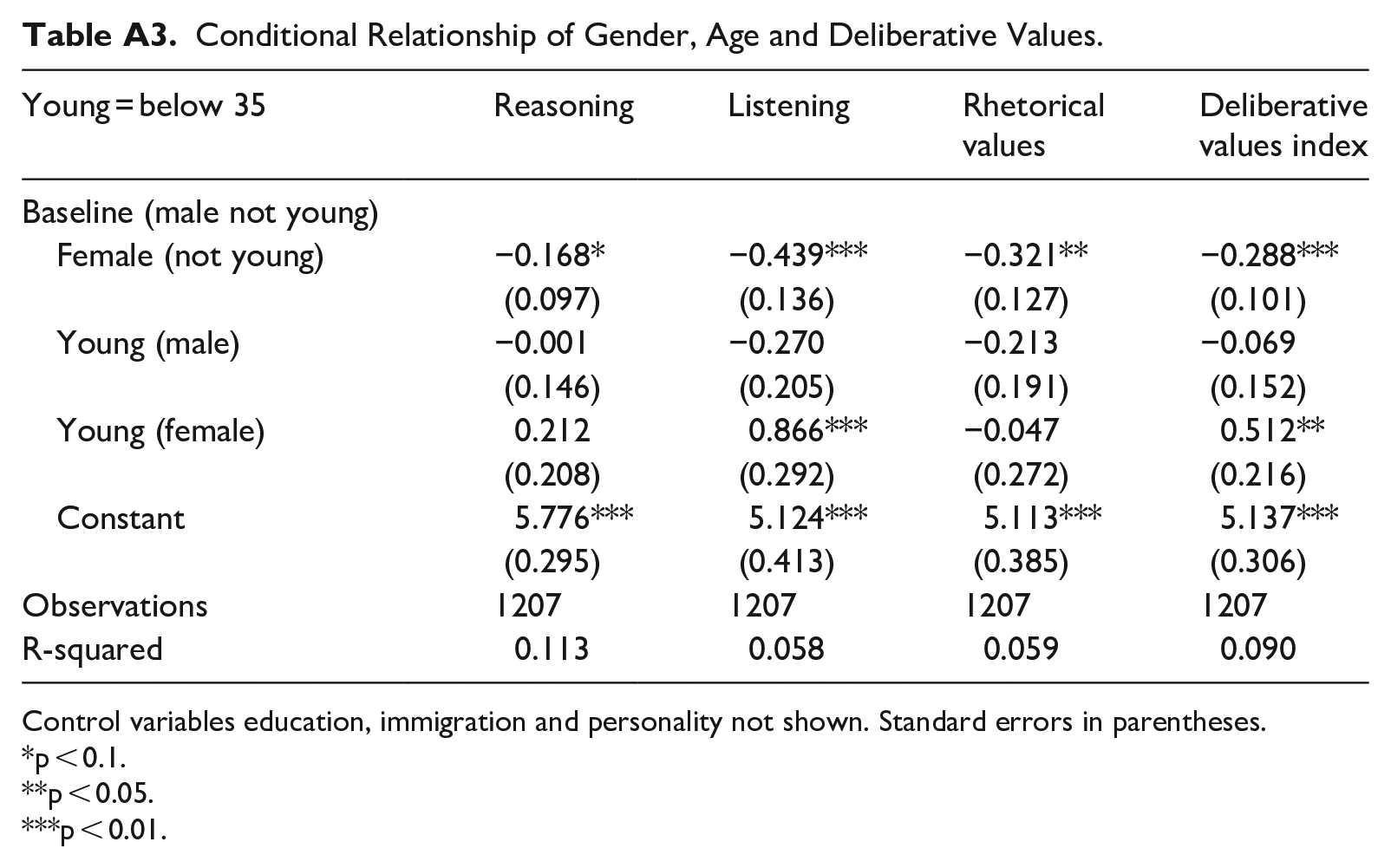
When exploring the gender effects further, we focus on two interactions: first, gender and age and second, gender and immigrant background. In the first case, it becomes evident that the major difference lies between male and female respondents aged above 35 (see Figure 3, related table is in Appendix 1, Table A3). Young women embrace listening values and deliberation more than elderly female respondents, and the gender differences disappear for those younger than 35 years old. This finding would be worth analysing further, as based on our cross-sectional data we cannot decide if it is a life cycle or cohort effect. Does the younger generation of women feel more empowered than older women, and/or do older women have more negative experiences of political discussions and as a result trust deliberation less as a political skill?
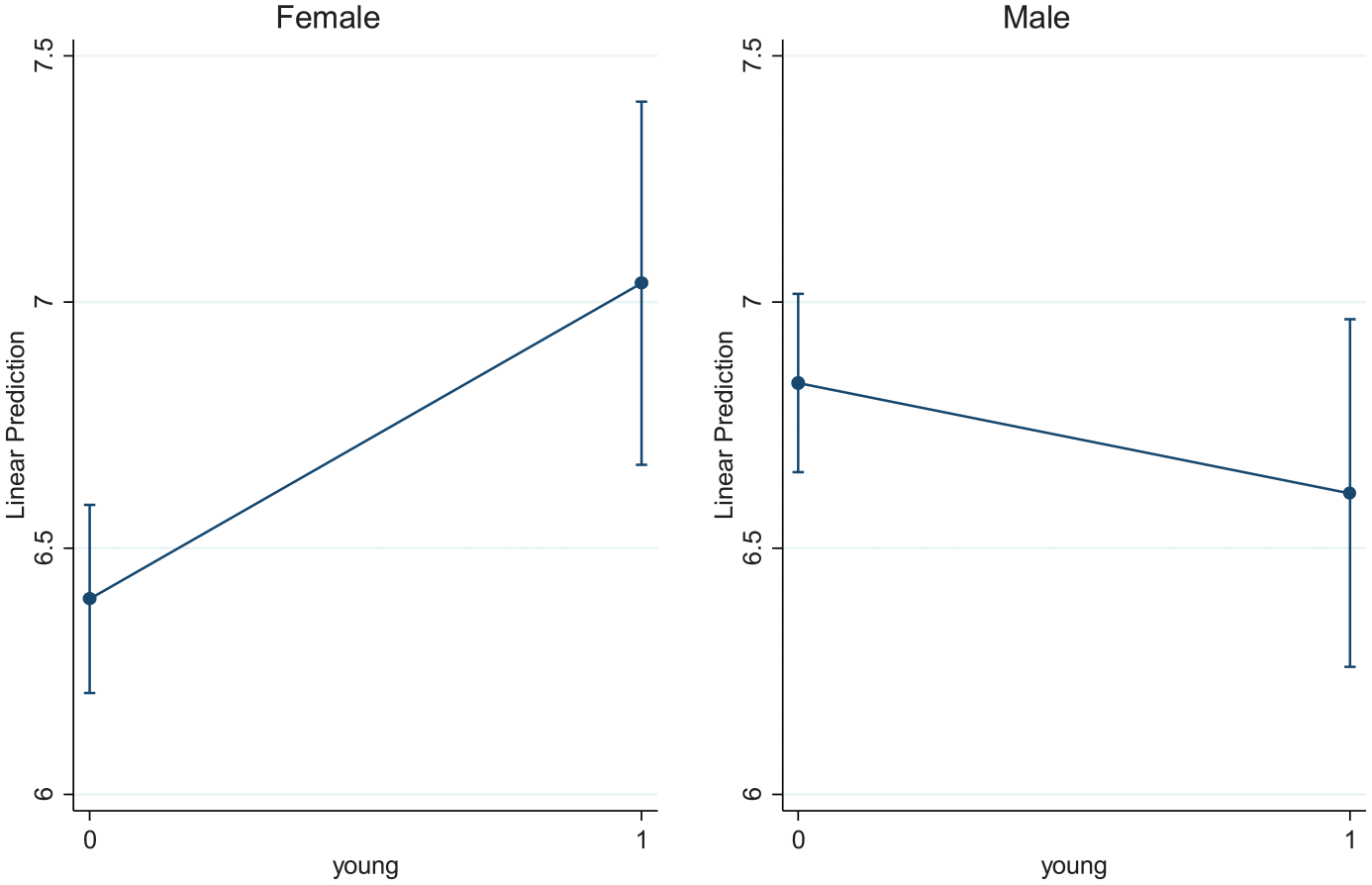
Values of Listening Over Age (Young or Not) and Gender.
In the second case, there is an interaction effect of gender and Swedish background on reasoning and rhetorical values (see Table 4, Figure 4 and Appendix 1, Table A1). Male respondents with a Swedish (or other Nordic) background clearly adhere more to the values of reasoning than men with non-Swedish backgrounds. A similar difference is not present among female respondents. This too calls for further research. Has this to do with gender differences in the countries they come from or from different experiences and understandings of the Swedish society?
Conditional Relationship of Gender, Swedish Background on Deliberative Values.

Control variables age, education and personality not shown.
and * mean the coefficient is significant at 1% and 5% respectively.
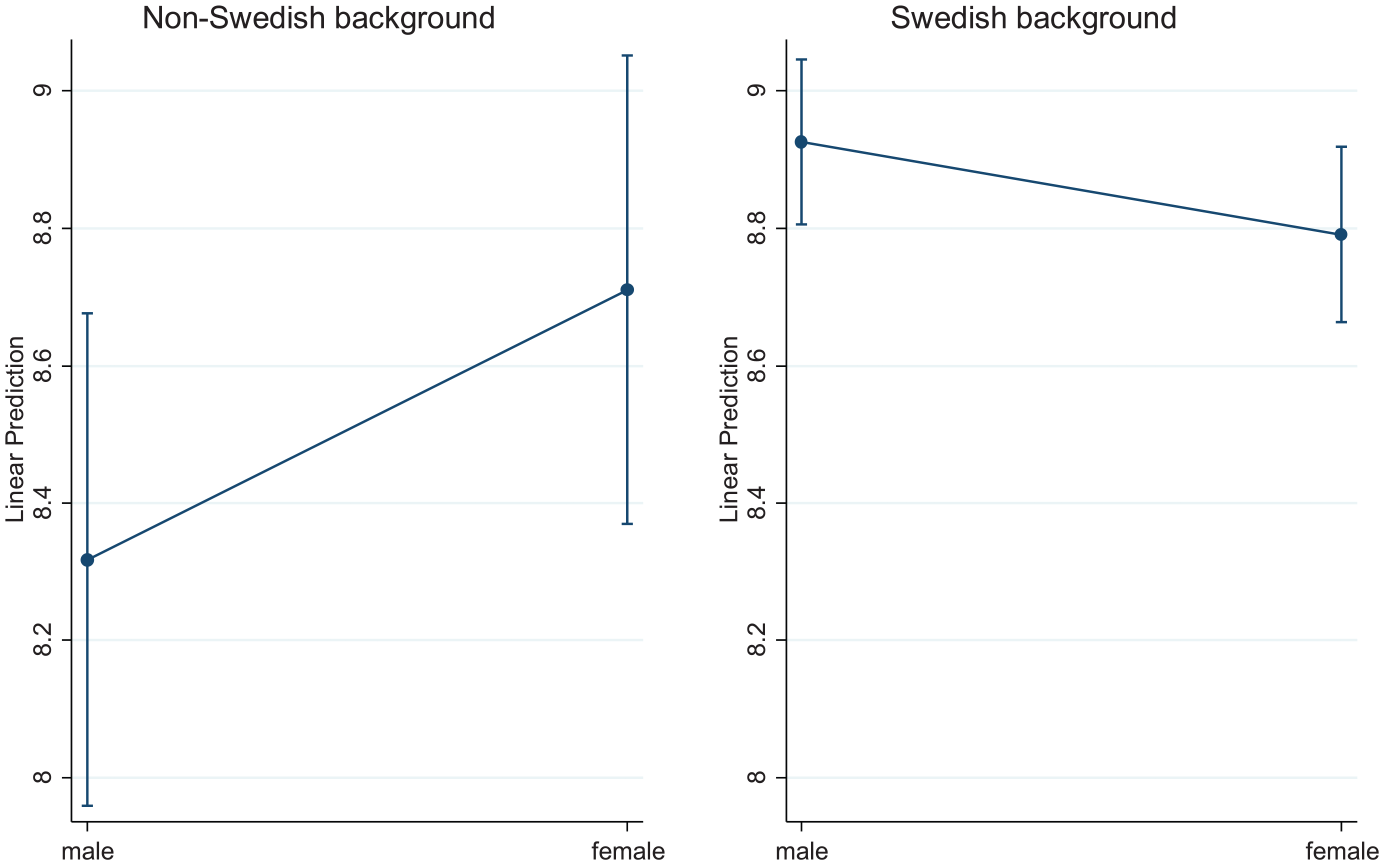
Values of Reasoning Over Non-Swedish Background and Gender.
In sum, age has only a very weak or insignificant linear relationship with deliberative values, which suggests that there are relationships between age and attitudes towards deliberation in Sweden that are not present in those countries the expectations were based on (e.g. the US). The unexpected effects of gender are actually small and mainly driven by one of the items – that one should be sincere and honest and share one’s views, as female respondents were significantly less likely to support this statement. However, as shown above, there are some non-linear relationships between gender and deliberative values, facilitated mainly by age and Swedish background.
Finally, the associations between personality traits on the one hand and deliberative and strategic rhetorical indexes on the other are generally weak and insignificant (Table 3 and Table A2). There are, however, expected relationships with the personality trait Openness (appreciation for a variety of experiences) and that one should always try to explain so that others understand, and that one should listen also to those who are emotional and to persons with opinions one dislikes. The personality trait Agreeableness (being kind, sympathetic and happy to help) is positively associated to the item aimed to capture embracing the value of also listening to persons who show strong emotions and at the same time are negatively associated with the value that one should try to convince others of one’s opinions and that politics is about winning. These obtained relationships are all to be expected given the general characteristic of an agreeable person (Jennstål, 2018). All in all, these expected associations confirm that our items aimed at capturing deliberative civic values are interpreted by respondents in expected ways.
Concluding Discussion
We have proposed a way to measure the predominance of deliberative civic values in society, and demonstrate with the help of survey data that the deliberative values of reasoning and listening are well-adopted in Sweden. The strategic rhetorical values such as understanding that politics is about winning discussions are far less embraced. Partly due to this clear pattern which produces limited individual-level variation in our data, we were unable to show that there are any strong substantial correlations between the respondents’ socio-economic background and deliberative civic values. There are, however, several interesting patterns that demonstrate the usefulness of the instrument and call for further research. As expected, highly educated persons endorse deliberative values more and strategic rhetorical values less than people with lower education. Young female respondents appeared to value deliberation more than elderly female respondents, and males with backgrounds from outside the Nordic countries clearly embrace values of reasoning less than other men living in Sweden.
These results open up a research agenda aiming to understand the importance of deliberative civic values. Cross-country and other studies with data that allow comparing various sites and communities are needed in order to evaluate the findings reported here (cf. Gerber et al., 2018). Obviously, an extended research agenda needs to include how values are connected to actual behaviour. 16 Are there contextual-level variations and how much does it matter to actual behaviour in terms of political participation? Is deliberation the default expectation in some contexts while strategic rhetorical action is more, or even primarily, anticipated in other contexts? Although it has been shown that mini-publics and other deliberative events promote highly deliberative behaviour around the world (Fishkin, 2018), it is possible that the fine-tuning of the institutional settings needed varies when deliberative events are organized within communities with diverse embracement of deliberative values. Furthermore, in order to make deliberation work in less regulated environments such as in social media, values may play an even larger role for behaviour.
Based on our findings, we are convinced that assessing citizens’ endorsement of deliberative values is important in order to understand the functioning of deliberative systems and practices. This is particularly important when different deliberative arrangements are organized all over the world aimed at strengthening or complementing liberal democracy (Fishkin, 2018; Grönlund et al., 2014). In these times of rethinking democratic institutions, an awareness of the status of deliberative values in societies can inform the design of deliberative arrangements and make it easier to foresee the challenges most likely to arise in processes of implementing deliberative practices.
Footnotes
Appendix 1
Conditional Relationship of Gender, Age and Deliberative Values.
| Young = below 35 | Reasoning | Listening | Rhetorical values | Deliberative values index |
|---|---|---|---|---|
| Baseline (male not young) | ||||
| Female (not young) | −0.168* | −0.439*** | −0.321** | −0.288*** |
| (0.097) | (0.136) | (0.127) | (0.101) | |
| Young (male) | −0.001 | −0.270 | −0.213 | −0.069 |
| (0.146) | (0.205) | (0.191) | (0.152) | |
| Young (female) | 0.212 | 0.866*** | −0.047 | 0.512** |
| (0.208) | (0.292) | (0.272) | (0.216) | |
| Constant | 5.776*** | 5.124*** | 5.113*** | 5.137*** |
| (0.295) | (0.413) | (0.385) | (0.306) | |
| Observations | 1207 | 1207 | 1207 | 1207 |
| R-squared | 0.113 | 0.058 | 0.059 | 0.090 |
Control variables education, immigration and personality not shown. Standard errors in parentheses.
p < 0.1.
p < 0.05.
p < 0.01.
Acknowledgements
The authors thank Simon Niemeyer and André Bächtiger for helpful comments on previous versions of this article. They also thank the anonymous reviewers for many excellent suggestions that helped improve the manuscript.
Declaration of Conflicting Interests
The author(s) declared no potential conflicts of interest with respect to the research, authorship and/or publication of this article.
Funding
The author(s) disclosed receipt of the following financial support for the research, authorship and/or publication of this article: The research was funded by the Swedish Research Council (Grant No. 2010-2306 and 2014-811).
