




Abstract
Do home ownership and house prices impact the shaping of individual perceptions on inequality and belief in meritocracy? We argue that home ownership and rising asset prices increase the salience of an individual’s own relative economic position, which in turn facilitates belief in meritocracy. We expect that, when house prices increase, homeowners are likely to strengthen their belief in meritocracy and defend their position by rationalizing that income distribution in society is fair and that economic success and failure are primarily determined by individual efforts. Our analysis of both a Korean panel survey and a cross-national survey finds strong and robust evidence of the asset price effect. Our findings suggest that the housing price effect on economic ideology is a general pattern, which implies that there are social and political consequences to the asset price effect.
Introduction
Since the 1980s, advanced capitalist countries have experienced a sharp increase in house prices and rising wealth inequality. This trend, in conjunction with changes in the labor market and welfare reform that caused employment and income to become insecure, has reinvigorated scholarly interest in the effect of housing inequality on social policy preferences and political behavior (Adler and Ansell, 2020; Andre and De Wilde, 2016; Ansell, 2014, 2019; Larsen et al., 2019; Ronald et al., 2017; Ronald and Kadi, 2018).
Housing is the largest kind of asset that most households own or are capable of purchasing. When the house price increases, their wealth can greatly increase without a corresponding increase in income. The increase in house price can be used to spend more than household income would otherwise allow and can affect the real economy in terms of production and employment (Stroebel and Vavra, 2019). The expectation that asset prices will remain stable or bring a greater profit can cause attitudes toward government taxation and social policy to change regardless of income (Ansell, 2019). Home ownership is therefore critical for economic security, but house prices also affect individual policy preferences and political behavior (Ansell, 2014; Ansell et al., 2022; Hall and Yoder, 2022; Steele, 2021).
Despite important studies on the link between asset inequality and social policy preferences, the literature is surprisingly sparse when it comes to analyzing the impact of home ownership and housing price increases on the perceived fairness of the market economy and belief in meritocracy. The extant literature has suggested that perceived economic fairness and belief in meritocracy strongly influence support for social policies (Alesina and Ferrara, 1999; Benabou and Tirole, 2006) and that home ownership impacts individual social policy preferences (Ansell, 2014, 2019; Ronald and Kadi, 2018). Yet there is a dearth of research on the link between home ownership and housing prices, on one hand, and perceptions on inequality, economic fairness, and belief in meritocracy, on the other hand. Perceptions on the fairness of distribution as well as belief in meritocracy are important intervening variables that we believe are left unexplored in the literature on the link between home ownership and the demand-side politics of the welfare state.
In this article, we explore the effect of home ownership and house prices on individual perceptions on fairness of distribution and belief in meritocracy. An individual’s economic position is a composite outcome of effort and circumstance (Roemer, 1998). Luck, such as family background, falls within the category of circumstance as an individual cannot exercise any influence and it is unpredictable (Dworkin, 1981; Roemer and Trannoy, 2016). We argue that home ownership and rising housing prices increase the salience of an individual’s own relative economic position, which in turn leads to belief in meritocracy. Building on Newman et al.’s (2015) framework, we argue that home ownership is likely to bolster homeowners’ belief in meritocracy because homeowners will defend and justify their position by rationalizing that income distribution in society is fair and that economic success and failure are determined mostly by individual efforts and hard work. Changing economic incentives brought about by home ownership are an important part of the explanation for perceptions on fair distribution and belief in meritocracy. Furthermore, we argue that rising housing prices are likely to bolster meritocratic beliefs among homeowners. The asset price effect we posit in this article refers to the idea that rising asset prices may increase the salience of economic status grouped by geographic area and intensify the rationalizing incentives by upholding meritocratic belief.
Our empirical analysis begins by exploring whether home ownership and housing prices affect perceived inequality and meritocratic beliefs. We then proceed to estimate the effect of housing prices and the ratio of asset price to debt among homeowners. We find robust evidence that supports the asset price effect on belief in meritocracy among homeowners. Our evidence draws from the analysis of both a Korean panel data and a cross-national survey.
The case of South Korea (hereafter Korea) provides a perfect context to empirically test our theory of rationalizing public belief. The symbolic power of geographic space in Korean society is tremendous and reflects individuals’ identity, social status, and economic class, termed “the republic of real estate” (Yang, 2018). A significant number of Koreans since the mid-2010s have bought their house by accessing credit amidst housing boom and bust cycles. In 2015, the rate of home ownership was 56.8%. The news of rising or falling housing prices regularly features in newspaper headlines, and the most important campaign pledges in presidential, parliamentary, and local elections are those related to housing and real estate prices (Kim and Kwon, 2017). Furthermore, in Korea’s “small welfare state” context (Yang, 2017), housing assets are expected to play a stronger role for self-insurance and an important private alternative to the welfare state (Busemeyer and Iversen, 2020). Our analysis of the Korean Welfare Panel Study finds that home ownership and rising asset prices are positively associated with perceptions on fairness of distribution and belief in meritocracy. Furthermore, to ensure the external validity of our findings, we analyze a cross-national survey, the International Social Survey Program (2009), and find evidence that suggests our findings from Korea are generalizable to other countries around the globe. We find strong evidence of the effect of home ownership and net home equity on the perceived inequality and belief in meritocracy among the mass public in 34 countries.
This study contributes novel evidence to the political science literature. First, our finding that home ownership and asset prices exert effects in shaping economic ideology adds a more nuanced story to extant studies on the source of attitudes toward inequality and belief in meritocracy, which have mostly focused on attributes such as income and education (e.g. Kluegel and Smith, 1986), personality traits (e.g. Jost et al., 2003), or objective economic inequality (Mijs, 2021). The findings of this analysis suggest the importance of housing assets in shaping economic ideology in the age of rising wealth inequality. Second, we provide strong and robust evidence suggesting that the asset price effect on economic ideology is a general global pattern. Indeed, our findings suggest that the home ownership and asset prices effect on perceptions on the distribution of income and belief in meritocracy is generally observed across countries in an era in which private alternatives to the welfare state are widely available through credit markets (Busemeyer and Iversen, 2020; Wiedemann, 2023). Our findings suggest that belief in meritocracy may be a mechanism of psychological resistance to redistribution among homeowners (Ansell, 2014).
Finally, our theory and evidence corroborate the importance of assets and wealth inequality in contemporary democratic politics. Because individual economic ideology is closely related to policy preferences, and elected representatives tend to respond unequally to different income groups (Bartels, 2008), our study touches on the importance of assets and wealth in democratic political processes and markedly deepening political inequality in both accountability and representation. One of the critical political consequences of rising asset price may be deepening political inequality. If home ownership and rising housing prices bolster public belief in meritocracy as our study suggest, and if home ownership changes economic incentives in a way to boost up voter turnout and political participation (Hall and Yoder, 2022), home ownership and rising asset prices may increase political and economic inequality.
The remainder of the article is organized as follows. In the next section we provide theoretical expectations about the link between home ownership and asset prices, on one hand, and economic ideology, on the other. We then introduce the data and empirical strategy, followed by the discussion of our analysis of a Korean panel survey. We then proceed to discuss the results of our analysis of a cross-national survey. The final section concludes with several implications.
Home Ownership, Asset Prices, and Economic Ideology
Since the 1980s, there have been many important studies on assets and wealth inequality. Stiglitz (2012) has suggested that increased land prices in recent decades have increased the capital-to-income ratio, and land has become a positional good. Fuller et al.’s (2020) study finds that housing assets account for much of the variation in the wealth-to-income ratio in advanced capitalist countries—a finding in line with Piketty (2014). For most people, a home may be the only real estate one owns. 1 In terms of the political consequences of home ownership, Kemeny (1992) asserts that home ownership is related to a wide range of ideas, values, social practices, and the legitimacy of domination, where home ownership is central to uniting capitalist society and embodies the ideology required to maintain capitalist-oriented hegemony. Home ownership contributes to maintaining bourgeois class values, supporting the private ownership system, maintaining social stability, and ensuring the conservative state’s role. 2 As such, when it comes to real estate assets such as housing, material self-interest is closely linked to non-material ideological perceptions and perspectives.
Meritocracy refers to the idea that economic outcomes are awarded based upon individual initiative, hard work, and ability (Newman et al., 2015). In this sense, the idea of economic fairness is encapsulated in the concept of meritocracy. In many studies, belief in meritocracy has been identified as an influential factor stymieing support for redistribution and social policy in the face of rising inequality (Alesina et al., 2001; Hochschild, 1981; Kluegel and Smith, 1986). Moreover, it has been documented that Americans tend to view the sources of poverty and inequality to be lack of hard work and individual efforts, while Europeans tend to attribute poverty to circumstances outside of one’s control (Alesina et al., 2004). When one attributes the sources of poverty and inequality to individual efforts and hard work rather than systematic barriers like family background, support for redistribution and welfare policy is likely to decrease. Furthermore, recent studies have suggested that rising inequality is legitimated by the popular belief in meritocracy and individuals in unequal societies tend to have stronger belief in meritocracy than those in relatively egalitarian societies (Mijs, 2021). A recent survey experimental study has suggested that the informational treatment on inequality, social position, and self-interest changed meritocratic beliefs among respondents (Mijs and Hoy, 2022).
Individual material self-interest is formed by both income and wealth, including housing assets and financial wealth (Ansell, 2014; Steele, 2021). Housing is the asset most widely held and most sentimentally important to people. As Ansell et al. (2022) have pointed out, wealth embodied in housing is distinct from labor market incomes in its connection to geographic place. Housing belongs to a specific location and the investment to purchase a house is illiquid and it is a long-term investment (Ansell et al., 2022). Housing provides a stock of wealth, which may be relied upon during times of economic risks such as unemployment and retirement, especially in the context of underdeveloped social protection systems (Ansell, 2014). We contend that such economic self-interest would be further strengthened as the mechanisms for income security that hitherto functioned through the welfare state and job security are not as effective and dependable as they were several decades ago. Relative to past decades, housing and other real estate assets play a much larger role in functioning as a self-insurance mechanism against the vicissitudes of the market economy (Ansell, 2019; Busemeyer and Iversen, 2020; Scheve and Stasavage, 2017). Put differently, the importance of real estate assets, such as housing, for one’s economic position has dramatically increased. Wealth inequality has markedly risen, and its political and economic salience has undoubtedly increased concomitantly.
In this article we posit and empirically test the effect of home ownership on economic ideology and provide a conditional hypothesis on the effect of asset prices among homeowners. First, economic interest approaches posit that wealthier housing asset owners defend the status quo because they benefit from it and hence advocate its continuation. The mechanism that drives such a behavioral pattern is essentially a rationalization motif. In contrast, renters without housing assets reject the notion of a meritocratic system and support the idea that luck or circumstance determines individual economic fortunes. Lower income earners and those without housing assets are less likely than higher income and wealthier citizens with housing assets to perceive economic advancement as the outcome of effort and hard work, and more likely to attribute economic success and failure to structural explanations (Kluegel and Smith, 1986). In line with this approach, we posit that home ownership bolsters belief in meritocracy, thereby defending and rationalizing wealthier individuals’ position and the economic system enabling such privilege. Accordingly, our first hypothesis is derived as follows: Rationalizing economic interest hypothesis: Home ownership is likely to have a positive effect on perceptions on relatively egalitarian distribution of income and upholding meritocratic ideology.
How do rising asset prices affect the economic ideology of homeowners? We posit that the home ownership effect on perceived inequality and belief in meritocracy varies across different levels of asset prices. Individuals who own a very expensive house may believe in meritocracy more strongly than owners of a cheaper house. Increases in asset prices would make asset holders wealthier and feel more secure and increase the salience of an individual’s relative economic position (Ansell, 2014). While changes in asset prices are in fact beyond their control, those asset holders have incentives to perceive and rationalize rising asset prices as the outcome of their hard work and initiatives. Various mechanisms would play out in linking rising house prices and meritocratic beliefs among homeowners. First, rising asset prices would make individuals’ relative economic status salient and lead to increased subjective social status. Second, increases in asset prices may change the asset holders’ belief in meritocracy and the notion of fairness. The rationale behind this behavioral change may stem from increased distributional conflict in the society between asset owners and those without. Under the context of increasing wealth inequality and issue salience of distributional conflict, wealthier asset holders may be incentivized to believe that the status quo outcome of distribution of income and wealth is fair as it is derived from fair competition based on meritocratic principles. In sum, as major beneficiaries of rising asset prices, the owners of wealthier housing assets have incentives to rationalize the distribution of income as fair and their economic achievement as the outcome of their hard work and initiatives. We should therefore expect to observe the asset price effect on belief in meritocracy among homeowners. Accordingly, we posit the following conditional hypothesis: Asset prices effect hypothesis: The home-ownership effect on perceptions on the fairness of distribution and meritocratic belief is conditional upon the price levels of housing assets. As house price increases, homeowners are more likely to perceive that the distribution of income is less inegalitarian and uphold belief in meritocracy.
Home Ownership, Asset Prices, and Economic Ideology: The Case of Korea
To explore the effect of housing assets on economic ideology, in this section we begin by analyzing the case of Korea. The symbolic power of geographic space in Korean society is tremendous, and phrases that represent specific spaces—such as the capital metropolitan area versus rural provinces, in-Seoul versus out-of-Seoul, and Gangnam (rich south of the Han River in Seoul) versus Gangbuk (poor north of the Han River in Seoul) districts—reflect individuals’ identity, social status, and economic class (Yang, 2018). The source of that power is real estate; this is reflected in the term “republic of real estate.” The importance of real estate, including housing and land, for the Korean public stems from the cultural heritage passed down from East Asia’s rice farming agricultural society (Talhelm et al., 2014) and the legacy of the real estate frenzy that began with the Gangnam development in the 1970s and 1980s during periods of rapid economic development. For Koreans, home ownership of newly constructed apartment complexes is akin to winning the lotto jackpot; they speculate on where new cities and districts will be developed and search for promising land and apartment complexes, aiming for extraordinary windfall gains (Kim, 2019). One of the most important campaign pledges in presidential, parliamentary, and local elections are those related to housing and real estate prices (Kim and Kwon, 2017). The electoral defeat of the incumbent party in the recent March 2022 presidential election was widely attributed to rising housing prices during their tenure.
Real estate market prices have been rising in Korea, in line with broader global trends (Choi, 2021; The Economist, 2021). Figure 1 shows the trend in average house prices between the capital metropolitan area (Seoul, Incheon, and Gyeonggi province) and the rest of Korean society in the past decade. We observe that average house prices have been rising overall. Moreover, the gaps between Seoul and the rest of the country in average house prices have markedly increased since 2017, showing deepening housing price polarization in the country. In particular, the gap in apartment prices is skyrocketing and the price ratio between the top 20% and the bottom 20% of apartment prices in Korea exceeded 8.0 at the end of 2020 (Choi, 2021). With a 56.8% home-ownership rate in 2019, and a conversion ratio of housing of about 105% in 2020, we observe housing inequality where some wealthier people own multiple houses while nearly half of the population does not own any home.
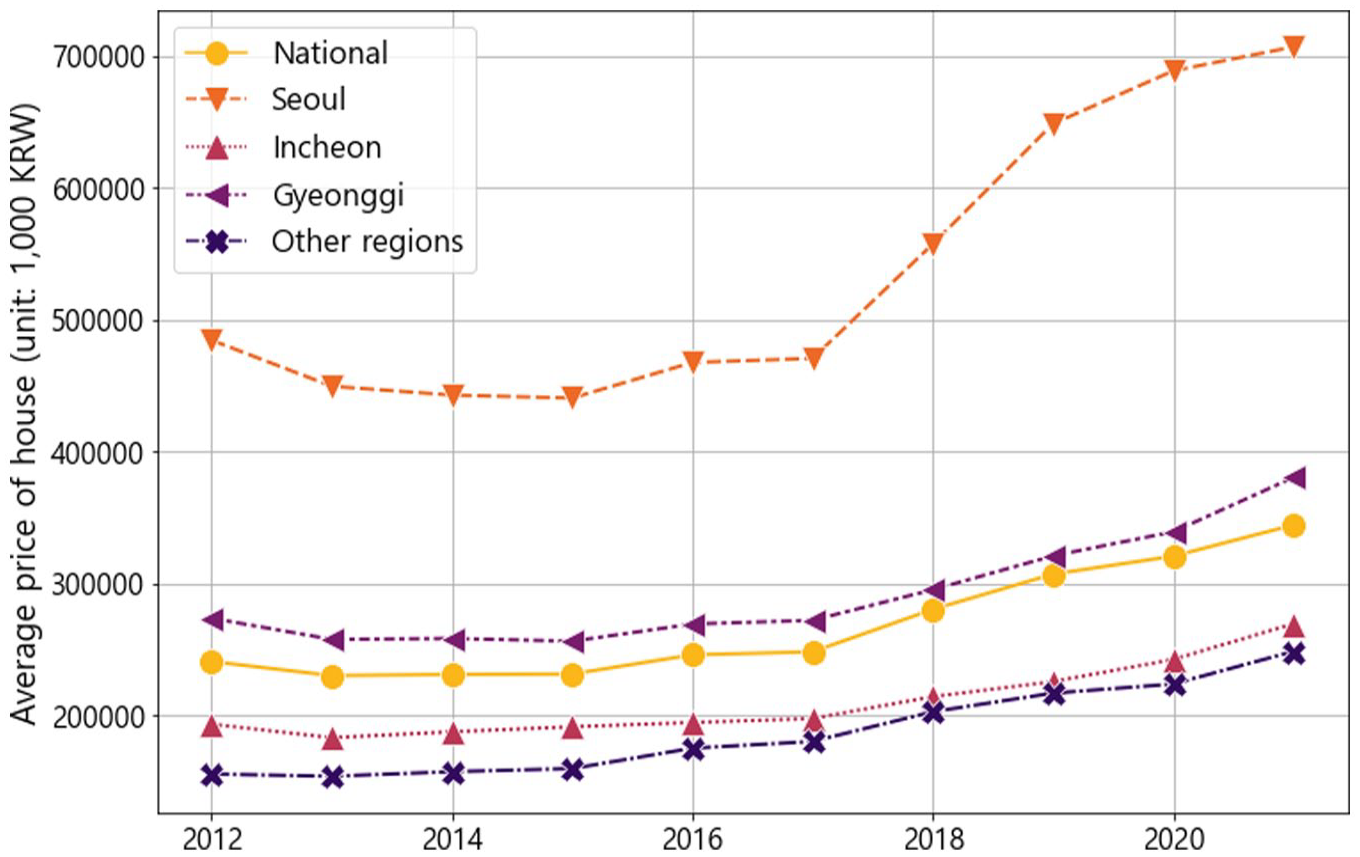
Trend in Average House Prices in Korea (2012–2021).
We now turn to whether these rising house prices have political consequences in terms of economic ideology, including perceptions on distribution of income and belief in meritocracy.
Data and Methods
To explore whether home ownership and asset prices have an effect on the perceived fairness of the market economy and belief in meritocracy, we analyze the Korean Welfare Panel Study conducted by the Korea Institute for Health and Social Affairs. The panel survey was administered to individuals aged 20 years or older, with nationally representative samples. As for the survey methods, the surveyor visited the target households in person and conducted an interview. This study uses data from 2007, 2010, 2013, 2016, and 2019, which include questions related to welfare attitudes (see Online Appendix A for more details about data and variables).
The outcome variables for this study are as follows. The question wording for Perceived inequality is “How do you think about the degree of income and wealth inequality in Korea?” The response was scaled 1~7, coded 1 if a respondent answered “very equal,” and 7 “very unequal.” Belief in meritocracy used the following set of questions: “How important do you think is the following item as a cause of poverty in our society? Lack of luck including deprived family background,” and “Lack of individual initiatives and effort.” The response was scaled 1~4, where 1 refers to “not important at all,” and 4 to “very important.” We normalize the scale of the outcome variables to range from 0 to 1.
The explanatory variables are home ownership, house price, and the ratio of house price to debts. Home ownership was coded 1 if a respondent owns a house and 0 otherwise (either renters who pay monthly rents or jeonse renters, who pay a refundable lump-sum deposit without monthly rents 3 ). House price was measured as nine categories, ranging from less than KRW 1 million (approximately US$900) to more than KRW 1 billion (approximately US$0.9 million). 4 House price includes jeonse renters’ lump-sum deposit. To calculate a ratio of house price to debt, we use Debt, which is measured as nine categories in the same scale as house price. We also examine an interactive effect of house price and home ownership in the analysis of Korea. 5
We include the control variables that may affect perceptions on inequality and belief in meritocracy (Alesina and Ferrara, 2005; Pandy et al., 1982; Weiner et al., 2011). These include demographic and socioeconomic variables such as a respondent’s income (1~7 scale), education levels (1~6 scale), sex (1 = female), age (1~6 scale), marital status (1 = married), and capital area (capital area including Seoul, Incheon, and Gyeonggi province). We also control for occupations by adding dummy variables for employer, as well as professional positions. We also include religion (1 = having a religion). 6
We estimate two-way fixed effects model. By including individual fixed effects and year-specific fixed effects, we can account for unobserved and unmeasured individual heterogeneity and time-specific shocks. Utilizing the panel data with two-way fixed effects estimation, our inference is that changes in home-ownership status and changes in house prices affect attitudinal variations in perceived inequality and meritocratic beliefs. Our inference is therefore more conservative than cross-sectional analysis in that we estimate the effect of changes in explanatory variables on attitudinal changes. Moreover, our panel research design allows us to disentangle whether home ownership and the house price effect is a causal factor in belief in meritocracy or whether confounders such as income or occupation affect both the likelihood of being a wealthier homeowner as well as upholding meritocratic beliefs. We first regress perceptions on inequality and meritocratic belief on home ownership, house price, and their interaction term, as well as controls and fixed effects; and then, second, regress perceptions on inequality and belief in meritocracy on house prices only among homeowners.
The Impact of Home Ownership on Perceived Inequality and Belief in Meritocracy
As a first cut, Figure 2 shows the results of a t-test on perceived inequality, luck, and efforts by classifying respondents by home ownership, which shows statistically significant differences between the two groups (see Table A6 in Online Appendix A for full results).

t-Test of Inequality, Luck, and Efforts by Home Ownership. (a) Inequality. (b) Luck. (c) Efforts.
Figure 2 suggests that individuals have different views on perceived economic fairness and belief in meritocracy, depending on whether they own a house or not. On average, homeowners tend to perceive that distribution of income is less inegalitarian than the renters do; they also tend to think that lack of individual effort rather than lack of luck can better explain poverty.
Table 1 shows the results of our analysis. Model 1 includes home ownership, Model 2 estimates the effect of house prices, Model 3 includes an interaction term of home ownership and house prices, Model 4 estimates the effect of a ratio of house price to debt, and Model 5 includes net house price. Our outcome variables are threefold: perceptions on inequality (A), perceptions on luck (B), and perceptions on efforts (C). We find that most explanatory variables have negative and statistically significant effects on the perceptions on inegalitarian distribution of income and wealth. In accordance with the rationalizing economic interest hypothesis, the results suggest that home ownership and house price, as well as house price ratio to debt and net house price, are associated with the perceptions that distribution of income is relatively egalitarian. The results also suggest that homeowners and rising house price tend to go hand in hand with perceptions that economic success stems from individual initiatives and efforts.
Home Ownership, House Price, and Economic Ideology.

Models are two-way fixed effects estimation. Control variables not reported. N = 13,434 (A), 9649 (B and C). See Tables B1–B3 in Online Appendix B for full results. FE: fixed effects.
p < 0.05; **p < 0.01; ***p < 0.001.
In terms of substantive effects, one standard deviation change in home ownership leads to decreases in perceived inequality by the order of one percentage point out of a 0~1 scale and one standard deviation change in house price leads to decreases in perceived inequality by two percentage point. Similarly, one standard deviation change in home ownership leads to increases in the likelihood of perceiving individual efforts to be the cause of economic success by the order of 1.2 percentage point and decreases the likelihood of perceiving luck to be associated with economic fortune by 2.9 percentage point. Although the magnitude of substantive effects is rather modest, we posit that it is the case that individual perceptions of inequality are relatively stable, while our two-way fixed effects model takes both unobserved individual heterogeneity and over-time trend into account, leading to fairly conservative estimates. The results in Table 1 suggest that the housing asset effects are consistent, where a greater value of assets and home ownership were associated with a greater likelihood of viewing society as more equal and perceiving that individual efforts rather than luck are associated with economic success (see Table B1–B3 in Online Appendix B for full results).
Figure 3 visualizes marginal effects of home ownership on economic ideology. Panel (A) shows a conditional prediction from interactive model on the perceived inequality. With a transition of house price from 1 to 9, predictions for the perception of inequality decreased from 0.76 to 0.55 for homeowners and decreased from 0.69 to 0.68 for renters. The results suggest that homeowners with higher levels of house prices tend to perceive the distribution of income to be fairer than their counterparts with lower levels of house prices. Panel (B) shows the marginal effect of home ownership moderated by house prices, using a binning estimator (Hainmueller et al., 2019).
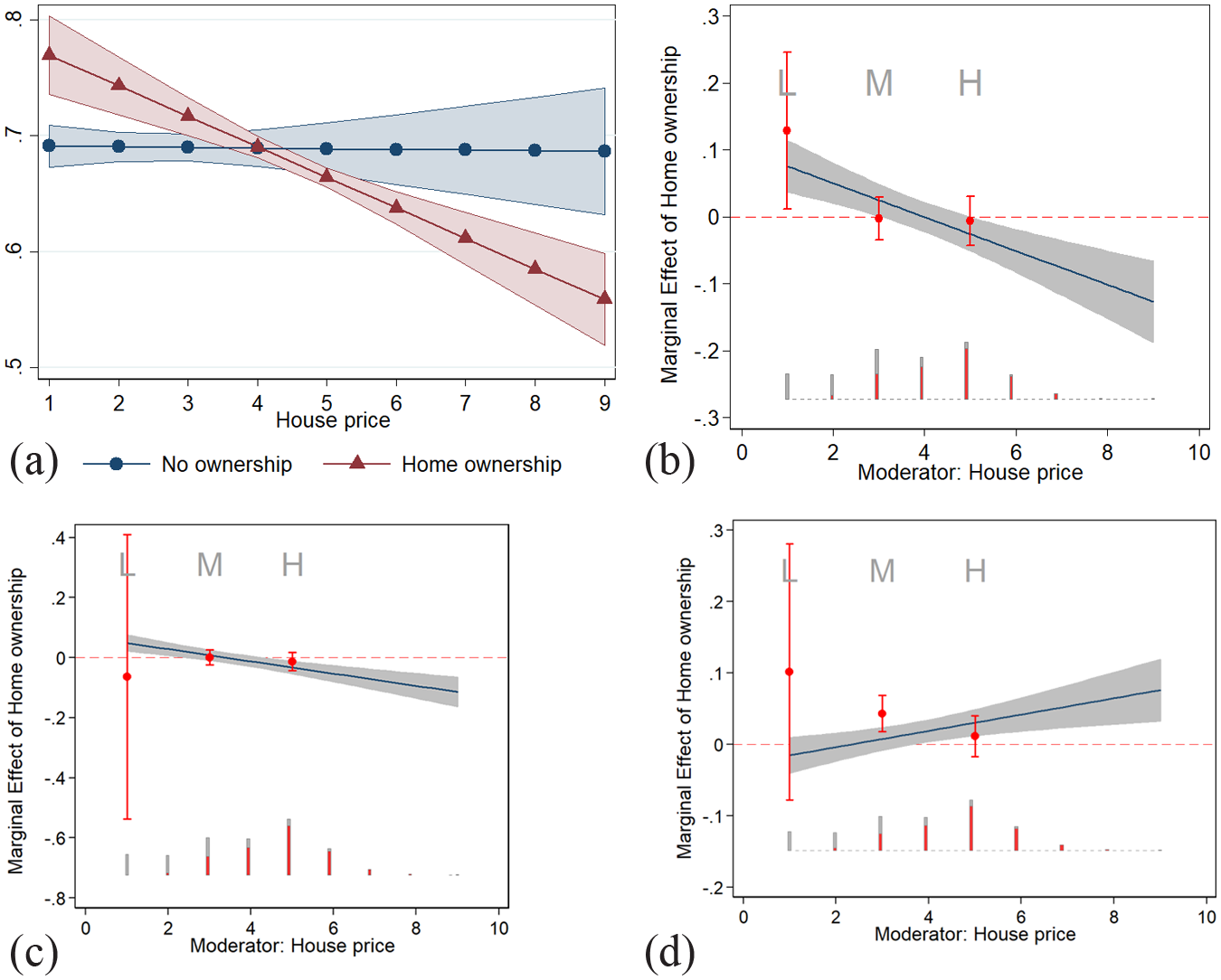
The Predicted Effect of House Price and Marginal Effect of Home Ownership. (A) Predicted Effect on Perceived Inequality. (B) Marginal Effect on Perceived Inequality. (C) Marginal Effect on Luck. (D) Marginal Effect on Efforts.
We observe that home ownership is associated with the perceived fairness of distribution, as house prices increases (larger than 6 out of a 1–9 scale). Panels (C) and (D) show the marginal effect of home ownership moderated by house price on perceptions on luck and efforts. As house price becomes more expensive, homeowners tend to perceive economic achievements are due to individual efforts rather than luck. The results of our analysis support the asset prices effect hypothesis. The home-ownership effect is more pronounced when asset price levels are higher.
The Effect of House Price Increases on Homeowners’ Meritocratic Beliefs
How do house prices influence belief in meritocracy? To examine how housing price affects beliefs regarding the perceived causes of poverty—lack of luck or lack of efforts—we estimate two-way fixed effects models with only homeowners. We regress perceived inequality, lack of luck as the cause of poverty, and lack of efforts as the cause of poverty on the three explanatory variables: house price, house price relative to debt, and net house price. We also include control variables as well as individual- and year-specific fixed effects (see Table B4 in Online Appendix B).
Figure 4 shows the estimated coefficients and 95% confidence interval of the three explanatory variables. The results show clear patterns of the house price effect. Among homeowners, increases in house prices are associated with lower levels of perceived inequality and a lower likelihood of perceiving the lack of luck as the cause of poverty, with the corollary that they have a higher likelihood of perceiving the lack of efforts as the cause of poverty. These patterns are similar with different measures of house prices, such as a ratio of house price to housing debt and net house price. As the value of housing assets increases, so does the tendency to believe in meritocracy.

House Price and Homeowners’ Perceptions of Inequality, Luck, and Efforts.
Figure 5 plots the estimated effects of house price on economic ideology. When house price changes from the bottom quartile (25%) to the top quartile (75%) level, holding other variables at their means, the predicted perception on inequality changes from 0.72 to 0.62 (lower score denotes perceived inequality is lower), the predicted belief that lack of luck is the cause of poverty decreases from 0.65 to 0.53, and the predicted belief that lack of efforts is the cause of poverty increases from 0.67 to 0.79.

Predicted Effects of House Price. (A) Inequality. (B) Luck. (C) Efforts.
Because in the Korean Welfare Panel Study house price was measured on a 1–9 scale, we estimate with three indicator variables for house price, by dividing house price into terciles, to see whether there is a nonlinear effect of house price (see Table B9–B12 in Online Appendix B). The results are qualitatively same to the ones reported in Table 1. We also estimated models that include an indicator variable for political orientation (liberal = 1) as a control. The results are also qualitatively same (see Tables B6 and B7 in Online Appendix B). In sum, our analysis of the Korean panel data clearly shows that homeowners tend to rationalize distribution of income as fair and believe in meritocracy. This home-ownership effect is more pronounced when asset price increases. Our findings support the rationalizing economic interest hypothesis and the asset prices effect hypothesis.
A Cross-National Analysis
To explore whether our findings from the Korean panel data are generalizable across countries, in this section we engage in a cross-national analysis. In our comparative analysis, we use the International Social Survey Program (ISSP) 2009, which includes questions relevant for the purpose of our analysis. Our analysis of ISSP 2009 includes respondents from 34 countries, mainly due to data availability (see Table A2 in Online Appendix A for the list of countries). Similar to the analysis in Korea, the effects of home ownership and house prices on the perceived fairness of the market economy and belief in meritocracy are analyzed.
The first outcome variable is the respondent’s Perceived level of inequality, which reflects “whether differences in income in respondent’s country are too large.” For each item, “strongly disagree” was scored 1 and “strongly agree” was scored 5, and we normalize the ordinal dependent variable to range from 0 to 1. Another outcome variable measures Perceptions of the causes of success, for which we use the following two questions about opportunities for getting ahead in life: “How important is coming from a wealthy family?” and “How important is hard work?” For each item, “Not important at all” was scored 1, and “Essential” was scored 5, which were normalized to range from 0 to 1.
Explanatory variables for the comparative analysis include Home ownership and Net house price. Specifically, the ISSP asks “How much money would be left if the home you and your family live in was sold?” and presents a series of categories of values. Accordingly, this measure helps in examining the effects of housing assets net of housing debts on how respondents perceive inequality and the cause of success in society. Control variables include the respondent’s income, indicators for employer and professional occupations, education, sex (1 = female), age, marital status, urban, and religion (see Tables A6 and A7 in Online Appendix A for more details about variables). We estimate ordinary least squares models with country fixed effects and country-clustered standard errors.
Before presenting estimation results, Figure 6 shows the t-test results for perceived inequality, luck, and efforts by classifying respondents by home ownership. In all analyses, the t-test results show that there are statistically significant differences between the two groups for the perceived fairness of the market economy and belief in meritocracy (see Table A10 in Online Appendix A for full results). On average, renters tend to perceive that inequality is high and that lack of luck rather than lack of efforts is a cause of poverty.
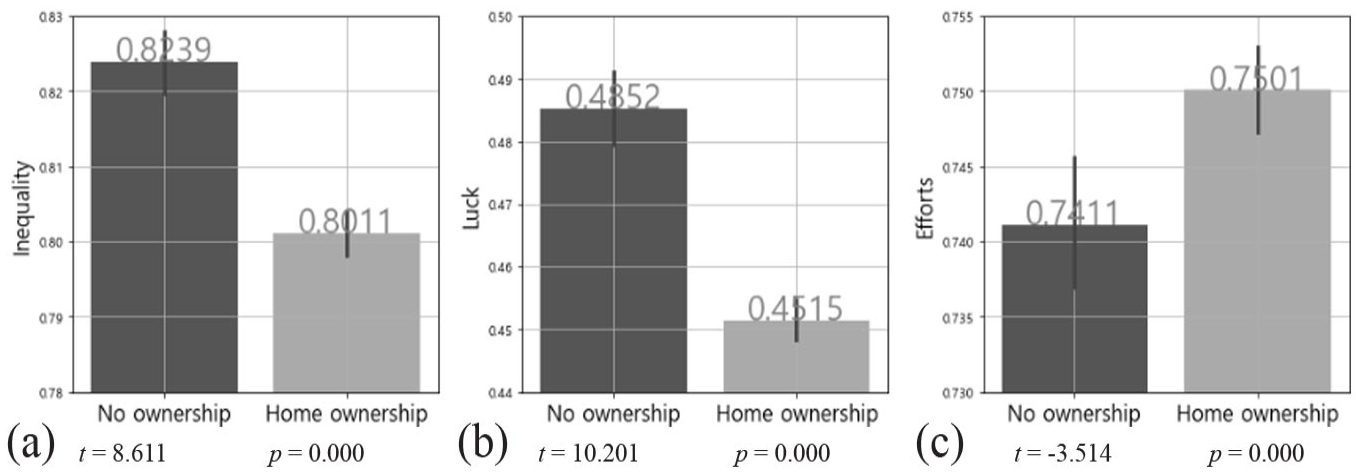
t-Test of Inequality, Luck, and Efforts by Home Ownership (ISSP, 2009). (A) Inequality. (B) Luck. (C) Efforts.
The results in Figure 7 show the effects of net house price and home ownership on the perceptions on inequality and meritocratic beliefs. We find that both net house price and home ownership are associated with the perception that inequality is not too high, and they are statistically significant at the 5% and 1% level in all models (see Table B5 in Online Appendix B). By expanding the analysis to 34 countries, we find the effects of home ownership and net house price on the perceptions on inequality across countries. In other words, people who own a house tend to believe that inequality is low while those without housing assets tend to believe inequality is high.
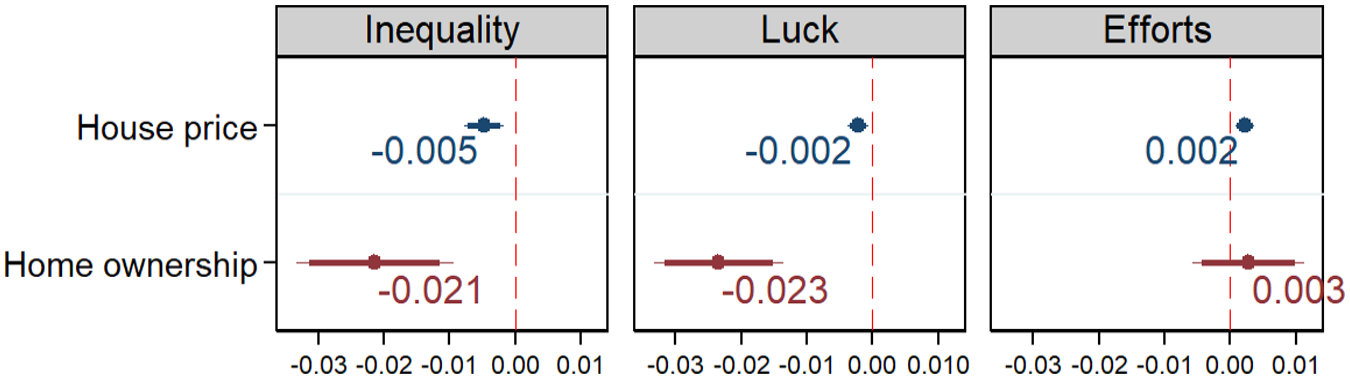
Home Ownership, House Price, and Perceptions of Inequality, Luck, and Efforts.
One standard deviation change in net house price is associated with a 1.4 percentage point decrease in perceived inequality, and about a 1 percentage point increase in meritocratic beliefs. One standard deviation change in home ownership is also associated with about a 1 percentage point decrease in perceived inequality. Again, the magnitude of the substantive effects is modest, but it is worth noting that similar findings can be observed from the Korean data as well as the ISSP data.
Turning to control variables, the indicators for employers and professionals are associated with lower levels of perceived inequality and they tended to have strong beliefs in meritocracy compared with other occupational groups. More educated, female, and religious individuals tend to have stronger meritocratic beliefs than their respective counterparts (see Table B5 in Online Appendix B). As a robustness check, we also report the results of estimation of ordered probit models in Table C3 in Online Appendix C, which renders qualitatively similar results.
Robustness Checks
For both the analysis of the Korean case and the cross-national survey, we conduct a series of robustness checks. First, there may be an endogeneity issue, which is one of the most harmful problems in drawing an unbiased inference. Specifically, we regress house price and home ownership on individual attitudes on distribution of income and meritocratic, belief because it may be conceivable that one becomes a homeowner through hard work based on a belief in meritocracy. The results suggest that this is not the case. The estimated coefficients are not distinguishable from zero. Moreover, since we report the results from two-way fixed effects models in the analysis of Korean panel data, our results take unmeasured heterogeneity of individuals and time trend into account.
Second, to see whether individuals’ political orientation is associated with both the likelihood of becoming a homeowner and attitudes toward inequality and economic ideology, we estimate our models including political orientations as a control variable. We include an indicator variable, coding 1 for liberal (in Korea) and left (ISSP), and 0 otherwise. The results reported in Table B6–B8 in Online Appendix B show that our main findings do not change even if we control for political orientation.
Third, to ensure that our results are not influenced by our choice of particular estimation methods, we conduct an ordered probit analysis, the results of which are reported in Online Appendix C. The results are qualitatively similar to those reported above. Fourth, to ensure that the results of our comparative analysis are not driven by particular influential observations, we conduct a jackknife analysis by excluding one country at a time. The results indicate that our findings are robust to influential observations. We report coefficient plots from our jackknife analysis of ISSP data in Figure B1 and B2 in Online Appendix B.
Finally, we include alternative measures of our explanatory variables to ensure that the results are not sensitive to a particular measurement of the explanatory variable. We use house price, house price relative to debts, and net house price in our analysis. Moreover, we estimated with three indicator variables for house price, by dividing house price into terciles, to see whether there is a nonlinear effect of house price (see Table B9–B12 in Online Appendix B). Our findings with alternative measures of the explanatory variable all point to the same direction of the association. That is, rising asset price bolsters meritocratic beliefs and perceptions on relatively egalitarian distribution of income among homeowners, suggesting strong evidence for the asset prices effect hypothesis.
Conclusion
The results of our analysis show that perceptions on inequality and causes of poverty or success differ significantly depending on home ownership and house prices. The findings indicate that as the price of an owned home increases, or when an individual is a homeowner, there is an increased tendency to perceive that distribution of income is relatively egalitarian. Moreover, homeowners are more likely to believe that success in life comes from individual efforts and is not hugely influenced by structural factors such as family background. This cascading process can complement previous studies that report that asset ownership and asset price increases lead to greater psychological resistance to redistribution (Ansell, 2014). It is noteworthy that, in the analysis of the interaction between home ownership and house prices, the effect of home ownership on perceptions of inequality and individual efforts increased when the house price rose above a certain level. Moreover, the findings from our comparative analysis suggest the generalizability of the effects of home ownership and asset prices on market fairness and belief in meritocracy.
This analysis makes several contributions to the literature on political economy and public opinion. First, the political economy of real estate or housing entails both material self-interest and ideological mechanisms through which individuals shape economic ideology and policy preferences. Arguably more so than income and unemployment risks, housing provides a discernible reference point for assessing one’s status vis-à-vis others. Many recent and important studies focus on the political consequences of housing assets and indebtedness (Andre and De Wilde, 2016; Ansell, 2019; Kohl, 2021; Steele, 2021; Wiedemann, 2023). Exploring various mechanisms linking housing and their political consequences would be an important venue for future research. Second, as the external validity of our findings suggests, the political consequences of housing are general phenomena across countries in the age of rising wealth inequality. For example, with increasing credit market accessibility in privatized Keynesianism (Baccaro and Pontusson, 2016; Crouch, 2009), how home ownership shapes and reshapes individual perceptions and attitudes toward public policy and electoral choices would have tremendous impacts in contemporary politics (Ansell et al., 2022; Hall and Yoder, 2022). Nevertheless, there may be cross-national variations in the house price effect in shaping individual economic ideology and political behavior. Exploring the structural or institutional sources of such cross-national variations would be a fruitful research avenue.
Finally, the results of this study show that home ownership exerts an influence on various layers of individuals, groups, and society as a whole. It influences economic ideology in that there is a clear relationship between asset ownership and psychological resistance to taxation and welfare programs. The findings of this study also open up discussions on how to approach asset inequality and the welfare state. As the value of the property they hold increases, property owners may develop meritocratic beliefs. Our findings imply that soaring housing prices and concentrated real estate ownership may be incompatible with the development of a universal welfare state. As recent studies have explored the heterogeneity within the middle-class in advanced democracies (Kurer, 2020), home ownership and the boom and bust of house prices across space would bring about increasingly divergent trajectories of economic fortunes among the middle-class people. In this respect, the hollowing-out middle class and its political consequences may be partly explained by home ownership and the dynamics of house prices. In addition, rising indebtedness, including home mortgage loans, may fuel economic vulnerability and political discontentment, likely leading to demands for increased social protection or support for populist parties. Understanding a complex relationship between rising house prices and the welfare state is an important research topic in the age of rising wealth inequality.
Supplemental Material
sj-docx-1-psx-10.1177_00323217231176677 – Supplemental material for Home Ownership, House Prices, and Belief in Meritocracy: Evidence from South Korea and 34 Countries
Supplemental material, sj-docx-1-psx-10.1177_00323217231176677 for Home Ownership, House Prices, and Belief in Meritocracy: Evidence from South Korea and 34 Countries by Seungwoo Han and Hyeok Yong Kwon in Political Studies
Footnotes
Acknowledgements
The authors wish to thank anonymous reviewers for insightful comments and suggestions.
Declaration of Conflicting Interests
The author(s) declared no potential conflicts of interest with respect to the research, authorship, and/or publication of this article.
Funding
The author(s) disclosed receipt of the following financial support for the research, authorship, and/or publication of this article: This work was supported by the National Research Foundation of Korea (NRF-2021S1A5A201067988) and a Korea University grant (K2108851).

Supplemental Material
Additional Supplementary Information may be found with the online version of this article. Table A1. Survey Information. Table A2. List of Included Countries (ISSP). Table A3. Dependent Variables for Korea Welfare Panel Study. Table A4. Independent Variables for Korea Welfare Panel Study.5 Table A5. Descriptive Statistics for Korea Welfare Panel Study. Table A6. t-test Results by Home ownership for Korea Welfare Panel Study. Table A7. Dependent Variables for ISSP. Table A8. Independent Variables for ISSP. Table A9. Descriptive Statistics for ISSP. Table A10. t-test Results by Home ownership for ISSP. Table B1. Housing and Perceptions of Inequality (Homeowners plus Renters). Table B2. Housing and Perceptions of Luck (Homeowners plus Renters). Table B3. Housing and Perceptions of Efforts (Homeowners plus Renters). Table B4. Housing and Perceptions of Inequality, Luck and Efforts (Only homeowners). Table B5. Housing and Perceptions of Inequality, Luck and Efforts. Table B6. Housing and Perceptions of Inequality (including political orientation). Table B7. Housing and Perceptions of Inequality, Luck and Efforts (Only homeowners, including political orientation). Table B8. Housing and Perceptions of Inequality, Luck and Efforts (including political orientation). Table B9. House Price (Tercile), and Perceptions of Inequality (Homeowners plus Renters). Table B10. House Price (Tercile), and Perceptions of Luck (Homeowners plus Renters). Table B11. House Price (Tercile), and Perceptions of Efforts (Homeowners plus Renters). Table B12. House Price (Tercile), and Perceptions of Inequality, Luck and Efforts (Only Homeowners). Table C1. Housing and Perceptions of Inequality (Ordered probit estimations). Table C2. Housing and Perceptions of Inequality(Ordered probit estimations). Table C3. Housing and Perceptions of Inequality, Luck and Efforts (Ordered probit estimations). Figure B1. Jackknife Analysis (Housing and perceptions of inequality). Figure B2. Jackknife Analysis (House price and perceptions of Luck and Efforts).
Notes
Author Biographies
References
Supplementary Material
Please find the following supplemental material available below.
For Open Access articles published under a Creative Commons License, all supplemental material carries the same license as the article it is associated with.
For non-Open Access articles published, all supplemental material carries a non-exclusive license, and permission requests for re-use of supplemental material or any part of supplemental material shall be sent directly to the copyright owner as specified in the copyright notice associated with the article.
