




Abstract
This article proposes to explore the interaction between populism and environmentalism in the discourse of populist radical left parties, through a case study of Jean-Luc Mélenchon’s parties, Parti de gauche (2008–2016) and La France insoumise (from 2016). While an emerging literature primarily investigated the populist framing of populist radical right parties’ climate (sceptic) discourse, the article analyses how a populist radical left party incorporates environmental issues into its agenda and the extent to which environmentalism and populism concretely interweave. Using mixed-methods, we first show that the logics of party competition and the growing salience of environmental issues led La France insoumise to gradually develop an ambitious green agenda. We then show that there is evidence for a populism/environmentalism nexus that could be defined as ‘green populism’. La France insoumise’s ecosocialist ideology combines to anti-elitism and people-centrism to blame the environmental crisis on the ‘oligarchy’ and to promote a green transition that would protect the people.
In Europe, the rise of populist parties and the growing importance of environmental issues on the public agenda are increasingly well documented in the academic field, although most often analysed separately.
On one hand, since the 1980s, the rise of populist parties has generated significant discussion in the political, media and academic fields. The definition of populism is subject to a wide range of debates, it has been defined as a discourse, an ideology, a worldview, a strategy. Nevertheless, the main contemporary approaches – ideational (Mudde, 2004) and discursive (Laclau, 2005) – agree on formal and minimal criteria as they both consider that populism (a) can be attached to different ideologies, and (b) that it is defined on the basis of three elements: people-centrism, anti-elitism and popular sovereignty (De Cleen and Stavrakakis, 2020). Populist parties divide society into two antagonistic camps (people-elite) and call on a radicalisation of democracy (Mouffe, 2018) considering that ‘politics should be an expression of the volonté générale (general will) of the people’ (Mudde, 2004). By looking at the host ideology to which populist parties are attached (e.g. socialism, liberalism and conservatism), the existing literature draws a distinction between exclusionary populist radical right parties (PRRPs) which combine populism with a nationalist and nativist ideology (Mudde, 2007), and inclusionary populist radical left parties (PRLPs) which associate populism with the demands of the traditional left and an anti-neoliberal agenda (Damiani, 2020; Katsambekis and Kioupkiolis, 2019).
On the other hand, green issues have been gaining salience in the public debate since the 1980s, particularly under the influence of emerging niche parties, especially in Western Europe: the green parties (Kitschelt, 1989). The 2000s saw a growing awareness of the adverse effects of global warming, its causes and consequences, notably through the publication of the Intergovernmental Panel on Climate Change (IPCC) reports. Concern about the need to implement policies to combat global warming by reducing greenhouse gas emissions has grown steadily over the past two decades. This increasing salience of climate issues has been fuelled by major collective mobilisations in the late 2010s, such as the climate strikes initiated in 2018 by Swedish activist Greta Thunberg. In the wake of this mobilisation, thousands of young people took to the streets in Climate Marches, led by movements such as Fridays for Future (Wahlström et al., 2020).
Research has long considered these two phenomena – the rise of populism and the salience of environmental issues – independently of each other. However, recent work has sought to build bridges between the two literatures and to analyse possible interactions between the two phenomena. While most of this research has focused on populist radical right parties and their framing of environmental issues, this article aims to analyse the connections between left-wing populism and environmentalism, in order to understand: (a) how left-wing populist parties address environmental issues and (b) to what extent is the environmental narrative of these parties framed in populist terms. The second research question relates to the respective roles of populism as such and its host ideology in framing environmental issues, linked with recent research in the field of populism studies which has specifically called for a clearer distinction between populism and ‘what it travels with’ (Hunger and Paxton, 2021).
To answer these questions, we propose a case study of Jean-Luc Mélenchon’s various parties: the Front de gauche (Left Front, FDG) and La France insoumise (Unbowed France, LFI). However, we focus mainly on LFI – created in 2016 – as it has made environmental issues one of the central themes of its agenda. Our case-selection procedure is of the ‘extreme’ type, in other words, it ‘exemplif[ies] [an] extreme’ case of this articulation (Gerring, 2009: 647). Our case is ‘extreme’ in the sense that the party is considered as a textbook case of left-wing populism in Europe (Chiocchetti, 2019), but at the same time can be considered one of the main – if not (electorally) the main – environmentalist forces in France since the 2017 presidential election. The article follows a mixed-methods research design and focuses on internal party dynamics (party elites and grassroot activists). This empirical approach aims to deepen and transform our understanding of the relationship between left-wing populism and environmentalism.
The article proceeds as follows. First, we present a review of the emerging literature on the links between populism and environmental issues and argue that examining left-wing populist parties can shed new light on the nature of these links (1). Second, we present the methods and the data used to answer our research questions (2). We then present our findings in two steps. The third section is devoted to the ‘greening’ of LFI, we show how and why environmental issues have become a central theme within the party’s discourse (3). 1 In the fourth section, we examine the populism/environmentalism nexus in LFI’s discourse (4).
The Relationship Between Populism and Environmentalism
Most of the existing work on the links between populist parties and environmental issues focuses on populist radical right parties (Buzogány and Mohamad-Klotzbach, 2022). This may be explained by an interest in understanding the drivers of climate change scepticism. Studies have shown that right-wing citizens are less likely than left-wing citizens to believe in climate change and support policies to mitigate it (McCright et al., 2016), and that voters of PRRPs are more likely to oppose policies such as higher taxes on fossil fuels (Kulin et al., 2021). Furthermore, PRRPs have often shown opposition to climate policies, whether in opposition as in Germany (Forchtner et al., 2018) or in Sweden (Hultman et al., 2020), or in government as in Hungary and Poland (Lockwood, 2018).
Research has focused on how these PRRPs frame their opposition to climate policies. Lockwood (2018) provides particularly interesting insights into how ideological content – nationalism, authoritarianism – combines with anti-elitism to frame climate and environmental policies as an agenda promoted by a cosmopolitan elite. These elite, captured by environmentalists, climate scientists and international institutions which adopt ‘complex’ and ‘opaque’ decisions, would pursue a policy contrary to the nation and the people’s interests. Other studies emphasise the role of the host ideology of PRRPs, such as Forchtner and Kølvraa (2015) who show how the British National Party and the Dansk Folkeparti (Danish People’s Party) defend the protection of nature on the basis of a romanticised vision of landscapes that would embody the purity of the nation, while at the same time doubting the climate policies dictated at transnational level. In a recent case study of the Alternative für Deutschland (Alternative for Germany), Küppers (2022) shows that the climate scepticism of the German PRRP is first and foremost linked to its host ideology (nationalism, pro-market positions) while populism does not necessarily play a crucial role.
Looking at populist radical left parties can provide new avenues into the links between populist discourses and environmental issues. Environmental demands have generally been more integrated on the left side of the political spectrum (Dalton, 2009). Left-wing parties and movements have traditionally been more inclined to incorporate environmental concerns into their agendas, given that climate and environmental policies often emphasise regulation and state intervention, and because of their strong links to environmental struggles in some countries (Persico, 2015). This is even more the case for some radical left parties. In their study on the greening of the European radical left, Wang and Keith (2020) note that several parties belonging to this party family have emerged on the basis of a left-libertarian agenda that included environmental issues from the outset, while others have integrated them gradually. These radical left parties tend to strongly combine environmental concerns with social justice. However, their degree of ‘greening’ varies according to several factors including party competition, the prominence of environmental issues, ideology and organisational goals.
While scholars have shown that PRLPs are more likely to adopt a green agenda due to their ideology (Buzogány and Mohamad-Klotzbach, 2022), little research has been conducted on the environmental discourse of PRLPs. Yet, there is increasing debate about the possible existence of an environmental populism or green populism, which, so far, focuses mainly on social movements, local mobilisations or environmentalist figures. For instance, when examining ‘populist environmentalism’, Meyer (2008) studied ‘localist and place-based’ social movements, such as the environmental justice movement in the United States, as he explained that regarding environmental issues ‘to date [2008], populist rhetoric and strategies have been most commonly focused upon problems at the local level’. Along the same lines, Bosworth (2022) sees the opposition of indigenous communities, environmental activists and farmers to pipeline construction in the Midwest as a form of ‘pipeline populism’. However, asking whether Greta Thunberg can be considered a promoter of climate populism, Zulianello and Ceccobelli (2020) show that the Swedish activist’s discourse is not based on anti-elitism and people-centrism but rather on a form of ‘technocratic ecocentrism’.
Regarding populist radical left parties specifically, Huber et al. (2021) provide interesting insights by including two PRLPs, Podemos (We Can) in Spain and Syriza (The Coalition of the Radical Left) in Greece, in their study of the link between populism and European energy and climate policy. To assess populist discourse on energy and climate, the authors rely on two central criteria of populism, anti-elitism and people-centrism. They show that these two elements are not prominent in Syriza’s discourse on energy and climate issues, whereas they are strongly present in Podemos’ discourse. The Spanish PRLP blames the European and Spanish elites for the implementation of austerity policies that prevent action against global warming, and advocates returning institutions to the service of the people by redirecting resources towards the green transition. This study provides an insightful framework for further research on the populism/environmentalism nexus in PRLPs’ discourse. These studies are of particular interest considering the importance taken by PRLPs in European party systems in the last decades, some of them achieving governmental positions, such as Podemos and Syriza, or gaining prominence in recent elections, such as LFI. Our article aims precisely to contribute to this ongoing scholarly debate with a detailed case study on the French PRLP.
Methods and Data
To answer our two research questions, the analysis follows two main axes: (1) the evaluation of Jean-Luc Mélenchon’s ‘greening’ between 2008 and 2022; (2) the measurement of the articulation between environmentalism and populism in LFI’s discourse. We use mixed-methods (lexicometrical analysis and qualitative content analysis) and we rely on a corpus of quantitative and qualitative data: (1) data related to electoral campaigns, and periods between these campaigns, to study the leaders’ discourse; (2) the doctrinal production of Jean-Luc Mélenchon, LFI’s leader; and (3) semi-structured interviews with party activists.
Measuring and Tracing the ‘Greening’ Process of La France Insoumise
Our analysis of LFI’s ‘greening’ process focuses on the discourse coming from the party leadership and combines a quantitative text analysis followed by a qualitative content analysis. To answer our first research question, we mainly focused on the figure of Mélenchon and left aside the other public figures of the party as he favours a communication based on strong and unique leadership (Marlière, 2020). We were interested in the period from 2008 – when Mélenchon left the Parti socialiste (Socialist Party, PS) to create his own (radical) left party, the Parti de gauche (Left Party, PG) – to 2022.
In the first stage, we conducted an exploratory lexicometrical analysis using IRAMUTEQ (R interface for textual statistics) to first have a global view of the evolution of Mélenchon’s environmentalist discourse over time, during the three presidential elections in which he ran as a candidate: 2012, 2017 and 2022. The analysis is first based on a statistical reading of a general corpus of the discourse delivered by the party leadership. Corpora are divided into seven categories: (1) meeting speeches; (2) blog posts; (3) press interviews; (4) party manifestos; and (5) elections pledges (see Table 1).
General Corpus Used for the Lexicometrical Analysis. a
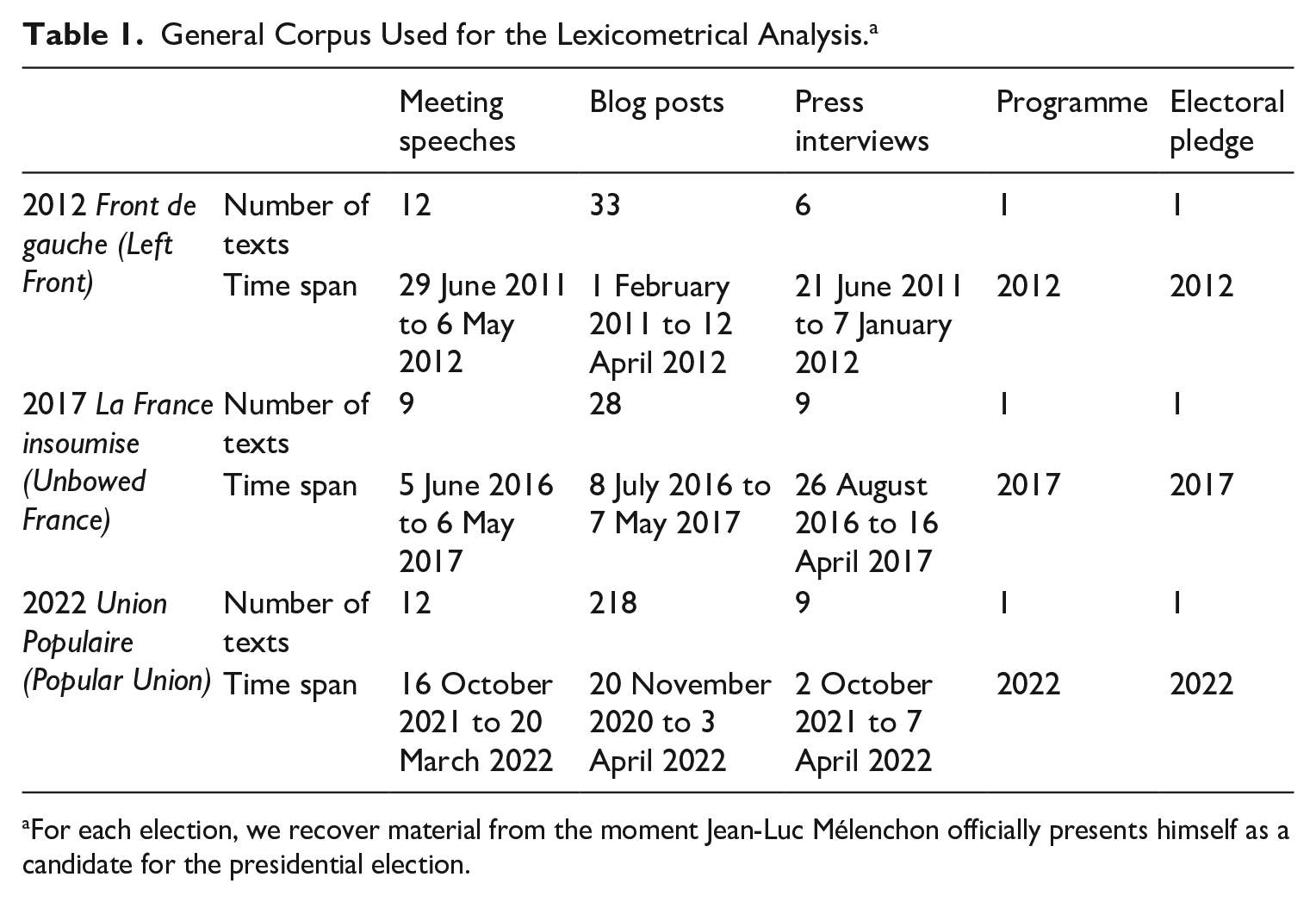
For each election, we recover material from the moment Jean-Luc Mélenchon officially presents himself as a candidate for the presidential election.
We performed simple textual statistics (called ‘frequency analysis’), 2 and descending hierarchical classification (DHC) on the corpora. Frequency analyses involve comparing the frequency of words in each corpus to compare different corpora with each other. When we used this tool, we considered that we could not measure the importance of an element simply by looking at the place a word occupied in the active forms. In other words, it is not possible to understand the place of the environmental issue in a discourse simply by looking at the variations of the term ‘environmentalism’. We therefore identified a set of lemmas 3 linked to this issue based on a preliminary reading of the corpus and on the existing literature. We selected six words: environmentalism/environmentalist [écologie/écologique], environment [environnement], nuclear [nucléaire], sea [mer], climat [climate], global warming [réchauffement climatique]. First, we looked at the frequency of each of these words in each corpus. However, as the size of each corpus is not perfectly identical, as a second step we reduced the frequency of each word in each corpus to 100,000 in order to be able to compare the variations of a word between each election (between each corpus).
DHCs – which are performed using Reinert’s (1979) method – allow the corpus to be divided into ‘classes’ which are associated with a list of words that are significant. 4 The different ‘classes’ correspond to different lexical universes (Arnoult, 2016). The ‘grouping of common ‘lexical symbolic worlds’’ is achieved from ‘the single corpus of all segments, [the software] will iteratively distinguish classes of homogeneous segments according to a predefined metric, in this case dissimilarity or measure of inter-class distance’ (Ferrara and Friant, 2016: 2–3). Each ‘thematic universes is associated with a list of forms (or words), whose degree of membership to the class is indicated by chi-square’ (Arnoult, 2016: 296–297). In other words, within each class, the words are classified according to the percentage of their frequency – ‘the occurrence of the word in the text segments in that class in relation to its occurrence in the corpus’ – and their chi-square – ‘the association of the word with the class’ (Chaves et al., 2017). The software provides dendrograms (words are ranked in descending order according to their chi-square) allowing the proximity and distance between the different classes to be seen.
At the second stage, we conducted a qualitative content analysis. We describe and explain the evolution of the place of environmentalism by analysing partisan documents (written, oral, visual) and manifestos, by tracing Mélenchon’s intellectual trajectory (based on his theoretical production: books, articles, blog notes), and by mobilising the literature on party competition in order to resituate his discourse in the context in which it is expressed.
Understanding the Articulation Between Environmentalism and Populism
To answer the second research question, we also combined a quantitative textual analysis with a qualitative discourse analysis.
In addition to the general corpus (see Table 1), we also constructed a second corpus – that we call environmental corpus – with all the passages of the general corpus that included the words used for the frequency analysis (environmentalism/environmentalist, environment, nuclear, sea, climate, global warming). For the lexicometrical analysis, we used this environmental corpus. We used NVivo, a Computer-Assisted Qualitative Data Analysis Software (CAQDAS), to code the different parts (‘references’) of the texts of the corpora (see Table 2). We distinguished four categories (‘nodes’): (1) traditional left (lexicon of socialism and/or communism, and articulation between social and environmental issues), (2) populist (people-elite axis), (3) technical (technical elements concerning, for example, marine energy, nuclear power and energies, labour and delocalisation, space conquest), (4) other (this category includes, for example, references to other parties, general statements on environmentalism, the articulation between environmentalism and international issues with, for instance, references to North Atlantic Treaty Organisation [NATO], to the European Union [EU], to peace). We then looked at the number of references in each node and we calculated the percentage represented by each category in each corpus (2012, 2017, 2022) to understand the weight of populist elements in Jean-Luc Mélenchon’s environmental discourse.
Categories Used to Measure the Weight of Populism in Jean-Luc Mélenchon’s Environmental Discourse. a
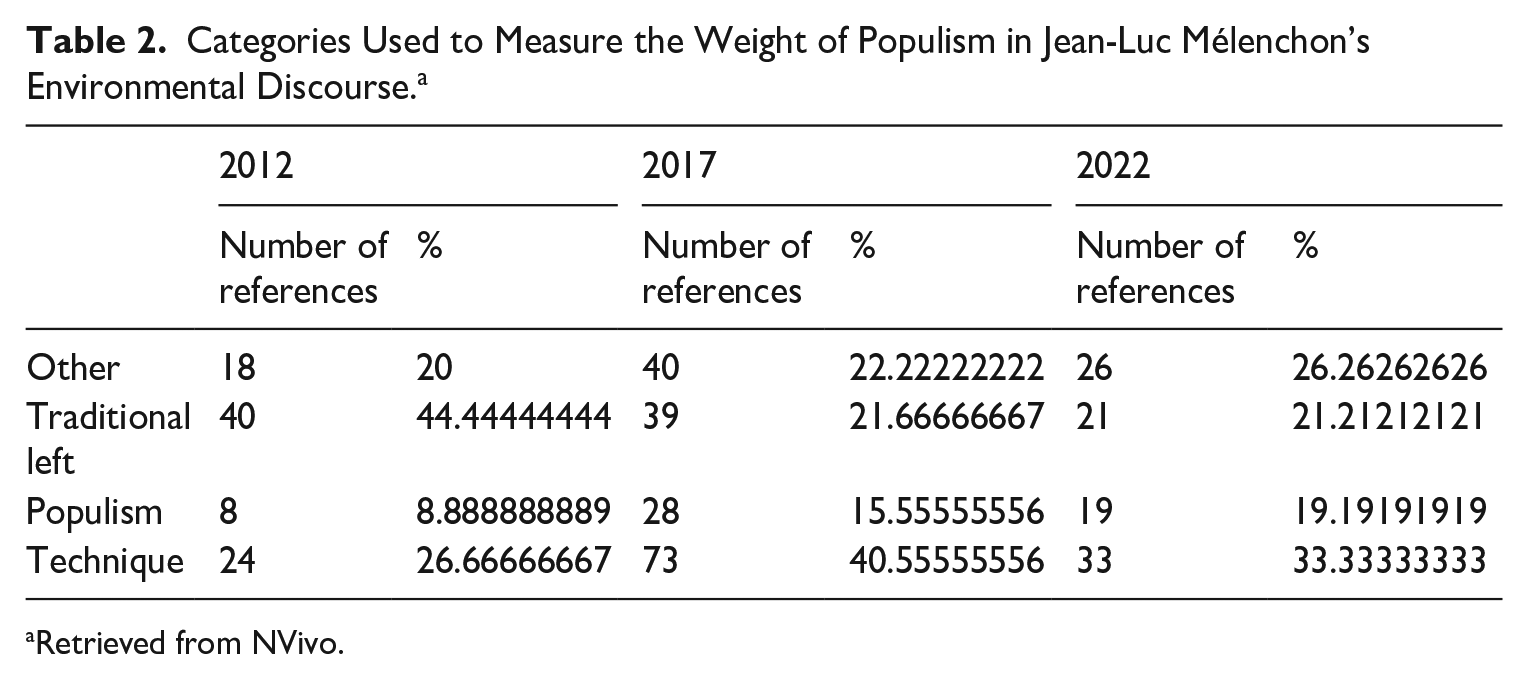
Retrieved from NVivo.
For the qualitative discourse analysis, we have broadened the focus beyond Jean-Luc Mélenchon. Although he remains the party’s central figure, LFI has diversified its public profiles since its entry into the National Assembly after the 2017 legislative elections (17 MPs). Three of them are mentioned in this section: Mathilde Panot, Jean-Hugues Ratenon and François Ruffin. We conducted a qualitative content analysis using material derived from their speeches and from party documents. We collected a wider range of data produced during the periods between presidential elections and which we selected according to their importance in relation to environmentalism.
To complete the discourse analysis, we drew on semi-structured interviews carried out as part of an ethnographic survey among grassroots activists. We thus mobilised ten interviews that we conducted face-to-face with activists in two cities, Rennes (north-west of France) and Montpellier (south of France), carried out between October 2016 and March 2022 (see Table 3). Our interview guide focused on their personal views on environmentalism and their perception of the party’s discourse on this matter, their relationship to climate mobilisations and their appreciation of the French green party, Europe Écologie – Les Verts (Europe Ecology – The Greens, EELV).
Sets of Interviewees According to Their Attributes.
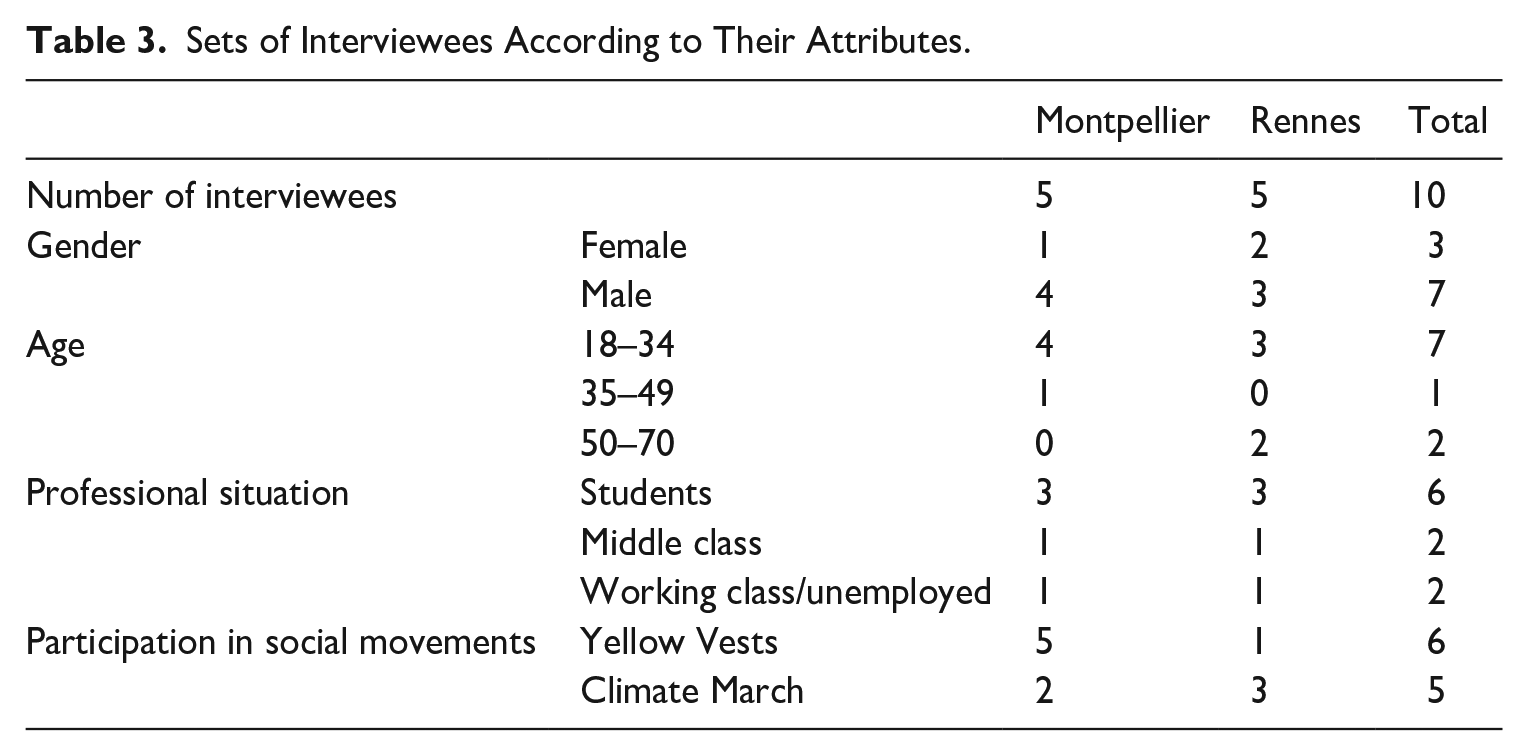
The interviews were analysed with the help of NVivo. They were coded using an abduction logic (see Table 4). We conducted Matrix Coding Queries to analyse the activists’ relationship with political environmentalism. We crossed several nodes between them in order to see which themes were most related to political environmentalism according to the activists (e.g. ‘social struggles’ and ‘political environmentalism’). We analysed the activists’ discourse using this tool and based on a qualitative analysis of their interviews.
Categories Used to Analyse the Nature of Activists’ Environmental Discourse. a

Retrieved from NVivo.
Although not the central element of the analysis, these semi-structured interviews provide an exploratory look into how rank-and-file activists receive, interpret or re-frame LFI’s discourse on environmental issues.
Becoming Greener than the Greens? From Jean-Luc Mélenchon’s Ecosocialist Turn to the Development of a ‘Popular Environmentalist’ Discourse
This section focuses on the ‘greening’ process of LFI.
A Quantitative Overview of LFI’s Greening Process
As a first step, we performed a frequency analysis to obtain an overview of the importance of environmentalism in Mélenchon’s discourse. The frequency analysis clearly shows that the environmental issue has become increasingly prominent in Mélenchon’s discourse over time as almost all the selected lemmas – except one (sea) – have been increasingly mobilised in each election (see Figure 1).
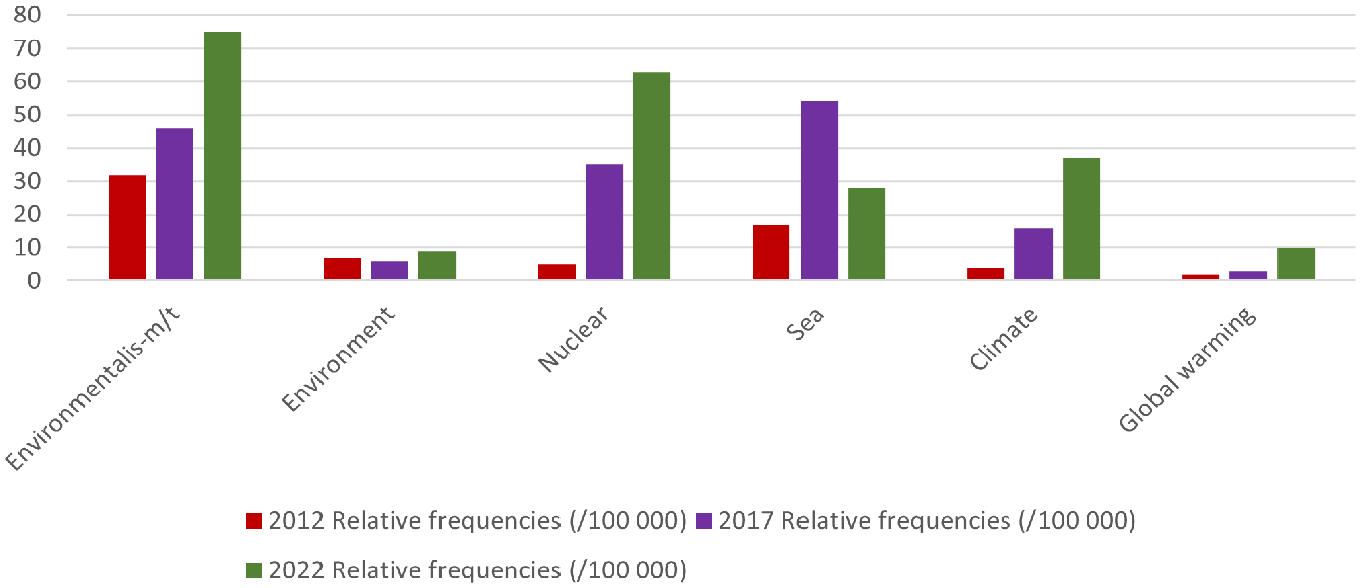
Evolution of the Place of the Environmental Issue in Jean-Luc Mélenchon’s Speech (2012, 2017, 2022).
The DHCs we conducted confirm these findings. The DHC of the 2012 presidential election shows that no class corresponds to a lexical universe linked to environmentalism (see Figure 2). In 2012, the four lexical universes are related to the radical left and the subject of change (class 1: ‘gens’ [people]); the electoral campaign (class 2: ‘campagne’ [campaign]); the programme (class 3: ‘public’ [public]); and the European Union (class 4: ‘euro’ [euro]).
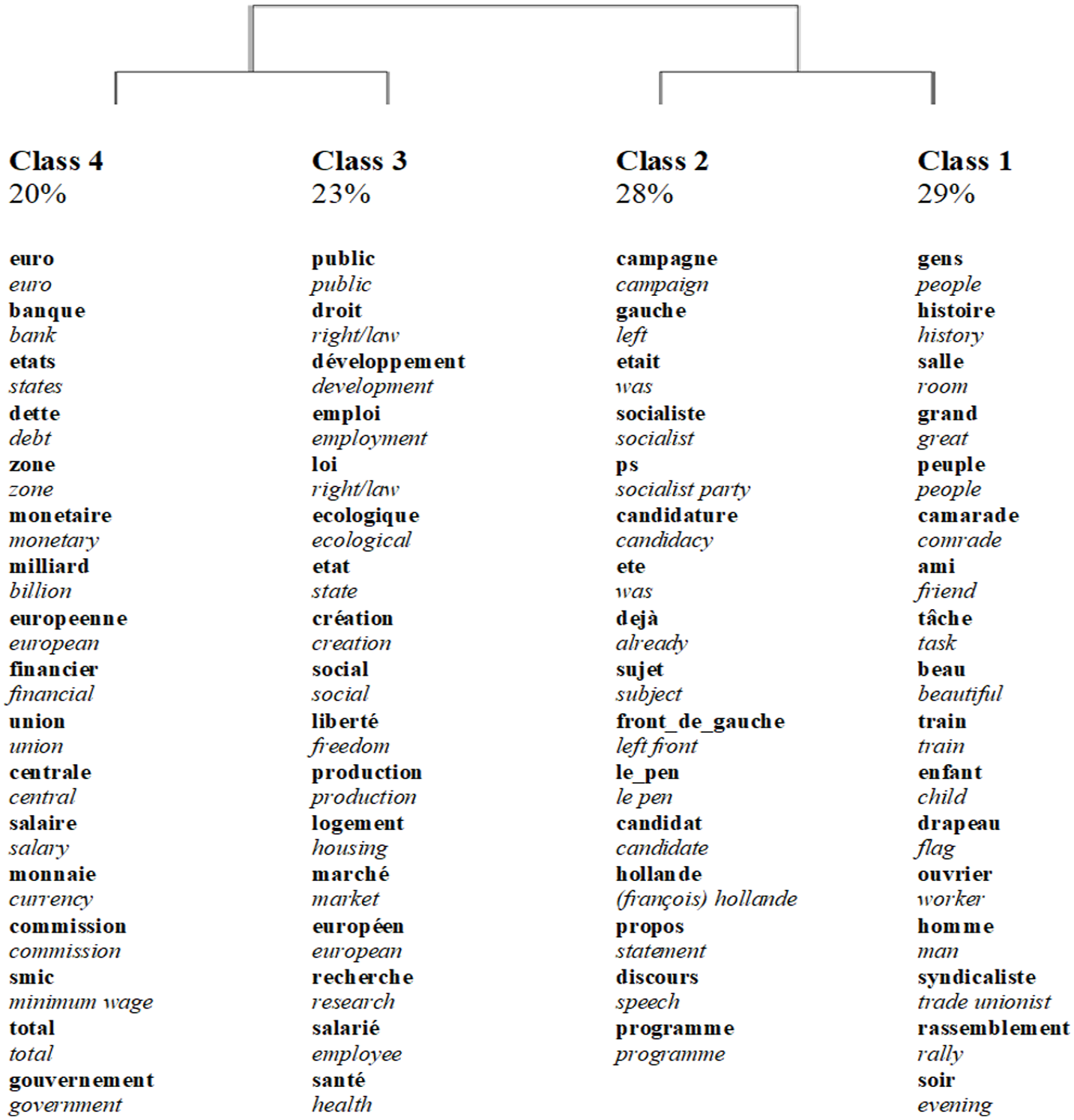
Various Thematic Lexical Universes in the Discourse of Jean-Luc Mélenchon in 2012 (DHC).
On the contrary, during the 2017 and 2022 electoral campaigns, the DHCs clearly identify lexical universes related to environmentalism (class 2 for 2017 and class 1 for 2022, see, respectively, Figures 3 and 4). In both cases, the lexical universes are composed of similar terms: sea [mer], energy [énergie], agriculture [agriculture], nuclear [nucléaire], production [production], environmental [écologique], climate [climatique] for 2017; water [eau], climatic [climatique], sea [mer], nuclear [nucléaire], change [changement], renewable [renouvelable], environmental [écologique] for 2022. In both 2017 and 2022, the dendrograms show that the lexical universe of environmentalism (class 2 in 2017 and class 1 in 2022) is attached to social issues (class 3 in 2017 and class 2 in 2022), which suggests that LFI intended to link these topics together.
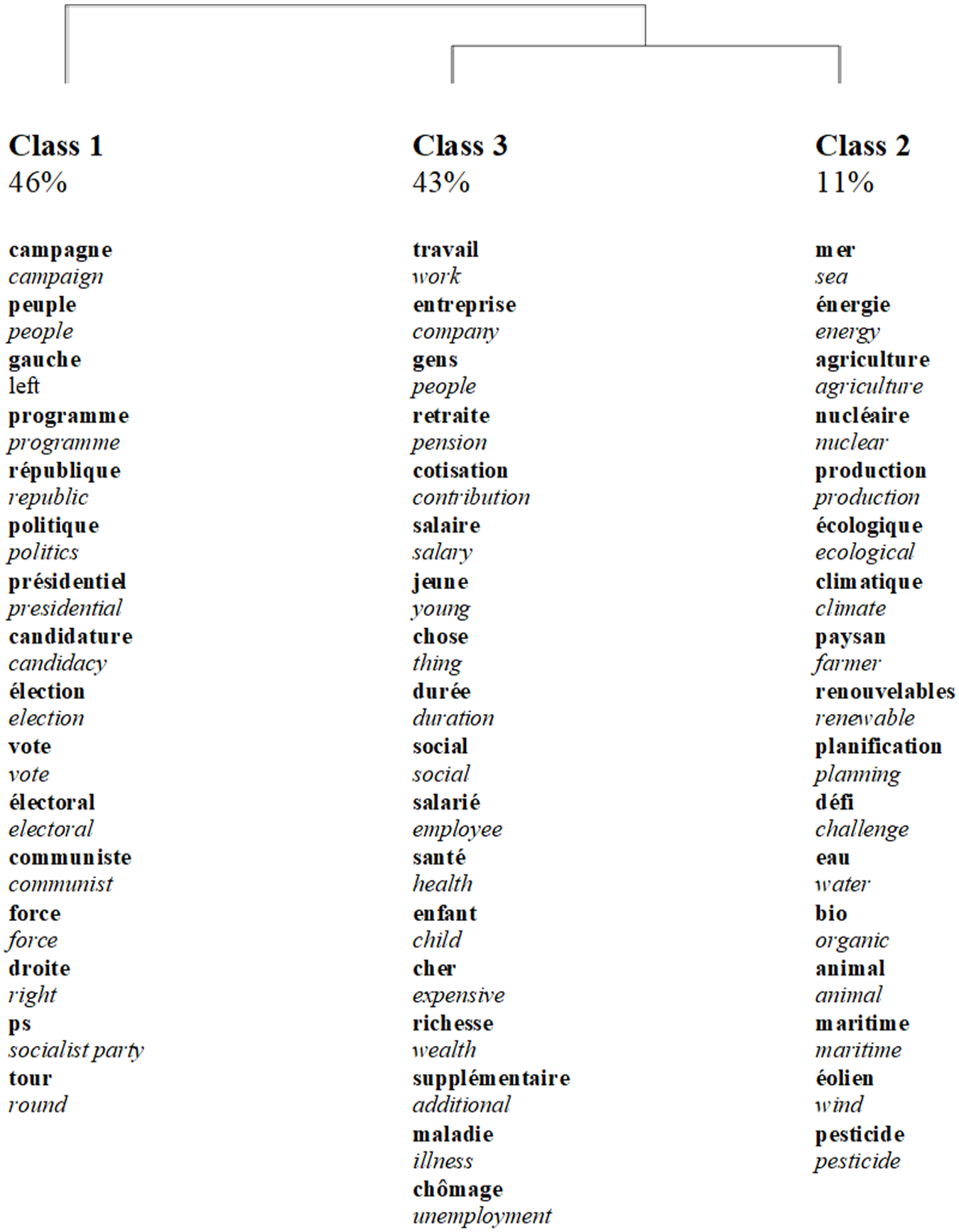
Various Thematic Lexical Universes in the Discourse of Jean-Luc Mélenchon in 2017 (DHC).
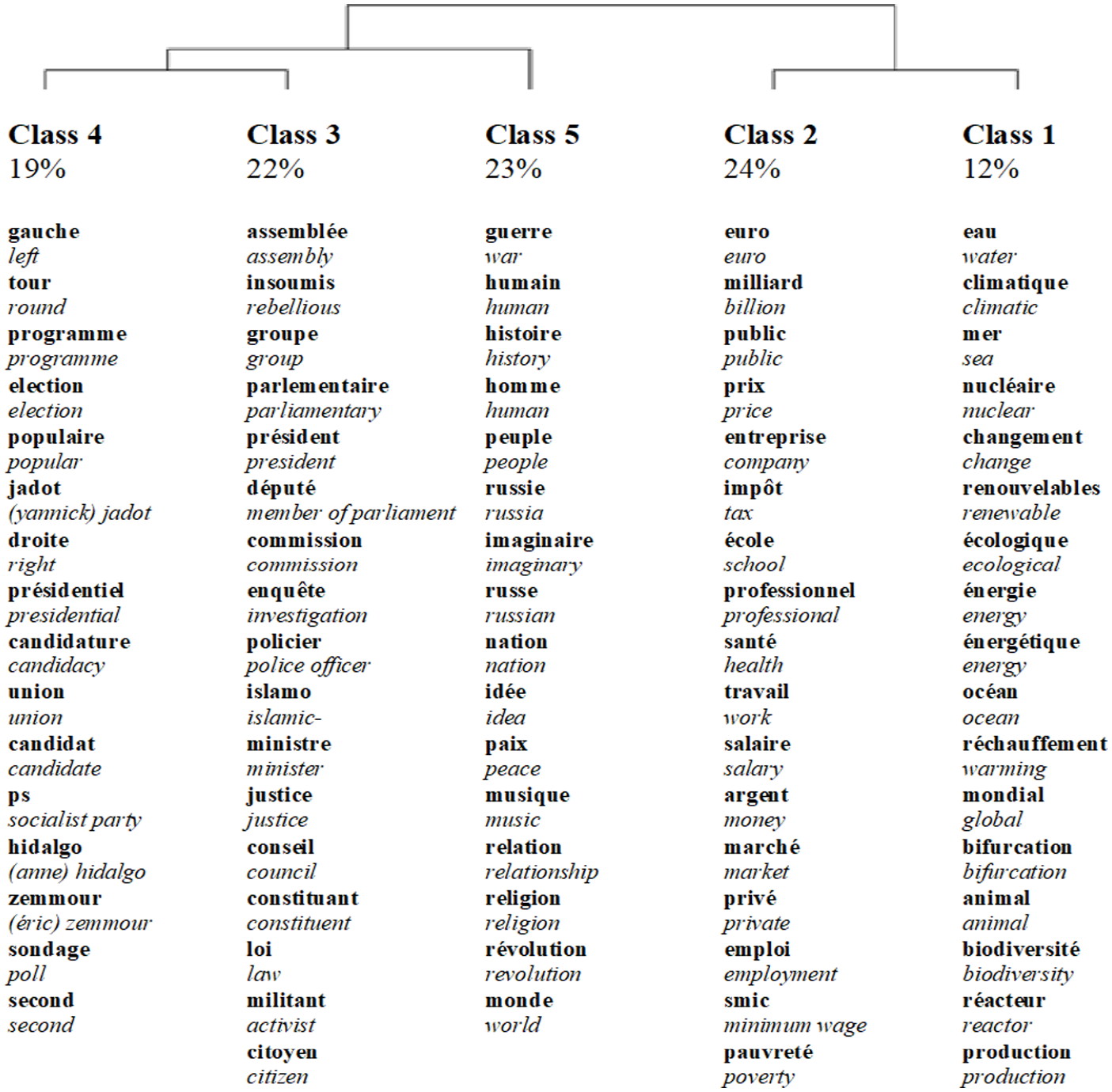
Various Thematic Lexical Universes in the Discourse of Jean-Luc Mélenchon in 2022 (DHC).
Finally, we compared the place occupied (in percentage) by the environment corpus in relation to the general corpus in order to identify the place of this theme in Mélenchon’s overall discourse. Here again, we can see a distinction between 2012, where this theme remains weak (8% of the total corpus), and 2017 and 2022, where it takes on greater importance (15% and 13% of the total corpus, respectively) (see Figure 5).
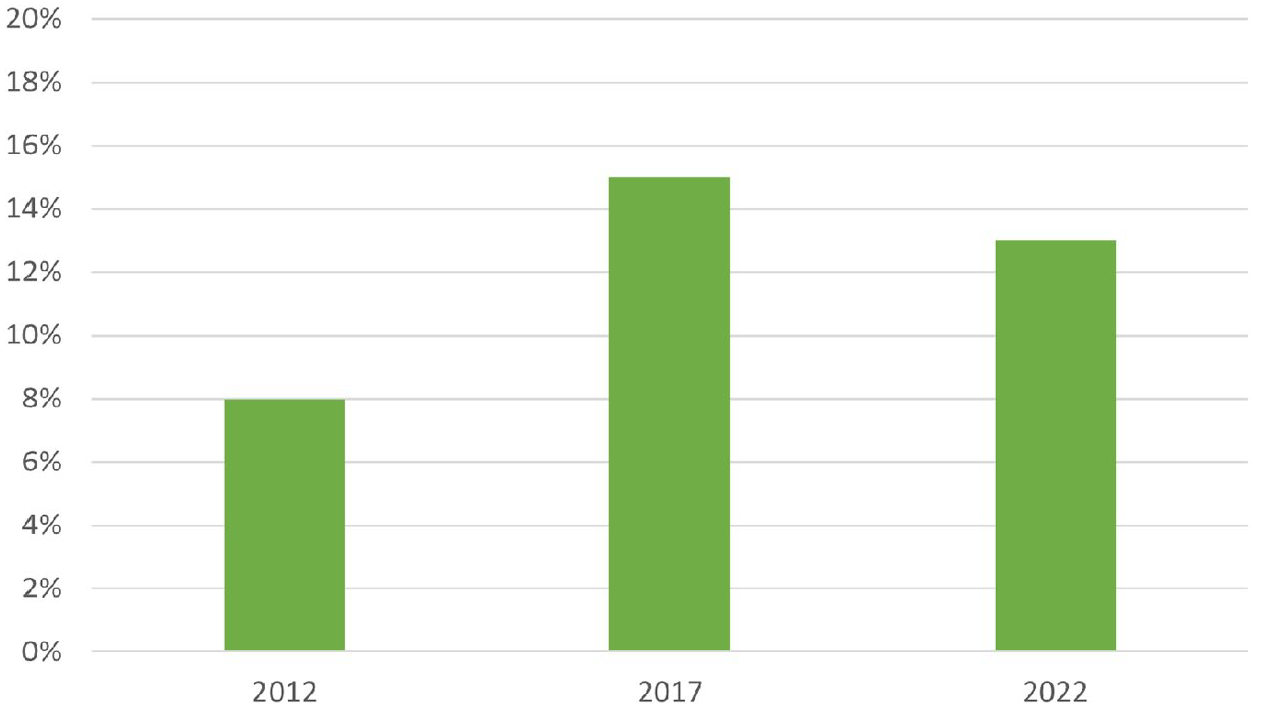
Place of Environmentalism in Jean-Luc Mélenchon’s Discourse (%).
This quantitative overview reveals that the place of environmentalism in Mélenchon’s discourse has globally increased over the course of the three electoral campaigns – with the exception of the salience of the environmental issue which decreases slightly between 2017 and 2022 (from 15% to 13%), a small reduction for which we provide explanatory factors in the qualitative analysis (see ‘Sharpening a green agenda in a context of growing issue salience and party competition’). The overall analysis reveals the growing importance of environmental issues in Jean-Luc Mélenchon’s discourse over time, particularly between 2012 (when environmentalism was more of a minor theme) and 2017/2022 (when environmentalism took a much more prominent place).
We will now explore how environmental issues have gradually been incorporated into the leader’s discourse and the agenda of LFI. To do so, we looked at Mélenchon’s activist and intellectual trajectories from his break with the Socialist Party in 2008, and we retraced the path by which LFI has positioned themselves as a strong environmentalist party.
A Qualitative Analysis of LFI’s Greening Process
In their study of the greening of European radical left parties, Wang and Keith (2020) identify ideology, organisational characteristics and goals, issue salience and party competition as key factors explaining these parties’ varying degrees of conversion to environmentalism. In terms of party competition, the existence of a green party that could pose an electoral threat may be decisive (Spoon et al., 2014), especially when radical left parties share some ideological affinity with their green counterparts and compete for the same vote shares (Adams and Somer-Topcu, 2009). We will see that in the French case, alongside other factors, party competition plays an ambivalent role, especially because the green party has experienced fluctuating results in recent decades.
From the Left Party’s Ecosocialist Turn to La France Insoumise’s Ambitious Green Agenda (2008–2017)
For thirty-two years, Jean-Luc Mélenchon had been a member of the Socialist Party, which he left in 2008 after repeatedly failing to shift its orientation towards more a left-wing stance. In November 2008, he created the Left Party with the aim of bringing together Socialist Party dissidents and members of the radical left, on the model of the German radical left party Die Linke (The Left). Mélenchon’s conversion to environmentalism mainly occurred within the Left Party. In January 2009, the party organised a ‘Forum on environmental planning’, in which Mélenchon defended the need to incorporate environmental issues into the socialist agenda, basing his reflection on the legacy of Marx, quoting one of the philosopher’s well-known formula: ‘nature is man’s inorganic body’. 5
In December 2009, the Left Party adopted the motto ‘Écologie–Socialisme –République’ (Environmentalism–Socialism–Republic), as well as a red and green flag, supposed to reflect the successful synthesis between the socialist left and environmentalism. The greening of the Left Party was then based on the doctrinal production of Mélenchon and was fuelled by the rallying of environmental figures, such as Martine Billard, a green MP and an important figure of the green party, who denounced their shift to the centre and joined the Left party in July 2009.
Although The Greens’ promising results at the European elections of June 2009 (16.28%) may have accelerated LFI’s greening process, the affirmation of such a ‘Red-Green’ identity is the result of a reflection started shortly after the creation of the party, at a time when the greens did not particularly represent an electoral threat (1.57% in the last presidential election of 2007). Wang and Keith (2020) showed that new radical left parties are usually more likely to embrace pro-environmental stances, as they have more flexibility to address a broader range of new issues than their traditional radical left or communist counterparts, caught in logics of ideological inertia and more willing to retain their traditional working-class voters. This analysis can be applied to the Left Party whose recent creation left room for ideological innovation, especially given its leader’s well-known appetite for theoretical developments. The Left Party had a strong interest in embracing environmental issues which had been neglected to date by traditional actors on the left, especially the Socialist Party and the French Communist Party (Parti communiste français, PCF).
During the 2012 presidential election, the Left Party competed within the Front de gauche coalition, alongside the PCF, with Mélenchon as candidate. The Left Front programme, entitled L’humain d’abord (Human First), included an environmental component based on environmental planning, public control of energy and investment in renewable energy. It also promoted a referendum on nuclear energy, a compromise between the Left Party (in favour of nuclear phase-out) and the PCF (willing to maintain and strengthen nuclear power). However, this environmental component remained overall sparse on details, and the green ambition advocated by the Left Party was partly held back by the Communist Party imbued with a more productivist culture. Along with the lower salience of environmental issues in the public debate compared to 2017, this electoral compromise with the Communist party partly explains the minor importance of environmental themes in Mélenchon’s discourse in 2012, as observed with the quantitative analysis.
The 2012 presidential election saw the triumph of the socialist candidate François Hollande, while Mélenchon received 11.10% of the vote and EELV’s candidate, Eva Joly, 2.31%. EELV then joined François Hollande’s government. During the years of opposition to Hollande’s presidency, the Left Party confirmed its environmentalist identity. In February 2013, the party published a manifesto entitled ‘18 theses for ecosocialism’, a ‘synthesis of a necessarily anti-capitalist environmentalism and a socialism free from the logics of productivism’. 6 Ecosocialism had since become the ideological compass of the Left Party and later irrigated the construction of LFI’s green agenda. These reflections on ecosocialism also translated into the publication of Jean-Luc Mélenchon’s book entitled La règle verte (The green rule, 2012) in which he put forward a proposal that would become central to the programme of LFI: the green rule – so called to mirror the European ‘golden rule’, the 3% deficit ceiling – which aims to neutralise France’s environmental footprint by prohibiting taking from nature more than it is capable of restoring over a year. The Left Party served as a launching pad for the creation of LFI in 2016.
The transition from the Left Party to LFI has led to what may seem to be a contradiction regarding environmentalism. On one hand, the reference to ecosocialism disappeared from the discourse and partisan documents (Cervera-Marzal, 2021). This can be explained by LFI’s ‘populist turn’ and the search for greater transversality, through the removal of symbols associated with the left, the term being considered discredited by the mandate of François Hollande and his alignment with austerity policies. On the other hand, after emancipating from the alliance with the communists, and building from the experience of the Left Party, LFI started to give a central place to environmental issues in its discourse and programme, as previously observed in the quantitative analysis.
In 2017, LFI’s manifesto, entitled L’Avenir en commun (The Future in Common), included more specific measures on environmental issues than the Left Front’s programme in 2012, such as the inclusion of the green rule in the Constitution, fossil fuel phase-out and the goal of 100% renewable energies by 2050, the thermal insulation of 700.000 homes per year, the promotion of a more plant-based diet or the zero-waste agenda. The manifesto also included phasing out nuclear power, and it gave a central place to the issue of water, particularly to the sea economy and marine renewable energies, which explains the importance of the ‘sea’ lemma in his discourse (see Figure 1).
This growing emphasis on environmental issues, reflecting the deepening of the programmatic development engaged within the Left Party, can hardly be explained by a direct electoral threat from the greens. Indeed, the latter ended up weakened after participating in governments under François Hollande’s presidency, thereby associating themselves with neoliberal inspired policies and a lack of environmental ambitions. However, in this context, party competition still appears to be a driver of LFI’s greener agenda: the weakening of EELV was seen by LFI as a window of opportunity to assert its position as a reliable and ambitious voice on social and environmental issues, filling a void left by the greens and the socialists. This strategy paid off, since Jean-Luc Mélenchon received 19.58% of the votes in 2017 presidential election while the socialist candidate, Benoît Hamon, supported by the greens, obtained only 6.36%.
Sharpening a Green Agenda in a Context of Growing Issue Salience and Party Competition
Under the liberal Emmanuel Macron’s 5-year term (2017–2022), LFI pursued and sharpened its green agenda in a context of increasing incentives to develop ambitious environmental stances. In August 2018, the resignation of Nicolas Hulot, the French Minister of Environment, after conceding that he lacked the political means to act on climate change, followed by the Climate Marches that began in October 2018, contributed to the increasing visibility of environmentalism in the public debate. This shift in the agenda has led political parties, and particularly left-wing parties, to seek support from the young and educated voters concerned about climate issues under Emmanuel Macron’s 5-year term. A survey conducted in 2020 on the French climate movement showed that 15% of its participants and sympathisers claimed affinity with LFI, compared to 31% for EELV (Alexandre et al., 2021b).
The 2017–2022 period was also characterised by electoral setbacks and increased competition with EELV. Despite the advantage achieved in the 2017 presidential election, LFI failed to confirm its favourable electoral results in the intermediate elections. In the 2019 European elections, EELV emerged as the leading party of the left with 13.48% of the votes whereas LFI only scored 6.31%. EELV also performed well in the municipal elections, winning several major town halls such as Lyon, Bordeaux or Strasbourg, while LFI did not present its own lists for these elections.
In a context of fragmentation of the left and considering the possibility that the 2022 presidential election could see a multitude of left-wing candidates competing, the struggle for environmental issues’ ownership has thus intensified over the period. Party competition around specific issues is not limited to deciding whether to address an issue or not, it also involves asserting divergent or convergent positions on a given issue (Guinaudeau and Persico, 2014). The increasing competition on the left and especially with the greens thus drove LFI to highlight its divergences with EELV. For instance, on 5 March 2019, Jean-Luc Mélenchon criticised the leader of the greens, Yannick Jadot, for his ‘liberal convictions’ and his defence of ‘free enterprise and the market economy’. 7 Mélenchon was thus seeking to position himself as the representative of a radical environmentalism that breaks with neo-liberalism, against a green leader deemed too close to the centre. This distancing from the greens’ agenda has also resulted in the assertion of an environmentalist discourse systematically linked to social issues, as our quantitative text analysis shows (see Figure 1) and breaking with the European treaties as opposed to EELV’s European federalism.
The 2018 Yellow Vests movement was also a way for LFI to distinguish itself from EELV. The movement was triggered by discontent towards the rise in fuel prices linked to the increase of a consumption tax on energy products. Although the movement subsequently broadened its demands to include wider purchasing power issues, social justice and democracy (Clemens, 2019; Gonthier and Guerra, 2022), it has often been presented by French political governing authorities as a mobilisation of citizens reluctant to environmental transition. Yellow Vests participants came mainly from middle and working-class backgrounds Collectif d’enquête sur les gilets jaunes, 2019 and adopted populist attitudes (Guerra et al., 2019). When defending the Yellow Vests, LFI regularly criticised EELV for advocating a top-down green transition that would exclude and penalise the underprivileged, a position which appears to be a key element in the articulation between environmentalism and populism, as we will see in further below.
In view of the 2022 presidential election, LFI updated its manifesto l’Avenir en commun, and environmental issues took an even more prominent place than in 2017. Environmentalism accounted for one of the five parts of the party manifesto, with a chapter entitled ‘adapting to nature’s system’, 8 which included the main orientations of 2017 and deepened certain points such as the fight against pollution, the exit from intensive breeding and the fight against animal mistreatment. As in 2017, LFI also offered a series of thematic booklets, of which 14 out of 42 directly related to environmental issues. These booklets were completed by ‘plans’ detailing the measures to be implemented to achieve the party’s objectives, such as a plan on the transition to sustainable food or a plan on the relocation of production.
In 2022, in his public speeches, Mélenchon still regularly addressed environmental and climate issues, albeit in a campaign largely dominated by the war in Ukraine and inflation issues (which may contribute to explain the slightly lower salience of environment issues compared to 2017, shown in Figure 5). The importance of environmental issues in LFI’s manifesto was welcomed by several environmental NGOs. Some of the main French environmental organisations (e.g. Greenpeace France, Réseau Action Climat [Climate Action Network], L’Affaire du siècle [The Case of the Century]), which assessed the presidential candidates on their green commitments, ranked Mélenchon equally in the lead with EELV’s candidate Yannick Jadot. This positive assessment by environmental NGOs was strongly relayed by LFI on social media, with the aim of installing Mélenchon as the best environmentalist candidate and capturing EELV’s voters. The late rallying of certain figures of the environmental community, such as Aymeric Caron, journalist known for his commitment to the animal cause, or Claire Lejeune, former federal secretary of EELV youth branch, reinforced LFI’s green profile and credibility.
With 21.95% of the votes in the first round of the election, Jean-Luc Mélenchon narrowly missed qualifying for the second round, while EELV’s candidate only received 4.63% of the votes. We can hypothesise that the promotion of an ambitious environmental agenda enabled Mélenchon to capture a large part of an electorate that had voted for the greens in previous intermediary elections. The leader of LFI benefitted from a strategic vote in favour of the candidate with the best chance of reaching the second round. In the aftermath of the presidential election, LFI began negotiations with all left-wing parties to set up a common platform for the legislative elections of June 2022. Despite their differences on the European integration, LFI and EELV were the first two parties to sign an agreement to compete together in these elections, under the banner Nouvelle Union populaire écologique et sociale (New Ecological and Social people’s Union, NUPES), alongside the Socialist Party and the Communist Party.
Examining the Populism/Environmentalism Nexus within La France Insoumise
This section is dedicated to the analysis of the populism/environmentalism nexus in LFI’s discourse. We argue that, just as populism can be used by PRRPs to pursue a climate change sceptic agenda, it can also be used to promote a green agenda by a left-wing populist party. It should be noted from the outset that the link between environmentalism and populism appears to be theorised by Jean-Luc Mélenchon under the concept of ‘popular environmentalism’. For instance, during a meeting in 2018, he explicitly voiced the antagonism between the people and the oligarchy: We practice a popular environmentalism [. . .] First, [popular environmentalism] names those responsible. Yes, in the battle for the survival of the ecosystem compatible with human life, there is a confrontation between the people and the oligarchy. No, the destruction of the ecosystem is not a spontaneous natural product of human beings’ perversity [. . .] The struggle between the oligarchy [. . .] and the mass of the people [. . .] exists in the environmental struggle
9
(Jean-Luc Mélenchon, meeting in Corbeille-Essonnes, 15 November 2018).
We seek to determine how this popular environmentalism is translated into the discourse and the extent to which it manifests in an entanglement between environmentalism and populism. To do this, we first looked at the extent of the prevalence of populist elements in Mélenchon’s environmental discourse. Following previous research adopting this analytical grid (Huber et al., 2021), we based our qualitative discourse analysis on two fundamental criteria of populist discourse – anti-elitism and people-centrism – and examined how these criteria intervened in the environmentalist discourse of LFI.
A Quantitative Overview of Jean-Luc Mélenchon’s ‘Green Populism’
The textual analysis shows that over time, Jean-Luc Mélenchon’s environmental discourse has been increasingly structured around populist elements (see Figure 6). In 2012, 8.8% of his environmental discourse was framed in populist terms (44.4% of the discourse was linked to the radical left host ideology); in 2017, this figure rises to 15.6% (21.7% for radical left ideology); and in 2022, to 19.2% (and 21.2% for radical left ideology). This confirms the existing literature which has shown that it was during the 2017 presidential election that the French radical left converted fully to populism (Alexandre et al., 2021a).
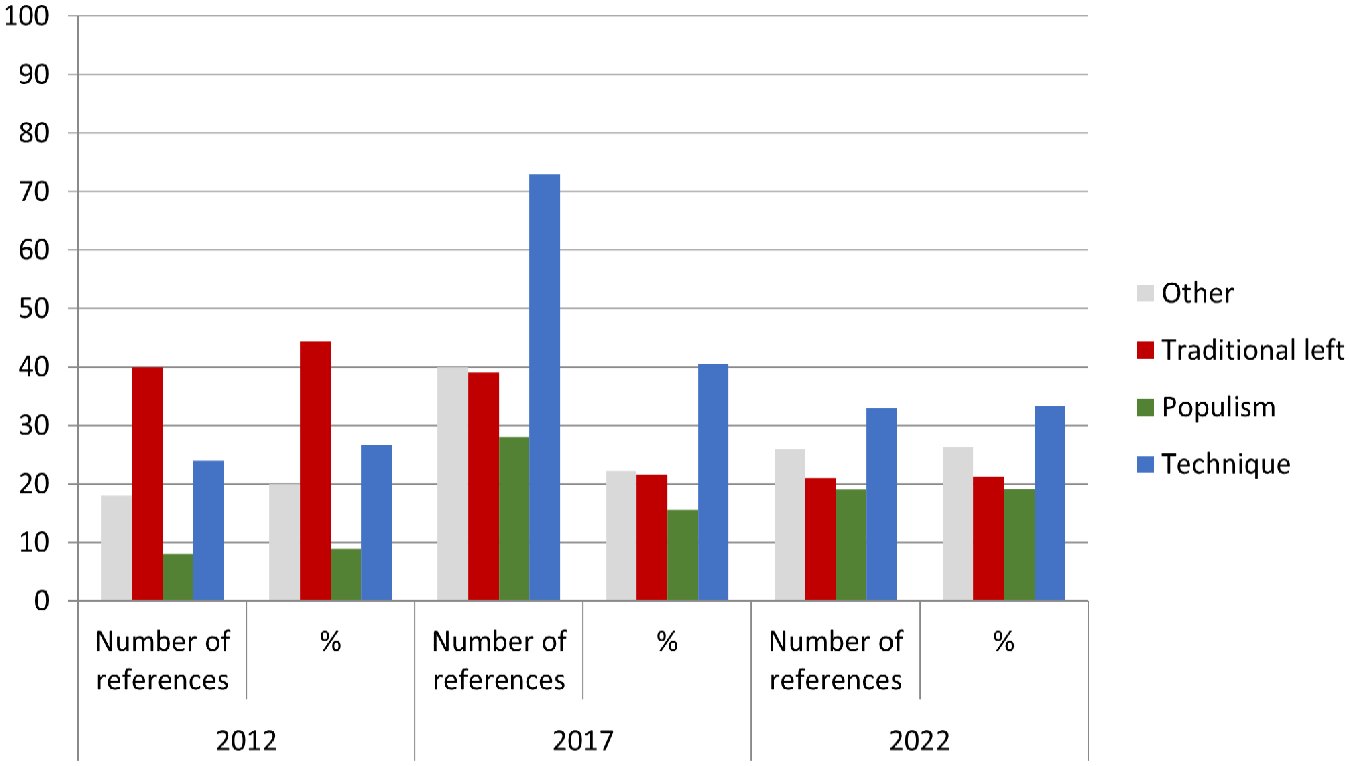
Nature of the Environmental Discourse in Jean-Luc Mélenchon’s Discourse.
Populist elements can be found in the Left Party’s environmental discourse as early as the 2012 campaign, when the party opposed the people (‘we are capable of organising the energy transition! [. . .] we are the people, we are the numbers, we are the intelligence!’) 10 and the elite (‘it is the conspicuous waste of the very rich that must be fought’). 11 However, given that the environmentalist/populist combination really started to develop in 2017 and 2022, we will focus mainly on these elections in the next section.
Framing Environmental Discourse in Populist Terms
Anti-Elitism
The anti-elitist framing of PRRPs’ environmental discourse frequently includes a critique of a cosmopolitan elite that imposes its climate agenda, as well as a suspicion towards environmentalists and climate scientists (Huber et al., 2021; Lockwood, 2018). Given PRLPs’ ideology and their adoption of a green agenda, we should not expect them to blame the elites for their climate mitigation policies, but rather for their contribution to the climate crisis or their failure to act in response to it. One of the main analytical goals therefore consists in identifying what in the environmentalist discourse of LFI falls under the influence of the radical left host ideology and/or what falls under the influence of populism.
In the case of LFI, the radical left ideology plays a central part when it comes to assigning responsibilities for the environmental crisis. In line with previous research on radical left parties’ green agenda (Wang and Keith, 2020), we can see that capitalism appears to be the main cause to blame.
Mélenchon (2014: 122) thus regularly points the finger at productivism, described as ‘the essential danger eroding current human civilisation’, and capitalism often described as ‘financial’ of ‘financialised’: For us, insoumis, the root of the environmental disaster is financial capitalism. From then on, environmentalist positions are based on a single question: how to break with the logic of productivist accumulation?
12
(Jean-Luc Mélenchon Blog post, 13 October 2021).
The party manifesto also advocates an environmentalism that ‘supposes breaking with the system of the money-king’. 13 LFI criticises a productive system based on unlimited production and accumulation without considering environmental and social limits. Financial capitalism is accused of imposing a logic of short-term profitability and promoting an unsustainable mode of consumption through the ‘charm of advertising injunctions’ (Mélenchon, 2014: 122). To this system based on the depletion of natural resources, LFI opposes the respect for the natural cycles – through the ‘green rule’ – and aims at the ‘harmony of human beings among themselves and with nature’, a leitmotiv of the 2017 and 2022 presidential campaigns.
This attachment to an anti-productivist environmentalism opposed to the capitalist system, reflecting the ecosocialist legacy from the Left Party, is particularly strong among grassroots activists. In the interviews we conducted, they frequently define themselves as ecosocialists and explained that anti-capitalism was what distinguished them from EELV. For instance, Arthur
14
(22 years old, student in public law) considers that ‘the differences are that we [LFI] try to link the social [issues] and environmentalism, with the expression of popular environmentalism, while breaking with capitalism is not really [in EELV’s] project’. On his side, Paul considers that: [The leaders of EELV do] not fundamentally criticise the consumer society, the capitalist society, while we [LFI] want to build another world, that’s our slogan. [EELV wants] to change some details, [on LFI’s side] we want to change society as a whole to try to launch a world movement (Interview Paul, twenty-four years old, PhD student in organic agriculture and climate change, Rennes, March 2022).
Although LFI’s ecosocialism has a major influence on the party’s environmental discourse, suggesting that the host ideology prevails over populism in the assignation of responsibilities for the environmental crisis, anti-elitist frames can also be identified. As could be expected, since LFI embraces scientific consensus over climate change, no trace of negative stances towards climate scientists and environmentalists can be found in the party’s discourse. However, in a context of growing incentives to claim their ‘popular environmentalism’, as approached in the previous section – Climate Marches, increasing competition with the greens, Yellow Vests movement – LFI increasingly targets the economic elite symbolised by multinational polluting companies, banks and the wealthy, for their contribution to climate change: Those belonging to the richest 1% pollute twice as much as the poorest half of humanity! Four French banks each have a carbon footprint larger than that of France itself (Jean-Luc Mélenchon (2021: 77), Députés du peuple humain).
Mélenchon attacks, for example, the appetence of the rich for highly polluting yachts: [The] super-yachts, if they satisfy the sick cravings of a handful of egotistical billionaires, do maximum damage to everyone else [. . .] Just one of these [yachts] emits, for the pleasure of one person, as much CO2 as 200 cars! [. . .] Let’s remember that in France, for example, 40,000 people die each year from air pollution
15
(Blog post J-L Mélenchon, 23 November 2021).
This reference to the yacht as a symbol of the rich’s responsibility in the climate crisis is also frequently used by LFI high-profile MP François Ruffin, who gained public prominence in 2016, before his election, as the director of a documentary about a working-class family’s fight against their former employer, Bernard Arnault, CEO of LVMH and the richest man in France. For instance, in a Facebook post on 27 July 2019, he stated: Today in France, the richest 10% of the population emit 8 times more greenhouse gases than the poorest 10%. When Bernard Arnault uses his yacht, it represents 1,200 litres of diesel in 1 hour! (Facebook post, François Ruffin, 27 July 2019).
LFI reproves the emblems of wealthy immoderation in a rhetoric opposing the ‘big’ against the ‘small’, the former being referred to as ‘the richest 1%’, ‘a handful of egotistical billionaires’, or even mentioned by name as in the case of Bernard Arnault. This explicit criticism of the economic elite is also noticeable in the party’s visual communication, on social media or on the stickers distributed by activists (see Figure 7).

Sticker (2022) and Visual Content of LFI (24 March 2022).
LFI’s anti-elitist frames can also be found in its frequent attacks on the political elite, both supranational and national, for their climate inaction and complicity with the economic elite in the environmental crisis.
For example, the EU is often targeted in LFI’s green narrative. The 2022 plan entitled ‘Our strategy in Europe’ 16 explicitly opposes the ‘European institutions’ to the ‘people of the continent’ and accuses ‘Bruxelles’ machine’ of hindering the implementation of ambitious environmental and climate policies.
LFI is even more critical towards the national political elite, especially against Emmanuel Macron and his government, both of which have been directly targeted by climate activists’ slogans and arguments since the beginning of the Climate Marches in 2018. LFI’s discourse goes beyond a conventional ‘government vs opposition’ framing to repeatedly accuse the President of serving the interests of the rich and the multinationals. The speech given by Mathilde Panot, the president of LFI’s group in the National Assembly, during the debate on the government’s climate bill on 29 March 2021, exemplifies LFI’s blaming of political elite for climate inaction well. This speech, reproduced in Mélenchon’s book Députés du peuple humain – a sign of its importance in the party’s narrative – puts the government’s climate policy on ‘trial’. Panot accuses the government of repressing climate mobilisations and of being complacent with the economic elite responsible for the climate crisis. The government is thus described as the ‘ventriloquist of private interests’ (Panot in Mélenchon, 2021: 108), a supporter of a ‘straw environmentalism’, in reference to the ban on plastic straws, which according to LFI symbolises a policy of small steps that is falling dramatically short of the target. She also questions Emmanuel Macron’s fiscal policy, and in particular the abolition of the wealth tax at the beginning of his mandate, pointing his complicity with the ‘oligarchy’: Your first misdeed: the organised fattening of the rich [. . .] you ignore the fact that the richer [. . .] the more they own, the more they pollute [. . .] With this [tax] abolition, you gave back 4 billion euros to the oligarchy, the same amount you wanted to recover with the carbon tax (Mathilde Panot, intervention in the National Assembly, 29 March 2021 (Panot in Mélenchon, 2021: 101–102)).
The complicity between the political and economic elite deemed responsible for the climate crisis is systematically pointed out by the main representatives of LFI. On 3 December 2019, Jean-Hugues Ratenon addressed the government in the National Assembly on climate disorder and clearly conflated the political elite and the economic elite into the same ‘you’ in a populist way: 100 multinational companies, your friends, are responsible for over 70% of global greenhouse gas emissions [. . .] The world is drowning and you, the privileged, continue to count the banknotes. Prime Minister, we will no longer suffer the environmental and social cost of your privileges. The people no longer wants this caste that not only exploits workers but also ravages the planet
17
(Jean-Hugues Ratenon, intervention in the National Assembly, 3 December 2019).
Embracing a radically antagonistic stance towards Emmanuel Macron’s government is another dividing line that activists draw with EELV. Six out of ten activists we interviewed accused a fringe of EELV of being porous to Macronism, pointing to the fact that several figures from the greens have been poached by Emmanuel Macron to join his first government. Slightly twisting Jean-Luc Mélenchon’s 2022 campaign slogan – ‘Another world is possible’ – they jokingly refer to Yannick Jadot, the green presidential candidate, by the formula ‘Another Macron is possible’.
People-Centrism
People-centrism can be displayed by the valorisation of a ‘pure’ and virtuous people or appear through the ‘construction’ of the people, the process by which the ‘marginalized and underprivileged plebs’ are erected into the legitimate community of the people (Katsambekis, 2022).
In PRRPs’ discourse on environmental issues, people-centrism is expressed through the valorisation of the people’s way of life, threatened by a climate agenda imposed by a technocratic elite and symbolised for example by carbon taxes or diesel bans (Huber et al., 2021). When LFI situates the people at the core of its environmentalist narratives, the people are constructed as (1) the first victims of the environmental crisis, (2) a majority unfairly stigmatised and penalised by the oligarchy, and (3) virtuous and crucial actors of the green transition.
LFI regularly refers to the people as ‘the greatest number’ that suffers from the consequences of global warming, and more generally from the environmental damage caused by the capitalist system and the economic elite’s lifestyle. In this logic, Mélenchon stated: The greatest number has an interest in this [green] transformation, the greatest number is you [. . .] because you are the first to suffer. The first to suffer have always been the workers, the employees, already those whose lungs were poisoned by silicosis, then by asbestos, etc. The farmers are the first to suffer from cancer, the workers who handle hazardous materials are the first to suffer (Jean-Luc Mélenchon, meeting in Corbeille-Essonnes, 15 November 2018).
Environmentalism is thus involved in the construction of LFI’s people, who are composed of the underdogs (workers, employees, farmers) and who share the common experience of suffering from environmental damage. Mélenchon frequently stresses the consequences of air pollution, pesticides and junk food on the underprivileged. The battle against junk food was even a central theme of the 2022’s presidential campaign, during which LFI’s leader defended wage increases, the implementation of organic food in school canteens and of freezing the prices of several fruits and vegetables, all measures presented as both environmentalist and beneficial to the people.
People-centrism in LFI’s environmental discourse is also reflected in the defence of a people stigmatised and penalised by an elite (‘the oligarchy’) who unfairly blame them for the environmental crisis. This can be seen for example in LFI’s support for the Yellow Vests movement born of opposition to the carbon tax. Opposing a carbon tax for a party that claims to be environmentalist may seem at first sight contradictory. Although there seems to be a convergence between left-wing populism and radical right populism in this area, it should be noted that LFI’s opposition to the carbon tax differs in part from that of PRRPs in that it targets the conduct of the elites responsible for these taxes. On one side, PRRPs would be more likely to decry the moral stigmatisation of the people’s everyday way of life by a cosmopolitan elite that uses the carbon tax as a pretext to impose ever more taxes on ‘the little guy’. On the other side, LFI emphasises the hypocrisy of the political elites who place the burden of the green transition on the shoulders of the underprivileged in order to better spare those who are actually responsible for the crisis, the economic elites, as previously demonstrated.
In fact, LFI saw the carbon tax as a symbol of a so-called green policy, castigating the most deprived who have no choice but to use private vehicles in their day-to-day lives. From this perspective, LFI links environmentalism with the defence of public services by blaming the political elites for hindering access for the people to basic services, as shown in Jean-Luc Mélenchon’s speech in 2018: They are the ones who reorganised the whole territory in this way by forcing you to get into cars to take kids to school, to take them to the doctor, they are the ones who organised this permanent relocation of people’s daily lives and now they come to blame you (Jean-Luc Mélenchon, meeting in Corbeille-Essonnes, 15 November 2018).
It is noteworthy that, at the grassroots level, the need for an environmental transition that does not penalise ‘the people’ – which, in this sense, refers to the underprivileged – is a central concern. When the activists we interviewed talk about environmentalism, they are also speaking about social struggles (47.9%) and popular sovereignty (20%) (see Table 5). They blame the ‘façade environmentalism’ of the centrist Emmanuel Macron, as well as EELV’s bland green agenda, which would not sufficiently take into account the effects of the green transition on the living conditions of the underprivileged.
Themes Addressed by Activists When They Talk About Political Environmentalism (%).

Against the vision of a people insensitive or even reluctant to environmental concerns, LFI is positioning itself as the defender of a virtuous – a central characteristic of populism from an ideational point of view – and proactive people able to rise as the driving force of the environmental transition: Never have the people been so aware and so willing to take the actions required for responsible behaviour in relation to the planet. If you’re waiting for the oligarchs to wake up one morning and say ‘look, we’ve gone too far and now we’re going to backtrack and stop getting rich off what we produce’, well, you’re dreaming (Jean-Luc Mélenchon, meeting in Corbeille-Essonnes, 15 November 2018).
This exaltation of a French people whose mission is to get moving to achieve the green transition is at the heart of Mélenchon’s doctrine. In particular it is set out in his book L’ère du peuple [The Era of the People] (Mélenchon, 2014) in which he describes the advent of a ‘people’ increasingly concentrated in urban areas and aware of the existence of a general human interest, called upon to become the leading force in both the ‘Citizens’ Revolution’ – through the democratisation of institutions – and in the environmental bifurcation. Therefore, the people is not confined to the position of victim of the climate crisis: it is elevated as the group that will tackle the climate challenge. This idea of a people fully mobilised to solve the climate crisis is also translated in LFI’s manifesto, through concrete measures such as the green employment guarantee or a whole plan dedicated to produce the qualifications necessary to involve workers in the green transition.
This emphasis on the greatness of the French people is also expressed by the bridges that LFI creates between the Yellow Vests’ demands for fiscal and social justice and the Climate Marches’ stance for environmental justice. The party articulates these mobilisations through the ‘people’ signifier, agglomerating them around the common opposition to an oligarchy that rejects their social and environmental aspirations, as revealed by this quote from MP Mathilde Panot’s speech in the National Assembly, which pays tribute to the Yellow Vests: They [Yellow Vests] shouted it everywhere: no environmentalism without social justice! When people have no choice but to use their cars to get around, it’s still them you’re going to mess with, rather than Total [French main oil company] [. . .] The people will always end up revolting against the powers of money and their political representatives [. . .] We are the movement of this hope
18
(Mathilde Panot, intervention in the National Assembly, 29 March 2021).
This articulation of the Yellow Vests’ and the Climate Marches’ demands is also reflected among the activists we interviewed who, for the most part, support and identify with these two movements. Activists relate to the slogan of the Yellow Vests, which later spread to parts of the French left: ‘end of the world, end of the month, same fight’. Those who were most involved in the Yellow Vests protests insist that this popular mobilisation has made environmental demands its own. For instance, an activist from Montpellier, even considers that the Yellow Vests movement is more radically environmentalist than the Climate Marches: Environmentalism is also present [within the Yellow Vests movement] [. . .] I follow a bit what happens on the side of Climate March, the other day I was in debate with one of its organisers who thinks that the Yellow Vests are not environmentalists [. . .] I told him that the Yellow Vests are more environmentalists than they are [. . .] because the Yellow Vests [. . .] are increasingly calling their enemy ‘capitalism’ or ‘big capital’ [. . .] they are going to attack the banks, they want to nationalise the stations, the highways, so there is a more and more anti-capitalist, state planning thought (Interview William, 29 years old, unemployed, Montpellier, March 2019).
Conclusion
Building on recent research on the links between populism and environmental issues, this article proposed a case study of the place and framing of these environmental issues in a populist radical left party, La France insoumise. While the emerging literature primarily investigated the presence of populist frames in the climate (sceptic) discourse of populist radical right parties, our aim was to analyse how a left-wing populist party seizes on environmental issues and to what extent its environmental discourse is articulated with populism.
Using mixed-methods, we have shown that the place of environmental issues has increased in the discourse of LFI over time. Ideological innovation at the creation of the Left party in 2008, the growing salience of environmental issues in the French public sphere, as well as the structure of party competition, have led the party to adopt an ambitious green agenda, which is undoubtedly one of the keys to its success in the 2022 presidential election when LFI became the leading force of the French left. Our findings thus echo and complement those of previous research on new radical left parties’ growing incorporation of environmental issues (Wang and Keith, 2020).
Our analysis of the connection between populism and environmentalism in the discourse of the party shows that there is evidence of a populism/environmentalism nexus which could be characterised as ‘green populism’ – and which is theorised by Jean-Luc Mélenchon as ‘popular environmentalism’. We have observed that the ecosocialist ideology and anti-elitism are combined in the party’s discourse to single out those responsible for the environmental crisis: capitalism and productivism, but also the economic elite and their irresponsible attitudes, as well as political elite guilty of climate inaction and of subordination to the interests of multinationals.
We also showed that people-centrism is displayed in several ways: LFI constructs the people as all the underdogs who are victims of environmental damage. The party also highlights the antagonism between a political elite that blames individual behaviour for the climate crisis and a people unfairly stigmatised and penalised by this elite’s so-called green policies, which target the greatest number instead of the rich and the multinationals. Finally, LFI praises a virtuous people whose greatness and collective action will be a key to complete the green transition successfully. Our analysis thus adds a contribution to the literature on left-wing populist parties by showing how environmentalism can take part in the construction of an antagonism between the people and the elite. It also provides new insights into the literature on the links between populism and environmental issues, by showing that populism does not necessarily translate into opposition to policies aimed at protecting the environment and combating global warming. While populism, in the most explored case of radical right parties, frequently expressed itself in opposition to the elite imposing a climate agenda against the interests of the people, it can also intervene in exposing the responsibility of the (economic) elite for climate crisis or the (political) elite’s climate inaction, while praising a virtuous people both victims of the environmental crisis and actors of the green transition.
Considering these findings, this article provides an invitation to further explore the populist/environmentalist nexus through new case studies or a systematic comparative approach. LFI can indeed be considered as an extreme case given the centrality of the environmental issue in its agenda, and its leader’s theorisation of the link between people/oligarchy antagonism and environmentalism. Our analytical grid could thus be replicated in other cases likely to display some degree of ‘green populism’ – such as the Spanish party Más País (More Country), founded in 2019 by Íñigo Errejón, who aim to combine Podemos’ former ‘populist hypothesis’, of which he was the driving force, with a new ‘green hypothesis’, or Alexandria Ocasio-Cortez’ defender of the Green New Deal in the United States within the Democratic Party. Future research may replicate our approach to determine the extent to which populism and environmentalism interact: Is the attribution of responsibility for the climate crisis framed in clearly anti-elitist terms, or is it radical left ideology or a technical narrative that prevails? Which elites are targeted and in what terms? How do environmental issues concretely operate in the construction of the people? Research could also explore how the populism/environmentalism nexus is reflected in the parties’ public policy agendas, whether in government or in opposition, as exemplified with LFI’s opposition to the carbon tax or more recently to low-emission zones in urban areas.
Footnotes
Acknowledgements
The authors acknowledge the organisers and participants of the 2022 Prague Populism Conference and of the panel ‘Narrative and Climate Politics’ of the 2022 ECPR General Conference where they received very valuable feedback on the article.
Declaration of Conflicting Interests
The author(s) declared no potential conflicts of interest with respect to the research, authorship, and/or publication of this article.
Funding
The author(s) received no financial support for the research, authorship, and/or publication of this article.
