



Abstract
This article examines more closely the empirical relationships between correctional officers’ job attitudes and officer demographics and perceptions of safety. Bi-level analyses from 1,740 officers in 45 prisons revealed that officers’ sex and race mattered for shaping an officer’s pride with co-workers, consideration of transferring to another facility, and perceptions of co-workers’ job satisfaction, but only as they were linked to perceptions of sexism and racism. Perceptions of safety also mattered. Yet, levels of inmate crime and victimization were irrelevant for shaping attitudes. Positive attitudes were also more common in facilities housing higher risk populations, and in facilities for men.
Introduction
There is a growing empirical literature on factors that shape correctional officers’ attitudes about their jobs (e.g., Lambert, Altheimer, & Hogan, 2010; Lambert & Paoline, 2012; Mitchell, MacKenzie, Styve, & Gover, 2000; Schaufeli & Peters, 2000; Stinchcomb & Leip, 2013). Understanding these factors is important in light of mounting problems in hiring and retaining qualified correctional officers (Sumter, 2008).
Related research often includes correctional officer demographics and perceptions of job safety as predictors of job-related opinions. Findings for sex and race effects are mixed, although one or both of these have emerged in some studies as significant predictors (e.g., Mitchell et al., 2000; Stinchcomb & Leip, 2013; Triplett, Mullings, & Scarborough, 1999). By contrast, there is more consistent evidence favoring the relevance of officers’ perceptions of safety where more “threatening” prison environments generally coincide with more negative opinions about the job (e.g., Blau, Light, & Chamlin, 1986; Lambert & Paoline, 2005, 2008; Schaufeli & Peters, 2000). Both sets of findings are potentially important for developing strategies to improve officers’ job attitudes. Here we provide closer inspection of these empirical links to job-related attitudes among 1,740 correctional officers from 45 prisons in Ohio and Kentucky.
We contend that an officer’s sex and race are related to officers’ job attitudes only through their perceptions of sexist and racist treatment. The influence of officers’ perceptions of safety, however, may have only to do with their personal job experiences as opposed to general indicators of more or less dangerous facility environments (e.g., levels of inmate crime).
A Multi-Level Model of Officers’ Attitudes
Our specific foci on officer demographics and perceptions of safety are framed within a broader perspective of correctional officers’ job-related attitudes. It is important to offer a framework within which these relationships can be examined and which can also guide model specification to provide more reliable estimates of the empirical relationships of interest.
Research on the sources of negative versus positive job-related attitudes among correctional employees in general has sporadically touched on the relevance of individual, organization, and client population factors for shaping various outcomes that either directly or indirectly reflect an officer’s job attitudes (e.g., Lambert et al., 2010; Lambert & Paoline, 2012; Mitchell et al., 2000; Schaufeli & Peters, 2000; Stinchcomb & Leip, 2013; Whitehead, 1989). However, this literature is void of multi-level frameworks that unify related concepts across these levels, let alone multi-level analyses that permit valid comparisons of the relative contributions of such factors.
Officers’ job-related attitudes may be influenced by their characteristics as well as by organizational and inmate population factors. It is possible that elements from each of these groups shape officers’ negative attitudes by interfering with their ability to maintain control over their work space. Officers work in a low control occupation (Dollard & Winefield, 1998) with little control over inmates and administrative policies. From a “personal control” perspective (e.g., Averill, 1973), certain characteristics of officers and prison environments have the potential to weaken an officer’s sense of control over his or her work, whether by interfering with the officer’s decision making and problem solving, making situations less predictable, and/or by hindering the officer’s ability to control outcomes. Factors that limit one’s control, whether at the micro or macro level, might ultimately contribute to negative job attitudes. We cannot directly examine an officer’s “control” over his or her work space, so this idea is put forth as a possible theme underlying linkages between officers’ job-related attitudes and a broad array of factors. Supporting evidence of these relationships would encourage direct examination of personal control in related research.
The outcomes examined in the broader literature on correction workers’ attitudes have been varied, recent examples of which include general indicators of job satisfaction (e.g., Stinchcomb & Leip, 2013) versus more specific indicators such as job “burnout” (e.g., Lambert, Hogan, Barton-Bellessa, & Jiang, 2012), job involvement (e.g., Lambert & Paoline, 2012), work “stress” (e.g., Finn, 2000), and job turnover (Mitchell et al., 2000). For the study described here, we deliberately selected three outcomes that capture different types of job-related attitudes as opposed to highly correlated outcomes that all tap into a single dimension. This was done to evaluate the robustness of the findings for officer demographics and perceptions of safety across different types of attitudes. The specific outcomes examined here include an officer’s pride in working with fellow prison staff (tapping esprit de corps), willingness to transfer to another facility if given the opportunity to do so (turnover intent), and perception of co-workers’ job satisfaction. The last item was not intended to actually tap co-worker satisfaction because this could vary quite a bit from an officer’s perception. Its relevance lies in tapping yet another aspect of the job from the perspective of the responding officer. We also recognize that there are reasons aside from negative attitudes toward the job that could lead an officer to either seize or refuse an opportunity to transfer (such as family-related reasons), but the question was asked along with several related questions in the context of an officer’s satisfaction with co-workers and job tasks in the current facility. It should be emphasized that these particular outcomes are just a few examples of relevant items tapping the multiple dimensions of job attitudes of interest to psychologists studying organizational climate (e.g., Jones & James, 1979).
Are Sex and Race Effects on Job Attitudes Spurious With Discriminatory Treatment?
An officer’s sex and race are often included as predictors of job attitudes but for different reasons. Blau et al. (1986) argued that female officers might have more negative attitudes about their job because women are more likely than men to endure greater job stress, but they did not provide a theoretical rationale for studying an officer’s race. Both effects were rendered nonsignificant when controlling for the prison in which an officer worked. Stinchcomb and Leip (2013) discussed both sex and race within an “importation” framework but did not explicate how these attributes might influence job-related attitudes. They found that women were less positive than men about the work climate. None of their survey questions captured perceptions of discriminatory treatment, however. Aside from these scholars, most researchers have not offered reasons for examining an officer’s sex and race except as control variables or because previous research found them to be relevant (e.g., Lambert & Paoline, 2012; Mitchell et al., 2000).
Regardless of the rationale for their inclusion, the question remains as to whether an officer’s sex and race maintain proximate effects on job-related attitudes or whether these effects are spurious with other factors. Scholars uncovering more negative opinions among females and minorities (such as Mitchell et al.’s [2000] finding that juvenile facility staff members were more likely to quit if they were female or Black) may be capturing how women and minorities are treated in an organization that remains dominated by White men. The more proximate effects on officers’ job-related attitudes may be their perceptions of sexism and racism in the organization. Consistent with our perspective, biased treatment could interfere with an officer’s ability to make independent decisions on how to carry out tasks, thus inhibiting control over their work space.
Subjective Versus Objective Indicators of Safe Working Environments
Compared with officer demographics, more consistent and stronger effects on job-related attitudes have involved officers’ perceptions of on-the-job safety. Dowden and Tellier’s (2004) meta-analysis of correctional officer stress led to their conclusion that perceived dangerousness was among the strongest predictors of stress in studies published before 2001. Also, the relevance of perceived dangerousness for predicting officer turnover intent was recently underscored by Matz, Woo, and Kim (2014) based on their meta-analysis of studies conducted before 2012. Important exceptions have been found (e.g., Lambert, 2006; Lambert & Paoline, 2012), but there is greater consistency in these findings relative to those for officer demographics. The question remains, however, whether individual-level perceptions of safety merely proxy aggregate-level indicators of more or less dangerous environments. If so, then a logical response would be to reduce facility threats to safety to improve officer attitudes. A disjuncture between the two sets of predictors, however, would not generate such a straightforward strategy.
Aside from asking officers whether they feel safe on the job, prisoners’ behaviors toward officers may also be relevant. The frequency of threats by inmates and levels of noncompliance with officers’ orders could generate feelings of less safety and greater unpredictability in an officer’s work space. Scholars have established empirical links between direct exposure to violence and an officer’s perceptions of safety (Cullen, Link, Wolfe, & Frank, 1985; Lambert & Paoline, 2005, 2008; Schaufeli & Peters, 2000). The frequency of face-to-face communication with inmates might also be relevant. More frequent communication might improve feelings of safety among officers if this communication enhances officers’ perceptions of control over their work space by providing them with firsthand information about inmates’ activities. However, more frequent face-to-face communication increases opportunities for physical confrontations (compare a cell house officer with an officer in visitor reception, for example). Some scholars have also found that more face-to-face contact with inmates can increase officer burnout (Schaufeli & Peters, 2000; Whitehead, 1989).
If perceptions of a safe work environment are shaped primarily by facility-level factors as opposed to individual experiences with inmates, then officer perceptions of safety should be rendered nonsignificant with the addition of objective indicators at the facility level such as inmate crime and victimization rates and/or inmate population custody levels. Higher levels of inmate crime and victimization necessarily reduce safety and may enhance the unpredictability of an officer’s work. Moreover, officers are evaluated in part by levels of rule breaking in their assigned areas (Lombardo, 1989), potentially affecting their opinions about co-workers in those areas.
Higher offender custody scores are indicative of inmates at higher risk of engaging in crimes during incarceration, so higher average custody scores for an inmate population may also adversely affect officers’ attitudes for the same reason as for actual crime rates in a facility. Observations conducted in the prisons under study also revealed that higher risk inmates are often more disrespectful and cynical toward officers, and levels of inmate cynicism might influence levels of conflict and the (in)ability of officers to control inmates. The idea of environmental threats to an officer’s control over his or her work space might also be extended to whether a prison houses women or men, assuming female inmate populations are generally less serious in terms of their criminal risk assessments (Bloom, Owen, & Covington, 2003).
Other Relevant Predictors of Job-Related Attitudes
Officer background factors aside from sex and race may also be relevant for shaping job-related attitudes. Some research suggests that factors such as age, family status, and education do not maintain significant relationships with job satisfaction in general (e.g., Stinchcomb & Leip, 2013), but other studies of more specific outcomes (e.g., staff turnover, level of involvement in decision making) suggest significant background effects even when controlling for perceived administrative support and fear on the job (e.g., Lambert & Paoline, 2012; Mitchell et al., 2000).
Older officers may have greater control over their environment if they are more experienced with the job and better able to anticipate conflicts with inmates. Consistent with this idea, Mitchell et al. (2000) found that the odds of quitting among staff in 49 juvenile correctional facilities were higher for employees who were younger. One might assume that more educated officers are also more committed to their work and co-workers because of a greater ability to problem solve, but limited evidence to date suggests that more education is linked to less job satisfaction (Jurik, 1985; Mitchell et al., 2000). More education may make criminal justice agents more idealistic about their work and lead to disillusionment more quickly (Jurik, 1985). From a control perspective, a more educated officer’s inability to influence more favorable outcomes could generate negative job attitudes, and working with less educated officers might also marginalize the more educated officers in the peer network.
An officer’s marital or family status has not been examined recently in related studies although it could be relevant as a proxy for family support. Lambert et al. (2010) examined the influence of family support on officers’ feelings of job ineffectiveness. An officer’s confidence in carrying out daily tasks could be enhanced by a family support network, although Lambert et al. (2010) did not find any such evidence. Blau et al. (1986) examined an officer’s marital status but found a counterintuitive effect on a measure of officer morale (i.e., married officers expressed weaker morale, suggesting a lack of support from spouses).
Organizational training and resources are also key elements to an officer’s ability to maintain control over the work environment (for problem solving and making informed choices). Officers’ perceptions of these factors may be more relevant than actual resources, however. Scholars have found that perceived authority over inmates is linked to higher levels of job satisfaction and lower levels of officer burnout (Griffin, Hogan, & Lambert, 2012; Hepburn & Knepper, 1993). Therefore, officers’ perceptions of adequate numbers of staff to ensure the safety of inmates and perceptions of having been trained for the tasks at hand could alleviate stress and contribute to more positive job attitudes. Communication with fellow officers might also be critical in this regard (Griffin, 2001; Lambert & Paoline, 2008, 2012; Paoline, Lambert, & Hogan, 2006). More communication might reflect reduced social distance among staff.
Aspects of the structural environments of prisons may also affect officer attitudes. The architectural designs of less secure facilities may promote more positive attitudes because these environments are less authoritarian compared with more secure facilities with controlled movement of the population, broader electronic surveillance, and so on. For example, campus style designs with primarily dormitory housing are probably the least restrictive environments for officers. Linear (“telephone pole”) designs, by contrast, can be more sterile environments. Officers in less restrictive environments may gain a greater sense of control over decision making.
Facility size and crowding may also be relevant in this regard. Officers may be familiar with only a small portion of the custodial staff in large facilities, and this anonymity may reduce predictability (Liebling, 2004). Crowded prisons may enhance these feelings and reduce a sense of control over work space (Cohen & Wills, 1985). The latter may also be influenced by noise levels that can exacerbate feelings of a crowded environment (Paulus, Cox, & McCain, 1988). A facility’s state of physical disorder (damaged walls or floors, graffiti, litter) may also weaken an officer’s positive outlook if it is also linked to the overall health of the work environment.
Each of the officer and facility characteristics described above may affect job attitudes as each might relate to the level of control an officer is able to exert over his or her work space. Although our primary interest lies in the effects of officer demographics and environmental “threat” on job-related attitudes, the estimation of a multi-level model reflecting our framework could provide a more rigorous assessment of these empirical relationships by controlling for factors that could be linked to officer demographics and environmental threat.
Method
The analysis was designed to test these research hypotheses:
To assess the impact of individual and facility characteristics on officers’ attitudes, we compiled survey and official data from inmates, officers, and wardens from all 42 state-operated confinement facilities in Ohio and Kentucky and the three privately operated facilities in Ohio. 1 Observational and official data on these facilities were also gathered for the analysis.
Sampling and Data Collection Procedures
Line officers and sergeants were included in the study because of the relatively large number of sergeants filling in for absent line officers. Systematic random samples were selected from lists of officers and sergeants provided by the 45 facilities. We selected 36% samples in the Ohio prisons. Procedures differed in Kentucky because the Ohio portion of the study was completed before Kentucky, and the remaining available resources permitted selection of 100 officers per facility in Kentucky. All officers in a Kentucky prison were included if there were fewer than 100 officers employed at the facility. Samples ranged from 19 to 178 officers per facility for a total of 3,857 officers and sergeants across both states. The total target sample was reduced to 3,710 officers due to transfers, firings, resignations, and leaves of absence. 2
Simple random samples of inmates were also drawn from each prison using electronic lists provided by each facility. The targeted samples varied in size across prisons due to practical constraints dictated by the Ohio Department of Rehabilitation and Correction (ODRC), the Kentucky Department of Corrections (KDOC), and the wardens of the Kentucky facilities. 3 Either 130 or 260 inmates were selected from each Ohio facility, and between 100 and 200 inmates were targeted from each Kentucky facility. The total targeted sample included 7,294 inmates across the 45 prisons. Some inmates were not available on the day of the survey, however, reducing the sample to 6,997 inmates. 4
Survey and official data were compiled on both officers and inmates. Officer surveys were placed in envelopes with a description of the study and request for (voluntary) consent to participate, and a postage paid return envelope. These envelopes were placed in the officers’ mail. Follow-up surveys were distributed to non-respondents. These procedures resulted in comparable response rates within each state (50% overall) and 1,740 usable surveys for the analysis.
5
Line officers constituted 95% of the sample and sergeants 5%. Samples were weighted to reflect the target populations. Each person was weighted inversely to his or her probability of selection in one’s facility, and weights were normalized. The Ohio sample was representative on sex, race/ethnicity, rank, and length of service. This sample was slightly older, however, than the target population (
The inmate surveys were administered to general population in designated areas (chapel, gymnasium, visiting area) whereas inmates in segregation or protective custody were surveyed in their cells. Inmates’ perceptions of confidentiality were enhanced by having them complete the surveys outside the direct view of security staff and away from surveillance cameras. After briefly describing the study, each inmate was given a survey and a consent form. Surveys were read to illiterate inmates and we recorded their responses. Each survey was collected by one of us. Inmates were not compensated for their participation in the study. These procedures resulted in 5,800 completed surveys although missing data on key questions reduced the sample to 5,630 inmates (an 80% participation rate). We attribute the relatively high participation rate to inmates being able to complete the surveys away from staff and returning the surveys directly to one of us on site without any “middle man.” The inmate samples were weighted for the analysis, with weights reflecting the inverse of an inmate’s odds of selection (and normalized). Comparisons between the weighted samples and the respective populations of inmates who had served at least 6 months in state custody revealed no significant differences with respect to age, sex, race, committing offense, prior incarceration, sentence length, and time served.
Measures
Table 1 provides a description of all measures for the analysis. Given our use of multi-level modeling (described below), the number of independent variables that could be included in the Level 2 model was limited due to the availability of only 45 prisons. The facility-level measures displayed in Table 1 reflect all that were explored for inclusion in the multivariate model. Only two of these measures were included in the final model. Nonetheless, the analysis of zero-order relationships still provides much insight into the relevance of these measures for related studies.
Description of Officer and Facility Samples.
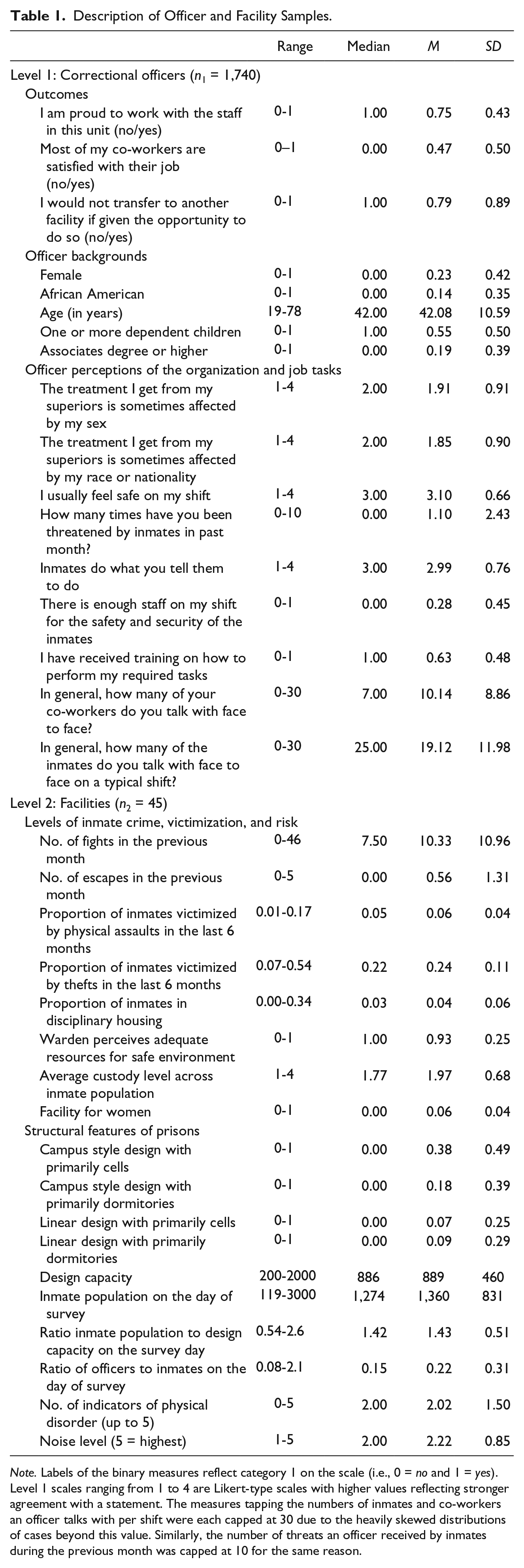
Note. Labels of the binary measures reflect category 1 on the scale (i.e., 0 = no and 1 = yes). Level 1 scales ranging from 1 to 4 are Likert-type scales with higher values reflecting stronger agreement with a statement. The measures tapping the numbers of inmates and co-workers an officer talks with per shift were each capped at 30 due to the heavily skewed distributions of cases beyond this value. Similarly, the number of threats an officer received by inmates during the previous month was capped at 10 for the same reason.
All Level 1 measures reflect officers only. The Level 2 measures include facility and inmate population characteristics, and wardens’ perceptions of adequate resources for maintaining a safe environment. The officer measures in Table 1 were ultimately selected from a larger pool based on their greater relevance to our framework, collinearity checks, and the strength of zero-order relationships with the outcomes. For example, age maintained a stronger effect than length of service on the outcomes examined here, and both could not be included in the same model due to collinearity. (A list of all measures considered is available on request.)
The outcome measures were derived from three survey items tapping an officer’s pride with co-workers, an officer’s perception of his or her co-workers’ satisfaction with their job, and his or her desire to transfer to another facility. Each item was originally scaled from 1 (strongly disagree) to 4 (strongly agree). All three items are correlated but with enough separation to suggest that each is tapping something unique about an officer’s job (Cronbach’s α = .58). After establishing that each item should be examined separately, we compared findings from ordinal regression, multinomial logistic, and binary logistic models (the last set involving collapsed categories on the Likert-type scales). The statistical significance and relative magnitude of the effects in each model were very similar across all three sets of analyses, and so we present the binary logistic regression models for purposes of data reduction.
The remaining Level 1 predictors are defined in Table 1. Most of the Level-2 predictors described in Table 1 are intuitive although a few need further explanation. A facility’s average custody level was computed as the average of inmates’ custody scores in each facility. These individual scores are determined by ODRC and KDOC, where inmates in each state are classified as either (1) minimum, (2) medium, (3) close, (4) maximum, or (5) administrative maximum custody. A four-category scale was created by collapsing categories (4) and (5). The average of the four-category scale was then computed. The numbers of fights and escapes during the previous month were derived from official data whereas the proportions of victimizations were aggregated from the inmate survey data. The measures of physical disorder and noise levels were created from our field notes (with high inter-coder reliability).
Statistical Analysis
Multi-level modeling was used because of the research design (officers nested within prisons) and our interest in examining both individual and facility/population effects on officer attitudes. Bernoulli models were estimated for the binary outcomes with HLM 7.0 (Raudenbush, Bryk, & Congdon, 2011). Bivariate means-as-outcomes models were estimated first to examine the zero-order effects of each Level 2 predictor, and these results helped to inform the Level 2 multivariate models.
The next stage of the analysis involved estimating random coefficients models to identify the Level 1 effects that varied significantly across prisons. The significantly varying slopes (p < .05) were kept as random in the final models whereas all other Level 1 effects were “fixed.” All Level 1 measures were grand mean-centered to control for compositional differences in officer samples across prisons that might have been linked to differences in mean levels of officers’ attitudes. The final stage of the analysis involved estimating the “full” multi-level models with both Level 1 and Level 2 predictors included. Intercepts-as-outcomes models were estimated to assess the Level 2 main effects on adjusted mean levels of officers’ attitudes (i.e., “adjusted” once controlling for compositional effects derived from the Level 1 predictors).
Results and Discussion
The between-prison variance in each outcome was significant (p < .001), prompting analyses of zero-order relationships between the Level 2 predictors and mean levels of officers’ attitudes across prisons. These relationships are displayed in Table 2. Given the analysis of three outcome measures and 19 Level 2 predictors, some of these relationships could be significant by chance given the large number of relationships examined. Therefore, we targeted measures that were significant predictors of at least two of the three outcomes as most relevant to our discussion.
Zero-Order Facility Effects on Mean Levels of Officers’ Attitudes.
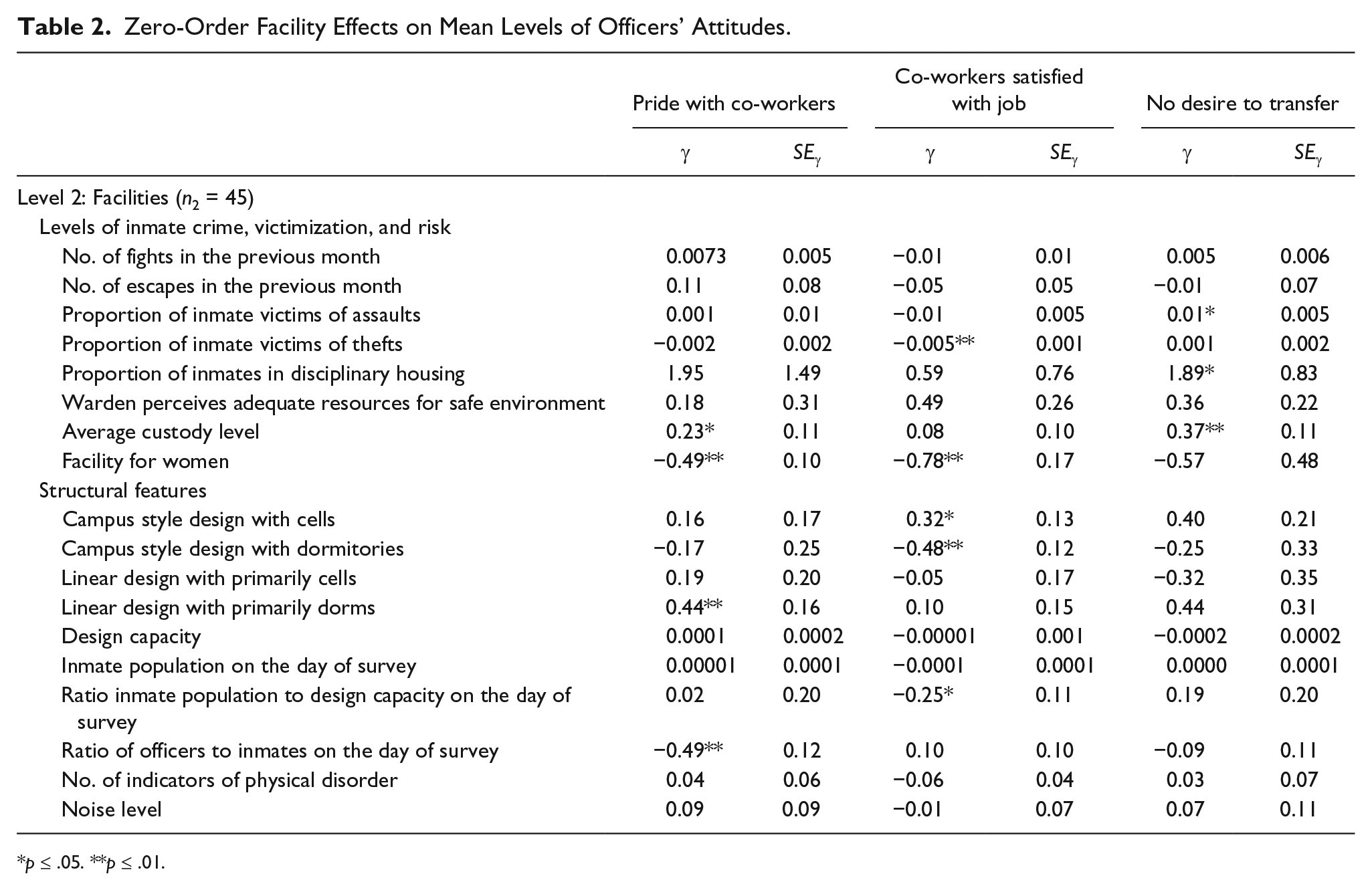
p ≤ .05. **p ≤ .01.
Prison-Level Effects on Officers’ Attitudes
Several themes emerged from the Level 2 findings. First, levels of inmate crime, whether measured as offending, victimization, or the proportion of inmates held in punitive segregation, were primarily irrelevant for predicting the officers’ attitudes examined here. None of these factors influenced an officer’s pride with co-workers and only one (theft victimizations) influenced perceptions of co-worker job satisfaction. Levels of assault victimizations and proportions of inmates held in disciplinary housing were each significant predictors of an officer’s disinterest in transferring to another facility, but these were not significant predictors of either of the other outcomes. Countering our prediction, objective measures of more dangerous environments were not linked to negative opinions about the job and co-workers.
A second theme is that higher average custody levels coincided with more pride with co-workers and less desire to transfer jobs. The directions of these relationships counter the idea that higher custody levels might contribute to officers’ negative job attitudes by creating a more threatening and unpredictable work environment. This relationship remained significant regardless of controls for any other Level 2 predictors (entered two at a time in each model). Therefore, it was included in the full multivariate model.
The findings discussed above contradict the idea that officers’ perceptions of safety proxy the effects of more “objective” indicators of facility safety. Based on our observations of officer camaraderie across prisons, the custodial workforce in more secure prisons generally consisted of more “seasoned” professionals in terms of their experiences dealing with more dangerous populations. These custodial teams functioned smoothly in their routines while effectively addressing inmate requests as they arose, for the most part. Officers’ greater reliance on fellow officers in more dangerous environments might enhance their loyalty to co-workers. Such loyalty might be more of a necessity for officers to maintain control over the most dangerous populations.
The third theme emerging from the means-as-outcomes analysis is that officers in prisons for women were more likely to maintain negative job attitudes, with significant inverse effects on an officer’s pride with co-workers and perception of co-worker job satisfaction. These relationships also countered our predictions and remained significant regardless of statistical controls. For this reason, whether a facility housed women was also included in the full model.
The final theme that emerged from these results is that none of the structural features of prisons were relevant for predicting more than one of the three outcomes. Of the four architectural design measures examined, findings are mixed and do not suggest any sort of pattern where less “restrictive” environments (such as campus style designs with dormitories) are more likely to promote positive attitudes among officers. Based on these findings, the Level 2 predictors included in the multivariate models were the average custody level of a facility’s inmate population and whether the facility housed female offenders.
Bi-Level Models of Officers’ Attitudes
Only five Level 1 effects on any of the outcomes varied significantly in magnitude across the 45 prisons (see Table 3). These effects were kept as random in the next stage of the analysis whereas all other effects were fixed. The full models are displayed in Table 3 with random coefficients in italics.
Bi-Level Bernoulli Models of Officers’ Attitudes.
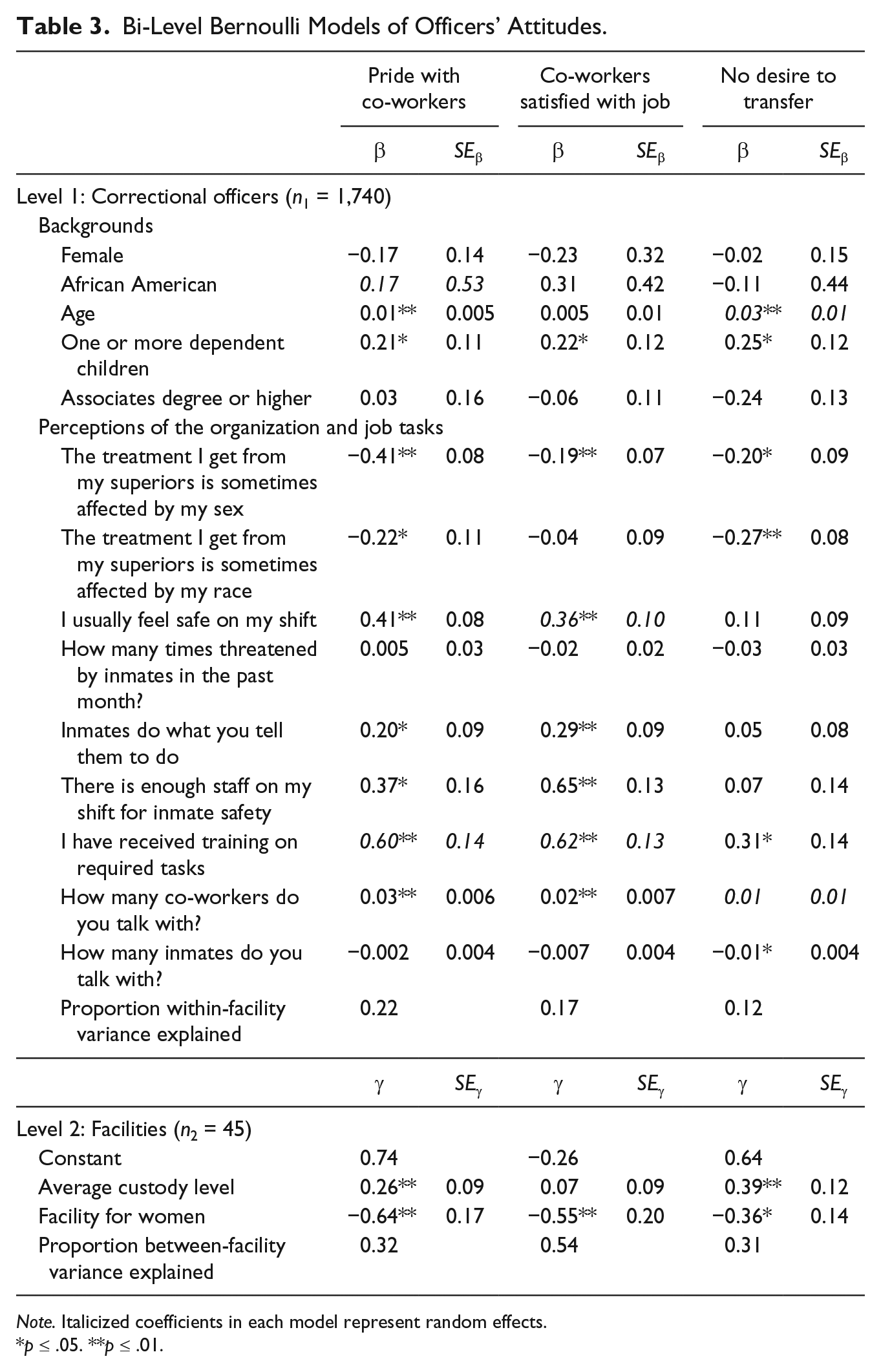
Note. Italicized coefficients in each model represent random effects.
p ≤ .05. **p ≤ .01.
Hypotheses 1 and 2: Are sex and race effects spurious with discriminatory treatment?
An officer’s sex and race each maintained significant zero-order relationships with two of the three outcomes examined. Women were less likely to report pride with co-workers and co-worker job satisfaction (p < .05), and African Americans were also less likely to report pride with co-workers as well as no desire to transfer to another facility (p < .001). However, all four of these significant relationships were rendered nonsignificant when controlling for officers’ perceptions of sexist and racist treatment by superiors. These findings support our first two hypotheses and suggest that an officer’s sex and race are relevant for shaping the attitudes examined here only as they shape perceptions of sexist and racist treatment. The more proximate effects of perceptions of biased treatment by superiors would be consistent with a control framework for understanding officer attitudes (i.e., being subjected to sexist or racist treatment may interfere with an officer’s ability to make independent decisions). Future studies might examine the linkages between perceptions of bias and an officer’s ability to make independent and effective decisions on how to carry out tasks.
Hypothesis 3: The relevance of subjective versus objective indicators of job safety.
Officers who generally felt safe on their shifts were more likely to report pride with co-workers as well as co-worker job satisfaction, but they were not more likely than other officers to report no desire to transfer to another facility. The two significant relationships were among the strongest in each model, however, which is consistent with Dowden and Tellier’s (2004) observation that “perceived dangerousness” is one of the strongest predictors of work-related stress across studies of correctional officers (although “stress” per se was not examined here). 6
In contrast to the findings for “feeling safe” at work, the prevalence of inmate threats was not significantly related to any of the outcomes examined. Although this finding counters Cullen et al. (1985), it is consistent with the Level 2 null effects of inmate offending, victimization, and the proportion of inmates held in punitive segregation.
The Level 2 findings for average custody level are consistent with the zero-order relationships described earlier and counter the idea that officers are more likely to maintain negative attitudes in facilities with more dangerous populations; that is, officers are more likely to maintain positive attitudes about their job and co-workers in facilities with higher risk populations. It appears that officer perceptions of safety do not merely proxy the effects of facility-level indicators of more dangerous environments, thus refuting our third hypothesis.
Consistent with the different effects of individual perceptions of safety and facility custody levels on job attitudes, there was no significant correlation between these two items. Perceived safety was also uncorrelated with most indicators of facility-level crime, victimization, and risk except for inmate-on-inmate fights and assaults (p < .01). These two measures were inversely related to perceptions of safety, as intuition would suggest. From a control perspective, perceptions of less safety may create a more unpredictable work environment. However, higher custody populations are housed in more secure settings, and these structurally more secure facilities might instill more confidence among officers. An important caveat to this observation is that facilities housing higher risk populations still maintained higher assault levels (r = .41; p < .001) and higher proportions of inmates held in punitive segregation (r = .71; p < .001), indicating that more secure facilities do not maintain lower violent crime rates.
Other effects on officers’ attitudes
Regarding officer background factors, older officers displayed more pride and less desire to transfer jobs, consistent with some prior studies of job satisfaction among corrections employees (Lambert & Paoline, 2012; Mitchell et al., 2000). Younger officers may not have the experience to inspire the confidence that we observed among many of the older officers. Officers with dependent children also expressed more pride and less desire to transfer, raising the possibility that families might provide social support that improves an officer’s outlook (but see Lambert et al., 2010). Finally, more educated officers were more likely to express interest in transferring to another facility. Jurik (1985) argued that more education might lead to greater cynicism sooner in an officer’s career. Alternately, a greater desire to transfer among more educated officers might reflect greater interest in job promotions.
Officers’ perceptions of adequate training, staff availability, and level of face-to-face communication with other officers were also important predictors of two or all three of the outcomes. Such factors may be important for enhancing officers’ control over their work environments. Perceptions of greater compliance on the part of inmates were also positively linked to “pride” and “co-worker satisfaction” whereas the frequency of communication with inmates on a daily basis was inversely related to “co-worker satisfaction” and “no transfer.” The frequency of contacts with inmates could weaken an officer’s perceived control over their work space, depending on the quality of these interactions, although it could also simply promote job burnout and cynicism (e.g., Lambert et al., 2010; Schaufeli & Peters, 2000; Whitehead, 1989).
The Level 2 main effect of whether a facility housed women was a significant predictor of all three outcomes. This finding raises the question of why more officers maintain negative attitudes in facilities for women. Wardens told us that female inmates seem to prefer male officers because female officers tend to hold inmates more accountable for their actions. Given that men made up between 40% and 50% of the custodial workforce in the facilities for women, this situation may have driven a wedge between male and female officers and interfered with their ability to maintain a cohesive peer network. Several male officers in a few of these prisons expressed preferences for working in facilities for men. These officers described female inmates as “needier” and “harder to manage,” suggesting the relevance of personal control (if these comments reflect difficulties with resolving conflicts and attaining predictable outcomes).
In sum, our analysis favors the idea that an officer’s pride with co-workers, turnover intent, and perception of co-workers’ job satisfaction are influenced by his or her background, perceptions of organizational resources and other aspects of the work environment, and facility-level characteristics reflecting the types of inmates held (based on sex and risk). Perhaps more important, however, is that levels of inmate crime and victimization were irrelevant for predicting officer attitudes.
Conclusion
Our study offers two primary contributions to research on correctional officers’ job-related attitudes. First, including measures of perceived sexist and racist treatment by superiors provided a more informed analysis of the links between an officer’s sex, race, and job-related attitudes. Second, multi-level modeling revealed that individual perceptions of safety are intuitively related to officers’ job attitudes whereas facility indicators of more dangerous environments are not.
Regarding officers’ perceptions of sexist and racist treatment by superiors, state corrections departments will benefit from more careful consideration of the ramifications of sexism and racism in the custodial workforce for weakening staff cohesiveness and potentially preventing optimal efficiency in both the management of and service to prisoners. Being subjected to such treatment may interfere with an officer’s ability to make independent decisions.
The higher prevalence of negative attitudes among officers working with female inmates suggests that officers may need formal training on general differences in the backgrounds and prison cultures of female versus male inmates. Bloom et al. (2003) argued that prison staff (who are predominantly male) are often not educated about sex differences in communication styles. This lack of “listening skills” can cause frustration among female inmates and impede the ability of staff to adequately address the needs of these women. Some male officers may be less able to effectively problem solve when supervising women relative to supervising men.
The finding that officers working in prisons with higher risk offenders are more likely to maintain positive attitudes toward their job and co-workers suggests that we should not expect officers to maintain negative job-related attitudes simply by nature of working with higher risk populations. Our observations of maximum security prisons actually revealed higher levels of camaraderie among officers, and this may enhance a sense of control over their work. Good morale among officers may actually be more difficult to achieve in minimum and medium security units. Some officers working in lower custody prisons may consider their tasks as amounting to “babysitting,” potentially contributing to more divided perspectives among them.
Limitations of the Study and Recommendations for Future Research
Limitations of the study described here include the limited number of outcome measures examined, which can only capture a few of the many dimensions of job-related attitudes, in addition to our analyses of single-item measures as opposed to the much richer multi-item factors examined by Lambert and his colleagues (Lambert and Paoline, 2005, 2008; Lambert et al., 2010; Lambert et al., 2012). Future research capable of examining multiple measures of esprit de corps, turnover intent, and perceptions of co-worker engagement within the multi-level framework adopted here might provide greater insights into the validity of our findings. Moreover, applications of this multi-level approach to examinations of more sophisticated, multi-item factors tapping aspects of officer morale and organizational climate such as job involvement, job satisfaction per se, and organizational commitment will broaden (or possibly refute) the relevance of a multi-level framework for understanding the most salient factors for shaping a correctional officer’s outlook on their job and peers.
A limitation of our independent variables includes the absence of any direct measures of an officer’s perceptions of “personal control” over the work environment. Many of the significant micro- and macro-level relationships uncovered here should encourage research that directly examines the applicability of concepts reflecting personal control (efficacy, decision making, and predictability) to an understanding of officers’ job attitudes. The ability to conduct multi-level studies incorporating objective measures of facility characteristics also has import for how structural and managerial features of prisons might influence officer attitudes, and related studies will provide insights into procedures for improving officers’ attitudes about their jobs.
Footnotes
Declaration of Conflicting Interests
The author(s) declared no potential conflicts of interest with respect to the research, authorship, and/or publication of this article.
Funding
The author(s) disclosed receipt of the following financial support for the research, authorship, and/or publication of this article: This study was supported, in part, by grants from the National Institute of Justice (Award #2007-IJ-CX-0010) and the National Science Foundation (Award #SES-07155515). The opinions, findings, and conclusions expressed in this study are those of the authors and do not necessarily reflect those of the Department of Justice or the National Science Foundation.