



Abstract
In this research, we quantify the difference in correctional officers’ ethical standards, as perceived by both officers and inmates. Confirmatory factor analysis (CFA) and higher order modeling were used to validate the correctional ethics instrument. Group invariance tests at first-order level were applied to examine the invariance structure of conceptualized and operationalized ethics across staff and inmates. The evidence indicates the construct validity of the ethic instrument. Furthermore, correctional officers have a higher perception of their ethical practice than inmates on two of five common dimensions (“professional relationship with inmates” and “use of force”).
Introduction
The criminal justice system provides the social and political mechanisms that prevent tyranny and anarchy. The nature of the authority, or the legitimized power residing in criminal justice actors, is both ethical and coercive (Stohr & Collins, 2014). Furthermore, it is well known that criminal justice professionals enjoy a significant amount of discretion in the performance of their duties. They frequently grapple with what is the right thing to do in their professional environments, or what is ethical. The interplay among this triad of influences—ethics, coercion, and discretion—shapes actors’ behaviors. It is not accident that criminal justice professionals in general, and correctional officers in prisons and jails in particular, often find themselves facing ethical dilemmas (Braswell, McCarthy & McCarthy, 2012).
Within the criminal justice system, investigating, prosecuting, and adjudicating offenders are rife with their own set of ethical issues. In particular, managing a large number of accused or convicted offenders in correctional institutions poses greater risks and challenges for correctional professionals because the prisons and jails are ethical “hot spots” where abuse of force is more likely to occur. This is likely true because imprisoning inmates is justified by law, social consensus, and moral grounds; however, controlling inmates often requires the wielding of coercive force. By their very nature, jails and prisons themselves have a power imbalance which favors the state and its actors over inmates. The situation is further complicated by the introduction of those who some might consider inmates morally flawed individuals, inmates, who by definition are accused of, or have been convicted of, violating criminal codes which represent a normative social consensus. In such circumstances, and in an effort to maintain security, the infliction of additional pain and suffering on inmates might appear reasonable or certainly understandable to correctional staff.
The purpose of the current study was to achieve a better understanding of the ethical culture of correctional settings. When we discuss ethical behavior or ethics, an operational definition is essential. According to Stohr and Collins (2014), “Ethical behavior is action which is regarded as ‘right’ in accordance with the ethical codes, rules and procedures, and statutes that govern the professional sphere” (p. 67). Having entered the era of the evidence-based paradigm, we as criminal justice professionals and researchers are responsible for producing scientifically validated evidence to justify practice. It is challenging, however, to achieve a better understanding of the ethical culture of the correctional workplace because of the difficulties in conceptualizing, operationalizing, quantifying, and validating the concept of ethics. In other words, if we only have the subjective understanding of the correctional officers, then we have an incomplete picture of a valid measurement of ethics. Furthermore, if what is deemed ethical work is based only on “common sense” or “subjective experience,” we will have a limited, unintended, or even negative conception of the work.
This research is designed to fill the gap in the literature regarding correctional officers’ and inmates’ perceptions of the ethical standards for work in jails. It builds on previous work by Stohr, Hemmens, Kifer, and Schoeler (2000) regarding what constitutes ethical behavior in prisons and jails for correctional officers, and in jails for officers and inmates (Iannacchione et al., 2014). The latter work indicated that officers had a more positive perception of their work as “ethical” than did inmates, though on most attributes of the work, their perceptions were in agreement.
When answering the questions of “what is ethical work in corrections” and “how do officers and inmates differ in their perceptions of this work,” researchers often face challenges because of the lack of a reliable and valid measurement instrument of the ethical culture in jails and prison for both inmates and officers. Even if one had a valid ethics instrument, the statistical analysis techniques that are usually applied to quantify the perception disparity lead to unreliable results—because no instrument or measurement is without measurement errors. One of the disadvantages of t tests is the assumption often made by researchers that the measurement is perfectly reliable and valid for diverse groups of respondents, even when the characteristics of individuals in different groups vary greatly. Therefore, our research team conducted an analysis to validate an ethics instrument and quantify the disparity between the ethical standards as perceived by inmates and staff. The research team applied confirmatory factor analysis (CFA), second-order modeling, and group invariance tests to address these disadvantages and challenges.
Literature Review
Those in a position of authority have a responsibility to behave ethically, especially when their role involves a significant imbalance of power over subordinates or others they supervise: In any profession, the more powerless the client is in relation to the practitioner, the more imperative the practitioner’s ethics become” (Braswell, McCarthy, & McCarthy, 2012, p. 74). While this relationship exists in many organizational settings, it is especially critical in a correctional setting. Abuse of power and ethical breaches have been well documented by other researchers (Amnesty International, 2004; Braswell, McCarthy, & McCarthy, 2012). The very nature of correctional work entails maintaining control and providing security to protect not only fellow staff from inmates but also inmates from each other. This is especially relevant as prison depopulation continues; recent research suggests that this movement may be increasing violence in some jails (Caudill et al., 2014). Besides providing physical security, correctional staff are responsible for creating a trusting environment for inmates, which can be difficult within the bounds of inmate culture (Fowler, Blackburn, Marquart, & Mullings, 2010).
To achieve necessary control, correctional officers need to establish their authority over inmates; however, authority can be susceptible to corruption and other abuses of power. Calhoun and Coleman (2002) found, for example, that female inmates found the power of correctional officers threatening, yielding a sense of powerlessness. This could potentially create an environment where sexual misconduct is not reported. Other abuses of power may include unacceptable uses of force (such as striking an inmate for no reason), being verbally abusive, or petty actions such as destroying inmate property or making them wait long periods of time to use the phone (Banks, 2013). Ethical violations in corrections are not the exclusive purview of correctional line staff, administrators may also commit infractions. An example is the case of James Crosby, the Secretary of the Florida Department of Corrections who was charged with accepting bribes and kickbacks (Mancini & Mears, 2013).
Sexual misconduct between staff and inmates is a well-documented concern (Amnesty International, 2004; Beck & Johnson, 2012). Beck and Johnson (2012) conducted a survey of former state prisoners regarding sexual victimization; they found that just more than 5% of former inmates in their study reported a sexual incident with staff during their most recent incarceration; only about 1% reported that this was nonconsensual. While the majority of these incidents would therefore be deemed consensual, with inmates willingly engaging in the activity, their status as prisoners means that they cannot give legal consent. This is a concern for prison and jail management because not only is this behavior illegal but other correctional staff are often aware of inappropriate relationships and fail to report it as well (Worley & Worley, 2011).
Sexual misconduct between staff and inmates is not the only ethical breach in a correctional setting. Other examples include the inappropriate use of force, doing favors for inmates, or dereliction of duty (e.g., calling in sick or conducting personal business while at work). Prior surveys to assess the ethical behavior of correctional officers indicate that the majority of officers state that they rarely or never engage in these behaviors but have not infrequently observed these breaches in their colleagues. Worley and Worley (2011) in their study of employee misconduct in the Texas correctional system found that correctional officers rated their own behavior as ethical but believed their coworkers engaged in deviant behavior, including inappropriate relationships with inmates. They further found that staff observed their peers engaged in such activity as calling in sick when they were not or allowing inmates to break rules.
Similarly, Iannacchione and colleagues (2014) found that jail staff had a greater reluctance to report colleagues for unethical behaviors, including theft, smuggling contraband, and abuse of inmates, but did believe that sexual relationships with inmates were not acceptable. In the same study, inmates were also surveyed regarding their perceptions of staff ethical behavior to see if there were differences. Inmates were more likely to view sexual relationships as acceptable but held similar opinions regarding the reporting of abuse. They were more likely to believe that staff should report their colleagues for theft and contraband violations. The demographics of the inmate respondents indicate key differences in inmate perception. Age was significant in determining how ethical behavior was viewed; older inmates believed that staff were more ethical in their behavior overall than did younger inmates.
These findings are similar to those of Blackburn, Fowler, Mullings, and Marquart (2011) in their study of boundary violations between inmates and staff. The researchers found that boundary violations by staff led to inappropriate friendships and sexual relationships with inmates. Blackburn and colleagues (2011) surveyed inmates in a state prison to assess how they interpreted staff misconduct. They found that males, younger inmates, Hispanics, and those with a high school education or less were much more likely to support these inappropriate relationships with staff. Overall, females, minorities, and those with higher education are more likely to view staff misbehavior as unethical (Iannacchione et al., 2014; Stohr et al., 2000). Understanding these demographic differences in inmate perceptions of ethical correctional work can assist in the identification of correctional officers who may be more susceptible to corruption or negative influence (Worley, Marquart, & Mullings, 2003).
Measuring Ethical Behavior
The power differential between practitioner and client creates an opportunity for misconduct and breaches of ethical codes, which were put in place to protect both parties. When ethical misconduct occurs, particularly in the correctional field, it harms inmates and staff, and increases the liability of the institution for administrators. The challenge for administration is to accurately assess to what degree staff adhere to ethical practices. Further insight in this regard could be gained by measuring how ethical inmates believe staff to be to determine if there is a substantial disjunction between the two sets of perceptions; if so, then there might be a larger organizational culture issue to be addressed.
The current research involves the development of an instrument to measure ethical behavior of staff, from the perspective of both correctional workers and inmates. As Iannacchione and colleagues (2014) found, generally, the perception of staff ethical behavior was consistent between staff and inmates, though staff tended to rate themselves as more ethical than inmates did. Developing a tool to accurately measure ethical behavior to assess if there are wide differences in perceptions of behavior between staff and inmates is critical for correctional administrators, so that they can determine the ethical culture of their facilities and address any deficiencies which might become apparent.
Purpose of This Study
In summary, in this research, we examine whether jail staff have a different level of perception with regard to various ethical behaviors and dimensions than inmates. Preliminary work on this question was done by Iannacchione and colleagues (2014), but we here conduct additional analysis to ensure that the quantitative and statistical comparison performed is based on a solid foundation of the valid measurement of one of the most complicated social constructs: ethics. Therefore, we will start by examining the validity of the ethics instrument at three levels (individual item level, dimension level, and structure level) by conducting CFA, second-order modeling, and group invariant tests.
Method
Instrument/Measurement
In this study, we used a semi-established ethics instrument that was created and developed by Stohr and Hemmens, based on their review of the ethics literature, the code of ethics of the American Jail Association, and the American Correctional Association, as well as professional experience. This instrument is designed to measure the perception of what is the ethical behavior of staff in prisons as perceived by inmates and correctional officers. According to Stohr and Hemmens, ethics in prisons and jails is a complex social, psychological, and political construct, which is conceptualized and operationalized into six dimensions (only five dimensions for inmates), including Subcultural Influences, Professional Relations With Inmates, Appropriate Use of force, General Conduct and the “Good Officer,” Democratic Participation in the Workplace (staff only), and Professional Coworker Relations.
The instrument contains 33 items measuring perceptions of ethical behaviors on a 7-point Likert-type scale, in which the response ranges from 1 (strongly disagree) to 7 (strongly agree). Not all the items were used for this analysis, and the items that were excluded had weak loadings based on the preliminary analysis (see the appendix for the items used in the current study). The staff ethics instrument was pretested in a prison, then revised and refined, and used in three prisons, two jails, and a jail academy, and then, for this study, in one jail. The inmate ethics instrument (which measured inmates’ perceptions of staff ethical behavior) used in this study was a modified version of the staff instrument.
Sampling
The ethics survey was administered in a jail located in an urban area in a mountain state. The survey included several components, and was administered to both inmates and staff. The survey was administered to staff in two separate training sessions where the management staff were excluded. Staff were informed of the voluntary and anonymous nature of the questionnaire. A total of 135 staff were available to take the questionnaire (according to management, five were absent due to sickness), and all 135 completed it for a 100% response rate. Of the 135 respondents, 120 were deputies, approximately 20% were female, and the vast majority was White. There were only five Hispanic deputies, two Asian deputies, and one Black deputy.
The inmate questionnaire was administered by the researchers in the jail’s living units. Jail staff observed the administration of the questionnaire from control rooms, but they were not in the living unit when it was administered. The voluntary and anonymous nature of the questionnaire was explained to the inmates by the researchers, and they were present to answer any questions or concerns as inmates completed it. The questionnaire was distributed to 773 inmates with a response rate of 70%, which resulted in 537 completed questionnaires. Table 1 provides additional details on the descriptors of inmate and staff respondent characteristics.
Sample Descriptive Statistics.
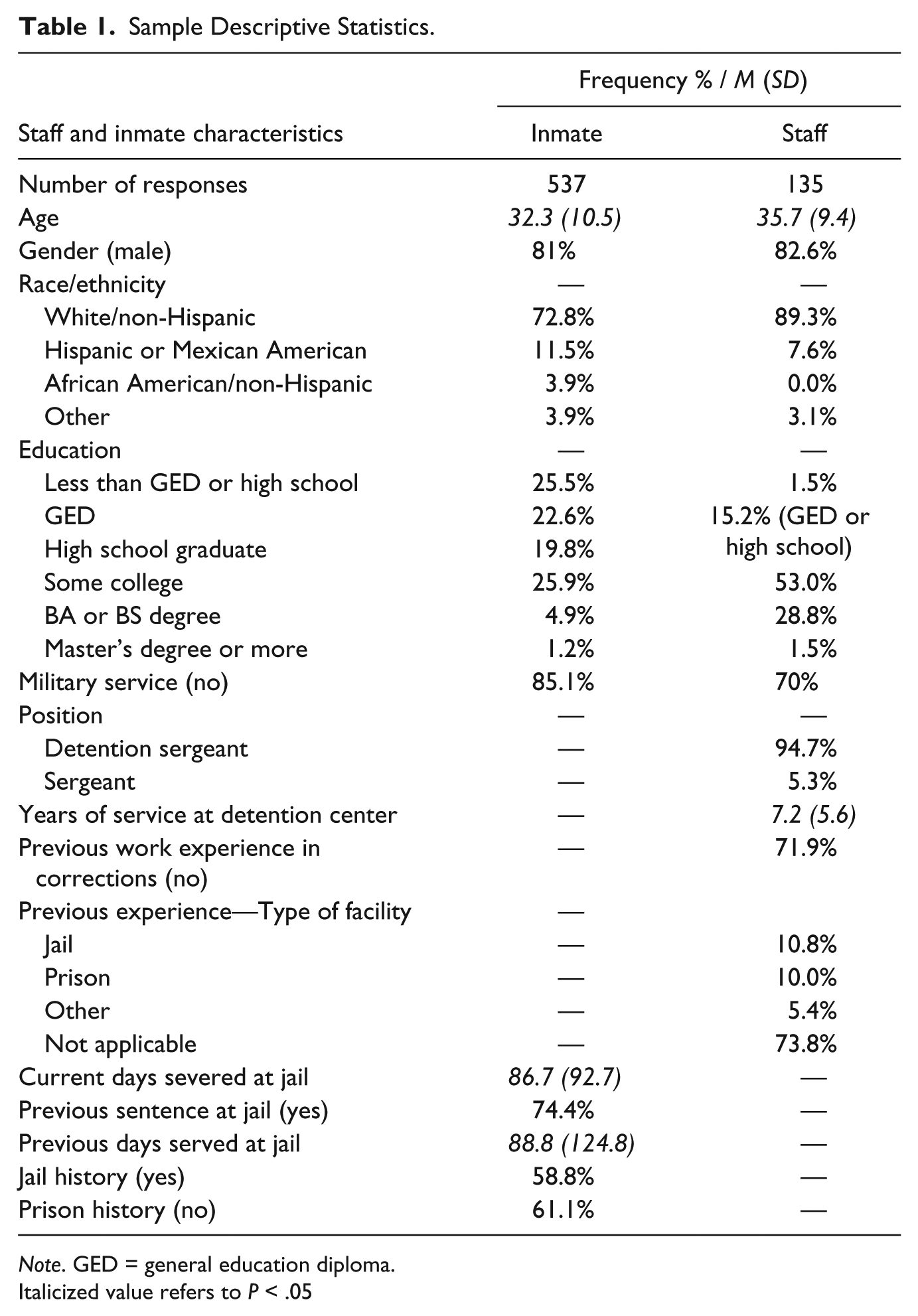
Note. GED = general education diploma.
Italicized value refers to P < .05
Analytic Strategy
Estimation
We used Mplus statistical software (Ver. 7.11) to conduct the statistical analysis. Due to the nature of categorical/ordinal variables, the analyses used the robust-weighted least-squares estimator (WLSMV). When conducting CFA and second-order modeling, the original 7-point Likert-type scaling approach is reserved. It should be noted that when conducting group invariance tests, 7-point Likert-type scale manifest variables are collapsed into binary variables, such that scores of 4 (“slightly agree”) or higher are recoded as “1 = agree,” and scores of 3 (“neutral”) and below are recoded as “0 = not agree.”
We recoded and collapsed variables into binary variables because of the technical difficulty in statistical calculation due to the missing responses in certain categories in the responses of correctional officers. The drawback of such a variable recoding approach is that when collapsing more categories of responses to fewer categories, we will experience a loss of statistical power and information. However, when using binary/categorical variables with WLSMV analysis, researchers will gain additional information regarding “item difficulty” and “item discrimination” on each manifest variable, both of which are extremely useful for group comparisons, as in the cases of correctional staff and inmates. In short, the negatives that derive from the loss of the information by collapsing variables are compensated by the additional type of information that is made available to the research team.
Model fit evaluation
When evaluating the goodness of statistical models, we used the conventional model fit indexes, including comparative fit index (CFI), Tucker–Lewis index (TLI), and root mean square error of approximation (RMSEA). We followed the generally accepted rules for indicating the goodness of model fit. For CFI and TLI, a value of .90 indicates an acceptable model, and a value of .95 or above indicates a good fit of the model. For RMSEA, a value of .08 or lower indicates an acceptable model, and a RMSEA value below .05 indicates a close model fit.
Second-order modeling
When imposing a second-order factor (ethics) over first-order factors (conceptualized ethical dimensions), we evaluate the goodness of second-order structure by using absolute chi-square (χ2) difference statistics. We do this because the second-order model structure, by its statistical nature, cannot fit better than the measurement model that only contains first-order factors. The appropriate method is to compare the hypothesized second-order model with the measurement model to determine whether second-order modeling results in a detrimental model fit.
(Partial) group invariance test and criteria
The group invariance tests allow the research team to test the validity of the instrument across different groups, in this case staff and inmates, by examining the invariant structure of certain parameters, including loadings and thresholds of manifest variables. Notably, in the ethics instrument, there are several items and one dimension (Democratic Participation) which were developed for staff only. Therefore, we only used the common items and common factors of inmates and staff when conducting group invariance tests.
The group invariance tests were conducted at the individual item level. The group invariance tests help determine the equality of the like-item loadings and like-item thresholds. In this analysis, like-item loadings and like-item thresholds were constrained to be equal across inmate group and staff. We will use the change in CFI value when evaluating the invariant form of the parameters across groups. There are other indicators which will be examined, such as the changes in TLI and RMSEA values as well as the statistic of chi-square difference tests. With that said, we will primarily rely on the change in CFI values as they compare with the other indicators because of the statistical and potential bias in other indicators. Specifically, the TLI and RMSEA correct for model parsimony, while the value of chi-square test and chi-square difference test are often inflated by large sample sizes. If we find that imposing constraint(s) on certain parameter results in detrimental fit (CFI change > .01), then partial group invariance tests will be performed, in which the parameter(s) would be set to be freely estimated. Then, we will compare the partially invariant model with the original model. Again, if the change of CFI is below .01, then we will retain the partially invariant models.
One of the advantages of the partial invariant tests is that this can provide the researcher with additional information regarding the generalizability of each manifest item. In other words, it will yield an important piece of information regarding whether different groups (i.e., inmates and staff) are as likely to provide a positive response on the items. To put this into context, empirical results from partial group invariance tests can tell us whether staff find it “easier” to endorse a “yes” on ethical perception items as compared with inmates.
Model identification
To solve model identification problems when conducting group invariance tests across groups with categorical/binary indicators, the loading of two within items in each group in each ethical dimension is constrained equally to gain sufficient positive degrees of freedom for overidentified models. This approach may be detrimental to the model and erroneously underestimate the goodness of the models’ fit because of the imposed unnecessary constraints. However, if one found the estimated models with additional (unnecessary) constraints still demonstrate a goodness of model fit, then one should conclude that the original model without additional constraints should be better when compared with the models with additional constraints. Conservatively, at least, the model should perform no worse than the models with additional constraints.
Results
Measurement Models
As indicated in Table 2, with CFI values >.924, TLI = .909, and RMSEA in the range of .050 to .080, the measurement model of ethics for both groups, staff and inmate, demonstrated a good model fit. All model fit indexes, including RMSEA, CFI, and TLI, suggested an acceptable model fit for the measurement model for both groups.
Measurement and Second-Order Model of Ethics for Inmates (N = 517) and Staff (N = 135).
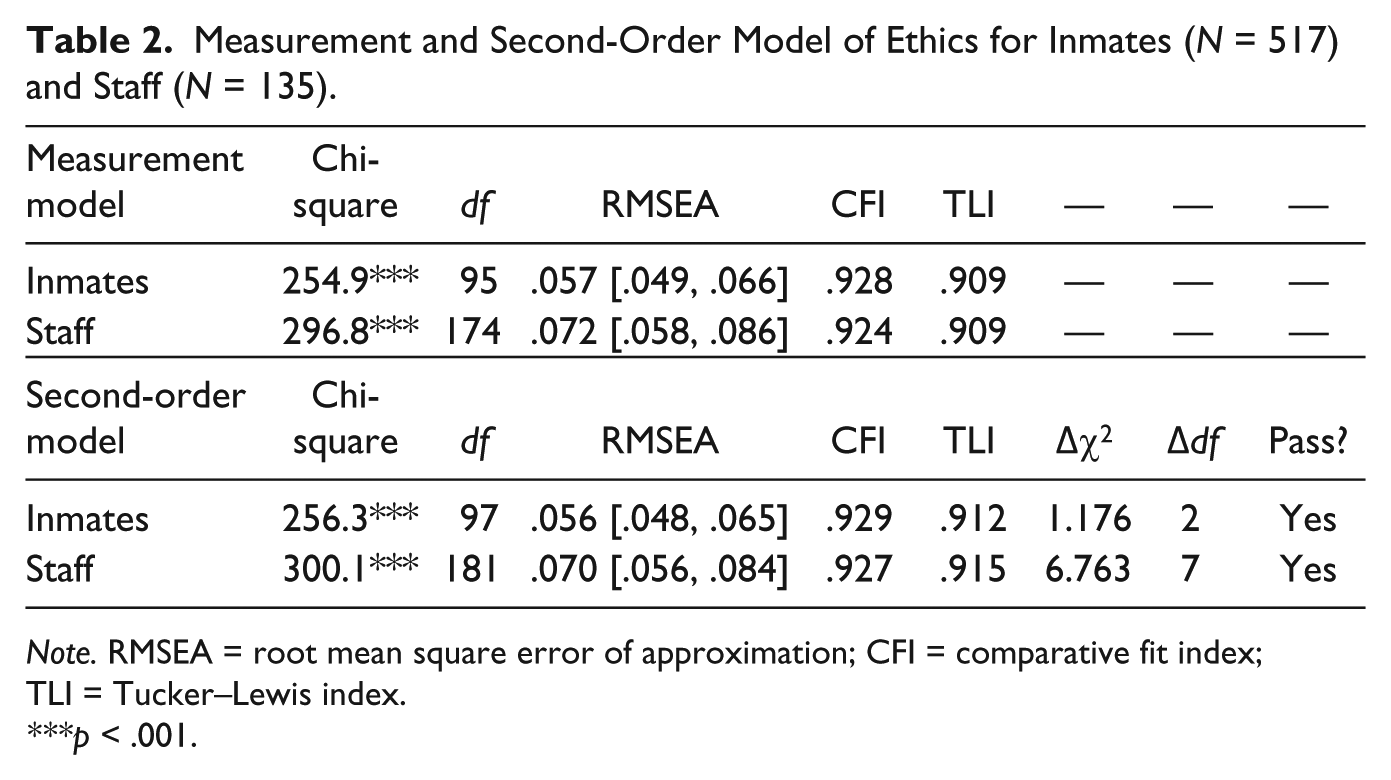
Note. RMSEA = root mean square error of approximation; CFI = comparative fit index; TLI = Tucker–Lewis index.
p < .001.
In both the groups, as indicated in Tables 3,conceptualized ethical dimensions are reasonably correlated with one another, which signifies that a second-order factor (ethics) may account for the common variance among first-order factors (each ethical dimension). Table 4 indicates that most of the item loadings are substantial and statistically significant.
Correlation Matrix for Five First-Order Factors.
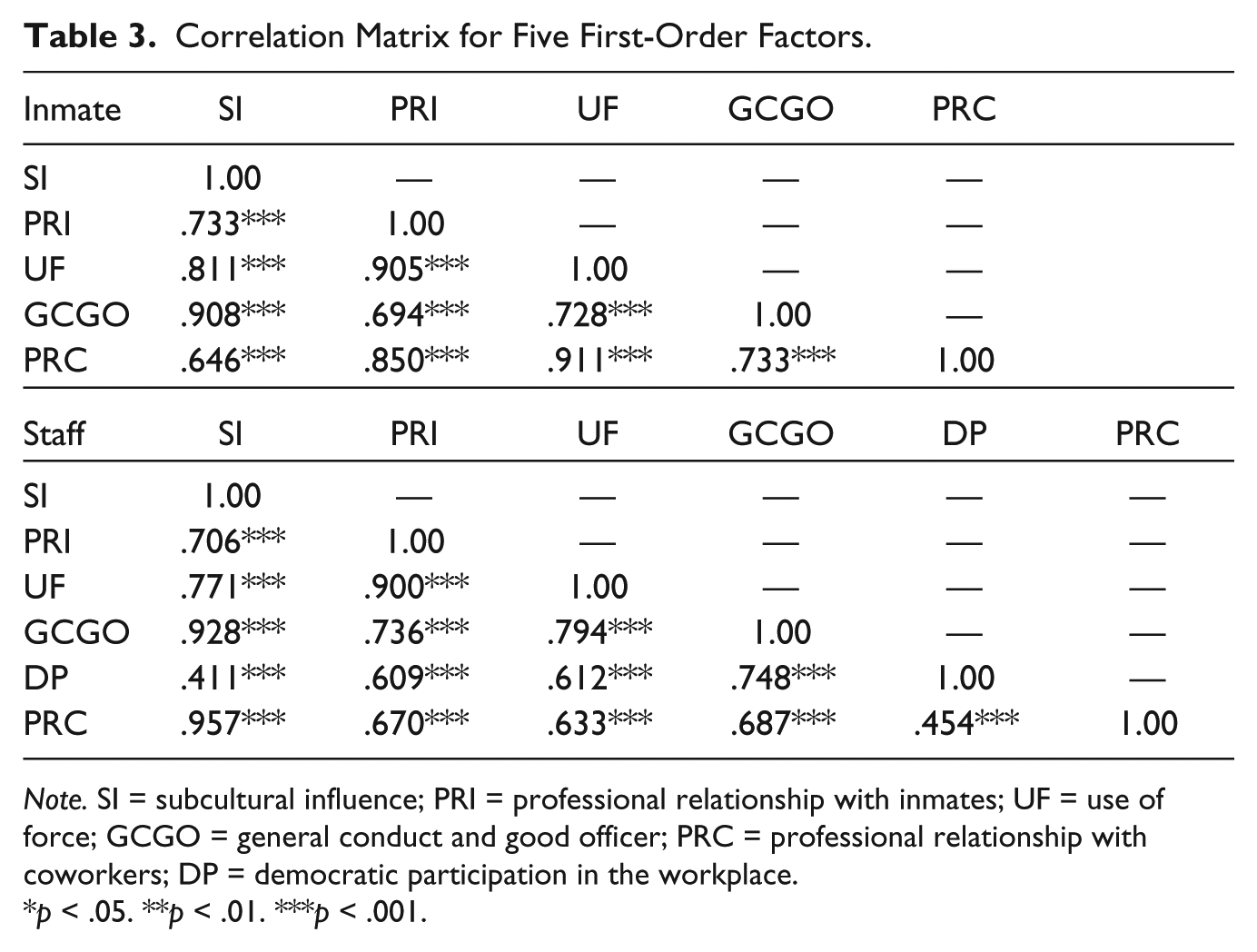
Note. SI = subcultural influence; PRI = professional relationship with inmates; UF = use of force; GCGO = general conduct and good officer; PRC = professional relationship with coworkers; DP = democratic participation in the workplace.
p < .05. **p < .01. ***p < .001.
Measurement and Second-Order Model of Ethics With Standardized Loadings.

*p < .05. **p < .01. ***p < .001.
Second-Order Models
As presented in Table 2, according to the chi-square difference test results (Δχ2 = 1.176 and Δdf = 2 for inmates model; Δχ2 = 6.673 and Δdf = 7 for staff model), imposing a second-ordered structure onto the first-order factors did not result in detrimental model fit for either of the groups. As demonstrated in Table 4, the value of loadings of the manifest indicators in the second-order model did not dramatically change, and they are relatively stable compared with the loadings in the measurement models. Therefore, we retain the second-order models for both staff and inmates.
As delineated in Table 5, in the second-order models for both staff and inmates, the first-order factor loadings are statistically significant and substantial (ranging from .700 to .968 for staff model and from .742 to .966 for inmate model), which means that the hypothesized second-order factor “ethics” is able to account for a large amount of the common variance among each of the first-order factors.
Standardized First-Order Factor Loading and Group Mean Difference.

p < .05. **p < .01. ***p < .001.
The visualization of the second-order model of ethics for both staff and inmates is presented in Figure 1.
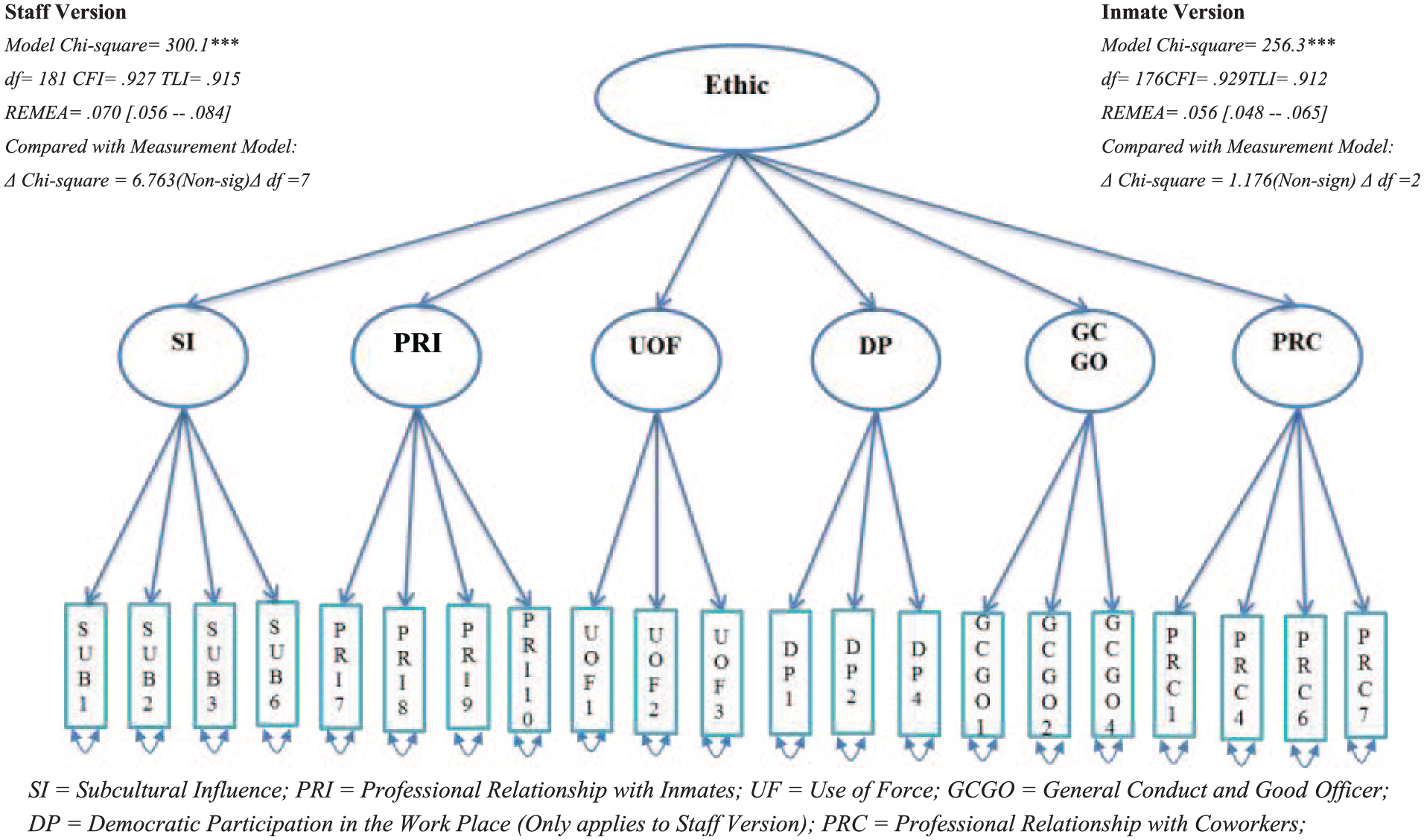
Second-order model of ethics in corrections.
Group Invariance Tests and Partial Invariance Tests
As indicated in Table 6, three dimensions (use of force, general good conduct, and the good officer and professional coworker relationship) passed the robust group invariance tests with no change in CFI values. Two dimensions (subcultural influence and professional relationship with inmates), however, did not pass the group invariance tests. Imposing constraints on like-item loadings and like-item thresholds resulted in detrimental fit, according to the change of value in CFI. Therefore, partial invariance tests were performed on these two dimensions. After setting the constraints free for the threshold with significant and the largest modification indices, both of the dimensions passed partial invariant tests across groups of inmates and groups of staff.
Group Invariance Tests and Partial Invariance Tests.
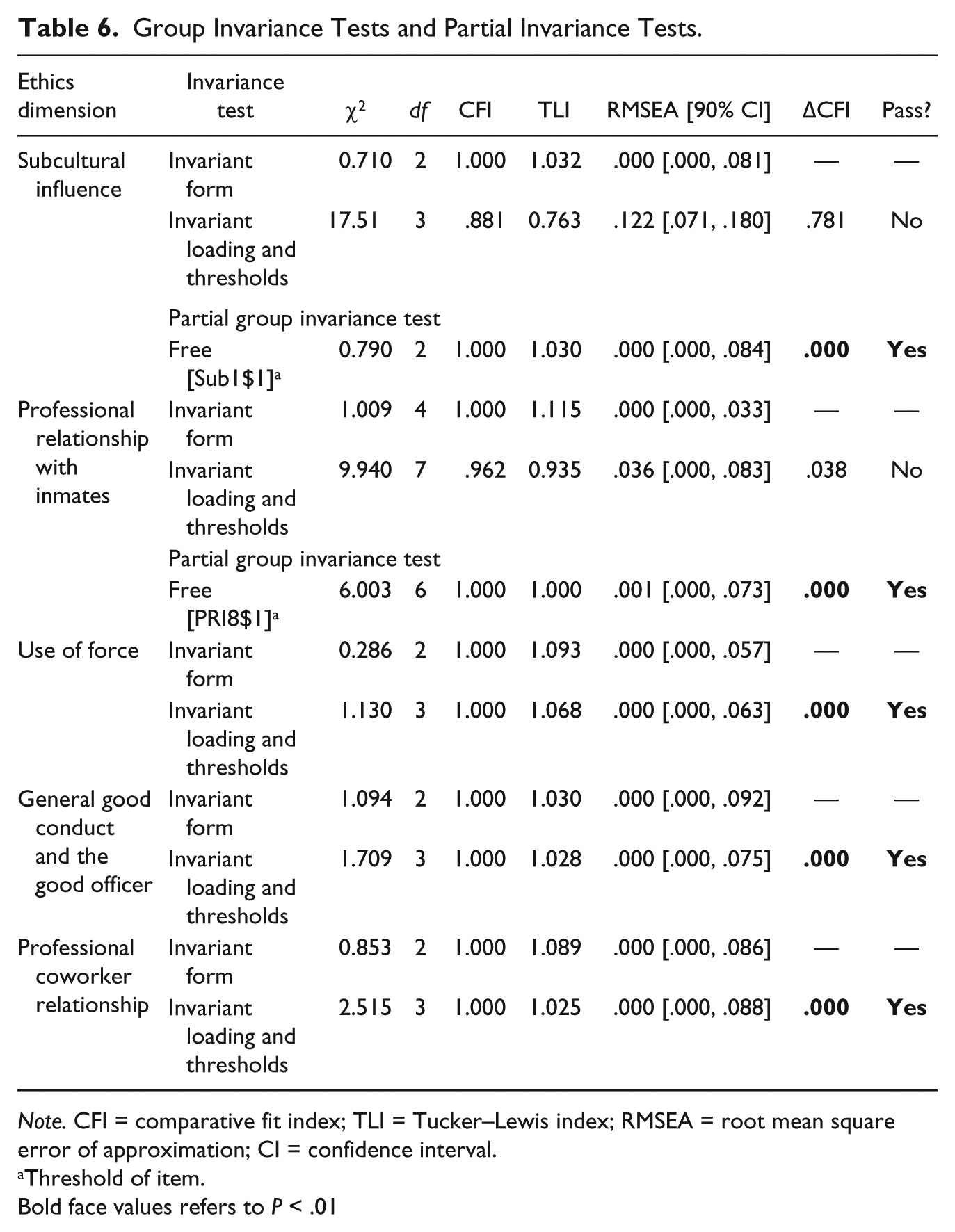
Note. CFI = comparative fit index; TLI = Tucker–Lewis index; RMSEA = root mean square error of approximation; CI = confidence interval.
Threshold of item.
Bold face values refers to P < .01
Item Characteristics and Factor Mean Difference
As presented in Table 7, most of the values of like-item loadings, thresholds, and discriminations are statistically equivalent across groups, which is the empirical support that reinforces the evidence accumulated from measurement models and second-order models. In other words, this evidence indicates the construct validity and the generalizability of the ethics instrument. Notably, there are two items that are statistically not equivalent in item difficulty values across groups. As indicated in Table 7, the item difficulty values of staff are significantly lower than those of inmates, which indicates that staff are more likely to endorse a positive response to support their perception of ethical conduct in comparison with inmates.
Standardized Item Estimates of Invariance Models and Partial Invariance Models.

Finally, as indicated in Table 5, compared with inmates, with p < .01 and standardized mean difference of 2.466 and 1.588, staff score is significantly higher than inmates on two of the factorial dimensions (use of force and general good conduct and the good officer).
Discussion
In correctional institutions, one of the dominant themes is the interplay between inmates and staff. Yet, the individuals in these two groups are by definition substantially different from each other in terms of why they are there and their responsibilities. Controlling inmates and maintaining order while engaging in effective rehabilitation efforts are by no means an easy task for staff and administrators. To meet such challenging requirements, criminal justice administrators often fall into the pitfall of the “means-over-ends” syndrome (Goldstein, 1979) or “end-over-means” traps (Stohr & Collins, 2014).
Moreover, inmates often come from dysfunctional families and disadvantaged communities (Sampson, 2012). The “get-tough-on-crime” movement of the last four decades reinforced our perception that it is a criminal’s free choice to commit crime, and that the focus of prison should not be rehabilitation but retribution and incapacitation. Because inmates are viewed so unfavorably (negatively), there exists the possibility that staff may be more inclined to treat them as they are viewed. Therefore, it is essential we understand the ethical environment in correctional settings, so that perceptions are understood and, if necessary, addressed proactively with the end of creating a more ethical environment.
Understanding jail and prison culture in general, and their ethical culture in particular, is so important that it demands the production of scientific evidence to inform administrative and managerial strategies. This study has made several contributions to potentially effectuate positive changes and actions: First, this study produced empirical evidence with relatively high-quality content validity and construct validity of the ethics instrument used.
Second, we have found statistical evidence from second-order modeling that supports the conceptualized and operationalized ethical nature and ethical dimensions (subcultural influences, professional relations with inmates, appropriate use of force, general conduct and the “good officer,” democratic participation in the workplace, and professional coworker relations).
Third, the hypothesized structure of ethical culture is valid not only for groups of inmates but also for staff, which indicates good generalizability of the validated ethic measurement/instrument across different groups.
Fourth, we found that, in general, staff score is higher than inmates when responding to the ethical items in the instrument for all five common dimensions, but such difference is only statistically significant for two ethical dimensions (use of force and general good conduct and good officers). This suggests that, compared with inmates, staff perceived the use of excessive force as less acceptable when controlling inmates.
Furthermore, compared with inmates, staff demonstrated higher level of ethical standards; these standards include refusing to bring contraband into prison, upholding the law, and protecting inmates. As explained above, staff score higher than inmates on all five common ethical dimensions, which indicates that staff have demonstrated higher ethical standards compared with inmates. This reconfirms previous research findings (Iannacchione et al., 2014).
Unfortunately, we believe that inmates’ less positive perception of staff ethical behavior reinforces the belief that inmates may be more vulnerable victims of staff deviance. Also, because inmates may perceive staff unethical behaviors as acceptable, they could encourage or manipulate staff to engage in certain unethical behaviors such as bribing correctional officers to bring in contraband or drugs. As well, they could be unconsciously encouraging staff to resort to violence to control inmates because they “respect a show of force.” Administrators confronted with such findings might work to calibrate the training of staff to ensure that they understand the myriad ways they are susceptible to corruption. They might also ensure that staff are trained well in the appropriate use of force and warned about the possible ill influence of inmates eager for a “show of force.”
Finally, we have found that most of the items common to both groups within each dimension are useful to estimate the ethical perceptions of both inmates and staff with two exceptions. According to the evidence produced by performing partial group invariant tests, compared with inmates, staff were more likely to endorse “ethical behavior.” These two items are “Detention staff have an obligation to report thefts by other staff” and “Minority group inmates are naturally less reliable as trustees than White Inmates.”
On one hand, on the basis of this evidence, we are confident that while the first item might be useful for measuring staff perceptions about low-level ethical violations, it might not be useful when examining serious ethical violations because of the lack of ability of discriminating the acceptable ethics standards. On the other hand, this implies that, compared with inmates, staff have a very clear ethical belief that “detention staff have an obligation to report thefts by other staff.” Furthermore, when conducting the analysis, the second item is reverse coded. Hence, staff are more likely to say no to this item than inmates. This means that staff are more likely to believe that minority groups are not less reliable as trustees than White inmates. In other words, it is very common for staff to believe that minority and White inmates are equally trustworthy.
Conclusions and Limitations
As discussed in the preceding, the results from the current study have important implications in terms of furthering the empirical knowledge regarding the culture and perceptions of ethical work in correctional settings. However, the generalizability of the findings from this study could be strengthened if we had obtained a more representative and larger sample of staff and inmates, particularly staff. With that said, this research does have the advantage of a reasonable sample size for the analysis of inmate perceptions (N = 537), and most of them (N = 517) have complete and valid responses that were used in the analysis.
Moreover, the model fit indexes did not reach the strict cut-off value that would indicate unquestionable good model fit but did indicate acceptable to good model fit. As far as the instrument goes, the research team used selected items; therefore, the empirical evidence resulting from this analysis can only be extended to the items that are used and not to the whole instrument. However, based on the strong scientific evidence produced in this study, we believe that we have found valuable items that can be used to measure the perceptions of the ethical behavior of staff, which, in turn, could be used to make informative managerial and administrative decisions.
Footnotes
Appendix
Ethical Dimensions and Item Descriptions.

| Items | Dimension and item descriptions |
|---|---|
| Subcultural influence | |
| SUB1 | Detention staff have an obligation to report thefts by other staff. |
| SUB2 | When staff see other staff abusing inmates appropriate they should report that abuse. |
| SUB3 | An officer who reports the harassment of inmates by other staff is doing the right thing. |
| SUB6 | If most of your coworkers choose to disregard policies and procedures, then it is okay for you to do so as well. a |
| Professional relationship with inmates | |
| PRI7 | Staff who treat inmates with respect rarely get respect from inmates in return. a |
| PRI8 | Minority group inmates are naturally less reliable as trustees than White inmates. a |
| PRI9 | Addressing inmates in a respectful manner may give them the idea that they can manipulate staff. a |
| PRI10 | When a correctional staff member is consistent and fair in their relations with inmates, they are more likely to be respected by inmates. |
| Use of force | |
| UOF1 | The only thing that inmates respect is a show of force. a |
| UOF2 | Most of the inmates in most instances will respond to an order with no force needed. |
| UOF3 | Hitting a disruptive inmate a few more times than is strictly necessary is understandable. a |
| Democratic participation in the workplace | |
| DP1 | Correctional administrators should provide a means for other correctional staff to have input into the operation of the institution. |
| DP2 | A correctional staff member should simply listen to orders and rarely offer input. a |
| DP4 | Correctional staff have the skills and abilities necessary to solve problems in the workplace. |
| General good conduct and good officer | |
| GCGO1 | Staff who bring in contraband should be disciplined. |
| GCGO2 | Detention staff should, above all, concern themselves with upholding the law. |
| GCGO4 | Detention staff members have a duty to protect the inmates. |
| Professional coworker relationship | |
| PCR1 | Making sexual comments in the workplace about other staff is not necessarily harassment. a |
| PCR4 | Put-downs of people of opposite gender in the workplace are usually meant to be funny. a |
| PCR6 | Sexual relations between staff and inmates are sometimes acceptable. a |
| PCR7 | Staff who treat inmates with respect rarely get respect from inmates in return. a |
Note. Response: 1 = strongly disagree, 2 = disagree, 3 = slightly disagree, 4 = neutral, 5 = agree, 6 = agree, 7 = strongly agree; 8 = don’t know = missing data.
Item is reverse coded.
Declaration of Conflicting Interests
The author(s) declared no potential conflicts of interest with respect to the research, authorship, and/or publication of this article.
Funding
The author(s) received no financial support for the research, authorship, and/or publication of this article.