



Abstract
Many correctional officers who work in close proximity with inmates are at a heightened risk of experiencing feelings of psychological distress. We analyzed 501 surveys collected from correctional officers within the Texas Department of Criminal Justice to identify characteristics of officers who are likely to exhibit signs of depression. Our findings reveal that female officers, as well as officers who work in higher custody levels, are more likely than other officers to report higher levels of depressive symptomatology. We also found that officers who experienced high levels of self-reported job-related stress were more likely to suffer from depression. Officers with attitudes favorable to the mistreatment of inmates also reported higher levels of depression. Officers who perceived their coworkers were engaging in boundary violations were no more or less likely to exhibit signs of depression. Given these findings, we conclude that organizational and supervisory support, coupled with positive incentives and employee assistance programs, may help mitigate the risks of depression for correctional officers, thereby making these salient staff more efficient and effective in the prison workplace.
Keywords
Working in institutional corrections involves interacting with individuals being held against their will for violations of criminal law. This form of employment is unique and differs significantly from most other occupations (Goldberg et al., 1996). It also carries risks. Armstrong and Griffin (2004) note that “few other organizations are charged with the central task of supervising and securing an unwilling and potentially violent population” (p. 577). Working in corrections presents challenges to officers, and these challenges can increase the level of psychological strain and stress, ultimately influencing officers” mental health (Ferdik & Smith, 2017). While there are a variety of different position in a correctional facility, such as, teachers, maintenance workers, and administrative personnel, correctional officers account for the largest group of staff working behind prison walls. These individuals are assigned duties and tasks to ensure a safe, secure, and humane institution. Correctional officers can be forced to work mandatory overtime, which, in turn, increases the incidence of accidents and other mistakes, such as sloppy paperwork (Ross, 2016). The nature of correctional employment can also require officers to work rotating shifts, which can take a toll on their mental and physical health (Wetzel, 2017). These work conditions may also make it difficult for officers to spend time with their loved ones or be available for routine visits to the doctor or dentist (Ross, 2016). Over time, they are also more likely to develop heart disease, high blood pressure, impotence, and stomach ulcers as the result of accumulated work stress. Officers are also at a heightened risk of contracting contagious diseases from inmates (Leininger, 2019). In spite of the above occupational hazards, correctional officers tend to receive very low pay. In Texas, for example, a newly hired correctional officer only receives an annual salary of $41,674 and maxes out in pay within six years at $51,338 (Texas Department on Criminal Justice, 2022). Correctional officers are expected to support the rehabilitation of inmates, while also maintaining control (Worley & Worley, 2011).
The mental health of correctional staff matters. The workplace itself may contribute, in either a positive or a negative manner, to the mental wellbeing of officers. Psychological distress and depressive symptoms can be detrimental for correctional staff (Badru et al., 2018; Goldberg et al., 1996; Liu et al., 2013; Obidoa et al., 2011). When officers suffer from extreme episodes of depression, the day-to-day operations of the correctional facility can be impacted. Mental illness, such as depression, may result in burnout or higher use of sick days – either outcome can result in fellow officers being required to work mandatory overtime (Lambert, Edwards, et al., 2005; Worley & Worley, 2013). Increasing the psychological wellbeing of correctional officers will result in a more professional workforce, which will assist in inmate rehabilitation, thereby making society a safer place. While research has examined how workplace variables contribute to the job stress of corrections officers, few studies have explored how workplace variables are linked to depressive symptomatology (i.e., depression) among correctional officers. This is an important area of study, as correctional officers have a suicide rate 39% higher than the general public’s (Kochanek et al., 2015; Stack & Tsoudis, 1997).
In this exploratory study, we use the job demands-resources model to examine the link between workplace variables and depressive symptomology among Texas correctional officers. The job demands-resources model places workplace variables into two general categories of job demands and job resources. Job demand variables are workplace factors that make the job more challenging and impede officers” work success (Schaufeli & Taris, 2014). Conversely, job resource variables are workplace factors that help officers be more successful in their jobs and/or allow the job to be more pleasant; they can also act as a buffer from the more trying aspects of the job (Demerouti et al., 2001). The current study examined the job demands of work stress, boundary violations, and attitudes favorable to the mistreatment of inmates. We also examined the job resource of job satisfaction. We hypothesized that work demands will raise the level of depressive symptomatology, while job resources will lower it. This study’s findings will help both correctional administrators and scholars understand how different workplace variables are associated with depression in correctional officers.
Literature Review
Job Demands-Resources Model
Demerouti et al. (2001) developed the job demand-resource model, which is an overarching model to explain how workplace factors may play a role in both positive and negative outcomes. Depression is one possible negative outcome. This model places workplace variables into the two general categories of job demands and job resources (Bakker & Demerouti, 2007). As indicated by Demerouti et al. (2001), “job demands are those physical, psychological, social, or organizational aspects of the job that require sustained physical or mental effort and are therefore associated with certain physiological and psychological costs” (p. 501). Conversely, job resources are “those physical, psychological, social, or organizational aspects of the job that may do any of the following: (a) be functional in achieving work goals; (b) reduce job demands and the associated physiological and psychological costs; (c) stimulate personal growth and development” (p. 501). In addition to making the job more enjoyable and buffering the negative effects of job demands, low levels (or absence) of job resources can become job demands (Schaufeli & Taris, 2014).
According to this model, prolonged exposure to job demands raises psychological distress, which, over time, increases levels of depression (Bakker & Demerouti, 2007). Job resource variables, on the other hand, aid employees in pursuing their jobs productively, make work more pleasant, and allow employees to feel esteemed in the workplace and by the organization (Hu et al., 2011). There is no specific set of workplace variables that are job demands or job resources. The effects of job demands and resources can vary across different organizations. As noted by Schaufeli and Taris (2014), “the job demands-resources model does not restrict itself to specific job demands or job resources. It assumes any demand and any resource may affect employee health and well-being” (p. 44). It is important to explore how different job demands and resources are related to depression among correctional staff.
The job demands-resources model focuses on the wellbeing of an employees (Bakker & Demerouti, 2007). According to Schaufeli and Taris (2014), there are two processes for the model – energetic process and motivational process. Demerouti et al. (2001) proposed that job demands and a lack of adequate job resources impact the energetic process of a person, and a person’s health and well-being are the result of a balance of job resources and job demands. Job demands result in mental and/or physical exhaustion, which results in a reduction of wellbeing. Job resources help buffer the effects of demands, raising the wellbeing of a person (Schaufeli & Taris, 2014). Schaufeli and Bakker (2004) added that the motivational process includes work engagement, and job demands result in job withdrawal to protect against further exhaustion from job demands. Job resources result in greater motivation, which increases the level of work engagement (Schaufeli & Taris, 2014). Basically, job demands tend to result in negative outcomes while job resources tend to result in positive outcomes, such as wellbeing.
The limited past correctional staff research generally provides support for the job demand-resource model. As previously indicated, there is no single model or single set of job demands-resources variables; instead, the model categorizes job variables depending on whether they negatively or positively affect employee wellbeing and motivation (Schaufeli & Taris, 2014). The current study explored how the job demands of work stress, boundary violation views, and mistreatment of inmates and the job resource of job satisfaction were associated with depressive symptomatology among correctional officers.
Boundary Violations Behind the Prison Walls
Most correctional officers are professional in their interactions with inmates; however, some officers cross the line and engage in boundary violations, which potentially puts everyone at risk. If, for example, an officer provided an inmate with a weapon, it could be used as a tool to assault a fellow correctional officer and perhaps even escape. Boundary violations refer to behaviors that “blur, minimize, or disrupt the professional distance between correctional staff members and prisoners” (Marquart et al., 2001, p. 878). Worley and Worley (2016) in their theory of crossing over, note that poor pay, perceptions of boundary violations by other officers, and lack of family support, lead some officers to have a lack of pride in their work and profession. This theory of prison employee corruption posits that some correctional officers cross over to the side of those who are more relatively deprived than they are, ultimately leading to the boundary violation (Worley & Worley, 2016). Boundary violations need not be sexual in nature. Some boundary violations may even seem fairly inconsequential, such as, a correctional officer giving an inmate fast food from the “free world” (Worley & Worley, 2016). While very few studies have systematically examined staff-inmate boundary violations (Worley et al., 2019; Worley et al., 2003; Worley & Worley, 2016), there is a strong indication that inmates (at least male inmates) often initiate interactions with staff members to entice them to commit rule infractions (Worley et al., 2003; Worley, 2016). Once an inmate corrupts a staff member, he can obtain creature comforts, such as alcohol, drugs, cell phones, and possibly even sex – usually from female employees (Worley & Cheeseman, 2006). Correctional officers” perceptions of boundary violations are an unexplored workplace factor in terms of its relationship with depression among correctional staff.
Attitudes Favorable to the Mistreatment of Inmates
While the academic literature pertaining to correctional officer brutality is scarce, both news reports and recent court documents illustrate that this phenomenon is pervasive (in terms of physical and sexual abuse) in prisons and jails throughout the country (Worley et al., 2021). In the first, and perhaps only ethnographic study of its kind, Marquart (1986), a prison officer turned professor, employed a complete participant observational approach to analyze correctional officers' use of physical coercion against inmates at a large maximum-security penal facility in Texas. During this field study, which occurred between 1981 and 1982, the researcher worked full-time as a correctional officer and was privy to at least 50 cases where prison staff physically abused inmates for engaging in various rule infractions.
While the excessive use of force by correctional officers against inmates continues to persist in prisons and jails, it is likely that neither the officer subculture nor prison administration openly embraces violence as a means to control inmates, as in the past (Chenault, 2014; Worley et al., 2021). Still, correctional officers may participate in numerous nonviolent abusive behaviors, which are more psychological, and less physical, in nature. Ross (2013), another former correctional officer turned academic, contends that officers may submit false disciplinary reports [inmate write-ups], steal a prisoners' belongings, tamper with thermostat settings, arbitrarily deny privileges, alter an inmate’s food, deny an inmate access to the infirmary, or destroy a prisoner’s mail. In the present study, we seek to examine whether an officer’s tolerance of the abuse of inmates is empirically related to his or her own symptoms of depression.
Depressive Symptomatology
Life stress is a term used to broadly describe how stressors can result in psychological distress for a person (Lin & Ensel, 1989). Life stress has two major parts – stimuli and psychological strain or distress (Slavich, 2016). Different stimuli in life can reduce or enhance the chances of psychological distress. Depression is a major consequence, and it is sometimes the focus of life stress research (Slavich, 2016). For the purpose of our investigation, questions related to life stress will measure respondents” depressive symptomology. Stimuli can either be negative or positive. Negative stimuli tend to result in greater psychological distress, and positive stimuli tend to reduce psychological strain, as well as provide a buffer to negative stimuli (Lambert et al., 2018). The most recent version of The Diagnostic and Statistical Manual of Mental Disorders (5th ed.; DSM–5; American Psychiatric Association, 2022) provides clinicians with an integrated approach to diagnosing an individual with depression. These new diagnostic criterial require clinicians to look at a patient’s depressive symptoms over the last two weeks (DSM–5). If a patient has low energy, a loss of self-worth, changes in appetite or sleep patterns, an inability to concentrate, suicidal ideation, and moves slowly, he or she is clinically depressed. According to the DSM–5, an individual only needs to meet a majority of the above criterial to be diagnosed as depressed. The symptoms must not be the result of substance abuse or another medical or mental health condition (DSM–5). The literature suggests that depression can result from psychological distress (Taylor et al., 2018).
Correctional Staff Research on Depression
In a study of U.S. correctional officers that used the Center for Epidemiologic Studies Depression (CESD) scale to measure the level of depression symptoms, Cullen et al. (1985) found that role problems (i.e., role conflict and role ambiguity) and feeling the job was dangerous were related to increased depressive symptomology, while supervisor support, coworker support, family support, and community support each had nonsignificant effects. Job satisfaction was not a significant predictor. In a study that used the CESD scale to measure the attitudes of U.S. probation and parole officers, job stress and role conflict both had a significant positive relationship with depressive symptomatology measured by the CESD scale (Gayman & Bradley, 2013).
In addition to the job demands of role conflict, role ambiguity, and perceived dangerousness of the job, association of the job demands of burnout and work-family conflict (i.e., domain spillover between home and work) with depression have been studied. A study that used the shortened 10-item CESD scale found that job burnout had a positive relationship with depression among jail staff (Jaegers et al., 2020). Similarly, using the shortened 10-item scale, emotional exhaustion job burnout resulted in higher levels of depression, and, additionally, depression resulted in lower performance among correctional staff. The level of variance explained in depression symptoms was not provided (Lee et al., 2019). Among correctional officers, work-on-family conflict and family-on-work conflict both were significantly related to higher levels of depression as measured using the shortened 10-item CESD scale, and a sense of coherence (looking at life in a positive manner) was significantly related to lower levels of depression (Obidoa et al., 2011). Using the depression part of the Brief Symptom Inventory, work-on-family conflict (when the work domain spills over and causes conflict in the home domain) was linked to depressive symptoms among correctional supervisors (Namazi et al., 2019).
The job resource of social support has been found to result in lower depression for correctional staff. Among male Chinese correctional staff, organizational support had a negative effect on depression measured using the CESD scale (Liu et al., 2013). Additionally, social support reduced the level of depression measured using the CESD scale among French correctional staff. No specific amount of variance explained in depression symptoms was provided (Goldberg et al., 1996).
In summary, two general conclusions can be formed from this published literature. First, the job demands and resources model, while not explicitly tested in the above studies, was supported. The current study indicates that job demands may be associated with higher levels of depression among correctional staff and job resources may be linked to lower levels of depressive symptomatology. Second, there has been limited research in this area. Additional studies examining how various job demands and job resources are related to correctional officer depressive symptomatology are needed. Other, as yet unstudied, workplace variables may be connected with correctional staff depressive symptomatology. The current study, therefore, explores how the job demands of work stress, boundary violations, and mistreatment of inmates, and the job resource of job satisfaction were related to correctional officer depressive symptomatology using the CESD scale.
Current Study
As previously discussed, under the job demands-resources model, job demands cause strain in people, increasing the chances of negative outcomes. Job resources tend to result in positive psychological feelings and can buffer the negative effects of job demands. When job resources are low or are missing, they become job demands. For the current study, the job demands were work stress, boundary violations, and mistreatment of inmates, and the job resource was job satisfaction. Obidoa et al. (2011) noted that depression or experiencing depressive symptoms often occurs as the result of stressors.
Work stress refers to feeling tense at work (Cullen et al., 1985). For the purposes of the present study, work stress is quite different than life stress. Questions relating to life stress measure aspects of one’s private life, whereas questions related to work stress relate to a respondent’s experiences in the workplace. Life stress measures focus on depressive symptomology. Work stress on the other hand is a predicator variable that measures a negative job experience, and, as such, is viewed as a job demand. The psychological tension from this job demand can wear on a person over time, increasing the chances for negative outcomes. Work stress can result in depressive symptomatology and depression (Gayman & Bradley, 2013; Jaegers et al., 2020). The adoption of the job demand resource model to understand work stress and its impact on officer depression is appropriate and intuitively makes sense (Demerouti et al., 2001). We predicted that work stress would have a positive association with CESD-scale depressive symptoms among correctional officers (Hypothesis 1).
Perceptions of boundary violations by fellow officers is a possible job demand which could contribute to experiencing depression symptoms. Perceptions of boundary violations occur when an officer believes other (fellow) officers are engaged in violating prison rules. This is viewed as a job demand, as it could place psychological strain on an officer. It could also place the officers at risk of being harmed or injured by inmates, who might strike back after being mistreated or victimized by rogue correctional officers (Lambert et al., 2018). As a job demand, this workplace variable is a stressor (i.e., raises level of psychological strain). As a stressor, we predicted that perceptions of boundary violations would have a positive relationship with depressive symptoms as measured by the CESD scale (Hypothesis 2).
When correctional officers possess attitudes and behaviors that demonstrate a willingness to engage in mistreatment of incarcerated individuals, we consider this is a job demand (Worley et al., 2021). If officers tolerate acts of abuse or incivility toward offenders, it can result in psychological strain and tension. These officers may feel guilty about their willingness to engage in abusive behavior, and/or officers may fear being caught and disciplined for such conduct. As a job demand, having attitudes favorable to the mistreatment of inmates is a stressor, and stressors can lead to experiencing depressive symptoms (Obidoa et al., 2011). Given this, we predicted officers” support for mistreatment behavior toward inmates would have a positive relationship with depressive symptoms as measured by the CESD scale (Hypothesis 3).
Job satisfaction refers to the “extent to which people like their job” (Spector, 1996, p. 214). Job satisfaction is a job resource because it results in individuals feeling good about their jobs. Job satisfaction is likely to result in positive psychological feelings, which, in turn, reduce the chances of experiencing depression. In light of the above, we predicted that job satisfaction will have a negative association with depressive symptoms measured by the CESD scale among correctional officers (Hypothesis 4).
Method
Participants
Human subjects” approval was granted for this study and informed consent was obtained from the participants. The research proposal was approved by two Institutional Review Boards (IRBs): a university board as well as the Texas Department of Criminal Justice’s. Approval from both institutions was contingent on the other board approving it. Surveys were administered to correctional officers from the Texas Department on Criminal Justice at a training workshop at a regional training center. The officers were from one of the six regions of the Texas prison system, had eight months or more employment with the prison system, and held a housing post that required regular direct contact with inmates. All the surveyed officers were line staff (i.e., had no direct supervision of other correctional staff) and worked at prisons holding male inmates. On the front of survey, respondents were informed about the nature of the study, as well as the risks and rewards. Respondents were also informed on this sheet that taking the provided survey was voluntary, that they could stop taking the survey at any time, that they could decline to answer any questions they wished, that responses would be anonymous, and data would be kept confidential. Of the 630 officers asked to be part of the study, 501 agreed and returned a completed survey, which is a response rate of 80%.
The median age was 37 years old, and the age of the responding officers ranged from 18 to 64. In terms of race/ethnicity, 68% indicated White/non-Hispanic, 20% African American, 6% Hispanic American, and 5% other. The reported median tenure with the Texas prison system was 5.2 years and ranged from about 1 year to 31 years. In terms of highest educational level, 43% reported earning a high school diploma or GED, 45% had taken some college courses but no college degree, 10% possessed an undergraduate college degree, and 2% had earned a graduate or professional degree. Among those who completed the survey, 66% indicated that they were men and 34% were women. In terms of custody (security) level, 12% indicated they were assigned to the lowest level custody unit, 34% to the next custody level, 33% to the third custody level, 17% to the second to highest custody level unit, and 4% to the highest custody level unit. Based on an information from the human resources office, the participants in this sample were similar to the overall population of correctional officers in the region in terms of race/ethnicity, tenure, gender, and custody level assignment at the time of the survey. The responding officers for the current study were slightly younger by about two years.
Variables
In the present study, the dependent variable was the level of depressive symptoms measured based on the 20-item CESD scale (Radloff, 1977). The scale consisted of 20 questions describing symptoms or behavior connected with depression. The following are the CESD items that asked how the participant experienced the following in the past four weeks, with no = 0 and yes = 1: 1) you were bothered by things that don’t usually bother you; 2) you did not feel like eating; your appetite was poor; 3) you felt that you would not shake off the blues, even with help from family and friends; 4) you felt that you were just as good as other people (responses reverse numbered); 5) you had trouble keeping your mind on what you were doing; 6) you felt depressed; 7) you felt that everything you did was an effort; 8) you felt hopeful about the future (responses reverse numbered); 9) you thought your life had been a failure; 10) you felt fearful; 11) your sleep was restless; 12) you were happy (responses reverse numbered); 13) you talked less than usual; 14) you felt lonely; 15) people were friendly (responses reverse numbered); 16) you enjoyed life (responses reverse numbered); 17) you had crying spells; 18) you felt sad; 19) you felt that people disliked you; and 20) you could not get going. Higher scores indicate a higher frequency of depressive symptoms (Devins et al., 1988).
Work stress, a job demand, was measured using 5 items from Cullen et al. (1985). The work stress items were: (1) When I am at work I often feel tense or uptight; (2) A lot of times, my job makes me very frustrated or angry; (3) There are several aspects of my job that make me upset about things; (4) I am usually calm or at ease at work (responses reverse numbered); and (5) I don’t consider this to be a stressful job (responses reverse numbered). The response options for these items were a 5-point Likert scale of strongly disagree ( = 1), disagree ( = 2), somewhat ( = 3), agree ( = 4), and strongly agree ( = 5). The Cronbach’s alpha value was .78. The items were entered into an exploratory factors analysis using principal axis factoring, and all loaded on a single factor, with factor loading scores of .56 or higher, indicating unidimensionality (Comrey & Lee, 1992). The responses to the five items were summed together to create an additive index of work stress.
The job demand variable for perceptions of boundary violations (i.e., acts committed by other staff) was measured using six items from Worley and Worley (2011). The items were: 1) Some employees let inmates do their jobs for them; 2) Some employees let inmates break the rules; 3) Most employees have had an inmate ask them to bring in contraband; 4) Some employees let inmates “kill”/masturbate on them; 5) Some employees have inappropriate relationships with inmates; and 6) A correctional employee would never live with or marry an inmate (responses reverse numbered). The response options for these items were a 5-point Likert scale of strongly disagree ( = 1), disagree ( = 2), somewhat ( = 3), agree ( = 4), and strongly agree ( = 5). The Cronbach’s alpha was .66, which was low. As such, factor analysis was conducted using principal axis factoring. The items loaded on one factor, with scores of .44 or higher, indicating unidimensionality (Comrey & Lee, 1992). The responses to these items were summed together to form an index for boundary violation views.
The job demand variable for correctional officer support for the mistreatment of inmates was measured using the following four items developed by Worley et al. (2021): 1) Uses of force should always be reported no matter how small (responses reverse numbered); 2) If I saw a co-worker, who was my friend, ripping up an inmate’s mail, I would not report this to a supervisor; 3) Even if I hated an inmate, I would never tamper with his/her food (responses reverse numbered); and 4) If I saw a co-worker, who was my friend, slap an inmate, I would not report this to my supervisor. The response options for these items were a 5-point Likert scale of strongly disagree ( = 1), disagree ( = 2), somewhat ( = 3), agree ( = 4), and strongly agree ( = 5). The Cronbach alpha value was .71. Factor analysis using principal axis factoring was used, and all the items loaded on a single factor with loadings of .60 or higher, suggesting unidimensionality of the items (Comrey & Lee, 1992). The responses were added together to form an index, and this index was labeled as the mistreatment of inmates for the current study. The higher the score of a respondent on this index, the more likely that the officer supported inmate mistreatment.
The job resource of job satisfaction was measured using five items adapted from the Quality of Employment Survey by Quinn and Shepard (1974). The job satisfaction items were: 1) All in all, how satisfied would you say you are with your job? (The response scale ranged from 1 = not satisfied at all to 5 = very satisfied); 2) If you were free to go to any type of job you wanted, what would your choice be? (The response options were 1 = prefer some other job to what I have now, 3 = retire and not work at all, and 5 = keep my present job); 3) Knowing what you know now, if you had to decide all over again whether to take the job you now have, what would you decide? (The response options were 1 = definitely not take this job, 3 = have second thoughts about taking the job, and 5 = decide without hesitation to take the same job.); 4) How well would you say this job measures up to the sort of job you wanted when you took it? (The response options were 1 = not very much like the job I wanted, 3 = somewhat like the job I wanted, and 5 = very much like the job I wanted.); and 5) if a good friend told you they were interested in working in a job like yours, what would you tell them? (The response options were 1 = advise against it, 3 = would have doubts about recommending it; and 5 = would strongly recommend it). The items had a Cronbach’s alpha value of .81 and loaded on a single factor with scores of .75 or higher in a factor analysis using principal axis factors. The results indicated unidimensionality (Comrey & Lee, 1992). The responses were summed together to form the job satisfaction index.
Results
The descriptive statistics of the variables are presented in Table 1. None of the variables were constants (i.e., there was significant variation in each variable). The median and mean were similar to one another for each non-dichotomous variable, which suggests that the variables were normally distributed. In addition, tests of normality indicated no problems. All the Cronbach alpha values were above .60, which is acceptable, especially for exploratory studies (Gronlund, 1981). In the aforementioned exploratory factor analysis, the factor loading scores for all the items measuring latent concepts were above .40, which is above the rule of thumb cut-off point (Comrey & Lee, 1992). The typical participant was a White man in his late thirties with about 5 years with the prison system, who was assigned to a medium or low-level custody unit. Depressive symptomatology could range from 0 to 19, had a mean of 8.43, a standard deviation of 4.74, and indicated many officers had a moderate level on this variable. The work stress index, could range from 5 to 30, had a mean of 20.91, a standard deviation of 4.40, and indicated that the stress level for many officers was somewhat high. The index for perceptions of boundary violations, which could range from 5 to 30, had a mean of 22.07, a standard deviation of 4.00, and indicated there were a fair number responding officers who perceived other officers engaged in boundary violations. Finally, the measure for mistreating inmates could range from 4 to 20, had a mean of 8.63, a standard deviation of 3.13, suggesting some officers had engaged in a moderate level of inappropriate behaviors toward inmates.
Descriptive Statistics of Study Variables.

Note. N stands for the number of participants for the variable, MD for the median value, SDev for standard deviation, Boundary Violation for boundary violation views, Mistreat Inmates for mistreatment of inmates, Depressive Symp for Depressive Symptomatology, and α = for Cronbach’s alpha value, a measure of internal reliability. Custody level measures the five security/custody levels of the prison system, where 0 represents the lowest level (minimum/camp) and 4 represents the highest level (maximin security prison). Boundary Violations measures perceived boundary violations of coworkers. Mistreat inmates measures self-engagement of abusive/unallowed behaviors toward inmates. Depressive Symptomatology is a 20-item survey asking if in the past four weeks experienced a particular event. The total number of participants was 501, ranging from 418 to 501 across the study variables.
The bivariate correlations for the study variables are reported in Table 2. The variables for race/ethnicity, educational level, custody level, and boundary violation views had statistically nonsignificant correlations with the dependent variable. Age, tenure, gender, work stress, job satisfaction, and mistreatment of inmates, however, had significant correlations. Increases in either age or tenure with the prison agency were associated with lower levels of depressive symptomatology. Female correctional officers in general reported higher levels of depression symptoms as compared to male officers. Increases in the level of stress felt at work were associated with raised depressive symptomatology. Conversely, higher satisfaction from the job was related to reduced levels of depressive symptomatology. Finally, the variable for abusive attitudes toward inmates had a positive correlation, which means increased engagement in this area was linked to greater depression among the surveyed correctional officers.
Correlations of Study Variables.
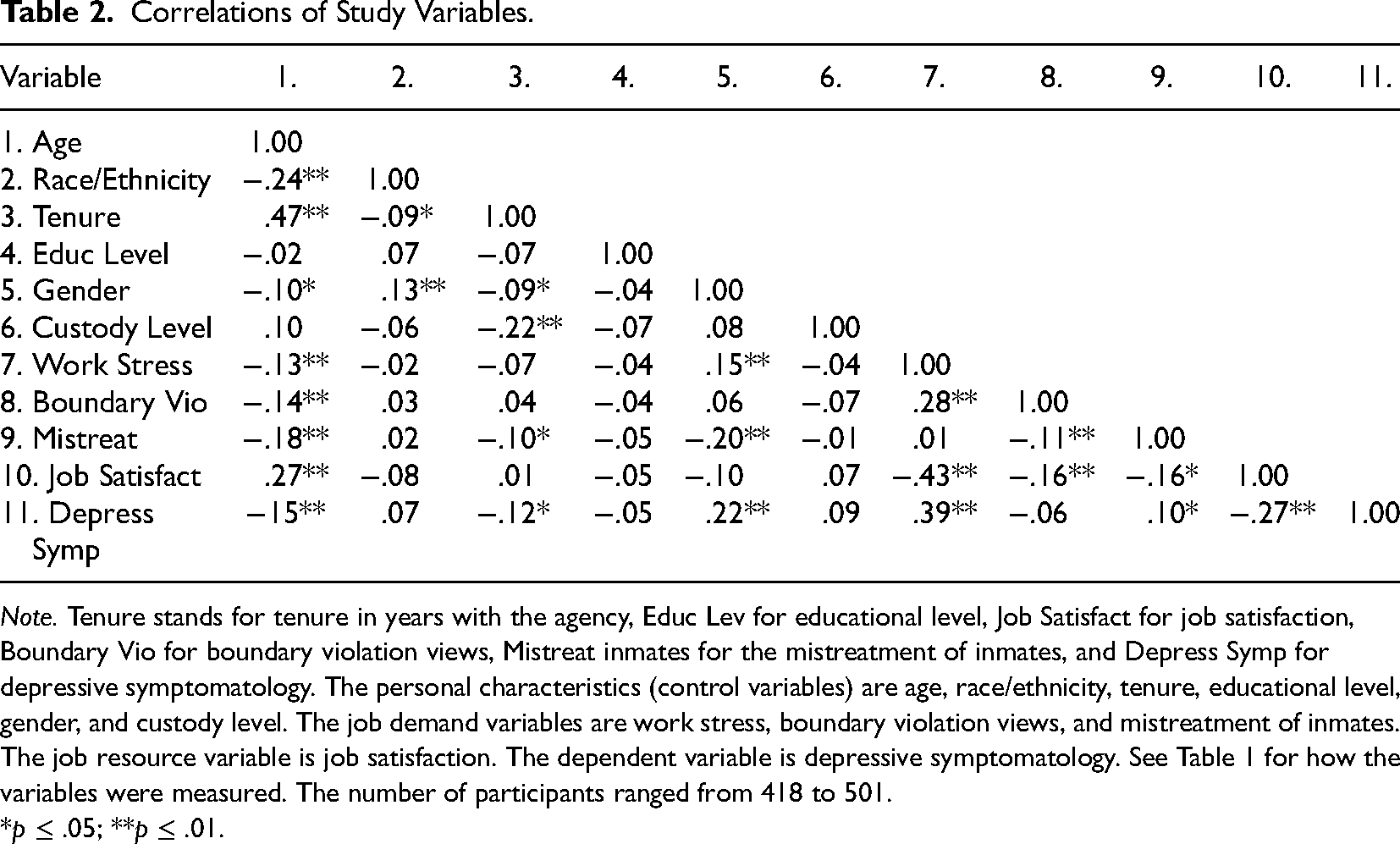
Note. Tenure stands for tenure in years with the agency, Educ Lev for educational level, Job Satisfact for job satisfaction, Boundary Vio for boundary violation views, Mistreat inmates for the mistreatment of inmates, and Depress Symp for depressive symptomatology. The personal characteristics (control variables) are age, race/ethnicity, tenure, educational level, gender, and custody level. The job demand variables are work stress, boundary violation views, and mistreatment of inmates. The job resource variable is job satisfaction. The dependent variable is depressive symptomatology. See Table 1 for how the variables were measured. The number of participants ranged from 418 to 501.
*p ≤ .05; **p ≤ .01.
Ordinary Least Squares (OLS) regression equation was estimated with depressive symptomatology as the dependent variable. The OLS regression results are presented in Table 3. Variance Inflation Factor (VIF) scores above 5 indicate a problem with multicollinearity among the independent variables (Tabachnick & Fidell, 2013). High multicollinearity occurs when an independent variable shares a very large part of its variance with the other independent variables in the regression equation, and this hinders the estimation of the effects on the dependent variable by the independent variables in question (Bollen, 1989). For the regression equation in the current study, the VIF values ranged from 1.07 to 1.55 (see Table 3). As such, multicollinearity was not seen as an issue in the multivariate regression analysis. The issues of outliers, influential cases, normality, linearity and homoscedasticity of residuals, and independence of errors, all of which can affect the regression results, were also tested (Berry, 1993; Tabachnick & Fidell, 2013).
OLS Regression Results with Depressive Symptomatology as the Dependent Variable.
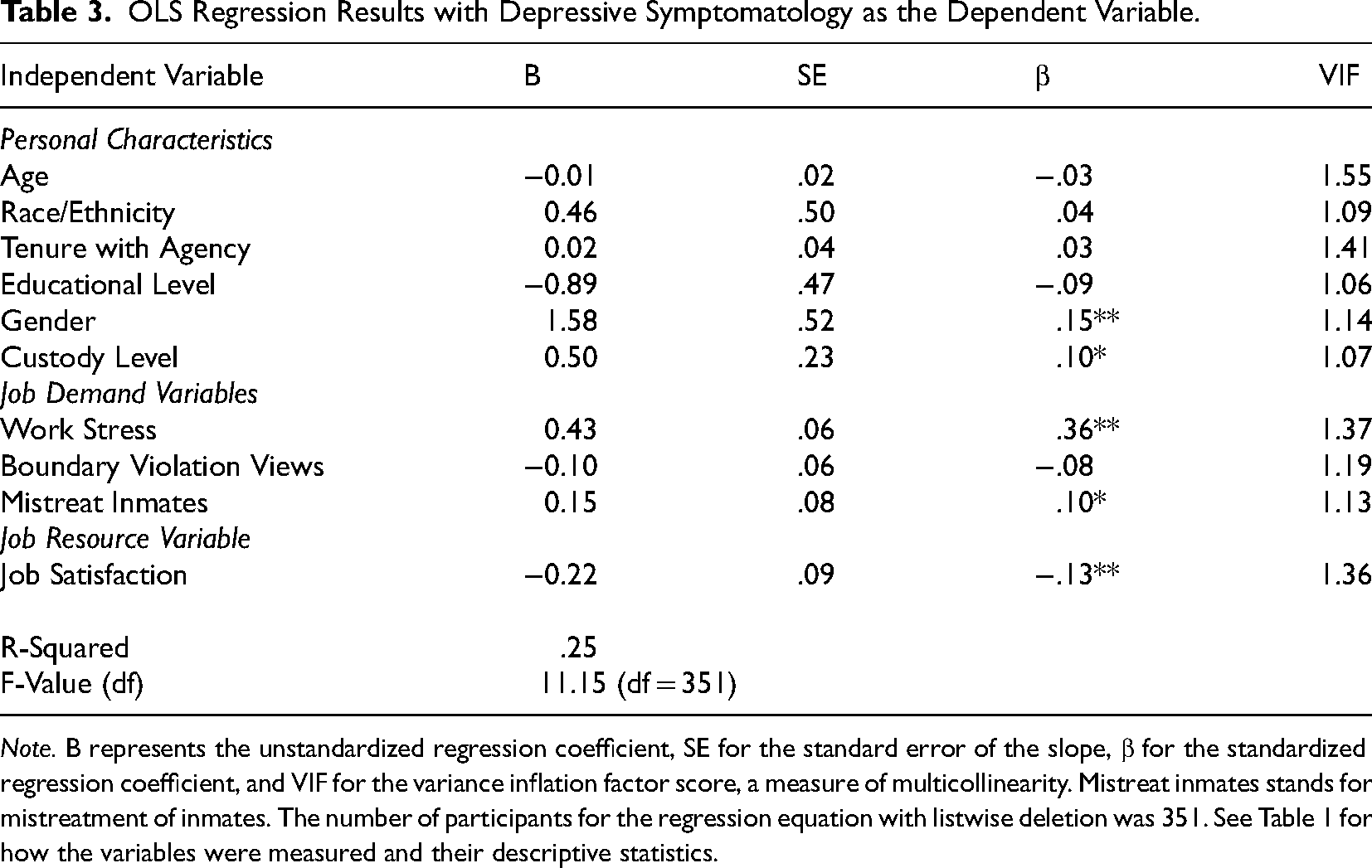
Note. B represents the unstandardized regression coefficient, SE for the standard error of the slope, β for the standardized regression coefficient, and VIF for the variance inflation factor score, a measure of multicollinearity. Mistreat inmates stands for mistreatment of inmates. The number of participants for the regression equation with listwise deletion was 351. See Table 1 for how the variables were measured and their descriptive statistics.
The R-squared statistic was .25, which indicates that approximately 25% of the variance in the depressive symptomatology dependent variable was explained by the independent variables as a group. Among the control variables, only gender and custody level had significant associations. Female correctional officers reported, on average, higher depressive symptomatology as compared to their male counterparts (Husain et al., 2014). Increases in custody level were associated with increases in the dependent variable. Work stress had a significant positive effect, which means increases in the level of stress were associated with greater depressive symptomatology (i.e., Hypothesis 1 was supported). Perceptions of boundary violations by fellow officers had a nonsignificant association (i.e., Hypothesis 2 not supported). The variable mistreatment of inmates had positive effects, suggesting that positive attitudes toward greater levels of abusive behaviors were linked to greater depressive symptomatology (i.e., Hypothesis 3 supported). Job satisfaction had a significant negative association, which means the more satisfaction gained from work, the less depressive symptomatology (i.e., Hypothesis 4 supported).
Discussion
Overall, the current results provide support for the job demands-resources model for explaining depressive symptomatology among correctional officers. Three of the four job demand-resource variables were significant predictors of depression measured using the CESD scale. Specifically, Hypotheses 1, 3, and 4 were supported by regression results. Hypothesis 2 was not supported.
Work stress was associated with higher symptoms of depression. The psychological strain of work stress likely weighs on officers, taking its toll and resulting in greater depressive symptomatology. It is common for those who work in prisons to be required to work mandatory overtime, frequently the equivalent of being forced to work a double shift—often with very little notice (Lambert, Hogan, et al., 2005). Correctional officers are often required to work overtime during June, July, and August due to a rise in vacations coupled with staff shortages (Wetzel, 2017). It is also common for officers to quit or become ill due to heat exhaustion—which further exacerbates the need for forced overtime (Worley & Worley, 2013). This may, indeed, create a vicious cycle where officers who required to work double shift become burned out and quit or use sick time to escape the stressors of the prison. Managing manipulative and abrasive inmates as well as dealing with difficult supervisors and coworkers may also make for a stressful work environment (Trammell & Rundle, 2015).
Work stress had the largest sized effects on the dependent variable of all the independent variables. This indicates that this is a major job demand that is linked to depressive symptomatology. The current finding for work stress is in line with the findings reported by Cheeseman Dial and Johnson (2008). This also supports the contentions that work stress is detrimental to correctional officers and that administrative efforts should be undertaken to reduce it. While our study does not directly measure the constructs of role ambiguity, role conflict, and role overload, empirical research indicates that all of these variables are linked to work stress (Lambert, Hogan, et al., 2005) and strain when applying the job-demands resources model (Demerouti et al., 2001). Given that work stress was correlated with depressive symptomology in the present study, we contend that efforts should be undertaken to ensure there is clarity of what is expected at work to reduce role ambiguity. In addition, clear directions across supervisors and managers would reduce role conflict. Position analysis can be undertaken to balance the workload of different positions in order to reduce the occurrence of role overload and role underload. All of the above strategies are likely to make the job less stressful which should, in turn, alleviate depressive symptomology among the correctional work force.
An officer’s willingness to engage in or ignore abuse of inmates appears to raise the level of depression symptoms reported by officers in the current study. Engaging in abusive behavior could result in psychological strain from either guilt or fear of being caught; however, being depressed could result in greater engagement in or turning a blind eye to inappropriate behaviors towards inmates. Neither postulation has beem test, and both explanations need to be studied in future research. What is clear is that this job demand is linked to higher CESD scores. Not only for ethical reasons but also to aid the mental health of officers, efforts should be undertaken to reduce mistreatment of inmates. Supervisors need to be trained in the proper methods to reduce mistreatment of inmates and how to support officers, so they do not engage in wrongdoing. Specifically, correctional supervisors must be trained to treat their subordinates with kindness and respect while avoiding both “hard” and “soft” management practices to reduce incidents of brutality toward inmates (McGregor, 1960; Worley & Worley, 2013; Worley et al., 2018). Hard management practices occur when supervisors use draconian punishments, such as denying their subordinate’s days off for no reason or employing arbitrary and excessive punishments for minimal or nonexistent rule infractions. Soft management practices, on the other hand, include anything from allowing employees to flagrantly disregard rules to permitting correctional officers to mistreat offenders with impunity. If supervisors and managers of correctional officers are fair, firm, and consistent they earn the trust and respect of their subordinates, which enhances the safety and security of the prison workplace (Keena et al., 2022). Supervisors must also be responsible for holding officers accountable when an act of brutality comes to their attention. In addition, fair investigations should occur when complaints of alleged misconduct by officers arise. Officers should be given every due process consideration during investigations; and, if possible, they should be reintegrated back into the organization. Of course, whether an officer is ultimately permitted to remain in the institution will depend on the extent of the rule violation, as some egregious acts of misconduct are illegal as well as traumatic to both inmates and staff members alike. If administrators were to implement informal peer networks, which could provide wayward officers with mentorship, would also be advantageous. Off-site team building and retreats could also be a strategy to generate shared norms and achieve collective goals (Cheeseman Dial & Johnson, 2008; Worley et al., 2018).
Contrary to Hypothesis 2, perceptions of boundary violations by other officers did not have a significant association with the dependent variable in either bivariate or multivariate analyses. It is important to note that the variable measured perceptions of boundary violations by fellow officers and not actual engagement in boundary violations. Participants may feel that if one of their peers behaves inappropriately with an inmate, this does not pose a major security concern that could put them at risk of being harmed by an inmate. It is also plausible that officers who are following the rules and behaving professionally may actually feel a sense of elevated social status within the organization when comparing themselves to officers who are flagrantly breaking institutional rules and crossing over to the side of the inmates (Worley, 2016; Worley et al., 2019; Worley & Worley, 2016).
As postulated, the job resource of job satisfaction was a significant negative predictor of the CESD dependent variable. Having a job that is liked probably results in a positive psychological state which helps reduce depressive symptoms. In addition, this positive state of mind likely buffers against negative effects from work by allowing the officer to focus on the positive aspects of the job rather than dwelling on negative demands of this type of work. Further, the findings support the contention that job resources often reduce the level of negative outcomes, in this case depression. Officers with high levels of job satisfaction are likely content with the stable pay, accrued vacation days, job security, stability, and predictability that is provided by the prison regimen. These officers may also be likely to find a sense of fulfilment and purpose working in a career that they believe enhances public safety.
Among the personal characteristics, gender and custody level had significant associations with the dependent variable in the multivariate regression analysis. Female officers, in general, reported higher levels of depressive symptomatology as compared to their male counterparts. This finding is consistent with a sample of male and female police officers in Khyber Pakhtoonkhwa, Pakistan, where female respondents also reported higher depression levels than their male counterparts (Husain et al., 2014). The current finding is also consistent with the general public. Women, in general, report higher levels of depression than men in society (Albert, 2015). Differing explanations for this discrepancy include physiological factors, social factors, and facing greater stressful events (Kessler, 2003). Female officers face enormous challenges from working in a masculine-focused occupation (Lambert et al., 2018). Further, female officers can face harassment on the job, not only by male inmates (Worley & Worley, 2013), but also by male staff (Trammell & Rundle, 2015). These types of work experiences could result in female officers suffering greater levels of depression because they may face greater and more unique job demands than male officers. Another explanation is that female officers are more likely to admit to depressive symptoms than male officers. The literature reports that women tend to be more willing to report depression compared to men, while men and women have similar levels of depression symptoms (Martin et al., 2013). While the specific reason(s) for the difference in levels of depressive symptomatology between female and male officers cannot be determined with certainty, what is clear is that in the current study women were higher than men in the level of self-reported depressive symptomatology.
Custody level was another personal characteristic that had a significant association with the dependent variable. Custody level had a positive relationship, which means officers working in higher security level units tended to report higher levels of depression symptoms. Working in higher security units likely results in greater challenges faced by officers because the importance of control increases. Officers who work in higher custody level units are typically more likely to work with offenders that can be more noncompliant, manipulative, and (likely) more assaultive than inmates in lower-level security facilities. Ferdik and Smith (2016), for example, contended that within maximum security facilities, there is a higher likelihood of officers working alongside inmates with contagious diseases, as well as a higher presence of gang activity and dangerous contraband (Butler et al., 2014; Meyers et al., 2020). Officers who routinely interact act with mentally ill offenders may be at a heightened risk of succumbing to depression. Researchers have also noted that inmates in higher security levels have a higher prevalence of mental health issues, as well as higher incidences of feelings of hopelessness and despair, than those in the general prison population. Officers who constantly work in maximum or closed custody facilities may also internalize stress given the high stakes that are involved during the course of their eight-hour shifts. This type of work experience can wear on a person psychologically over time, increasing depressive symptoms. It seems that an officer’s location in the prison facility is statistically related to depressive symptoms. Interestingly, in a similar study of Pakistani police officers, Husain (2020) also found that location was a predictor of depression. In the above study, urban officers reported higher levels of depression than rural officers. Finally, age, race/ethnicity, tenure, and educational level had nonsignificant associations with the dependent variable.
Limitations
As with many studies, the current investigation has limitations. First, the data is from Texas prison officers from one region, and the Texas prison system has six regions. The results could be contextual and situational, varying between regions. In addition, the results could vary across different prison systems not only in the U.S. but also across the world. Research involving prisons in other locations is needed to determine whether the current findings can be replicated. Replication research can help answer the question whether the studied variables are universal in their effects or vary contextually, and, if so, how. The Cronbach’s alpha for the boundary violations measure was .66, which, while low, was above the cut-off level of .60, and the factor analysis results suggest unidimensionality. Future research should develop new items to measure perceptions of boundary violations by fellow staff to determine whether the internal reliability of this measure can be raised. In the future, additional job demand and job resource variables should be added to explore their effects and to determine whether the amount of variance in the CESD measure can be raised. In the current study, the amount of variance in the dependent variable accounted by the independent variables was 25%, which means about 75% of the variance in depressive symptoms is explained by other independent variables. These other variables need to be identified. The job demands and resources model needs to be tested with other correctional officer outcomes, such as job involvement, organizational commitment, and job performance. Further, the effects of depression on officers, such as absenteeism, turnover, life satisfaction, and performance need to be explored. Finally, while guided by theory, the current study was based on a cross-sectional design, and, as such, causal relationships cannot be empirically demonstrated. A longitudinal design is required to demonstrate causality empirically. In future longitudinal studies, including the independent variables we have examined in the present study as well as the dependent variable of depressive symptomology would be advantageous. Ideally, surveys should be distributed to the same sample of correctional officers at least once every year; however, since prison facilities tend to have exceptionally higher attrition rates (Lambert, Edwards, et al., 2005; Wetzel, 2017), it might be productive to administer surveys to the sample semiannually.
Implications
In spite of its limitations, this study has several implications. Efforts are needed to improve the job satisfaction of correctional officers, who work in a demanding occupation. Organizational justice refers to having clear and transparent procedures (i.e., procedural justice) and fair outcomes (i.e., distributive justice), and these can make the job more enjoyable. Research indicates that both procedural and distributive justice increase job satisfaction among correctional staff (Lambert et al., 2020). Allowing officers a voice in the organization through input into decision-making can also raise the level of satisfaction gained from the job (Paoline et al., 2015). Quality supervision can also make the job more pleasant, raising the level of job satisfaction within a correctional facility (Castle, 2008). Allowing for greater job variety can also raise the level of job satisfaction in the field of corrections (Paoline et al., 2015). In addition to these approaches to building job satisfaction, officers need to be asked why they enjoy their job and what realistic changes can be made to enhance job satisfaction. In addition, supervisors and administrators need to be trained on the importance of job satisfaction and how to increase it. Further, they need to be rewarded for when job satisfaction of officers is raised.
The level of work stress needs to be reduced. Past research indicates reducing job ambiguity, role conflict, and role overload can lower the level of work stress felt by correctional staff (Lambert et al., 2005). In addition, addressing the issue of work-family conflict (when work spills over to home causing conflict and when home issues follow the person to work resulting in conflict) often can reduce the level of work stress among those working in prisons (Armstrong et al., 2015). In addition, increasing job resources can also lower the level of work stress. For example, procedural justice has been reported to have a negative association with work stress among correctional staff (Lambert et al., 2007). Organizational support by correctional supervisors and managers also has been reported to result in less work stress (Lambert et al., 2016). Supervisors should also utilize what Wetzel (2017) referred to as “comprehensive staffing analysis,” a methodology that strategically fill vacancies while limiting overtime. Supervisors and administrators need to be aware that mandatory overtime is often closely related to work stress (Worley & Worley, 2013). In addition to the suggested ways to reduce work stress, supervisors and administrators should ask officers what workplace factors contribute to their stress and suggested ways to improve the work environment so as to lower work stress. Supervisors and administrators need to be evaluated and rewarded for reducing the level of work stress among officers. More training related to inclusion and diversity might also help to mitigate toxic work environments which often have collateral consequences for female prison employees (Trammell & Rundle, 2015). All employees who work in correctional institutions must learn to support and empathize with their coworkers. Male officers, in particular, must take the lead in demonstrating their solidarity with female officers, as inmates might look to these individuals for subtle cues as to what types of behaviors are acceptable, regardless of the official rule (Worley & Worley, 2013). As working in prison is a demanding and sometimes stressful occupation, interventions aimed at dealing with work stress in a positive manner need to be instituted and tested.
Engagement in mistreatment behavior toward inmates must be addressed, not only because it is the ethical thing to do, but because these behaviors are prohibited. Additionally, the current study indicates mistreatment of inmates or ignoring (i.e., not reporting) mistreatment of inmates is linked to greater depressive symptomatology for officers. Efforts need to be undertaken to create a culture where rules and regulations will be followed (Lambert et al., 2018). In other words, the prison workplace needs to be professionalized. Supervisors and administrators need to send a message that officers must follow the rules and, if not, there will be consequences. Officers need to be asked in confidence why they feel engagement in mistreatment of inmates occurs and their suggestions for addressing this type of behavior. Supervisors and administrators need to reward and support officers who follow the rules and do not engage in mistreatment behavior (Lambert et al., 2018). Supervisors need to direct, guide, and support officers so as to reduce the number and severity of mistreatment of inmate incidents.
Finally, interventions are needed to assist officers suffering from depression. Employee assistance programs not only need to be instituted, but officers need to be encouraged to use these services (Ferdik & Smith, 2017). Officers need to be assured that punitive action will not be taken against them for using this or other interventions. In addition, the issue of peer pressure not to use these services needs to be addressed, including sending messages that use of these services can help officers and there is nothing wrong in using them. There are different types of interventions that can aid officers” psychological wellbeing. For example, cognitive behavioral therapy can help employees with depression (Yunus et al., 2018). Additional efforts include encouraging interpersonal/solution-focused reactions (e.g., talking with others) in response to demands rather than emotional/avoidant responses (e.g., keeping the matter internal or substance abuse) (Trounson et al., 2019). Peer-support programs may reduce the level of stress and, in turn, depression among correctional officers (Ferdik & Smith, 2017). A meditation and relaxation-based intervention could also help reduce the level of depression symptoms among officers (Yunus et al., 2018). Officers should be encouraged to exercise, be provided nutritional support, and incentivized to maintain healthy weights since each of these is linked to improved mental wellbeing (Ferdik & Smith, 2017). Finally, combined interventions, such as cognitive behavioral therapy with coping strategies training, may be more effective than a single focused intervention (Yunus et al., 2018). It is important to note that there has been little published research on the effectiveness of interventions to reduce depression symptoms among correctional officers. Scholars need to evaluate the effectiveness of interventions in reducing correctional officer depression and improve the mental wellbeing of these officers. As mentioned previously, if an officer experiences depression and either quits or calls in sick for an extended period of time, this can impact staffing decisions and result in mandatory overtime as well as the cancellation of approved time off. Officer depression can disrupt the prison workplace by affecting staffing and employee morale (Wetzel, 2017).
Conclusion
In closing, working in prisons is a unique job which carries the risk of higher mental health problems, such as depression, among correctional officers. Correctional officers are a valuable resource for a correctional institution. Officers are responsible for a myriad of tasks and duties to ensure a safe, secure, and humane facility. The current study used the job demands-resources model to examine how the job demands of work stress, boundary violations of fellow officers, and behaviors that condone the mistreatment of inmates and the job resource of job satisfaction were associated among Texas correctional officers with depressive symptomatology measured using the CESD scale. It was observed that job satisfaction, as a job resource, was associated with lower depressive symptomatology measured by the CESD scale. Work stress and attitudes that condone the mistreatment of inmates, as job demands were associated with increased depression symptoms. Perceived boundary violations by fellow officers, however, had a nonsignificant association. Efforts need to be undertaken to reduce both work stress and the mistreatment of inmates and to raise job satisfaction among correctional officers in an effort to reduce depressive symptomatology. Further interventions need to be instituted and evaluated to lower depression among officers. Additional research is needed in the area of how workplace factors may increase or decrease the level of depressive symptomatology among officers, a value resource for prisons. At the very least, we hope this current research will spark interest in studying the variables which affect depression among correctional officers and evaluating interventions to improve the mental wellbeing of prison staff. There is still much unknown that will only be revealed and better understood by new studies.
Footnotes
Acknowledgments
The authors thank the editor and anonymous reviewers for their comments and suggestions, which improved the paper. Finally, the authors gratefully acknowledge the assistance, support, and wonderful hospitality of countless Texas Department of Criminal Justice employees for facilitating this research project from beginning to end. While the Texas Department of Criminal Justice approved this study, this does not imply the Department’s endorsement or concurrence with statements or conclusions contained therein.
Declaration of Conflicting Interests
The author(s) declared no potential conflicts of interest with respect to the research, authorship, and/or publication of this article.
Funding
The author(s) received no financial support for the research, authorship, and/or publication of this article
