




Abstract
Dog-training programs have become a popular form of alternative prison programming. One of the reported benefits of these programs is their low cost to the criminal justice system. Very little research has been conducted on their effects on offenders, and, to date, no cost-benefit analyses have been reported. This article presents a cost-benefit analysis using program cost and updated recidivism results from an evaluation of dog-training programs. The analyses projected that, for every criminal justice system dollar spent on the dog-training programs, between $2,877 and $5,353 were saved. These findings suggest that dog-training programs could be cost-beneficial.
Introduction
Responding to and attempting to curb criminal behavior is becoming an increasingly expensive undertaking. For instance, between the years 1982 and 2003, expenditures on our nation’s criminal justice system increased by $36 billion, which equates to a 418% increase (Hughes, 2006). Likewise, criminal justice has become an enormous burden upon state budgets, and Hughes (2006) indicated that, during the same period (1982–2003), state spending in all areas of criminal justice increased: policing by 293.4%, judicial and legal by 474.3% and corrections by 550.9%. When examining the US Census Bureau’s archived local and state finances, it appears that since 2003, the increases have slowed but are still quite substantial. Between the years of 2004 and 2015, our nation’s policing budgets have increased by 50.03% and corrections budgets have grown by 36.22% (US Census Bureau: State and Local Government Finances, 2018) 1 . For example, in the 2015 to 2016 fiscal year, Florida budgeted over $4.2 billion for criminal justice and corrections, which increased to $4.4 billion the following fiscal year (2016–2017), and in 2017 to 2018, they increased their budget by about $32 million (Florida Policy Institute, 2019).
Despite these large expenditures directed to “correcting” criminal behavior, those released from prison still contribute significantly to the crime rate of their release state (Rosenfeld et al., 2005). Osterman and Caplan (2016) estimate that, over a three- year-period, inmates released from New Jersey prisons cost more than half a billion dollars in post-release criminal activity. Disaggregated, the average offender released from a NJ prison costs the state $34,324.02 for all post-release arrest events in 3 years, and $17,533.51 for the first post-release arrest event. Similarly, Raphael and Stoll (2004) found that ex-offenders released from prison significantly increase nearly all felony offenses in the area in which they are released. During the 1990s, the net increase in the population of those released from prison accounted for roughly 2% of property crime and 2.5% of violent crime. However, when examining murder and robbery, Raphael and Stoll (2004) found that those released from prison in 1993 accounted for 14% of murder and 7% of robbery in 1994. They concluded that, due to the high cost of criminal victimization, even modest effects of prison rehabilitation or post-release rehabilitation programs on crime would likely be beneficial for state criminal justice budgets.
As a result of decades of mounting correctional costs and subsequent expenditures from criminal recidivism, legislators and correctional administrators have focused on ways to cut correctional budgets. The Vera Institute of Justice’s Center on Sentencing and Corrections issued a report in 2010 outlining cost-cutting information from 44 states and found that, among several strategies, some states had chosen to adopt prison-based rehabilitation programs that were shown to reduce recidivism and operational costs in the long run. Their 2016 report also found that 32 states had enacted prisoner reentry-focused initiatives to reduce recidivism (Silber et al., 2016). Notably, this solution may increase upfront costs but be slow to show cost savings in the form of reduced recidivism. Therefore, increasingly, correctional administrators and legislators have recognized the need to identify correctional programs that can offer reductions in recidivism at a low cost.
Dog-training programs are a form of inexpensive correctional programs that have become popular in all 50 states. Since their inception in 1981, over 330 dog programs have been established throughout the United States. These programs are incredibly economical to implement and often rely entirely on donations. In the case of Florida, they are not even included in the yearly corrections budget, as they are funded entirely by the affiliates (i.e., humane society, local shelter, etc.).
There are two primary types of dog-training programs, the first of which has inmates socialize dogs to go on to further training to become special needs or service dogs (seeing-eye dogs, Posttraumatic Stress Disorder [PTSD] dogs, and explosive detection dogs). In the second type, inmates train dogs sourced from animal shelters in basic obedience skills, to increase their likelihood of being adopted by the general public. In both types of dog-training programs, the dogs generally reside in the cells or in the dormitories with their inmate handlers, and the handlers care for the dogs 24 hours a day, 7 days a week.
Literature Review
In corrections programming, cost-benefit analyses are a useful way of demonstrating how the outcomes of a program relate to the costs associated with crime and repeat offending. The first major cost-benefit analysis in the field of criminology was of the Perry preschool intellectual enrichment program in which a random sample of 123 low-income, high-risk children was selected to receive a high quality preschool education. After following the children up to age 27, Schweinhart et al. (1993) demonstrated that, for every $1 spent on the Perry preschool program, $7 was saved in crime- related costs to the government/taxpayers.
While there are only a few correctional programs that incorporate cost-benefit analyses, there are enough to provide useful comparisons to the savings projected for the dog-training programs. For example, in their systematic review of cost-benefit analyses of corrections programming, Farrington et al. (2001) found that the benefit-to-cost ratios of programs ranged from 0.17 for a jail-based program for burglars to 7.14 for a community-based program targeting offending and substance use. This means for every dollar spent on the jail-based program, there was a deficit, with only a return of 17 cents. In contrast, the community-based program saw a return of $7.14 for every dollar spent. The average ratio of these studies was approximately 2.2, so, on average, correctional programming projects a return of $2.20 for every dollar spent on rehabilitation programs.
Similarly, Petersen et al. (2011) conducted a cost-benefit analysis of four tiers of prison-based drug treatment programs in Connecticut prisons. Tier 1 was merely basic substance abuse education. Tier 2 consisted of intensive outpatient treatment three times a week for 10 weeks. Tier 3 participants spent the entire day in treatment for 16 weeks, and Tier 4 was a therapeutic community model in which the inmates were separated from the general population while attending treatment. Those who participated in the four tiers were compared to a group of similar inmates 2 for 12 months following release. Based on their cost-benefit analyses, cost savings were seen in the drug treatment program for all tiers with the exception of Tier 1. Even though Tier 2 had the highest recidivism rates (compared to Tiers 3 and 4), it was the most cost beneficial. Due to the low cost of implementation of Tier 2, Connecticut taxpayers received a six-fold return on their investments. Tier 3 resulted in a savings three times as much as the cost of implementation, and Tier 4 netted taxpayers twice the amount of money they spent on implementing the program.
In a more comprehensive evaluation, Drake et al. (2009) conducted a systematic review of all research evidence on recidivism outcomes for prison programs utilized in Washington State correctional institutions. The authors located a total of 545 controlled evaluations and used those recidivism figures to project the cost-savings for crime victims, taxpayers, and total benefits or deficits once the cost of the program was taken into account. While several programs had null effects and a few even led to a loss, there were quite a few programs that were projected to accrue savings based on the recidivism figures. For instance, vocational education programs led to a 9.8% reduction in recidivism, saving a total of $20,714 per offender. Similarly, general education programming saved $17,636 per offender, leading to an 8.3% reduction in recidivism. Other findings documented cognitive behavioral therapy to reduce recidivism by 6.9%, equating to a savings of $15,361 per offender, while correctional industries reduced recidivism by 6.4% and saved $13,961 per offender. Lastly, the savings per offender of prison-based drug treatment was $12,715 per offender, reducing recidivism by 6.4%.
Despite the popularity of prison-based dog-training programs, very little is known about their effectiveness regarding participants’ post-release behavior, and even less is known about the benefit-to-cost ratio of these programs. The limited and primarily qualitative research on dog-training programs suggests that they have a desirable impact on adult inmate handlers’ wellbeing and behavior (Cooke & Farrington, 2014; Furst, 2011; Strimple, 2003). Meta-analyses conducted by Cooke and Farrington (2016) suggest that dog-training programs have a stronger effect on externalizing behaviors, such as antisocial behavior, offending, and self-control, than on internalizing behaviors such as depression, self-esteem, and empathy. However, recently, Grommon et al. (2020) found that short-term exposure to dog-training programs in juvenile facilities did not have any effect on psychosocial functioning, calling into question the effectiveness of such programs for juveniles. On the other hand, Hill (2020) utilized propensity score matching and found that adult male inmates who participated in dog-training programs in Florida for at least 31 days had statistically significant reductions in re-arrest for any reason (p = .03) and re-arrest for a new crime (p = .10) within 1 year of release. Consequently, researchers (e.g., Fawcett & Gullone, 2001; Fournier et al., 2007; Furst, 2011; Strimple, 2003) suggest that, because of the reported desirable impacts and these low cost of the programs, they might be a cost-beneficial form of correctional programming. However, to date, no cost-benefit analysis of dog-training programs has been reported.
Method
In this article we present several cost-benefit analyses, using updated recidivism analyses from Hill’s (2020) evaluation of dog-training programs, and based on program implementation costs from several dog-training programs in Florida Department of Correction institutions and crime costs suggested by several researchers (Cohen & Piquero, 2009; McCollister et al., 2010; Welsh et al., 2015; Farrington & Koegl, 2015). Because past offending predicts future offending, the study uses dog training participants’ offense data from the last 5 years “at risk” (the last 5 years in which they were not incarcerated) to estimate their future offending rates.
Recidivism Reductions
To determine the recidivism reductions of participation in a dog-training program, a cohort of inmates (n = 204,094) released from Florida prisons between the years of 2004 and 2011 was analyzed. For this analysis, recidivism measures include re-arrest for any reason and re-arrest for a new crime within 1 year. The treatment group consisted of male inmates enrolled in a dog-training program for more than 31 days, and the comparison group was those who had never enrolled in a dog-training program. The 363 inmates who comprised the treatment group participated in 13 dog-training programs in 12 separate Florida correctional facilities.
Acknowledging that program participants may be different beforehand from non-participants, it is important to deal with selection effects in evaluating the impact of a program (see e.g., Farrington, 2003). One method of dealing with selection effects is to use propensity score matching (PSM). The study, therefore, used two-to-one nearest neighbor propensity score matching 3 with replacement, which means that each treated unit (inmate in a dog program) was matched with up to two comparison units (inmates not in a dog program) with the closest (neighbor) propensity score (Apel & Sweeten, 2010; Austin, 2008, 2010). The caliper was set to 0.01, indicating that each match needed to be nearly identical (Barth et al., 2008; Rosenbaum & Rubin, 1985). The treatment and comparison groups were matched on 15 covariates and three post-factum variables (employed upon release, community custody upon release, and supervision upon release) that were highly predictive of both selection into treatment and post-release recidivism (see Table 1 for the complete list of covariates).
Description of Control Variables.
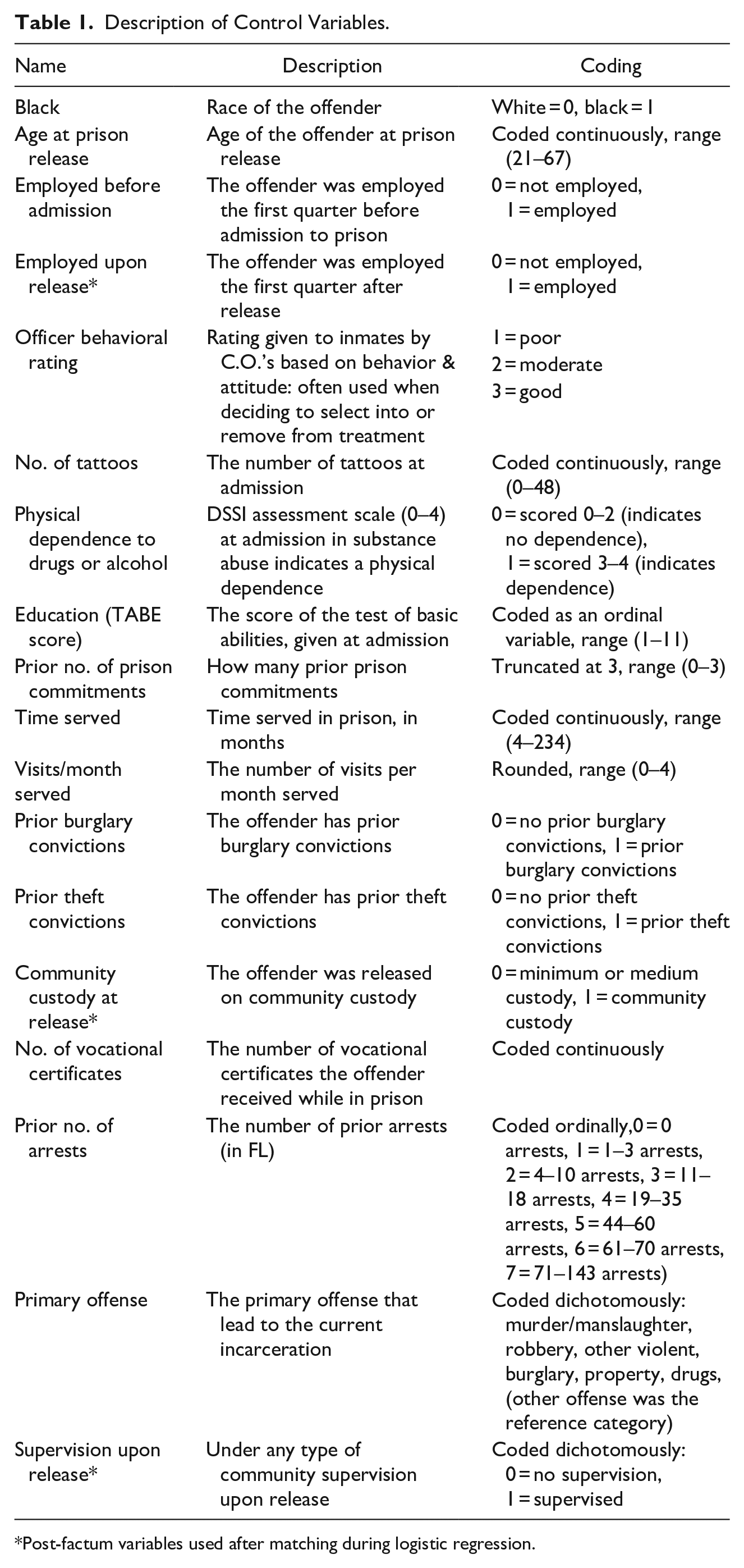
Post-factum variables used after matching during logistic regression.
Table 2 indicates that the treatment (n = 363) and comparison group (n = 459) were balanced on all covariates; no differences were significant after matching and the standardized bias (SB) for each covariate was reduced below 20% (Apel & Sweeten, 2010). After balance was achieved, logistic regression was used to determine the effects of participation in a dog-training program on recidivism. Three post factum variables were removed from the matching procedure (community custody at release, post-release supervision, and post-release employment) because they could not be predictors of the treatment (the dog program). Instead, they were included in the causal analysis stage (logistic regression) after matching.
Means Before and After Matching for All Covariates (2-1 Nearest Neighbor Matching with Replacement).
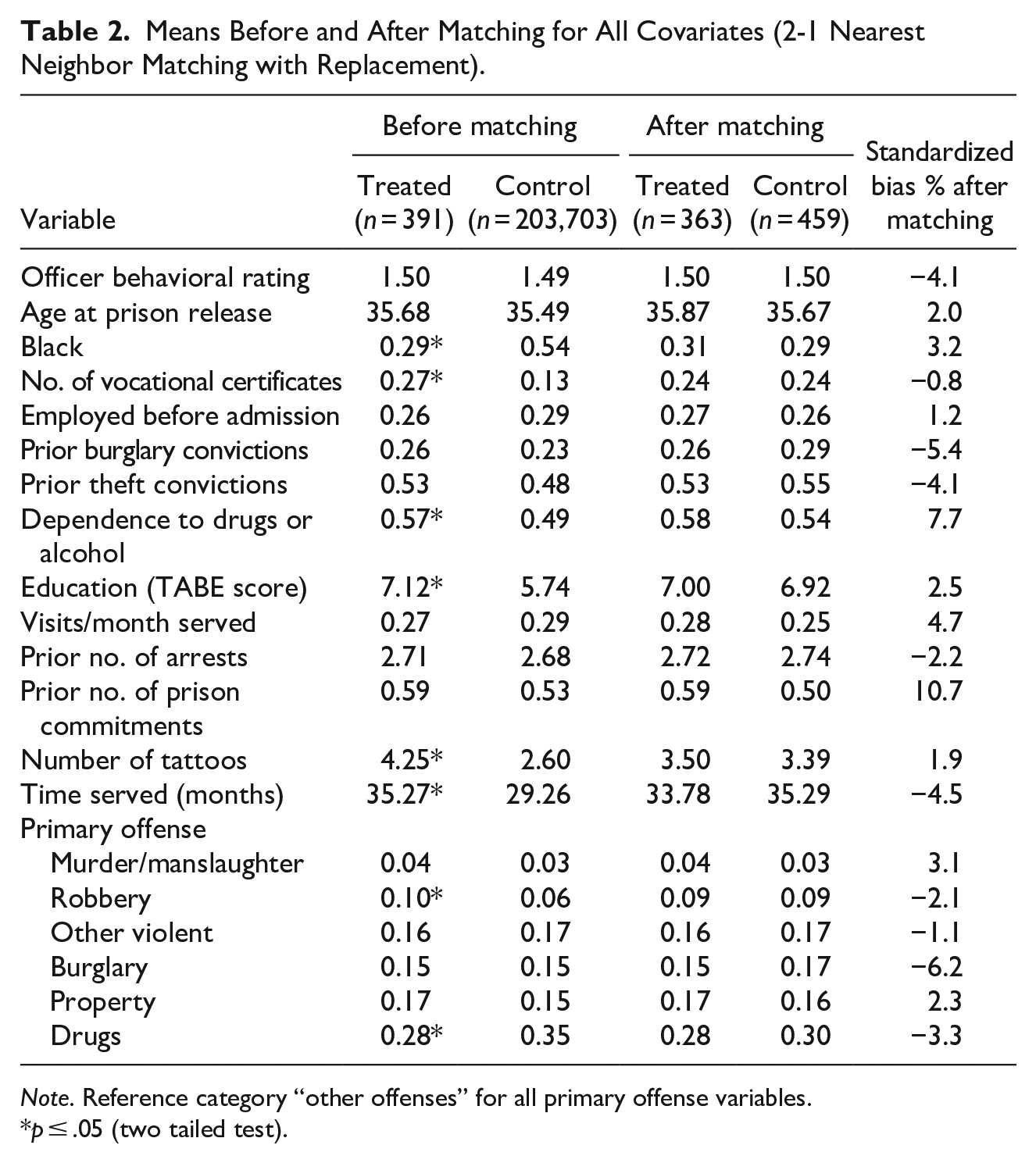
Note. Reference category “other offenses” for all primary offense variables.
p ≤ .05 (two tailed test).
After logistic regression, participation in a dog-training program remained statistically significant (p ≤ .01) for re-arrest for any reason (β = .47) and re-arrest for a new crime (β = .40) (see Table 3). The positive values of β indicate that the program was effective in reducing rearrests (see Farrington & Ttofi, 2009, p. 78). The partial odds ratios give the best estimates of the effects of the program after controlling for other variables. The next step was to determine the relative decrease in recidivism for program participants. Using national recidivism figures (see Durose et al., 2014), we assumed that 50% of the control group was re-arrested. Using 2 × 2 tables, we were able to determine how many of the program participants were re-arrested. Of the 363 participants, 139.08 of them were re-arrested for any reason; this would correspond to a partial OR of 1.61. This corresponds to an absolute 11.69% decrease or a relative 23.38% decrease in re-arrest for any reason. Of the 363 participants, if 145.78 of them were rearrested for any reason, this would correspond to a partial OR of 1.49. This corresponds to an absolute 9.84% decrease or a relative 19.68% decrease in re-arrest for a new crime.
Logistic Regression Coefficients for the Effect of Participation in a Dog-Training Program on Recidivism Outcomes (2:1 Nearest Neighbor Matching with Replacement) a .

Note. n = 363 (treated) n = 459 (controls).
Analyses include the three post-factum variables (community custody at release, post-release supervision, and post-release employment).
p ≤ .01.
Offending Rates and Cost of Crimes
The next step of this cost-benefit analysis was to determine the program participant offending rates, types of offenses, and the cost of each offense for their last 5 years at risk (not incarcerated). We assume that the rate of offending would be the same in the following 5 years in the absence of any program effect. First, the dataset used for the recidivism outcomes (Hill, 2020) was merged with a Florida Department of Law Enforcement dataset that provided the five previous years of arrests (prior to current incarceration) for each offender in the release cohort. Table 4 presents the yearly number and cost of crimes committed by those in the treatment group (n = 363) and the comparison group (n = 459). This sample committed a total of 14,259 offenses, which constitutes roughly 17 offenses per offender in the 5-year period.
Yearly Offense Rate, US and Criminal Justice System Cost.

Next, the cost of crimes was determined using the figures presented by Cohen and Piquero (2009), McCollister et al. (2010), Farrington et al. (2003), and Farrington and Koegl (2015). These figures include both tangible costs and intangible costs. The tangible costs are those incurred by law enforcement, the judicial system, and corrections, which are referred to as criminal justice system costs. On the other hand, the intangible costs, referred to as US costs, are those incurred by the victim(s) and society, such as monetary value of items lost and/or pain and suffering (often based on jury awards). The crime figures were then adjusted to 2012 prices in the American South. For instance, Table 4 indicates that each burglary costs the US $2,431 and the Criminal Justice System (CJS) $4,656; each motor vehicle theft costs the US $12,387 and the CJS $5,512; and each drug crime costs the US $972 and the CJS $486. On the other hand, violent crimes are much more costly; each homicide costs the US just over $9 million dollars and the CJS $391,194, while each aggravated assault costs the US $91,726 and the CJS $14,951. Therefore, in the 5 years before our sample was incarcerated, they committed 14,259 offenses that cost the US approximately $526,020,828, which, as shown on Table 4, equates to $127,986 per offender per year. In addition, in the 5 years prior to the incarceration of our sample, they committed offenses that cost CJS a total of $49,976,170 which is approximately $12,160 per offender per year. 4
Cost of Operating a Dog-Training Program in Florida Correctional Institutions
Like many dog-training programs, the Florida Department of Corrections does not fund any of the facility dog-training programs. The dog-training programs are the result of Memoranda of Agreements formed with affiliates (i.e., humane society, local animal shelter); the supplies needed to operate the programs are donated to the affiliates that provide the dogs and the training. Even though the Florida Department of Corrections does not fund these programs, $26 a year is spent on printing and photocopying the dog-training participant training manuals, which, in this case, is the only criminal justice system program cost.
On the other hand, the dog-training programs cost the affiliates roughly $9,326 per program per year. This figure includes the adoption fees; most programs cost approximately $20,000 per year, but they recoup over half of that from the adoption fees. This money is used for the maintenance and care of the dogs (food, vaccines, vet care, etc.). The dog trainers who train the dogs and teach the inmates to train and socialize the dogs are all volunteers. Adjusting the cost of this program ($9,326) to represent the cost of participation per year for the average number of participants who participate in dog programs annually 5 equates to $187 per participant per year. In addition, adjusted accordingly, the Florida Department of Corrections’ yearly cost of $26 becomes $0.50 per participant per year.
Calculating Cost Savings
As previously stated, to calculate the cost savings, we used 2 × 2 tables to calculate the absolute change in the fraction of people who reoffended (see Farrington & Loeber, 1989; Lipsey & Wilson, 2001). This resulted in the ability to determine the absolute percentage reduction in those who reoffended by adding and subtracting the absolute percentage change to the national 50% recidivism average (Durose et al., 2014), yielding the relative percentage change in reoffending. The difference between these figures is the percent reduction in reoffending. We then reduced the number of each type of offense by the percent reduction in reoffending and adjusted the cost of crime accordingly. Then, we were able to calculate the amount saved as a result of the reduction in reoffending. Using this figure and the program cost variables, we were then able to calculate the benefit-to-cost ratios.
Findings
Projected Savings Based on Recidivism Figures
Beginning with the figures associated with re-arrest for any reason, using the values listed above (OR = 1.61), participation in a dog-training program in Florida correctional facilities leads to a relative 23.38% reduction in re-arrests for any reason. To determine the actual US and CJS total cost savings, each figure from the savings column needs to have 187 and 0.50 subtracted from it respectively to account for the cost of each program for the US and the CJS per offender per year. When including homicide, Table 5 indicates this equates to a projected $29,736 (ex. 25,923−187 = 29,736) per offender per year for the US. This means that the US could save $160 for every dollar spent on the dog-training programs. For the criminal justice system, participation in a dog-training program leads to a potential $2,842 (including the subtraction of 0.50 per offender per year) in savings per offender per year. This means that for every dollar the criminal justice system spends on the dog-training program, a savings of $5,686 is possible. When discounting for inflation by an estimated 1% per year for the 5 years post release, the overall benefit-cost ratio would be 151:1, and the CJS ratio would be 5353:1.
Cost-Benefit Analysis Based on Re-Arrest for Any Reason (Within One Year).

In contrast, when excluding homicide, a comparably rare and expensive offense that could skew the results, the US could save $4,834 per offender per year, which equates to a projected savings of $27 for every dollar spent on the dog-training programs 6 . Using the more conservative measure (excluding homicide), the criminal justice system may save $1,797 per offender per year, which is a projected savings of $3,594 for every dollar spent on the dog-training program. When discounting for inflation by an estimated 1% per year for the 5 years post release, the overall benefit-cost ratio would be 25:1 and the CJS ratio would be 3418:1.
When focusing on the figures associated with re-arrest for a new crime 5 , the numbers are just as staggering. Using the values listed previously (OR = 1.49), participation in a dog-training program leads to a 19.68% relative reduction in re-arrests for a new crime. When including homicide in the calculations, this leads to potential savings of $25,001 per offender per year for the US (minus the cost of the program). This means that, for every dollar the US spends on dog-training programs, one could save $135. Regarding the criminal justice system costs, dog-training programs are projected to save $2,393 per offender per year. This equates to a potential CJS savings of $4,786 for every dollar spent on the dog-training program. When discounting for inflation by an estimated 1% per year for the 5 years post release, the overall benefit-cost ratio would be 128:1 and the CJS ratio would be 4551:1.
Notably, when using more conservative figures by excluding homicide, projections indicate that the US could save $4,839 per offender per year. This leads to projected savings of $23 for every dollar spent on dog-training programs. Additionally, when excluding homicide, the criminal justice system could save $1,512 per offender per year, which equates to $3,025 for every dollar spent on the dog program. Inflation was discounted by an estimated 1% per year for the 5 years post release; therefore, the overall benefit-cost ratio would still be 22:1 and the CJS ratio would be 2877:1.
Projected Savings for a 5% and 1% Reduction in Recidivism
Although the recidivism figures presented here had reductions between 23.38% and 19.68%, we scaled the recidivism reductions to 5% to show projected savings for other states, correctional facilities, or dog-training programs that may lead to lower recidivism reductions. Using a 5% reduction in recidivism, the US could potentially save $6,213 per offender per year 7 (when one subtracts program expenses). This leads to a projected savings of $34 for every dollar spent on the program. On the other hand, the criminal justice system could save $607 for each offender per year and potentially save $1,216 for each dollar spent on dog-training programs. So, even when dog-training programs only reduce recidivism by 5%, both the US and the criminal justice system will accrue savings.
When scaling recidivism reductions to as low as 1%, these programs still result in savings for the US and the CJS. For instance, the US could save $1,093 per offender per year, which leads to a potential savings of $7 for every dollar spent on the program 8 . For the CJS, the dog programs are projected to save $121 per offender per year, which equates to $243 for every dollar spent on the program.
Discussion
The objective of this study was to project the cost savings that could be accrued by implementing dog-training programs in correctional facilities. Our analyses indicate that dog-training programs in Florida are projected to save between $22 and $151 for every US dollar spent and between $2,877 and $5,353 for every Criminal Justice System (CJS) dollar spent. These figures are quite excessive for two reasons: (1) dog-training programs are relatively inexpensive for both the affiliates and especially the correctional facilities to implement and, (2) crime is expensive, so even a very small reduction (as low as 1%) leads to savings. Based on the figures presented above, for every dollar spent on the dog-training programs the CJS could save up to $5,353, which is the equivalent of preventing roughly one burglary, or, two incidents of fraud, or 10 drug crimes per offender per year. For every dollar spent on the dog-training program, the US could save $151. While this sum is not enough to cover the cost of one crime for the US, if the US spends $7.00 on dog-training programs, the return would be the equivalent of reducing one drug crime, or one administration of justice crime per offender per year. Similarly, if the US spends $20.00 on dog-training programs, it could yield the equivalent of reducing one burglary per offender per year. It is also notable that our reduction in reoffending calculations predict that the dog-training programs will result in almost 3,334 fewer offenses in total in the 5 years post-release.
It is important to note that dog-training programs are not nearly as effective as some other correctional rehabilitation programs (drug treatment or cognitive behavioral) - particularly in light of the fact that Hill (2020) found no statistically significant reductions regarding reconvictions and re-incarcerations. However, reducing re-arrests during the first year of release is an important finding, as the Bureau of Justice Statistics indicates that over half of released inmates who were arrested within 5 years were rearrested during that first year (Durose et al., 2014). And, as seen above, even small reductions in re-arrests during the first year of release can lead to savings both for the US and the criminal justice system, supporting Raphael and Stoll’s (2004) conclusion that even modest effects of prison rehabilitation programs on crime would likely be beneficial for state criminal justice budgets.
While it appears that the dog-training programs are extremely cost-beneficial, it is important to investigate whether the costs applied in our analysis are representative. Therefore, we have compared the cost of Florida dog-training programs to other similar dog-training programs. Annually, a dog-training program in California costs the affiliates approximately $5,000 and incurs no criminal justice system costs. Likewise, a program in Illinois has an annual budget of $25,000 for the affiliate but also incurs no criminal justice system costs. Similarly, dog-training programs in South Carolina are not funded by the department of corrections and thus have no criminal justice costs. Like the Florida programs, these programs also recoup a portion of these costs in adoption fees, thus reducing their annual outlay. On the other hand, not all dog-training programs are as inexpensive. For instance, a dog-training program in Texas has an annual criminal justice system cost of approximately $2,030; and, similarly, a dog-training program in Oklahoma has an annual criminal justice system cost of approximately $1,500. A New Mexico dog-training program costs the Corrections Corporation of America $3,600 annually, but, still, like many of the programs, relies largely on adoption fees, in-kind donations, and volunteers. In light of these funding differences, our exact projected savings are not necessarily generalizable for dog-training programs that are funded by their state’s department of corrections. However, the financial benefits would always greatly exceed the financial costs.
In viewing this study’s projected savings in light of massive correctional budgets, it is best to characterize their effect as minimum to moderate. Nevertheless, when taking into account the extraordinary number of inmates being released from prisons every year, the savings can add up, especially over time. The hope is that that these reserves can be re-invested in at-risk communities in the form of prevention programs to help slow the cycle of crime, as suggested by Cohen et al. (2010a, 2010b). However, as Austin (2010) points out, it is important that the interpretation of any cost-benefit analysis takes into account the relative number of inmates which each program can serve in a given year. Undeniably, the dog-training programs only have room for 10 to 15 offenders at a time (per training session for the dogs), and while the average time spent in the program is 10.8 months (Furst, 2006), offenders can often stay in the program for several years. Nevertheless, Florida correctional institutions already have models in place that can increase the number of offenders who participate in these programs. For instance, the Taylor Correctional Facility has UTOPIA (Undergoing Training and Obedience to Increase Adoptability) inmate participants work with each dog in teams of three, thereby increasing the number of participants. Similarly, one can implement more than one program in a facility. The Tomoka Correctional Facility, for example, has two programs in place in their facility, and the Gadsden Correctional Facility 9 has four dog-training and socializing programs in operation.
In responding to calls to end mass incarceration, states have begun to reform their penal statutes in an attempt to stem the flow of individuals being sent to prison. However it is unlikely that these reformed statutes will begin to have a significant effect any time soon, given the large population currently incarcerated and the iatrogenic effects of incarceration (Vieraitis et al., 2007). Additionally, the multiple obstacles faced by offenders in attempting to stay crime-free upon release, such as lack of employment opportunities, access to governmental benefits, treatment for substance abuse or mental illnesses, affordable housing, loss of human capital, and family support (Becker, 1968; Naser & LaVigne, 2006; Travis & Petersilia, 2001) continue to affect recidivism rates. Furthermore, when taking into account the large number of incarcerated parents (Glaze & Maruschak, 2008) and the intergenerational effect of crime from parent to child (Hagan & Foster, 2012; Huebner & Gustafson, 2007; Johnston, 2012), it is quite possible that we will not see prison reform effects for generations to come. Therefore, any program that can offer immediate savings (even small ones) at little to no upfront costs is worthy of consideration during this era of increased correctional spending. While the savings offered by dog-training programs are relatively minimal to moderate, the lack of upfront criminal justice funding investment can incentivize state correctional systems to incorporate them as part of cost-cutting while still investing in rehabilitation programs that address recidivism reduction.
In order for the benefit-to-cost ratio to be desirable, the benefits of implementing the program must outweigh the costs of program implementation. As noted above, the costs of implementing dog-training programs vary by state. In Florida, the average annual cost of the shelter-dog programs is approximately $9,326. Using this figure, even a 1% reduction in reoffending is beneficial, as the crime savings (with a 1% reduction of offending) are about $890 per offender per year in total costs, and about $204 per offender per year in criminal justice system costs 10 .
Limitations and Suggestions for Future Research
All of the above benefit-to-cost ratios suggest that dog-training programs are more cost-beneficial than traditional forms of prison programming. However, these cost-benefit figures are based on recidivism data that are subject to several limitations. As mentioned in Hill (2020), while propensity score matching was utilized and matched on 18 variables (15 co-variates and three post factum variables), it is still possible that those who volunteer or are selected to participate are inherently different from those who do not in a way that affects recidivism. The low Gamma level found after matching and logistic regression indicates that it is possible that the effects of the program are overestimated. As such, other researchers are encouraged to replicate this study, utilizing additional covariates and possibly incorporating variables that account for post-release environment.
Additionally, the data did not indicate whether inmates were removed from the treatment due to rule violations, so it was not possible to account for dog-training program attrition which could affect the results. Petersen et al. (2011) noted that by including non-completers (or drop-outs in this case) in the sample, they add to the cost but hurt the benefit-to-cost ratio because they often detract from the effectiveness. However, this may not be a concern for the dog programs because they are so inexpensive to implement. Either way, the monetary gains from the dog-training program are impressive, especially considering that the sample may include the drop-outs who added to the cost but detracted from the benefits. Another drawback of the study was the relatively short follow-up period for the outcome variable. Since the majority of the dog program participants were released in 2011, there was insufficient data to follow them for more than 1 year post-release because the last date in the recidivism database was April, 2013. Consequently, researchers are encouraged to analyze longer follow-up periods to determine the effectiveness of these programs for more than 1 year to investigate whether their beneficial effects persist or dissipate.
Another potential argument against the validity and reliability of the above cost-benefit figures is that the ratio is so large only because of the very low cost of implementing a dog-training program, which means that very small reductions in reoffending as a result of program participation will result in considerable monetary savings. The average annual cost of each program was $9,326 for the affiliates and $26 to the Florida Department of Corrections. It is quite possible that other institutions would not experience similar savings if their programs are more expensive than those in Florida. However, as discussed, the Florida program costs are fairly typical.
Thus far, the limited research on dog-training programs provides empirical support for the largely anecdotal evidence of their benefits. An obstacle in studying these programs is the vast differences in program implementation and practices. The annual cost of implementing the programs and how the programs are funded are one such obstacle. At this point in time, it is difficult to accurately compare programs. Nonetheless, it is important to continue to evaluate dog-training programs and better understand their impact on participants, the criminal justice system, and communities. Because of the limitations outlined, further research on dog-training programs is needed—in particular, large-scale randomized trials. In addition, future analyses should take a prospective approach, which would be yield a more accurate benefit-to-cost ratio.
Conclusion
In light of the exorbitant costs of crime and corrections, it is essential that criminal justice systems consider alternative, cost-beneficial forms of correctional programming. While reducing recidivism and the cost of correctional programming are of concern to the criminal justice system, meeting both objectives can be a difficult task. For instance, cognitive behavioral therapy and more traditional forms of correctional programming can be expensive to implement, even if they are cost-beneficial in the long run to the criminal justice system and society as a whole. Furthermore, as Petersen et al. (2011) indicated, the programs that reduce recidivism to the greatest extent are not always the most cost-beneficial. Their analysis revealed that the prison-based drug treatment program tier that had the highest recidivism rates wound up being the most cost-beneficial because that tier was the least expensive to implement. Therefore, innovative and alternative forms of programming, such as dog-training programs, may offer a solution to the problem of reducing recidivism amid budgetary constraints, despite modest reductions in recidivism.
This is the first series of cost-benefit analyses of dog-training programs to be conducted and, therefore, the first discussion of tangible costs and cost savings for practitioners. These analyses suggest that dog-training programs are good investments for the criminal justice system and the US. However, the savings identified in this study are a mere “drop in the bucket” of the cost of crime, and it is unrealistic to implement a program that will produce the savings needed to cover current budget deficits. The best we can do is to ensure that we are not implementing programs that cause deficits or are so costly they will eventually be cut. While Hill’s (2020) study found that dog-training programs do not significantly reduce recidivism beyond re-arrests compared to more traditional programs that have been found to reduce reconvictions and re-incarcerations, they are cheaper to implement and quite cost-beneficial. Therefore, it appears they are a viable option for correctional systems moving forward, especially during an era of budgetary crisis in corrections.
Footnotes
Declaration of Conflicting Interests
The author(s) declared no potential conflicts of interest with respect to the research, authorship, and/or publication of this article.
Funding
The author(s) received no financial support for the research, authorship, and/or publication of this article.