




Abstract
Stress in teacher education students is a key issue, due to its physical and social impact and its relevance to students’ future as professionals. This study uses the Perceived Stress Scale, the Coping Responses Inventory—Adult Form, and the Psychological Well-Being Scale to analyze how coping strategies mediate the relationship between stress and well-being in a sample of Spanish teacher education students (n = 334). The results show that the students had a good general level of psychological well-being, although with little personal growth and autonomy. Their level of stress meant that they could offer active, engaged responses, although the coping strategies that were used tended to be avoidance type, which could lead to certain adaptive difficulties. Our results also indicate that coping has a partial mediating role. Finally, organizational actions are proposed for universities that could help to enhance students’ personal resources for dealing with stress.
Keywords
Introduction
The influence of stress on students’ well-being and health is well-known, despite the lack of attention to this issue in the academic university environment (Chapell et al., 2005). Stress is known to affect academic performance and hamper processes such as attention and concentration, dedication to study, and class attendance (Matheny, Roque-Tovar, & Curlette, 2008). Therefore, stress has a potentially negative effect on students’ learning (Michie, Glachan, & Bray, 2001), cognitive capacities (Deligkaris, Panagopoulou, Montgomery, & Masoura, 2014) and, much more importantly, their psychological well-being (Heiman, 2004; Struthers, Perry, & Menec, 2000). If stress becomes chronic, it can lead to the syndrome of burnout, involving high levels of emotional exhaustion, an increase in depersonalization, and a reduction in personal fulfillment (Maslach, 1999).
The effect of stress on university students should not be taken lightly, particularly when the students will become teachers in the future. Logically, a good education, which is the aspiration of any community, is that provided by teachers who show that they have solid emotional and psychological well-being (Higgins, 2011). However, in recent years, teacher stress has increased above 30% (Rudow, 1999) and has reached 46% in teachers in the United States (Greenberg, Brown, & Abenavoli, 2016). This leads to many problems in the general functioning of education systems (Montgomery & Rupp, 2005). The considerable increase in stress could be explained by a range of variables and situations that, in one way or another, have a negative impact on the quality of education offered in schools (Browers & Tomic, 2000). Factors include the complexity of the educational process, an increase in educational bureaucracy, the increasing proximity of families in formal education, and a lack of resources to respond to the increase in educational tasks that must be undertaken (Hakanen, Bakker, & Schaufeli, 2006). Consequently, specific training is required, which should be included in the syllabuses of university schools and faculties dedicated to teacher education.
Lazarus and Folkman (1984) proposed a transactional coping model in the study of stress. They conceptualized stress as the result of situations or events that tax or exceed individuals’ resources and threaten their well-being. Individuals tend to appraise situations that threaten their well-being in two ways: if the situations do not exceed their resources they are seen as opportunities for growth, and if they go beyond their coping capacity they are perceived as stressful (Lazarus & Folkman, 1984).
Recent literature on stress and coping describes two basic ways of tackling stress: approach (fight) and avoidance (flight). Approach includes all strategies of confronting and facing up to the problem that is causing malaise or a negative emotion, while avoidance includes all the cognitive and behavioral strategies that allow an individual to escape from the problem or negative emotions (Herman, Hickmon-Rosa, & Reinke, 2017).
The interaction between stress and coping among students is well-documented (Largo-Wigth, Peterson, & Chen, 2005; Lee, Kang, & Kim, 2017).However, the role of coping strategies in the relationship between stress and well-being of students is not clear. Several authors have related stress with well-being: students who can combine many social roles tend to experience less stress and a higher level of well-being (Greenhaus, Collins, & Shaw, 2003; Pluut, Curseu, & Ilie, 2015). It has been proposed that students’ coping style can be used to predict students’ well-being and to help their adaptation to the university environment. The reality of university life in Spain revolves around contexts that combine family ties, part-time work, and university studies, without the physical isolation of life at U.S. universities, for example, and the resources and opportunities that these universities have.
Various authors have indicated that students who adopt approach strategies will be better adapted to university, feel more satisfied, and experience less stress (Gaudreau, Carraro, & Miranda, 2012; Gustems & Calderón, 2013; Savickas & Porfeli, 2012), while higher levels of psychological stress are related with avoidance strategies (Chai & Low, 2015) and the use of avoidance rather than approach strategies would be associated with worse adjustment (Shepherd-McMullen, Mearns, Stokes, & Mechanic, 2015; Taft, Resick, Panuzio, Vogt, & Mechanic, 2007).
From a conceptual and methodological perspective, coping is considered a mediating variable (MV) between stress and psychological well-being. Despite interest in the topic, few studies have focused on analysing this mediating role. As far as we know, no research has been conducted on this role in teacher education students. Therefore, the objectives of the study were to (1) analyze protective role of approach strategies to cope with stress and to get better well-being and (2) establish how coping mediates between stress and well-being. We expected to find that, in line with the literature, approach strategies would have a mediating effect between stress and well-being, while avoidance strategies would not play a mediating role.
Method
Participants
Descriptive statistics of relevant variables (n = 334).

n: number; SD: standard deviation; FSS: familiar socioeconomic status.
Measures
The following questionnaires were administered. The sociodemographic datasheet provided information about some characteristics of the group: age, gender, year of study, degree being studied, and parental educational level and occupational field. These last two factors were introduced in the Hollingshead Occupational Scale (Hollingshead, 2011) to obtain FSS. The students specified their high school grade point average and the number of academic credits they had successfully completed. This last variable was considered as an indicator of academic progress.
Perceived Stress Scale (PSS)
The PSS (Cohen, Kamarck, & Mermelstein, 1983) was administered in order to determine the participants’ subjective stress experience. The PSS elicits responses to 14 items ranked on a five-point Likert scale (0 = never, 1 = almost never, 2 = once in a while, 3 = often, and 4 = very often). The total score of the PSS is obtained by reversing the scores of items 4, 5, 6, 7, 9, 10, and 13 (in the following manner: 0 = 4, 1 = 3, 2 = 2, 3 = 1, and 4 = 0) and subsequently adding the 14-item scores. A single score is achieved with higher scores indicating higher levels of perceived stress. According to Cohen et al. (1983), alpha (α) coefficients for this instrument range from .84 to .86, with a reported predictive validity ranging from .52 to .70. The PSS is a valid predictor of health-related outcomes that measure stressful life events.
Coping Responses Inventory-Adult Form (CRI-A)
The CRI-A (Moos, 1993) was used to obtain an indication of the students’ coping strategies. This inventory consists of 48 items that require participants to indicate their responses on a four-point Likert scale anchored by “not at all” and “fairly often.” The CRIA-Adult is designed to measure four types of coping responses to stressful life circumstances. These responses are measured by four scales: two scales measure approach coping and two scales measure avoidance coping (Moos, 1993). The cognitive approach coping strategies include logical analysis and positive reappraisal. The behavioral approach coping strategies comprehend seeking guidance and support, and problem solving. The cognitive avoidance coping strategies include cognitive avoidance and acceptance/resignation. The behavioral avoidance coping strategies comprise seeking alternative rewards and emotional discharge. The reliability coefficient of the CRI-Adult ranges from .58 to .74, thus indicating moderate to high internal consistency for the test. The Spanish adaptation of the CRI-Adult shows good reliability, with Cronbach’s alpha coefficients ranging between .81 and .90. The CRI-Adult is considered to be valid and has been used extensively by researchers (Patiño & Kirchner, 2010).
Psychological Well-Being (PWB)
The PWB (Ryff, 1989) is a self-report scale with 42 items designed to measure psychological well-being. The instrument consists of six subscales: Self-acceptance, Positive relationships with others, Personal growth, Purpose in life, Autonomy, and Environmental mastery. The Self-acceptance dimension assesses positive attitudes held toward the self. The Positive relationships with others dimension assesses the ability to love, trust, and establish deep relationships with others. The Personal growth dimension measures one’s needs to actualize and realize one’s potentials. The Purpose in life measures one’s sense of directedness and goals. The Autonomy assesses self-determination, independence, and an internal locus of control. Finally, the Environmental mastery measures one’s ability to manipulate and control complex environments. Seven items were designed to measure each subscale on a 6-point Likert scale that ranges from strongly disagree (1) to strongly agree (6). The scale includes both positive and negative statements to look at the consistency of students’ response for each subscale. However, for the purposes of the current study, only the total score average sum were used. Thus, higher values on total score sum correspond to higher level of psychological well-being, ranging from 1 to 6. Ryff and Keyes (1995) reported the following internal consistency reliability coefficients ranged from .81 to .85. In the present research, Cronbach’s alpha for PWB were Self-acceptance (α = .848), Positive relationships (α = .809), Personal growth (α = .778), Purpose in life (α = .846), Autonomy (α = .751), and Environmental mastery (α = .731). The Spanish adaptation of the PWB shows good internal reliability, with Cronbach’s alpha coefficients ranging between .84 (Self-accaptance) and .70 (Personal growth). The CRI-Adult is considered to be valid and has been used extensively by researchers (Díaz et al., 2006).
Procedures
This study was approved by Ethics Committee of the University of Barcelona (Spain) and was conducted in line with the guidelines of the Belmont Report (1978). Subsequent to a full explanation of the study procedures to students in their classrooms, students were invited to participate. A consent form to be signed by students was requested on the day of the data collection.
Participation was voluntary, anonymous, and each participant provided written informed consent prior to being enrolled in the study. The questionnaires were applied collectively in groups of 15–30 students over a 1-hour session in their classrooms. The evaluation was carried out during March 2014 to April 2014 corresponding to the second semester of the course. Students were informed that there were no good or bad answers, and that the answers should be chosen according to their own experiences. Special attention was paid to ensure the privacy and confidentiality of the data and to avoid random answers. Two members of the research team were present in the classroom to clarify doubts and help if necessary.
Data analyses
The characteristics of the students were described. In the case of the quantitative variables, means and standard deviations were calculated; frequencies and percentages were used for qualitative variables. Bivariate correlations were calculated between perceived stress, coping strategies, and psychological well-being. In the subsequent statistical analyses, perceived stress, as measured by the PSS, served as the predictor variable in the regression analyses, while psychological well-being, measured by PWB, was utilized as the criterion variable. Coping scales of the CRI-A were included in regression analyses as a mediator variables. The MedGraph program (Jose, 2013) was used to examine the mediation role of coping strategies between the perceived stress and psychological well-being. A prerequisite for performing this analysis was that the coping strategies correlated significantly with both perceived stress and psychological well-being. Therefore, we tested four models taking total approach cognitive coping, approach behavior coping, avoidance cognitive coping, and avoidance behavior coping as mediational model. All regression analyses were performanced using Statistical Package for the Social Sciences version 23. For all the tests carried out, bilateral statistical significance was set at p ≤ .05.
Results
Descriptive data of relevant variables and bivariate correlations
Overall level of students’ psychological well-being by subscale.

SD: standard deviation.
Means, standard deviation and Pearson’s correlations between predictor (perceived stress), moderator (coping strategies), and criterion (psychological well-being) variables.
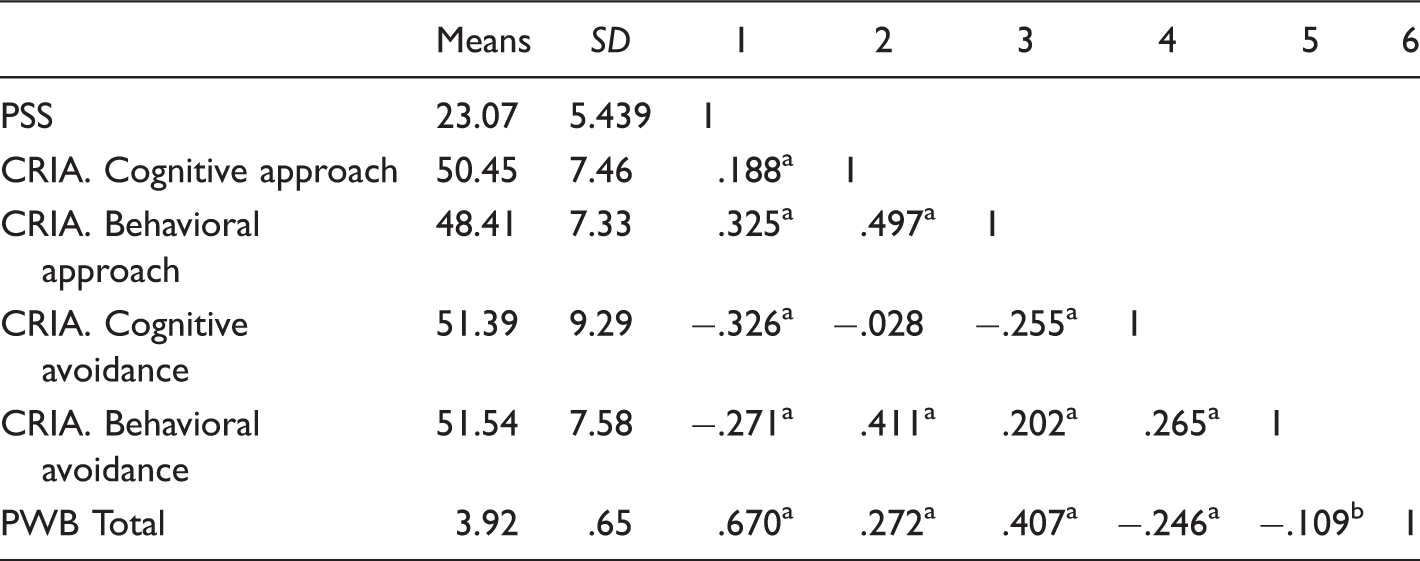
SD: standard deviation; CRIA: Coping Responses Inventory-Adult; PSS: Perceived Stress Scale; PWB: Psychological Well-Being.
aCorrelation is significant at the 0.01 level (2-tailed). bCorrelation is significant at the 0.05 level (2-tailed).
Mediating role of coping strategies
The MedGraph program (Jose, 2013) was used to examine the mediating role of coping strategies (MV) between perceived stress (independent variable, IV) and psychological well-being (dependent variable, DV). A prerequisite for performing this analysis is that the MV correlates significantly with both the IV and the DV. Therefore, we tested four models taking cognitive approach coping, behavioral approach coping, cognitive avoidance coping, and behavioral avoidance coping.
Product–term regression analyses with approach coping strategies as intervening variable for educational teacher students.
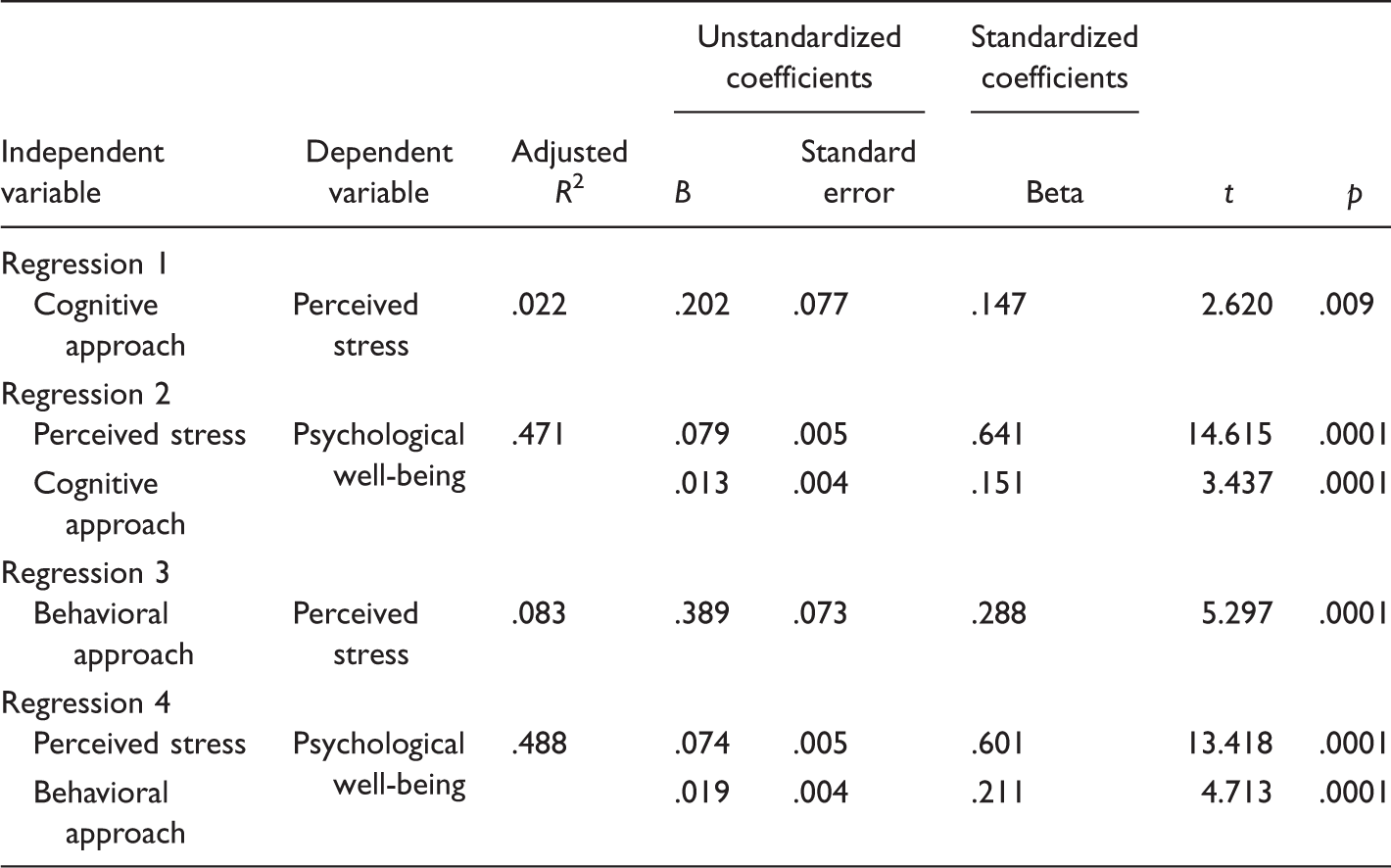
As indicated in Figures 1 and 2, approach coping strategies had a partial mediating effect, since the association between perceived stress and psychological well-being was significantly reduced by the inclusion of the approach cognitive coping (Sobel z value = 2.04, p = .042) and approach behavior coping (Sobel z value = 3.54, p < .001). The indirect to total ratio indicates the percentage of the effect of the IV on the DV that goes through the MV. Thus, approach coping mediated 4% (cognitive) and 10% (behavioral) of the relationship between stress and well-being. Although the effect size was small for approach cognitive, the positive sign of B indicates that this strategy has a protective role, mitigating the effect of the stress on the well-being.
Results of MedGraph program. Significance of mediation (Sobel Test), effect size measures, and variance of cognitive approach coping as a mediator between stress (VI) and psychological well-being (VD). Results of MedGraph program. Significance of mediation (Sobel Test), effect size measures, and variance of behavioral approach coping as a mediator between stress (VI) and psychological well-being (VD).

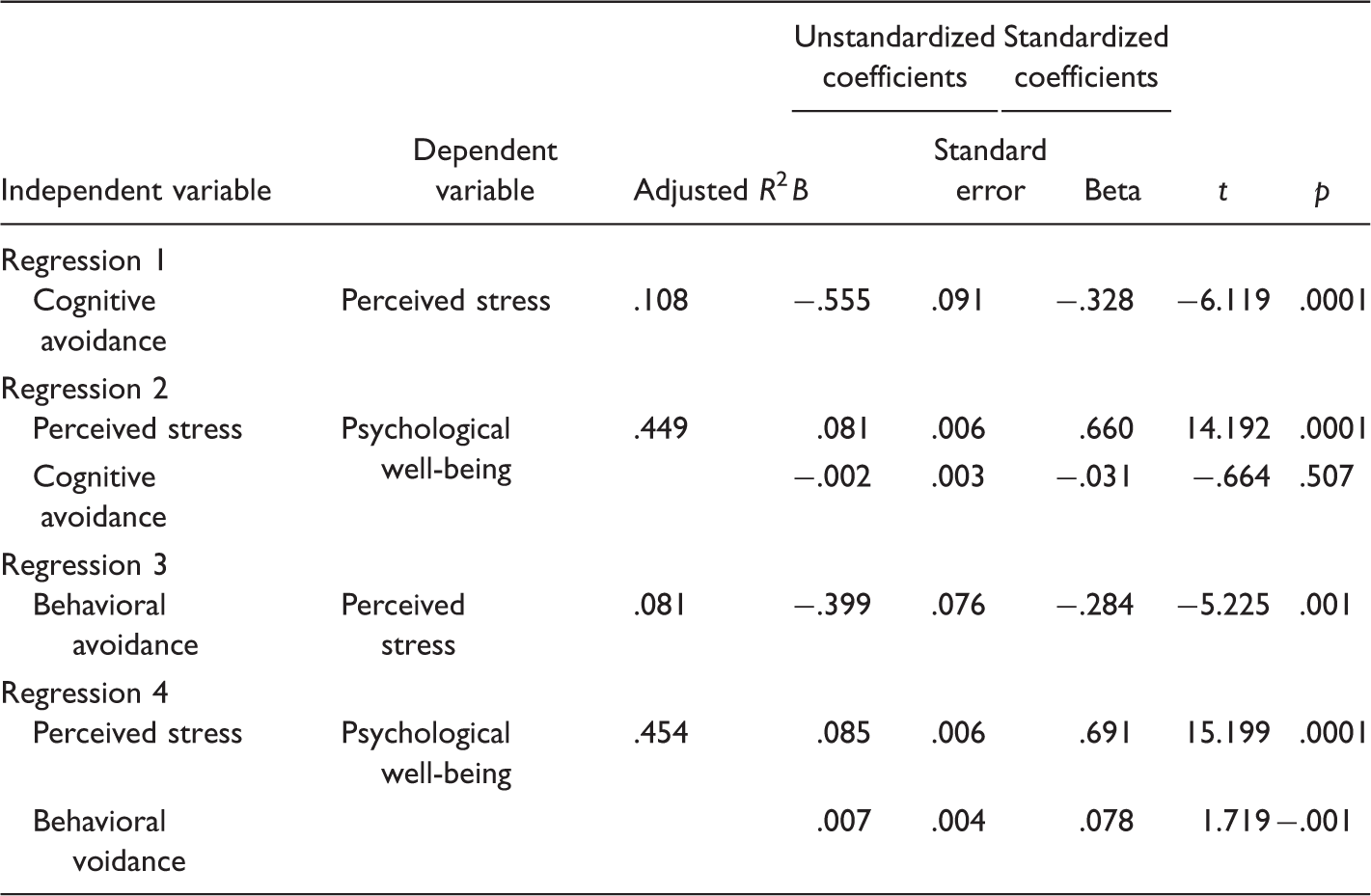
Product–term regression analyses with avoidance coping strategies as intervening variable for educational teacher students.
Discussion
Several findings of the study are notable. In relation to the first objective, teacher education students generally have a good level of psychological well-being, moderated stress, and they tended to use avoidance coping. The university students in our sample accepted and respected themselves as they are and maintain a clear direction and purpose in their life goals and objectives. All of these aspects foster motivation and academic engagement (Friedlander, Reid, Shupak, & Cribbie, 2007; Stupnisky, Renaud, Daniels, Haynes, & Perry, 2008).
In contrast, personal growth and autonomy were the aspects of psychological well-being that were given the lowest scores by university students in our study. According to Ryff (1989), autonomy reflects the capacity to maintain our individuality in different contexts and to feel free from social pressures and stress. The great importance that young people attribute to maintaining successful social relationships means that, to a certain extent, they subordinate their own beliefs and convictions to those of the majority, to avoid rejection. For example, Soares and Dias (2007) found that university students perceived a low level of autonomy when they faced a lack of affection and approval of their peers. Autonomy also has an impact on students’ motivational style and coping strategies (Ryan & Deci, 2000). Students who are subjected to more controlling methodological approaches (e.g., those whose opinions are not valued, who are not given opportunities to make decisions, or are not allowed to assume responsibility for their own learning processes), and who therefore perceive that they have less autonomy in their academic activity, show lower levels of engagement (Reeve, Jang, Carrell, Jeon, & Barch, 2004) and autoregulation (Black & Deci, 2000). In turn, this affects students’ perceptions of their studies (Diseth & Samdal, 2014).
The perception of stress among teacher education students was similar to that found in some international studies (Stallman, 2008; Tavolacci et al., 2013; Wong, Cheung, Chan, Ma, & Tang, 2006). A certain level of stress, such as that recorded in our study, is necessary and even desirable to obtain an active, engaged response to studies, and to generate a degree of well-being among students. However, psychological well-being may be diminished if stress levels are too high. This occurs in various university contexts where students feel isolated in the face of many problems and perceive the university as a competitive, stressful environment. In line with other authors, we found that higher level of psychological stress was related with avoidance strategies (Suldo, Dedrick, Shaunessy-Dedrick, Fefer, & Ferron, 2014). The use of avoidance strategies has been related with a wide range of problems, including poor academic performance (Aguilar-Vafai & Abiari, 2011), abuse of substances such as tobacco, alcohol, and cannabis (Butler, Dodge, & Faurote, 2010; Sun, Buys, Steward, & Shum, 2011), burnout (Lee et al., 2017), and unhealthy diet (Tavolacci et al., 2013). Avoidance strategies tend to be used frequently in periods marked by uncertainty and a lack of control (Ruus et al., 2007)—a situation that would be neither logical nor desirable among university students.
The second objective of this study was to analyze whether students had specific mediating mechanisms to manage demands and potentially stressful situations in the academic context. Our results indicate that the students in the sample frequently used avoidance strategies. When they faced an academic or personal problem, the two avoidance strategies that they used most often were seeking social support and emotional discharge, in this order. These results are in agreement with other studies in the literature (Cabanach, González, & Freire, 2009; Souto, 2014). However, these researchers urge caution in extrapolating the results to the entire population of university students—a caution which also applies to our research. We must bear in mind that our sample comprised mainly women, as in the aforementioned studies. Our results indicate that the use of avoidance strategies (e.g., denying the problem, systematically avoiding thinking about it, abusing harmful substances) would interfere with optimal psychological functioning (DeLongis & Holtzman, 2005; Karekla & Panayiotou, 2011).
Our results support the idea that approach strategies play a partial mediating role. The use of approach strategies could help students to manage stress better and to improve their psychological well-being. The range of cognitive approach strategies (positive reappraisal and planning) or behavioral ones (seeking advice or the solution to problems) enable students to plan and manage their personal and contextual resources (i.e., regulate the effort invested in each task, determine the most effective learning strategy in each case, draw up a study timetable and modify it according to needs, select the ideal physical space for academic work, etc.). These strategies could have a protective effect and mediate the relationship between the stressor and the psychological well-being of students in the study.
A first limitation of our study is related to the nature of its design. We used a cross-sectional study to analyze the influence of strategies adopted by university students to cope with stress and the impact of these strategies on their psychological well-being. As a result, we could not establish casual relationships between the variables. Second, the sample comprised teacher education students from just one university. The lack of students from other degree courses and other universities limits our ability to extrapolate the results to the entire university population.
Most of the students in our sample were women. We tried to include as many students as possible from the degree course, although the male/female ratio reveals the current situation in which the majority of teacher education students are women. If we had had a larger number of male students in the sample, we would have been able to analyze potential differences between students of both sexes. This issue could constitute a future area of research.
Finally, self-reported data are limited by the fact that it can rarely be verified independently and because contains potential sources of bias, such as answers that may be exaggerated, selective memory, or a desirability bias. For instance, the relatively high scores for psychological well-being could be influenced by social desirability bias. According to this concept, students may try to give an image of their psychological health that is better than the real situation, despite their anonymity in the data collection process.
In conclusion, the results of this study add to the emerging area of research on the protective role of approach strategies to cope with stress and ensure psychological well-being; conceptualized as the desire to achieve everything that you can. Reinforcing the use of strategies such as planning, seeking help and searching for the solution to problems, and promoting the psychological well-being of university students are essential actions to foster successful adaptation to a stage of life like higher education, which involves enormous demands, and therefore makes individuals vulnerable to stress (Carter, Kelly, Montgomery, & Cheshire, 2013; Moshki, Amiri, & Khosravan, 2012).
In teacher education, Bilbao and Monereo (2011) propose that continuing education plans should be focused on critical incidents that have been identified as those that cause most malaise in teachers and on developing the emotional skills of university students (Pena & Extremera, 2012). From a more general, systemic perspective, Greenberg, Brown, and Abenavoli (2016) suggest that measures should be implemented at three levels: (a) organizations, leading to internal changes that prevent the emergence of stressful situations; (b) the relationship between teachers and organizations, offering, for example, mentoring programmes or accompaniment in the initial stages of the professional career; and (c) individuals, including mindfulness activities and other techniques that enable stressful situations to be tackled successfully.
The university education received by future teachers must also be considered in light of the results obtained. It seems that is no longer enough to have theoretical, technical, and practical knowledge of the teaching profession. In addition, a more personal, humanistic type of education is required so that teaching staff can tackle stress with a certain degree of effectiveness. It is crucial to examine at least three issues. The first of these is university tutoring: the systematic meeting between lecturers and students to address personal, emotional, and ethical issues in certain depth (Biggs & Tang, 2011). However, in Spanish universities at least, tutoring is an area that still requires attention, as tutorials are being increasingly used as the setting in which to make occasional complaints about the curriculum. The second issue is that it could be helpful to include a subject or course on the great ideas that form part of universal and Spanish cultural heritage; ideas that would be of use to future teachers and are part of what is now known as the cultivation of humanity (Nussbaum, 2001). Here too, Spanish universities should address changes and consider the potential of the liberal arts, for example, which are taught in other western university environments (Delbanco, 2012). The third and last issue is to recover university life, that is, to consider an academic experience that goes beyond just passing from one subject to another. In other words, universities should offer seminars and cultural, music, and sports events, and so on. University life in other environments could also be an example for Spanish universities to follow (Melleby, 2011).
Although we still have a long way to go to unravel the mechanisms that can boost well-being, Ruus et al. (2007) consider that the educational system could and should become one of the main promoters of positive psychological functioning in individuals. Education and training are processes that go or should go beyond the mere transmission and evaluation of contents. It is equally important for students to establish significant relationships with other people, to know how to be autonomous, to adapt to their environment, and to establish personal goals and objectives that lead them to develop their individual capacities and potential to the maximum. From this perspective, education professionals can promote interpersonal resources and the well-being of their students.