




Abstract
Positive face-to-face human interactions are known to benefit well-being. Drawing upon previous work regarding the interference of media (via technological devices or print) in social interaction, the aim of this study was to identify whether using media during face-to-face interaction could potentially limit the positive effect of interaction on well-being. Participants were 437 university students who completed an online survey which assessed media multitasking behaviors, well-being (trait depression, trait anxiety, social anxiety, empathy, and psychological well-being), and personality traits (Big-5 and narcissism). Face-to-face interaction was positively associated with well-being. However, when media use during face-to-face interaction was considered, there was a negative relationship with well-being (more depression, more anxiety, and less psychological well-being). Those who used certain media types, such as phone or video chatting, listening to music, and gaming, while interacting with others, also had lower scores on measures of empathy. Regression analyses showed significant contributions by these media types to empathy levels, even after controlling for age, gender, and personality traits. Face-to-face media multitasking was related to higher levels of narcissism and neuroticism, and lower levels of agreeableness, conscientiousness, and openness. This study provides insight into the possible role of media multitasking during face-to-face interaction on psychosocial outcomes.
Introduction
Face-to-face interaction and social relationships with others are associated with many psychosocial benefits, such as increased feelings of connectedness (Toepoel, 2013), increased levels of happiness (Leung, Kier, Fung, Fung, & Sproule, 2011), lower levels and risk of depression (e.g., Cruwys et al., 2013), and better overall health (Vaillant, 2008). However, mobile technologies have changed the way people interact with others and people start using media devices from a young age (Giedd, 2012). In this article, “media” refers to content that is delivered through technological devices (e.g., mobile phone, computer, and television) or print (e.g., magazines and newspapers). Media use results in increased screen time and decreased face-to-face communication and activities (Giedd, 2012). This has raised concerns about the development and maintenance of face-to-face social skills in people of today’s society (Giedd, 2012). Thus, research attention has turned to media use during social interaction, in order to understand its impact on well-being and other aspects of individual behavior and functioning.
What Is Media Multitasking?
Media multitasking has been defined in various ways. According to Ophir, Wagner, and Nass (2009), it involves using at least two media forms concurrently. Others define media multitasking as using media whilst engaging in other non-media activities, such as interacting with others (e.g., Xu, Wang, & David, 2016). In the current research, we adopted the latter definition including media activities (e.g., phone/video calls, social media, and video gaming) during face-to-face interaction. Given the increased accessibility of media for a range of activities (Rideout, Foher, & Roberts, 2010), media multitasking has become an increasingly common occurrence amongst children, young adults, and even older adults (Rideout et al., 2010). Large-scale studies show significant increases in the concurrent use of different media forms in young Americans (Bányai et al., 2017; Rideout, 2015; Rideout et al., 2010), and reports have identified young adults as being among the most connected Internet users (Madden, 2006). Hence, the impact of media multitasking during face-to-face interaction on psychosocial well-being has recently become an area of research interest. First, we outline a theory that accounts for media multitasking behaviors and how this could influence well-being.
According to the Adaptive Control of Thought and Rationale Theory (ACT-R; Anderson et al., 2004), people multitask by drawing resources from motor, perceptual, or cognitive pools. While these pools can operate in parallel, within-pool demands are serial.Playing online/video games and watching TV/movies require sensory input (visual and auditory) that is similar to the one used during face-to-face interaction (getting information about people from visual cues and auditory cues from verbal content of the conversation). Therefore, it is difficult to effectively do both at the same time. This would likely reduce the quality of interaction from one or both activities to the extent that media use during face-to-face interaction has an adverse impact on personal relationships and overall well-being might be reduced. Thus, the current study seeks to add to the research by examining the links between media multitasking during face-to-face interaction on a range of psychosocial well-being facets by using this theory to explain these relationships.
Using Media While Interacting Face-to-Face Hurts Relationships and Well-Being
Social relationships, particularly face-to-face relationships, promote physical and emotional well-being (e.g., Reis, Sheldon, Gable, Roscoe, & Ryan, 2000; Uchino, Cacioppo, & Kiecolt-Glaser, 1996), and a meta-analysis shows that the relationship between happiness and social relationships with quality face-to-face interactions is extremely robust (Lyubomirsky, King, & Diener, 2005). As technology has become more prominent in people’s lives, the nature of social relationships and the ways they are created and maintained have also changed. Currently, there is limited research that has explored the concurrent use of media and face-to-face interaction. Further, those that have explored this so far have only looked at a limited range of media activities such as mobile phone use, social media, and video gaming. Therefore, this paper will first review studies that have focused on media use while interacting face-to-face, followed by a summary of other media use and media multitasking studies (without face-to-face interaction) that will build on the rationale for our current study and hypotheses.
A few studies have looked specifically at face-to-face media multitasking (i.e., use of media during face-to-face interaction). Mobile phone during meals with others (family, friends, and associates) was viewed negatively by children and adults (Moser, Schoenebeck, & Reinecke, 2016). Przybylski and Weinstein (2013) demonstrated that when strangers interacted in a controlled laboratory settings, perceived closeness, feelings of connection, and conversation quality were rated more negatively when mobile devices were present than when they were absent. This was particularly so when personally meaningful topics were being discussed. This was supported by another study that found people who texted during a conversation were rated by their companions as less polite and attentive and the conversation quality was lower (Vanden Abeele, Antheunis, & Schouten, 2016).
In a study investigating dyads engaging in a casual or meaningful 10-minute conversations in a coffee shop, Misra, Cheng, Genevie, and Yuan (2016) showed that the presence of mobile devices was related to lower levels of connectedness and empathic concern, regardless of age, gender, ethnicity, or mood. These findings held regardless of the type of conversation (casual or meaningful). It appears that even without active use, the presence of mobile devices has the potential to undermine individual face-to-face interactions by increasing the chances of overlooking nonverbal cues or expressions, missing changes in tone of voice, and reducing eye contact—all of which are important for fulfilling face-to-face conversations.
McDaniel and Coyne (2016) studied the interference of technology in romantic relationships of married women and women cohabiting with their partners, and the effect of this on personal and relationship well-being. It was found that interruptions in couple time (leisure, conversation, or meals) caused by technology were associated with increased conflict and lower relationship satisfaction. Those who perceived more frequent interruptions also showed poorer personal well-being such as greater depressive symptoms and lower life satisfaction. This was supported by Roberts and David (2016), who found that mobile phone use while in the company of a relationship partner can impact on relationship satisfaction, particularly for those with anxious attachment styles. In addition, media multitasking behavior was found to indirectly influence depression scores through relationship satisfaction (Wang, Xie, Wang, Wang, & Lei, 2017). Amichai-Hamburger and Etgar (2016) investigated the association between smartphone multitasking and romantic intimacy. Although participants’ self-reported smartphone multitasking scores were not related to romantic intimacy, their partners’ scores were negatively related to romantic intimacy ratings. This implies that overall relationship quality is likely to decrease if either partner (or both) frequently engages in smartphone use while interacting face-to-face.
Hence, studies show that using media while interacting face-to-face has negative associations with social relationships and well-being outcomes; however, no study has directly measured the link between this multitasking behavior across a range of media activities and an individual’s psychosocial well-being. This study will fill this gap within the literature.
General Media Multitasking is Also Linked to Negative Well-Being
A number of studies have investigated the link between media multitasking and aspects of psychosocial well-being.Becker, Alzahabi, and Hopwood (2013) found that media multitasking was a unique predictor of self-reported symptoms of depression and social anxiety, even after controlling for personality traits (extraversion and neuroticism). The results suggest that personality traits may influence one’s dispositional vulnerabilities to mood and anxiety problems whereas media multitasking might be an environmental factor that contributes to increased vulnerabilities to mood and anxiety problems.
The negative psychosocial outcomes of media multitasking have also been demonstrated in young girls aged between 8 and 12 (Pea et al., 2012). Higher levels of face-to-face communication were associated with positive socioemotional outcomes. Face-to-face interaction was negatively related to media multitasking, suggesting a trade-off relationship for young girls. Overall, video use, online communication, and media multitasking were associated with negative socioemotional outcomes, including feeling less social success and normalcy, having more negative friendships, and sleeping less.
Other studies have specifically looked at media multitasking during social interaction and how this affects psychosocial well-being. Xu et al. (2016) examined media multitasking and psychosocial well-being in university students. They distinguished social interaction as either synchronous (real-time interaction such as face-to-face, phone calls, and video chatting) or asynchronous (e.g., texting and social networking sites). Media multitasking during synchronous, but not asynchronous, social interaction significantly decreased social success.
Media multitasking and psychological health in people aged between 14 and 85 years have also been investigated (Reinecke et al., 2016). In this study, Internet multitasking referred to using the Internet while engaging in other media or non-media activities, which could include face-to-face interaction such as a conversation, having a meal, interacting with a romantic partner, or going out with friends. Internet multitasking was related to more perceived stress, depression, and anxiety, particularly in the younger age groups (14 to 49 years). This is consistent with other studies in this area, and overall, the research indicates that media multitasking is related to negative outcomes on social, emotional, and psychological well-being in both adults and children (Becker et al., 2013; Pea et al., 2012; Reinecke et al., 2016; Xu et al., 2016).
Relationship Between Media Multitasking, Personality, and Well-Being
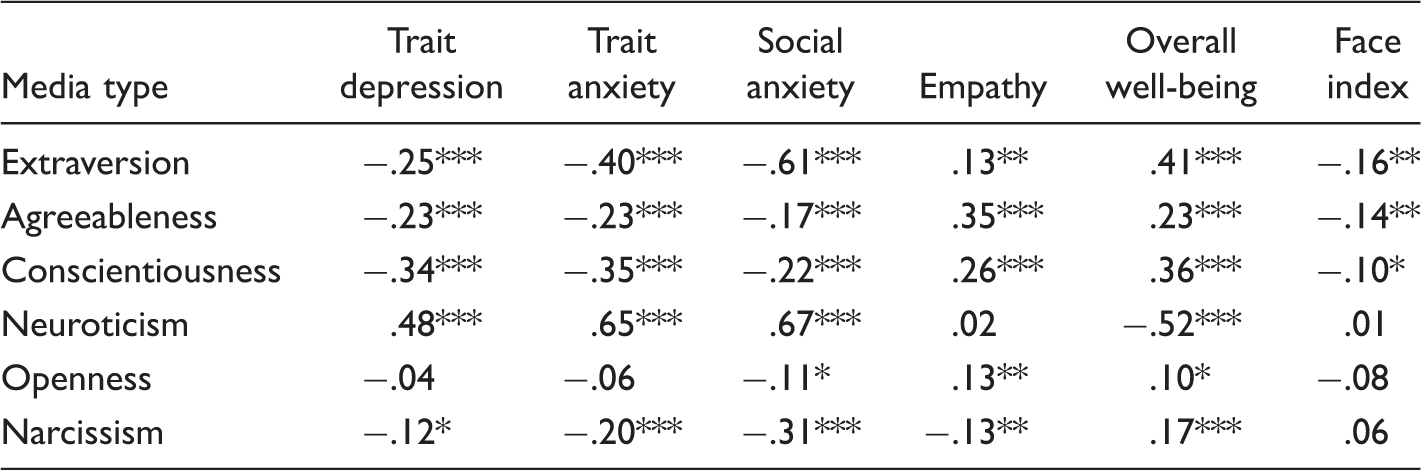
There are currently limited studies that have investigated only media use during face-to-face interaction and personality traits. However, other general media multitasking studies (including a combination of both media and non-media activities) have found relationships with media multitasking behavior and personality traits such as impulsivity and sensation seeking (Duff, Yoon, Wang, & Anghelcev, 2014; Jeong & Fishbein, 2007; Sanbonmatsu, Strayer, Medeiros-Ward, & Watson, 2013). The relationship between media multitasking and the Big 5 personality traits (extraversion, conscientiousness, agreeableness, neuroticism, and openness) has hardly been researched and will be explored in the current study. Furthermore, a range of studies has found associations between Big 5 personality traits and depression, anxiety, and subjective well-being (Kotov, Gamez, Schmidt, & Watson, 2010; Steel et al., 2008). Narcissism, particularly the maladaptive type, has also been linked to psychopathology and poor psychosocial outcomes (Calhoun, Glaser, Stefurak, & Bradshaw, 2000), but has not been investigated in relation to media multitasking behaviors. Taken together, the relationship between face-to-face media multitasking, Big 5 and narcissism personality traits, and psychosocial well-being will be explored in the current study. In addition, since they appear to consistently influence one’s vulnerability to well-being, these personality traits will be used as control variables to identify the unique contribution of face-to-face media multitasking to psychosocial well-being.
The Current Study
Previous research has shown positive effects of face-to-face interactions on well-being and negative effects of general media multitasking on well-being (Becker et al., 2013; Pea et al., 2012; Reinecke et al., 2016; Xu et al., 2016). The research suggests that media use while interacting face-to-face has a negative impact on the positive benefits usually associated with social interaction (McDaniel & Coyne, 2016; Misra et al., 2016; Przybylski & Weinstein, 2013; Uhls et al., 2014). The current study further expands on the literature by examining the relationship between various types of media use while interacting face-to-face on a number of psychosocial well-being factors, including trait depression, trait anxiety, social anxiety, empathy, psychological well-being, and personality traits such as the Big-5 and narcissism.
It is hypothesized that face-to-face interaction will be positively related to well-being, but using media during face-to-face interaction will be negatively related to well-being (higher depression, anxiety, social anxiety, and lower empathy and general well-being). Based on Anglim and Grant (2016), it is also expected that personality traits will be related to subjective and psychological well-being. Therefore, following Becker et al. (2013), personality will be controlled in the analyses examining the relations between media use during face-to-face interaction and well-being.
The relations between use of each of the 10 different types of media activities during face-to-face interactions and psychosocial well-being were also examined. Based on the existing research, it is hypothesized that, compared to other media activities, use of mobile phones and social media during face-to-face interaction would be most strongly related to poorer well-being.
Method
Participants and Procedure
A total of 437 participants (365 females, 72 males) took part in this study. Participants’ mean age was 21.14 years (SD = 5.80, min = 17, max = 50). Although this is a large age range, 95% of participants were aged 36 and below. Given the imbalance of gender and large age range, both gender and age were used as control measures in the analyses. Participants were undergraduates recruited through the Griffith University Research Participation Program who completed an online survey in return for course credit when they were enrolled in first year psychology courses. An information page was first provided and participants provided consent by continuing with the survey. The research protocol was approved by the Griffith University Human Research Ethics Committee.
Measures
Media use during face-to-face interaction
The Media Multitasking Index (MMI; Ophir et al., 2009) questionnaire measures media multitasking and total media use.Ralph and Smilek (2017) modified the MMI to include face-to-face interaction and other media activities. The current study adapted both questionnaires to include types of media that were more relevant to current trends in media use. We examined face-to-face interaction while using 10 forms of media: reading print, texting/instant messaging, social media sites, non-social media sites, phone/video chatting, television, music, video/online gaming, e-mailing, and offline computer tasks. Participants rated this simultaneous media use and interacting face-to-face according to “Most of the time (1),” “Some of the time (0.67),” “A little of the time (0.33),” or “Never (0).” The 10 responses are summed and then divided by the total number of hours of face-to-face interaction to provide a measure of the amount of concurrent media used while interacting face-to-face. The Face-to-Face Interaction Index (i.e., face-to-face media multitasking) represents the level of media multitasking an individual engages in during a typical hour of interacting face-to-face with a person. A higher score indicates that an individual spends more time using media while interacting with others face-to-face. In the current study, Cronbach’s alpha was .79 which is in the acceptable range.
Maryland Trait State Depression Scale—Trait form
The Maryland Trait State Depression Scale (MTSD) was developed based on the DSM-V criteria for depression (Chiappelli, Nugent, Thangavelu, Searcy, & Hong, 2014). It assesses depression and distinguishes current state symptoms from trait-like symptoms. The MTSD-T has 18 items. Participants answer on a five-point Likert scale. Responses on the trait form are based on one’s adult life except the past seven days, and ranges from “never (1)” to “experienced many times in a month for almost every month of my adult life (5).” Higher scores indicate more depressive symptoms, with a range of 18 to 90. Test-retest validity and reliability were good (Chiappelli et al., 2014). In the current study, Cronbach’s alpha was .94 which is in the excellent range.
State Trait Anxiety Inventory—Trait form
The State Trait Anxiety Inventory (Spielberger, Gorsuch, Lushene, Vagg, & Jacobs, 1983) is a well-established measure of anxiety, separating state symptoms from more enduring trait-like symptoms. For the trait-form, participants respond to 20 statements based on how they generally feel. Participants rate themselves on a four-point Likert scale ranging from “almost never (1)” to “almost always (4).” Higher scores indicate more symptoms of anxiety, with a range of 20 to 80. Test-retest reliability for the trait scale was good, and its validity compared to other measures of anxiety was high (Spielberger et al., 1983). In the current study, Cronbach’s alpha was .92 which is in the excellent range.
Interaction Anxiousness Scale
The Interaction Anxiousness Scale (Leary, 1983) is a 15-item measure of social anxiety. It considers both the social interaction and performance anxiety aspects of social anxiety. Participants rate themselves on statements on a five-point Likert scale ranging from “not at all characteristic of me (1)” to “extremely characteristic of me (5).” A higher score reflects more social anxiety symptoms, with a range of 15 to 75. The Interaction Anxiousness Scale demonstrated strong reliability and validity in data collected over 12 years (Leary & Kowalski, 1993). In the current study, Cronbach’s alpha was .90 which is in the excellent range.
Toronto Empathy Questionnaire
The Toronto Empathy Questionnaire (Spreng, McKinnon, Mar, & Levine, 2009) is a 16-item measure assessing empathy as an emotional process. Participants rate themselves on a five-point Likert scale ranging from “never (1)” to “always (5)” based on how frequently they felt or acted as described. Higher scores indicate higher levels of empathy, with a range of 16 to 80. Spreng et al. (2009) showed that the Toronto Empathy Questionnaire had strong validity and test-retest reliability. In the current study, Cronbach’s alpha was .88 which is in the good range.
Well-being Manifestations Measure Scale (WBMMS)
The WBMMS is a 25-item questionnaire with six subscales measuring a combination of cognitive and affective components of psychological well-being and a total well-being score (Masse et al., 1998b). The six subscales are: control of self and events, happiness, social involvement, self-esteem, mental balance, and sociability. Participants rate themselves on a five-point Likert scale (1 = never, 2 = rarely, 3 = sometimes, 4 = frequently, and 5 = always) based on their feelings and experiences during the last month. Higher scores indicate higher levels of psychological and total well-being, with a range of 25 to 125. Good reliability and validity has been found for the total well-being scale and its subscales (Masse et al., 1998a, 1998b). In the current study, the total scale obtained a Cronbach’s alpha of .95 which is in the excellent range.
Big 5 Inventory-10 (BFI-10)
The 10-item scale (BFI-10) was developed by Rammstedt and John (2007) including two items per subscale (extraversion, conscientiousness, agreeableness, neuroticism, and openness). Each short-phrase item is rated on a five-point Likert scale from 1 = disagree strongly to 5 = agree strongly. Higher scores show a stronger indication of that personality trait (ranging from 2 to 10 for each trait). Although this is a much shorter version of the original 44-item version, Rammstedt and John (2007) showed that the BFI-10 still had good validity, reliability, and internal consistency. In the current study, Cronbach’s alpha for the subscales ranged from .31 to .61.
Narcissistic Personality Inventory-16
The Narcissistic Personality Inventory-16 (Ames, Rose, & Anderson, 2006) is a measure of narcissistic personality traits. It was developed to capture various facets of narcissism including self-ascribed authority, superiority and entitlement, and self-absorption. There are 16 item pairs where participants choose which statement of each pair described them best. Higher scores reflect higher levels of narcissism, ranging from 16 to 32. Reliability and validity has been found to be adequate (Campbell, Rudich, & Sedikides, 2002). In the current study, Cronbach’s alpha was .70 which is in the acceptable range.
Data Analysis
We will be employing correlational analyses to examine the link between using media while interacting face-to-face and psychosocial well-being. In addition, hierarchical regression analyses will be used to determine the unique contribution of using media while interacting face-to-face towards these psychosocial outcomes whilst controlling for age, gender, and personality traits (Big 5 and narcissism).
Results
Correlations for Media Use During Face-to-Face Interaction (Face-to-Face Interaction Index)
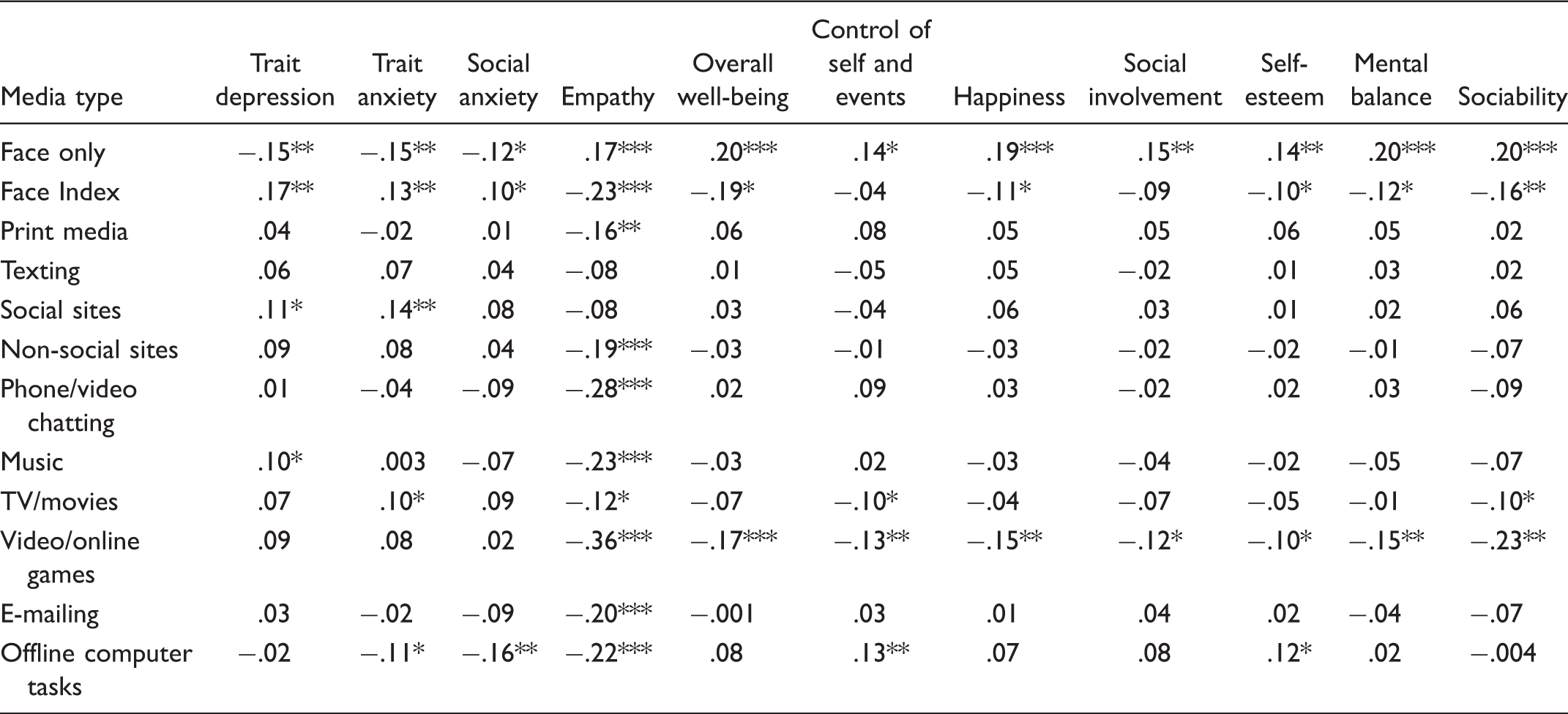
Correlations between media multitasking, depression, anxiety, social anxiety, and empathy.
*p < .05, **p < .01, ***p < .001.
These results show that when media is used during face-to-face interaction as opposed to pure face-to-face interaction (i.e., Face only variable in Table 1), the relationship with psychosocial outcomes changed from a positive to negative relationship.
Correlations between personality, face-to-face index, and psychosocial outcomes.
*p < .05, **p < .01, ***p < .001.
Using Different Media Types While Interacting Face-to-Face and the Relationship With Depression, Anxiety, and Empathy
Further analyses were conducted to identify relationships between using 10 different media types (each item from the MMI) during face-to-face interaction and the psychosocial outcomes (see Table 1). It was expected that the use of technological devices such as mobile phones (e.g., texting and phone chatting) and social media, while interacting with others would be most strongly related to poorer psychosocial outcomes. Results partially supported the hypothesis and showed that using social media or listening to music during face-to-face interaction was associated with higher levels of trait depression. Using social media and watching TV or movies while interacting face-to-face were linked with higher trait anxiety. Doing offline computer tasks while interacting face-to-face was related to lower trait anxiety and social anxiety. Using non-social sites, reading print, phone/video chatting, listening to music, watching TV/movies, playing online/video games, e-mailing, and doing offline computer tasks while interacting face-to-face were all related to lower levels of empathy.
Using Different Media Types While Interacting Face-to-Face and the Relationship With Psychological Well-Being (WBMMS)
Based on previous research, it was expected that using mobile devices and social media while interacting face-to-face would be most strongly related to poor general well-being. Results did not support the hypothesis, and instead showed that increased time playing online/video games while interacting face-to-face showed negative relationships with overall psychological well-being (WBMMS) and the subscales control of self and events, happiness, social involvement, self-esteem, mental balance, and sociability. More TV/movie watching during face-to-face interactions was associated with lower control of self and events and sociability scores. In contrast, interacting face-to-face while doing offline computer tasks was related to higher control of self and events and self-esteem scores. Refer to Table 1 for relationships between different combinations of media multitasking and psychological well-being.
Regression Analyses for the Contribution of Media Use During Face-to-Face Interaction for Depression, Anxiety, and Empathy Scores
The relationship between face-to-face interaction with media multitasking and psychosocial well-being was further explored by running separate hierarchical regression analyses using trait depression, trait anxiety, social anxiety, empathy, and overall well-being as the dependent variables. These psychosocial variables were selected because of the correlations with face-to-face interaction media multitasking (overall and different media types). Predictors were entered into the regression analysis in two steps. On the first step, age, gender, Big-5 personality variables, and narcissism were entered. On the second step, the Face-to-Face Index score was entered. This approach allowed us to determine whether overall use of media during face-to-face interaction made a unique contribution after controlling for demographic and dispositional factors such as age, gender, and personality traits.
Hierarchical regression models predicting trait depression.

**p < .01; ***p < .001.
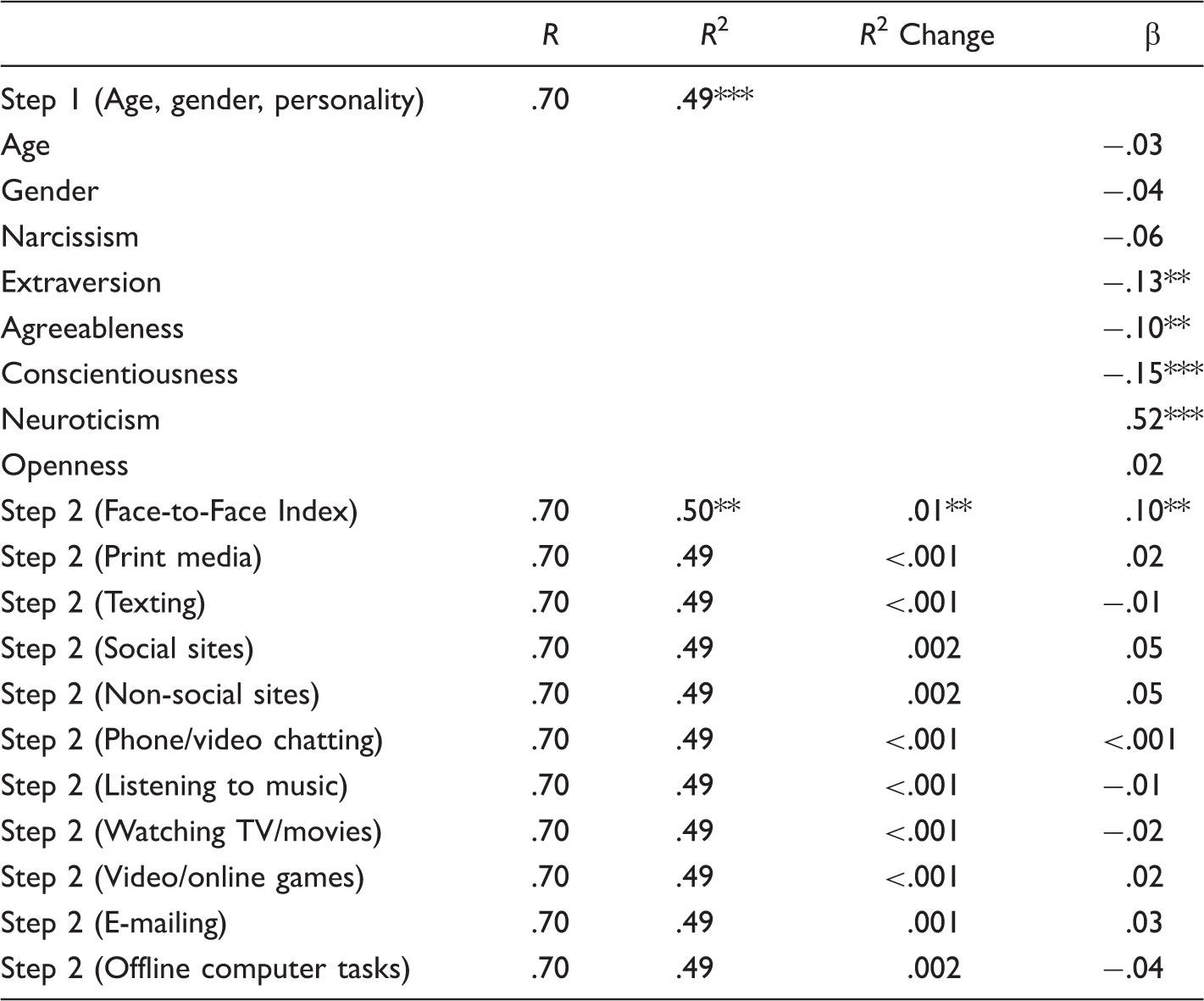
Hierarchical regression models predicting trait anxiety.
**p < .01; ***p < .001.
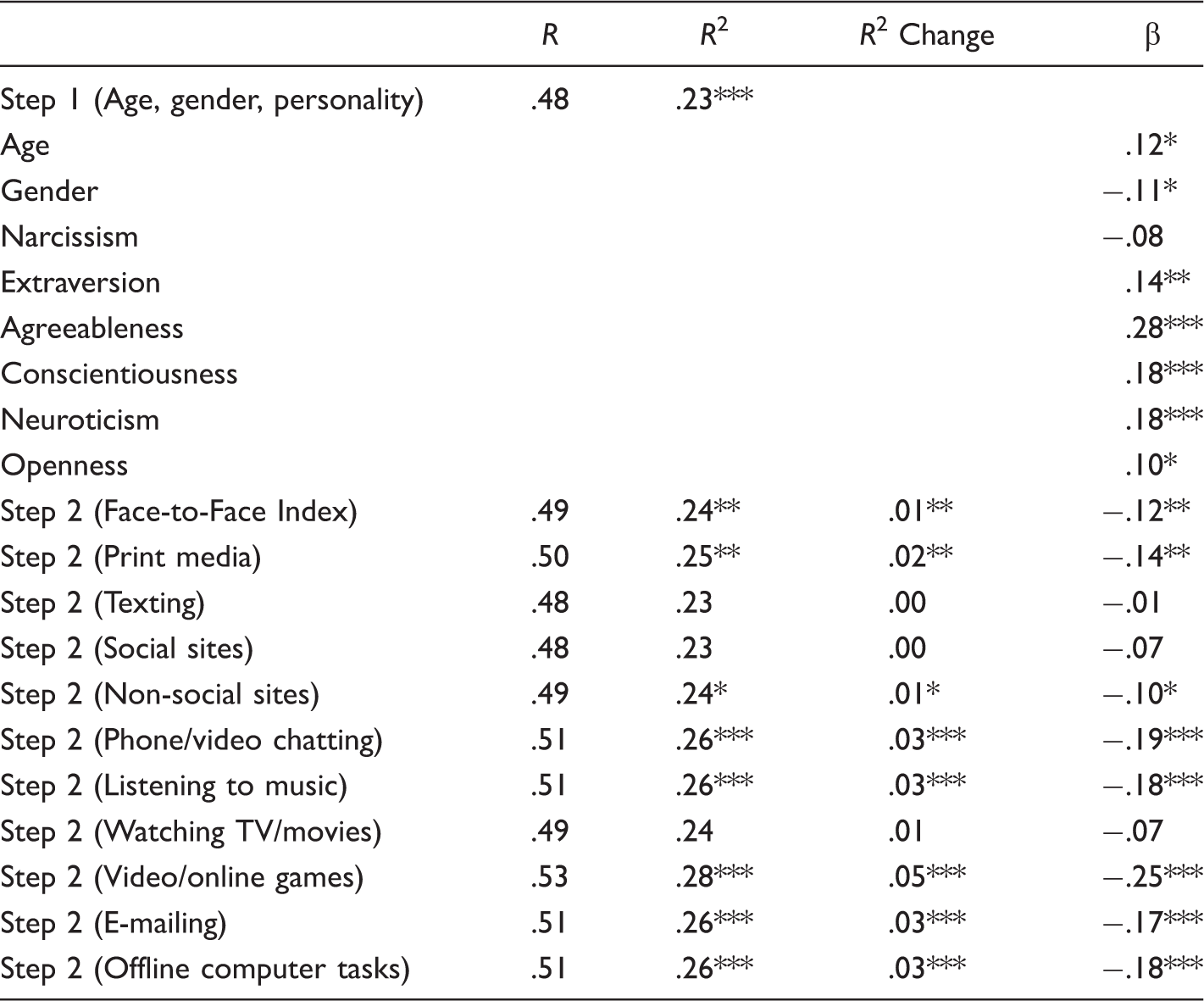
The model for empathy at Step 1 was significant, F(8, 428) = 15.99, p < .001. The Face-to-Face Index also significantly contributed to lower empathy levels by accounting for an extra 1% of the variance even after controlling for age, gender, and personality, F(9, 427) = 15.26, p = .01.
Media use while interacting face-to-face was not a unique predictor of social anxiety after age, gender, and personality were controlled for (p = .13). At Step 1, the model for social anxiety was significant, F(4, 428) = 81.88, p < .001. At Step 2, the Face-to-Face Index contributed 0.2% extra variance, F(9, 427) = 73.21, p = .14.
Separate regressions were then run for each use of media type during face-to-face interaction using the same control variables. With the exception of listening to music, which approached significance when predicting trait depression, F(9, 427) = 20.16, p = .07, none of the media types made significant contributions to trait depression (all Fs < 19.94, all ps > .10) or trait anxiety (all Fs < 45.34., all ps > .10). Doing offline computer tasks while interacting with others was a significant contributor to less social anxiety, F(9, 4270 = 74.34, p = .01. Refer to Tables 3, 4, and 6 for regression statistics for trait depression, trait anxiety, and social anxiety.
Hierarchical regression models predicting empathy.
**p < .01; ***p < .001.
Hierarchical regression models predicting social anxiety.
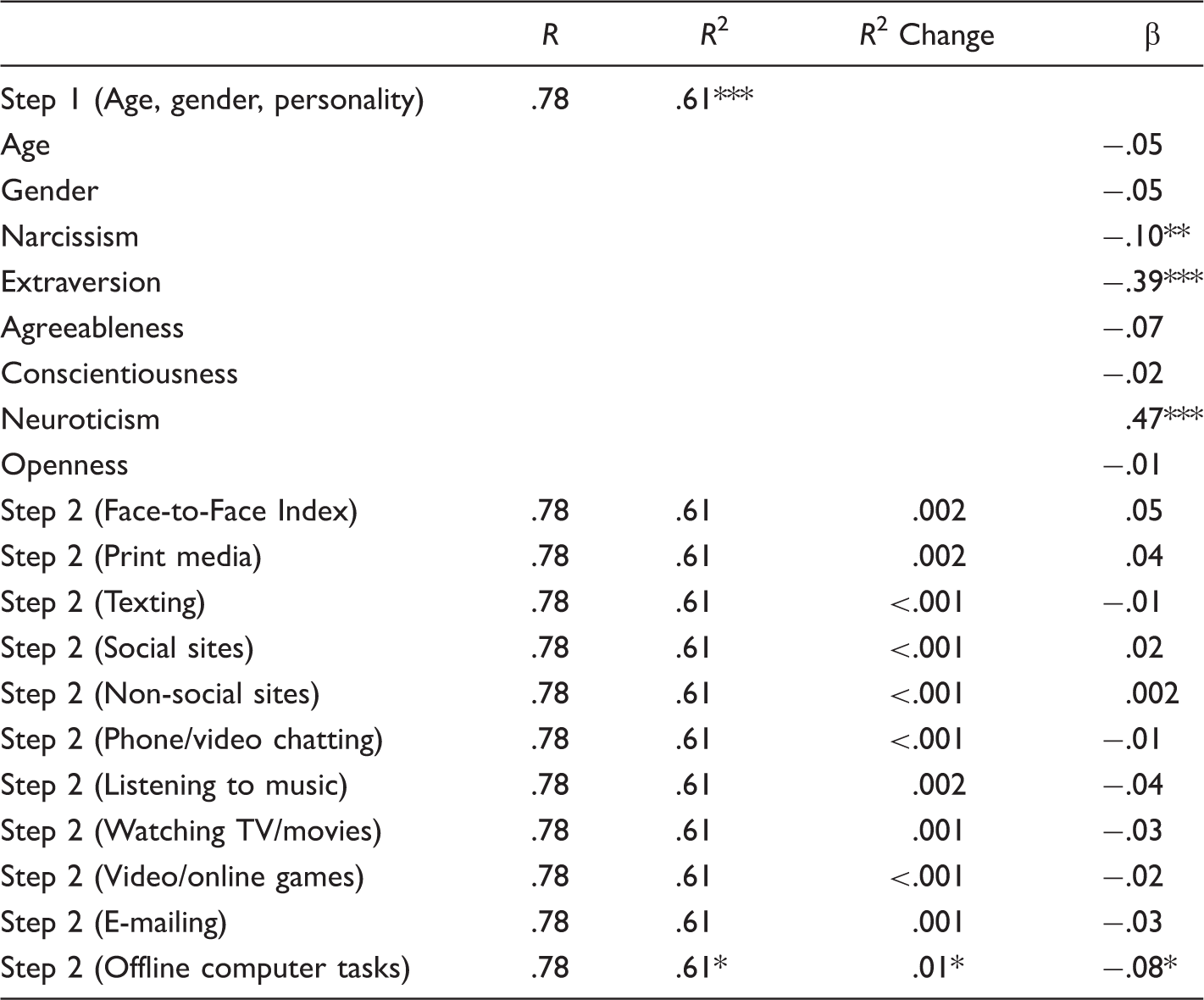
*p < .05; **p < .01; ***p < .001.
Regression Models for Overall Well-Being as Measured by the WBMMS
Hierarchical regression models predicting overall well-being.

*p < .05; **p < .01; ***p < .001.
Discussion
This study explored the relationship between using various media forms while interacting face-to-face and a range of well-being measures. As expected, time spent on face-to-face interaction by itself was associated with lower trait depression, trait anxiety, and social anxiety scores. It was also related to higher levels of empathy and psychological well-being. These results support previous studies showing psychosocial benefits of interacting with others (e.g., Cruwys et al., 2013; Leung et al., 2011; Toepoel, 2013). When face-to-face interaction occurred concurrently with media use, these relationships were negative, suggesting that the inclusion of media use may not only hinder the positive effects of face-to-face contact, but even contribute to negative psychosocial well-being. This is consistent with the hypotheses and previous studies showing that media multitasking during social interactions decreased aspects of well-being, such as social success and feelings of normalcy (e.g., Pea et al., 2012). However, these previous studies did not assess the same psychosocial well-being factors that were examined in this study, including trait depression and anxiety, social anxiety, and empathy. Therefore, this study expands the current knowledge on the links between using media while interacting face-to-face and psychosocial well-being.
Although the regression analyses did not show overall face-to-face media multitasking to be a significant unique contributor of social anxiety, it was for trait depression and trait anxiety.While we acknowledge that the contribution is small, such is to be expected given the multitude of known contributing factors to depression and anxiety. Nevertheless, it suggests that people who use media while interacting with others may be increasing their risk to depression and anxiety, likely through poorer relationship quality. However, it is also a modifiable behavior that can be managed more readily than (for example) genetic or personality predispositions to reduce the additional risk of depression and anxiety. The findings from this study partially support and expand the work of Becker et al. (2013). The differences in results for social anxiety could be due to a larger number of controlled variables such as age, gender, and more personality traits in this study, compared to just extraversion and neuroticism in the Becker et al. (2013) study. Further, Becker et al. (2013) measured social anxiety and used a screener for state depression. This study adds to the existing research by using a trait anxiety and trait depression measure and showing that the negative influence of media use during face-to-face interaction is not limited to a specific anxiety or state depression only.
Partially supporting the hypotheses, using different media during face-to-face interaction was found to be related to various positive and negative psychosocial outcomes. Using social media and playing online/video games while interacting face-to-face were significant predictors of poorer overall psychological well-being as measured by the WBMMS. Most studies have found social interaction to be beneficial to well-being (e.g., Toepoel, 2013) and some studies also suggest that using social media lowers depression due to the social connections involved (Houston, Cooper, & Ford, 2002). However, the current results suggest that an individual communicating face-to-face and through social media at the same time is unable to reap the benefits of both or either one. This may indicate that the quality of social interaction is more important to measures of well-being than just the presence of another person, and using media during interpersonal interaction reduces its quality. One explanation for these results could be that when a person uses these forms of media while interacting with others, there is a trade-off on the quality of interaction due to conflicting use of cognitive resources, as previous studies have observed (Misra et al., 2016; Przybylski & Weinstein, 2013). This is consistent with the ACT-R theory (Anderson et al., 2004), which would support that media multitasking while interacting face-to-face would be difficult to do effectively. This is because face-to-face interaction usually involves visual and/or auditory cues, which take up resources from those pools. Media activities often also require resources from the visual and/or auditory pools (e.g., watching a movie or listening to music); therefore, they would compete for the same limited resources needed for effective face-to-face interaction. Although relationship or conversation quality was not directly measured in the current study, it is possible that the concurrent use of media such as social media while interacting with others contributes negatively to interpersonal relationships, and over time, contributes to an increase in depression and anxiety, and a decrease in overall well-being. This is consistent with previous research showing a negative association between media use, relationship quality, and well-being (McDaniel & Coyne, 2016; Misra et al., 2016; Przybylski & Weinstein, 2013; Uhls et al., 2014).
The results also provide evidence that those who use media while interacting with others face-to-face have lower levels of empathy. It is unclear whether people with lower levels of empathy are more likely to engage in media activities while talking to others, or whether engaging in these activities leads to reduced opportunities to develop empathic social skills. The latter would support results from Uhls et al. (2014) showing improved social and emotional perception skills (components of empathy) in children when they participated in outdoor camp without media devices. Nevertheless, this also suggests that continued face-to-face media multitasking is likely to further diminish empathic skills over time simply from lack of development and practice. As a result, lower levels of empathy would likely impact on relationship quality (Lopes, Salovey, & Straus, 2003), affecting one’s feelings of social connectedness and social support, thus reducing well-being and increasing the risk of mental health issues. The current results further support this by showing that even after controlling for age, gender, and personality factors, a number of types of media used during face-to-face interaction still predicted lower levels of empathy. This is the first study to have looked at the link between face-to-face media multitasking and empathy in individuals, and provides us with additional information about how face-to-face media multitasking can negatively impact relationships and well-being, given that empathy has been shown to be an important element for both (Carnicer & Calderon, 2014; Levesque, Lafontaine, Caron, Lyn Flesch, & Bjornson, 2014).
Interestingly, doing offline computer tasks while interacting face-to-face was related to lower social anxiety and higher feelings of control of self and events and mental balance. One possible explanation is that the sample was university students, who are likely to engage in collaborative group discussions or study groups with peers. This presents an opportunity for social interaction that includes a common conversational topic for each member. This could facilitate positive social experiences, increase feelings of control and mental balance, as well as reduce social anxiety. Likewise, in a workplace setting, performing offline computer tasks alone may be isolating and boring. However, interacting with colleagues can improve workplace relationships, social connectedness, and individual well-being (Colligan & Higgins, 2006).
This study provides insight into the relationship between media use while interacting with others and well-being including more enduring measures such as trait depression and anxiety. Although this expands on the current literature, there are limitations on the conclusions that can be made due to the correlational nature of the study, and it is not conclusive the extent to which media multitasking behaviors influence trait measures of well-being or whether it is the traits that lead to media multitasking behavior. This would also be an alternative explanation, given media use while interacting face-to-face may provide some relief or avoidance of overwhelming symptoms, which further accommodates those symptoms. Perhaps a longitudinal study of ongoing, consistent media multitasking could provide more clarification on this relationship.
One potential limitation of this study is the imbalance of gender within the sample as there were five times more females than males. While some studies show no gender differences in Internet use or television viewing (Gross, 2004; Hunley et al., 2005), some studies have shown gender differences in Internet use (e.g., Ohannessian, 2009). It has been suggested that males mainly use the Internet for entertainment and leisure while females are more likely to use it for interpersonal communication and educational assistance (Ohannessian, 2009; Weiser, 2000). Therefore, gender was used as a control measure in the analyses. Although gender difference is not the focus of the current study, further research could include a more gender-balanced sample and identify potential gender differences in media use during face-to-face interaction and how they might be related to psychosocial outcomes. Further, although a large age range is present in the sample, the majority of participants were clustered in the same age group, and results did not differ when older participants were excluded from the analyses. Age was also used as a control measure in the analyses.
Although there are limitations of using single-item measures, we approached our analyses of different types of media in an exploratory manner and cautiously interpret the findings. However, the results are still of some value as they provide insight that perhaps using certain types of media while interacting with others may not be as bad as others. This can help to reduce the overgeneralization that all media multitasking is bad and encourages future research to look at other types of media multitasking in more detail.
Overall, the results from this study suggests that using media while interacting face-to-face with others could counteract the positive effects of social interaction and has negative implications on well-being. This implies that the quality of interaction plays an important role in psychosocial well-being, rather than just face-to-face presence. It is also important to consider the type of media being used when interacting with others, and the setting this is occurring in, as they have varying effects on psychosocial well-being. Entertainment and leisure-type activities such as listening to music, social sites, watching TV/movies, and playing games while interacting with others appears to have negative well-being outcomes, while work-related activities such as offline computer tasks are related to positive well-being outcomes. In addition, the results indicated more media multitasking while interacting face-to-face to be a predictor of lower empathy levels. Based on previous research (Carnicer & Calderon, 2014; Lopes et al., 2003), it is likely that this would contribute to poorer relationship quality, and in the long-term, well-being would suffer due to less social support and sense of connectedness (McDaniel & Coyne, 2014; Misra et al., 2016; Pea et al., 2012; Przybylski & Weinstein, 2013; Uhls et al., 2014). Media use while interacting face-to-face predicts negative psychosocial outcomes, with the exception of a few media types. Therefore, engaging in this behavior should be reconsidered if possible, particularly in excessive amounts.