



Abstract
We examined whether emerging adults would engage in mobile phone use (MPU) when given the opportunity to socialize face-to-face with a close friend in a laboratory setting. Sixty-three U.S. college student friendship dyads rated their friendship quality in an online survey before coming into the laboratory together. When they arrived for their appointment, they were asked to wait together in a room for 5 min. A hidden camera recorded each dyad. Friends then separately rated the quality of the interaction. We coded time spent using mobile phone in seconds. A hierarchical regression conducted at the level of the dyad controlling for friendship quality and gender showed that more MPU was associated with lower quality interactions. We discuss findings in terms of the potential for MPU to interfere with the development of friendship intimacy.
Although mobile devices may enhance our lives in many ways, the benefits could come at the cost of high-quality face-to-face interactions. Through naturalistic observations in U.S. public spaces, Humphreys (2005) documented how mobile phones commonly distract people from their in-person interactions. In survey research, adult women report that mobile devices frequently interrupt quality time with romantic partners, and the more frequent these interruptions, the lower their relationship satisfaction (McDaniel & Coyne, 2014). Even the simple presence of a mobile phone in a room may have negative consequences. Przybylski and Weinstein (2013) found that college students, meeting for the first time, reported lower feelings of trust and empathic understanding when there was a cell phone in the room, particularly when they discussed intimate topics. The authors speculate that the phone reminded participants of alternative possibilities and thus prevented them from fully engaging in conversation with their partner.
Indeed, the ubiquity of mobile devices may tempt emerging adults to turn to their technology for immediate gratification, rather than be present for mutual fulfillment to unfold within social interactions in the physical world. This trend may be a cause for concern, given that intimacy development is a critical task of emerging adulthood (Arnett, 2000). Through interactions with close friends, emerging adults practice self-disclosure, vulnerability, empathy, emotional support, and trust (Allen & Land, 1999). Friends who spend greater proportions of their time together distracted by their mobile phones may experience poorly coordinated conversations and decreased access to emotional cues, which could reduce their opportunities to build a mature sense of intimacy in the long term.
To understand how mobile devices may impact friendship interactions, we examined the extent to which college students use their phones when waiting in a room with a close friend and whether their phone use was associated with their perceptions of the quality of the interaction. We hypothesized that the more time the dyad spent engaged in phone use, the lower their interaction quality. We analyzed all data at the dyadic level because our goal was to examine dyadic phenomena: the use of mobile devices and interaction quality within an interdependent interaction between two friends.
Method
Participants
Participants, students enrolled in psychology courses at a university in the Pacific Northwest of the United States (M age = 18.79, SD age = 0.99), were asked to indicate a close friend to participate with them; 63 out of 68 same-gender dyads met the recruitment requirements and fully completed the questionnaires. We recruited same-gender friendship dyads because cross-gender friendships are categorically different (Bleske-Rechek & Buss, 2001). Of the 126 participants (94 women and 32 men), 70% identified as Caucasian (Euro-American), 12% Asian, 9% Hispanic, and 9% other ethnicities. The average friendship length was more than 2 years (M length = 2.88, SD length = 3.36). Ninety percent of the participants reported having access to their mobile phone during the laboratory appointment. Participants were reimbursed for their time with research credit or $5.00 if not enrolled in a psychology course.
Measures
Friendship quality
The McGill Friendship Questionnaires (Mendelson & Aboud, 2012) contain two subscales: Friendship Functions (26 items) and Respondent’s Affection (16 items). Sample items include “______ is someone I can tell private things to” and “I am happy with my friendship with ____.” Participants wrote the name of the friend who participated with them, and the online questionnaire inserted this name into all items. Subscales were averaged to create the friendship quality variable (α = .946). Possible values ranged from 1 to 9, and participants’ average friendship quality was high (M FQ = 7.61, SD FQ = 0.72).
Interaction quality
The Interaction Quality Scale (Cuperman & Ickes, 2009; 18 items) measures participants’ perceptions of the quality of the interaction, including their feelings of enjoyment, synchrony, and mutual understanding. Originally developed for stranger interactions, several questions were modified to better suit friendship interactions. An example item is: “To what degree did the interaction seem smooth, natural, and relaxed to you?” The scale ranged from 1 to 10, with higher scores indicating greater satisfaction with the interaction (α = .875). Participants rated the laboratory interaction as highly representative of their normal friendship interactions (M = 8.65, SD = 1.48).
Procedure
Participants were e-mailed the friendship quality questionnaire a week before they attended the experiment in friendship pairs. Upon their arrival, participants were escorted to a waiting room and asked to be seated and wait about 5 min 1 for the experimenter to return with study materials, leaving the two friends alone together. The 5-min interaction was videotaped with a hidden camera. When the experimenter reentered the room, she told participants that their interaction had been recorded and asked for consent to use the video for research. Participants were asked to complete the interaction quality questionnaire and then fully debriefed about the purpose of the study.
Coding Mobile Phone Use (MPU)
The videotapes of the 5-min interaction were coded for the amount of time in seconds each participant used their phone by either looking at, typing on, or scrolling through information on the screen (range 0–300 s). The two friends’ amounts of phone use were averaged to create a dyad phone use variable (M = 57.00 s, SD = 76.83, range = 0–296.5 s).
Results
We used dyad averages on all variables to conduct a hierarchical regression with the predictors at the level of the dyad in part due to moderate-to-high correlations between friends’ scores on all variables. Intraclass correlations and correlations between dyad-level variables are reported in Table 1. Furthermore, analyzing at the dyad level is theoretically important because interactions are interdependent—whether one person or both are using their phone, it impedes interaction.
Intraclass correlations between friends’ scores and Pearson correlations between variables in regression analyses.a
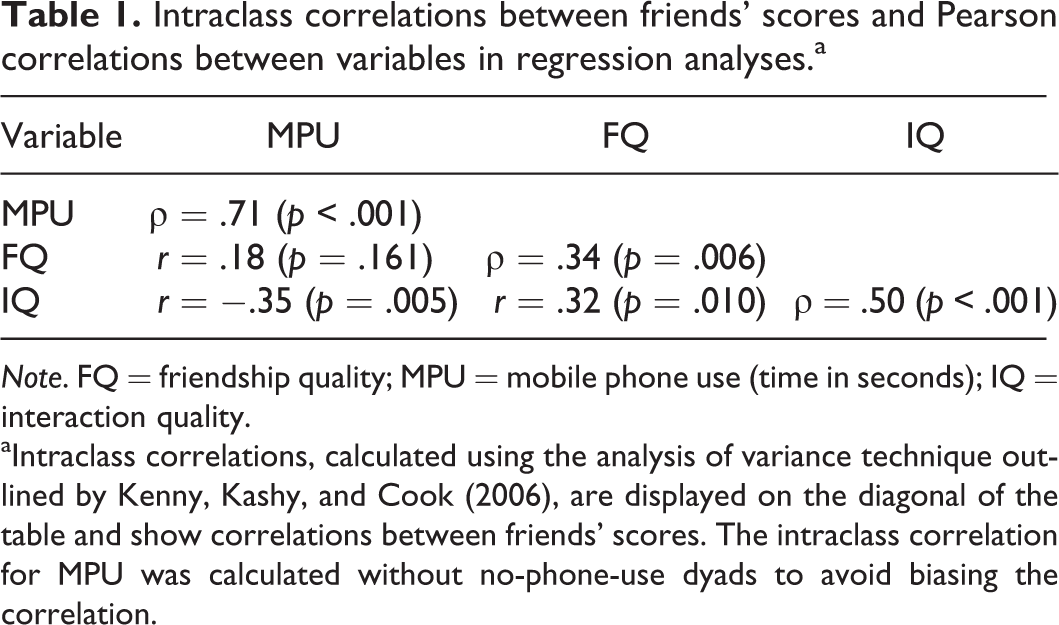
Note. FQ = friendship quality; MPU = mobile phone use (time in seconds); IQ = interaction quality.
aIntraclass correlations, calculated using the analysis of variance technique outlined by Kenny, Kashy, and Cook (2006), are displayed on the diagonal of the table and show correlations between friends’ scores. The intraclass correlation for MPU was calculated without no-phone-use dyads to avoid biasing the correlation.
A hierarchical linear regression was conducted including all dyads to test whether phone use time predicted interaction quality, controlling for gender and friendship quality. Means for the dyadic variables used in regression analyses are reported in Table 2. In the first step, gender and friendship quality were used to predict interaction quality (R 2 = .11, p = .031). MPU was added in the second step. The increase in the amount of variance explained was significant (ΔR 2 = .167, p < .001). More time spent engaged in MPU was associated with lower interaction quality.
Measures of Normality for Dyadic Variables in the Regression Analyses.
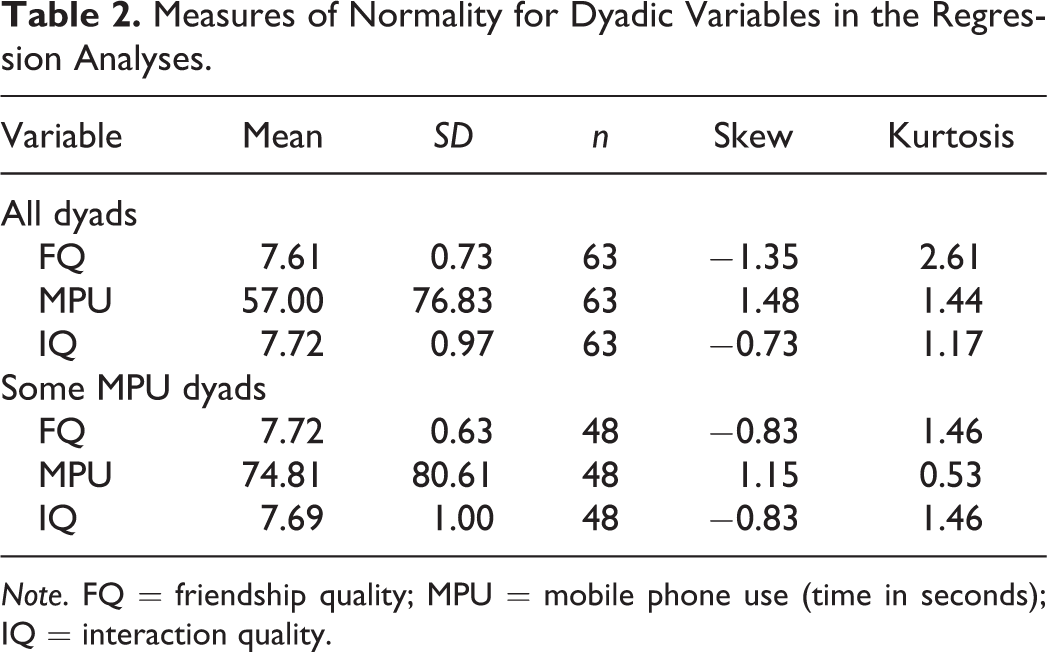
Note. FQ = friendship quality; MPU = mobile phone use (time in seconds); IQ = interaction quality.
Dyad’s phone use time was slightly skewed due to several dyads (n = 15) in which there was no phone use. Therefore, a second analysis was conducted without the no-phone-use dyads to assess the impact of violations of normality on the results. The second regression analysis showed that MPU again predicted lower interaction quality and significantly increased the amount of variance explained after controlling for gender and friendship quality (ΔR 2 = .160, p = .004). Regression values for both analyses are presented in Table 3.
Regression Analysis Testing the Association Between Mobile Phone Use and Interaction Quality.a
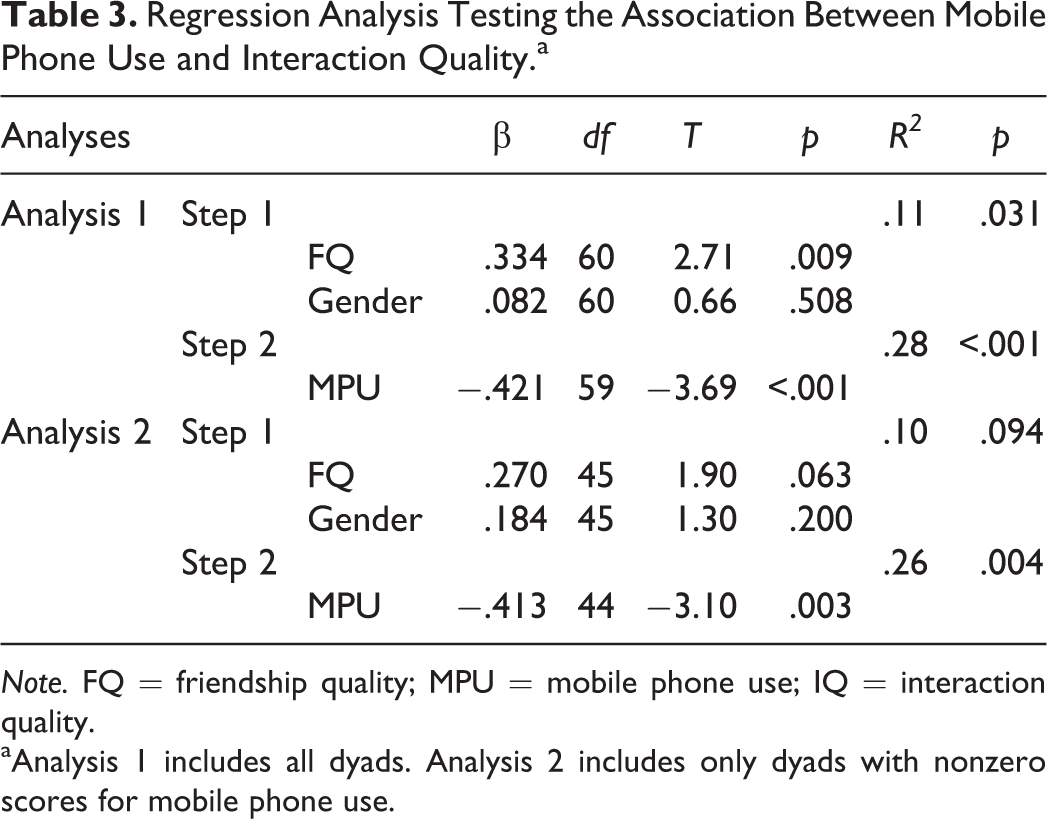
Note. FQ = friendship quality; MPU = mobile phone use; IQ = interaction quality.
aAnalysis 1 includes all dyads. Analysis 2 includes only dyads with nonzero scores for mobile phone use.
Discussion
In this study, we asked same-sex close friendship dyads in college to wait alone together for 5 minutes and observed that a majority of friendship dyads (76%) chose to use their phones at some point during the interaction. The more time the dyad spent using their phones, the lower they rated the quality of their interaction; that is, participants themselves were more likely to report that the interaction felt more strained and less enjoyable. Our findings confirm previous observational research documenting that phone use distracts from face-to-face conversations (Humphreys, 2005) and is associated with diminished feelings of closeness among romantic partners (McDaniel & Coyne, 2014), strangers meeting for the first time (Przybylski & Weinstein, 2013), and now close friends.
Limitations in this study include a small sample of male participants, which restrict our power to detect gender differences, and the lack of experimental manipulation that would provide stronger evidence for a causal relationship between phone use and interaction quality. Moreover, a fuller understanding of the implications of our findings for developmental processes in emerging adulthood would require longitudinal designs examining whether suboptimal face-to-face interactions due to the interference of communication technologies create cascade effects (Masten & Cicchetti, 2010) that impede the maturation of intimacy over time.
Nevertheless, our study highlights the potential for communication technologies to diminish opportunities for self-disclosure and empathic attention during face-to-face interactions in emerging adults’ close friendships. Compared to past generations, millennial youth are developing intimacy skills alongside greater capacities to maintain large networks of social contacts and to gratify immediate impulses on their digital devices. Indeed, MPU is strongly habit-forming due to its provision of intermittent rewards of novel information (e.g., Oulasvirta, Rattenbury, Ma, & Raita, 2012). Adolescents and emerging adults may be particularly vulnerable to the temptations of their digital devices, given increased sensitivity to rewards in early adolescence and delayed maturation of neural systems responsible for inhibition until the mid- to late 20s (Galvan et al., 2006). Thus, an important developmental task during the transition to adulthood now includes learning how to balance instantaneous digital gratifications with sustained engagement in face-to-face interactions. We recommend future research explore how reduced proficiency in reading facial expressions due to communication technology use could contribute to documented generational decreases in empathy (see Twenge, 2013; Uhls et al., 2014) and also examine how many young people do learn to successfully balance communication technology use with deep interpersonal connections.
Footnotes
Authors’ Note
The data for this article were collected while the first author was a master’s student at Western Washington University; however, the article was written once she had begun her doctoral studies at Université Rennes 2.
Authors' Contribution
Genavee Brown contributed to conception and design; contributed to acquisition, analysis, and interpretation; drafted and critically revised the manuscript; gave final approval; and agreed to be accountable for all aspects of work ensuring integrity and accuracy. Adriana M. Manago contributed to conception and design; contributed to interpretation; critically revised the manuscript; gave final approval; and agreed to be accountable for all aspects of work ensuring integrity and accuracy. Joseph E. Trimble contributed to conception and design; contributed to analysis and interpretation; gave final approval; and agreed to be accountable for all aspects of work ensuring integrity and accuracy.
Declaration of Conflicting Interests
The authors declared no potential conflicts of interest with respect to the research, authorship, and/or publication of this article.
Funding
The authors received no financial support for the research, authorship, and/or publication of this article.