




Abstract
People who anticipate the potential regret of one’s decisions are believed to act in a more risk-averse manner and, thus, display fewer risk-taking behaviors across many domains. We conducted two studies to investigate whether individual differences in regret-based decision-making (a) reflect a unitary cognitive-style dimension, (b) are stable over time, and (c) predict later risk-taking behavior. In Study 1, 332 participants completed a regret-based decision-making style scale (RDS) to evaluate its psychometric qualities. In Study 2, participants (N = 119) were tested on two separate occasions to assess the association between RDS and risk-taking. At Time 1, participants completed the RDS, as well as trait measures of anxiety and depression. One month later, they completed the Balloon Analogue Risk Task (BART) and state mood (Positive/Negative affect) scales. The RDS had a sound unidimensional factorial structure and was stable over time. Further, higher reported RDS scores were significantly associated with less risk-taking on the BART, holding other variables constant. These studies suggest that individual differences in regret-based decision-making may lead to a more cautious approach to real-world risk behaviors.
Keywords
Introduction
The decisions that we face in everyday life often lack a clear-cut superior choice and ultimately involve trade-offs. For instance, choosing where to go on vacation, accepting or rejecting a job offer, includes options that may have both positive and negative qualities ascribed to them. Moreover, the decision itself involves uncertainty: One might not know the likelihood that he or she will be satisfied with one’s choice. Although the choices may vary in content, research suggests that stable patterns of decision styles may guide individuals’ choices across domains. For instance, some individuals are inclined toward analyzing the pros and cons of each decision they make; others have an immediate feeling of what to do; and still, others try to make the choice that minimizes future negative feelings in the event that one’s decision did not turn out as expected (i.e., avoiding future regrets).
Despite research that has implicated regret as an important emotional input in decision-making processes, dispositional tendencies in regret-based decision-making have received less attention (George & Dane, 2016; Lerner, Li, Valdesolo, & Kassam, 2015; Phillips, Fletcher, Marks, & Hine, 2016; Wang, Highhouse, Lake, Petersen, & Rada, 2017). Construct validity for a personality disposition should be supported by different types of evidence. First, a scale should include a sample of items that adequately conceptualize the construct. Second, there must be some stability of personality ratings over time. Third, these ratings must be predictive of relevant behaviors. Before empirically examining these requirements, we briefly frame regret style within the literature on cognitive and decision styles. Then, we motivate why risky choices may be an ideal domain within which one can test predictive hypotheses essential for establishing regret as disposition.
Cognitive style and decision-making
Broadly, cognitive style describes the habitual ways in which people process information in everyday situations (Kozhevnikov, 2007). In the management science and organizational psychology literature in particular (Kozhevnikov, Evans, & Kosslyn, 2014), cognitive styles have evolved more specifically into “decision-making styles,” which represent the degree to which individuals tend to construe a decision problem, search for information, and choose for alternative options in a relatively stable way across time and situations (Phillips et al., 2016; Wang et al., 2017).
Several dispositional decision-making styles have been proposed (Betsch & Iannello, 2010; Hamilton, Shih, & Mohammed, 2016; Pacini & Epstein, 1999; Scott & Bruce, 1995; Sjöberg, 2003). One prominent model of decision styles has been inspired by dual-process theories (Evans & Stanovich, 2013), which suggests an interplay of two systems that facilitate either intuitive, associative reasoning (System 1) or reflective, deliberative processing (System 2). Accordingly, an intuitive decision maker tends to make choices based on immediate feelings about the key elements of a decision, whereas a reflective decision maker may be more likely to evaluate the options and their attributes thoroughly and to make rule-based decisions (Kozhevnikov et al., 2014; Phillips et al., 2016; Wang et al., 2017).
However, research has acknowledged that two primary decision-making styles may not adequately account for diversity in how individuals typically approach decisions. For example, Scott and Bruce (1995) proposed a typology, which incorporated dependent, avoidant, and spontaneous styles. Similarly, Mann, Burnett, Radford, and Ford (1997) considered buck-passing, procrastination, and hypervigilance as additional constructs to consider. More recently, Leykin and DeRubeis (2010) developed five additional styles, namely, confident, spontaneous, anxious, regretful (or brooding), and respected. Therefore, although intuition and reflection are both prominent examples of the habitual ways in which people make their decisions, they cannot be considered exhaustive of all decision styles.
Regret-based decision-making
Regret is a comparison-based negative emotion of self-blame that people experience when they realize or imagine that their present situation would have been better if they had decided differently in the past (Pieters & Zeelenberg, 2007; Zeelenberg & Pieters, 2007). By definition, regret is inextricably intertwined with decision-making and has received considerable empirical attention in research that has examined how emotion impacts decision processes (George & Dane, 2016; Lerner et al., 2015). Regret regulation theory suggests that experienced regret is unique from other emotions in that it included elements of counterfactual thinking (i.e., considering alternative courses of actions and their outcomes) and assumed personal agency for one’s choices (Pieters & Zeelenberg, 2007; Zeelenberg & Pieters, 2007). In addition, regret can be experienced about past (i.e., realizing that a discarded option was better than a freely chosen one) or future decisions (i.e., imagining that an available choice could be better than another that one would like to pick). Therefore, dispositional tendencies to consider regret may influence decision-making at multiple stages of a decision process. Specifically, predecisional regret has a high informative valence in the appraisal of risks and benefits (Brewer, DeFrank, & Gilkey, 2016). In contrast, postdecisional regret plays an essential role in learning from the past, in turn updating the informative value of anticipated regret for future decisions (DeWall, Baumeister, Chester, & Bushman, 2014).
Consistent with regret regulation theory, Nygren (2000) posited that some people could be more inclined toward protecting themselves against regret feelings in decision-making, while others could be less so. A regret-based decision maker is expected to choose the option that reduces regret or to avoid making decisions due to the fear of regret (Nygren, 2000). To assess this style, Nygren and White (2002, 2005) used the Decision-Making Style Inventory (DMI), which also measured the tendency to use intuition and reflection. Different studies supported the validity of the regret style. First, although the regret style was positively associated with reflection and negatively with intuition, the correlations were small (Nygren & White, 2002). Therefore, regret style did not overlap with the two main styles of decision-making, a finding that supports the independence of the construct. Second, individuals reporting higher levels of regret style also held related beliefs about their decision-making tendencies, such as experiencing difficulties making choices (Djulbegovic et al., 2015; Rim, Turner, Betz, & Nygren, 2011; Shaffer, Tomek, & Hulsey, 2014; Turner, Rim, Betz, & Nygren, 2012), and expressing self-doubt about one’s problem-solving and decision-making ability (Morera et al., 2006; Nygren & White, 2002). In addition, other DMI studies suggested that individuals who tend to focus on regret tend to be more indecisive or avoidant when making choices (Elaydi, 2006; Leykin & DeRubeis, 2010; Morera et al., 2006; Nygren & White, 2002). Last, regret style was positively associated with affective traits such as harm avoidance, anxiety, depression, and neuroticism (Dewberry, Juanchich, & Narendran, 2013; Leykin & DeRubeis, 2010; Nygren & White, 2002, 2005).
Regret style and risk-taking
By definition, regret would not be experienced if one knew what the outcomes of each possible outcome would be with 100% certainty, assuming that an individual had an ordered preference of desired outcomes. However, a majority of choices that we face each day involve uncertain or risky outcomes. From a behavioral economics perspective, risk-taking involves choosing an available option with a higher degree of variability than its alternatives (e.g., in a decision that involves a choice that offers $100 for sure and one that offers a 50% chance to win $200, otherwise $0). It follows that the presence of uncertainty increases the possibility that an undesired outcome may occur. Hence, risk evaluation processes are likely to be part of the nomological network of the regret-based decision-making style construct.
Several studies support this assertion. For instance, anticipating regret for the consequences of not using a condom predicted greater condom use intentions among adolescents, young adults, and drug users (Richard, van der Pligt, & de Vries, 1996; Smerecnik & Ruiter, 2010; van Empelen, Kok, Jansen, & Hoebe, 2001). Likewise, anticipated regret predicted college students intention to limit alcohol consumption and less binge-drinking in the past (Cooke, Sniehotta, & Schüz, 2007), as well as childbearing age women intention to abstain from drinking while pregnant (Vézina-Im & Godin, 2011). Anticipated regret was also a protective factor for adolescent smoking initiation (Conner, Sandberg, McMillan, & Higgins, 2006) and predicted adult daily smokers cessation intentions (Janssen, Waters, Van Osch, Lechner, & De Vries, 2014; Lazuras, Chatzipolychroni, Rodafinos, & Eiser, 2012). Moreover, anticipated regret for speeding (i.e., fine) was associated with lower reported driving speeds (Elliott, Thomson, Robertson, Stephenson, & Wicks, 2013) and for using prohibited substances to enhance sport performance with intention to dope (Lazuras, Barkoukis, Mallia, Lucidi, & Brand, 2017). Anticipated regret has also been linked to both risk perception and intentions to partake in a variety of gambling activities (Li et al., 2010). Although the type of gamble (e.g., sport bets, horse racing, card games) moderated the relationship between anticipated regret and intention to gamble, anticipated regret was correlated with higher risk perception, and both these variables were uniquely associated with intention to gamble (Li et al., 2010).
By contrast, regret regulation theory maintains that people strive to avoid regret and predicts risk-seeking or risk aversion depending on which option protects the most from feedback on the foregone outcome (Pieters & Zeelenberg, 2007; Zeelenberg & Pieters, 2007). For instance, in a classic study, in which risky and safe gambles were offered to the decision maker, participant’s risk attitude was based on which of the two options he or she expected to receive feedback, regardless of either outcome valence (gains vs. losses) or risk level (Zeelenberg, Beattie, Van Der Pligt, & De Vries, 1996). Likewise, there was a higher propensity to buy lottery tickets if a winner could have been identified, at least roughly, based on the postcode of the area of residence than if it was impossible for the losers to trace the winner (e.g., designated by a printed code on a ticket that no one knows; Zeelenberg & Pieters, 2004). Moreover, anticipated regret for knowing that the winner was in one’s neighborhood of residence but one has not participated in the lottery mediated this propensity. Therefore, risk-seeking for gains was the most frequent choice in situations, in which participants anticipated to have a feedback on a discarded risky option (Zeelenberg et al., 1996; Zeelenberg & Pieters, 2004).
Other studies (Tochkov, 2009, 2012) also examined how anticipated regret affected risk preferences using a computerized laboratory task in groups of social and problem gamblers. Although social gamblers were more regret-averse than risk-averse, problem gamblers more strongly preferred the proposed risky alternatives and were less guided by anticipated regret in their choices (Tochkov, 2009, 2012). Furthermore, social gamblers were more accurate than problem gamblers in predicting their regret feelings in a gambling task, although the negative mood biased their anticipated regret.
Research hypotheses and overview of the studies
In this study, we aimed to conceptualize the construct validity of a regret-based decision-making style better. To address this issue, we devised two independent studies, testing the requirements of stability, content, and predictive validity that would support the existence of this construct. Study 1 examined the dimensionality and stability of regret style using selected items tapping into the hypothesized dispositional style. One primary question was the degree to which predecisional and postdecisional regret reflect a unitary construct. Then, we examined whether regret-style ratings remain constant or change over a one-month period. Study 2 examined the predictive validity of the regret-based decision-making style. Over a one-month interval, we assessed regret style (T1) and performance on a frequently used behavioral risky decision-making task, the Balloon Analogue Risk Task (BART; Lejuez et al., 2002). In this task, individuals are asked to pump a computerized balloon, in which they gain points for each pump. With each pump, the balloon gets bigger, but also does the potential that it will burst, which would subsequently result in the loss of all winnings for that trial. Participants make sequential choices between a sure outcome (i.e., their current level of winnings) and a risky gamble (i.e., making an additional pump, but with an increased chance to lose all winnings). Our previous research has found a positive effect of anticipated regret on risk aversion on BART (Panno, Lauriola, & Pierro, 2015). In this study, we examine whether regret style can be predictive of risky choices on this task. Because of their reported associations with both regret and risk perceptions, we also assessed and controlled for affective traits such as harm avoidance, anxiety, depression, and emotional stability (T1) and current state positive and negative affect (T2) to strengthen our test of unique predictive validity.
Study 1: Dimensionality and stability of regret style
Participants and procedure
A total of 332 participants took the Regret Decision Style (RDS) scale. We collected data from two different samples. Undergraduate students at Sapienza University of Rome (N = 143; Mage = 24.66 years, SD = 2.52 years; 69% women) participated in this study for partial course credits and completed the scale in small-group sessions of about eight people in a laboratory room. Fifty-nine participants (Mage = 24.26 years, SD = 1.32 years; 81% women) also completed the RDS one month apart. Community participants (N = 189; Mage = 31.97 years, SD = 11.11 years; 58% women) took the RDS scale as a part of a larger study on individual differences in decision-making. This group voluntarily participated and was recruited during leisure time nearby museums, archaeological, or art sites in the city center. The student and the community groups had statistically different mean age, t(213.297) = 8.75, p < .001, equal variance not assumed, and gender composition, χ2(1) = 36.44; p < .001. The local ethical review board at Blinded for Review approved the study.
Measures
Regret style
Using a standard forward/backward translation procedure, we translated the DMI
1
(Nygren, 2000) into Italian. Because the original DMI regret-style subscale comprised 15 items, the RDS used in this study was abridged to make it less time-consuming for use in laboratory experiments and larger test batteries. In so doing, we reviewed item-total correlations obtained from an unpublished data set in which we administered the full DMI.
2
The items that correlated the most with the total score were short-listed, and their content was examined by the first and second authors to ensure content preservation. As a result of this process, nine items were retained. Regarding content coverage, six items described postdecisional regret and three items described predecisional regret (Figure 1).
Confirmatory factor analysis model of the Regret Decision Style scale. Note: The circle represents a latent variable. Squares represent measured indicator variables. Numbers attached to the arrows going from the latent variable to the measured indicators are standardized factor loadings. Numbers attached to other arrows are error terms variances. The text to the right of each measured indicator describes the content of each RDS item. The text in square brackets specifies whether the content refers to predecisional or postdecision regret. The text in round brackets specifies the item number in the Decision-Making Style Inventory (Nygren, 2000).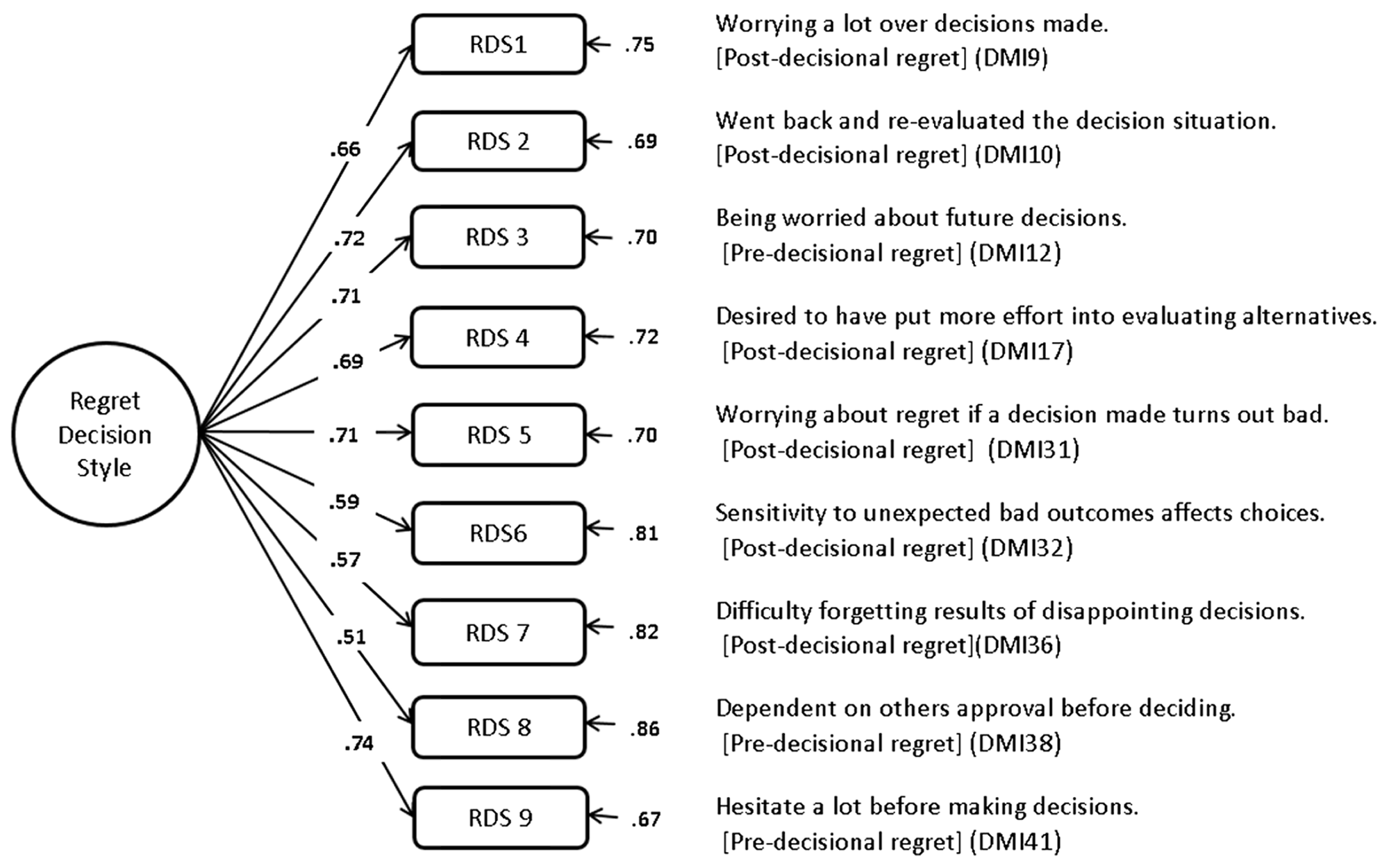
Statistical analyses
Single group analysis
A confirmatory factor analysis model with a single regret-style latent variable and nine indicator variables was fitted to the data. For comparison, we also fitted a two-factor model with predecision and postdecision regret latent variables. We used EQS 6.1 in all analyses (Bentler, 2004). Specifically, the maximum likelihood robust method was used to estimate the model parameters, as the data significantly violated the assumption of multivariate normality (Mardia’s normalized coefficient = 11.44). Since any factor model could be rejected, based on the inspection of the model chi-square, we used both absolute (i.e., the root mean square error of approximation, RMSEA) and relative fit indexes (i.e., the comparative fit index, CFI; and the Bentler–Bonett non-normed fit index, NNFI) to assess the model fit. For RMSEA, values lower than .05, between .05 and .08, and higher than .10 indicate good, acceptable, and poor model fit, respectively. For CFI and NNFI, values greater than or equal to .90 support an acceptable model fit; values higher than .95 are strongly recommended (Byrne, 2006).
Multiple group analyses
In the single group analysis, we merged data from two different samples to have an acceptable sample size for a CFA study. The single group analysis assumed that we had drawn the student sample and the community sample from the same population. However, the student and the community sample had significantly a different gender and composition. Through multigroup factor analyses, we tested whether the regret-style factor model fitted to the whole sample could be generalized to different subpopulations. According to Byrne (2008), an initial step requires only that the same number of factor and factor loadings be the same across groups, namely configuration invariance. This analysis, which represents the most lenient form of invariance, also serves as a baseline onto which future analyses can be compared, each imposing more stringent forms of invariance. Typically, primary interest focuses on the factor loadings invariance because the tests for the equivalence of error variances and covariances are typical “overly restrictive” (Byrne, 2006, p. 227).
Results
Dimensionality of the regret style
Although the single-factor model was statistically significant, SBχ2 = 75.54; df = 27; p < .001, there was an acceptable fit between the model and the data, NNFI = .930; CFI = .947; RMSEA = .075 (90% confidence interval (CI) = .055, .095). Because the RDS included both predecision and postdecision regret items, we also fitted a two-factor model reflecting specific item contents. This model, NNFI = .930; CFI = .947; RMSEA = .076 (90% CI = .056, .096), was not statistically different from the single-factor model, ΔSBχ2 = 0.94; df = 1; p = .33. Therefore, the parameter added to model the two latent variables was redundant and the single-factor model can be accepted just as well. As one can see from Figure 1, no item had a standardized factor loading less than .50 on the single latent variable, and the coefficients ranged from .51 to .74. Noteworthy, there were two postdecisional regret statements (i.e., nos. 2 and 5) and two predecisional regret items (nos. 3 and 9) among the indicator variables with the highest loadings on the latent regret-style factor. This finding reinforced the view that both predecisional and postdecisional regret are strongly tied to how a decision maker habitually construes a decision problem. As a whole, these results supported the unidimensionality of the RDS, which is a necessary condition for construct validity.
Following Byrne (2008), we started a multigroup factor analysis by evaluating the equality of configuration between students and community participants. This analysis yielded a slightly suboptimal fit relative to the single sample analysis but still overall acceptable, SBχ2 = 123.91; df = 54; p < .001; CFI = .937; NNFI = .916; RMSEA = 0.086 (90% CI = .065, .105). After that, we constrained the factor loading to be equal between-groups. This analysis yielded acceptable fit indexes, SBχ2 = 132.75; df = 62; p < .001; CFI = .936; NNFI = .926; RMSEA = 0.080 (90% CI = .061, .099), and more importantly, fit the data as equally well as the configural invariance model, ΔSBχ2 = 5.12; df = 8; p = .74. Finally, we attempted to test the equality of error variances across groups. Although such stringent test of invariance still yielded an acceptable fit, SBχ2 = 170.87; df = 71; CFI = .919; NNFI = .908; RMSEA = 0.089 (90% CI = .072, .106), it resulted in a significant worse fit than the loading invariance model, ΔSBχ2 = 54.67; df = 9; p = .010. Taken together, the multigroup analyses established the configural and metric invariance of the RDS.
Stability and reliability of regret style
The nine-item RDS attained fairly high-reliability coefficients. The model-based reliability coefficient ω resulting from the single group analysis was .87, while it was .88 and .86, respectively, for students and community participants. Recall that 59 students completed the RDS twice. We used this subsample to examine the stability of the regret-style construct and to assess the test–retest reliability of the RDS scores. The total scores were M = 41.52 (SD = 9.84) and M = 41.66 (SD = 9.53) for test and retest occasions, respectively. A paired sample t test turned out to be statistically insignificant, t(58) = − 0.17; p = .86, and the 4-week test–retest correlation was r = .81. These findings indicated that the decision style was a relatively stable characteristic of the person and strongly supported the reliability of the RDS.
In sum, this study showed that predecision and postdecision regret items tend to merge into a unidimensional latent construct, namely the regret style. Furthermore, the RDS was invariant at the metric level across the student and community samples, an important prerequisite for examining the relationships of regret style with other constructs across different subpopulations. Consistent with our dispositional hypothesis, RDS scores were highly stable over a one-month period. In the next study, we investigated whether the regret style could predict a behavioral outcome in a risky decision-making task.
Study 2: Regret style predicts risky choices
Participants and procedure
One hundred nineteen undergraduate students (68% women) participated in this study for partial course credits. Participants mean age was 21.32 years (SD = 3.47 years). Participants signed up for two separate studies spaced one month apart. On the first occasion, the participants took a large, self-report battery, which included the RDS, the Hospital Anxiety and Depression Scale (HADS), and other scales unrelated to the goals presented in this study. We administered the questionnaires in small-group sessions of about eight people in a laboratory room. We also recorded participants’ gender and age on this occasion. One month later, the participants took the BART. The Positive and Negative Affect Schedule (PANAS) was also administered just before the task to control for individual differences in mood state. Participants individually took the risk task in a 3 m × 3 m experimental room using a desktop computer. After the experiment, the students were debriefed and rewarded for their participation. The experimenters were blind to participant scores on RDS, HADS, and PANAS.
Measures
Regret style
Same as in Study 1.
Positive and negative affect
The PANAS (Terracciano, McCrae, & Costa, 2003) comprises 20 items. Participants were instructed to rate how they felt “right now” on a scale from 1 (very slightly or not at all) to 5 (extremely). Positive and negative mood scores were obtained by adding the 10 positive and 10 negative mood items (α values = .79 and .86 for positive and negative mood, in this sample).
Anxiety and depression
The HADS (Iani, Lauriola, & Costantini, 2014) comprises 14 items, each rated on a 4-point scale. It provides two subscale scores with higher scores indicating greater levels of anxiety and depression (α values = .77 and .54 for anxiety and depression, in this sample).
Risk taking
The BART (Lejuez et al., 2002) is a 30-trial, computer-based measure of risk-taking propensity. On each trial, a small simulated balloon is presented, and the participants can inflate it by pressing a pump button, thereby earning €.05, which is accrued in a temporary bank. The balloon can explode any time after each pump, and if this happens, sums of money in the temporary bank are lost. The participant can decide to transfer the money from the temporary bank to the permanent bank, thus ending the trial. The primary dependent measure on the BART is the average number of pumps across trials, excluding trials in which the balloon exploded, hereafter referred to as the Average Adjusted Pump (AAP). The AAP score is widely considered to be a valid measure of risk-taking tendencies across a range of clinical and nonclinical contexts (for review, see Lauriola, Panno, Levin, & Lejuez, 2014).
Statistical analysis
We carried out a hierarchical multiple regression analysis, regressing AAP on regret style, anxiety, depression, positive affect, and negative affect. Because of our interest in determining the degree to which regret style uniquely accounts for the variance in risk-taking, we first fitted a regression model with mood states (Step 1), then anxiety and depression (Step 2), and finally, added regret style (Step 3) to the model. We interpreted a significant change in R2 as support for the unique predictive power of regret style, beyond that observed with mood state variables entered on Stage 1 because of their temporal proximity with the dependent variable, and more dispositionally stable measures of anxiety and depression entered on Stage 2 because of their direct link with the negative emotionality/neuroticism trait. To assess the shared and unique contributions of each predictor, we compared the zero-order correlations to partial correlations of mood states, depression, anxiety, and regret style with risk-taking while controlling for the other predictors.
Results and discussion
Summary table of multiple regression analysis.
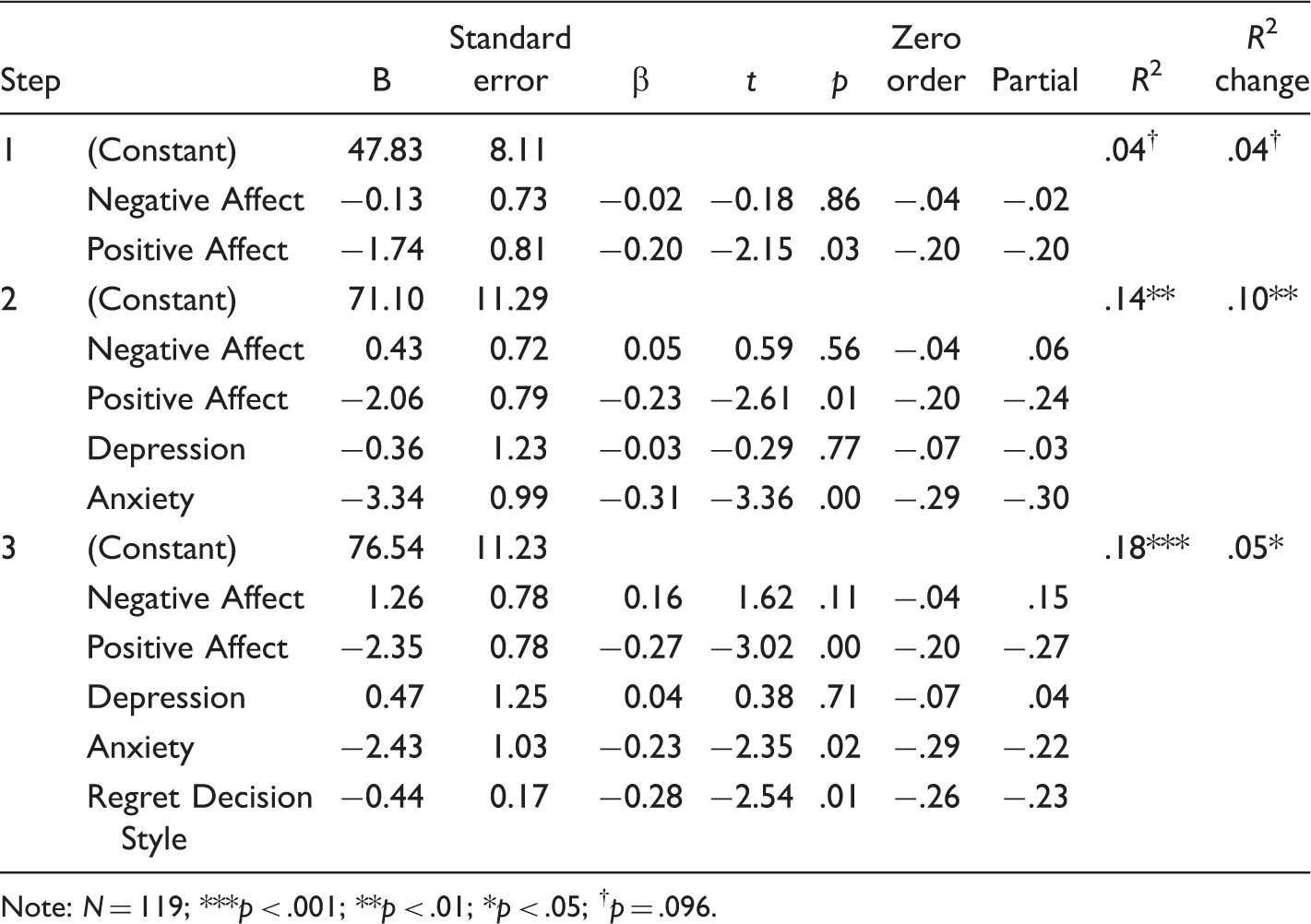
Note: N = 119; ***p < .001; **p < .01; *p < .05; †p = .096.
Discussion
Although intuitive and reflective decision styles have been extensively studied as trait-like dimensions with predictive validity in real life decisions (Kozhevnikov et al., 2014; Phillips et al., 2016; Wang et al., 2017), less is known about regret-based decision-making style, despite the fact that minimizing regret is the most studied emotion in decision-making (George & Dane, 2016; Lerner et al., 2015). Is regret-based decision-making a trait-like construct with predictive validity in risky decision-making? The results of two independent studies suggest that the answer to this question is overall positive.
Study 1 demonstrated that a single latent variable measured by predecisional and postdecisional regret items was an acceptable fit, whereas a two-factor model with separate latent variables for each type of regret was an less parsimonious classification of regret style. When people were asked to report their typical way to make their decisions, the two aspects were strongly interrelated. Consistent with an emotion-as-feedback approach, postdecisional regret may help the decision maker to learn from experience and to update the recovery of anticipated regret feeling useful for future decisions (DeWall et al., 2014). Risky choices that end up in negative outcomes may engender counterfactual thinking on how the outcome could have been different if one had made a different choice, in turn, it may elicit, the painful experience of regret. This emotional information, stored in memory, is believed to become salient again in the form of anticipated regret when one has to make future risky decisions and might contribute to deciding more cautiously.
By definition, a dispositional construct is expected to be relatively stable over time and able to predict behavior. In this regard, Study 1 provided preliminary evidence that regret-based decision-making scores did not change over a one-month period. Also, Study 2 reinforced the conclusion regarding the stability of the trait, showing that regret scores predicted observable risky choices in a behavioral risk-task administered one month later. Noteworthy, prior regret-style research was entirely based on cross-sectional designs. Therefore, although people endorsing a regret style exhibited decision difficulty, indecisiveness, decision avoidance, and self-doubting concerning decision-making ability (Djulbegovic et al., 2015; Elaydi, 2006; Leykin & DeRubeis, 2010; Morera et al., 2006; Nygren & White, 2002; Rim et al., 2011; Shaffer et al., 2014; Turner et al., 2012), the finding that regret style was stable over time (Study 1) and predicted observable choice in a risk-taks (Study 2) is novel and extends the literature in a meaningful way.
Because regret style has been shown to be associated with negative affective traits like harm avoidance, anxiety, depression, and neuroticism (Dewberry et al., 2013; Leykin & DeRubeis, 2010; Nygren & White, 2002, 2005), one might argue that a negative emotionality might predict risk aversion as well as regret style. Despite the fact that trait-anxiety assessed one month before the task also predicted subsequent risk aversion, regret style was also significant controlling for anxiety. Therefore, it is tempting to speculate that our findings might reflect unique processes through which negative affectivity and regret might motivate risk-averse choices. Even though regret and anxiety are both negative emotions, their role in predicting risk-taking on BART was likely very specific. Consistent with regret theory (Pieters & Zeelenberg, 2007; Zeelenberg & Pieters, 2007), the regret-style measure used in this study predicted risk aversion because there was an element of agency in pumping the balloon, while the money accumulated in the temporary bank might have triggered counterfactual thoughts as if the balloon had exploded. Because regret regulation theory maintains that people strive to avoid regret and predicts risk-seeking or risk aversion depending on which option protects the most from feedback on the foregone outcome, these results suggest that individuals reporting greater regret-style orientation approached the BART as if the foregone outcome was the money accumulated in the temporary bank. In addition, consistent with an adult temperament perspective on risk-taking (Lauriola & Weller, 2018), we found that anxiety predicted risk aversion. This finding resonates with past research that has reported robust associations between traits related to negative affectivity and risk perceptions (e.g., Chauvin, Hermand, & Mullet, 2007; Sween, Ceschi, Tommasi, Sartori, & Weller, 2017; Weller & Tikir, 2011). In this context, trait-anxiety may be associated with elevated perceptions of dangers associated with the likelihood that the balloon would explode, thereby motivating a reaction of cognitive, and physical, withdrawal from the aversive stimuli.
More generally, our second study paralleled the extant literature on regret and risk aversion real-world domains (Conner et al., 2006; Cooke et al., 2007; Elliott et al., 2013; Janssen et al., 2014; Lazuras et al., 2012, 2017; Li et al., 2010; Richard et al., 1996; Smerecnik & Ruiter, 2010; van Empelen et al., 2001; Vézina-Im & Godin, 2011) as well as our previous research on anticipated regret and BART (Panno, Lauriola & Pierro, 2015). As such, it seems reasonable to conclude that regret style might be associated with real-world risk-taking as well as it was predictive of risky choices in our laboratory.
Because emotions unrelated to the actual decision (i.e., incidental emotions) may bias the decision process (Lerner et al., 2015) and interfere with one’s experience of regret (Tochkov, 2012), we controlled for negative and positive mood states in regression analysis. Regret style predicted risk aversion on BART above and beyond incidental emotions. However, one unanticipated finding was that positive mood was the single best predictor of risk aversion on BART. We interpreted this finding in a mood maintenance framework (George & Dane, 2016). Specifically, individuals in a positive mood tend to be more optimistic in risky situations, but notwithstanding this, they are also less willing to risk, especially if possible losses are tangible and valuable. However, it is worth acknowledging that other accounts are possible, such as affect generalization approaches, that make different predictions, namely positive mood may increase risk-taking due to an optimistic appraisal of probabilities (Lerner et al., 2015).
Limitations and future directions
Notwithstanding methodological strengths (e.g., longitudinal design, behavioral observations), this study has several limitations that provide directions for future research. First, both studies involved a one-month interval between two measurement occasions. Therefore, the degree to which the stability coefficient of regret style fully resembles that of personality traits remain an open research question. Future research should expand on these findings using research designs involving more time points, longer periods, and psychometric methods aimed to disentangle state and trait components in regret-style scores (e.g., latent state-trait models). Second, although there is evidence that risk-taking behavior is rooted in personality (Lauriola & Weller, 2018), it is also domain specific (Weber & Blais, 2006). Accordingly, one might argue that the predictive relation of regret-based decision-making with the BART is not warranted to generalize to other risk domains (e.g., social, financial, or ethical). Studies might then investigate to what extent individual differences in regret-based decision-making generalize to other types of risk tasks or predict real-world risk-taking in at least two different domains. It would be interesting to include in future studies variables describing risky behaviors of the participant’s everyday life that span across a variety of domains, including, but not limited to, financial, health, social, and ethical domains. Third, the samples used in both studies are nonprobabilistic, and hence, we must temper any generalizations across a broader population. A goal of future research would be to examine the measurement invariance of the RDS with more robust samples, and the predictive relations assessed for regret style and risk aversion should be cross-validated using more diverse samples.
Conclusion
The results of this study ruled in three main characteristics expected for personality dispositions, such as showing an empirically robust and unidimensional factorial structure, being relatively stable over time, and being able to predict choice behavior. As such, our study sought to clarify whether habitually taking regret into account can be thought as a trait-like dimension with predictive validity on risk-taking behavior in laboratory settings. Furthermore, our findings also show promise for studies oriented toward investigating how dispositional regret can predict real-world risk-taking behavior.
Footnotes
Author Contributions
The authors discussed the contents of this article together. Marco Lauriola elaborated the research hypotheses, devised the methodological content, and analyzed the data. Angelo Panno developed the theoretical framework and collected the data. Joshua A. Weller conferred with other authors about theoretical and empirical aspects of the studies and provided a significant contribution to the interpretation and discussion of research findings. The final version of the article was written by M. Lauriola, A. Panno, and J. A. Weller.
Acknowledgments
The authors thank Giulia Santoro, Correggia Angela, and Valentina Di Rago for their help in collecting data and references.