



Abstract
The aims of this study were to test: (a) the association of political orientations with morality orientations, specified by moral foundations theory, on a sample of young adults from Turkey, representing a collectivistic culture; and (b) the statistically mediating roles of needs for cognition and recognition in the links between political orientation and morality endorsements. According to the results (a) right-wing orientation and need for recognition were associated with all the three binding foundations (i.e., in-group/loyalty, authority/respect, and purity/sanctity); (b) right-wing orientation was associated with binding foundations also indirectly via the role of need for recognition; (c) regarding individualizing foundations, left-wing orientation and need for cognition were associated with fairness/reciprocity, whereas only gender was associated with harm/care; and (d) left-wing orientation was associated with fairness dimension also indirectly via the role of need for cognition. The cultural relevance of moral foundations theory as well as the roles of needs for cognition and recognition are discussed.
Keywords
Introduction
Psychologists have been interested in studying political orientations and attitudes for a long time. In recent years, there has been a renewed interest in exploring the associations between different political identities or beliefs and related social–cognitive and motivational orientations (Caprara & Vecchione, 2018; Jost, Nosek, & Gosling, 2008). In this regard, researchers working on moral foundations theory (Haidt & Graham, 2007), as well as their critics (e.g., Kugler, Jost, & Noorbaloochi, 2014), have paid particular attention to the relationship of liberal or left-wing versus conservative or right-wing political outlooks and moral values, aiming to delineate the motivational systems associated with those political and moral orientations. In this vein, our aims in this study, based on moral foundations theory, were twofold: (a) to explore the relationship between political orientations and morality judgments of adults from Turkey, a unique collectivist context, situated at the East–West crossroads (Hofstede, 2016) and (b) to contribute to the related literature also by exploring the roles played by the motivational orientations of the need for cognition and the need for recognition in the links between political orientations and the use or endorsement of different morality foundations.
Psychological correlates of right-wing and left-wing ideologies
Related studies have indicated that the conservative or right-wing (relative to liberal or left-wing) political orientation tends to be positively associated with characteristics such as a more “constrained vision,” labeled by Sowell (2002) to refer to the constraints of authority, institutions, and traditions needed by people to enable a civil life; a pessimistic view about human nature with a strong opposition to change; a tendency toward stability, intolerance for ambiguity, death anxiety, and fear of threat and loss; dogmatism, needs for order, structure, and closure; support for a group-based structure of society, enhancing hierarchy, status-quo, and having higher level of religiosity, right-wing authoritarianism, and system justification; and negatively associated with openness to experience, uncertainty tolerance, integrative complexity, and self-esteem (e.g., Graham, Haidt, & Nosek, 2009; Haidt & Graham, 2007; Jost, Glaser, Kruglanski, & Sulloway, 2003; Jost et al., 2008; Piazza & Sousa, 2013; Talaifar & Swann, 2019; van Leeuwen & Park, 2009; Wright & Baril, 2011). Accordingly, based on the results of a meta-analysis, Jost et al. (2003) concluded that resistance to change and acceptance of inequality constitute two core aspects of conservative ideology. On the other hand, liberals were considered more likely to have an “unconstrained vision,” labeled by Sowell (2002) to explain that people need to be free from constraints as much as possible so that they can pursue their own courses of personal development; a tendency to be more optimistic about human nature and more open to experience; being higher in characteristics such as creativity, novelty, and diversity; having higher egalitarian attitudes and lower system justification levels; more concerns about social injustice and equality; and having more positive attitudes toward countercultural forms of physical expression and pleasure-seeking activities (e.g., Graham et al., 2009; Haidt & Graham, 2007, Jost et al., 2008; Sowell, 2002). In sum, conservative or right-wing (relative to liberal or left-wing) ideology seems to satisfy people’s need for meaningfulness by providing motivation to cope with their intolerance for ambiguity and perceived threat of change by preserving the certainty provided by status quo. In line with the studies noted, currently, there appears to be a growing body of research which suggests that individuals with different political orientations also tend to differ in terms of their morality orientations, as considered later.
Moral foundations theory and its relationship with political orientations
The mainstream view in psychology has considered morality as “prescriptive judgments of justice, rights, and welfare pertaining to how people ought to relate to each other” (Turiel, 1983, p. 3); hence, in terms of protecting individuals. However, this individual-centered outlook, emphasizing the justice-fairness (Kohlberg, 1969; Turiel, 1983) and care (Gilligan, 1982) foundations of morality, was criticized for neglecting the social context and the related group-level moral values such as loyalty, duty, or obedience to the law (Graham et al., 2011; Haidt & Graham, 2007).
In line with such criticisms and anthropological accounts—for example, Shweder’s (1990) categorization of moral ethics involving “ethic of autonomy,” “ethic of community,” and “ethic of divinity”—Haidt and Graham (2007) developed the moral foundations theory, which proposed a model with five innate psychological foundations labeled as harm/care, fairness/reciprocity, in-group/loyalty, authority/respect, and purity/sanctity. Of those, harm/care and fairness/reciprocity foundations, which refer to moral values focusing on individuals, were classified as individualizing (in congruity with Shweder’s “ethic of autonomy”) whereas the authority/respect, in-group/loyalty, and purity/sanctity foundations, which refer to moral values focusing on groups, were classified as binding (in congruity with Shweder’s “ethic of community” and “ethic of divinity”; Graham et al., 2009). More specifically, the individualizing foundation of harm/care, which requires an empathic perspective, is about protecting and nurturing others and avoiding harm; and is based on the evolutionary tendency to protect one’s own offspring. On the other hand, fairness/reciprocity, involving the perception of justice, is the most important component of cooperation; emotions such as anger, guilt, or gratitude as well as values such as friendship or altruism are driven by reciprocity. Considering the binding foundations, in-group/loyalty implies the perceived importance of being a member of a group. Trusting, cooperating, and sharing same goals within a group contribute to survival in an evolutionary way. Since helping the group also means helping the individual self, values such as loyalty, patriotism, and heroism are developed. Authority/respect foundation is about the hierarchical structure of society. From chimps to human beings, in each social context, some members are superior to others. Power and status help to get more access to resources and provide more protection to one’s offspring. As can be seen in many cultures, admiration toward superiors, respect, duty, and obedience are defined as key characteristics of a functional society. Finally, purity/sanctity foundation is related to disgust, which serves not only as a biological protection but also as a social emotion, evolved to enable a physically and spiritually clean life (Graham & Haidt, 2011; Graham et al., 2011; Haidt & Joseph, 2004; Haidt & Graham, 2007).
People with different political orientations seem to differ in terms of their considerations of different morality foundations; for example, liberal or left-wing-oriented people appear more likely to be concerned about harm and fairness, whereas conservative or right-wing-oriented people seem to be allied with all of the five moral foundations (Graham & Haidt, 2010; Graham et al., 2009; Haidt, 2007; Jost et al., 2008; Piazza & Sousa, 2013; Talaifar & Swann, 2019; van Leeuwen & Park, 2009). In terms of the individualizing and binding classification, the left-wing has been found to be more concerned with individualizing foundations, whereas the right-wing appeared to value the binding foundations of morality more than the left-wing (e.g., Federico, Ekstrom, Tagar, & Williams, 2016; Graham et al., 2009; Haidt & Graham, 2007; van Leeuwen & Park, 2009), and those trends were found to be robust across national and cultural contexts (e.g., Graham et al., 2011).
Moral foundations theory has inspired a large number of studies in the field; however, it has also been challenged on several grounds. For example, some critics have argued that it is simply repackaging some well-known political differences with pithy names, conflating conservativism and morality (e.g., Schein & Gray, 2018). Raising a similar criticism, Kugler et al. (2014) indicated that liberal–conservative differences involving the use of binding foundations may be attributable, at least partly, to the likelihood of conservatives to score higher on authoritarianism relative to liberals. On the other hand, Janoff-Bulman and Carnes (2013, 2016) challenged the assertions that only conservatives are group-oriented and embrace a binding morality and provided evidence that while liberals and conservatives did not differ on moralities involving self-regulation, they did differ on collective moralities involving social-regulation, such that conservatives were more likely to endorse Social Order morality (emphasizing the importance of group conformity, strict adherence to norms, constraining individual-level expressions for the sake of group interests) while liberals tended to endorse Social Justice morality (orienting toward advancement of the group’s welfare by focusing on equality-based distributional justice, communal responsibility, and collective efforts).
Furthermore, there has been a theoretical dispute between moral foundation theorists and rationalists regarding the role of reasoning in the formation of moral judgments. In this regard, Haidt’s (2001, 2003) Social Intuitionist Model, proposed in reaction to the conscious reasoning perspective of morality mostly associated with Kohlberg (1969), suggests that morality is largely, if not entirely, intuitive and/or emotional; that is, except for some rare cases (e.g., involving conflicting intuitions or situational demands for thorough examination) moral judgments are based on automatic, effortless, affective responses, whereas reasoning can be generated after a moral judgment is made. Defenders of rationalist theories (e.g., Pizarro & Bloom, 2003), in contrast, stress the importance of deliberative reasoning in the formation of moral judgments and argue that whatever intuitive understanding people have may serve as a starting point for deliberative reasoning. Hence, understanding the association of analytic and experiential–affective heuristic style differences with endorsement of morality foundations has been an important research area. Accordingly, in this study, we have considered the relationship of the need for cognition and the need for recognition with morality and political orientations, which seem to be adopted in part because they satisfy various psychological needs, and hence tend to possess a strong motivational basis (Jost et al., 2003).
The need for cognition and the need for recognition
The need for cognition is considered as a stable motivational characteristic, which refers to individual differences involving the tendency to engage in and enjoy thinking (Cacioppo & Petty, 1982). A higher level of need for cognition is related to a personality which is active, exploring, organized, detail-oriented, intrinsically motivated, and open to experiences (Cacioppo, Petty, Feinstein, & Jarvis, 1996). Those characteristics lead people to think about cases, events, relationships, or even their own thoughts thoroughly. This metacognition helps avoid mental shortcuts, and hence, helps avoid common biases. On the other hand, individuals low in need for cognition may be more likely to rely on both others and cognitive heuristics for cognitive activities, and hence to make more stereotype-related judgments (Cacioppo et al., 1996; Carter, Hall, Carney, & Rosip, 2006; Petty, Briñol, Loersch, & McCaslin, 2009; Wegener, Clark, & Petty, 2006). Consistently, the lower level of need for cognition has been found to be related with authoritarianism (Sorrentino, Bobocel, Gitta, Olson, & Hewitt, 1988) and need for closure (Chirumbolo, 2002; Hannikainen, Miller, & Cushman, 2017; Roets & Van Hiel, 2011; Van Hiel, Pandelaere, & Duriez, 2004), both of which tend to be highly related to right-wing orientation (Van Hiel et al., 2004).
Extrapolating from the abovementioned studies, it can be further noted that characteristics associated with low and high need for cognition (or need for low and high effort thought) seem to show similarities with right-wing or conservative and left-wing or liberal political orientations, respectively (Eidelman, Crandall, Goodman, & Blanchar, 2012; Yılmaz & Sarıbay, 2016). Also, people with higher cognitive abilities, problem-solving skills, or need for cognition tend to examine moral issues more thoroughly than those low in need for cognition (Singer, Mitchell, & Turner, 1998). In congruence with those studies, recent studies have pointed to negative association of analytic thinking with binding moral values, while some also reported a positive correlation between analytic cognitive style and individualizing moral values (e.g., Garvey & Ford, 2014; Hannikainen et al., 2017; Pennycook, Cheyne, Barr, Koehler, & Fugelsang, 2014; Yılmaz & Sarıbay, 2017). Extrapolating from the abovementioned literature, we expected the need for cognition to be associated more with the individualizing foundations of morality, particularly involving fairness judgments, and to be negatively associated with reliance on binding heuristics.
The need for recognition, the other motivational characteristic investigated in this study, has not received the research interest that the need for cognition has received, although it was also among the needs posited by Cohen, Stotland, & Wolfe (1955) more than 60 years ago. However, we think it is important to undertake this exploratory approach toward understanding the role of this variable, which Taylor (1992) referred to as a “vital human need” (p. 26), and noted that people need to feel recognized by important others as worthy individuals. Being unable to do so may hinder persons’ positive relationship with themselves, hence may serve as a strong motivator. Accordingly, the need for recognition has been considered as “a tendency to seek being acknowledged as a person worthy of attention,” involving tendencies such as fame, status, and acknowledgment-seeking (Imamoğlu, 2001, p. 4). From an evolutionary perspective, just like many species, human beings have also evolved to live in groups; and fitting in a social group appeared to have survival value. As an extension of this strategy, people still need to be an accepted and recognized member in their social groups. The reputation matters; hence, people may be likely to care about what others think about themselves (Haidt, 2012). However, just as individuals tend to differ in terms of their level of need for cognition, they may also differ in terms of the degree to which they tend to be motivated to achieve fame and status in the eyes of others.
Consistent with the findings noted earlier, studies involving Turkish participants reported the need for cognition to be positively correlated with characteristics such as individuation, tolerance for ambiguity, curiosity, and exploration security as well as relatedness, satisfaction with self and the family, whereas the need for recognition was found to be negatively correlated with individuation, relatedness, self-directedness but positively correlated with perceiving the family as distant-punitive (Imamoğlu, 2001, 2003; Imamoğlu & Imamoğlu, 2010). Hence, in contrast to those high in need for cognition, individuals, whose love/belonging, inclusion needs are not met, may be likely to develop a concern with seeking recognition from others. In a similar vein, Bloland (1999, as cited in Imamoğlu & Imamoğlu, 2010, p. 48), “the late Erik Erikson’s daughter, proposed that a strong pursuit of fame and recognition may be based on an unsatisfied need for human connection.” Related social psychological studies indicate that such goals or desires may have biasing effects on judgments. For example, the dual-process heuristic-systematic model of Chaiken, Giner-Sorolla, and Chen (1996) proposes that when processing information and reaching judgments, people may be likely to use the relatively effortless heuristic mode, and/or the more analytic systematic mode; and their particular goals or motivations as well as the capacity for effortful processing may determine which mode is likely to predominate in a particular situation. In this vein, individuals high in need for recognition may be expected to be more likely to engage in impression-motivated heuristic processing in accordance with their desire to gain recognition, unlike those high in need for cognition, who would be expected to be more likely to engage in systematic processing, as noted earlier. Thus, although the need for cognition and the need for recognition have been found to be negatively correlated, it is important to emphasize that they should be considered as negatively associated but distinct constructs (Imamoğlu, 2001); that is, while the need for cognition appears to be more of a cognitive style variable, positively associated with self-directed and individuation-based motivational tendencies, the need for recognition, which tends to be negatively associated with self-directed motivational tendencies, may be more likely to be an impression-motivated and other-directed orientation (Cacioppo et al., 1996; Chaiken et al., 1996; Imamoğlu, 2001, 2003; Imamoğlu & Imamoğlu, 2010).
At this point, we may further address the question regarding our choice of those motivational variables: Why have we focused on need for cognition and need for recognition in the context of moral foundations theory, which asserts that the links between political orientation and endorsements of moral foundations are intuitive? As noted when considering the theoretical dispute between intuitionists and rationalists concerning the role of reasoning in moral judgments, in contrast to intuitionist outlook, rationalists (e.g., Pizarro & Bloom, 2003) stress the importance of deliberative reasoning in the formation of moral judgments (while acknowledging that people’s intuitive understanding may serve as a starting point). Accordingly, consideration of individual differences in need for cognition in the context of moral foundations theory may be important in shedding light on this dispute involving the role of deliberative reasoning in the formation of moral judgments. In fact, although the general outlook of social intuitionists propose that heuristic processing (the intuitive process) is the default process in the formation of moral judgments, Haidt (2001) has also acknowledged the possible role of individual differences in need for cognition by noting that, “solitary moral reasoning may be common among philosophers, and among those who have a high need for cognition” (p. 820, italics added). Hence, based on the abovementioned studies associating the need for cognition with rational, analytic thinking, as well as those associating analytic (or deliberative) cognitive style with liberal (or left-wing) political orientation and individualizing morality foundations while associating intuitive processing with conservative (or right-wing) political orientation and binding morality foundations (e.g., Garvey & Ford, 2014; Hannikainen et al., 2017; Pennycook et al., 2014; Yılmaz & Sarıbay, 2016), we expected that left-wing-oriented individuals would be more likely to score higher on need for cognition (i.e., engage in rational, analytic thinking) and endorse individualizing morality foundations, whereas the right-wing-oriented individuals were expected to be likely to score higher on need for recognition (i.e., engage in more heuristic thinking involving impression management goals) and endorse binding morality foundations. Thus, in line with the abovementioned research trends, we expected the need for recognition to be negatively associated with the need for cognition and using individualizing moral foundations but to be positively correlated with right-wing political orientation and endorsing binding moral foundations. Since binding is strongly related to acceptance and group-based orientation (Haidt, 2012), individuals, who have high need to gain social/political power, status (i.e., seek recognition) within their group, may be more inclined to engage in impression-motivated heuristic processing in accordance with their recognition-related goals.
An overview of the Turkish context and hypotheses of the present study
Although moral foundations theory has been proposed to overcome some of the limitations of Western conceptualizations of morality that focus narrowly on harm and fairness, it has nonetheless been mainly investigated in Western contexts; hence, the field would benefit from more studies in different cultural settings. In this regard, Turkey, classified as representing a collectivist culture (Hofstede, 2016), seems to provide a unique setting to explore the relationship between political and moral orientations because it can be considered to represent a society at the crossroads between the East and West; that is, geographically, its location forms a bridge between Asia and Europe; historically, it has grown out of one of the largest empires in history—the Ottoman Empire—as a democratic, secular Republic in 1923. Since then, the Turkish society has been undergoing rapid social change in numerous domains of life and values (e.g., Imamoğlu & Karakitapoğlu-Aygün, 2006). However, despite increases in individualistic values, the Turkish sociocultural context (e.g., relative to Sweden) is still characterized by interdependence, emphasizing care, support and close ties with families, and general social network (Imamoğlu, 1999, 2011; Imamoğlu, Küller, Imamoğlu, & Küller, 1993).
Thus, the political and moral outlooks of Turkish people may be expected to have been influenced, not only by the interdependence-based cultural background (which emphasize care and support) but also, by their responses to the repercussions of the societal changes, associated with the transition from a theocratic monarchy to a secular democracy based on equal rights. Accordingly, in line with the motivated social cognition framework of conservatism (Jost et al., 2003), those who tend to resist change may be likely to identify with the right-wing political orientation and adopt more conservative outlooks, while those who favor social change and equality may be likely to identify more with the left-wing or social–democratic orientation; for example, a recent study, involving Turkish university students (Yılmaz & Sarıbay, 2018), reported strong correlations between right-wing orientation and conservatism as well as resistance to change and opposition to equality. In a similar vein, a study involving the sociopolitical identities of relatively well-educated Turkish adults, from different parts of the country, indicated that the relatively left-wing-oriented individuals were more likely to define themselves as being secular, social democrat, liberal in terms of sexual freedom, socialist, and not being antisecular-religious; whereas the right-wing-oriented ones were more likely to define themselves as being nationalist, secular-religious, religious, conservative, and believer (Dalmış & Imamoğlu, 2000). In fact, in Turkey, a strong association seems to exist between right-wing political ideology and religiosity (e.g., Yılmaz & Sarıbay, 2018), which, in congruence with other reports (e.g., Beit-Hallahmi & Argyle, 1997), has been found to be positively correlated with characteristics such as traditional value orientations and attitudes toward women, authoritarianism, and interrelatedness but negatively correlated with individuation and need for cognition (Imamoğlu, 1999).
Regarding morality foundations, in line with Haidt’s (2008) suggestion that moral systems tend to serve different functions, differences may be expected to exist in the degree to which cultures generally stress the individualizing or binding foundations of morality. In the Turkish context, based on group-oriented collectivistic traditions, emphasis on binding foundations of morality would be expected to be strong, particularly among the right-wing individuals (who seem likely to resist change); however, in view of the relatedness-, care-, and support-based cultural context as well as the trends toward individualization (which do not seem to be opposing one another; e.g., Imamoğlu, 2003), emphasis on the individualizing foundations of morality would also be expected to be strong, particularly among the left-wing individuals (who seem likely to be open to change and favor equality). As mentioned earlier, considering that people’s moral intuitions and judgments may be expected to be influenced by their psychological needs and outlooks, we have also explored the roles played by the needs for cognition and recognition on the morality endorsements of Turkish individuals with different political orientations. On the basis of the preceding review and the expectations noted, our hypotheses may be summarized as follows: Hypothesis 1: Association of political orientation with use or endorsement of moral foundations.
In congruity with the Turkish cultural context and the studies noted earlier (e.g., Graham et al., 2011; Talaifar & Swann, 2019; van Leeuwen & Park, 2009), we expected respondents’ right-wing orientation (i.e., self-reported political identity) scores to be positively associated with their use of the binding moral foundations of in-group/loyalty, authority/respect, and purity/sanctity, which were expected to be positively correlated with each other. On the other hand, we expected the right-wing orientation scores of participants to be negatively associated with their use of the individualizing moral foundations of harm/care and fairness/reciprocity, which again were expected to be positively correlated with each other; however, in line with the aforementioned strong cultural emphasis on care and support, we expected that the association between right-wing and harm/care would not be as pronounced as that for fairness/reciprocity, and may even be nonsignificant, in congruence with the recent results of Yılmaz and Sarıbay (2018), based on a study involving Turkish university students. Hypothesis 2: Association of political orientation with the need for cognition and the need for recognition.
In line with the literature, which suggest right-wing political orientation to be associated with low-effort thought and reliance on heuristics (e.g., Eidelman et al., 2012; Garvey & Ford, 2014; Hannikainen et al., 2017; Kruglanski, Pierro, Mannetti, & De Grada, 2006; Yılmaz & Sarıbay, 2016), we expected the right-wing orientation to be negatively correlated with the need for cognition and to be positively correlated with the need for recognition. We also expected those two need types to be negatively correlated with each other, in congruence with the abovementioned expectation regarding their opposite association with reliance on heuristics and the related findings (e.g., Cacioppo et al., 1996; Chaiken et al., 1996; Imamoğlu, 2001; Imamoğlu & Imamoğlu, 2010). Hypothesis 3: Associations of the need for cognition and the need for recognition with use or endorsement of moral foundations.
In line with the related studies which point to the association of preference for rational thinking or analytic cognitive styles with individualizing moral foundations and those pointing to the relationship of preference for heuristic or low-analytic cognitive styles with binding moral foundations (e.g., Garvey & Ford, 2014; Hannikainen et al., 2017; Pennycook et al., 2014), we expected the need for cognition (involving rational, analytic processing) to be positively associated with individualizing moral foundations (i.e., harm/care and fairness/reciprocity) but to be negatively correlated with binding foundations of morality (i.e., in-group/loyalty, authority/respect, and purity/sanctity). On the other hand, we expected the need for recognition (involving impression-motivated, heuristic processing) to be negatively associated with individualizing foundations of morality but to be positively correlated with binding moral foundations, which is strongly related to group-based orientation involving acceptance (Haidt, 2012). Hypothesis 4: The roles of the need for cognition and need for recognition in the links between political orientation and use or endorsement of moral foundations.
Extrapolating from the related studies (e.g., Cacioppo et al., 1996; Chaiken et al., 1996; Garvey & Ford, 2014; Hannikainen et al., 2017; Imamoğlu & Imamoğlu, 2010; Pennycook et al., 2014). and expectations noted earlier, we expected the need for cognition (involving rational, analytic processing) to statistically mediate the association between left-wing orientation and the use of individualizing moral foundations, controlling for the need for recognition; on the other hand, we expected the need for recognition (involving impression-motivated, heuristic processing) to statistically mediate the association between right-wing orientation and the use of binding moral foundations, controlling for the need for cognition. Thus, left-wing political orientation was expected to be associated with morality endorsements involving individualizing foundations both directly as well as indirectly via the mediation by the need for cognition, whereas a right-wing orientation was expected to be associated with morality endorsements involving binding moral foundations, both directly as well as indirectly via the mediation by the need for recognition.
Method
Participants
The sample consisted of 306 young adults (Nfemale = 219, Nmale = 87) from different parts of Turkey with a mean age of 24.70 (standard deviation (SD) = 6.89; range = 18–59). The general education level of the sample was high (the percentages of those having high school, university, master, and PhD degrees being 4.2%, 77.1%, 10.8%, and 7.8%, respectively). The participants perceived their socioeconomic status generally as being middle class with a mean of 3.15 (SD = .73) on a five-point scale. The mean of political orientation on a nine-point Likert-type scale (1 = extremely left; 9 = extremely right) was 4.13 (SD = 1.71).
Materials
Before conducting the study, all measures were prepared in accordance with the ethical standards of American Psychological Association, and ethical approval was obtained from the Middle East Technical University—Human Participants Ethics Committee. The convenience sampling method with snowball technique was preferred to collect data using online survey programs (i.e., QUALTRICS, SONA). The announcements of the research were shared in social media channels, research pages of universities, and e-mail groups of people who were willing to participate in the study. Participants were informed about the content of research through voluntary participation and debriefing forms. They completed the online questionnaire in 25 minutes, approximately. Data collection period lasted about four weeks.
Moral Foundations Questionnaire
The scale was developed by Graham and Haidt (2011) and was adapted to Turkish by Yalçındağ (2013) and Yalçındağ et al. (2019). Moral Foundations Questionnaire consists of two parts as moral relevance and moral statements, which are used to create five subscales as “harm/care,” “fairness/reciprocity,” “in-group/loyalty,” “authority/respect,” and “purity/sanctity,” each of which consisted of a total of six items (i.e., three moral statement items and three moral relevance items).
Moral statement items can be exemplified as follows: “Compassion for those who are suffering is the most crucial virtue.” (harm/care); “When the government makes laws, the number one principle should be ensuring that everyone is treated fairly” (fairness/reciprocity); “I am proud of my country’s history.” (in-group/loyalty); “Men and women each have different roles to play in society” (authority/respect); and “People should not do things that are revolting to others, even if no one is harmed” (purity/sanctity). Participants responded to each item by using a six-point Likert-type scale (1 = strongly disagree, 6 = strongly agree). Moral relevance items can be exemplified as follows: “Whether or not someone was cruel” (harm/care); “Whether or not someone was denied his or her rights” (fairness/reciprocity); “Whether or not someone showed a lack of loyalty” (in-group/loyalty); “Whether or not someone showed a lack of respect for authority” (authority/respect); and “Whether or not someone did something disgusting” (purity/sanctity). Participants responded to each item using a six-point Likert-type scale (1 = not at all relevant, 6 = extremely relevant). Cronbach’s alpha reliability values for each subscale were found as .64 (harm/care), .70 (fairness/reciprocity), .66 (in-group/loyalty), .78 (authority/respect), and .79 (purity/sanctity). Higher scores indicate a strong endorsement of the related moral foundation.
Need for Cognition Scale
The scale was originally developed by Cacioppo and Petty (1982) to measure the tendency to engage in and enjoy thinking. It was adapted to Turkish by Imamoğlu (2001, 2003). The Turkish form of Need for Cognition Scale consisted of 27 items; e.g., “I really enjoy a task that involves coming up with new solutions to problems.” Participants responded to each item using a five-point Likert-type scale (1 = strongly disagree, 5 = strongly agree) and higher scores indicated a higher level of need for cognition. In different studies conducted in Turkey, Cronbach’s alpha values of the scale were reported to range from .88 to .92 (Imamoğlu, 2001, 2003). In this study, it was found as .72.
Need for Recognition Scale
The scale, consisting of 15 items, was developed by Imamoğlu (2001) to measure the tendency to seek being acknowledged as a person worthy of attention. The scale was developed using varimax factor analysis that yielded five factors (according to the eigenvalue greater-than-one criterion that explained 63.2% of the total variance), involving the factors of Fame-Orientation (i.e., considering being famous very important; even more so than being the creator of a very important invention which would be acknowledged only after one’s lifetime), Attention-Seeking (i.e., preferring being the center of attention and being under the spotlight; e.g., rather than being the really important person behind the scene), Easy-Reward Seeking (i.e., preferring tasks that yield quick results and bring rewards; wanting to be pampered), Acknowledgment-Seeking (i.e., wanting to work with a title whatever one does; and being driven to speak in a group so that others can feel one’s presence), and Status-Orientation (i.e., having a strong urge to belong to groups with people of high status and to wear fashionable clothing with brand names). The second-order Need for Recognition factor, involving those five factors, explained 47% of the total variance, and had a Cronbach’s alpha value of .79. A sample item is as follows: “There is no point to do good things if no one appreciates it”. Participants responded to each item by using a five-point Likert-type scale (1 = strongly disagree, 5 = strongly agree), and higher scores indicated higher levels of need for recognition. Imamoğlu (2001) reported that Need for Recognition Scale scores were negatively correlated with the variables of the need for cognition (r = –.32, p < .001), individuation (r = –.27, p < .01), self-directedness (r = –.31, p < .001), relatedness (r = –.21, p < .05), and perceiving the family as stimulating (r = –.18, p < .05) but positively correlated with perceiving the family as distant-punitive (r = .19, p < .05).
In this study, Cronbach’s alpha value of the single-factor structure was found to be .80. Since it is a relatively new scale, further reliability analyses were conducted. Item-total correlations of the scale ranged from .36 to .64. Also, the split-half reliability of the need for recognition scale was investigated. Spearman–Brown correlation coefficient and Guttman split-half coefficient between part 1 (eight items, Cronbach’s α = .65) and part 2 (seven items, Cronbach’s α = .69) was found as .78.
Political orientation and demographic information form
Political orientation was tested using one-item nine-point Likert-type scale (1 = extremely left, 9 = extremely right) in which higher scores indicated higher right-wing orientation. One-item political orientation scale, involving left-right (or liberal-conservative) classification, has been reported as having power to predict moral foundations (e.g., Graham et al., 2009; Talaifar & Swann, 2019; Yılmaz, Sarıbay, Bahçekapılı, & Harma, 2016). The demographic information form included questions about participants’ age, gender, educational level, and perceived socioeconomic status.
Results
Preliminary analyses
As can be seen in Table 1, mean morality endorsement scores were higher for individualizing (mean (M) = 5.16, SD = .49) relative to binding foundations (M = 3.59, SD = .97), t(305) = –27.11, p < .001. The participants also scored higher on need for cognition (M = 3.63, SD = .48) relative to need for recognition (M = 2.69, SD = .50), t(305) = 18.82, p < .001.
Descriptive statistics and correlations of study variables.
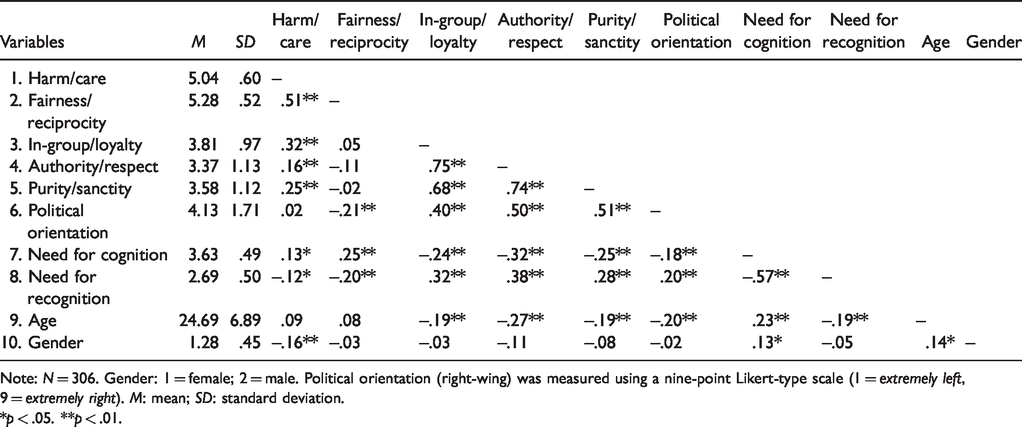
Note: N = 306. Gender: 1 = female; 2 = male. Political orientation (right-wing) was measured using a nine-point Likert-type scale (1 = extremely left, 9 = extremely right). M: mean; SD: standard deviation.
*p < .05. **p < .01.
As shown in Table 1, all moral foundations were positively correlated with each other except for the fairness/reciprocity dimension which was strongly (positively) correlated only with the other individualizing foundation of harm/care, but independent of the binding foundations of in-group/loyalty, authority/respect, and purity/sanctity. As for the relationship between political orientation and morality, right-wing political orientation was found to be positively associated with all three binding foundations of morality but negatively correlated with fairness/reciprocity and independent of harm/care dimension of the individualizing foundations. Besides, a strong negative correlation was found between the need for cognition and the need for recognition. Also as expected, the need for cognition was found to be negatively correlated with both the right-wing political orientation as well as the binding foundations of morality but to be positively associated with the individualizing foundations of morality. In contrast, the need for recognition was found to be positively correlated with right-wing orientation and binding foundations of morality but to be negatively correlated with the two individualizing foundations. As for the demographic characteristics, age was positively correlated with need for cognition; negatively correlated with right-wing political orientation, need for recognition, and the binding foundations; but independent of the individualizing morality foundations. Besides, gender (being male) was positively correlated with need for cognition, negatively correlated with harm-care, and independent of the other variables.
Hierarchical regression analyses
As can be seen in Table 2, each regression analysis consisted of three steps: At the first step, age and gender were entered to control the effect of demographic variables; at the second step, political orientation, while at the third step, the need for recognition and need for cognition were entered as predictor variables of morality endorsements.
Hierarchical regression analyses.
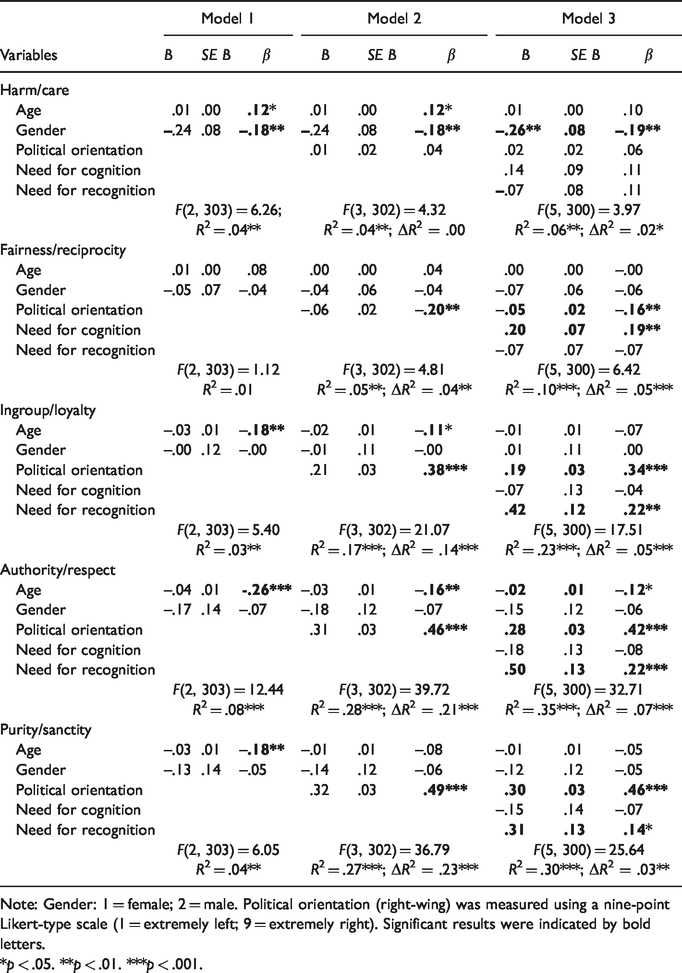
Note: Gender: 1 = female; 2 = male. Political orientation (right-wing) was measured using a nine-point Likert-type scale (1 = extremely left; 9 = extremely right). Significant results were indicated by bold letters.
*p < .05. **p < .01. ***p < .001.
Neither political orientation nor the needs for cognition or recognition had a significant impact on the harm/care dimension, which was significantly predicted only by gender (coded as a dummy variable whereby increasing values represent males). Accordingly, women were found to be more likely (relative to men) to endorse the harm/care dimension. On the other hand, controlling for age and gender, both political orientation and the need for cognition significantly predicted the individualizing dimension of fairness/reciprocity, explaining 4% and 5% of the variance, respectively (Table 2). Accordingly, right-wing orientation had a negative impact while need for cognition had a positive impact on being likely to use the fairness/reciprocity foundation of morality.
Controlling for age and gender, both political orientation and the need for recognition significantly predicted each of the binding morality foundations; that is, right-wing political orientation explained 14%, 21%, and 23% of the variance in ingroup/loyalty, authority/respect, and purity/sanctity dimensions, respectively, while respective percentages explained by the need for recognition were 5%, 7%, and 3%. Accordingly, right-wing orientation and need for recognition explained unique variance in binding morality foundations.
Mediation analyses
As noted earlier, to estimate the degree to which political orientation predicted endorsement of morality foundations through the need for cognition and the need for recognition, separate multiple mediator analyses with 5000 bootstraps were conducted with PROCESS modules (Hayes, 2013). In congruity with the abovementioned finding that political orientation was not associated with the harm/care foundation of morality, the related parallel mediation analysis results also indicated that need for cognition and need for recognition did not play a mediatory role on the relationship between political orientation and harm/care foundation of morality. The four analyses involving the other morality dimensions, that yielded significant results, as explained later, were repeated by controlling for the effects of age and gender, but those variables did not have any significant effects on the related dependent variables; hence, they were not included as covariates in the model not to lose power.
The individualizing foundation of fairness/reciprocity
As shown in Figure 1(a), the impact of right-wing orientation on endorsement of fairness/reciprocity dimension was statistically mediated only by the need for cognition (indirect effect = –0.009, standard error (SE) = .005, CIBCA = –.022 to –.003) whereas the need for recognition did not play a significant role. The multiple mediator model accounted for 9% of the variance in fairness/reciprocity endorsements (p < .001). Thus, right-wing orientation seemed to negatively predict the use or endorsement of fairness/reciprocity not only directly but also indirectly through the mediatory role of the need for cognition (controlling for the need for recognition).

Multiple mediational models of right-wing orientation and moral foundations through the need for cognition and the need for recognition. *p < . 05, **p < . 01, ***p < . 001.
The binding foundations of ingroup/loyalty, authority/respect, and purity/sanctity
As shown in Figure 1(b) to (d), only the need for recognition appeared as a significant statistical mediator in the link between right-wing orientation and endorsements involving each of the binding foundation dimensions of ingroup/loyalty (indirect effect = .024, SE = .01, CIBCA = .008 to .05), authority/respect (indirect effect = .030, SE = .013, CIBCA = .009 to .062), and purity/sanctity (indirect effect = .018, SE = .009, CIBCA = .004 to .042). The variance accounted by those multiple mediator models were 22%, 34%, and 29%, respectively (p < .001, for all). Thus, right-wing orientation seemed to positively predict the binding foundations of ingroup/loyalty, authority/respect, and purity/sanctity not only directly but also indirectly through the statistical mediatory role of the need for recognition (controlling for the need for cognition).
Discussion
In general, the results supported our hypotheses involving the association of political orientations of Turkish young adults with their use or endorsement of morality foundations, as specified by moral foundations theory, and the roles played by motivational differences in the need for cognition (a reflective cognitive style variable) and the need for recognition (an impression-motivated variable) in the links between political orientation and morality endorsements. Our first hypothesis, which predicted that the right-wing political orientation would be positively associated with all three of the binding moral foundations (i.e., in-group/loyalty, authority/respect, and purity/sanctity), was supported in keeping with the moral foundations theory and related studies (e.g., Graham et al., 2011; Haidt & Graham, 2007; Talaifar & Swann, 2019; van Leeuwen & Park, 2009); however, unlike those studies, of the two individualizing moral foundations, right-wing political orientation was found to be negatively associated only with fairness/reciprocity foundation but to be independent of harm/care. This finding, in congruence with a recent study involving Turkish university students (Yılmaz & Sarıbay, 2018), is consistent with the strong emphasis on care and support in the collectivistic Turkish culture; hence, points to the influence of the cultural context on morality considerations. The harm/care dimension has been found to be unique in that it appeared to be the only morality foundation that was positively associated with all the other dimensions; that is, besides being strongly correlated with the fairness/reciprocity dimension, weaker but significant correlations were found with the binding morality foundations. These results, pointing to a central position of the harm/care dimension, also seem to be congruent with other theoretical outlooks which regard harm (intentionally caused suffering) as the most important moral consideration (e.g., Schein & Gray, 2018), as well as the conclusion by Graham et al. (2011) that across cultures the greatest degree of moral commonality may be found in issues related to harm and care. Furthermore, the harm/care dimension was also unique in that it was predicted only by gender. That is, in congruence with the theoretical outlook of Gilligan (1982, which refers to the evolutionary tendencies of women involving the protection and care for their offspring to get an advantage in the natural selection process), women seemed more likely to consider the harm/care dimension of morality, regardless of age, political orientation, or individual differences involving the needs for cognition or recognition,
The other individualizing moral foundation dimension of fairness/reciprocity also appeared to be unique in that while all the other moral foundation dimensions were positively correlated with each other, the fairness/reciprocity dimension was positively correlated only with harm/care, as noted, but was independent of the binding foundation dimensions. Furthermore, within the Turkish context, fairness/reciprocity dimension appeared to be the only morality foundation dimension which was negatively correlated with right-wing political orientation. On the other hand, the binding foundations of ingroup/loyalty, authority/respect, and purity/sanctity were not only strongly correlated with each other but also (moderately) associated with right-wing orientation (as well as need for recognition while being negatively correlated with need for cognition). Interestingly, with increasing age, Turkish individuals seemed less likely to endorse the binding moral foundations. Age also seemed to be negatively associated with right-wing orientation (and need for recognition but positively associated with need for cognition) and independent of the individualizing foundations. Thus, we should note that while pointing to the importance of cultural factors (e.g., when considering the harm/care dimension of morality), our results also suggest that one should be cautious in considering collectivist cultures as giving more importance to the group-related binding foundations rather than the individualizing ones. In fact, our participants seemed significantly more likely to endorse individualizing foundations of morality than the binding foundations; hence, suggesting that the relationship between morality considerations and cultures may likely be more complex than a simple collectivist versus individualist classification would imply. At this point, we should also note that, as asserted by Janoff-Bulman et al. (e.g., Janoff-Bulman & Carnes, 2013, 2016; Janoff-Bulman, Sheikh, & Hepp, 2009), moral foundations theory considers only Social Order morality (involving a general proscriptive orientation toward protecting the group), which tends to be associated with political conservativism, but neglects Social Justice morality, which tends to be associated with political liberalism, and involves a general prescriptive orientation toward providing for the group (i.e., orienting toward advancement of the group’s welfare by focusing on equality-based distributional justice, communal responsibility, and collective effort). In line with the findings by Janoff-Bulman et al., we suggest that left-oriented Turkish individuals, who seemed more open to change and more likely to favor equality (e.g., Dalmış & Imamoğlu, 2000; Yılmaz & Sarıbay, 2018), may expected to be also concerned with a group-based morality involving Social Justice, and we encourage future research to clarify this issue.
Regarding the associations between motivational variables of the need for cognition and the need for recognition with political and moral orientations (Hypotheses 2 and 3), our results indicated not only that those motivational variables were negatively correlated with each other but also that their relationships with political and moral orientations seemed to involve a reverse pattern, as expected. Specifically, the need for cognition (involving motivation for rational, analytic thinking) was found to be negatively correlated with both the right-wing political orientation as well as with each of the three binding foundations but to be positively correlated with both of the individualizing foundations of morality. In contrast, the need for recognition (involving impression-motivated heuristic thinking) was found to be positively correlated with both the right-wing political orientation as well as with all the three binding foundations of morality but to be negatively correlated with both of the individualizing foundations, as expected. In line with those associations, participants who were left-wing (or low right-wing) oriented and high in need for cognition seemed more likely to endorse the fairness/reciprocity dimension of the individualizing foundation of morality. On the other hand, participants who were right-wing oriented and high in need for recognition seemed more likely to endorse the ingroup/loyalty, authority/respect, and purity/sanctity dimensions in their morality judgments. Controlling for age, gender, and political orientation, the need for cognition explained unique variance in fairness judgments, whereas the need for recognition explained unique variance in judgments involving binding foundations. Furthermore, our results involving the question of whether the need for cognition and the need for recognition statistically mediated the observed link between political orientation and endorsement of different morality foundations (Hypothesis 4), indicated that the need for cognition partially mediated the link between (low right-oriented) political orientation and fairness/reciprocity, controlling for the need for recognition. Thus, as expected, right-wing political orientation was found to negatively predict the fairness/reciprocity dimension of the individualizing foundation not only directly but also indirectly through the mediatory role of the need for cognition. On the other hand, right-wing political orientation statistically predicted being more likely to use the binding foundations of authority/respect, in-group/loyalty, and purity/sanctity, not only directly but also, indirectly via the mediation by the need for recognition (controlling for the need for cognition).
Thus, present findings are generally congruent with past studies which suggest that different political orientations have different perspectives about morality, and that liberal or left-wing orientation is more likely to be associated with issues of fairness, whereas the right wing seems to be related to binding foundations of morality (e.g., Bassett, van Tongeren, Green, Sonntag, & Kilpatrick, 2015; Graham & Haidt, 2010; Graham et al., 2009; Haidt, 2007; Jost et al., 2008; Piazza & Sousa, 2013; van Leeuwen & Park, 2009). Also, in line with the idea that political outlooks are adopted in part because they satisfy various psychological needs, and hence tend to possess a strong motivational basis (Jost et al., 2003), our findings point to the associations of the need for cognition and the need for recognition with the left-wing and right-wing political orientations, respectively, in line with studies which associate right-wing orientation with low-effort thought and reliance on heuristics (e.g., Eidelman et al., 2012; Garvey & Ford, 2014; Hannikainen et al., 2017; Yılmaz & Sarıbay, 2016). In a similar vein, our findings also suggest that individuals’ moral intuitions and judgments may be associated with their psychological needs and outlooks; for example, individuals, who have high (rather than low) need to gain social/political power, status (i.e., increased recognition), may be more inclined to endorse binding moral foundations, whereas those high in need for cognition may be more concerned with issues of fairness. Thus, our findings seem to be congruent with both the studies which associate rational thinking or analytic cognitive styles with individualizing moral foundations as well as those studies which associate the preference for experiential/emotional thinking or low-analytic cognitive styles with binding moral foundations (e.g., Garvey & Ford, 2014; Hannikainen et al., 2017; Pennycook et al., 2014; Yılmaz & Sarıbay, 2017).
Limitations, suggestions, strengths, and conclusions
The first limitation of this study, shared by most other related studies, is its reliance on self-report data and correlational research design. Accordingly, the statistical predictions, referred to in this article, cannot be considered as implying causal connections between the tested variables. That is, in considering political orientation as predictor and morality endorsements as criterion variables, in line with other related studies (e.g., Kugler et al., 2014), our aim was to explore whether political orientations of Turkish individuals predict their likelihood to endorse different morality foundations and whether the motivational variables of the need for cognition and need for recognition can be shown to statistically mediate the possible links between political orientations and morality endorsements. Experimental research would be needed to explore the causal relationships between psychological needs, moral, and political outlooks, in which case, it may also be important for future researchers to investigate the mediational role of motivational variables by implicit measures of political and moral orientations to avoid the effect of conscious attention. It should also be noted that in the present article, we have referred to left-wing/right-wing and liberalism/conservatism interchangeably overlooking possible differences, in line with reports of strong correlations between right-wing orientation and conservatism in Turkey (e.g.,Yılmaz & Sarıbay, 2018), and have used a single item to assess political orientation, in line with reports that (one-item) unidimensional left-right construct seems to have predictive power and common meaning across societies (e.g., Graham et al., 2011; Talaifar & Swann, 2019; Yılmaz et al., 2016). However, future studies may still consider measuring political orientations by moving beyond a unidimensional left-right (or liberal/conservative) continuum and using scales which may better represent nuances in the political spectrum, as also suggested by Youngblut and Casper (1993). Finally, this study was conducted only on a Turkish sample. Although some consistent trends were observed with other studies based on samples from other cultures (e.g., Graham et al., 2009, 2011), still more research from different cultures is needed to explore the degree to which present findings can be generalized to other cultures.
In spite of those limitations, we think that this study has some strong aspects. First, it has tested the predictions of moral foundations theory and its association with political orientations using a sample of generally young adults (rather than a typical undergraduate sample) from Turkey, which represents a collectivist culture (Hofstede, 2016), and a secular state with a predominantly Moslem population. Our study has not only provided supportive evidence for the moral foundations theory but has also contributed to extending that line of research to include the role played by motivational factors. In this regard, we have considered the direct and statistically mediating roles of not only the need for cognition, which has been studied quite extensively in the psychological literature, but have also explored the roles played by the need for recognition (to our knowledge for the first time in the particular research area), an important motivational variable, which has been relatively neglected in the related literature. However, in view of the converging evidence obtained in this exploratory study involving the need for recognition, we suggest that further investigations considering this neglected variable may be worthwhile. Present study suggested that the need for recognition may be likely to function as an impression-motivated heuristic associated with the right-wing political orientation and binding moral foundations.
In conclusion, our results from a Turkish sample of generally young adults suggest that, unlike the care/harm dimension which seems to be independent of political orientation, in congruence with recent reports from Turkey (e.g., Yılmaz & Sarıbay, 2018), the fairness/reciprocity dimension of the individualizing foundations tends to be associated with the leftist outlook, whereas binding foundations of morality tend to be associated with right-oriented political outlook, consistent with trends obtained from other cultures (e.g., samples from the United States, United Kingdom, Argentina, and Canada; Graham et al., 2009). Furthermore, we have statistically demonstrated that the link between left-orientation and the fairness/reciprocity dimension is partially mediated by the need for cognition, whereas the links between right-orientation and binding foundations of morality are partially mediated by the need for recognition. In other words, individuals high (rather than low) in political right-orientation may also be motivated by their needs for recognition (controlling for their needs for cognition) in being more likely to endorse the binding foundations of in-group/loyalty, authority/respect, and purity/sanctity in their morality judgments. In contrast, the more left-oriented individuals, in being more likely to endorse the individualizing foundation of fairness/reciprocity in their judgments of morality, may also be motivated by their needs for cognition (controlling for their needs for recognition).
Thus, in line with the wide range of studies (noted in the introduction) associating the need for cognition with rational, analytic thinking, our results suggest that left-wing-oriented individuals may be more likely to engage in rational, analytic thinking when endorsing fairness judgments. On the other hand, in congruence with the strong negative association of the need for recognition with the need for cognition, and studies involving impression-motivated processing (Chaiken et al., 1996), our findings suggest that right-wing-oriented individuals may be likely to engage in more heuristic thinking (involving impression management goals toward satisfying their needs for recognition) when endorsing binding morality foundations. Regarding the theoretical dispute between intuitionists and rationalists concerning the role of reasoning in moral judgments (referred to in the introduction), present results involving the binding foundations, seem congruent with the intuitionist outlook of moral foundation theorists. On the other hand, the finding pointing to the role of need for cognition in fairness judgments appears to be inconsistent with the view that moral judgments involve a rapid heuristic process without any conscious reflection or reasoning, but more congruent with the outlook of rationalists (e.g., Pizarro & Bloom, 2003), who stress the importance of deliberative reasoning in the formation of moral judgments by arguing that people’s intuitive understanding may only serve as a starting point for deliberative reasoning. However, although this finding may seem incongruent with the general outlook of social intuitionists who consider heuristic processing (the intuitive process) as the default process in the formation of moral judgments, it is congruent with Haidt’s (2001) acknowledgement that deliberative moral reasoning may be common among those high in need for cognition, as noted earlier.
In sum, present findings supported and extended the perspective of moral foundations theory (Haidt & Graham, 2007) by focusing on the role of motivational characteristics of young Turkish adults, in exploring the link between political orientations and morality judgments. As noted, moral foundations theory was originally developed to describe cross-cultural differences in morality (Haidt & Joseph, 2004). Accordingly, Haidt (2008) has suggested that moral systems may serve different functions and that differences may exist in the degree to which cultures generally stress the individualizing or binding foundations of morality. However, as noted, our findings suggest that one should be cautious in making generalizations about cultures and assuming that collectivist cultures (e.g., Turkey) tend to stress the binding foundations of morality (rather than the individualizing ones), since our results indicated just the opposite. Realizing that our sample cannot be assumed to be representative of the Turkish culture, we just want to stress that it is also important to consider that cultures tend not to be as homogeneous, as is often assumed, but often tend to show important within-culture differences, as indicated in different areas (e.g., Imamoğlu & Karakitapoğlu-Aygün, 2006). In that regard, the moral foundations theory has been also useful in understanding within-culture morality differences among individuals with different political outlooks, which, as noted earlier, tend to show consistent trends across groups from several nations (e.g., Graham et al., 2009). Our results, in congruity with those earlier trends, as well as more recent findings involving Turkish students (e.g., Yılmaz & Sarıbay, 2018), further suggest that young adults from the Turkish context may differ in assuming an individualizing or a binding approach in their morality considerations depending on their particular political and motivational orientations.
