




Abstract
Recovery from work is generally thought to occur outside of the workplace. However, employees may also have the opportunity to recover within the work day via microbreaks during demanding work tasks. Two major strategies for mitigating fatigue include psychological detachment (i.e., mentally disengaging) and replenishing motivational incentives via positive affect. This study examined whether 40-s “microbreaks” improve work recovery and to what extent different microbreak content (mastery vs. relaxation activities) boost performance. Using an experimental study, we randomly assigned individuals to receive a relaxation microbreak (n = 59), a mastery microbreak (n = 68), or no break (n = 72) in the middle of a monotonous work task and assessed work performance. Microbreaks improved task performance and within-task recovery, but only for psychological detachment (not positive affect). Mastery breaks also resulted in more psychological detachment than relaxation breaks, but this increased detachment did not explain performance differences between break types. These results build on existing recovery theories by further demonstrating within-task recovery and provide practical implications for organizations to consider the importance of microbreaks.
Introduction
Periodic work breaks are assumed to be vital for sustaining good work performance given employees often spend long consecutive hours in the workplace (e.g., on average, 8.56 hours per day; U.S. Bureau of Labor Statistics, 2017). Given that work productivity requires considerable effort (Demerouti, Bakker, Nachreiner, & Schaufeli, 2001), in addition to recovery during nonwork hours (e.g., evening, vacations; Demerouti, Bakker, Geurts, & Taris, 2009), even having brief “microbreak” activities during work hours could help employees effectively recover from job demands and improve subsequent job performance (Kim, Park, & Headrick, 2018; Kim, Park, & Niu, 2017; Trougakos & Hideg, 2009). Several experimental studies have been conducted in the work recovery context; however, they tend to either target comprehensive training programs in organizations (e.g., recovery training program; Hahn, Binnewies, Sonnentag, & Mojza, 2011; Siu, Cooper, & Phillips, 2014) or focus more specifically on different activities at work (e.g., office-based physical activities, lunchtime park walks, or relaxation exercises; Abdin, Welch, Byron-Daniel, & Meyrick, 2018; Sianoja, Syrek, de Bloom, Korpela, & Kinnunen, 2018). In addition, few studies using experimental research have focused on short rest breaks within the workday (i.e., microbreaks) and the underlying processes by which they are effective (Tucker, 2003). Microbreaks are distinct from scheduled work breaks (i.e., scheduled lunch breaks, or short rest breaks for shift workers) and arranged activities from wellness programs, the latter of which are often imposed by organizations. In addition, microbreaks are very short and completely volitional activities between work tasks that fall outside of the scheduled break time (Trougakos & Hideg, 2009). These microbreaks can range from respite, to chores, to social, cognitive, and nutrition-intake activities (Fritz, Lam, & Spreitzer, 2011; Kim et al., 2017; Trougakos & Hideg, 2009). Moreover, the length of microbreaks varies greatly across literature domains, with some studies suggesting the average length of naturally occurring microbreaks is around 27.4 s (Henning, Sauter, Salvendy, & Krieg, 1989) and others showing that 40-s microbreaks are sufficient for improving attention and task performance (Lee, Williams, Sargent, Williams, & Johnson, 2015). Thus, this study aimed to contribute to the work recovery literature by exploring how two types of microbreaks (i.e., mastery and relaxation) influence recovery experiences and task performance using an experimental design. Such an approach could inform strategies of managing workplace fatigue and improving task performance (Fritz et al., 2011).
According to the job demand-resources (JD-R) model (Demerouti et al., 2001), various work-related and work environment factors can be classified as either demands or resources. Job demands refer to factors that generate stress and require employees’ physical and psychological effort (e.g., physical or mental workload) whereas job resources refer to the motivational aspects of the work environment that foster personal growth and help achieve work goals or demands (e.g., autonomy and social support; Bakker & Demerouti, 2007). Meta-analytic findings suggest negative relationships between job demands and employees’ recovery from stress, and positive relationships between job resources and recovery (Bennett, Bakker, & Field, 2018). Two mechanisms targeting at either demanding or resource-generating aspects of the job could aid in work recovery, which is a reversal of the stress process, and momentary affective well-being at work. The first mechanism addresses the health impairment (i.e., exhaustion) process by reducing demands such that decreasing effort expended on work tasks can help restore one’s physical and psychological energy to cope with more tasks (per the effort-recovery process; Meijman & Mulder, 1998). The second mechanism involves providing employees motivational resources to better manage work demands. Drawing from the conservation of resources theory (Hobfoll, 1989), individuals are motivated to protect and build psychological and environmental resources, which helps with task accomplishment and coping with job demands.
Sonnentag and Fritz (2007) describe two key aspects of work recovery experiences that map on to these two mechanisms. Psychological detachment—defined as mentally disengaging from work tasks—is an important component of the recovery process with respect to reducing work demands (Sonnentag & Fritz, 2015). Although most research focuses on psychological detachment outside of work (e.g., during evenings, Sonnentag, Binnewies, & Mojza, 2008; during weekends, Binnewies, Sonnentag, & Mojza, 2010; during vacations, de Bloom, Geurts, & Kompier, 2012), short breaks during work (e.g., Bosch, Sonnentag, & Pinck, 2018; Fritz et al., 2011) may also allow for momentary mental disengagement from work tasks (Sonnentag & Fritz, 2015). Such prevention of attentional resource drain during work activities could later benefit task performance (Binnewies et al., 2010).
Alternatively, positive affect is a component of recovery related to motivational processes (Sonnentag & Fritz, 2007). Positive feelings reverse negative activation by restoring lost motivation. Relaxation (e.g., stretching), social (e.g., checking social media), and cognitive (e.g., reading books) microbreaks were shown to be positively related to increased positive affect at the end of the workday (Kim et al., 2018). In addition, presenting a task as “fun” has been shown to reverse mental fatigue effects because it increases motivation to engage in the task due to the associated positive emotional experiences (Laran & Janiszewski, 2011). These positive emotions then serve as motivational resources to boost task performance (Beal, Weiss, Barros, & MacDermid, 2005). In this study, we focused on two break activities that can facilitate both psychological detachment and positive affect: relaxation and mastery activities.
Relaxation and mastery microbreaks
To date, research examining the effects of microbreaks as a strategy to recover from work demands and increase work performance has focused on relaxation activities (e.g., Kim et al., 2017; Lee et al., 2015; Mclean, Tingley, Scott, & Rickards, 2001). Relaxation activities, which are nonwork tasks that require little effort, are proposed to help workers focus their attention away from work and boost positive emotions due to increased contentment (Sonnentag & Fritz, 2007; Trougakos & Hideg, 2009). Engaging in relaxation activities removes the exposure to job demands, thus providing opportunities to psychologically disengage and boost positive feelings associated with activities. Indeed, engaging in relaxation activities (e.g., gazing out the office windows) during microbreaks are effective in reducing the negative impact of work demands on negative affect (Kim et al., 2017). In addition, the restored energy from engaging in relaxation activities could promote better performance in subsequent work tasks via recovery experiences (e.g., psychological detachment; Binnewies et al., 2010) or positive affect (Kim et al., 2018). Another study used experimental design to show that viewing a pleasing image of nature for just 40 s was enough to help avoid performance decrements during a task (Lee et al., 2015). Drawing from both theoretical propositions in the JD-R model and previous empirical findings on the effectiveness of relaxation activities, engagement in microbreaks provides an opportunity for workers to restore energy and regain resources for subsequent work tasks. Although a relaxation microbreak may be short, it temporarily stops the expenditure of physical and psychological effort in work tasks, thus potentially facilitating recovery experiences (Meijman & Mulder, 1998).
Furthermore, mastery activities require an attentional shift from work to nonwork activities, boosting positive emotions through feelings of competence and accomplishment (Sonnentag & Fritz, 2007; Trougakos & Hideg, 2009). These activities tend to be involved and effortful as one may be engaging in tasks that are challenging but enjoyable and require extensive thinking and processing (e.g., learning an instrument for fun). Conceptually, switching away from an undesirable effortful task that leads to fatigue achieves psychological detachment, and switching to a desired effortful task that generates competence could increase positive affect due to motivational processes (Sonnentag & Fritz, 2007). Although Kim et al. (2017) provided some empirical evidence that cognitive microbreak activities (i.e., activities that may require some levels of mental effort and attention) were negatively associated with negative affect at work, the activities categorized as cognitive did not necessarily generate the experiences of competence. Again, mastery activities could be helpful in improving task performance in a similar way as relaxation activities (Binnewies et al., 2010; Kim et al., 2018). Linking empirical findings on cognitive and mastery activities to the JD-R model, mastery microbreak activities not only stop workers from exposure to work demands momentarily (reducing health impairment from demands) but also provide opportunities for them to actively engage in fun and nonwork-related activities to rebuild psychological resources (increasing motivation; Bakker & Demerouti, 2007; Hobfoll, 1989). Most importantly, we focus on effortful activities that provide a sense of accomplishment, which is an important experience in facilitating psychological resources (Sonnentag & Fritz, 2007). Yet, no research to date has explored whether mastery experience microbreaks could sustain work performance via recovery processes using an experimental design. This is a significant gap given the importance of mastery experiences in recovery processes, plus the practical significance of employees having easy access to games and other mastery-related activities via smartphone devices (e.g., interactive crossword games, language-proficiency games).
Therefore, we investigated whether microbreak activities involving mastery could induce the same performance benefits as relaxation compared to a no break group. Also, by directly measuring momentary experiences of psychological detachment and positive affect following a microbreak, this study helps resolve conflicting findings with regards to what underlying processes facilitate recovery during breaks (e.g., Rook & Zijlstra, 2006; Trougakos, Beal, Green, & Weiss, 2008). We expected that both mastery experiences and relaxation activities provided in the middle of a monotonous, clerical work task would facilitate (a) psychological detachment and (b) positive affect, which in turn would lead to performance benefits compared to a no break group (see Figure 1).
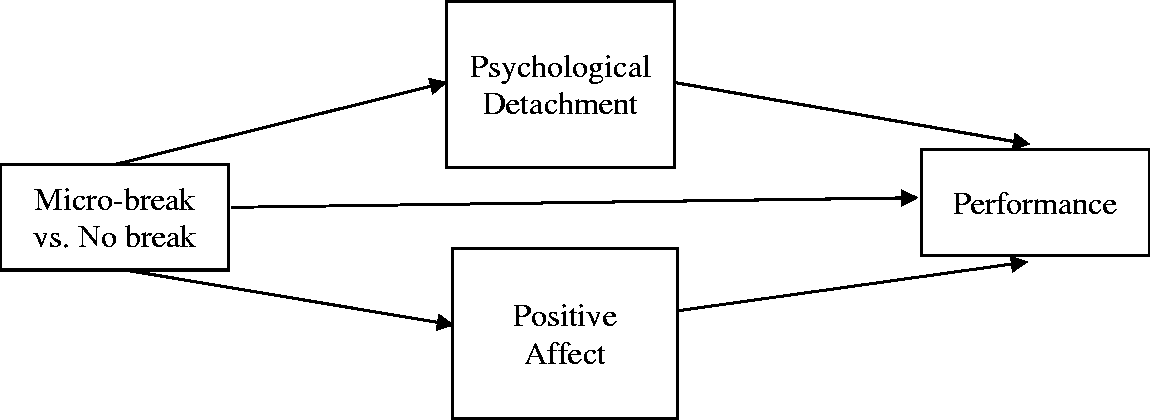
Theoretical model of the current study.
Hypothesis 1: Individuals taking relaxation and mastery microbreaks will have higher performance than those without a break.
Hypothesis 2: Individuals taking relaxation and mastery microbreaks will report more (a) psychological detachment and (b) positive affect than those without a break.
Hypothesis 3: There are indirect effects of relaxation and mastery microbreaks on performance via (a) psychological detachment and (b) positive affect.
Method
Participants
We recruited 247 undergraduate students from a U.S. public university to participate in the study in exchange for course credit. Because the effects of momentary recovery on state experiences are related to motivational resource replenishment (Hobfoll, 1989; Sonnentag & Fritz, 2007), 23 participants were excluded via their “no” responses to a quality control item (“In your honest opinion, should we use your data in our analyses?”). In addition, two participants were excluded because their performance on the main task reflected poor effort (> two standard deviations below the average performance scores; Howell, 1998). We also removed 12 participants due to technical issues (e.g., the computer crashed). The final sample included 199 participants, in which 59 were assigned into relaxation microbreaks condition, 68 were assigned into mastery condition, and 72 were assigned into no break condition. In the final sample, 56.8% of participants identified as male (n = 113), 53.3% White (n = 106), 18.1% Black (n = 36), 17.6% Hispanic (n = 35), 7.5% Asian (n = 15), 0.5% Native Hawaiian (n = 1), and 3.0% other (n = 6). The average age was 20 years old (SD = 2.36), and average American College Testing (ACT) score was 22.92 (SD = 3.79).
Procedures
Participants reported to a laboratory to perform a clerical editing task with the goal of creating attentional fatigue typical to knowledge worker positions. Using an online survey platform, participants were given a piece of literature and asked to click on all target letter combinations (es) that follow the letter “I.” This letter cross-out task has been used to assess performance decrements in past work break research (Cheng & Wang, 2015). Participants were asked to click on the specified letters in a clerical-type document for the first 10 minutes of the task. A 10-minute block of time has previously been shown to be sufficient for inducing fatigue for this type of task in past research (Jung, Makeig, Stensmo, & Sejnowski, 1997). After the first half, participants were randomly assigned to one of three microbreak manipulations (no break, relaxation microbreak, or mastery microbreak). A 40-s microbreak length was chosen for this study given effects found in past research (Lee et al., 2015). Those assigned to the no break condition were directed to answer a short state recovery measure and then continued with another 10 minutes of clerical editing task.
To serve as a relaxation microbreak, participants were asked to stare at a picture of a rooftop full of natural greenery and flowers on the computer monitor for 40 s. In past studies, this has been used as a low effort activity because an aesthetically pleasing image of flowers and nature has been found to be restorative and attention-boosting (Lee et al., 2015). In addition, the color green increases feelings of positive affect (Kaya & Epps, 2004). These studies suggest that staring at a rooftop with natural greenery meets the criteria to qualify as a relaxing experience and replenish resources (Sonnentag & Fritz, 2007).
To serve as a mastery break, a challenging themed anagram game was introduced to participants in this condition. During their 40-s microbreak, participants played a “fun word construction game” that has been used in other studies as a standard challenging anagram task (e.g., Ammons & Ammons, 1959). The task was adapted to a fun and visually pleasing format with bright colors and involved animal words as a consistent theme (Kaya & Epps, 2004). To ensure the relatively effortful activity was not experienced as negative, positive feedback, stating that the participant performed better than 90% of their peers, was provided after task completion to ensure feelings of perceived competence related specifically to their performance on the break task (Hobfoll, 1989; Schaufeli, Bakker, & Van Rhenen, 2009). This positive feedback was used to boost competence because it provides an upper comparison to standard performance, facilitating more self-efficacy (Carver & Scheier, 1990). In addition, past research has shown that positive feedback provided after task completion could elicit positive affect by boosting enjoyment, enthusiasm, and joy (Stotland, 1969), promoting perceived competence (Schaufeli et al., 2009), and fostering motivation (Kluger & DeNisi, 1996). Adding a theme (i.e., animals) also made the anagrams and positive performance feedback believable due to reducing the perceived difficulty of the task (Carver & Scheier, 1990; Kaya & Epps, 2004).
After the microbreak, participants answered state recovery measures and then proceeded to the last 10-minute editing task. All participants responded to the second sets of state recovery measures and demographic questions at the end of the study. Then, experimenters provided debriefing information on false positive feedback for those who were in the mastery microbreak condition and general summary of the study.
Measures
Furthermore, we pretested adapted items to ensure the mastery and relaxation task content differed in perceptions of state competence and arousal. In a sample of full-time employees (from Amazon’s Mechanical Turk; N = 59), participants were asked to imagine a list of 20 break items from the literature, including “winning a game” (mastery task) and “looking at nature” (relaxation task), and rate them on adapted state measures of competence, arousal, and affective valence. Initial support for the association of these imagined tasks with expected state experiences was found. Specifically, “winning a game” resulted in higher participant competence ratings than the average ratings of other breaks, F(1,19) = 10.54, p = .002, and “looking at nature” was rated as being more relaxing than the average ratings of other breaks, F(1,19) = 13.89, p = .001, supporting the use of these tasks as mastery and relaxation activities. Furthermore, the two breaks did not differ in affective valance, t(58) = 2.33, p = .23, suggesting they were both positive experiences. Support was used as rationale for the use of these adapted measures in the main study. In particular, affective valence was used most directly in hypothesis testing for positive affect (i.e., both breaks should improve positive affect more than the no break condition), whereas arousal and competence were used as manipulation checks to assess the relaxation and mastery microbreak manipulations, respectively.
Psychological detachment was measured using the subscale from the Recovery Experience Questionnaire (Sonnentag & Fritz, 2007). We adapted the subscale to logically fit with the work task. Three items (e.g., “I forgot about the clerical editing task.”) were measured using a five-point Likert scale (1 – I do not agree at all to 5 – I fully agree). Participants were also asked about demographic characteristics (age, gender, race, and ACT score).
Results
Before testing our hypotheses, two of the state recovery measures following microbreaks were tested as manipulation checks (see Table 1). Arousal (i.e., calm/restless) reports were not significantly different between the groups, F(2, 196) = 0.89, p = .413, although descriptive patterns suggest those in the relaxation condition trended toward reporting lower arousal than mastery and control conditions. Also, competence reports did not differ significantly between the groups in the omnibus test, F(2, 196) = 2.66, p = .072, although descriptive data trended toward the mastery condition reporting higher competence than the relaxation and the no break conditions. Follow-up pairwise analyses showed that people who received mastery microbreaks did report higher competence than people receive no break, t(138) = 2.23, p = .028. However, no significant differences observed in reported competence level between participants in mastery microbreak and relaxation microbreak conditions, t(125) = –.50, p = .618.
Descriptive statistics across conditions.
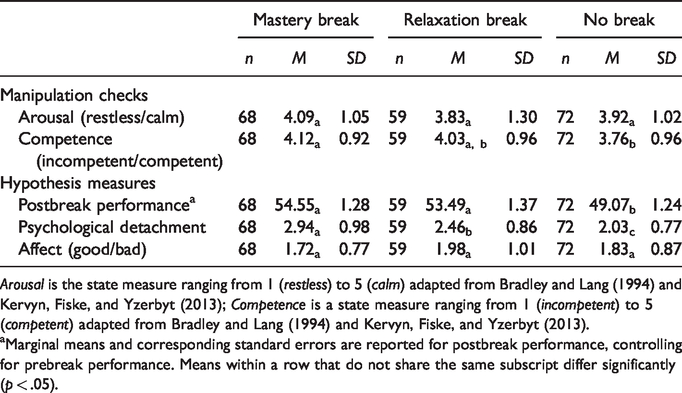
Arousal is the state measure ranging from 1 (restless) to 5 (calm) adapted from Bradley and Lang (1994) and Kervyn, Fiske, and Yzerbyt (2013); Competence is a state measure ranging from 1 (incompetent) to 5 (competent) adapted from Bradley and Lang (1994) and Kervyn, Fiske, and Yzerbyt (2013).
aMarginal means and corresponding standard errors are reported for postbreak performance, controlling for prebreak performance. Means within a row that do not share the same subscript differ significantly (p < .05).
An analysis of covariance (ANCOVA) was conducted to examine the effect of condition on postbreak performance. Consistent with our first hypothesis, postbreak performance for participants who received either type of microbreak (M = 54.06, SE = 0.93) was significantly better than those who did not receive a microbreak (M = 49.07, SE = 1.24), F(1, 196) = 10.34, p = .002, when controlling for prebreak performance. 1 An exploratory ANCOVA comparing the two types of microbreaks suggested mastery and relaxation conditions did not differ significantly on postbreak performance when controlling for prebreak performance, F(1, 124) = 0.30, p = .583 (see Table 1).
A one-way analysis of variance was conducted to examine the effects of microbreak conditions on state recovery measures. Participants who received a mastery or relaxation break scored higher on psychological detachment (M = 2.71, SD = 0.96), compared to those who did not receive a break (M = 2.03, SD = 0.77), F(2, 196) = 18.61, p < .001. Planned contrasts comparing the no break condition to the two break conditions demonstrated that microbreak participants reported more psychological detachment, t(196) = 5.14, p < .001. However, positive affect was not significantly different across conditions, F(2, 196) = 1.40, p = .249. Thus, Hypothesis 2 was only partially supported. Exploratory analyses comparing effects of both types of microbreaks on psychological detachment showed that the mastery microbreak resulted in higher psychological detachment reports (M = 2.94, SD = 0.98) than the relaxation microbreak (M = 2.46, SD = 0.86; t[125] = 2.89, p = .004).
We employed a bootstrapping approach (10,000 bootstrap samples with 95% bias-corrected confidence intervals) using SPSS (Hayes, 2013) to test Hypothesis 3 for the proposed indirect effects via (a) psychological detachment and (b) positive affect. Given that no difference in positive affect was observed between groups, we omitted testing indirect effects via positive affect. However, results suggested that the indirect effect of psychological detachment was not significant on the relationship between the microbreak conditions and subsequent task performance, controlling for prebreak performance (ab = –.14, bias-corrected SE = .04, bias-corrected 95% C.I. = [–.95, .58]). Thus, Hypothesis 3 was not supported. Overall, these data suggested microbreaks resulted in improved task performance and within-task recovery (i.e., the psychological detachment process). However, the effect of microbreaks on recovery did not transmit to task performance.
Discussion
We examined the effectiveness of relaxation and mastery types of microbreaks in facilitating within-task recovery and postbreak task performance. In line with our hypotheses derived from work recovery and JD-R theory, taking either a 40-s relaxation microbreak or mastery microbreak resulted in better subsequent task performance than the no break condition, controlling for prebreak performance. Both types of microbreaks increased reports of psychological detachment compared to no microbreak; however, psychological detachment did not transmit the effect of microbreaks onto task performance.
Implications
Our findings contribute to the work recovery literature by further examining the effect of within-task recovery activities on task performance experimentally and unpacking the underlying recovery mechanisms. Linking back to the JD-R model, microbreak activities provide individuals an opportunity to temporarily get a psychological break from work demands and replenish motivational resources to invest in subsequent work tasks (Demerouti et al., 2001). In addition, mastery microbreaks in particular shift individuals’ attention from work to nonwork tasks within a short time frame, thus achieving momentary psychological detachment better than relaxation tasks (Sonnentag & Fritz, 2015; Trougakos & Hideg, 2009). Inconsistent with recent findings (Kim et al., 2018), microbreaks did not influence one’s momentary affective experiences related to positive emotions. This discrepancy may be attributed to workers being less intrinsically motivated to engage in microbreaks when they are not by choice, which may lower one’s positive evaluation of the microbreaks.
In addition, this study yielded intriguing results such that microbreaks enhanced recovery experiences in the form of psychological detachment, but increased psychological detachment did not boost postbreak performance. We suspect that there may be other underlying psychological mechanisms we did not capture in the current study. For instance, a previous study examining the relationship between characteristics of general work breaks and physical well-being found evidence of a mediating effect of resources in the forms of energy, motivation, and concentration (Hunter & Wu, 2016). Therefore, energy management could be an alternative way to rebuild psychological resources (Hobfoll, 1989; Quinn, Spreitzer, & Lam, 2012). In particular, energy management could be achieved in many ways, including attention restoration, psychological need fulfillment, and positive affective experiences (Quinn et al., 2012).
Our study focused primarily on psychological detachment and positive affective experiences, but perhaps the participants in the current study also felt energized during microbreaks due to merely getting the opportunity to temporarily shift their attention to another task. These shifts in attention can be an important factor in the relationship between job stressors and psychological detachment (Sonnentag & Fritz, 2015). In accordance to the attention restoration theory (Kaplan, 1995), fixating on nature scenes can be effective in drawing one’s attention away from exhausting directed tasks or events and towards restorative objects or tasks. Previous research has shown that nature enhanced mood, recovery, and performance in many different ways (e.g., interaction with indoor plants, Shibata & Suzuki, 2004; interaction with nature, Korpela & Kinnunen, 2010; Sianoja et al., 2018). Our findings may also suggest that getting the opportunity to shift from a more demanding work-related task to an interesting break task may be more important than (a) the effort involved in completing the break task (i.e., requiring some effort for mastery activities or low effort for relaxation) or (b) whether the alternative task is perceived positively. Thus, future research could test other psychological or attentional mechanisms of microbreaks on performance in an experimental context beyond the mastery and relaxation activities tested in this study.
Lastly, previous research examined the roles of microbreak or general work break activities using nonexperimental design in which the activities reported were chosen freely by participants. Having control over one’s nonwork-related activities could serve as a form of resource gain, as control is considered to be a recovery experience (Sonnentag & Fritz, 2007). This study randomly assigned microbreaks to participants, which may undermine one’s sense of control over leisure and personal activities. However, our findings regarding performance boosts and psychological detachment suggested that being told to engage in a microbreak is similarly beneficial to individuals’ recovery experiences and task performance as freely chosen microbreaks. This study’s experimental design offers insights in the practical implication of promoting microbreaks on the job to boost better work and individual well-being outcomes. Particularly, many companies are adopting software solutions (e.g., RSIGuard) that can allow organizations to either implement mandatory short breaks or provide break reminders and tips automatically. This study empirically tested the effects of simulated mandatory microbreaks, which helps inform organizations in their decisions for implementing microbreak-related wellness strategies.
Limitations and future directions
The experimental approach of this study offered many advantages to guide causal interpretations of our study. Using both a consistent work task across all participants and random assignment to break conditions provided a high level of experimental control that cannot be achieved in field research settings. However, this study also does have some limitations with respect to self-reports of recovery experiences between conditions and the generalizability of these findings to work tasks (i.e., limited to specific types of clerical tasks).
The primary limitation of this study is that our interpretations are limited by a lack of strong evidence for the strength of manipulations on self-reported recovery experiences. Both microbreaks were theoretically inspired and designed based on two mechanisms: mastery experiences to boost competence and relaxation experiences to facilitate calm (Sonnentag & Fritz, 2007). We included self-report measures immediately after the microbreaks to test if the microbreak activities influenced self-reports of increased state competence (mastery) and decreased state arousal (relaxation). However, state competence and arousal did not significantly differ among all three conditions, except that competence experienced in mastery microbreak condition was higher than no break condition. This suggests that although the pretest of these break types provided some support that individuals engaging in such activities would experience what we expected, the lack of statistical support in manipulation checks in the main study might also point to a limitation in how we measured the intervening mechanisms that explain the relationship between breaks and performance.
Future research might consider using alternative measures that assess discrete emotional experiences that comprise positive affect and different arousal levels as well as other measures of mastery. For example, a measure of subjective leisure well-being uses 15 discrete emotions to asses positive affect that range from content to excited, and fulfillment of psychological needs in leisure activities has been assessed in other studies (Kuykendall et al., 2017; Sonnentag & Fritz, 2007). Although this study chose brief measures given the short time frame of the microbreak, studies using longer microbreaks may consider also using the traditionally longer assessments of recovery experiences.
The length of the microbreak might also be a factor limiting the size of our observed effects. The 40-s length of the microbreaks used in this design was chosen to replicate a similar within-task recovery study on performance outcomes, such as making less response errors after the relaxation microbreak (Lee et al., 2015), but perhaps a longer break might be necessary to allow for differential effects of various break types (mastery vs. relaxation) on self-report measures of these experiences. In addition, both measures were significantly negatively skewed, where almost all participants reported feeling competent (the extreme end of the incompetent/competent scale), and feeling calm (the extreme end of the calm/restless scale). Thus, restriction of range may present difficulty in testing these variables as measures sensitive to detect state competence and state arousal. Given that both breaks did produce performance benefits compared to a no-break condition, there is still reason to suspect participants received some sort of motivational gains—that is, perhaps these effects occur outside of conscious or self-reflective processes detected using self-report measures. Relatedly, self-report measures for underlying psychological processes might not be an accurate representation of substantive concepts under investigation (Sonnentag, Venz, & Casper, 2017). For example, perhaps these results could be explained through differences in momentary physiological changes (e.g., heart rate variability related to changes to arousal level).
In addition, the scope of the conclusions from this study is limited to taking breaks from monotonous work tasks common to various knowledge-worker positions (e.g., editing, data entry, attentional alertness tasks). In the future, it might be useful to explore the different types of work that cause fatigue. It may be the case that the benefits from the microbreaks on performance in this study do not generalize to recovery from other types of fatigue, as fatigue and necessary recovery strategies can be dependent on characteristics of the work itself (Demerouti et al., 2001). For instance, boring work tasks deplete motivation whereas stressful work tasks deplete executive functioning (e.g., planning and critical thinking). Although both are negative, boring tasks result in fatigue characterized by low arousal, whereas stressful tasks result negative activation, characterized by high arousal (Watson, Wiese, Vaidya, & Tellegen, 1999). Therefore, we can presume that different work tasks might benefit from different types of microbreaks. Specific recovery needs for different types of work demands can help further determine the ideal type of recovery activities based on the task in future research.
Lastly, microbreaks can take various forms other than relaxation and mastery activities. Previous studies have examined other activities (e.g., socializing, intake nutrition; Kim et al., 2017). We focused primarily on relaxation and mastery activities corresponding to the theoretical mechanisms proposed in this study. Future research could include a wider range of activities to further understand the nuanced differences in different microbreak activities.
Conclusion
This study explored whether employee performance can be improved with brief work breaks (microbreaks) within the work day, and why this effect may occur. We found that even 40-s microbreaks help people feel psychologically detached from work tasks and boost performance compared to no break. In addition, having a microbreak that involves mastery (i.e., an effortful game) is just as effective as a microbreak that involves relaxation (i.e., looking at nature). The findings from this study suggest that quickly shifting one’s attention from demanding work tasks to fun and relaxing break activities affords work and recovery benefits. This study challenges common assumptions about work breaks and how people recover from work: employees can take effective breaks during the work day to recover, breaks do not need to be long to be effective, and breaks do not necessarily need to be relaxing to boost performance. This study offers insights for organizations in potentially increasing the awareness and application of microbreaks for employees, especially those in occupations requiring clerical work that can be monotonous and require attention to detail.
