



Abstract
Employees withholding their opinions is pervasive in organizations. However, the individual outcomes of employee silence have not been frequently investigated. Previous studies have found that there are detrimental effects of employee silence and building on this research stream, the study viewed perceived stress as an underlying mechanism linking employee silence to task performance and deviant behavior. Moreover, this study explored the moderating effect of interpersonal trust in the relationship between employee silence and perceived stress. Using a sample of 231 white-collar employees from China, this study found perceived stress to mediate the relationships between employee silence and task performance and deviant behavior. Also, coworker trust was found to moderate the relationship between employee silence and perceived stress. As coworker trust moderated the relationship, supplementary analyses further found mediated moderation for the model.
Introduction
Employee input has been proven to be crucial for organizational functioning in a wide range of aspects such as organizational learning, decision making, innovation, and teamwork efficiency (e.g., A. S. Y. Chen & Hou, 2016; Kim et al., 2010; Milliken & Lam, 2009; Ng & Feldman, 2012; Wilkinson & Fay, 2011). Although employees are constantly encouraged to speak up about their suggestions, ideas, concerns or any other forms of opinions; they generally tend to remain silent which can impose as threats not only to the development of organizations but also to individuals (e.g., Detert et al., 2010; Milliken et al., 2003; Morrison & Milliken, 2000; Perlow & Williams, 2003). Consequently, recent studies have focused on the antecedents of employee silence such as abusive supervision, ostracism, authoritarian leadership, and leader personality (e.g., Duan et al., 2018; Gkorezis et al., 2016; Jahanzeb & Fatima, 2018; Song et al., 2017; Wang & Jiang, 2015) to identify the causes of employee silence but have yet to comprehensively explore the consequences of silence. Currently, only a handful of studies have investigated the effects of employee silence and have found it to be negatively related to workplace attitudes and behaviors such as job satisfaction, organizational commitment, creativity, and withdrawal (e.g., Bormann & Rowold, 2016; Guo et al., 2018; Nikolaou et al., 2011; Whiteside & Barclay, 2013).
Research on silence is still developing and studies must further investigate how employee silence affects workplace attitudes and behaviors. In order to understand the complex nature of silence, studies should examine underlying mechanisms and boundary conditions that can further associate the effects of silence on attitudinal and behavioral outcomes. As there are limited studies that have empirically tested underlying mechanisms that link employee silence and workplace outcomes (e.g., Jain, 2015; Srivastava et al., 2019), the current study explored the mediating effects of perceived stress for the relationships between employee silence, task performance, and deviant behavior. According to Morrison and Milliken’s (2000) conceptual framework, the study takes a stress perspective depicting employee silence as a workplace stressor that can induce adverse psychological responses, which in turn results in detrimental outcomes (Spector, 1998).
In addition, coworker trust was included as a boundary condition for the relationship between silence and stress to examine whether it can alleviate the effects of silence on stress. Trust has been found to be significantly related to silence (e.g., Dedahanov & Rhee, 2015; Hassan et al., 2019; Nikolaou et al., 2011). Trust towards coworkers involves positive expectations and confidence in terms of one’s fellow members’ ability, integrity, and benevolence (Mayer et al., 1995). Withholding genuine opinions and information are considered to cause psychological discomfort, an aversive result that individuals want to eliminate but have difficulties in removing (Festinger, 1962; Morrison & Milliken, 2000). In this regard, coworker trust can help shape the perceptions of work events (Vigoda-Gadot & Talmud, 2010) and can help mitigate the psychological discomfort resulting from silence.
Therefore, the present study contributes to silence literature by identifying perceived stress as a mediating process that associates silence and behavioral outcomes. Second, investigating coworker trust as a boundary condition for the relationship between employee silence and stress extends trust literature as it was found to be beneficial to the mental health of silent employees in that it can alleviate the impact of employee silence on stress. Last, mediated moderation was found for the study model, indicating that when silent employees trust their colleagues, their levels of stress decreased, which then resulted in increased task performance while decreasing deviant behavior.
Employee silence
Employee silence is defined as the intentional withholding of ideas, information, and opinions that is perceived to be important to one’s work and organization (Morrison & Milliken, 2000; Pinder & Harlos, 2001; Tangirala & Ramanujam, 2008; Van Dyne et al., 2003). Employee silence refers to situations where employees have genuine opinions or important information but tend to remain silent (Morrison, 2014). Previous research has addressed the dynamics of withholding information regarding different communitive content, targets, and contexts. For example, the “mum effect” (Rosen & Tesser, 1970) was used to describe the unwillingness to convey undesirable information in work settings due to the fear of jeopardizing interpersonal relationships. Noelle-Neumann (1974) identified a model of “spiral of silence” emphasizing how silence reinforces itself due to perceptions of possible support when speaking in public. Furthermore, Peirce et al. (1998) explored this phenomenon from a managerial perspective stating that the “deaf ear” syndrome of managers precludes employees from speaking up. Although informative, these approaches have been relatively scattered (M. Knoll et al., 2019) as employee silence serves as an umbrella that holds these fragmented yet related constructs describing the suppression of any genuine opinions and information (M. Knoll et al., 2019; Tangirala & Ramanujam, 2008).
Employee silence is frequently observed within organizations (Morrison, 2014). Silence can become contagious among individuals and can also become a collective phenomenon (Morrison & Milliken, 2000). Unfortunately, organizations have difficulties in detecting misconducts and errors as well as making proper decisions due to lack of significant information (e.g., Near & Miceli, 2016; Perlow & Williams, 2003; Schulz-Hardt et al., 2006) and as silence is covert in nature (e.g., Van Dyne et al., 2003), silence requires closer attention because it is likely to generate negative attitudes and behaviors that can negatively affect the individual and the organization. Despite its scarcity, literature on employee silence has found some evidence on the outcomes of withholding genuine opinions. Studies have empirically associated employee silence to outcomes such as organizational commitment, job satisfaction, and creativity (e.g., Dedahanov & Rhee, 2015; Guo et al., 2018; Vakola & Bouradas, 2005). However, how silence comprehensively influences an individual has yet to be investigated (Morrison, 2014).
Since employee silence is still in its early stage of development (Brinsfield et al., 2009; M. Knoll et al., 2016; Morrison, 2014), issues remain unclarified regarding dimensionality and empirical operationalization. Studies have investigated multiple dimensions on why employee silence may occur such as the fear of possible negative individual outcomes, belief that speaking up will not make a difference or resignation, unwillingness to hurt other organizational members’ benefits, and protecting or gaining one’s own benefits (Brinsfield, 2013; M. Knoll & Van Dick, 2013; Van Dyne et al., 2003). Accordingly, numerous researchers have conducted research using the multi-dimensional typologies based on the underlying motives such as quiescent/defensive silence based on fear, acquiescent silence based on resignation, prosocial silence based on altruism, opportunistic silence based on self-interest, and relational silence based on protection of valuable relationships (e.g., Brinsfield, 2013; M. Knoll & Van Dick, 2013; Milliken et al., 2003; Pinder & Harlos, 2001; Van Dyne et al., 2003).
Although research has approached employee silence as a multi-dimensional construct, the present study focuses on silence as a unidimensional construct. Previous studies have investigated silence as a multi-dimensional construct and the multi-dimensional construct has been soundly established (M. Knoll & Van Dick, 2013), however, current empirical literature has rather measured employee silence in a holistic manner (e.g., Duan et al., 2018; Tangirala & Ramanujam, 2008) which makes it difficult to conclude its dimensionality. According to M. Knoll and Van Dick’s (2013) study, the four forms of employee silence deriving from the divergent motives (i.e., quiescent, acquiescent, prosocial, opportunistic) were all found to be negatively correlated with job satisfaction and well-being while positively correlated with strain and turnover intention. Hence, the different dimensions of employee silence may exhibit the same directional relationships when associated with outcomes such as employee psychological well-being, job satisfaction, strain, and turnover intention. In this regard, investigating employee silence as a unidimensional construct may be sufficient in deepening our knowledge on the core nature of employee silence.
Hypothesis development
The mediating effects of stress
Extant literature has established that employee silence will exert negative impacts on employee health and psychological well-being by increasing their levels of stress (M. Knoll et al., 2016; Morrison & Milliken, 2000; Pinder & Harlos, 2001). A stressor is “a condition or situation that requires an adaptive response from a person” (Spector, 1998) that can lead to negative psychological and physiological responses and decrease performance (e.g., J. C. Chen et al., 2006; Jex, 1998; Motowidlo et al., 1986). In this regard, silence can be integrated into stress literature as employee silence can be suggested to be a stressor that will elicit increased levels of stress and then result in negative behavioral outcomes.
Cognitive dissonance theory argues that individuals would experience aversive psychological states when they have contradictory thoughts and behaviors (Festinger, 1962). By actively refraining from expressing what individuals believe should be said, silence is likely to increase psychological discomfort such as stress due to cognitive dissonance. A recent qualitative study by Kirrane et al. (2017) supports this assertion in that silence resulted in feelings of stress. Moreover, empirical results from previous studies also provide evidence to this assertion. Findings from Dedahanov, Lee, Rhee, and Yusupov (2016) study indicated that employees restraining themselves from expression due to protecting their relationships and avoiding interpersonal conflict would experience discrepant beliefs which in turn results in elevated levels of stress. In another study, Dedahanov, Lee, and Rhee (2016) found that employees refraining from disagreement with their managers would experience increased levels of stress.
Furthermore, when individuals experience cognitive dissonance, they will be motivated to take actions to lessen their perceptions of dissonance (Festinger, 1962). However, when employees remain silent, their discomfort is difficult to mitigate because it is challenging to break the silence (Detert & Edmondson, 2011; Morrison & Milliken, 2000; Morrison et al., 2011; Perlow & Repenning, 2009) or to change one’s well-established beliefs (Festinger, 1962). As discomfort persists, individuals will be likely to avoid situations that generate uneasiness (Festinger, 1962), indicating that it is common for silent employees to disengage from work and work information as a coping strategy to deal with stress which then can negatively affect behavioral outcomes such as performance. This is consistent with the stressor-strain relationship as deviant behavior can be a coping strategy when confronting stressors that one is unable to resolve (Folkman et al., 1986; Sullivan & Bhagat, 1992). Also, according to coping theory (Lazarus & Folkman, 1984), stress will be likely to increase deviant behaviors as an emotion-focused coping strategy when stress cannot be adequately addressed by individuals (Mawritz et al., 2014). Moreover, numerous studies have found stress to result in negative outcomes such as workplace deviant behavior (e.g., Yao et al., 2014), thus proposing the following: Hypothesis 1: Stress will mediate the relationship between employee silence and task performance. Hypothesis 2: Stress will mediate the relationship between employee silence and deviant behavior.
The moderating effects of trust
Interpersonal trust is defined as “a psychological state comprising of the intention to accept vulnerability based upon positive expectations of the intentions or behaviors of another” (Rousseau et al., 1998, p. 395). This positive expectation takes root in the knowledge and skills of another party needed for desired results as well as its ethical motivation (Lleó de Nalda et al., 2016; Mayer et al., 1995). By trusting another party, individuals are more likely to engage in taking risks which then produce positive outcomes (Mayer et al., 1995) such as increased levels of task performance, prosocial behaviors, and job satisfaction and reduced turnover intentions (e.g., Mayer & Gavin, 2005; Mulki et al., 2006; Zhu & Akhtar, 2014).
Although silence studies have argued that trust is an antecedent because it promotes risk-taking behavior and reduces risk perceptions of speaking up (e.g., Dedahanov & Rhee, 2015; Nikolaou et al., 2011), Khalid and Ahmed (2016) implied that trust might not function in predicting employee silence in situations where other strong precursors of employee silence exist such as dispositional factors and organizational factors. They found in their study that when organizational politics dimensions (such as pay and promotion policies) were taken as an environmental determinant of employee silence, trust did not predict silence, thus yielding inconsistent results with prior research (e.g., Dedahanov & Rhee, 2015).
Positive relations with organizational members are advantageous to employee well-being (George & Brief, 1992) while destructive relationships characterized by distrust can be a potential source for stress because it induces negative feelings and perceptions about the environment and other organizational members (Lazarus, 1995). Thus, trust can be viewed as a positive psychological process (Turner et al., 2002) that can benefit mental states by promoting positive interpersonal relationships such as with one’s coworkers. Previous studies have found that by fostering positive expectations and faith in a specified target, trust will lower perceptions of future risk and can help alleviate stress (Guinot et al., 2014). In addition, trust can increase satisfaction and relieve stress symptoms through generating beliefs that trustees will provide thoughtful consideration and concerns (Liu et al., 2009).
As the influence of trust on silence needs to be further clarified within research, the study argues that interpersonal trust will have a moderating role for the relationships between silence and its outcomes. Interpersonal trust can alleviate the effects of silence on stress because it can help individuals derive meaning about silence which then can reduce cognitive dissonance. Employees are likely to make sense of their silence by holding others responsible for raising critical issues and information (Bisel & Arterburn, 2012). Interpersonal trust can facilitate and reinforce the sense-making process because when employees trust other organizational members, they perceive the trustees as principled and prosocial in nature and rely on their expertise regarding work matters, hence placing the psychological burden of providing input to the trustees (Bisel & Arterburn, 2012). This is in alignment with the cognitive dissonance reduction strategy proposing that new cognition or information can rationalize incoherent behavior and is helpful in regaining harmony and alleviating psychological discomfort when dissonance elimination cannot be effectively achieved by change (Festinger, 1962). In this notion, we propose the following: Hypothesis 3: Coworker trust will moderate the relationship between employee silence and stress where higher levels of trust will weaken the relationship. Figure 1 shows the hypothesized study model. Hypothesized research model.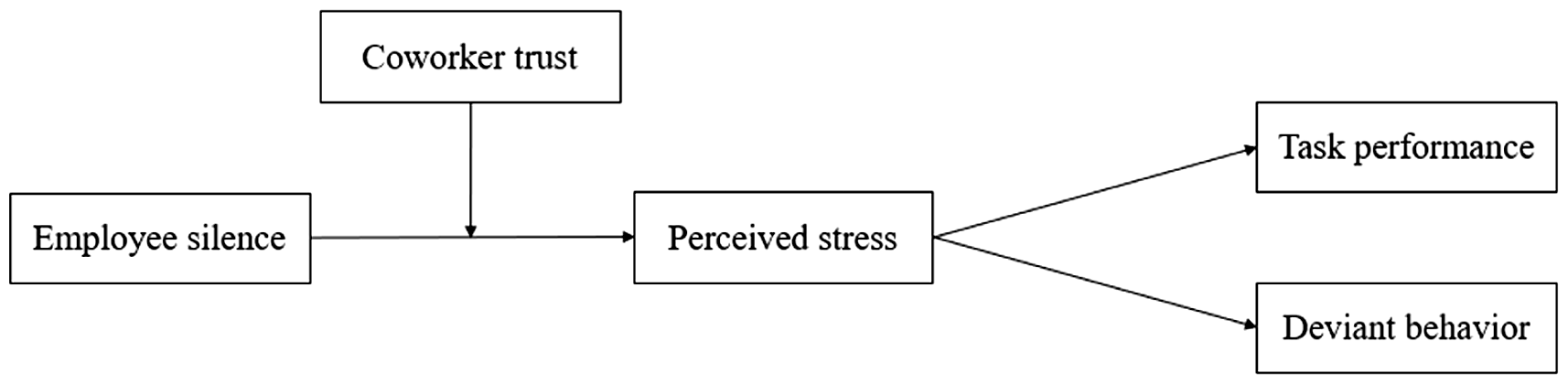
Methodology
Procedure and participants
A time lagged two-wave self-reported questionnaire was given to full-time employees to collect data. The questionnaires were given to a contact person for each organization and each contact prepared a list of participants in sequence and distributed the numbered envelopes accordingly at both times. The list was assured to be known only by the contact person who did not participate in the survey and the surveys were enclosed in individual envelopes with sealing tape in order to ensure anonymity. 5 Chinese yuan was also included in each envelope at both times as an incentive. At time 1, 310 surveys with instructions and the purpose of the study were distributed to the point of contact for each organization in China and 262 were returned, yielding a response rate of 85%. Employee silence and coworker trust were measured at time 1. After a three-week interval, the second survey measuring perceived stress and performance behaviors was sent to those who returned their first surveys at time 1. 231 complete surveys were received at time 2, thus having a response rate of 88%. Demographic variables were measured at both times just as another means to verify the respondent match.
Common method bias
Common method bias was controlled following P. M. Podsakoff et al.’s (2003) procedural and statistical recommendations. First, the introduction of the study and the contact information of researchers were clearly stated in the cover letter to reduce the concerns about the purpose of the study. Confidentiality and anonymity were also assured in the cover letter in order to reduce social desirability. Second, a three-week interval separating the variables was used and last, Harman's single-factor test was conducted to test whether common method bias was a concern. The single-factor test resulted in 26.4%, therefore common method bias was not considered to be a cause of concern.
Measures
Since the study was conducted in China, the measures were translated to Chinese and went through a translation-back-translation procedure to ensure validity (Brislin, 1970). All of the items were measured with a 7-point Likert scale from 1, “strongly disagree,” to 7, “strongly agree.
Employee silence
A five-item scale adapted from Tangirala and Ramanujam’s (2008) study was used to measure employee silence. Sample items are “I choose to remain silent when I have concerns about the work,” and “Although I have ideas for improving the work, I do not speak up.” Cronbach’s alpha was .85.
Perceived stress
Perceived stress was measured with Cohen et al.’s (1983) 14-item scale. Sample items are “In the last month, I have often been upset because of something that happened unexpectedly,” and “In the last month, I have often felt that I was unable to control the important things in my life.” Cronbach’s alpha was .94.
Coworker trust
Coworker trust was measured by P. M. Podsakoff et al.’s (1990) 6-item scale with a referent shift. Sample items are “I feel quite confident that my coworkers will always try to treat me fairly,” and “I have complete faith in the integrity of my coworkers.” Cronbach’s alpha was .92.
Task performance
Task performance was measured by Williams and Anderson’s (1991) 7-item scale. Sample items are “I adequately complete assigned duties,” and “I fulfill responsibilities specified in my job description.” Cronbach’s alpha was .96.
Deviant behavior
Deviant behavior was measured by Bennett and Robinson’s (2000) 19-item scale. Sample items are “I make fun of someone at work,” and “I take property from work without permission.” Cronbach’s alpha was .95.
Results
Descriptive statistics and correlation coefficients are presented in Table 1. Before examining the hypotheses, discriminant validity was tested through confirmatory factor analyses (CFA) using AMOS 24 by comparing the proposed five-factor model to other alternative models. The results showed that the proposed model was an acceptable fit to the data (
Means, SDs, and zero-order correlations.

Note: n = 231. SD: standard deviation.
*p < .05. **p < .01.
Hierarchical regression analyses were conducted using SPSS 22 to test the hypotheses. Gender, age, education, position, and tenure were included as control variables for the analyses. Hypothesis 1 and 2 proposed that perceived stress will mediate the relationships between employee silence and task performance and deviant behavior, respectively. The regression analyses results are shown in Table 2. Mediation analyses were conducted using the PROCESS macro (Model 4) (Hayes, 2017) and employee silence was found to have a significant positive effect on perceived stress (β = .35, p < .001) and a negative effect on task performance (β = −.13, p < .05). Employee silence was found to have an indirect effect on task performance (−.06) as the bootstrap results with a bootstrapped 95% CI did not include zero (−.12, −.02), thus supporting Hypothesis 1. Similarly, Hypothesis 2 was supported as employee silence was positively related to deviant behavior (β = .16, p < .05) and had a significant indirect effect on deviant behavior (.04) while the bootstrap results also did not include zero (.02, .07).
Regression results for mediation.

Note: Bootstrap size = 5,000. LL: lower limit; CI: confidence interval; UL: upper limit; SE: standard error.
*p < .05. **p < .01. ***p < .001.
Table 3 exhibits the regression results for the moderation analyses. Before the analyses, the predictor variable and the moderating variable were mean-centered (Aiken & West, 1991). Table 3 depicts that coworker trust has a significant moderating effect on perceived stress (β = −.22, p < .01). In order to plot the interaction effects, Aiken et al.’s (1991) recommendation was adopted to examine coworker trust at values one standard deviation higher and lower than the mean. Figure 2 indicates that when coworker trust was high, the relationship between employee silence and perceived stress weakened; whereas when coworker trust was low, the relationship between employee silence and perceived stress strengthened; thereby supporting Hypothesis 3.
Regression results for perceived stress.

*p < .05. **p < .01. ***p < .001.
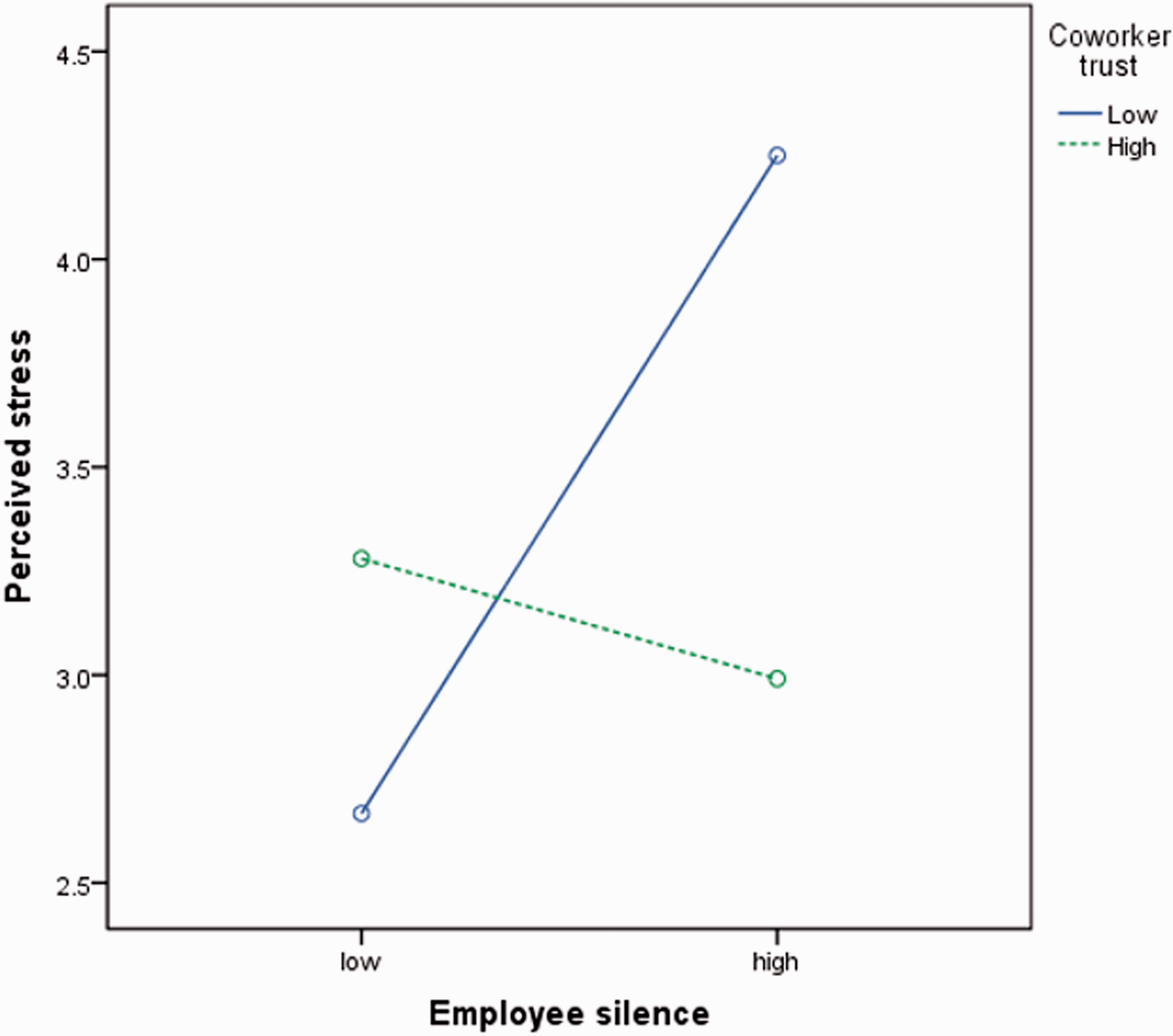
The moderating role of coworker trust in the relationship between employee silence and perceived stress.
Mediated moderation results.

Note: Bootstrap size = 5,000. LL: lower limit; CI: confidence interval; UL: upper limit; SE: standard error.
Furthermore, as coworker trust was found to moderate the relationship between employee silence and perceived stress, supplementary analyses were conducted to test for mediated moderation. Using the PROCESS macro (Model 7), the results shown in Table 4 show that mediated moderation was supported for both task performance (.01, .07) and deviant behavior (-.04, -.01) as the bootstrapped results around the indirect effect did not include zero.
Discussion
The consequences of employee silence in the work context have yet to be exhaustively examined (M. Knoll et al., 2016; Morrison, 2014). Building on Morrison and Milliken’s (2000) theoretical framework and studies linking employee silence to stress (Dedahanov, Lee, & Rhee, 2016; Dedahanov, Lee, Rhee, & Yusupov, 2016), the present study sought to extend employee silence literature by identifying perceived stress as an underlying mechanism explaining the detrimental effects of employees withholding their opinions on behavioral outcomes. In addition, the study tested interpersonal trust as a boundary condition for the relationship between silence and stress.
In general, the study findings support Morrison and Milliken’s (2000) and Morrison’s (2014) framework as employee silence can exert negative effects on individuals. Employee silence can evoke negative psychological reactions such as perceived stress which further results in negative behavioral outcomes such as decreased levels of task performance and increased levels of deviant behavior. Consistent with previous studies (Dedahanov, Lee, & Rhee, 2016; Dedahanov, Lee, Rhee, & Yusupov, 2016), employee silence was found to positively affect stress. This finding supports cognitive dissonance theory since individuals perceive discomfort when they have inconsistent beliefs and behaviors. When individuals intentionally refrain from expressing their opinions, they are likely to feel discomfort because they cannot satisfy their internal needs to express their true opinions (Ménard & Brunet, 2011; Schlegel & Hicks, 2011). Similarly, failure to express their true selves while suppressing their expressions have been found to negatively affect well-being (Pugh et al., 2011).
Moreover, the study found perceived stress will result in decreased task performance and increased deviant behavior. The study results are consistent with stress literature as stress reduces employees from fulfilling their role tasks and increases the likelihood of employees engaging in counterproductive behaviors due to stress (e.g., ; N. P. Podsakoff et al., 2007; Yao et al., 2014). In this regard, employee silence can be argued to be a workplace stressor and be a source of stress. Subsequently, stress has detrimental effects on workplace behaviors such as task performance and deviant behavior and the study results suggest that perceived stress can be an underlying mechanism that associates employee silence and task performance and deviant behavior.
The study hypothesized coworker trust to moderate the relationship between silence and perceived stress. Trust can reduce the sense of insecurity and risk by fostering positive judgement and expectations of the forthcoming based on the trustee’s characteristics (Dirks & Ferrin, 2001; Mayer et al., 1995). Even though the results showed a nonsignificant correlation between coworker trust and employee silence, the study still found coworker trust to significantly moderate the silence-stress relationship. Since the target of voice or silence is commonly one’s immediate supervisor (Brinsfield, 2013), positive attitudes toward coworkers may have little to do with the fear or futility of speaking up as they are primary motives for silence (Morrison, 2014; Pinder & Harlos, 2001), thus a nonsignificant correlation between coworker trust and employee silence was expected. Trust in coworkers draw inferences about characteristics of coworkers such as integrity, competence, and reliability (Dirks & Ferrin, 2002). Reliance on coworkers can add new cognitive elements that are consistent with the choice of silence (Festinger, 1962). In addition, knowing the ability to vent to trusted coworkers can also serve as a buffer reducing the discomfort from dissonance (Morrison & Milliken, 2000). Thus, it is reasonable to argue that coworker trust can help justify one’s action of withholding relevant information and opinions and acts as a psychological buffer mitigating the employee silence-stress relationship.
Last, the study found a mediated moderation relationship suggesting that perceived stress mediates the moderating effect of coworker trust on the relationships between employee silence and task performance and deviant behavior. These findings suggest that when silent employees trust their colleagues, their levels of stress decreased which then increased their task performance levels while also decreasing the likelihood of engaging in deviant behavior.
Theoretical and practical implications
The present study extends employee silence literature by examining its behavioral outcomes through perceived stress as an underlying mechanism. Most of the studies within silence literature have focused on exploring the antecedents and motives of silence (e.g., Bormann & Rowold, 2016; Rai & Agarwal, 2018; Tangirala & Ramanujam, 2008) while not much has been studied about its consequences (M. Knoll et al., 2016). Although some theoretical frameworks have proposed to delineate the negative effects of employee silence, there is a sparse amount of empirical evidence to support the relationships (M. Knoll et al., 2016; Morrison, 2014). However, there are a few exceptions that highlight the psychological costs of silence (e.g., Dedahanov, Lee, & Rhee, 2016; Dedahanov, Lee, Rhee, & Yusupov, 2016) and the current study further supports the studies and goes beyond the direct effects of silence as perceived stress was found to have a mediating role in associating employee silence to performance behaviors. These findings draw upon cognitive dissonance theory by adopting a stress perspective which can naturally integrate employee silence within stress literature.
In addition, the study adds to the literature on interpersonal trust. Organizations are characterized by higher levels of task interdependence and extensive social interaction. Trust among coworkers is thus pivotal as work conditions frequently require cooperation and sharing of organizational information (D. L. Knoll & Gill, 2011). Given the importance of coworker trust, this study contributes to literature by examining coworker trust as a boundary condition that alleviates employee stress within the context of employee silence. Furthermore, as coworker trust was found to moderate the mediated model, this further contributes to theory as this finding suggests that under certain conditions, the effects of silence can be weakened as coworker trust can indirectly affect task performance and deviant behavior.
This study provides insights to managers and organizations in that employees suppressing input can be identified as an internal stressor that can decrease organizational effectiveness. Since employees generally remain silent due to numerous reasons such as fear, being labeled negatively, and feelings of futility (e.g., Kiewitz et al., 2016; Milliken et al., 2003; Pinder & Harlos, 2001), managers and organizations should create a safe and trustworthy environment where employees can voluntarily voice their opinions and beliefs so that it can help benefit not only individual mental health but also organizational performance. In this perspective, leadership and formal communication channels and policies without the fear of negative repercussions can encourage employees to voluntarily voice their opinions and beliefs that can help organizational effectiveness (Avey et al., 2012; Bormann & Rowold, 2016; Dedahanov, Lee, & Rhee, 2016).
Moreover, organizations and managers can benefit from fostering trust among subordinates in order to attenuate the negative effects of employee silence. Since trust is related to the willingness to take risks, managers should organize training programs to promote interpersonal trust in order to reduce the perceptions of risk. Teamwork or other informal social associations such as social network services and other communication channels can also be used to create social connections among coworkers and supervisors to foster interpersonal trust.
Limitations and future research
Although previous conceptual research (e.g., M. Knoll et al., 2016; Morrison & Milliken, 2000) has suggested a foundation for the causal relationships, the study can be further strengthened in order to assure causal inferences. Longitudinal studies on silence are needed in the future to validate the causal relationships. Next, as the study collected self-reported data for all of the variables, it can be a potential problem for common method biases. However, common method bias was not a significant concern as several procedural and statistical remedies recommended by P. M. Podsakoff et al. (2003) were implemented and Harman’s single-factor test was also conducted. Moreover, it is recommended that data are collected using multi-rater assessments to further reduce the possibility of common method biases. Last, as the study was conducted in China, the study findings might not be generalizable to other cultures. Nevertheless, as employee silence has been proven to be a pervasive phenomenon across cultures (Jain, 2015), the results can be valuable to future researchers who intend to compare the effects of employee silence in different cultural contexts.
Conclusion
As employee silence can have detrimental consequences on organizational members and organizations, it is critical to carefully examine the complexities of employee silence. In this notion, the study found perceived stress to mediate the relationships between employee silence and task performance and deviant behavior which supports existing theoretical frameworks on silence and stress. In addition, coworker trust was found to moderate the relationship between silence and stress which then was found to mediate the moderated research model; therefore, further contributing to extant literature.
Footnotes
Appendix

| Constructs and items | Loadings |
|---|---|
| Employee silence | |
| 1. I chose to remain silent when I have concerns about the work. | 0.68 |
| 2. Although I have ideas for improving the work, I do not speak up. | 0.82 |
| 3. I say nothing to others about the problems I notice in my workgroup. | 0.79 |
| 4. I remain silent when I have information that might help prevent an incident in my workgroup. | 0.77 |
| 5. I keep quiet instead of asking questions when I want to get more information about the work. | 0.80 |
| Coworker trust | |
| 1. I feel quite confident that my coworkers will always try to treat me fairly. | 0.87 |
| 2. My coworkers would never try to gain an advantage by deceiving other coworkers. | 0.87 |
| 3. I have complete faith in the integrity of my coworkers. | 0.89 |
| 4. I feel a strong loyalty to my coworkers. | 0.84 |
| 5. I have a sense of loyalty toward my coworkers. | 0.80 |
| Perceived stress | |
| 1. In the last month, I have often been angered because of things that happened that were outside of my control. | 0.74 |
| 2. In the last month, I have often felt difficulties were piling up so high that I could not overcome them. | 0.75 |
| 3. In the last month, I have often failed dealing with irritating life hassles. | 0.82 |
| 4. In the last month, I have often felt that I was unable to cope with important changes that were occurring in my life. | 0.82 |
| 5. In the last month, I have often doubted my ability to handle my personal problems. | 0.82 |
| 6. In the last month, I have often felt that things were not going my way. | 0.82 |
| 7. In the last month, I have often been unable to control irritations in my life. | 0.86 |
| 8. In the last month, I have often felt that I was losing control of things. | 0.86 |
| 9. In the last month, I have often found myself thinking about things that I have to accomplish. | 0.77 |
| 10. In the last month, I have often been unable to control the way I spend my time. | 0.71 |
| Task performance | |
| 1. I adequately complete assigned duties. | 0.88 |
| 2. I fulfill responsibilities specified in my job description. | 0.85 |
| 3. I perform tasks that are expected of me. | 0.88 |
| 4. I meet formal performance requirements of my job. | 0.90 |
| 5. I engage in activities that will directly affect my performance evaluation. | 0.84 |
| 6. I fulfill aspects of the job I am obligated to perform. | 0.87 |
| 7. I perform essential duties. | 0.84 |
| Deviant behavior | |
| 1. I make an ethnic, religious, or racial remark at work. | 0.68 |
| 2. I curse at someone at work. | 0.77 |
| 3. I act rudely toward someone at work. | 0.80 |
| 4. I publicly embarrass someone at work. | 0.79 |
| 5. I take property from work without permission. | 0.79 |
| 6. I spend too much time fantasizing or daydreaming instead of working. | 0.65 |
| 7. I falsify a receipt to get reimbursed for more money than I spend on business expenses. | 0.77 |
| 8. I take an additional or longer break than is acceptable at my workplace. | 0.68 |
| 9. I litter my work environment. | 0.86 |
| 10. I neglect to follow my boss's instructions. | 0.74 |
| 11. I discuss confidential company information with an unauthorized person. | 0.81 |
| 12. I use an illegal drug or consume alcohol on the job. | 0.88 |
| 13. I drag out work in order to get overtime. | 0.86 |
Author Biographies
Declaration of Conflicting Interests
The author(s) declared no potential conflicts of interest with respect to the research, authorship, and/or publication of this article.
Funding
The author(s) received no financial support for the research, authorship, and/or publication of this article.
