



Abstract
Research has found that the most prevalent forms of bullying in the workplace are ambiguous and difficult to detect. As a result, bullying often results in subjective interpretations of the behavior thereby inducing various possible attributions by targets. Based on findings about the misattribution of bullying behavior, we extend current conceptualizations of workplace bullying and investigate the role of targets’ attributions in explaining the relationship between workplace bullying and key dimensions of targets’ performance. We propose that different attributions can have differential effects on targets’ work performance. This contributes to the current debate and conflicting views about the effects of workplace bullying on work performance. We develop a theoretical model of bullying attributions that integrates key contextual factors across multiple levels. We propose that bullying can paradoxically result in positive effects on target performance under certain conditions. This theoretical model serves as a roadmap for future research in this area.
Introduction
Research on workplace bullying has grown significantly over the past decade (e.g., Ferris, Zinko, Brouer, Buckley, & Harvey, 2007; Fox & Stallworth, 2010; Parzefall & Salin, 2010; Sidle, 2009). Interestingly, research over this period has revealed that the most common forms of bullying are relatively subtle rather than overt, and are therefore open to subjective interpretation (e.g., D’Cruz & Noronha, 2010; Lutgen-Sandvik, Tracy, & Alberts, 2007). Examples include assigning excessive workloads, persistently criticizing one’s work, taking credit for another’s work, and intentionally withholding information (Bulutlar & Unler Oz, 2009; Fox & Stallworth, 2005). Only recently have researchers begun to more closely investigate these relatively subtle forms (see Baillien, Neyens, Witte, & Cuyper, 2009; Boddy, 2011; D’Cruz & Noronha, 2010).
Despite findings that bullying behavior in the workplace commonly takes subtle forms, research has consistently reported that workplace bullying has adverse effects on targets’ personal and professional lives. For instance, researchers have found that targets often experience poorer physical and mental health (Vega & Comer, 2005), including psychological distress, anxiety, and depression (Mikkelsen & Einarsen, 2001). Researchers have also reported that workplace bullying is a prevalent phenomenon. For example, Lutgen-Sandvik et al. (2007) found that nearly 47% of employees in the USA have experienced some form of bullying over a 2-year period.
Surprisingly, however, limited conceptual and empirical research has been done to investigate whether incidents of bullying in organizations influence the work performance of targets. While researchers have intuitively suggested that workplace bullying will likely lead to lower levels of performance (e.g., M. Harvey, Treadway, Heames, & Duke, 2009; Vega & Comer, 2005), others have suggested that perpetrators may use bullying to increase the performance of their employees (D’Cruz & Noronha, 2010; Ferris et al., 2007; Salin, 2003; Sidle, 2009). Moreover, Parzefall and Salin (2010) suggested that, “To date very limited attempts have been made to understand the mechanisms and processes through which the experience of workplace bullying evolves and translates into negative reactions from targets” (p. 762). Echoing this, Hershcovis and Barling (2010) concluded their study by stating that: “More research on victim attributions [emphasis added] …will yield useful insights into the psychological processes of victims and may help explain victim reactions to mistreatment” (p. 886).
Research has revealed that individuals make causal attributions about events (Heider, 1958; Kelley, 1967), meaning that they attempt to interpret and explain their experiences. These attributions in turn often predict subsequent reactions and behaviors (Ilies, De Pater, Lim, & Binnewies, 2012; Nishii, Lepak, & Schneider, 2008), including their work performance. Hence, we focus on the attribution-making processes of targets to understand how different attributions can translate into distinct reactions in the form of work performance. Finally, our focus on targets’ attributions and its subsequent effects on work performance will allow us to address the “under-theorized perceptions of and reactions to bullying” (Parzefall & Salin, 2010, p. 774).
To enhance theory development in bullying research and to elucidate reactions to, and consequences of, bullying, we develop a theoretical model that integrates attribution theory into the workplace bullying–employee performance relationship. While the core aspects of the model focus on the attribution process inherent in workplace bullying experiences, this model offers a broad, multifaceted exploration of the attribution process. In particular, we examine key contextual predictors spanning multiple levels and theorize potential consequences of bullying. In doing so, this theoretical model provides a foundation and roadmap for future research.
This paper makes a number of contributions. First, drawing upon recent qualitative evidence, we develop and offer a new definition of the bullying construct that we believe is more consistent with target reports. Second, our theoretical model addresses the “black box” that currently exists between workplace bullying and targets’ work performance by theorizing on the perceptions and reactions to bullying as explanations for differential consequences. Third, we adopt a multidimensional approach to bullying attributions by examining the role of the perceived nature and perceived source of the bullying behavior. This multidimensional and nuanced analysis enables us to build on prior studies investigating the role of attributions in workplace mistreatment (e.g., Douglas et al., 2008; P. Harvey, Martinko, & Summers, 2010; Hershcovis & Barling, 2010), while advancing a typology of bullying attributions. By considering the nature and source of the bullying, we counterintuitively predict that bullying, in some instances, may increase work performance. This paves the way for possible explanations as to why some targets fold under the pressures of bullying, while others have been found to increase their performance (see Coyne, Craig, & Chong, 2004; D’Cruz & Noronha, 2010; Ferris et al., 2007). Fourth, we use attribution theory to predict key contextual factors that can shape target attributions, including the role of leader–member exchange, group status, and organizational culture.
We first present an overview of workplace bullying and its current conceptualizations, which are used to develop a new definition of workplace bullying. This definition allows us to develop a typology of bullying attributions that range from negative to positive attributions. We then propose a model wherein targets’ attributions of the bullying shape the relationship between exposure to bullying and its effects on targets’ work performance through trust, coping style, and beliefs of reciprocity.
Workplace bullying: An overview
There is significant disagreement in the literature concerning the definition of workplace bullying (see M. Harvey et al., 2009). We use a common definition below as a base, while addressing some of its inherent assumptions (Einarsen, Hoel, Zapf, & Cooper, 2003):
Bullying at work means harassing, offending, socially excluding someone, or negatively affecting someone’s work tasks. In order for the label bullying (or mobbing) to be applied to a particular activity, interaction or process it has to occur repeatedly and regularly (e.g. weekly) and over a period of time (e.g. about six months). Bullying is an escalated process in the course of which the person confronted ends up in an inferior position and becomes the target of systematic negative social acts. (p. 15)
This perspective draws insight from research on workplace diversity, which reveals how behaviors that are considered to be inappropriate, such as racism in the workplace, are enacted through more subtle means and in ways that can be more easily rationalized to others by the perpetrator (e.g., the exclusion of certain racial groups is in the “best interests” of the client) (see Cortina, 2008). Essentially, these forms mask the perpetrator’s true underlying intentions (Brief, Dietz, Cohen, Pugh, & Vaslow, 2000; Deitch et al., 2003). In many instances, bullying and discrimination/prejudice may overlap, whereby ethnic (e.g., D. Lewis & Gunn, 2007) and gender (e.g., Eriksen & Einarsen, 2004) minorities are more likely to report bullying than others. Nevertheless, bullying can occur even when discrimination and prejudice are absent. Thus, unlike prejudice and discrimination, the target of bullying may, or may not, be targeted because they belong to a particular social group.
When perpetrators engage in bullying behavior that overlaps with work requirements (e.g., excessive workloads, overly strict deadlines), they may be attempting to mask their true motives by, for example, intentionally bullying through management. Similar to rationalization about discrimination/prejudice (Cortina, 2008), perpetrators may claim that their behavior is intended to increase performance or in the best developmental interests of the target. Most importantly, when perpetrators subtly engage in bullying, this can increase the possibility of varying attributions (Andersson & Pearson, 1999).
Many qualitative studies have found that targets may not realize they are being bullied for lengthy periods of time (e.g., Baillien et al., 2009; D’Cruz & Noronha, 2010; Leck & Galperin, 2006). A passage from D’Cruz and Noronha’s study (2010, p. 109) helps to clarify this point as well as the attributions made by the targets:
Participants maintained that it was only in retrospect that they were able to identify when the experience of bullying began. During the initial onset period, being immersed in their work, they did not realize that they were being bullied… When they did become aware of the change in the bully’s behaviour towards them, they attributed it to the oppressive work environment.
According to our theorizing, a target may even misinterpret the perpetrator’s intent to be positive (e.g., perceiving that the assigning of extra workloads is developmental; that the excessive monitoring reflects care and positive concern from the perpetrator; that the persistent criticism has positive intentions). Researchers have indeed found that targets may ascribe positive intentions to a perpetrator of negative behaviors (e.g., Furst & Cable, 2008). This raises an important question about whether bullying that is mistakenly perceived positively by the target can be labeled bullying. In response to this potential concern, we contend that the misinterpretation of bullying does not nullify the actual negative intent that the perpetrator may have. Based on our aforementioned reasoning and qualitative evidence from target accounts, we offer a new definition of workplace bullying:
Workplace bullying occurs when an employee is subjected to repeated and persistent negative social acts over a period of time through which the perpetrator intends to cause harm or negatively affect the targeted employee. Such behavior may be overt and apparent (e.g., physical aggression/violence) or calculated, manipulative, and difficult to detect (e.g., bullying through excessive work demands or persistent criticism of work). While the bullying is intended to negatively affect the target, he/she may find this behavior ambiguous and difficult to interpret. Therefore, workplace bullying does not require the target to recognize that he/she is being bullied.
Workplace bullying: An attributional model
In the theoretical model presented in Figure 1, we integrate target attributions about bullying behavior into a broader framework that includes perpetrator motives, forms of bullying, perceptions about the bullying behavior, and key consequences. In particular, we contend that perpetrator motives may shape the subtlety of the bullying behavior, which in turn informs target perceptions about the nature of the bullying as work-driven or non-work-driven. Target perceptions about the source of the bullying, specifically person versus context, and their perceptions about perpetrator intent interact to produce target attributions. These attributions then influence target trust for the perpetrator, which will shape various dimensions of the target’s performance. Since perpetrator intent represents a key feature of our new definition, we first describe the possible motives that may underlie the perpetrator’s bullying behavior.
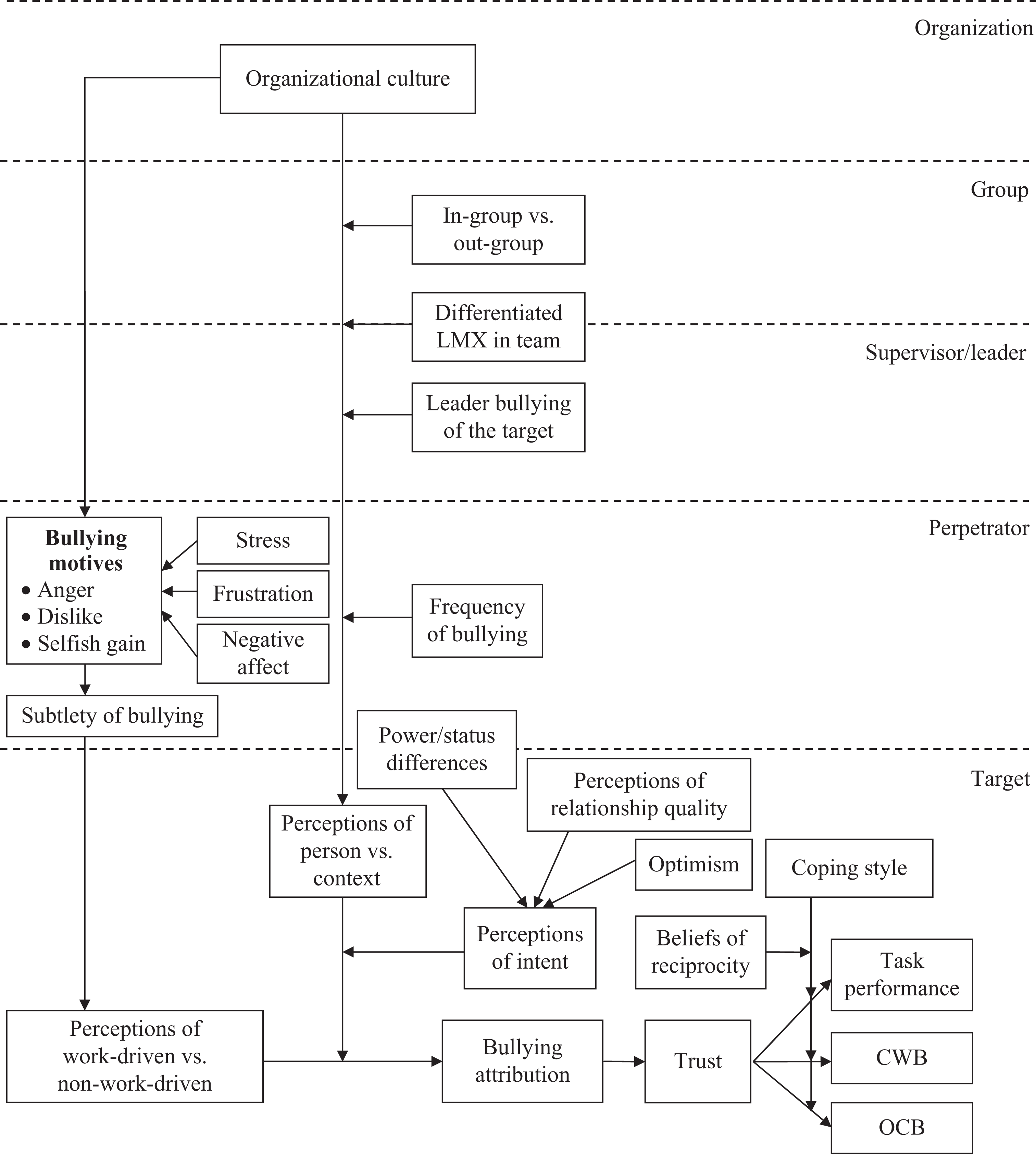
An attributional model of workplace bullying.
Bullying motives and its predictors
Employees who engage in bullying behavior may have one or more possible motives that drive their actions. Based on our review of the literature, we posit three key motives underlying bullying behavior: anger, personal dislike, and selfish gain. First, anger is reflected as an interpersonal emotion directed at one or more other individuals and can escalate into forms of aggression such as bullying (Douglas et al., 2008). Second, researchers have found that an employee’s personal dislike toward a coworker can trigger bullying behavior (Strandmark & Hallberg, 2007). Indeed, bullying behavior enables employees to act upon their personal dislike toward a coworker. Finally, selfish gain represents a third possible motive. For example, supervisors may use bullying behavior toward one or more employees in order to increase their performance through fear and intimidation (e.g., Liefooghe & Davey, 2001). Therefore, we posit that anger, personal dislike, and selfish gain represent three key bullying motives.
We believe that four important predictors of these three bullying motives can be identified. First, the organizational culture may encourage aggressive or self-interest-based behaviors (Bulutlar & Unler Oz, 2009; Salin, 2003). Such cultures may normalize anger or dislike toward coworkers and/or promote selfish gain. For example, research has found that self-interest-based climates are associated with increased bullying behavior (Bulutlar & Unler Oz, 2009). Second, stress may produce feelings of anger, dislike, and/or selfish gain. Research has found that employees who experience greater stress may cope by releasing it onto others through emotional reactivity (e.g., anger, dislike) in the form of bullying behavior (e.g., Baillien, de Cuyper, & de Witte, 2011). Third, similarly to stress, employees may cope with feelings of frustration by converting these emotions into anger, dislike, or selfish gain. Fourth, negative affect may produce feelings of anger, dislike, and/or intentions of selfish gain. Reviews have found that negative affect is among the strongest predictors of bullying behavior (e.g., Aquino & Thau, 2009; Einarsen et al., 2003). Negative affect reflects one’s tendency to experience negative emotions, which include anger (Watson, Clark, & Tellegen, 1988). While emotions such as stress and frustration may result in unconscious one-off acts such as aggression or violence, we believe that once these are channeled into regular, repeated, and persistent negative behaviors through interpersonal motives of anger, dislike, and/or selfish gain, such behaviors become conscious to the perpetrator. As a result, such behaviors would then constitute bullying.
The influence of perpetrator motives on bullying subtlety
The motives of the perpetrator will likely play an important role in shaping the form of the bullying behavior. Earlier, we identified three bullying motives: anger, dislike, and selfish gain. These motives vary in the extent to which the perpetrator possesses negative feelings toward the target (e.g., anger, dislike) versus an attempt to fulfill their self-interest (e.g., selfish gain). When based on the latter, the perpetrator may be more calculated and manipulative in order to achieve his/her desired goals (Spector, 2011). This may be done to avoid identification and punishment by others, which may otherwise compromise his/her desired goals. This increased caution will tend to take the form of subtle behaviors, which are more difficult to identify for others (Hoel & Beale, 2006; Parzefall & Salin, 2010).
Since anger and dislike involve greater emotion targeted at another employee, these motives may be associated with less caution. This is because such emotions cause greater emotional reactivity from perpetrators (Yang & Diefendorff, 2009). While we argue that anger and dislike become conscious to the perpetrator when the behaviors are exhibited regularly, repeatedly, and persistently, these two motives nonetheless blend some degree of emotion with action. Furthermore, the concept of affect management (Dalal, Lam, Weiss, Welch, & Hulin, 2009) explains perpetrator behavior as being performed to cope with one’s emotions. Such behavior allows perpetrators to restore balance in their emotions (Dalal et al., 2009). Therefore, when perpetrator motives stem from anger or dislike rather than selfish gain, they will tend to be less calculative in their behaviors, which will result in greater variance in the form of bullying perpetrated.
The role of subtlety on target perceptions about the nature of the behaviors
Subtle bullying behavior entails an important challenge for targets. On the one hand, targets who experience subtle bullying find it difficult to identify the perpetrator’s intent (Hoel et al., 2010). On the other hand, coworkers tend to be skeptical and question targets’ suspicion that the perpetrator has negative intent toward the target (Lutgen-Sandvik, 2006). Moreover, skepticism from coworkers can provoke targets to reconsider their initial suspicions (Lutgen-Sandvik, 2006).
Researchers have suggested that targets may vary in the extent to which they perceive bullying behavior to be work-driven (Bulutlar & Unler Oz, 2009; Liefooghe & Davey, 2001). Because it is difficult to identify and detect, subtle bullying behavior may more likely result in targets perceiving the behaviors to be work-driven than nonsubtle bullying behavior (Parzefall & Salin, 2010). While subtle bullying behavior causes confusion among targets, nonsubtle bullying behavior is overt and explicit. As a result, nonsubtle bullying behavior will tend to be easier to identify and detect for both targets and observers, which will result in greater certainty that the behavior is non-work-driven (Strandmark & Hallberg, 2007).
Work-driven versus non-work-driven perceptions and person versus context attributions
Parzefall and Salin (2010) argue that bullying that is blurred with work requirements may be particularly difficult to recognize. Several qualitative studies have also reported that when targets experience work-driven forms of bullying, the attributions they make can vary significantly. Indeed, perceptions that the behaviors are work-driven will likely result in the target attaching work-related motives to the perpetrator. In contrast, targets who perceive that the bullying is non-work-driven will tend to make attributions of a personal nature. This is particularly likely when the forms that the bullying takes are not subtle, which suggests important indirect effects of subtlety. When targets perceive that the bullying behavior is non-work-driven, they tend to personalize their experiences (Strandmark & Hallberg, 2007). Therefore, bullying behavior that is perceived to be non-work-driven by the target will more often result in attributions that reflect personal attacks and humiliation, while work-driven perceptions will produce attributions that reflect work requirements. These attributions can be further distinguished based on whether the target perceives the person (e.g., Leck & Galperin, 2006) or the context (e.g., Liefooghe & Davey, 2001) as the source of the behavior.
Person versus context perceptions: Kelley’s covar-iation model of attributions
Studies in workplace bullying have revealed that targets may often attach responsibility to the work environment for bullying behaviors (D’Cruz & Noronha, 2010, 2011). For example, researchers found that targets who were bullied at work through constant threats to employment, excessive work demands, and persistent monitoring felt that the organization was the bully (Liefooghe & Davey, 2001). More specifically, targets in this study claimed that they did not feel bullied at an interpersonal level; rather, they felt that the environment was the driver. Conversely, researchers have also found several cases in which the target identified a specific perpetrator of the bullying acts (e.g., Leck & Galperin, 2006; Strandmark & Hallberg, 2007). Therefore, target perceptions about whether the perpetrator is the person or the context can further delineate target attributions. Before discussing perceived intent, we outline key predictors of person versus context perceptions using Kelley’s (1967) covariation model of attributions.
Kelley’s (1967) covariation model consists of three key informational features that may help predict person versus context attributions: consensus, consistency, and distinctiveness. Consensus refers to the extent to which the behavior can be compared to other behaviors within the context. In relation to workplace bullying, high consensus would suggest that bullying is common in the organization; thus, organizational culture may represent a predictor of consensus. Consistency refers to the extent to which the behavior is repeatedly observed over time. In relation to workplace bullying, high consistency suggests that the bullying is frequent and repeatedly experienced. Hence, frequency of the bullying behavior can predict consistency. Finally, distinctiveness refers to the extent to which the behavior compares with behaviors displayed by other individuals. High distinctiveness would suggest that bullying or related behaviors are not exhibited by individuals other than the perpetrator. Differentiated leader–member exchange (LMX) status, leader bullying, and in-group versus out-group status can predict distinctiveness.
According to Kelley’s covariation model, the three features of consensus, consistency, and distinctiveness predict whether an individual makes attributions internal or external to the person. Since bullying attributions involve and are influenced by perceptions about who the perpetrator is (e.g., D’Cruz & Noronha, 2010; Leck & Galperin, 2006; Liefooghe & Davey, 2001), we adapt Kelley’s model to suggest that these three informational features will help predict whether targets perceive the person or the context as the driver of the bullying. Consistent with Kelley’s model, we predict that high consensus and high consistency will result in context-based attributions. Similarly, we predict that low consensus and high consistency will result in person-based attributions. However, in the context of workplace bullying, we predict that low distinctiveness will result in context-based attributions, while high distinctiveness will result in person-based attributions. We discuss these in more detail below.
Consensus (organizational culture)
Kelley’s (1967) covariation model suggests that consensus information represents a central predictor of the role that individuals attribute to the context. When very similar behaviors are prevalent in a particular context, individuals tend to attribute a greater role to the context as a driver of the behavior (Kelly, 1967). Furthermore, when bullying behavior is common in the organization, there tends to be an increased blurring of appropriate versus inappropriate behavior (Bulutlar & Unler Oz, 2009; Salin, 2003). Moreover, in organizations in which bullying behavior is common, such behavior can become normalized in the eyes of employees (cf. Ashforth & Anand, 2003; Salin, 2003).
When bullying behavior becomes viewed as a normal aspect of everyday work, the responsibility for the bullying behavior becomes diffused across several organizational members (Detert, Trevino, & Sweitzer, 2008), which leads to increased difficulty in identifying a sole perpetrator (see Liefooghe & Davey, 2001). In such cases, researchers have found that employees tend to make attributions about the intensive or masculine work environment (e.g., Collinson, 1988; D’Cruz & Noronha, 2010, 2011). Therefore, when bullying behavior is common in an organization (i.e., high consensus), employees will tend to make context-based attributions.
Consistency (frequency of bullying behavior)
When bullying behavior is highly frequent, employees have greater opportunity to observe and identify the behavior. As mentioned earlier, frequency is a key feature of bullying behavior. Nevertheless, similar to behaviors that are common across the organization, highly frequent bullying may lead to the normalization of the behavior for employees. High consistency can predict person-driven perceptions when consensus is low and context-based perceptions when consensus is high. When bullying behavior is common in an organization (i.e., high consensus), the frequency (i.e., consistency) with which a target experiences the behavior may further normalize the behavior for the target.
When bullying behavior is not common within an organization—suggesting the increased potential for person-based attributions—the target may increasingly identify the actual perpetrator as the driver of the bullying when he/she frequently experiences the behavior. This is because the bullying will tend to stand out relative to other behaviors within the organization. Greater frequency of bullying will result in increased exposure to the behavior for the target, which will allow him/her greater opportunity to identify that the behavior is inconsistent with those practiced more regularly in the organization.
Distinctiveness (differentiated LMX, leader bullying, and in-group/out-group status)
The third feature that can help predict person versus context attributions is distinctiveness, which can be reflected by leader bullying behavior toward the target, differentiated LMX, and in-group versus out-group status of the target. Differentiated LMX refers to the variance in subordinates’ perceptions about their LMX status with their leader relative to others’ LMX status (Henderson, Liden, Glibkowski, & Chaudhry, 2009). More specifically, differentiated LMX speaks to the differential treatment by the leader of his/her subordinates (Boies & Howell, 2006). Differentiated LMX spans across multiple levels since it includes comparisons across group members (group-level) and may examine agreement between leader and subordinate LMX relationships (Henderson et al., 2009).
Distinctiveness suggests that the perpetrator’s behaviors toward the target are distinct (or different) from those that the target experiences from other individuals. In particular, when targets have a good working relationship with both their leader (supervisor) and other group members, bullying from the perpetrator will have high salience despite whether the organizational culture encourages such behaviors. Since distinctiveness captures a comparison between behaviors from multiple sources, we use differentiated LMX since it also reflects differentiated treatment from the leader to his/her subordinates. We also use leader bullying of the target since it captures whether targets are experiencing bullying from their leader, which can make other bullying they experience less salient (and less distinct). Finally, in-group versus out-group status reflects whether the target belongs to the in-group versus the out-group (measured according to group member reports), with in-group status more likely suggesting high distinctiveness of bullying behavior from a perpetrator than out-group status.
While Kelley’s covariation model (1967) suggests that high distinctiveness results in an increased likelihood of context-based attributions, we expect the opposite in the context of bullying behavior. When targets do not experience bullying from their leader, and are members of the in-group, they will more likely identify that the bullying they experience is driven by the person rather than the context even when the organizational culture may encourage bullying behavior. Moreover, when there is little differentiation in LMX status across group members, they will also be more likely to recognize the perpetrator as the bully. This is because the target will more easily identify that this behavior differs from other behaviors that he/she is otherwise normally exposed to. In other words, the treatment from the perpetrator will significantly differ from the treatment by others when (a) the target does not experience bullying from his/her leader, (b) there is low differentiated LMX within the team, and (c) when the target has in-group (rather than out-group) status.
In contrast, when targets experience negative behaviors from their supervisor (leader bullying and high differentiated LMX status of a low quality) and group members (out-group status), the bullying behavior may become blurred relative to other behaviors they are generally exposed to (Collinson, 1988; Liefooghe & Davey, 2001). Differentiated LMX of a low quality suggests that the target may feel singled out by the leader, which fairness theory (Folger & Cropanzano, 1998) suggests will result in the target viewing negative behavior as particularly unfair (Duffy, Ganster, Shaw, Johnson, & Pagon, 2006). When a target who reports differentiated LMX of a low quality is also bullied by one or more peers, the target may blame the context as opposed to any single employee as the perpetrator. Leader bullying behavior suggests that targets experience negative exchanges with their leader, while out-group status suggests that the target is excluded from the inner circle of employees. In such cases, employees may more regularly experience negative behaviors making bullying less distinct. This can reduce the likelihood that targets identify any single perpetrator and instead attribute the behaviors to their context (in this case, an unpleasant environment).
Perceptions of intent and bullying attributions
Attributions about bullying behavior will tend to also be shaped by the target’s perceptions of the perpetrator’s intent (Hershcovis, 2011). Because bullying behavior can vary in subtlety (Fox & Stallworth, 2005), and may be blurred with work requirements (Parzefall & Salin, 2010), there may be a variety of ways in which the target may interpret the intent underlying these behaviors. Interestingly, researchers have hinted at the possibility of positive interpretations of both bullying as well as other negative behavior experienced by targets (e.g., Baillien et al., 2009; Furst & Cable, 2008). For example, excessive workloads by a supervisor (included as a form of bullying in Fox & Stallworth, 2005; Lutgen-Sandvik et al., 2007) may be viewed by some as developmental and thus positive (Furst & Cable, 2008), while viewed negatively by others (Strandmark & Hallberg, 2007). Hence, target perceptions of perpetrator intent can range from positive to negative. We believe that targets’ perceptions about the perpetrator’s intent will likely be shaped by three key constructs: power/status differences, perceptions of relationship quality with the perpetrator, and targets’ optimism.
Power/status differences between the target and perpetrator
The perpetrator’s hierarchical status relative to the target will likely play a role in shaping the latter’s attribution. To explain, a target may interpret criticism about his/her work differently when the source of the criticism is a supervisor as opposed to a group member. Interestingly, recent empirical research supports the potential for employees to falsely presume positive motives underlying supervisors’ negative acts (e.g., Furst & Cable, 2008; Shapiro, Boss, Salas, Tangirala, & Glinow, 2011). To illustrate, subordinates are more likely to accept negative behaviors from their leaders and ascribe positive intentions to them (Furst & Cable, 2008). Moreover, even when leaders transgress codes of interpersonal conduct they are often given more latitude by subordinates without punitive evaluations (Shapiro et al., 2011). Notably, researchers have suggested that employees may often attribute coercive behaviors and threats from supervisors as “well-intentioned” and “justified” (Furst & Cable, 2008, p. 454). Thus, the likelihood that targets perceive positive intent underlying a perpetrator’s bullying behavior is higher when the perpetrator has greater hierarchical power/status than the target.
Perceptions of relationship quality with the perpetr-ator
Targets’ perceptions about their relationship quality with the perpetrator may also play a role in shaping their perceptions of the perpetrator’s intent. For example, target perceptions about their quality of relationship with the perpetrator may influence how he/she perceives assignments and criticism from the perpetrator (see Ragins, Cotton, & Miller, 2000). In particular, targets who believe that they have a high-quality relationship with the perpetrator will tend to have less suspicion of bullying when experiencing negative behaviors because they will tend to doubt that the perpetrator would harm them (Brower, Schoorman, & Tan, 2000).
Interestingly, research has revealed the strong potential for incongruent perceptions about the relationship quality between subordinates and their supervisor, which may similarly exist among group members. More specifically, reports of congruity on the relationship between supervisors and subordinates have often been weak to modest (e.g., Cogliser, Schriesheim, Scandura, & Gardner, 2009; Gerstner & Day, 1997). In addition, recent research suggests that abusive relationships can exist even in situations in which subordinates perceive a high-quality relationship between themselves and their supervisor (Lian, Ferris, & Brown, 2012). Similar findings have also been found in nonwork relationships whereby otherwise supportive relationships with a spouse, siblings, and parents can consist of negative interpersonal behaviors (Berscheid & Regan, 2005). Therefore, incongruent perceptions of relationship quality can exist among employees, which can shape the attributions they make about bullying behavior.
Optimism
Researchers have found that an employee’s level of optimism can result in significantly different perceptions and interpretations of an event (Briones, Tabernero, & Arenas, 2007; Munyon, Hochwarter, Perrewe, & Ferris, 2010). Using persistent criticism as an example of bullying behavior (see Lutgen-Sandvik et al., 2007), targets who have high levels of optimism may more likely interpret the criticism as intended to help them learn their work more effectively. Hence, targets with high optimism will view the criticism as developmental. Conversely, targets who have low levels of optimism are more likely to view the criticism in a negative light. Hence, a perpetrator with negative intent may provide the same persistent criticism to two employees and both of these targets may view the criticism differently based on their level of optimism (Munyon et al., 2010).
Target attributions about bullying behavior
Table 1 illustrates the interaction between the predictors of attributions discussed thus far (i.e., work-driven vs. non-work-driven perceptions, person vs. context, and perceptions of perpetrator intent). Each interaction produces a distinct attribution, resulting in six attributions.
A typology of target attributions about workplace bullying.

Developmental attributions
A developmental attribution can be defined as an interaction between perceptions by the target that the bullying behaviors are work-driven, are positively intended, and are driven by the person rather than work context. When a target makes a developmental attribution, he/she fails to recognize the negative underlying intent of the perpetrator. Instead, the target interprets the perpetrator’s motives to be positive. To illustrate, while a perpetrator may intentionally overwork an employee because of an underlying dislike or selfish gain, the target might attribute the perpetrator’s bullying (e.g., excessive workload) as a demonstration of trust in his/her abilities. Alternatively, the target may attribute a very high workload as an indication of the perpetrator’s intention to test his/her ability for advancement. Moreover, a perpetrator who wants to increase his/her own performance might intentionally manipulate a subordinate into working extra hours by providing an implicit, but false, expectation of promotion. This is most likely to occur when the target perceives the behavior to be work-driven, person-driven, and to carry positive intent.
Opportunistic attributions
In contrast, perceived work-driven bullying may also be conceptualized negatively. An “opportunistic” attribution can be defined as perceptions that the behaviors of the perpetrator are work-driven with negative perceived motives, while being driven by the person (perpetrator). When a target makes an opportunistic attribution, he/she recognizes the actual negative intent of the perpetrator. Strandmark and Hallberg (2007) found that targets who experienced excessive work demands sometimes perceived the perpetrator to be intentionally bullying them through work due to the success and competence that the target has demonstrated. In other words, some targets perceived that perpetrators felt threatened by them and thus engaged in bullying to weaken them and avoid criticism and competition themselves. Moreover, some targets perceived that the perpetrator engaged in work-driven forms of bullying because the perpetrator felt that the target is vulnerable and can be taken advantage of (Strandmark & Hallberg, 2007). Thus, when targets perceive the behavior to be work-driven, person-driven, and carry negative intent, they will make attributions that reflect the perpetrator’s opportunistic actions.
Challenging work culture attributions
Challenging work culture attributions refer to perceptions that the bullying is work-driven, context-driven, and associated with positive perpetrator motives. In such cases, the target does not recognize the negative intent underlying the perpetrator’s behaviors. For example, targets may perceive the behavior as an organizationally driven call to positively challenge employees. Excessive workloads may be perceived as developmental for all employees and beneficial for their career growth. Moreover, the perceived intent underlying strong criticism of their work is viewed as developmental. Because bullying perpetrators have negative intent, they may manipulate employees into working extra hours to increase their own performance metrics (Liefooghe & Davey, 2001). Alternatively, perpetrators may overwork their team of employees because of an underlying dislike of certain popular team members (D’Cruz & Noronha, 2010), but rationalize such behaviors as developmental to avoid punishment. These examples entail a “challenging work culture” attribution whereby targets attribute the work-related bullying positively and embedded in the organizational culture.
Harmful work culture attributions
Harmful work culture attributions refer to perceptions that the behaviors are work-driven, context-driven (e.g., organizational culture), and with the target ascribing negative intent to the perpetrator. For instance, one target stated, “Employees mean nothing—they are the workhorses. And all that talk [about professionalism] was to get us to work more” (D’Cruz & Noronha, 2010, p. 113). While this quote demonstrates that the target perceived the received behaviors to be work-driven, the underlying motives were perceived negatively. While demanding work cultures can be attributed in various ways, Agervold (2009) found that several employees reported victimization in work cultures characterized by high performance demands and work pressures. This account from a call center employee reflects this attribution: “it’s (bullying) not really individually bullying. I don’t ever feel bullied on a one-to-one it’s more the environment… we have to work within strict confines” (Liefooghe & Davey, 2001, p. 381). While this employee does not feel individually bullied, he/she nonetheless specifically attributed the behaviors as bullying but ascribed a central role to the context.
Personal attack attributions
A personal attack attribution can be defined as a target’s perception that the bullying is non-work-driven, person-driven, and carries negative intent. This may include perceived attacks to the target’s social identity or group (e.g., sex, race/ethnicity). The following account reveals a personal attack attribution in which the target reported that the perpetrator: “Shift(ed) the chair out of my room which was comfortable to some hard rock thing that was a back creaser, lots and lots of things that were very much indicative of making my life more and more uncomfortable” (S. E. Lewis, 2006, p. 125). Because of the increased ease of identifying non-work-driven bullying acts as bullying (Leymann, 1996), the perceived intent of the perpetrator can be more clearly identified as malicious (i.e., negative). Personal attack attributions can be distinguished from opportunistic attributions in that the latter always include some intertwinement with work behaviors, which will cloud the bullying to varying degrees for the target. Whereas, personal attack attributions involve behaviors that are clearly distinct from work-related behaviors, making the bullying behavior more accurately interpreted.
Culture of humiliation attributions
Culture of humiliation attributions involve perceptions that the behaviors are non-work-driven, context-driven, and are shaped by negative intent. Salin (2003) cites examples in which jokes and “funny surprises” become an accepted feature of an organizational culture and are perceived to have no relevance to the actual work of the individual or organization. Other scholars have also reported this type of organizational culture in their research (e.g., Baillien et al., 2009; Collinson, 1988). Such behaviors can easily be distinguished from perceived work-driven bullying because these acts focus on offending or humiliating the targeted person (e.g., rumors, jokes) and are based on personal factors; thus, making these behaviors more easily detectable as bullying. A culture of humiliation attribution suggests that bullying is perceived to be an inherent feature of the organization. Therefore, while targets become aware that they are being bullied, they attribute the behaviors to the context.
Bullying attributions and target trust
The attribution that targets make will tend to influence their level of trust in the perpetrator. When targets make developmental attributions, they may feel positively distinguished by the perpetrator. For instance, an employee who is receiving significantly more tasks from a supervisor in comparison to his/her colleagues may perceive that the supervisor trusts in his/her abilities more so than others. Similarly, when targets make challenging work culture attributions, they may feel increased trust toward the work culture’s intent to develop their skills and provide opportunities for advancement. Targets who conceptualize high workloads as a signal of trust may also reciprocate with increased trust in the perpetrator. Similarly, targets who receive persistent criticism of their work may perceive the underlying motives of the perpetrator positively and believe that the criticism is aimed at developing their abilities (Furst & Cable, 2008). These attributions will likely produce feelings of increased trust in the perpetrator.
In contrast, when targets make attributions that reflect negative intent on the part of the perpetrator (opportunistic, harmful work culture, personal attack, or culture of humiliation attributions), they will tend to feel less trust toward the perpetrator (Strandmark & Hallberg, 2007). This is because targets who make such attributions will likely feel that the perpetrator does not have their best interests in mind. Instead, when targets make attributions that reflect perceptions of negative intent, such attributions ascribe self-interest and/or malice to the perpetrator (Bulutlar & Unler Oz, 2009). Researchers have found that targets become uncertain and fearful about future treatment from the perpetrator (Lutgen-Sandvik, 2006; Strandmark & Hallberg, 2007), which reflect reduced levels of trust.
Proposition 13a: When targets make developmental or challenging work culture attributions, they will develop increased trust toward the perpetrator.
Target trust and target performance: The moderating role of coping style
Research has revealed that increased trust toward others leads to higher performance (Salamon & Robinson, 2008). Consistent with prior research, trust may influence various forms of performance such as task performance (Salamon & Robinson, 2008), organizational citizenship behaviors (Liden, Sparrowe, & Wayne, 1997), and counterproductive workplace behaviors (Cohen-Charash & Mueller, 2007). Within the context of workplace bullying, we expect attributions about bullying behavior to produce important indirect effects on these varying forms of performance. A key moderating construct can help explain the expected effects: coping style.
Target coping style
While targets who do not recognize the perpetrator’s negative intent, and make positive attributions about the behavior (developmental or challenging work culture), will likely increase performance, targets who recognize the negative intent of the perpetrator may also increase performance under certain circumstances. Hence, even when targets recognize the negative intent underlying the bullying behavior, their coping style may help explain their response in terms of performance. To illustrate, research on coping behaviors reveals that individuals may use “positive thinking” in response to workplace stressors (Havlovic & Keenan, 1991; Rotondo, Carlson, & Kincaid, 2003). This behavior enables individuals to “exercise great control to manage their cognitions in an optimistic fashion” (Rotondo et al., 2003, p. 278).
Employees may also actively manipulate their interpretations of their work environment, which directs their thoughts in a more positive direction (Hochwarter & Thompson, 2012). For example, this can result in the mentality of “whatever doesn’t kill you only makes you stronger.” The target may also actively cope with the bullying behavior by increasing work efforts and motivation to get ahead and out from under the supervision or range of the perpetrator. Such motivation to get away from the perpetrator can also result in greater caution against engaging in both individual and organization-directed counterproductive workplace behavior (CWB). Possible punishment for engaging in CWB may be viewed as potentially threatening the target’s opportunity to advance in the organization, which suggests fewer opportunities to get away from the perpetrator.
Finally, targets who use positive thinking as a coping mechanism may also attempt to build a stronger network with others (e.g., group members). Individuals desire a sense of belongingness (Baumeister & Leary, 1995), which can be threatened by bullying behavior (Strandmark & Hallberg, 2007). Hence, targets may seek belongingness from other group members to compensate for the treatment from the perpetrator, which can be developed through organizational citizenship behavior (OCB) directed at these group members. Certain group members may also view OCB with the target as a form of uniting against the perpetrator. Therefore, although the target reduces his/her level of trust in the perpetrator, he/she may increase task performance, decrease CWB, and increase OCB when using “positive thinking” to cope with the bullying behavior.
Nevertheless, targets will less likely increase task performance, decrease CWB, and increase OCB when they have strong beliefs of reciprocity. When employees recognize that they have been bullied, they may view the organization as responsible for the bullying and attach blame for not protecting them. Strong beliefs of reciprocity may tempt targets to engage in revenge behaviors toward both the perpetrator and the organization. Consistent with social exchange theory (Blau, 1964), revenge will be particularly likely when targets hold high beliefs of reciprocity. Social exchange theory posits that unspecified exchanges occur between parties and are characterized by the reciprocity of behaviors, which suggests that one party will reciprocate based on the behaviors received from another (Cropanzano & Mitchell, 2005). Research suggests that social exchange theory can be applied to exchanges that are both positive and negative (Mitchell & Ambrose, 2007).
Hence, although targets may cope with the bullying behavior in positive ways because of their desire to get away from the range of the perpetrator, high beliefs of reciprocity may induce reluctance to increase task performance, decrease CWB, and increase OCB. This is because individuals who hold strong beliefs of reciprocity will feel that negative behaviors should be reciprocated with negative (not positive) behaviors (Eisenberger, Lynch, Aselage, & Rohdieck, 2004). Such targets will not want to see the perpetrator benefit from the bullying; rather, they will desire retribution.
Discussion
Our application of attribution theory represents the first attempt to develop a full attributional model of workplace bullying. To begin, we integrated target accounts of bullying to advance a new definition of workplace bullying. In doing so, we built on and extended the current definition by describing the discrepancy between its current conceptualizations and recent findings in the workplace bullying literature. Based on this new perspective, we developed an attributional model integrating perpetrator motives, target perceptions, contextual features and predictors, target attributions, and varying forms of performance.
We theorized that the influence of workplace bullying on various forms of performance will depend on targets’ attributional processes. These attributional processes are shaped by several key contextual factors that span across multiple levels within the organization. Moreover, perceptions about the nature of the act (i.e., work-driven or non-work-driven), the underlying intent of the perpetrator, and the source of the bullying (i.e., person or context), which is influenced by bullying frequency, leader bullying, differentiated LMX, in-group versus out-group status, and organizational culture, play important roles in shaping target attributions. We proposed a nuanced typology of targets’ bullying attributions, which influence their level of trust in the perpetrator and three forms of performance: task performance, CWB, and OCB. We believe that this typology advances our understanding of the vastly different ways in which bullying may be interpreted and construed by targets. In particular, this typology reflects recent findings that report targets’ misattribution about bullying behavior.
The theoretical model developed in this paper offers an important framework for future research that may seek to test a number of important processes, such as the role of perpetrator motives in shaping bullying behavior, the key contextual factors that shape target perceptions and interpretations, the varied types of attributions that bullying targets may make, the role of individual differences that influence targets’ cognitive processes, and the wide range of performance outcomes that may paradoxically range from decreased to increased performance of targets. Our approach draws from social psychology and emphasizes the importance of understanding the role of attributions in explaining meaningful workplace outcomes. In the following sections, we discuss methodological and measurement issues, theoretical contributions and directions for future research, and we conclude with implications for policy and practice.
Methodological and measurement issues
A new definition of workplace bullying would require changes to the way in which the construct is measured. First, measures of workplace bullying should be reframed to reflect perpetrator self-reports (see Greenberg & Barling, 1999). In order to simultaneously capture target attributions, researchers may use designs that mirror social network analysis or sociometric analysis (e.g., Coyne et al., 2004). In such designs, employees would report whether they have engaged in bullying behavior (and whether they believe they have been subjected to such behavior) toward each group member/subordinate respectively. This would address research questions related to target attributions. Conversely, researchers may sample based on dyads of peers (or subordinates/supervisors) with measures for perpetrating and being exposed to bullying. This would address calls for more dyadic research in this area (Aquino & Lamertz, 2004). For measuring subtlety, few studies have investigated and captured the effects of subtlety. Nevertheless, some research using factor analyses has reported and tested subsets within the workplace bullying scale that reflect differences in the level of subtlety (as well as work-driven vs. non-work-driven; e.g., Bulutlar & Unler Oz, 2009). Finally, several measures of organizational culture can be used, such as ethical climate (Victor & Cullen, 1988) or perceived sanctions against deviant behaviors (Greenberg & Barling, 1999).
Theoretical contributions and directions for future research
This paper makes a number of key theoretical contributions to the workplace bullying literature. First, we integrate recent findings from target reports to build on the current definition of workplace bullying. In our definition, we contend that workplace bullying involves negative intent from the perpetrator, which suggests several new directions for workplace bullying research. In particular, more work is needed to identify the range of perpetrator motives. While we offer three key motives found in the literature, we believe future research should further investigate why employees engage in bullying behaviors. In addition, future research should also build on our exploration of key predictors of these motives (e.g., personality, context, and so on). For example, what types of practices and policies (e.g., reward systems) can deter or prompt these motives? What other individual differences may explain perpetrator motives?
Second, there have been calls for research that integrates attributions into the workplace victimization and bullying literatures (e.g., Hershcovis & Barling, 2010; Parzefall & Salin, 2010). We extend attribution theory to the workplace bullying literature by developing a theoretical model revealing the predictors, types, and consequences of bullying attributions. In doing so, we draw upon the extant literature to develop a typology that reflects considerable variance in possible target attributions. Our theoretical model also provides a framework for understanding the vast range of factors that shape a target’s attributions. We encourage future research to test the theorized relationships posited in our model. Moreover, researchers may examine attributional processes of other actors including perpetrators and third parties such as group members, leaders, customers, and clients. While we contend that there must be intent to harm on behalf of perpetrators, they may attribute the causes underlying their behaviors differently. This also suggests the possibility of investigating perpetrators’ cognitive processes and mechanisms of rationalizing their behaviors. Furthermore, future research should investigate targets’ attributions about bullying that attacks their social identity or group, and how their reactions may vary from attributions through which they do not associate a social group.
Third, we drew upon social exchange theory and research on coping to understand instances in which targets may increase performance even when they recognize the perpetrator’s negative intent. Hence, not only may targets increase trust in the perpetrator when making attributions that ascribe positive intent to the perpetrator, but also targets who ascribe negative intent to the perpetrator may paradoxically increase task performance, OCB, and decrease CWB when coping with bullying by using positive thinking and when they have low beliefs of reciprocity. Future research should examine these outcomes at and across multiple levels. For example, when bullying behavior occurs across different teams, the bullying may stimulate increased OCB and cohesion within the bullied team as an attempt to unite against the perpetrating team. Conversely, when bullying occurs within teams, researchers should investigate how reactions to bullying behavior from the target and other group members change the in-group/out-group dynamics.
Implications for policy and practice
The varied range of attributions that targets may make about bullying behavior bears a number of implications for organizations. Our perspective on workplace bullying further reinforces that such behavior can be difficult to detect. While we have described certain instances in which bullying behavior may result in increased trust and/or performance, we cannot ignore the instances in which bullying will result in decreased trust and performance. When targets attribute positive intent to the perpetrator’s bullying behavior, we theorized that the perpetrator may be bullying based on selfish gain and manipulation. Hence, human resources (HR) leaders and organizational managers will tend to find these behaviors undesirable (despite the instances in which it can increase target performance) because of the adverse consequences it can have on organizational culture. We believe that managers should provide attributional training through which targets and observers can increase their likelihood of identifying bullying behavior when it occurs. Training should focus on appropriate versus inappropriate behaviors to help targets identify when they are being taken advantage of. Training should also build a culture of caring and respect to make bullying behaviors more salient to targets who experience them. Organizations should also increase policies and sanctions against bullying behavior to, at the very least, prevent non-work-driven bullying, which often takes less subtle forms.
Conclusion
Workplace bullying has received growing scholarly interest over the past two decades. Nevertheless, research has found that targets interpret and construe bullying behavior in different ways. Prior treatment of the construct has focused on target perceptions as a reflection of whether bullying has occurred. We offer a new perspective on workplace bullying that has important implications for theory, research and measurement, and practice. Moreover, we develop and present a theoretical model of bullying attributions. This model reveals key motives that may be driving perpetrator bullying behavior, contextual factors that shape employee perceptions and attributions of the bullying, and varying outcomes related to trust and performance. We believe that this model sets a solid foundation for future research in the workplace bullying area and offers several directions that build upon our attributional model.