




Abstract
Cyberloafing, the intentional use of the Internet for personal purposes during class hours, has received the scholars' attention due to the increased access to digital devices in educational settings. Considering the possible negative consequences of misuse of the Internet on health and well-being, the current study aims to investigate the underlying mechanisms of this relationship by examining in detail the role of coping strategies. The sample consisted of 272 undergraduate students. The participants were asked to fill out items measuring cyberloafing behaviors, coping strategies (emotion-focused and problem-focused), and psychological symptoms (depression, anxiety, anger, and somatization). The results revealed that cyberloafing is positively related to psychological symptoms. Furthermore, it is observed that cyberloafing moderates the relationship between emotion-focused coping and psychological symptoms such that at high levels of cyberloafing, emotion-focused coping is associated with higher levels of psychological symptoms. These findings contribute to the existing literature on students’ psychological well-being in terms of highlighting its relation with coping strategies and problematic Internet use.
With the technological advances in the last few decades, the Internet has become available in all aspects of daily life. Even though it has many benefits for individuals, it is a double-edged sword with its drawbacks. For instance, employees may voluntarily use this technology for non-work-related tasks during work hours (Y. Jeong et al., 2020), which in turn leads to decreased productivity and increased costs in organizations. Accordingly, scholars have introduced the term ‘cyberloafing’(Lim, 2002), also known as ‘cyberslacking’ (Garrett & Danziger, 2008a; Kim & Byrne, 2011; Taneja et al., 2015; Vitak et al., 2011) as one of the counterproductive behaviors in a work setting, and have primarily investigated the antecedents, consequences, and management of cyberloafing behaviors among employees (Mercado et al., 2017; Metin-Orta & Güngör, 2018; Sampat & Basu, 2017). Broadening this term to the field of education, scholars have also focused on students' misuse of the Internet during class, and conducted a large number of studies on non-academic internet use in academic settings through addressing different terms such as “off-task multitasking” (Wood et al., 2011), “off-task media use” (le Roux & Parry, 2017a; Parry & le Roux, 2018; Parry et al., 20120), “media multitasking” (Aagaard, 2015; van Der Schuur et al., 2015), “laptop multitasking” (Kraushaar & Novak, 2010; Sana et al., 2013), “off-task smartphone use” (Abramova et al., 2017), and “in-class smartphone/social media use” (Flanigan & Babchuk, 2015; Kuznekoff & Titsworth, 2013).
As smartphones are ubiquitous in today's world, teenagers and young adults have permanent access to the Internet anywhere and anytime (Y. J. Jeong et al., 2019). For instance, a Bradford Networks 2013 study has revealed that students are allowed to bring along their smartphones and use them in 89% of the universities in the USA and the UK, and in 44% of elementary and high schools (O'Bannon et al., 2017). Likewise, it is reported that a majority of university students use digital devices including laptops, tablets or smartphones during class time for non-class related purposes and engage in various activities such as texting, emailing, social media use and web surfing (Berry & Westfall, 2015; Junco, 2012; Roberts & Rees, 2014). This leads to higher rates of diminished attention, missing instruction and lecture notes, and lower grades among students (Berry & Westfall, 2015; Flanigan & Babchuk, 2015; Jacobsen & Forste, 2011; McCoy, 2013; van Der Schuur et al., 2015).
Earlier studies (Barry et al., 2017; Becker et al., 2013; Hinsch & Sheldon, 2013; Kross et al., 2013; Meier et al., 2016; Rosen et al., 2013; Vannucci et al., 2017) also demonstrate consistent links between students’ Internet use and their psychological well-being. For instance, cross-sectional and longitudinal research examining the relationship between the use of social networking sites (SNSs) and well-being among students has shown that SNS use is negatively associated with students' academic and overall well-being (Hinsch & Sheldon, 2013; Kross et al., 2013; Meier et al., 2016). Furthermore, previous research has revealed associations between media multitasking and lower emotional well-being indicated by more symptoms of depression and higher social anxiety (Becker et al., 2013). It is particularly argued that media-induced task switching and low cognitive control over switching behavior impair students' performance and well-being (Rosen et al., 2013, van Der Schuur et al., 2015). Thus, given the availability of digital devices and detrimental outcomes of the Internet use on students' academic performance and psychological well-being, it should be the primary concern of researchers to systematically investigate the factors influencing the misuse of the Internet in educational settings.
Even though there is a large number of published studies extensively investigating non-academic Internet use among students with respect to its determinants (le Roux & Parry, 2017a; Parry & le Roux, 2018) and consequences (Aagaard, 2015; Abramova, et al., 2017; Burak, 2012; Flanigan & Babchuk, 2015; Foster, 2008; Fried, 2008; Kraushaar & Novak, 2010; Kuznekoff & Titsworth, 2013; le Roux & Parry, 2017b; Sana et al., 2013; van Der Schuur et al., 2015), little is known about the role students' Internet use plays in moderating coping abilities. To our best knowledge, it has not yet been investigated whether non-academic Internet use buffers or enhances one's ability to cope with stress in influencing psychological functioning. In this regard, the current study proposes that students’ cyberloafing behavior, defined as their voluntary use of the Internet and other technologies during scheduled class time for non-class related purposes (Gerow et al., 2010), influences the way coping mechanisms affect psychological symptoms.
Coping, in general, refers to the management of a stressful situation (Lazarus & Folkman, 1984). In doing so, people use two basic coping strategies, namely problem-focused coping (PFC) that involves attempts to change the situation, and emotion-focused coping (EFC) that involves alleviating the negative emotions caused by stress (Lazarus & Folkman, 1984). Scholars have demonstrated that the use of PFC is associated with better well-being while the use of EFC is associated with worse (Mayordomo-Rodriguez et al., 2015; Sinha & Watson, 2007). From the stress and coping perspective, the psychological symptom level is usually treated as an outcome variable; that is, the predictors of well-being and psychological symptoms are investigated in relation to stress levels and coping strategies. Psychological symptoms are multidimensional distress signs in terms of physiological, emotional, cognitive, and behavioral aspects (Derogatis, 1977). The most common of such symptoms include anxiety and depression (Kring et al., 2014). However, it does not always have to be part of a psychopathological diagnosis, in other words, the level of symptoms may increase during stressful periods (Adams et al., 2016). Moreover, having psychological symptoms is a complex experience with changes in physiological, cognitive, and emotional aspects. For example, different types of symptoms such as depressive symptoms and physical problems may overlap. The scope of this study is not a prediction of diagnosis, rather an overall indication of well-being in relation to coping. Thus, the current study examines the coping strategies used for stressors faced during university years as predictors and the level of psychological symptoms as an outcome variable.
There is a small body of literature that is concerned with cyberloafing behaviors in relation to job stress and coping in a work setting (Andel et al., 2019; Henle & Blanchard, 2008; Koay et al., 2017; Varghese & Barber, 2017). In these studies, it is argued that coping plays an important role in the relationship between stress and well-being, and that the misuse of the Internet at work may be related to employees’ emotion-focused coping strategies (Henle & Blanchard, 2008). Andel et al. (2019) examined the coping function of cyberloafing in the presence of a workplace stressor, namely aggression. They revealed that cyberloafing moderated the relationship between exposure to aggression and turnover intentions and job satisfaction. Thus, cyberloafing can sometimes provide a break from the stressful work environment. Similarly, Pindek et al. (2018) suggested a coping function of cyberloafing in the context of work underload and boredom. Although previous research has provided a link between coping and cyberloafing, it does not quite address how the use of coping strategies (emotion-and problem-focused) may interact with cyberloafing behaviors in predicting psychological well-being. Thus, considering cyberloafing as a problematic internet use (Kim & Byrne, 2011), it can be argued that cyberloafing behavior interacts with students’ use of coping strategies (emotion-and problem-focused) in predicting psychological symptoms. As a result, the investigation of these relationships may help scholars to better understand the antecedents of psychological health among students, and thus, contribute to the development of preventive interventions.
Cyberloafing behaviors at work
The term ‘cyberloafing’ was first introduced in a work setting (Lim, 2002) and proposed to include non-work related Internet-based activities such as instant messaging, checking one’s personal email, visiting sport, news and entertainment sites, online shopping, gaming and gambling, and downloading music (Lim, 2002; Vitak et al., 2011). Lim (2002) proposed two forms of cyberloafing behaviors as ‘browsing’ (e.g., surfing non-work sites) and ‘e-mailing’ activities (e.g., checking, sending or receiving non-work related e-mails). Additionally, Blanchard and Henle (2008) identified two types of cyberloafing behaviors as ‘minor' (e.g., e-mailing, surfing news or sports sites) and ‘serious' (e.g., online gambling, surfing adult web sites).
Several theoretical frameworks have been put forward to understand the nature and antecedents of cyberloafing in a work setting. Firstly, organizational justice and neutralization were proposed as underlying mechanisms for misuse of the Internet in the workplace (Lim, 2002). When individuals perceive their organizations distributively, procedurally and interactionally unjust, their tendency to cyberloaf is facilitated through neutralization techniques. These techniques rationalize “their deviant behaviors as justifiable and/or excusable” (Lim, 2002, p. 679). Secondly, Baumeister's ego-depletion models of self-regulation which assumes that “all acts of self-regulation draw upon a common pool of resources” (Baumeister et al., 2000; Wagner et al., 2012, p. 1069) was put forward to explain cyberloafing. According to this model, when individuals engage in episodes of self-regulation, they consume their limited but renewable resources. The depletion of self-regulatory resources, in turn, increases cyberloafing behaviors (Wagner et al., 2012). Yet, some scholars (e.g., Hagger et al., 2016) question the strength or existence of the ego-depletion effect; that is, the findings of a meta-analysis demonstrate small effect sizes for the ego-depletion effect across 23 participating laboratories (Hagger et al., 2016). Therefore, the issue of ego-depletion remains controversial among scholars. Thirdly, drawing upon the theory of planned behavior (Fishbein & Ajzen, 1975), subjective social norms, attitudes and perceived behavioral control were suggested as antecedents of cyberloafing behaviors (Askew et al., 2014).
In general, cyberloafing is considered as workplace production deviance (Lim, 2002; Lim & Teo, 2005) as any behavior involving misuse of the Internet leads to uncompleted work demands and reduced productivity among employees (Lim & Chen, 2012). For instance, empirical studies have shown that cyberloafing behaviors engaged in for deviant purposes increase work stress (Özkalp & Yıldız, 2018), and emailing activities, which bring about distraction, decrease positive affect (Lim & Chen, 2012) among employees. Other researchers have suggested the benefits of engaging in cyberloafing on individual's well-being and work performance. More specifically, giving periodic breaks from work may help employees to recharge their energy, refocus their attention on work demands, cope with personal problems and work stress, and thus, increase their performance, productivity and satisfaction at work (Lim & Chen, 2012; Özkalp & Yıldız, 2018; Page, 2015). It is particularly argued that cyberloafing behaviors emerge as a coping strategy against workplace stressors (Henle & Blanchard, 2008; Koay et al., 2017; Varghese & Barber, 2017). For instance, empirical studies have revealed that cyberloafing behaviors engaged in for personal development decrease work stress (Özkalp & Yıldız, 2018), and browsing activities which allow for relief from work increase positive affect (Lim & Chen, 2012) among employees. Against this backdrop, a controversy exists over whether cyberloafing has beneficial and/or detrimental consequences. Thus, more research is needed for a better understanding of its impact on an individual's well-being and performance.
Cyberloafing behaviors in educational settings
With the prevalence of digital technologies like laptops, tablets or smartphones among students and ease of access to the Internet, cyberloafing has become popular in educational settings, too. Considerable research has documented the positive and negative effects of in-class Internet use on students' classroom learning and academic performance. In some studies, scholars emphasize the benefits of using digital devices in class such as increasing students’ class participation, facilitating faculty-student interaction and active exploratory learning (Barak et al., 2006; George et al., 2013; Karataş, 2018; Kong & Song, 2015; Stephens et al., 2012). In other studies, however, scholars lay stress upon its negative impact on students' classroom learning, attention, and academic grades (Aagaard, 2015; Abramova, et al.,2017; Chen & Yan, 2016; Flanigan & Babchuk, 2015; Foster, 2008; Fried, 2008; Kraushaar & Novak, 2010; Kuznekoff & Titsworth, 2013; Lam & Tong, 2012; Ravizza et al., 2014; Sana et al., 2013; van Der Schuur et al., 2015; Wood et al., 2011). In particular, an extensive body of research provides supporting evidence that students’ in-class Internet use is associated with less ability to concentrate and attend to the material being covered during the lecture (Fried, 2008; Wei et al., 2012), less comprehension and recall of the course material (Fried, 2008; Gaudreau et al., 2014; Kraushaar & Novak, 2010; Sana et al., 2013; Wood et al., 2011), and lower academic grades (Burak, 2012; Ellis et al., 2010; Junco, 2012; Kraushaar & Novak, 2010; Kuznekoff & Titsworth, 2013; le Roux & Parry, 2017b; Ravizza et al., 2014; Sana et al., 2013; Wood et al., 2011).
It is primarily argued that multitasking with digital technologies, particularly media multitasking defined as “using multiple forms of media simultaneously or using media while performing non-media activity” (Parry et al., 2020, p.261), may account for negative outcomes on academic performance (Aagaard, 2015). As multitasking is cognitively demanding, the irrelevant use of technological devices during lecture may negatively influence visual and auditory attention (Abramova et al., 2017), and cause overload and distraction among students (Lam & Tong, 2012). Apart from this, attention theories suggest that excessive sources of information (e.g., pop-ups, instant messages) may create cognitive overload, which in turn causes attentional shifts and distraction when new information comes in (Roda & Thomas, 2006). Scholars have also proposed that media multitasking takes up one’s capacity for information processing (Chen & Yan, 2016) and encode information into memory (Junco, 2012), thus hindering learning process.
Supporting these arguments, empirical studies has demonstrated that when participants were asked to perform a task, for example reading a text while engaging in media multitasking such as simultaneously answering messages or watching videos, there was a significant decline in their academic performance (van Der Schuur et al., 2015). In particular, it was found that social media use while attending to academic tasks is negatively associated with retainment of information, and academic achievement, while positively associated with the amount of time spent on completing tasks (Flanigan & Babchuk, 2015). Similarly, previous research reveals that students’ active use of smartphones (e.g., texting or posting) during lecture is associated with less note-taking, less recall of information, and diminished performance in academic tests (Kuznekoff & Titsworth, 2013). Thus, the findings of empirical research overall demonstrate that in-class internet use has detrimental effects on students' cognitive abilities and academic achievement.
The subjective and situational determinants of non-academic internet use within educational settings have also been investigated by scholars (le Roux & Parry, 2017a; Parry & le Roux, 2018). In these studies, researchers have particularly explored behavioral beliefs, norms, motivators of students' off-task media use (le Roux & Parry, 2017a), and identified several factors including norms, policies, fear of missing out, grit, control over technology, quality of lecture and visibility of peers' Internet use as determinants of off-task media use during class (Parry & le Roux, 2018).
On the other hand, a growing body of research has addressed demographic variables and individual factors in cyberloafing behaviors (Akgün, 2020; Baturay & Toker, 2015; Durak, 2020; Saritepeci, 2019), academic antecedents and consequences of cyberloafing behaviors (Akgün, 2020; Durak, 2020; R. Yılmaz & Yurdugül, 2018; Wu et al., 2018) and cyberloafing intentions within educational settings (Taneja et al., 2015). The findings show that males, higher-grade students, advanced and frequent users, and those having more Internet experience tend to cyberloaf more than females, lower-grade students, novice and less frequent users, and those having less Internet experience (Baturay & Toker, 2015). Likewise, recent studies demonstrate that students' cyberloafing behaviors are positively correlated with their information technology usage experience and daily usage (Akgün, 2020; Durak, 2020; Saritepeci, 2019). Furthermore, consistent with theory of planned behavior (Fishbein & Ajzen, 1975), it was revealed that students' intentions to cyberloaf in class are predicted by their attitudes toward cyberloafing, subjective and descriptive norms, and perceived behavioral control (Taneja et al., 2015). In addition, cyberloafing attitudes are positively related to student consumerism (students’ perception of learning as a service to purchase), escapism (students’ desire to escape from the class due to disinterest), and lack of attention; while negatively related to cyberloafing anxiety and distraction by others’ cyberloafing behaviors (Taneja et al., 2015).
The aforementioned studies mostly examine cyberloafing behaviors in terms of individual differences, and academic antecedents and outcomes. Yet, the literature pertaining to the psychological consequences of these behaviors is rather limited. The majority of empirical studies address the effect of the Internet use, in particular, social networking on mental health (see Metin-Orta & Çelik-Örücü, 2019 for a review). In these studies, researchers have shown that procrastination with social media leads to academic stress and SNS-induced strains thus, indicating detrimental impact on students' academic and overall well-being (Hinsch & Sheldon, 2013; Meier et al., 2016). Furthermore, it is demonstrated that frequent checking of social media accounts is related to loneliness (Barry et al., 2017), while spending more time in social media is associated with increased anxiety (Vannucci et al., 2017), depression (Rosen et al., 2013), negative affectivity, and lower satisfaction with life (Kross et al., 2013). Based on the findings in the relevant literature, the following hypothesis was generated:
Hypothesis 1: Cyberloafing relates positively to the level of psychological symptoms, including depression, anxiety, anger, and somatization.
Coping with stress and psychological well-being
Stress is described as a person-environment relationship, in which the stress source can be environmental, personal or interactional (Lazarus & Folkman, 1984). If an individual assesses a situation as a threat to the well-being and exceeding own resources, s/he uses coping mechanisms to manage this unpleasant negative situation. In the Transactional Model of Stress and Coping, Lazarus and Folkman (1984) defined coping as a process of managing the demands of a stressful situation, and identified two basic coping strategies, namely problem-focused coping (PFC) and emotion-focused coping (EFC). PFC includes approaching the problem, trying to change the situation, or solve the problem. For example, asking for consultation, information gathering and making plans are some PFC strategies. EFC, on the other hand, includes avoiding the problem or alleviating the negative emotions or distress caused by stress (Lazarus & Folkman, 1984). Ignoring the problem, self-blaming, or distraction are some EFC examples.
The use of PFC and EFC are related to the perceived controllability of the situation In other words; PFC is more often preferred in high-control appraisal, whereas EFC is more often used in low-control appraisal (Folkman & Moskowitz, 2004). This relationship between the controllability of the situation and coping strategy is referred to as the goodness-of-fit (Conway & Terry, 1992). For example, Eatough and Chang (2018) found that when high control appraisal and PFC are used together, they give better results in terms of dealing with conflict with supervisors at the workplace. On the other hand, when low-control appraisal is combined with EFC, the result was more adaptive for the workers. Thus, in controllable situations, the use of PFC is associated with better outcomes. However, in uncontrollable situations, staying away from negative emotions by using EFC strategies can be more adaptive than trying to solve an uncontrollable problem. After the coping process, the individual evaluates the short term and long term results. The physiological changes, emotions, and evaluation of the outcome are the short term results, whereas health, well-being, and social functioning are the long term results. Accordingly, people evaluate the outcomes of their coping strategies and decide how to cope in the next encounter. Put differently, they people learn how to cope with stressful situations over time, upon which the use of coping mechanisms gradually become automatic.
While examining the relationship between coping with stress and psychological well-being, it is of crucial importance to address university years since it can be considered as a transition period to adult life (Towbes & Cohen, 1996) involving various stressful life events such as loss of a loved one, family problems, anxiety about future, financial problems, school performance (e.g., Adams et al., 2016; Macan et al., 1990). These stressful situations are often managed by the use of coping mechanisms, which end up with a number of positive and/or negative outcomes. For example, the stress experienced as a result of an imbalance between efforts for school and rewards in return may result in withdrawal from school for university students, mediated by burnout (Williams et al., 2018). While the use of PFC is associated with better well-being (Sasaki & Yamasaki, 2005), EFC is associated with worse (Mayordomo-Rodriguez et al., 2015). Specifically related to the use of EFC strategies of university students, this tendency is associated with some negative outcomes such as alcohol use (Moeller & Crocker, 2009), low-GPAs (Windle & Windle, 1996), gambling (Lightsey & Hulsey, 2002) and physical health issues (Leitschuh, 1999). Similarly, lower levels of self-esteem and the use of escape-avoidance coping are associated with higher levels of psychological symptoms (Sinha & Watson, 2007). Moreover, depression symptoms, anxiety, and stress-related problems are reported as reasons for seeking therapy for college students (Baptista & Zanon, 2017). Based on the aforementioned findings indicating links between (non)adaptive coping strategies and psychological outcomes, the following hypotheses were generated:
Hypothesis 2a: EFC relates positively to the level of psychological symptoms including depression, anxiety, anger, and somatization.
Hypothesis 2b: PFC relates negatively to the level of psychological symptoms including depression, anxiety, anger, and somatization.
Coping with stress, internet use, and psychological well-being
The research on the Internet use and coping has revealed that non-adaptive coping is associated with problematic internet use (Laconi et al., 2017). Similarly, more hours spent on the Internet is related to more use of tension reduction as a coping style (Vaish et al., 2014). This mechanism includes strategies such as consumption of alcohol for physical relaxation in stressful situations (Sher et al., 2007), similar to EFC in Lazarus and Folkman’s (1984) terms. Moreover, higher levels of anxiety and wishful thinking as coping strategies are associated with more use of the Internet for male students (Hetzel-Riggin & Pritchard, 2011). The relationship between stress and motives for the use of the Internet among college students were investigated by Deatherage et al. (2014). Accordingly, coping motivations such as staying away from problems is positively related to stress, whereas enhancement related motivations such as having fun are negatively related to stress. Similarly, using the Internet for mental disengagement was related to lower levels of life satisfaction (van Ingen et al., 2016). Thus, the relationship between Internet use, stress, and coping processes can be considered as a part of a complex mechanism. In the presence of different stressors, Internet use may function differently; in other words, it may sometimes be regarded as a source of stress, a way of coping, and part of well-being (Demirtepe-Saygılı, 2019). To promote healthy use of the Internet, it is important to reveal its consequences in different stressful contexts. Thus, the current study focuses on a specific type of misuse of internet, i.e. cyberloafing in a specific sample (i.e. undergraduate students). Cyberloafing includes engaging in Internet content unrelated to class activities. From a coping perspective, such behavior may be a form of avoidance. When cyberloafing interacts with a general EFC tendency, it is assumed to have an aggravating effect on psychological symptoms. However, unlike EFC, PFC strategies usually include attempts to approach the problem. Thus, cyberloafing may disrupt the coping process by preventing the individual from addressing the stressful situation. Accordingly, it can be argued that the relationship between coping strategies and psychological symptoms is different among students with high or low levels of cyberloafing. In other words, cyberloafing is expected to moderate the relationship between coping strategies and psychological symptoms.
Considering (a) the links between cyberloafing and stress in work settings, (b) the relationships between stress, coping and psychological well-being, (c) possible stress factors during university years, and (d) the common use of the Internet and smartphones among the university students, the present study proposes possible interaction effects between cyberloafing and coping strategies in predicting psychological well-being in the following hypotheses:
Hypothesis 3a: Cyberloafing moderates the relationship between EFC and psychological symptoms. That is, the positive relationship between EFC and psychological symptoms is stronger at higher levels of cyberloafing.
Hypothesis 3b: Cyberloafing moderates the relationship between PFC and psychological symptoms. That is, the negative relationship between PFC and psychological symptoms is stronger at lower levels of cyberloafing.
Method
Participants and procedure
The data were collected from undergraduates at two universities in Ankara, Turkey. After the exclusion of 3 participants with missing values in more than 5% of the items, the convenience sample consisted of 272 students (176 females, 95 males, 1 not reported). The mean age of the participants was 21.41(SD = 2.21, ranging between 17 and 34). Most of the students were from the faculty of Arts and Sciences (N = 172), followed by Business and Administration (N = 77), and Engineering (N = 20). The sample consisted of 97 freshmen, 61 sophomores, 62 juniors, and 51 seniors (1 not reported). The students’ CGPA scores were asked in 5 categories over 4.00. Accordingly, twenty-four percent of the sample has a CGPA between 2.00 and 2.50 (n = 67), 23% had CGPAs lower than 2.00 (n = 63), 18% were between 2.50-3.00 (n = 50), 13% between 3.00-3.50 (n=35), and 8% between 3.50-4.00 (n = 22). Thirteen percent of the sample consisted of first year-first term students (n=36), with no calculated CGPA scores. The frequencies of daily hours spent on the Internet or mobile technology were as follows: nineteen percent of the sample spent less than 2 hours (n=52) a day, while 56% spent 2-4 hours (n = 152), and 25% spent more than 4 hours a day (n=68) on the internet. Among all the Internet applications used by the participants, the most common ones were YouTube (n = 254, 93%), WhatsApp (n = 255, 93%), and Instagram (n = 209, 77%).
After obtaining the approval of the Ethics Committee, participants filled out a questionnaire comprising scales assessing cyberloafing behaviors, ways of coping, and psychological symptoms. They also reported demographical information (e.g., age, gender, department, university, the year at school, and CGPA) and time spent on the Internet or mobile technology. It took 20 minutes to fill in the paper-pencil questionnaire in class, and extra credit was given to students for their voluntary participation.
Materials
Cyberloafing scale
A 30-item cyberloafing scale was used to measure the degree of cyberloafing behaviors. The scale was developed by Akbulut et al. (2016), and it has five factors: sharing (9 items; e.g., “I check my friends’ posts”), shopping (7 items, e.g., “I shop online”), real-time updating (5 items, e.g., “I retweet the tweets I like”), accessing online content (5 items, e.g., “I download music”) and gaming/gambling (4 items, e.g., “I bet online”). The instruction of the scale aims to measure cyberloafing behaviors in the class context in particular (Akbulut et al., 2016). The respondents indicated the frequency of cyberloafing behaviors they engage during the class hours by using a 5-point scale from 1 (“never”) to 5 (“always”). The cyberloafing score is generated by averaging all items, the higher scores indicate greater cyberloafing behaviors in class. In a previous study (Akbulut et al., 2016), the cyberloafing scale yielded adequate reliability and validity in a Turkish sample with internal consistency coefficients of .94 for the total scale, .93 for sharing, .88 for shopping, .94 for real-time updating, .94 for accessing online content and .81 for gaming/gambling. For the present sample, the internal consistency coefficients were .93 for the total scale, .92 for sharing subscale, .83 for shopping subscale, .65 for real-time updating subscale, .92 for accessing online content subscale and .83 for gaming/gambling subscale.
Ways of coping inventory
This inventory was developed by Folkman and Lazarus (1980) and adapted to Turkish by Siva (1991). The current study used PFC (e.g. “I try to make a decision after I evaluate the event”) and EFC subscales (e.g. “I try to forget what happened”), whose internal consistency reliabilities were .90, and .88, respectively (Gençöz et al., 2006). For the present sample, the internal consistency reliability was .91 for problem-focused and .82 for emotion-focused coping subscales. As this study aims to investigate cyberloafing in an educational context, the participants were asked to respond considering their university life. As a result, the instructions included the following phrase “… focusing on the problems you face during university years”. The respondents rated each coping statement on a 5-point scale from 1 (does not apply to me) to 5 (very applicable to me). Rather than having a total score, we used average scores for 2 dimensions of coping; higher scores indicate greater use of each dimension.
Brief symptom inventory
It was initially developed by Derogatis (1977) with 90 items, and then it was shortened to 53 items (Derogatis, 1992). It includes a list of physical and psychological symptoms (e.g., “feeling alone”, “hopeless about future”) and physical symptoms experienced as a part of psychological symptoms (e.g. “dizziness”, “numbness”). The scale consists of 5 dimensions; namely, anxiety, depression, negative self, somatization and anger/aggression. For each symptom, the respondents rated their experiences of the last two weeks on a 5-point scale, ranging from 0 (not at all) to 4 (extremely high). A composite score was generated by averaging all items to have a general evaluation of psychological symptoms. Higher mean scores on this checklist indicate experiencing higher levels of psychological symptoms. The reliability coefficients of the subscales ranged between .71 and .85 in the original scale. The short version with 27 items was adapted to Turkish by Şahin et al. (2002). The reliability coefficients of the Turkish version of the subscales ranged between .70 and .88. For the present sample, the internal consistency reliability was .95.
Data analysis
For preliminary analyses, SPSS version 21.0 (IBM Corp., 2012) was used. In order to test the hypotheses that cyberloafing would moderate the relationships of coping styles and psychological symptoms, the PROCESS approach was used (Hayes, 2013), automatically computing the interaction terms and to run the analysis.
A significant interaction term indicates that the relationship between the predictor (coping styles) and the outcome variable (psychological symptoms) changes depending on the level of the moderator (high and low levels of cyberloafing behaviors).
Results
First, the missing cases were replaced with their means. Second, the descriptive statistics and correlations among the study variables were analyzed. The participants, on average, reported lower levels of cyberloafing behaviors (M = 1.92, SD = .73) as compared to university student samples in previous research using the same instrument (e.g., Akbulut et al., 2016, 2017). Similarly, they showed lower levels of psychological symptoms (M = 1.32, SD = .82). Considering their use of coping strategies, the participants reported moderate levels of EFC (M = 2.27, SD = .50) and moderate-to-high levels of PFC (M = 3.42, SD = .59). As shown in Table 1, cyberloafing behaviors were positively correlated with the time spent on the Internet or mobile technology, psychological symptoms, and EFC. However, they were not significantly correlated with the students' age, the year at school, CGPA and PFC. Furthermore, psychological symptoms were negatively correlated with age, the year at school, and PFC, while positively correlated with the time spent on the Internet or mobile technology. Lastly, PFC was negatively correlated with the time spent on the Internet or mobile technology.
Descriptive statistics and correlations among study variables.
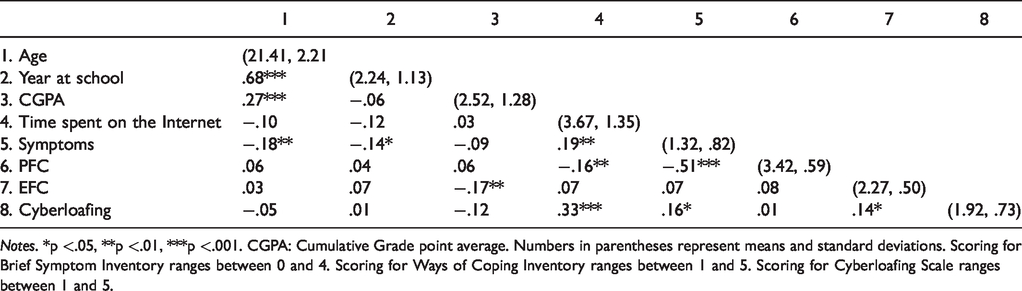
Notes. *p <.05, **p <.01, ***p <.001. CGPA: Cumulative Grade point average. Numbers in parentheses represent means and standard deviations. Scoring for Brief Symptom Inventory ranges between 0 and 4. Scoring for Ways of Coping Inventory ranges between 1 and 5. Scoring for Cyberloafing Scale ranges between 1 and 5.
Third, the gender differences within the study variables were analyzed by independent samples t-test. The results have revealed that there were significant gender differences in cyberloafing behaviors [t(269) = −5.20, p < .001, Cohen’s d = .63] and PFC [t(268) = −3.11, p < .01, Cohen’s d = .41]. That is, males had higher scores on cyberloafing (M = 2.21, SD = .84) than females (M = 1.75, SD = .61). Moreover, males reported more use of PFC (M = 3.56, SD = .49) than females (M = 3.34, SD = .62). However, there were no significant gender differences in EFC [t(268) = .39, p = .70] and psychological symptoms [t(269) = 1.11, p = .27].
Hypotheses testing
In order to test the study hypotheses, two regression analyses were conducted for the main effects of cyberloafing, EFC, and PFC on the psychological symptoms as well as their interaction effects via the PROCESS approach. First, the model testing the effects of cyberloafing and EFC was significant (R = .21, R2 = .04, F(3,267) = 3.89, p < .01). As shown in Table 2, a higher level of cyberloafing behaviors was significantly related to a higher level of psychological symptoms [t(267) = 2.48, p < .01]. However, the main effect of EFC on psychological symptoms was not significant [t(267) = .50, p = .62]; whereas, the moderating effect of cyberloafing on the relationship between EFC and psychological symptoms was significant [t(267) = 2.06, p < .05] (See Table 2).
Moderational model of cyberloafing, EFC, and psychological symptoms.

As shown in Figure 1, when the cyberloafing level was high, EFC was significantly related to higher level of psychological symptoms [t(271) = 2.03, p < .05]. That is, among the students showing higher levels of cyberloafing, psychological symptoms tend to be high at greater use of EFC. However, when the cyberloafing level was low, EFC was not significantly related to psychological symptoms [t(271) = −1.09, p = .28].

Interaction effect of cyberloafing and EFC on psychological symptoms.
Second, the model testing the effects of cyberloafing and PFC was significant (R = .54, R2 = .29, F(3,267) = 37.42, p < .001). Considering the main effects, higher levels of cyberloafing behaviors were related to higher levels of psychological symptoms [t(267) = 3.37, p < .001]. Moreover, higher levels of the use of PFC were related to lower levels of psychological symptoms [t(267) = −10.01, p < .001]. However, the moderating effect of cyberloafing on the relationship between PFC and psychological symptoms was not significant [t(267) = −.38, p = .70].
Discussion
The increased access to digital devices and ease of use among students has attracted the attention of scholars and, accordingly, considerable studies have been conducted to identify the antecedents and consequences of, and individual differences in, cyberloafing behaviors in educational settings (e.g., Baturay & Toker, 2015; Durak, 2020; Wu et al., 2018). The present study adds to previous research by examining undergraduate students’ cyberloafing behaviors in relation to their use of coping strategies and psychological symptoms. In this way, it contributes to the literature by adding this new form of student misbehavior to research on coping and well-being.
The findings of the current study showed that males tend to cyberloaf more than females, in line with previous research (Akbulut et al., 2017; Akgün, 2020; Baturay & Toker, 2015; Dursun et al., 2018; Garrett & Danziger, 2008a; 2008b; Henle & Blanchard, 2008; Lim & Chen, 2012; Vitak et al., 2011; F. G. K. Yılmaz et al., 2015). Earlier studies conducted in various cultures also demonstrated that male students are more likely to use smartphones (Aljomaa et al., 2016), spend more time on information and communication technologies particularly for personal use, and have greater confidence in using the Internet and positive attitudes toward the Internet as compared to females (Li & Kirkup, 2007). Accordingly, the possibility of engaging in cyberloafing behaviors is likely to be higher among males as compared to females, as demonstrated in the present work.
Besides, cyberloafing behaviors were positively correlated with the time spent on the Internet or mobile technology in line with other research (Akgün, 2020; Baturay & Toker, 2015; Durak, 2020; Saritepeci, 2019; F. G. K. Yılmaz et al., 2015). In particular, F. G. K. Yılmaz et al. (2015) have revealed that students who use the Internet for 10 hours or more daily are the ones who show the highest level of cyberloafing in the computer lab; while, those who use the Internet less than one hour daily show the lowest level of cyberloafing. In a related vein, earlier studies have shown higher levels of cyberloafing among individuals with more habitual computer use at the workplace (Garrett & Danziger, 2008a; Vitak et al., 2011). Considering other demographic variables, the findings revealed insignificant correlations between students' cyberloafing behaviors and their age, year at school and CGPAs. Unlike previous findings (Durak, 2020; Dursun et al., 2018; Wu et al., 2018), the students' CGPAs were not correlated with their non-academic internet use in class. This finding is not expected since the use of technological devices in class may cause overload and distraction among students (Fried, 2008; Lam & Tong, 2012), thus influencing their academic performance (Aagard, 2015; Flanigan & Babchuk, 2015; Junco, 2012; Kuznekoff & Titsworth, 2013; le Roux & Parry, 2017b; Ravizza et al., 2014; van Der Schuur et al., 2015). Furthermore, cyberloafing behaviors were not associated with age and grade unlike previous studies (Akgün, 2020; Baturay & Toker, 2015; Garrett & Danziger, 2008a; Ugrin et al., 2007; Vitak et al., 2011).
Supporting the study hypothesis (H1), the findings revealed that cyberloafing is positively related with psychological symptoms among undergraduate students. In the related literature, a number of scholars have focused on health-related variables, such as job or school burnout (Aghaz & Sheikh, 2016; Salmela-Aro et al., 2017) and positive and negative affect (Lim & Chen, 2012) in relation to cyberloafing behaviors. In particular, it was revealed that individuals with higher levels of emotional exhaustion, cynicism and decreased professional efficacy at work show higher levels of cyberloafing behaviors (Aghaz & Sheikh, 2016). Furthermore, school burnout and excessive Internet use (which can be related to cyberloafing) predict each other positively in adolescents longitudinally (Salmela-Aro et al., 2017). Besides, the impact of cyberloafing on emotions differs depending on the type of online activities (Lim & Chen, 2012). More specifically, browsing leads to positive affect, while emailing leads to negative affect. Furthermore, the study findings are consistent with previous research focusing on the effect of social networking on psychological well-being (Rosen et al., 2013; Vannucci et al., 2017).
Considering the second hypotheses (H2a & H2b), the results showed that PFC, and not EFC, was significantly associated with psychological symptoms. In general, previous studies have demonstrated the beneficial effects of PFC and detrimental effects of EFC on well-being (e.g., Mayordomo-Rodriguez et al., 2015; Soderstrom et al., 2000). In particular, scholars argue that PFC becomes more effective in controllable situations (Eatough & Chang, 2018). The students in our sample might have appraised stressors faced during university years as controllable, which might explain the negative relationship between PFC and psychological symptoms.
In accordance with previous research focusing on problematic internet use and coping (e.g. Laconi et al., 2017), cyberloafing moderated the relationship between EFC and psychological symptoms, supporting the study hypothesis (H3a). That is, at high levels of cyberloafing, EFC was associated with higher levels of psychological symptoms. At low levels of cyberloafing, however, EFC was not significantly related to psychological symptoms. Notably, the findings indicate that the moderating role of cyberloafing contributes to the existing literature on problematic internet use and student psychological well-being.
Although the moderation model for PFC and cyberloafing was significant, contrary to our expectations, the interaction effect was not as such. That is, only the main effects which included a negative relationship between PFC and psychological symptoms and a positive relationship between cyberloafing and psychological symptoms were statistically significant. Although cyberloafing was expected to moderate this relationship, the results did not support our hypothesis (H3b). There may be various explanations for these findings. First, as scholars suggest, EFC and PFC are not necessarily the opposite of each other; in contrast, they appear to be independent and an individual can use both strategies together (Skinner et al., 2003; Sideridis, 2006). Second, Internet use can also be regarded as a PFC strategy; that is, people may use the Internet to receive online help or to search for answers and solutions (van Ingen & Matzat, 2018). For instance, in terms of PFC in an educational context, these strategies may include studying, attending classes, and preparing for exams. From a PFC point of view, cyberloafing may distract the student from the task. In order to better understand the relationship between PFC and cyberloafing, an investigation of the antecedents of cyberloafing is needed. That is, cyberloafing due to an inability to understand the content of lectures, boredom, problems with attention or even fear of missing out (Parry & le Roux, 2018) may be related to different stress levels and choice of coping strategies. As shown by prior research, students use both approach-coping and avoidance-coping to deal with academic boredom, which is defined as a negative emotion with a low level of arousal (Tze et al., 2013). Moreover, within the work context, because of a positive relationship between cyberloafing and boredom, cyberloafing was suggested as a boredom coping mechanism (Pindek et al., 2018). Accordingly, it can be argued that as cyberloafing includes off-task behaviors, it may be close to EFC and distant from PFC. Therefore, it is of crucial importance to investigate the underlying mechanisms and motivations of cyberloafing in an educational context.
Practical implications
University years can be regarded as a “late adolescence” (Sprinthall & Collins, 1984) or an “emerging adulthood” (Berk, 2010) period, including developmental tasks in terms of intellectual, moral, sexual or social areas. Internet use has great potential to influence all developmental tasks. Therefore, the misuse of the Internet during this critical period may lead to negative consequences for students. Accordingly, this study has two important practical implications.
First, from an individual perspective, developmental tasks may end up increasing the level of stress and psychological symptoms. For instance, problems with life such as family conflicts and poor academic performance are associated with higher levels of stress (Simonelli-Munoz et al., 2018). However, it does not necessarily result in psychiatric diagnosis (Johnson et al., 1989). The most important thing is how successfully the individual copes with these tasks. As shown by the present study, when EFC interacts with cyberloafing, it may increase the level of psychological symptoms. Therefore, to enhance adaptation and maintain psychological well-being, preventive interventions can be implemented for university students. For example, a recent study tested the effectiveness of resilience and coping intervention (First et al., 2018) with the aim of increasing coping resources and problem-solving. The effectiveness of such interventions including the role of the Internet use needs further investigation.
Second, from a group/societal perspective, it is of crucial importance to manage cyberloafing in class due to its adverse consequences for students. Since students can easily access the Internet through their mobile phones, banning technology or attempts to curb media use inside the classroom to change students' misbehaviors (le Roux & Parry, 2017a) are not effective solutions. Thus, researchers and educators should give priority to finding other ways of minimizing the use of digital devices in class through, for example raising awareness as to the appropriate and ethical use of technology and adopting effective policies (e.g., Berry & Westfall, 2015; Parry et al., 2020). For instance, interventions and policies encouraging class-related technology use and discouraging non-class-related use (Ledbetter & Finn, 2013) may be useful to eliminate misuse of the Internet in an educational setting. Researchers may investigate how potential negative consequences might be transformed into positive ones to enable effective learning (Baturay & Toker, 2015; Taneja et al., 2015).
Limitations and avenues for future research
Several limitations of the current study should be acknowledged. First, the sample consists of undergraduate students, mostly from the faculty of arts and sciences; thus, the results may not be generalizable to broader populations. As suggested by le Roux and Parry (2017b), the relationship between in-class social media use and academic performance can be different in various areas of study. Second, the cross-sectional nature of the study prevents causal interpretations about the relationships among variables. Future studies may examine this relationship longitudinally by assessing the variables over a period of time. Similarly, when the complex nature of stress and well-being is considered, students may experience many stressful situations besides school. Thus, stress, coping, and well-being investigation in different contexts would provide a better understanding. Third, it relies on self-reports, thus increasing the possibility of social desirability bias. Since the data was collected during class hours through the face-to-face method, the students might underreport their cyberloafing behaviors due to concerns for anonymity and confidentiality of their responses. Earlier work indicates a small relationship between cyberloafing and social desirability bias in online surveys (Akbulut et al., 2017). Thus, in future cyberloafing research, scholars may prefer online surveys.
Another interesting avenue for future research is to explore the characteristics of the educational context such as in-class activities, type of course material, teaching style of the instructor (e.g., Parry & le Roux, 2018; R. Yılmaz & Yurdagül, 2018); and the characteristics of the student such as personality traits, self-regulation, attitude towards and interest in the course (e.g. Flowerday & Shell, 2015; R. Yılmaz & Yurdagül, 2018), level of student motivation and participation (e.g., Flanigan & Babchuk, 2015; Parry & le Roux, 2018) which may be related to cyberloafing.
Conclusion
The current study overall suggests a negative consequence of cyberloafing for psychological health among undergraduate students. More importantly, it highlights the interaction effect between two risk factors on diminished psychological well-being. In this sense, it contributes to the studies of researchers and practitioners in terms of developing preventive interventions regarding the detrimental effects of cyberloafing and EFC. Considering the increase of the Internet use and the availability of digital devices among students, it is crucial to investigate cyberloafing in educational settings.
Footnotes
Author Biographies
Declaration of Conflicting Interests
The author(s) declared no potential conflicts of interest with respect to the research, authorship, and/or publication of this article.
Funding
The author(s) received no financial support for the research, authorship, and/or publication of this article.
