



Abstract
Individuals’ tendency to use their interactions with others in the management of their own emotions is called Interpersonal Emotion Regulation (IER). Limited studies have explored the association between IER and psychological distress with none focusing on the role of mediating variables in this relationship. The current study aims to explore the role of negative mood regulation expectancies (NMRE), which is defined as one’s confidence in the effectiveness of their coping skills while dealing with difficult emotions, as a possible mechanism underlying the association between IER and psychological distress. The data were collected from 204 (164 women) Turkish speaking individuals whose age ranges between 18 and 32 (M = 22.78, SD = 3.21). The participants completed measures of IER, NMRE and psychological distress. The results have indicated that NMRE has a significant mediating role in the relationship of Soothing dimension of IER with psychological distress. The present findings highlighted the maladaptive function of Soothing as an IER strategy in addition to shedding light on the important role of NMRE in this relationship.
Introduction
Emotion regulation (ER) is an umbrella term that covers all internal and external processes that allow us to modify, monitor, and evaluate both the intensity and the temporal features of our emotional reactions while also taking contextual demands into account (Thompson, 1994). Thus, ER includes social, behavioural, cognitive, biological, controlled, and uncontrolled automatic processes (Aldao et al., 2016; Garnefski et al., 2001). ER involves both intrapersonal (managing emotions by oneself) and interpersonal (managing emotions by making use of others) regulatory processes (Thompson & Calkins, 1996). Although strategies used in the intrapersonal ER process had been frequently examined by existing studies (Dixon-Gordon et al., 2018), its interpersonal aspects that involve using other people with ER purposes had been overlooked by many contemporary ER theories (Hofmann, 2014).
Hofmann et al. (2016) recently introduced a new model of interpersonal emotion regulation (IER) that emphasizes the role of social interactions in ER. IER model focuses on how individuals use others to alleviate their distress or negative emotional state. It is important to note that IER model assumes that individuals utilize others to regulate their emotions without conscious or deliberate effort. Hofmann et al. (2016) have conceptualized IER as a construct consisting of four distinct strategies: “Enhancing Positive Affect,” “Perspective Taking,” “Soothing,” and “Social Modeling.” Enhancing Positive Affect involves approaching other people to intensify feelings of happiness and pleasure when one is feeling elated, which makes it an ER strategy that aims to change the emotional state of the others. In contrast, Perspective Taking involves getting the opinion of others when one is experiencing distressing emotions. Similarly, Soothing is described as seeking out sympathy, compassion, and comfort from others. Lastly, Social Modeling refers to looking at others to understand how they deal with a given situation with the purpose of imitating that pattern when necessary (Hofmann et al., 2016). The IER strategies other than Enhancing Positive Affect are more concerned with what one is feeling, and how that emotion is regulated through the utilization of already existing interpersonal relationships.
The initial work on this model revealed that the habit of regularly using interpersonal ER strategies is associated with higher levels of general ER difficulty, in addition to depression and anxiety (Hofmann et al., 2016). This pattern is especially present for Perspective Taking, Soothing, and Social Modeling dimensions, which are ER strategies that aim to regulate the negative mood. The same pattern was not observed for Enhancing Positive Affect. Instead, Enhancing Positive Affect was reported as inversely associated with depression and anxiety, which may be due to its adaptive ER function (Altan-Atalay & Saritas-Atalar, 2019; Hofmann et al., 2016). In contrast to Hofmann et al. (2016), more recent studies indicate inconsistent results regarding the association between dimensions of IER and psychological distress. In this regard, while several studies have shown a negative association between Enhancing Positive Affect and depression (Altan-Atalay & Sarıtaş-Atalar, 2019; Koç et al., 2019; Pruessner et al., 2019), others have not reported such a significant association (Gökdağ et al., 2018). Furthermore, a similar inconsistency exists in results on perspective taking. Notably, some studies found a negative correlation between Perspective Taking and depression (Altan-Atalay & Sarıtaş-Atalar, 2019; Koç et al., 2019), but this inverse association was not confirmed in other studies (Gökdağ et al., 2018; Pruessner et al., 2019). However, none of the studies found Social Modeling to have significant associations with dimensions of psychological distress (Altan-Atalay & Sarıtaş-Atalar, 2019; Gökdağ et al., 2018; Koç et al., 2019; Pruessner et al., 2019). Lastly, studies have consistently indicated a weak but positive association between Soothing and dimensions of psychological distress (Altan-Atalay & Sarıtaş-Atalar, 2019; Gökdağ et al., 2018; Koç et al., 2019). Therefore, these mixed findings and the limited number of studies on IER highlight the importance of conducting further research to uncover how these strategies relate to psychological distress.
Hofmann et al. (2016) have suggested that the excessive use of IER strategies prevents individuals from using other adaptive coping mechanisms at times of distress. This may lead to the perception of self as lacking the capacity to cope with difficult situations (Hofmann, 2014). This negative self-image, in turn, can be associated with a proneness for psychological distress, “a state of emotional suffering characterized by symptoms of depression (e.g., lost interest; sadness; hopelessness) and anxiety (e.g., restlessness; feeling tense)” (Drapeau et al., 2011, p. 105). In the current study, psychological distress was conceptualized as a negative emotional state characterized by symptoms of depression, anxiety and stress. In other words, Hofmann et al. (2016) proposed that frequently relying on IER interferes with the development of coping self-efficacy by preventing the individual from developing and practicing with adaptive ER strategies, which, in turn, increases psychological distress. However, this relationship had not been empirically investigated yet.
The mediator role of negative mood regulation expectancies (NMRE)
NMRE, is a type of self-appraisal that has conceptual similarities with coping self-efficacy (Catanzaro, 1993). It can be defined as one's perception of the effectiveness of own coping skills and ER strategies used to alleviate negative affective states (Catanzaro & Mearns, 1990). Individuals with high NMRE are able to cope with their negative emotional states and mitigate their emotional distress through holding optimistic beliefs (Catanzaro, 1993; Catanzaro et al., 2014; Catanzaro & Mearns, 1990; ). High NMRE is associated with better distress tolerance and more frequent use of adaptive coping strategies, and adaptive ER strategies (Catanzaro et al., 2000; Davis et al., 2005; Hamamura & Mearns, 2019; Hemenover et al., 2008), so it is found to be a resilience factor that buffers the negative impact of stressful situations (Kirsch et al., 1990). Moreover, according to Kassel et al. (2007), the preexisting adaptive coping strategies and one’s history of successful ER attempts are closely connected with the development of NMRE, which in turn, acts as a resilience factor. In other words, individuals who over time have successful emotion regulation experiences tend to hold positive expectations about their possibility of effectively regulating their emotions in the future (Silver et al., 1995). However, a similar trend is not observed in individuals who habitually utilize maladaptive or avoidance-based ER strategies. From a similar vein, when individuals habitually use IER strategies, through time, they might fail to raise confidence regarding their own skills for regulating their negative emotions. Thus, they may involuntarily develop the idea that their capacity to regulate their negative emotions by themselves is limited. More specifically, relying habitually on others during negative emotional states may be associated with low trust on their own coping skills since they do not experience positive consequences of their own coping skills. Hence, this might cause elevated feelings of psychological distress during the experience of a difficult problem. In line with these, frequent use of IER strategies is expected to be associated with having low NMRE, which in turn, is associated with psychological distress.
The current study
Although the examination of the association between IER and psychological distress bears significant importance for understanding the mechanisms that are responsible for the maintenance of psychological distress, existing studies have not yet addressed the nature of this association. We explore a model that aims to improve our understanding of IER strategies and their association with psychological distress through NMRE. Previous studies have emphasized that habitually seeking help and support from others at times of distress may impair individuals’ self-confidence regarding their inner sources for coping and ER (Hofmann et al., 2016), thereby increasing psychological distress. Thus, the present study aimed to add to the accumulation of research on the association between IER and psychological distress by investigating the mediator role of NMRE (which is a construct that conceptually overlaps with coping related self-efficacy; Catanzaro, 1993). We hypothesized that the frequent use of IER strategies will be associated with low levels of NMRE, which in turn will be associated with psychological distress after controlling for the variance explained by gender and age. Specifically, relying on others frequently in the regulation of negative emotional states would be associated with the perception of their already existing resources as inadequate, thereby augmenting their levels of psychological distress. Moreover, given that IER is a multidimensional construct, we expect to see differences between various dimensions of IER regarding their associations with NMRE. In particular, this pattern is expected to be less significant in Enhancing Positive Affect when compared with other IER dimensions since EPA is a strategy aiming to increase feelings joy and happiness by approaching to others. On the other hand, this pattern is expected to be strongly significant in Soothing, as it is a strategy aiming to seek reassurance from others at times of distress, which is argued to be associated with psychological distress (Marroquín, 2011).
Method
Participants
Participants were 205 individuals (164 women) with an age range between 18 and 32 (M = 22.78, SD= 3.22). Most of the participants were high school graduates (49.3%), residing in urban parts of Turkey (66.4%). Approximately 87% of the participants were single, and 68.6% of them were currently working.
Questionnaires
Interpersonal Emotion Regulation Questionnaire (IERQ)
IERQ, developed by Hofmann et al. (2016), has 20 items on a 4-Likert-type scale measuring IER strategies of “Enhancing Positive Affect,” “Perspective Taking,” “Soothing,” and “Social Modeling.” The sample items include “It helps me deal with my depressed mood when others point out that things are not as bad as they seem” (Perspective Taking), “Because happiness is contagious, I seek out other people when I am happy” (Enhancing Positive Affect), “I look to others for comfort when I feel upset” (Soothing), “It makes me feel better to learn how others deal with their emotions” (Social Modeling). The Cronbach’s alpha of the scale ranges between .89 and .94 (with Soothing being highest and Enhancing Positive Affect lowest), indicating an adequate level of internal consistency. Furthermore, it has good convergent validity since it shows significant correlations with scales of emotion regulation and coping. Its Turkish translation and standardization were performed by Gökdağ et al. (2018) and it indicates the same factor structures of the original scale, in addition to showing excellent psychometric properties. Turkish form of IERQ has a Cronbach’s alpha of .91 and internal consistencies of subdimensions range between .81 and .89. It also has an adequate convergent validity since it has an association with other emotion regulation scales such as ERQ.
Negative Mood Regulation Expectancies Scale (NMRE)
The NMRE was developed by Catanzaro and Mearns (1990) and is comprised of 30 statements that are based on a 5-Likert-type scale. The items assess one’s belief in their emotional regulation, emotional control and emotional change abilities. The sample items include, “When I am upset, I’ll end up feeling very depressed.” The higher scores on this scale are indicative of more positive beliefs in one’s emotion regulation coping skills. NMRE has an adequate internal consistency (Cronbach’s alpha ranges between .87 and .92) (Davis et al., 2005; Kassel et al., 2007; Kirsch et al., 1990). The Turkish adaptation of the scale, which was performed by Kaymakçıoğlu (2001), was used for the current study. This version has an adequate internal consistency (α = .88) in addition to convergent validity evidence manifest in the correlations of NMRE with scores on scales assessing adaptive coping habits (.48), the intensity of depression (–.46) and anxiety (–.54).
Depression, Anxiety, Stress Scale (DASS)
Lovibond and Lovibond (1995) developed the scale with the aim of evaluating depression, anxiety and distress components of psychological distress in both clinical and non-clinical samples. DASS consists of 42 4-Likert type items and has revealed adequate levels of reliability with internal consistencies ranging from .92 to .97 (Lovibond & Lovibond, 1995). The scale also showed a high correlation with other anxiety and depression scales, indicating adequate construct validity (Antony et al., 1998). Like the original version, the Turkish version of the scale has adequate validity and reliability (Cronbach’s alpha ranges from .89, .82 and .85) (Bilgel & Bayram, 2010).
Procedure
Ethical approval from the Ethics Board of a Turkish University was obtained prior to the data collection process. Participants were recruited through announcements posted on social media platforms (e.g., Twitter). The link was provided on the announcements, and after informed consent, each participant had access to the online questionnaires through Qualtrics software. Most participants completed the survey questions within 20 minutes. Participants were not compensated for their participation.
Results
Basic descriptive information, reliability, and Pearson’s correlations of the key study variables are presented in Table 1. As the table indicates, only Soothing dimension of IER is significantly associated with psychological distress and NMRE. NMRE indicated a negative association with psychological distress.
Descriptive statistics, reliability coefficients, and Pearson’s correlations.

EPA= Enhancing Positive Affect, SM= Social Modeling, S= Soothing, PT= Perspective Taking, NMRE= Negative Mood Regulation Expectancies, DASS = Depression Anxiety Stress Scale.
**p < .01, *p < .05.
Mediation analyses: Role of NMRE
Four different mediation analyses were conducted using PROCESS macro (Model 4) with bootstrapping sample technique proposed by Hayes (2013). Given that the sample consisted of predominantly female participants and included diverse age groups, age and gender were held constant. The results indicated that NMRE mediated the relationship between Soothing dimension of IER and psychological distress. However, we did not find such a pattern for other dimensions of IER (see Table 2). Specifically, the mediation analysis conducted to test if NMRE has a mediator role in the association between Soothing and psychological distress showed that the absolute indirect effect of NMRE was between .23 and 1.15. This indicates that NMRE significantly mediated the relationship between Soothing and psychological distress since the confidence interval did not include zero (B = .68, SE =.23, 95% CI [.23, 1.15], p <.05) (see Table 2).
Direct and indirect effects of IER’s dimensions on psychological distress by NMRE.
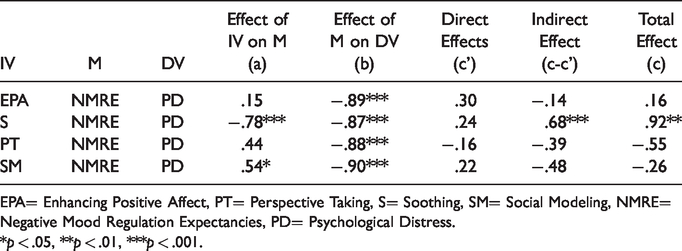
EPA= Enhancing Positive Affect, PT= Perspective Taking, S= Soothing, SM= Social Modeling, NMRE= Negative Mood Regulation Expectancies, PD= Psychological Distress.
*p < .05, **p < .01, ***p < .001.
Discussion
The present study sought to explore the mediating role of NMRE in the relationship of IER with psychological distress. The results have indicated that, among the dimensions of IER, only Soothing has a significant association with NMRE, indicating that individuals who frequently use Soothing as an ER strategy tend to have low levels of NMRE. The results have also revealed that NMRE significantly mediates the relationship of Soothing with psychological distress. Notably, individuals with frequent use of Soothing may be more likely to have low confidence in their coping resources, and subsequently, may show a greater vulnerability for psychological distress. Relying on others at times of distress to receive sympathy and comfort may be related to elevations in psychological distress since these individuals may fail to develop confidence in their skills for the management of negative emotions successfully without the instrumental or emotional help of others. Utilizing Soothing as a major ER strategy may interfere with the development of an awareness of own ER strategies, and thus elevations in the subjectively felt distress following exposure to a threat or in response to the anticipation of a threat. It is also possible that frequent use of IER strategies following failures and losses may prevent such individuals from developing and using successful intra-personal ER strategies, which subsequently makes them vulnerable to psychological distress in the long run.
The current results did not indicate NMRE to be a significant mediator in the association of Enhancing Positive Affect, Perspective Taking and Social Modeling with psychological distress. First of all, different from the other dimensions, Enhancing Positive Affect aims to upregulate others’ emotions rather than own emotions and thus might not have any association with how the individuals evaluate their own resources for ER. Contrarily, both Social Modelling and Perspective Taking are used with the aim of downregulation of negative emotions. However, both have the potential to give the individual an opportunity for the acquisition of certain emotion regulation skills and thus may not be associated with the feeling of being vulnerable at the face of negative emotions, which is a characteristic associated with low NMRE (Catanzaro, 1993).
Inconsistent with the studies that were conducted with Western cultures (Hofmann et al., 2016), the current study also failed to show significant associations between dimensions of IER and psychological stress except for Soothing. The present findings can be interpreted from two different perspectives. First, the current findings may be associated with the nature of the strategies that are assessed in the current study. That is, as Dixon-Gordon et al. (2018) also argued, IER strategies that are investigated within the scope of the current study refer to the regulation of one’s emotion through others without a deliberate effort to do so. In other words, the IER measure does not capture purposeful or explicit help-seeking from others at times of distress purposefully or explicitly. This may explain why the current study did not find significant associations between IER dimensions and psychological stress except for Soothing.
Secondly, culture might have a role in these findings since it influences the adaptiveness of turning to others at times of distress (Hofmann, 2014). Different from the original study, the participants of the current study are of Turkish origin and as Ford and Gross (2019) stated, the meaning and implications of ER strategies may vary depending on the cultural characteristic and in particular the functions and closeness of interpersonal relationships (emphasizing the importance of relational versus autonomous self-construal) (Ford & Gross, 2019; Liddell & Williams, 2019). Specifically, Turkish families put a strong emphasis on emotional dependency and interpersonal closeness (Kagitcibasi, 2007) and individuals’ use of other people (parents in particular) as ER sources for a long time. Moreover, the continuation of the close relationship with others and depending on others at times of stress had been reported to be associated with better outcomes in terms of ER strategies in the Turkish sample (Saritas-Atalar & Altan-Atalay, 2017). In light of these, it can be stated that relying on others at times of distress may not necessarily be maladaptive among Turkish speaking individuals.
It should be noted that the current results indicate that Soothing dimension of IER has a significant relationship with psychological distress, which are in line with studies conducted with Turkish sample (Gökdağ et al., 2018; Koç et al., 2019). This may stem from the maladaptive nature of Soothing as an IER strategy regardless of cultural characteristics. Soothing may take place in the form of reassurance-seeking, and the link between excessive reassurance-seeking and psychopathology (e.g., depression) has been well-documented in previous studies (Dixon-Gordon et al., 2018). Also, Soothing might be considered as a form of explicit social support (e.g., emotional comfort, instrumental aid) since individuals openly seek help from others to alleviate their distress. Studies have indicated that explicit social support aggravates depression in collectivistic cultures since disclosure of negative emotions has the potential to hinder relationships (Taylor et al., 2007).
The current study is exploratory in nature since, to the authors’ knowledge, it is the first to investigate the mechanism through which IER influences psychological distress. Moreover, it also opens a door for cross-cultural explanations for the association between IER and psychological distress since the results are based on a non-western sample and are partially in contradiction with the findings of the only study conducted with a Western sample (Hofmann et al., 2016). Several limitations of the present study should also be noted. Firstly, this study is based on correlational design and self-reported measures, which prevent us from making cause-effect inferences. Secondly, the data was collected from a community sample, which involves some bias regarding the demographic variables, such as access to the internet and education level. Moreover, the data were collected from a relatively small number of individuals. Both of these issues limit the generalizability of the results to the whole Turkish population. Therefore, future studies can utilize separate temporal assessments of the variables for a stronger mediation test (Maric et al., 2012). Also, longitudinal designs can be conducted to understand the developmental trends in IER capacities and clarifying the direction of prediction among measured variables. Furthermore, although we suggested that culture may have a role in current findings, we did not measure the self-construal (relational versus autonomous) of participants. Future studies can investigate the role of self-construal on the association between IER and psychological distress. Next, the results indicate that IER has a low correlation with other study variables. This suggests that other variables (e.g., intrapersonal ER) may also play a crucial role in this relationship. Hence, the examination of the contribution of such factors to the relationship between IER and NMRE is important to understand the nature of IER and its role in the development of vulnerability to psychological disorders. Finally, as the study is the first to explore the mediating role of NMRE on the association between IER and psychological distress, confirmatory studies are needed on this issue.
In conclusion, the findings of this study indicate that NMRE mediated the association only between the Soothing dimension of IER and psychological distress. The findings from the current study contribute to cross-cultural issues in IER. The results may also have important implications for developing intervention methods to treat certain clinical and subclinical forms of psychological distress that are related to relying on maladaptive ER strategies (i.e. Soothing). Notably, providing individuals with alternative coping strategies and enhancing coping self-efficacy (NMRE) may have significant benefits for individuals.
Footnotes
Compliance With Ethical Standards
All procedures performed in studies involving human participants were in accordance with the ethical standards of the Koc University ethical committee and with the 1964 Helsinki Declaration and its later amendments or comparable ethical standards.
Declaration of Conflicting Interests
The author(s) declared no potential conflicts of interest with respect to the research, authorship, and/or publication of this article.
Funding
The author(s) received no financial support for the research, authorship, and/or publication of this article.
