




Abstract
This study explores how resilience mediates the association between peer victimization and mental well-being among left-behind children in the Chinese cultural context, and how gender groups differ in certain path. Data are collected from a random sample of 471 left-behind children from the City of Huai’an in mainland China. Results of this study shows that peer victimization is not only significantly and directly related, but also indirectly associated with children mental well-being through the intermediary mechanism of resilience. The theoretical model is applicable to both male and female left-behind children with no gender difference. The findings provide empirical support for the proposed theoretical framework that resilience plays a crucial mediator in the relationship between peer victimization and children mental well-being. Empirical evidence also shows that interventions focused on anti-bullying and cultivating resilience may be effective to improve children mental well-being.
Introduction
The rapid development and urbanization in China have contributed to a mass migration of rural residents from the countryside to urban areas (Hu et al., 2008; Wen & Lin, 2012). Thus, children were often left in their hometowns with other family caregivers (Ye et al., 2006). Consequently, a new subpopulation of left-behind children has emerged in China (Duan & Zhou, 2005). The All-China Women’s Federation (2013) estimates that the number of left-behind children in China had reached approximately 61.03 million, representing a growth of 2.42 million since 2005. By 2015, left-behind children has reached 68.77 million (National Bureau of Statistics, UNICEF & UNFPA, 2017), which accounted for 25.39% of the entire child population in China (Duan et al., 2017).
Defined as the repetitive and systematic abuse of power by one or more peers during a period in purposive attempts to damage or inflict discomfort (Olweus, 1993), peer victimization mainly includes four dimensions: physical victimization, verbal victimization, social manipulation, and attacks on property (Mynard & Joseph, 2000). Such experiences are widely recognized as a public health concern for children development (Anthony et al., 2010). Until now, a substantial body of empirical research examines outcomes of peer victimization on children mental health (Kaspar, 2013; Moore et al., 2017; Ttofi et al., 2011). However, extant research mainly focuses on negative aspects of mental health such as depression and anxiety, but rarely involve mental well-being (Brunstein Klomek et al., 2019; Copeland et al., 2013; Zhang et al., 2019). Compared with their peers, rural left-behind children were more likely to become targets of peer victimization in school owing to the lack of parental care and nurturance (Otake et al., 2019; Zhao et al., 2015). And when they suffer from bullying victimization, they are more likely to exposed to emotional burdens, which increase the risk of development mental health problems (Zhang et al., 2019). So exploring the underlying mechanism on the relationship between peer victimization and mental well-being is significant for left-behind children to improve their mental health.
Previous findings on the association between peer victimization and children or adolescent mental health are contradictory, indicating both a strong association (Cao et al., 2020; Lebrun-Harris et al., 2019), and weak or even insignificant (Chen & Wei, 2011b; Kim et al., 2006). These inconsistent findings raise the doubt of if any potential psychosocial mechanism explains the links between peer victimization and children’s mental health condition or not (Ye et al., 2016; Zhou et al., 2017). One such mechanism between the two variables is resilience (Salami, 2010; Wu et al., 2018). Some theories and perspectives such as stress process model propose that resilience may play a mediating role in such path (Lee, 2017; Maidaniuc-Chirila, 2015; Pearlin, 1989), but lacks empirical support, especially in the special group of left-behind children in mainland China.
In this context, the present study aims to examine how peer victimization indirectly influences children mental well-being as mediated by resilience using a random sample of left-behind children in Huai’an City, Jiangsu Province in mainland China. Theoretical contributions and practical suggestions are presented to improve the mental well-being of left-behind children.
Literature review
Peer victimization and mental well-being
Several theories propose the adverse influences of peer victimization on children mental well-being. For example, trauma theory (Freud, 2014) proposes that trauma such as experiences of peer victimization can lead to the highest stimulation to children within a short period and bring distress, which negatively affects children mental health and even causes neurosis. In addition, emotion regulation theory (Gratz & Roemer, 2004) posits that being the victims of bullying, or exposure to school violence, serves as the prominent source of stress for children and adolescent psychosocial development. And this stressor can contribute to defect in affect regulation (Cicchetti & Toth, 2005; Repetti et al., 2002), which causes adverse influence on children mental health (McLaughlin et al., 2009).
However, empirical findings on the link between peer victimization and children’s mental health are contradictory. Students who suffered from bullying victimization by school peers are found highly likely to encounter depression, anxiety, suicide ideation and other undesirable mental health symptoms (Cao et al., 2020; Lebrun-Harris et al., 2019). Those adverse effects can even persist into their adulthood (Copeland et al., 2013). However, weak or insignificant relation between peer victimization and children mental health is also found. For instance, Chen and Wei (2011b) found that peer victimization unsuccessfully predicted self-esteem based on a sample of Taiwanese junior high school students. Students’ mental health status was also not directly associated with experiences of peer victimization (Chen & Wei, 2013).
In addition, although a growing body of empirical studies examine the effects of peer victimization on children mental health outcomes (Kaspar, 2013; Moore et al., 2017; Ttofi et al., 2011), the main focus is on negative effects such as anxiety, depression, and suicidal ideation while rarely involves positive aspects such as mental well-being (Brunstein Klomek et al., 2019; Copeland et al., 2013; Stewart-Brown et al., 2009; Zhang et al., 2019). Mental well-being is defined as multiple combinations of positive functioning and feeling (Ryan & Deci, 2001), which is strongly associated with individual mental functioning, life satisfaction, and capability to create and maintain good interpersonal relationships with others (Stewart-Brown & Janmohamed, 2008). It is also recognized to have significant impact on children social development, and even induces new therapies that emphasize on promoting positive mental health (Huppert et al., 2005; Joseph & Linley, 2006; Linley & Harrington, 2005). However, evidence is lacking on the link between peer victimization and children mental well-being in Chinese cultural context. Therefore, this study fills this gap and explores the effects of such relation.
Resilience and mental well-being
Resilience is defined as the ability to successfully spring back, recover and adapt adverse situation, and develop social and academic power to cope with severe stressful circumstance (Hinduja & Patchin, 2017). Individuals with high levels of resilience can flexibly and resourcefully adapt to adverse situations (Chi et al., 2016). Empirical studies provide consistent evidence that resilience is positively related to mental well-being, involving life satisfaction, positive affect, life meaning, and self-acceptance (Di & Palazzeschi, 2015; Gerino et al., 2017; Khawaja et al., 2017; Li & Hasson, 2020; Sagone & Caroli, 2014). Specifically, psychological trait resilience plays an essential role in enhancing self-esteem and life satisfaction among adolescents (Arslan, 2019; Zhao et al., 2020). Individuals with high levels of resilience are also higher likely to enjoy positive affect and emotion than their peers (Wang et al., 2016; Wang et al., 2017). In addition, children’s anxiety and depression can be alleviated by improving their resilience (Liu et al., 2018).
Peer victimization and resilience
Although advocated as a personality trait and represents personality that make people successfully adapt to stressful circumstances (Connor & Davidson, 2003; Tugade & Fredrickson, 2007), resilience is also considered as the product of a complex dynamic process in the adverse situation and interactions between individual and environment (Egeland et al., 1993; Rutter, 1985). That is, resilience can be regarded as a state of being affected by context elements (Zhao et al., 2020), hence providing the rationale of the present study considering resilience as a dynamic process influenced by a noxious environment with peer victimization (Zhou et al., 2017). However, previous empirical findings on the relationship between peer victimization and resilience are disputable. For example, the negative relationship found between peer victimization and children resilience (Liu et al., 2015; Sauer, 2013) indicates that former might undermine the latter among adolescent (Zhou et al., 2017). The opposite conclusion is that peer victimization is positively related to children resilience (Wright et al., 2019), which evolves from confronting and dealing with stressful events (Kaplan, 2006). Thus, with the increase of exposure to peer victimization, children resilience can evolve and improve (Sapouna & Wolke, 2013). Therefore, the association between peer victimization and children’s resilience remains unclear.
Peer victimization, resilience and mental well-being
In summary, the contradictory results on the association between peer victimization and children mental well-being (Chen & Wei, 2011b; Lebrun-Harris et al., 2019) may suggest a potential psychosocial mechanism between the two variables (Ye et al., 2016; Zhou et al., 2017). Resilience has been discussed as an important potential mediating mechanism between peer victimization and children mental health (Salami, 2010; Wu et al., 2018). That is, the pathway from peer victimization to children mental well-being maybe indirect through resilience, which can be explained in two aspects. First, children who suffer from peer victimization are more likely to experience decreasing resilience (Lee, 2017; Maidaniuc-Chirila, 2015). Once their level of resilience drops, they are less able to adapt to adverse situation, which will have a negative impact on their mental well-being (Narayanan & Betts, 2014; Zhou et al., 2017). In addition, the stress process model also proposes that psychological resources such as resilience can serve as mediator linking adverse situation and psychological health condition (Pearlin, 1989). Accordingly, children living in stressful situations characterized by peer victimization are more likely to suffer from decreasing resilience, which in turn undermines children mental well-being (Liu et al., 2015; Ye et al., 2016). However, empirical evidence is lacking to support the indirect path from peer victimization to children mental well-being through resilience, especially in the Chinese cultural context.
Gender difference
Previous studies on peer victimization mainly focused on the different forms between male and female children indicating that boys were more likely to be the targets of overt aggression such as physical victimization, while girls were higher likely to suffer from interpersonal aggression such as spreading rumors (Crick & Grotpeter, 1995; Felix & McMahon, 2006). However, how gender difference influences the impacts of peer victimization on children’s mental well-being is neglected. Girls are regarded as typically preserving value and protecting harmonious interpersonal relationships with others (Block, 1983; Carbone-Lopez et al., 2010), which makes them more sensitive and vulnerable in peer relationships than boys (Ledwell & King, 2015; Navarro et al., 2011). Once their peer relationships encounter considerable threat such as peer victimization (Leadbeater et al., 1999; Rose & Rudolph, 2006), girls are higher likely to encounter mental well-being decreasing than boys. In addition, the different bias of expression of psychological distress can also cause gender difference on the relationship between peer victimization and mental well-being (Gjerde, 1995; Gjerde et al., 1988; Leadbeater et al., 1995). Specifically, stress derived from peer victimization may be reflected in inward emotional responses in girls, but in outward-directed behaviors in boys (Rudolph, 2002). That is, when suffering from peer victimization, girls are higher likely to appear as internalizing problems, such as decreasing mental well-being while boys are higher likely to show externalizing problems, such as aggression and delinquency (Bakker et al., 2010). Thus, experiences of peer victimization may have greater effects on the mental well-being of girls than boys. However, few empirical studies examine gender difference in the influences of peer victimization on children mental well-being, which deserves exploration.
Method
Participants
The data of this study depended on a project that collected information of psycho-social development of children from the City of Huai’an, in Jiangsu Province in mainland China. Totally, 471 left-behind children were extracted from 18 classes of three primary and middle schools of three counties in Huai’an. 243 among them were male and 228 were female. Their mean age was 12 years (SD = 1.808) and ranges from 8 to 16. Table 1 shows the descriptive statistics of the sample.
Sociodemographic characteristics (N = 471).

Procedure
The multi-stage cluster random sampling method was applied in the process of collecting data and carried out as follows. First, three counties were randomly extracted from a list obtained from the Huai’an government. Second, in each county, a primary school and a middle school were randomly extracted. Third, one class in each grade was chosen randomly in each selected school. Considering the limited reading, comprehension, and cognitive abilities of pupils, we only choose grade 4–6 in primary school and grade 7–9 in middle school. At last, based on the method of simple random sampling, 50 students in every selected class were chosen to take part in this investigation. Thus, the overall sample size was expected to be 900.
Before the formal survey, students were asked to confirm their willingness to participate in this investigation, and those who agreed had their parents informed and requested to sign consent forms. Respondents were asked to independently finish the questionnaire by themselves, and were provided with advice in class if they had any questions in the completion process. Altogether, 817 students and their parents agreed to sign the informed consent. Thus, 817 questionnaires were distributed, and 796 were received. Among them 746 was valid samples after checking with effective recovery of 93.7%. On the basis of the definition of left-behind children, the sample of 471 left-behind children was selected from the total population. During this entire process, ethical standards were strictly followed and approval was procured from the Survey and Behavioral Research Ethics Committee.
Measurement
Peer victimization
Peer victimization of left-behind children was assessed using the multidimensional peer-victimization scale, a self-report questionnaire consisting of 16 questions (Mynard & Joseph, 2000). It is a three-point scale with responses ranging from 1 (never) to 3 (more than once), with a higher score reflecting more peer victimization. This scale mainly revels children’s peer victimization in four dimensions including physical victimization, verbal victimization, social manipulation and attacks on property. Each dimension includes four items (e.g., “Punched me”, “Swore at me”“Kick me” “Refused to talk to me” and “Try to destroy my stuff”) . The four item scores were averaged to create a mean score for the four dimensions respectively. The scale has been used in previous studies in China and showed good validity (Fung et al., 2021; Li et al., 2020). The Cronbach’s alpha of the four subscales in this study were 0.885, 0.713, 0.735, 0.708 respectively.
Resilience
To assess the left-behind children’s resilience, we adopted the Children and Youth Resilience Measure (CYRM-28), which was created by Ungar and his colleagues (Ungar et al., 2008). It is a self-report scale that covers three components of resilience including individual resilience, relational resilience and contextual resilience. Individual resilience includes 11 items (e.g., “I can recognize my strengths”) and a mean score was calculated with a higher score indicating a higher level of individual resilience. Relational resilience includes 7 items (e.g., “My parents know me well”) and were averaged to a mean value to represent relational resilience. Contextual resilience includes 10 items (e.g., “I feel a sense of belonging to my school”) and were also taken the average with higher score indicating higher level of contextual resilience (Liebenberg et al., 2012). Each questions has five statements that rated on a scale of “not at all = 1” to “a lot = 5”. The Chinese version of CYRM-28 has been shown good validity in previous studies (Li et al., 2018). The Cronbach's alpha of the three subscales were 0.814, 0.795, 0.751 respectively in this study.
Mental well-being
Left-behind children’s mental well-being was assessed by Warwick-Edinburgh Mental Well-being Scale (Stewart-Brown & Janmohamed, 2008). Each item is worded positively and together they cover most, attributes of mental well-being. The informant answered the following question: “Did you have the following feeling in the past two weeks?” and the scale contained 14 items (e.g., “I’ve been feeling useful”, “I’ve been feeling loved” and “I’ve been feeling cheerful”). It is a five-point scale answering from 1 (never) to 5 (always), and all the items were summed up with a high score demonstrating high level of mental well-being. The scale has been demonstrated high validity and reliability in previous studies conducted in China (Fan & Lu, 2020; Fung et al., 2021). The Cronbach’s alpha of this scale in this study was 0.883.
Control variables
The controlled sociodemographic variables include grade, single-parent status, parents’ education, occupation and income in this study. Grade (4–9), single-parent status (yes = 1, no = 2), parents’ degree of education was measured in four kinds from “Illiterate” to “senior high school and above”. Parents’ occupation was divided into six types involving “civil servants”, “businessman”, “migrant worker”, “peasant”, “retirement” and “unemployment”. Parents’ income was reflected by eight classifications, including “999 and below”, “1000–1999”, “2000–2999”, “3000–3999”, “4000–4999”, “5000–5999”, “6000–6999”, “7000 and above”. The results of descriptive statistical analysis of sociodemographic variables are showed in Table 1.
Data analysis
Descriptive statistics (frequencies, percentages, means and standard deviations) and preliminary analyses for the variables involved in this study were conducted in SPSS 21.0.
Amos 21.0 was used to conduct structural equation modeling so as to exam the proposed theoretical model in this study. First, confirmatory factor analysis (CFA) was done to judge whether the measurement model show good fitness (Bentler, 1990). Five important indices were employed to test the model fit: (1) χ2. The smaller χ2 indicates a higher fit of the model (Bollen, 1989). But χ2 is not prioritized for large samples due to its sensitivity to sample size (Byrne, 2001; Rigdon, 1995). (2) Comparative fit index (CFI), Incremental fit index (IFI) and Normed fit index (NFI), they all above 0.90 (Bentler, 1990; Hu & Bentler, 1999) indicate that the model is well suited to the data. (3) RMSEA. The model fit data precisely when RMSEA ≤ 0.05. And the value ranges from 0.05 to 0.08 is also accepted (Kline, 2015; Ne & Cudeck, 1993). Second, for the structural model including direct, indirect and total effects within the theoretical model would be assessed by bootstrapping methods (2,000 iterations for the present study) using 95% confidence intervals. The effects are considered significant if there is not ‘‘zero’’ value between the upper and lower bounds of the confidence intervals (Preacher & Hayes, 2008).
Finally, group comparison analysis was conducted to test whether there is significant difference on the path from peer victimization to children mental well-being in male and female subgroups. First, measurement invariance (configural, metric and scalar) was examined across gender group (Cheung & Rensvold, 2002). Chi-square difference, p > 0.01 (Freund et al., 2011), |ΔCFI| < 0.01 (Cheung & Rensvold, 2002), and |ΔRMSEA| < 0.015 (Chen, 2007) are the important indicators for supporting invariance assumption. Then, all the factor loadings, paths, and covariance were compelled to be equal at the same time applying to same model in male and female group. Next, releasing the only direct path from peer victimization to mental well-being and to see whether the chi-square difference (Δχ2) is significant or not.
Results
Descriptive statistics and preliminary analyses
Table 2 shows the results of descriptive statistics for the main variables in this study. In addition, Pearson's correlation was conducted to analyses the correlation among gender, peer victimization including physical victimization, verbal victimization, social manipulation and attacks on property, resilience including individual resilience, relational resilience and contextual resilience and children mental well-being. In addition, in order to examine the multivariate normality, skewness and kurtosis were conducted and the values of all the variables in this study were within acceptable ranges of ±2 (range from −0.089 to 1.441) (Kim, 2013; Miles & Shevlin, 2001). In addition, Variance Inflation Factor (VIF) was conducted to test the multicollinearity, and the statistics of all the predictors (VIFs < 2.37) indicate that multicollinearity is not a concern in this study (Adeboye et al., 2014; Daoud, 2017). Besides, the correlations of peer victimization and resilience is −0.25, indicating no potential multicollinearity problems (Kline, 2015).
Means, standard deviation (SD), and correlation between the variables.
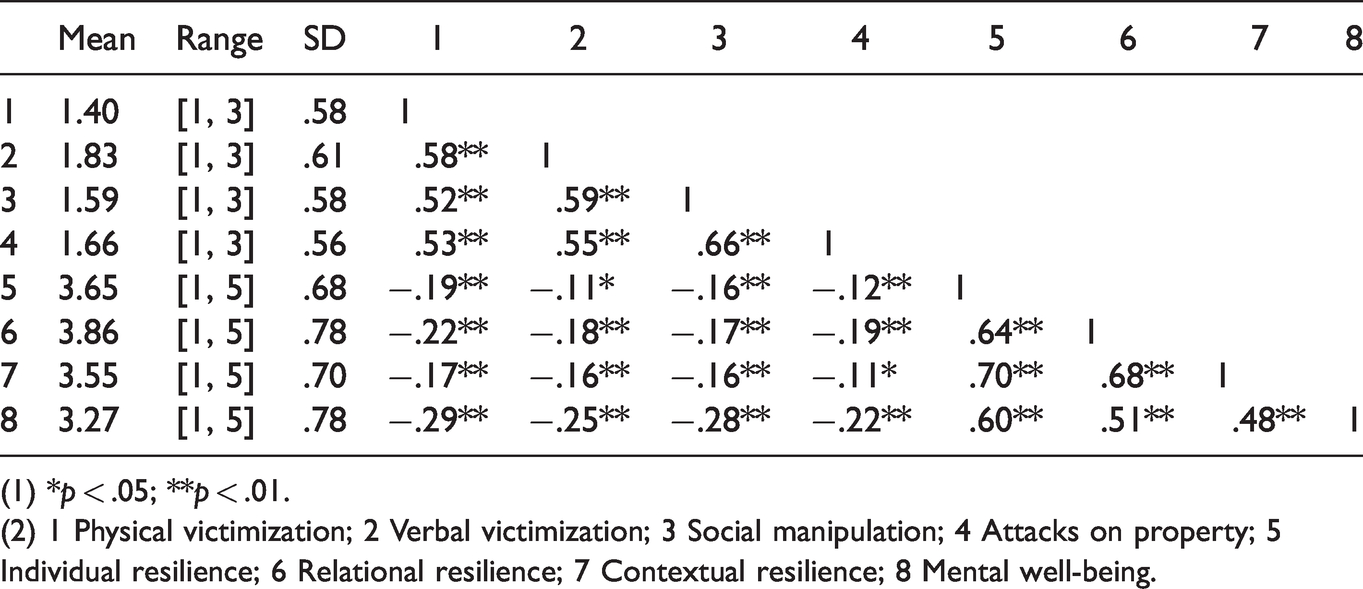
(1) *p < .05; **p < .01.
(2) 1 Physical victimization; 2 Verbal victimization; 3 Social manipulation; 4 Attacks on property; 5 Individual resilience; 6 Relational resilience; 7 Contextual resilience; 8 Mental well-being.
Standardized factor loadings of observed variables on latent construct.
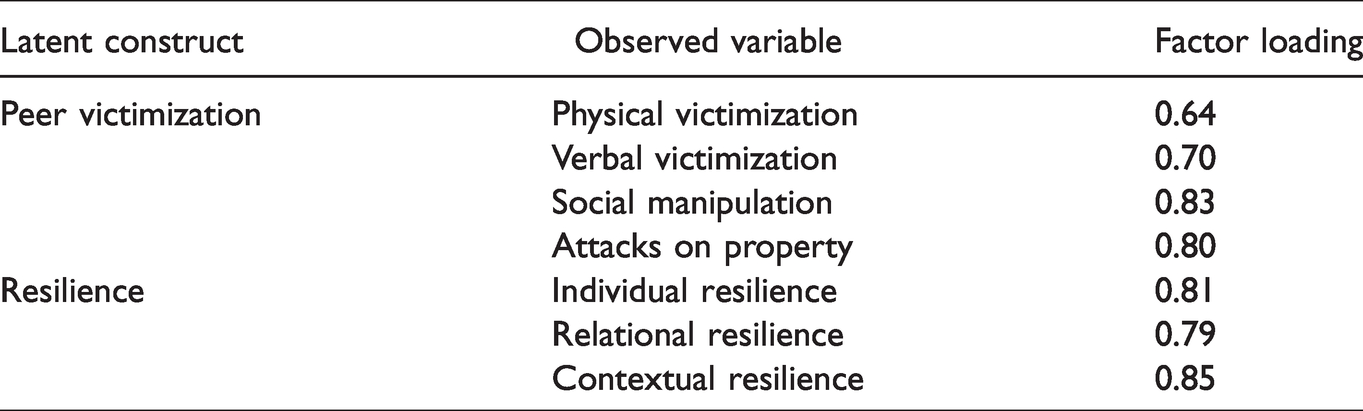
Measurement model
Confirmatory factor analysis was conducted using the maximum likelihood method of estimation and the results show a good fit indexes. χ2 (12, N = 471) = 22.00, p < 0.05, though χ2 is significant due to it sensitivity to large sample, but the other four indicators also show good model fit, CFI (0.993) NFI (0.985) IFI (0.993) are all larger than the marginal value of 0.9, RMSEA (0.042) is also less than the threshold of 0.08. In addition, the standard factor loadings of the observable variables in this study are between 0.64 and 0.85, all above the acceptable loading of 0.3 (Agnew, 1991). Hence, the results of measurement model indicate that the selected observable variables efficiently reflect the essential structure of the latent variable in this study. The standard factor loadings of each observable variable are shown in Table 3.
Structural model
Results show that the structural model fit data well in this study. Although Chi-square (χ2 = 161.254, df = 66, p < 0.001) is significant, NFI (0.933), IFI (0.960) and CFI (0.959) are all larger than 0.9, RMSEA (0.055) is less than 0.08. Furthermore, the results show that the whole model can explain 46.90% of children mental well-being.
The results of structural model standardized are shown in Figure 1. In order to simplify the model, this chart only presents the related paths of independent variable, mediating variable and dependent variable, while the paths of control variables are omitted. Results reveal that peer victimization significantly and directly influences children’s mental well-being, suggesting that the increase of peer victimization lead to the deterioration of children mental well-being after controlling for some sociodemographic factors (β = −.190, p < 0.001). Children resilience also has a significant impact on children mental well-being, implying that children with less resilience are higher likely to encounter mental well-being decreasing (β = .602, p < 0.001) after controlling other variables. In addition, peer victimization is negatively related to children resilience (β = −.252, p < 0.001), that is, with the increase of peer victimization experiences, children resilience would become less and less after controlling for other factors.
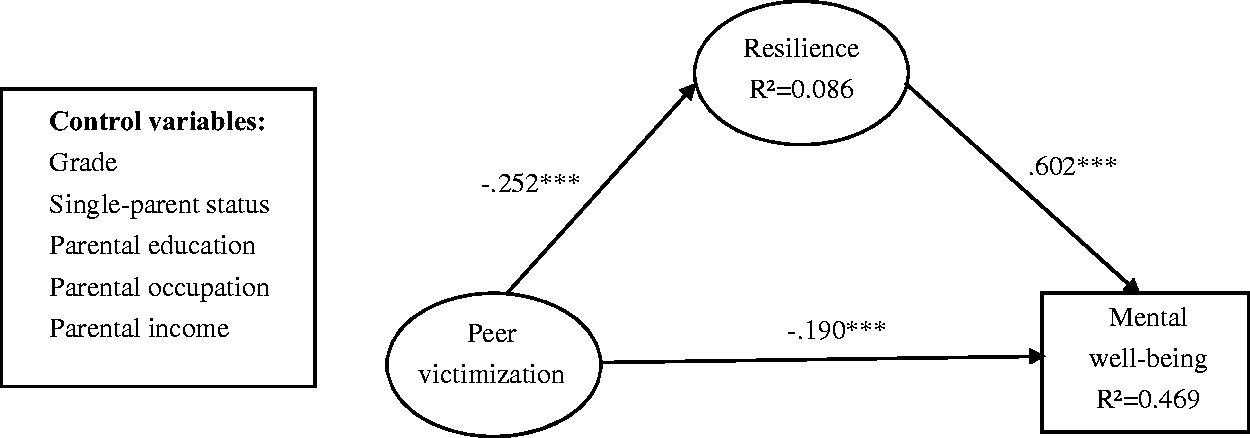
Overall sample.
2000 bootstrapping samples from the raw dataset were generated to exam the indirect effect. The analysis results show that the indirect influences of peer victimization on children mental well-being through resilience is −.152 (SE = 0.038, CI = [−.225, −.093], p< .001). The confidence interval of 95% does not include zero, which indicates that peer victimization has remarkable indirect influence on children mental well-being via resilience.
In addition, all control variables involved in this research (grade, single-parent status, parental degree of education, parental occupation and parental income) have no remarkable effect on children resilience and mental well-being.
Gender comparison
First, measurement invariance was examined and Table 4 showed the goodness-of-fit statistics of measurement invariance across gender.We examined the configural invariance by constraining the factorial structure equally between male and female subgroup. And the results indicated that the factor structure was equivalent across gender.Then, we tested metric invariance and got acceptable results (Δχ2 = 11.483, p = 0.043, ΔCFI = 0.005 < 0.01, ΔRMSEA = 0.002 < 0.015), indicating that factor loadings of male and female groups were also equivalent. Finally, scalar invariance was conducted to examine indicator intercept equality across gender. The results (Δχ2 = 18.502, p = 0.018, ΔCFI = 0.007 < 0.01, ΔRMSEA = 0.003 < 0.015) indicates that the intercepts of each item were invariant across gender group in this study. In summary, the gender showed invariances in configural, metric, and scalar.
Measurement invariance across gender.

After that every factor loading, path, and covariance were compelled to equalize of the same model for both male and female subgroups. The results showed a good fit [χ2 (135, N: males = 243, females = 228) = 244.241, p < .001, GFI = 0.940, CFI = 0.953 and RMSEA = 0.042], indicating that the model could apply male and female groups simultaneously.
Next, the proposed theoretical model was further conducted to determine gender difference on the certain direct path from peer victimization to children mental well-being. First, all the factor loadings, paths, and covariance were compelled to equalize at the same time to the same model across genders (χ2 = 366.276, df = 202). Then, the model was tested by releasing the path from peer victimization to mental well-being (χ2 = 363.047, df = 201). The result found that chi-square difference (Δχ2 = 3.229 < 3.841, P < 0.05) is non-significant, which indicates that there is no significant gender difference on the path from peer victimization to children mental well-being. Finally, the whole model accounted for 48.9% of the variance in children mental well-being for females (R2 = 0.489) and 48.2% for males (R2 = 0.482). These results suggest that the overall model explained left-behind children mental well-being more or less for female and male. Figure 2 shows the results of the gender comparison analysis.
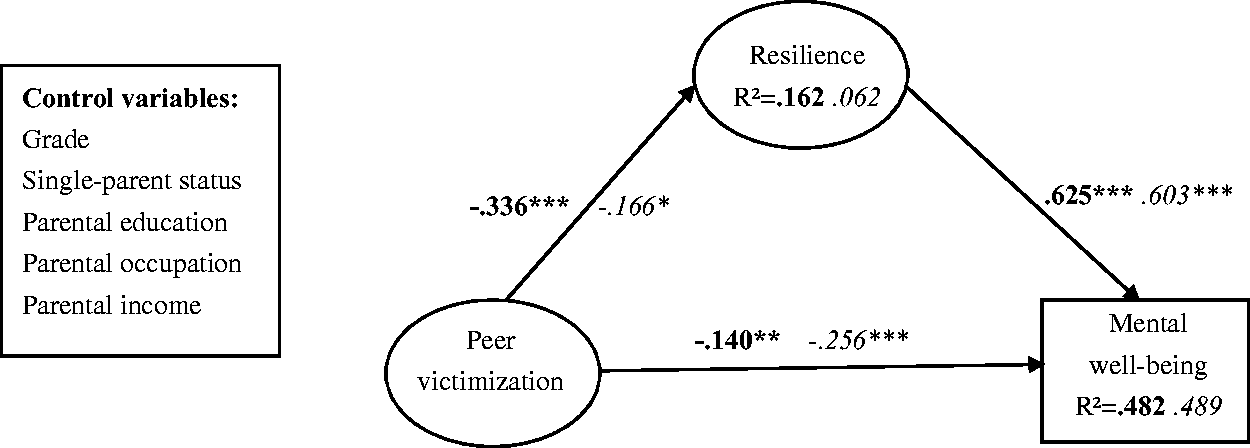
Gender comparison (males in bold, females in italics).
Discussion
Using the random sample of 471 left-behind children collected in the City of Huai’an in mainland China, this study examines how children mental well-being is associated with peer victimization in Chinese primary and middle school settings. Children mental well-being is proposed to be directly related to peer victimization and indirectly mediated through resilience. The model is expected to simultaneously fit male and female left-behind children with certain path differences. The findings supply empirical evidence supporting the proposed theoretical framework in this study.
Overall model
The results show good indices of model fit, supporting the theoretical model of peer victimization and resilience associated with children mental well-being among left-behind children in mainland China. Furthermore, peer victimization and resilience in this model accounted for a pretty large number of the explained variance in children mental well-being. Thus, peer victimization and resilience play important roles in explaining the mental well-being among left-behind children in the Chinese cultural context.
As such, children mental well-being is directly associated with peer victimization. The findings are consistent with theories such as trauma and social emotion regulation (Freud, 2014; Gratz & Roemer, 2004) and various empirical studies on school bullying carried out in Western countries (Brunstein Klomek et al., 2019; Copeland et al., 2013) indicating that experiences of peer victimization lead to reduced children mental well-being. However, the results conflict with some empirical studies carried out in the Chinese cultural context, such as in Taiwan, that show weak or insignificant link between peer victimization and children mental well-being (Chen & Wei, 2011b; Kim et al., 2006). This contradiction may result from the special sampling group of left-behind children. Due to the lack of parental care, support and nurturance, left-behind children are more vulnerable to school bullying and higher likely to appear undesirable psychological symptoms than those who live with parents (Chang et al., 2017; Otake et al., 2019; Tang et al., 2018; Zhao et al., 2015). Therefore, this study resolves the academic argument about the association between peer victimization and children mental well-being, which indicates that peer victimization is directly and significantly associated with mental well-being in the group of left-behind children in the Chinese cultural context.
Moreover, the results reveal that experiences of peer victimization undermine resilience among left-behind children in Chinese cultural context. And the findings also respond to the academic debate on the relationship between peer victimization and resilience, whether the former negatively predicts (Liu et al., 2015; Sauer, 2013) or positively influences the latter (Wright et al., 2019). Perhaps, compared with children living with their parents, left-behind children suffer from less resilience-producing external elements such as supportive growing environments, social supports and parent attachment (Baruth & Caroll, 2002; Bozak, 2013) and internal elements involving self-esteem, self-control, and self-efficacy (Ahlin & Antunes, 2015; Ogunmakin & Akomolafe, 2013). Therefore, when encountering peer victimization, resilience of left-behind children decreases and cannot evolve with the help of those resilience producing elements as non-left behind children (Zhao et al., 2015; Zhou et al., 2017). Thus, for left-behind children, experiences of peer victimization are more likely to reduce rather than promote their resilience. In addition, the findings show that resilience elicits significant predictive effects on mental well-being among left-behind children, which keeps peace with previous empirical research (Di & Palazzeschi, 2015; Sagone & Caroli, 2014).
Apart from the direct effects, the results also show that children mental well-being is indirectly associated with peer victimization through resilience. Left-behind children in mainland China with experiences of peer victimization are higher likely to suffer from decreasing resilience, which in turn reduces their mental well-being. The findings support the proposed theoretical framework considering that peer victimization has an indirect link with children mental well-being through resilience. The findings also keep peace with the prediction of the stress process model, which proposes that psychological resources such as resilience can serve as mediator linking adverse situation and mental health status (Pearlin, 1989). Accordingly, children living in stressful situations characterized by peer victimization are highly likely to suffer from low level of resilience, which in turn can undermine their mental well-being (Liu et al., 2015; Ye et al., 2016). The overall findings also imply that mental well-being of left-behind children is not only directly influenced by experiences of peer victimization, but also indirectly influenced through their resilience.
Gender differences
The results reveal that the theoretical framework could be applied to male and female left-behind children simultaneously suggesting that resilience similarly mediates the relationship between peer victimization and children mental well-being for both genders.
Notably, the results show no significant gender difference on the path from peer victimization to children mental well-being, indicating that when bullied by peers in school, male and female children are equal likely to suffer from problems in mental well-being. These findings conflict with several theories that propose females are more sensitive and vulnerable to peer victimization due to their greater emphasis on peer relationships (Ledwell & King, 2015; Navarro et al., 2011). These findings also conflict with the perspectives of differential orientation in expressing psychological distress that, when simultaneously experiencing peer victimization, female are more likely internalize problems such as decreasing mental well-being than males (Bakker et al., 2010). These findings imply that peer victimization poses the same threat to left-behind children’s mental well-being for both male and female in Chinese cultural context. Future studies may confirm this proposition.
Limitations
There are still some limitations required consideration in this study. First, because the data used are cross-sectional, the conclusions cannot predict the causal relationship of variables in this study. Longitudinal data could be used to provide evidence supports for causality among peer victimization, resilience, and children mental well-being. Second, children self-reports scale of peer victimization was used in this study, which may lead to exaggerating or underreporting being bullied because of potential social desirability bias and sensitivity to school violence (Chen & Wei, 2011a, 2013). Future studies are encouraged to collect data on peer victimization from multiple respondents such as peers, teachers and parents. Finally, this study uses a random sample of left-behind children from primary and middle school in the City of Huai’an in mainland China. As such, the conclusions should not be generalized in other groups or cultural contexts. Future research can examine how the proposed theoretical model applies to other countries, cultures, and societies and find their similarities or differences.
Implications
In conclusion, this study provides the empirical supports for the significant effects of peer victimization on children mental well-being and the mediating mechanism of resilience among left-behind children in Chinese cultural context. The theoretical model fits both male and female left-behind children. Theoretical value and intervention suggestions that can promote children mental well-being among bullying victims are presented as follows.
On the theoretical level, this study examines the applicability and feasibility of several theories (e.g., trauma theory, emotion regulation theory, resilience perspectives and stress process model) on the relationships among peer victimization, resilience and children mental well-being, which helps fill the knowledge gap in Chinese cultural context. Empirical support is also provided for the proposed theoretical framework in which peer victimization is indirectly associated with children mental well-being through the mediator of resilience. This theoretical framework can be examined in other groups or cultural context. In addition, the findings settle academic disputes on the interrelationship between peer victimization, resilience and mental well-being. Explicitly, experiences of peer victimization undermine both left-behind children’s resilience and mental well-being in Chinese cultural context.
On practical level, the current results show that resilience serves as a crucial role in the influencing mechanism of peer victimization on the mental well-being among left-behind children. Thus, social work programs concentrating on cultivating resilience for victims of bullying may be effective. Accordingly, certain strategies such as providing students chances to confront and successfully overcome hardship which are found to improve student resilience, may be useful (Durlak et al., 2011; Lerner et al., 2009; Orpinas & Horne, 2009). In addition, Promoting Alternative Thinking Strategies (PATHS) are demonstrated as a successful program to help children build resilience (Bierman et al., 2010; Domitrovich et al., 2007). PATHS help children gain positive social and mental development by managing emotion adjustment, interpersonal conflict, and problem-solving strategy (Cooke et al., 2007; Winslow et al., 2013). Moreover, savoring intervention can also be applied to promote positive emotions and resilience among children (Smith et al., 2014). These interventions can take various forms including increasing participation in positive future life events, enhancing awareness of positive stimuli and emotion at present, and encouraging positive recall of past events (Smith & Hollinger-Smith, 2015).
Nevertheless, this conclusion does not imply that practices and intervention programs should only concentrate on resilience to increase children mental well-being. The findings also demonstrate the significant direct effects of peer victimization on the mental well-being among left-behind children. The findings indicate that future intervention programs concentrating on children mental well-being should also consider decreasing the occurrence of school bullying. Accordingly, effective anti-bullying interventions can be applied to Chinese primary and middle schools with numerous left-behind children. Art therapy interventions are found to be a useful anti-bullying tool (Safaria & Yunita, 2014) including different creative techniques such as drawing, sculpting, and collage therapy (Malchiodi, 2011; Rubin, 2012). These interventions are more helpful for emotional expression due to the lack of restrictions by language, age, cognitive competence, or illness (Slayton et al., 2010). Art therapy serves as a vital role in the treatment of mental health problems for children and adolescent (Slayton et al., 2010). In this therapy, children would be free to express their feelings and minds, which helps them better understand bullying (Crawford, 2011).
In addition, school personnel in particular should guarantee that students live in a positive environment (Heller, 2014). Special emphasis on the harmony of interrelationship between students, teachers, and peers is necessary, because those relationships yield significant power to improve or hinder children’s psychosocial development (Bronfenbrenner, 1979; Ye et al., 2016). Furthermore, school social worker can also think about to form self-help groups for victims of school bullying to share their experiences of victimization and offer support and help to each other (Malecki & Demaray, 2006; Newman-Carlson et al., 2000).
Finally, the findings indicate that the whole theoretical model could adapt to male and female left-behind children simultaneously. Thus, interventions on increasing children mental well-being developed based on the proposed theoretical model can be usefully across genders in mainland China.
Footnotes
Declaration of Conflicting Interests
The author(s) declared no potential conflicts of interest with respect to the research, authorship, and/or publication of this article.
Funding
The author(s) received no financial support for the research, authorship, and/or publication of this article.
