




Abstract
Recent research suggests that meritocratic beliefs impact future-oriented activities. However, relatively little attention has been given to concomitant work outcomes, such as employee creativity. This study examines how the meritocratic beliefs of newcomers relate to employee creativity. We explore a serial mediation model where the meritocratic beliefs of newcomers heighten their meaning of work and learning adaptability, which increases employee creativity. We use questionnaires to survey 212 full-time employees from 10 manufacturing enterprises in China, who had joined their companies for less than a year. The results show that positive serial indirect effects of the meritocratic beliefs of newcomers on employee creativity via increased meaning of work and learning adaptability. Overall, the results provide new insight that may advance theoretical and practical implications on the pathways in which meritocratic beliefs may enhance employee creativity.
Keywords
Introduction
Meritocratic beliefs, an important individual value, denote the belief that an individual’s efforts, ability, and education are the reasons behind social outcomes, and that individuals can realize their values through effort (Li, 2016). This may make individuals show positive work behaviors to achieve higher social status and career aspirations (Hu et al., 2020; Shane & Heckhausen, 2016). Recent research suggests that meritocratic beliefs impact future-oriented activities (Hu et al., 2020; Shane & Heckhausen, 2017). However, relatively little attention has been given to concomitant work outcomes, such as employee creativity. The underlying mechanism of the relationship between meritocratic beliefs and creativity remains unclear.
In the current era, enterprises and employees need creativity more than ever, especially for new employees. When new employees first join an organization, they are faced with an unfamiliar organizational environment. Compared with longer-standing employees, newcomers’ work attitudes and behaviors have different characteristics. Newcomers are in the period of organizational integration, and their surrounding environment is full of uncertainty (Black & Ashford, 1995). Adapting to this new environment and integrating into the new organization is the primary task of this phase. Employee creativity, which is defined as “a behaviour in which individuals produce creative ideas or countermeasures in their work and attempt to practise them” (Scott & Bruce, 1994), is essential for newcomers to rapidly adapt to their environment (George, 2007; Li et al., 2017), especially in the current uncertain times. Using the generation, promotion, and application of creativity to promote innovation can help organizations gain competitive advantages (Gumusluoglu & Ilsev, 2009) and achieve organizational effectiveness (Hughes et al., 2018).
Considering the importance of creativity, scholars have studied the antecedents of enhancing employee creativity (Chen et al., 2016; Yamaoka & Yukawa, 2020). The generation of creativity is a complex process, which can be affected by many factors, such as personal characteristics, values, an individual’s corresponding knowledge, skills, motivation, and the organizational environment (Anderson et al., 2014; Kim, 2019). Among these, individual factors occupy an important position (Amabile et al., 2004; Ma, 2009; Smith & Lewis, 2011). As an individual factor, meritocratic beliefs reflect the view that career-related attainment is closely related to personal characteristics.
In the current study, we have expanded the existing literature by testing how meritocratic beliefs relate to creativity in the manufacturing industry in China. More specifically, drawing on the career construction theory, we propose a serial mediation model linking the meritocratic beliefs of newcomers to their creativity through the mediating role of their beliefs on the meaning of work and their learning adaptability. Career construction theory holds that individual factors can shape adaptability, which in turn may forecast vocational outcomes and an individual’s need to understand why their profession matters by linking their values with their career (Savickas, 2013). Meritocratic beliefs represent a possible means to control the environment (Shane & Heckhausen, 2016). These beliefs highlight the internal locus of control. This internal incentive that can send a signal to individuals to induce them to invest their time, energy, and abilities in their work (Rotter, 1966). Making a greater effort is more conducive to the realization of an individual’s creativity (Eldor & Harpaz, 2016; Koch et al., 2015). Individuals who invest more work, energy, and time are able to offer different ways to deal with problems and solve difficulties in the work environment, thereby enhancing creativity (Noor, 2018). Therefore, the meritocratic beliefs of newcomers may facilitate their creativity.
The overriding purpose of meritocratic beliefs is to build and cultivate meaningful perceptions of hard work (Goode et al., 2014). According to the career construction theory, personal understanding of the meaning of work (i.e., an individual’s subjective experience of the value of existence at work; Rosso et al., 2010) provides an important basis for the development of adaptability at work (Savickas, 2005), such as learning adaptability (i.e., willingness to learn and adapt to the current field in order to stay at the forefront of the field; Wang et al., 2011). The meaning that employees ascribe to work will encourage them to focus more on their tasks and devote more resources to their work (Baek-Kyoo et al., 2019). When individuals believe that the work they are currently engaged in is meaningful, they are more willing to learn. Thus, newcomers’ enhanced learning adaptability can increase the effort they spend on learning new knowledge, promoting progress, finding a new way to solve the problem and kindling employee creativity. Thus, this research aims to investigate the relationship between meritocratic beliefs and creativity serially mediated through the meaning of work and learning adaptability among newcomers in the manufacturing industry in China.
This study offers some major contributions to the literature. First, drawing on the career construction theory, this study has examined meritocratic beliefs as a critical antecedent to creativity in newcomers, providing a new angle to understanding how newcomers’ meritocratic beliefs can enhance their creativity in the workplace. Second, we uncover the career construction process of meaning of work and learning adaptability, through which the meritocratic beliefs of newcomers is related to their creativity, expanding our understanding of why meritocratic beliefs produce proactive employees. Third, we also tested serial mediation between meritocratic beliefs and creativity via meaning of work and learning adaptability.
Theory and Hypotheses Development
Meritocratic Beliefs of Newcomers and Creativity
Employee creativity, as reflected by innovative and useful ideas or methods generated by individuals in their work related to products, services, and processes (Amabile, 1996), is the driving force underlying enterprise development. Previous research has indicated employee creativity depends on personal characteristics, values, and beliefs (Anderson et al., 2014; Kim 2019). Meritocratic beliefs emphasize that individual ability and effort are the main determinants of success (Hing et al., 2011), and so are more willing to pursue career goals (Shane & Heckhausen, 2016). A belief in fairness and predictability makes people think that they can get what they deserve (Laurin et al., 2011), and then propels them to input time and energy in pursuing target, as well as to anticipate positive results for the future (McCoy et al., 2013). This can trigger the process of career construction. Career construction theory holds that workplace advancement is driven by individual preparation of resources devoted to one’s career (Savickas, 2013). Newcomers who hold meritocratic beliefs are relatively more likely to identify opportunities and bring career-related goal strategies, making them willing to actively try and make strong efforts to achieve good results (Shane & Heckhausen, 2016).
Individuals with a high level of meritocratic belief attribute success or failure to personal characteristics and believe that the fair distribution of social resources is closely related to the individual’s efforts (Goode et al., 2014). Dedicated employees put considerable energy into their work and their thinking is more flexible (Eldor & Harpaz, 2016). Employees with meritocratic beliefs hold that their efforts will be rewarded and hence they are willing to invest energy in their work (Goode et al., 2014). Studies have found that individuals who are highly engaged in their work have positive attitudes toward new ideas for optimizing and changing work processes (Bakker et al., 2020). As a result, individuals who hold a high level of meritocratic beliefs are more likely to engage in creativity. Thus, we can get:
Meritocratic beliefs are related to higher levels of employee creativity.
Mediating Effects of Meaning of Work
The meaning of work refers to subjective experience of the value of existence in individual work (Rosso et al., 2010). For most adults, work occupies an important part of life. Work not only provides financial support,\ but also provides individuals with a sense of belonging, accomplishment, and meaning (Blustein, 2008). According to the career construction theory, a career is constructed by creating the meaning of professional behavior (Savickas & Porfeli, 2012). The creation of positive meaning requires the individual’s past memories, present experience, and future desires to work together. Career construction theory holds that the idealized state that people may achieve in the future can give meaning to the individual’s current work and daily life. Newcomers need to connect the meaning of their work with their own career to understand why their career is important. Meanwhile, meritocratic beliefs can reflect an individual’s yearning for a possible state in the future and has future attributes (Goode et al., 2014). Based on the proactive motivation model, the generation of individual initiatives in the workplace can come from the willingness for future-oriented thinking (Parker, 2010). When people think that their own efforts can bring fair treatment, their future goals become clear (Hu et al., 2020), making it easier for them to perceive a sense of meaning (Dik et al., 2015). Based on these arguments, we propose that meritocratic beliefs predict an increase in the meaning of work over time.
Moreover, research has found that meaning of work can enhance individual creativity (Akgunduz et al., 2018; Yeh & Lin, 2015). Individuals that possess a high level of meaning to their work can effectively use the knowledge management process to improve their creativity. Thus, this leads to the following hypothesis:
Meaning of work mediates the relationship between meritocratic beliefs and employee creativity.
Mediating Effects of Learning Adaptability
The career construction theory proposes that human development is driven by the goal of adapting to the ever-changing social environment (Savickas & Porfeli, 2012). Adaptation is related to individual differences and is a learnable, dynamic, high-level psychosocial resource, enabling individuals to plan and respond to career development tasks. Previous studies have found that some stable personality traits are related to adaptability, such as work-related curiosity (Abukhait et al., 2020). Therefore, in line with career construction theory, we argue that the meritocratic beliefs of newcomers are positively related to their learning adaptability, which, in turn, is positively related to newcomers’ creativity.
Individuals with meritocratic values believe that their own efforts and abilities are important to their future social status, and their self-control at work has an impact on their achievements. Career construction theory also provides feasible interpretation for the influence of perceived controllability on favorable consequence at work. Individuals who perceive the controllability of the individual and the environment may be clearer about their direction in career, meanwhile, forming a greater sense of responsibility for their future career (Kerpelman & Mosher, 2004). Newly hired employees do not fully master all the skills required at work and need to continue to learn. Therefore, newcomers with meritocratic beliefs will devote more energy and time to learning to achieve their desired results.
Moreover, individuals with a high level of learning adaptability are more inclined to adapt to changes in workplace, and they are willing to acquire more professional knowledge and skills (Boulamatsi et al., 2020). Previous studies have found that newcomers who are willing to spend time on learning will be more proficient in mastering new technologies and knowledge, and then propose innovative improvements and new ideas to standard procedures at work (Levine et al., 2003). Based on above, we hypothesize:
A Serial Mediation Model of Meritocratic Beliefs
Based on the above analysis, the meritocratic beliefs of newcomers may influence individual creativity through meaning of work and learning adaptability, respectively. Next, this research concludes that the meaning of work can drive learning adaptability. Individuals who hold a positive attitude toward the value of their own work have stronger internal incentives, while individuals who are not sure whether their work has value or are less likely to complete the work. When employees hold a high level of work significance, they believe that work has value, and work occupies a more important position in individual lives. Individuals may find it difficult to adapt to new tasks, academic skills, and requirements, especially if they are newcomers (Liu et al., 2014). Since newcomers cannot possess all the skills required by the position at the start of their employment, they need to constantly learn new information. When individuals feel that the work they are currently engaged in is valuable, they are more willing to learn and to improve their level of learning adaptability. In addition, the career construction theory proposes that an individual’s attitude is the key to the complex environment in his career. The career construction theory conceptualizes career development as an action-oriented process, during which the individual establishes a career plan and actively prepares for it (Savickas & Porfeli, 2012). When individuals believe that their current job is important for their career development and hold a high level of work sense perception, they are more likely to show enthusiasm at work and face the challenges of their career and increase their learning adaptability (Figure 1). Based on the above, we hypothesize: Theoretical model.
Meaning of work and learning adaptability sequentially mediate the positive relationship between meritocratic beliefs and employee creativity.
Method
Participants and Procedure
Two waves of data were collected from 10 organizations in the manufacturing industry in China. This study adopted a questionnaire survey method, and the distribution and recovery period of the questionnaire was from November 2020 to January 2021. To minimize system bias, data were collected from different regions, such as Harbin, Beijing, and Shenyang. Data were collected from employees who had joined the company for less than a year, and before the formal survey, 10 newcomers were selected for the pre-survey. According to their feedback, the language and format of the questionnaire were revised so that participants could understand more clearly.
During the first phase of the survey, the questionnaire only included the basic information of the respondents (i.e., age, gender, education, and tenure) and meritocratic beliefs, meaning of work, and learning adaptability, which were evaluated by the employees. In total, 330 questionnaires were distributed and 325 were recovered. In phase 2 (1 month later), a questionnaire on the creativity of newcomers was distributed to the participants that responded with valid answers during the first stage; Studies have found that time separation between dependent variable and criterion variables could effectively make a reduction in common method variance bias (Podsakoff et al., 2012). One month is chose as the time lag interval since this research handles a psychological process and its effects on employee creativity. When holding meritocratic beliefs, employees may result in cognitive effects on behaviors within weeks. Employee creativity could result in phase 2 while the employees experience meaning of work. Thus, two separate surveys were used with intervals of one month, consisting with previous studies (Peng et al., 2020). 325 questionnaires were distributed, and 290 were recovered. After removing missing data and unmatched data, a total of 212 valid datasets were obtained. The effective questionnaire recovery rate was 64.24%. In the final sample, 64.20% were male and 35.80% were female; average age was 26.33 years; average tenure was 2.10 months; and 17.30% had a junior college degree or below, 69.80% had a bachelor’s degree, and 13.20% had a master’s degree or higher.
Measurement
The translation-back-translation method was used to ensure the questionnaire’s accuracy (Brislin, 1980). Three bilingual PhD candidates were asked to translate the English questionnaire into Chinese. Then, three lecturers were asked to translate the Chinese version back into English. The back translation is consistent with the meaning expressed by the measurement of the original version of the questionnaire. All measures were rated using a 5-point response scale, ranging from 1 (strongly disagree) to 5 (strongly agree). After translation was completed, 10 employees were selected to conduct a pilot to verify the accuracy of the questionnaire. On the basis of their feedback, we re-adjusted the expression of the language to ensure that the content was clear. Finally, we established the scales, including meritocratic beliefs, meaning of work, learning adaptability, and employee creativity, and the control variables.
Meritocratic Beliefs
We adapted the three-item scale developed by Smith and Stone (1989) and modified by Shane and Heckhausen (2016) to measure meritocratic beliefs. A sample item is “People at the top of the social status ladder in China are there because they possess drive and perseverance.” The internal consistency Cronbach’s alpha was .70.
Meaning of Work
We adapted the three-item scale developed by Spreitzer (1995) to measure meaning of work of newcomers. A sample item is “The work I do is very important to me.” The internal consistency Cronbach’s alpha was .74.
Learning Adaptability
We adapted Wang et al.’s (2011) five-item scale, which was developed by Ployhart and Bliese (2006), to measure learning adaptability of employees in the workplace. A sample item is “I enjoy learning various approaches to meet new requirement.” This scale is widely used, and the internal consistency Cronbach’s alpha was .72.
Employee Creativity
We adapted the four-item scale developed by Farmer et al. (2003) to measure employee creativity. A sample item is “This employee seeks new ideas and ways to solve problems.” The internal consistency Cronbach’s alpha was .72.
Control Variables
Newcomers’ age, gender, education, and tenure were controlled in the current organization because prior research indicated that these demographic variables potentially affect individuals’ behavior at work (Ng & Feldman, 2012). With regard to gender, male newcomers were coded as 0 and female newcomers as 1. Respecting education, newcomers with junior college degrees or below were coded as 1, those with bachelor’s degrees 2, and those with master’s degrees or higher as 3. Moreover, this research controlled for tenure in the current organization (in months) because prior research has shown that tenure affects individuals’ attitudes among Chinese employees (Hui & Tan, 1996).
Results
Analytical Strategy and Preliminary Analysis
In this study, some methods were used in the data collection process to reduce common method biases. First, participants filled out the questionnaire anonymously. Second, a time interval was set when collecting data, and the interval between the first phase of data collection and the second phase of data collection was two weeks. Third, at the beginning of the questionnaire, it was emphasized that it did not matter whether the answer was right or wrong. What is more, Harman single factor analysis was conducted, and the results showed that four factors with eigenvalues greater than 1 were extracted, and the variance interpretation rate of the first factor before rotation was 38.19%, which is within the acceptable maximum of 50%.
Results of confirmatory factor analysis.

Note: MB = Meritocratic beliefs; MOW = meaning of work; LA = learning adaptability; EC = employee creativity. CFI = Comparative Fit Index; TLI = Tucker–Lewis Index; RMSEA = Root-Mean-Square Error of Approximation; SRMR = Standardized Root Mean Square Residual.
Descriptive Statistics
Descriptive statistics, correlations of variables.
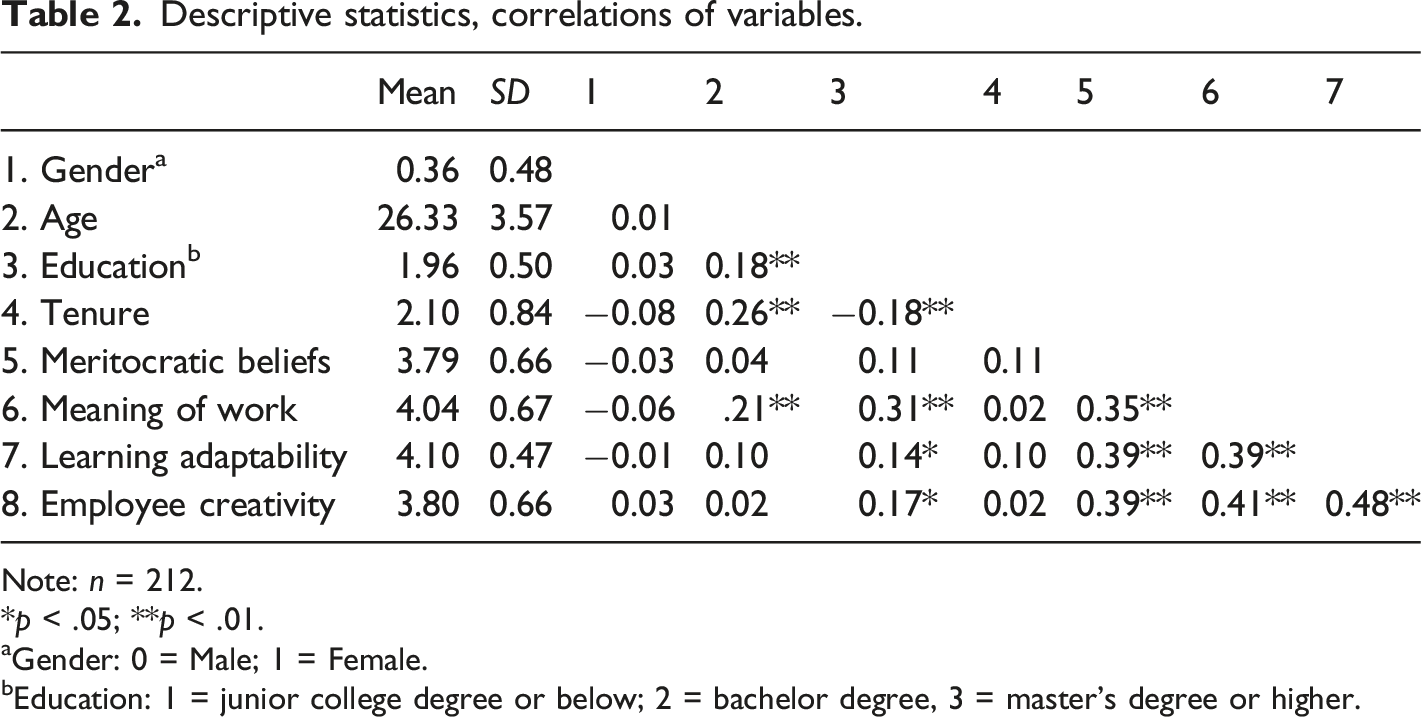
Note: n = 212.
*p < .05; **p < .01.
aGender: 0 = Male; 1 = Female.
bEducation: 1 = junior college degree or below; 2 = bachelor degree, 3 = master’s degree or higher.
Hypothesis Testing
The Mediating Effect of the Meaning of Work.
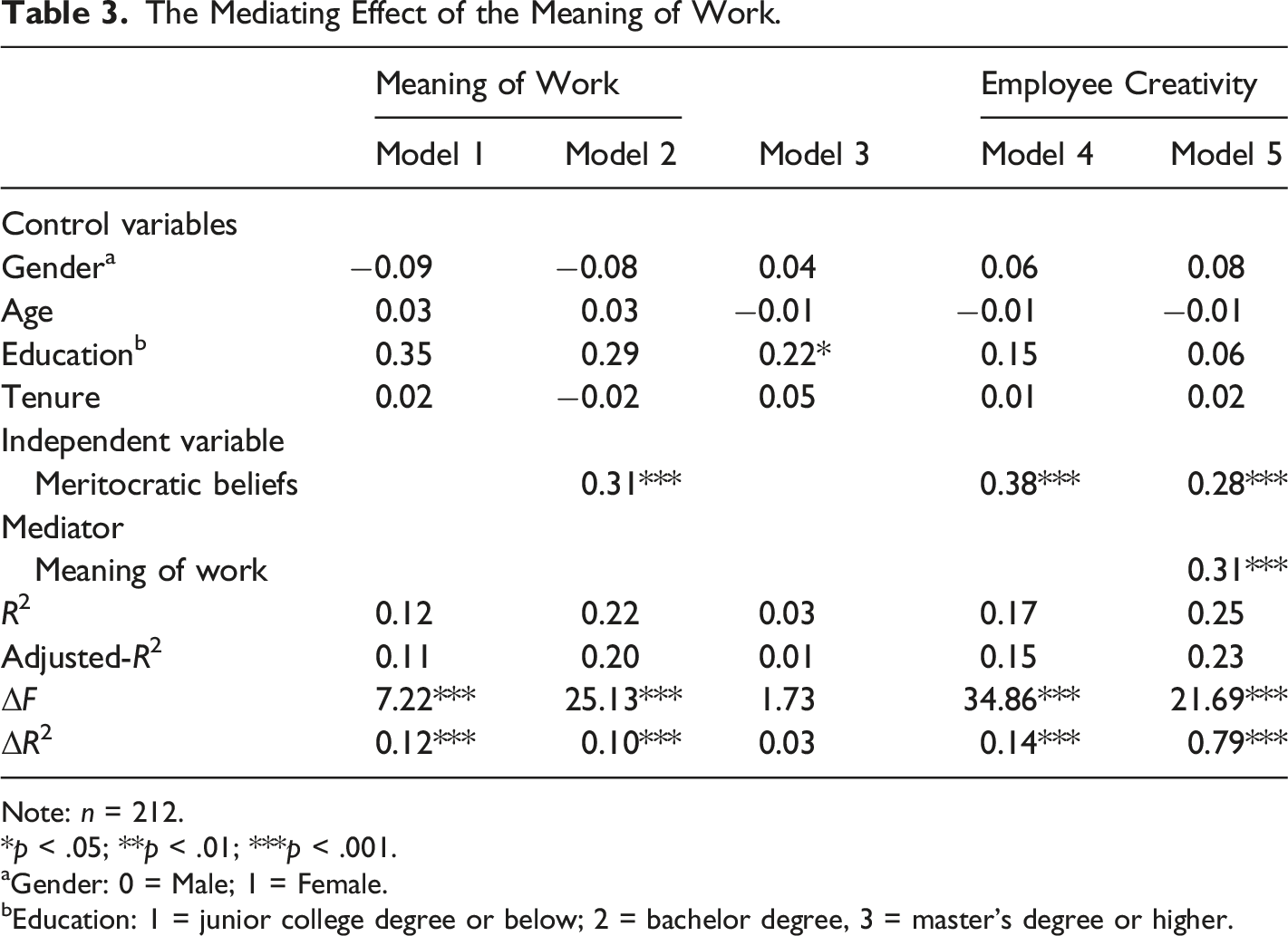
Note: n = 212.
*p < .05; **p < .01; ***p < .001.
aGender: 0 = Male; 1 = Female.
bEducation: 1 = junior college degree or below; 2 = bachelor degree, 3 = master’s degree or higher.
The results revealed meritocratic beliefs to be positively related to creativity authentic pride (β = 0.28, p < .001), and Hypothesis 1 was supported. Besides, Hypothesis 2, which predicted that meaning of work partially mediates the relationship between meritocratic beliefs and creativity of newcomers, was supported. There was a positive effect of meaning of work on creativity of newcomers (β = 0.31, p < .001, Model 5 in Table 3). Meritocratic beliefs had a positive effect on employee creativity (β = 0.38, p < .001, Model 4 in Table 3). The relationship between meritocratic beliefs and creativity of newcomers was still significant when meaning of work was added in the regression model (β = 0.28, p < .001), but the effect became weaker. Mackinnon et al. (2007) find that the distribution-of-the-product method about indirect effect is good. With the help of SPSS PROCESS, selecting the fourth model, results showed that meaning of work had significant mediation effects on the link of meritocratic beliefs with employee creativity (indirect effect = 0.100, SE = 0.032, 95% CI= 0.046 to 0.168). Overall, Hypothesis 2 is supported.
Hypothesis 3, which predicted that learning adaptability partially mediates between meritocratic beliefs and creativity, was supported. In addition, learning adaptability positively affected creativity of newcomers (β = 0.53, p < .001, Model 5 in Table 4), and meritocratic beliefs positively affected creativity (β = 0.38, p < .001, Model 4 in Table 4). The relationship between meritocratic beliefs and creativity of newcomers was still significant when learning adaptability was included in the regression model (β = 0.24, p < .001, Model 6 in Table 4), but the effect became weaker. With the help of SPSS PROCESS, selecting the fourth model, results showed that meaning of work had significant mediation effects on the link of meritocratic beliefs with employee creativity (indirect effect = 0.139, SE = 0.038, 95% CI = [0.076, 0.223]). Overall, Hypothesis 3 is supported.
The mediating effect of the learning adaptability.
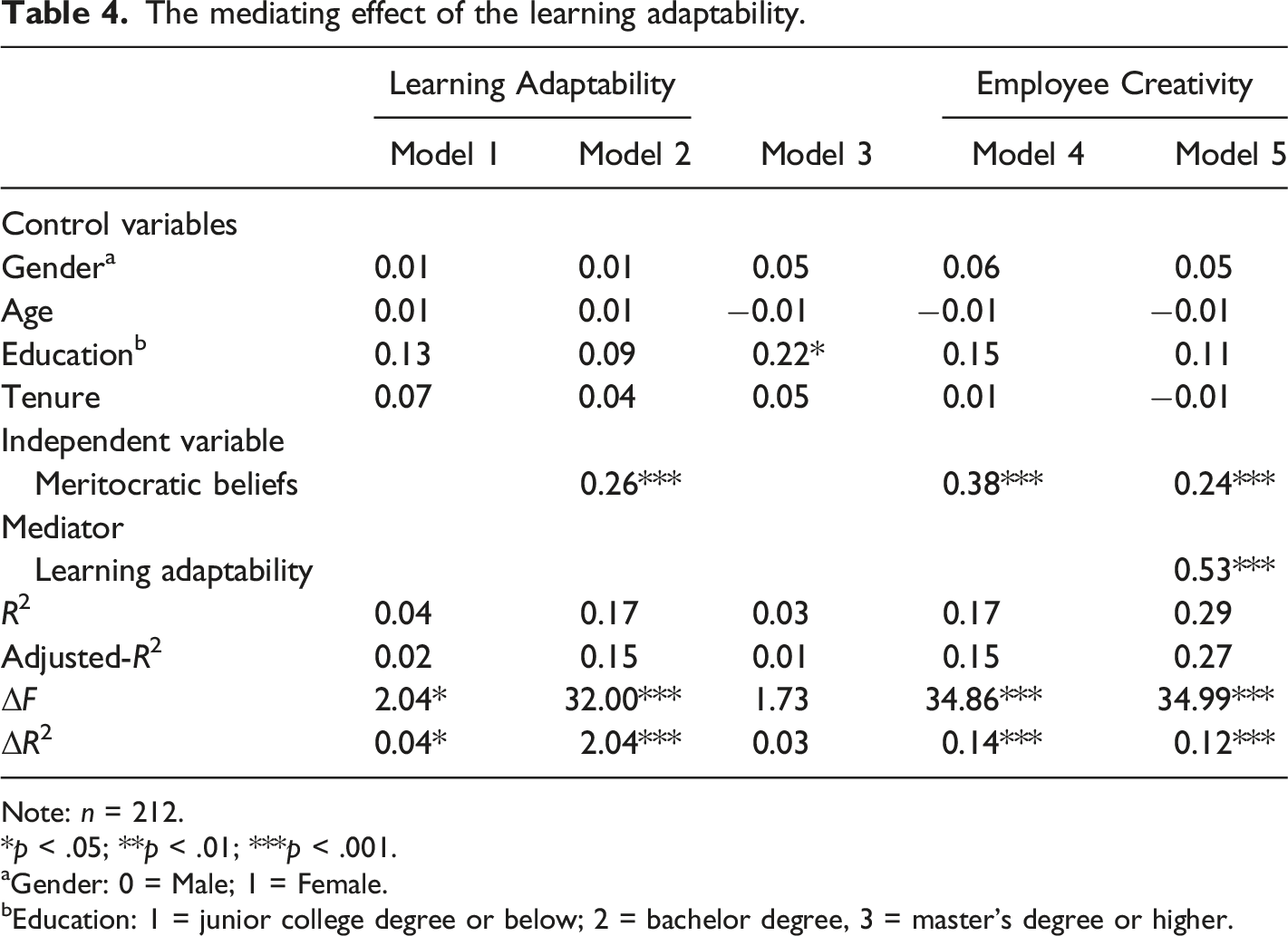
Note: n = 212.
*p < .05; **p < .01; ***p < .001.
aGender: 0 = Male; 1 = Female.
bEducation: 1 = junior college degree or below; 2 = bachelor degree, 3 = master’s degree or higher.
Hypothesis 4, which predicted that meaning of work and learning adaptability serially mediate the relation between meritocratic beliefs and creativity of newcomers, was supported. The serial mediation model in this research that links meritocratic beliefs with creativity of newcomers was tested with the help of Model 6 of SPSS PROCESS, and this method is proposed by Hayes (2013). The results showed that meaning of work mediated the association between meritocratic beliefs and employee creativity (conditional indirect effect = 0.071, SE = 0.027, 95% CI [0.022, 0.128]), as did learning adaptability (conditional indirect effect = 0.088, SE = 0.031, 95% CI [0.035, 0.158]). The results also supported the serial mediating effect (conditional indirect effect = 0.029, SE = 0.012, 95% CI [0.012, 0.057]). Taken together, Hypothesis 5 is supported (Table 5).
Tests on serial mediation model of meaning of work and learning adaptability.
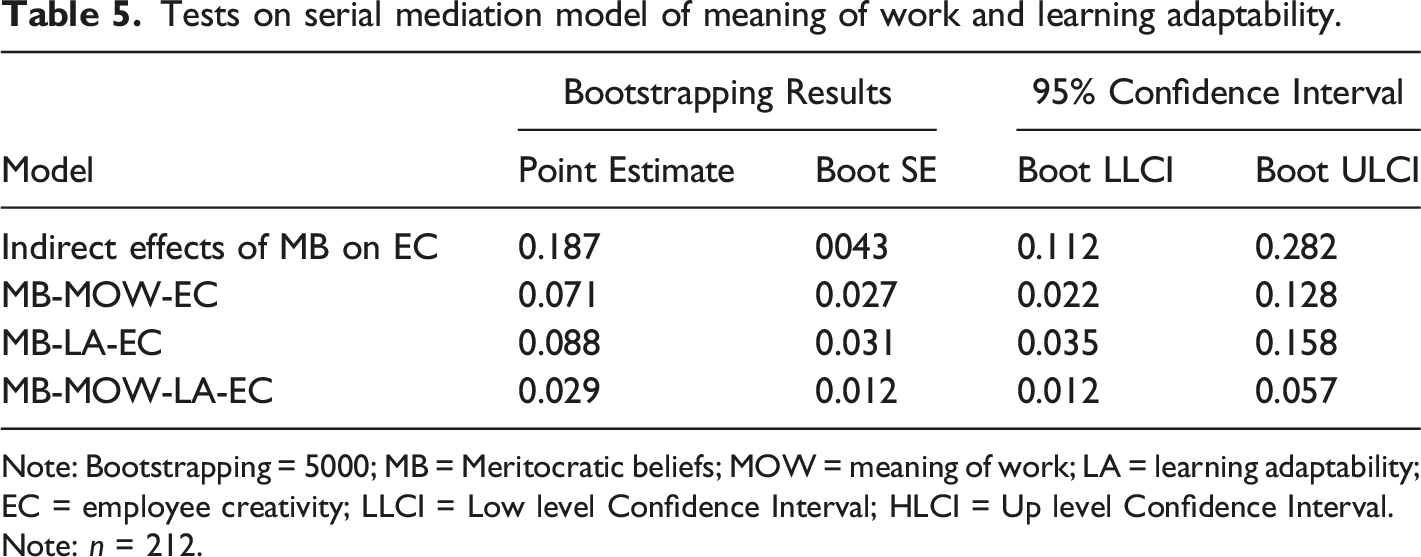
Note: Bootstrapping = 5000; MB = Meritocratic beliefs; MOW = meaning of work; LA = learning adaptability; EC = employee creativity; LLCI = Low level Confidence Interval; HLCI = Up level Confidence Interval.
Note: n = 212.
Discussion
Theoretical Implications
As expected, meritocratic beliefs were found to have a positive association with meaning of work and learning adaptability, respectively. These findings lend further support to the positive role of meritocratic beliefs in creativity.
This study has some theoretical implications. First, the positive relationship between meritocratic beliefs and creativity is now identified. Our research provides some of the first insights into how newcomers’ meritocratic beliefs may be linked to work outcomes of more immediate relevance to the organization, such as creativity. An exploration of the influences of meritocratic beliefs is a major contribution of this research. Using the career construction perspective (Savickas, 2013), our research hold that meritocratic beliefs trigger the process of career construction, thus influence their attitude and behaviors. Our research provides additional evidence that having meritocratic beliefs leads to positive cognitive responses, which determines the potential beneficial effects of meritocratic beliefs. Although researchers have found that meritocratic beliefs have impact on future-oriented activities (Hu et al., 2020; Shane & Heckhausen, 2017), relatively little attention has been given to concomitant work outcomes. Consistent with the career construction theory (Savickas, 2013), higher levels of adaptive readiness and adaptability resources energize employees’ work efforts, which in turn serve to elicit and direct personal effort toward work-related outcomes. By examining the relationship between meritocratic beliefs and creativity, this study broadens the literature on this novel area of meritocratic beliefs.
Second, this study contributes to the nascent study of meritocratic beliefs by identifying meritocratic beliefs as a central antecedent of a key directional subjective appraisal by individuals—the meaning of work in newcomers. Indeed, meaning of work is one of the core components of an awareness of orientation, which can be seen as an indispensable part of the individual’s process in pursuing of life goals (Schnell, 2009), and it is a fundamental aspect of individual work-related behavior in many organizations (Allan et al., 2019). Furthermore, newcomers’ meaning of work is closely related to desirable employee outcomes, including higher creativity (Liang et al., 2021). However, despite the importance of newcomers’ meaning of work, we still know little about what prompts newcomers to make this subjective appraisal from their individual characteristics, values, and beliefs. Scholars have argued that meritocratic beliefs can be seen as individual characteristics, and an important antecedent of directional subjective appraisal (Kahler et al., 2014). Nevertheless, this assumption is still underexplored in empirical research. This study addresses this limitation in the current literature on meaning of work and individual beliefs though developing and testing the link between meritocratic beliefs and meaning of work.
Third, our study contributes to the emerging field of meritocratic beliefs by examining the increasingly popular, yet largely untested, presumption that meritocratic beliefs foster positive newcomers’ behaviors. By linking theories of meritocratic beliefs and learning adaptability, we develop and test the argument that newcomers’ meritocratic beliefs may enhance learning adaptability. Indeed, previous researchers have suggested that adaptability requires newcomers to show individual positive traits, values, and beliefs, such as in a future work self (Zhang et al., 2017). Examining such links is important because it can help us to better understand individual values and their work-related outcomes.
Fourth, this study found that meaning of work and learning adaptability had a significant positive serial mediation effect on the relationship between meritocratic beliefs and creativity of newcomers. The finding is relevant since previous research indicates that meaning of work and adaptability is associated and has significant implications for positive outcomes for individuals in their work (Shin et al., 2018). However, there is as yet no research to analyze how these two relationships work together.
Practical Implications
Our results have certain practical implications. First, by showing that the meritocratic beliefs of newcomers may be positively related to creativity, this research hopes to stress the importance of carefully pursuing and controlling newcomers’ career construction processes and the resulting positive work behaviors to managers. By emphasizing the importance of personal effort, ability, and other individual factors to career development, and creating a fair, just, and open career promotion platform to enhance the development of new employees, managers can inspire individuals to be proactive and improve their creativity. Given that creativity is beneficial to organizations, when selecting employees, organizations need to consider the investigation of individual characteristics and professional values.
Second, we found that the meritocratic beliefs of newcomers can facilitate creativity by boosting the meaning of work. Therefore, managers need to pay attention to employees’ values and self-understanding because this is related to their perceptions of their career and assists them in developing meaningful beliefs about their work. Self-construction is an important part of the development of adaptive careers. Finding a connection between the present and the future self that can be achieved by one’s own efforts may encourage individuals to actively shape their future through adaptive professional behaviors. We believe that this “meaning construction” process is valuable for employees’ career growth, especially for newly recruited employees, and that it is the internal driving force that encourages effort at work.
Third, we found that the meritocratic beliefs of newcomers can facilitate creativity by enhancing their learning adaptability. Hence, to help newcomers build adaptability and enhance their creativity, organizations could provide training to enhance meritocratic beliefs. By providing training to employees, they can enhance their adaptability so that they can better prepare and implement adaptive behaviors and show more positive behaviors throughout their careers. Organizations could also provide environments fostering learning adaptability, such as those offering opportunities for learning and development.
Limitations and Future Research
This research has some limitations. First, newcomers’ career construction can come from many aspects. Although newcomers’ personal characteristics, values, and beliefs can be one of the antecedents of stimulating career-related behaviors, such as creativity (Anderson et al., 2014; Kim, 2019). Newcomers’ can also obtain career-related motivation and abilities, from other aspects such as leader and peers. Thus, future studies can replicate our model and integrate other factors with meritocratic beliefs to predict newcomers’ attitudes and behaviors. Second, in terms of methodology, this research is limited in that the samples were all from China and the sample size is small. Therefore, further research should consider the multicultural situation and sample size should be further expanded. Third, the cross-sectional data were obtained through a questionnaire survey. In the future, longitudinal research is required in order to reflect the vertical causality between variables.
Conclusion
In this research, we used career construction theory to investigate the relationship between meritocratic beliefs and creativity. Specifically, the serial mediation model which proposed in this research shows that meaning of work and learning adaptability mediates the relationship between meritocratic beliefs and creativity of newcomers respectively. Understanding the inner mechanism from meritocratic beliefs to work-related results is important for providing interventions to help newcomers quickly adapt to the new environment and show more positive behaviors at work.
Footnotes
Declaration of Conflicting Interests
The author(s) declared no potential conflicts of interest with respect to the research, authorship, and/or publication of this article.
Funding
The author(s) disclosed receipt of the following financial support for the research, authorship, and/or publication of this article: This paper is supported by grants from the National Natural Science Foundation of China (Project Numbers: 71372089), Higher Education Teaching Reform Project in Heilongjiang Province (SJGY20200061) and Young Talents Project of Northeast Agricultural University (20QC27 and 18QC59).
