



Abstract
My career story (MCS) comprises a self-guided autobiographical workbook designed to simulate career construction counseling. The MCS contains a series of questions from the Career Construction Interview to elicit a life-career story and reveal a life theme that are then related to a current career problem indicated by the workbook user. Reflecting on the answers to the questions aims to promote key life-design goals of adaptability, narratability, intentionality, and action. After describing its development and use, a case illustration and initial preliminary validity study of the MCS is presented. Latent semantic analysis, a method for determining meaning similarity of words and passages within bodies of text, indicated a mean agreement level of .81 between MCS life portraits constructed by participants (N =10) and those constructed for the participants by experts in career construction counseling. The MCS shows some initial promise for self-guided career intervention to increase self-reflection and ability to tell and enact one’s career story. Future research is needed to support the validity of the MCS workbook.
Keywords
My career story (MCS; Savickas & Hartung, 2012) comprises a self-guided, autobiographical workbook designed to simulate career construction counseling. Developed from career construction theory and practice (Savickas, 2011, 2013) within the life-design paradigm (Savickas, 2012; Savickas et al., 2009), the MCS aims to help individuals tell, hear, and enact their life-career stories in terms of who they are, where in the world of work they would like to be, and what they think it will take to connect themselves to occupations they may like. The MCS contains written exercises and goal-setting activities identified as critical to successful career planning (Brown & Ryan Krane, 2000; Brown et al., 2003; Ryan, 1999). In the present study, we situate the MCS within the contemporary context of the narrative paradigm in career intervention. We then describe the development, content, and aims of the MCS and demonstrate its use through a brief case study. Finally, we report on an initial, preliminary examination of the validity of the MCS for use as a narrative career intervention workbook for guided self-reflection. To our knowledge, this is the first effort to investigate the validity of the workbook.
Narrative: A Third Wave of Career Intervention
Narrative reflects a third wave of career intervention. The first wave concerned matching people to jobs in a psychology of occupations initiated in the early 1900s and epitomized by Holland’s (1997) approach. The second wave concentrated on managing worker and other life roles over the life span in a psychology of careers launched at mid-20th century and epitomized by Super’s (1990) life-span, life-space approach. The third wave now focuses on making meaning through work in a psychology of life design introduced at the end of the first decade of the 21st century and epitomized by Savickas’ (2011) career construction approach. Each wave, from occupations to careers to life design, crests and joins with the next adding to the sea of available career intervention models and methods. These waves also reflect three larger movements from, respectively, mechanism and a focus on traits, to organicism and a focus on developmental stages, to contextualism and a focus on narratives (Sarbin, 1986). Combined, “if dispositional traits sketch the outline and characteristic adaptations fill in the details of human individuality, then narrative identities give individual lives their unique and culturally anchored meanings” (McAdams & Pals, 2006, p. 210).
Recognizing the power and prevalence of story in human life, career counselors increasingly use narrative models and methods in practice (e.g., see Maree, 2007; McMahon, 2017; Savickas, 2011; Whiston & Rahardja, 2005). In so doing, they seek to deliver career interventions that better account for life’s complexity and richness within a rearranged structure of work. Compelling forces of economic, occupational, and organizational instability along with personal insecurity about work and career attendant life in the digital age accelerate this use. Today, individuals must seek security in the blankets of their own life stories rather than relying on an organization to provide them that security (Sullivan, 2011). The capricious, unsteady, and equivocal nature of work and workplaces in contemporary life prompts intensified search for meaning (Dik, Byrne, & Steger, 2013). Meanwhile, the digital age presents the paradox of unparalleled interconnectivity alongside mounting isolation as the demands of making a living and living a life often stretch people beyond their families, communities, and other familiar contexts.
Using narrative career interventions recognizes people as holistic, self-organizing, and active constructors and shapers of their lives through work, family, play, and other elements of human experience. It remains an individual’s story that has the power to tie together past, present, and future in his or her life. It is story which is able to provide unity and purpose…. The story is the answer to the questions, ‘Who am I?’ and ‘How do I fit into an adult world?’ (McAdams, 1985, p. 18).
Augmenting the prevailing views on careers in objective terms of traits indicated by test scores that suit occupations and in subjective terms of tasks to master in developing a career, the narrative perspective conceives of work as a vehicle individuals may use to advance their life projects and life themes (Hartung, 2013; Savickas, 2011).
The MCS: A Narrative Career Intervention
Career construction counseling entails an interpersonal process of helping people design their lives through work and career (Savickas, 2011). The approach applies social constructionist principles and narrative practices to career counseling. To expand its reach and offer supplementary materials for use in career counseling and research, the MCS (Savickas & Hartung, 2012) was developed. The MCS was designed to augment and simulate essential elements of career construction counseling. Using guided self-reflection, the MCS specifically aims to increase narratability, intentionality, and career adaptability as described by Savickas and colleagues (2009). Narratability denotes the capacity to coherently tell one’s own life story clearly and coherently and say who one is and who one is becoming. Intentionality denotes the capacity to understand self and situation by giving meaning and direction to one’s unique lived experiences and circumstances. Career adaptability means capacity to plan, direct, explore, and shape one’s career (Savickas, 1997, 2013). The MCS applies career construction counseling principles to helping people make choices about current life-career transitions and future career directions. Research suggests that workbooks like the MCS offer an effective means of career intervention to improve career planning and choice (Brown & Ryan Krane, 2000; Brown et al., 2003). Available free of charge at www.vocopher.com, in both English- and Portuguese-language versions, the MCS follows a rationale based in career construction theory and practice (Savickas, 2011, 2013), includes content that assists users to tell, hear, and perform their life-career stories, and offers use in diverse settings.
Rationale
People often need help planning and deciding about their career paths. Such help includes figuring out what kind of work they might want to do and how to go about doing it. It also includes core career adaptability components of planning and feeling in control of their futures, exploring possible careers, and building confidence to do what they want to do and solve problems that might get in the way (Savickas, 2013). Most people need this help because they are facing a change in their life; like going from high school to college, from school to work, or from one job to the next.
Sometimes, career assessment inventories and scales can be helpful to learn about what kinds of jobs and occupations a person may like and to make choices. Counselors often use these assessments (see Wood & Hays, 2013) to help with matching clients to jobs that seem right for them. Usually, career tests tell about individuals’ work-related interests, abilities, and personality. Such assessments tell about what kinds of people clients most resemble and what kinds of jobs people like them most often do. While often helpful for identifying college majors or occupations that might fit them best, such assessments usually tell just one part of the whole life story. To understand themselves more completely and how they can use work to be the person they want to be, it may help for clients to think about their whole life story (Hartung, 2005; Rottinghaus & Eshelman, 2015). Knowing and telling one’s own life story, or autobiography, adds meaning to career plans and choices. It can also deepen life-career planning and decision-making with a clearer sense of direction and purpose.
Humans make themselves and their worlds through the stories they tell (McAdams, 1985; Ricoeur, 1986). To best achieve life-career success, individuals must create a story about themselves that expresses very clearly who they are as a person, where they most like to be in the work world, and how they want to use work in a way that best allows them to fully be themselves (Savickas, 2011). To construct such a story, it may help to think of a life-career as an ongoing tale with three main parts: a lead character or self that represents who a person is, an educational or work setting where that person feels most comfortable, and a script with a plot and a central theme that explains and shows the person how to use work in a way to best realize the self that the individual has constructed.
The MCS aims to help people tell, hear, and author their own life stories. It offers a sort of “narrative mirror” individuals may hold up to look at themselves. By looking closely in this mirror, they can reflect on how they may use school and work in a way that is meaningful to them and that matters to other people. Telling, hearing, and coconstructing their own stories with valued audiences such as a counselor, coach, mentor, family member, or friend, empowers individuals to author their own life careers and experience work satisfaction (Savickas, 2011).
Content
The MCS contains a series of questions that prompt users to tell their life stories, reveals their life themes, and enacts their stories in work and career. The life theme is then related to a career problem currently faced, such as deciding about educational and occupational options and making career plans. Reflecting on the answers to the questions aims to promote achievement of core life-design goals of narratability, intentionality, and career adaptability (Savickas et al., 2009).
The MCS comprises three parts. Part 1, “Telling My Story,” begins with two opening prompts. The first prompt instructs the user to write a brief essay telling about their current career problem and how they hope the workbook will help them with that problem. The essay aims to elicit the client’s current perspective on their problem, goals for completing the workbook, and hints at a possible solution they might already have in mind. The second prompt directs the user to list all of the occupations they are currently considering or have considered in the past. This list represents their expressed occupational interests.
After these two opening prompts, Part 1 involves answering four key questions taken from the Career Construction Interview as seen in Table 1 (Hartung, 2015; Savickas, 2011). These questions elicit small stories about self (personality or reputation), setting (preferred work environments), script (plan for linking self to setting), and self-advice (guidance to self). The answers to each question tell one part of the whole life-career story. The first question asks about role models, or heroes and heroines admired as a child to elicit stories that reveal the template used for constructing a self and determining how life should be lived successfully. The second question asks about favorite magazines and TV shows that provide vicarious environments, or settings in which individuals immerse themselves. These magazines and shows indicate manifest interests. The third question elicits a favorite story in the form of a book or movie that attracts a person’s attention because it has a plot that resembles her or his own principal problem, preoccupation, or pain and provides a plan of action. The person feels drawn to the story because it offers a life script for successfully dealing with a core problem and a central character who constitutes an ideal self. The fourth question asks about a favorite saying that represents self-advice in the form of the best counsel one has for dealing with life’s problems. Favorite sayings or mottos remind people how to deal with their problems and become more complete.
Content of the Career Construction Interview.
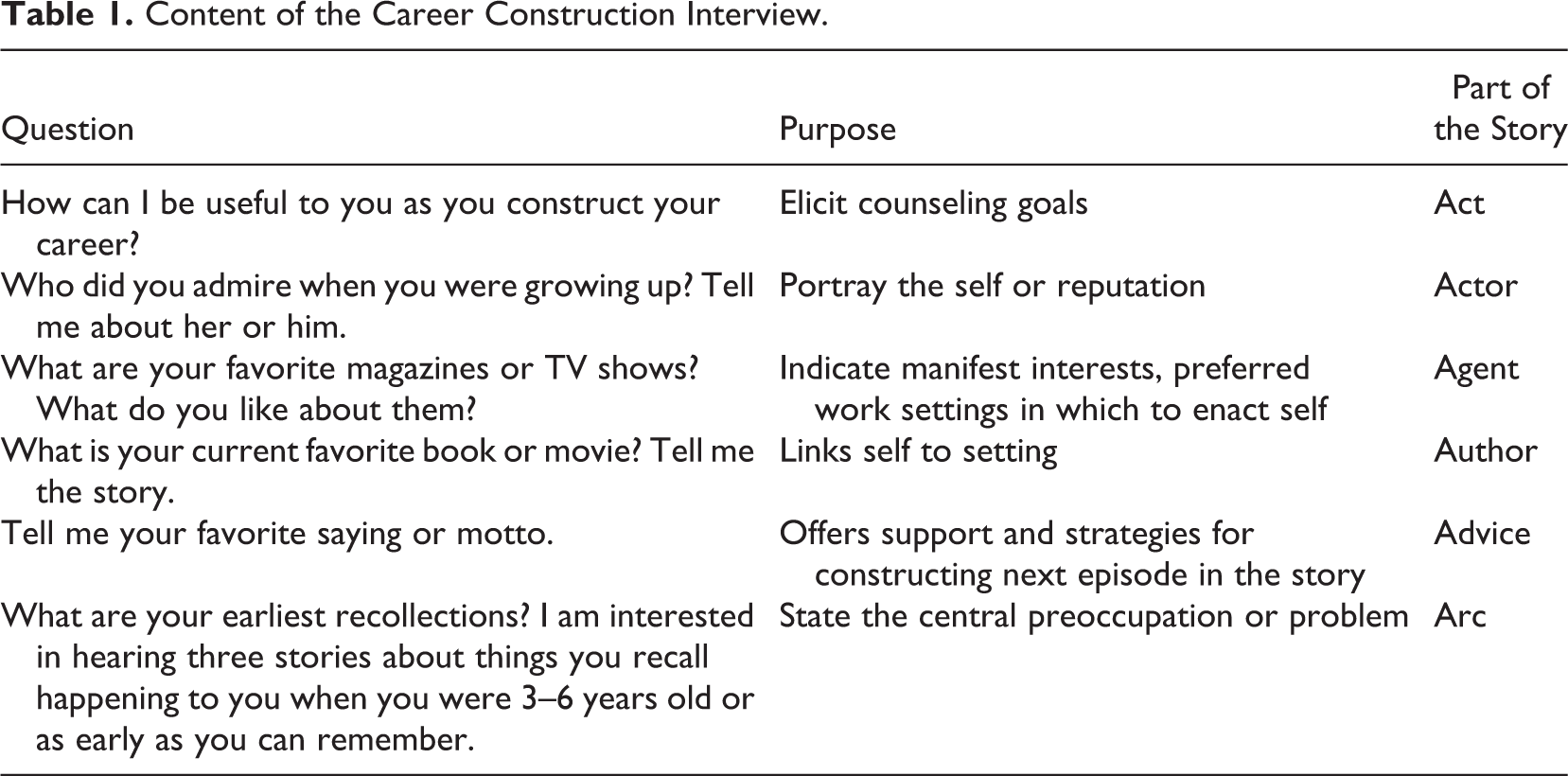
Part 2, “Hearing My Story,” uses the answers from Part 1 to tell the whole career story with greater clarity and comprehension. This process aims to promote understanding of self, preferred settings, a life script, and self-advice. The mini-stories told in response to the four questions of Part 1 are used in Part 2 to construct a summary life portrait about self (who one is or is becoming), setting (preferred work environments), script (a way to link self to setting), success formula (mission statement drawn from self, setting, and script), and self-advice (how to apply the success formula). The life portrait aims to increase narrative identity (Ricoeur, 1986), or who individuals are as the lead characters in their own life-career stories, where in the world of work they would most like to be who they are, and what they believe it will take to connect self to possible work settings. The individual then shapes the themes and patterns culled from these microstories into a macronarrative about the core problem or preoccupation, motives, goals, adaptive strategies, and self-view. This reconstruction process empowers authorship of the life-career story and enhances the potential for experiencing work as a personally meaningful context for development and a socially relevant endeavor.
Part 3, “Enacting My Story,” involves making a realistic plan to put the story into action. This plan involves reflecting on, telling, and performing the story. Reflecting on the career story leads to setting goals for the next chapter of the life career. Telling and talking about the career story and the conclusions drawn from the workbook with valued audiences promotes making it more real and clear and feeling more confident in living it. Audiences might be family members, friends, mentors, coaches, and teachers. Performing the story by identifying specific action to take increases exploration, commitment, and goal attainment.
To assess the usability of the MCS, 22 counseling program graduate students completed the MCS and evaluated its content. Demographic details about these students were not available. We decided to enlist students for convenience and because we expected they would be sensitive to and critical about issues of readability, clarity, formatting, and organization. Students provided their evaluations by responding to 6 items about the MCS in terms of its clarity of stated purpose, ease of use, organization and formatting, and overall comprehensibility. Each item was placed on a 5-point Likert-type scale ranging from 1 = strongly disagree to 5 = strongly disagree. A sample item was “The MCS workbook purpose was clearly stated.” Total ratings could range from 6 to 30 with higher scores indicating more favorable rating of the MCS content. The mean individual-item rating across the 22 students was 4.5 (standard deviation [SD] = .43; range = 3.5–5.0). The mean total rating across the 22 students was 26.8 (SD = 2.6; range = 21–30). An additional open-ended item invited raters to indicate any suggestions they had for improving the MCS content. Their suggestions mostly concerned adding additional space for writing answers to the MCS questions and making it accessible online rather than in paper form only.
Use
The MCS may be considered a self-directed, counselor-free workbook. Individuals, groups, and educators may use the MCS for guided self-reflection to increase narrative identity, intentionality, and adaptability in career planning, career choice, and work adjustment. Individuals may use the workbook independently or counselors may assign the workbook to clients and discuss the results with them. Individuals may use the MCS to tell, hear, and retell with greater clarity their own life-career stories, and identify ways to enact those stories in work. Doing so can help them better understand how they want to use work in a way that allows them to become the person they want to be. In groups, individual members may further engage other group members as an audience to help them tell and enact their stories (Barclay & Stoltz, 2016a , 2016b). Likewise, they, in turn, can provide an audience for other group members as they listen to and reflect on other members’ stories. Teachers may use the workbook as the syllabus or an activity for a high school or college career orientation or career education course (Lara-Hilton, 2015). Thereby, the MCS may help increase students’ ability to tell, hear, and retell with greater clarity and comprehension their emerging life-career stories and enact those stories in school and future work roles.
An MCS Case Study
To demonstrate use of the MCS, we introduce the case of Elisa (a pseudonym). Elisa was a 49-year-old Italian woman employed in a university center in Italy to support students with disabilities as they completed their major areas of study. Elisa reported that she struggled with her career goals and agreed to complete the MCS because she feared not being able to achieve her professional goals in the job context where she was hired. She wanted the counselor to help her set career goals and increase her confidence to achieve them. The counselor assigned the MCS workbook. Elisa then completed it and discussed her results with the counselor. Following are Elisa’s responses to the MCS workbook questions.
Part 1: Telling My Story
Essay
Elisa began the MCS by writing the following essay: I’ve just finished the post-degree course in career counseling, an educational experience very important for my career and personal life. Today, I feel more confident, skilled, and focused on my wish. I’d like to use what I learned in this course in my current work environment - a university service for people with disabilities and dyslexia, which also provides vocational guidance for undergraduate and graduate students with disabilities. I believe that this confidence, security and ‘professionalism’ are visible. Recently, my [department] head, asked me to dedicate myself as soon as possible to design a career guidance service for the users of our office. I’d like to plan an ‘integrated services’ where career education and career counseling activities for students with disabilities are provided. This is for me an important career development opportunity, for which I was trained and I will stay in education, implementation, collaboration with other practitioners and supervisors. This project represents my contribution to improve the quality of life of people with disabilities. In any case I want to try and I will not easily give up. I thought, however, to have a ‘plan B’ and a ‘Plan C’ if some obstacle prevents realizing my goal, such as has happened in the past. Plan B is to move to another office to support the organization of conference and education activities, relationships with foreign countries, advertising activities, research projects, promotion and development of local services and relations with other research centers and services, activities and interventions in schools, and English translations. Plan C regards career education and career counseling activities in schools with which the social cooperative that I founded already has several agreements in other areas (linguistic-cultural mediation, intercultural education, psychological counseling for foreign students of the second generation, peer education, teacher training, etc.). I expect this workbook will be useful to reflect on what is essential for me to stay where I am or build a different career path for my future. I’d like to better understand how important it is for me to work with people with disabilities.
Occupations
Elisa listed the following as occupations she was considering: career counselor in her organization, career counselor at the university career counseling and vocational guidance service, and freelance work in career education and career counseling.
Having written her problem statement essay and listed her expressed occupational interests, Elisa proceeded to answer the four MCS questions about role models, favorite magazines/TV shows/web sites, favorite book, and favorite saying.
Role models
Elisa identified three role models. First was Anna, a supportive elementary school teacher. She described Anna as friendly, calm, and empathic. She showed a concern for others and a real interest in her work. She made sure that a child with a disability could stay in Elisa’s elementary school classroom. Elisa admired Anna’s perseverance, gentleness, and belief in what she did.
Elisa described her third role model, Ulisse, as a brave navigator, intelligent, and curious, willing to face danger and the unknown. He thirsts for discoveries and to broaden his horizons, he does not stop in the face of difficulties, but with astuteness and the help of companions he finds his way around obstacles to continue his journey around the sea. His desire to learn and explore leads him to clash with the forces of nature and with the aversion of Fate, but he perseveres, goes hard, does not give up, and remains true to himself.
Favorite magazines or TV shows
Elisa named three favorite magazines. She liked La Stampa, a news magazine, because it offers an honest, witty, and ironic translation of the political, economic, social, and cultural development of her country. She also liked its cultural section that reviews novels and includes poetry collections. She liked Internazionale, a weekly magazine, because of its interesting articles about the foreign press, its gathering information from different sources and with different viewpoints, and because great cultural figures of international standing contribute to it. She also liked La Republica because it is a news magazine based on democratic values. Elisa liked the magazine’s culture and health section.
Favorite book or movie
Elisa identified her favorite book as My Sister, My Spouse: A Biography of Lou Andreas-Salomé. It is a rich and in-depth biography of Lou Salomé, psychoanalyst and author. The book tells about her extraordinary life from her birth in Russia to her death in Germany. Reading about Lou’s life tells about the cultural fervor of her age: philosophy, literature, poetry, theater, music, and psychology of Europe at the turn of the 20th century. Lou was a brave woman, unconventional, eclectic, free, intelligent, and sophisticated. She was the muse of poets, intellectuals, and philosophers. Lou was a vital woman, not conventional, who acted according to her own ideas and passions without fear. Her life, as told by the author, conveys the idea that awareness comes only through experience, curiosity, and experimentation.
Favorite saying
Elisa listed the following as favorite sayings: “Red sky at night you will hope for beautiful weather”; “While there is life there is hope”; “You cannot draw blood from a turnip”; and “Health first of all.”
Part 2: Hearing My Story
Rewriting my story
Using her answers from Part 1, Elisa constructed a summary life portrait as seen in Table 2. Inspection of Table 2 indicates (a) the intelligent, brave, navigator self she has constructed from her role models, (b) her preference for diverse, people-oriented, cooperative work environments, (c) her script for linking herself to her preferred work settings whereby an extraordinary, brave, unconventional, eclectic, free woman fearlessly lives and acts according to her own ideas and passions without regard for the consequences, and (d) her self-advice to remain optimistic and persevere. Using her success formula and self-advice from her summary portrait, as instructed by the workbook, Elisa then rewrote her opening essay as follows:
Elisa’s MCS Life-Portrait Summary.
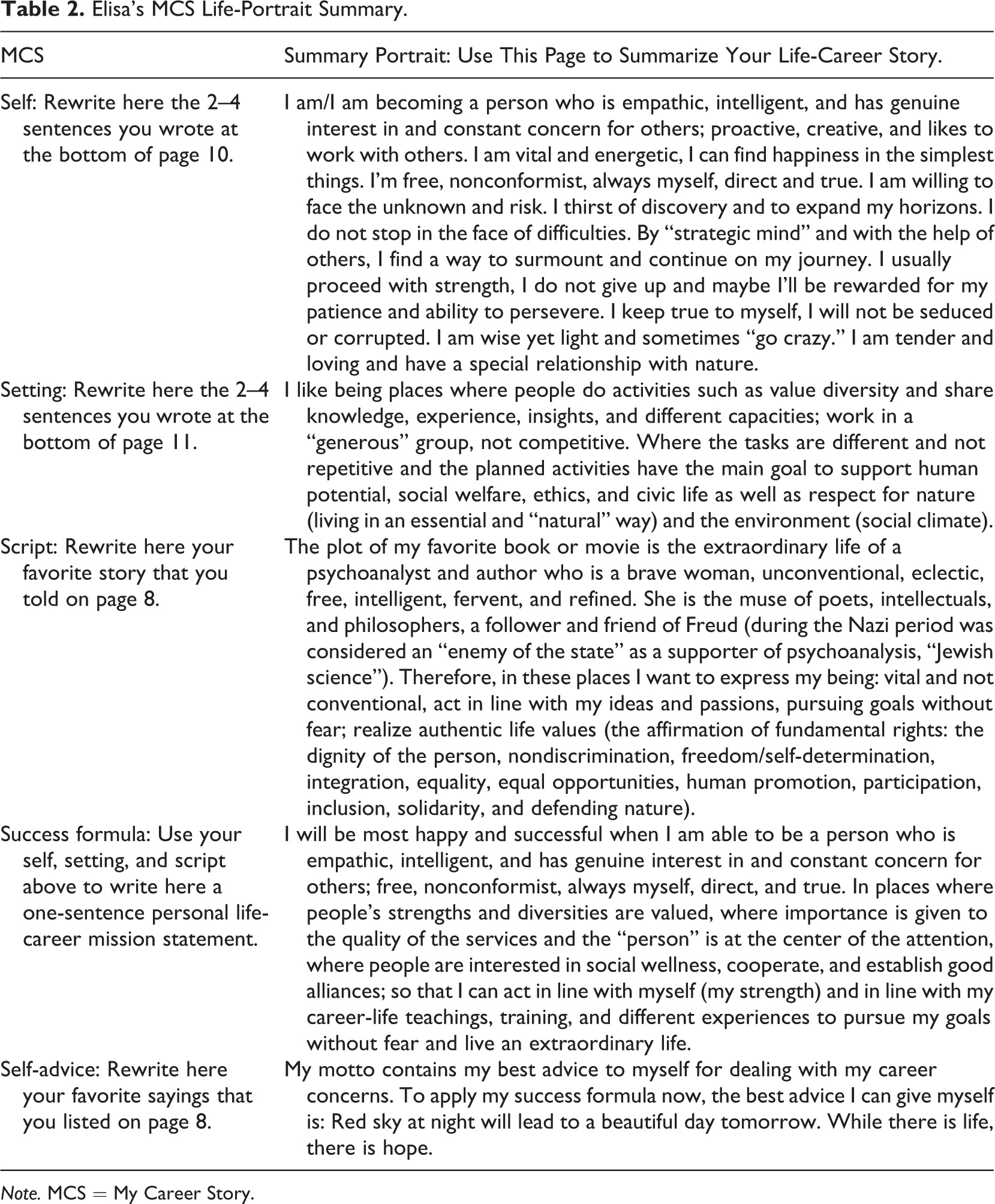
Note. MCS = My Career Story.
Red sky at night and you will hope for beautiful weather. That means that if at the end of all my days I have the feeling of having well lived I will have ended with a ‘good sunset’. It is very likely that ‘tomorrow’ will be a better day, richer and more radiant, full of possibility, and positive. The advice that I give to myself, then, is to look ‘today’ in order to design ‘tomorrow’. The seed is not a simple affair: unexpected forces of nature, the envy of others, may affect crop, rot the shoots, sawing at the base of the stalk of corn growing, poison the land, pollute the environment. I have already had this experience when I was a ‘farmer’ less experienced, and now I have ‘made the bones’, ready to go toward unexpected forces and grow up. Now I can move with more agility. I want to be able to expand my business, I want to be able to make full use of what I learned and grow. To do so, I need space, time, dedication, and others who can give me an hand. I know how to defend myself against unexpected obstacles or real barriers. I can try to predict them, imagining possible solutions in advance (see my plans B and C). The way to defend myself from others’ envy is to be loyal, respectful, cooperate as much as possible, and build multiple networks, alliances, and alternatives; be direct and assertive; and propose changes and solutions on an informed basis and with conviction.
Exploring occupations
Part 2 of the MCS closes with the opportunity for users to list occupations they are now considering based on their summary portraits. It also prompts them to explore additional occupations if they wish by conducting an O*NET online occupational database search (http://www.onetonline.org) using their vocational personality types (i.e., RIASEC codes; Holland, 1997) derived from their favorite magazines or TV shows. Doing so, Elisa identified the following occupations: vocational guidance counselor; research administrator; Italian language teacher for foreign students (creative writing group workshops, cooperative learning with the use of different media, such as video production, audio, and photos); animator for children and adolescents (use of theater and dance, improvisation, and body expression); human resources coordinator; and project coordinator (areas: educational, social, international relations, language and cultural exchanges, and environment). This opened up further opportunities for exploration should she decide to move from her initial plan to her stated alternative Plans B or C.
Part 3: Enacting My Story
The MCS concludes in Part 3 with construction of an action plan. This plan comprises goals for enacting the life portrait made in Part 2. Elisa listed two such goals. As a short-term goal, Elisa stated her aim to write a project proposal to her director to develop, promote, and commission an integrated system of vocational guidance services (career education and career counseling) for college students with disabilities. As a medium-term goal, Elisa indicated that she would activate Plan B and/or C if her short-term goal was thwarted. In keeping with the MCS directions, the counselor also encouraged Elisa to tell her story to valued audiences Elisa identified in her workbook that were her husband and parents.
Validity of the MCS
To initially examine the validity of the MCS, we conducted a preliminary assessment of the extent to which MCS user life-portrait summaries would match life-portrait summaries written for those users by career counselors steeped in the principles and practice of career construction counseling. The guiding question we sought to answer was whether or not an MCS summary made by a user would match a summary made by an expert in the development and use of the MCS. To answer this question, we compared the levels of agreement between user- and expert-constructed life-portrait summaries.
Participants and Procedure
Ten participants (mean age = 36.1 years, SD = 7.74, range = 27–45) were involved in the study, three men and seven women. All participants were enrolled in a vocational guidance and career education master’s degree program at a university in Northern Italy. Students were not trained in career construction theory and practice during the master’s degree. All participants volunteered to take part in the study. Ten participants completed the MCS workbook individually and then returned it to the second author, who offered a follow-up consultation session for any participant who wanted to discuss their completed workbooks. None of the participants involved in the study requested such follow-up consultation. The present study authors served as the experts who constructed life portraits of the participants. One expert possessed a doctoral degree in counseling, licensure as a professional counselor, and more than 20 years of publication, teaching, and practical experience in the models and methods of career construction counseling. The other expert was a doctoral candidate in counseling psychology at the time of the study with more than 3 years of publication, presentation, and practical experience in career construction theory and practice.
Data Analysis
The first and second authors independently examined each participant’s responses to the first 4 MCS items. Based on their analyses, each author then completed a life portrait summary based on participant responses to the four MCS questions. We used Latent Semantic Analysis (LSA) as a procedure to estimate the semantic similarity between participants and experts MCS summaries. LSA comprises a fully automated computational technique for representing the meaning (content) of a text as a vector in a relatively high-dimensional semantic space. The rationale and method for LSA have been described in Deerwester, Dumais, Furnas, Landauer, and Harshman, (1990) and Landauer and Dumais (1996) and are summarized in Landauer, Foltz, and Laham (1998).
LSA is based on the vector-space method. In this method, given a text corpus of N documents and M words, the LSA paradigm defines a mapping between the M words and the N documents into a continuous vector space S, where each word is associated to a vector in S, as well as each document is associated with a vector in S. The S vector space represents a “semantic space” since semantics conveyed by the presence of the ith word in the jth document can be measured by taking the dot product between the vector representing the word and the vector representing the document (Agostaro, Augello, Pilato, Vassallo, & Gaglio, 2005).
For the objectives of this study, we followed the holistic method applied by others (e.g., Foltz, Gilliam, & Kendall, 2000; Kintsch et al., 2000; Landauer, Foltz, & Laham, 1998). The holistic method consists of analyzing the similarity between participant portrait summaries and expert portrait summaries. Higher correlations between participant and expert summaries represent indicators of the validity of the MCS workbook. The 10 portrait summaries written by participants were chosen as a standard (taking an average of them), and each expert summary score was computed as its LSA cosine with the standard.
The corpus analyzed comprised 5,279 different terms, 10 documents, and 5 dimensions. Terms refers to the number of words in the whole corpus, counting each word only once even if it occurs more than once. Documents refer to the number of completed MCS workbooks. Dimensions denote five areas of the MCS used to construct the life portrait: role models (self), favorite magazines/TV shows (setting), favorite book (script), success formula, and favorite saying (self-advice). We mapped the texts in an LSA space built through the program available at the University of Colorado website (http://lsa.colorado.edu/). Then, we obtained the similarity between the participants’ summaries and the experts’ summaries, all encoded as vectors in the semantic space, by computing the cosine between them. The submitted texts’ similarity matrix was obtained in term-to-term space for each section of the summaries (self, setting, script, success formula, and self-advice).
Results
Agreement between the two coders for each participant across each MCS summary section (i.e., self, setting, script, success formula, and self-advice) was calculated by LSA pairwise comparison (Landauer & Dumais, 1996). Table 3 contains LSA values indicating level of similarity between the texts of each section of the participant and expert summaries. The total score of the two experts for each summary section reflects an average value ranging from .67 to .94 with a total mean agreement value across all sections of .81. These values represent moderate-to-high similarity levels between participant and expert summaries. As seen in Table 2, differences in agreement rates between experts across the five dimensions ranged from a low of 0.00, with both experts achieving a level of 0.94 (script), to a high of 0.07, with expert 1 = 0.85 and expert 2 = 0.92 (success formula). These low difference values suggest a high degree of consistency between the two raters.
Mean Agreement Levels Between Participants (N = 10) and Experts for Each MCS Life Portrait Summary Section.
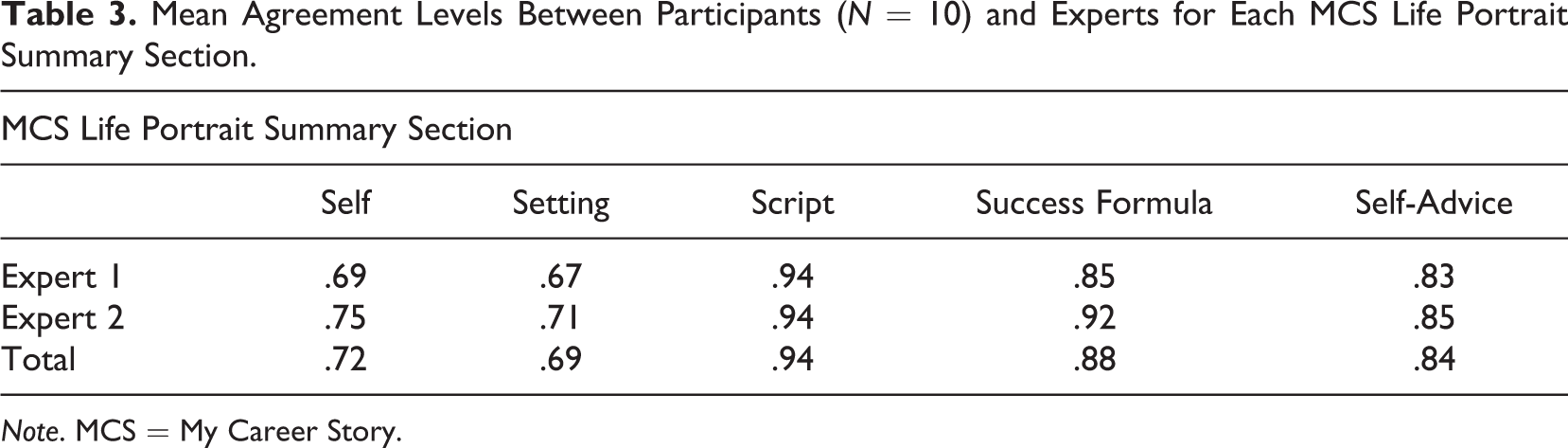
Note. MCS = My Career Story.
Discussion
As a theory and counseling scheme, career construction (Savickas, 2011, 2013) applies narrative methods in an interpersonal process that aims to help people coherently tell their life stories, adapt to changes in themselves and their situations, and intentionally design their life careers. While career construction counseling has been widely described and applied (Di Fabio & Maree, 2013; Savickas, 2011, 2013), counseling itself represents just one form of career intervention. Career intervention takes many forms to promote career planning, occupational exploration, career decision-making, vocational choice, job entry, work adjustment, and retirement. In practice, career counselors, student affairs personnel, and other career development professionals apply career interventions such as individual and group counseling, assessment interpretations, curricula, workbooks, computer-assisted guidance, and workshops to foster individual career growth and development (Hartung, Savickas, & Walsh, 2015). The MCS, as described and illustrated in the present article, adapts career construction principles to career intervention in the form of a workbook thereby intending to expand the reach of career construction practice beyond individual counseling. In so doing, the MCS includes goal-setting activities identified as critical to the efficacy of career interventions (Brown & Ryan Krane, 2000; Brown et al., 2003; Ryan, 1999).
Results of our preliminary analysis suggest that the MCS workbook offers a promising theory-based, practical method for individuals and groups to use in constructing their life careers. Initial assessment of the MCS content by 22 counseling graduate student users offered preliminary support for the usability, formatting, and comprehensibility of the workbook. Likewise, initial assessment of the validity of the MCS indicated that users appear able to meaningfully and accurately construct life portraits that largely agree with expert life portraits constructed for users.
Limitations and Future Research Directions
Several factors limit the present study and should be addressed in future inquiry along this line of research. First, the small sample size, restricted geographical representation of the participants, and narrow scope of the present analysis limit the generalizability and veracity of the conclusions drawn from the present study data. Second, as graduate students enrolled in a counseling training program, participants were likely more insight oriented, articulate, and attuned to career development themes in their own lives than would most typical career counseling clients. Therefore, future studies should include more diverse and representative samples that could increase generalizability of the results. Third, potential expert-rater bias exists because of the fact that the two expert life-portrait constructors were also the study authors. Future studies would do well to enlist expert raters who are completely independent of the research.
Much further research also is needed to more thoroughly and critically examine the validity of the MCS for use as a self-guided narrative career intervention. Suggested avenues for further study include testing the MCS as an intervention to increase critical outcome variables, such as career decidedness and career adaptability measured at pre- and posttesting. The MCS also by design aims to foster reflexivity toward increased narratability—the ability to tell one’s own career story. Therefore, further research should examine the affect of the workbook on improving users’ narratability skills. Future studies using qualitative designs that include interviews and focus groups could be conducted to examine the users’ perceptions about the impact and usefulness of the workbook for career planning and decision-making.
Additional quantitative work using LSA or other such semantic analysis methods could be undertaken to identify whether or not a shift toward more positive, clear, action-oriented language occurs in the stories users tell at the at the end of the workbook after constructing their life portraits compared with the stories they tell at the opening of the workbook. Such a shift would be in line with desired outcomes of constructivist-based counseling (Neimeyer, 2009). Finally, longitudinal follow-up methods could also be included in future studies to assess participants’ long-term progress toward and achievement of their career goals at key time periods after use of the MCS workbook. With further study that supports the MCS as an assessment method, the workbook may ultimately reach its aim to help individuals shape their identities with regard to career planning and decision-making. In so doing, they may ultimately use the MCS to achieve core life-designing goals of narratability to know and tell one’s life-career story coherently, adaptability to cope with changes in self and situation, intentionality to design a meaningful life, and activity to put one’s life-career story into action.
Conclusion
Career counselors increasingly use narrative career intervention methods to better account for and attend to the complexity of work in people’s lives (Hartung, 2013). Narrative methods may better empower people with the capability and confidence to create the inner stability needed to navigate through today’s turbulent times (Savickas, 2011, 2012, 2013). The MCS workbook aims to help clients tell, hear, and enact their own life-career stories in terms of who they are, where in the world of work they would like to be, and what they think it will take to connect themselves to occupations they may like. Because it contains written exercises and goal-setting activities identified as critical to successful career planning (Brown et al., 2003) and uses a narrative approach, the MCS may prove especially useful for life-career design in the digital age (Savickas et al., 2009). Results of this preliminary study exploring the validity of the MCS process encourage further study and use of the workbook for in practice and research contexts.
Footnotes
Declaration of Conflicting Interests
The author(s) declared no potential conflicts of interest with respect to the research, authorship, and/or publication of this article.
Funding
The author(s) received no financial support for the research, authorship, and/or publication of this article.