



Abstract
Although humans have been exploring the mysteries of anxiety, relatively few specific cognitive pathways for generation of anxiety have been explored. We integrated many existing theories and experiences in clinical counseling to propose a new anxiety cognitive domino model of anxiety. The model suggests that there are six ordered cognitive factors that affect anxiety, which act like a domino effect, leading to the development and circulation of anxiety. On the one hand, this model provides a more comprehensive framework for understanding anxiety from the perspective of assessing abilities at different psychological stages. On the other hand, this model explores methods for pre managing anxiety before stressful events occur, which has practical significance for both individuals and organizations.
Emotions help individuals adapt to their environment. Evolutionary theory states that adaptive individuals are more likely to reproduce and cope with environmental challenges (Greenberg, 2002). According to Plutchik (1980), emotions also develop to adapt to the environment and are functional. Negative emotions are more prominent than positive emotions because of their survival value. Not all negative traits are illnesses, such as anxiety and sadness, and may be adaptive responses to minimize harm when health is threatened (Keller, 2018; Syme & Hagen, 2019). However, when this response is excessive, it can lead to mental disorders. Therefore, when studying these symptoms and disorders, in addition to focusing on the biological basis, it is important to look at how psychological stress can be alleviated.
Stress, ability, and anxiety are closely related (Gloria & Steinhardt, 2014; Lazarus & Folkman, 1984; Markou & Cryan, 2012). Lazarus (1966) defined stress as the subjective feeling that demands exceed available resources. This mismatch stems from the discrepancy between external demands and an individual’s ability to cope (French et al., 1982). Individuals’ appraisals of stress and competence influence mood: when matched, happiness is felt and work motivation is enhanced; mismatches generate anxiety and affect mental health (Csikszentmihalyi, 1975; Yerkes & Dodson, 1908). Both the evaluation of the demands of the external environment and the evaluation of the individual’s competence are emotions caused by the subjective outcome of the individual’s external or internal evaluation. In summary, we extend the definition of stress to include the absolute value of the difference between an individual’s subjective perceptions of his or her past, present, or future abilities, the demands on abilities from experiences, environments (passive), and goals (active), and the corresponding subjective perceptions of coping abilities.”
Not only is it important to understand stress from a competence perspective, but understanding stress is also necessary to understand anxiety, but there is a lack of a complete and specific cognitive mechanism to clarify how anxiety generated and how it can be effectively managed. Though many theories have described a lot of cognitive factors that trigger anxiety, some of these theoretical models are not complete or specific. For example, Ellis’ (1962) ABC theory attributes negative emotions to incorrect cognitions, and recent researches have emphasised that irrational and negative beliefs lead to emotions such as anxiety (Turner et al., 2019; Vîslă et al., 2015). However, the ABC theory is not specific enough to clearly elucidate the nature of the belief system, evaluating accessibility and its relationship with other cognitive factors (Smith, 1982). Beck’s (1976) cognitive model of mood disorders laid the theoretical foundation for cognitive behavioural therapy, emphasising that early negative life experiences establish stable negative cognitive schemas for the individual, some of which are rigid and negative. Consequently, when faced with a major life event, these negative assumptions are activated, leading to negative emotions and behaviours. However, the model under-defines the specific understanding and scope of cognition. A more comprehensive explanation comes from Barlow’s (2000) anxiety process model of anxious apprehension. This model suggests that threat cues will lead to negative emotions, cognitive bias, and hypervigilance, and the shift of attention focus to self-assessment further enhances the awakening of negative emotions. Cognitive attentional bias, narrowing the scope of attention to threat sources, interpretation bias and memory bias can aggravate anxiety by affecting individuals’ reduced attention to the task at hand. Although this explanation is very attractive, the premise of this theory is that anxiety is not generated through conscious and rational evaluation (Ohman, 1997; Ohman, Hykt & Lundqvist, 2000), but directly triggered by cues, which is inconsistent with the current views of cognitive behavior and daily life experience. And what exactly is the “threatening cues”? Isn’t it that the relationship between negative emotions and cognitive biases have fallen into a logical misunderstanding, just like “a chicken lays an egg, an egg lays a chicken”?
The purpose of this article is to review and synthesize the cognitive theories and models of emotion put forward by predecessors, and combine the practical work experiences of psychological counseling and treatment to provide a cognitive model of anxiety, which explains a series of cognitive factors about one’s own ability that cause anxiety and provide possible ways to relieve anxiety. In order to achieve this goal, the rest of this article is divided into four parts. In the first section, we propose that there are six cognitive factors that will affect the generation of anxiety responsibility. The second section aims to clarify the domino effect of the model, that is, the chain relationship between each cognitive factor. In the third section, we propose that the deadly cycle of anxiety can be effectively broken by improving time management ability (including goal setting, choosing the right environment, and self-growth). Finally, the fourth section discusses the prospect of close research on this model in the future.
The Cognitive Factors Affecting Anxiety
The six-factor cognitive domino model of anxiety (see Figure 1) is based on the premise that the generation of anxiety is one of the significant adaptive abilities of human beings to batten down the hatches. Anxiety mainly comes from the individual’s belief that his or her ability are insufficient to cope with the needs of the future external environment (Bögels & Zigterman, 2000), is a worry about the future (Barlow, 1988; Craske et al., 2009; Smith & Allred, 1989; Waikar & Craske, 1997). The six components of the model have been elaborated below. The following diagram showed the cognitive factors in the domino model and their relationships with anxiety. The six-factor cognitive domino model of anxiety.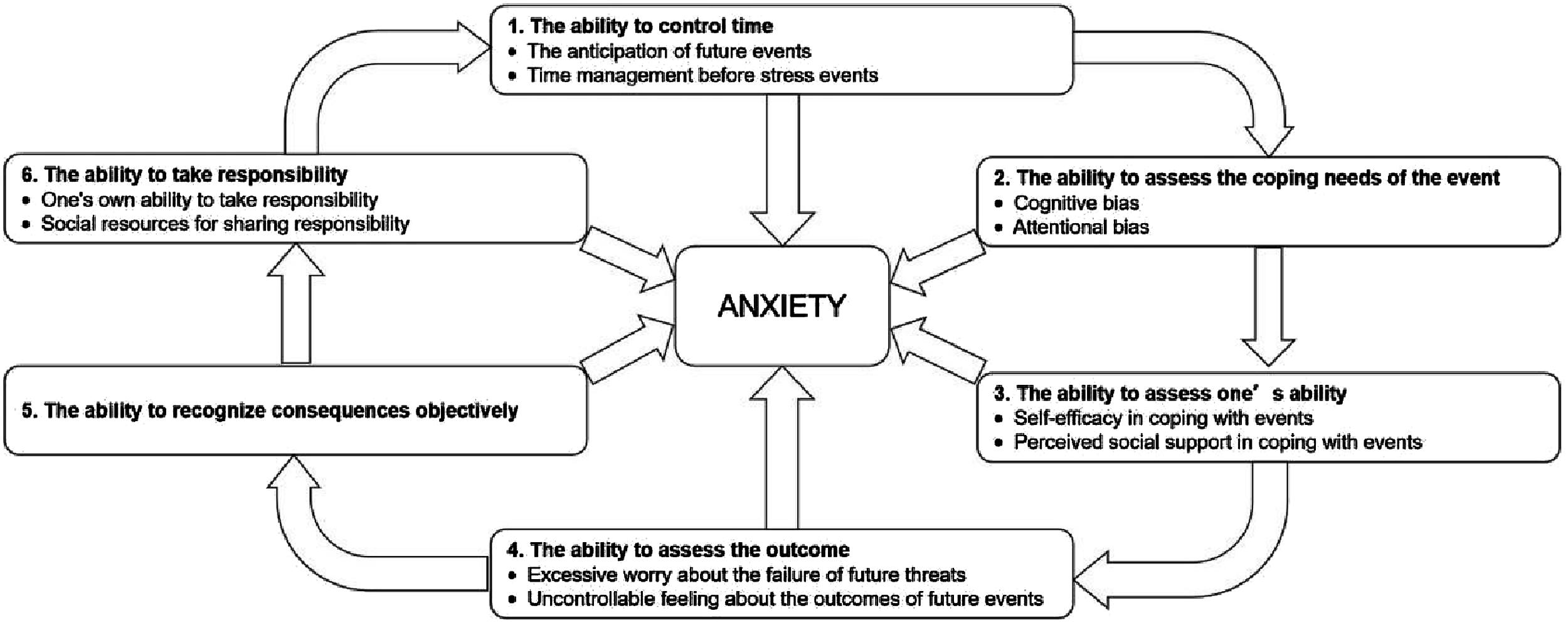
Factor 1: The Ability to Control Time
The first cognitive factor in our model is the ability to control time, which includes the prediction of future events and the management of time before future events occur. In life, the uncertainty of the possibility, time distance and nature of future events will reduce the effectiveness and efficiency of people’s preparation for future events (Grupe & Nitschke, 2013), which makes it difficult to plan and manage time effectively, and leads to a lack of sense of control over time (Jex & Elacqua, 1999), thus causing anxiety.
The Anticipation of Future Events
Anxiety can be triggered by uncertainty about future events, a fact supported by several studies (Barlow, 2000; Bennett et al., 2018; Grillon et al., 2004; Morriss & Van Reekum, 2019). The safety-signal hypothesis (Seligman & Binik, 1977) posits that when the threatening event is predictable because there is a signal to indicate the danger, when there is no signal, it means that the individual is safe; but when the threatening event is unpredictable, the individual has no perceived safety period, which makes the individual fall into long-term state of anxiety. Secondly, the knowledge that a threat is certain to happen, but without knowledge of when, can lead to anxiety (Bennett et al., 2018). Additionally, the belief that a dangerous event will approach swiftly is a cognitive factor that influences the correlation between anticipation and anxiety (Williams et al., 2005). According to empirical research, accelerated threat perceptions increase anxiety (Riskind, 2018). All three of these points indicate that the uncertain anticipation of future threats leads to the development and persistence of anxiety.
Time Management Before Stress Events
Time management is another aspect of time control ability, and individuals who lack the ability of time management may experience higher levels of anxiety. We propose that the concept of time management should be macroscopic, that is, all actions that can help to complete the task by effectively using time are included in the concept of time management in this article, including setting appropriate goals, selecting the appropriate environment, and self-growth. First, the goal setting theory states that the set goals should be challenging, specific and achievable (Fried & Slowik, 2004; Locke & Latham, 2002). Past experience is an important indicator of goal setting, and a clear deadline is a time-controlled tool that can motivate individuals to work towards the goal (Locke & Latham, 1990). When there are multiple goals, the priority of the goals should be determined according to the importance of the goals (Macan, 1994) for time management. Furthermore, if it requires prolonged exposure to highly challenging tasks, it will also burden the individual’s cognitive resources, causing stress and anxiety (Cohen, 1980). Therefore, it can be argued that some difficult tasks can be divided into simple, smaller parts, which may reduce the level of cognitive demand of the individual task and increase the likelihood and efficiency of completing the task goal (Fried & Slowik, 2004). Second, when in an environment that individuals feel encouragement and a sense of achievement, individuals will be encouraged to pursue and participate in the realization of high-value goals (Erez et al., 1990), and this environment that provides social support can give individuals confidence and motivation to achieve their goals. Moreover, a suitable physical environment, such as bright, ventilated places, can also help stimulate individual creativity and improve performance (Alencar & Bruno-Faria, 1997). Many elements in the workplace (e.g., colors, smells, sounds, and decorations) will affect the mood of the individual, and even provide support to the individual (Dul et al., 2011). Another important point is that other people in the environment also have a significant influence on the accomplishment of the task or the realization of the goal. Social learning theory (Bandura, 1977) proposes that other people in the environment can be good or bad role models. The social comparison theory (Festinger, 1964) points out that people evaluate themselves by comparing themselves with others, in order to avoid feeling that they are lagging behind others and not as capable as others, individuals will work harder to perform. Third, stress comes from the fact that the individual is not able to cope with the external needs, before the event (which can be regarded as a challenge or threat), the individual needs to reasonably manage time and maximize his or her ability to cope with the upcoming “ability assessment” in the limited time. So, setting clear and appropriate goals, selecting appropriate environment and self-growth are three steps of time management at the macro level. Time management behaviors can effectively reduce the negative impact of excessive stress on the body and mind of individuals, but time management behaviors may not directly reduce stress. Rather, it is the perceived control over time (Macan et al., 1990) developed through time management behaviours and the subjective feelings of purpose, orientation and persistence in the use of time that are directly responsible for reduced job stress, worry and increased satisfaction (Kelly, 2003).
In general, the anticipation and time management of future threats are the manifestation of the ability to control time. The former is the judgment and imagination of anticipation based on various past and present information, and the latter is the process of preparing for the occurrence of threats, and both of them can influence the generation and development of anxiety.
Factor 2: The Ability to Assess the Coping Needs of the Event
Assessing the coping needs of the event is the performance of ability, including the ability to objectively assess the information needed to respond to future events (information includes the cognitive resources and ability needed to respond), and the ability to process information, and the ability to assess the threats of events to individuals. We believe that levels of these abilities will be associated with levels of anxiety. Cognitive theories argue that negative cognitive biases, or the tendency to give priority to negative information, play a central role in the occurrence and maintenance of anxiety and depression (Beck, 2008; Beck & Clark, 1997; Clark & Wells, 1995; Eysenck, 1992; Mathews & MacLeod, 2005). Cognitive bias and attentional bias are considered to be the key cognitive factors that cause anxiety (Calvo & Castillo, 2001), and they are two subjective biases that are prone to occur when assessing future event response needs. The following two aspects of the ability are described: the cognitive bias and the attentional bias of threat.
Cognitive Bias
Early studies have proven the link between anxiety, depression and a series of negative cognitive biases (Mathews & MacLeod, 2005). In general, these theories assume that bias increases the frequency, intensity, or diversity of negative thoughts, which in turn can adversely affect emotion, related anxiety and depressive symptoms (Clark & Steer, 1996). Cognitive bias in the processing of ambiguous information has been demonstrated in many studies on anxiety (Butler & Mathews, 1983; Mathews & MacLeod, 1994; Mathews et al., 1989). Cognitive biases usually associated with anxiety tend to interpret ambiguous stimuli in a negative way. Researchers have provided empirical support for this hypothesis (Eysenck et al., 1991; Richards & French, 1992). However, these studies focused on the deviations of people with anxious traits in processing ambiguous information. We hope to reverse the relationship between the two and highlight the effect of cognitive processing on anxiety. We think that the inability to process fuzzy information objectively will increase the anxious emotion of individuals, which is a negative emotional state caused by the lack of ability (Beard & Amir, 2010). For example, the cognitive model of social anxiety suggests that interpreting ambiguous information as a threat will maintain individuals’ anxious state (Clark & Wells, 1995; Rapee & Heimberg, 1997). On the contrary, there are also studies which proved that promoting individuals’ benign interpretation can reduce anxiety (Murphy et al., 2007). Furthermore, in the cognitive models of anxiety, the overestimation of threat is an important aspect of negative thinking, which is the one central level of fear (Beck et al., 1985; Wright & Borden, 1991). The individual’s past negative experiences formed some distorted schemas, and when similar life events occur, these schemas will be activated, leading to the distortion of the individual’s interpretation of information, thereby overestimating the severity of the threat and causing anxiety.
Based on the findings of aforementioned studies, we can know that the perception of future events plays an important role in triggering anxiety.
Attentional Bias
Attentional bias towards threat signals in the situation can increase anxiety. There are different opinions in the research on the relationship between attentional bias and anxiety. Clark and Wells’ cognitive model of social phobia (1995) suggests that when people with social phobia are confronted with social interaction, they pay more attention to negative information and cues in social situations. They use these social cues to assess and predict current and future social performance, leading to negative judgments, which further aggravate emotional and behavioral symptoms. Some researchers have suggested that attentional bias may be a cognitive vulnerability factor for the development of anxiety (Bar-Haim et al., 2007; Pérez-Edgar et al., 2010). In Bar Haim’s et al. (2007) model, the relationship between attentional bias and anxiety and fear is explained by strict linear causality. But the chain concept implies that attentional bias and anxiety are a one-way causal relationship, which is inconsistent with the phenomenon observed in many studies (anxiety also affects attentional bias). Van Bockstaele et al. (2014) posited that attentional bias towards threats in the situation and anxiety should be in a complementary relationship. Attentional bias towards threat signals will increase anxiety, and anxious feelings will in turn increase their attentional bias towards threats. This is consistent with the theory of Williams et al. (1997) and Eysenck (1997).
Above, from the perspective of the mechanism of the generation and development of anxiety caused by cognition of event response needs, we believe that attention bias or threat cues leading to attention bias will increase the individual’s threatening perception of future events. Conversely, if the threatening cues of the event are not noticed, the individual’s anxiety level will in turn be lower than the threat level brought about by the event, and unmatched anxiety will also be detrimental to the individual’s adaptability.
Factor 3: The Ability to Assess one’s Ability
When people assess an event as threatening to themselves, they may examine whether they are capable of coping with the event. Individuals’ subjective assessment of their ability to cope with the event will affect the anxiety level. We can assume that this link includes two key parts: (a) subjective assessment of self-ability, namely self-efficacy; (b) subjective assessment of resources that can be mobilized by oneself, namely perceived social support.
Self-Efficacy in Coping with Events
When people feel that their sense of control over the future (self-efficacy and certainty) has declined, anxiety is easily triggered (Rector et al., 2008). Self-efficacy is a firm belief in ability, which is based on people’s assessment of various sources of information about their ability (Bandura, 1986). It is worth noting that Muris (2002) reminded us that self-efficacy is partly independent of actual ability. For example, some people are assessed to be highly competent for a particular task, but in fact, those who are not confident in their ability are unlikely to try this task. According to Bandura’s self-efficacy theory (1997), self-efficacy plays a pivotal role in self-regulation in emotional state. A sense of incompetence will seriously affect people’s judgments about life events and social conditions. When people think that they do not have the ability to deal with potential threats, they will become anxious (Muris, 2002). Another thing to note is that Bandura’s self-efficacy is for a specific task area, not a general personality trait. Because different tasks have different needs for specific skills and special ability, this leads to a lot of differences in self-efficacy levels in different tasks. And many researchers have admitted that self-efficacy measures for specific fields have greater predictive power than general self-efficacy measures (Bandura, 1990, p.102; also see Schwarzer, 1994). Therefore, the self-efficacy in the current model mainly refers to the self-efficacy in specific task areas (can be called situational self-efficacy), and measurement tools should be constructed according to different research fields, such as teaching self-efficacy, marketing self-efficacy, job-hunting self-efficacy and so on (Bandura, 1986). And many empirical studies among different populations have proved that self-efficacy is negatively related to negative emotions such as stress, anxiety, and depression (e.g., adolescents, Muris, 2002; graduate students, Ghaderi & Rangaiah, 2011; patients with physical diseases, Liu et al., 2018). At the same time, self-efficacy is also closely related to different types of anxiety (such as social anxiety, Matsuo & Arai, 1998; test anxiety, Yue, 1996; Internet anxiety, Paul & Glassman, 2017; academic writing anxiety, Huerta et al., 2016).
Perceived Social Support in Coping with Events
The assessment of the ability to respond to events also includes the individual’s knowledge of the resources available to them, that is, the social support network. Social support is a continuous social set, which provides individuals with the opportunity to know themselves and maintain their expectations of others. When the individual needs, other supportive members of the set can provide assistance, including instructive information, cognitive help, practical help and emotional support (Caplan, 1982). Perceived social support is a concept relative to actual social support, which means the individual’s expectation and evaluation of the social support they may receive, and perceived social support more emphasis on subjectivity (Barrera, 1986). The results of empirical research confirmed that: perceived more social support has a positive impact on the individual’s mental health, while lack of perceived social support will increase the individual’s anxiety level (Fredriksen & Rhodes, 2004; Mollaoglu, 2006; Norberg et al., 2006; Peter et al., 2017).
It is worth noting that the close relationship between social support and mental health only exists in stressful situations (Cohen & Wills, 1985). McFarlane et al. (1983) used longitudinal research to conclude that there is a reciprocal relationship between social support and pressure. They found that uncontrollable life events would reduce the perceived help of future support matters. However, the perceived help also interfered with the increased perception of stressful events. Regarding the impact of perceived social support on emotional cognitive mechanisms, Lakey and Drew (1997) argued that perceived social support plays a schematic role in stressful situations, interpreting and attributing the meaning of events and situations. People with high perceived social support are more likely to interpret events and situations as positive.
For assessing the individual’s own ability to cope with the event, in general, we consider the individual’s situational self-efficacy in coping with the event and the perceived social support that can be used by the individual, but even if the individual evaluates only one of the two as a higher level, it is helpful to reduce anxiety.
Factor 4: The Ability to Assess the Outcome
Combining the ability levels of the previous links will affect the individual’s ability to evaluate the outcome. The inability to objectively evaluate the possible outcomes of future events, which in turn produces unmatched outcome assessments, can lead to excessive worry or not worrying about the occurrence of negative outcomes. Therefore, we believe that the ability to evaluate outcomes is one of the important links of the six-factor cognitive domino model of anxiety. It is worth noting that the assessment of outcomes here refers to the assessment of the objective outcomes of comparing the ability needs of future events with people’s own corresponding capability, such as whether the goal can be achieved, or success and failure.
Excessive Worry About the Failure of Future Threats
Cognitive theories emphasize the importance of erroneous threat assessment in maintaining anxiety (Beck et al., 1985; Clark & Wells, 1995). These theories believe that pathological anxiety is maintained by the following tendencies: (A) linking phobic stimulus or phobic responses to unrealistic high probability damage (i.e. probability bias); (B) exaggerating the negative consequences of expected harmful events (i.e. cost bias) (Dhawan et al., 2006). We believe that probability bias is a reflection of the inability to objectively evaluating the outcomes of future events. Individuals with probability bias will exaggerate the probability of failure of the future threat events, while anxiety is the response to the threat that may lead to failure in the future (Smith & Allred, 1989). For example, in the study of test anxiety, Liebert and Morris (1967) analyzed test anxiety according to the two main factors of worry and emotionality. Among them, worry belongs to the cognitive component, which mainly points to the concern about the failure of the test outcomes. Cognition is considered to be the factor that has the greatest impact on the test, while worry are considered the most important component of cognitive factors. On the one hand, high-level test-anxious individuals pay too much attention to test failure outcomes that affect their problem-solving ability and motivation level (Flett & Blankstein, 1994). On the other hand, if an individual’s cognition of the test is often accompanied by a higher degree of worry, such as fear that a certain test will fail completely, then this cognitive style can easily be strengthened (Zeidner, 1998). Therefore, the individual’s worry about the failure of the future threat event is one of the important reasons that affect the individual’s anxiety, and the anxious individual is also accompanied by more worry about the failure outcomes.
Uncontrollable Feeling about the Outcomes of Future Events
In addition, the individual’s belief that he or she has no ability to control the outcome of future events is another explanation for outcome anxiety. Barlow (1988) argued that anxiety arises from unpredictable, uncontrollable events and emotions. And, empirical research supported that low perceived control is key to the development of anxiety (Barlow, 1988). Alloy’s (1990) helplessness model of depression and anxiety states that pure anxiety stems from a feeling of uncertainty about the outcome of future events that feels helpless (uncontrollable), which leads to an increased arousal and alertness. Therefore, this article argues that an individual’s lack of a sense of control over the outcome of a future stressful event can lead to an increase in anxiety.
Combining the needs of the environment and the individual’s abilities, individuals tend to make expectations about the outcome of events. When individuals believe that their abilities and available resources are not sufficient to cope with the environment, individuals tend to have negative expectations about the event, and negative expectations bring about negative emotions; and when individuals are not clear about the needs and their abilities to cope with the event, they usually develop a sense of not being able to control the event, and this feeling of not being able to control the future triggers anxiety in individuals. Thus, the inability to objectively assess the relationship between needs and abilities leads to an inability to objectively evaluate the outcome of the event, which is one of the key aspects that triggers anxiety.
Factor 5: The Ability to Recognize Consequences Objectively
After assessing the outcomes of future events, people will begin to imagine a series of consequences brought about by the outcomes. If the individual only one-sided imagination or exaggerates the negative consequences, it is easy to fall into the anxiety of catastrophic thinking. For example, a simple skin lesion might evoke the belief: “I have skin cancer and will die from it.” There is increasing evidence that catastrophic belief is a key predictor of distress (Geisser et al., 2000; Sullivan et al., 2001).
Ellis (1962) coined the term “catastrophic thinking” and described it as the tendency to amplify a perceived threat and overestimate the severity of its potential consequences. This is similar to the meaning of probability bias and cost bias. What we emphasize here is the impact of the potential consequences of threat events on anxiety, that is, cost bias. In many anxiety-related disorders, catastrophic explanation is considered to be the main cause of anxiety symptoms (Gellatly & Beck, 2016). In the catastrophic thinking model of Gellatly and Beck (2016), catastrophic belief, explanatory bias, attentional bias, attention fixation, and anxiety interact to maintain the catastrophic thinking cycle. Among them, the triggering event activates catastrophic belief, and people with catastrophic belief will exaggerate the potential negative consequences of the event and imagine the worst consequences (Clark, 1986). In fact, even if the individual evaluates the expected event as a positive result, it may also produce a negative imagination or even catastrophic about the expected outcomes, that is, the fear of success. Especially the fear of success shown in women is more obvious, because women often think that success will inevitably bring some negative costs (Horner, 1968).
Thus, whether the expectation of an outcome is negative or positive, there is the potential for a catastrophic assessment of the consequences of the outcome, which is an important factor in inducing and promoting anxiety.
Factor 6: The Ability to Take Responsibility
Why do not all individuals who experience negative stressful events have negative emotions such as anxiety? Another important factor that causes stress is coping (Kraaij et al., 2002). Folkman (1984) described “coping” as “changing cognitive and behavioral efforts to manage specific external and/or internal needs that are assessed to consume or exceed the person’s resources”. Stress theorists believe that sufficient psychological coping resources as an important part of the ability to deal with emotionally disturbing events (Folkman & Lazarus, 1988; Matheny et al., 1986). Because the object of this link is the negative consequences of the stress event, the “coping” here refers to the responsibility for the negative consequences of the stress event, which is distinguished from the coping to the stress event itself. We argue that individuals not only need coping ability when coping with the stressful event, but subjective assessment of their ability to bear the consequences of the stressful event is a more important factor affecting individual emotions. If an individual believes that he or she has the ability to deal with the negative consequences of stressful events, or can get useful social support (resources) to help bear the consequences, then his or her emotion will be less affected by the previous link (assessing the consequences of stressful events), because these negative consequences will not have a lasting and serious negative impact. For example, we already know that expected unemployment will have many negative consequences, but if a person is confident in his ability to cope with the consequences and has enough resources to live a normal life even when he is unemployed, or to get support from family or friends, then expected unemployment may not cause much anxiety to the him.
From the point of view of the source, the coping resources that bear the responsibility for the consequences can also be divided into internal coping resources and external coping resources. Therefore, this part of the six-factor cognitive domino model of anxiety also needs to be discussed from two aspects: personal coping ability (internal coping resources) and social support (external coping resources). The relationship between internal and external coping resources and anxiety can be seen specifically in the Factor 3 section.
Domino Effect: Chained Relationship Between The Six Cognitive Factors
These six cognitive factors not only have independent and direct effects on anxiety, but also are interlinked. Just like dominoes, problems in one cognitive factor will have an impact on the next cognitive factor, resulting in anxiety and vicious circle.
The Perceived Control over the Time of the Expected Event Affects the Assessment of the Threat of the Event
First of all, the individual’s sense of control over future events will have an impact on the assessment of events. Predictability is an important feature of a sense of control over future events. From the time dimension, whether the expected event occurs, the time of the future event and the approaching speed are important factors of perceived anxiety. The assessment of the possibility, time and state of the stimulus is the embodiment of predictability. Sussman and colleagues (2015) found that the predictability of threat stimuli affects perceptual sensitivity and speed of perception of stimuli. If events are unpredictable, individuals will perceive stimuli as threatening and pay more attention to the threat stimuli (Mathews & MacLeod, 1994; Williams et al., 1997). Besides, the additional arousal of approaching threat stimuli will also increase individual attention bias and priority treatment of threats (Grillon & Charney, 2011; Mather & Sutherland, 2011). Therefore, the individual’s expectation of the event affects the assessment of the threat of the event by affecting attention and perception. However, there is no clear theoretical explanation on the relationship between unpredictability and threat cognitive assessment, and most studies still focus on the top-down expectation driving effect on perception.
The Ability to Recognize Expected Threat Events Affects the Assessment of Coping Ability
With the escalation of threat assessment, individuals’ assessment of level of their own ability will decrease. We believe that if an individual perceives vague cues as threatening or exaggerates the degree of threat, the individual will then suspect that his or her own ability is insufficient to cope with the pressure of threats, and use this defensive thinking to protect the individual from being hurt. This view is supported by the emotion evaluation model (Lazarus, 1999; Lazarus & Folkman, 1984), in which the “preliminary” assessment judges the stressor as a threat (damaging) or a challenge (opportunistic), which affects the subsequent “secondary” assessment, that is, to assess the individual’s perceived coping ability and alternative coping methods (Chen & Jackson, 2019). In other words, the perceived needs of the environment determine the degree of confidence of the individual in his or her ability to cope with the needs of the environment. Some studies have shown that the perception of environmental stress is related to self-efficacy (Guo et al., 2019; Lee et al., 2016; Park et al., 2008), and a high level of perception of stress can predict low levels of self-efficacy (Cho & Kim, 2014). These results show that the perception of stress can affect individual cognition, emotion and behavior. When individuals assess that the demands of the environment are threatening, this idea will weaken their perceived ability to cope with the needs, and individuals are more likely to adopt evasive ways to deal with the needs of the environment, and have more negative emotions, such as anxiety and depression.
Perceptions of one’s Own Coping Ability and Perceived Social Support Affects the Assessment of Outcome Expectations
Although self-efficacy and outcome expectation are usually regarded as parallel factors by researchers to analyze their influence on behavior and emotion, in fact, the relationship between these two factors is close (Bandura, 1982; Larson & Daniels, 1998; Schunk, 1984, 1990), and self-efficacy will affect the success or failure of the expected outcome to a certain extent. Bandura (1984) argued that self-efficacy and outcome expectations are two completely different concepts. Self-efficacy is based on past experiences and emphasises perceptions of competence, whereas outcome expectations are perceptions of outcomes that may occur in the present or future. Confident people have a greater expectation of a successful outcome, whereas those who lack confidence perceive failure as more likely (Pajares & Johnson, 1994). Although there are not many studies on the relationship between the two, some studies have proved that self-efficacy has a certain influence on outcome expectation (Devins et al., 1982; Yu & Ko, 2006). Among them, Devins and colleagues (1982) mentioned that low perceived self-efficacy can reduce self-esteem and increase depression, and these two characteristics are also characteristics of individuals with lower outcome expectations. In addition, the perceived availability of social support can increase positive outcome expectations. Cohen and Wills (1985) divided social support into four categories: esteem support, informational support, social companionship, and instrumental support. Among them, informational support refers to suggestions and guidance for response to problems and events, and instrumental support is to directly provide problem solving tools, such as material resources. If the individual perceives informational support and instrumental support that may be helpful to solve the problem and help the individual cope with the stress when facing a stressful event, then it is more likely to produce positive outcome expectations. In brief, having a high level of self-efficacy or perceiving sufficient social support can help individuals to deal with the pressure of future events more confidently, resulting in more positive outcome expectations.
Perception of the Outcome Affects the Assessment of the Consequences
The ability to assess outcomes is followed by the ability to evaluate consequences, two factors that seem similar but are in fact different. The assessment of outcomes is often limited, such as whether the goal is achieved, negative outcome or positive outcome, but the assessment of the consequences is varied. The individual’s assessment (imagination) of the consequences is more subjective, and various possibilities can be imagined, forming important reasons for worry. For example, if a student thinks that his or her college entrance examination will be worse than expected (outcome), he or she may next think that failure of the college entrance examination will lead to disappointment of parents, ridicule from classmates, not finding ideal job, and even life failure (these are consequences). Further research indicates that probability bias increases cost bias (Shirotsuki et al., 2010). For example, if an individual perceives public speaking as threatening, he or she may be more afraid of making a fool of himself or herself in a speech (probability bias), which is disastrous for him or her, makes him or her feel ridiculed, and impairs people’s assessment of his or her ability (cost bias). In other words, there is a misperception of the outcome, which then leads to a series of disastrous consequences resulting from the negative outcome. Thus, overestimating the likelihood or probability of a negative outcome occurring can lead individuals into a spiral of imagined catastrophic consequences.
Assessment of the Consequences Affects the Assessment of Responsibility
The next link of dominoes is that the ability to assess consequences affects the ability to assess responsibility. Expected consequences may affect individual self-assessment (Bandura, 1997). We argue that the expected consequences can affect the individual’s self-efficacy, and further affect the individual’s coping strategies and emotional responses. If people expect the consequences of the event to be negative and very serious, they will assess that they have less ability to bear these negative consequences, including perceived lower self-efficacy and lower perceived social support. The expected consequences of inducing anxiety are often negative and exaggerated. This distorted belief in the consequences will reduce the individual’s self-efficacy in the face of the responsibility for the consequences. However, there is another possibility that people with low self-efficacy who bear the consequences may also have lower feelings of helplessness and negative emotions, that is, they can rely on available support resources, such as more capable people, to cope with the expected consequences (Devins et al., 1982). But those anxious people are often unable to objectively perceive their own social support resources, or ignore or underestimate them, even after the expected consequences are bad, so that they not only think that they are unable to bear the consequences, but also think that no one can help them deal with these negative consequences and end up in a state of isolation.
The Ability to Take Responsibility Affects Time Management
The ability to take responsibility for consequences can further influence the ability to control time. Specifically, when dealing with consequences, individuals with high self-efficacy are more proactive in dealing with challenges and adopting positive coping strategies (Schwarzer & Aristi, 1997), thus being well prepared for challenges before they arrive. Thus, when faced with the consequences of failure, individuals with high self-efficacy have a greater sense of control over their time and assess their ability to grow and achieve their goals through time management. In addition, social support, as an important psychological resource, can provide instrumental and psychological help for individuals to achieve their time management goals (Hobfoll, 2002) and improve their time management skills. On the one hand, individuals with a high perception of social support are more likely to have a greater sense of control in anticipation of negative consequences, adopt more positive coping strategies, and are thus more motivated to pursue their goals and to engage in time management and self-growth in order to achieve them (House et al., 2003). On the other hand, perceived social support allows individuals to feel that others can provide them with material or moral support, which allows them to cushion their psychological stress and focus on solving problems and achieving their goals through time management in the face of the consequences of expected failure. In conclusion, self-efficacy and the perceived social support as psychological resources for coping when taking responsibility for expected consequences can influence an individual’s time management skills and promote advance planning and preparation for taking responsibility.
Discussion
In this article, we have formed a more comprehensive and specific cognitive model of anxiety by synthesizing existing anxiety models, theories, and practical work experiences in psychological counseling and treatment. This model can help people more easily understand the mechanism of anxiety and guide people in coping with stressful events to prevent excessive anxiety. First, we propose and describe in detail the six-factor cognitive domino model of anxiety, and clarify their direct relationships respectively with anxiety by reviewing and synthesizing existing studies. Secondly, We have combined practical work experience in counselling and relevant researches to try to clarify the causal relationship between these six cognitive factors and anxiety, as well as the closed-loop logical relationship between these six cognitive factors like a domino effect. Through the discussion of these two parts, we hope to show more clearly the cognitive mechanism of anxiety in the six-factor domino model.
Theoretical Implications
The six-factor cognitive domino model of anxiety has several important theoretical meanings. First, the model emphasizes the causal relationship among various cognitive factors that affect the generation of anxiety. Many past models on the mechanism of anxiety also involved many cognitive factors, but most of them proved that the correlation among each cognitive factor and anxiety is considered separately, or there is a relatively vague correlation among cognitive factors. Through literature review and logical reasoning, the model suggests that these cognitive factors not only affect anxiety levels individually, but that there is a logical and sequential causal relationship between them. Just like dominoes, one factor will trigger a series of chain effects. These cognitive factors that trigger anxiety are just like this, which can explain the catastrophic thinking pattern of anxiety and how to guide the reasonable occurrence of anxiety.
The six cognitive factors in the domino model of anxiety proposed in this paper all reflect the individual’s abilities, emphasizing the fact that there are causal influences among individuals’ different abilities, which in turn lead to the development of anxiety. In general, our view is that the individual’s subjective perception of his or her lack of social adaptability leads to the generation of anxiety. And several extant theoretical perspectives also argue that anxiety is caused by lack of ability. However, these perspectives are not very clear in defining and differentiating abilities, for example, by generalizing abstractly about abilities, or by equating self-efficacy with abilities. But the six-factor cognitive domino model of anxiety suggests that at different psychological time stages, the content of individual thinking is different, and the content of individual assessment of their own ability is also different, so it cannot be generalized. Therefore, it is necessary to clearly divide the abilities assessed at different psychological stages.
In addition, the current cognitive trainings that interferes with anxiety focuses on post-event cognitive training, but such post-event interventions cannot avoid people suffering from anxiety. However, cognitive training prior to the occurrence of a stressful event can fully utilize the individual’s emotional regulation of anticipations and reduce the degree of negative anticipations. It also helps individuals adjust their cognition of stressful events, increase their coping ability and use resources to face the anxiety brought by future uncertainty. Although the six-factor cognitive domino model of anxiety mainly describes the cognitive mechanism of anxiety, it proposes a method to solve this chain effect, that is, through objective assessment of one’s own ability, to set appropriate goals, select the appropriate environment, and conduct time management for self-growth. Many researchers have long recognized that time management is an effective way to cope with anxiety caused by stressful events (Aeon & Aguinis, 2017; Häfner et al., 2014). Moreover, time management is an ability that can be cultivated through time management training. The time management training we proposed can be divided into three dimensions: (a) set the goal (b) select the appropriate environment (c) self-growth, the implications of these three steps are detailed in time management before stress events in factor 1. Overall, training can improve the ability of time management, which in turn improves the individual’s ability to control time, which then influences the overall six-factor cognitive domino model of anxiety.
Practical Implications
The six-factor cognitive domino model of anxiety has practical significance for the management of anxiety in individuals prone to experiencing stressful events. Anxiety is a negative expectation of an uncertain future threat (Grupe & Nitschke, 2013). Therefore, how to manage expectations before a stressful event occurs is the key to avoiding excessive negative emotions and affecting performance. Our model points out that the method of anxiety management before the stressful event occurs—risk management and improving the ability of time management can help individuals to keep their anxiety levels within appropriate limits before coping with stressful events Because stress and performance are in an inverted U-shape, appropriate “benign stress” can promote individual performance (Selye, 1978). Therefore, the six-factor cognitive domino model of anxiety has important practical significance for how individuals can reduce their anxiety in the face of anticipated stressful events and how organizations can manage their employees’ stress to improve their performance.
Ability is a key concept throughout our model, and it is different from trait or tendency, can be changed and improved by training. So, it has practical implications for anxious individuals. In response to the anxiety caused by the lack of six abilities in the model, we propose to promote the other abilities through risk management and the improvement of time management skills. Risk management allows individuals to realize what the worst consequences will be. Time management skills then increase the likelihood of task completion by allowing individuals to prioritise and organise activities with the resources they can utilize, depending on the level of risk perceived by risk management (Claessens et al., 2004). The expectation that tasks will be completed successfully or that performance will improve reduces personal stress and anxiety. Also, individuals with high time management skills will prioritise their tasks, focus on the one task at hand and are less likely to procrastinate. Such individuals will gain satisfaction (Zafarullah & Pertti, 2017) and a sense of control in time management, as well as reduce feelings of stress (Häfner & Stock, 2010). It could even be argued that time management is a valuable ability to help individuals overcome negative emotions when they are facing adverse situations and coping with a lack of resources. In short, risk management and time management can not only help to cope with stressful events, but also increase and maintain individual happiness, and satisfaction in work and life (Aeon & Aguinis, 2017), which are of great value to individuals and organizations.
Limitations
This article still has some limitations, but these limitations are also a possible direction for future improvement and deeper research on the six-factor cognitive domino model of anxiety.
Firstly, the present model does not consider the potential influence of other factors (e.g., biological, environmental) because it focuses on the influence of cognitive factors on anxiety production, which is a limitation of the present model.
Second, the model is a preliminary idea summarised in the process of accumulating a large number of counseling cases, and this paper argues the possibility of the existence of the model at the theoretical level through past theoretical and empirical studies. In addition, there have been empirical studies that have partially validated the model (Gan, 2022; Chen, 2019). In the future, it is still necessary to validate and improve the model through more empirical studies, and to assess the applicability of the model in different contexts. For example, premarital anxiety, social anxiety, language learning anxiety, and employment anxiety are stressful situations with their specificities, whether the anxiety cognitive domino model can be interpreted generically in different contexts, and which cognitive factors may not work or have new cognitive factors playing a greater role in different contexts are worth to be explored in the empirical studies, as it may affect the mechanisms of models in different contexts.
Although studies from different cultural backgrounds have been used in this article to argue for a relationship between cognitive factors, the discussion of the influence of cultural factors on each cognitive factor could be expanded in detail in the future. Many studies have shown that the contexts, processes, and experience and expression of anxiety are influenced by various cultural factors, including, for example, the norms faced by individuals in a given culture, ways of pursuing the self, and traditions of social practices (Hinton, 2011; Hofmann et al., 2010; Kleinknecht et al., 1997; Lewis-Fernández et al., 2010).
Fourth, considering the relationship between individual differences and the cognitive factors of the model to identify potential moderators and mediators of the model’s effects is also a direction that could help refine the model in the future. This is because individual personality differences are strongly associated with daily stress and can influence thinking and behavioural styles to vary (Williams & Carlson, 2024). For example, research had found that neuroticism is positively associated with negative emotions in situations with high stress, while dutifulness and extraversion are negatively associated with negative emotions (Leger et al., 2016). Additionally, individuals with chronic diseases and poor health behaviours are at increased risk of experiencing emotional disorders (Farris & Zvolensky, 2019). In addition, the applicability of the model to different age groups is a direction that needs to be validated in the future, for example, whether it can be applied to both mentally immature children and cognitively aging older adults.
Finally, the use of anxiety cognitive domino models for anxiety pre management has not yet formed specific application plans that are suitable for different populations and clinical environments, and there is a lack of actual effectiveness evaluation in clinical practice. In the future, it is necessary to explore clinical application plans based on this model framework and develop targeted intervention measures for anxiety sufferers. In addition, the proposed method of intervening in anxiety by improving risk management and time management abilities can also be used for longitudinal studies in the future to track intervention effects, including changes in anxiety levels and assessment abilities at various stages of the model.
Footnotes
Declaration of conflicting interests
The author(s) declared no potential conflicts of interest with respect to the research, authorship, and/or publication of this article.
Funding
The author(s) received no financial support for the research, authorship, and/or publication of this article.

Data availability
Data sharing not applicable to this article as no datasets were generated or analyzed during the current study.