



Abstract
Although many language teachers resort to their first language (L1) at various junctures during their practice, not many studies have tried to understand the reasons for this from teachers’ personal perspectives. This study aimed at investigating English as a foreign language (EFL) teachers’ cognitive processes during their classroom codeswitching. Stimulated recall technique was used to tap into teachers’ cognition. An entire session of four EFL teachers’ classroom practice was video-recorded. This was followed by an interview session in which participants tried to recall their thoughts while watching their own performance. The recollections, which were recorded and transcribed, were then analyzed using a three phase model of theme assignment, categorization, and labelling. The findings showed that eight factors were mentioned by teachers as the reasons for their codeswitching with Students’ Better Comprehension and Efficiency constituting the most and least important ones, respectively. Implications are drawn for classroom practice and suggestions for future research are provided.
Introduction
Teacher cognition, defined as ‘the unobservable cognitive dimension of teaching – what teachers know, believe and think’ (Borg, 2003: 81), has been the focus of various studies since the mid-1990s. Research projects concentrating on teachers’ knowledge of grammar instruction (Andrews, 1994; Borg, 1999), beliefs on teaching L2 writing (Burns, 1992; Tsui, 1996), knowledge of the best ways for implementing their lesson plans (Bailey, 1996; Bartels, 1999), and opinions about teaching (Cabaroglu and Roberts, 2000; Smith, 1996) have aimed at illuminating the role of teachers’ cognition in their decision making process. These studies, however, encompass a rather small proportion of those realms which are affected by teachers’ beliefs and thought processes. As an incipient research area in the ELT context (Gatbonton, 2008), more studies are needed to investigate the role of teacher cognition in other aspects of the language classroom (Akbari and Dadvand, 2011; Akbari and Tajik, 2009).
One of the relatively unexplored areas in which language teacher cognition may play a crucial role is teachers’ codeswitching; that is, the choice of different codes (mother tongue versus foreign language) in the classroom. As the term choice implies a sort of ‘decision-making’, the outstanding concept that can be inferred from the studies of teacher thinking (Freeman, 2002) is that these choices are influenced by teachers’ mental cognitive processes. Therefore, by investigating why teachers switch between the mother tongue and the foreign language (FL), one might be able to delve into the underlying cognitive processes that guide teachers’ decisions to codeswitch.
The necessity of conducting such a study becomes more evident as one finds out that codeswitching has been considered a pedagogical instrument in the hand of teachers despite the traditional criticisms against the use of students’ first language (L1) in the classroom (Cook, 2001). Furthermore, recent studies show that teachers have a more positive attitude toward the use of L1 since they view it as a constructive instrument in teaching and classroom management (Carless, 2008; Orland-Barak and Yinon, 2005; Storch and Aldosari, 2010; Van Der Meij and Xiaoguang, 2010).
Therefore, looking at the issue of codeswitching (CS) from the teachers’ perspective may reveal some pedagogically significant aspects of their mental lives that have remained vague for researchers (Mugla and Seedhouse, 2005). With the aim of tackling this issue, the following research questions were addressed in the present paper:
What are teachers’ motives for CS in the classroom?
Which of these motives are the most/the least prominent ones?
More specifically, attempts were made to tap into teachers’ cognitive processes during CS by identifying the logic (or reasons) behind it. These motives were then ranked from the most important (or frequently occurring) to the least significant.
Teacher CS in the Classroom
Codeswitching refers to ‘the use of more than one language or code in a single stretch of discourse’ (Belz, 2002: 61); it may occur either inter-sententially, when speakers switch at clause or sentence boundaries, uttering either of the clauses or sentences in one of the two languages, or intra-sententially, which involves switching within a single clause or sentence boundary (Sankoff and Poplock, 1981).
For the purpose of the present study, the previous research on teachers’ CS has been categorized into function-related and reason-related groups; that is, a number of studies have tried to come up with different categories of tasks that are accomplished through teachers’ use of L1 within the confines of the classroom (hence the functions of teacher CS). In contrast, the second group includes research projects that have focused on why teachers switch to L1. For example, a teacher might switch to L1 to translate an unknown vocabulary item (i.e. the function) because of the belief that it helps save class time (i.e. the reason).
The majority of publications in this regard have focused on the functions of CS. A review of these studies (e.g. Kim and Katherine, 2005; Mugla and Seedhouse, 2005; Polio and Duff, 1994; Qian et al., 2009; Rolin-Ianziti and Brownlie, 2002) indicates that teachers usually resort to the L1 to translate a word or sentence, talk about the features of the foreign language (i.e. metalinguistic use), manage classroom, highlight important points, and build rapport with students.
Among a few studies that intended to investigate the reasons assigned by teachers to their instances of CS (which is the focus of the present study), Duff and Polio’s (1990) can be mentioned as one of the first attempts. They audio-recorded two sessions of the classes taught by 13 native teachers of different foreign languages. The participants were then interviewed with the purpose of enquiring about their teaching background, philosophy of teaching, and their attitude toward the use of students’ L1 (English) in the classroom. The results revealed that departmental policies, avoidance of comprehension breakdown, the disparity between the L1 and L2, students’ proficiency level, the activities at a given moment in the classroom, and the available time were the main reasons that influenced teachers’ decision to switch to students’ L1.
This study, however, is hampered by some methodological problems. First, the purpose of the interviews was to investigate participants’ general ideas about CS, but this was done without them listening to the recorded materials of their classroom performance or focusing on any particular example of their CS. This might have undermined the reliability of their statements since they were mostly general statements based on what they had in mind at the time of the interview and, therefore, what they said might not fully describe their detailed belief systems about CS. In other words, what they stated in their interviews might not have entirely reflected their mental cognitive processes during their teaching practice. Second, the study was conducted among teachers who did not share the same L1 with students. This might have reduced the generalizability of the findings to the dominant language teaching situations where teachers and students have a common native language. The fact that the researchers did not provide any information regarding the demographic characteristics of their sample teachers (e.g. gender, age, academic degree, teaching experience, etc.) makes the generalization of the results even more problematic.
In another study, Macaro (2001) asked six student teachers of French to discuss some arguments and counter arguments about the use of L1 in the classroom and attend a one day class in which they were taught French in order to experience and reflect upon the exclusive use of the L2. Moreover, they observed experienced French teachers’ classroom with a focus on their practices of CS. They were then given six separate French classes to teach over a 14-week period. Their classroom performance was videotaped followed by the transcription of the occasions in which they had switched to English (which was both teachers’ and students’ L1). In addition, no longer than 10 days after the end of the period, two of the teachers were individually interviewed using the stimulated recall technique in order to discover the reasons behind their CS. The results of the interviews showed that teachers assigned two types of reasons to their CS: at the macro level, National Curriculum guidelines and, at the micro, avoidance of breakdown in communication and better student comprehension were the most important reasons. In contrast, teacher education programmes experienced by the participants played no significant role in influencing their decisions for CS.
Macaro’s study has some methodological defects that compromise its internal and external validity. Doubts exist regarding the ‘ecological validity’ (Mullock, 2006: 50) of the study; since the classes were formed only for research purposes and participant teachers were aware of the focus of the study from the very beginning, their classroom performance might not have been as natural as desirable. In addition, there was a long time lapse between student teachers’ classroom performance and the stimulated recall protocols (around ten days) which might have hindered the participants from remembering the exact thoughts involved in their teaching processes (Gass and Mackey, 2000). Therefore, what they recalled while watching their own instances of classroom CS might not have exactly reflected their thought processes during their teaching.
In a case study, Edstorm (2006) played the role of both researcher and participant teacher by audio recording an entire term (24 sessions) of her Spanish class and keeping a reflective journal. The results of data analysis indicated several reasons for the teacher’s CS such as considering teaching as a moral obligation for building a relationship with students, achieving multiple goals such as recognizing the difficulty of learning a language, better understanding the relationship between language and the realities it describes, avoiding the stereotypical ideas about the target culture, and also feeling too lazy to talk in the target language.
The methodological problem here was that the researcher/teacher was aware of the purpose of the study which might have influenced her classroom practices. Moreover, since the researcher and the teacher was one and the same person, her reflective journal writing and analysis might have been biased in the sense that she had inadvertently imposed her own ideas on writing and analysing the journals with the aim of reaching the desired outcomes.
Finally, Kang (2008) conducted a case study in which he observed and audio-recorded 14 sessions of the classroom practice of a Korean English as a foreign language (EFL) teacher in an elementary school. He also held three interviews with the teacher at the beginning, in the middle, and at the end of the period. Interview transcripts, which aimed at discovering motives for CS from the participant’s perspective, indicated that students’ inability to comprehend the target language input, teacher’s lack of necessary proficiency, and, above all, students’ interest were the reasons identified by the teacher.
Taken together, the available literature on teacher CS has mainly focused on its functions. In other words, researchers have tried to find out when teachers usually resort to students’ L1 throughout their practice without paying enough attention to why they switch on those occasions. Even in the studies in which teachers’ personal perspectives on CS have been taken into account, there are some methodological problems that render the validity of the findings doubtful. Consequently, the present study partially aimed at filling this gap by utilizing a more reliable procedure for eliciting EFL teachers’ ideas about their CS which will hopefully result in a better understanding of teachers’ cognitive processes in this regard.
Methodology
Participants
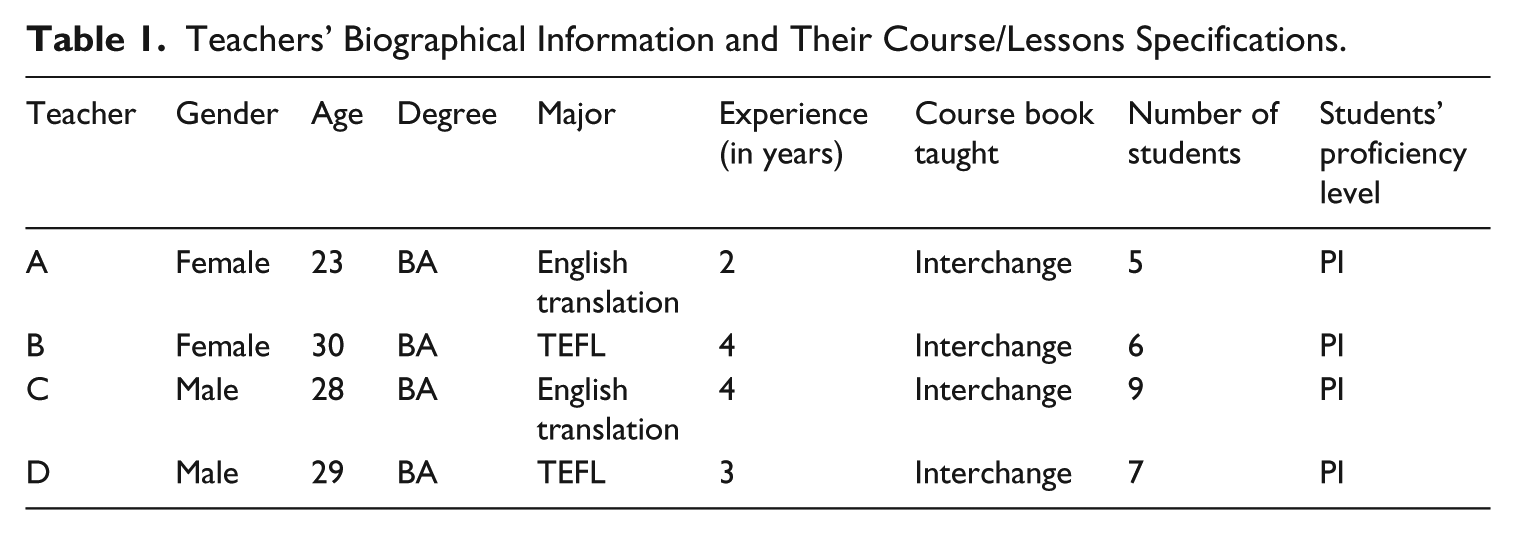
Four full-time EFL teachers (two males and two females) teaching general English courses in a private language institute in Kermanshah, one of the western cities of Iran, participated in this study. The majority of private institutes in Iran (including this one) follow a communicative approach to language teaching and discourage teachers from using students’ L1 irrespective of their proficiency level. This provides an appropriate situation for studying CS.
The participants were between 23 and 30 years old with Bachelor of Arts (BA) degrees in English-related majors: teachers A and C held a BA in English translation, and teachers B and D had BA degrees in Teaching English as a Foreign Language (TEFL). Using the non-probability sampling technique called purposive sampling (Ary et al., 2005), the target participants were selected from among less experienced teachers with roughly the same amount of teaching experience (i.e. between two to four years of pedagogical practice) in order to control the effect of experience on the research outcome.
The number of students in the participating classes ranged from 5 to 9 with a total of 25. All of them were between 15 to 27 years of age and shared the same native language with that of the teachers, i.e. Persian. They attended English classes twice a week with each session lasting 75 minutes. Here again efforts were made to minimize the effect of extraneous variables through selecting intact classes which had as homogeneous students as possible in terms of their native language, age, ethnic background, and proficiency level (i.e. pre-intermediate or PI). Table 1 provides a detailed illustration of the features of the four teachers and their corresponding students.
Teachers’ Biographical Information and Their Course/Lessons Specifications.
Data Collection
Since it is believed that stimulated recall protocol is one of the most suitable approaches for examining teachers’ cognitive processes (Meijer et al., 2002), this method was utilized for gathering participants’ perspective on their instances of CS. This approach includes videotaping a session taught by the target teachers followed by an interview session in which they comment on their classroom performance trying to recall as many thought processes as possible while teaching. In fact, since teachers cannot teach and verbalize their thoughts simultaneously, this approach is supposed to let them imagine themselves in the classroom situation and remember their thought processes at the moment of their teaching.
In a meeting with one of the researchers, all four participants received some broad explanation about the nature of the study and data collection procedure. Then a schedule was planned for conducting the video recording sessions and follow-up interviews. In each interview session, while watching their classroom performance, teachers were asked to state why they had switched to L1 (either inter-sententially or intra-sententially) on certain occasions. The verbal recollections were recorded and then transcribed for follow-up analysis. It should be noted that different frameworks have been proposed for CS (e.g. Meyers-Scotten, 1993); however, Sankoff and Poplock’s (1981) classic framework was adopted in the present study since we needed to come up with a clear definition which made it easy to extract instances of CS in teachers’ recorded videos.
Several measures were taken to make sure that the reliability and validity of the research findings would not be greatly affected by the use of this data collection approach. First, although participants received some explanation about the nature of data collection procedure and the following interview, they were not explicitly informed about the exact purpose of the research. By so doing, it was hoped that they would not be negatively affected by their conscious attention to the CS phenomenon and their classroom practice would be closer to the natural situation. Second, in order to minimize the effect of the presence of camera on teachers’ and students’ classroom conduct, the main videotaping phase started in the third session after having kept the camera off on the tripod at the rear of the class for two sessions. Also, the video recording was completed without the presence of any of the researchers so that teachers’ and students’ classroom performance would not be negatively influenced by the presence of an observer. Furthermore, because the passage of time may hinder teachers from remembering the exact thoughts they have had during their teaching practices (Gass and Mackey, 2000), efforts were made to minimize the interval between the participants’ classroom performance and the follow-up interviews. The time lapse ranged from a quarter to two hours for different participants depending on their teaching schedule. Finally, in order to avoid any confusion regarding the participants’ inability to express themselves in English, all the interviews were conducted in Persian. For the purpose of illustration, however, the literal English translation of the excerpts are presented in the results section, hence there may be some occasionally grammatical lapses.
Data Analysis
A three-phase approach was adopted for data analysis. In the first one, named theme assignment, each of the transcripts (in which teachers had talked about the reasons for their CS) was assigned a theme with a phrasal structure based on the main reason mentioned by teachers as the underlying incentive for their CS. Then, all the themes with a similar content were grouped together in the categorization phase and received a particular label according to the common thematic content (i.e. labelling phase). This yielded a classification of reasons that were mentioned by the participants as the motives for the recourse to L1. The following excerpts from teacher A’s and teacher B’s verbal recollection protocols demonstrate an example of how the process of theme assignment, categorization, and labelling proceeded in practice:
Why did you speak Persian here?
I felt that if I explained [this grammatical point] in English, perhaps they would not understand. I would like to explain in Persian so that they would understand in both languages.
Why did you use Persian in this moment?
To help them [students] get the meaning better. [If Persian explanation is provided,] they would no longer make a mistake and they would not make a big deal out of it.
Accordingly, helping students make better sense of the target language was the theme assigned to teacher A’s excerpt and helping students absorb the meaning and avoid making mistakes was the one given to teacher B’s transcript. As their contents more or less conveyed the same reason, these two themes were categorized into a single group which was labelled Students’ Better Comprehension based on the common thematic content of its belonging themes.
However, the process of theme assignment, categorization, and labelling was not as straightforward as it has been illustrated in the above example. In some cases, various reasons were mentioned by the teachers as the underlying motive for a single instance of their CS. Here different themes were assigned to a single excerpt which were consequently classified under various categories. As an example, in the following excerpt checking students’ memory and having repetition for better learning were the themes that emerged from teacher D’s verbal recollection transcript which were then categorized under the groups Check Students’ Comprehension and Students Better Comprehension respectively:
Is there any reason that you speak Persian here?
Yes, I want to see whether they remember wh-questions. Also, I want them to repeat the point for themselves so that they would learn better.
At the same time, to check inter-rater reliability of the categorization phase, a second party, a colleague who was familiar with the research analytic scheme, was asked to regroup the extracted themes, an attempt which is believed to increase the reliability of the results (Gass and Mackey, 2000). The results yielded 92% of consistency between the researchers’ categorization and that of the outside examiner. In those cases that this second party’s categorization was not similar to that of the researchers, a final decision was made through discussion.
Results and Discussion
The recorded videos of teachers’ performance indicated that roughly 27% of the entire class time was devoted to the use of L1. Also, a total of 58 themes could be extracted from the transcribed interviews. They were then categorized into eight groups of reasons according to the similarity of their thematic content. Each group received a label which best described the common core characteristic of its belonging themes. These eight reasons along with the frequency of the themes which described them are illustrated in Table 2.
Frequency of the Reasons for Teacher CS.
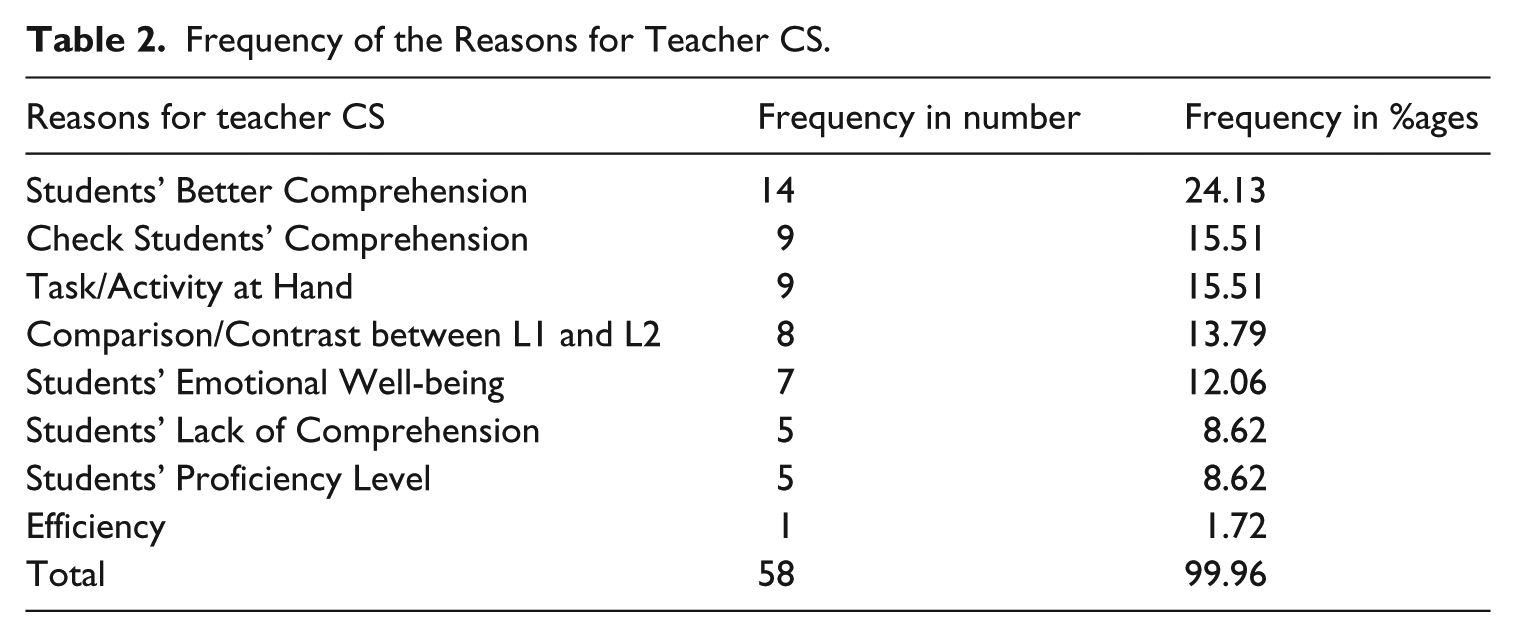
As it can be seen, Students’ Better Comprehension was the most frequently cited reason for resorting to L1, whereas Efficiency was mentioned just once by one of the participants. In fact, all the four participants were primarily concerned with the comprehensibility of what they said to the students. This preoccupation was manifested in different forms in their classroom practice, including repetition of what they said, asking students some follow-up comprehension questions, physical gesture, and elaboration on what they stated in more detail. However, one of the most convenient tools that all of the teachers utilized at some point during their teaching was resorting to the L1. In fact, in most of the cases, this form of CS was preceded by some minutes of explanation, elaboration, and other aforementioned tools. In the words of teacher A: When you use Persian to explain a point, you can be sure that everybody in the classroom will be able to understand the matter.
Also, Students’ Better Comprehension was the ultimate goal in those occasions that teachers used the L1 to discipline them or show disapproval of their behaviour. Teacher C, for instance, utilized the L1 to reprimand a late comer so that she would completely grasp the idea and try not to be late in future. Elaborating on the moment, he said: I told her, ‘the class starts at 6 sharp.’ Since she might not understand English, in this occasion I used Persian so that she would completely comprehend what I meant and therefore would not repeat the same mistake [i.e. being late] in future.
The same reason has been mentioned in some previous studies (Duff and Polio, 1990; Edstorm, 2006; Kang, 2008; Macaro, 2001). It seems that the mother tongue is utilized by language teachers not only to enhance students’ comprehension, but also to see whether they have understood a point. L1, as the most reliable source that teacher and students have in common, helps them compensate for communication breakdowns (Macaro, 2001) and overcome comprehension problems.
The second reason mentioned by all the participants for switching to Persian was checking students’ comprehension. This one, which is closely related to the previous reason, manifests itself in the form of teacher-induced CS (Mugla and Seedhouse, 2005). More precisely, teachers asked students, for example, to translate into Persian what they had just said in English. This would let teachers know that the students had understood the learning material and, therefore, no further elaboration was needed. Commenting on one of the occasions of CS in his class, teacher D states: I asked the student to translate the sentence into Persian to see whether she had got it. When she mentioned the Persian equivalent, I was sure that she had learned it.
In some cases, all the participants used L1 in order to compensate for students’ lack of comprehension (the sixth reason mentioned by teachers). This reason for teachers’ CS, which is closely intertwined with the two previous ones, grew out of various signs which showed students’ difficulty in understanding some explanation given by the teacher. The signs involved a question asked by students, a facial gesture showing their lack of comprehension, or their silence in response to teachers’ comprehension check questions. As an example, in an episode of her verbal recollection, teacher A commented on her CS: Here, I asked them [students] the meaning [of the word]. They did not know it, so I switched to Persian in order to explain it.
The difference between the first reason (Students’ Better Comprehension) and this one is that, in the former, explanation was provided as a result of teachers’ discretion without the presence of any symptom of lack of comprehension, whereas, in the latter, it was the outcome of observing some signs of lack of comprehension. Overall, it can be said that more than 40% of the reasons for teacher CS were concerned with student comprehension in one way or another.
Another reason mentioned by three of the teachers (A, C, and D) has to do with the task at any given moment. In other words, some of the activities (e.g. explanation of grammatical points) seem more difficult to explain in English. Also, it is hard for students to understand the complex, technical language of grammar through English. Here Persian is the preferred code to achieve the simultaneous purpose of easier explanation and understanding. For example, when teacher A commented on one of her instances of CS in the case of grammatical explanation, she said: Irregular verbs are easier to understand [in English]. But I explain the regular verbs in Persian so that students will understand better.
The same finding has also been echoed by Duff and Polio (1990) and Kang (2008). One explanation might be that since some activities need more elaboration from teachers, a more complex language (in terms of technical words) must be used (Kim and Elder, 2005). On the other hand, as teachers are obsessed with providing comprehensible input, they avoid using the TL, which might hinder students’ comprehension.
Two of the teachers (B and D) resorted to Persian throughout their teaching in order to make a comparison between English and Persian, hence the fourth reason for CS, i.e. Comparison/Contrast between L1 and L2. They found it interesting for students to discover the similarities between the two languages, especially with respect to pronunciation. As teacher B said: [In this occasion] I wanted to make students notice that blouse is the same as blooz /blu:z/. So students do not need to look for a word for the shirt they have on because blooz in Persian is the same as blouse in English.
Also, at some points, the ultimate goal was longer retention of the TL material. Therefore, teachers made a comparison between the two languages with the hope that it would become easier for students to remember the newly learned issues. In one instance, teacher D said: I think it is easier for students to remember English items if they find the similarities between them and Persian words. In this way, they are able to associate English words with Persian words and therefore it is less likely that they forget the newly learned material.
This reason for CS shows that some language teachers still believe in the basic tenets of contrastive analysis; that is, they think if students become conscious about the similarities and differences between the mother tongue and the TL, they would be more able to learn the second language. Moreover, some of the mistakes that students make are the result of the L1 interference and such a comparison is helpful for them to overcome these difficulties (James, 1981).
Affective considerations was another reason behind two of the teachers’ (A and C) CS. The use of Persian by teachers would help students feel solidarity and overcome the stressful situations that usually arise from being located in the target language classroom. According to what participants said, CS was used to reduce students’ stress and gain their attention. Teacher C, for example, stated that: She [one of the students] is one of the youngest students in the class. She is a very good student, but was stressed a little. She even stated that she was stressed out. I [used Persian and] encouraged her to try [to answer the stated question].
As Krashen (1985) claims, if students are going to learn another language, the first step is reducing their affective filter so that they can approach the FL without much apprehension. The use of the L1 as a pedagogical tool helps students conquer the fear of participating in classroom activities especially among young learners and those who are at the beginning stages of learning.
Two of the teachers (C and D) believed that since students were at the initial stages of learning English and were not highly proficient (they were at the pre-intermediate level), the use of the mother tongue seemed inevitable on some occasions. But as the students become more proficient over time, the amount of class time during which the teacher speaks Persian would decrease. In the words of teacher C: [I spoke Persian] because the students are at the beginning semesters. I believe in the first few terms we cannot teach exclusively in English. I think we should teach in both English and Persian.
As indicated in some previous studies (e.g. Duff and Polio, 1990), the less proficient the students are, the more likely the teacher is to resort to his/her L1. In fact, as mentioned above, since teachers try to increase students’ comprehension at any cost, they would consider their proficiency level as a determining variable. Consequently, at the beginning stages, the use of mother tongue is widespread in the classroom, while it becomes less prevalent at more advanced levels.
Finally, in one case, teacher B mentioned lack of enough time as the motive behind her CS in the classroom. According to what she said, sometimes it takes a lot of time to explain something in English and one has to use Persian in order to save time which is better to be spent on something else. In her own words: With this Persian translation, instead of speaking for an hour in front of the whiteboard, I would be able to provide a concise and to-the-point explanation.
This finding, which is supported by the available literature (e.g. Duff and Polio, 1990; Qian et al., 2009), has to do with the fact that in many cases language teachers are forced to follow an existing syllabus. They are usually required to cover certain units of a predetermined book and, at the end of the term, students are asked to sit for an exam which will determine the future of their studies. Although in our research, just one teacher mentioned this reason for resorting to L1, it seems that this is a problem that many language teachers encounter but they might use different strategies, such as providing less explanation and ignoring unimportant activities, to be able to complete the curriculum within the schedule.
Overall, the results indicate that irrespective of the institutional policies which advocated the minimal use of the mother tongue, all the four participants resorted to this tool in different occasions during their teaching. From what teachers mentioned regarding their motives for CS, it might be claimed that teachers’ cognition is a strong driving force which leads them to switch to their students’ L1 with the purpose of accomplishing various matters.
Conclusion
The present study is unique in terms of the methodology it has utilized to tap into EFL teachers’ cognition on the reasons behind their classroom CS. Although limited in the number of participants, it has possibly made a contribution to the language teaching and research. For example, instead of criticizing the use of the L1 in the classroom, language teaching experts must think of methods which can optimize the application of the mother tongue. In this regard, it might be advisable to provide teachers with a comprehensive framework depicting the appropriate time when switching to the L1 can be beneficial. Additionally, it is useful to know that the primary concern of language teachers is students’ comprehension, even if it necessitates switching to the L1. It might be a good idea to provide student teachers with a repertoire of strategies in teacher education programmes that help them enhance students’ comprehension and learning, including the optimal procedures to utilize L1.
Due to the qualitative nature of the present study, generalization to other contexts must be made with care. At the same time, further research is necessary to delve more into the reasons behind teacher CS instances. Certainly this line of research can illuminate the possible potentials for the use of the mother tongue in the classroom. Also, contextual differences can play a crucial role in the amount and type of teacher CS. Future studies must try to discover the influence of this variable by collecting data from participants who are teaching in various contexts (e.g. urban versus rural schools). Finally, students’ proficiency level, as one of the reasons leading to teacher CS should be investigated more deeply. Future researchers should try to find out the reasons that teachers might mention as being the underlying factor for their resort to the L1 at various proficiency levels.
Footnotes
Acknowledgements
We are grateful to all the participants and language institute administrators who kindly contributed to this study by their participation or cooperation.
Funding
This research received no specific grant from any funding agency in the public, commercial, or not-for-profit sectors.