




Abstract
This paper presents the relationship between Korean EFL learners’ self-reporting learning style preferences and their perspectives on ELT materials evaluation. Quantitative data was acquired from 521 subjects’ responses to a learning style survey and a questionnaire of materials evaluation checklist. The findings show that Korean EFL learners’ major (salient) learning styles were likely to affect their views of materials evaluation. That is, learners with multiple major learning styles and with tactile or kinesthetic learning styles tended to have higher levels of expectation concerning materials evaluation. Also, they tended to be significantly concerned with the criteria relevant to their major learning styles. This suggests that learning style can be a referential indicator for the selection of learner-appropriate ELT materials. Teachers can utilize information about their students’ perspectives on materials evaluation relative to learning styles to facilitate materials selection or adaptation, and to develop teaching methods with consideration of individual learners’ preferences. The implications of the study will be discussed.
Keywords
Introduction
Learners in EFL contexts are primarily dependent on ELT materials as well as teachers’ instructions for their English language learning. Therefore, ELT materials should enable teachers to provide efficient instructions to learners and encourage the learners to improve their English language proficiency. While Korean elementary or secondary school teachers’ and students’ materials evaluation and selection is rather limited due to the central role of a national English curriculum and textbook in the EFL context, university instructors and students can play a significant role in the procedures for adopting more appropriate materials out of various commercially-published coursebooks.
However, it appears that in reality instructors and university-level learners are often not at the center of the planning, development, and selection stages of ELT materials. Learners, in particular, have been neglected in the implementation of materials evaluation, even though they have some potential abilities as materials evaluators (Breen and Candlin, 1987). More practically, it appears that learners have been largely excluded from the decision-making process in terms of textbook selection in classroom contexts, whereas the role of teachers has been more extensive (Lee, 2013).
Recently, theoretical rationales for learner-centered curriculum development within adult EFL contexts have received more attention. The learner-centered curriculum is a collaborative effort between teachers and learners, since learners are closely involved in the decision-making process regarding the content of the curriculum and how it is taught. In addition, content selection is an important component of the curriculum. In such a curriculum, clear criteria for content selection offers guidance on the selection of materials and learning activities and assists in assessment and evaluation (Nunan, 1988).
In his analysis McGrath (2002) found that the needs and wants of learners are not actively considered in the discussions of materials evaluation and selection. Weimer (2013:15) argued that a ‘learner-centered’ approach can be realized when ‘teaching motivates and empowers students by giving them some control over learning processes’. Nunan (1988), in describing the learner-centered curriculum, emphasized that learners are qualified to state their own needs and preferences with regard to learning content when they are given appropriate opportunities. Further, Cunningsworth (1995) and Tomlinson (2011, 2013) argued that learners’ analysis of materials was worthy of serious consideration. Chambers (1997) also noted that a wide range of users’ participation in selecting suitable materials is recommended.
Despite increased interest in individual differences in language learning, there has been little effort to discuss such learner individual differences in depth and to apply knowledge gained in practical areas such as curriculum development, teaching methodology, and materials selection (McDonough et al., 2013). For example, learners’ learning styles can relate directly to ELT materials use. Perceptual learning styles, as an instance of learner difference, can be incorporated into ELT materials so that language input is presented to learners in their preferred form of sensory style such as:- visual; auditory; tactile; or kinesthetic, and in any preferred social mode, group or individual.
The present study ultimately intends to explore whether Korean EFL learners’ learning styles are related to their perspectives on ELT materials evaluation. Even though learning styles are not the only factor which affects learners’ perspectives on materials evaluation, it seems probable that EFL learners’ perceptual learning style preferences may have something to do with learners’ preferences for the qualities of language materials since the presentation mode of language input in the materials is closely related to perceptual learning styles. EFL researchers and ELT practitioners should be provided with theoretical and practical implications for the development of evolved materials, the selection of appropriate materials, and the adaptation of the materials in classroom with consideration of individual learning styles.
Background
Individualized perspective on materials evaluation concerns individual learner differences. Each learner is naturally different in many respects, so it can be assumed that learners will vary in their estimation of evaluation criteria depending on these individual differences. For example, highly-motivated learners have shown a decreased interest in decorative illustrations, whereas low-motivated learners have provided positive feedback to pedagogic illustrations within materials (Kim, 2003). It is assumed that individualized opinion on materials evaluation will derive from learners’ different characteristics. These differences range from demographic factors such as age, gender, geographical location, and membership, to the individual factors of language learners such as aptitude, motivation, learning strategy and learning style preferences. Therefore materials should be informed by consideration of both learners’ consensual and individualized opinions on materials evaluation.
Unfortunately, however, studies on materials evaluation from learners’ points of view have fallen behind other areas in SLA research. As learner-centeredness has become a crucial theme in the field of ELT, addressing learner factors in ELT materials evaluation accords closely with current trends. Variables in language learning encompass a wide range of learner characteristics, for instance, intelligence, aptitude, personality, motivation, learning style, and learning strategy, among others (Dörnyei, 2005; 2006; Lightbown and Spada, 2006; Skehan, 1991). This has increased interest in individual differences with reference to language learning that should be integrated with the theories and principles of ELT materials development.
Dörnyei (2005: 155) argued that ‘some sort of style harmony would be beneficial in many respects for teachers and learners alike’ noting a mismatch between learning styles and the syllabus/language tasks. It is expected that this mismatch can be mitigated by analysing learners’ learning styles and then empowering students to adopt various approaches (Oxford and Anderson, 1995). In other words, knowledge of students’ learning styles is the first step in order for teachers to provide them with more effective learning environments. Teachers’ awareness of students’ learning style preferences may allow them to provide them with more research-based teaching rather than merely conventional instruction. Moreover, learners may also benefit from greater knowledge of their own learning style preferences.
Knowledge of learning styles has the educational potential to benefit both teachers and learners (Dörnyei, 2005); that is, teachers can utilize information about learning styles in instruction, and learners can facilitate their own learning through greater knowledge of their individual learning styles. This match between teaching styles and learning styles has been extensively examined (Hyland, 1993; Kinsella, 1995; Peacock, 2001; Tudor, 1996; Reid, 1996), and the findings indicate that learners can learn more effectively when teaching styles are consistent with individual learning styles. This implies that having knowledge of learners’ learning styles will provide teachers with useful information in regard to practical aspects such as teaching methodology and curriculum and materials development. Several studies have also revealed that learning style as a variable of individual difference is relevant to L2 achievement (Chen, 2009; Ehrman and Leaver, 2003; Lee and Kim, 2014; Peacock, 2001; Wong and Nunan, 2011). All things considered, studies on learning styles appear worthy of further investigation in an effort to reveal the theoretical and practical implications for more effective English teaching and learning.
Despite the fact that the majority of learners’ individual differences can hardly be considered in terms of construction of ELT materials or teaching methods, the characteristics of language learners as individuals can provide insightful information on design of materials and methods (McDonough et al., 2013). Studies on ELT materials from the perspectives of learning styles remains an under-researched area (McLoughlin, 1999), yet some researchers have indicated that learning styles should be taken into account in the optimization of curriculum implementation and materials use (Keobke, 1998; McLoughlin, 1999; Rasmussen, 1998; Riding and Grimley, 1999; Wild, 1996). Learners can provide a range of feedback on ELT materials depending on their learning style preferences, and this feedback can be directly or indirectly relevant to their English achievement. Consequently, teachers’ and materials developers’ knowledge of their learners’ style orientation can facilitate the development of appropriate teaching methods and instructional materials.
Methodology
The research questions whether Korean EFL learners have different perspectives on ELT materials evaluation criteria depending on their major learning style preferences. If so, what are they? A total of 521 EFL learners from four different universities in South Korea participated in the survey throughout a year from April 2012 to March 2013. Their responses to a two-part questionnaire were used. The 30-item questionnaire adapted from Reid (1987) and the 15-item checklist questionnaire adapted from Kim (2004) were implemented for the analysis of the learners’ major learning styles and their perspectives on the importance of each evaluation criteria (see Appendix).
Major learning style refers to participants most favoured learning style, for example visual, auditory, tactile, kinesthetic, group, or individual style. A learner can have one distinctive major learning style, multiple major styles, or no major style (Reid, 1987; 1998). In the present study, major learning style is identified through the respondents’ rating to the learning style statements which are based on a five point Likert-scale (Strongly agree=5, agree=4, so so=3, disagree=2, and strongly disagree=1). The sum of the scores determines a respondent’s major learning style.
The perspective refers to preference based on the respondent’s individual judgment or belief. The materials evaluation criteria refer to the list of reason(s) that the evaluator considers when evaluating materials for the selection of appropriate materials. In the present study, learners’ perspectives on ELT materials evaluation criteria are elicited by learners’ rating to listed criteria presented in a checklist questionnaire in numerical value on a five point Likert-scale (Very important=5, important=4, so so=3, little important=2, not at all important=1).
Ratings on the questionnaire of learning styles and materials evaluation criteria represent the quantitative data. The data were analysed via SPSS 20 and Microsoft Office EXCEL 2007. Two types of data analyses, descriptive statistics and inferential statistics, are presented. Descriptive statistics such as means, standard deviations, frequency, and percentages are included in order to identify the learners’ major learning styles, and to descriptively examine the learners’ perspectives on ELT materials evaluation criteria. Inferential statistics are also used. ANOVA and t-tests are conducted in order to explain mutual relationship for the purpose of generalization. The significance level of all tests for inferential statistics is set at p <.05.
Results and Discussion
Number of Major Learning Styles and Perspectives on Materials Evaluation Criteria
The key objective is to discover the correlation between the number of major learning styles is related to the learners’ perspectives on evaluation criteria. First, the mean score of each 15 evaluation criteria was examined by the number of major learning styles: zero (no), one, two, three, four, five, and six. According to the results of the descriptive statistics, the mean scores of all 15 evaluation criteria were lowest in no major learning style. The group of six major learning styles has the 11 highest mean scores out of the 15 criteria, and the second-highest mean score by criterion belongs mostly to four or five major learning styles. In other words, the learners with multiple major learning styles tend to be placed at a higher value on the criteria than those identified with no or a single major learning style.
Figure 1 clearly illustrates the pattern of the learners’ perspectives on materials evaluation criteria depending on number of major learning styles. As seen, the broken line in the very front (with the darkest colour) stands for ‘no major learning style’, and then the remaining lines identify major learning styles from one to six follow behind in precise order. So, the second from the front line describes ‘one major learning style’, the third line ‘two major learning styles’, and, finally, the line at the very back (with the softest colour) stands for ‘six major learning styles’.

Graph of Broken-line on Criteria Importance by Number of Major Learning Styles (MLST).
The seven broken lines indicate that 1) There is a tendency for mean scores of the 15 evaluation criteria to ascend as the number of major learning styles increase. 2) Generally, the pattern of change in the seven broken lines is similar throughout the 15 evaluation criteria, but in case of ‘six major learning styles’ some variations are present in criteria 5, 6, 11, and 12, which are relevant to encouragement of learner responsibility, acknowledged methodology, self-study friendliness, and practicability of materials.
To sum up, the findings suggest that the number of major learning styles is associated with perspectives on ELT materials evaluation criteria. Compared to learners with a high number major learning styles the learners with fewer major learning styles generally express the opinion that the given 15 evaluation criteria are less important. This phenomenon may suggest that the learners with multiple learning styles desire to utilize a variety of functions present in most materials.
Type of Major Learning Styles and Perspectives on Materials Evaluation Criteria
This focus now moves onto consider, whether opinions on materials evaluation criteria differ depending on type of learning style. In order to identify the salient traits of the perspectives of each style learner, the 521 learners were dichotomized between ‘the major learning style-identified’ and ‘the major learning style-absent’. That is, visual-identified learners and visual-absent learners, and five other pairs were examined with regard to their responses to 15 materials evaluation criteria.
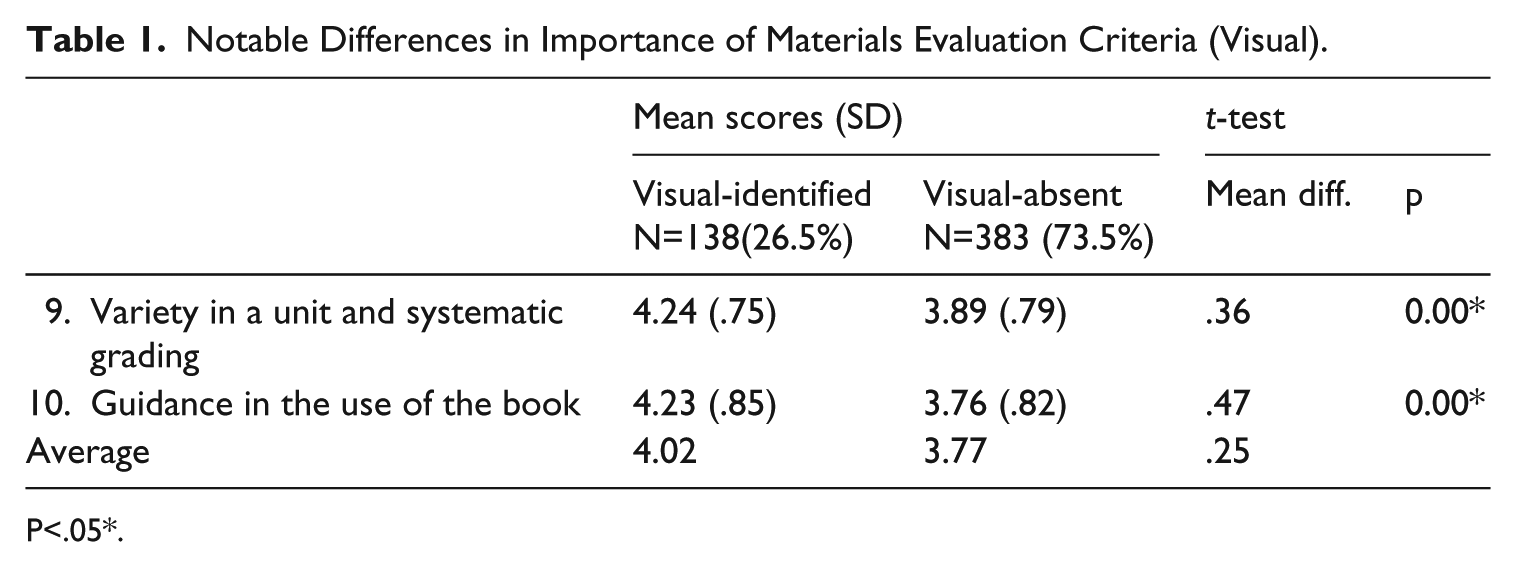
First, 138 visual major learning style-identified learners and 383 visual major learning style-absent learners were compared. The learners who are identified as visual major learning style have moderately higher mean scores on the importance of all the evaluation criteria than those of the rest. Especially, in terms of criterion 10 and criteria 9, differences are most marked at .47 and .36, respectively as shown at Table 1. That is, it can be argued that visual learners are more conscious of the visual aspects in materials such as guided overview and the organization of the contents than non-visual learners.
Notable Differences in Importance of Materials Evaluation Criteria (Visual).
P<.05*.
On the whole, however, the difference between the two groups (visual and non-visual) with respect to their perspectives on the 15 criteria is at a moderate level in that the average of the differences is no more than 0.25. Visual-identified learners, therefore, are not likely to be conspicuously different from visual-absent learners with regard to their value of the materials evaluation criteria.
Independent t-tests were also carried out in order to statistically compare the mean scores of the two groups. The results indicate that the 13 mean differences are statistically significant at the alpha level below p<.05 except for the criteria of encouragement of learner responsibility, and inclusion of summary and index. This may suggest that visual major learning style-identified learners are generally more sensitive when evaluating ELT materials, yet they do not have very different opinions from non-visual learners on encouragement of learner responsibility and inclusion of summary and index.
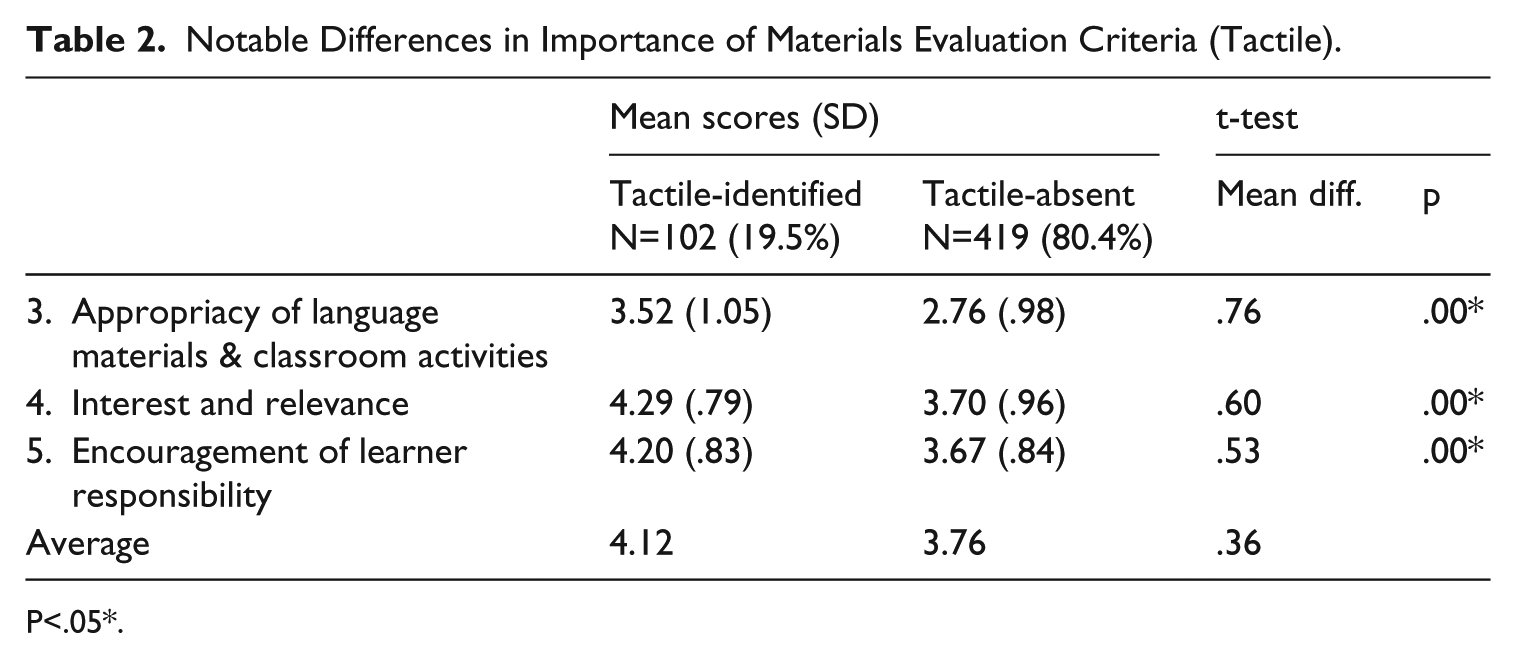
Tactile major learning style belongs to 102 learners, and the remaining 419 learners are identified as tactile major learning style-absent. The learners who are identified as tactile have similarly higher mean scores on the importance of all evaluation criteria than the learners who are identified as non-tactile. The results indicate that tactile-identified learners generally have higher expectation levels than tactile-absent learners when evaluating ELT materials. The average of 15 evaluation criteria importance is 4.12 for tactile-identified and 3.76 for tactile-absent learners. The average of the mean differences is 0.36. Particularly, in terms of criteria 3, 4, and 5, the mean differences between the two groups are as large as .76, .60, and .53, which indicates that the tactile-identified learners are especially more aware of the importance of appropriacy of language materials and classroom activities, and interest and relevance, and encouragement of learner responsibility. Table 2 shows the differences.
Notable Differences in Importance of Materials Evaluation Criteria (Tactile).
P<.05*.
This tendency is understandable in that tactile-oriented learners prefer to learn through direct and hands-on experience, for example, building or assembling activities. It appears that tactile–identified learners spontaneously pay more attention to how the activities are played and whether the activities or tasks are interesting and encouraging enough for them to enjoy. According to the t-test results, in 13 criteria out of 15, the mean difference between the two groups is significantly different at the alpha level below p<.05.
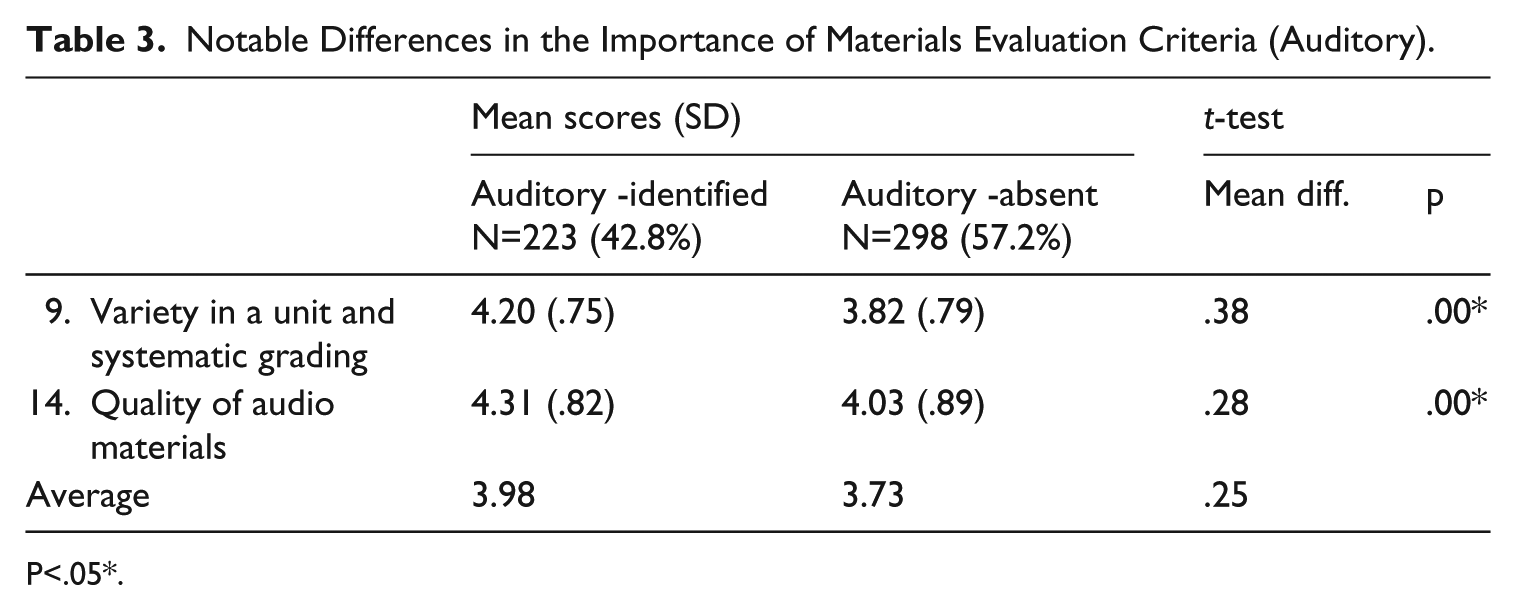
The number of auditory major learning style-identified learners equals 223, and the remaining 298 learners are considered auditory major learning style-absent. Auditory style is the most favoured learning style that 42.8% of the entire population of the present study belongs to. Auditory-identified learners also provide moderately higher mean scores on the importance of all the evaluation criteria than auditory-absent learners.
According to the results, the average of 15 evaluation criteria level of importance is 3.98 for auditory-identified learners and 3.73 for auditory-absent learners, as shown at Table 3. The average difference equals 0.25, which indicates that the difference between the two is modest. The results of the t-test indicate that the differences are mostly significant at the alpha level below p<0.5. In terms of the criteria relevant to appropriacy of language materials and activities, interest and relevance, and methodology, however, the significance of the difference was not confirmed.
Notable Differences in the Importance of Materials Evaluation Criteria (Auditory).
P<.05*.
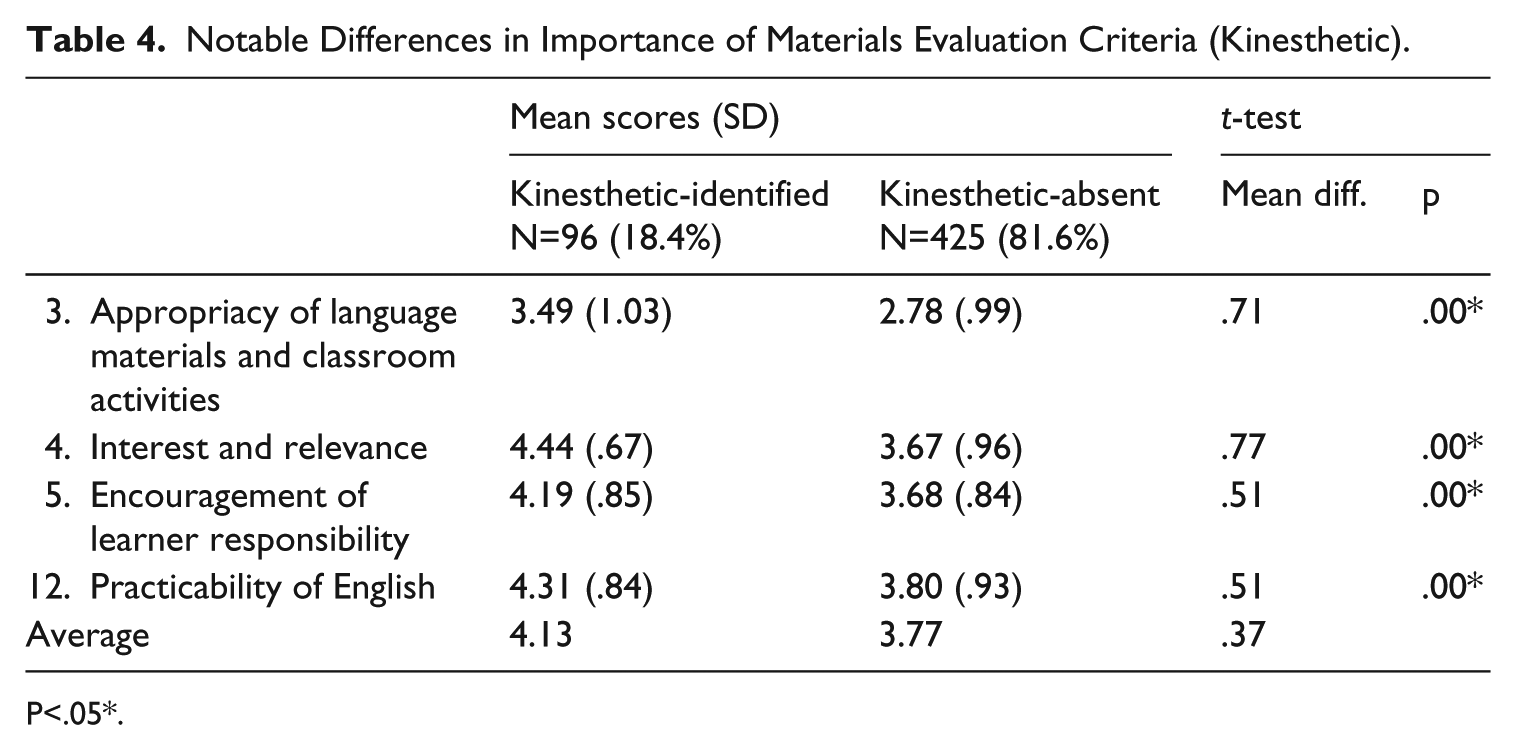
Kinesthetic learning styles have much in common with tactile learning styles based on the analysis, and the similarity between the two is convincing as both learning styles feature experiential learning methods such as role playing and model building. Table 4 provides notable statistical information on the mean scores of the evaluation criteria importance answered by 96 kinesthetic major learning style-identified learners and 425 style-absent learners. Kinesthetic-identified learners show higher mean scores on the importance of all the evaluation criteria than kinesthetic-absent learners. The average of the mean differences of the 15 evaluation criteria is 0.37, and this is the largest gap among the six pairs of major learning style-identified and -absent.
Notable Differences in Importance of Materials Evaluation Criteria (Kinesthetic).
P<.05*.
Kinesthetic-identified learners consistently present the opinion that all the evaluation criteria are important, whereas kinesthetic-absent learners are comparatively lenient. Particularly, in terms of criteria 3 and 4, the mean difference between the two groups is large at .71 and .77, which indicates that kinesthetic-identified learners are especially aware of the importance of appropriacy of language materials and classroom activities, and interest and relevance. There also exists a gap of 0.51 between the two groups on criteria 5 and 12. These findings indicate that kinesthetically oriented learners value learning activities, interesting and encouraging contents, and authenticity of English use.
According to the t-test results, in 13 criteria out of 15, with the exception of methodology and reasonable price and availability, the mean differences between the two groups are significantly different at the alpha level below p<.05. This indicates that kinesthetic major learning style-identified learners generally have a higher level of expectation than non-kinesthetic learners in almost every aspect.
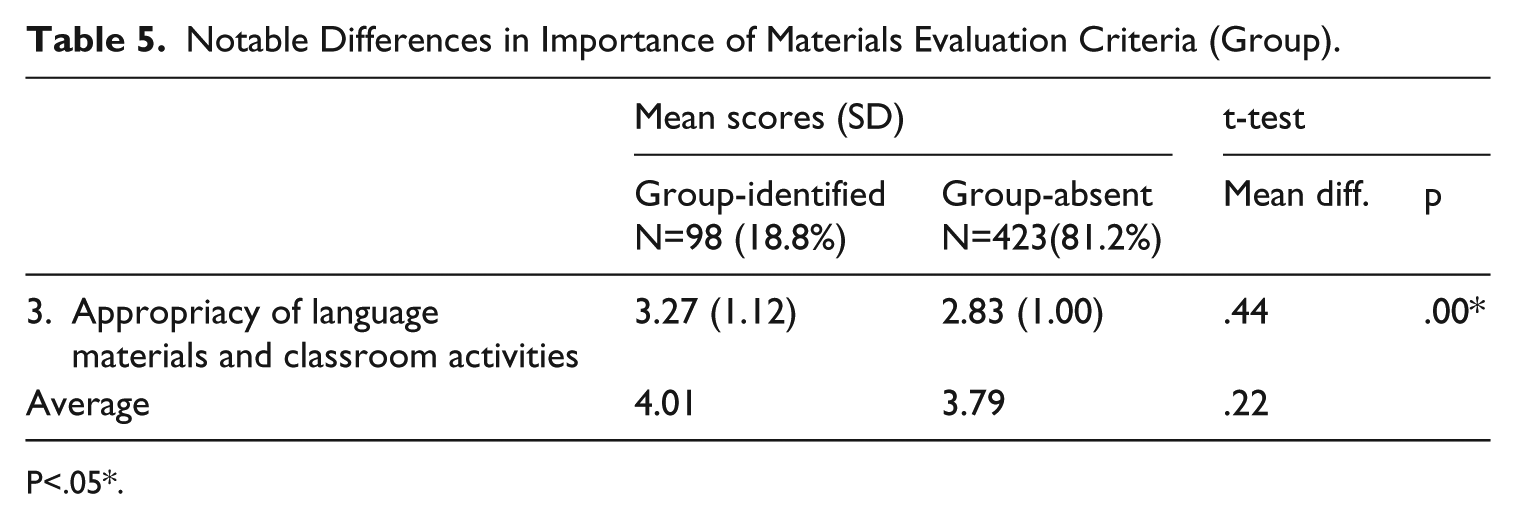
Differences in mean scores between group major learning style-identified learners and style-absent learners, and between individual major learning style-identified learners and style-absent learners, reveal rather different patterns from the above-mentioned major learning styles. According to Table 5, the average of the mean score differences is 0.22 between group-identified and group-absent learners. The biggest gap is 0.44 for criterion 3, appropriacy of language materials and classroom activities. It indicates that group-identified learners care more about whether the materials provide appropriate language models and activities. Other than this criterion, no prominent difference is found between the two groups.
Notable Differences in Importance of Materials Evaluation Criteria (Group).
P<.05*.
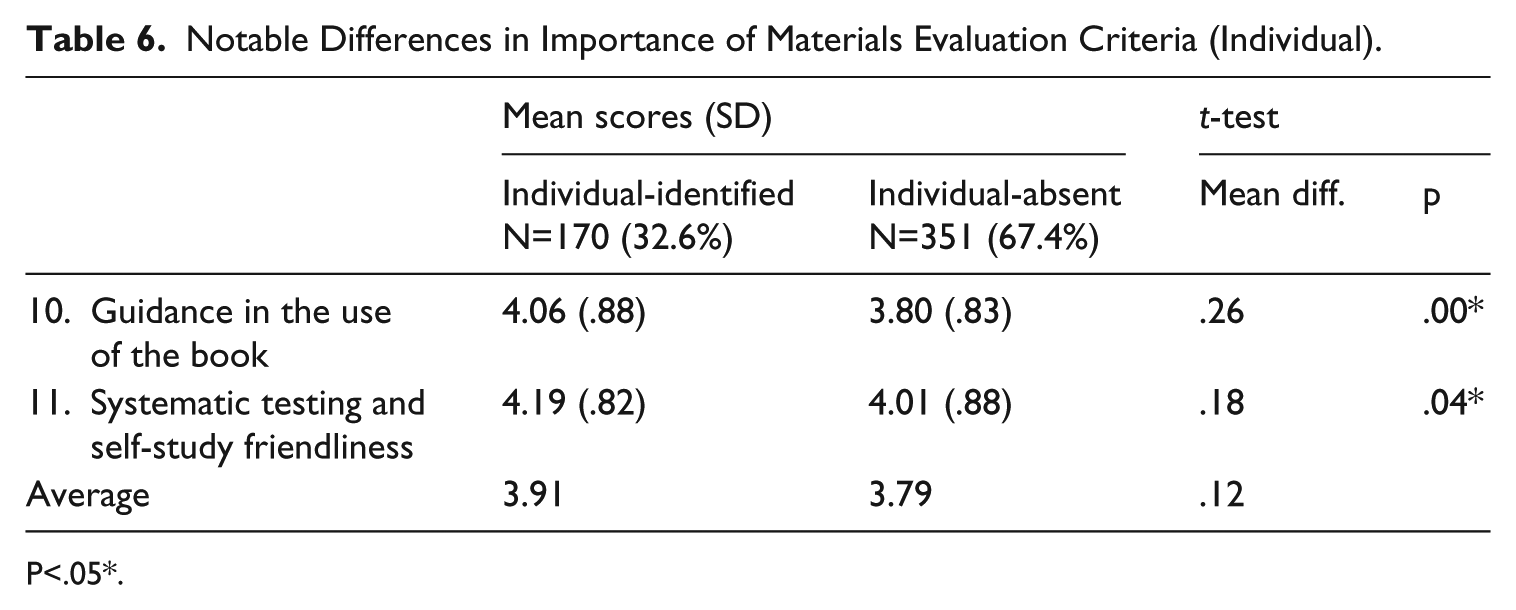
In case of individual major learning style-identified learners, the average of the mean score differences from the style-absent learners amounts only to 0.12, which shows the slightest difference among those of the six learning style pairs. Table 6 demonstrates that individual style learners may not be as sensitive when compared to other style learners.
Notable Differences in Importance of Materials Evaluation Criteria (Individual).
P<.05*.
In short, the social mode of learning style is not as likely to influence learners’ perspectives on materials evaluation criteria as profoundly as sensory modes such as visual, tactile, auditory and kinesthetic learning.
One final analysis of the dichotomy between major learning style identification is related to the ‘No major learning style-identified’ group. The total 521 learners are divided into ‘No major learning style-identified’ group, which consists of the learners who do not reveal any major learning style and ‘Any major learning style-identified’ group, which represents the learners who have more than one learning style.
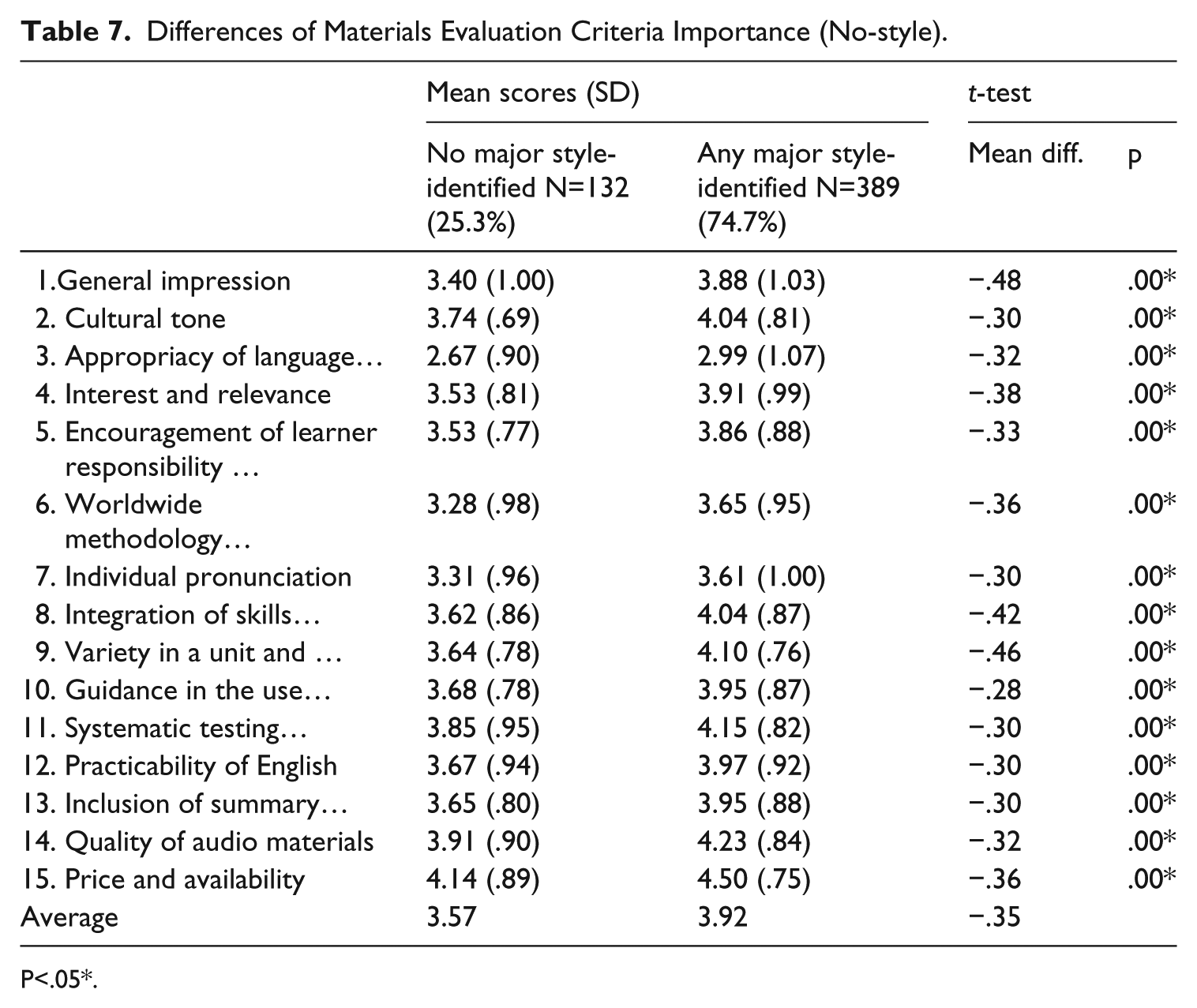
As shown in Table 7, the mean differences of the 15 evaluation criteria importance demonstrates the reverse of previous findings on the six major learning style-identified learners’ opinions. ‘No style-identified’ learners have lower mean scores on all 15 evaluation criteria with an average of -0.35. This indicates that the learners are more conscious of ELT materials evaluation criteria when they have at least one type of major learning style. The independent t-tests confirm that the two groups have significantly different opinions on all fifteen evaluation criteria at the alpha level below p<.05. That is, the findings suggest that learners generally are more conscious of materials evaluation criteria when they have at least one major learning style.
Differences of Materials Evaluation Criteria Importance (No-style).
P<.05*.
The mean differences of evaluation criteria level of importance between major learning style-identified groups and major learning style-absent groups on the six learning styles have been statistically examined. ‘No major learning style-identified’ learners were also compared with ‘any major learning style-identified’ learners. It was found that the style-identified groups generally have higher mean scores than the style-absent groups in terms of the 15 evaluation criteria. The mean scores of the evaluation criteria importance by each major learning style-identified learner indicate that tactile and kinesthetic-identified learners tend to establish relatively rigorous standards compared to other style-identified learners and no style-identified learners consistently have the lowest mean scores.
These findings strongly suggest that tactile and kinesthetic learners are more exhaustive evaluators in terms of materials evaluation. In addition, they are especially concerned with the overall quality of the materials they are going to employ for English language learning. The reason may be due to characteristics of individual tactile and kinesthetic learners. Tactile and kinesthetic learners typically may have active and energetic attitudes when learning English, and this kind of enthusiasm transfers to materials evaluation as well. Further research may help explain this projection.
Figure 2 clearly illustrates the trend of the learners’ perspectives on materials evaluation criteria depending on their types of major learning styles. As seen, the broken line in front (with the darkest colour) stands for ‘no major style (N)’. The remaining major learning styles follow behind in order of individual (I), auditory (A), group (G), visual (V), tactile (T), and kinesthetic (K).

Graph of Broken Lines on Mean Scores of Criteria by Type of Major Learning Style.
The seven broken lines indicate that 1) Generally, the pattern of change of the seven broken lines are similar throughout the 15 evaluation criteria. 2) No style-identified learners differ from style-identified learners in that they believe the evaluation criteria less important than any other style-identified learners. 3) Tactile and kinesthetic-identified learners differ from other style-identified learners in that they place a relatively higher value on most of the evaluation criteria, especially much higher value on the criteria of appropriacy of language materials and classroom activities (criterion 3), interest and relevance (4), and encouragement of learner responsibility (5).
Implications
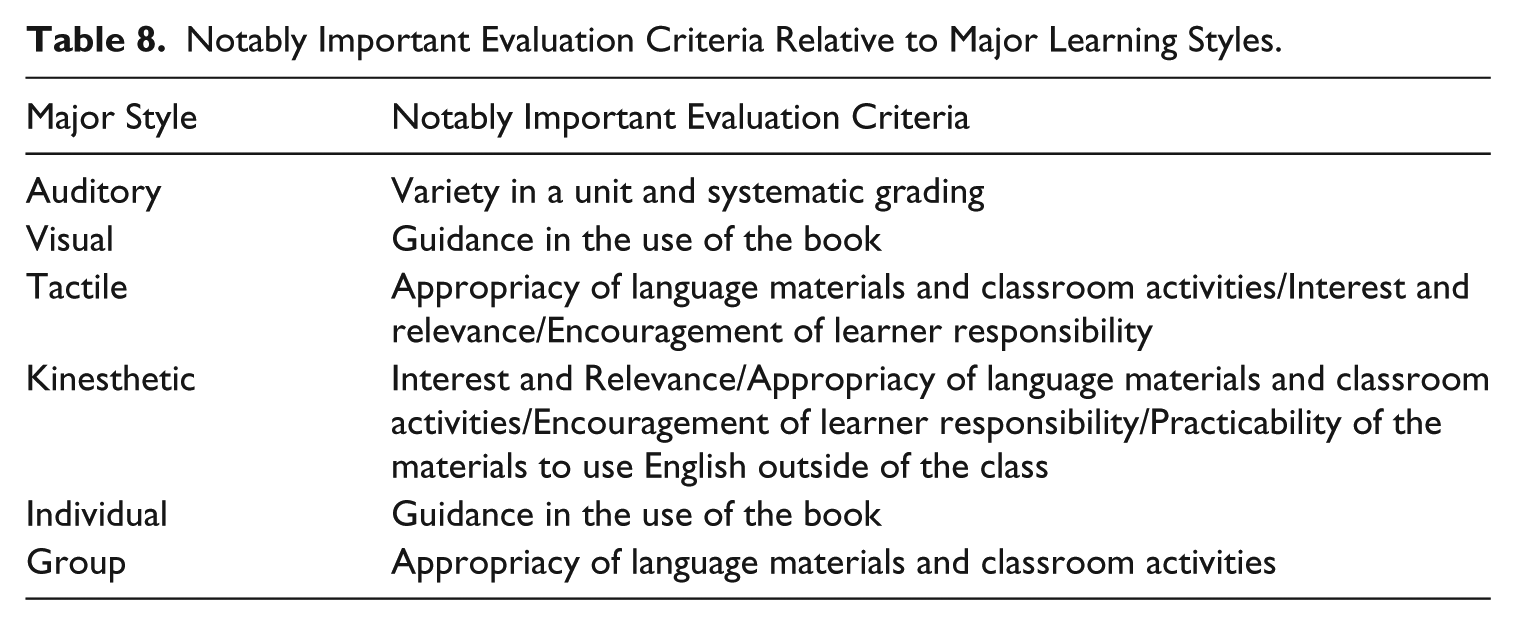
All things considered, it appears that a learner’s major learning style identified through a self-reporting questionnaire can be relevant to their perspectives on ELT materials evaluation criteria. Korean university EFL students are likely to consider the importance of materials evaluation criteria differently depending on the number and the type of the major learning style. The result suggests that materials employment with consideration of a learner’s major learning style can facilitate more effective and optimized English learning. Each style learner can be satisfied with the style-conscious materials employment. This suggests that teachers should try to be more conscious of their students’learning styles and match instructional methods and classroom materials to these styles. Table 8 summarizes the findings regarding important evaluation criteria relative to learning styles.
Notably Important Evaluation Criteria Relative to Major Learning Styles.
The major implication of the present study is that teachers can give guided and informed instructions to their learners after they conduct learning style surveys. The information drawn from the learning style surveys will be advantageous to teachers’ daily practice through greater consideration of preferred learning styles and class context (Tyacke, 1998).
Figure 3 demonstrates the suggested procedures for teachers’ actual application of learning style questionnaires to their classrooms. As shown, teachers can utilize the information on their students’ learning style preferences as a part of teaching methods. Teachers are required to play different roles in implementing questionnaires, analysing learning style preferences, developing style-conscious instructional materials, and applying the materials to the class.

Procedures for Teachers’ Actual Application of Learning Styles.
Importantly, the relationship between Korean university students’ major learning styles and their perspectives on materials evaluation criteria can provide teachers and learners with useful guidance for more learner-appropriate materials. The criteria learners consider highly important when evaluating English materials partly correspond to the characteristics of their major learning styles. This suggests that learning style can be a referential indicator for the selection of learner-appropriate materials. Learning styles can aid in the selection of individually appropriate ELT materials. Although multiple types and resources of input should be granted to learners for effective language learning, it cannot be denied that materials which are well-matched to learners’ style or learning practice are more appealing to them. In this regard, learning style preferences, especially major learning styles, can play an important role in guiding teachers and learners to more precise choices (McDonough et al., 2013; Tomlinson, 2011).
Finally, university-level students can provide useful information on ELT materials evaluation, so the learners’ opinions should be heard and taken into account by materials developers. This confirms the fact that teachers need to involve learners in order to facilitate effective and advanced development and selection of ELT materials, a position which has already been argued by noted scholars (Cunningsworth, 1995; McGrath, 2002; Nunan, 1988; Tomlinson, 2011; 2013).
Footnotes
Appendix
Materials Evaluation Checklist Criteria (Adapted from Kim, 2004).

| ←important not important→ | |||||
|---|---|---|---|---|---|
| 1. The textbook should be well edited – the printing and illustrations should be of high quality and have an attractive layout – and it should appear to be up-to-date. | 5 | 4 | 3 | 2 | 1 |
| 2. Any cultural tone / bias in the book should be appropriate in the classroom and be restricted to a degree acceptable to me. | 5 | 4 | 3 | 2 | 1 |
| 3. The materials, language focus and activities in the book should be in general appropriate for me and should ask me to perform roles or activities acceptable in the classroom. | 5 | 4 | 3 | 2 | 1 |
| 4. The book should appear relevant and interesting to me to encourage personal involvement. | 5 | 4 | 3 | 2 | 1 |
| 5. The book should have the materials which encourage me to assume responsibility for my own learning. | 5 | 4 | 3 | 2 | 1 |
| 6. Methodologically the book should be in line with current worldwide theories and practices of language learning. | 5 | 4 | 3 | 2 | 1 |
| 7. Pronunciation: there should be sufficient work on recognition and production of individual sounds, stress, patters and intonation. | 5 | 4 | 3 | 2 | 1 |
| 8. The balance between listening, speaking, reading, and writing skills development in the book should be appropriate to me and there should be various activities for communicative interaction for the development of communicative strategies | 5 | 4 | 3 | 2 | 1 |
| 9. There should be variety in the makeup of individual units and the grading of new items should be proper and systematic. | 5 | 4 | 3 | 2 | 1 |
| 10. Useful guidance should be given to me on correct use of the book. | 5 | 4 | 3 | 2 | 1 |
| 11. There should be mechanisms – e.g. achievement tests – for giving regular feedback to me and there should be provision for the book to be used for self-study by lone learners. | 5 | 4 | 3 | 2 | 1 |
| 12. The book should be enabling me to use English outside the classroom situation. | 5 | 4 | 3 | 2 | 1 |
| 13. There should be a summary of new and reviewed grammar and language functions, a comprehensive index and a list of new vocabulary and topics. | 5 | 4 | 3 | 2 | 1 |
| 14. (If used) Audio materials should be of good quality construction and have a variety of voices and they are native speakers talking at normal speed. | 5 | 4 | 3 | 2 | 1 |
| 15. The textbook (audio materials and workbook) should be easily available and not be prohibitively expensive. | 5 | 4 | 3 | 2 | 1 |
Funding
This research received no specific grant from any funding agency in the public, commercial, or not-for-profit sectors.