



Abstract
This study investigates the perceptions of stakeholders on the impact of a high-stakes assessment of English language teachers’ proficiency – the minimum language standards Language Proficiency Assessment for Teachers (English) [LPATE], which was introduced in 2000. Given that the test has now been in place for 17 years, the study investigates the extent to which the LPATE assessment has contributed to English language teacher standards in Hong Kong. Interview data from 24 participants in primary and secondary schools in Hong Kong, reveal a number of positive links between the LPATE test and English language teaching as a profession. The introduction of the LPATE was deemed to be necessary in terms of setting, raising and maintaining language proficiency standards; stakeholders’ awareness that English teachers need to have high language standards, subject-matter knowledge and pedagogical skills related to English language teaching; and that now an increasing number of English teachers are exempt from the LPATE through having opted for relevant degrees and teacher training, questions should be asked about how and whether the LPATE should be used in more relevant and meaningful ways.
Introduction
The Language Proficiency Assessment for Teachers of English (LPATE) is a test of standards of English language proficiency for Hong Kong primary and secondary school teachers of English, or those who wish to become teachers of English. The current study investigates perceptions of the impact of the LPATE assessment on English language teachers’ proficiency, now that approaching two decades has passed since the introduction in 2000 of the minimum language standards Language Proficiency Assessment for Teachers (English) [LPATE] (Coniam and Falvey, 2013). If a second language is to be delivered by means of a ‘communicative curriculum’, it has been argued, the bedrock for such a pedagogy (Medgyes, 1999, Andrews, 2003) is the ability to function in the second language. The current study took a qualitative approach, with 24 interview participants. A clear message emerged that the LPATE played a considerable role in enhancing teacher professionalism. To put the current study into perspective, some background issues concerning teacher certification will first be elaborated upon.
Teacher Standards, Teacher Certification and Teacher Language Certification
The attention paid to teacher and language teacher standards assessment has been growing for over 30 years. The report of the Holmes Group (1986) in the USA attempted to answer the concerns of parents and professionals about standards in education and was instrumental in focusing on teacher assessment, stating that ‘one of five major goals is to create professionally relevant and intellectually defensible standards for entry into the profession of teaching’ (1986: 13). The work of the Holmes Group foreshadowed what the Hong Kong LPATE research discovered 20 years later, where virtually identical findings occurred during the extensive investigations and validation exercises of the LPATE in Hong Kong – so much so that teachers with appropriate content and professional qualifications were exempted from the LPATE assessment.
In addition to general teacher certification, there is the specific issue of teacher language certification. A specific instance of this over two decades ago was reported with reference to teacher standards problems in the USA protectorate of Guam, where the quality of English language education was questioned. Tests of Reading, Writing, Listening and Speaking were created in 1990 by a team led by Stansfield et al., (1990) in order to ensure that minimum agreed standards were reached by the teachers of English on Guam.
In the late 1990s, many other countries then began to investigate the establishment of ‘benchmark’ tests/minimum standards tests for language teachers. One example occurred in Australia where the LPTT was designed to assess Italian and Japanese students’ language ability, which involved the ability to explain subject-specific metalinguistic concepts, the ability to summarize, paraphrase, simplify information, and the ability to formulate questions and initiate classroom activities (Elder, 1993a, Burke, 2015). The tasks devised in the LPTT were similar to tasks teachers might be expected to perform in classrooms (Elder, 2001). In addition, tests were designed for trainee teachers using a foreign language (in this case English) as the medium for teaching school subjects such as mathematics and science in Australian secondary schools (Elder, 1993b; Viete, 1998).
In other fields – medicine, for example – certification and re-certification have become standard practice for general practitioners around the world. Overseas doctors coming to the USA, the UK and Australia for further study or to practice medicine have to be professionally re-certified as well as benchmarked in English. In the UK, a high-stakes professional assessment of overseas medical practitioners, the PLAB Test (Professional and Linguistics Board) has been operating under the aegis of the British Medical Council for more than 25 years.
In Hong Kong, growing disquiet in commercial and educational circles about the language standards of teachers of English was confirmed by Tsui et al., (1994) who stated that fewer than 20% of English language teachers were both subject and professionally trained (Holmes 1986: 41). This prompted the Hong Kong Government to initiate, in the mid-1990s, the establishment of minimum standards of competence for teachers of English and Putonghua as a Foreign language.
After considerable development and trials, the minimum standards LPATE for Hong Kong were published in 2000. The first live administration was held in March 2001.
Given that, currently, there are ventures into establishing minimum standards competence tests for teachers of English in countries such as Japan, Vietnam and Thailand, the current study is timely in its relevance.
Background to the English Language Teachers’ Minimum Standards Initiative
As stated above, growing disquiet in commercial and educational circles in Hong Kong about the language standards of teachers of English was confirmed by Tsui et al., (1994) who stated that less than 20% of English language teachers were both subject and professionally trained. This prompted the Hong Kong Government to initiate a study in 1997 to investigate minimum standards of competence in English for the 12,500 teachers of English (out of a total of 42,000 teachers in all schools).
One controversial decision taken at the time was to use the ‘educated Hong Kong speaker of English’ as the target goal for teachers of English.
It was eventually confirmed that a battery of ‘formal’ tests would be created (i.e. the four skills of Reading, Writing, Listening and Speaking), and a live classroom performance test of Classroom Language (Coniam and Falvey, 2002). The perceived threat to the profession – especially to primary school teachers – was that retraining and possible dismissal would result from failure to meet the standards to be established. Assessment tasks should be authentic, credible and transparent.
A pilot study, the Pilot Benchmark Assessment (English) [PBAE], was held in 1999 and administered to lower secondary English language teachers (Years 7–9), after which the examination syllabus and specifications for the LPATE test (Government of the Hong Kong Special Administrative Region, 2000) were published in 2000. The first live administration was held in March 2001.
It was agreed that after 2006 the test would be revised and only offered to new teachers. In addition, full exemption was offered to teachers holding both a relevant degree and a professional teaching qualification. The government also provided (US$30 million) for in-service development courses for teachers to attain the required standards. The revised LPATE was completed in 2007. This was broadly similar to the 2000 version, with some minor amendments (Coniam and Falvey, 2013). From the beginning, the Hong Kong Examinations and Assessment Authority (HKEAA) has administered the LPATE, with the exception of the Classroom Language Assessment component, which is administered by the Government’s Education Bureau.
Language Teaching as a Profession
In recent years, an increasing awareness has emerged that English language teaching requires more than merely good language proficiency. In this light, three main aspects related to language teaching as a profession are discussed below.
1. Language Proficiency of Language Teachers
Elder (2001) considers that the language proficiency of English language teachers is English Proficiency for Specific Purposes (EPSP), encompassing all the language skills needed in informal and formal communications, plus specialist skills of subject knowledge and discourse competence to deliver such knowledge (Elder and Kim, 2014).
Given that language teachers’ language proficiency is deemed to be a highly necessary – though not sufficient – condition for an effective language teacher (Fischer, 2013), it is unlikely that teachers who do not speak a language well themselves can teach students to speak that language. Indeed, as most L2 input is from teachers (Andrews, 2003), language proficiency and teachers’ self-confidence in language teaching will by default impact upon students’ language proficiency.
Fischer (2013), for example, argues that teachers who do not reach a minimum standard will deprive students of the opportunity for meaningful and rewarding language learning.
‘In the 1990s, Hong Kong faced the problem of ‘falling’ language standards, with insufficient language proficiency and professionalism being considered one of the key reasons for the apparent decline in language standards (Lin, 1997). This was the backdrop to the introduction of the LPATE: to ensure that language teachers met minimum language requirements. In the survey conducted with 12,500 teacher participants, over 80% agreed with the need to establish a minimum standard (Coniam and Falvey, 1999). The Hong Kong Examinations and Assessment Authority contend that the gate-keeping function, the high profile within education and pioneer reporting methods, help maintain English language standards in Hong Kong (Drave, 2006). Indeed, Qian reports that some teachers who did not reach the minimum language requirement were reassigned to teach a different subject or left the teaching profession (Qian, 2008).
2. Subject-matter Knowledge
As English is not only the medium of instruction but also the object of teaching, a good command of metalinguistic knowledge – comparable to content knowledge in other subjects – is necessary (Elder, 2001; Elder and Kim, 2014). English language teachers are expected to have knowledge about language (subject-matter knowledge), including syntax, discourse, pragmatics, sociolinguistics and psycholinguistics, as well as pedagogical knowledge (Mann, 2005).
Whereas students themselves do not necessarily need to acquire metalinguistic knowledge, language teachers need such knowledge to make appropriate classroom decisions (Kamler, 1995). Taking grammar as an example, Andrews (2003) points out that teachers’ grammar knowledge entails a higher degree of grammatical consciousness than learners/students need. Language teachers, as educational linguists, should be able to analyse the language and be aware of the ‘interlanguage stage’ learners may be at (see Griffiths and Parr, 2001).
Teachers’ subject-matter knowledge strongly impacts on their teaching. In a study involving classroom observation and interviews, Borg (2001) reported how language teachers who were confident in grammar would involve students in discussing grammatical issues regularly and formulate the grammar rules on the spot. Other teachers, who were more uncertain about grammar, however, would only provide a very indirect answer to students’ grammar questions. Novice language teachers’ avoidance of teaching grammar because of insufficient knowledge has also been reported (Richards et al., 1996). The evidence of the impact of teachers’ confidence in or knowledge of grammar is noted in a study of teachers’ knowledge of grammar and the teaching of writing (Myhill et al., 2013). When the teacher could explain compound nouns clearly, students used more compound nouns in their writing (Myhill et al., 2013). In a state-of-the-art article, Svalberg (2007) points out that an effective way to teach students language knowledge involves actively engaging students by drawing their attention to language features and raising their awareness of how such features work, rather than merely practising or producing language features (Svalberg, 2007).
Even if the role of grammar is played down, Ellis (2006) argues that teaching grammar is still necessary, through an approach which focuses on meaning and focuses selectively on the aspects learners might have difficulties with. Mullock (2006) concludes that teachers who teach English as a second language still pay explicit attention to language items and skills.
The introduction of the LPATE drew attention to subject-matter knowledge and the fact that Hong Kong English teachers were not subject-trained. Whereas the LPATE is mainly a language proficiency test, Coniam and Falvey (2013) believe that such a test measures specifically the language ability of an L2 teacher. The language proficiency assessed in the LPATE is interconnected with teachers’ subject-matter knowledge and pedagogical knowledge. For example, the writing component of the LPATE expects candidates to identify student errors and explain errors to students. The Classroom Language Assessment (CLA) component assesses the language of teaching.
3. Pedagogical Knowledge of Teachers
As Richards (2008) points out, language teachers need to know not only knowledge about (i.e. subject-matter knowledge) but also knowledge how (i.e. how to transform content into easily accessible and learnable forms). Language teachers are expected to introduce content, set up lesson arrangements, check students’ understanding, guide student practice, monitor student language use, and move appropriately from one task to another (see e.g. Richards, 2010: 107). Language teachers are also expected to organize, explain and clarify any issues learners have in foreign language learning; arouse the interest of learners in studying a foreign language; as well as pay attention to individual student needs (Borg, 2006).
Importantly nonetheless, language teachers’ pedagogical skills need to be closely integrated with course content (Andrews and McNeil, 2005). Shulman (1987) promulgated the concept of ‘pedagogical content knowledge’, arguing that pedagogical content knowledge is important for teachers to transform their content knowledge in pedagogically appropriate ways which fit different learners’ needs.
Myhill et al., (2013) illustrate how teachers who lacked pedagogical content knowledge adopted a formulaic way of teaching grammar through listing grammatical rules. In contrast, teachers with a good command of pedagogical content knowledge were able to draw students’ attention to grammar issues in a particular context and foster thinking and discussion over grammatical issues, so that students gradually developed meta-linguistic awareness (Myhill et al., 2013). One way of improving teacher pedagogical content knowledge is through teacher professional training (Wright, 2010).
The CLA (Classroom Language Assessment) component in the LPATE is an authentic and effective way to assess teachers’ abilities to use language in the classroom. Although not intended to assess pedagogical skills, it draws attention to actual teaching in the classroom. A parallel here is the teacher language proficiency test in the USA, the American Council on the Teaching of Foreign Languages (ACTFL), which serves a similar function to the LPATE in terms of what it expects teachers to understand regarding language acquisition and in terms of creating a supportive language classroom (Pearson et al., 2006). In the UK, the Teacher Knowledge Test developed by Cambridge ESOL (see, www.cambridgeenglish.org/teaching-english/teaching-qualifications/tkt/) serves a similar function: ensuring that teachers have basic pedagogical content knowledge before entering the profession (Richards, 2010).
Summary: Language Teaching As a Profession
The sections above support the contention that English language teaching is a career of educational specialization, which requires entry requirements in terms of language standards, and specialized knowledge in both subject-matter and pedagogy (Richards, 2008). Similar expectations of English language teachers are discussed by Richards (2010), who emphasizes that language teaching is a profession that requires specialized knowledge. Given that a major intention of introducing the LPATE was to ensure a facet of English language teacher quality (Coniam and Falvey, 2013), the current study explores how and in what ways the LPATE impacts English language teaching as a profession.
Research Methods
Purpose of the Study
The purpose of the study was:
To investigate, qualitatively, the perceptions of relevant stakeholders of the effects of the LPATE policy.
Interview Participants
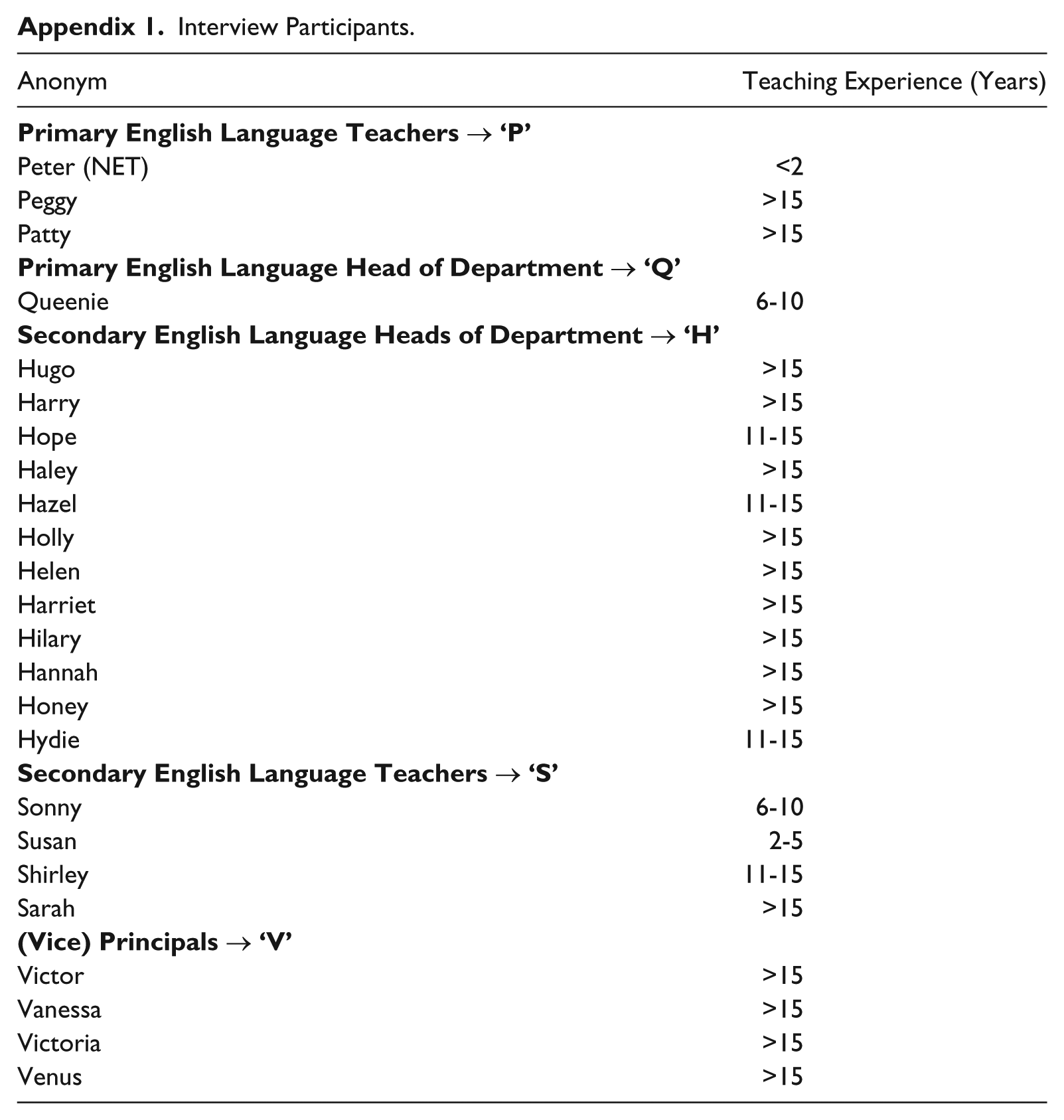
The current study was drawn from a large-scale study which collected data through both questionnaires and semi-structured interviews. Among the 236 completed questionnaire responses 57 respondents indicated that they were willing to participate in follow-up interviews. The researchers therefore identified 24 teachers who were English language heads of department or who had considerable English language teaching experience (preferably both), and approached them about being interviewed. One native-speaking English teacher (NET) 1 was also included. A summary of the interviewees’ profile is provided in Table 1 below; Appendix 1 presents the full list of interview participants and their backgrounds.
Job Positions Held by Interviewees.
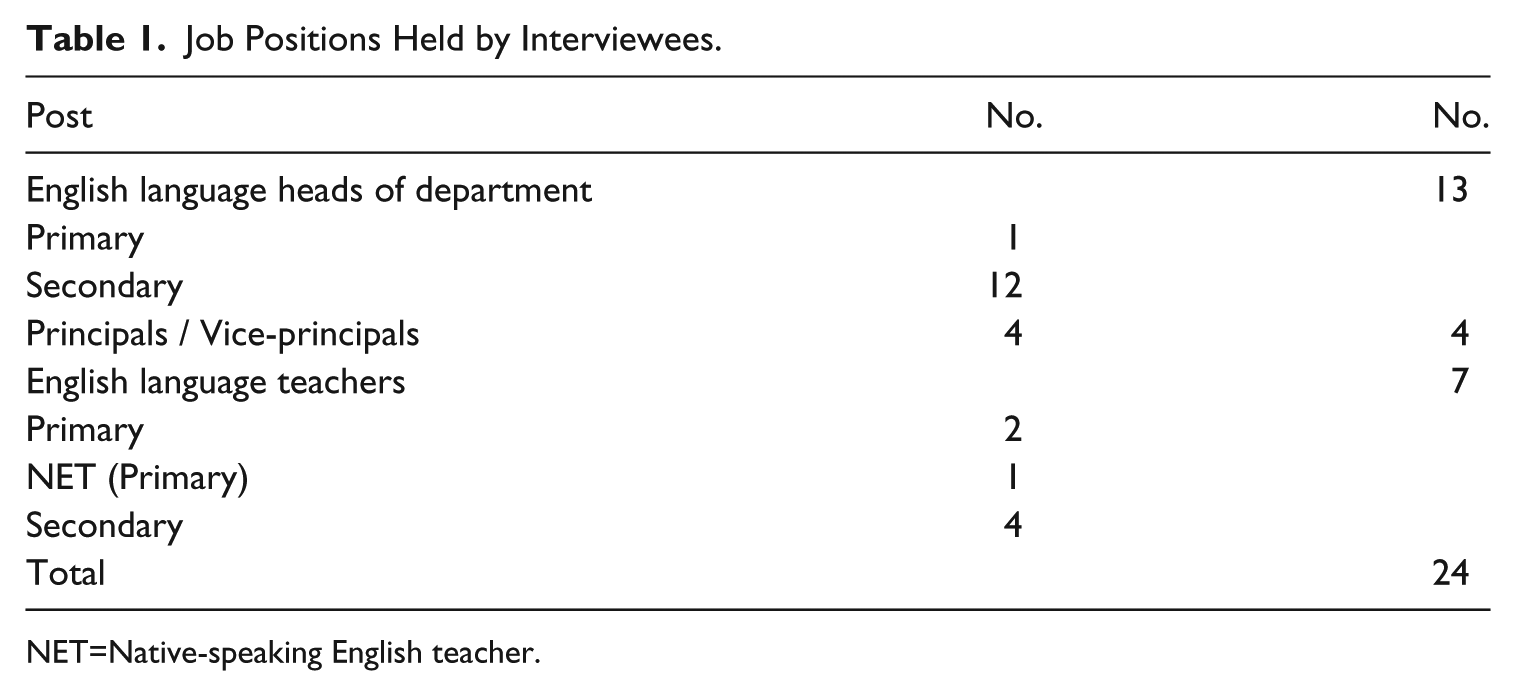
NET=Native-speaking English teacher.
Table 1 shows that 13 interviewees were English language heads of department, with four on the principal track.
The participants did not come solely from high ability (high ‘band’) schools (see, Table 2). 2 It should, however, be noted that official bands for primary schools do not exist in the way that they do for secondary schools.
Interview Participants’ School Bands.
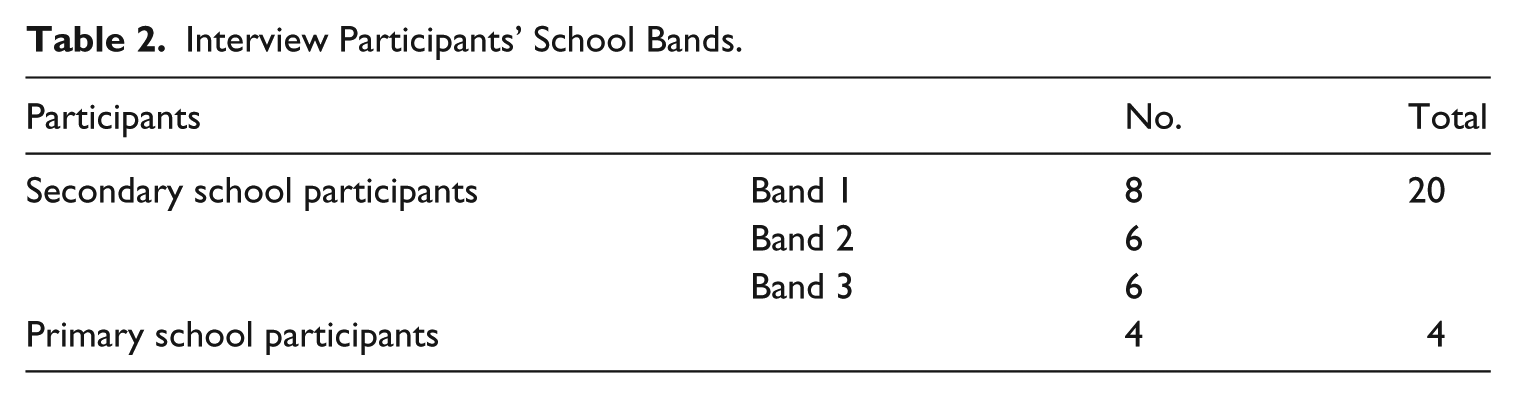
There were 20 secondary school participants and four primary school participants.
Since the sample comprised principals, heads of departments and classroom teachers, it might be argued that there could be bias in different participants’ perceptions – on the grounds that principals and heads of department had a vested interest in supporting the LPATE as a manifestation of government policy. In this light, Table 3 presents the picture of the responses to the key issues discussed below.
Findings Classified by Theme and Participant.

Key: Ps=principals/vice principals; HoDs= heads of department; Ts=teachers.
In addition to Table 3 showing that the heads of departments contributed the majority – 60/98 (61%) – of the comments, in line with this group constituting 13/24 (54%) of the sample, it should be noted that the benchmark policy impacted upon heads of departments as severely (if not more so given that they needed a Level 4) as upon ordinary teachers. In addition, all the principals had been/still were practicing English language teachers and hence were not just ‘outsiders looking in’, but faced the same constraints with regard to taking the test/holding a relevant degree/qualifying for exemption as did regular teachers. The possibility of there being bias due to heads of departments and principals comprising the majority of the sample would not therefore appear to be the case.
Data Collection
Semi-structured interviews were adopted as they focused closely on issues relating to the participants’ perceptions of the impact of the LPATE and also allowed for free expression (Merriam, 2009). Interview protocols were drafted on the basis of interesting and significant issues in interviewee’s responses on the survey. Interviews started with warm-up questions on participants’ own and school backgrounds, after which interviewees were asked to recall what changes they felt had taken place since the introduction of the LPATE. Those who had taken the LPATE were invited to comment on their own experience. To enhance reliability, interviewees were invited to provide examples to illustrate their arguments.
24 interviews were held between June and September 2015. Interviews lasted for 30–60 minutes, were conducted in English, and took place in the interviewees’ schools or other convenient locations.
Interview Data Analysis
A grounded and iterative approach was taken to the data, using the software NVivo 8. Researchers went through each transcript, identifying the main themes relevant to the current project’s research question. Meaningful units in the transcripts were first coded into free nodes in NVivo, and then put together under ‘umbrella’ tree nodes. All codes, including free nodes, tree nodes and child nodes were then revised after the analysis of subsequent transcripts. What emerged as relevant to the focus of the current study were the three themes that made English language teachers professional: ‘language proficiency’, ‘subject-matter knowledge’ and ‘pedagogical knowledge’.
After initial analysis, the NVivo Query function was used to search for key issues worthy of further analysis; e.g. the query for the term ‘grammar’ helped to identify all issues relevant to the relationship between grammar and the LPATE test, as ‘grammar’ emerged as a key theme in the interview transcripts. The query for ‘LPATE exemption’ and ‘exemption’ put together all views about whether the LPATE should have exemptions. All codes were then re-read, refined and written up.
Findings
1. The LPATE was a Response to a Problem in the Past
Thirteen of the 24 interviewees thought that the LPATE could be considered significant around the year 2000, as it helped focus attention on a problem Hong Kong faced at that time – that many English teachers were not trained in English as a subject. The introduction of the LPATE was intended to ensure that all teachers were qualified and well trained. LPATE could therefore be seen as acting as a quality assurance agent. Victor stated:
I think, basically, the introduction of the LPATE depends on the context of education at that time, because there were a lot of language teachers who were not language-trained. They had other majors but they took up one or two classes, and they didn’t have relevant training. Despite the fact that they had teacher training, they were not particularly trained as a language teacher (Victor).
Sonny, for example, recalled how, when he was a secondary school student, an economics teacher with poor English proficiency taught him English (which, he stated, dampened his enthusiasm for English at the time). It was noted that English teachers with a degree in English were asked to teach senior forms while those without a degree in English taught junior forms (Hazel).
Victor said the introduction of the LPATE was an important decision at that time and guaranteed that English language teachers met a certain standard of language proficiency. The LPATE policy was well-intended. The LPATE policy, as Hope recalled, drove many ‘unqualified’ English teachers out of the profession, in particular from the primary school sector where many English teachers were mathematics and geography majors. The introduction of the LPATE helped to maintain English language standards and to ensure that English teachers were capable and proficient second-language users (Sarah).
However, the LPATE was considered to be less relevant nowadays, as some respondents commented:
I think to be honest, less and less people will focus on the LPATE. In our field, not many people will discuss the LPATE anymore. It’s something in the past (Victoria).
The basic question is “What issue is the LPATE now addressing”. At that time it addressed a particular, and a very clear issue and problem confronting Hong Kong society. But right now is it still serving that purpose? Do we still have needs like this? (Victor).
While there were only two universities offering Bachelor degrees in English language education in the 1990s, this situation has changed in that government now offers sufficient training courses and programmes to provide an adequate supply of trained teachers for the local school system (Vanessa). Due to the expansion of language degrees in recent years, more English teachers have become qualified through taking degree courses, so fewer teachers now choose – or need – to take the LPATE. One third of respondents commented that the LPATE does not serve the function that it used to, and the relevance of the LPATE has diminished somewhat.
2. The LPATE and Language Proficiency
Importance of Language Proficiency
Respondents agreed that the language proficiency of English teachers was important for language teaching. Ten interviewees held strong beliefs that English teachers should have a high language standard. Hugo, a head of department, believed that high English language standards were necessary for teachers – irrespective of the ability of the students being taught. English teachers, who are English major graduates, should be able to use English proficiently, both inside and outside classroom settings.
In Hugo’s words:
You’re teaching English. This is your profession. I keep on telling my teachers that despite being English majors, you have to keep your English at a certain level. Although you’re teaching very weak students, don’t put down your English newspapers. I think this applies to many schools in Hong Kong (Hugo).
Although working in a Band 3 (low ability) school, Hugo encouraged his teachers to use as much English as possible, even in the weakest classes. The more English the teachers used, the more likely it would be that students’ English standards would improve. Queenie, a primary school teacher, shared a similar view:
English teachers have to use accurate grammar, accurate language or accurate classroom language, because students are learning all the time. You also need to use the language appropriate to the students’ level. In primary schools, students do not have much vocabulary; you have to use the correct word choice for them. You have to have this kind of knowledge (Queenie).
The NET teacher, Peter, agreed that English teachers’ language standards were an important issue in the context of primary school. He reported – from his experience of co-teaching with other teachers – that the better English standards teachers possessed, the more comfortable and confident they were when speaking to students in English so these teachers would know how to explain things to students in a simplified way instead of switching to Cantonese.
The responses above support the case for the importance of teachers’ language standards, and across different levels of schools. In general, the sentiment was that only when students were exposed to English teachers with good proficiency were students able to make noted improvements. Peggy stated that two of her classes were taught by a NET teacher for four lessons per week, and she observed how, in that academic year, those students’ oral language proficiency improved.
The LPATE as a Benchmark Test
Twenty-one of the 24 participants believed that the LPATE was a benchmark test that ensured English language standards:
At least the teachers need to obtain proficiency that can reach the benchmark that allows them to teach in the classroom (Harry).
If there is no benchmark like the LPATE, everybody can become an English teacher. It is necessary to have all teachers pass the language proficiency examinations (Susan).
The LPATE is really professional to make sure that all teachers have a good English standard (Hannah).
The LPATE, according to Queenie, minimized the gap between teachers of different proficiency levels, so that standards could be maintained. Sonny, an English language teacher in a Band 1 school, further illustrated how the LPATE maintains English teacher standards.
I think the LPATE is a good initiative because it really raises the English standards of the English teacher in Hong Kong in general. When I went to my previous school, I heard that some of the previous English teachers could not teach English because they couldn’t get the qualification (Sonny).
Sonny believed that the LPATE requirement made schools select teachers who were qualified, rather than out of convenience and expediency.
The LPATE was also considered to be a means of informing teachers of their weaknesses, in order to make improvements, as shown in Helen’s response below:
I guess because of these sub-papers, the teachers would be better informed of their strengths and weaknesses in certain areas. This is important (Helen).
Hugo, who believed strongly that all teachers should take the LPATE, emphasized it was all right if English teachers failed the first time around. If these teachers failed, they would know what to focus on to improve their proficiency. In this way, the LPATE served as a good diagnostic device for teachers to know where they were, what proficiency level they were at and what they had achieved (Peggy).
Generally, the LPATE was considered to be a quality assurance process which ensured English teacher proficiency standards.
3. The LPATE and Subject-Matter Knowledge
One theme, mentioned by 18 of 24 interviewees, was that the introduction of the LPATE had a clear expectation that all English language teachers should be trained in the subject of English. Merely speaking good English is not sufficient in itself. Such a requirement, according to Harry, changed the mindset of school principals, English language heads of department, English language teachers and the general public. In Harry’s words:
Now because of the LPATE, it seems there were changes in the mindset of the administrators and also the heads of department. English teachers need to be trained professionally. So they need to learn sociolinguistics or even phonology, phonetics or linguistics to help them have the confidence to present the knowledge to the students (Harry).
Although English language subject-matter knowledge includes a number of aspects, the need for a knowledge of grammar and meta-language were the major aspects that emerged in the current study. Fifteen interviewees addressed the issue of grammar in English language teaching.
Susan, a comparatively novice teacher who had just passed the LPATE, obtaining Level 4, recalled that the LPATE helped her in terms of explaining grammatical items to students. She stated that her knowledge of language had improved through preparation for the test. As English teachers need to explain grammatical errors to students, an awareness and knowledge of grammar was important (Queenie). Hannah, an English head of department with over 20 years’ teaching experience, noted how young teachers may not have an explicit knowledge of grammatical structures, stating that the LPATE alerted these teachers to the need for basic grammatical knowledge if they were to successfully teach students. Such improvements in language knowledge can be seen in comments made by Shirley:
I think teachers will study more before they take the exam. So in that case, they can improve their knowledge of English. When they analyse students’ compositions, they will know, this is the problem of fragmentation; this one runs-on; this one misplaced the verb. So, in this sense, the teachers’ knowledge will be improved (Shirley).
The responses above demonstrate that the participants felt that the LPATE raised teachers’ awareness of grammatical knowledge.
Teaching or testing grammar using a communicative approach was a point of contention in the interviews. While the LPATE improved grammatical knowledge, Hope pointed out that current classroom instruction placed less and less emphasis on grammatical structures:
After the implementation of the communicative approach, students have become more confident in expressing themselves, and they do not care so much about grammar. They really treat English as a means of expressing their thoughts and ideas and feelings (Hope).
It is noticeable how grammar has become somewhat downplayed in Hong Kong public exams (Coniam, 2015). The Hong Kong Year 12 senior high school public examination – the Hong Kong Diploma in Secondary Education (HKDSE) – does not have a section testing grammar explicitly (Hope). Harriet (mistakenly perhaps) argued that it was not necessary for her to know everything about English grammar as she could always refer to grammar books if students had questions. Metalanguage was not necessary (Hope). In this light, Harriet’s and Hope’s responses might appear to indicate that they themselves did not have a sound knowledge of English grammar. Those teachers who took a positive attitude towards the grammar test in the LPATE considered grammatical accuracy to be important for English language teachers; Hugo said:
You’re talking about a test for the English teachers. Accuracy is important because you are teaching English. If you yourself cannot even get the rules right, how can you teach students? You say “Oh the way I’m using it is the communicative approach”. Honestly, does that mean you don’t need grammar? Does that mean the English that you or your students use need not be grammatically correct? It makes no sense, right? (Hugo)
Hugo was worried that grammar teaching will be downplayed further if English teachers and heads of department consider it unnecessary for grammar to be tested in the LPATE. Even where the Hong Kong Education Bureau advocates a communicative approach to language teaching, teachers and students still need to use grammatically correct language. The communicative approach, to be effective, also needs an understanding of grammar (Ellis, 2006).
4. Pedagogical Knowledge and Skills
The Classroom Language Assessment
The Classroom Language Assessment (CLA) component is closely related to actual language teaching in that this component assesses teachers’ use of language in their own classrooms, as noted by nine participants The CLA component cannot be assessed through other language proficiency tests (Holly). In Haley’s words:
I would say the examination somehow channeled the teachers’ training. In the past, perhaps there was no speaking paper, no classroom language – this module. I do think nowadays, because of the speaking exam, and perhaps classroom language, the new teachers are more competent in their communication (Haley).
Haley’s response demonstrates that LPATE draws explicit attention to the elements of classroom language that are important for good language teaching. The English language proficiency of teachers in lower band schools was reported to have improved after the introduction of the LPATE (Venus). Teachers with the LPATE qualification were also considered to be more confident in delivering lessons, writing minutes, and having conversations in English during English panel meetings. The LPATE qualifications reflected teachers’ abilities to use language (Holly).
Limitations of the CLA component were, however, also noted. The CLA assessment can only be taken by serving teachers, so the quality of preservice teachers cannot be guaranteed (Harry). Such a response raised the issue of whether preservice teachers should also take the CLA, for example, in their teaching practice, to guarantee their language standards before they start teaching.
Pedagogical Knowledge and Skills
It was agreed by 15 of 24 interview participants that English language teaching required more than language proficiency and subject-matter knowledge. Pedagogical skills and general teaching skills were also deemed to be important:
For teaching English effectively, I think it has more to do with their teaching methodologies. You can have very good qualifications but you may not know how to teach it (Hazel).
Getting a Level 3 is just a sort of guarantee that they have command of the language well enough. But the exam does not make them an effective teacher. It is more about their teaching skills, but of course the language matters (Helen).
More specifically, English teachers, according to Shirley, need to know how to help students, in particular low-achieving students, with a pace appropriate to the class – rephrasing to facilitate understanding, using group discussion strategies, using pictures as examples. The pedagogical skills teachers need may also be related closely to subject matter, for example, leading students to think critically and develop a line or argument in argumentative writing (Hilary).
Good English teachers are also expected to have a good personality and good attitude, as shown below:
Subject knowledge is important but it cannot make you a good teacher. I think it’s the character. The character, personality, mentality and attitude of a teacher, although they come second after subject language, are vital (Hugo).
When recruiting teachers, we look into their personality, whether they could build up a good relationship with students (Honey).
One way of obtaining pedagogical skills and knowledge was professional training. The Postgraduate Diploma in Education (PGDE), according to secondary school principal Victoria, was critical in developing teaching skills and pedagogy that were relevant to teaching in secondary schools. Compared with Peter – the NET teacher who had only been in Hong Kong for two years – Vanessa seemed to be more aware of the importance of pedagogical skills from her experiences in teaching English and managing the panel.
5. The LPATE and Teaching as a Profession
The findings above have reinforced the point that the LPATE heightens the awareness that an English language teacher requires more than good English – they also require adequate subject-matter knowledge and pedagogical knowledge.
A positive view towards the impact of the LPATE was that the LPATE gave English teachers a sense of professional recognition. Eleven out of 24 interviewees stated that the LPATE policy delivered a message that schools needed qualified English teachers with ‘professional’ knowledge of the language.
I think the LPATE is a good way to set up professional standards for teachers. Also, the school and the EDB could have used it as a tool to push or to encourage teachers to learn continuously (Sonny).
We need a way to tell the public that all these teachers are qualified. I think getting an LPATE qualification is one way for the public to realise that teachers are professional. It’s not the same as that anyone who has a degree can teach the language subject (Holly).
With regard to ‘being professional’, Hilary responded that teachers need to have subject knowledge, such as syntax, lexis, as well as pedagogical knowledge in teaching English. Hazel said that teachers should explain subject matter in a pedagogically appropriate manner. Hugo believed that regardless of the level of students, English teachers need to be professional teachers.
Discussion and Conclusion
Two aspects were most prominently commented upon. One – by 21 of 24 participants – that the LPATE ensures English language standards; and two – by 18 of 24 participants – that the LPATE improves language subject-matter knowledge, in particular, a knowledge and awareness of grammar. Pedagogical skills – which are not a major focus of the LPATE test – were, however, also believed to be important to the teaching profession, with 15 of 24 participants commenting on this issue. The message that English language teaching is a profession that requires expertise in language skills, language knowledge and pedagogy (Richards, 2010) came across strongly in the current study.
Three quarters of participants recognized that the foremost impact of the LPATE was on improving English language teachers’ language standards generally – through keeping those who were unqualified from entering the teaching profession. Although this study has not collected concrete evidence of the type and level of improvement in language standards, the belief was strong that English language teachers should have high language standards and that language standards were indeed being assured by the LPATE benchmark assessment. The responses from the relevant stakeholders demonstrate that in addition to purely improving language standards, one major contribution of the LPATE policy has been to raise stakeholders’ awareness that English teachers need to be both proficient in English and subject-trained. The findings support the belief that second language teachers are expected to have both ‘general language proficiency’ and ‘academic proficiency’; i.e. they need to be proficient in reading, listening, writing, speaking and subject-specific knowledge (Elder and Kim, 2014). Knowledge about language is assessed through the Writing component of the LPATE which expects teachers to be able to correct students’ errors and explain errors to students.
Interviewees who were in favour of the assessment of grammar believed that regardless of students’ levels, English teachers need to be proficient in their knowledge of English, language use skills and be able to use English appropriately (Kamler, 1995). Such a view reinforces the importance of subject-matter knowledge of English language teachers (Borg, 2001; Myhill, et al., 2013) and echoes the initiatives behind the introduction of the LPATE: that English language teachers should be subject-trained. Although it is now clear that the traditional way of teaching grammar through drilling and practise is less desirable than it was, grammar teaching is considered necessary in the contemporary classroom. Good teaching cannot be conducted without good pedagogical knowledge and skills. The heads of department and principals in the current study were fully aware of the core role of pedagogical skills in handling students’ different needs and in transforming what teachers know into what students know. It is clear that the LPATE – although not a professional assessment of pedagogical knowledge – helped to highlight the importance of pedagogic skills.
For ease of reference, Table 3 illustrates the type and number of participants whose responses were coded under specific themes. There were five main themes; of these, three themes – the LPATE and language proficiency; the LPATE and subject-matter knowledge; and the LPATE and pedagogical knowledge and skills – comprised two sub themes.
Two further points are worthy of discussion. The first point is whether or not the LPATE or similar tests merely serve a problem-solving purpose, with the problem seen as solved once the test designers have done their job. In the case of the Hong Kong LPATE, the government, from quite an early stage, listened to/took on board advice that a uni-dimensional solution would not suffice on its own. Major policy decisions were therefore made such as the decision to move to an all-graduate profession and the commitment of large sums of money to finance teacher development programmes by most of the tertiary institutions, including some from overseas. As discussed above, however, it was accepted that the LPATE was not the only way to approach a solution to the problem. Indeed, in addition to the other improvement measures that were introduced, the government made it clear that the LPATE would not be a stand-alone, once and for all, single measure to set and maintain standards. Instead, they decided that it would first be administered for a period of five years, after which a programme of review and revision would be undertaken.
The second point concerns the LPATE as a pioneering tool, especially in terms of how Hong Kong’s LPATE experience may help other countries where a similar idea is currently being deliberated. Indeed, this is the case with a number of ASEAN countries. The LPATE, in association with the other initiatives listed in the paragraph above has succeeded very well in achieving its designed purpose. However, it must be stressed that it is not being claimed that a stand-alone LPATE would have totally succeeded without the other measures that were instituted. All of these initiatives have, in fact, combined to produce a qualified and language-proficient English language teaching workforce.
Footnotes
Appendix
Interview Participants.
| Anonym | Teaching Experience (Years) |
|---|---|
|
|
|
| Peter (NET) | <2 |
| Peggy | >15 |
| Patty | >15 |
|
|
|
| Queenie | 6-10 |
|
|
|
| Hugo | >15 |
| Harry | >15 |
| Hope | 11-15 |
| Haley | >15 |
| Hazel | 11-15 |
| Holly | >15 |
| Helen | >15 |
| Harriet | >15 |
| Hilary | >15 |
| Hannah | >15 |
| Honey | >15 |
| Hydie | 11-15 |
|
|
|
| Sonny | 6-10 |
| Susan | 2-5 |
| Shirley | 11-15 |
| Sarah | >15 |
|
|
|
| Victor | >15 |
| Vanessa | >15 |
| Victoria | >15 |
| Venus | >15 |
Funding
The author(s) disclosed receipt of the following financial support for the research, authorship, and/or publication of this article: This work was supported by the Hong Kong Research Grants Council [grant number 18401514].