



Abstract
This research explores international English majors’ experiences and perceptions of the characteristics of an effective English-as-a-medium-of-instruction (EMI) course. Through an analysis of the triangulated data collected through questionnaire surveys, classroom observations, interviews and correspondences between 45 students and their lecturer in an EMI course at a key comprehensive university in Beijing, this study found that international English majors viewed the lecturer’s English proficiency, personality, commitment to students and to teaching, teaching approach, and language use as the major factors contributing to EMI course effectiveness. Meanwhile, these students did not consider their own English proficiency as crucial to the effectiveness of EMI courses, and neither did they expect EMI courses to improve their English ability.
Keywords
Introduction
Globalization has led to the internationalization and marketization of higher education worldwide (Graddol, 2006). With this trend, English has been increasingly adopted as the medium of instruction for content-based courses at the level of tertiary education (Dearden, 2014), particularly in regions of the expanding circle of English (Kachru, 1986). Compared with many other regions within the expanding circle, mainland China is a newcomer to the English-as-a-medium-of-instruction (EMI) community.
In the year 2001, the Chinese Ministry of Education (MoE) included EMI course promotion in its 12 guidelines for improving the quality of Chinese undergraduate education, in which offering 5–10% of undergraduate subject courses through English was officially promulgated (MoE, 2001). Six years later, another MoE’s policy stipulated that 10% of total undergraduate credits should be earned through EMI courses (MoE, 2007). In 2010, the MoE further encouraged more EMI courses to be offered in higher education institutions to attract international students (MoE, 2010). In the wake of this series of EMI promotions, the number of EMI courses in Chinese tertiary education drastically increased (Cai, 2010).
With the rise and development of China as a key player in world politics and the global economy, a growing number of international students have chosen China as their destination for tertiary education, among whom those from Korea constitute an impressive proportion. According to statistics provided by the Chinese Ministry of Education, until the year 2014, Korean students accounted for 16.7% of the total international student population in Chinese tertiary education (MoE, 2014). A certain number of international students, especially those from nonnative-English speaking countries, incline to choose English as their major. These students study English in an English-as-a-foreign-language country where the native language of the population is not English and since English is not only the medium of instruction but also indeed the subject matter of their disciplinary study, their attitudes and perceptions of EMI courses are worth exploring. The present research is an effort in this direction by focusing on an effective EMI course for international English majors at a key comprehensive university in Beijing. Specifically, this study intends to address the question: what do international English majors perceive are the major characteristics of an effective EMI course for them?
Literature Review
Much of existing EMI research has focused on students’ and lecturers’ general attitudes toward EMI courses (Jensen and Thøgersen, 2011), how effective EMI courses are in improving students’ English proficiency (Lei and Hu, 2014; Wilkinson, 2013) and the difficulties posed to students and lecturers in learning and teaching in EMI courses and their respective coping strategies (Evans and Morrison, 2011; Hu et al., 2014). Some research has identified positive attitudes from students’ and lecturers’ perspectives toward EMI programmes, showing that EMI courses would effectively help students improve their English proficiency (Belhiah and Elhami, 2015), yet other research held the view that we should not equate EMI courses alone to automatic improvement in English proficiency (Chapple, 2015). However, since the ultimate goal of EMI courses is to impart professional content knowledge, it may be slightly off the point to focus too much on the influence that EMI courses bring to students’ English language proficiency; rather, attention needs to be paid to the role that students’ and lecturers’ English proficiency plays in effective EMI courses.
Research has also found that due to students’ inadequate command of English, they tended to be less interested in participating in classroom interaction (Airey and Linder, 2006), had difficulty in understanding lectures (Hellekjær, 2010; Joe and Lee, 2012), and had to spend more time after class to complete the assignments and review the course content (Airey and Linder, 2007; Evans and Morrison, 2011). As a result, students needed to employ certain strategies in order to compensate for their lack of comprehension of the course content, such as reading textbooks before lectures (Airey and Linder, 2006), asking lecturers to code-switch to a language in which they had higher proficiency (Hu et al., 2014), seeking help from the lecturer after class and forming study groups with their peers (Yeh, 2014).
Meanwhile, existing literature has showed that teaching an EMI course is a difficult task for lecturers as well. EMI teachers’ inappropriate language proficiency (Coleman, 2006; Vinke et al., 1998; Vu and Burns, 2014), inadequate teaching resources (Vu and Burns, 2014), and lack of effective pedagogy (Wilkinson, 2005) all pose serious challenges to the effectiveness of EMI courses. Consequently, in order to relieve their pressure, EMI lecturers may resort to teaching strategies such as simplifying the curriculum content (Hu et al., 2014), reducing improvisation and classroom interaction to the minimum (Hu and Lei, 2014; Jensen and Thøgersen, 2011), code-switching to a language in which the lecturer has higher proficiency (Hu et al., 2014; Vu and Burns, 2014) and seeking the help of support from PowerPoint slides or reference materials (Hu et al., 2014; Vu and Burns, 2014). These findings raise concerns about EMI teacher preparation. Shulman’s (1986; 1987) model of teacher knowledge and Richards’ (2012) identification of competence and performance in language teaching have both discussed the qualities of qualified teachers. According to these two frameworks, many of the problems teachers encounter in EMI classroom are attributed to their insufficiency in certain aspects of teacher knowledge.
It is worth noting that much of the current literature has focused on non-English majors. It is reported that English literature and linguistics have also been quoted as subjects taught through EMI in tertiary education (Dearden, 2014), yet little research has been conducted on these required courses for English majors. Within the research field of EMI education, English majors deserve special attention and treatment. For non-English majors in EMI programmes, English is simply the medium of subject knowledge instruction, whereas the case is apparently different for English majors in that the medium of subject knowledge instruction – the English language, is at the same time indeed the subject matter of their major. Therefore, attention needs to be paid to this special group as regards what their perceptions are toward EMI courses. As an effort in this direction, this research intends to explore international English majors’ perceptions of the salient characteristics of an effective EMI course.
Research Design
Research Site
The focal course of this study was Introduction to Linguistics, a required course for international students majoring in English at a key comprehensive university in Beijing. The course was available to all freshman, sophomore, junior and senior international English majors in the English department. This course aimed to provide an introduction to the basic concepts, theories and methods of linguistics. The course lasted 17 weeks and included 15 lectures covering primary linguistic branches: phonetics, phonology, morphology, syntax, semantics and pragmatics in this order. Each lecture lasted approximately 90 minutes. The mid-term examination was scheduled in the ninth week and the final examination was arranged in the 17th week. The default working language of the lectures was English. The textbook for this course was Victoria Fromkin, Robert Rodman and Nina Hyams’s An Introduction to Language (7th edition). The content knowledge instructed in this EMI course was based on this textbook and before each lecture, the students were requested to read in advance the chapters in the textbook related to each topic and do a note-taking assignment on what they had read. In-class activities of the focal course included instructor’s lecture delivery, quizzes, student-instructor interaction and discussion on linguistic issues.
Participants
The participants in this study were 45 international English majors who signed up for the course in the semester from March to June 2015. The average age of the students was 19.8. Of the 45 students (21 female and 24 male), 40 were native Korean speakers, two were native Burmese speakers, one was a native Japanese speaker, one was a native Thai speaker, and one was a native Indonesian speaker, indicating rather limited linguistic diversity. They had spent 11.4 and 7.1 years on average learning the English and Chinese language respectively. The average length of their stay in China was 6.3 years. They had all passed HSK (Level VI) 1 and the English proficiency test developed by the university’s English department. All the students were first-year undergraduate students and this course was their first EMI course during their university study.
Instruments
The data for this study were collected via questionnaires, classroom observations, semi-structured interviews, and correspondence exchanges between the lecturer and students.
Questionnaires
Three questionnaires (start-of-term, mid-term, end-term) were developed to explore students’ perceptions of the major characteristics of the focal EMI course. The data gathered via the three questionnaires were intended to reveal the students’ change of perceptions throughout the whole course.
The first questionnaire was distributed to the students in Week 1 of the course. This start-of-term questionnaire included ten questions aiming to solicit students’ demographic information, self-assessment of their English and Chinese proficiency, their level of confidence in using English and Chinese, why they chose the course and whether they had registered for EMI courses before.
The mid-term questionnaire, distributed after the mid-term examination, consisted of three parts including 30 questions in total. Part I (eight questions) solicited demographic information of the participants, length of stay in China, number of years they had learned English and Chinese, and their self-assessment of their English and Chinese proficiency compared to their classmates. Part II (16 questions) aimed to solicit students’ views on EMI courses in general and this course specifically. Questions in this part focused on the participants’ perceptions of the differences between EMI courses and English language skill courses, the relationship between EMI courses and English proficiency, their lecturer’s English proficiency, language practice, performance in class and style of instruction, their willingness to participate in in-class activities, and their language of preference for teaching and learning activities. The last part (six questions) requested the students to answer questions related to their out-of-class study. Questions in this part focused on issues such as the students’ opinions toward the difficulty level of the textbook, how much time they usually spent in finishing the note-taking assignments, what difficulties they encountered in studying the course, their strategies in dealing with the difficulties and their attitudes toward the assignments.
The end-term questionnaire had 35 questions and was answered by the students after the final examination. The first 30 questions were exactly the same as the mid-term questionnaire, asking the students’ opinions and attitudes toward the issue of interest at the end of the course in order to provide data for comparison with the information solicited in the mid-term questionnaire. The five more specific questions in the end-term questionnaire were intended to obtain the students’ overall attitudes toward the course as a whole, their achievements throughout the entire course sessions, their perceptions of the relationship between students’ English proficiency and effective EMI courses, their opinion on whether it was necessary to take courses on specific English language skills if all courses on English linguistics, literatures, and cultures were delivered in English.
All the questions in the three questionnaires were written in both English and Chinese. Students were asked to answer the questions in either English or Chinese according to their preference.
Classroom Observations
This method was applied throughout the semester. The researcher, a colleague of the course lecturer, observed and video-taped in-class activities of all the 15 lectures with permission from the lecturer, the students and the university. The lecturer and the students were informed of the general purposes of the study before the first lecture. This observation contributed to a better and greater understanding of the context in which classroom activities occurred and provided the researcher with direct experience in the course. The video-recorded data were transcribed to identify emergent themes in the study.
Semi-Structured Interviews
After the mid-term examination, ten of the students were invited for a semi-structured interview (See Table 1 for detailed background information of the ten students). All five of the students in the class who had a non-Korean background were purposefully included in these interviews in order to maintain cultural diversity in the sample.
Background Information of Student Interviewees.
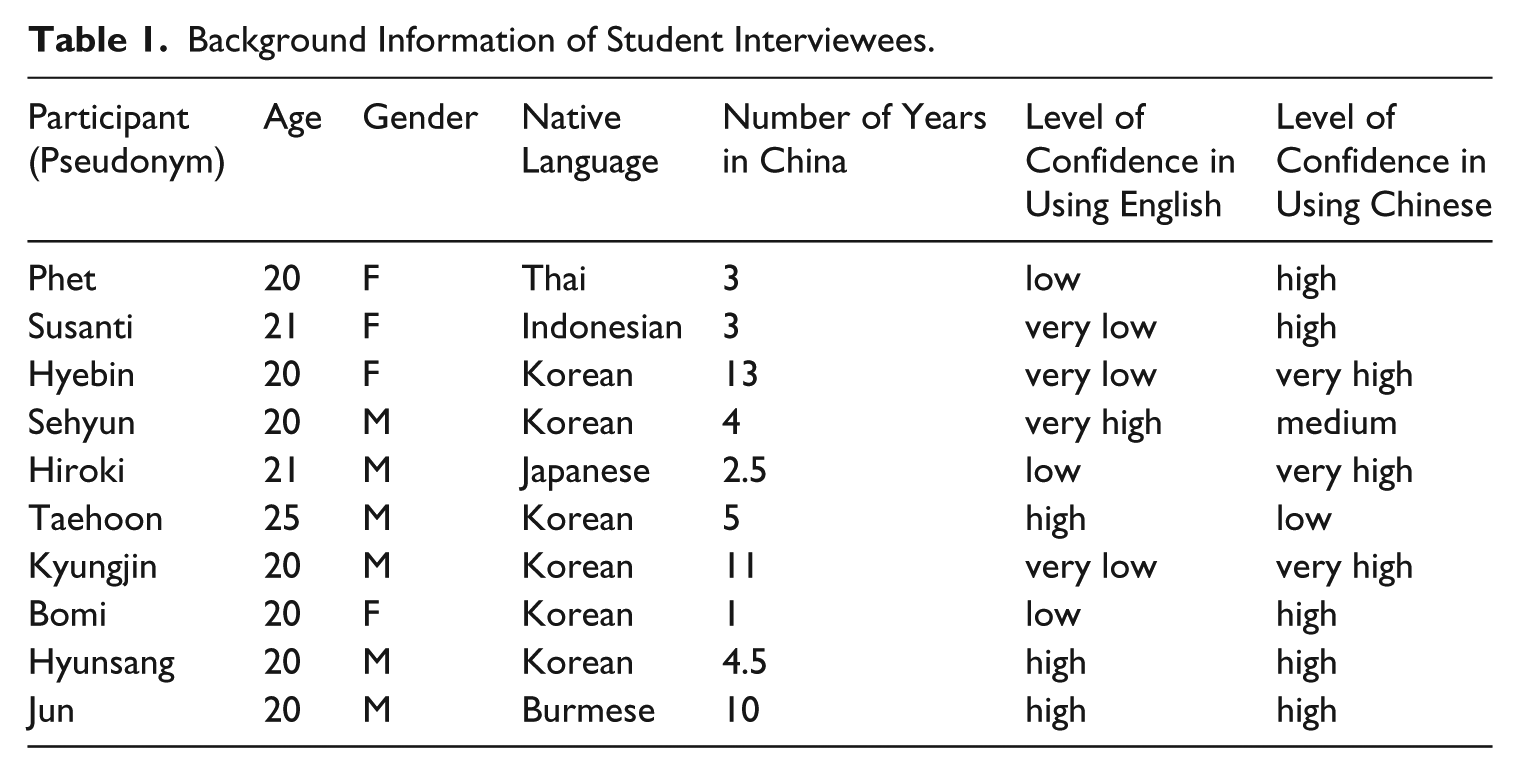
The guidelines for students’ interviews focused on their evaluation of the lecturer’s and their own English proficiency, their opinions on the relationship between EMI course and English proficiency, their attitudes toward the course, the difficulties they had and the strategies they adopted to solve these difficulties, what they thought of the lecturer’s personal and teaching style, their self-assessment of the achievements they had made and what aspects of the course satisfied them the most until the mid-term examination.
When all the 15 lectures were over, the same ten students were asked to participate in a semi-structured interview again. The focus and guidelines for these interviews were the same as those for the mid-term interviews. The goal of this end-term interview was to investigate whether there had been any changes in the interviewees’ perceptions toward the issues of interest to this study.
All the interviews were conducted in Mandarin Chinese or English out of the students’ preference. All the interviews were audiotaped and later transcribed. Each of the interview sessions lasted approximately 40 minutes.
Correspondence Exchanges
Throughout the whole semester, there were 194 correspondence exchanges between the lecturer and 33 of the 45 students, in which 163 were by e-mail and the rest were through Wechat, a Skype-like instant messaging software. Topics of these exchanges included discussion on the content of the lecture, Q&A interaction on specific linguistic issues, advice on learning strategies, and personal communications. All these exchanges were kept in order to provide further useful information.
Data Analysis
The data gathered through the four instruments were analysed both quantitatively and qualitatively. Considering that the purpose of the study was to investigate international English majors’ views of an effective EMI course based on their experiences rather than the factors affecting their perceptions, this study did not compute inferential statistics. Instead, it presented descriptive statistics in order to highlight and identify salient themes from the qualitative analysis that was guided by the grounded theory, a methodology for building theoretical constructs from qualitative data (Corbin and Strauss, 2008). At first, all of the hands-on data were coded using open coding techniques, which were used to identify general categories of information contained in the qualitative data. The open coding process was conducted by reading and rereading the data and by marking themes with summary labels. The tentative themes were annotated with short terms, such as attitudes toward EMI courses, views on the relationship between EMI courses and language skill, and strategies adopted to cope with EMI learning difficulties. Secondly, the tentative themes were categorized into closely related and meaningful superordinate themes using axial coding. The refined themes were organized in an outline, presenting hierarchical relationships among the themes and moving from superordinate categories to more specific ones. Finally, these themes were reexamined to ensure that they were well-developed in terms of properties, dimensions, and variations (Corbin and Strauss, 2008), and were rearranged and reorganized into coherent logic. The process of analysis was carried out in a recursive pattern with the data repeatedly reviewed and themes re-deconstructed and re-reconstructed.
Findings and Discussion
Data analysis revealed that the lecturer’s English proficiency, personality, commitment to students and to teaching, teaching approach, and language use were deemed as the major factors influencing the effectiveness of the focal EMI course for international English majors, whereas students’ English proficiency was unimportant to EMI course effectiveness.
Students’ and Lecturers’ English Proficiency
The current research found that international English majors did not regard their own English proficiency as crucial to the effectiveness of EMI courses, while they also held that the lecturer’s appropriate English proficiency was a prerequisite for effective EMI course delivery.
Data gathered from start-of-term, mid-term and end-term surveys on students’ confidence in using English for course study illustrated a slight change (see Table 2), and it could be seen that approximately half of all the 45 students did not find their English proficiency adequate enough for the focal course.
Students’ Level of Confidence in Using English for the Focal Course (N=45).

When asked about their self-rated English proficiency compared with their classmates, only four students thought that they were better at English than their classmates, 14 thought they were at about the same level with others, and 27 thought their English proficiency was lower than most of their classmates, denoting that as far as the students were concerned, their English proficiency was not high enough, at least not as high as their own expectations.
However, in the interviews when asked about whether their low self-rated English proficiency was a barrier to their course content comprehension, seven out of the ten interviewees stated explicitly that their English proficiency did not matter that much. The following excerpts from Hyebin’s interview best explained the situation:
I don’t think my English proficiency bothers me too much. I mean, yes, my English is very bad, but this course is not about English skills, it’s about linguistic knowledge, as long as I make efforts to understand the content knowledge, I think I’ll do good.
Kyungjin, who also rated his English proficiency as very low, shared his view toward the influence of his English proficiency on his motivation of registering for the focal EMI course:
I have learned English for ten years and my English is still very poor so I don’t think English skill class will do me good. But in this course I don’t have to worry about my lack of English proficiency. As long as I study hard, I can have high scores, even higher than the students with high English proficiency.
These data suggest that these students tended to think that their English proficiency was unimportant to the effectiveness of the focal EMI course in that the course focused on linguistic knowledge and hence their low English competence was not an impediment to EMI content learning.
In sharp contrast, students strongly held that the lecturer of EMI courses must have high English proficiency, especially in speaking and pronunciation. The lecturer of the focal course was a 26 year-old native-Chinese-speaking PhD candidate majoring in Applied Linguistics. Although he had no overseas education experience, his English proficiency (TOEFL IBT score: 118/120 and IELTS score: 8.5/9) was acknowledged as adequate by the English department of the university for EMI lecturing. The students also considered the lecturer’s English proficiency sufficient for teaching the course. In the questionnaire, the lecturer’s English level was rated high by 36 students and very high by the other nine students. When asked whether they thought the lecturer’s English proficiency was important to the success of the focal EMI course, all 45 answered ‘yes’ in their questionnaires, and one student explained his/her stance as follows:
EMI course lecturers must be good at English. They need to deliver the lectures and teach us the knowledge in a clear and organized way. That is the bottom line. Actually, they don’t have to be native speakers of English, that’s not necessary, but since we are English majors, and the lecturers were English majors too, I don’t think that is too much to ask them to be very good English users.
The above results showed that even though almost half of the international English majors in the focal EMI course rated their English proficiency as low, they did not believe that their insufficient English competence lowered their EMI study efficiency or became an obstacle for course effectiveness. This finding is similar to Joe and Lee’s (2012) research result in which no relationship was identified between students’ satisfaction with EMI courses and students’ English proficiency, and their EMI course achievements were not related to their English ability either. Although the present research found that the international English majors in this study did not regard their English proficiency as an important factor to EMI success, previous research revealed that in certain contexts a negative effect might occur if subject content is delivered in a language in which students lack adequate proficiency (Airey and Linder, 2006; Hu et al., 2014). Moreover, echoing previous studies (e.g. Jensen et al., 2013; Wilkinson, 2013), this research found that international English majors believed that lecturers’ English proficiency played an important role in the effectiveness and success of EMI courses. Existing literature shows that student critique of EMI teachers’ English proficiency is widespread (Tatzl, 2011), yet the students in this study agreed that the lecturer’s English proficiency was sufficient, which paved the way for effective EMI teaching. Research has demonstrated that a certain threshold level is necessary for effective teaching and is important for constructing language teachers’ language-related identity (Pennington and Richards, 2016). Therefore, the focal EMI lecturer’s English proficiency not only guaranteed course effectiveness, but also highlighted his strong language-related identity.
Lecturer’s Personality
Students also acknowledged the lecturer’s personality as an important factor for the effectiveness of EMI courses. When asked what they thought about the lecturer of the focal course, most students highlighted that they felt very comfortable bonding with him. Indeed, 42 (93.3%) students observed that they felt the lecturer was very nice and friendly and always willing to put himself into their shoes. One student wrote down the following comment on the lecturer in his/her questionnaire:
I didn’t want to have this course at first, but it’s the lecturer who is so caring about us and likes us so much that I feel that I want so much to try. Some teachers don’t like international students, but in this class, I feel very, very welcomed.
This comment raised a crucial theme: what general attitudes the lecturer had toward international students as a whole. This student was not the only one who brought up this point in the questionnaire. Another student even regarded this issue as the most important factor to the success of all courses for international students:
The lecturer and we are from different cultural backgrounds, but we need to feel that our country, our people and our culture are showed respect and understanding. He is objective and does not have cultural bias. This actually heavily affects our attitude toward the lecturer, the course, and even the university. In this class, I can feel that the lecturer likes us, likes our culture from his heart. I think this makes the work half done.
Another theme frequently mentioned (by 29 students) concerning the lecturer’s personality was that he was a trustworthy person who always kept his promises. This was a characteristic highly valued by Sehyun in his interview:
I trust the lecturer very much because he always acts as what he promised and trusts us back. I remember in the first lecture he said if we have any questions in class, just feel free to interrupt him anytime. At first, few of us dare to do that because the lecturers of some of my other courses also said this but when we did interrupt, they did not seem happy.
With reference to Murray et al.’s (1990) 29 types of teacher personality, the lecturer was perceived by the students as a meek (mild-mannered), sociable (friendly, outgoing, enjoys being with people), supporting (helpful and gives sympathy and comfort), and objective (fair and bias-free) person. Although a previous study has reported that teacher personality did not influence English majors’ evaluation of the effectiveness of their courses (Mori and Tanabe, 2015), the current research found that international English majors in the focal EMI course considered the lecturer’s personality as crucial to the effectiveness of the class. As far as these students were concerned, the lecturer’s personality determined the type of teacher-student relationship and consequently affected teaching effectiveness. Previous studies have also noted that recognizing the diversity in student population and cultural backgrounds is of importance to EMI course success (Mckay, 2014). The focal lecturer’s willingness to keep an open mind and his appropriate management of cultural diversity in the classroom won him his students’ trust and support, which contributed considerably to the effectiveness of the focal EMI course. Teachers’ individual characteristics, beliefs and knowledge about the world and other people are important in constructing a professional teacher identity (Pennington and Richards, 2016). The focal EMI teacher’s efforts to construct his identity as a transcultural person and to develop a balanced teacher-student relationship based on his individual self and his students’ cultural backgrounds indicated his awareness of self-knowledge (Pennington and Richards, 2016) and knowledge of learners (Shulman, 1986; 1987).
Lecturer’s Commitment to Students and to Teaching
Another recurrent theme was that the students appreciated the lecturer’s commitment to students and to teaching work.
Indeed 27 students noted in the questionnaire survey that the lecturer welcomed any questions from the students and strived to answer each question in a clear and understandable way, as one student wrote:
No matter how many questions are asked in class, he would stop his lecture and answer them one by one, including the questions which I think are easy and stupid. After class, no matter when we had questions and called him or emailed him, he always answered us nicely and patiently.
This point could also be verified by a series of e-mail correspondence between the lecturer and Phet. For example, Phet once had difficulty understanding the design features of language, and she sent the lecturer an e-mail hoping the lecturer could explain the issue in detail:
Dear Professor, My name is Phet. I am reviewing what we covered today in class. But I cannot understand what it means that language is arbitrary. Can you explain it once more? I am sorry to bother you. Thank you so much. Sincerely, Phet
The lecturer answered the question with a 504 word e-mail. After reading the e-mail, Phet had new problems and sent another e-mail to the lecturer. When finally everything became clear to Phet, ten rounds of e-mail back-and-forth had been done, with a pattern that Phet’s e-mails were no more than two sentences yet the lecturer’s explanations were more than 250 words every time. When asked in her interview about this experience, Phet expressed her heartfelt appreciation:
I really thank the lecturer for answering my question so thoroughly and patiently the whole time.
Apart from the lecturer’s efforts to answer students’ questions, 19 students mentioned that the lecturer was always well-prepared before class and always tried to use examples from real life to explain the boring linguistic theories, as one student remarked:
The PowerPoint slides of this course are the most organized and viewer-friendly of all my classes. He even looked for examples in Korean which he does not speak but did it for the purpose of making it easier for us Korean students to understand.
Previous research reported that teacher commitment was believed to be a crucial factor to achieving teaching effectiveness (Singh and Billingsley, 1998) and to improving educational outcomes, especially student academic achievement (Riehl and Sipple, 1996). According to the students in the current research, their lecturer was always willing to help students with their learning difficulties and was sensitive of student development and achievement. Meanwhile, the lecturer exerted volition and efforts to provide effective teaching, showed great passion and enthusiasm to teaching, and devoted extra time to students. This finding showed that the lecturer’s commitment to students (Kushman, 1992; Razak et al., 2009) and to the teaching work (Razak et al., 2009; Warr et al., 1979) played significant roles in supporting and promoting the quality of EMI instruction and learning. Moreover, the lecturer’s commitment is a reflection of his excellence in what Shulman defined as teachers’ pedagogical knowledge (Shulman, 1986; 1987; Zhang, 2015) and indicated his student-related identity (Pennington and Richards, 2016).
Lecturer’s Teaching Approach
Findings also showed that students regarded the lecturer’s teaching approach as a crucial factor for the effectiveness of the EMI course.
Classroom observation data indicated that the lecturer employed a student-centred approach and did not play a dominant role in class. The class sessions resembled a series of workshops rather than lectures. The lecturer introduced the basics of linguistics first and then discussed with his students real-life language use situations that reflected the issues of linguistic knowledge. The lecturer always took examples of language use from English, Chinese and Japanese and then asked students to find examples in their native languages to which the linguistic theories under discussion can be applied. Therefore, the students became active contributors to in-class linguistic knowledge construction. Bomi in her interview commented that:
The teacher’s teaching approach makes us feel that we are the centre of the class. We do not just passively learn what the teacher tells us; instead we have a lot of in-class teacher-student and student-student discussion to brainstorm. This interactive way of instruction for the first time made me feel I am in college now.
Previous studies have found that lecturers might dominate the entire class session and keep the lecturer-student interaction to the minimum as a solution to overcome the difficulty in teaching EMI courses, which negatively affected the efficiency of EMI course delivery (Evans and Morrison, 2011; Hu et al., 2014; Yeh, 2014). In opposition to these previous findings, the lecturer of the focal EMI course deployed an interactive approach to teaching and constantly kept open the door for lecturer-student communication and cooperation, which was welcomed by the students. It was also found that the students appreciated the lecturer’s hard work and constant efforts to make in-class teaching activities more meaningful, to introduce new ways of learning, and to present materials that were more relevant and of great interest to students. The focal EMI lecturer’s interactive teaching approach showed his deep pedagogical knowledge (Shulman, 1986; 1987; Zhang, 2015) and student awareness thus his student-related identity (Pennington and Richards, 2016).
Lecturer’s Language Use
One more theme ranking up among the most important features contributing to the success of EMI courses for international English majors is the lecturer’s language use.
It came as a surprise to the present study that more than half of the international English majors in the focal EMI course reported their English level as low or very low, as was showed in Table 2; yet 11 students answered in the questionnaire that they completely comprehended the course content, 32 students said they understood almost all the content except for certain problems that needed more detailed explanation which they themselves could solve after class, while two said they did not understand much of the course content. From classroom observations, this study found that the gap between the students’ low self-rated English proficiency and high comprehension rate of the course content was bridged by the lecturer’s occasional code-switching. The lecturer mostly delivered the lectures in English while code-switching to Chinese, the language in which 40 students believed they had higher proficiency than English, when further explanations on subject matters were needed. When asked what they thought the best language practise in EMI courses was for them, 36 students thought the lecturer’s way was the best, five students believed that half English and half Chinese might be better, one student liked the all-English scenario and three students thought either language was reasonable since this issue did not matter that much.
Previous studies stated that one of the purposes of EMI courses was to improve students’ English proficiency (Kirkpatrick, 2014; Wilkinson, 2013). The present study, however, found in the data that students disagreed with this statement. Although a certain number of students claimed their English proficiency improved (24 in reading and 27 in listening), Hyunsang, one of these students, elaborated on his stance in his interview as follows:
I don’t think improving our English ability should be the aim of EMI courses, especially for English majors. We have many other courses for that so in EMI courses I think learning subject knowledge is more important.
Even though several previous studies found that all-English EMI courses in certain contexts might improve students’ English ability (Balhiah and Elhami, 2015), it is widely believed that principled code-switching could be beneficial for the efficiency and quality of subject knowledge delivery (Kang, 2012; Li, 2013). The lecturer of the focal course, with his proper code-switching in class, managed to fulfil his main duty of guaranteeing students’ comprehension of subject knowledge, which from the students’ perspective accomplished the mission of EMI courses and this in-class language practise became another reason why students believed the focal EMI course was an effective one. In addition, the lecturer’s language-related identity (Pennington and Richards, 2016) is reflected in his in-class code-switching. His high level of automaticity and fluency in English and Chinese enabled him to rely on occasional switches between the two languages for explanatory backup and to redress communication breakdown (Pennington, 1995; 1996). Meanwhile, the students’ satisfaction with the lecturer’s code-switching denoted that his in-class language use was based on his student knowledge (Pennington and Richards, 2016). It was his understanding of the students’ English proficiency and their learning difficulty that propelled him to alternate between English and Chinese for effective EMI teaching.
Conclusion
This study investigated the characteristics of an effective EMI course for international students taking English as their major in a non-English speaking country. Students in the focal course reported that five features were of most importance to the effectiveness of the course: the lecturer’s English proficiency, personality, commitment to students and to teaching, teaching approach, and language use. However, different from findings in previous research, these students did not regard their own English proficiency as crucial to EMI course effectiveness, and neither did they expect EMI courses to improve their English ability in that English proficiency improvement, as far as they were concerned, was the purpose of English skill courses rather than content-based courses.
This research holds that the low expectation of EMI courses’ positive influence on raising students’ English proficiency may be a special case to English majors while students’ hopes that their lecturers have an open mind and handle cultural diversity in the class properly is an important concern of international students. What is also worth noting is that the salient factors rated by students as important for effective EMI courses fall within the categories in frameworks of teacher knowledge and identity. However, as our findings have shown, these factors do not work separately. For EMI teacher preparation, therefore, all these aspects need to be considered together.
Given these findings, we suggest that higher education institutions in China tighten their selection criteria for appointing lecturers to deliver EMI courses for international English majors. An English proficiency test for EMI lecturers is needed to guarantee teachers’ adequacy for EMI course delivery. In addition, lecturers’ characters and teaching attitudes need to be taken into account. More importantly, lecturers’ perceptions of the international student community and capability of managing cultural heterogeneity ought to be highlighted when considered for positions to teach EMI courses. An evaluation portfolio for EMI lecturers, in which feedback from students, assessment from the department and evaluation from the university are enclosed, is necessary for both the university’s reference to appoint EMI lecturers and lecturers’ self-improvement of their EMI teaching literacy.
Footnotes
Acknowledgements
I am grateful to Professor Weimin Zhang for his enlightening suggestions and illuminating feedback on this article. I am also greatly indebted to the anonymous RELC Journal reviewers for their insightful advice and helpful comments.
Funding
The author(s) disclosed receipt of the following financial support for the research, authorship, and/or publication of this article: This research was funded by the 2014 Beijing Higher Education Teaching Reform Project, Grant Number: 2014-ms012.