



Abstract
The use of English to teach content subjects has been a growing trend in many parts of the world. It is labelled in a variety of ways, such as content-based learning, content and language integrated learning, immersion education, theme-based language teaching, and bilingual education, but it is referred to in this paper as English-medium instruction (EMI). The expansion of EMI worldwide has resulted in many different forms of EMI, as well as some confusion as to how they differ. In addition, a number of different forms of EMI may occur in the same school or institution, area, or country. The different forms of EMI can be usefully classified in the form of a typology. A typology provides a basis for objective and quantifiable accounts of the characteristics of EMI in different situations. The present typology describes 51 features across 10 curriculum categories, which were identified when comparing different forms and realizations of EMI. It highlights the many different dimensions of EMI that are involved in describing, planning, or evaluating EMI.
English-Medium Instruction Today
The use of English to teach content subjects has been a growing trend in many parts of the world. It is labelled in a variety of ways, such as content-based learning, content and language integrated learning (CLIL), immersion education, theme-based language teaching, and bilingual education, and will be referred to here as English-medium instruction (EMI). Several definitions of EMI have been proposed, including: “the use of the English language to teach academic subjects (other than English itself) in countries or jurisdictions where the first language of the majority of the population is not English” (Macaro, 2018: 35) and “settings where English is the language used for instructional purposes when teaching content subjects although not itself the subject being taught, and also a second or additional language for most participants in the setting…” (Pecorari and Malmström, 2018: 499). Although the growth of EMI is a global phenomenon, it is more widely used in private rather than public education (Dearden, 2015: 6) and is part of the broader role of English as a lingua franca, particularly in the academic domain (Galloway et al., 2017). Reasons for the choice of EMI may include:
To improve the learning of English
To provide a common language of instruction in countries with multilingual populations
To promote economic competitiveness through developing an English proficient workforce
To produce graduates with global literacy skills
To enable institutions to attract international students
To raise university rankings
To increase the prestige of an institution
To promote the competitiveness of universities
To facilitate regional and international communication
To develop students’ intercultural communication skills
However, while the increasing use of EMI and the spread of “Global English” is sometimes seen as offering affordances (e.g. Hultgren, 2019), others see it as problematic and another aspect of the relentless spread of English – a debate that we will not pursue here (but see Pauline et al., 2016).
The expansion of EMI worldwide has resulted in many different applications of EMI as well as some confusion as to how they differ (Lasagabaster and Sierra, 2010; Pecorari, 2020). In addition, a number of different forms of EMI may occur in the same school or institution, area, or country. Prompted by a re-reading of Mackey’s classic typology of bilingual education (Mackey, 1970), this paper seeks to classify the different forms of EMI in the form of a typology. A typology provides a basis for objective and quantifiable accounts of the characteristics of EMI in different situations, allows for the comparison of different forms of EMI, as well as suggests issues for further research. The present typology also provides “an accessible metalanguage” (Lin, 2016: 4) to describe different dimensions of EMI. In this typology, 10 criteria are used to identity the characteristics of EMI in a given context. The criteria are:
purposes of EMI;
assessment in EMI;
curriculum models;
introduction of EMI;
access to EMI;
the English course and EMI;
the EMI teacher;
the English subject teacher;
the EMI learner;
instructional materials in EMI.
Purposes of EMI
A number of forms of EMI are found, which differ according to the purposes and manner in which it is used (see Table 1).
Categories of different purposes of EMI.
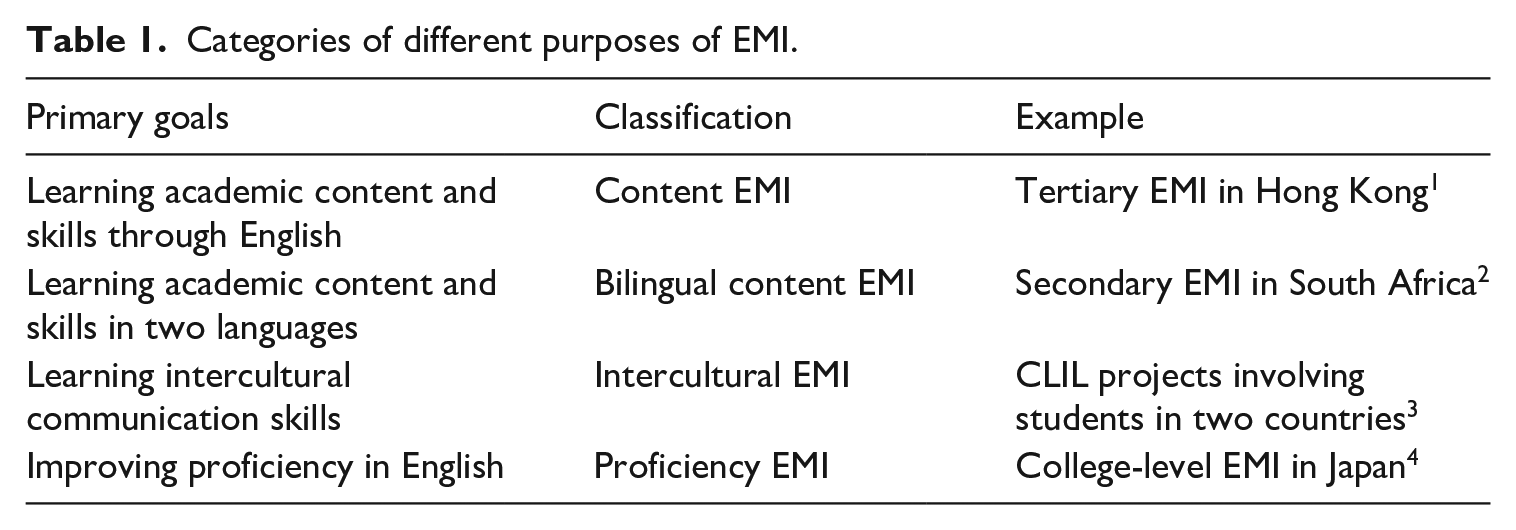
A number of factors account for the emergence of different forms of EMI (Macaro, 2018). In some contexts it emerged as a legacy of British and American colonialism, where in countries such as Ghana, India, Singapore, and the Philippines, English became the principal language of government and administration and provided a convenient medium of instruction that could be used as an alternative to the provision of public education in a multitude of local and regional languages. In other situations (Content EMI) it has often been driven by more pragmatic circumstances, such as the need to attract international students through offering graduate programs in English (e.g. Denmark), or in order to better equip graduates with communication skills needed in a globalized economy (e.g. South Korea). In Europe, through the movement known as CLIL, it was not merely intended to facilitate content learning through English or other languages but became part of a policy to promote bilingualism and “for EU citizens to have competence in their mother tongue plus two community foreign languages” (Llinares et al., 2012: 1), referred to above as Intercultural EMI.
Assessment
Assessment in EMI may be based on English learning, content learning, or both (see Table 2).
Categories of different kinds of EMI assessments.
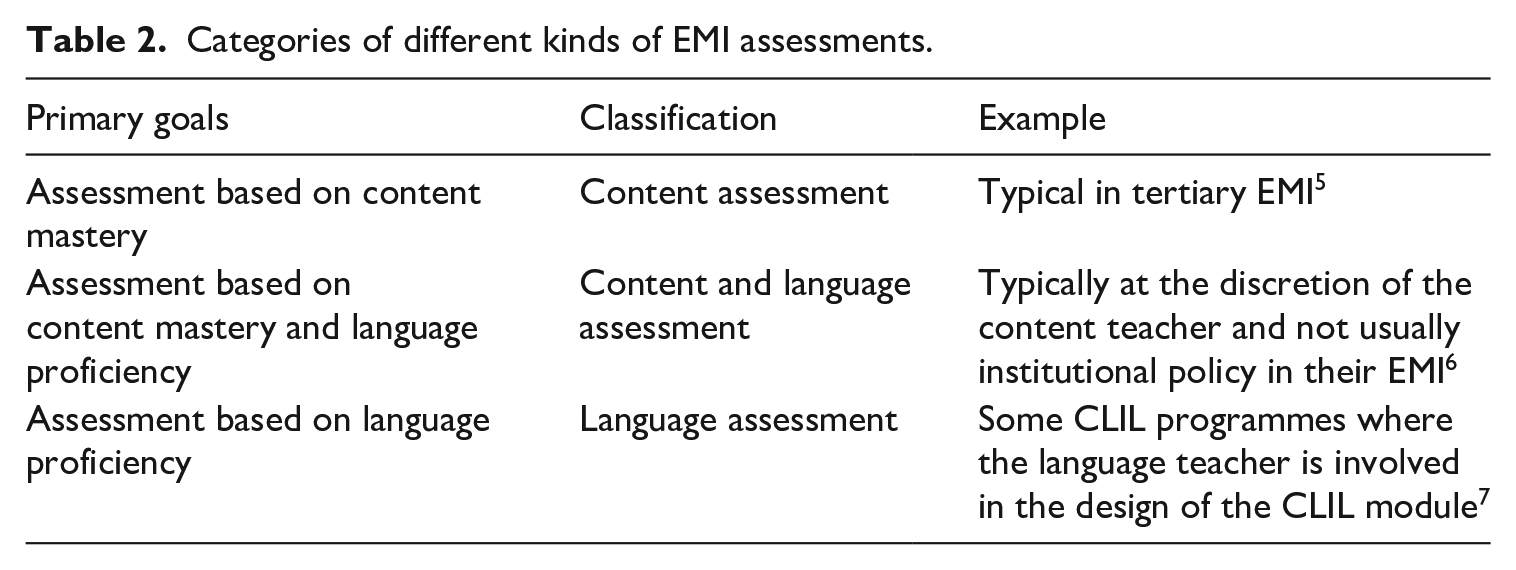
The extent to which assessment in EMI is content- and/or language-based is described in an account of content-based instruction (Met, 1999) and of CLIL approaches (Coyle et al., 2010). CLIL has been described as a dual-goal approach – “learning language” and “learning through language”. In both cases, approaches can be seen along a continuum of content and language integration. One end of the continuum features those more “content-driven” programmes (e.g. immersion programmes), where assessment is based on content-learning, whereas on the other end are those “language-driven” programmes (e.g. the conventional, often isolated second language (L2) learning lessons) (Lo and Lin, 2019), where assessment is based on language proficiency. This can be represented as the continuum of EMI, as shown in Figure 1 (Thompson and McKinley, 2018: 3).

Continuum of EMI (adapted from Thompson and McKinley, 2018: 3).
A similar representation can be found in Lin (2016: 148). Met (1999) provides a useful comparison of content- and language-driven EMI (referred to by Met as content-based instruction) (see Figure 2).
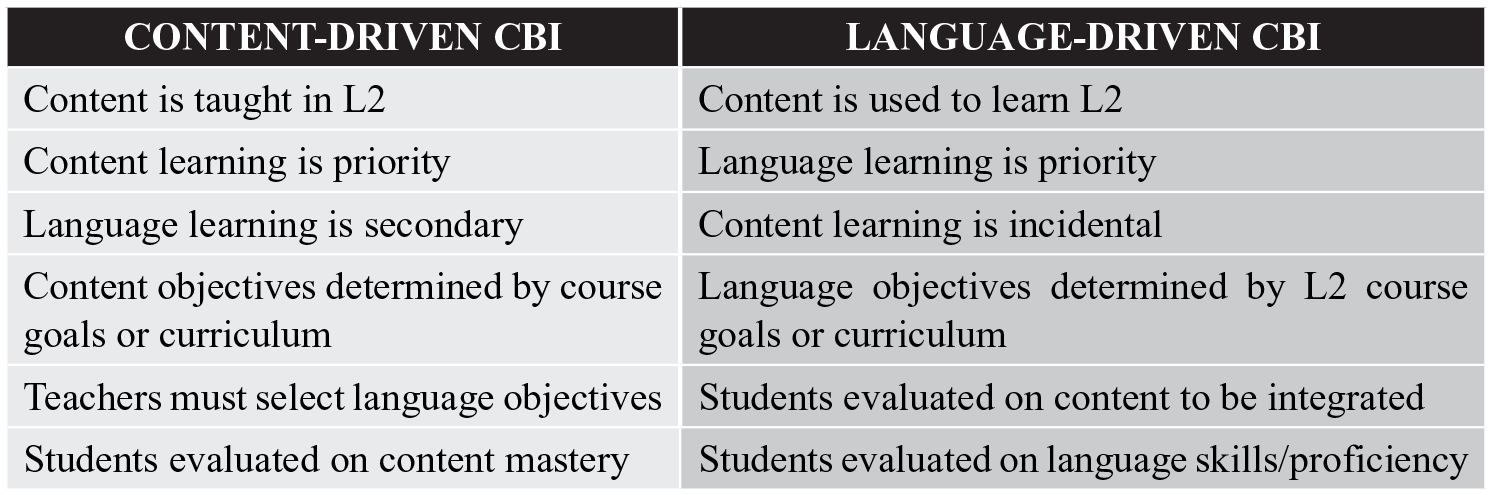
Comparison between content-driven content-based instruction (CBI) and language-driven CBI.
CLIL is similar to immersion programmes found in some English-speaking countries, where students acquire the L2 through a natural learning process (Jäppinen, 2005: 149), fostering bilingualism. Although CLIL and immersion are often used synonymously in foreign language research, Lasagabaster and Sierra (2010) suggest there are differences between CLIL and immersion in terms of classroom language, teacher training, the sociolinguistic context, teaching principles, types of teaching materials, and language achievement. Dalton-Puffer (2007) notes that in some CLIL classrooms, teachers pay special attention to developing students’ subject knowledge and L2 communicative competence, while teachers in immersion programmes only teach and assess students’ subject knowledge in the target language, with less focus on testing language learning. Finally, students in immersion classrooms are often immigrants, whereas in CLIL classrooms, students are local students sharing the same first language (L1). Coyle et al. (2010: 17) compare content- and language-driven CLIL (see Figure 3).

Comparison between content-driven CLIL and language-driven CLIL.
Curriculum Models of EMI
The different roles English fulfils in school and university curriculum worldwide has led to many different approaches to EMI. The following are the major curriculum models that we have identified (see Table 3).
Categories of different EMI curriculum models.
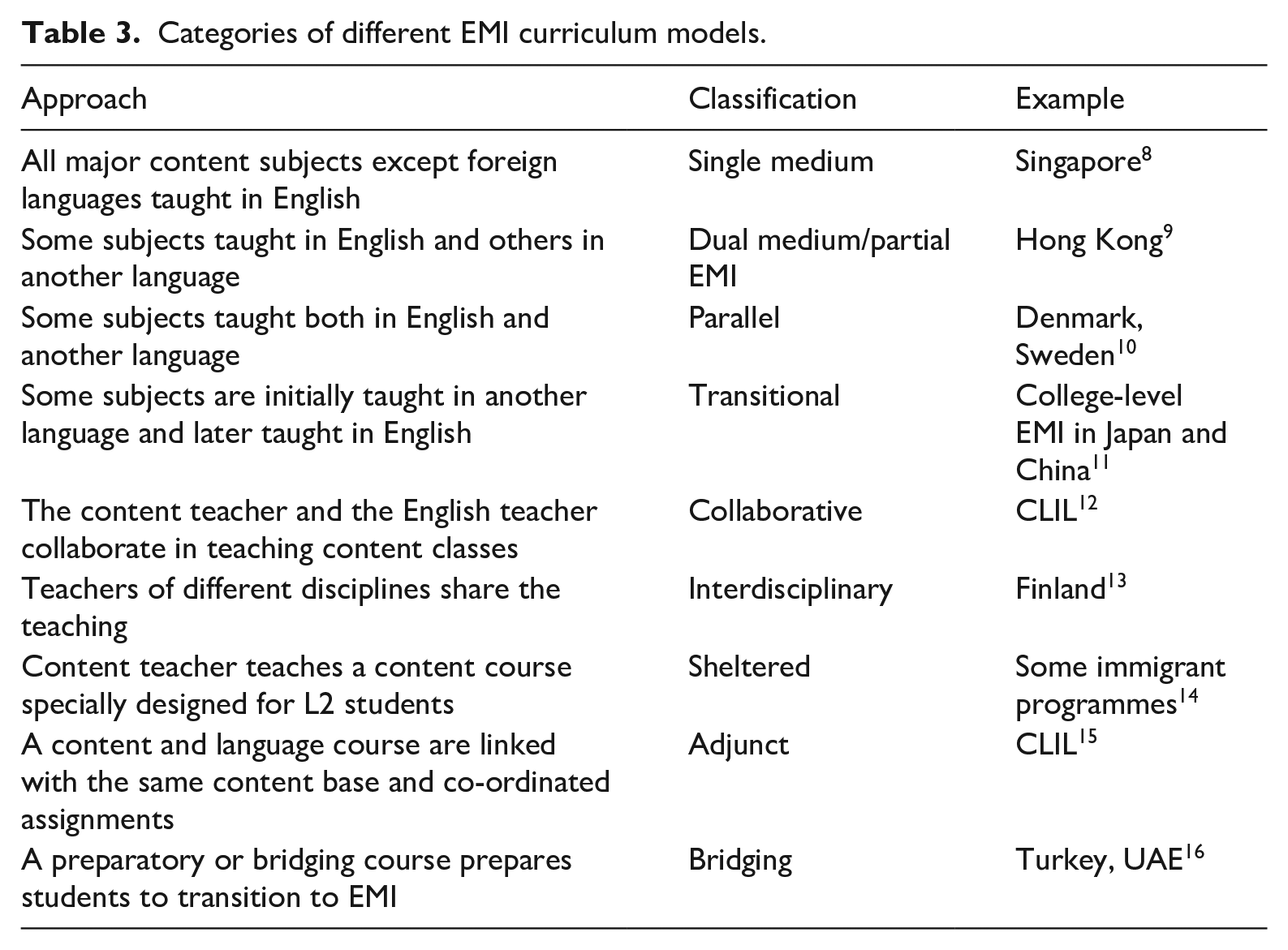
The realization of each of the approaches above may vary in different contexts. For example, a transitional approach might involve English as a subject in primary and lower secondary and transition to EMI at secondary. Or when English is the major language of higher education, English may be a subject through to upper secondary followed by a full-time intensive English course focusing both on general English as well as EAP (English for Academic Purposes) (i.e. a bridging course), before students move to university where English is the primary language used at both undergraduate and graduate levels. Teaching modes may also vary considerably. Xu and Harfitt (2019: 213) comment that in Hong Kong “the same subject can be conducted primarily in Chinese and sometimes in English for certain units of the subject in some schools whereas in others, the subject can be taught entirely in English (or in Chinese)”. Hence, the quantity of English used in an EMI classroom may vary, ranging from substantial to sporadic, and may also vary according to the amount of spoken versus written English that occurs (Czura and Papaja, 2013).
Introduction of EMI
Depending on local needs, such as the role of languages in the national curriculum, the availability of suitable teachers, materials, and other resources, EMI may be introduced at different points in the educational system (see Table 4).
Categories of different EMI introduction models.

Early EMI is not common except in post-colonial countries where EMI has a long history, since in other contexts the English proficiency level of young learners is usually insufficient to support EMI. In Hong Kong, the use of EMI may be optional and depend on the school’s ranking. In higher education contexts in countries, such as South Korea and Italy, EMI may be used for some subjects and not across the whole curriculum.
Access to EMI
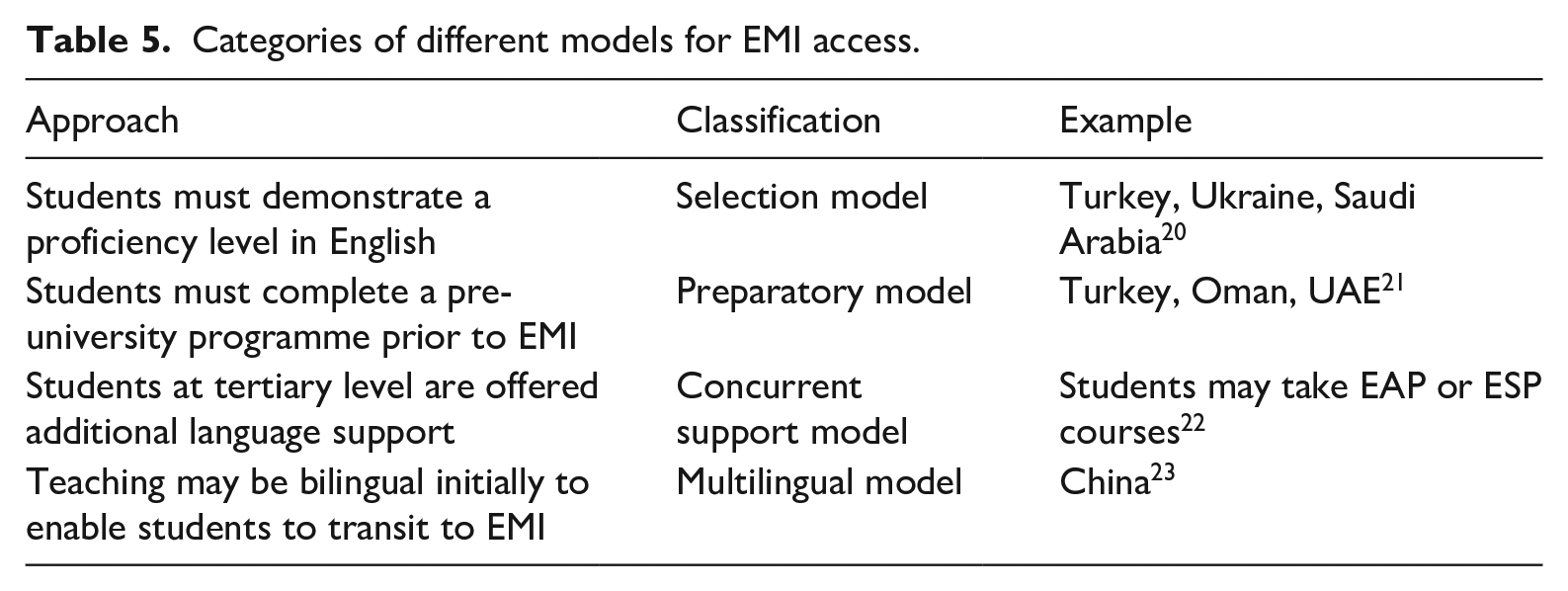
Since a high level of English proficiency is a pre-requisite for learners’ successful participation in EMI, different entry requirements may be established (Macaro, 2018) (see Table 5). Tests may serve as a screening device to determine which students need a bridging programme and which can progress to EMI. For an EMI program at a Japanese University, strict language-testing benchmarks for admission are clearly defined. Students must provide a threshold evidence of language proficiency through internationally recognized tests such as the TOEFL (Test of English as a Foreign Language) or IELTS (International English Language Testing System) (Brown, 2014). In one Saudi Arabian University, students are required to take four seven-week learning modules (18 hours) a week and must pass an exam at the end of each module to enter their undergraduate degree program (Alyami, 2020). The use of a preparatory or bridging course is common in many countries such as Turkey and in several countries in the Middle East, where students complete an extended pre-university English course designed by language specialists who are familiar with academic genres and with the language demands of content subjects. In other contexts (e.g. Hong Kong), tertiary level students who need additional English-language support for EMI are provided with courses in ESP or EAP through a language centre or similar unit.
Categories of different models for EMI access.
The English Subject Course and EMI
In EMI contexts, English usually has two roles in the curriculum: as a school subject and as a medium of instruction. These different roles support different targets for the learning of English.
English as a Subject
When English is a subject in the high school curriculum (sometimes referred to as General English, or English Language and Literature), English is the target of learning. The goals and content of the English course address the knowledge and skills identified in the national curriculum. The curriculum could include courses such as Structure of English, Composition, Literatures in English, Public speaking, Creative writing, and Drama, which form the basis for textbooks and other learning resources, as well as the basis for school or national exams. The teacher is normally a language specialist whose responsibility it is to ensure that the expected standards of knowledge, skills, and performance in English are achieved.
EMI
When English is a medium of instruction, English is primarily the means of learning. The EMI teacher is a content specialist and his or her role is to facilitate the understanding of content subjects such as math, geography, or science, through English. During this process, the teacher may not prioritize the kind or quality of English either he or she uses, nor that of the learners. Language learning may take place incidentally as a result of EMI, but the teacher will generally assume that learners’ development of the necessary language skills is the responsibility of the English course and the English teacher. Lin (2016: 63) comments on the “disconnect” that often exists between content teachers and English-subject teachers: Very often teachers and curriculum planners of content subjects and language subjects operate in insulated bubbles without talking to each other as if they do not need to know what is being taught and learnt in each other’s subject domains, not to mention collaboration.
Teaching through English may require the content teacher to make use of a range of strategies, including code switching, translanguaging, translation, and a variety of ways of modifying his or her language (Airey, 2012; Basturkman and Shackleford, 2015). However, limitations in the teacher’s English could also result in teaching that is less flexible and improvisational than [when] they were teaching in their first language. They could not use anecdotes or humor, or deepen students’ understanding through thorough and varied explanations. They reduced the amount of content instruction and adopted various coping strategies such as using a transmission-oriented pedagogy, avoiding asking or answering questions, and switching to their L1. (Cheng, 2017: 90)
Learners’ priorities in EMI will be to develop disciplinary competence and disciplinary literacy in English. Airey (2011: 13) defines the latter as “the ability to appropriately participate in the communicative practices of a discipline”. This will include successful participation in EMI lessons, including understanding and using discipline specific vocabulary, genres, and registers, and developing the skills needed to complete subject-specific academic tasks in English. In the EMI context, students may have a different “idea” of English, seeing it as a resource they can use to navigate and participate in content lessons, where communicative effectiveness may have priority over other aspects of language learning. Besides, there is a growing trend for the English teacher to also become a content specialist, moving beyond their role as a language specialist. For example, in Hong Kong, English teachers are required to teach English writing across the curriculum, such as in STEM (Science, Technology, Engineering and Mathematics) areas, Liberal Studies, History, Geography, etc. (CDC, 2017).
Relationship Between the Subject Course and EMI
The relationship between the English course and the EMI course may be either relatively independent or exist in a complementary or supportive relationship. For example, the Chinese Standards of English Language Ability (a Chinese adaptation of CEFR (Common European Framework of Reference for Languages)) are described only in relation to general proficiency in English, while the US-based national TESOL standards include standards related to general proficiency as well as those required to achieve academically in the content areas. However, in many contexts, the role of the English subject (either at school or at university) and the extent to which it is intended to support EMI is not always clearly identified. Macaro comments (2018: 26): If policymakers or institution managers (school principals, university rectors) really believe that students’ English proficiency can be ensured by “immersion” in the language that EMI is expected to provide, then what possible use are the EFL teachers? Are they there to offer a parallel programme of general English that merely imparts an alternative body of knowledge and perhaps creates an alternative student career path to EMI? Are they there to prepare the students before they embark on an EMI programme? Are they there to concurrently supplement the learning of English via EMI when a deficit is spotted?
The following relationships are found between the English subject course and the EMI course (see Table 6).
Categories of different relationships between the English subject course and EMI courses.

The EMI Content Teacher
Content teachers may be unilingual in English, may be bilingual and speak English with varied levels of proficiency, and may vary in the extent to which they have received specialized preparation (see Table 7). An obstacle to the successful implementation of EMI in some countries, particularly at tertiary level, has been the lack of content teachers who have the requisite proficiency in English to teach their subjects wholly or partly in English (Cheng, 2017), as well as the lack of appropriate training opportunities for such teachers (see Miller (2020) for an account of principles and pedagogies in teaching content through English). Content teachers with restricted English ability may avoid asking and answering questions, make use of code switching, simplify the disciplinary content of their lectures, avoid interaction with students, and need extra time to prepare lessons. However, from a survey of training programs in three countries for Chinese tertiary EMI teachers, Yuan (2020) found that language proficiency training alone was insufficient as a foundation for EMI instruction, and that “English language proficiency, pedagogical quality, and intercultural communication are the three key factors in the successful implementation of EMI instruction” (Cheng, 2017: 101).
Categories of different types of EMI content teachers.
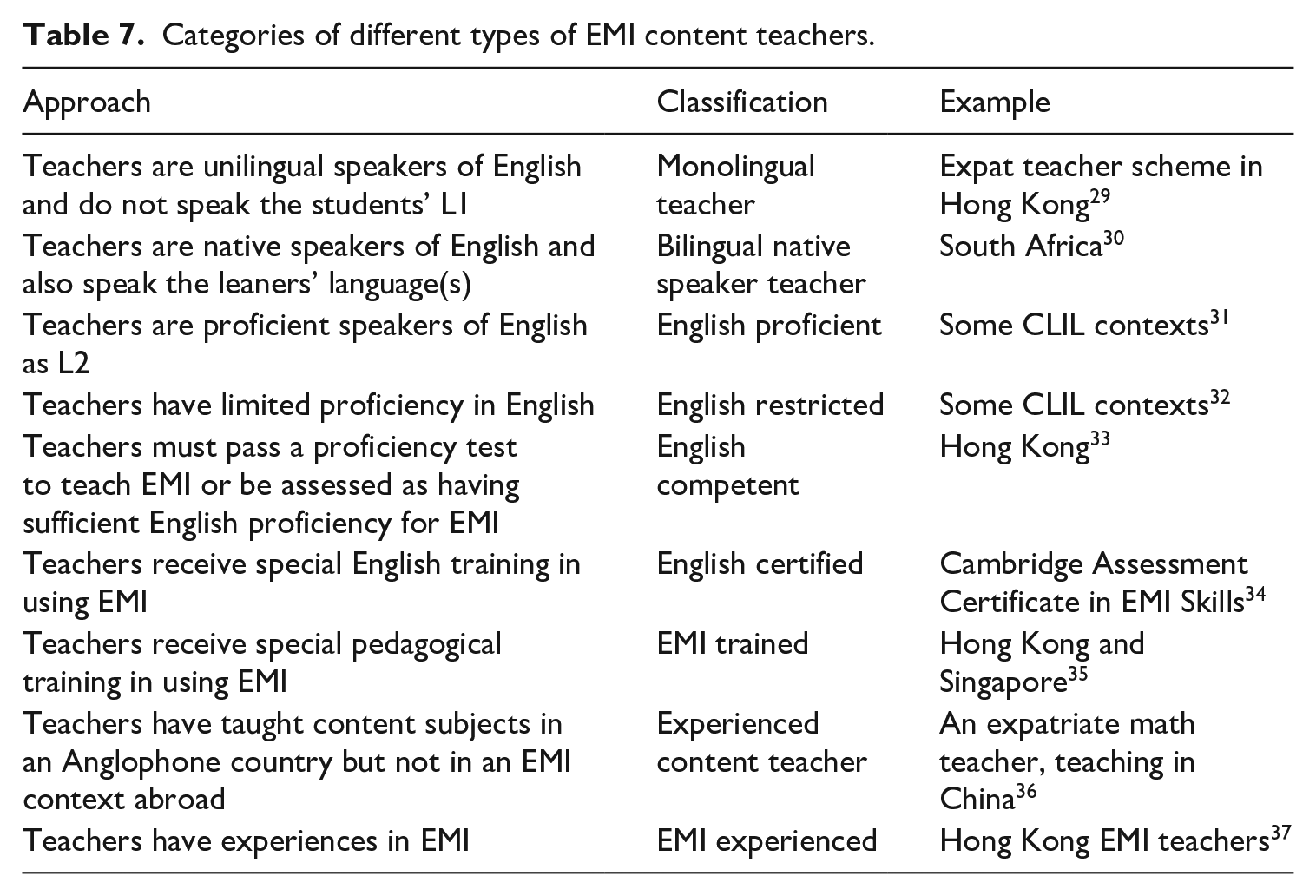
In Hong Kong, non-language subject teachers who wish to teach in EMI secondary schools must achieve Level 3 or above in English Language of the Hong Kong Diploma of Secondary Education Examination, or Grade C or above in English Language in the (now discontinued) Hong Kong Certificate of Education Examination. Content teachers can also take the Cambridge Assessment Certificate in EMI, which is intended for teachers who want to gain an online qualification and who teach and work in the medium of English. The certificate is mainly for university professors, lecturers, tutors, and researchers whose L1 is not English, but who use English to teach students, present academic results, and interact with colleagues. Many higher institutions in Hong Kong provide workshop-based programs to address the local needs and demands of EMI educators. These programs can also form a component of pre-service teacher education programmes for future EMI teachers whose L1 is not English.
Richards and Pun (forthcoming) argue that EMI instruction can be understood as a form of English for specific purposes, requiring the use of specialized communicative skills rather than simply higher levels of “general language proficiency”. Hence, benchmarks described in the CEFR or in frameworks such as the Cambridge proficiency exams are insufficient to reflect the particular kind of language skills EMI instruction requires. They suggest the following professional development goals for EMI teachers:
To develop awareness of how disciplinary specific content, genres and academic tasks influence the nature of EMI teaching and learning in their discipline
To develop effective teaching strategies that integrate content and language learning in EMI instruction
To develop an awareness of the use of English in communicating disciplinary content
To develop abilities to accommodate their EMI instruction to support the learning of students with differing levels of English proficiency
To learn through collaboration and support in a community of practice
The English Subject Teacher
Teachers of the English subject may also have different language profiles and needs (see Table 8). In many EMI contexts English subject teachers have advanced proficiency levels in English as well as professional qualifications in TESOL. In some countries where English teachers may have restricted English ability, expatriate English teachers teach the English subject, as with some schools in Hong Kong and with the JET (The Japan Exchange and Teaching) program in Japan. In Hong Kong, qualifications are needed to be an English Teacher. There are several qualifications available, such as PGCE, TEFL, IELTS, CELTA, etc.
Categories of different kinds of English subject teachers.

The EMI Learner
Similarly, learners may have different language profiles as well as different levels of experience of EMI (see Table 9).
Categories of different kinds of EMI learners.

Learners in EMI contexts may have varying levels of English-language proficiency as well as varying levels of familiarity with EMI. For example, EMI has a long history in Danish and Dutch universities, unlike its status in German, French, and Spanish higher education (Coleman, 2006). Inadequate language proficiency among learners has been found to impact learners in different ways, including difficulties in understanding lectures, problems communicating disciplinary content, as well as requiring more time to complete a course (Galloway et al., 2017). Bilingual EMI at secondary level (e.g. South Africa) often reflects concerns that students’ English proficiency is not sufficient to support English-only EMI. The proficiency issue for learners is sometimes addressed in a focus on English across the school curriculum. Lin (2006) analysed teaching practices in Hong Kong science classrooms and proposed a practical bilingual pedagogical approach, where most subject content is delivered in L1, except for key terms and recapping in L2. This would compensate for students’ limited proficiency in English and allow them more time to make the transition from L1 to L2 instruction. In the Canadian context, Cummins (1979) suggested it might take at least three to five years for students to successfully gain the proficiency needed to fully benefit from immersion programmes where English-speaking students are taught their school subjects in French. In the case of EMI, students need to develop the ability not only to understand content taught in English but also to articulate their understanding of content in English – a capacity that they typically lack at the beginning of an EMI programme, but which they will have developed at a later stage when their English proficiency has improved and they have had increased exposure to full English instruction (Marsh et al., 2000).
Instructional Materials in EMI
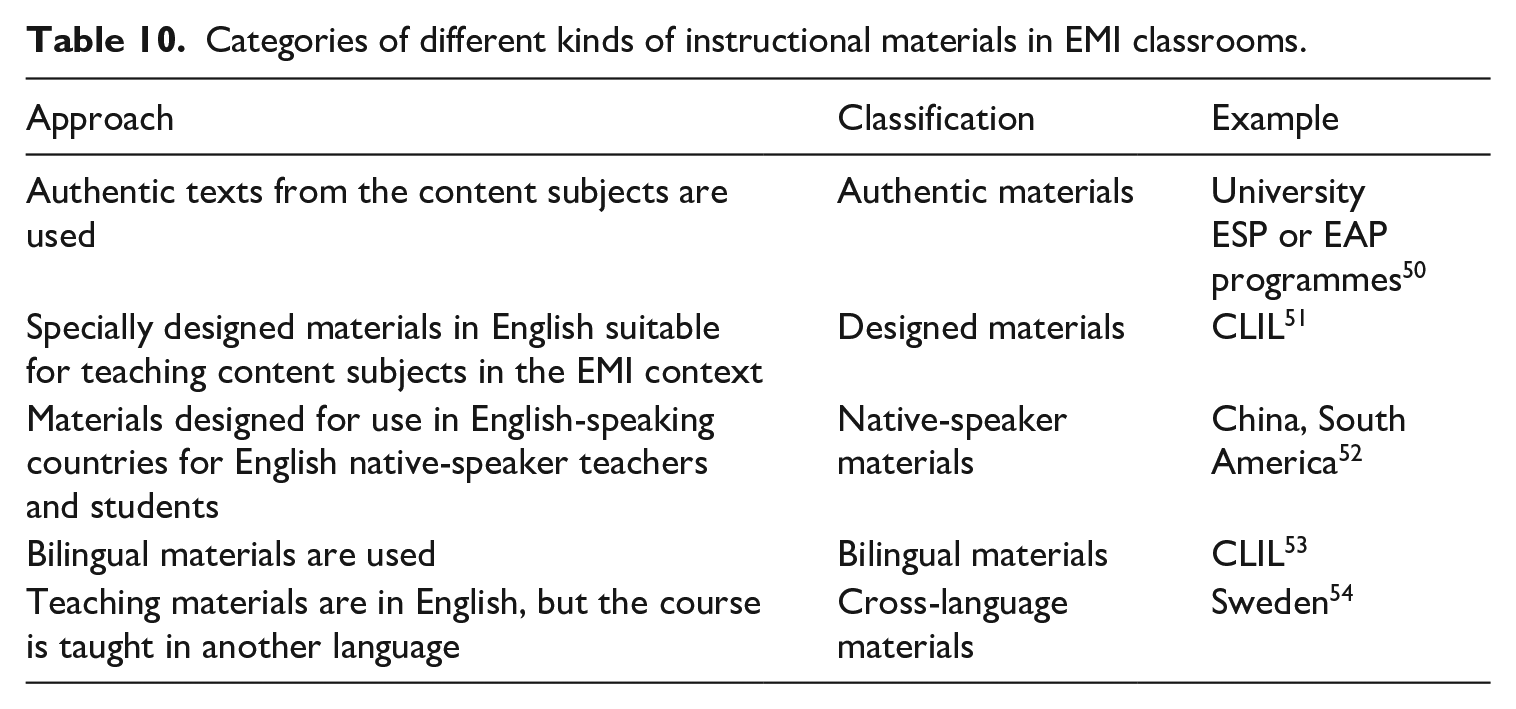
Teaching materials often play a crucial role in EMI and may take a variety of different forms (see Table 10). For example, specially designed materials for CLIL courses may include additional learning support, including graphs, tables, photos, and language exercises, along with content knowledge (e.g. Spain). The aim is for the materials to provide easier access to content without overwhelming them with new information (Gray, 2013). Schools known as “bilingual schools” or “international schools” in some countries use curriculum and textbooks developed for schools in the US or an Anglophone country. In China, textbooks published by Anglo-American universities are usually adopted for EMI, and the relative linguistic demand of the available textbooks are often the most important criterion for choosing one over the other (Lei and Hu, 2014). However, materials developed for native speakers may not match learners’ language needs, raising problems in testing students’ actual learning (Koyama and Bartlett, 2011). Some of the difficulties experienced in introducing EMI in some countries (e.g. Malaysia) have been attributed to lack of suitable materials for content teachers. Lethaby (2003) cites lack of appropriate materials as a major source of problems or elite bilingual schools in Mexico. Lin (2016: 59) points out that in the Hong Kong EMI context there is a “disconnect” between the models of writing presented in the English subject class and textbooks and the type of writing students are expected to use in their content classes. As Lin puts it, “. . .frequently the textbook publishers present the concepts and topics using one set of genres while the assignment and assessment tasks require the students to produce writing in a different set of genres”.
Categories of different kinds of instructional materials in EMI classrooms.
Pecorari et al. (2011) observe that whereas in the past, English-language textbooks were often used in contexts where no suitable materials were available in the learners’ L1, they are currently often chosen “because teachers identify some positive values in them” (p.314), both in terms of high standards of development and production as well as their role in supporting incidental learning of English.
Using the Typology
The complete typology of EMI is given in Appendix 1. It describes 51 features across 10 curriculum categories, which were identified when comparing different forms and realizations of EMI. We regard the typology as a first step towards addressing the questions posed by Macaro et al. (2018: 68): Can the research field, as a collective endeavour, arrive at a model of the different learning situations in which content and language are at issue? Is it possible to identify and then define relatively stable superordinate and subordinate terminology for these learning situations within such a model?
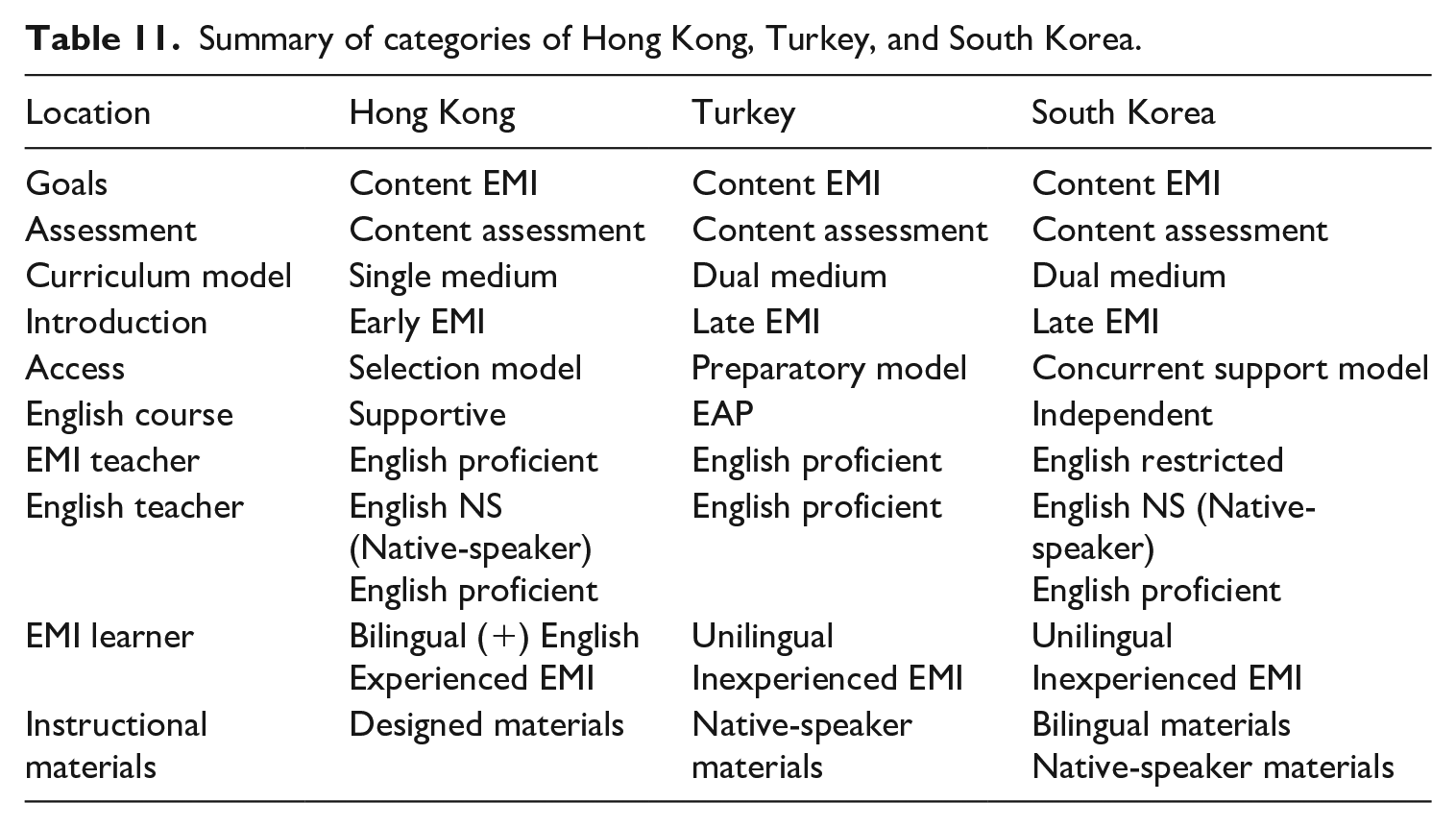
The typology seeks to do this by providing a framework and terminology that can be used to profile the features of EMI in different settings. It can serve as an objective basis for comparing EMI across different contexts and to document how approaches to EMI are being modified or changing. The typology can be used to profile characteristics of EMI and to compare its status in different contexts, as can be seen in Table 11, which illustrates the status of EMI in what Kachru (1985) referred to as Outer Circle (Hong Kong) and Expanding Circle (Turkey, South Korea) countries. Table 11 is a summary of these three representative regions or countries to illustrate the profile characteristics of EMI.
Summary of categories of Hong Kong, Turkey, and South Korea.
The typology also raises issues that need to be considered in designing, implementing, and evaluating EMI approaches and identifies issues for different stakeholders such as school administrators, policymakers, researchers, language teachers, content teachers, teacher trainers, and students. For example:
How is EMI defined and characterized in the context?
What level of English proficiency is needed to successfully teach EMI?
How do teachers and learners navigate teaching and learning in EMI?
What kind of institutional support is provided for content teachers transitioning to EMI?
How does EMI affect the learning of academic content as well as English?
What level of English proficiency is needed to successfully learn through EMI?
What support is provided for learners transitioning to EMI?
How do teachers and students respond to EMI?
What instructional resources are needed to implement EMI?
What factors account for the success or lack of success of EMI in different contexts?
The typology can thus be used as a navigator to guide curriculum planners as well as content and language teachers to find “suitable” sets of parameters to implement effective EMI teaching according to their cultural and classroom contexts.
An example scenario would be the following: A prestigious private university in Indonesia plans to use EMI in its international business diploma in order to ensure that graduates of the program have both good business skills as well as good English communication skills (Bilingual Content EMI) and also to build in a competitive edge to their diploma compared to other providers of similar degrees in the region, none of which offer EMI in their programme. After consultation, the institution decides that initially they will use a Dual Medium approach, with some modules being taught in English (e.g. Marketing) and some in Indonesian. The program may later switch to Single Medium, depending on the effectiveness of EMI and the availability of instructors. In order to be accepted into the program, potential students must achieve a level of 5 on IELTS (Selection Model). An intensive three-month English Language course is provided by the university English Language Centre to prepare students for the IELTS test (English for Academic Purposes). The centre staff are proficient speakers of English as L2 (English Proficient). EMI teachers must be assessed informally as having sufficient proficiency in English for EMI (English Competent). A series of workshops are provided for the EMI instructors to prepare them to use English to teach their subjects, following successful completion of which the instructors are able to take part in the program (English Certified). A range of textbooks and materials used in similar programs in Australia are selected for the EMI modules (Native-Speaker Materials). Assessment throughout the course will be based both on content as well as language proficiency (Content and Language Assessment). As the program is being implemented, formative evaluation procedures developed by staff of the English language centre will be used to monitor the transition to EMI and, if necessary, additional support will be provided for both teachers and course participants.
On a final note, Mackey’s concluding comment on his typology of bilingual education can also serve as an appropriate conclusion to our intentions here: It is only after we have taken all the variables into account and applied appropriate measures of them that we can achieve any degree of certainty in our planning in this important and complex field. Toward this end it is hoped that this preliminary typology may be of some help. (Mackey, 1970: 606)
Footnotes
Appendix
A typology of EMI.

| Primary goals | Classification | |
|---|---|---|
|
|
1.1 Learning academic content and skills through English | Content EMI |
| 1.2 Learning academic content and skills in two languages | Bilingual content EMI | |
| 1.3 Learning intercultural communication skills | Intercultural EMI | |
| 1.4 Improving proficiency in English | Proficiency EMI | |
|
|
2.1. Assessment based on content mastery | Content assessment |
| 2.2. Assessment based on content mastery and language proficiency | Content and language assessment | |
| 2.3. Assessment based on language proficiency | Language assessment | |
| Approach | Classification | |
|
|
3.1. All major content subjects except foreign languages taught in English | Single medium |
| 3.2. Some subjects taught in English and others in another language | Dual medium | |
| 3.3. Some subjects taught both in English and another language | Parallel medium | |
| 3.4. Some subjects initially taught in another language and later taught in English | Transitional | |
| 3.5. The content teacher and the English teacher collaborate in teaching content classes | Collaborative | |
| 3.6. Teachers of different disciplines share the teaching | Interdisciplinary | |
| 3.7. Content teacher teaches a content class specially designed for second language students | Sheltered | |
| 3.8. A content and language course are linked with the same content base and co-ordinated assignments | Adjunct | |
| 3.9. A preparatory or bridging course prepares students to transition to EMI | Bridging | |
|
|
4.1. EMI commences in pre-school or primary school and continues to higher education | Early EMI |
| 4.2. EMI commences in secondary school and continues to higher education | Middle EMI | |
| 4.3. EMI occurs only in higher education | Late EMI | |
| Approach | Classification | |
|
|
5.1. Students must demonstrate a proficiency level in English | Selection model |
| 5.2. Student must complete a pre-university program prior to EMI | Preparatory model | |
| 5.3. Students at tertiary level are offered additional language support | Concurrent support model | |
| 5.4. Teaching may be bilingual initially to enable students to transition to EMI | Multilingual model | |
|
|
6.1. The English course is not linked to EMI | Independent |
| 6.2. The English course includes support for EMI | Supportive | |
| 6.3. The English course covers a range of general academic and literacy skills needed for EMI | English for academic purposes | |
| 6.4. The English course includes a range of general academic content | Thematic approach | |
| 6.5. The English course prepares students for disciplinary competence in a specific disciplinary area | English for specific purposes | |
|
|
7.1. Teachers are unilingual speakers of English and do not speak the students’ L1 | Monolingual teacher |
| 7.2. Teachers are native speakers of English and also speak the learners’ language(s) | Bilingual English NS | |
| 7.3. Teaches are proficient speakers of English as L2 | English proficient | |
| 7.4. Teachers have limited proficiency in English | English restricted | |
| 7.5. Teachers must pass a proficiency test to teach EMI or be assessed as having sufficient English proficiency for EMI | English competent | |
| 7.6. Teachers receive special English training in using EMI | English certified | |
| 7.7. Teachers receive special pedagogical training in using EMI | EMI trained | |
| 7.8. Teachers have taught content subjects in an Anglophone country but not in an EMI context abroad | Experienced content teacher | |
| 7.9. Teachers have experience in EMI | EMI experienced | |
|
|
8.1. Teachers are unilingual native speakers of English from an English-speaking country | English NS |
| 8.2. Teachers are native speakers of English from an English-speaking country and also speak the learner(s)’ language(s) | Bilingual English NS | |
| 8.3. Teachers are native speakers of a local variety of English | English NS | |
| 8.4. Teachers are proficient speakers of English as L2 | English proficient | |
| 8.5. Non-native-speaker English teachers must pass an English test | English certified | |
| 8.6. In-service language training provided for teachers with needs for higher levels of English proficiency | English enhanced | |
|
|
9.1. Learners must achieve a certain proficiency level in English in order to take part in EMI | English certified |
| 9.2. Learners are unilingual | Unilingual minus English | |
| 9.3. Learners are bilingual or multilingual in languages other than English | Bilingual minus English | |
| 9.4. Learners may be bilingual or multilingual, including English | Bilingual plus English | |
| 9.5. Learners have no previous experience of EMI | Inexperienced EMI | |
| 9.6. Learners have previous experience of EMI | Experienced EMI | |
|
|
10.1. Authentic texts from the content subjects are used | Authentic materials |
| 10.2. Specially designed materials in English suitable for teaching content subjects in EMI context | Designed materials | |
| 10.3. Materials designed for use in English-speaking countries for English native-speaker teachers/students | Native-speaker materials | |
| 10.4. Bilingual materials are used | Bilingual materials | |
| 10.5. Teaching materials are in English, but the course is taught in another language | Cross-language materials |
Acknowledgements
We are grateful to Diane Pecorari, Hu Guangwei, Lindsay Miller, and the reviewers for their valuable suggestions during the preparation of this paper.
Funding
The authors received no financial support for the research, authorship, and/or publication of this article.
