



Abstract
Currently, a growing number of teaching approaches focus on aspects of variation in language (e.g. English as a Lingua Franca (ELF), World Englishes, English for Specific Purposes (ESP), genre theories, etc.); however, each of these approaches tends to focus on particular (specific) aspects of language variation and do not fully account for the range or dynamicity of linguistic variations. This article, based on a discussion of language variation, proposes a model of language proficiency that considers the dynamic nature of language variation and is not dependent on static (native-speaker defined) norms of language. Using the Dynamic Approach to Language Proficiency as a model of language proficiency and grounded in understandings of language variation, this article introduces the concept of Teaching English as a Dynamic Language (TEDL). The article includes evidence for the need to develop such a model and also points out ways in which current and future work can contribute to further development of this approach. Finally, the article also identifies some socio-economic implications of this work and explicitly supports the need to recognize and empower local (including endangered) languages through TEDL.
Keywords
Introduction
This article, based on a discussion of language variation, points out that while teaching English as a Lingua Franca (ELF)/English as an International Language (EIL) is a step in the right direction, it is not sufficient. ELF/EIL, 1 as will be explained in a later section, focus on how English is used in global contexts by people who come from a range of different (linguistic) backgrounds and therefore adds an important set of understandings about language and contributes to inter-cultural communication; however, this is just one of the ways in which the English language varies. A more inclusive way of integrating understandings of language variation in English Language Teaching (ELT), as this article will argue, can perhaps be considered Teaching English as a Dynamic Language (TEDL). TEDL, in addition to considering Global Englishes, a cover term that includes World Englishes and ELF/EIL (Galloway and Rose, 2015), draws on an understanding of language as a Complex Adaptive System (discussed in more detail in the next section). The article will also consider a range of implications for developing TEDL, as well as outline some ways of doing so.
A discussion of language variation has a number of implications for education. Below, I have included two broad observations that relate issues about language (and language variation) to students, schools and communities.
The languages that students bring to and develop during their schooling are not consistent in or across students, schools and communities.
Students’ languages, regardless of whether they use them as their mother tongue or as their ‘other’ tongue, impacts and relates to their performance and engagement both in and out of school.
These two statements highlight the linguistic variations that exist in and across communities and their potential implications. These relationships will be discussed in reference to appropriate theoretical frameworks below.
Understanding Language Variation
This section will develop and explain the core arguments that identify a need for developing TEDL. These arguments are based primarily on an examination of language variation. Languages, as will be pointed out below, vary a lot and this variation is not only reflected in the formal features of a language, but also in terms of the meanings that are created through language. In addition, language varies across a number of dimensions (e.g. users, uses, mode, and time) and these dimensions help us understand some of the ways in which language is a dynamic system. Most current approaches in ELT (including those oriented to Global Englishes) focus on particular (specific) types of language variation but do not take into account the dynamic nature of language. As a result, they fail to consider the implications of language variation and dynamicity in developing their pedagogical material, curriculum, assessment, and teacher education. This situation can be addressed if we consider the implications of Teaching English as a Dynamic Language. In order to develop this argument, we will first briefly respond to the following three broad questions:
a) What are some of the dimensions of language variation?
b) What are some types of language variation?
c) How do we study language (variation)?
What Are Some of the Dimensions of Language Variation? 2
To respond to this question, I will draw on some of my own recent work (see, for example, Mahboob, 2015; Mahboob, 2017) that focussed on identifying factors that help us understand variations in language (including ‘semantic variation’, discussed in more detail in the following section) and the implications of these variations. This work, which draws on Halliday and other colleagues’ work in Systemic Functional Linguistics 3 (a socio-semiotic theory of language), identifies four broad dimensions that we can consider in identifying where, when, how, and what variations may exist in language. These dimensions include: user-oriented features of language; use-oriented features of language; mode-oriented features of language (including multi-modality); and time. Each of these dimensions includes a number of sub-dimensions, each of which impacts our language choices in particular ways. Furthermore, these four dimensions are not independent, but rather interact with each other in all contexts: any given instance of language is shaped by (and carries information about) its users, use, mode, and time. Let us consider this in relation to Example 1 below:
Example 1: Yes, you are right, just like what Shakespeare says in Hamlet: ‘Give every man thy ear, but few thy voice’.
The linguistic features of Example 1 above suggest that this is a sample of an oral text and is a response (or a continuation) to a previous turn (by another participant). The conversation suggests that the participants (or at least some of them) are in agreement with each other. One can also note that the person speaking (if not all the participants) has some understanding of English literature (and Shakespeare/Hamlet) and that the event/text that they are discussing has some relevance to the quote being used. Example 1 was probably produced in recent times, but it refers to another text from an earlier period (use of ‘thy’). While thinking of time in terms of present/past and identifying features of language that have changed over time is one way of understanding how time impacts language, there are other ways in which time also operates when it comes to semiotic systems such as language. Time can influence our language in at least three other ways (see Halliday and Matthiessen, 2004 for a discussion of this): a) what part of a text we are focussed on (logogenesis, or text-time), for example, our understanding of a phrase/utterance may be different if it occurs in the beginning, middle or end of a text; b) when we read a text in terms of our own age/development (ontogenesis), for example, we will have different understandings of the same text based on whether we are reading/listening to it as a child or an adult; and, c) how the text is framed within the larger context of history (phylogenesis) and our familiarity with that history, as, in Example 1 above, we are called to reinterpret Polonius’ words from Hamlet in relation to another (later) event/observation/text.
While time plays a very important role in what meanings we create (and how we understand them), the interaction between the first three dimensions (users, uses, and mode) can give us a sense of how language is/can work in a range of domains (and sub-domains). These three dimensions can be plotted together to give us the three-dimensional framework of language variation (Figure 1).
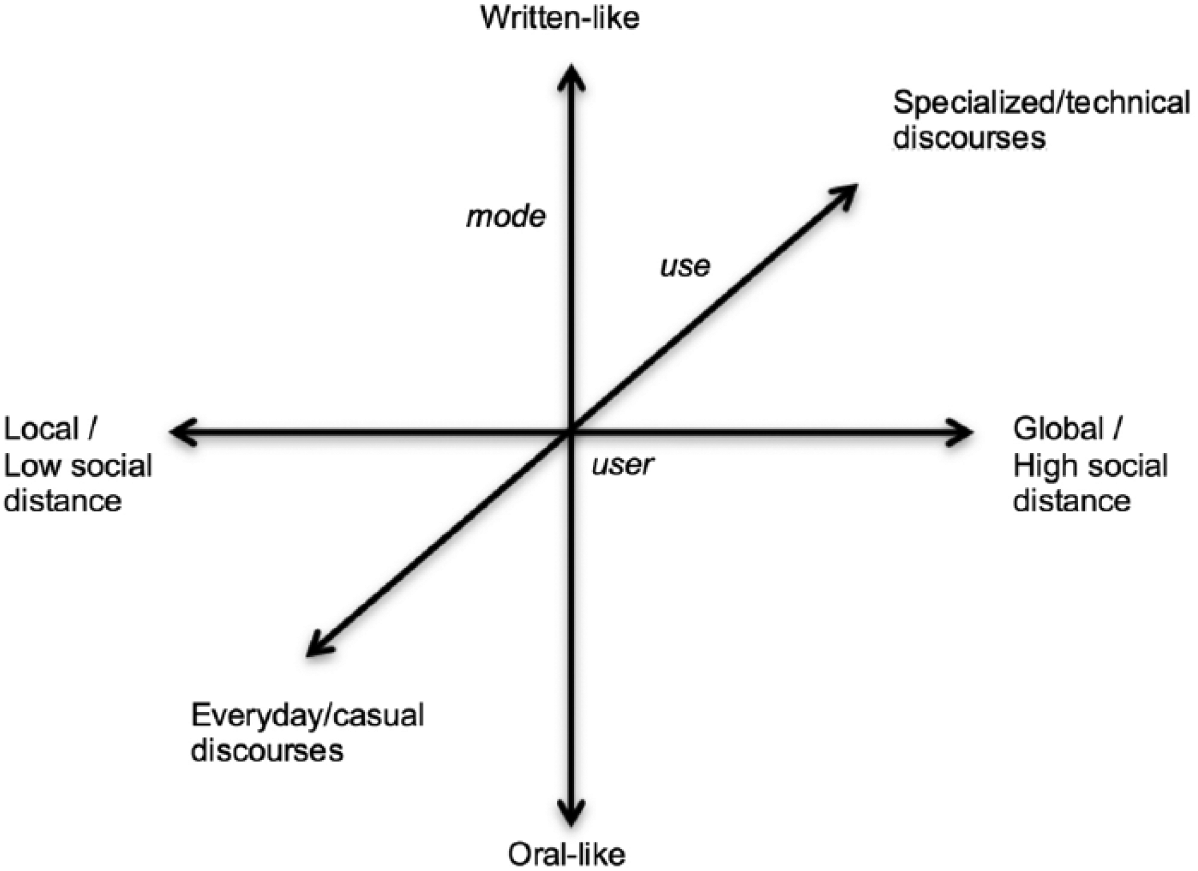
Three-dimensional Framework of Language Variation.
The three-dimensional framework helps us to identify eight broad domains of language, listed in Table 1 below. Note that while I have used examples from English in the description of domains, these domains can be translingual (Garcia and Li Wei, 2013; Li Wei, 2018), i.e. individuals may use more than one language and may blend multiple languages. Some of the other languages that people may use in domains 1 and 2 (and potentially 3 and 4) include local (and potentially endangered) languages/dialects (which are often marginalized in an ELT oriented field). TEDL, as will be pointed out in the concluding section, supports people’s right to maintain and expand the meaning-making potential of their local languages/dialects.
Eight Broad Domains of Language Variation, with Areas in Linguistics that Study It.
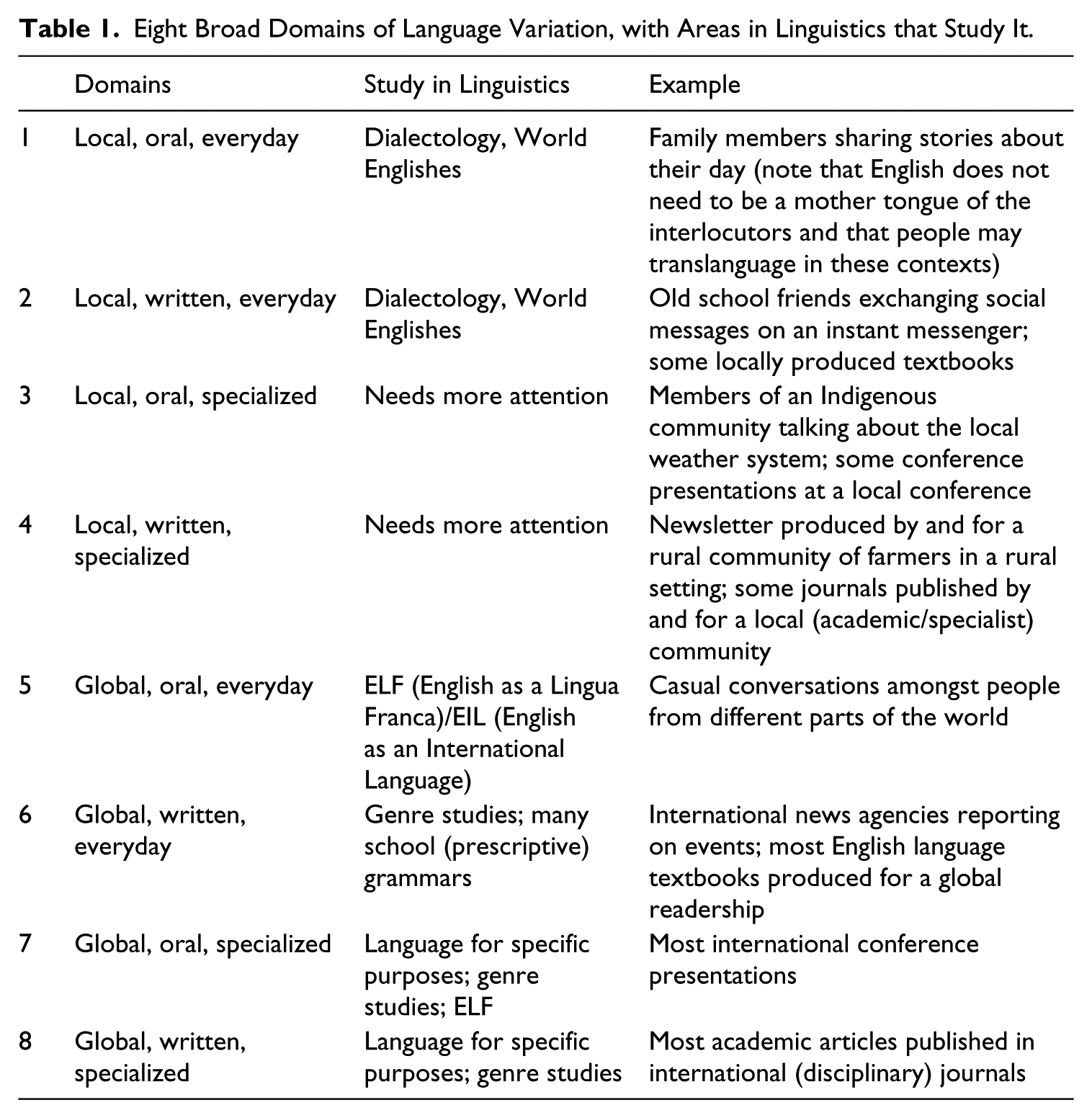
Table 1 helps us in identifying how and why language(s) varies across different contexts. The three-dimensional framework and the eight domains partially explain the two statements in the Introduction to the article: the language students bring to school (domains 1 and 2) may be different from that of schooling (domains 5 and 6) and in higher education (domains 7 and 8). These differences (including differences in dialects, registers and languages), unless bridged, can and do impact student participation in schools (and other contexts). For example, if a person can only use language as it is used in their local, everyday contexts, they will have difficulties in understanding texts produced in domains 7 and 8, which are technical and specialized. This is one reason why, for example, students, unless they receive appropriate training and support, have trouble reading and writing research papers in disciplinary areas in universities.
Table 1 also helps us in identifying how different areas of specialization in linguistics draw on data from different domains, and thus tell us different things about language. For example, while World Englishes and dialectology studies predominantly focus on examining features of language as it is used for local purposes (domains 1 and 2), many ELF/EIL studies focus on the use of English in global settings (domains 5 and 6; where users may be multilingual). World Englishes studies tend not to focus on data that is globally oriented, oral/written, and specialized (domain 7 and 8) and thus do not necessarily inform or tell us much about the use of language in such contexts. Thus, drawing our teaching practices/materials on just World Englishes cannot sufficiently prepare our students to succeed in higher education or in specialized programmes. Similarly, ELF/EIL oriented material (which predominantly focusses on domain 5; although there are some projects that also look at ELF in academic contexts) on its own will provide little support to people who need to engage with more locally oriented varieties of languages (domains 1 and 2) or with more specialized/technical written discourses (domains 8). To learn and teach language (which, as will be discussed in the next section, includes, learning the language, learning about the language, and learning through language), we need to consider the implications of the three-dimensional framework and the eight domains. For example, we need to consider how models and descriptions of language that we use/draw on align with the goals of our programme and the needs of our students. Furthermore, we need to consider both formal and semantic types of language variation.
What are Some Types of Language Variation?
A majority of work done on language variation (e.g. in sub-fields such as dialectology and World Englishes) takes a formal approach to describing these variations. For example, they examine variations in phonetic, phonological, morphological, syntactic, semantic, pragmatic features of languages/dialects etc. While these types of variations do exist in languages, they do not sufficiently explain how meanings (and access to meaning-making resources) vary across individuals and communities. This later type of variation is called semantic variation 4 (Hasan, 2008/2011) and is crucial for understanding the argument being developed in this article.
Ruqaiya Hasan’s extensive work illustrates how language variation is not simply about the differences in the formal/structural features of language, but also about the differences in the meanings that we make (and the linguistic resources used to make them). Hasan explains the concept and implications of semantic variation through detailed linguistic analyses (drawing on Systemic Functional Linguistics) of a number of texts collected from interactions between children and their parents. By using data from child-parent interactions, she is able to not only illustrate how semantic variation works, but also how we are allocated different meaning-making resources through early childhood interactions and some potential consequences of this.
To understand this, we will discuss two extracts from Hasan’s work. Both of these extracts are naturally occurring conversations between children aged three and a half years of age and their mothers.
Extract 1: (Source: Hasan, 2008/2011)
1 Mother: D’you love daddy?… d’you love daddy?
2 Julian: mmm (=yes)
3 Mother: D’you love Rosemary? (
4 Julian: No!
5 Mother: Why don’t you love Rosemary?
6 Julian: (LAUGHS)
7 Mother: Why don’t you love Rosemary?
8 Julian: (CONTINUES TO LAUGH)
9 Mother: You’re a [?rat-bag] (REALIZES CHILD WAS TEASING)
10 Julian: I do
11 Mother: (UNINTELLIGIBLE)
12 Julian: Who else do you want me to love?
13 Mother: You can love whoever you want to love
14 Julian: Can I love Peter?… Can I?
15 Mother: No, I think that’s more like friendship
16 Julian: Pardon?
17 Mother: I thought you’d say that. It’s like friendship, isn’t it? You’re
friends with Peter, aren’t you?
18 Julian: Yep… (
19 Julian: When I get old as you and [? Maree likes me] could we
marry each other?
20 Mother: No because Maree is your cousin
21 Julian: Oh!
22 Mother: ’Cause cousins aren’t allowed to marry
23 Julian: Why?
24 Mother: ’ Cause the law says they’re not
25 Julian: Who is that?
26 Mother: The law? (= do you mean who is the law?)
27 Julian: Yeah
28 Mother: The policeman… (
Hasan (2008/2011) draws a number of observations based on an analysis of this extract. For example, she points out that the questions that the mother is asking appear to already have a ‘correct’ answer. Hasan calls such questions ‘assumptive questions’ because ‘the person asking appears to have already made an assumption what the correct answer should be’ (2008/2011:119). Second, the exchange exemplifies Halliday’s observation that learning language includes three facets: ‘Learning Language, Learning through Language, and Learning about Language’ (Halliday, 1980). In Extract 1, through this interaction, Julian is: a) learning language (meaning of the word ‘love’); b) learning through language (who he can or cannot love); and c) learning about language (when is it appropriate or inappropriate to use the word ‘love’). And, third, by referring to authority figures, the mother is articulating who is allowed to make decisions in his community (the law/police). Hasan states that ‘it is in daily discourses of this kind that children’s mental habits take shape; they receive their early lessons in forms of reasoning, and in what is relevant to their ways of living’ (2008/2011: 62). These discourses lead to variations in the language and the meanings that children learn to make in and through language. The meanings that Julian, who comes from a lower socio-economic status (SES) family, is learning to make in Extract 1 contrasts with those Kristy, who comes from a higher SES family, is learning to make in Extract 2.
Extract 2: (Source: Hasan, 2002)
1 Mother: Did you know that they are going to leave?
2 Kristy: No.
3 Mother: They’ve been building a house.
4 Kristy: Mm.
5 Mother: Oh, they haven’t been building it, somebody else has been building it for them, and it’s nearly finished, and they’re going to move to their house in May.
6 Kristy: Why in May?
7 Mother: They’re going to wait until the end of the school term.
8 Kristy: Mm.
9 Mother: Because Cathy goes to school now, and then she will
change to her new school after the holidays.
10 Kristy: Mm
11 Mother: If they’d moved earlier she’d only go to the new school for a week or two, and then they’d have holidays, you see, it would mess it up a bit for her.
Extract 2 contrasts with Extract 1 in a number of ways. First, instead of asking ‘assumptive questions’, Kristy’s mother asks ‘prefaced questions’. Prefaced questions ask ‘about the addressee’s state of knowledge: did the addressee know something to be the case’ (Hasan, 2002: 117). Kristy’s mother is also observed self-correcting herself (perhaps to avoid misinterpretation by the child) and responding to Kristy’s questions in an informative way. While Extract 1 also clearly shows that Julian is eager to learn and engage, the types of meanings that he is learning to make may not be those valued in educational contexts; thus, it may impact his success in being able to engage with ‘uncommonsense’ (discussed in a later section) discourses of schooling and education. In contrast to Extract 1 (where Julian’s mother referred to authority), Kristy’s mom scaffolds Kristy into thinking about how things are interrelated and how we can identify and understand reasons that lead to particular decisions. This informal schooling is introducing Kristy to the kind of meaning making resources that are valued in schools; and, thus, increasing her chances of succeeding in and through school.
Hasan’s analysis of her data also led her to describe the process of ‘semiotic mediation’. She defines semiotic mediation as ‘mediation of something by someone to someone else by means of the modality of language’ (Hasan, 2002), and argues that it is these mediations that shape children’s ways of learning and meaning and leads to semantic variation.
5
The differences between the semiotic mediation experienced by Julian and Kristy lead to different ways of seeing and interacting with the world. While Kristy is being scaffolded into learning to understand how different events are interrelated and how decisions are made based on a number of factors, Julian is learning that things are as they are because people with authority say so. Children bring these ways of meaning-making into school, where certain types of semantic variations are preferred over others. Hasan further notes that even after a year of schooling, children do not change these habits. And, although, it is possible to develop different ways of making-meaning, this is something that needs to be supported through teaching and education. Hasan (2002: 120) observes: at this early stage of three and half to four years, the children belonging to these two groups have established different ways of learning, different ways of solving problems, different forms of consciousness, or mental disposition… As this process begins from early infancy, invisible mediation which occurs in the course of everyday activities… attains a primary status in the life of the individual. It becomes in effect the ruler of attention and interest, of motivation and relevance. The child’s ways of participating in the negotiation and appropriation of technical concepts or specific knowledge structures, etc. is coloured initially – though not necessarily finally – by the experience of this primary mediation.
Hasan’s work is essential in understanding and developing TEDL. Research on semantic variation illustrates how variations in language are not just about formal features of a language, but includes variations in the types of meanings made. These variations are often understudied in current research and therefore are ignored in mainstream educational material, theories and practices. One consequence of this is students from lower SES backgrounds have more challenges in succeeding in and through education (as their ways of meaning-making are not in alignment with those used in education), while students from higher SES have a better chance (as their ways of meaning-making are more in alignment with those used in education).
Drawing on semantic variation in developing educational resources and approaches can help in what Hasan calls Reflective Literacy. Reflection literacy ‘is a form of literacy that would go beyond simple interpretation to reflection on how the ‘same’ words can be made to construe different meanings and what is the social significance of such semantic construals’ (2003/2011: 229). Hasan (2006/2011: 243) identifies three principles that need to be considered in applying this work in educational contexts: (i) the study of the meaning-making potential of language should never be divorced from literacy pedagogy: this potential is also a potential for linguistic variation; (ii) all instances of meaning making should be subject to interrogation: e.g., ‘what meaning construed how’, ‘why’ and ‘why here’; and (iii) the significance of what language refers to, what meanings it makes, should never be divorced from the social context from where the pressures for meaning making arises.
6
This work helps us realize that studying or teaching language variation (e.g. Global Englishes) is not simply about describing formal features of a language or about teaching ‘local’ or ‘standard’ forms of the language but about being part of a community that is working to understand how our societies maintain an unequal distribution of resources and what we can do to change this. By including semantic variation in our work, we can both understand and take action to change the hegemonic discourses embedded in current mainstream educational material, theories, and practices. By drawing on this work in developing TEDL, we can help individuals understand and develop a range of meaning-making resources and use them in appropriate contexts. This, in time, will impact not just individual students, but also their communities.
How Do We Study Language (Variation)?
In recent years, researchers (e.g. De Bot, 2008; Larsen-Freeman, 2016; Larsen-Freeman and Cameroon, 2008 etc.) have been drawing on Dynamic Systems Theory to illustrate how language is a Complex Adaptive System (CAS). For example, De Bot, Lowie and Verspoor (2007: 19) state: A DST [Dynamic System Theory] view entails that an individual’s language system with its numerous sub-systems is in constant flux, that the system as a whole and the sub-systems will show a great deal of variation, that small differences between individuals at a given point of time may have a great effect and that there is no such thing as an end state.
In their seminal paper, ‘Language is a Complex Adaptive System’, The ‘Five ‘Group’ (2008: 2), point out: (a) The system consists of multiple agents (the speakers in the speech community) interacting with one another. (b) The system is adaptive; that is, speakers’ behavior is based on their past interactions, and current and past interactions together feed forward into future behavior. (c) A speaker’s behavior is the consequence of competing factors ranging from perceptual mechanics to social motivations. (d) The structures of language emerge from interrelated patterns of experience, social interaction, and cognitive processes.
Similarly, Larsen-Freeman (2016) in a paper that shows how CAS theory can inform ELF research identifies the following features as evidence that language can be considered CAS: emergence (new features of language may arise when the system is used), self-organization (order in language emerges through use), open (language, as a system, is open to additions and changes), adaptive/feedback sensitive (our language assimilates and responds to use), dynamic (language is not static or restricted by ‘rules’), unfinalizable (there is no end-point in what language is, nor do we ever stop developing our own language), inseparable from context (language is shaped by and in turn shapes our understanding of context), and variable (variation is always present across all strata of language).
This view of language is in alignment with the earlier discussions of language variation. This work also shows how our evolving understandings of language, such as through studies of ELF/EIL (e.g. Baker, 2015; Li Larsen-Freeman, 2016) and translanguaging (e.g. Wei, 2018) etc, relate to issues of language learning, use, and development. Considering language as CAS may also help us in moving beyond dependence on ‘native-speaker’ models and norms – and the implications of such models on theoretical (e.g. critiquing notions of fossilization, target-language, interlanguage, and ultimate attainment etc.) and professional concerns (e.g. concerns of discrimination against ‘non-native’ English speakers in TESOL).
Work on CAS is crucial for developing TEDL, as is marked in the use of the term ‘dynamic’ in the title. The previous two sections provided ways of thinking about language variation in terms of the dimensions and types of language variation; CAS provides a way to think about how we can study these (and other) variations. Grounding TEDL in research on CAS along with understandings of language variation can help us both recognize and address variations in language that are reflected in the languages that students bring to various educational institutions as well as those that emerge in these contexts.
The discussion of language variation in this section highlights the importance of integrating these into our work in ELT. However, one challenge in doing this is that these approaches are essentially designed to identify and explain how, why and what type of language variation occurs. In order to use them in educational contexts, we need an approach to language proficiency that can be used to reimagine language competence and to enable us to develop appropriate material and practices for teaching, assessment and teacher education.
Dynamic Approach to Language Proficiency (DALP)
In the previous section, we discussed some of the ways in which linguists have and are studying language variation. While all of these have some implications for language teaching and learning (e.g. see Lin, 2016 for implications of the three-dimensional framework in education; see Hasan, 2003/2011 for some discussion of semantic variation, types of literacy, and education; see De Bot et al., 2007; Larsen-Freeman, 2016, for implications of CAS on ELF and SLA respectively), we need a model of language proficiency that can help us both understand language as a dynamic system, and, yet allow us some ways in which we can ‘measure’ it. The Dynamic Approach to Language Proficiency (DALP) is one such approach (Mahboob and Dutcher, 2013; Mahboob and Dutcher, 2014).
DALP is a model of language proficiency that responds to some of the issues that arise when we study language variation. DALP posits that ‘being proficient in a language implies that we are sensitive to the setting of the communicative event, and have the ability to select, adapt, negotiate, and use a range of linguistic resources that are appropriate in the context’ (Mahboob and Dutcher, 2014). As such, DALP does not examine a pre-determined set of formal linguistic features, but rather one’s ability to adapt and negotiate language (variation). DALP models ontogenetic development of language for all individuals over time because a person’s proficiency shifts as they develop the ability to communicate at a higher level of competence in a wider range of situations. This development is not based upon a person’s adherence to an outside (native-speaker) norm but rather their flexibility in negotiating language and meaning in different contexts necessitating language variation. In placing the basis of proficiency on communicative flexibility rather than solely on norm-adherence multilingualism is seen to be valued, as is the ability to negotiate different contexts within the same linguistic code.
In her work on ELF, Seidlhofer (2011: 198) describes language learning from a lingua franca perspective as a process of learning ‘to language’ rather than ‘a language’. Learning to language means developing the ability to negotiate meanings in different context (language as ‘verb’) rather than learning a set of isolated forms (language as ‘noun’). The DALP model provides a way to conceptualize proficiency that is compatible with the ELF approach, and, at the same time, considers other domains and types of language variation.
In developing DALP, we need to consider two core elements: shared linguistic code and shared contextual knowledge (Figure 2). Shared linguistic code refers to the user’s control of the myriad features of a given language such as mode of communication (written, spoken, multimodal) and structural components of a language. Shared contextual knowledge refers to the familiarity with the setting, purpose, socio-cultural practices, participants, turn-taking organization of an event, and semantic variation etc. These two elements may be viewed as continuums, and a person’s language proficiency can be placed along a line of having relatively more or less proficiency in a certain area. In Figure 2, these two lines intersect to form four Zones of Proficiency; a person’s Zone of Proficiency can change in a non-linear fashion depending on his or her knowledge of and familiarity with the linguistic code and/or contextual features of a situation.
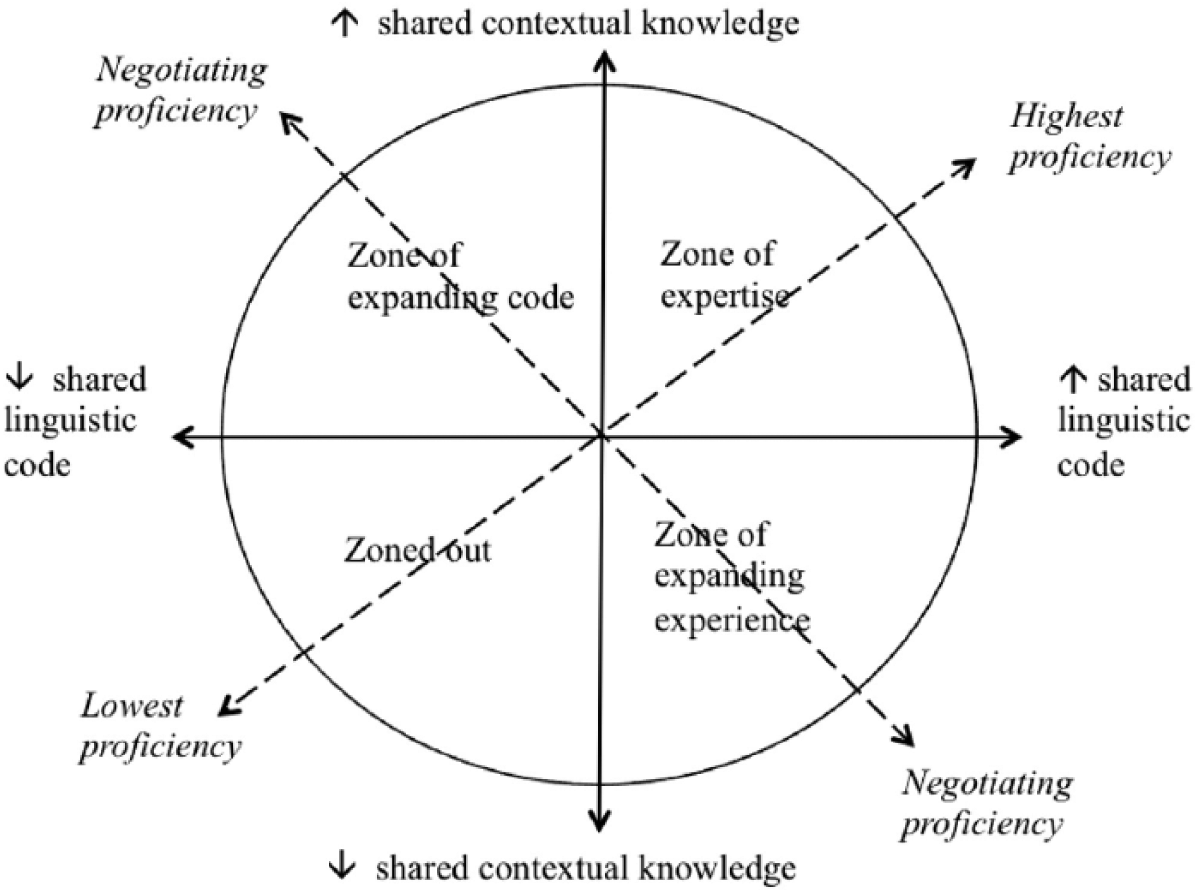
Dynamic Approach to Language Proficiency.
The dynamic element of this model can also be understood in relation to CAS. The ‘Five Graces Group’ (2009) identifies the following characteristics of CAS: Distributed Control and Collective Emergence, Intrinsic Diversity, Perpetual Dynamics, Adaptation Through Amplification and Competition of Factors, Nonlinearity and Phase Transitions, Sensitivity to and Dependence on Network Structure, and Local. While it is beyond the scope of this article to discuss each one of these characteristics in relation to DALP, they provide insights that should be considered in the development of TEDL resources.
The four zones identified in DALP include: Zone of Expertise, Zone of Expanding Experience, Zone of Expanding Code, and Zoned Out. A person can be said to be in their Zone of Expertise when they are in full control of the linguistic code and the conventions of appropriate contextual use. The criteria for the Zone of Expertise is one’s ability to negotiate contexts successfully (not what one’s mother tongue is). A person can be considered to be in the Zone of Expanding Experience when the user is familiar with the language that is being used in a particular context, but the context itself is unfamiliar. Conversely, when a person is familiar with the context of a situation but not the linguistic code used in that context, they can be considered to be in the Zone of Expanding Code. Both the Zone of Expanding Experience and the Zone of Expanding Code can be considered zones where an individual is ‘negotiating proficiency’, they have some skills to be able to negotiate the context/code to achieve their purposes, but are not fully familiar with what is expected of them. Multiple interactions in a particular context and with a particular type of language (as well as formal training) can help a person move from these zones of negotiating proficiency to the Zone of Expertise. Finally, when a person is unfamiliar with both the contextual elements and the linguistic code of a situation, their proficiency is considered lowest and they can be said to be Zoned Out (for examples of each of these zones, see Mahboob and Dutcher, 2014; Mahboob and Dutcher, 2015).
DALP focusses on the ways in which people negotiate language variation in different contexts. The results of these negotiations can be quite different: for example, where particular interactions or ways of speaking/writing become frequent, a recognizable and relatively stable variety of language might emerge. On the other hand, language might evolve in contexts where people share little and the duration of interaction is short; in such cases, studies of contact languages might explain how people develop ways of communicating. A person’s proficiency is determined by how much variation one can negotiate, not on one’s status as a native or non-native speaker. Proficiency, as defined in DALP, is not restricted to a single language; one’s proficiency includes one’s competence in multiple languages and dialects (as well as other multimodal resources), and translanguaging. This is because negotiating across varying codes and contexts may require one to use a range of linguistic resources. In other words, the more ways of negotiating variation one has, the more resources to meaning-making one has – making them more proficient in language. Conversely, the more restricted one’s ability to negotiate varying codes and contexts, the less proficient one is. This model of language proficiency recognizes multilingualism and variation, does not draw on native-speaker models/norms, and supports a dynamic approach to language teaching/learning.
Implications for Language Teaching: Teaching English as a Dynamic Language
The DALP model, along with our understanding of language variation, identifies gaps in our current approaches in ELT: many of these approaches do not draw on a framework of language variation, nor do they draw on understandings of language as CAS. Thus, there is a need to develop an approach to ELT that considers different domains and types of language variation; an approach that recognizes language as a CAS. Teaching English as a Dynamic Language is an attempt to conceptualize an approach to ELT that acknowledges and promotes language variation and language diversity.
Teachers’ Professional Development
If language is to be understood as a CAS, then it is essential for teachers to integrate it in their practice. This also necessitates competent teacher educators and appropriate teacher education curriculum and material. Currently, many (if not most) language education programmes draw on grammatical approaches (e.g. transformative and generative grammar) that, while they may serve specific purposes in linguistics, were not necessarily designed for educational applications and therefore may not serve the needs of educators and students. There are few programmes that draw extensively on approaches to language that take a social-semiotic and CAS orientation. By overlooking these current (and emerging) approaches to language study, teacher education programmes fail to fully prepare teachers to support their students’ diverse and varying needs.
In some ways, one can argue that such teacher education programmes are anachronistic: they draw on theories of language that are obsolete and/or inappropriate for ELT. A useful analogy for this would be to imagine training doctors today based on the scientific beliefs and practices in medicine 200 years ago and/or training them based on research on reptile biology (instead of human biology). While this may appear to be an outrageous analogy, it is not an inappropriate one. Traditional grammars are based (with few changes) on early English grammars written over 200 years ago; and generative/transformative grammar are/were not to be used by teachers for language teaching purposes. These approaches do not integrate understanding of language as a socio-semiotic and complex adaptive system. A failure to update the assumptions and understandings that inform language teaching and language teacher education has severe negative consequences for students and their ability to succeed in and through education.
Earlier in this article, we discussed some of Ruqaiya Hasan’s work on semantic variation. Hasan studied how children start developing an understanding of language, language use, and the world through everyday, locally oriented and oral interactions (domain 1). Following Bernstein (1999), Hasan labels the knowledge that children develop in everyday discourses as ‘common sense knowledge’ and the unconscious teaching that happens in these everyday contexts as ‘local pedagogy’. This common sense knowledge and local pedagogy, she illustrates, is contrasted with the knowledge that is expected in educational contexts (domains 5 and 6 in schools and 7 and 8 in higher education), which is ‘un-commonsense’ knowledge (and which requires understanding of oral and written, globally oriented, and, to varying degrees, specialized and technicalized discourses). If teachers are unfamiliar with these aspects of language and learning through/about language, then they lack the training to effectively overcome gaps between the language and approaches to learning that students bring with them to the ones that they will need to succeed.
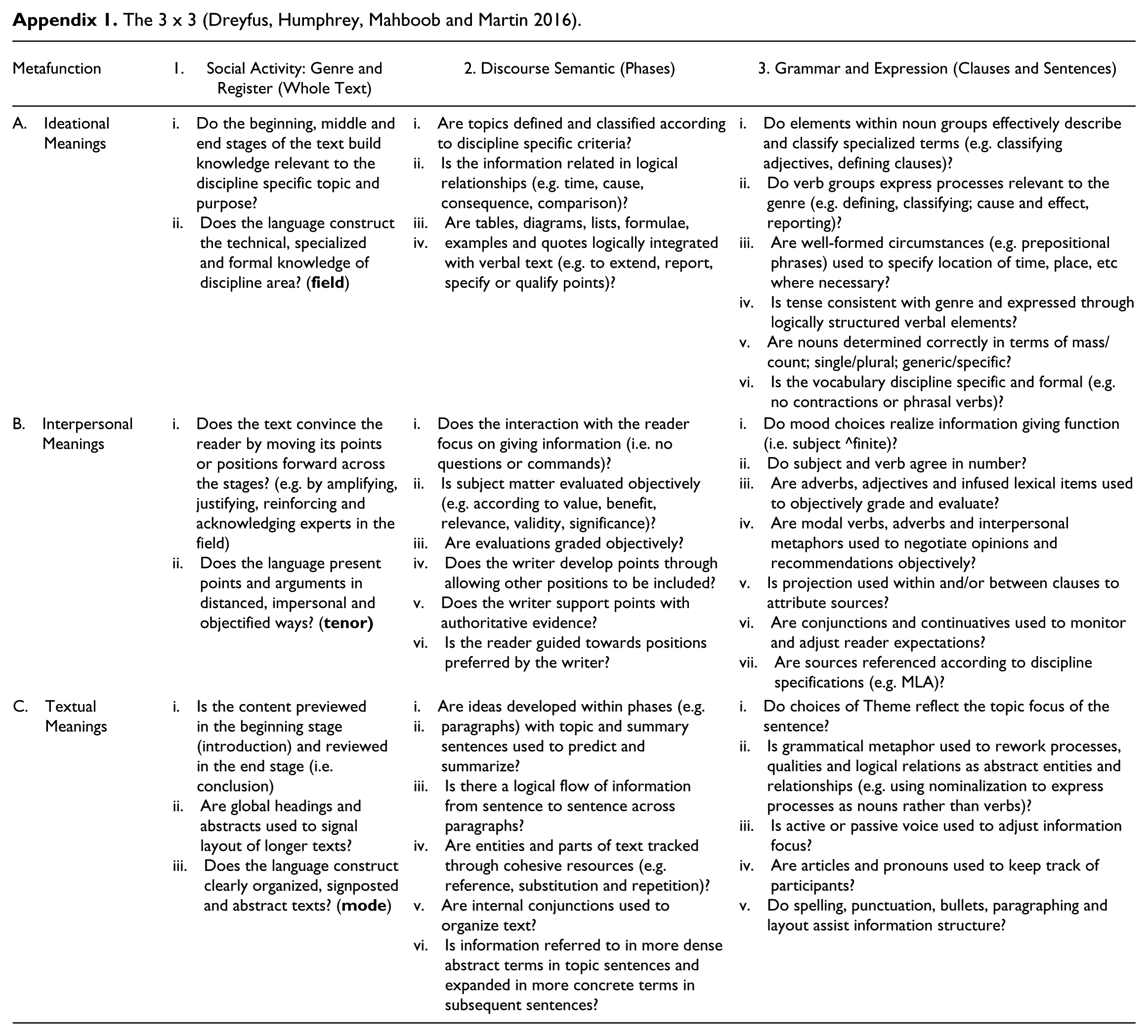
Today, there are many grammars of English (e.g. Systemic Functional Grammar, which Hasan draws on in her work on semantic variation) and models of language variation that have been developed keeping in mind their application in educational contexts. For example, ‘3 x 3’ (Appendix 1), a resource developed by the SLATE team (Dreyfus et al., 2016) was designed to train novice teachers how to develop an understanding of the key linguistic features that are used in particular text-types/genres. Drawing on Systemic Functional Linguistics, 3 x 3 plots three (3) metafunctions (ideational, interpersonal, and textual) and three (3) strata (whole text, phases, and clauses and sentences) to create a ‘3’ x ‘3’ matrix. For each of the nine cells, 3 x 3 includes possible queries about what features of language are used to create what meaning at what strata (e.g. features that create interpersonal meanings at the whole text level) in a text. Since 3 x 3 is not a static rubric, it can (and should) be adjusted for different genres/registers before being used. This is necessary because some of the questions included in a 3 x 3 may not be applicable to another genre; and, conversely, there might be questions that are not already included in another 3 x 3. Thus, 3 x 3 is a context and register sensitive tool which can help teachers identify key features (variations) of different genres that they need to examine/teach.
Teachers can be trained to use 3 x 3 to identify key meaning-making features of texts that they have to work with. They can also be trained to create genre/register specific 3 x 3s. Learning how to use and/or design 3 x 3 or similar tools can empower teachers by enabling them to carry out their own analysis on texts/genres that they need to teach. This means that teachers will be able to identify features that reflect the variations in language and use their findings to develop context relevant training/teaching materials (using appropriate and socio-culturally informed pedagogical frameworks). Teachers with appropriate tools of language analysis will then not be dependent on the one-size-fits-all kind of grammars currently in use and will be able to develop grammatical descriptions of genres and teaching material that they need to work with.
Testing and Assessment
Not unlike current dominant teacher education programmes, most of the current standardized English language tests are, again, anachronistic and draw on ‘static’ native speaker norms of language as their ‘measuring rod’. These tests typically measure the performance of how ‘non-native’ speakers of English respond to items based on native speaker norms; ‘native’ speakers are not expected to or required to take these tests. The assumption here is that all native speakers of a language already know the system. This implies that these tests do not include any measures of semantic variation or an individual’s ability to negotiate variation.
DALP, by considering variability and negotiation as key features in our understanding of language proficiency, could have implications for language assessment. Making a similar argument, Johnson Gerson (2008) argues that we need an approach for assessing proficiency that accounts for language variation in different contexts. Such an assessment would help ascertain a test-taker’s ability to adapt their use of language to different situations and their ‘responsiveness to assistance or feedback’ (Johnson Gerson 2008) rather than their ability to respond to items based on static monolingual native speaker models. A reimagined method of assessment, perhaps based on DALP, would more accurately describe a person’s (both native and non-native speakers of a language) potential ability to engage in new communities and situations. Such assessment will provide information on how an individual might perform in new contexts and what type(s) of support they may need to help them overcome any language challenges.
At present, I am not aware of any (standardized) tests that do this. However, it is possible to conceive of approaches to testing and assessment that consider the dynamic nature of language. For example, rather then testing individuals’ ability to demonstrate whether they have control over ‘standard’ language (as defined by native speaker) norms, language tests can require test takers to demonstrate their ability to negotiate variations in language. Tests could include a diverse range of texts and contexts and be designed to assess the individual’s ability to negotiate variations. These tests can report on the nature of language code and contexts where test takers have expertise, where they are negotiating either the code or the context, or where they are zoned out. The results of such a test can report on the ability of a test taker (both native and non-native speakers of a language) in terms of how much variation they can negotiate efficiently and where/when/how they fail to successfully engage with variation. Results of such tests would be useful for a range of purposes (and not just education) because they would tell us how well an individual might be in working with relatively (un)familiar language and/or in (un)familiar contexts. This is just one hypothetical possibility. We need to develop and consider models and tests/assessments that integrate understandings of language variations and CAS.
Curriculum and Material Development
Current textbooks typically also do not consider language variation or the dynamic nature of language in developing material. For example, locally produced textbooks include language that is sometimes dominated by features of domain 1 and 2. In Mahboob (2015), I point out how locally produced textbooks in Pakistan adapt the linguistic features of biographical texts to project particular political and religious ideologies; such adaptations, while they reflect ways in which biographies may be written in domain 2, do not reflect those written in domain 6. This raises the question whether educational material that draws mostly on language features of domain 1 and 2 can prepare students to be able to engage with globally oriented (technical/specialized) texts.
On the other hand, many internationally produced textbooks use language that mostly includes features of domain 5 and 6. Using features from only domains 5 and 6 implies that students who learn from these textbooks are unable to accommodate variations that are found in domains 1 and 2. These teaching material resources also fail to sufficiently prepare students for engaging with the more technical/specialized language of domains 7 and 8. For example, one study by To and Mahboob (forthcoming), examined the linguistic complexity of four EFL textbooks published by a major international press and used widely in Vietnam. Our goal in this project was to explore whether science and non-science texts included in these books showed linguistic variation. While we expected to find differences between these two text types, based on our understanding of the three-dimensional framework and work on genre theory (e.g. Martin and Rose, 2008), the results of this study did not reveal any meaningful differences. The findings of this study suggest that these textbooks do not sensitize students to variations that they will encounter when they engage with disciplinary texts.
A failure of textbooks to reflect language variation and dynamicity has a number of implications. For example, it may lead to subject teachers complaining that English language teachers do not sufficiently train the students. English language teachers, on the other hand, technically fulfil their job requirements by teaching the assigned curriculum. The main losers here are the students who are left without appropriate and sufficient training to be able to read and write in ways that are appropriate in different contexts. One way of addressing this issue is by drawing on our understandings of language variation (including semantic variation) in developing ELT and other educational material. Material developers should also consider the dynamic nature of language and prepare students to be able to negotiate unfamiliar language and/or context successfully.
Currently, there are numerous projects in ESP that attempt to develop context specific material. For example, in a SLATE inspired project at Carnegie Mellon University, Qatar, Miller and Pessoa (2016) collected and analysed assignments in the Information Sciences department. They then analysed these texts and identified features that were crucial in drafting good assignments. The team then converted this analysis into training material. This and similar projects are evidence that some academics, researchers, and educators do focus on language variation in certain contexts with a goal to use those studies to develop context relevant and pedagogically sound educational and training resources. However, many of these projects tend to focus on academic or professional discourses and are often designed for education/training purposes. This work can be expanded and genres that are not necessarily business, academia, policy, or industry related should also be examined and, perhaps, used for community-based projects. In addition to variations in language for specific purposes, other types and domains of language variation also need to be examined to support students’ multiple needs.
Non-native English Speakers in TESOL (NNEST) Studies
One last implication of acknowledging the dynamic nature of language that I want to briefly discuss here is that of the preference given to native speakers and models/norms of language drawn on ‘native’ speakers (including in language testing, as discussed earlier). In ELT, native-speakers, often of British or American English, are considered ideal candidates for language teaching regardless of their professional qualifications or the context of teaching/learning the language (Braine, 2010). This issue is partly grounded in a belief that native speakers are the benchmark for assessing and teaching language; a belief based in a static understanding of language that is untenable given our work on CAS and language variation (see, for example, contributions to Martinez Agudo, 2017). This belief impacts approaches to language teaching (e.g. most current ELT approaches discourage, if not disapprove, the use of local languages) and on hiring practices (e.g. many ELT job advertisements state that they are looking for ‘native’ speakers). The beliefs and perceptions that underlie such practices can be challenged by sustained research on language variation and CAS and the use of this work in teacher education programmes, language assessment, and material development.
The native speaker fallacy also supports some of the fundamental theories in foundational second language acquisition research. For example, ideas such as interlanguage, fossilization, target language, ultimate attainment etc., are grounded in ideas that learners should achieve ‘native’-speaker proficiency in language. These concepts have already been challenged in the discipline (e.g. Bhatt, 2002); in addition to the problems identified previously, these concepts also do not account for language variation or dynamicity in their theoretical assumptions. An updating of these and other such problematic concepts will contribute to an attitude shift and decrease discriminatory and biased assumptions and practices.
Conclusion
This article argued that current practices and approaches in ELT are mostly based on assumptions where language is seen as a static entity, a ‘noun’ that can be described in its entirety through pedagogical and descriptive grammars. This is an issue because this work does not consider different dimensions, domains, and types of language variation, nor does it account for language as CAS. These limitations require us to consider new ways of thinking about language proficiency, ones that are based on understandings of language variation and dynamicity (and where the act of languaging is seen as a verb). The article then introduced the Dynamic Approach to Language Proficiency, a model of language proficiency that is not based on static norms/features of language based on native speakers; but rather examines how well (or not) individuals negotiate and adapt language in different contexts and with appropriate structural/functional variations. We then considered how our understanding of language variation, DALP and CAS lead us into creating a new direction in ELT: Teaching English as a Dynamic Language. While TEDL is a new idea, it is preceded by a number of other approaches that focus on specific types of variations in language; for example, ESP, EFL/EIL, genre theory, World Englishes, Teaching English as an Additional Dialect, etc. TEDL can contribute to this work by providing an overarching approach to developing material, curricula, teacher education resources, tests, etc., that recognizes and utilizes our growing understanding of language variation and CAS. In developing TEDL, we will need to closely monitor and identify any assumptions that reflect a static view of language (this includes work that only focusses on structural/formal features of language variation) in both new and existing work.
In conclusion, I would like to revisit the two statements that have been supported through the discussions presented in this article:
The languages that students bring to and develop during their schooling are not consistent across students, schools and/or communities.
Students’ languages, regardless of whether they use them as their mother tongue or as their ‘other’ tongue, impacts and relates to their performance and engagement both in and out of school.
These two statements were discussed in this article and we noted that these variations have socio-economic and political implications. TEDL can provide ways of enabling teachers and students (in disempowered contexts) by recognizing variation in how people use language to make meanings and how these meanings (and the resources used to make them) vary between and within individual, communities, and contexts. One consequence of this would be to create space for recognizing, teaching, and celebrating local languages and local ways of meaning making alongside the teaching of more globally oriented languages (and, thus expand people’s repertoire of meaning-making resources). Recognizing diversity in language and using it to develop ELT approaches can help sustain and promote diversity of languages, cultures, and belief systems.
Footnotes
Appendix
The 3 x 3 (Dreyfus, Humphrey, Mahboob and Martin 2016).
| Metafunction | 1. Social Activity: Genre and Register (Whole Text) | 2. Discourse Semantic (Phases) | 3. Grammar and Expression (Clauses and Sentences) |
|---|---|---|---|
| A. Ideational Meanings | i. Do the beginning, middle and end stages of the text build knowledge relevant to the discipline specific topic and purpose? ii. Does the language construct the technical, specialized and formal knowledge of discipline area? ( |
i. Are topics defined and classified according to discipline specific criteria? ii. Is the information related in logical relationships (e.g. time, cause, consequence, comparison)? iii. Are tables, diagrams, lists, formulae, iv. examples and quotes logically integrated with verbal text (e.g. to extend, report, specify or qualify points)? |
i. Do elements within noun groups effectively describe and classify specialized terms (e.g. classifying adjectives, defining clauses)? ii. Do verb groups express processes relevant to the genre (e.g. defining, classifying; cause and effect, reporting)? iii. Are well-formed circumstances (e.g. prepositional phrases) used to specify location of time, place, etc where necessary? iv. Is tense consistent with genre and expressed through logically structured verbal elements? v. Are nouns determined correctly in terms of mass/count; single/plural; generic/specific? vi. Is the vocabulary discipline specific and formal (e.g. no contractions or phrasal verbs)? |
| B. Interpersonal Meanings | i. Does the text convince the reader by moving its points or positions forward across the stages? (e.g. by amplifying, justifying, reinforcing and acknowledging experts in the field) ii. Does the language present points and arguments in distanced, impersonal and objectified ways? ( |
i. Does the interaction with the reader focus on giving information (i.e. no questions or commands)? ii. Is subject matter evaluated objectively (e.g. according to value, benefit, relevance, validity, significance)? iii. Are evaluations graded objectively? iv. Does the writer develop points through allowing other positions to be included? v. Does the writer support points with authoritative evidence? vi. Is the reader guided towards positions preferred by the writer? |
i. Do mood choices realize information giving function (i.e. subject ^finite)? ii. Do subject and verb agree in number? iii. Are adverbs, adjectives and infused lexical items used to objectively grade and evaluate? iv. Are modal verbs, adverbs and interpersonal metaphors used to negotiate opinions and recommendations objectively? v. Is projection used within and/or between clauses to attribute sources? vi. Are conjunctions and continuatives used to monitor and adjust reader expectations? vii. Are sources referenced according to discipline specifications (e.g. MLA)? |
| C. Textual Meanings | i. Is the content previewed in the beginning stage (introduction) and reviewed in the end stage (i.e. conclusion) ii. Are global headings and abstracts used to signal layout of longer texts? iii. Does the language construct clearly organized, signposted and abstract texts? ( |
i. Are ideas developed within phases (e.g. ii. paragraphs) with topic and summary sentences used to predict and summarize? iii. Is there a logical flow of information from sentence to sentence across paragraphs? iv. Are entities and parts of text tracked through cohesive resources (e.g. reference, substitution and repetition)? v. Are internal conjunctions used to organize text? vi. Is information referred to in more dense abstract terms in topic sentences and expanded in more concrete terms in subsequent sentences? |
i. Do choices of Theme reflect the topic focus of the sentence? ii. Is grammatical metaphor used to rework processes, qualities and logical relations as abstract entities and relationships (e.g. using nominalization to express processes as nouns rather than verbs)? iii. Is active or passive voice used to adjust information focus? iv. Are articles and pronouns used to keep track of participants? v. Do spelling, punctuation, bullets, paragraphing and layout assist information structure? |
Funding
This research received no specific grant from any funding agency in the public, commercial, or not-for-profit sectors.