




Abstract
This study was conducted to understand issues related to the current practice of English teacher education development in the Lao People’s Democratic Republic with a focus on reading. It recognizes that what pre-service teachers experience both prior to and during their teacher education are important and need to be understood if the goals of teacher education are to be achieved. Previous research found that pre-service teachers’ prior experiences of both reading and learning to read were mostly a matter of learning discrete language items rather than developing comprehension and critical reading, and that these experiences had shaped perceptions about how reading is taught. This study extends this understanding by investigating reading-related pedagogy on a teacher education programme. Its findings highlight a gap between an education policy that promotes communicative language teaching and classroom practice. Therefore, for the goals of policy to be realized in the language classroom, appropriate innovations are needed.
Keywords
Introduction
A common characteristic of teacher education in its different forms is that it seeks to achieve change. Not uncommonly the nature of the change has been determined by a central or national body, such as with the introduction of a new curriculum, and strategies are put in place to prepare and support serving teachers through in-service education, and teachers-in-training through pre-service education. Pre-service English language teachers are the focus of this article.
The literature on teacher preparation tells stories of both success and failure in terms of achieving change, and there is considerable support for the idea that pre-service education has a weak transformational effect. One long-standing suggestion is that the experience of being a learner has shaped pre-service teachers’ thinking before they begin their teacher preparation, and that this can be difficult to change. A starting point, therefore, is to understand that prior experience. However, as teacher education seeks to achieve change, what pre-service teachers experience during teacher education is also important. Thus, this article seeks to explore current experience of reading in English among pre-service teachers in a little-investigated context, the Lao People's Democratic Republic (PDR), where change is typically mandated from on high.
Change in the Education System
One of the perspectives on teacher change proposed by Clarke and Hollingsworth (1994 cited in Clarke and Hollingsworth, 2002) is change as systemic restructuring in which teachers respond to and enact ‘change policies’ of the system. These can be viewed as top-down changes, coming from government or ministries, and if their enactment depends on directives from above the change strategy is described as power-coercive and unlikely to be successful on its own. Other strategies are therefore required, and may include rational–empirical and normative-re-educative (Chin and Benne, 1969). Both may be applied through in-service teacher education, with the former relying on reason and explanation, the latter on involvement and engagement. However, even then success is not guaranteed.
In language teaching, there are multiple examples of failed attempts to bring about this type of system change as illustrative examples within the Asia-Pacific region alone make clear. In Malaysia, the government mandated a shift to teaching science and mathematics in English as an expression of modernization and globalization, but reversed the policy after six years in the face of community backlash (Hanewald, 2016). In Vietnam, Canh and Barnard (2009) investigated classroom discourse to find out the extent to which communicative language teaching (CLT) was being implemented and found it was not. Among the reasons they proposed for this were curriculum and examination pressure, and a lack of motivation to learn a foreign language. In Japan, Humphries and Burns (2015) looked at the use of CLT-oriented textbooks in an engineering university and identified the main barriers to change as relating to teacher beliefs, understanding of the new approach, and a lack of ongoing support. Teachers lacked the time to come to terms with the innovation. In the People’s Republic of China, where top-down efforts to introduce CLT have met with resistance (Wang, 2017), Hu (2002) suggested the Chinese culture of learning as a cause. The difficulty of ‘foreign’ imports was also seen in Papua New Guinea, where the introduction of outcomes-based education in secondary schools was dropped after five years. It had been promoted by Australian consultants and among the reasons for its failure was a lack of collaborative professional development (Joskin, 2013). A further reason for resistance to change was neatly encapsulated in the title of a study of innovation in the Seychelles: ‘I have been doing things this way for so many years; why should I change?’ (Mohamed, 2008).
The examples above mostly relied on in-service rather than pre-service teacher education, and in the latter the ‘apprenticeship of observation’ (Lortie, 1975) is often cited as an obstacle to achieving change. This is recognition of the fact that through the years of being a learner, people develop a set of beliefs and assumptions about the nature of teaching and learning and the role of the teacher and learners that then influence them as teachers themselves, although at times this can take the form of a reaction against rather than a replication of what was observed and experienced. In either case, these prior experiences contribute to a language teacher's cognition that in turn shapes and is shaped by classroom practice (Borg, 2006; Macalister, 2010). However, they are not the sole influence. Professional coursework and other forms of professional development, including pre-service and in-service teacher education, can also play a part. Johnson and Golombek have argued that the pedagogy experienced in language teacher education (LTE) plays a critical role, and have suggested that ‘LTE pedagogy be recognized as a central domain in the knowledge-base of LTE’ (Johnson and Golombek, 2020: 117).
In summary, then, achieving change in an education system is not an easy or straightforward exercise. Many factors can contribute to the success or failure of an innovation. English language teaching (ELT) in the Lao PDR is not exempt from these concerns, as the next sections will make clear.
English Language Education in the Lao PDR
Since the collapse of the Soviet Union in 1991, and in response to the growing demands of socioeconomic development and international cooperation, English has become the most important non-regional foreign language for the Lao PDR. The Government of Laos introduced important educational frameworks and visions in 2006 and 2008 with the aim of lifting the country out of poverty by 2020 through education reform (Phetsiriseng, 2009). Of the six frameworks established for education, the one that relates most to ELT focuses on developing human resources that meet the regional and international standard (Ministry of Education and Sports, 2008) . English is a compulsory subject in primary and secondary schools, and at university (Ministry of Education and Sports, 2015). As Viphavanh (2014: 6) explains, ‘English is required as one of the main foreign languages at all levels of the Lao education system to enable the country to better integrate into the region and the world’. This policy has led to an increasing demand for English teachers in the Lao PDR, and also to attempts to change the way English is taught.
Traditional teaching approaches have tended to dominate ELT in the Lao PDR (Thongphanheuangsy, 2014). These include the audio-lingual (ALM) and grammar translation (GTM) methods. Criticisms of the effectiveness of these methods lead to the introduction of CLT. Unlike ALM and GTM, the main purpose is to encourage learners to use the target language to achieve communicative functions. Within CLT, reading is the act of constructing meaning from a written text using various strategies and skills. In other words, it is a process which requires not only linguistic knowledge but also cognitive and metacognitive strategies (Grabe, 2009; Grabe and Stoller, 2018). Examples include using prior knowledge, evaluating the text, making rational judgements of the text being read, and checking understanding.
The focus on the ability to communicate is very clear in recent official documents. National English curriculum statements point out that the teaching of English should focus on communication rather than grammar. With reference to reading in particular, its course description ‘focuses on critical and academic reading’ (Ministry of Education and Sports, 2019: 20, translated). Thus, the teaching of English should be communicative rather than form focused. This approach to teaching and learning is also reflected in statements of the teacher education programme (TEP)'s philosophy, that ‘the programme must ensure critical thinking abilities, deep learning, social responsibility, open-mindedness, and a good role model for learners’ (National University of Laos, 2010: 3).
Prior Learning Experiences
Top-down statements of expected educational outcomes are, however, no guarantee that they will be achieved. After all, it is teachers working with learners in classrooms who achieve the outcomes. The extent to which teachers are prepared for this is largely determined by LTE, one of the factors that can shape language teacher cognition. As with pre-service teachers anywhere in the world, the participants in this study had undergone an ‘apprenticeship of observation’ prior to joining the TEP. In order to understand their cognitions as they entered LTE, Phonekeo (2020) explored their prior learning experiences in relation to reading through surveys and semi-structured interviews. One hundred and twenty-nine pre-service teachers completed a survey regarding prior experiences of reading and learning to read in English. The main themes that emerged were an exposure to grammar translation, with a focus on pronunciation, oral fluency, and intonation, and on vocabulary, with encouragement of dictionary use. The overall picture of the Lao English as a foreign language (EFL) pre-service teachers’ prior experiences in reading and learning to read in English was learning discrete language knowledge. In other words, they had an experience of grammar translation, rather than reading skill development. These experiences appeared to have shaped their perceptions. The three highest-ranking survey items all related to a bottom-up reading approach, paying attention to individual words, pronunciation, and translation in learning English reading. The fourth-ranked item, stressing the importance of reading aloud, also seemed to be related to grammar translation, as reading aloud is typically focused on pronunciation. Further, the three lowest ranked perceptions were related to comprehension development and critical reading skills. One of the possible reasons for this may be that they were not regular features of the school classroom.
The conclusion to be drawn is that, if the top-down changes envisaged for ELT in Laos have any chance of being implemented, the TEP needs to challenge thinking by providing new input and new learning experiences.
Research Purposes and Questions
The main purpose of this study was to investigate the current practice of reading instruction in Lao EFL pre-service teacher education, for how teachers learn to teach can prepare them to realize education policy goals. In this way it responds to Johnson and Golombek's (2020) call for greater attention to LTE pedagogy, and for the need to widen the geographical spread of LTE research (Barkhuizen and Borg, 2010: 238). Therefore, two research questions are addressed in this study:
RQ1: What is the current practice of reading instruction in the Lao EFL pre-service teacher education system?
RQ2: What are Lao EFL pre-service teachers’ perceptions of this practice?
Methodology
Research Design
This is a qualitative study that draws upon important elements of exploratory and ethnographic research (Creswell, 2007). Exploratory research is an investigation into an issue which is not clearly defined and empirically studied. It is conducted to provide a better understanding of the existing issue which is worth further discovering as the results can be used for a follow-up action (Stebbins, 2001). ‘Ethnographic research is a qualitative design in which the researcher describes and interprets the shared and learned patterns of values, behaviors, beliefs, and language of a culture-sharing group’ (Creswell, 2007: 68). An important element of this research rests in the comprehensive description of the issue under investigation. This allows the gathering of rich information through data triangulation sources which aim for ‘thick description’ and seek to ‘unearth and piece together participants’ own perspectives and values’ (Palfreyman, 2015: 146).
Participants
Both pre-service teachers (or students) and lecturers from one TEP in the Lao PDR contributed to this study. Six lecturers were recruited for class observations and semi-structured interviews to seek answers to the first research question. They were selected using a purposive sampling method as determined by the research purposes and questions (Dörnyei and Taguchi, 2010). All were adults who had been learning English for a number of years, but had had a wide range of learning experience which allowed comprehensive data to be generated. Ten students who completed the survey were subsequently invited to participate in semi-structured interviews to seek answers to the second research question. Ethics approval from Victoria University Wellington's Human Ethics Committee was followed when recruiting the participants so that they were not exploited in any manner.
Data Collection and Analysis
To seek answers to the research questions, semi-structured interviews and class observations were used. The semi-structured interviews were conducted in Lao with both students and lecturers. They were then translated by the second author and checked for accuracy by a bilingual Lao colleague. The classroom observations were conducted to investigate the current practice of reading instruction. All data collection instruments were piloted with a group of students who had similar characteristics to the participants of the main study prior to their actual use and the piloting results showed that the instruments were reliable. After data collection, content and thematic analysis was employed.
Findings
This section begins with the findings from the lecturers (RQ1), in order to understand the LTE pedagogy being employed in the teaching of reading and the extent to which it aligns with policy expectations. It then moves to the findings for pre-service teachers and their perceptions of current classroom practice (RQ2).
Lecturers and Classroom Practice
Observation found that activities in the classroom were of four main types and were book-ended by attendance and homework checking at the start and homework assignment at the end, with comprehension questions and vocabulary exercises being the main forms of homework. Both attendance and homework contributed 10% each to a student's final grade, and a student could fail a course through low attendance. As this section will demonstrate, reading instruction in this context was on grammar translation, involving deliberate attention to language features.
When asked about difficulty in teaching reading, the six lecturers identified a considerable range of factors. These fell into two broad categories. People lacks included pre-service teachers’ low and diverse English backgrounds, pronunciation issues, insufficient vocabulary knowledge, and teacher workload. Resource lacks included a lack of teaching materials, a lack of Internet access, the irrelevance of reading texts to the context, and the classroom physical environment. Taken together, these placed important constraints on facilitating interactive and innovative reading instruction in the Lao EFL pre-service TEP. When asked about how they addressed the issues mentioned, the lecturers reported paying attention to lesson plan preparation by using their private Internet access, and through pedagogical decisions such as assigning more work to students to do, having good students help weak students, and giving different reading texts to different groups of students to read. In these ways they sought to work against some of the constraints they had identified.
Grammar Translation
In five of the six reading classes observed students read texts aloud and translated them into their first language. This reflects the dominant use of the traditional teaching method of grammar translation. Results from the interview data analysis were also congruent with the observational evidence. For instance, one of the interview participants stated: Most of the time, I primarily follow the textbook. I divide the students into groups and assign them one or two paragraphs to read. Members of each group take turns reading aloud by focusing on pronunciation. After reading, I have them translate the text into Lao and finally focus on new vocabulary. (Teacher 4)
The result was not surprising since the Lao EFL lecturers still followed a traditional rote memorization mode of instruction, reflecting the principles of the ALM and GTM. Critical reading skills, deep and meaningful learning, self-regulation, and meaning construction that might be expected of an LTE pedagogy aligned with policy expectations were not in place. This becomes increasingly evident when the components of a lesson are examined.
Vocabulary
Vocabulary received considerable attention. Five of the six classes observed focused pre-service teachers primarily on reviewing difficult words prior to and after reading the text. The finding also reflects comments in the teacher interviews. For instance, one of the participants indicated that: The main focus of reading instruction is vocabulary because it is an indispensable part of reading. If students lack vocabulary knowledge, it is impossible for them to understand the text. (Teacher 2)
One of the important reasons why vocabulary was frequently targeted was that the reading test components appeared to include a vocabulary feature. Reading test paper analysis revealed that each test paper included direct testing of vocabulary knowledge. For instance, one of the question types in a reading test required students to: (1) match the words in column A with their meanings in column B; and (2) choose the best word for each sentence. In other words, a vocabulary focus has become one of the significant aspects of learning and teaching English reading in this context due to the vocabulary-oriented testing culture.
Comprehension Questions
The role of answering comprehension questions in the textbook and going over the answers with the students was a focus in the observational and interview data. This practice was common in the six classes observed. In addition, the six teachers interviewed also stated that answering comprehension questions was one of the main features of teaching and learning reading. For instance, one of the participants stated: After having students translate the text and answer the comprehension questions, I go over the answers with them. (Teacher 3)
As pointed out earlier, one of the main reasons the lecturers only followed the comprehension questions in the textbook was that they had multiple tasks to deal with, which affected their lesson planning preparation: The main challenge is that the teachers have a lot of work to do, for instance, meetings and administrative affairs, not enough time to prepare lessons. I just follow the textbook. (Teacher 4)
Teachers were required to participate in not only teaching but also administrative work (e.g., Women's Union, Youth Union, Trade Union, Party matters and meetings). Because of this, using the comprehension exercises in the textbook was an appealing time-saving decision.
These questions and activities focused students on linguistic features (e.g., vocabulary, grammar, etc.) or literal comprehension. This type of question can be answered explicitly and directly from the text without critical thinking and metacognitive reading strategies. For instance, one of the question types was about the meaning of up to 50 other students (turn 01 of Extract 1). This was immediately followed by another question about the meaning of travelling around (turn 05):
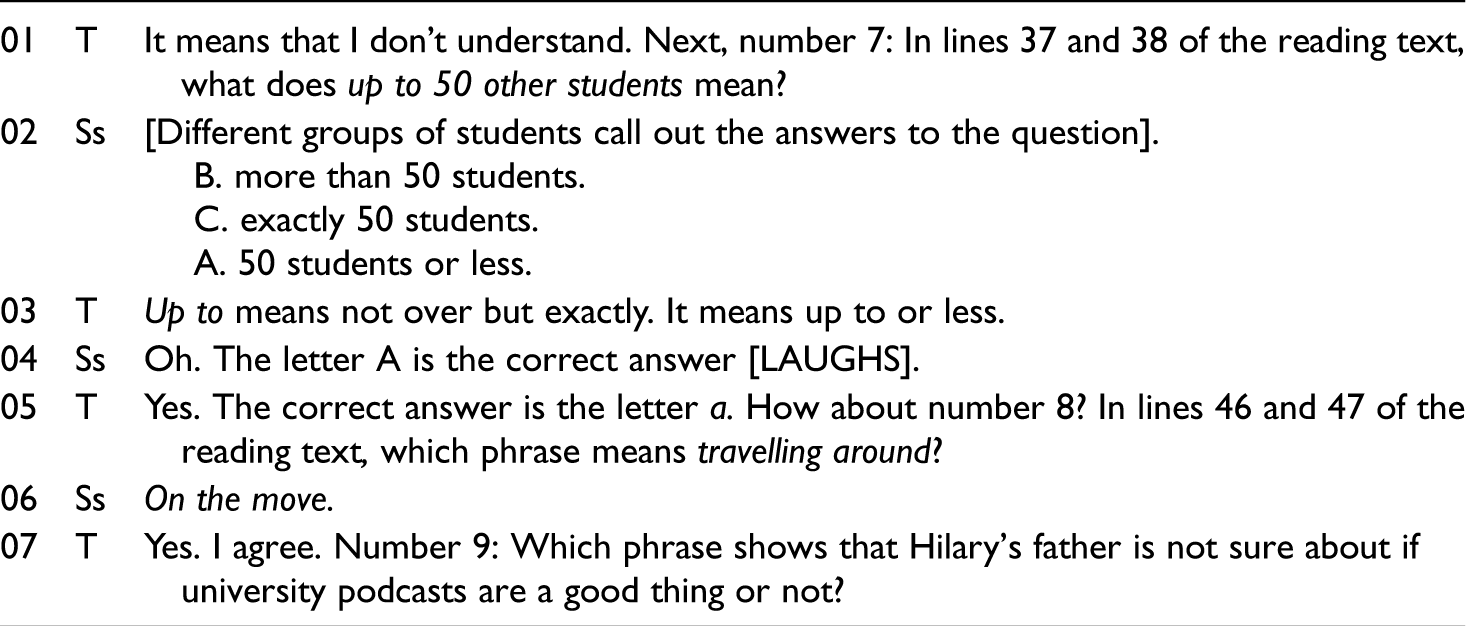
As can be seen, this type of question required students to directly identify answers represented in the text; this fails to foster deep and meaningful interaction with the reading text. It also tends to lead to initiation–response–evaluation (IRE) sequences (Walsh, 2011). Although the IRE is commonly practised in classrooms all around the world, the controlled turn-taking tends to limit learner–learner interactions and to limit opportunities for learners to develop communicative competence since their role is reduced to one of responding to teacher questions. This also suggests that classroom interaction is goal-oriented in the sense that the teacher is the only person who establishes goals and sets the agenda for instruction. This teacher-prepared and teacher-delivered lesson tends to focus on conveying factual information and literal recall from the students. As a result, this orientation influences not only the teaching approach adopted but also the language used to accomplish the goals.
In addition, when going over the answers with the students, there was a lack of meaningful interaction between the teachers and students because the teacher only checked whether the answers given by the students were right or wrong according to the answer key without having the students strategically identify and interact with the reading text and with one another. This can be seen in Extract 2. For instance, the teacher asked the students to call out the answer (turn 01). One of the students stood up and said: ‘Make’ (turn 02). ‘Correct all?’ asked the teacher (turn 03). The students said: ‘Yes’ (turn 04).

The teachers asked the students to take turns answering the questions and then gave scores for their participation. To promote meaningful interaction and active engagement in creating meaning of the text, a discussion of the right and wrong answers should be fostered during this process. As it is, students may be being exposed to what Day and Park (2005: 68) refer to as the ‘death by comprehension question syndrome’.
Pronunciation
A further practice found in the data was the practice of reading aloud with a pronunciation focus. In three of the six reading classes observed, students stood up and read the text aloud one by one. This practice also reflects the interviews where five of the six teachers stated that correct pronunciation of words or sentences was one of the central focuses in teaching reading. This primary focus on a discrete language skill further detracted from comprehension development; students were not concerned about the meaning of the text.
In-Class Actual Reading Time
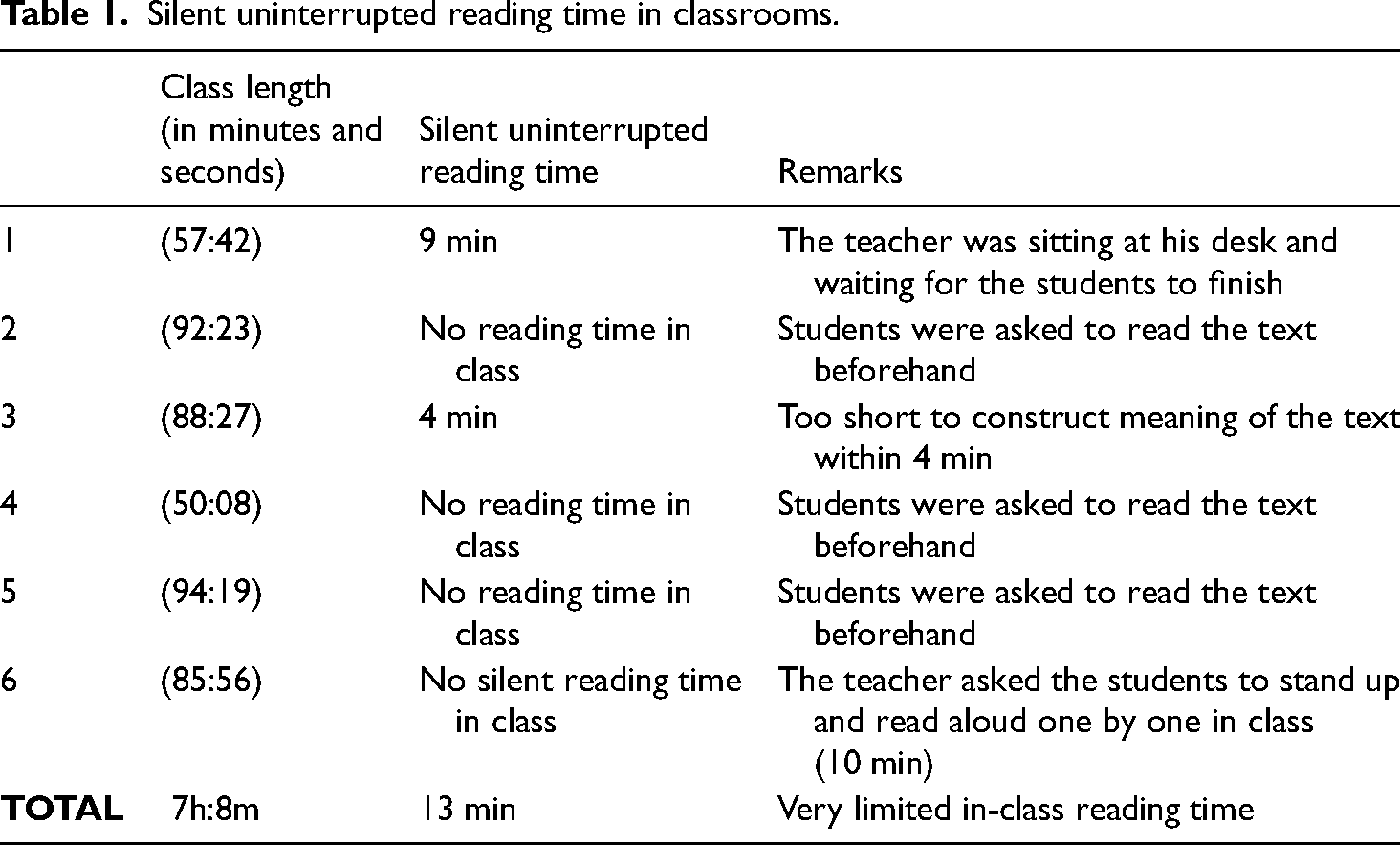
Possibly the most startling pattern that emerged from the six classroom observations was the limited silent, uninterrupted reading time in classes (see Table 1). It can be seen that only 13 min (observations 1 and 3) out of seven hours were used for silent, uninterrupted reading time in the six classes. Such in-class reading time was insufficient for promoting meaning-focused interaction and active engagement with the reading text. This suggests that the teacher did most of the talking during reading classes. The majority of time was spent on reviewing and explaining new vocabulary, reading aloud, translating the text, and checking comprehension questions as previously pointed out. This seems to violate the notion that ‘Learners learn to read by reading’ (Williams, 1986: 43). Therefore, reading should be encouraged in order to develop better readers.
Silent uninterrupted reading time in classrooms.
Pre-Service Teachers’ Experiences of Reading on the TEP
Several important themes relating to pre-service teachers’ experiences in learning to read on the TEP also emerged from the interview data. These are summarized in Table 2. Grammar translation, vocabulary and pronunciation again feature prominently.
Reading on the teacher education programme.

Although a majority commented on the suitability of the textbook, three participants pointed out that there were no supplementary materials to help facilitate learning or support the textbooks and two participants found the textbooks boring because each unit had the same layout.
In terms of the challenges in learning reading, 80% of the participants stated that vocabulary was the main difficulty. Difficult vocabulary made it hard to construct meaning from the text. Other important themes that emerged on the topic of the challenges include: incorrect pronunciation (40%); lack of English cultural knowledge (30%); failure to construct meaning of the text (30%); lack of reading skills or strategies (20%); and translation (20%). It may not be surprising, then, that when asked about the main focus of learning reading, the participants identified correct pronunciation (50%) and vocabulary (40%), ahead of translation (20%), and understanding (20%). This reflects their experiences and perceptions reported in the survey.
In summary, the results from both sources were congruent. The current state of reading instruction in Lao EFL pre-service education was still dominated by a traditional method of grammar translation and a discrete language skill focus. What the pre-service teachers experienced in their pre-service education appears to reinforce the assumptions and beliefs about teaching reading formed through the apprenticeship of observation (Lortie, 1975). The overall picture of the Lao EFL pre-service teachers’ experiences in reading and learning to read in English was learning discrete language knowledge: vocabulary; pronunciation; and translation.
Discussion
While CLT was introduced as the catalyst for shaping and transforming the teaching of English, the consensus is that its impact has been constrained. This study has extended understanding of those constraints by drawing attention to the pedagogy employed in LTE. Teaching on the TEP has reinforced perceptions about learning to read formed by prior experience. Despite top-down efforts to adopt the principles of CLT, the teaching that the students experience is firmly rooted in more traditional approaches where attention to meaning is not emphasized. Learning and teaching reading are mostly a matter of learning language items rather than comprehension and critical reading development. The TEP, it seems, is not a site for change. It is not preparing ‘teachers to construct and enact theoretically and pedagogically sound instructional practices for their students’ (Johnson and Golombek, 2020: 118).
However, it would be too simple to slip immediately into criticism and negative judgement of current practice. It is not that any of the reported or observed teaching practices are ‘bad’ in themselves. There is no question, for example, that vocabulary plays an important role in reading comprehension and the development of language proficiency. Research evidence, however, makes the point that effective vocabulary instruction should take account of word frequency and learners’ existing vocabulary knowledge. This does not seem to have been the case here, where both pre-service teachers and lecturers drew attention to challenges posed by a mismatch between existing vocabulary knowledge and the vocabulary demands of the texts. As stated earlier, one possible reason for emphasizing learning new words might have been due to the inclusion of the testing vocabulary knowledge in the mid-term and semester examinations.
A similar point can be made about the focus on comprehension questions. As Day and Park (2005) state, comprehension questions can play an important role in teaching reading if designed and used appropriately and meaningfully. In the TEP, lecturers appeared to be restricting themselves to the questions provided in the course book. They did not, as stated by Murtiningsih and Hapsari, encourage thinking ‘beyond the textbooks or reading text sources they are provided with and […] willing to modify the materials creatively into more engaging activities’ in order to foster ‘students’ level of cognitive development, language proficiency, and interest’ (Murtiningsih and Hapsari, 2018: 163).
It is possible to defend the other two main activities found in the classroom observations (and reflected in the student interviews), although both are closely aligned with GTM and ALM. A pronunciation focus could be justified because being able to recognize a phonological feature is beneficial for fluency development and comprehension (Holsgrove and Garton, 2006). However, from the data available, there seems to be no suggestion that attention to pronunciation was linked to understanding of the text or arose from communication breakdown requiring attention to a problematic pronunciation feature.
Reading out loud and translating the text was the other dominant practice. Claims have been made for the benefits of these activities (Schaffner, 1998) such as improving verbal agility and developing learners’ understanding of how languages work, but the drawbacks have also been acknowledged (Malmkjaer, 1998; Schaffner, 1998). Translation in reading, for example, is time-consuming and prevents learners from thinking in the target language. On balance, the findings of this study reflect drawbacks rather than benefits. Translation did not encourage communication of meaning in the target language. If, after translation, students had been encouraged to summarize the main point of the text this might not have been the case. However, it was not, and as a consequence, most of the students were not sure about the meaning of the text they interacted with. Overall, then, and as the findings revealed, students’ critical reading skills were not being promoted as they were required to focus on learning a lot of new words, practising pronunciation and providing translation instead of developing comprehension.
The language teaching cognitions of both students and lecturers in regards to reading instruction are clearly shaped by two of the factors that have been identified as formative in models of language teacher cognition. The first of these is prior experience. For the pre-service teachers this can be seen as the influence of their ‘apprenticeship of observation’. For the lecturers it is not just their more distant ‘apprenticeship’ but the fact that they have, presumably, been successful within a traditionally oriented system and so may hold the assumption that ‘what worked for me will work for you’. The second factor at work is that of context. Perhaps this is most obviously seen in this study by the link between assessment and classroom practices. In part this determines how time is spent in the classroom, as attendance and homework together accounted for 20% of the final grade, but it also explains why, for example, vocabulary received the attention it did in the classroom. For the students, a third factor identified in models of language teacher cognition is also at work. The LTE pedagogy, or their professional coursework, is reinforcing rather than challenging and potentially changing their thinking about classroom practice.
Thus, while it is possible to understand why what was done is done, and how perceptions about reading were formed, it does appear that these factors conspire to work against top-down aspirations for CLT. LTE is part of a system that connects the classroom to policy. Because of its responsibility for teacher preparation, it can play a very important role in delivering the desired learning outcomes. As a result of current LTE pedagogy in this context, however, current and future generations of Lao school students are unlikely to experience any change from ALM and GTM in their language classrooms, unless there is some form of intervention. In other words, there is an unaddressed gap between policy and practice in EFL pre-service teacher education development in the Lao PDR.
Pedagogical Implications
If change is to occur in line with policy, then it must start somewhere within the education system and the most likely site is pre-service LTE on the TEP. It could be in developing the knowledge base about effective teaching practices, adding knowledge derived from professional coursework to the assumptions and beliefs based on prior experience (cf. the models in Borg, 2006; Macalister, 2010; Woods, 1996). Such knowledge may at times challenge existing assumptions and beliefs, potentially leading to change. However, it should also be in methodological innovations so that students (and lecturers) have the opportunity to experience and evaluate a different way of learning and teaching. This is unlikely to occur unless cognizance is taken of constraints within the system, such as the reliance on course books, the limited time available for materials preparation, and the need to satisfy assessment requirements. A key challenge, therefore, is to find a means of introducing change into Lao EFL education that is appropriate to the context (Holliday, 1994, 2016). This was the focus of the larger study from which this paper is derived (Phonekeo, 2020; Phonekeo and Macalister, 2021).
Conclusion
This study revealed that both Lao EFL pre-service teachers and lecturers focused extensively on discrete language features in the course of learning and teaching reading as opposed to critical reading and comprehension development. Furthermore, there was a gap between policy and practice in the actual classroom both in schools and on the TEP. As a consequence, the development of Lao EFL pre-service teacher education has not achieved the goals set so far. This issue will continue to exist until appropriate interventions are taken.
