




Abstract
This study reports on English-as-a-foreign-language teachers’ beliefs about coursebooks and their adaptation profiles; it also unveils the demographic characteristics that differentiate the profiles. Responses from 3654 Chinese English-as-a-foreign-language teachers were analyzed using Latent Profile Analysis, descriptive statistics and Scheffé's method. Results indicate four distinct coursebook adaptation profiles: Highly Active, Moderately Active, Lowly Active and Adding-Deleting-Oriented. The four profiles differed significantly in the distribution of teachers by professional titles, administrative posts, types of students they teach, and participation in coursebook writing and coursebook use training. The teachers tended to regard coursebooks as resources rather than scripts.
Keywords
Introduction
Coursebooks are an important curriculum component embodying an organized knowledge system and serving as a de facto syllabus for classroom teaching, learning and examinations (Apple and Christian-Smith, 1991). Much of the English language teaching to second-language (L2) speakers is conducted through coursebooks (Menkabu and Harwood, 2021), which expose learners to and inform them about the target language, while offering them opportunities for language practice and encouraging them to make discoveries about the language (Tomlinson, 2012). Hence, the quality and appropriateness of the language and content of these coursebooks have been the focus of many studies (Gray, 2010a).
Since the mid-1990s there has been growing interest in language materials development in terms of design, writing, implementation and evaluation (Tomlinson and Masuhara, 2018). Increasingly, researchers have realized the inseparability of coursebooks and language teaching and learning, with coursebooks being ‘a key component in most language programmes’ (Richards, 2001: 251) in both school and university-level educational contexts (McGrath, 2006). It has also been widely recognized that teachers play a fundamental role as ‘mediators’ (McGrath, 2002: 20) between the books and learners, which implies that teachers’ use of coursebooks has a considerable impact on the extent to which they fulfill their functions (Wright, 2015) because of the need to minimize mismatches between coursebook content and educational context requirements (McDonough et al., 2013). According to Bosompem (2021), teachers usually adapt the coursebooks they use in class. Teachers’ beliefs about coursebooks are likely to affect how they use them and the same applies to learners (McGrath, 2006). Thus, seeking to understand what these beliefs are (McGrath, 2006) and how teachers use their coursebooks appears necessary. Drawing on theories and findings from curriculum and educational research, it can be concluded that teachers, with their own cognition, motivation and behavior, influence both how coursebooks are used and how students learn via coursebooks (Tomlinson and Masuhara, 2018). Thus, research on teachers’ beliefs and adaptation practices appears warranted. Although previous studies have focused on the reasons why teachers adapt coursebooks and how this might be achieved (McDonough and Shaw, 2003), little attention has been paid to teachers’ beliefs about coursebooks and their adaptation practices in the L2 context (Bosompem, 2021) from a latent profile analysis (LPA) perspective.
Like many countries in Asia and beyond, China is an English-as-a-foreign-language (EFL) setting in which English is the dominant foreign language in schools and universities. In the Chinese EFL education system, teachers and students first encounter written texts in coursebooks; thus, coursebooks are indispensable and assume a pivotal role in English language education in China. China has over 10 million university students learning English and more than 150,000 university EFL teachers. Despite the central role of English coursebooks, how Chinese university EFL teachers perceive and appropriate coursebooks has received little research attention. Accordingly, this study addresses the gap by reporting on teachers’ beliefs about coursebooks and their adaptation profiles; it also unveils the demographic characteristics that differentiate the profiles. Such an investigation can have significant implications for how teacher education programs should address teachers’ adaptation of coursebooks in EFL contexts.
Literature Review
Defining Language Coursebooks
Two similar terms are used to refer to language coursebooks: language materials and coursebooks. Language learning and teaching (LLT) materials are defined as follows: ‘(a) physical entities, (b) texts, (c) environments, (d) signs, and (e) technologies within the perceptual field of the learner(s) or teacher(s); these are used with the ultimate intention of facilitating LLT and in some sort of principled way’ (Guerrettaz et al., 2021: 11). This implies that LLT materials include everything that can facilitate students’ language learning.
Coursebooks, also called textbooks, are used in formal instruction as mediating tools to transmit canonized knowledge (Sammler, 2018). These coursebooks tend to influence what and how teachers teach and, to some extent, how and what students learn. Their inherent suitability for the context and the attitudes of teachers and learners mostly decide their effectiveness (McGrath, 2006). The majority of them are ‘global coursebooks produced by publishers such as Pearson, National Geographic, Oxford University Press, Cambridge University Press, Delta, and Macmillan’ (Jordan and Gray, 2019: 439). Although global coursebooks are often adapted by teachers for regional differences, publishers also work with local teachers and institutions to produce region-specific coursebooks following local ministry requirements (Hughes, 2019). In this study, the term ‘coursebooks’ refer to textbooks used in university English classes that are published by Chinese publishers.
Teachers’ Beliefs About Coursebooks
Teacher cognition refers to what teachers know, believe and think (Borg, 2003), and it is regarded as the most important factor in teaching practices (Vartuli, 2005). Extant literature has indicated that teachers usually hold two basic beliefs about coursebooks: coursebooks as a Bible to be followed reverentially and coursebooks as a resource (Tomlinson and Masuhara, 2018). The former belief indicates that the coursebook is authoritative and unchangeable, and the latter suggests that the coursebook should be treated as a supportive and flexible but not mandatory resource. Previous research shows that teachers (especially those with little experience or confidence) tend to follow coursebooks reverentially (Tsui, 2003), while experienced teachers tend to use coursebooks as a source of ideas (Haggarty and Pepin, 2002). Gray's (2010b) study also indicates that more confident or experienced teachers do treat their coursebooks as a resource rather than a script regardless of the design or origin of the book. In some Asian countries such as Japan, China and Oman, primary and secondary school teachers feel obliged to strictly follow their coursebooks because the examinations are based on their contents (Tomlinson and Masuhara, 2018).
Although language teachers’ cognition powerfully influences and shapes their practices, there exists a potential gap between teacher beliefs and practices (Borg, 2015). Accordingly, researchers have investigated teachers’ beliefs and practices regarding coursebooks and coursebook use. In consonance with McGrath's (2006) research, Bosompem (2021) found that tertiary-level teachers underscored the facilitating, supportive and guiding roles of coursebooks. Such support can be linguistic, methodological, cultural or contextual (McGrath, 2002). Although the teachers in Bosompem's study generally supported the use of coursebooks, some saw them as a constraint, leaving little room for teachers to make curriculum decisions, and they reported a lack of flexibility in the coursebooks to accommodate various teaching and learning styles and strategies. Questionnaire responses also showed teachers’ positive perceptions towards coursebook adaptation, although accounts of their practices sometimes presented a different picture.
Teachers’ Adaptation Practices of Coursebooks
Adapting coursebooks, which means ‘making changes of some kind’ (Rathert and Cabaroğlu, 2021: 2), together with offloading and improvising constitute the three ways that teachers appropriate coursebooks in their teaching (Brown, 2009). Adaptation is considered necessary because mismatches may occur between the coursebook content and the learners, teachers and teaching context (McDonough et al., 2013). Indeed, many researchers have observed that teachers play an important role in the classroom use of coursebooks (Stylianides, 2016). Shawer (2010) distinguished between curriculum-transmitters, curriculum-developers and curriculum-makers based on the degrees of coursebook adaptation made by English language teachers. Bosompem (2021) discovered that some teachers adapted coursebooks with confidence while others with guilt and uncertainty because they felt that the authority of the coursebook or the government syllabus should not be challenged. Yet others practice adaptation without even being aware of what they are doing. Despite these perceived varying coursebook usages, how teachers actually use (e.g. adapt) their coursebooks has been an under-researched area until recently (Tomlinson and Masuhara, 2018).
The main purpose of coursebook adaptation is, as McDonough and Shaw (2003: 76) claim, ‘to maximize the appropriacy of teaching materials in context, by changing some of the internal characteristics of a coursebook to suit our particular circumstances better’. Researchers have provided a list of techniques of adaptation that may be used to achieve this purpose, such as ‘adding (AD)’, ‘deleting (DE)’, ‘reordering (RO)’ and ‘modifying (MO)’ (Tomlinson and Masuhara, 2018; Rathert and Cabaroğlu, 2021). Adding means that teachers supplement or extend the original material. Deleting means reducing the number of materials or omitting some content. Reordering means sequencing activities differently for logical or pedagogical effectiveness. Modifying means either rewriting the activities or exercises (RWE) and/or rewriting the input materials (e.g. texts, audio and video clips) (RWM).
Some studies have examined teachers’ adaptation practices using qualitative methods (Grammatosi and Harwood, 2021; Rathert and Cabaroğlu, 2021). For example, Grammatosi and Harwood (2021) reported how an experienced teacher used textbooks on an academic English course. Findings showed that he sometimes adapted, and frequently abandoned, the book, and that his decisions regarding the use of the textbook were influenced by various factors. These factors included his evaluation of the quality of the textbook and its lack of alignment with his preferred pedagogical approach, and some contextual factors, such as his views on the lack of fit between the textbook and his students’ needs, abilities and interests, course logistics with new students enrolling halfway through the course, and his course director's refusal to allow him to use the textbook of his own choice. For another example, Rathert and Cabaroğlu (2021) examined two English language teachers’ views and usages of their coursebook in a Turkish university. Regarding the coursebook as the central tool in their teaching practice, both teachers played the role of curriculum-transmitters.
Although many studies have addressed the factors influencing teacher coursebook-use practices, they have mainly focused on the following variables as the determining factors: the teachers’ confidence, knowledge, experience and motivation; the students; the teaching effect; examinations; logistical constraints; lack of fit; and other contextual components (Tomlinson and Masuhara, 2018). Regarding the factor of teaching experience, mixed evidence has been reported by various researchers showing that longer teaching experience does not necessarily lead to more flexible use of coursebooks (e.g. Gray, 2010b; Tsui, 2003). As for the factor of training, Ravelonanahary (2007) presented that a lack of training resulted in a lack of alternatives for teachers in Madagascar; they simply followed their coursebooks because they had no training in using them effectively.
The studies mentioned above have mainly focused on primary and secondary school teachers’ coursebook adaptation practices and their influencing factors, while the university context seems to be neglected. Although studies have shown that multiple factors affect teachers’ coursebook adaptation practices, other demographic characteristics such as gender, professional title, administrative post, educational degree, student type and training in coursebook use have received little research attention as predictors of coursebook adaptation practices. Previous studies on coursebook use have largely used qualitative methods and have been small-scale; there has been little large-scale survey-based research on teachers’ beliefs about coursebooks and their usage practices, and even less about using LPA to identify different profiles of coursebook adaptation. Considering the gaps identified above, the present study seeks to answer the following research questions:
1. What are teachers’ coursebook adaptation profiles and the demographic characteristics associated with these profiles?
2. What beliefs concerning coursebooks do different teacher profiles hold?
LPA Approach to Examining Teachers’ Practices of Coursebook Adaptation
LPA is a person-centered statistical method for identifying potential subpopulations that share similar patterns based on their specific configuration on continuous variables (Hagenaars and McCutcheon, 2002). LPA provides important complementary understanding of phenomena (Morin et al., 2016). As noted earlier, the vast bulk of research on teachers’ practices of coursebook adaptation mainly adopted qualitative methods or variable-centered analytic approaches (e.g. regression) to examine the separate adaptation practices such as adding, deleting, reordering, rewriting exercises and rewriting input material. However, little is known about the profiles of teachers’ coursebook adaptation. This research niche is ideally occupied by adopting LPA, which is able to investigate whether any of the subgroups show a pattern of key variables that could not be observed with a variable-centered approach (Lazarsfeld and Henry, 1968) and provides an alternative way of understanding coursebook adaptation practices among teachers. Furthermore, LPA can add to existing knowledge of how intervention efforts can be targeted to the specific needs of different profiles. Although a growing number of studies have employed LPA to identify teacher profiles regarding need-supportive teaching, burnout and so on (e.g. Hornstra et al., 2021; Pyhältö et al., 2021), little is known about teachers’ coursebook adaptation profiles. As such, to identify the potential subgroups of teachers who share a particular pattern of coursebook adaptation practices, LPA is applied in the current study.
Methods
Instrument
A composite questionnaire was developed for a series of studies including this one. Eight out of 60 items were designed for this particular study, one of which was related to teachers’ tendencies to adapt coursebooks, and five items were related to their adaptation practices, while the other two were related to teachers’ beliefs about coursebooks. To ensure reliability and validity, 14 researchers in applied linguistics and 17 university EFL teachers from 31 universities were asked to rate the questionnaire items regarding the content and language clarity on a 10-point scale. The mean score of 8.77 and a Cronbach's alpha of 0.81 showed the questionnaire had good content validity and reliability respectively. The items were answered on a 5-point Likert scale, ranging from 1 (strongly disagree) to 5 (strongly agree). Demographic questions about teachers and their universities were also asked. Teacher background items addressed gender, teaching experience, professional titles, administrative posts, educational qualifications, types of students taught (English or non-English majors) and participation in coursebook training. University information encompassed university level and location. As such, the study focused on the influence of teacher demographic backgrounds on adaptation profiles.
Sample
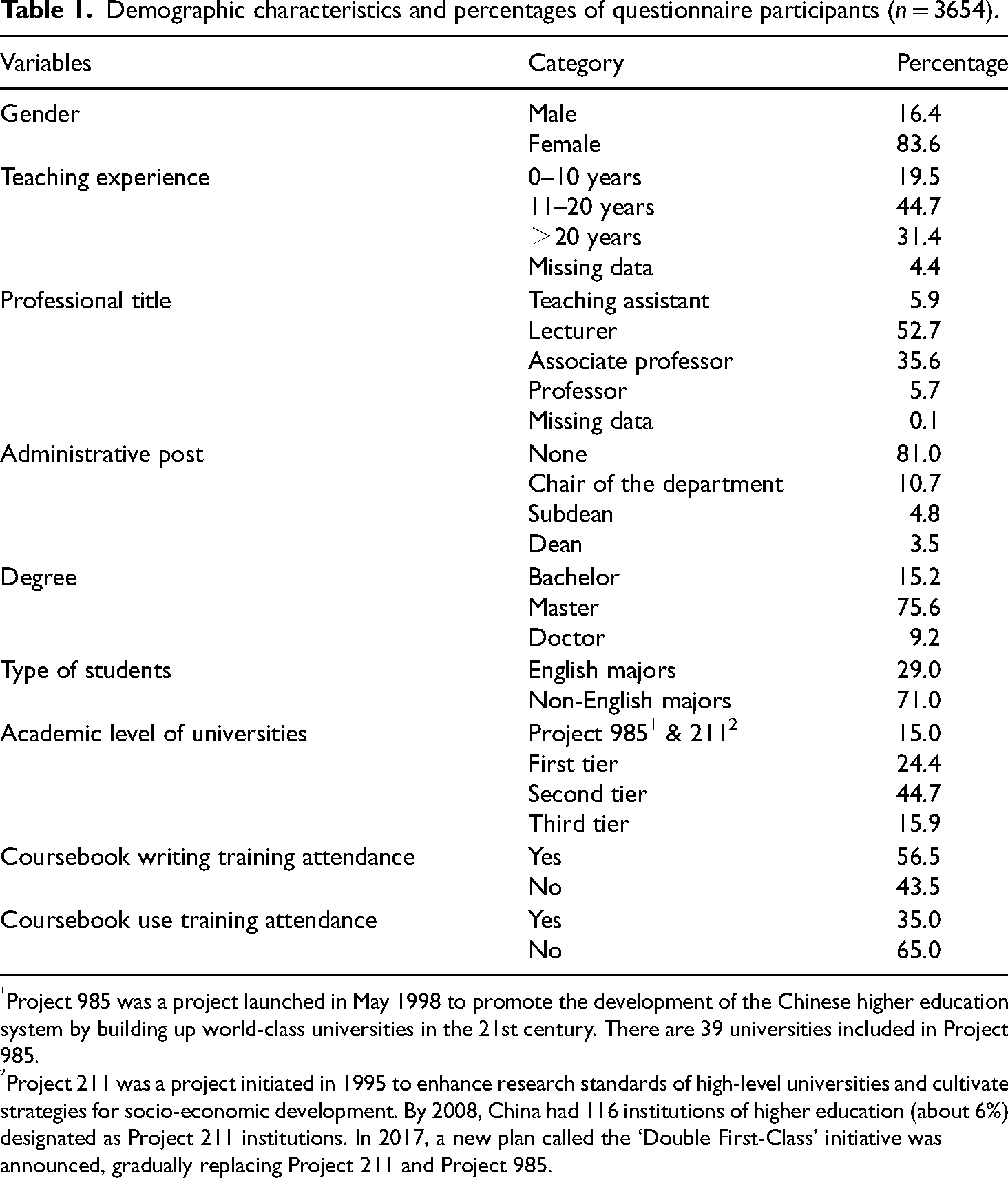
The study adopted purposeful sampling to recruit EFL teachers from a wide range of geographical settings. We sent the questionnaires to university EFL teachers via social media apps such as WeChat (Groups) in July 2020. A total of 4194 EFL teachers completed the online survey. The respondents signed an online informed consent form before they proceeded to the questionnaire. The data of 540 respondents were eliminated because of the following four reasons. First, respondents took only a few seconds to complete the questionnaire, which meant that they were likely speeding through the questions and were not reading them carefully and answering them thoughtfully. Second, respondents selected the same response for at least five items in a row. Third, respondents gave patterned responses. Fourth, respondents gave inconsistent responses to related question items. Thus, the final sample size for the questionnaire was 3654 (87.1%) from 647 universities across 31 provinces in China, with female predominance (83.6%) in the percentage of responses received. Respondents’ mean number of teaching years was 19.47 (SD = 11.42). The university coverage (n = 647) – that is, 51% of the 1258 universities in China – revealed a strong representation of the country's university population. To date, this is the largest poll of teacher respondents participating in a study about EFL coursebook adaptation. Table 1 shows the characteristics of respondents.
Demographic characteristics and percentages of questionnaire participants (n = 3654).
Project 985 was a project launched in May 1998 to promote the development of the Chinese higher education system by building up world-class universities in the 21st century. There are 39 universities included in Project 985.
Project 211 was a project initiated in 1995 to enhance research standards of high-level universities and cultivate strategies for socio-economic development. By 2008, China had 116 institutions of higher education (about 6%) designated as Project 211 institutions. In 2017, a new plan called the ‘Double First-Class’ initiative was announced, gradually replacing Project 211 and Project 985.
Data Collection and Analysis
The questionnaire items were written in Chinese to ensure respondents’ full understanding. We uploaded the composite questionnaire to an online survey tool (https://wjx.cn/) and retrieved and sent its quick response (QR) code to teachers via WeChat. The teachers then scanned the QR code with their mobile phones and accessed the online questionnaire. Debriefing acknowledgments and lucky money of a random amount or hongbao, symbolized by an electronic red envelope, were provided for their voluntary participation.
To answer the research questions, various methods were adopted to analyze data. For the first research question, we adopted LPA to better understand teachers’ coursebook adaptation practices. Analyses were conducted with Mplus 7 (Muthén and Muthén, 1998–2012). We used this technique to identify groups of teachers with similar coursebook adaptation patterns regarding AD, DE, RO, RWE and RWM. Based on Nylund et al. (2007), we adopted five types of adaptation practices as criteria, two profiles as the starting point, and the increase in the number of profiles to evaluate profile models with incremental numbers of latent profiles (e.g., 2, 3, 4 and 5 latent profiles). We used a combination of fit criteria to determine the number of latent profiles, including Akaike's Information Criterion (AIC) (Akaike, 1987), Bayesian Information Criterion (BIC) (Schwarz, 1978), Adjusted BIC (aBIC), entropy index, Lo-Mendell-Rubin likelihood ratio test (LMR) and bootstrap likelihood ratio test (BLRT). For AIC, BIC and aBIC, a lower value represented a better fit. The normalized version of entropy, which scales to the interval [0,1], is commonly used as a model selection criterion indicating the level of separation between classes. Values close to 1 indicate better classification (Nylund et al., 2007); values > .70 indicate that the latent classes are highly discriminating and that the class assignment accuracy is accurate (Nagin, 2005). For LMR and BLRT, a small probability value (e.g. p < .05) indicates that the K0-class model provides a significantly better fit to the observed data than the K −1-class model.
To answer the second research question on what beliefs concerning coursebooks different teacher profiles held, descriptive statistics were conducted to show teachers’ beliefs about coursebooks. T-test, analysis of variance (ANOVA) and Scheffé's method were used to analyze the differences among profiles about different beliefs.
Results
RQ1: What Are Teachers’ Coursebook Adaptation Profiles and the Demographic Characteristics Associated With These Profiles?
Regarding teachers’ tendency to adapt coursebooks, responses to one item, ‘I will adapt coursebooks in my daily teaching’, were used. Here, the mean score (M = 3.97, SD = 0.84) indicated the teachers had a positive tendency towards adapting their coursebooks. Notably, 2144 teachers (58.7%) chose 4, and 863 (23.6%) teachers chose 5. In other words, 82.3% teachers were quite likely to adapt their coursebooks.
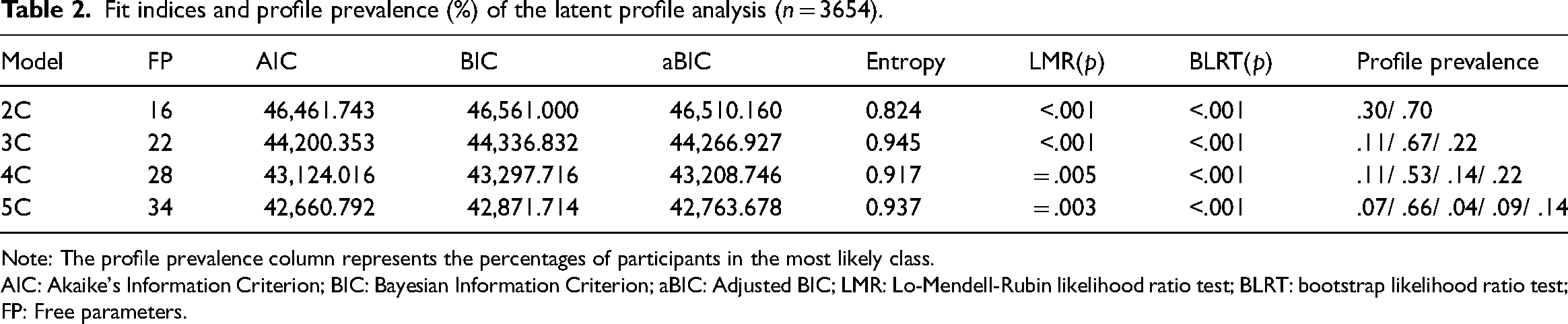
The other five questionnaire items addressed teachers’ five types of adaptation practices: AD, DE, RO, RWE and RWM. To attain a robust understanding about teachers’ adaptation practices, we used LPA to identify different profiles of teachers’ adaptation. Two to five profile models were evaluated. A two-profile model was initially tested; however, it did not converge and was not considered a viable model. The values of AIC, BIC and BIC decreased as the number of extracted profiles increased, indicating that a greater number of profiles fit the data increasingly better. With the increase of the model number, the decrease margin of models’ fit indices reached the greatest value in the 4C model and began to decrease steadily afterwards. A four-profile model is also simpler than a five-profile one. Table 2 shows the fit statistics – that is, the AIC, BIC, aBIC, Entropy, LMR and BLRT values – from the series of latent profile models with two to five classes.
Fit indices and profile prevalence (%) of the latent profile analysis (n = 3654).
Note: The profile prevalence column represents the percentages of participants in the most likely class.
AIC: Akaike's Information Criterion; BIC: Bayesian Information Criterion; aBIC: Adjusted BIC; LMR: Lo-Mendell-Rubin likelihood ratio test; BLRT: bootstrap likelihood ratio test; FP: Free parameters.
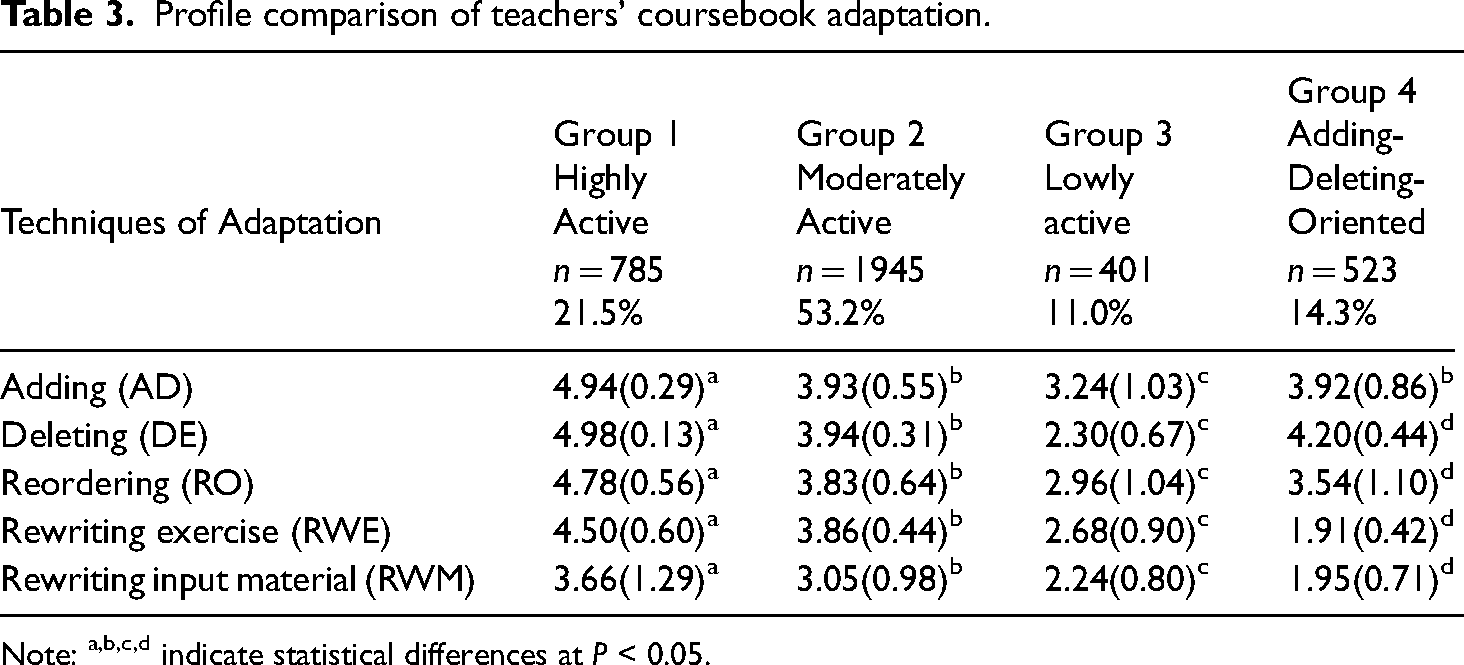
Considering the established criteria, the four-profile model was preferred over other models for statistical and conceptual reasons; thus, it best represented the data (Figure 1). The four-profile model had the second lowest AIC, BIC and Adjusted BIC values, a moderate entropy value and statistically significant LMR and BLRT values. The four-profile model included the following profiles: Group 1 (Highly Active Profile; n = 785, 21.5% of sample), Group 2 (Moderately Active Profile; n = 1945, 53.2% of sample), Group 3 (Lowly Active Profile; n = 401, 11.0% of sample) and Group 4 (Adding-Deleting-Oriented Profile; n = 523, 14.3% of sample). Group 1 reported the highest levels of adaptation practices including AD, DE, RO, RWE and RWM across the four profiles. Apart from RWM (M = 3.66), the mean scores of the other four types were higher than 4.5. Group 2 had moderate levels of adaptation practices across the four profiles. The mean scores of the five types in Group 2 were all higher than 3 and lower than 4, and they were significantly lower than those in Group 1 (Table 3). Group 3 had the lowest level of adaptation practices across the four profiles in terms of DE (M = 2.30), RO (M = 2.96), RWE (M = 2.68) and RWM (M = 2.24). The mean scores of the four practices were all lower for Group 3, and they were significantly lower than those in Group 2. Even if the mean score of AD (M = 3.24) was higher than 3, it would have been the lowest across the four groups. Group 4 reported the second lowest level of adaptation practices in terms of AD, RO, RWE and RWM across the four profiles. Within Group 4, DE was the highest (M = 4.20), significantly higher than DE in Group 2 (M = 3.94). Overall, all four profiles were significantly differentiated from each other in DE, RO, RWE and RWM. Groups 1, 2 and 3 were significantly differentiated from each other in AD; Group 4 was significantly differentiated from Groups 1 and 3 in AD, but not significantly differentiated from Group 2 in AD.
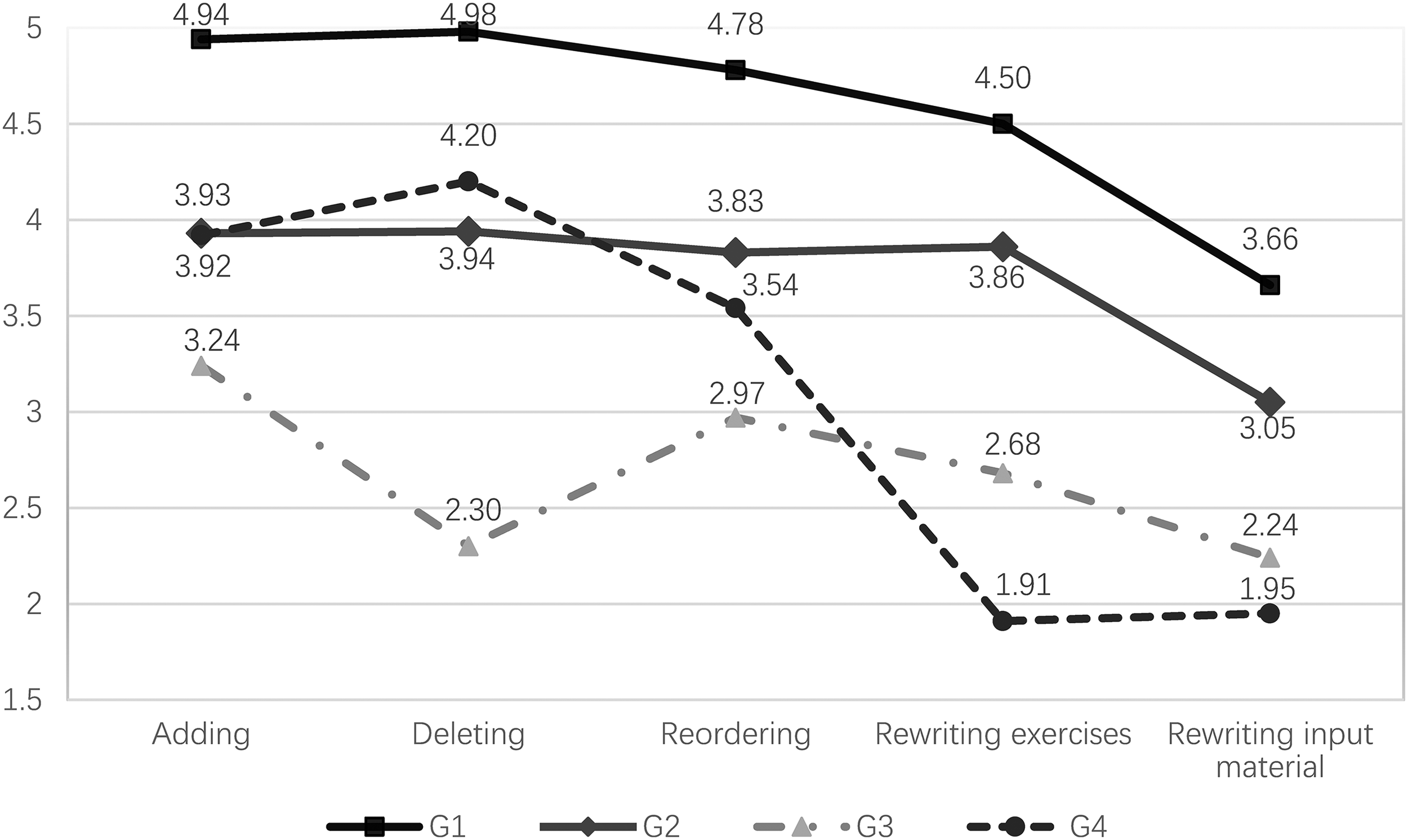
Four profiles of teachers’ coursebook adaptation.
Profile comparison of teachers’ coursebook adaptation.
Note: a,b,c,d indicate statistical differences at P < 0.05.
To examine the meaningfulness of these profiles, we compared the four groups’ demographic characteristics using crosstabs. Table 4 presents the results of a Chi-squared test revealing that, in general, the four groups differed significantly in the distribution of teachers by professional title (χ2 = 36.93,df = 9,p < .001), administrative post (χ2 = 38.10,df = 9, p < .001), type of students (χ2 = 16.16,df = 3, p < .01), coursebook writing training (χ2 = 41.84,df = 3,p < .01), and coursebook use training (χ2 = 10.05,df = 3,p = .018). Group 1 had the highest percentage in the following parameters: associate professors and professors, chairs of departments, subdeans and deans, teachers teaching English majors, teachers who have attended coursebook writing training, and teachers who have attended coursebook use training. A Z-test was further conducted to compare column proportions, finding that Group 1 had a higher percentage of teachers with doctoral degrees than those in Group 2 and Group 3. Group 3 had the highest percentage of teachers without any administrative posts, the lowest percentage of teachers with doctoral degrees and the lowest percentage of teachers who had not attended coursebook use training. Group 4 was found to have the lowest percentage of teachers teaching English majors, the highest percentage of teachers teaching non-English majors and the lowest percentage of teachers who had attended coursebook writing training. Gender, teaching experience, degree and academic level of universities were not significant predictors.
Demographic characteristics of teachers’ coursebook adaptation profiles.
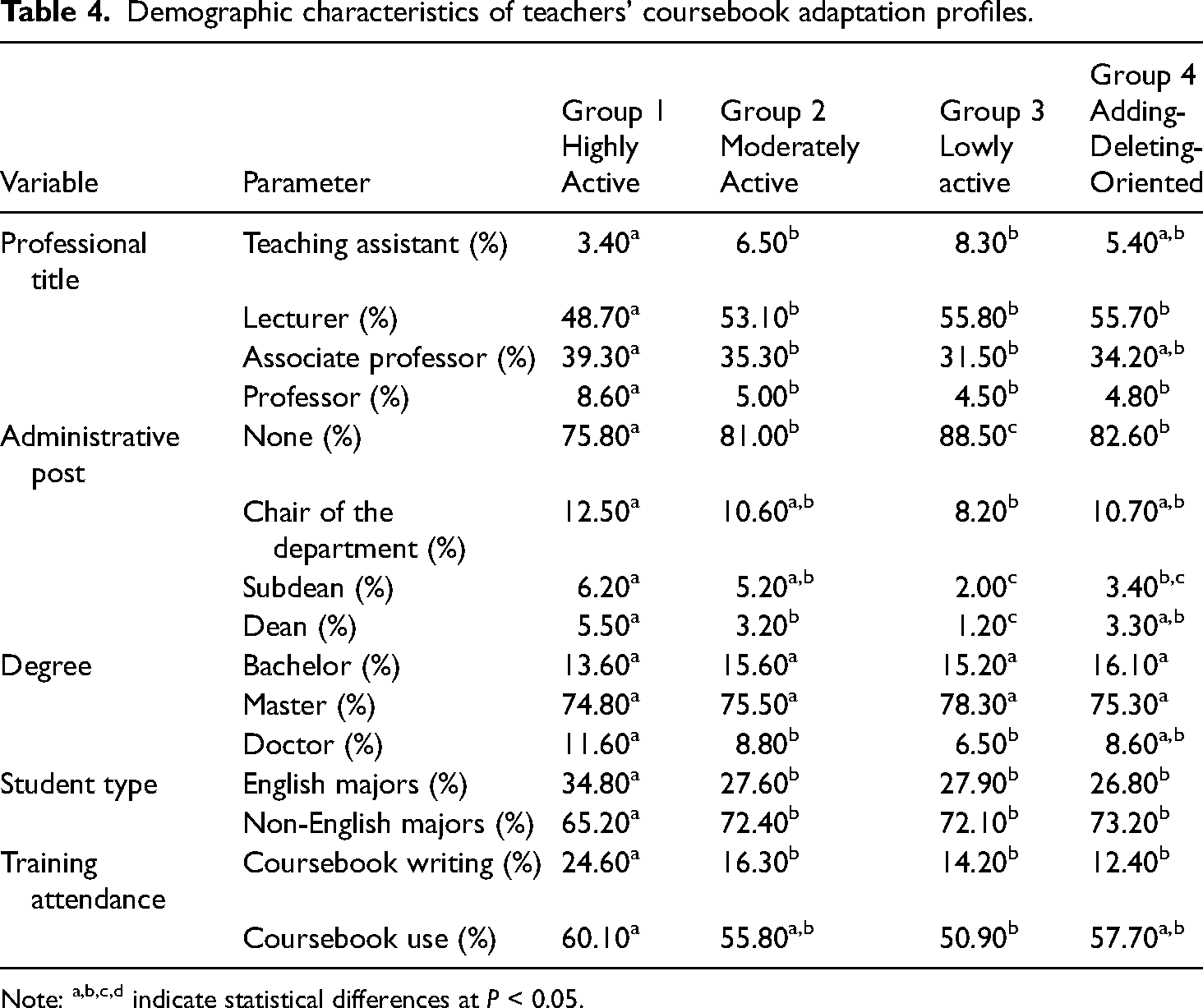
Note: a,b,c,d indicate statistical differences at P < 0.05.
RQ2: What Beliefs Concerning Coursebooks Did the Teachers Hold?
The average rating on the item asking teachers to indicate their beliefs about ‘coursebooks as resources’ was 3.81 (SD = 0.86) (Table 5), significantly higher than the median 3. The average rating on the item asking them to indicate their beliefs about ‘coursebooks as Bibles’ was 2.93 (SD = 1.02), significantly lower than the median 3. These results show that the teachers tended to regard coursebooks as resources to be exploited, rather than as scripts to be followed reverentially, and that the difference in the ‘coursebooks-as-resources’ belief among the teachers was lower.
Descriptive statistics and significance test of teachers’ beliefs about coursebooks.
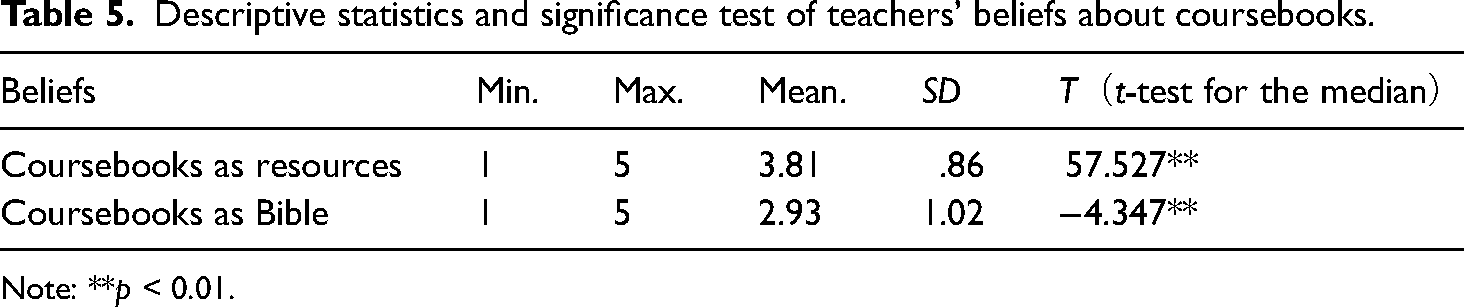
Note: **p < 0.01.
ANOVA was conducted to compare the four groups of teachers’ beliefs about coursebooks, with the results indicating significant differences in both beliefs – that is, ‘coursebooks as Bibles’ and ‘coursebooks as resources’. Regarding the former belief, Group 2 (Moderately Active Profile) had a significantly higher score than those of Groups 1, 3 and 4 (F = 10.76). Regarding ‘coursebooks-as-resources’ belief, Group 1 (Highly Active Profile) had significantly higher scores than those of Groups 2 and 4, and Group 3 had the significantly lowest score (F = 93.10) (Table 6).
Descriptive statistics and significance test of teachers’ beliefs in four profiles.
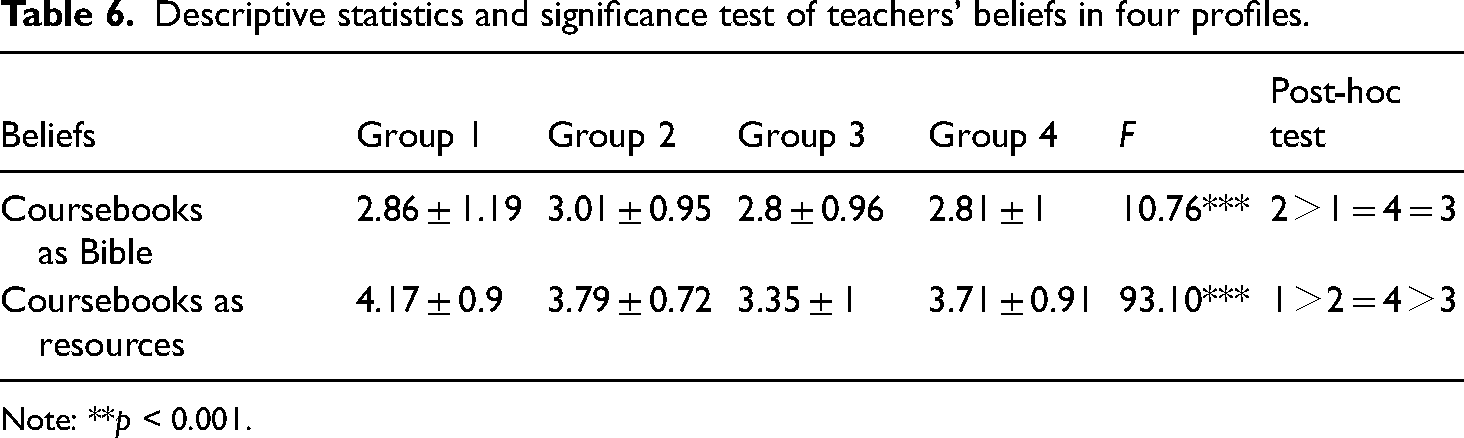
Note: **p < 0.001.
Discussion and Implications
The four profiles identifying teachers’ coursebook adaptation using LPA was the first innovative finding. Previous studies have focused on how and why teachers adapt coursebooks (McGrath, 2013; Rathert and Cabaroğlu, 2021); however, no research has used LPA to classify teachers into homogeneous groups based on their adaptation practices while identifying their demographic characteristics. These four profiles can be regarded as subgroups of Shawer's (2010) classification of curriculum-developers. The findings of the present study contribute to our understanding of professional development (PD) concerning teachers’ coursebook adaptation. Teachers in all four profiles tended to add to and/or delete the content of their coursebooks, which is mainly a quantitative adaptation. Adding or deleting material may often be an intuitive practice rather than an outcome of reflective consideration (Bosompem, 2021). Groups 1, 2 and 3 had higher levels of deleting than adding. In Group 4, adding was higher than deleting. Among all the groups, this finding implies that teachers were most likely to omit the content they did not like or think suitable for their students, or supplement with other material. Meanwhile, in Groups 1 and 4, reordering, rewriting exercises and rewriting input material had lower scores. The most difficult practices of coursebook use were to rewrite exercises or the input material to suit their teaching contexts. Group 3 (11.0%) and Group 4 (14.3%) had the lowest level of rewriting exercises and rewriting input materials with scores lower than 3. This finding indicates that more than a quarter of teachers did not modify the material in their coursebooks, because they lacked either awareness or ability.
By examining demographic characteristics of the different profiles, we found Group 1 (Highly Active Profile) had the highest percentage of (associate) professors, teachers with administrative posts and teachers who teach English majors and have attended training on coursebook writing and/or use. In the other three groups, teaching assistants, lecturers, teachers without administrative posts and teachers who teach non-English majors and have no training experience in coursebook writing and use accounted for a larger proportion. Unlike previous studies which found that teachers’ experiences can influence their use of resources over time (Gracin and Matić, 2021), with teachers who have little experience tending to follow coursebooks reverentially (Tsui, 2003), our study found that the four groups did not differ significantly regarding teaching experience. According to Ravelonanahary (2007), teachers often follow coursebooks because they have no training in using them effectively. Echoing this finding, our study found that teachers who attended training in coursebook writing and usage occupied higher percentages in Group 1 and were more likely to adapt coursebooks than those who did not. There were higher percentages of teachers teaching English majors in Group 1 mainly because they taught English majors with small class sizes; thus, they were more likely to understand their students and consequently adapt coursebooks based on their students’ needs and language proficiency levels. However, teachers teaching non-English majors had more difficulties adapting coursebooks to suit their students because of large class sizes (e.g. sometimes more than 70 students). Teachers with administrative posts have more opportunities to attend academic conferences and training sessions, which may explain why the percentage of administrators in Group 1 was higher.
Teachers’ beliefs about coursebooks generally align with their adaptation practices. The results indicate that the teachers tended to regard coursebooks as resources to be exploited rather than as a Bible to be followed reverentially. Consistent with previous findings that teachers’ coursebook beliefs have an impact on coursebook use (Rathert and Cabaroğlu, 2021), 82.3% of the teachers were quite likely to adapt their coursebooks in their daily teaching practice. However, it should be noted that there may be mismatches between how teachers think they use coursebooks and how they actually use them (Tasseron, 2017).
Finally, the use of LPA demonstrated the value of profile analysis when considering teachers’ coursebook adaptation practices, and future coursebook research may be strengthened by using LPA to identify unique groupings of individuals. Researchers and practitioners may consider the use of these profiles in addition to the total scores when identifying and supporting teachers who may be having trouble adapting their coursebooks.
Based on our findings, this study has several practical implications for stakeholders, including teacher educators, publishers and teachers. First, it underscores the need to provide teachers with informed approaches to coursebook adaptation in teacher PD, which may influence their use over time. Adaptation and development of coursebooks are often included in PD programs (Moore et al., 2021), and teacher educators need to assess any factor that can impede effective coursebook adaptation. Differences in adaptation practices based on profile membership further illustrate the potential utility of profile identification for intervention design. For example, PD on coursebook adaptation should be carried out differently depending on the profile. The Lowly Active Profile group performed significantly lower on all five adaptation strategies, suggesting that interventions regarding awareness and knowledge about current principles and methods of coursebook adaptation may be especially warranted for these teachers. For the Adding-Deleting-Oriented Group, PD should focus on how to adapt coursebooks qualitatively, namely by reordering, rewriting/modifying exercises or inputting materials. For Highly and Moderately Active Profiles, PD should not only consider how to make high-quality adaptations, but it should also emphasize the appropriateness and effectiveness of the adaptation, which means the domain of consequence (outcomes such as students’ engagement and learning) (Moore et al., 2021). Additionally, coursebook PD programs should be more performance-centered rather than lecture-oriented. For example, PD could first introduce teachers to the ways of assessing a coursebook's suitability for a group of students, then provide one coursebook unit for teachers to try out different adaptation techniques. This technique could provide opportunities for teachers to practice adaption, rather than treating them as Bible-like resources, and thus empower them to reinterpret and reshape their existing coursebooks while becoming ‘savvy users, adapters, and makers of materials’ (Atkinson, 2021a: 17).
Second, publishers in China provide accompanying teacher guides and PowerPoint slides containing supplementary language points, cultural knowledge and additional or alternative activities. These slides can be considered a product of adding or modifying. We suggest publishers provide teachers with ideas on context-specific adaptations instead of simply supplying so much material, a situation that may result in teachers’ overreliance on the slides, which possibly contributes to their deskilling (Littlejohn, 2012).
Third, teachers should change their habitual adaptation practices, such as deleting or adding. Whether teachers’ additions to their coursebooks are better than the existing content still needs further investigation (Zhang et al., 2021). Thus, teachers are to be aware of the multiple adaptation possibilities to fully exploit their coursebooks. Notably, steady refinement of teachers’ performance is mediated by time, effort, inner motivation, extent of challenge, repetition and feedback (Ericsson et al., 1993), which makes the trainability of adaptation expertise limited (Atkinson, 2021b). Moreover, the degree to which teachers adapt coursebooks depends on teacher autonomy (Sampson, 2009), personality (Bosompem, 2021), creativity and expertise (Menkabu and Harwood, 2021), and is influenced by their beliefs. As such, teachers need to exercise agency and actively spend time and effort in adapting their coursebooks.
Conclusion
The present study was among the first to examine profiles of teachers’ coursebook adaptation by adopting LPA. The large sample of respondents that informed this study made it possible to explore how EFL teachers perceive and adapt coursebooks; thus, the purpose of this study was to add to the extant literature about coursebook usage by utilizing an advanced statistical technique to identify coursebook adaptation profiles.
Although the findings of this study have contributed to the existing theories about EFL teachers’ beliefs about and practices of coursebook adaptation, it is not free from limitations. First, the data were collected with online questionnaires within two weeks. Although respondents had sufficient time to think and respond, no mechanism for clarification was provided. Thus, teachers’ exact understanding of the items could not be fully assured, which may have threatened the reliability of the responses. Second, the research relied on a single source of data from the participants’ own perspectives, and the study could not show how teachers actually adapt their coursebooks. Moreover, as a quantitative study, the findings do not provide a thick explanation as to why the teachers had their beliefs and adaptation practices. Notably, as the LPA utilized was exploratory, it is important to consider the validity of the four identified profiles across multiple samples. Future research should be conducted on other populations and in other contexts to see whether the identified profiles can be replicated and to assess whether the practical utility of the identified profiles predict teachers’ coursebook adaptation performance. Researchers should further examine teachers’ coursebook adaptation practices in situ instead of relying on self-reported data. Further studies should also investigate the effect of PD interventions targeting teachers with different coursebook adaptation profiles because teachers with different profiles may respond differently to PD. Nevertheless, we hope our study contributes to a deeper understanding of how language teachers perceive and use coursebooks in the global context.
Footnotes
Funding
This work was funded by the Ministry of Education's 14th Five-Year Plan (2021–2025) Project of Key Research Institute of Humanities and Social Sciences, National Research Centre for Foreign Language Education, Beijing Foreign Studies University. It was supported by the Project of Discipline Innovation and Advancement (PODIA)-Foreign Language Education Studies at Beijing Foreign Studies University, Beijing (Grant Number: 2020SYLZDXM011). It was also supported by the International Joint Research Project of Huiyan International College, Faculty of Education, Beijing Normal University(Grant Number: ICER201901).
