



Abstract
General labor market condition is an important contextual factor influencing employment opportunities and outcomes for people with disabilities and is particularly significant given the recent economic recession. Yet, longstanding data analytic strategies have focused only on individual predictors rather than the dynamic interaction among individual level and organizational/environmental level variables, such as considering the role of labor market conditions. This study used the Rehabilitation Services Administration Case Service Report (RSA-911) data for fiscal years 2005 and 2009 to represent two distinct time periods, one before and one during the U.S. economic recession, respectively. Hierarchical linear modeling was used to examine the relationship between state unemployment rate and its interaction with personal factors influencing the employment outcomes of people with disabilities receiving state vocational rehabilitation services. Results found negligible between-state differences, but state unemployment rates were found to moderate the relationships between some demographic variables and successful competitive employment vocational rehabilitation (VR) case closure. Specifically, the significance and magnitude of those effect sizes varied by general economic context. These findings call attention for the need to consider the role of contextual variables, such as state unemployment rates, and their impact on the predictive strength of specific demographic and disability variables on employment outcomes for people with disabilities.
Keywords
The recent recession has had a disproportionate impact on workers with disabilities, with the number of employed workers with disabilities declining at a rate of more than two to three times that of workers without disabilities (Fogg, Harrington, & McMahon, 2010; Kaye, 2010). Disability employment statistics also suggest that a sizeable percentage of people with disabilities are no longer looking for employment. For example, between 1970 and 2010, the number of individuals receiving Social Security Disability Insurance (SSDI) benefits increased nearly sixfold, from 1.5 million in 1970 to 10.3 million in 2010 (Congressional Budget Office, 2012); however, it is estimated that only half of 1% of all SSDI beneficiaries leave the rolls because of work since the implementation of the Ticket to Work and Work Incentives Improvement Act (TWWIIA) in 2001 (O’Leary, Livermore, & Stapleton, 2011).
The state-federal vocational rehabilitation (VR) program, which serves approximately 1,000,000 individuals per year and spends more than $2.5 billion annually, plays a large and instrumental role in helping persons with disabilities achieve their independent living and employment goals (Martin, West-Evans, & Connelly, 2010; U.S. Government Accountability Office [GAO], 2005). In recent years, rehabilitation researchers and scholars have emphasized the need to consider person–environmental interaction factors in the development and delivery of effective VR interventions (Chan, Strauser, Gervey, & Lee, 2010; Chan, Tarvydas, Blalock, Strauser, & Atkins, 2009). The traditional supply-side approach of providing medical, psychological, educational, and vocational services to improve functioning, stamina, and job skills alone—without taking into account the role of organizational behaviors, employer needs, and the changing labor economy (e.g., the recent recession)—is no longer adequate for achieving meaningful employment outcomes for people with disabilities. This is because supply-side employment models ignore variables related to employer demand (and the interaction of employer-demand and supply-side factors) as predictors of employment outcomes for people with disabilities (Chan et al., 2010).
An important contextual factor affecting successful VR closures is state unemployment rate. There has been considerable variability in these rates by state and across time periods. According to the Bureau of Labor Statistics (2011a, 2011b), unemployment rates for 2009 ranged from a low of 4.1% in North Dakota to as high as 13.4% in Michigan (see Appendix A). Moreover, reviewing the U.S. Bureau of Labor Statistics’ information for 2005 and 2009, state unemployment rates appear to have been affected by the recession disproportionately. For example, state unemployment rates doubled in Alabama and Florida (increasing from 3.8 to 9.9, and 3.8 to 10.4, respectively). Yet, different patterns were found for other states, with North Dakota showing only a minor increase (3.4 to 4.1) and Louisiana showing a decrease (6.7 to 6.6) in unemployment over these same years. Unemployment rates clearly play an important role in labor market conditions, yet are seldom included in models predicting employment outcomes of people with disabilities, and state-level variability is seldom addressed.
It is logical to assume that the recent recession and continued economic stagnation has a significant effect on VR outcomes. Previous research examining the relationship between national unemployment rates and VR closures from 1945 to 1981 indicated significant correlations between national unemployment rates and VR outcomes when unemployment rates were higher than 5.5% over a prolonged period of time (Misra & Tseng, 1986). Recently, Cook and colleagues (2006) conducted a longitudinal, multisite randomized study on the effect of local unemployment rates on employment outcomes for people with psychiatric disabilities. They found that indeed local unemployment rates had a significant effect on competitive employment. Participants in their study who lived in counties with high unemployment rates had poorer employment outcomes than those who lived in counties with relatively low unemployment rates. Outcomes were also affected by individual characteristics such as gender and race.
For people with disabilities facing significant challenges in the current labor market, it is crucial to investigate the environmental factors that are associated with successful VR outcomes. At the same time, the relationship between specific client factors (e.g., demographic characteristics, disability severity) and employment outcomes has been documented in the literature (e.g., Dutta, Gervey, Chan, Chou, & Ditchman, 2008; Wheaton & Hertzfeld, 2002). Thus, it is essential to consider these aspects together by investigating the possible interactions between state unemployment rate and specific client characteristics. With the advent of more sophisticated data-analytic techniques, researchers can now investigate personal and environmental factors by using procedures such as Hierarchical Linear Modeling (HLM) to examine multilevel data. However, little research has investigated the relationship between state unemployment rates and personal factors on VR outcomes. The purpose of the current study was to use HLM to examine the relationship between state unemployment rates and VR outcomes of people with disabilities using data from fiscal years 2005 and 2009 to address the downward trend in the economy and employment outlook. In addition, we examined the moderating effects of state unemployment rates on the relationships among individual characteristics and VR outcomes.
Method
Data Sources
The U.S. Department of Education, Rehabilitation Services Administration Case Service Report (RSA-911) data were used for this study. The RSA-911 dataset includes comprehensive administrative case records that detail demographic and service-related information for all cases closed by the state-federal VR system in a given fiscal year. The dataset provides information about each case, including demographic information, disability type and cause, employment outcome, and VR service utilization.
The RSA-911 datasets for fiscal years 2005 and 2009 were used in the present study. These distinct time periods were selected to represent a year before the economic downturn (2005) and a year during the global financial crisis (2009). Cases used in this study included all VR clients who (a) received services in the nonblind state-federal VR programs in any of the 50 states and Washington, D.C.; (b) obtained successful or unsuccessful closure after receipt of VR services for either the fiscal year 2005 or 2009 (i.e., closure codes 26 or 28), with successful closure status in this study including only employment in a competitive job; (c) were between the ages of 16 and 65 at time of application for VR services; and (d) had records with no missing data for all variables of interest in this study.
Outcome Variable
The outcome variable used in the present study was competitive employment at closure. To arrive at this dichotomous variable, first cases were selected only if they had been “exited with an employment outcome” (Code 26) or “exited without an employment outcome, after receiving services” (Code 28). Second, of the cases closed as “26,” only those with competitive employment outcomes were retained. In accordance with the federal regulations implementing the Rehabilitation Act amendments of 1992, competitive employment was defined as work in the competitive labor market performed on a fulltime or a part-time basis in an integrated setting where the client is compensated at or above the minimum wage but not less than the customary wage or benefits paid by the employer to others without disabilities performing the same work. The cases closed with code 28 represented clients whose VR services had been initiated but did not result in successful employment (i.e., unsuccessful rehabilitation). For the purpose of this study, rehabilitation outcome was a nominal, dichotomous variable (i.e., competitive employment outcome at closure vs. unsuccessful rehabilitation after initiation of services).
Level 1 (Individual) Predictors
Several individual characteristics were tested for associations with employment status. These included, gender, age, race/ethnicity (European American, African American, Latino/a, Native American, and Pacific Islander/Asian), primary disability type (physical, sensory, cognitive, or psychiatric), significant disability (significant or not significant), education level, public cash support received, and public medical benefits support received. Age, education, and the number of specific public cash and/or medical benefits received were included as continuous variables. Public cash benefits included Supplemental Security Income (SSI), Social Security Disability Insurance (SSDI), Temporary Assistance for Needy Families (TANF), state or local general assistance, veterans’ disability benefits, workers’ compensation, and other public financial benefits (Rehabilitation Service Administration [RSA], 2008). Public medical benefits consisted of Medicare, Medicaid, and public insurance from other sources. Race/ethnicity and disability variables were dummy-coded using European American and physical disability as the reference groups.
Level 2 (Environmental) Predictor
In this study, we used each state’s unemployment rate as environmental indicators of the labor conditions affecting the employment outcomes of VR clients. The official adjusted unemployment rates for each state were retrieved from the Bureau of Labor Statistics, U.S. Department of Labor (http://www.bls.gov/lau/). See Appendix A for a list of the unemployment rates by state and year.
Data Analysis
People with disabilities generally seek jobs in their local labor markets, which is influenced by each state’s unique economical, regulatory, and environmental factors. The cases in this database were the clients who received VR services in different agencies across the 50 states and Washington, D.C. Although state VR agencies follow generally similar patterns of service delivery and service options, in reality, the policies and modalities to provide services to clients can vary with each VR agency as does the labor condition. Thus, VR clients residing in the same state should not be assumed to be independent of each other, indicating the nested structure of this data. HLM, a technique appropriate for examining relationships with a nested structure of data, was used. Parameter estimations were based on the method of Maximum Likelihood Estimation. The commercial statistical program HLM 7.0 (Raudenbush, Bryk, & Congdon, 2010) was used for the data analysis.
This study incorporated personal factors (Level 1) and environmental factors (Level 2) within the multilevel structure of the data. Considering the dichotomous nature of the dependent variable (successful competitive employment closure), we used multilevel logistic regression (Bernoulli) models to examine the relationships among personal characteristics, state unemployment rate, and employment status (Raudenbush et al., 2010). Based on a person–environment interaction understanding, three models were investigated for 2005 and 2009 as follows:
Model 1 (empty model): Only state code and employment status were entered in this model without any Level 1 predictors. This model was used only to estimate how the likelihoods of having a successful VR closure (i.e., being employed with a competitive job) varied across different states. It provides an estimate of the proportion of variance in employment status that can be explained by the state (environmental) level—that is, between-state differences.
Model 2: All Level 1 personal factor variables were added into this model, which allowed the intercept to be varied. This model provides detailed information regarding the associations between personal factors and employment status.
Model 3: The Level 2 variable of state unemployment rate was added into the final model, allowing us to examine whether state unemployment rates could moderate the relationships between personal factors and employment status.
State unemployment rate, the Level 2 variable, was centered on (i.e., subtracted from) the national adjusted unemployment rate (see Appendix A) before adding it to the model because the value of zero for an unemployment rate is impossible and meaningless—that is, it happens rarely that a state has no one unemployed. It is also more interpretable to use the national average unemployment rate as a reference point to determine a state’s relative standing with regard to unemployment.
Results
The total numbers of cases meeting the inclusion criteria for this study were 326,751 in 2005 and 294,315 in 2009. Examining the Level 1 variables, the distributions of personal factors in the samples from 2005 and 2009 were similar, suggesting that the present study likely had two homogeneous samples. Participant characteristics for each sample are presented in Table 1. Male, European American, high school graduate, and having a primary disability of psychiatric disorder were the dominant sample characteristics. As for the Level 2 variable, the adjusted state unemployment rates ranged from 2.8% to 7.8% in 2005 and from 4.1% to 13.4% in 2009 (see Appendix A), whereas the national unemployment rate went from 5.1% in 2005 to 9.3% in 2009. Moreover, the Pearson product-moment correlation coefficient for the average state unemployment rates between 2005 and 2009 is only .56. These data indicate considerable between-state variation in unemployment rates, and this variation changes over time, providing support for the present study to examine how different state unemployment rates are associated with employment outcomes of VR clients.
Characteristics at Application of the 2005 and 2009 Samples.

Note. N = Number; M = Mean. The numbers in the parentheses are SDs. RSA = Rehabilitation Services Administration Case Service Report.
Psychiatric disorders include alcohol and drug abuse/dependence, anxiety disorders, depressive and other mood disorders, eating disorders, personality disorders, schizophrenia and other psychotic disorders, and other nonlisted mental illness according to the RSA-911 dataset codebook. bEducation was treated as a continuous variable in the analysis.
Between-State Environmental Variation
According to the results of Model 1, the value of γ00 was .52 (SE = .04, p < .001) for 2005 and .25 (SE = .04, p < .001) for 2009, whereas the value of Level 2 residual (u0) was .29 (χ2 = 4,508, p < .001) for 2005 and .29 (χ2 = 5,449, p < .001) for 2009. The intraclass correlation coefficients for 2005 and 2009 were calculated to be .024 and .027 using the formula provided by Snijders and Bosker (1999). The magnitude of these effect sizes did not indicate strong between-state differences in employment status, with our results indicating that only 2.4% to 2.7% of the variance in employment status could be explained by the between-state environmental variation.
Subgroup Outcome Variation Across Years
In Model 2, all personal factors included in the study, with the exception of Pacific Islander/Asian ethnicity, reached statistical significance for 2005 and 2009 (see Table 2), supporting previous literature that individual factors predict VR outcomes. According to the model, Native Americans with severe psychiatric disorders and low education who were receiving public cash and medical benefits generally had the lowest odds of being employed with a competitive job after receiving VR services. On the other hand, age, gender, and Hispanic ethnicity had only a small effect size, meaning that the subgroup differences were minor.
Odd Ratios for Successful Employment Outcomes by Personal Factors in Model 2 for 2005 and 2009.
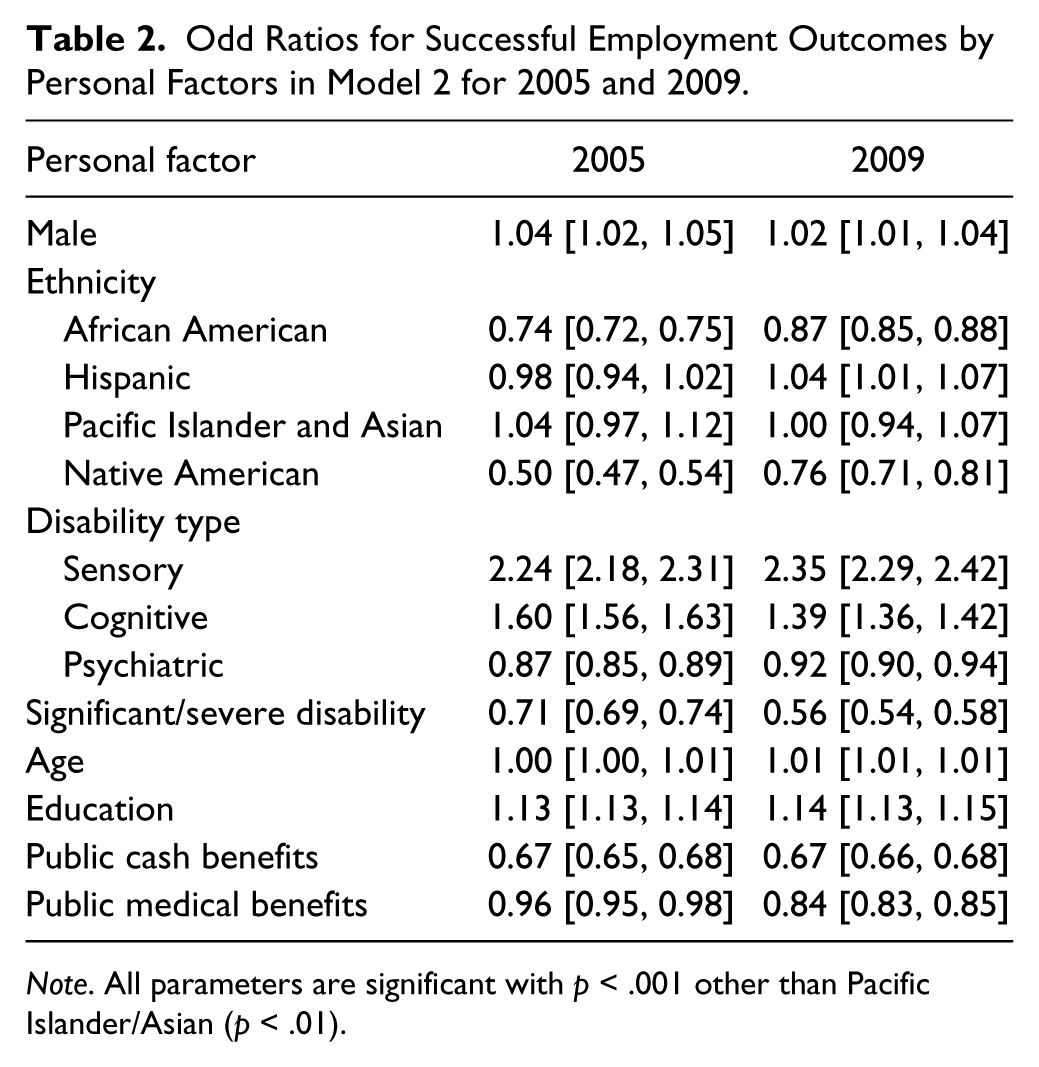
Note. All parameters are significant with p < .001 other than Pacific Islander/Asian (p < .01).
As for the subgroup differences in the relative chances of successful employment, several personal factors had different results associated with the models for 2005 and 2009. These included ethnicity (all but Pacific Islander/Asian), disability type, significant disability, and public medical benefits. Specifically, the odds of obtaining employment for those with cognitive impairments still remained better than their peers with physical disabilities, but this advantage decreased from 1.60 in 2005 to 1.39 in 2009. On the other hand, we found that the odds of being employed for those with sensory disabilities and psychiatric disorders increased slightly from 2.24 and 0.87 in 2005, to 2.35 and 0.92 in 2009, respectively. Moreover, although African American and Native American clients were still less likely to be employed than their European American counterparts, their odds of being employed improved from 2005 to 2009. Conversely, clients with significant disabilities and those receiving medical benefits showed a further reduction in their odds of being employed relative to those with nonsignificant disabilities and those not receiving public medical benefits in 2009.
Person–Environment Interaction with Employment Outcome
Model 3 demonstrates the impact of state unemployment rate on the relationships between personal factors and employment outcomes. Specifically, state unemployment rate appeared to moderate the relationships between some personal factors and employment outcome. In 2005 (the year with the relatively stable economy), results indicated that state unemployment rate significantly moderated the relationships between employment status and the following personal factors: age, Native American ethnicity, cognitive impairment, significant disability, and the receipt of public medical benefits (see Table 3). As the state unemployment rates increased, the disparities decreased in successful competitive employment outcomes between European Americans (favored) and Native Americans, and between those with cognitive impairments (favored) and physical disabilities. On the other hand, the disparities between nonsignificant disability (favored) and significant disability increased when state unemployment rates increased. Furthermore, because the original margin of disparity between the recipients and nonrecipients of public medical benefits was small, the advantaged group could change in those states with lower unemployment rates. In particular, age was found to be a significant predictor of employment status; however, the effect size suggests a negligible clinical impact on employment outcome.
Parameters of Multilevel Analysis Estimated for the 2005 Dataset.

p < .05. **p < .01. ***p < .001.
Finally, we found that the state unemployment rates in 2009 had a different impact on the relationship between personal factors and employment status (see Table 4). As state unemployment rates increased, disparities in successful employment diminished between individuals with physical disability (favored) and those with psychiatric disorders; European Americans (favored) and African Americans; and individuals with nonsignificant disabilities (favored) and those with significant disability. However, the disparity between nonrecipients and recipients of public medical benefits increased as the state unemployment rates increased. Interestingly, the small advantage of being employed for Hispanics over European Americans in the 2009 dataset could disappear and actually reverse when the state unemployment rate fell below the national average.
Parameters of Multilevel Analysis Estimated for the 2009 Dataset.

p < .01. ***p < .001.
Discussion
Despite the longstanding emphasis on strategies to increase employment outcomes of individuals with disabilities, the promise of meaningful work remains elusive for many. Rehabilitation researchers and scholars have called attention to the need to recognize person–environment interactions when conceptualizing predictors of employment outcomes (Chan et al., 2010); yet, often, this dynamic relationship is overlooked. Contextual variables are particularly relevant given the dismal economic conditions that have affected the labor market over the past 5 years. This study is one of a few to explicitly address the impact of state-level economic conditions on employment outcomes for people with disabilities. Using HLM, we examined the role of state unemployment rates on the relationship between personal characteristics and employment outcomes for individuals with disabilities receiving services through state VR agencies. Our findings extend the literature on the role of contextual factors in understanding employment outcomes in several important ways.
First, our findings suggest that state-specific unemployment rates are indeed associated with VR clients’ chances of securing competitive employment. State unemployment rate was negatively associated with employment closure. Results showed that as unemployment rates rose, the overall number of successful VR closures with competitive employment decreased from 183,961 in 2005 to 158,636 in 2009, but the annual numbers of VR applicants remained generally the same between these years. Furthermore, we found two trends regarding how different economic situations were related to the VR employment outcomes among subgroups of people with disabilities with respect to their chances of being placed with a competitive job. The relative advantage of VR clients with cognitive impairments (compared with their peers with physical disability) in obtaining competitive employment seemed to decline as the economy worsened (odds ratio decreased from 1.60 in 2005 to 1.39 in 2009). Meanwhile, the relative disadvantage of those with significant disabilities or those receiving public medical benefits was reinforced by the poor economy (odds ratio decreased from 0.71 to 0.56 and 0.96 to 0.84, respectively). This suggests that people with significant disability and those who are public medical beneficiaries seem to be the most vulnerable to poor economic conditions.
Second, our findings support the role of state unemployment rates in moderating the relationship between personal factors and VR employment outcomes. Our findings suggest that some disadvantaged groups within the VR system are worse off with regard to securing competitive employment when they live in a state with a higher than average unemployment rate. This was the case even when the overall national economy was performing well in general, as shown in 2005. In states with high unemployment rates (i.e., above the national average), disadvantaged subgroups of VR clients—specifically, those with significant disability and recipients of public medical benefits—tended to face poorer closure outcomes in 2005. In contrast, smaller discrepancies in the odds of successful competitive employment closure for those disadvantaged groups were found in the states with unemployment rates below the national average—that is, these groups still faced worse odds of obtaining employment relative to the reference groups, but these odds diminished further in states with poorer labor market conditions. Meanwhile, state unemployment rates higher than the national average appeared to buffer against the relative disadvantage of groups such as Native Americans (vs. European Americans) and those with physical disability (vs. cognitive impairment). In other words, while these groups still faced poorer odds of competitive employment closure in general, smaller discrepancies in their odds of successful competitive employment closure relative to the reference groups were observed in states with better economic conditions.
A different pattern of disparities emerged in 2009 when the economy was weak. The discrepancies in relative odds of successful VR closure decreased between individuals with physical disability (favored) and those with psychiatric disorders; European Americans (favored) and African Americans; and individuals with nonsignificant disability (favored) and those with significant disability. On the other hand, the discrepancies increased between nonrecipients (favored) and recipients of public medical benefits. These findings suggest that the advantage of European Americans, those with physical disability, and those with nonsignificant disability over other groups diminished in a weakened economy. In other words, we found that those groups that fared better in a thriving economy such as 2005 no longer had the same extent of advantage over their counterparts in 2009’s weakened economy. Notably, the only exception to this pattern in our study was that the odds of recipients of public medical benefits obtaining employment were further worsened in a weak economy.
Third, our findings highlight that state unemployment rates appear to affect the VR outcomes of people with different types of disabilities in disparate ways. In particular, people with significant disability and public medical beneficiaries are most sensitive to changes in state’s employment conditions, economy, job market, and workforce composition. Our findings suggest that these groups do better when the state economy is good and less well in a poor economy. People with significant disabilities appear to have a better chance of obtaining employment in a stable economy, although they still fare worse than their counterparts with nonsignificant disabilities. Interestingly, our findings also indicated that when the economy is good, employers appear to be more willing to hire people with cognitive impairments, whereas people with physical disability are at increased risk of unemployment when the economy weakens. One possible explanation for these findings is that people with significant disability or cognitive impairments (e.g., people with development disabilities) rely heavily on supported employment (Cook et al., 2006). When the economy weakens, it may become more difficult for VR practitioners to develop supported employment opportunities with employers. Therefore, this may help to explain why the higher employment success of VR clients with cognitive disabilities compared with people with physical disabilities appeared to dissipate in a poor economy.
Fourth, our findings did not reveal any substantial presence of between-state variation in explaining VR employment outcomes. There are several possible explanations for the negligible state environmental effect. It is plausible that VR interventions minimized the influence of unemployment rates on VR outcomes of people with disabilities regardless of their residence. It is also plausible that the dichotomous nature of the employment status (outcome) variable used in this study renders it unable to maximize the variation, consequently resulting in undetectable between-state differences. A more sophisticated measurement model of employment outcomes is needed. Last, it is possible that the universal criteria for successful closure used across VR agencies nationwide could create minimal between-state variation in successful VR employment outcomes.
Finally, our study highlights the utility and capacity of HLM techniques for capturing state-level factors and their influences on employment outcomes rather than relying on traditional data-analysis techniques that usually assume that all selected cases are independent of each other. For example, the raw differences in VR successful closure rates between the two disability subgroups—cognitive impairments (58%) and physical disability (55%)—was only 3% in 2005. Nonetheless, after adjusting for other personal factors and taking state-level (i.e., the nested structure of environment) into account, people with cognitive impairments were found to have significantly higher odds of being closed successfully compared with those with physical disabilities (OR = 1.60, 95% CI [1.56, 1.63]). This example helps to illustrate the potential subgroup differences researchers may underestimate without using multilevel analysis. In addition, HLM analysis allows for testing potential environmental factors when controlling for personal factors simultaneously to better describe the dynamic relationships between independent variables and outcomes of interest and to reinforce the ecological validity of research results.
Limitations and Future Research
The present study provides an initial picture of how state unemployment rates are related to successful employment outcomes, as well as the impact of personal factors in different economic situations. However, as an initial exploration analysis, our study possesses several limitations that should be addressed in future research. First, using 1-year cross-sectional data to represent good versus poor economic situations limits our interpretation and the generalizability of results to a specific economic environment. In particular, due to the current dramatic changes in global, national, and state economies, studies are needed to investigate whether the obtained results can indicate a stable pattern for capturing the dynamic interaction between state unemployment rates, personal characteristics, and VR outcomes. Moreover, this study found that specific disability subgroups tend to suffer or benefit from different state unemployment situations. More research is needed to understand the disability-specific impact of state unemployment rates on VR employment outcomes so as to inform future development of evidence-based interventions to improve the VR outcomes for those subpopulations with the lowest employment rates.
Second, owing to the nature of RSA-911 datasets, the findings can only be applied to people with disabilities (generally people with severe disability) who are served by state VR agencies. Future research is needed to probe the relationship between state unemployment rates and the employment of people with disabilities working in competitive employment settings (not just those served by the state-federal VR program). Further studies are also needed to examine whether state unemployment rates are associated with the effectiveness of VR services on successful employment outcomes. Currently, little is known about the extent to which state unemployment rates for people with disabilities are associated with the unemployment rates for the general population within the state, which may provide valuable evidence about whether the employment of people with disabilities is independent of, or associated with, employment rates of persons without disabilities.
Third, our study lacks specific state VR policy- and service-related information. Although services provided by VR agencies have been supported as effective in promoting successful VR employment outcomes (Mount, Johnstone, White, & Sherman, 2005), no clear information is available to support that the variation in the services provided by different state VR agencies may differentially influence state-specific successful closures. Future research is needed to look more carefully at the role that particular services and service patterns play in promoting successful outcomes under certain labor market conditions.
Fourth, the dichotomous nature of the outcome variable in the present study diminishes its variation in capturing the actual between-state and within-state differences. Developing a more sophisticated measurement model of employment outcomes is needed to capture the variety of real-life employment situations and address the disparities among different demographic and disability subpopulations. It is also necessary to explore other modifiable demographic determinants and environmental factors of VR employment outcomes, such as state VR organizational behavior variables or industrial composition of a state economic environment.
Finally, our study did not evaluate the long-term employment outcomes for VR clients. Longitudinal investigations can better examine the consistent or dynamic patterns related to the association of state unemployment rates and personal characteristics with VR employment outcomes. Findings from longitudinal studies will not only be able to examine the causality between modifiable determinants of VR outcomes but also be useful for informing the development of ecological interventions for promoting employment of people with disabilities. This is especially warranted when macro, micro, or both economic environments become unstable.
Implications for Rehabilitation Practice and Policy
Our findings suggest several areas that could be addressed in rehabilitation practice to enhance the chances of securing competitive employment for VR clients. Because specific disability groups appear to be more susceptible to changes in state unemployment situations, VR policymakers and practitioners need to be aware of these changes and take action to prevent potential disparities in VR employment outcomes for subpopulations of VR clients who are particularly vulnerable to changes in labor market conditions, especially when the economy worsens. Rehabilitation practitioners and educators need to pay more attention to the groups that are likely to struggle with employment differently in good and bad times. For VR practitioners, understanding how the economic climate affects specific disadvantaged groups of VR clients is more crucial than ever in times of weak economy. For instance, our findings suggest that those with significant disability and those receiving public medical benefits are most vulnerable to poor economic conditions. At the same time, the relative advantage of individuals with cognitive impairment in securing employment over those with physical disability appears to attenuate with a weakened economy. Thus, it is imperative that VR policies and strategies are developed to address differential needs of client groups given the specific labor market context.
Moreover, because state unemployment rates appear to moderate the relationship between disability types and VR employment outcomes, state VR agencies should design services and policies specific to the different disability subpopulations to increase the odds of successful employment outcomes for these disadvantaged groups. More specifically, a greater need for policy and programs to support the groups at the highest disadvantage during the recession is warranted—especially, given this is a time when funding continues to be diminished and priority of expenditures are reevaluated.
Finally, as programs and policies are developed with specific subpopulations of VR clients in mind, it is important to recognize the economic context when evaluating the success of such interventions. For example, an intervention aimed at increasing competitive employment for individuals with a certain disability type that is evaluated on a yearly basis should take into consideration the potential influence of state and national unemployment rates, along with other economic condition variables that may affect employment outcomes. As our study findings demonstrate, such variables can have a disproportionate impact on specific subgroups.
Conclusion
This study enhances our understanding of the association of state unemployment rates with VR employment outcomes for people with disabilities by using multilevel analysis. Our findings demonstrate the dynamic moderating influence of state unemployment rates on the predictive relationship between personal factors and VR employment outcomes. As the unemployment rate remains high, governments, stakeholders, VR practitioners, and rehabilitation educators need to pay close attention to the negative effects the economy has on the disparities in employment outcomes for people with disabilities. Moreover, it is critical that we understand the differential impact these rates can have on specific subpopulations of individuals with disabilities so that we can better determine who is at risk and implement effective intervention strategies.
Footnotes
Appendix
Unemployment Rates by State in 2005 and 2009
| Unemployment rate (%) |
||
|---|---|---|
| State | 2005 | 2009 |
| United States | 5.1 | 9.3 |
| Alabama | 3.8 | 9.9 |
| Alaska | 6.9 | 7.7 |
| Arizona | 4.7 | 9.9 |
| Arkansas | 5.1 | 7.5 |
| California | 5.4 | 11.3 |
| Colorado | 5.1 | 8.1 |
| Connecticut | 4.9 | 8.2 |
| Delaware | 4.0 | 7.9 |
| Washington, D.C. | 6.5 | 9.7 |
| Florida | 3.8 | 10.4 |
| Georgia | 5.2 | 9.8 |
| Hawaii | 2.8 | 6.9 |
| Idaho | 3.7 | 7.4 |
| Illinois | 5.8 | 10.0 |
| Indiana | 5.4 | 10.4 |
| Iowa | 4.3 | 6.2 |
| Kansas | 5.1 | 7.2 |
| Kentucky | 6.0 | 10.3 |
| Louisiana | 6.7 | 6.6 |
| Maine | 4.9 | 8.1 |
| Maryland | 4.1 | 7.4 |
| Massachusetts | 4.8 | 8.2 |
| Michigan | 6.8 | 13.4 |
| Minnesota | 4.2 | 8.0 |
| Mississippi | 7.8 | 9.4 |
| Missouri | 5.4 | 9.4 |
| Montana | 3.6 | 6.1 |
| Nebraska | 3.9 | 4.7 |
| Nevada | 4.5 | 11.6 |
| New Hampshire | 3.6 | 6.2 |
| New Jersey | 4.5 | 9.0 |
| New Mexico | 5.2 | 6.8 |
| New York | 5.0 | 8.3 |
| North Carolina | 5.3 | 10.5 |
| North Dakota | 3.4 | 4.1 |
| Ohio | 5.9 | 10.1 |
| Oklahoma | 4.5 | 6.7 |
| Oregon | 6.2 | 11.1 |
| Pennsylvania | 5.0 | 8.0 |
| Rhode Island | 5.1 | 10.9 |
| South Carolina | 6.8 | 11.5 |
| South Dakota | 3.7 | 5.2 |
| Tennessee | 5.6 | 10.5 |
| Texas | 5.4 | 7.5 |
| Utah | 4.1 | 7.6 |
| Vermont | 3.5 | 6.9 |
| Virginia | 3.5 | 6.9 |
| Washington | 5.5 | 9.4 |
| West Virginia | 4.9 | 7.7 |
| Wisconsin | 4.8 | 8.7 |
| Wyoming | 3.7 | 6.3 |
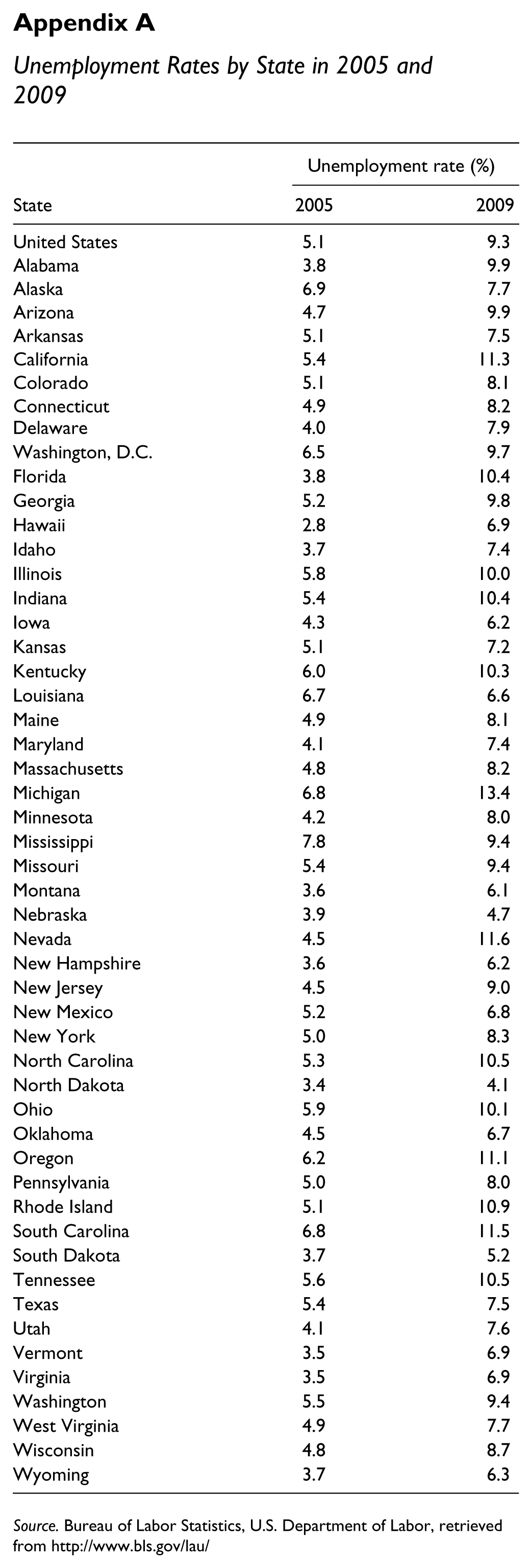
Source. Bureau of Labor Statistics, U.S. Department of Labor, retrieved from http://www.bls.gov/lau/
Authors’ Note
The contents of this article do not necessarily represent the policy of the U.S. Department of Education, and endorsement by the Federal Government should not be assumed.
Declaration of Conflicting Interests
The author(s) declared no potential conflicts of interest with respect to the research, authorship, and/or publication of this article.
Funding
The author(s) disclosed receipt of the following financial support for the research, authorship, and/or publication of this article: The contents of this article were developed with support through the Rehabilitation Research and Training Center on Effective Vocational Rehabilitation Service Delivery Practices established at both the University of Wisconsin–Madison and the University of Wisconsin–Stout under a grant from the Department of Education, National Institute on Disability and Rehabilitation Research (NIDRR) Grant PR# H133B100034.