



Abstract
The purpose of this study is twofold: (a) to examine the relationship between individual factors and rehabilitation outcomes of transition youth with disabilities receiving state vocational rehabilitation services and (b) to determine the contextual effects of state unemployment rate on the employment outcomes of transition youth and its potential interactions with personal and service factors. Hierarchical generalized linear modeling was used to analyze Rehabilitation Services Administration Case Service Report (RSA-911) data for fiscal year 2013. Results show that state unemployment rates were found to moderate the relationships between some demographic and service variables and successful competitive employment. These results indicate the importance of contextual variables, such as state unemployment rates, and their impact on the predictive strength of specific personal and service variables on employment outcomes of youth with disabilities. Implications for vocational rehabilitation services and policy, and future research are discussed.
Keywords
Work has been the central activity in all human societies. The significance of work stems from being the foundation for meeting human needs (Strauser, O’Sullivan, & Wong, 2010). According to Blustein (2008), work provides the context for individuals to fulfill three basic human needs: survival and power, social connection, and self-determination and well-being. Therefore, the activity of work has a positive effect on individuals’ physical and psychological health (Strauser et al., 2010). Work may be particularly beneficial for individuals with disabilities because they suffer greater social isolation, stigma, and financial burdens when compared with people without disabilities (Blustein, 2008). The work activities can help people with disabilities overcome these negative experiences by providing them with opportunities for security (e.g., food, safety), social belonging and intimacy, personal esteem, purpose, and personal growth (Lent & Brown, 2013).
Unfortunately, the benefits of employment do not accrue to the majority of people with disabilities. Recent data from the Bureau of Labor Statistics (2011) show that among working-age individuals with disabilities, labor participation rate is 34.0%, while the rate for individuals without disabilities is 74.0%. Focusing on youth with disabilities, 23% of youth with disabilities participate in the labor force compared with 35% of those without disabilities. As these youths age, the disparities increase. For example, 45% of young adults with disabilities ages 20 to 24 participate in the labor force compared with 72% of young adults without disabilities (Bureau of Labor Statistics, 2011).
In 1973, the Rehabilitation Act was passed with the goal of providing people with disabilities with opportunities to obtain employment and achieve self-sufficiency as the general population. Under this law, federal funding is provided to state vocational rehabilitation (VR) agencies to assist people with disabilities to find or maintain employment in the community through appropriate services. Services may include but are not limited to assessment, career guidance and counseling, university training, on-the-job training, job coaching, job placement services, and transportation (Rehabilitation Service Administration [RSA], 2008). Several research studies have documented the significant role of the state–federal VR program in helping individuals with disabilities achieve their employment goals (e.g., Bolton, Bellini, & Brookings, 2000; F. Chan, Cheing, Chan, Rosenthal, & Chronister, 2006; Dutta, Gervey, Chan, Chou, & Ditchman, 2008; Gamble & Moore, 2003). After receiving VR services, the employment rates of people with disabilities are consistently found to be around 60% (Rosenthal, Chan, Wong, Kundu, & Dutta, 2006). However, variation in successful employment outcomes rates has been observed by types of services provided to consumers and their personal characteristics (Ditchman et al., 2014).
The relationship between specific VR services provided to consumers and employment outcomes has been supported in the rehabilitation literature. Moore, Feist-Price, and Alston (2002), for example, studied adults with intellectual disabilities in the VR system. They found that job placement was the main predictor of VR successful employment. In another study conducted by Bolton et al. (2000), job placement and training services were reported as predictors of successful outcomes for VR consumers. Rosenthal, Dalton, and Gervey (2007) investigated people with psychiatric disabilities in the VR system. They found that consumers in this population who received job placement and counseling services were more likely to be closed successfully in employment. For individuals with intellectual and co-occurring psychiatric disabilities, Austin and Lee (2014) found that job-related VR services such as job placement, job search, job readiness, and on-the-job supports were significant predictors of successful competitive employment outcomes.
In addition to services delivered, many studies investigated personal characteristics of individuals with disabilities receiving services from state VR agencies. For example, studies on adults with disabilities found that African Americans were the least likely to be competitively employed at the termination of services (Olney & Kennedy, 2002; Patterson, Allen, Parnell, Crawford, & Beardall, 2000). In another study, African American and Native American consumers were found to be less likely to achieve successful employment than their European American counterparts (J. Y. Chan et al., 2014). In this study, race as a confounding variable appeared to interact with other personal characteristics and employment outcomes. The researchers found that Native Americans with severe psychiatric disabilities and low education who were receiving public cash and medical benefits generally were less likely to be employed. Studies that focused on transition-age youth in state VR programs reported that transition youth with specific learning disabilities and transition male consumers were more likely to be competitively employed (Rabren, Dunn, & Chambers, 2002; Rabren, Hall, & Brown, 2003).
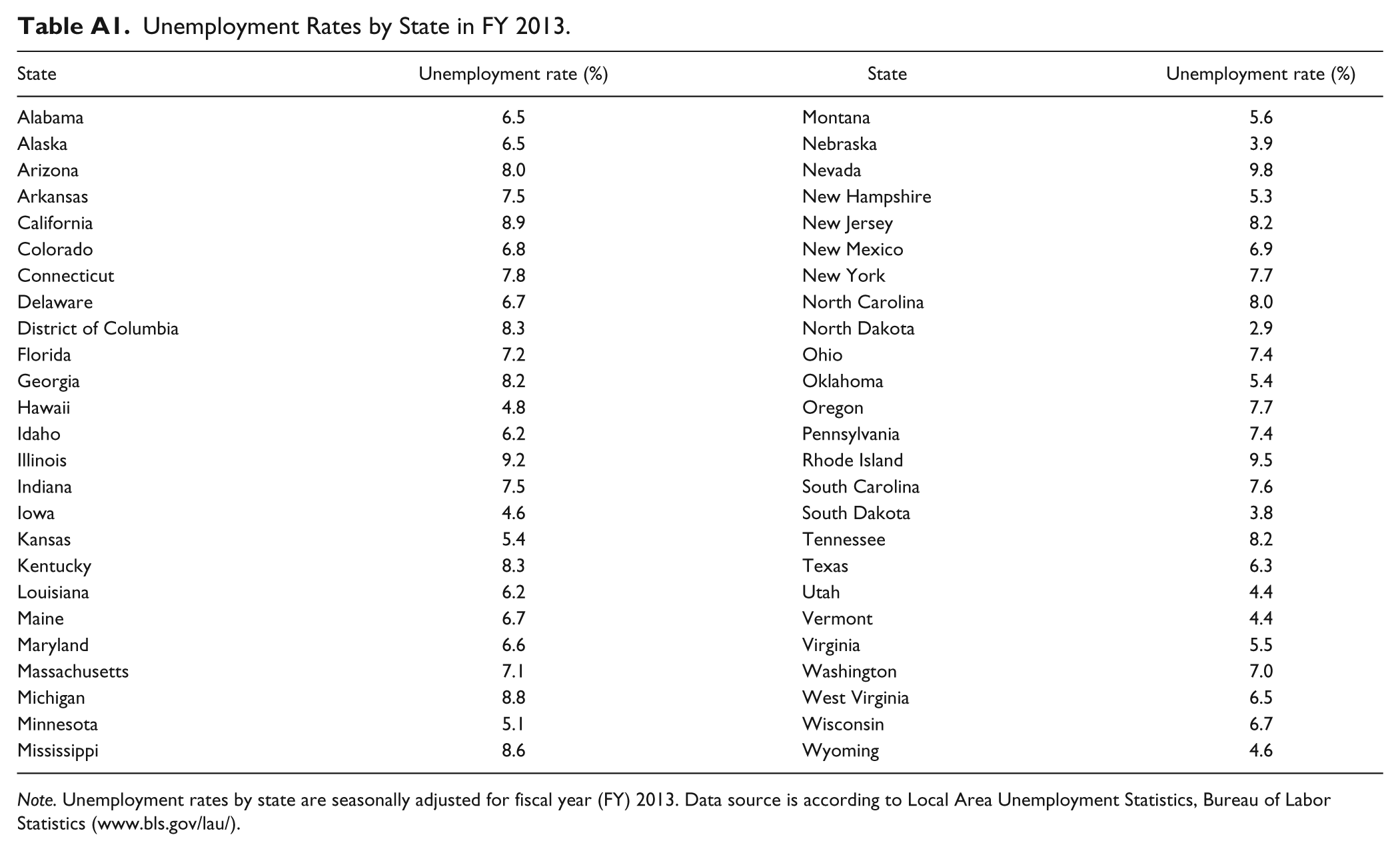
Some studies have examined environmental factors rather than individual characteristics and found that economic, demographic, and agency factors (e.g., unemployment rate, state per capita income, population size) were important in accounting for state agency differences in employment outcomes (J. Y. Chan et al., 2014; Giesen & Cavenaugh, 2013). One of the environmental factors that have been examined by these studies is state unemployment rate. This variable represented accountability in terms of a state’s overall economic condition, shaping a business environment that directly affects consumers’ earnings (Yamamoto & Alverson, 2013). There has been considerable variability in unemployment rates by state and across time periods. According to the Bureau of Labor Statistics (2014; see Table A1 in Appendix A and Figure A1 in Appendix B), state unemployment rates for 2013 ranged from a low of 2.9% in North Dakota to as high as 9.8% in Nevada. Unemployment rates play an important role in labor market conditions; therefore, it has a significant effect on employment outcomes.
Misra and Tseng (1986) conducted a study to examine the relationship between national unemployment rates and employment outcomes from 1945 to 1981. The results of the study indicated a significant correlation between national unemployment rates and employment outcomes especially when unemployment rates were higher than 5.5% over a prolonged period of time. Cook and colleagues (2006) conducted a longitudinal, multisite randomized study on the effect of local unemployment rates on employment outcomes for people with psychiatric disabilities. They found that local unemployment rates had a significant effect on competitive employment. Participants in their study who lived in counties with high unemployment rates had poorer employment outcomes than those who lived in counties with relatively low unemployment rates.
Giesen and Cavenaugh (2013) conducted descriptive and multilevel analyses to determine which client and state or agency factors predicted competitive employment for VR clients with visual impairments who received Social Security Disability Insurance (SSDI). The researchers found a significant relationship between unemployment rate and competitive employment. Specifically, an increased state unemployment rate made it less likely for participants to achieve competitive employment. J. Y. Chan and colleagues (2014) examined the effect of state unemployment rate and its interaction with personal factors influencing the employment outcomes of people with disabilities receiving state VR services. The results indicated that state unemployment rates moderated the relationships between some demographic variables and successful competitive employment VR case closure.
As demonstrated in research already discussed, environmental factors such as state unemployment rates, as well as individual-level factors such as demographic characteristics, types of disabilities, and service types have significant effects on the employment outcomes of VR consumers. Thus, it is essential to examine all these factors together by investigating individual-level factors and the possible interactions with state unemployment rate to find their collective effect on employment outcomes of VR consumers. Such examinations can help develop better plans when working with individuals with disabilities on successful employment outcomes. Because individuals with disabilities comprise a heterogeneous group of people, in terms of age, type of disability in addition to other demographic factors such as gender, and ethnicity, it is also essential to conduct research studies that specifically address the issues of each group in the VR system. One of the important groups that deserve attention is transition-age youth with disabilities. Transition youth receive employment services prior to leaving high school. The school-based services they receive and their experiences in the VR program make them a uniquely different population (Rabren et al., 2002). However, there is still little research that discusses this population and examines the factors that affect their VR employment outcomes.
The purpose of this study was to examine the relationship between individual and VR service factors and employment status of transition youth with disabilities who participated in the VR program. In addition, effects of state unemployment rates on the relationships between specific individual characteristics and services received, and employment outcomes were examined.
Method
Data Collection
The U.S. Department of Education, Rehabilitation Services Administration Case Service Report (RSA-911) data were used for this study. The RSA-911 data set provides demographic, socioeconomic, and disability status information at the time of referral for VR, as well as service and outcome information for all cases closed during the course of a fiscal year. The fiscal year data for 2013 were used to conduct this study. Cases used in this study included all VR clients who (a) were between the ages of 16 and 25 at time of application for VR services, (b) received services in the nonblind state–federal VR programs in any of the 50 states and Washington, D.C., (c) obtained successful or unsuccessful closure after receipt of VR services for the fiscal year 2013 (successful closure status in this study includes only employment in a competitive job), and (d) had records with no missing data for all variables of interest in this study.
Outcome Variable
The outcome variable used in this study was competitive employment at closure. For the purpose of this study, the outcome was a nominal, dichotomous variable. The dichotomous indicator of competitive employment was coded 1 for a competitive employment outcome and 0 for a noncompetitive employment outcome or an unsuccessful closure after VR services. Competitive employment included employment in an integrated setting, self-employment, Business Enterprise Program employment, and supported employment in an integrated setting that was full- or part-time and that was compensated at the maximum of the state or federal minimum wage (RSA, 2008). Noncompetitive employment included individuals who worked as homemakers, unpaid family workers, or when the job they held did not meet the income criterion. Unsuccessful closures included individuals whose cases were closed and who exited without employment outcomes after VR services.
Level 1 (Individual) Variables
Individual-level variables included such demographic characteristics as gender (with male coded as 1 and female coded as 0), minority (with minority coded as 1 and nonminority coded as 0), and primary disability type (physical, sensory, learning, attention-deficit/hyperactivity disorder [ADHD], intellectual and traumatic brain injury [TBI], autism and other communicative, or psychiatric and substance abuse [SA]). Disability variables were dummy-coded using physical disability as the reference group. Other individual characteristics included age at application, education level at closure, and public cash support received at closure. Note that age, education, and the amounts of public cash support from all sources were included as continuous variables. Public cash benefits included Supplemental Security Income (SSI), SSDI, Temporary Assistance for Needy Families (TANF), state or local general assistance, veterans’ disability benefits, workers’ compensation, and other public financial benefits (RSA, 2008).
Three VR services included in analysis were College/University Training (all academic training beyond secondary education including university courses conducted by university, college, or junior college), Job Search (services that include sufficient information provided to the individual services to permit or arrange for a job interview with a potential employer), and Job Placement (services provided when the consumer is referred to and hired by an employer). Services were coded as dichotomous and showed only whether such services were provided. The last variable included in analysis was Case Costs (costs of all services consumer received through the VR program). Case Costs variable was included as a continuous one.
Level 2 (Environmental) Variables
The lone environmental variable was each state’s unemployment rate. It refers to percentage of persons (aged 16 years or older) unemployed in each state. This variable was used as environmental indicator of the labor conditions that affect the employment outcomes of VR consumers (Yamamoto & Alverson, 2013). The state unemployment rates (see Table A1 in Appendix A and Figure A1 in Appendix B) were obtained from the U.S. Department of Labor’s Bureau of Labor Statistics (http://www.bls.gov/lau/).
Data Analysis
In this study, there were predictors at both individual and state levels, and the criterion measure (competitive employment) was dichotomous. Therefore, a two-level Hierarchical Generalized Linear Model (HGLM) was employed to examine the relationships with a nested structure of data. Analyses were conducted using Mixed Models in IBM SPSS 22 (Heck, Thomas, & Tabata, 2012; Raudenbush, Bryk, & Congdon, 2010). Parameter estimates were based on the method of Restricted Maximum Likelihood Estimation. Three models were hierarchically examined as follows (i.e., Model 1 ⊂ Model 2 ⊂ Model 3):
Model 1 (unconditional model)
This model has a simple hierarchical structure (empty model with no predictors) that included only state code and employment status. This model was used to estimate the proportion of variance in employment status that can be explained only by the state (environmental) level—that is, variation of between-state differences in outcomes.
Model 2 (conditional model with Level 1 predictors)
All Level 1 variables (individual characteristics and services) were added to Model 1 to examine the relationship between personal factors (demographics and VR service-related variables) and employment status.
Model 3 (conditional model with Levels 1 and 2 predictors)
The Level 2 variable of state unemployment rates was added to Model 2 to examine whether the state unemployment rate has an indirect effect on the relationships between personal factors (demographics and VR services) and employment status. Note that the Level 2 predictor was grand-mean centered by empirical grand average of 7.2267% for easier interpretation of coefficient estimates (Enders & Tofighi, 2007). See Figure B1 in Appendix B for graphical descriptions of HGLMs.
Results
Considering the inclusion criteria, the total number of cases included in this study was 122,703. Descriptive data focusing on the demographics and types of disability for those included in the study, as well as VR service characteristics, are presented in Table 1. As shown, males comprised the majority of participants, 60.3% versus 39.7% females. Nearly 61.0% of these participants were nonminority (White) versus 39.0% minority. Individuals with learning disabilities represented 30.1% of the sample, 54.8% of participants had either high school degree or special education certificate of completion, 39.0% of participants received job placement services, and 30.4% received job search services. As for the Level 2 variable, the adjusted state unemployment rates ranged from 2.9% to 9.8% (where the U.S. average was 7.3%).
Individual Demographic Characteristics and VR Services Among Youth.

Note. Successful closure (%) is based on those who had received VR services. VR = vocational rehabilitation; ADHD = attention-deficit/hyperactivity disorder; TBI = traumatic brain injury; SA = substance abuse.
Between-State Environmental Variation
According to the results of Model 1, youth’s employment outcomes differed much across states, ranging from 23% in Louisiana to 76% in Delaware. The overall successful outcome rate was about 0.53 (SE = 0.07, p = .052). This result implies that 53% of youth populations across states reached competitive employment, while the estimated variance of Level 2 residuals was 0.19 (z = 4.890, p < .001). The intraclass correlation coefficient (ICC) was calculated to be .055 using the formula provided by Hox (2010), where ICC = .19 / [0.19 + π2 / 3]. As shown, only 5.5% of the variance in employment status could be explained by the between-state level, which implies that the unconditional model could not gauge the magnitude of variation between states in employment—that is, predictors at person or environment level might need to be added to account for variation in outcomes.
Associations Between Predictors and Employment Status
In Model 2, all Level 1 variables for individual factors (i.e., personal demographics and service-related variables) were included in the study. The results indicated that 70% of variance was explained by all Level 1 predictors. The results also showed that Level 1 predictors were all significant with the only exception of psychiatric disability and SA (see Table 2). According to the results of the model, male participants exhibited employment odds of 1.23 times greater than females. Minority participants were 0.88 times as likely to achieve successful employment compared with White participants. Moreover, the odds of obtaining employment for youth with learning disabilities were 1.64 times greater than their peers with physical disabilities. Youth participants with higher education levels generally had higher odds of being employed with a competitive job after receiving VR services than those with lower education levels. However, age, the amount of public support, and cost of VR services had only a small effect size, meaning that the subgroup differences were minor. Note that each of the estimated personal and service effects here were shown by controlling for the confounding effects of all the other Level 1 variables.
Odds Ratio for Successful Employment Outcomes by Personal and Service Factors in Model 2.

Note. CI = confidence interval; ADHD = attention-deficit/hyperactivity disorder; TBI = traumatic brain injury; SA = substance abuse.
***p < .001.
The results also indicated that VR services had different impacts on the competitive employment outcomes of youth with disabilities. Specifically, youth who received college or university training service through VR were 0.82 times as likely to achieve successful employment compared with those who did not receive the service. In contrast, youth who received job search and job placement services provided through VR were, respectively, 1.68 and 3.37 times more likely to achieve successful employment than those who did not receive these services.
Interactions Between Predictors and Unemployment Rates
In Model 3, the grand-mean-centered state unemployment rate was added at Level 2 to examine its moderating impact on the relationships between individual factors (personal and service variables) and employment outcomes. The results showed that state unemployment rate explained 7.8% of variance in employment outcomes. Note that the variance-explained statistics from Models 1 to 3 suggested that the majority of variation in outcomes was associated with Level 1 predictors (i.e., personal characteristics and service factors), while only a small portion of the variation was linked with the between-state level and the contextual variable (i.e., state unemployment rate). According to the results, state unemployment rates confounded with the Level 1 personal and service predictors. Specifically, when state unemployment rates were centered at 7.3% (about the U.S. average), the odds of outcomes were significant with all the Level 1 predictors except for psychiatric disability and SA, and the result of individual effects were all very close to that measured by Model 2 (see Tables 2 and 3). For example, males were 24% more likely to gain employment than females, minority had 12% less chances of being employed than nonminority, and youth with learning disabilities were about 64% more likely to be employed than those with physical disability; education would still help improve outcome, even though there was a high unemployment rate (e.g., 7.3%). The effects of other personal factors such as age, public support, and service cost, remained tiny. The results also indicated that the effective VR services were job placement and job search.
Parameters of Multilevel Analysis in Model 3.

Note. ADHD = attention-deficit/hyperactivity disorder; TBI = traumatic brain injury; SA = substance abuse.
***p < .001.
Furthermore, the centered state unemployment rates could moderate the odds of employment with these Level 1 predictors: age, education, intellectual disability and TBI, autism and other communicative disabilities, cost of services, public support amount, and the receipt of job search and job placement services (see Table 3). As the state unemployment rates increased (e.g., 1% above the U.S. average), the disparities decreased by 7% of average odds in successful competitive employment outcomes between youth with intellectual disabilities and TBI (favored) or autism and other communicative disabilities (favored), and those with physical disabilities (disfavored); and there was a reduction of 6% in the odds between youth with higher education levels (favored) and those with lower education levels (disfavored). However, for every 1% increase in unemployment rates, the disparities in the odds of successful employment increased by 1% between youth with older age (favored) and those with younger age (disfavored), and there were 4% and 3% increments in the difference of employment opportunities between the recipients (favored) and nonrecipients (disfavored) of job search and job placement services, respectively, when state unemployment rates increased by 1% from the average. For the amounts of public support and VR services costs, the small moderating effect size of state unemployment rates suggested a negligible impact of their interactions on employment outcome.
Discussion
The goal of this study was to examine the effects of individual-level variables on employment outcomes of youth with disabilities. In addition, the effect of state-level economic conditions on youth’s employment outcomes was addressed. Specifically, the study used HGLM analyses to investigate the impact of state unemployment rates on the relationship between personal characteristics and VR services, and employment outcomes of youth with disabilities in the VR program. The results of the study illustrate the importance of considering multiple factors when examining employment outcomes. The major findings of this study are listed as follows.
First, the results of the study emphasize the indirect effect of state unemployment rates on VR consumers’ opportunities of achieving competitive employment. As indicated by the study, the higher the state unemployment rates, the lower the chances for youth with disabilities to achieve competitive employment. These results were consistent with previous research that showed that an increased state unemployment rate hindered the likelihood of competitive employment for VR consumers (J. Y. Chan et al., 2014; Cook et al., 2006; Giesen & Cavenaugh, 2013; Misra & Tseng, 1986). These findings highlight the importance of addressing such contextual variables as state unemployment rate when studying predictors of employment outcomes of people with disabilities.
Second, the state unemployment rates appeared to have an effect on the relationship between personal and service factors and VR employment outcomes. For example, the results showed that as the state unemployment rates increased, the disparities in relative odds of successful VR closure decreased between youth with intellectual disabilities and TBI (favored) or youth with autism and other communicative disabilities (favored), and youth with physical disabilities (disfavored). Also, as the state unemployment rates increased, the disparities in relative odds of successful VR closure decreased between youth with higher education levels (favored) and those with lower levels (disfavored). These findings suggest that the advantage of youth with intellectual and TBI, or youth with autism and other communicative disabilities, and of youth with higher education levels, over their corresponding counterpart diminished, as states had higher unemployment rates (i.e., above the national average). In contrast, the disparities in successful employment increased between youth with older age (favored) and those with younger age (disfavored), and between the recipients (favored) and nonrecipients (disfavored) of job search and job placement services when state unemployment rates increased. This suggests that when states’ unemployment rates rose, youth with younger age and those who did not receive job search or job placement services tended to face poorer odds of employment outcomes.
Third, the findings highlight the different effects of state unemployment rates on the VR outcomes of youth with different types of disabilities. As indicated by the results, youth with intellectual disabilities and TBI or youth with autism and other communicative disabilities have better opportunities to achieve successful employment outcomes when state economy is good; however, they have fewer opportunities in a poor economy. These results were consistent with the findings of J. Y. Chan et al. (2014) that indicated that people with intellectual disabilities have a better chance of obtaining employment in a stable economy. Chan and colleagues attributed these results to the role of employers who might be more willing to hire people with significant disabilities only when the economic conditions are good. According to Cook and colleagues (2006), individuals with significant disabilities or cognitive impairments rely heavily on supported employment. In states with higher unemployment rates, VR practitioners’ efforts to develop supported employment opportunities with employers may be impeded (J. Y. Chan et al., 2014). This may help explain why the opportunities of youth with intellectual disabilities and TBI or youth with autism and other communicative disabilities (compared with youth with physical disabilities) to achieve successful employment outcomes diminish in states with higher unemployment rates.
Finally, the study indicated that receiving job search and job placement services was associated with successful outcomes for youth with disabilities. This finding was consistent with that of Hennessey and Muller (1995), and Rogers, Bishop, and Crystal (2005), which found that job search and job placement services increase the likelihood of employment for consumers with disabilities. By exploring the effect of state unemployment rate on the relationship between service factors and employment outcomes, the findings emphasized the importance of job search and job placement services for youth with disabilities. This study demonstrated the effectiveness of such services in enhancing the opportunities for youth with disabilities to get competitive employment despite poor labor market conditions. This evidence is an important finding that supports previous studies about the impact of such services on employment outcomes of youth with disabilities. More importantly, this evidence provides new knowledge about how the job-related services may increase transition youth’s opportunities to achieve successful employment outcomes in a weak economy.
Limitations and Future Research
The current study demonstrates the importance of considering individual-level characteristics and VR services when evaluating the predictors of successful employment outcomes for transition-age youth with disabilities. In addition, this study highlights the impact of state unemployment rates on employment outcomes of youth in VR. However, the study has some limitations that should be noted. First, the study analyzed only the fiscal year data for 2013. With only 1 year of data, the results may be short-lived, especially given the current dramatic changes in global, national, and state economies. Therefore, further examination using different fiscal year or multiple-year data is needed to study whether the reported results indicate a stable pattern for capturing the dynamic interaction between state unemployment rates, personal characteristics and VR services, and employment outcomes (Yamamoto & Alverson, 2013).
Second, this study did not examine the effects of state employment rates on employment outcomes with VR clients with multiple disabilities. The study focused on the type of the primary disability clients have as it is the main disability that affects employment outcomes. RSA (2008) defined the primary disability as the main “impairment that causes or results in a substantial impediment to employment.” (p. 16) Secondary disability is defined as the “impairment that contributes to, but is not the primary basis of, the impediment to employment” (p. 17). However, the influence of secondary or multiple disabilities is still worth of investigation; therefore, further research studies may choose to include a variable for multiple disabilities or secondary disability to investigate its effect on employment outcomes.
Third, this study could not examine such individual-level characteristics of transition-age youth as self-determination, motivation, family income, living arrangement, and participation in other federal and nonfederal programs. These variables may potentially influence employment outcomes of youth with disabilities (Rogers et al., 2005; Wittenburg & Loprest, 2007). More research is needed to understand the effect of these variables and their relationship to the impact of state unemployment rates on youth’s employment outcomes. This might help develop evidence-based interventions to improve the VR outcomes of transition youth with disabilities.
Fourth, this study did not examine the long-term employment outcomes of youth in VR. Employment is a developmental process that cannot be understood adequately and analyzed by research in the time frame of a typical VR case, approximately 90 days of stable employment leading to closure (Yamamoto & Alverson, 2013). To examine indicators of successful employment, researchers need to consider long-term employment outcomes, and thus employment should be studied with longitudinal empirical-research designs. Longitudinal investigations can report more concrete results related to the association of state unemployment rates and personal characteristics and VR services, with employment outcomes. Findings from longitudinal studies can be useful in developing effective interventions for enhancing employment outcomes of youth with disabilities (Carter, Austin, & Trainor, 2012).
Implications for Practice and Policy
The findings of the study have several implications for VR practice and policy. First, VR policymakers and practitioners need to consider the effect of changes in unemployment rates on specific disability groups such as youth with intellectual disabilities or TBI. For VR practitioners, it is crucial to understand how the changes of economic conditions affect specific groups of VR consumers, so that VR professionals are able to develop strategies and services that enhance the employment outcomes of the groups who are particularly vulnerable to those economic changes in labor market, especially in bad economy situations.
Second, VR practitioners need to pay attention to the role that particular services play in promoting successful outcomes for youth with disabilities under certain labor market conditions. According to the results of the study, emphasis should be placed on job search and job placement related services. These services were found to be important predictors of competitive employment for youths with disabilities. In particular, these services were found to remain effective in promoting successful employment outcomes for youth with disabilities even during weak economy times.
Finally, it is imperative for VR practitioners and policymakers to conduct more research studies using the RSA data to investigate effectiveness of the services provided for VR consumers. The results of these studies can be used to support the decisions about resource allocation, policy development, and services evaluations. It is equally important to recognize the impact of the economic conditions on VR employment outcomes when evaluating the effects of policies or service interventions. Specifically, VR practitioners and policymakers should take into consideration the impact of state unemployment rates along with other economic factors that may affect employment outcomes.
Conclusion
The results of the study provide evidence about the significant factors (personal characteristics and VR services) that may predict successful competitive employment outcomes for youth with disabilities. In addition, the findings of the study suggest that the state unemployment rates have significant effect on employment outcomes for youth with disabilities. As indicated by the study, state unemployment rates moderated the relationship between personal and service factors and VR employment outcomes. With higher unemployment rates, VR policymakers and practitioners need to exert more efforts to support disadvantaged and at-risk groups of youth with disabilities. Implementing creative and effective strategies is always essential to address the disparities in employment opportunities and outcomes among certain vulnerable groups of youth with disabilities.
Footnotes
Appendix A
Unemployment Rates by State in FY 2013.
| State | Unemployment rate (%) | State | Unemployment rate (%) |
|---|---|---|---|
| Alabama | 6.5 | Montana | 5.6 |
| Alaska | 6.5 | Nebraska | 3.9 |
| Arizona | 8.0 | Nevada | 9.8 |
| Arkansas | 7.5 | New Hampshire | 5.3 |
| California | 8.9 | New Jersey | 8.2 |
| Colorado | 6.8 | New Mexico | 6.9 |
| Connecticut | 7.8 | New York | 7.7 |
| Delaware | 6.7 | North Carolina | 8.0 |
| District of Columbia | 8.3 | North Dakota | 2.9 |
| Florida | 7.2 | Ohio | 7.4 |
| Georgia | 8.2 | Oklahoma | 5.4 |
| Hawaii | 4.8 | Oregon | 7.7 |
| Idaho | 6.2 | Pennsylvania | 7.4 |
| Illinois | 9.2 | Rhode Island | 9.5 |
| Indiana | 7.5 | South Carolina | 7.6 |
| Iowa | 4.6 | South Dakota | 3.8 |
| Kansas | 5.4 | Tennessee | 8.2 |
| Kentucky | 8.3 | Texas | 6.3 |
| Louisiana | 6.2 | Utah | 4.4 |
| Maine | 6.7 | Vermont | 4.4 |
| Maryland | 6.6 | Virginia | 5.5 |
| Massachusetts | 7.1 | Washington | 7.0 |
| Michigan | 8.8 | West Virginia | 6.5 |
| Minnesota | 5.1 | Wisconsin | 6.7 |
| Mississippi | 8.6 | Wyoming | 4.6 |
Note. Unemployment rates by state are seasonally adjusted for fiscal year (FY) 2013. Data source is according to Local Area Unemployment Statistics, Bureau of Labor Statistics (www.bls.gov/lau/).
Appendix B
Acknowledgements
The authors would like to thank Dr. Sukyeong Pi, the director of Project Excellence, Rehabilitation Counseling Program, Department of Counseling, Educational Psychology and Special Education at Michigan State University for supporting this research project. The authors would also like to thank the editor and the three anonymous reviewers for their helpful comments and suggestions.
Declaration of Conflicting Interests
The author(s) declared no potential conflicts of interest with respect to the research, authorship, and/or publication of this article.
Funding
The author(s) received no financial support for the research, authorship, and/or publication of this article.