



Abstract
A modified consensual qualitative research approach was taken to determine factors that influence job placement services in selected state Vocational Rehabilitation agencies. Thirty-five counselors, supervisors, and administrators participated in semistructured interviews on job placement and how they determine whether the counselor or another professional (e.g., in-house placement specialist, community rehabilitation provider) provides the direct service. Results indicated that several factors were noted by at least half of the participants, including anticipated intensity of services needed by the client, counselor caseload size/available time, existing employer relationships, availability of a placement service provider, and placement skills. Results highlight the impact of consistently high client volume on placement services, particularly for individuals with the most significant disabilities. Implications related to the current state of policy and practice for placement services, as well as potential future directions, are discussed.
The public Vocational Rehabilitation (VR) program has long been considered the most important vocational program for persons with disabilities (Saunders, 2005). In the 2011 Fiscal Year, there were 564,908 new applicants nationally, with 74% determined eligible for services (Rehabilitation Services Administration [RSA], 2011). Job placement is considered by many to be “the driving force behind the vocational rehabilitation program” (Chan, Cheing, Chung Chan, Rosenthal, & Chronister, 2006, p. 258). Research has indicated that receipt of placement services is the strongest predictor of employment outcomes (e.g., Bolton, Bellini, & Brookings, 2000; Boutin & Wilson, 2009; Chan et al., 2006; Gamble & Moore, 2003; Jung, Schaller, & Bellini, 2010; Moore, Feist-Price, & Alston, 2002; Rosenthal, Dalton, & Gervey, 2007; Wheaton & Wilson, 1996). These findings have been consistent across individuals from a variety of disability groups and racial and ethnic backgrounds.
The three most common options for providing job placement services in public VR are (a) for counselors to provide services directly, (b) to contract services to a community rehabilitation provider (CRP) outside of the agency, or (c) to delegate responsibility to an in-house placement specialist acting in a similar capacity as a CRP, but employed by the agency. Current data indicate inconsistent use of placement services in public VR (Chan et al., 2006; Gilbride, 2000; Schultz, 2008). In a sample of 288 VR counselors representing three state agencies, reported use of CRPs ranged from 0% to 100% (Schultz, 2008). Another study sampling 52 administrators representing 40 states showed use of CRPs ranging from 0% to 80% between agencies. Furthermore, these same administrators projected use of CRPs to range from 0% to 100% in the 3 to 5 years following the time they were surveyed (Gilbride, 2000). Reasons behind these inconsistencies in the use of CRPs are unknown. McMahon and Fraser’s (1978) 30-year-old observation about the use of CRPs seems equally relevant today: “At a period in this country’s rehabilitation history when demands for effective, cost-efficient services are incessant, it is difficult to explain the vast inconsistencies in use of subprofessionals . . .” (p. 31). Given the critical nature of placement services in relation to successful employment outcomes and increasing demand for effective rehabilitation counseling services, developing models to guide provision of placement services is more important than ever.
In the only study known to analyze placement provider decisions, Schultz (2008) applied the Theory of Planned Behavior to test whether personal attitudes, perceived agency attitudes, and self-efficacy in relation to provision of job placement influenced the decision of whether counselors provide placement directly or use CRPs. Perceived agency attitudes significantly predicted use of CRPs, but no counselor characteristics significantly contributed to the model, leaving approximately 80% of the variability unaccounted for. Despite having a solid theoretical grounding, these results provide insufficient information about what factors counselors consider when determining placement services. Insufficient theory or models to guide practice or research in job placement remains a problem in VR. Gilbride, Stensrud, and Johnson (1994) provided some initial guidelines for provider decisions. For instance, the authors recommended that a VR counselor might consider providing job placement services directly when caseloads are small, clients live in rural areas, there are few employers in the area, and so on. The suggested guidelines likely describe some of the factors that influence provider decisions; however, no study has sought to verify the use of these guidelines with VR counselors, supervisors, or administrators. It is possible that other factors play an important role in placement provider decisions. We were unable to find any literature describing the decision to use or the effectiveness of in-house placement specialists for inclusion in this brief review.
The purpose of this project is to assess factors that influence job placement provider decisions in public VR. Based on work experience and the literature, we suspected that many potential factors could influence job placement decisions. For example, a combination of needs or preferences of the client (i.e., individual differences), the agency climate (i.e., policy, staff training), the local labor market, and counselor comfort or skill with job placement could all affect this decision to some degree. To explore this complex issue more thoroughly, we decided to interview staff with different perspectives—those making the decisions regarding services (counselors), those providing direct guidance and training (supervisors), and those creating policies and setting staff expectations (administrators). The experiences and opinions of these individuals seemed likely to uncover the range of possible influences on job placement services. Qualitative interviews were conducted with VR administrators, supervisors, and counselors. Interview data were analyzed using a consensual qualitative research (CQR) approach developed and updated by Hill and colleagues (Hill, 2012; Hill et al., 2005; Hill, Thompson, & Williams, 1997). An inductive, qualitative approach is fitting for this study given the state of the research and lack of theory addressing placement provider decisions.
Method
A modified CQR process was used in this study (CQR-M; Spangler, Liu, & Hill, 2012). CQR-M is an analysis method typically applied to larger sample sizes than would be used in traditional CQR. We proceed with a brief description of traditional CQR methods before addressing key modifications in this study due to the limited existing research using either a traditional or modified approach. CQR was selected from among available qualitative approaches because of its combination of constructivist and postpositivist underpinnings (Stahl, Taylor, & Hill, 2012), where meaning is derived from the words and context of participant interviews (primarily constructivist), but results are presented as objectively as possible by summarizing and finding themes across participants (primarily postpositivist). CQR has gained popularity in counseling and social science research as a way to explore and attempt to understand complex issues, retaining the philosophy of the qualitative approach, while addressing some of the limitations inherent in qualitative research (e.g., threats to validity from researcher bias and interpretation, lack of structured methods for coding and analysis; Hill, 2012). CQR is based largely on grounded theory (Hill, 2012). Commonalities between the two include interviewing of participants, developing core ideas and domains, and taking steps to remain faithful to the data. However, as noted by Hill (2012), CQR and grounded theory differs in that (a) CQR researchers use the same semistructured interview protocol across all participants (allowing for probing questions) while grounded theory researchers use a more unstructured interview protocol that tends to evolve with additional participants, (b) CQR uses multiple judges and auditors to analyze the data while grounded theory often uses only one judge, (c) CQR researchers quantify the representativeness of main ideas while grounded theory researchers do not attempt to specify the proportion of participants who shared an idea and, (d) the CQR method of data analysis is relatively fixed while the grounded theory method is more flexible.
CQR Stages
There are four key steps in the traditional CQR process (Hill, 2012). The first step is conducting the interview, followed by the determination of domains, core ideas, and ending with a cross analysis. The interview consists of open-ended questions that provide a framework for responses but do not limit those responses to a predetermined point of view. Follow-up questions function to encourage elaboration of ideas rather than to direct or influence the response. The goal of the interview is to capture the phenomenon with as little researcher bias as possible. The second step involves the construction of domains that are essentially a list of topics that can be used to broadly describe the participant’s experience. Core ideas are then used to summarize what was said in each of the domains. These core ideas help during the final, and most complex phase, of cross analysis that ascertains common themes across participants.
In CQR-M, the process of writing core ideas is supplanted by the identification of categories that serve to further explain the domain. Then, during cross analysis, data are coded into these categories and potential subcategories as they arise during the coding process. The final difference is that CQR-M forgoes the use of an auditor because coding is generally done in rounds with one team identifying domains and categories and a second team checking the viability of those domains and categories. This serves the same reliability function that an auditor serves in a traditional CQR approach. Use of CQR-M, as opposed to CQR, provides a more complete description of the population while still allowing the domains to emerge from the data itself so that new, and potentially unexpected, ideas are not lost. To manage the large amount of data, we identified global themes stemming from the semistructured interview. For example, one interview question targeted the importance of job placement to participants, whereas another examined the agency influence on job placement. Each of these questions represented a theme where we applied CQR-M methods to identify domains and categories within that theme. See Figure 1 below for a summary of our modified CQR process in this study.
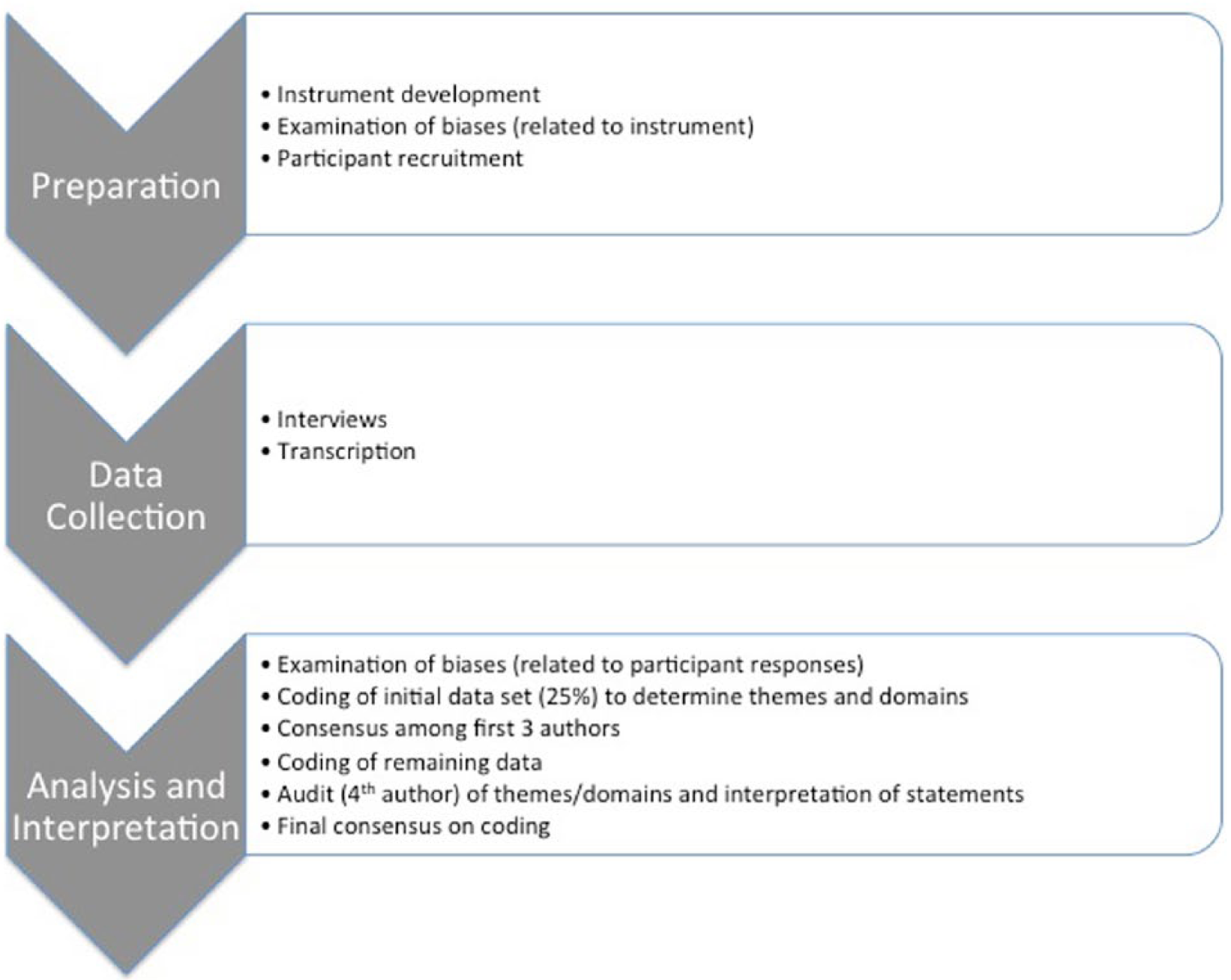
Modified CQR process.
Researchers
Allison Fleming is a 32-year-old, Caucasian female who has been a rehabilitation counselor educator and researcher for 1 year. She previously worked as a VR counselor in a Massachusetts public VR agency for 2 years. In addition, she worked for two-and-a-half years as a trainer for job developers, job coaches, and counselors in job development, employment support strategies, and other employment services. Brian Phillips is a 34-year-old, Caucasian male who has been a rehabilitation counselor educator and researcher for 2 years. He previously worked for a CRP where he provided counseling, job placement, work adjustment, and other services as a job coach and rehabilitation counselor for 5 years. Ashley Kaseroff is a 29-year-old, Caucasian female doctoral student in rehabilitation psychology. As a master’s student in counseling psychology, Ashley focused on school counseling and interned for a year at an alternative high school in which a portion of her caseload was students involved in individualized education programs. Ashley previously worked for a nonprofit organization providing supported employment and transition services for adults with disabilities. She worked as a job coach, coordinator, and job developer for 2 years. Garrett Huck is a 35-year-old Caucasian male doctoral student in the rehabilitation psychology and special education program at the University of Wisconsin–Madison. Garrett completed a practicum with a CRP and an internship with the Wisconsin public VR during his master’s degree coursework. In addition, Garrett was a Division of Vocational Rehabilitation employee for several months prior to working as a job placement provider and vocational team leader for 7 years at the Program of Assertive Community Treatment in Madison.
We, as team members, discussed biases before conducting any interviews to increase awareness and reduce undue influence of bias on data collection and analysis. In terms of biases, all four researchers reported before the study that we viewed job placement as being an important VR service, and all expected that participants would feel the same. All had reported an expectation for caseload size to have some influence on job placement provider decisions; however, expectations for what other factors may influence provider decisions were mixed. There was also some divergence in the expected interest of VR counselors for providing their own job placement, with some expecting counselors to have a preference for providing their own placement and others on the research team expecting counselors to prefer referring out.
Participants
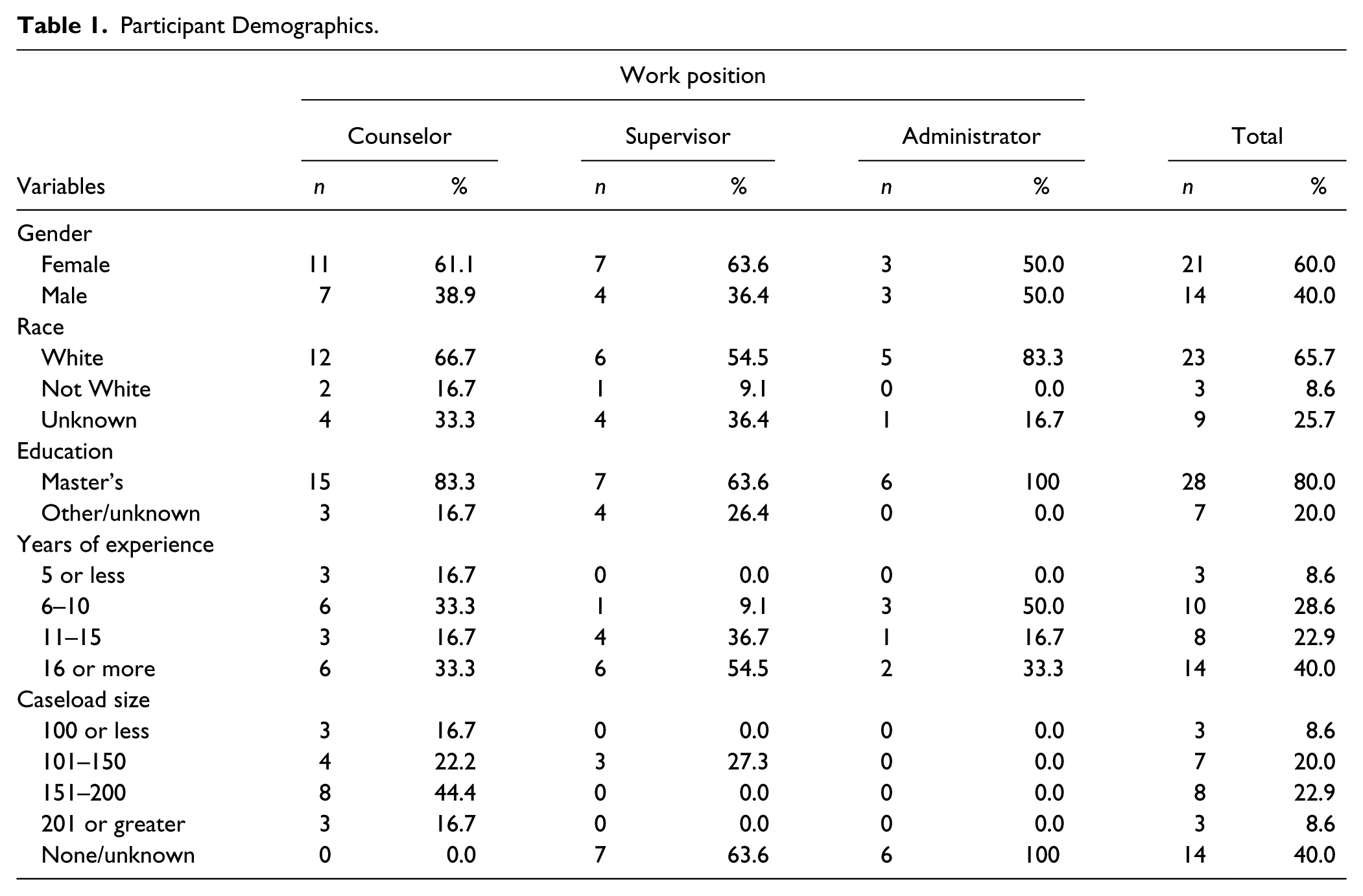
Interviews were conducted with a combination of administrators, supervisors, and counselors across state agencies that spanned 5 of the 10 RSA regions in an attempt to capture a diverse response. Participants included 6 administrators (one to two from each state), 11 supervisors (two to three from each state), and 18 rehabilitation counselors (three to four from each state), for a total of 35 participants. One interview with a job placement specialist was not included in the data analysis due to unique decision factors associated with that position. Demographic information for the total sample and for each subgroup can be found in Table 1. A general question about the use of each of the three provider options showed a diversity of practice in the use of CRPs and in-house specialists; a small number of counselors provided nearly all of their own placement services whereas the majority heavily used one or both of these other options.
Participant Demographics.
Measure
The semistructured interview was derived from a combination of the literature and personal experience of the researchers. In accordance with CQR methods, we were careful to explore their biases throughout instrument construction. Our team went through each question before collecting data and discussed their expectations of participant answers, and how they would protect against leading participants to those answers during interviews. Open-ended probes to interview questions were included, as recommended in CQR (Burkard, Knox, & Hill, 2012); however, interviewers are not limited to use the pre-developed probes alone. A key part of accurately capturing the depth of the phenomenon involves following the participant; therefore, the current protocol allows for deviations.
After asking for basic information about their roles and options for placement (“Could you describe current options that clients have for job placement services within your agency?”), the primary research question was addressed by asking for “circumstances that make it preferable to utilize one [placement option] over another.” Follow-up questions about agency influences and client characteristics ensured at least minimal coverage of these areas. The interview closed with the option to add any information about placement not addressed in the interview.
Procedure
Recruitment of participants
Recruitment began with an email or phone request to administrators requesting permission to interview individuals within the VR system. With agreement to participate, the administrator(s) was asked to recommend one administrator (either themselves or a colleague), two to three supervisors, and three to four rehabilitation counselors for interview. These people were then sent an email explaining the purpose of the study, as well as the informed consent. Those who opted to participate gave verbal consent prior to the interview. All but one of the interviews were conducted over the phone by a pair of researchers (a schedule conflicted required a single researcher to conduct the interview in one case). Use of two interviewers helped guard against interviewer bias while enriching the information through the probing from multiple perspectives.
Data preparation and coding
After the interviews were conducted, the audio recordings were placed on a secure web service. Four transcribers, approved by the Internal Review Board and overseen by one of the researchers, were given access to transcribe and de-identify nine interviews. These nine interviews, consisting of one administrator, one supervisor, and seven rehabilitation counselors, became the initial data set used to determine domains and themes by the first three authors. The remaining 26 interviews were transcribed and de-identified by a paid transcription service. Following the recommended CQR-M process (Spangler et al., 2012), coding began with the first three authors meeting as a group to gain consensus on the initial three themes: importance of placement services, agency influence on placement services, and primary factors in job placement determinations. We engaged in an iterative process to identify and extract meaningful data units (i.e., phrases, sentences, paragraphs) and create domains and categories that summarized the data. This initial coding process was followed by group meetings in which consensus was achieved between authors on the domains and categories. Coding continued with individual coding followed by group consensus until stable domains and categories had been obtained. The fourth author then served as an auditor to check the established domains and categories as well as to help code the remaining interviews. Authors then paired up to code the remaining 26 interviews into domains and categories for each theme. Coding continued to be completed individually first, then with a partner to obtain consensus. Discrepancies that could not be resolved were brought to the other pair of researchers for decision. The pairs then exchanged their coded themes for a thorough review. Last, the four researchers met to discuss coding until everyone felt the domains and categories accurately represented participants’ experience of the factors affecting provider decisions in job placement.
Results
CQR protocol was followed for translating frequency of participant comments to a standard measure of representativeness for each category in the sample. A category consisting of data from all or all but one of the participants is considered general. A category consisting of data from more than half of participants but fewer than the threshold for general (17–33 participants in this sample) is considered typical. A category consisting of data from at least 4 participants and up to half (16 in this sample) is considered variant. A category consisting of only a few (2–3 in this sample) participants is considered rare.
Participants were asked the overall and relative importance of placement services in their respective agencies prior to the interview questions analyzed using CQR. Not surprisingly, all participants reported placement services to be among the most important offered by public VR. The comment “job placement is one of the most important services we provide” typified responses. Although unanimous importance was anticipated in an agency evaluated primarily by placement outcomes, it was necessary to ensure that provider decision making in this sample was not influenced by differences in its perceived importance.
Agency Influence
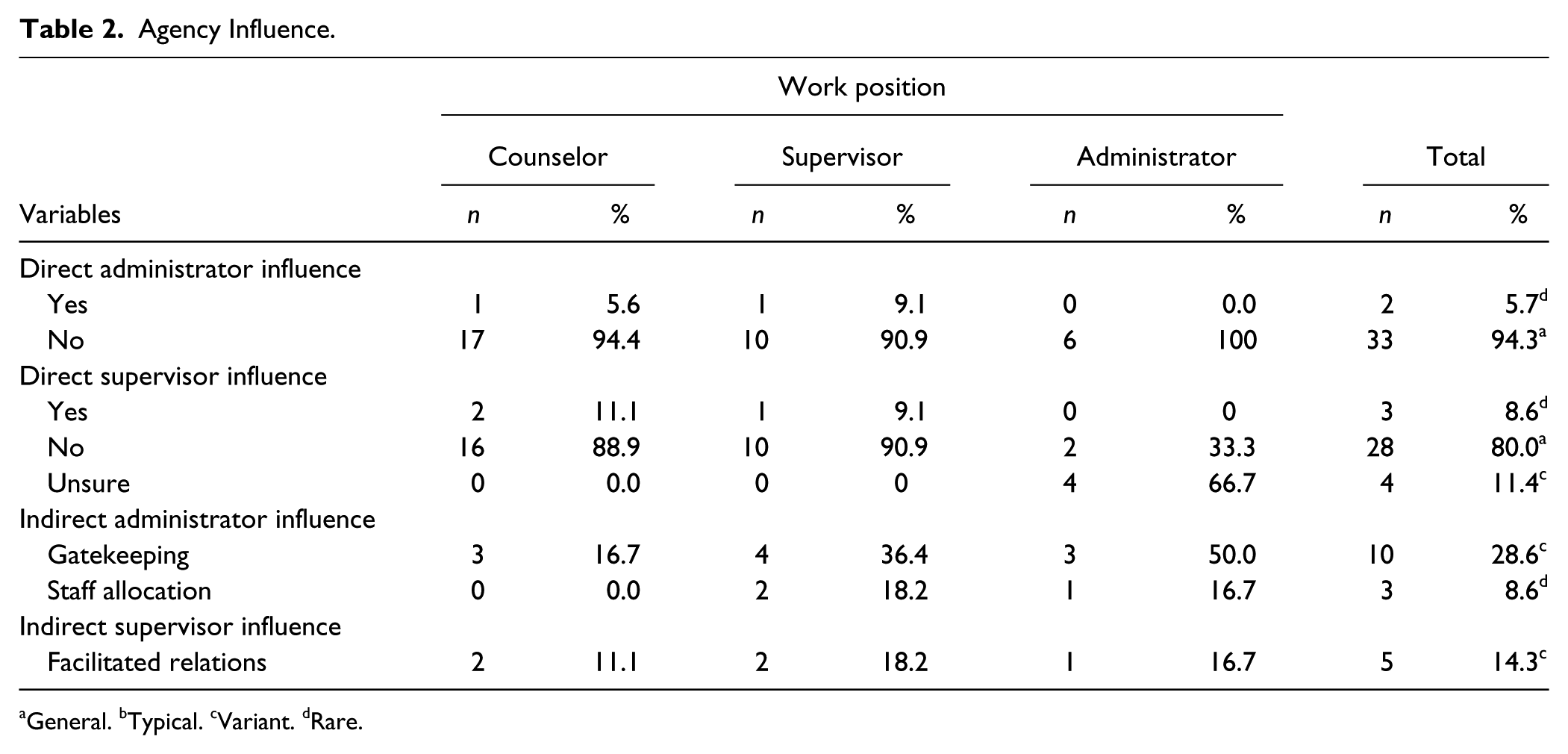
Participants were encouraged to describe any types of agency influence (formal or informal) on placement provider decisions. Two primary domains appeared across comments, direct and indirect agency influences. Direct influences only included statements about the direct, conscious influence of administrators or supervisors on placement provider decisions, whereas indirect influences included any other activity determined to influence placement decisions. Table 2 provides frequencies for all domains and categories in this theme, broken down by role of participants in the agency.
Agency Influence.
General. bTypical. cVariant. dRare.
Direct factors
Direct influence from administration or supervisor was rare among participants. The importance of professional autonomy was reflected in responses across administrators, supervisors, and counselors, as evidenced by an administrator stating, “No, I think, a lot of that is really just counselor discretion,” a supervisor stating, “No. We never really dictated those kind of things to our counselors,” and counselors stating, “No, they let us have complete independence on when and when not to use a CRP,” and, “No, that’s a professional decision.”
Indirect factors
Indirect influence categories emerging from the interviews included two related to administrators and one related to supervisor influences. These influences were, respectively, (a) CRP gatekeeping, (b) staff allocation, and (c) facilitation of counselor–CRP relationships. The gatekeeping domain referred to administrator selection of CRPs for counselor use and was variant in this sample. A representative example of this category is found in this counselor statement, “they [administrators] totally monitor and approve and authorize as far as . . . who we can work with.” Statements about staff allocation were rare, and all referenced the administrator’s positioning of in-house specialists in agencies in their respective states. The one indirect supervisory influence that emerged was the facilitation of counselor–CRP relationships. This variant category is represented by a supervisor who said this about her facilitation of monthly vendor meetings: “My goal is to really strengthen that relationship with our vendors, to iron out kinks, to celebrate successes. It’s not really a requirement but I encourage my counselors to be there, because it’s their vendors.”
In sum, it appears from this sample that counselors are left to their own discretion in making placement provider decisions within the agency, despite indirect agency influences that may shape the choice. One administrator, speaking to the existence of formal policy on provision of placement services, said, “there’s nothing in writing. In fact, in our entire policy manual, there’s not a single chapter on job placement. Which tells you—I mean it tells you something.” For better or for worse, provider decisions were predominantly left fully to the counselors.
Decision Factors in Placement Determinations
Participants identified several factors that influence counselor decisions of whether to provide placement services or refer to an in-house job placement specialist (if available) or CRP. Ten domains emerged from comments referencing placement service provision decisions. Domains, with accompanying frequencies, can be seen in Table 3, broken down by role of participants in the agency. Domains included intensity of services needed by the client (typical), caseload size/counselor time management (typical), employer relationships (typical), provider availability (typical), placement skills (typical), client relationships (variant), communication (variant), fiscal concerns (variant), disability knowledge (rare), and other (rare). The following section is a detailed presentation of the domains and categories.
Factors Influencing Placement Services.

General. bTypical. cVariant. dRare.
Intensity of services needed by the client
The largest domain was related to intensity of services. These comments indicated that placement provider decisions are heavily dependent on the amount of placement assistance the client is likely to need. Respondents noted that some services related to placement (e.g., helping with a resume) are far less time intensive than others (e.g., making contact with an employer on a client’s behalf, negotiating accommodations, providing on the job supports following a placement). The anticipated intensity and time required to provide these services were typical and reflected the vast majority of participants. One example of this domain is illustrated in this counselor’s statement: It’s a number of factors, but to what degree of help do they need, how much time commitment are we talking about? That’s the first thing. If they need not too much help, just more of guidance maybe some resume development, just some pointers on various things, you know—job placement help, then I’m probably gonna do that myself without questioning anybody about anything else.
Intensity could also be reflected in the level of perceived disability, such as with this supervisor who stated, “Definitely the significance of the disability . . . the results of the assessments will determine lots of times too, you know, what route they’re going to take with the placement for the individual.” Patterns of placement decisions based on intensity emerged from the data (i.e., if X, then placement decision Y). These patterns provide additional insights into placement decisions. The counts that follow exceed the number of participants because the 29 participants often made several comments to this end.
The general pattern reflected in participant statements was that when high intensity services are anticipated, a CRP is usually involved (typical at 22 comments). An example is found in this statement by an administrator, “we need to use a contracted provider when a consumer really needs an intensive advocacy [sic] or someone contacting employers on their behalf.” A supervisor added, If I have someone who is going to require a substantial amount of time that I don’t have to give to them, not by choice, I just don’t have the time, I’ll refer them out to the CRP for assistance with the resume building and job search, interviewing skills and all that good stuff.
A counselor also suggested this tendency, “it really depends on the individual and the level of support that they need.” Respondents also indicated that clients with fewer needs often go to the in-house person (variant at 12 comments) or stay with the counselor (variant at 15 comments). For example, a supervisor noted, “If a person can function well enough to seek work more on their own, then we [Counselors] do that.”
One administrator summed intensity decisions as follows: [t]he way we’ve always kinda trained counselors is to think about it as being a continuum, and on the low side of that continuum is a client that, you know we can provide some rudimentary VR services to and then refer them to our department of workforce services, and they can go find their own job in the job lab . . . The next kinda group is a group of clients that need a little more hands on stuff, and that’s usually where I think the counselor needs to be involved with job placement activities. But then you start getting into clientele that need a lot more intensive resume writing, interview . . . you know mock interviewing, and maybe even some guidance about how to do job search. Those are the folks that we kinda look at [in-house placement] for. And then as you continue up the continuum, eventually you get to clients who . . . really a job coach is what they . . . they need somebody not only to help with the placement, but to help them learn the job.
Caseload size and counselor time management
The second largest domain “Caseload Size/Time Management” was also typical among the sample. Respondents in this domain indicated that counselors’ caseload size and resulting restrictions in the amount of time available prevented them from providing direct job placement services, reaching out to employers, or spending time in the community. Some comments reflected a tendency to prioritize how time was spent, for example, by focusing on the counseling role and finding other ways to ensure that clients’ needs were met in other areas. Many of the respondents shared a caseload or time management strategy to demonstrate how they continued to ensure that clients had their service needs, including placement, met despite the shortage of available time to spend with clients.
Acknowledgment of problems associated with large caseload size was present at each level of VR staff that we interviewed. For example, one administrator commented, “I think with the sizes of caseloads that our counselors have, even for those who would want to do more for the job placement, the time constraints out there for them doing that, is very difficult.” Supervisors also noted that caseload size prevented counselors from getting more involved with placement. One explained, “[t]hey just don’t have the time in the day to be able to go out in the community and knock on doors and try to do some of the job placement stuff,” whereas another added, “it’s just the demands of services and the various demands and the huge caseloads make it almost impossible for counselors to do that.” Several counselors commented that they feel the pressure of serving many clients. For example, a counselor stated, “I think the counselor still has such a big caseload, that to do a lot of job placement independently with the consumer is difficult because you just don’t have the time.” Another counselor added, “It’s difficult to, you know, 40 hours a week do what we have to do here in the office and then also build relationships with community with businesses. Only so much time to do a lot of stuff.” Comments did not necessarily reflect the feeling that counselors should not be doing placement. For example, one counselor stated, “I feel like job placement is definitely a part of my job but we are slightly removed from that, and that’s because of the high caseloads.”
One supervisor observed that counselors have to be strategic in how time is spent because of high client volume, “I think that counselors do a great job with trying to identify in what they can manage and what they may get over their head, which is just a time capacity.” Some participants provided examples of areas that the counselor should be directly responsible for versus the services that could be provided by another professional through a referral. One counselor explained, [i]f I’m gonna be focusing on preparation, somebody else has to do the placement. If I focus on placement, I’m gonna have really bad placements or no placements ’cause there’s no preparation. So you have to decide, you know there has to be—there has to be one or the other.
A supervisor highlighted the importance of the counseling function, “It’s much more important that the counselors be available to counsel.” Another supervisor differentiated between the roles of the counselor as compared with CRP staff this way, “they [CRPs] are more dedicated to just doing [job placement] while the counselor might not be able to because of the workload.” Yet another supervisor provided a specific example of how spending time on intensive placement activities might negatively affect caseload management, “realistically we as counselors, we can’t be out there doing the job coaching, learning. Learning how to do a job first and then teaching the client because otherwise [we] would be neglecting the rest of our caseload.”
Of the 27 respondents who reported the limiting influence of caseload size, 15 made comments that referral was necessitated by high caseloads. Of these 15 individuals, the majority (13) specifically referenced CRP services. For example, one administrator stated, because the lack of time that counselors have to really spend with their clients, just due to the volume that they are serving, I think that right there makes it more enticing for them to do the referral to the CRP or [in-house placement specialists].
One counselor who covers several rural areas commented on how he or she uses CRPs strategically in areas where they are available: “[Referring to CRPs] frees me up for doing that work in other communities where I don’t have that support.” This comment by a counselor demonstrates how utilizing CRPs has been helpful, “all the VR offices use our vendors to help support us in the placement process. With a caseload as large as most of us have, we do rely on vendors pretty heavily.” However, not all comments indicated reliance on CRPs; for example, this counselor noted, “if I wasn’t that busy at that point in time then I probably wouldn’t even consider referring them out,” demonstrating an inclination to provide direct placement services if he or she has the time.
Existing employer relationships
Another typical domain from the participant comments referenced employer relationships. Comments included in this domain indicated that placement provider decisions were influenced by employer relationships held by the counselor—VR agency, in-house specialist, or CRP. For example, one administrator noted, “if you know in this particular town this CRP has great result with working with this particular employer and you want your consumer to get a job there then you’re going to refer to that CRP for sure.” These comments were examined further to see whether a pattern of comments would emerge related to who was thought to have the employer relationship, but there were no clear indications that any one provider was referenced at a substantially higher rate. A supervisor mentioned a particular provider, “we had one where I think he could make a couple phone calls and come up with a job. Just that he was that networked into the community.” Likewise, a counselor explained, “I have good relationship—working relationship—with the manager there. And I work to provide my more severely disabled clients’ employment there.” These comments reflect the value associated with existing relationships with employers.
Availability of a placement provider
Availability was also a typical domain for this sample. Comments that referenced limitations on decisions regarding placement due to environmental circumstances (e.g., rural areas lacking providers, offices that did not have access to an in-house placement specialist) were included in this domain. Of note, a much higher proportion of respondents from the two most rural states discussed availability as an issue in their local areas. Of the 17 comments, 13 referred to a lack of available CRPs, 3 referenced the lack of access to an in-house placement specialist, and 1 referred to not having a counselor to serve a particular area.
Like the domain related to caseload size, respondents from all levels noted that availability was limiting for some counselors when considering how to provide placement services. Rural areas were often highlighted in comments; for example, one administrator noted, “[i]n more of the rural areas, you’re going to find and in my experience, the counselors are doing more job development and more job placement just because they don’t have as many options to make the referral.” Another administrator pointed out that even though there are in-house placement specialists across the state, not all areas have access to these staff, . . . we have a portion of the eastern part of the state that we don’t have a job placement specialist and so all of those are either going to be either the counselor does it or it’s going to be a CRP.
Other respondents discussed the lack of CRPs available to provide services. One supervisor stated, “. . . honestly all of my counselors do provide some placement services. They really do. They have to because they’re all they have.” Counselors also noted a lack of available providers: In some areas we have shortages of service providers, some vendors have waiting lists, and we find that to be very problematic [and,] [i]t’s one big problem and we don’t have a lot of providers beyond us that provides placement. So that really limits what we can do with somebody.
Placement skills
Placement skills were a typical domain among respondents and included comments indicating that the choice of who will provide the placement services is related to level of placement skill. How participants expressed “placement skills” ranged from experience in a given field, knowledge of a local labor market, ability to arrange accommodation or assistive technology, or more general statements indicating that an individual possessed abilities to help clients secure employment. Respondents reflected feelings of confidence in counselor or job placement specialist skills, or, in some instances, limited experience or skill with direct placement services.
In reference to strong placement skills, there were comments highlighting the strength of both CRP staff and counselors and how confidence in placement skill influences the placement service decision. One counselor made this comment that illustrates the perceived benefit of making a referral to a particular job developer: “But [name of job developer] will get him a job. I flat guarantee it.” Other comments indicated that placement skills in general are important; for example, this supervisor noted, “It’s definitely skill level, and you know, sometimes utilizing a job placement person. If they’re highly skilled, they can get the jobs much faster than maybe you know, a counselor.” Some counselors added that they approach the decision about who might be more skilled on a case-by-case basis, “if it’s something I have more experience or if I know I have more experience in that type of field . . . then I may be more willing to [take] them on myself,” and, “If I thought I could handle it better [I would provide the placement services].”
Six individuals made comments that reflected a lack of counselor skill or experience providing placement services. Comments reflected a reliance on placement specific staff (e.g., in-house specialists or CRPs) to provide direct placement services because of a lack of perceived skill or comfort with providing direct placement services. For example, one administrator commented, “I think we have some counselors who do not know how to effectively do job placement, especially in areas of the state where we have a lot of CRP providers that do the job placement.” A supervisor discussed observations of staff and their level of comfort with the various tasks associated with job placement, “people are at different levels in terms of comfortableness for providing that.” From the counselor perspective, one respondent noted an observation of peers: I know with a lot of people I work with that’s not a comfortable thing for them to do, to do this outreach, so a lot of the coworkers I have basically are using the vendors and placement specialists to help with that.
Client relationships
A variant category referenced how the relationship with the client factored into placement decisions. Not surprisingly, three of the five respondents who made comments of this nature were counselors. Some comments reflected instances where clients who are referred to VR agencies are already working with CRPs, and because they already have that relationship, it makes sense for them to continue to work together. Other comments reflected a desire to make a good match for the client, as stated by this counselor: if I have a consumer that I feel would work best with a person like this, then I try to make that match. Either it be myself or some person, this CRP or this other CRP, then I try to make sure that they get with the person that best fits them.
Some indicated a feeling of responsibility for client success because of a particularly strong working alliance. For example, one counselor stated, if you have somebody that you have to see them succeed and you want to make sure that you’re that, wanna [sic] make sure it happens, then I’ll just take that person kind of under my wing and kinda [sic] do it myself.
Communication
Another variant category related to how communication affects the decisions regarding placement. As opposed to client relationships, administrators made a greater proportion of the comments in this domain than supervisors and counselors. Comments related to communication were made in reference to the perceived advantage associated with the in-house placement staff. Respondents indicated that the convenience of having this person within the same office or agency, as well as having shared access to the case management system, facilitated more frequent and immediate communication regarding client progress with placement. A comment that illustrates the benefit associated with communication came from this administrator: [h]aving the internal point of contact, the internal job developer specialist in your office could be an advantage because one, you might just be walking down the hall and having a quick conversation with someone. If there is some sort of an immediate need versus trying to either connect with or set up a meeting with an outside vendor. So the access, having someone right there in your office would be an advantage at times.
Fiscal concerns
A final variant category was related to the impact of fiscal concerns on placement decisions. Interesting to note is that among the five participants who indicated that they take cost into account, none of them were administrators. The comments within this domain reflected a consciousness of the cost associated with placement services and efforts to only invest service dollars when necessary. For example, one supervisor stated, “we are fiscally responsible, we pay for services that our clients need and we try to instill in that the importance of providing the service the clients need.” Fiscal responsibility often meant utilizing agency employees, including placement specialists appropriate and available. As explained by this counselor, financially, it’s less expensive for us to use the in-house person, so that saves us money. If we can use the in-house person, then we don’t pay for anything, and that really is a good thing and it’s a wonderful way to go if you feel that it’s going to work.
One decision factor comment referring to decisions based on a consideration of CRP safety was categorized as other.
Limitations
The results of this study should be considered within the context of a few limitations. First, although efforts were made to include individuals from different regions, we must acknowledge that we could not capture the intricacies of placement across all counselors and agencies. Small samples are the norm in CQR research (Knox, Schlosser, & Hill, 2012), so our sample of 35 is comparatively large, but caution should be taken in generalizing the comments from our sample to other counselors or agency staff. Our research team followed the recommended guidelines for self-identifying bias and other processes for analyzing the data objectively, including bringing in an auditor to minimize the likelihood of clear misinterpretation of comments. However, a different research team may have drawn alternative conclusions, and our backgrounds with placement services may have biased our interpretations despite our best efforts.
Our team had limited diversity in race and ethnicity, age, and years of experience, and this may have affected our interpretation. In addition, if we had utilized alternative methods of data collection in addition to interviews, we may have discovered other relevant information. Observation or other data collection efforts might have shifted a greater emphasis to the agency environment with respect to this study. Despite these limitations, we believe that our study has some important implications for rehabilitation services and future research.
Discussion
The purpose of this study was to identify factors that influenced how placement services were provided within public VR agencies. Some interesting patterns emerged in our interviews with counselors, supervisors, and administrators from five states. As participants confirmed, placement services hold an important place in the VR process. Many participants commented that placement was the reason that agencies existed, and often acknowledged that placements are how success of services is evaluated. Even given the well-known importance of placement, we also know that services are provided utilizing many different resources, including counselors, in-house placement specialists, and CRPs. These inconsistencies in who provides placement have been poorly understood in the literature. Our goal in taking this qualitative approach was to gain a better understanding of the decision process of counselors, particularly what factors seemed most important when determining how placement services should be provided. The value in doing so is to facilitate a discussion of the current state of placement services in the public agency. It is beyond the scope of the current study to determine whether these practices are effective or the “best”; however, we can proceed with an informed discussion of what current state of policy and practice means for placement services, as well as potential future directions.
Despite a diversity of backgrounds and approaches, several decision factors were typical among the sample (i.e., intensity of services, caseload size/time, employer relations, provider availability, and placement skills). Furthermore, other decision factors that could be expected to influence provider decisions were rarely mentioned among the sample (i.e., direct agency influence and disability knowledge). This combination of typical and rare decision factors provides understanding of how counselors decide whether to provide placement services or to refer.
With few exceptions, agency administrators and supervisors did not seek to directly influence counselor placement decisions. That is not to say that there is no agency influence. Results suggest that administrators and supervisors indirectly influence placement provider decisions by way of approving the CRPs counselors can choose from, by allocating limited in-house positions across offices within their state, and by facilitation of CRP–counselor relationships. These results are in harmony with those found by Schultz (2008), which suggest the presence of agency influence and a great deal of variation not captured by agency influence.
The most commonly reported influences on provider placement decisions were intensity of services and caseload size/time, with greater intensity of services and larger caseloads both typically leading to an increased use of CRPs. Although some participants spoke of high caseloads as being unwelcome influences on placement provider decisions, others did not express any concern over the influence of caseload size. In nearly all cases, it was apparent that caseload size and intensity were closely related for participants. Large caseloads were reported by many to be the catalyst for referring clients with more intense service needs. Participants explained that with all of their other responsibilities, it was not possible for them to go do the work required for job placement (e.g., building relationships with employers, locating leads, following up with clients once placed). Counselor involvement seemed particularly problematic for clients who needed assistance applying or interviewing for jobs. As we have acknowledged, it is beyond the scope of this research to provide evidence for how placement services should be provided; however, it is evident that caseload size has a major role in that debate. Thus, any administrator, supervisor, or counselor wanting to make a drastic increase in the role of VR counselors in placement services will be unlikely to achieve that goal without first addressing caseload size.
Given the consistently high client volume (RSA, 2011) across state agencies resulting in high caseloads, the status quo for placement services for many seems to be reliance on CRP partners. A great advantage to using CRPs for more intensive service needs is that it allows for a greater number of clients to be served per counselor. An area deserving consideration related to this decision factor is the overarching mission of state-federal VR services. The Rehabilitation Act of 1973, as amended, places priority on serving people with most severe disabilities. However, findings from our sample suggest that where most severe translates to most intense service needs, placement services are least likely to be provided directly by VR agency staff. This dynamic suggests an area of possible concern regarding services to people with most significant disabilities and requires greater understanding of the CRPs who are typically asked to serve most severe populations in placement and of best practices for providers generally.
Results give support for the importance of employer relations and placement skills in placement provider decisions, but without a clear consensus on which provider is most likely to be used when seeking those skills. Comments from our participants complimented many CRP staff for being “in the trenches” and out with employers, in some cases, highlighting a particular person in their area who is known for being successful in helping clients get jobs. In other interviews, counselors spoke of their own success in supporting customers find work and talked about their own connections that they had developed with employers over time. However, in some cases, participants noted that lack of involvement with placement often leads to a lack of confidence and hesitation to directly contact employers or try to network on behalf of clients. It seems, at least from the perspective of many of our participants, that “practice makes perfect” when it comes to placement services. Who was the most practiced seemed to vary in our sample.
Placement provider decisions based on intensity and caseload size are far removed from placement services based on evidence-based practices that address what specific placement services are most effective, for whom, when in the VR process, and under what circumstances (Paul, 1969). Evidence that decisions regarding placement services often come from a place of necessity due to time or lack of familiarity deserves greater attention. With agencies currently struggling to maintain funding in a tough economic climate and continued high demand for services, it is not surprising that staff report strategic approaches to managing their caseloads and ensuring that all clients get services that they need even if the agency is not providing the support directly. However, lack of open discussion about the implications of counselors and agency staff reacting to high demand (e.g., “survival mode”) does not help us to determine best practice or future directions. Even if these conditions are unavoidable or unchangeable, it is critical that we acknowledge how services might be affected. The data collected in this study provide a look at how decisions related to one service are affected by high client volume and limited counselor time; other services may be affected in different ways or not at all.
Future Research
Although data from the RSA 911 database have consistently supported placement services as a predictor of successful employment outcomes, more intervention research is needed for progress toward an evidence-based practice of placement services. The term placement services encompasses a variety of discrete tasks that contribute to helping a client obtain a job. Therefore, job placement is not a singular activity, but rather consists of a series of discrete tasks. Meaningful categorizing of these tasks is likely to provide better understanding of which placement services affect the greatest influence on placement outcomes. Of course, studies need not be limited to a measure of services. Systems must not be viewed as unalterable in the efforts to find best practices for client services. The effect of caseload size on counselor behavior has been given very little attention in the rehabilitation counseling literature. Interventions that alter caseload size, for instance, may serve as a legitimate means for altering placement services and for improving outcomes (Kierpiec, Phillips, & Kosciulek, 2010). The research from this study suggests that any intervention is likely to be influenced by caseload size and intensity of service needs.
Given the heavy use of CRPs and in-house placement specialists for placement services, where available, it would be important to know of any significant differences in outcomes between providers. Randomized controlled trials and paired comparisons are two research designs that would allow for a comparison of placement providers or interventions while accounting for individual differences. More could be done to address the question of whether the three primary placement providers obtain similar outcomes, and, where differences exist, what factors contribute to those differences.
Future research could also involve greater consideration of placement services from the perspective of CRPs and in-house placement specialists. Insights from these providers may be helpful due to their tendency to work with most severe disability populations and because of their frequent interactions with employers. We expect that a combination of quantitative and qualitative research that (a) considers the three primary placement providers, (b) specifies placement tasks being measured, and (c) accounts for possible systemic influences will move forward placement research toward development of models of job placement that could be used to improve practice.
Footnotes
Acknowledgements
The authors thank the participating agencies, including the staff who assisted with the recruitment and those who were interviewed, and greatly appreciate their time and additions to this project.
Authors’ Note
The co-first authors Fleming and Phillips contributed equally to this article.
Declaration of Conflicting Interests
The author(s) declared no potential conflicts of interest with respect to the research, authorship, and/or publication of this article.
Funding
The author(s) disclosed receipt of the following financial support for the research, authorship, and/or publication of this article: This research was funded by the Wisconsin Alumni Research Foundation at the University of Wisconsin–Madison.